















year

Connor Roberts: Wales and Burnley defender to appreciate career more after ‘draining’ year

Roberts was summoned from the bench by head coach Craig Bellamy in the 60th minute of Wales’ defeat by Romania.

The 64-cap international’s fellow substitute David Brooks levelled proceedings just three minutes after entering the pitch to cancel out Florinel Coman’s opener at Stadionul Steaua.

But Adrian Rus netted an 80th minute winner as the men in yellow clinched their first victory since football legend Gheorghe Hagi was appointed boss in April.

It means Wales are without a win in four matches in 2026 while their winless run in away friendlies was extended to 17 matches – a sequence stretching back to November 2008.

Despite the disappointing result, Roberts was delighted to be back on the pitch representing his national side once again.

“Personally for me, it’s brilliant to be back,” said the Burnley defender.

“Some people are happy that I’m back, some people not so happy, but I am back and hopefully I can keep ticking over during the summer and go again next season for club and country.”

Source link

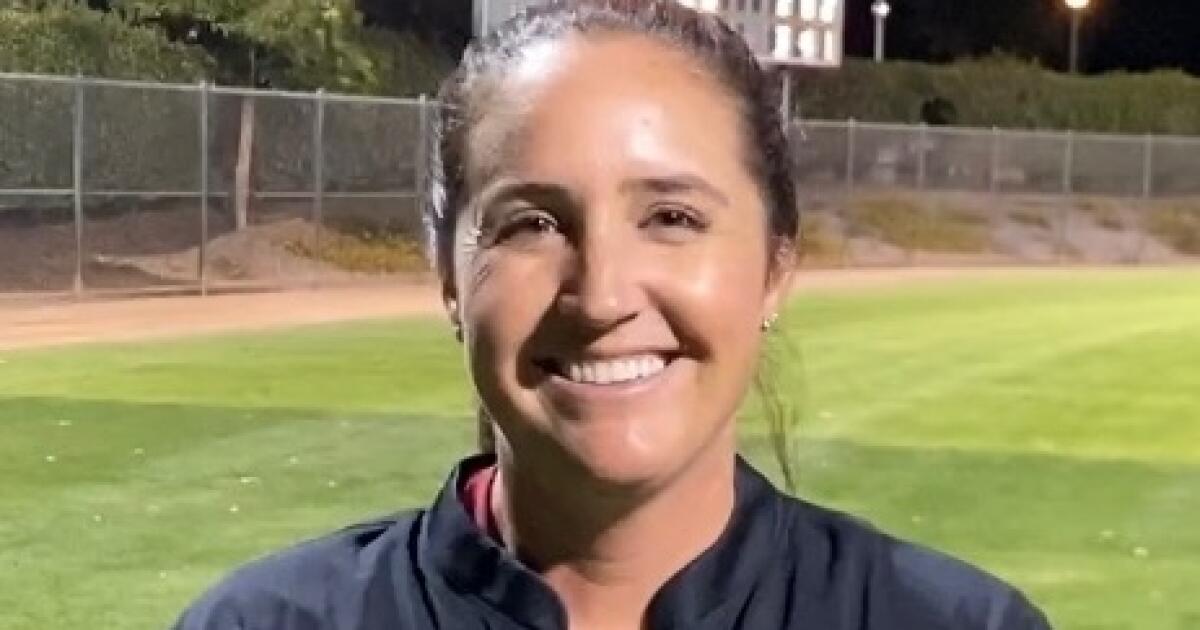
The Times’ softball coach of the year: Katie Stith of JSerra

Katie Stith, the softball coach at JSerra High, can finally take a bow and become the most famous Stith in the family — at least for a couple weeks.

Imagine being the daughter of legendary club softball coach Mike Stith (OC Batbusters), then going into coaching. Katie did just that and has earned the spotlight after guiding JSerra to its first Southern Section Division 1 championship.

She has been selected The Times’ coach of the year for 2026.

It was her eighth season, and if you want to play in Division 1 in Southern California, you have to go through the gauntlet of powerhouses, from Norco to Orange Lutheran to Murrieta Mesa.

JSerra navigated a difficult regular-season schedule, then avoided upsets in the playoffs. The team finished 25-8 and had wins over Norco, La Mirada, Oaks Christian, Orange Lutheran and Garden Grove Pacifica — all prominent programs.

She was able to rely on pitcher Liliana Escobar and catcher Annabel Raftery in those pressure-packed moments from the first game to the last.

Source link

GOP Sen. Bob Packwood of Oregon dies

Former Sen. Bob Packwood, a moderate Oregon Republican whose reputation as a champion of women’s rights was tainted late in his career by a sexual harassment scandal, has died. He was 93.

Packwood’s death Saturday was announced in an obituary sent to media outlets by his family. The release didn’t include additional details.

As the scandal unfolded, Packwood initially refused to quit the chamber in which he had served for 27 years, saying he didn’t want to be remembered only for that.

Before the #MeToo era, Packwood stood out as an example of private behavior undermining a man’s public image. He previously had been praised by Planned Parenthood and others.

The great-grandson of a member of the 1857 Oregon Constitutional Convention, Packwood established himself as a social moderate and fiscal conservative who often voted across party lines. He considered running for president in 1980.

Elected to the Senate in 1968, Packwood was best known as the leading Republican advocate of abortion rights — at a time when the position had bipartisan support — and was widely admired by women’s groups throughout the country until the Senate Ethics Committee launched an investigation into the allegations of sexual and official misconduct in 1993.

More than two dozen women, former employees and acquaintances, accused him of making unwanted or uninvited sexual advances.

The allegations remained the target of an ethics inquiry that widened to include other alleged acts of official misconduct. He resigned in September 1995, and went on to start a lucrative lobbying business in Washington.

Democratic Sen. Ron Wyden, who replaced Packwood in 1996, said that although he should be praised for his record on abortion rights and tax reform, how Packwood treated women overshadows it all.

“His horrible history as documented in his own diaries will forever overshadow that public record. Simply put, historians’ first line about Bob Packwood must include those women who he abused and assaulted for years and years,” Wyden said in a statement.

As chair and then ranking Republican on the Senate Finance Committee, Packwood was a master of cutting deals and forging compromises needed to pass tax legislation through Congress. He was most proud of the lead role he played in a sweeping tax reform of 1986 that lowered the top income tax bracket and eliminated many itemized deductions.

Over his career, he was described as a blunt, independent, outspoken politician who was a boat-rocker, loose cannon, skilled partisan, and — for most of his career — political survivor.

“I think they probably all ring true,” Packwood told the Associated Press in December 1992.

“I would like to think that I am nobody’s lackey. I try to reach conclusions independently and then I’m willing to fight for those conclusions; if necessary, having to fight against my party or my party’s president,” he said.

Packwood won his first Senate election at age 36, narrowly defeating Democratic Sen. Wayne L. Morse, an Oregon legend who had held the seat for 23 years. He quickly grabbed attention as a rising star in the GOP. By 1980, he was elected chairman of the National Republican Senatorial Committee.

But he lost the seat when the White House backed a competitor after Packwood publicly accused President Reagan of alienating women, African Americans and Jews.

Just two weeks after Packwood’s reelection in 1992, the Washington Post printed allegations from former female employees and acquaintances that the senator had subjected them to uninvited sexual advances.

The Senate Ethics Committee also investigated allegations that Packwood solicited jobs from lobbyists for his ex-wife, used his staff to try to threaten the female accusers into keeping quiet and obstructed the investigation by altering his personal diaries.

The Senate held two days of extraordinary debate in 1993 over whether Packwood should have to comply with an Ethics Committee subpoena for his diaries, in which he reportedly made entries relevant to the investigation. The Senate voted 94 to 6 to enforce the subpoena.

Packwood took the case to federal court and lost, ending when Supreme Court Chief Justice William Rehnquist refused the senator’s request for the high court to intercede.

Packwood launched his lobbying business, Sunrise Research Corp., in 1997. By 1999, the firm was grossing $1.5 million a year. His business slowed in later years, but he told a City Club of Portland audience in 2010 that he was still spending about half his time in Washington lobbying for a number of clients.

It was interesting work, Packwood told the audience, according to the Oregonian, but “it is not as much fun as being in the Senate.”

As Congress became increasingly partisan after his departure, Packwood continued to advocate a centrist tack and in his 2010 City Club speech called for Oregon to create nonpartisan elections.

Source link

Ann Patchett’s luminous ‘Whistler’ is the must-read novel of the season

Book Review

Whistler

By Ann Patchett
Harper: 304 pages, $30

If you buy books linked on our site, The Times may earn a commission from Bookshop.org, whose fees support independent bookstores.

At the recent glitzy PEN America Literary Gala at the Natural History Museum in New York City the evening’s MC, B.J. Novak, declared that the crowd was there to celebrate more than just freedom of speech — they were there for “literary glamour.”

“Writing is glamorous,” he declared. “Reading is glamorous.”

For Novak, bestselling novelist Ann Patchett — who has also worked tirelessly on behalf of independent booksellers and in support of her fellow writers, and was one of the event’s honored guests — epitomizes that allure. “I think it’s great that Ann Patchett is a smoke show. She doesn’t have to be,” he quipped. “It’s just cool that she is.”

With “Whistler,” Patchett’s 10th novel, she definitively proves that the “smoke show” moniker, if at all relevant, is icing on the cake. This exquisite writer has once again delivered an incandescent work of fiction — sweet, but never sentimental, infinitely wise and suffused with love. It’s also an ode to New York City itself.

“Whistler” is narrated by protagonist Daphne Fuller, a 54-year-old English teacher married to Jonathan, a restlessly retired doctor and hospital administrator who dotes on his wife and whom he regards as “extraordinary.” When we first encounter the couple, they’re roaming the Metropolitan Museum of Art — which, one gets the sense, they know by heart. As Daphne ponders the sculpture “Two Horses,” by Charles Ray, Jonathan spots an elderly stranger eyeing his wife, casting glances in her direction. The stranger follows them from room to room fixated on Daphne. Jonathan’s curiosity is piqued, and he slips away from his wife’s side to get to the bottom of why they’re being followed — which is revealed to be the novel’s inciting incident.

Turns out that stranger is no stranger at all. He is Eddie Triplett, a long-lost stepfather whose divorce from Daphne’s mother, Abigail, remains an unhealed wound. Running into Eddie now for the first time in more than four decades, Daphne is startled by the rush of emotion she feels: “I hadn’t known there was something in me to break,” she reflects, “but there it was and break it did. I stepped into an open crack in time and fell backwards.”

Eddie, as it happens, is but one of Daphne and her sister, Leda’s, three dads. By the time Abigail marries her third husband, mild-mannered Lucas, and the couple go on to have three sons, Daphne has grown a protective shell. These facts are narrated with detachment by the protagonist herself. As she and Eddie gently unspool their memories and together fill in the blanks, their bond deepens. The “falling backwards” Daphne experiences in Eddie’s company — traversing time — soothes, softens and delights her.

As the novel unfolds, what becomes ever clearer is that Daphne and her author are undeniably similar, though Patchett has observed: “I am normally careful to make sure there is a big wall between my life and my fiction.” In “Whistler,” she throws that caution to the wind. Easter eggs are scattered throughout. Like Daphne, Patchett is married to an older man — also a doctor — whom she adores. She too had three dads, as she chronicled in a 2020 New Yorker piece aptly titled “My Three Fathers.” Patchett and her heroine also appear to share this enviable trait: They navigate life with grace, generosity and utter competence. IRL, Patchett returns emails on the day she receives them, is an outspoken advocate for free expression, is generally renowned for her good deeds. She’s also widely known for her many devoted friendships, though she doesn’t suffer fools. You’d want to be her ride or die. As you would … Daphne’s.

In an interview 10 years ago, Patchett observed that it wasn’t until she read a piece by Jonathan Franzen, “in which he insisted that the novelist had to do what scares him most, and for him, that had been writing about his family,” that she considered following that path in her fiction. “I thought ‘oh nothing would scare me more. I would happily ride down the Amazon in a canoe and deal with snakes’ ” (as she did for “State of Wonder”) “ ‘than face my family.’ ” In 2016 she wrote “Commonwealth,” which drew on her personal experience of divorce and dysfunction, themes she revisits in “Whistler.” But in “Whistler,” it’s as if Patchett herself is in the reader’s ear. (And, by the way, should you pick up the audio version of the book, she narrates and is literally in your ear.)

Patchett has said she had an ulterior motive for writing “Whistler.” She’d been in the midst of writing a different book, a novel about a Wyoming rancher and her horse, Whistler, but it wasn’t clicking. As she pressed on over the better part of a year, a second idea came to her “like a fever dream.” She immediately filed away the messy work-in-progress and began writing a fictional ode to a cherished friend, former publishing executive Jim Fox, to whom “Whistler” is dedicated. Fox had died two years before, on his 85th birthday, and Patchett was still grieving. Her aim, with “Whistler,” she has said, is to put down on paper how much they loved each other. Fox is reborn as Eddie Triplett in the book, a charming and erudite book editor who radiates joie de vivre and is among the loves of his stepdaughter Daphne’s life.

Patchett’s literary style isn’t of the show-offy variety packed with dazzling sentences and edge-of-your-seat cliffhangers. The drama is quiet. Her words accrue and gain power through their spareness and clarity, and a level of character development that forges an easy intimacy with the reader. There’s also a sly wit and sagacity that have become Patchett signatures, honed to perfection in “Whistler,” whether wrestling with the legacy of family trauma, or the human struggle to accept the transitory nature of it all. Or, as Patchett’s mother once admonished after the failure of her daughter’s first marriage: “Stop trying to make everything permanent. It doesn’t work.”

While Patchett has clearly drawn on actual events and individuals to produce this luminous work, she exhibits the expert novelist’s knack for following a plot where the imagination takes it. I don’t recommend consuming “Whistler” in one enormous gulp. I dipped in and out, savoring scenes, reflecting on them, occasionally shedding a tear. In other words, I didn’t want it to end.

Haber is a writer, editor and publishing strategist and co-founder of the Ink Book Club on Substack. She was director of Oprah’s Book Club and books editor for O, the Oprah Magazine.

Source link

Alexander Zverev wins the French Open, his first Grand Slam title

Alexander Zverev is no longer one of the best players never to win a major title.

He’s finally a Grand Slam champion.

In his fourth major final, Zverev beat Flavio Cobolli 6-1, 4-6, 6-4, 6-7 (5), 6-1 for the French Open title on Sunday.

It was a unique opportunity for Zverev without Jannik Sinner or Carlos Alcaraz across the net and the third-ranked German took full advantage on the red clay of Roland Garros.

When Cobolli missed an overhead on the second championship point after more than four hours of the five-set encounter, Zverev dropped on his back to the clay and covered his face with his hands as he began sobbing. When he got up, with his shirt and arms covered in clay, Zverev put his hands back on his face before he lifted both arms in celebration.

When Zverev was handed the Coupe des Mousquetaires trophy, he lifted it with both hands and let out a liberating roar.

“This court is so special to me in so many ways. I’ve had the best moments of my life on this court; I had the worst moment of my life on these courts,” Zverev said, referring to when he was injured and pushed off on a wheelchair during a semifinal against Rafael Nadal in 2022.

“I was laying in that corner over there four years ago with seven broken ligaments and two fractured bones,” Zverev said. “I lost a Grand Slam final here two years ago but now finally it’s a happy end.”

Zverev has now joined an elite group of players that captured their first major in their fourth final: Eight-time major champion Andre Agassi, 2001 Wimbledon winner Goran Ivanisevic and 2020 U.S. Open champion Dominic Thiem.

No Sinner or Alcaraz

Zverev had been an overwhelming favorite for the title ever since the top-ranked Sinner struggled in the first week’s heat wave and wasted a two set and 5-1 lead against Juan Manuel Cerundolo in the second round. A day later, 24-time Grand Slam champion Novak Djokovic was also eliminated.

Alcaraz, the two-time reigning champion, withdrew before the tournament with an injured right wrist.

It was Zverev’s second French Open final, having wasted a lead of two sets to one against Alcaraz in the 2024 championship match.

Zverev had an even bigger advantage — two sets to none — in the 2020 U.S. Open final and lost that one, too, to Thiem. He was also beaten in straight sets by Sinner in the 2025 Australian Open final.

It was the 25th title of Zverev’s career.

Cobolli’s first Slam final

The 14th-ranked Cobolli had never been past a Grand Slam quarterfinal until this week. He was attempting to become the first Italian man to raise the singles trophy at Roland Garros since Adriano Panatta 50 years ago.

Cobolli comes from the same tennis club in Rome as Panatta did and Panatta was asked by tournament organizers to present the trophy to the champion to celebrate the anniversary of his 1976 triumph.

The honors, however, went to Zverev.

Russian teenager Mirra Andreeva won the women’s singles trophy on Saturday.

Zverev took control early on

The match was played in perfect conditions and Zverev’s game was almost flawless at the start.

Zverev broke Cobolli’s serve in a long opening game when Cobolli shanked a forehand into the first row of the stands. The break came after Zverev had a bit of luck when a backhand return hit the net but dribbled over on game point for Cobolli.

A group of women in the stands held up letters to form Zverev’s nickname: “Sascha.”

Cobolli likes to stand way over near the corner of the court and hit big kick serves out wide into the ad court. Zverev knew what was coming and returned one such kick serve early in the first set with a backhand that he wrapped around the outside of the net post. Cobolli ended up winning the point, but it was a message from Zverev that he knew how to handle his opponent’s tactics.

The next time Zverev hit a wrap-around-the-net-post return, Cobolli couldn’t handle it and Zverev won the point.

Cobolli’s supporters in his box were all dressed in blue, the color of Italy’s national teams, and as Cobolli worked his way back into the match, there were chants of “Ole, Ole, Ole; Flavio, Flavio.”

After Zverev held for a 6-5 lead in the fourth, he had his upper right leg treated by a trainer. Then Zverev wasted a 3-1 lead in the tiebreaker, which Cobolli concluded with a forehand winner up the line that produced a roar from the crowd.

But Cobolli appeared to run out of energy in the fifth, running down a drop shot only for Zverev to then pass him up the line for a 3-0 lead and a double break.

Abuse allegations

Moments after Zverev’s previous Grand Slam final in Australia in 2025, a person in the stadium yelled out the names of two of his ex-girlfriends who accused him of physical abuse.

One case was resolved following an agreement between German prosecutors, lawyers for Zverev and his former partner. The ATP Tour investigated another case and concluded there was insufficient evidence.

Dampf writes for the Associated Press. Samuel Petrequin and Jerome Pugmire contributed to this report.

Source link

Claire Danes’ ‘Beast in Me’ Emmy chances, by the numbers

Claire Danes’ performance in Netflix’s “The Beast in Me” appears like a lock for an Emmy nomination for lead actress in a limited series or TV movie. In typical fashion, Danes left it on all the floor in portraying a reclusive author who suspects her developer neighbor (Matthew Rhys) of misdeeds.

1995

The Golden Globes rarely get it as right as they did in awarding Danes the drama series best actress award, at 15, for ABC’s “My So-Called Life.”

19

The lifespan of the authentic teen drama that introduced viewers to Danes’ unique emotional translucence, counted in episodes.

1st

Danes also received an Emmy nomination for the series — the first of eight for acting so far.

16

She is the second-youngest Emmy nominee ever for lead actress in a drama series, between Melissa Sue Anderson (15, for “Little House on the Prairie”) and Kristy McNichol (17, for “Family”).

3

Danes won an Emmy for playing the real-life animal science professor in the HBO movie “Temple Grandin,” and two for playing complex CIA officer Carrie Mathison on Showtime’s “Homeland.”

31

Span of years between Danes’ first and 2026 nominations, if she receives one.

47

Danes’ Emmy longevity may not equal the likes of Carol Burnett, nominated in 2024 for “Palm Royale” 62 years after her first, but it’s mighty impressive for someone Danes’ age.

49

There’s even a contender in her category this year whose span between nominations would be longer than Danes’ lifetime: Sally Field, who appears in Netflix’s TV movie “Remarkably Bright Creatures.”

Source link

World Cup poses an unprecedented security challenge at a fraught moment

The World Cup, a 48-team, 104-match behemoth kicking off this week in Los Angeles and across 15 other cities in the United States, Mexico and Canada, presents an unprecedented security challenge, with more countries, games and a larger footprint than ever before.

It also comes against the backdrop of the U.S. and Israel’s war with Iran, mounting political violence in President Trump’s orbit and growing fears of artificial intelligence-fueled disruptions, creating a complex threat environment for authorities.

Overseeing the sprawling security apparatus is a legion of federal agencies, state and local police departments and private entities. Their responsibilities range from securing stadiums and fan zones to escorting teams and protecting dignitaries.

Their tools include hunter drones that can shoot nets over objects in restricted airspace, bag-inspecting robot dogs, giant X-ray trucks and thousands of AI-powered cameras trained on public spaces soon to be thronged by fans.

In the U.S., it’s “78 Super Bowls over 39 days,” said Andrew Giuliani, executive director of Trump’s World Cup task force, which is overseeing the multiagency effort.

“There’s never been a summer like this in American history from a security angle,” said Giuliani, son of former New York City Mayor Rudolph W. Giuliani. “We’re as prepared as we can be.”

Collaborative effort

The tournament has the same high-level federal security designation as the Super Bowl, just below a presidential inauguration or a national political convention, ensuring federal, state and local coordination. It coincides with other major events linked to the 250th anniversary of America’s founding.

So far, Giuliani said, there are no credible threats.

The Department of Homeland Security, focused on Trump’s immigration enforcement crackdown and with a funding lapse only recently resolved, estimates that as many as 7 million people will visit the United States for the World Cup.

The U.S. Secret Service, under scrutiny after security breaches and attempts on Trump’s life, is in charge of protecting world leaders who show up to cheer on their countries. Trump has expressed interest in attending a match.

“I feel very comfortable where we’re at, and we feel like we have a zero-fail mission,” Homeland Security Secretary Markwayne Mullin told Congress last week, noting that the Secret Service was understaffed by about 860 agents. “But it’s going to be complicated.”

Officials have indicated they are confident they can keep Trump safe because they will be integrating his usual security into the robust World Cup plan on days he may watch a match.

The FBI has spent two years developing its security plan, incorporating lessons from other major events such as the Macy’s Thanksgiving Day Parade and New Year’s Eve ball drop in New York and testing them at smaller ones, including last weekend’s Israel Day parade in the city.

“We prepare for the worst day,” FBI Special Agent in Charge Amit Kachhia-Patel in New York told the Associated Press. “And that’s how we go into any single event.”

To help cover security costs, the Federal Emergency Management Agency has distributed $625 million to the 11 U.S. host cities. An additional $250 million is being directed toward tracking and neutralizing suspect drones.

The disbursement of those funds was held up by the department’s funding delay in Congress, which the Trump administration has argued hindered security planning.

Others involved in the planning effort said the federal government could have played a more hands-on role even before the partial shutdown.

John Cohen, a former senior Homeland Security official who has been briefing state leaders before the matches, said the government was largely absent from planning meetings last year and did not begin sharing threat intelligence with host regions until recently.

“With an event of this magnitude, one would expect the federal government would’ve played a more active role,” Cohen said. “It felt like a missed opportunity to showcase that collaboration.”

Evolving threats from drones and AI

In January, thousands of officials involved in World Cup security gathered for exercises simulating crowd surges, vehicle attacks and mass shootings.

A month later, the U.S. and Israel launched a war with Iran.

“The security picture fundamentally changed,” said Stefano Ritondale, chief intelligence officer at Artorias, a defense intelligence company not involved in the security preparations. “There’s a major difference in preparing for a lone-wolf radical who rams his car into a public place and a terrorist who is bankrolled by a foreign country we’re at war with.”

Among the greatest concerns are drones.

Since the last World Cup in Qatar in 2022, drones have become a prominent weapon in conflicts including Russia’s war in Ukraine and Hamas’ attack on Israel on Oct. 7, 2023.

“If there is one threat that keeps me up at night, it is from drones,” said New York City Police Commissioner Jessica Tisch, whose department is partnering with the FBI on drone mitigation.

Drones are prohibited over stadiums and fan zones, and Kachhia-Patel said the FBI has a “full suite of options” to thwart incursions. They include agents monitoring the sky and a “variety of means” to safely down the devices, he said without elaborating.

Before this year’s World Cup, the growing sophistication of AI videos was a particular concern, with officials warning that state actors can harness the technology to sow misinformation and panic.

On match days, the FBI will activate joint operations centers in each host city, bringing together local, state and federal law enforcement agencies to monitor and investigate threats.

“If there’s a video that shows an explosion going off at a site, and it’s AI-generated, we have people on the ground who can validate whether or not that’s true,” Kachhia-Patel said.

Opportunity for private tech

Some AI companies have pitched themselves to police departments in host cities, promising to comb through data and surveillance on game days to prevent threats, including unruly fan behavior.

“We know sports fanaticism around here in terms of the NFL and baseball to some extent, but nothing like international soccer,” said Jake Becchina, a police spokesperson in Kansas City, Mo., which is hosting six matches.

The department has contracted with Peregrine Technologies, which promises to sift through police data and publicly available information such as team practice locations and the country affiliation of popular bars, to get ahead of possible conflict.

In Dallas, a recent $120-million tech upgrade will give local police body cameras capable of real-time translations, helping law enforcement communicate with international visitors soon to descend on the region.

Several drone detection and mitigation companies are joining efforts to help federal agencies secure the skies.

One of those companies, Fortem, has claimed to have signed a multimillion-dollar contract with the Department of Homeland Security before the World Cup for an unusual drone mitigation strategy: quadcopters that can shoot nets at encroaching drones to trap them in midair. A Homeland Security spokesman declined to discuss the contract.

Just as the teams will aim to perform their best on the pitch, Giuliani said the security planning was a unique chance to “show off American exceptionalism.”

“If we do our job right,” Giuliani added, “nobody will be talking about security at the World Cup.”

Offenhartz, Sisak and Santana write for the Associated Press. Offenhartz and Sisak reported from New York, Santana from Washington. AP writer Alanna Durkin Richer in Washington contributed to this report.

Source link

The Times’ softball player of the year: Liliana Escobar of JSerra

When her team needed her the most, JSerra High pitcher Liliana Escobar delivered a gritty 12-strikeout effort in the Southern Section Division 1 finals against La Mirada, leading the Lions to a 3-2 win and their first CIF title.

Her ability to rise to the occasion time and again while playing in the highest division is why Escobar is The Times’ high school softball player of the year, and no one is more proud of the senior than JSerra head coach Katie Stith.

“Liliana’s one of the best players I’ve ever coached,” Stith said. “She’s talented, of course, but what stands out is the type of teammate she is. She’s so wise for her age and always made it a point to look out for the team. She wanted to win for them.”

Escobar did her fair share of winning in her prep career. She had 14 victories as a junior was selected the Division 2 player of the year after posting a 1.20 earned-run average while striking out 239 batters in 140 innings. This spring she improved to 18-5 and gave up only 26 earned runs with 264 strikeouts and 47 walks in 153 innings pitched. She signed with the University of Florida on Nov. 12, one month after committing to one of the most successful SEC programs.

“What she’s accomplished the last two years is just incredible,” Stith said of Escobar, who plays travel ball for the OC Batbusters. “After battling an injury and having to sit out her sophomore season she could’ve let that defeat her, but she fought hard to be at her best.”

Escobar recorded 10 or more strikeouts 15 times this season and outdueled Orange Lutheran ace Rylee Silva twice in Trinity League action, but perhaps her most impressive performance was a three-hit shutout with 14 strikeouts in the CIF-SS Division 1 semifinals against defending champion Norco — her second win in three outings versus the Cougars this spring.

She threw a five-hitter in the Lions’ playoff opener against Yucaipa and lasted all eight innings with 10 strikeouts in a 5-4 triumph over Ayala in the second round. She struck out 10 again and gave up only three hits in a 1-0 quarterfinal victory over Garden Grove Pacifica.

“Liliana becomes so courageous and competitive when she gets in the circle,” Stith added. “She believes in herself and executes every pitch, trusting the coaches every step of the way. I’m grateful for the time I got to spend coaching her and the example she set for those to follow. This is just the beginning for her. … I think she’ll do great things for the Gators.”

Source link

The Times’ baseball player of the year: James Tronstein of Harvard-Westlake

Last summer, James Tronstein of Harvard-Westlake was struggling at the plate. Then came shocking news before his senior year: He didn’t make the list of 40 finalists for the U18 national baseball team despite winning gold medals for the U15 team.

“He was pressing,” coach Jared Halpert said. “He had really good at-bats but wasn’t getting results. Credit goes to his maturity, ‘How do I get better?’”

His mental adjustment on how to react to failure, combined with a conditioning program that led him to lose 10 pounds and become faster and stronger, created a spring environment sending him into rarefied air.

The 6-foot, 170-pounder batted .531 with 52 hits and 10 home runs while making the transition from center fielder to shortstop. Everyone associated with the program now calls him the best hitter in school history.

For an individual performance that separated him from all others, Tronstein has been selected The Times’ player of the year for the 2026 season. The Vanderbilt commit and possible high draft pick has been a four-year varsity starter. He also was named the Gatorade state player of the year.

One of the lessons Tronstein said he learned is that “baseball is a game of failure. How am I going to handle that and set myself up for success?”

“He started evaluating situations,” Halpert said.

He also became a vocal leader, having been taken under the wings by former stars Bryce Rainer, Tommy Bridges and Miguel Villegas. His fire during games and his support of teammates came through loud and clear

He credited Halpert for teaching him about baseball and life.

“Coach Halpert has a huge impact on my life,” Tronstein said. “He’s made me into the man I am today.”

Tronstein helped Harvard-Westlake win the Mission League title and reach the Southern Section Division 1 semifinals before losing 3-1 to eventual champion St. John Bosco.

Source link

Dodgers show courage, honor LGBTQ+ pioneers Glenn Burke, Billy Bean

Let’s go Dodgers. High fives all around.

Because this time, with the newest historical exhibit at Dodger Stadium, the team got it right.

Amid all the historical installations and tributes in the open-air museum that is the Centerfield Plaza, and just a few feet from a Fernando Valenzuela mural, a new display honors Glenn Burke and Billy Bean, two former Dodgers outfielders who were the first and second professional baseball players to come out as gay.

It’s not a fleeting mention on Pride night, it’s a permanent record. A static reminder of progress made — and still to be made. And a much-deserved thank-you.

A wall inside Dodger Stadium features photos honoring former Dodgers and LGBTQ+ pioneers Billy Bean and Glenn Burke.

A wall inside Dodger Stadium honors former Dodgers and LGBTQ+ pioneers Billy Bean and Glenn Burke.

(Ronaldo Bolanos/Los Angeles Times)

“It’ll be here tomorrow, it’ll be here on the weekend and if you come next month, it’ll be here,” said the Dodgers’ team historian Mark Langill, who pointed to a spot just down the hall where in 1976 he was an 11-year-old getting Burke’s autograph.

Baseball is steeped in such history. The personal, the statistical, the societal. And the Dodgers’ is incomplete without their stories — Burke’s and Bean’s.

But the Dodgers have not, of course, always gotten this stuff right.

In 1978, they did Burke wrong, trading him — he believed — after management learned he was gay.

In his three seasons in L.A., Burke had proved himself a capable reserve outfielder who was popular with his teammates.

As far as we know, in 1977, he was the first guy to initiate a high five — spontaneously reaching above his head to slap hands with Dusty Baker after the home run that made Baker the fourth Dodger, along with Ron Cey, Steve Garvey and Reggie Smith, to hit at least 30 home runs that season, a MLB first.

Glenn Burke, left, goes to give a high-five to teammate Dusty Baker after Baker hit a home run in 1977.

Glenn Burke, left, goes to give a high-five to teammate Dusty Baker after Baker hit a home run in 1977. It is believed to be the first instance a high five was exchanged.

(Los Angeles Times)

There’s a fantastic photo of the historic high five included in the tribute to Burke and Bean, which is situated on a hallway wall beneath the left-field bleachers, beside the “Dodger Dugout” augmented reality photo booth.

Burke was also the first guy in that Dodgers clubhouse to crack a joke when the team needed it, his former teammate Rick Monday said.

“When called upon, he could play really well,” Monday said before the Dodgers took the field against the Angels on Friday, when the Dodgers and many of their rainbow-sporting fans celebrated the team’s 13th annual LGBTQ+ Pride Night. “And when we needed a moment of levity, Glenn was not afraid to come forward and put a smile on people’s face.”

But shortly before he died of AIDS in 1995 at 42, Burke published an autobiography, “Out at Home,” in which he described the team’s management being “afraid of my sexual orientation, even though I never flaunted it. To this day, the Dodgers deny trading me because I was gay. But it was painfully obvious.”

“Oh, what he had to deal with and keep it hid,” said Joyce Burke-Henderson, one of Glenn’s sisters at Friday’s pregame unveiling, where family members of both players gasped and cried and cheered the installation’s reveal.

“But as time went on, people did know. And then I think he came to the point where he just didn’t care and he just told it like it was.”

Joyce Henderson, sister of Glenn Burke, speaks about her brother during a ceremony honoring the former Dodger.

Joyce Henderson, sister of Glenn Burke, speaks about her brother during a ceremony honoring the former Dodger and LGBTQ+ pioneer at Dodger Stadium Friday.

(Ronaldo Bolanos/Los Angeles Times)

Burke came out in 1982, three years after playing his 225th and final big league game, in an Inside Sports article, “The Double Life of a Gay Dodger.”

“We just appreciate that now people are opening their eyes and just trusting in the Lord,” Burke-Henderson said Friday, “that things will go forward and work out and everybody will be loved regardless of their situation.”

The Dodgers first honored Burke in 2022, at their ninth Pride Night.

The next season, they made a mess of the Pride festivities, inviting and uninviting and then reinviting the Sisters of Perpetual Indulgence, a group known for its work in support of AIDS patients and whose members dress in drag, as nuns.

In 2023, the Dodgers also invited Bean — who was MLB’s senior vice president for Diversity, Equity and Inclusion. He appeared in a pregame ceremony on the field while protesters gathered outside the stadium.

Bean died the next year, at 60, 11 months after being diagnosed with acute myeloid leukemia.

Greg Baker, husband of the late Billy Bean, wipes away tears during a tribute honor Bean as a LGBTQ+ pioneer.

Greg Baker, husband of the late Billy Bean, wipes away tears during a tribute honor Bean as a LGBTQ+ pioneer at Dodger Stadium on Friday.

(Ronaldo Bolanos/Los Angeles Times)

Once a Northeast Santa Ana Little Leaguer, Bean became valedictorian at Santa Ana High, played for Loyola Marymount and went on to appear in 272 big-league games — including 51 for the Dodgers in 1989 — before abruptly walking away from baseball in 1995.

It got to be too much, he’d explain later, continuing to hustle to keep his baseball career afloat while keeping his sexuality secret, acutely aware of the blowback he’d get if it got out.

“For nine years,” he told the New York Times, “I felt as though I had one foot in the major leagues and one on a banana peel.”

“When he left baseball suddenly, I knew something was wrong,” Bean’s mother, Linda Kovac, said Friday, pausing to wipe away tears. “He was playing very well, it wasn’t like he was kicked out or anything. And it just didn’t make any sense.”

When Bean finally told his family he was gay, in 1996 — three years before clueing in an unsuspecting public via a Miami Herald article — none of his loved ones blinked. That included his stepfather, Ed Kovac, the homicide cop and former Marine who’d had a partner on the force who was gay.

“He worked with someone that he respected, side by side, on criminal cases,” Linda said. “We’re still friends with that guy.”

Linda and Ed Kovac, parents of Billy Bean, hold hands in front of a tribute dedicated to their son at Dodger Stadium.

Linda and Ed Kovac, parents of Billy Bean, hold hands in front of a tribute dedicated to their son at Dodger Stadium on Friday.

(Ronaldo Bolanos/Los Angeles Times)

Knowing someone — or of someone — who is gay or lesbian has long tended to dispel falsehoods and quell fears that might exist.

“One of the most important things any one of us can do in our community is be out, to be proud,” said Greg Baker, Bean’s husband. “The fact that someone can be out in a world that typically doesn’t have a lot of role models of the same ilk, it’s a brave thing to stick your neck out. It’s also very important.”

And it’s not a surprise, Baker said, that more athletes aren’t out in sports like baseball. Not with Gallup polling released last week telling us that with public acceptance of same-sex marriage and relationships in the U.S. has flattened after two-plus decades of growing support — down from 71% to about 65%.

“I want to thank the Dodgers organization,” Baker said. “It’s brave of them in this day and age to spotlight someone in our community when other organizations are trying to erase us.”

The Dodgers have done the opposite, putting up a permanent marker. A long time coming, a tribute to last.

Source link

Jared Grindlinger caps off Huntington Beach High career with a title

Jared Grindlinger was right where he wanted to be Saturday afternoon at the end of his last high school baseball game — on the mound with a chance to clinch a championship for the orange and black.

Huntington Beach had a 5-0 lead with two outs and the bases loaded in the top of the seventh inning when the Oilers’ highly touted left-hander came in to relieve Jared Marchbank. The cushion was narrowed to two with runs scored on an error, an uncaught third strike and a wild pitch, but Grindlinger struck out the fourth batter to tie the bow on his team’s 5-3 victory over San Diego Cathedral in the Southern California Regional Division I final.

“I knew I’d be facing the top of their lineup and those guys are all great players but I was ready for it,” Grindlinger said. “To do this with my best friends who I’ve grown up with my entire life means everything to me.”

Grindlinger graduates Wednesday with plenty to be proud of and much to look forward to. The 6-1, 170-pound pitcher/outfielder reclassified in February to make himself eligible for next month’s Major League draft and is a potential first-round pick. Having just turned 17, the University of Tennessee commit has a bright future, but he wants to savor his final days on campus following in the footsteps of older siblings Bradley and Trent, who were back at their alma mater Saturday to cheer on Jared.

“I’ve known him since he was in second grade and he has two brothers who played for me too,” Oilers coach Benji Medure said upon wrapping up his 26th season. “Jared loves to compete and he fell in love with the culture and the family aspect of our program.”

In the first round of regionals on Tuesday, Grindlinger went four for four at the plate with a double, a home run, two singles and a run batted in plus he pitched three scoreless innings with five strikeouts in a 10-3 victory over Patrick Henry in San Diego. Two days later, he singled, tripled and scored two runs in an 11-3 semifinal victory at Corona.

Grindlinger blasted the fourth pitch he saw over the right-field fence to put the Oilers up 2-0 in the first inning Saturday — a lead they held until tacking on three more in the bottom of the sixth. He also patrolled left field and snared a line drive to end the top of the fourth.

“He came with two really good fastballs but then he hung a changeup and I knew I got it,” Grindlinger said of his 41st hit and second homer this season. “I’ve been working on discipline to look for my pitch.”

Medure noted Jared’s similarities to Bradley, the oldest, and Trent, whom he may soon be playing with in Knoxville.

“Bradley was a terrific pitcher and Trent was a super hitter and they’re all very close,” Medure said. “I think Jared picked Tennessee because he wants to be with his brother.”

He could be a Volunteer with his brother Trent next season.

“Jared’s got the best traits from both me and Bradley,” said Trent, who just completed his first season in Knoxville, where he made the SEC All-Freshman team as a catcher. “He has an aura about him and I’m super proud of him.”

“Jared’s a lot better than I was at his age,” admitted Bradley, a 2023 Huntington Beach alum who played at Long Beach State but is entering the transfer portal. “He’s barely 17 and getting to the upper 90s. He’s more polished, plus he’s a lefty.”

The hardest part about skipping his senior year to graduate early was not the extra classes he had to take but knowing he would be missing out on a chance to see his coach reach another milestone.

“He was a freshman and the second game that season I got my 400th win and Jared said, ‘I’m gonna be part of 400 and 500,’” added Medure, who is 28 wins away. “That year, we won 23 and 25 the next year. We had it all planned that 500 would be for the CIF title. When he decided to reclass to make millions of dollars he told him, ‘I feel bad I can’t win that 500th game for you.’ That’s the kind of kid he is.”

Grindlinger credits his mom for helping him meet all of his academic requirements and his brothers for teaching him everything he knows about the sport they all play.

“Whatever happens — whether it’s the draft or college — I’m good,” he said.

Medure is thrilled how the season ended considering he did not believe his team would even be in the regional bracket after losing early in the section playoffs. He is grateful for the three seasons he got to coach his superstar.

“Jared came in to let us know that scenario was on the table and every coach in that room said, ‘Awesome!’” Medure recalled. “He was scared to tell us because he thought we’d be upset. Usually it’s done to buy another year, not to lose one. Of course I’d like to coach one of the best players in America for four years, but ultimately I want him to do what’s best for him.”

Source link

Route 66 still beckons at 100 as a caravan takes off from Santa Monica

Around 7 a.m. Saturday, in a lot beside the shuttered Santa Monica Civic Auditorium, a strange set of cars and trucks began to gather. Three Model A’s. A couple of ’60 convertibles. A 1964 Chevrolet Impala station wagon. Also, a big bull on trailer wheels.

“Am I in the right place?” asked a man in one of the Model A’s.

“Going to Chicago?” asked a guy in a white Denali.

“I wish I could do the whole thing,” said Joe Hernandez of Pasadena, wistfully standing by.

  • Share via

This was the starting line for roughly 70 drivers who gathered to celebrate the centennial of Route 66 with a 2,448-mile, 20-day caravan to Chicago. Most had come from outside California to share an adventure with fellow “roadies” and boost awareness of the classic scenery and independent businesses along the eight-state route.

But soaring gas prices and hesitant international travelers have added uncertainty to a trip that was always going to be a logistical challenge. Day 1 alone might terrify an L.A. commuter: From the Pacific to Pasadena by surface streets, including miles on Santa Monica and Colorado boulevards.

“I don’t know how it’s all going to happen,” said Gary Daggett, president of the Old Route 66 Assn. of Texas. But he and his wife, Stephanie, have more than a little Route 66 experience to draw upon.

Mike and Lisa Visket of Prescott, Ariz., at the Santa Monica Pier in their respective orange and white Route 66 shirts

Mike and Lisa Visket of Prescott, Ariz., pose in Santa Monica at the pier in their Route 66 clothing on June 6, 2026.

“This is our 30th trip over 20 years,” Daggett said. “You can’t see everything. There’s so much…. You start meeting the people, you get hooked on the people.”

Shortly before their 8:30 departure time, organizer Rhys Martin called drivers together.

“Leaving here is going to be a little complicated,” he said.

Martin, who is part of the Route 66 Road Ahead Partnership, is president of the Oklahoma Route 66 Assn., and serves as manager of the National Trust for Historic Preservation’s Preserve Route 66 initiative. For the journey, he is driving a ’64 Chevy Impala station wagon with a GPS unit inside so that armchair travelers can follow his journey on the web.

“It’s going to be impossible to keep everybody together,” he said during preparations. “We’re encouraging people to spread out and support independent businesses rather than all going to one place and demolishing the kitchen.”

A caravan of cars

William Cooke of Pinon Hills participates in a caravan from Santa Monica Pier to Chicago, celebrating the centennial of Route 66.

In song and literature, the route is celebrated as an east-to-west journey. This caravan, running in the opposite direction, will travel from California through Arizona, New Mexico, Texas, Oklahoma, Kansas and Missouri to Illinois.

From Santa Monica, the Day 1 schedule took drivers to Beverly Hills City Hall, Grand Central Market downtown for lunch, the Chicken Boy statue and Galco’s Soda Pop Stop in Highland Park, then an overnight in Pasadena.

Day 2 takes the group from Pasadena to Barstow. Day 3, from Barstow to Needles. On June 25, the caravan is due to arrive in downtown Chicago.

The loose procession was led by a core group of 15 cars, including representatives of all eight states on the route. Since anyone can join or leave the caravan at any time, the number of vehicles will vary by the hour.

Through the decades, the road has grown from an American artifact into a global symbol of small-town Americana. Many merchants, restaurateurs and hoteliers along 66 now say that their summer customers are mostly travelers from abroad, especially Europe. One of the caravan’s drivers, in a rented pickup truck, was Dries Bessels, co-founder of the Dutch Route 66 Assn.

Detail of a person in a cowboy hat with pins

Brady Wilson of Amarillo, Texas, displays an assortment of Route 66 pins on his cowboy hat. Wilson is part of a caravan of Route 66 enthusiasts who set out from Santa Monica Pier on June 6, 2026, for Chicago.

Though the Model A’s will surely raise eyebrows on the road, the caravan’s most startling element is the fiberglass bull representing the Amarillo-based Big Texan Steak Ranch restaurant, one of the event’s sponsors.

“It’s the same one my dad brought home in ’71. His name is Big Moo,” said Danny Lee, who co-owns the restaurant with his brother, Bobby Lee. “He’s 12 and a half feet high. About 500 pounds. It’s all fiberglass.”

In 21 cities along the drive, the Big Texan team aims to stage nightly steak-eating contests, giving free dinners to anyone who can eat 72 ounces of steak, a baked potato, three shrimp, a side salad and a roll in 60 minutes.

The caravan’s first challenge came at the Santa Monica Pier, where there was no room for the cars due to a construction project, World Cup preparations and a Children’s Hospital fundraiser. Instead, the caravan gathered by the Santa Monica Civic Auditorium. Drivers strolled over the pier for a photo op, then returned to their cars.

“Herding cats,” said George Kulakowski of Huntington Beach, at the wheel of a 1931 Ford Model A Panel Delivery truck.

People pose for a photo in front of a sign that says Santa Monica 66 End of the Trail

Participants in a Route 66 centennial caravan pose for a photo before they depart from Santa Monica Pier on June 2, 2026, for Chicago along the historic highway.

Another challenge awaited in West Hollywood, where Santa Monica Boulevard (aka Route 66) was busy with crowds for the city’s WeHo Pride Street Fair. By plans laid ahead of time, most caravan vehicles detoured around the party while select caravan cars followed a police escort through the action.

This way, Martin said, “another community along Route 66 gets to share its identity with the community at large.”

A woman wears an earing with the sign of Route 66

Allison Lehn of Boston participates in a caravan from Santa Monica Pier to Chicago, celebrating the centennial of Route 66.

By 11:15 a.m., Martin’s car had reached Sunset Boulevard in Silver Lake. Meanwhile, assorted other parades and caravans are traveling Route 66 in other states this year; most of them concentrate on short segments.

By 12:45 p.m., caravaners had met the mayor of Beverly Hills and rolled through West Hollywood’s Pride festivities, arriving at Grand Central Market, running slightly ahead of time.

On May 30, an estimated 3,596 classic cars joined a “Capital Cruise” on Route 66 in Tulsa, Okla., becoming a Guinness Book of World Records holder for the largest parade of classic cars, drawing an estimated 100,000 spectators and overwhelming local traffic.

In Arizona, the Williams Historic Route 66 Car Show was set for Friday and Saturday. In Texas, the Amarillo-based Texas Route 66 Festival is running Thursday through June 13.

A man in a green shirt, left, and a woman in dark clothes drive along a road with buildings ahead

William Cooke of Pinon Hills, left, and Sarah Jane Woodall of Tecopa, Calif., drive along Wilshire Boulevard in a 1960 Edsel Ranger Convertible as part of a Route 66 centennial caravan.

In those states and beyond, the caravan from Santa Monica will find hotels and motels in every kind of condition, vintage neon, road food, blue states, red states and purple states.

As a package of Times stories described in May, some landmarks date to the highway’s days as a scene of Depression desperation in the 1930s, others to its giddy postwar years in the late 1940s and ‘50s.

Route 66 was created in 1926 as a highway stitching together hundreds of local roads. Nicknamed “the Main Street of America” by its boosters and “the Mother Road” by John Steinbeck in “The Grapes of Wrath,” the highway inspired Bobby Troup’s song “(Get Your Kicks on) Route 66” in 1946.

But economic life along Route 66 has been precarious since the late 1960s, when interstate highways and chain hotels began stealing traffic away from the older, slower road. After Route 66 was decommissioned as a highway in 1985, about 85% of the old route remained in use, often as small-town thoroughfares, country highways and frontage roads alongside Interstate 40.

Efforts to save and rebuild the route as a historic resource began in the late 1980s and gained ground after the 2006 release of the Pixar/Disney animated features “Cars,” which tells the story of the highway’s rise and fall. In small towns such as Tucumcari, N.M., and Seligman, Ariz., the highway remains central to local identity and economy.

A participant's vehicle in a caravan with stickers in the rear window. One says Preserve Route 66

A vehicle in the Route 66 caravan is photographed June 6, 2026.

This year’s centennial improvements along the route “are things that are going to go into the future,” Martin said. “The real impact is going to be next year and the years after.”

Source link

Proud Boy booted from Spencer Pratt election night party

Proud boy expelled from Pratt’s party

Spencer Pratt’s election night party at Don Antonio’s Mexican restaurant in West Los Angeles included a few uninvited guests, and it wasn’t just members of the news media.

As Pratt spoke to reporters relegated to the sidewalk, a Virginia man convicted of joining in the Jan. 6, 2021 assault on the U.S. Capitol hovered behind him, trying to horn his way into the candidate’s frame as Pratt spoke to the news cameras.

A member of Pratt’s security team grabbed the man, Jon Mellis, by the shoulders, dragged him past the TV cameras and pushed him down onto the pavement of Pico Boulevard as cars whizzed by.

Mellis — a member of the far-right Proud Boys who was pardoned by President Trump along with the other Jan. 6 rioters — wasn’t thrilled. He attempted to interrupt multiple news broadcasts to air his grievances.

“They can’t assault me like that,” Mellis said.

“They hate MAGA,” someone else in his group chimed in.

Earlier Tuesday evening, Mellis had happily mugged for one news camera after another, expressing his fealty for Pratt.

Mellis described himself as “ultra-MAGA” to The Times and, pre-shove, said he didn’t mind that Pratt was distancing himself from the MAGA movement as he campaigns for votes in the Democratic stronghold of Los Angeles.

Recent polling showed most Democrats were less likely to vote for Pratt when perceiving the candidate as tied to MAGA and Trump. Given that, it’s hardly surprising that Pratt’s security team gave Mellis and his friends the bum’s rush.

“Those guys are paid ops,” a member of Pratt’s campaign wrote on X. “They crash every single event.”

Airbnb’s election night sweep

It was a good election night for short-term rental giant Airbnb, which infused numerous city races with cash and didn’t take a single loss.

The company teamed up with the Central City Assn., a group representing downtown Los Angeles businesses, to fund ads in support of Karen Bass, city attorney candidate John McKinney and five City Council candidates.

The business group said its PAC, which received funding from Airbnb and the Los Angeles Police Protective League, spent nearly $5 million during the primary election cycle, up from $1 million during the 2024 primary and general elections.

“We have been intentional about supporting candidates and causes focused on building more housing; investing in public safety, transportation, and infrastructure; and supporting the diverse businesses that provide jobs and put paychecks in Angelenos’ pockets,” said Nella McOsker, president of the Central City Assn.

“The results speak for themselves,” said Justin Wesson, Airbnb senior manager of public policy in California. “Airbnb has arrived in L.A. politics — not as a guest, but as a permanent resident.”

In council, CCA and Airbnb supported Traci Park, who declared victory and had a big lead over her opponent; Jose Ugarte, who will probably advance to a November runoff; and Timothy Gaspar, who was leading in his primary as well, though votes are still being tallied and it wasn’t clear if he would make the majority threshold needed for an outright victory. CCA also supported Monica Rodriguez, who ran unopposed and Tim McOsker (Nella McOsker’s father), who coasted to a big lead in the primary.

Betting on whims and vibes

This is Los Angeles’ first mayoral election in the age of prediction markets, and two giants of the field, Kalshi and Polymarket, have been actively promoting betting on who will be the next mayor — and even sub-bets within the election, such as which candidate will come in second place in the primary or which two candidates will advance to the runoff.

On election night, as Spencer Pratt led Nithya Raman for second place by about 9 percentage points, both Kalshi and Polymarket had Pratt favored to move on to the runoff.

But overnight, the market shifted, with a Bass versus Raman runoff now considered more likely by bettors, probably due to a widely held belief that the remaining votes to be counted will lean more Democratic as the county tallies late-arriving vote-by-mail ballots.

Although Kalshi promotes its markets as the “odds” that a certain candidate will win, experts warn it merely represents the beliefs of bettors, who are not always the best-informed.

“This is people’s whims and vibes. You might have better luck in Vegas; at least when you bet in Vegas there’s math involved,” said Democratic consultant Mike Trujillo.

A spokesperson for Kalshi said “sharp traders on Kalshi are experts at pricing likelihoods in real time.”

Eric Zitzewitz, a professor of economics and expert on prediction markets at Dartmouth College, said that sites such as Kalshi and Polymarket are pretty accurate, and that smart money usually corrects the market.

“Historically that movement in Pratt’s price would reflect a movement in his odds,” Zitzewitz said.

As of Friday, Polymarket had a Bass-Raman runoff at 80%, and a Bass-Pratt runoff around 22%. Kalshi gave Bass and Raman a 78% chance of advancing and Bass and Pratt 22%.

Pratt currently leads Raman, but Los Angeles County is still tallying ballots and Raman has gained some ground following initial results Tuesday.

You’re reading the L.A. on the Record newsletter

Sign up to make sense of the often unexplained world of L.A. politics.

State of play

— BASS VERSUS?: Mayor Bass will advance to a runoff against either Pratt or Raman after a bruising primary campaign during which the incumbent was attacked from the left and the right.

— COALITION KAREN: A broad coalition of supporters assembled by the mayor helped her secure a spot in the Nov. 3 runoff. On her side was organized labor, including the powerful police officers’ union; business leaders, working closely with Airbnb; the Los Angeles County Democratic Party, including key elected officials; and immigrant rights groups that applauded Bass for her condemnation of federal ICE raids.

— COMEBACK COUNCILMEMBER?: Raman is still running behind Pratt, but experts say the remaining ballots to be counted should favor Democrats. “Don’t count [Councilmember] Nithya Raman out yet,” said Zev Yaroslavsky, director of the Los Angeles Initiative at UCLA Luskin.

— INCUMBENTS IN CONTROL: The mood was celebratory in Los Angeles City Council chambers Wednesday, as incumbents up for reelection held wide leads over their challengers as vote counting from Tuesday’s primary continued.

— FELDSTEIN SOTO OUT, MEJIA IN: Los Angeles City Atty. Hydee Feldstein Soto all but conceded that her reelection bid had failed Wednesday morning, as she lagged far behind her two well-funded challengers based on early returns. Her incumbent colleague, City Controller Kenneth Mejia, appeared to be faring better in his bid to stay in office, holding a double-digit lead over finance executive Zach Sokoloff.

QUICK HITS

  • Where is Inside Safe? The mayor’s signature program moved 20 people inside from Skid Row in Council District 14.
  • On the docket next week: Proposals from the Charter Reform Commission are still being reviewed by the Rules, Elections, and Intergovernmental Relations Committee, with the next meeting scheduled for June 12.

Stay in touch

That’s it for this week! Send your questions, comments and gossip to LAontheRecord@latimes.com. Did a friend forward you this email? Sign up here to get it in your inbox every Saturday morning.

Source link

Commentary: For mayoral candidates and all of L.A., here’s the homelessness conversation we must have

Ron, a West L.A. resident, thinks he knows why former reality TV star and political newcomer Spencer Pratt won so much support in his run for mayor.

People are frustrated, frightened and angry about homelessness “and the crime associated with it,” Ron said in an email. He added that he voted for Mayor Karen Bass, but “almost everything Pratt said about the homeless resonated with me. … The homeless run wild here, without consequence.”

“Many of us support him not because we think he’s perfect,” said Kathy, “but because we are deeply dissatisfied with the direction of Los Angeles and feel that traditional politicians have not delivered the results we were promised.”

Bob, “a left-leaning Palisades resident,” said the issue is not Pratt’s lack of credentials, but the failures of incumbents. “There was a columnist … who documented in depth the situation at MacArthur Park,” Bob wrote in reference to me. “What was his name and what happened to him? Did he change his tune?”

These are all fair points, and if Pratt holds onto one of the top two spots and makes it to the Nov. 3 general election, or he’s overtaken by late-charging Councilmember Nithya Raman, we’re going to hear a lot more about homelessness in coming months.

So whether we’re looking at a Bass-Raman contest or a Bass-Pratt showdown, here are some random musings, and I’ll begin by responding to Bob’s question about whether I have changed my tune.

Not in the least.

The situation in MacArthur Park — targeted Thursday in a crackdown that involved multiple arrests — has long been a disgrace, and the same is true of many other places I’ve written about for the past quarter of a century. Last month, I visited a Hollywood neighborhood where one frustrated resident hired her housekeeper to document chronic problems related to homelessness, illegal dumping and criminal activity.

Residents have good reason to ask why they haven’t gotten better results after responding to politicians’ pleas for more money over the years.

It’s no surprise that Bass had high unfavorability ratings and why, despite leading in the primary vote count, she’ll fall far short of the 50% needed to avoid a second election phase. I still can’t believe that when I first asked her about the sad state of MacArthur Park, she told me she was fully aware, because she often drove through the area on her way to work.

Then why hadn’t she led the charge to address the problems and return the park to the community?

It shouldn’t take months, let alone years, to take back control of public spaces, and Pratt’s criticism is warranted, no doubt. And my main issue is not the hypocrisy of him saying God wants him to be mayor while calling his opponents demonic entities and villainizing homeless people he intends to shoo away to Seattle. It’s that his “fixes” demonstrate a lack of understanding.

Let me make a confession. From one angle or another, I’ve been writing about the intersection of homelessness, mental illness and addiction for a couple of decades, and I still have a lot to learn.

And on a personal note, I lost my son to a drug overdose. He had a job and wasn’t homeless, but like a lot of people who struggle with depression and other demons, he was resistant to help, and even to the idea that he needed help.

There are a lot more substance users like him, living out of public view, than there are on the street. We notice only those who don’t have the means to pay the rent or the mortgage as housing prices rise. So when Pratt says we don’t have a homelessness problem, but a drug problem, he’s missing a critical component in understanding why L.A. has tens of thousands of unsheltered people.

Pratt said on his website that his “treatment first” approach would direct resources into mental health and drug treatment care, which sounds good except that those responsibilities are primarily under county jurisdiction, not city control.

He and others have attacked harm reduction practices, such as distribution of needles and other paraphernalia. And I have to admit that it seems counterintuitive to enable further drug use. But the idea is to prevent death, engage clients and start a relationship that might lead to transformative care.

The county reports that in 2024, fentanyl-related deaths decreased by 37% and meth-related deaths by 20%. Harm reduction can be “absolutely invaluable,” addiction specialist Rick Rawson told me when I was working in MacArthur Park, but we need much more than that.

“When you have someone who becomes so incapacitated that they can’t stand up,” Rawson said, “to say that you’re just going to provide them with harm reduction and hope they don’t die, I think that falls short of the responsibility we have to each other and to the sickest people.”

I’ll add here that I firmly believe we should intervene more aggressively with people who are gravely ill, or are a threat to themselves or others. I recently profiled two San Diegans who are advocating for use of an existing law to allow for deeper evaluations and longer-term treatment plans for people with chronic drug and mental health issues.

It’s worth noting that drug and alcohol rehab is seldom a quick or surefire remedy. As for mental illness, it took me one year, along with the help of trained professionals, to convince my friend Nathaniel to seek help after he’d spent decades on the street following a diagnosis of schizophrenia.

What I’ve found over the years is that many of those living in tents and cars and alleys and parks are damaged in numerous ways.

I’m less inclined to judge people from a distance after having met a man on Skid Row who said he fell apart after his young daughter drowned. I’ve met women who are victims of domestic abuse or sexual assault. People in the grip of killer drugs like meth or fentanyl don’t think as clearly as we’d like them to, and they repeatedly sabotage their own self-interest.

To see people take over public spaces, openly sell or use drugs, lash out and scare those around them is disturbing and sometimes scary. But to say they choose to live on the street, as Pratt has, is to miss the point, to excuse our own complicity, to overlook historic policy failures, and to choose contempt over compassion.

Homelessness can cause mental illness, and mental illness can cause addiction, and vice versa. One condition alone can be difficult to address, but intertwined maladies further complicate matters.

I recently checked in with a guy I wrote about who had been addicted and homeless in Koreatown, and he said his recovery took more than half a year. He was in residential treatment for a few months, then in intensive outpatient treatment. There are no shortcuts, he said.

I’m not here to defend Bass, or Raman and the rest of the City Council, which shares responsibility for the current state of the city. Limited progress has been made in the last 3½ years, with a marginally lower number of homeless people.

But there’s a long way to go in moving people indoors and restoring a sense of order and public safety. The many needs include smarter enforcement of existing laws, faster development of low-cost interim and permanent housing, better coordination of outreach and follow-up services and more people willing to do all of this work.

Let’s hope that in the coming months we’ll get an honest conversation about what’s working, what isn’t, and how to do better.

steve.lopez@latimes.com

Source link

L.A. divided: Bass, Pratt and Raman dominated in different parts of the city

Mayor Karen Bass ran the table in South Los Angeles, Spencer Pratt found strong support from his Westside base, and Nithya Raman racked up votes in Echo Park and other neighborhoods with a concentration of renters, according to a Times analysis of partial precinct-level results from this week’s primary election.

The Times analysis, based on an estimated 62% of the ballots counted so far, found that Pratt was favored in many of the same neighborhoods that voted for mayoral candidate Rick Caruso in 2022, while Raman made inroads in progressive areas dominated by Bass four years ago.

Bass found support in neighborhoods along much of the Harbor and Santa Monica freeway corridors, along with central San Fernando Valley communities from Van Nuys to Arleta.

With much of the vote left to be counted, a map prepared by The Times showing how neighborhoods voted represents a snapshot of an election still very much underway. Bass garnered enough votes on election night to qualify for a Nov. 3 runoff, the Associated Press determined, but votes are still being tallied and it’s not yet clear if she will face Pratt or Raman.

Early returns show Pratt with a significant lead over Raman, but some analysts expect the remaining ballots to lean Democratic, as many left-of-center voters held onto their mail-in ballots until the last minute as they waited to choose between Democratic gubernatorial candidates.

Not surprisingly, Pratt did well in the Pacific Palisades, where his home burned down in the 2025 fire, garnering 60% in one precinct. The next closest candidate there was Adam Miller at 14%.

A registered Republican, Pratt also led in many of the more conservative neighborhoods that were dominated in the 2022 mayoral primary by Caruso, a former Republican who switched to being a Democrat before running for mayor. Pratt was ahead in much of the Westside and the West Valley, the analysis found, including much of Woodland Hills, Encino, West Hills and Chatsworth — just like Caruso four years ago.

“The Pratt vote mirrors a tremendous amount of the Rick Caruso vote: geographically, demographically and ideologically,” said Dave Jacobson, a Democratic consultant and co-founder of J&Z Strategies.

Certain Valley neighborhoods that supported Caruso didn’t go to Pratt, though, as Bass made inroads in areas including Northridge and North Hills, extending her support farther west into the Valley than she did in her last primary.

At the same time, Pratt appeared poised to win some neighborhoods that Bass carried in 2022. He was leading in Studio City and Hancock Park, according to the preliminary returns in areas where Bass led Caruso after the primary.

Bass’ stronghold in South L.A.

Bass’ support eroded to some extent since 2022, when she secured 43% of the vote in the primary against Caruso, then-Councilmember Kevin de Leon and leftist Gina Viola, the analysis based on partial returns shows. Even so, Bass outperformed her 2022 primary results in many areas south of the Santa Monica Freeway, though the precincts are slightly different than they were four years ago, making direct comparisons difficult.

In one precinct in Gramercy Park, Bass picked up 82% of the vote so far — up from a similar precinct where she won about 75% of the vote in 2022. Part of Bass’ dominance in the area could have to do with the fact that Pratt and Raman didn’t perform as well as Caruso did in many of these South L.A. neighborhoods.

Still, in some parts of the neighborhood, Bass underperformed 2022, though she still won more than half the vote.

In a Baldwin Hills neighborhood precinct where she won 77% of the vote last time, Bass was down to about 64% this year so far, as Raman took 20% of the precinct and Pratt had 9%. In 2022, Caruso won less than 13% of the area.

Bill Carrick, a longtime Democratic consultant, said it was unsurprising to see Bass’ support continue to be strong in South L.A.

“She’s been in the community there, lived there a long time and represented them in various capacities,” he said. “She’s a pretty well-known figure. She’s tied into all the networks.”

The Raman factor

The partial election returns show Raman leading the pack in precincts known for their progressive politics, particularly those with younger people in renter-heavy neighborhoods stretching from Hollywood to Highland Park.

Every neighborhood that Raman won was taken by Bass during the primary in 2022, though Viola, a leftist candidate that year, also did well in these precincts compared with other parts of the city.

On the Westside, Raman found few spots to lead, taking Sawtelle and Palms by fairly narrow margins, although those margins could possibly increase as more votes are counted.

She also dominated the Westwood precinct that includes UCLA, winning 56% of the vote in one precinct, compared with Bass’ 19% and Pratt’s 10%. And in a Los Feliz precinct in her council district, Raman so far has 58% of the vote, far ahead of Bass and Pratt.

Still, as of Wednesday, Raman was trailing in 54 of the 66 precincts in her own council district.

Zachary Donnini, a data expert with the nonpartisan group VoteHub, said he expects to see Raman’s numbers rise as the county continues to count late-arriving mail-in ballots, which he says tend to skew younger and more Democratic — which is Raman’s base.

“All the areas that are good for Pratt are going to become less good for him, and all areas that look less good for Raman are going to look better for her,” Donnini said.

Too close to call

Across the city, certain battleground precincts were so tight that no single candidate had a lead as of Wednesday’s count, on which The Times’ analysis was based.

In two adjacent Koreatown precincts, Bass and Raman were tied, with 117 votes in one and 187 votes in another, with Pratt trailing not far behind in both.

Bass and Raman also split a downtown Los Angeles precinct with 199 votes each, though Raman carried much of the rest of downtown, which Bass won in 2022.

In the Valley, it was Bass and Pratt who split precincts. In one Sun Valley precinct, the two each took 151 votes compared with Raman’s 80. They also tied in an Encino precinct.

Source link

In Gee Chun moves up second-round leaderboard at U.S. Women’s Open

“Dumbo” might not sound like the most flattering nickname, but In Gee Chun has embraced it.

Years ago, her coach in South Korea gave her the moniker because of her exceptionally keen hearing, the ability to hear someone clearing their throat or opening a soda two holes away. She leaned into it ever since. The Disney character adorns her golf bag and is her driver headcover, and her fans refer to themselves as the “Flying Dumbos.”

At the U.S. Women’s Open on Friday, everyone heard Chun’s footsteps. She shot a three-under-par 68 to claim an early share of the lead at Riviera with Jennifer Kupcho and Japan’s Hinako Shibuno.

Many of the contenders were still on the course at press time, but Chun assured herself of a prime position heading into the weekend, in the hunt for her fourth major championship. She won the Open in 2015, Evian in 2016, and Women’s PGA in 2022.

Were Chun to win this tournament, she would be in rarefied air with bookend victories separated by 11 years. According to Elias Sports Bureau, among women with multiple U.S. Open titles, Meg Mallon had the longest gap (13 years apart), followed by Annika Sorenstam (10 years).

Of course, there’s a big difference between being at a logjam atop the leaderboard on Friday and lifting the Harton S. Semple Trophy on Sunday.

“Just stick to the game plan, nothing changes,” Chun said of her mindset heading into the weekend. “I don’t want to think about the future to put extra pressure on me.”

Speaking of extra pressure, Kupcho has an arrangement with her mom. They’ll talk before and after the tournament, but not during it.

“Me and my mom kind of have an understanding,” she said, “like, ‘Just don’t text me. I don’t want to hear from you if I play good. I don’t want to hear from you if I play bad. We’ll talk at the end of the tournament.’”

Jennifer Kupcho hits out of a fairway bunker on No. 9 during the second round of the 81st U.S. Women's Open.

Jennifer Kupcho hits out of a fairway bunker on No. 9 during the second round of the 81st U.S. Women’s Open at Riviera Country Club on Friday.

(Gina Ferazzi / Los Angeles Times)

Kupcho, raised in Colorado, said she hasn’t banned her folks from attending, “But I don’t think they’re going to.”

Maybe she could have used some TLC on Friday. After leading outright Thursday with a 66, she came back to earth with a 73.

That was still enough to keep her squarely in the mix. The same could not be said for Michelle Wie West, who followed a 75 with a 74 — a deflating finish for the LPGA legend who came out of retirement to use her final year of exemption to play at Riviera.

“Obviously I would be lying to say I wasn’t disappointed. I would have loved to have made the cut today, granted all day,” Wie West said. “But I had a blast honestly, with playing here at Riv, such a special week to have played it, and to have family, friends, a lot of familiar faces coming out, it was a lot of fun.

“I hit some good shots, hit some good putts, and kind of felt that feeling again, which is awesome.”

Nelly Korda, ranked No. 1 in the world, was coming on strong Friday afternoon in the wake of a ho-hum 73 in the opening round. She had three birdies and six pars on the front nine in the second round.

Nelly Korda misses a birdie putt on No.3 during the second round of the U.S. Women's Open on Friday.

Nelly Korda misses a birdie putt on No.3 during the second round of the U.S. Women’s Open on Friday.

(Gina Ferazzi / Los Angeles Times)

Likewise gathering momentum was Alison Lee who shot a 70 on Thursday, and Friday had four birdies through her first 12 holes. She grew up in Valencia and played at UCLA.

Lee had a son, Levi Todd Kidd, in April of last year and was back on the LPGA Tour within four months. She made her 2026 debut at the LET Saudi Ladies International in February and opened with a two-under 70 despite playing with rental clubs, as her regular set was stuck in Amsterdam.

Balancing a major championship and motherhood is no simple challenge.

“It’s been really tough trying to juggle everything,” she told reporters before the Open. “I feel like sometimes I’m drowning under water, but thankfully I have some great people and great help around me where I can get through it.”

She’s staying with her parents in Valencia so she won’t disrupt her son’s schedule, and has a backup room at Megan Khang’s nearby rental home for early tee times.

Recently, her baby had the kind of breakthrough every parent can appreciate.

“He’s sleeping a lot better,” she said. “Therefore, my life has been a lot easier. … I’ve been able to get a little more rest. I’ve been able to work out a little bit more and practice a little bit more.”

Source link

California, other states may sue to block Paramount-Warner Bros. deal

The state of California is leading an effort to prepare a possible lawsuit that could thwart Paramount Skydance Corp.’s planned acquisition of Warner Bros. Discovery, a potential obstacle for the $111 billion deal.

The lawsuit, which could be filed as early as this month, would likely involve multiple states, according to a source familiar with the deliberations who was not authorized to comment publicly.

The litigation would seek to challenge the proposed merger on antitrust grounds, arguing it would thwart competition, lower wages and lead to widespread job losses.

“The Paramount acquisition of Warner Brothers remains an active investigation, and we do not have any updates to share at this time,” said California Atty. General Rob Bonta’s office in a statement.

In a statement, Paramount said it “will continue to fight against any attempt to derail a deal that plainly benefits consumers, creators and the industry as whole.”

“Opposing this deal means opposing expanded consumer choice, new opportunities for creators and workers, and greater competition throughout the creative ecosystem — the opposite of what antitrust law is meant to achieve,” the company added.

Warner Bros. Discovery shareholders in April approved the sale of the company to Paramount after Netflix dropped out of the auction.

Under Paramount Chairman David Ellison’s proposal, Warner investors would receive $31 a share, nearly four times the price of the company’s stock in April 2025. He also said he will keep both studios’ release schedules of 15 movies a year for a total of 30 films a year.

Nonetheless, Ellison and his team have vowed to make $6 billion in cuts following the merger, which requires regulatory approval. The combined company would have to contend with $79 billion in deal debt.

The prospect of substantial job cuts during a period of downsizing in Hollywood has ignited widespread opposition to the sale.

Thousands of people who work in the TV and film industry, including actor Joaquin Phoenix and director-writer-producer JJ Abrams signed an open letter opposing Paramount’s planned acquisition of WBD, saying it would lead to fewer production jobs and fewer choices for consumers. Others have also raised concerns about the impact it could have on content.

“The consequences would be felt nationwide, from destroying CNN the way that Ellisons have devastated CBS to entertainment industry job losses and consumers losing access to independent voices and a competitive market,” said Norm Eisen, executive chair of Democracy Defenders Fund, one of the groups that organized the open letter. “State attorneys general have both the authority and the responsibility to act when a transaction of this scale directly threatens the public’s interest, and I hope states across the country will join any effort to challenge this deal,” Eisen said in a statement.

The potential lawsuit, first reported by Bloomberg and Reuters, is being considered by other states, including New York and Colorado.

“Paramount and Warner Bros. haven’t cleared regulatory scrutiny,” Bonta told The Times in March. “My office has an open investigation into [the deal] and we intend to be vigorous in our review.”

Despite the potential obstacle, Raymond James equity analysts said in a note on Thursday that they “still believe the deal is likely to close.”

Last month, Paramount hired antitrust attorney Jeffrey Kessler to defend its planned acquisition of Warner Bros. Discovery. Kessler recently led a case for state attorney generals against concert promoter and ticketing firm Live Nation, resulting in a win for states, including California.

“We also think there are win/win solutions to be had particularly in California given exodus of production from CA in recent years and efforts to bring production back to Hollywood,” the analyst said in their note.

Source link

Serena Williams changes her mind, extends comeback tour

Serena Williams has added another stop to her comeback tour: the Berlin Tennis Open.

Just a day after announcing her return to professional tennis, the 23-time Grand Slam singles champion has been added to the 16-team doubles field at Germany’s WTA 500 event.

“Every tournament I add to my schedule right now feels special, and Berlin is no exception,” Williams said in a statement shared by the event on Tuesday. “I’m excited to compete in front of the German fans and continue building momentum throughout the grass-court season.”

Williams is set to play in the doubles tournament at the HSBC Championships at London’s Queen’s Club, which kicks off June 8. On Thursday, 19-year-old Canadian rising star Victoria Mboko confirmed on Instagram that she’ll be Williams’ partner at the event. The Berlin Tennis Open will begin June 13 and Williams’ partner has yet to be named.

The 44-year old tennis great is returning to the sport after almost four years away from competition. She firmly denied rumors of her return on social media just last year.

Williams appeared to poke fun at her own turnaround with a short ad video posted to X on Thursday captioned “I changed my mind.”

Despite prior rumors, Williams’ sister Venus seemed just as surprised as everyone else that Serena was returning to the competitive circuit.

“I think she hits every now and then,” Venus Williams, who also still competes professionally, said during a recent interview at Roland-Garros. “I never see her on the court that often, so I don’t know when she’s been practicing, honestly.”

Despite not having seen her practice first-hand, Venus Williams is not worried about how Serena will play at the upcoming competitions.

“She’s, I think, a little bit of a natural,” she said with a laugh. “She has a pretty good record. She knows what she’s doing. She’s very tenacious. I’m not worried about how she’s going to play, even though I really haven’t seen her play. It’s so crazy.”


Source link

Tony Awards 2026: How to watch, start time and who’s performing

It’s Broadway’s time to shine Sunday when the 79th Tony Awards take New York City.

Broadcast live from Radio City Music Hall, the night promises plenty of onstage drama and hopefully some real-life intrigue. The number of new Broadway productions this year — 30 — shrunk from last year’s 42, but there are still some standout shows and performances to watch out for, from flashy revivals like “Cats: The Jellicle Ball” to Laurie Metcalf’s stunning turns in both “Death of a Salesman” and “Little Bear Ridge Road.”

Grammy Award winner Pink is hosting for the first time, and though the pop star lacks direct Broadway roots, her songs have been featured in the jukebox musicals “Moulin Rouge!” and “& Juliet.”

Here’s everything else you should know about this year’s ceremony, including how to tune in.

How can I watch?

The three-hour awards ceremony will air live on CBS on Sunday at 5 p.m. Paramount+ premium-level subscribers can also stream it on the app, while those with other membership tiers can watch the show on-demand after it airs.

The annual pre-show, “The Tony Awards: Act One,” will stream live on free service Pluto TV at 3:35 p.m. that same day. It is hosted by Tony Award nominee Laura Benanti and actor Tituss Burgess and includes the first round of Tony Award presentations.

Who is performing?

This year’s opening number, a show-stopping Tonys tradition, will feature more than 170 Broadway performers. It’s choreographed by Sarah O’Gleby and written by Benj Pasek, Justin Paul and Mark Sonnenblick.

As always, casts from the productions nominated for best musical — “The Lost Boys,” “Schmigadoon!,” “Titaníque” and “Two Strangers (Carry a Cake Across New York)” — and for best revival of a musical — “Cats: The Jellicle Ball,” “Ragtime” and Richard O’Brien’s “The Rocky Horror Show” — will perform during the ceremony.

Rachel Zegler will pay tribute to “A Chorus Line” and Tony Award winner Leslie Odom Jr. will perform “Without You” from “Rent” to honor the show’s 30th anniversary as well as those in the theater community who have died this year.

The “Chicago” revival will also celebrate its 30th anniversary on Broadway with a performance from stars including Queen Latifah, who was nominated for an Academy Award for her portrayal of Matron Mama Morton in the show’s 2002 film adaptation, and Tony Awards host Pink. The entire original cast of “The Book of Mormon,” including Tony Award nominees Josh Gad, Andrew Rannells and Rory O’Malley and Tony winner Nikki M. James, will also perform in celebration of the show’s 15th anniversary on Broadway.

Who is presenting?

Notable stars of stage, screen and music presenting awards include Grammy Award winner Megan Thee Stallion, who made her Broadway debut this year in “Moulin Rouge!”; Nicole Scherzinger, who won a Tony last year for her performance in the revival of “Sunset Boulevard”; and Academy Award winner Adrien Brody.

You can find the star-studded presenter lineup here.

What is nominated?

“Schmigadoon!” and “The Lost Boys,” both nominated for best musical, lead the pack with 12 nominations each going into Sunday’s awards ceremony. The “Ragtime” revival trails with 11 nominations, and lauded revivals “Death of a Salesman,” “Cats: The Jellicle Ball” and “The Rocky Horror Show” are each nominated for nine awards.

Find a full list of nominees here.

Source link

SAG-AFTRA members approve deal with major studios

SAG-AFTRA members overwhelmingly approved a four-year TV and film deal with major studios including Netflix, Disney and Warner Bros. Discovery on Thursday night, increasing minimum wages and addressing concerns about the use of AI performers.

The deal, which was expected to be approved, received the support of 91% of SAG-AFTRA members who voted on the agreement, which starts July 1 and ends June 30, 2030. The union represents 160,000 performers, including actors, stunt performers and influencers.

“This agreement builds on the foundation members fought to establish and carries that work into the next chapter of our industry,” said SAG-AFTRA President Sean Astin in a statement. “It delivers meaningful gains in compensation, strengthens protections around artificial intelligence and digital identity, reinforces the long-term security of members’ benefit plans and recognizes the realities of how performers work today.”

Under the new deal, the length of the agreement between SAG-AFTRA and major studios represented by the Alliance of Motion Picture and Television Producers expands from three years to four years.

It also boosts minimum wage by 3% annually, increases contributions to the health plan by 1% and expands the bonus to the union’s Success Bonus Distribution Fund based on residuals that performers get for popular streaming programs.

The contract also addresses concerns about the growing use of artificial intelligence in TV and film and its impact on actor jobs. Last year, many actors spoke out about Tilly Norwood, a computer-generated “actor” and whether synthetic characters like her could threaten their livelihoods. Some performers have also advocated for getting paid if their likenesses are used to create such characters made through AI systems.

Not all members were in favor of the contract, saying it did not go far enough in protecting performers against AI.

“It normalizes the use of AI replicas and synthetic performers rather than drawing a firm line protecting human performers and their jobs,” said Chuck Slavin, a background actor and performer.

Slavin, a former New England local board member, ran against Astin for SAG-AFTRA president last year.

Producers agreed to “a principle strongly favoring human performances” and that producers would only use a synthetic if it “brings significant additional value to the motion picture.” If a producer decided to use a synthetic in a role that could be done by a human, they would need to notify the union and bargain in good faith.

Additionally, the contract merges the pension plans of the Screen Actors Guild and the American Federation of Television and Radio Artists, which were previously separate but combined in 2012 to form SAG-AFTRA.

Their health plans were consolidated in 2017, but the pensions have remained separate . That was a major sticking point with members, some of whom couldn’t qualify for benefits as their contributions were split between two plans. Studios agreed to boost their overall contributions to the combined plan by 1%.

SAG-AFTRA’s deal comes after the Writers Guild of America members also approved an agreement with the AMPTP in April.

The groups were able to agree on contracts this year, without striking as they did in 2023.

“SAG-AFTRA’s leadership brought a genuine commitment to partnership, and together with the WGA agreement, these deals demonstrate what is possible when the industry works toward practical solutions that support its long-term stability,” AMPTP said in a statement.

The Directors Guild of America began negotiations with AMPTP last month, with its contract expiring on June 30.

Staff writer Cerys Davies contributed to this report.

Source link

I flew to seven new countries in one year – it cost me £1,600 in total

One savvy traveller has found an alternative way to jet off abroad that not only saves money, but also allows her to visit a plethora of destinations throughout the year

A woman has remarkably been able to visit seven countries in a year for less than £2,000.

Flights can be notoriously expensive, especially to those sought-after destinations. Even flights that are just for a few hours can quickly cost hundreds of pounds, leaving holidaymakers questioning their getaway to Europe.

Yet, that wasn’t going to stop Helen Dalling, 55, from travelling last year. Instead, she looked for alternative ways to travel that not only saved money but also ticked off a plethora of holiday destinations.

In a bid to travel as much as possible and to keep costs considerably low, Helen, from Milton Keynes, swapped longer getaways for short escapes. Some were extreme day trips flying to and from the destination within 24 hours, while others offered an overnight stay.

“I’ve always loved travelling, but as I’m getting older and I’ve got kids and I work full-time, I thought ‘I’m not going to see enough countries in the world’,” Helen told creatorzine.com. “‘If I don’t start going to see a few of them, I need to do them quick and cheap’. That’s really why I started doing it.”

While it’s certainly a little more hectic than a week-long beach getaway, the change in travel meant that the 55-year-old was able to visit seven countries last year for around £1,600. This included the costs of flights, airport parking, hotels, sightseeing, food and drink, and spending money.

In 2025, Helen travelled to Paris, Budapest, Alicante, Malaga, Split, Prague, Amsterdam, and Geneva twice. It varied how long she would stay in each destination, from just a few hours to an overnight stay.

“I went to seven brand new countries”, Helen said. “That’s what I really wanted to do, I thought, ‘I’ve never been to Hungary, so let’s go to Budapest’.”

To help keep costs as low as possible, Helen regularly looks out for deals from different airlines that fly from her nearest airport, London Luton. “When I went to Paris, I was basically just browsing on New Year’s Day, not doing much else, and I spotted that you could get a flight to Paris for £13, one way and £12 the other”, she revealed. “I just booked it – and then when I told a friend, she booked it too and came with me.”

Helen continued: “The Budapest flights were about £8.99 each way; you can’t even get them that cheap anymore. I’ve done others that were £15-£20 return; I just book them – when I see the price, I just go for it.”

While she sometimes travels solo, it’s often a great chance to catch up with friends on an extreme day trip. “Instead of going to London for lunch, let’s go somewhere for the day,” Helen said.

“I did Geneva twice last year, but the second one I did at Christmas was with a real old friend of mine who is really into her food. So we went and did a foodie trip to the Christmas markets in Geneva and just went for the day – she’d never done one.

“Everybody that I’ve done one with has said ‘Oh my God, that was amazing’. I’ve got a bit of a queue of people wanting to go as well, but only so much money.”

After visiting seven countries last year, Budapest, which cost £191 for an overnight stay, stood out for Helen. “We just fell in love with Budapest,” she said. “Every time we did something else afterwards, I just said to my friend, ‘It’s not Budapest, though, is it? It’s not Budapest.’

“It was February when we did that, but the sky was blue, and we had the best time.

“It was super cheap, and everything just worked.” She added: “It was so lush. We were just sitting in these massive pools of boiling hot water with the cold air on our skin, just going, ‘This is amazing.'”

Following her extreme trips last year, Helen is determined to do the same this year. She’s already travelled to Palma in Mallorca with a friend for under £120, spent the night in Lithuania, and ventured to Albania for the day.

She confessed: “I’m always buzzing after a day trip. I would definitely do it again, it’s a great way to visit countries you’d never visit by going on one holiday a year.

“Last year I visited seven new countries, and it’s liberating.”

Price breakdown of Helen’s 2025 trips

  • Paris – £139 (extreme day trip)
  • Budapest – £191 (overnight)
  • Alicante – £62 (extreme day trip)
  • Malaga – £118 (extreme day trip)
  • Geneva – £182 (extreme day trip)
  • Split – £315 (overnight)
  • Prague – £165.11 (overnight)
  • Amsterdam – £290 (overnight)
  • Geneva – £138 (extreme day trip)

Total – £1,600.11

Do you have a travel story to share? Email webtravel@reachplc.com

Source link

Dodgers Dugout: Justin Turner will answer your questions

Hi, and welcome to another edition of Dodgers Dugout. My name is Houston Mitchell and I’m wondering why no one ever talks about Roy Hobbs as one of the all-time greats. It’s like he didn’t even exist.

Are you a true-blue fan?

Get our Dodgers Dugout newsletter for insights, news and much more.

The next part of our “Ask …” series is here, and it’s a big one. Former Dodgers third baseman Justin Turner, now playing for the Tijuana Toros in the Mexican League, has agreed to answer selected questions from Dodgers Dugout readers.

Do I really need to remind you of who Turner is and his feats as a Dodger? I don’t think so. He is one of the most beloved Dodgers in recent times.

Turner agreed to answer questions from readers of this newsletter. Please send me an email with your question to houston.mitchell@latimes.com. Please make sure the subject line reads Ask Justin Turner. I will select some questions for him to answer. His answers will appear in a future newsletter. You have until Sunday at 6 p.m. to send in your question.

Ohtani is a decent player

It appears reports of Shohei Ohtani‘s demise were greatly exaggerated.

On April 24 against the Chicago Cubs, he went 0 for 3, striking out all three times. His batting splits (batting average/OB%/SLG%) dropped to .237/.361/.433), his worst numbers in a few seasons. Stories started to appear everywhere that pitching and hitting is too much for him. The Dodgers needed to give him a lot more days off, or, have him stop pitching altogether, since no one can do what he is trying.

Ohtani heard all of that, I’m guessing, and used it to stoke his competitiveness.

His numbers since April 24:

Hitting: .344/.461/.576. He’s now hitting .301/.420/.521 this season. Last season he hit .282/.392/.622. His power is down, but power is down across the majors this season. At current projections, there will be 400 fewer home runs this season.

On the mound since April 24, Ohtani is 4-2 with an 0.97 ERA.

Will he become the first person to win MVP and Cy Young in the same season? Well, on Wednesday, MLB.com announced the results of a survey of 35 experts, asking them to vote as if the season ended that day. Here are the results:

NL MVP
1. Ohtani
2. James Wood, Nationals
3. Corbin Carroll, Diamondbacks

They didn’t do voting for Cy Young, but most places have Ohtani third right now, behind Cristopher Sánchez of the Phillies and Jacob Misiorowski of the Brewers.

Comparison

The Dodgers have played 63 games this season and are 40-23. How do they compare to last season’s team at the same point in the season?

Record
2026: 40-23
2025: 38-25

Runs per game
2026: 5.24
2025: 5.69

Batting average
2026: .264
2025: .265

OB%
2026: .343
2025: .341

SLG%
2026: .443
2025: .466

Doubles
2026: 108
2025: 106

Triples
2026: 7
2025: 9

Home Runs
2026: 85
2025: 101

Walks
2026: 249
2025: 234

Batter Strikeouts
2026: 483
2025: 515

Grounded into double play
2026: 56
2025: 47

Left on base
2026: 438
2025: 416

Stolen bases
2026: 27
2025: 40

ERA
2026: 3.08
2025: 4.12

Starters’ ERA
2026: 2.96
2025: 3.69

Relief ERA
2026: 3.31
2025: 4.27

Hits per 9 IP
2026: 6.87
2025: 8.09

Walks per 9 IP
2026: 2.79
2025: 3.54

K’s per 9 IP
2026: 8.99
2025: 9.13

IRS%
2026: 26.8%
2025: 23.4%

Don’t be like these people

I’m sure some readers get annoyed when during my semi-annual reminder that it’s only a game, and if you are angry five minutes after a game is over, perhaps you should find a new hobby.

But there was a reminder last week as to why it is so necessary to keep it in mind. The world is a much angrier place now than when I was younger (uh oh, old man rant). I blame social media. Everyone can find their own echo chamber of people who agree with them and never have to see an opposing opinion. And when they do, they can’t handle it (generally speaking, of course).

And the anonymity of social media gives people false bravado, causing them to say things they never would in person. Such was the case Saturday, after Dodgers reliever Tanner Scott had his first blown save in what has been a good season for him.

The next day his wife, Maddie, shared some messages the Scott family received on social media. One of them was, ““Hope this mutt d i e s soon,” on a photo of the Scott’s child on Instagram. And that was the most tame of the messages. All because Tanner Scott blew a save and the Dodgers lost.

Disturbing? That doesn’t begin to describe it. While I’m sure none of the Dodgers Dugout readers are this depraved, it serves as a reminder that these people are human beings trying their best. Be critical of their performance when warranted. But don’t get angry. You should see some of the emails I get after the Dodgers lose two in a row. Some people are just beyond furious, calling players names, etc.

“I don’t speak out often. Ever actually,” Maddie Scott wrote over a screenshot of the hatred she received. “I promise you, you don’t know what it’s like unless you’re living it. When did it stop being a game?”

Astros pitcher Lance McCullers Jr. received death threats after a loss last season, telling reporters, “I understand people are very passionate and people love the Astros and love sports, but threatening to find my kids and murder them is a little bit tough to deal with just as a father, I think. So just as a father, I think there have been many, many threats over the years aimed at me. But I think bringing kids into the equation, threatening to find them or next time they see us in public they’re going to stab my kids to death, things like that, it’s tough to hear as a dad,” McCullers said, in the understatement of the year.

I realize the stupid people doing this are a small, small percentage of any team’s fan base. But, don’t give in to the anger when the Dodgers lose. Be disappointed, sure. But just think, if the worst thing in your day is that the Dodgers lost, then you’ve had a pretty good day.

Scott got the loss Thursday when he gave up a walk-off homer. Disappointing? Sure. Ruin the rest of your night? I hope not.

It’s All-Star time

Time to vote for who you think should start in this year’s All-Star game. You can click here to vote. I still miss the days at Dodger Stadium when ushers (wearing their straw hats) would hand people stacks of ballots. Some ushers even had ballots with the Dodgers already selected for you.

Up next

Friday: Angels (*Reid Detmers, 2-5, 4.63 ERA) at Dodgers (Roki Sasaki, 3-3, 4.59 ERA), 7:10 p.m., Sportsnet LA, KTTV, AM 570, KLAA 830, KTNQ 1020

Saturday: Angels (Jack Kochanowicz, 2-4, 5.23 ERA) at Dodgers (Yoshinobu Yamamoto, 5-4, 2.86 ERA), 7:10 p.m., Sportsnet LA, KCOP 13, AM 570, KLAA 830, KTNQ 1020

Sunday: Angels (José Soriano, 6-4, 2.72 ERA) at Dodgers (Emmet Sheehan, 3-2, 4.50 ERA), 1:10 p.m., Sportsnet LA, KCOP 13, AM 570, KLAA 830, KTNQ 1020

All times Pacific

*-left-handed

In case you missed it

Shaikin: MLB’s wild pitch: Using fan-despised TV blackouts as leverage against players

Dodgers pitcher Tanner Scott’s wife reveals death threats she received about their child

Plaschke: Ryan Ward becomes an unlikely star in memorable Dodger Stadium debut

And finally

Justin Turner‘s walk-off homer against the Cubs in Game 2 of the 2017 NLCS. Watch and listen here.

Until next time …

Have a comment or something you’d like to see in a future Dodgers newsletter? Email me at houston.mitchell@latimes.com. To get this newsletter in your inbox, click here.

Source link