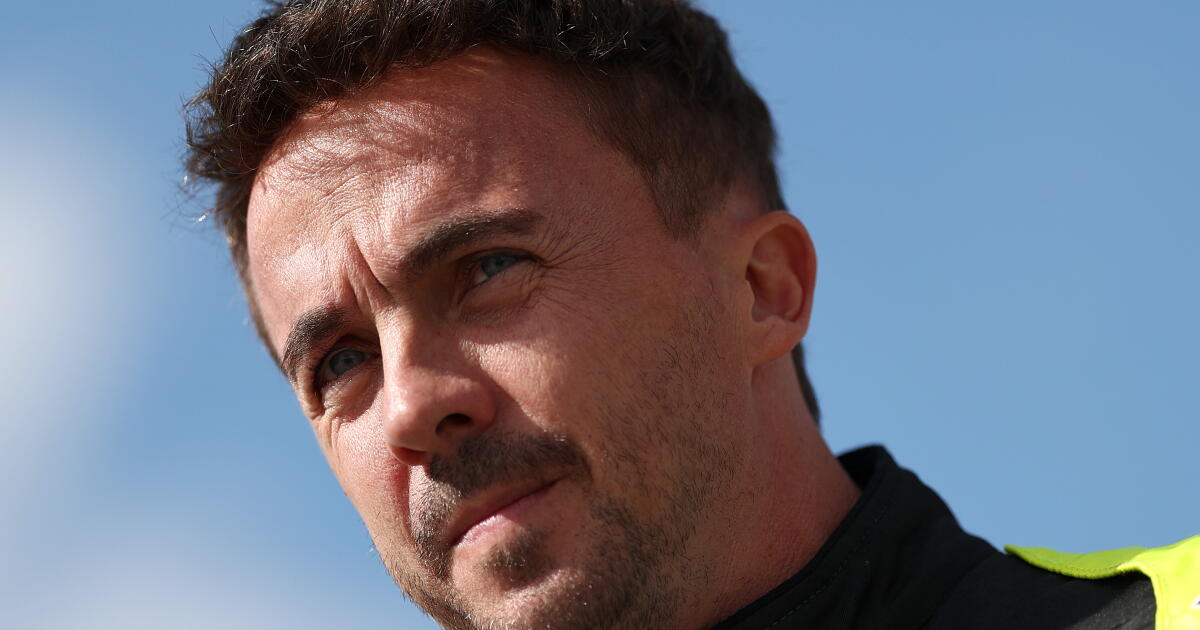
Frankie Muniz had a vulnerable moment on social media Friday, revealing he’s hit rock bottom following the announcement of his split from wife Paige Price.
The “Malcolm in the Middle” star announced he and Price were calling it quits after seven years of marriage in July, and now the actor is revealing he’s experienced some painful introspection in recent weeks.
“The last 6 weeks of my life have been a nightmare I’m praying to wake up from,” he wrote on Instagram. “Everything felt heavy, unclear, and like it was falling apart at the same time. I wouldn’t wish this season on anyone.”
He continued that despite the painful experience, “the unexpected gift in the middle of it is that I’ve had nowhere to hide.”
The actor-turned-race car driver said he’s spent the last several weeks reflecting and can now see the areas of his life where he thinks he can improve.
“I want to become a better version of me. Not the polished version I show the world … the actual one,” he wrote.
“I read that sometimes hitting rock bottom is the thing that wakes you up. It forces the changes you needed to make all along so you can live the best life possible. That idea has been sitting with me. In five years I believe I’ll look back at this exact low point and feel grateful for it, because the high I’ll be standing on then only exists because I went through this.”
He told his followers that this period isn’t the end of the story, but the catalyst for change.
“It’s the part where I start doing the work … the uncomfortable, unglamorous, necessary work. I’m choosing to treat this season as the foundation, not the finish line.”
Shortly after Muniz’s post, Price posted an Instagram story with a message that some followers speculated may be a response to the actor’s admission.
“Life is all about perspective. If you ask the grass, the zebra is the monster and the lion is the protector,” Price wrote.
Muniz is best known for his titular starring role in the beloved Fox sitcom “Malcolm in the Middle,” which ran for seven seasons in the early aughts. In April, the series returned for a four-episode reunion arc on Hulu starring returning fan favorites Bryan Cranston as Hal, Jane Kaczmarek as Lois and a couple of Malcolm’s TV siblings.
In 2006, when “Malcolm in the Middle” wrapped, Muniz transitioned away from acting and pursued race car driving.
Tens of thousands of people walk in and out of Dodger Stadium on any given night, paying scant attention to the trees, plants, and other foliage surrounding it on all sides. Chaz Perea made his peace with that a long time ago.
“Getting to Dodger Stadium is not a small thing,” said Perea, 41, the stadium’s landscape manager. “You’ve got to park in this monster,” he said, motioning to the acres of asphalt around him, “and then go find your seat in that monster.”
1
2
3
1.The agave garden sits outside Lot B at Dodger Stadium on Friday.(Gina Ferazzi/Los Angeles Times)2.Dodgers fans walk past vibrant plants behind photos of former Dodgerss outside center field at Dodger Stadium on Friday.(Gina Ferazzi/Los Angeles Times)3. A group visits agave island during a tour of Dodger Stadium’s botanic garden on Tuesday.(Christina House/Los Angeles Times)
For the past 17 years, Perea and his four-person crew have been responsible for every bit of stadium landscaping that isn’t the field itself. That’s roughly 300 acres, encompassing the parking lots, the hillsides meeting the 110 Freeway, and 149 concrete planters nicknamed “martinis” for their glass-like shape. The planters are original to the stadium’s 1962 construction, and many had crumbled badly enough over the decades to need painstaking repair.
The landscaping isn’t just about plants and planters. Behind a fence beyond the iconic orange 76 ball in the parking lot once sat a hidden garden. Its centerpiece was an eight-foot-tall stone lantern given to then-Dodgers owner Walter O’Malley by Japanese sports columnist Sotaro Suzuki and his wife, Toku, who had attended the stadium’s grand opening in 1962. Suzuki commissioned the 3,921-pound Kasuga-style lantern, which arrived in five pieces in late 1965 and became the centerpiece of a garden that also featured a small wooden bridge and a collection of rocks.
“For years, it was maintained by our gardener with great pride,” said former Dodgers owner Peter O’Malley, Walter’s son. “But it was remote, and fans couldn’t really get up there easily to see it or sit in the garden. And it got neglected for a few years. Some years later, I forget how many, we had to fence in the whole property.”
In 2024, shortly after the Dodgers signed two-way sensation Shohei Ohtani, the club moved the lantern to a place of prominence outside the top-deck gates, overlooking the downtown skyline. The move was an elaborate, delicate production. Bundled and boarded up, the lantern inched across the parking lot on the back of a flatbed truck that climbed a ring road steep enough to cause concern.
“It was like they were moving the Ark of the Covenant,” Perea said.
No one exhaled until the cargo was unloaded, unswaddled, and confirmed to be in one piece.
An 8-foot-tall stone Kasuga-style lantern is displayed at Dodger Stadium on Tuesday.
(Christina House/Los Angeles Times)
Perea’s crew works out of a large metal shed at the far end of a parking lot, a shop they affectionately call “the Oasis.” Much of what’s inside was retrieved from a dumpster, or scavenged before it landed in one. Perea, who describes himself as a bargain shopper, is passionate about repurposing whatever he can; many of the succulents at the stadium came from his own clippings.
“My general philosophy is I don’t treat the Dodgers like I’m salaried management,” he said. “I treat them like I’m a contractor that they don’t want to get rid of. So I manage the expenses and the labor as such.”
He doesn’t have much interaction with players and executives, though he’s occasionally been called to their homes to help with landscaping problems. One visit stands out.
“Vin Scully is the coolest one I’d stake a claim to,” he said of the legendary play-by-play man. “He was an unbelievable class act. He had a tree issue. He had us out, and was so attentive and appreciative, it was just stunning to me.”
1
2
3
4
1.Landscape manager Chaz Perea gives a tour of Dodger Stadium’s botanic garden.(Christina House/Los Angeles Times)2.A ceramic dog and monkey sit on a golf cart inside the Dodger Stadium landscape team’s shed on Tuesday.(Christina House/Los Angeles Times)3.A photo of Jim Lefebvre, Dodger player from 1965-1972, is surrounded by plants at Dodger Stadium on Tuesday.(Christina House/Los Angeles Times)4.Adolfo Hinojosa checks on the planters near center field at Dodger Stadium on Tuesday.(Christina House/Los Angeles Times)
On the hillside above the shop is an open-air lunch area, its seating made from wooden bleachers salvaged from the old right-field pavilion. Peek through the bushes and the stadium is visible in the distance. Inside the shop, the walls are lined with neatly organized shovels, pickaxes, and ladders. Above them hang paintings, art being another of Perea’s passions, most of them made by his friends.
Perea freely admits he’s an odd fit for the job. He’s not a baseball fan; he prefers beach volleyball and mixed martial arts. He had a rough upbringing in Arizona, dropped out of high school, and got by on $6.75 an hour doing golf-course maintenance, supplementing it with landscaping gigs he ran out of his pickup truck before eventually returning to school.
He came back to the classroom with a purpose, not only finishing high school but going on to earn multiple advanced degrees and, ultimately, a Ph.D. He’s now a professor of horticultural science and co-chair of agricultural science at Mt. San Antonio College.
But it’s his day job that draws clusters of Dodger fans willing to pay $52.25 each for his 90-minute botanic garden tour of the grounds. They explore “Agave Island” near the main entrance, a wedge of land planted with nine palm trees to match the number of players on a baseball field, and the planters outside the club-level entrance, where the crew grows chilies (jalapeños, serranos, habaneros), along with basil, mint, tomatoes, onions, and garlic. That garden spawned an annual salsa competition, in which club employees harvest their own ingredients from the planters, make salsa at home, and bring it back to be judged. Perea and his crew make handmade tortillas and quesadillas for the event.
Landscape manager Chaz Perea gives a tour of Dodger Stadium’s botanic gardens on Tuesday.
(Christina House/Los Angeles Times)
Two more planted islands are devoted entirely to tequila agave. It takes nearly a decade for the plant to mature, and about 110 pounds of its core to yield a single liter of tequila through processing. Perea and his crew hope to eventually try making some themselves, as an in-house project rather than a commercial one.
The landscape looked very different before Perea arrived. He describes the old look as Disneyland-esque: heavy on lawns and flowers, constantly in need of replacement, and thirsty for water. About two years into the job, he began swapping annual flower beds for drought-tolerant succulents. When one executive noticed and ordered the flowers put back in a particular spot, Perea complied there, then made the same swap a little farther down the hillside, out of view.
Turnover among executives and ownership gave him repeated openings to make wholesale changes, a shift that coincided with California’s drought crisis. Within a few years, he had planted 10,000 cuttings and stripped every flower bed from the property.
“A lot of people look at this as the last unpainted canvas in Los Angeles,” Perea said.
Chaz of Chavez Ravine, perpetually painting the corners.
In the second week of the college football season, in a clash of titans, the University of Texas scored 21 unanswered points to surge past Ohio State in the fourth quarter and win, 24-23.
The comeback, Gov. Greg Abbott decreed, was the greatest home victory in more than 130 years of Longhorn football.
A screen grab of one celebratory moment showed a group of students ecstatic beyond belief. They were clad in the university’s signature burnt orange. Two wore cowboy hats. One flashed “Hook ‘em Horns,” the university’s proud hand signal.
To see the picture earlier this month was to witness pure, untempered joy.
Most of the students were darkly complected and apparently of South Asian heritage. French posted the photo and wrote on X, “I heard UT graduation this year looked like this. I didn’t believe it. The problem is now obviously far worse than anyone imagined.”
“Like body-cams exposed criminals, social media is exposing how many Americans have been displaced by foreigners,” French spewed. “It’s everywhere and far worse than any of us could imagine.”
In many places, French’s unapologetic, unvarnished bigotry would be disqualifying. But given Texas’ strong Republican leaning he stands a better-than-even chance of being elected in November to the state Railroad Commission, which, despite its name, oversees Texas’ vast oil and gas industry.
The hateful gibe was perfectly in character. “In some ways in Texas this is old news,” said Brandon Rottinghaus, who teaches political science at the University of Houston.
Last year, as chairman of the Tarrant County GOP, French posted an online poll asking, “Who is a bigger threat to America?” The choice on offer: Muslims or Jews.
Speaking in March at a political conference, he urged President Trump to round up and deport every Muslim in the country, calling the Islamic faith subversive and a clear and present danger to America.
“The Republican Party is used to Bo French making these kinds of outrageous statements,” Rottinghaus said.
Still, the response to French’s latest acrid emission was telling, not least for what it says about reflexive partisanship and today’s political reward structure.
As you’d expect, his Democratic opponent, state Rep. Jon Rosenthal, was scathing. “I spent 25 years as an oil and gas engineer,” he wrote on social media. “Bo French spent Sunday morning sorting our student section by skin color … A man who can’t tell a Longhorn from a foreigner has no business regulating anything in TX.”
The state’s outgoing U.S. senator, Republican John Cornyn, was also quick to denounce French. “This is the Republican nominee for statewide office,” Cornyn said in a post. “Are other Republican elected officials going to condemn the intolerance and racism, or look the other way while it becomes normalized.”
“That is not my message,” Abbott said in a written statement, summoning the moral clarity and political courage of a puff pastry. “We all support our college football teams. The way we win the state is the same way we win football games. We unite under the brand of Texas.”
Then, just to have it both ways, Abbott suggested “that doesn’t mean that Texas cannot also lead in having the toughest immigration laws of any state in America and freezing H1B visas at our universities.” (The overwhelming majority of those holding H1B visas are Asian nationals from India and China.)
Paxton responded by attacking his Democratic opponent, state Rep. James Talarico, for saluting Cornyn for taking a stand against French’s prejudice. “I condemn racism in all its forms,” Paxton wrote on X, adding, “Only one person in this race has a history of dividing Texans by race, and it’s James Talarico.”
A simple, straightforward condemnation shouldn’t have been hard. Lacey Hull, a Republican state representative from Houston, was among those in the GOP who showed how.
“Please delete this,” she urged French on X. “This post breaks my heart. I see college kids cheering on their football team. I see Texans.”
Both need a robust GOP turnout to win in November and neither wants to risk alienating too many within the party’s xenophobic, anti-immigrant wing.
“They’re concerned about turnout,” said Mark Jones, a political scientist at Rice University. “Texas is a red state, but one thing that Republicans are concerned about is that the base may not turn out in as large a number as they need.”
Given French’s loathsome history, Abbott and others in the party establishment worked hard to keep him from winning the Republican nomination, Rice noted. But not Paxton. He headlined the kickoff to French’s campaign and has good reason to be glad he won and is now part of the GOP ticket.
His presence means that Paxton is only the second most odious figure seeking statewide office in Texas in November.
UCLA offensive coordinator Dean Kennedy stressed that his offense needed to come out swinging Saturday against Purdue after going scoreless in the first half against San Diego State last week.
And the Bruins heeded the advice, scoring 21 first-quarter points before pulling away in the second half to take a 52-38 win in their Big Ten opener Saturday night at the Rose Bowl.
UCLA improved to 3-0 and matched its 2025 win total with its first 50-point game against a Power Four program since November 2022. Bob Chesney joined Terry Donahue and Jim Mora as the only coaches to start their UCLA tenures 3-0.
Fifth-year tailback Wayne Knight spearheaded the offensive outburst, rushing for 177 yards and two touchdowns for a Bruins team that had 369 yards and four touchdowns on the ground via an average of 7.7 yards per carry. Knight has eight touchdowns in three games, matching the Bruins’ total output for rushing touchdowns last season.
“The biggest thing for us was to just put it all together. And I think that we stepped up to that challenge — what we did on the ground, in the air,” Knight said. “But the guys up front, no matter who is in there as guys are rotating all the time, whoever is in there is going to put up front. They are working as a team.”
While Chesney made sure to acknowledge his running backs — with all three starters reaching the end zone — he made a point to recognize the man under center, highlighting senior quarterback Nico Iamaleava’s resiliency.
After posting two interceptions to zero passing touchdowns through the first two weeks of the season, Iamaleava completed 19 of 31 passes for 276 yards and three touchdowns while rushing for 55 more. Iamaleava looked much more comfortable and confident in the pocket, despite playing through multiple injuries.
UCLA defensive players celebrate after defensive lineman Sahir West (15) recovers a fumble against Purdue Saturday at the Rose Bowl.
(Ronaldo Bolanos/Los Angeles Times)
“Last week, I told you it wasn’t his greatest game. We watched him go out here today, and I think he was near perfect for a stretch in the beginning of that game, finding all kinds of different receivers and being able to carry the ball himself a little bit,” Chesney said. “And just what a warrior, because he was pretty nicked up out there in moments, and he just wanted to keep fighting.”
Iamaleava found security in senior wideout Semaj Morgan, who hauled in four passes for 72 yards and two touchdowns. In three years at Michigan, Morgan had just four receiving touchdowns. Outside of Morgan, fifth-year wide receiver Leland Smith caught three passes for 59 yards despite playing just one snap across the previous two weeks, potentially giving Iamaleava and Kennedy a big target to look to going forward.
James Madison transfer Landon Ellis, who returned to the field for the first time since going down with a head injury in the beginning of the second half against California, scored his first touchdown as a Bruin. And South Carolina transfer Brian Rowe Jr. caught two passes for 65 yards despite getting targeted eight times, including a deep shot from Iamaleava in the end zone that bounced off his chest.
Although UCLA’s offense turned in 645 yards of total offense, its defense struggled to hold back a Purdue team that lost its 19th consecutive conference game.
UCLA quarterback Nico Iamaleava passes during the first quarter Saturday against Purdue.
(Ronaldo Bolanos / Los Angeles Times)
While the Bruins held Aztec signal caller Jayden Denegal to just 45 passing yards, the secondary found itself facing a different beast in Boilermaker quarterback Ryan Browne, who completed 19 of 30 passes for 378 of Purdue’s 488 total yards, with a touchdown and an interception. Xavier Townsend had 162 yards receiving and two touchdowns.
“I felt like the pressure mounted a little bit and we were not as clean in our technique as we needed to be,” Chesney said. “We can’t put ourselves in panic mode, which might have hit us a little bit throughout today. But when we needed it the most, we were able to get a stop.”
Chesney said the UCLA defense has the personnel and ability to compete with anyone, but penalties and a fake punt that resulted in a first down allowed the Boilermakers to get within one score and added unnecessary pressure.
Fortunately for the UCLA secondary, linebacker Sammy Omosigho put the defense on his back.
Omosigho led the team in tackles with 12, but more important, he had two sacks and two forced fumbles. He has four forced fumbles in three games.
“That’s his third game in a row forcing a fumble. There’s other things he’s going to want to clean up in there too and other schematic things that he can do better,” Chesney said of Omosigho. “But at the same point in time, the one play that stuck out to me was a running back, and it looked like he was going to go and get the edge, and Sam just put out one arm and just crumbled this kid with one arm. The strength he has, the poise he plays with, the toughness he plays with and the strength to be able to execute and finish on those tackles, are things that are pretty impressive.”
UCLA running back Anthony Woods is hoisted up by offensive lineman Julian Armella after scoring a touchdown against Purdue at the Rose Bowl on Saturday.
(Ronaldo Bolanos/Los Angeles Times)
James Madison transfer Sahir West recovered both of Omosigho’s takeaways — the Boilermakers’ first two giveaways this season — and they set up UCLA touchdowns.
While Purdue (1-2) kept up with UCLA for most of the game, its hopes of a comeback ended when senior defensive back Rodrick Pleasant picked off Purdue quarterback Ryan Browne with less than six minutes left.
Despite the Bruins’ difficulty thriving on both sides of the ball during the same game, Chesney said he is confident in his team’s ability to compete going forward.
“We heard the guys on defense saying thanks for getting our back,” Chesney said. “The offense struggled last week, we’re going to need them at some point. The defense is going to need that at some point, and then we’re all going to need the special teams at some point. We haven’t played the perfect complementary game yet, but there’s one in there and I’m looking forward to seeing that day because it exists. There’s fibers in here of a really high level football team.”
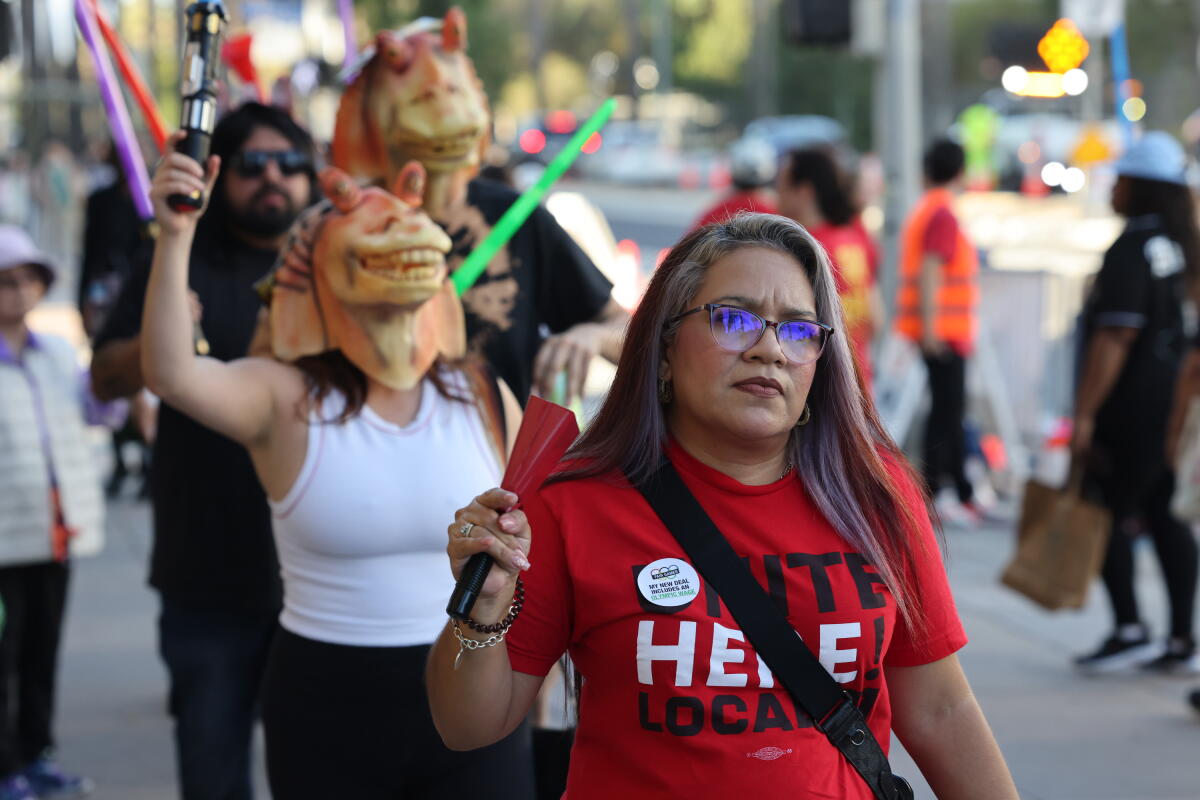
Days before the Lucas Museum of Narrative Art officially opens, protesters from the Fair Games Coalition — wearing Jedi robes and Jar Jar Binks masks and carrying lightsabers — rallied together outside the new museum.
Dozens of people from the group fighting for better worker protections during major sporting events were loudly blowing horns, banging drums and chanting, “Sí se puede,” directly across from Exposition Park’s newest museum. The group was at the museum’s private opening party Saturday night to take a stance against museum co-founder Mellody Hobson‘s recent resignation from the Los Angeles Olympics organizing committee, LA28.
“We launched the campaign with some real, reasonable demands,” said Jessica Durrum, the director of the Fair Games Coalition, for the Los Angeles Alliance for a New Economy. “If the Olympics are coming to town, we want to make sure there are lasting benefits for our communities.”
The Fair Games Coalition, which is made up of over 80 organizations, formed to fight for better labor deals during major events like the Super Bowl and the Olympic and Paralympic Games. Some of the unions in the coalition include United Teachers Los Angeles, National Union of Healthcare Workers, United Food and Commercial Workers Local 770, United Farm Workers and various community groups.
Ahead of these events, the group is asking that employers provide union and living wage jobs, funding for 50,000 units of housing for working families, a moratorium on short-term rentals and protections for immigrant workers.
Gladys Avyla marches in a Fair Games Coalition protest outside the Lucas Museum of Narrative Art.
(Jonathan Alcorn / For The Times)
Gladys Avyla, a member of Unite Here Local 11, has worked as a cleaner at the W Hotel in Hollywood for the last 14 years. Several years ago she had to move to Victorville when her rent in L.A. got too high. Avyla said that with these major sporting events coming through town she’s worried the cost of living will continue to rise as her work gets busier and busier.
“Rent is very high, and everything is expensive. It’s hard living here. We need a wage increase for the Olympics because everything costs so much,” Avyla said in Spanish. “We need help for all workers. We’re human beings, but, honestly, we aren’t treated like human beings.”
Hobson, who co-founded the billion-dollar museum alongside her husband, George Lucas, resigned from LA28 earlier this week. She reportedly stepped down from the position due to the demands of running the Lucas Museum.
But the Fair Games Coalition claims she responded to their requests to meet and discuss their concerns by resigning. The 35-person board led by Casey Wasserman, who was recently under heat for his ties to Jeffrey Epstein and Ghislaine Maxwell, is meant to help plan and execute the upcoming Olympic Games.
“That’s how you hide your head in the sand. But we’re not giving up. She still has clout and still has a lot of power in the city of Los Angeles with the Olympic Committee,” said the Rev. Gary Bernard Williams from St. Mark United Methodist Church, a member of the coalition. “There’s going to be a lot of money flowing at the top. Very little money will be trickling down to the workers who need it the most.”
Demonstrators at a Fair Games Coalition protest at the Lucas Museum of Narrative Art.
(Jonathan Alcorn / For The Times)
LA28 and the Lucas Museum did not immediately respond to a request for comment.
During this year’s World Cup, where several games were hosted in L.A., Unite Here Local 11, the union which represents workers including dishwashers, concession workers, bartenders and servers and SoFi Stadium’s food-service operator Legends Global, came to a tentative agreement days before the first match. Pastor Bridie Roberts, who works as the community organizing director at Unite Here Local 11, said having the Fair Games Coalition’s support was helpful during the negotiations.
“Our members face serious, critical decisions every single day about how to make ends meet and they work with some of the biggest tourism companies in the world that will profit in the billions of these games,” said Roberts. “We feel that the games have potential to bring real outcomes for working people, but only if we fight for them.”
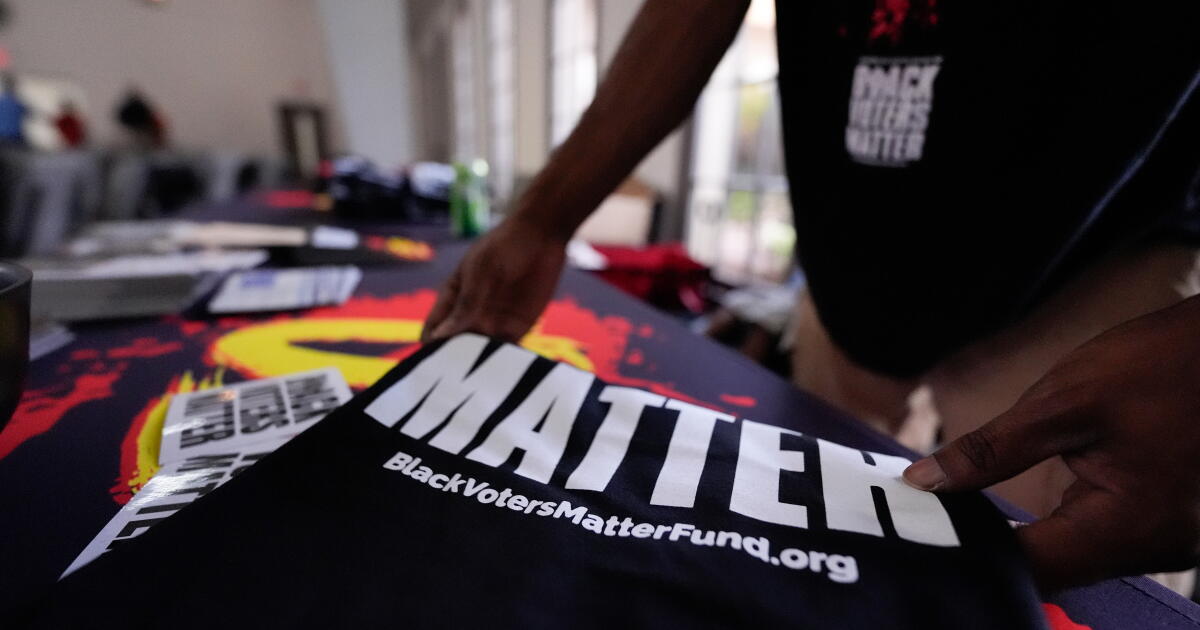
WASHINGTON — Several of the nation’s largest voter engagement and racial justice organizations are facing steep funding shortfalls and staffing cutbacks just as voting is getting underway in an election that will determine control of Congress for the final two years of President Trump’s term.
The shortfalls are setting off alarms among Democratic strategists, who are betting on high turnout and robust voter protection efforts to boost the party’s chances this fall. They are worried that many grassroots groups will not be able to mount effective registration and get-out-the-vote efforts, much less protect against the possibility of election interference from the administration given Trump’s efforts to restrict voting access and assert federal control over the election.
America Votes, a coordinating hub for more than 400 progressive groups, has fallen “well below” the level of funding it had during the 2022 midterms, the group’s executive director, Daria Dawson, said in a statement to the Associated Press. America Votes has acted as a nerve center for the voter mobilization efforts of groups such as the NAACP, Planned Parenthood, the League of Conservation Voters, the AFL-CIO and SEIU labor unions, as well as local groups focused on racial justice, climate and civil liberties.
“There is still time to reach voters and bring them into this election, but we are no longer talking about a future opportunity,” Dawson said. “The window to engage them is open now, and it is narrowing every day.”
Racial justice activists feel betrayed
Wealthy donors and philanthropic groups have reduced their support of many liberal causes since the 2024 presidential election. That pullback has been especially stark for voting groups geared toward engaging communities of color.
While multiple organizers said some funders had expressed an interest in adopting different strategies, racial justice organizers have felt that as a betrayal.
A retreat in donor support is “handcuffing our ability to persuade our communities to vote in a year where there is no Voting Rights Act,” said Esosa Osa, a veteran Democratic strategist and founder of Onyx Impact, a research group focused on combating misinformation in Black communities.
A Supreme Court ruling this year knocked out one of the last remaining pillars of that landmark 1965 law, essentially gutting it.
“We are watching surrender, not strategy,” Osa said.
A July memo that circulated among major Democratic fundraisers warned that “the organizations that registered and persuaded millions of voters to participate in the 2018 and 2022 midterms are drastically underfunded. They have raised nearly 40% less than they had at this point in those cycles.”
It further warned that funding voter mobilization groups was especially critical “given that the Democratic brand is underperforming on generic ballot tests relative to historical comparisons and the president’s approval ratings.”
The shortfalls have led organizations focused on engaging and mobilizing key voting groups to scale back operations and staffing over the last year. That has included programs aimed at registering and mobilizing lower-propensity voters, voters of color, and rural and younger voters.
The Democratic National Committee, which has faced its own funding challenges, has consolidated voter engagement efforts this year partly in response to the ecosystem’s past shortcomings. The DNC in a statement said it was making “historic investments” in its organizing but did not address the weaknesses among allied groups.
“We are expanding our voter protection infrastructure to defend Americans’ sacred right to vote, hold Trump and Republicans accountable in court, and register and mobilize voters across the country,” said Angelo Fernández Hernández, a DNC spokesperson.
‘Being Black … again has become a bad word’
The reasons for the troubled funding landscape are varied and at times unclear, according to nearly two dozen fundraisers and organizers who spoke with the AP. Some donors, still disappointed with the Democratic Party and some of its allies following the 2024 presidential election, have closed their pocketbooks to liberal causes entirely.
While a small group of liberal megadonors has continued to bankroll progressive causes, most focus their support on liberal legal organizations that have taken the Trump administration to court, rather than political or voter engagement groups.
Others, including major philanthropic institutions, have pulled back out of fear of retribution that giving to political or racial justice causes could draw the administration’s ire. Organizers who have engaged with potential donors said the administration’s targeting of political opponents and diversity initiatives seems to have put a chill on fundraising for their causes.
Tameka Ramsey-Brown, founding director of the Michigan Coalition on Black Civic Participation, said multiple donors since the 2024 election had asked whether her group could remove the word “Black” from its name or find financial conduits to mask the source of donations for fear of retribution from the administration.
“Just being Black in this country again has become a bad word, and it has made it that much more difficult just to raise money because funders don’t want the added pressure and stress or attacks on them by funding us,” she said.
Smaller budgets, shifting strategies
Many of the nonprofit groups that traditionally have conducted the registration, voter education and organizing say they are trying to adapt to their new, leaner reality.
Vamos a Votar, an initiative of the largest civil rights and advocacy groups focused on Latino communities, has had to readjust its ambitions this year due to a lack of investment from funders.
“This is shaping up to be a cycle where investments haven’t gone to the Black and brown communities that will ultimately decide this election,” said Juan Proaño, chief executive of the League of United Latin American Citizens, a member of the initiative.
In a September pitch circulated among donors, the coalition said it aimed to invest $27.5 million in voter engagement and persuasion efforts this year, but still required $5.4 million from donors to fund voter turnout efforts across 10 states and 17 House districts. Even that investment reflected reduced ambitions from previous pitches to donors early this year.
“It has been extremely disappointing to see that progressive donors are not meeting the moment,” said Héctor Sánchez Barba, head of Mi Familia Vota, one of the affiliated organizations. “We are not waiting. We are always on the front lines for our democracy and our communities.”
To counter the funding cutbacks, some groups have begun relying more heavily on artificial intelligence to provide voter registration guides, share information in multiple languages and track potential election issues. Some groups have increased their partnerships with ride-sharing companies to provide free rides to polling places instead of bus shuttles.
With fewer in-person organizers, some groups are also focusing on social media and partnering with liberal content creators to boost their messages.
“In my more than 30 years of organizing, it has never been this bad to raise money to support Black causes of any kind,” said Melanie Campbell, president and chief executive of the National Coalition on Black Civic Participation, a nonpartisan civil rights group.
“We’re going to do the work, our state affiliates are doing all that is possible. … But the bottom line is that those who believe that democracy matters should make sure they fund the work.”
The new incentive is aimed at bringing back jobs for the industry’s editors, sound mixers, composers and visual effects artists. It will allow a 35% to 50% credit on qualified expenses related specifically to post-production work done in California, and unlike the state’s existing film and TV credit, it doesn’t require productions to shoot here.
“This legislation protects the extraordinary people who make this industry possible and makes it unmistakably clear: California is still the future of film and television,” said Gov. Newsom in a statement. “We have the talent. We have the infrastructure.”
The bill, AB 2319, was authored by Assemblymember Nick Schultz (D-Burbank) and introduced earlier this year. It cleared the state Senate 33 to 5 on Aug. 30, and the Assembly approved the final version 72 to 2 the same day. Schultz originally sought $100 million for the program. It is expected to start in January with $10 million, according to the Assemblymember Schulz’s office.
“It’s a historic moment for California’s post-production community. But it’s also just the beginning of what we really need to do to to fight for our industry,” said Marielle Abaunza, president of the California Post Alliance, a group advocating for the bill. She said the group is readying its strategy to get more funding for the program next year.
As Hollywood productions continue chase tax credits to other states and countries, much of the post-production work is going with them. California’s share of U.S. post-production employment has fallen from 53% to 42% over the last 13 years, according to CVL Economics, an economic consulting firm tied to California Post Alliance. The state had about 12,000 post-production jobs last year, per CVL Economics.
Ben Urquhart, 51, spent 18 years as a post-production executive at NBCUniversal. The Culver City resident hasn’t been able to find work in the two and a half years since he was laid off.
“It’s grim and it’s hard. There are jobs, but we have a large amount of extremely qualified people competing for every level of job,” Urquhart said. “When I was a kid, I was a [production assistant] in the 90s, and you could get a job within a couple of weeks. But when I got laid off a couple of years ago, I realized that is certainly not the case at all anymore. It’s been a large-scale transformation.”
Urquhart said the new incentive would help California compete with jurisdictions that already offer these credits and “level the playing field.”
Last year, California expanded its film and TV tax credit program, more than doubling the old $330-million cap to $750 million through June 30, 2030. The existing program already covers post-production, but only if 75% of filming or the overall budget is spent in the state.
Newsom also signed a bill that would strengthen the current tax incentive program overall. In June he revealed a state budget measure that capped how much in tax credits a business can claim each year, a limit industry groups warned would undercut the expanded program. But the new Senate Bill 186 enhances refundability for the industry and exempts independent productions from the credit limits, starting next year.
The advertising blitzkrieg of L.A.’s mayoral campaign is here.
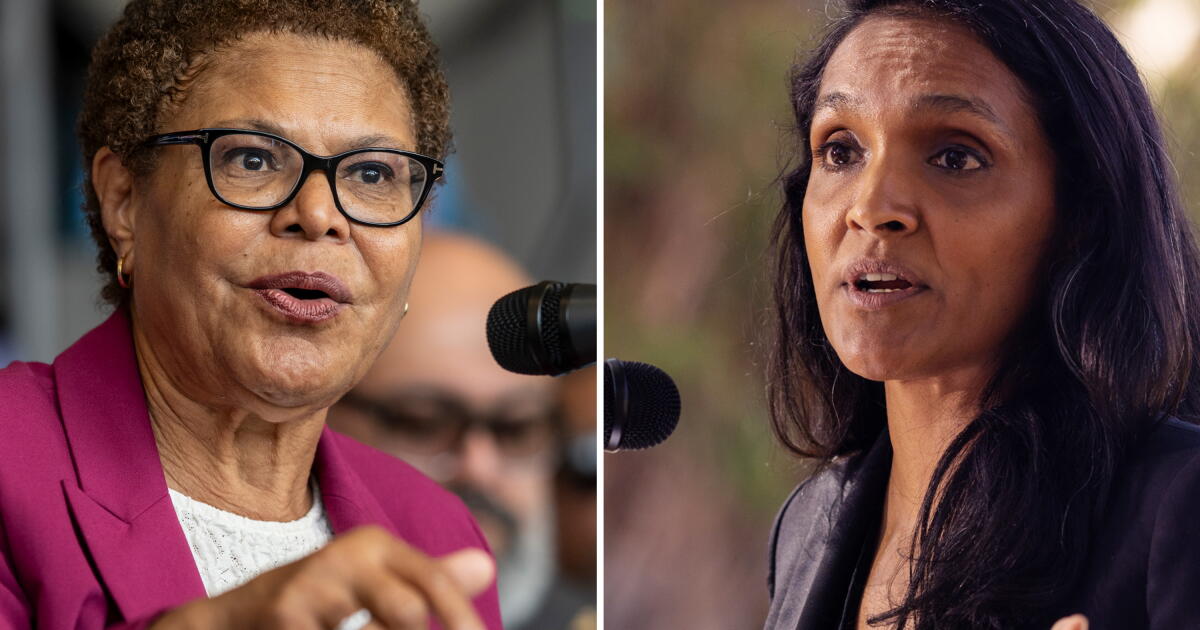
Mayor Karen Bass and her opponent, City Councilmember Nithya Raman, dropped new campaign commercials over the last week, buying time on television, streaming channels and other platforms. Supporters of both candidates released ads as well.
The two candidates relied heavily on free media for most of the summer, putting videos on Instagram and inviting the news media to cover their appearances.
The dam effectively burst on Monday, with Raman touting her new Hollywood-themed ad “For Your Consideration,” timed to coincide with the Emmy Awards.
You’re reading the L.A. on the Record newsletter
Sign up to make sense of the often unexplained world of L.A. politics.
By continuing, you agree to our Terms of Service, which include arbitration and a class action waiver. You agree that we and our third-party vendors may collect and use your information, including through cookies, pixels and similar technologies, for the purposes set forth in our Privacy Policy such as personalizing your experience and ads.
The 30-second spot starts with Raman stepping out on the town, then shifts to some standard L.A. imagery: freeways, palm trees, Echo Park Lake and, of course, the Hollywood sign.
“L.A. shows the world what it means to be a star,” declares the ad’s narrator, actor and screenwriter Bob Odenkirk. “And every Angeleno deserves the chance to reach for their own.”
After Raman has stopped off at a taco stand and hugged a dog, Odenkirk delivers the ad’s final message: “Change. Affordability. An L.A. that loves you back.”
That ad ran on television a few times before being cycled onto social media, per the Raman campaign.
Three days later, Bass went up with a 30-second spot — on digital platforms for now — centered on President Trump’s immigration raids.
The ad offers footage from the day in July 2025 when Bass confronted federal immigration agents in MacArthur Park. The video features images of gun-toting federal agents in military uniforms and Bass hopping out of a car in an aquamarine pant suit to face them.
“When someone comes after your family, you don’t hesitate,” Bass says. “You stand up. You fight.”
One of Bass’ most formidable allies — the Los Angeles Police Protective League — went hard negative with its first ad of the runoff campaign, offering the message that Raman “Doesn’t Get It.”
The commercial, released Friday, follows a young girl as she walks past a homeless encampment, juxtaposed against video of Raman talking about her opposition to a law that prohibits encampments near schools.
“I don’t think a kid’s gonna be safer because a tent is 500 feet away from a school,” Raman said in the clip, which was taken from a 2024 candidate forum in Sherman Oaks.
The backpack-wearing child speaks to the camera and says: “Walking to school shouldn’t be scary.”
“I’m just a kid,” she says. “But even I know I’d be safer if this was 500 feet away.”
The police union says the ad will start running on television this weekend and already is on social media platforms.
Meanwhile, Raman’s backers have an assortment of attack ads running on Facebook and Instagram.
Streets For All, a group that wants to expand the city’s bus and bike lane network, pulled video footage from a different Sherman Oaks candidate forum — this one featuring Bass and Raman last month.
At that event, Bass told the audience that Raman is unresponsive to her constituents, forcing many in Sherman Oaks to contact the mayor’s office directly.
“Many of you have my cellphone, you have called me,” Bass says in the ad. “You called on me specifically for help.”
Streets For All contends those remarks show that Bass gives wealthy homeowners her number while “regular Angelenos get ignored.”
“L.A. deserves a mayor who doesn’t just listen to the rich and powerful,” the ad says.
By Friday, Streets For All had nearly two dozen different video spots opposing Bass over such issues as homelessness, transparency and the Palisades fire, according to Ethics Commission filings.
The biggest backer of the group’s political action committee is hedge fund manager Aaron Sosnick. Of the $1.2 million that the group plans to spend in the mayor’s race, Sosnick has provided $1 million, said Michael Schneider, who heads the group.
Schneider said the committee also has financial support from retired real estate developer Yuval Bar-Zemer — known for his work in the Arts District — and Todd Wexman, chief principal of 4SITE Real Estate, a real estate development company.
Raman pollster says she’s in the lead
The Raman campaign shared the results of a new internal poll that showed their candidate with a five-point lead over Bass.
Of the 600 likely voters who were surveyed, 44% supported Raman and 39% backed Bass, with 17% undecided, according to a memo provided to the campaign and viewed by The Times. The survey, conducted by Hart Research Associates in early September, had a margin of error of 4 percentage points.
“In the initial trial heat for Los Angeles mayor, Councilmember Nithya Raman is in the rare position for a challenger of already LEADING the incumbent,” the polling firm wrote.
Another poll, commissioned by an independent expenditure group supporting Raman, portrayed the race as a statistical tie, at least initially. Estamos con Nithya for Mayor of LA 2026, sponsored by the Western States Regional Council of Carpenters, said its poll showed Bass with 38% and Raman at 37%.
However, when voters received more information on the candidates, Raman took a 7-percentage-point lead, with 41% supporting her and 34% supporting Bass, according to a memo prepared by the group’s pollster.
The margin of error was 3.7 percentage points.
The Bass campaign declined to share its internal polling when contacted by The Times.
However, Neighborhoods for a Better L.A., an independent expenditure group supporting the mayor, said a survey it commissioned in early August showed the mayor with an edge over Raman of 41% to 35%, with 24% of the electorate undecided.
That poll, conducted by Tulchin Research, surveyed 1,200 likely Los Angeles voters and has a 2.8-percentage-point margin of error, the group said.
The poll also found that when given “balanced biographies” about both candidates, Bass’ support grew to 45% while Raman went down to 33%.
“Communications focused on Raman’s record can both reduce her support and consolidate voters behind Bass,” the pollsters wrote.
Giving back El Grito cash
Los Angeles City Councilmember Imelda Padilla locked down sponsorships for the city’s celebration of El Grito, which marks Mexico’s independence.
Tuesday’s event, which featured an evening of musical performances, was sponsored by an assortment of city contractors and government agencies, including waste hauler Athens Services and the Department of Water and Power.
Still, Padilla decided she didn’t want to partner with one particular business, announcing at the last minute that organizers no longer would accept a $5,000 sponsorship from Home Depot.
On the day of the celebration, Padilla issued an apology on Instagram, saying she had heard from community members upset over the event’s affiliation with Home Depot, whose parking lots have been the site of many federal immigration raids.
“We have rescinded their partnership for this event,” Padilla said in her post. “The spirit of El Grito is rooted in celebrating our Latino heritage and creating a space where our families feel welcomed, safe, and celebrated.”
In an email, a Home Depot spokesperson said the company is not involved in immigration enforcement activities and doesn’t coordinate with Immigration and Customs Enforcement or U.S. Border Patrol. The company also doesn’t receive advance warning about enforcement actions, the representative said.
“We cannot legally interfere with federal enforcement agencies, including preventing them from coming into our stores and parking lots,” Home Depot spokesperson Evelyn Fornes said.
State of play
— COZY WITH CARUSO: Billionaire developer Rick Caruso, who was defeated by Bass in 2022, appeared alongside the mayor at a groundbreaking for the Palisades Recreation Center. Caruso praised her for her work on the project but stopped short of endorsing, saying he intends to meet with Raman in the coming weeks.
— LIFE AFTER PRATT: The voters who picked reality TV personality Spencer Pratt in the June 2 primary election are now up for grabs. But will they stay home instead of picking a mayoral candidate?
— BASS BAILS: The mayor skipped a congressional hearing on waste and fraud in homeless spending this week, calling the session politically motivated. Rep. Tim Burchett, the Republican who chaired the subcommittee meeting, accused her of dodging accountability.
— FINDING FRAUD: Federal authorities arrested three people who were working in Los Angeles-area homeless nonprofits this week, accusing one of them of misappropriating more than $7.5 million in taxpayer funds. Scott Turner, secretary of the Department of Housing and Urban Development, said the Los Angeles Homeless Services Authority, which provided the funding, had allowed fraud to “run rampant.”
— WE’RE IN THE MONEY: The 2028 Summer Olympic Games in Los Angeles will generate up to $40.6 billion in increased economic output and add as many as 224,000 jobs, according to an upbeat economic forecast released this week. Another, more tempered estimate put the increase at $20.5 billion to $25.4 billion.
— SEETHING OVER SKID ROW: Some activists want dogs taken away from homeless residents living in Skid Row, saying those animals are living in an unsafe environment. A Bass aide responded by cautioning that it is “neither humane nor legal to remove animals from their human companions without appropriate cause.”
QUICK HITS
Where is Inside Safe? The mayor’s signature program to combat homelessness went to Avalon Boulevard and 64th Street in South L.A., an area represented by Councilmember Curren Price.
On the docket next week: The council’s Public Works Committee meets Tuesday to discuss ways of cleaning, safeguarding or demolishing nuisance properties.
Stay in touch
That’s it for this week! Send your questions, comments and gossip to LAontheRecord@latimes.com. Did a friend forward you this email? Sign up here to get it in your inbox every Saturday morning.
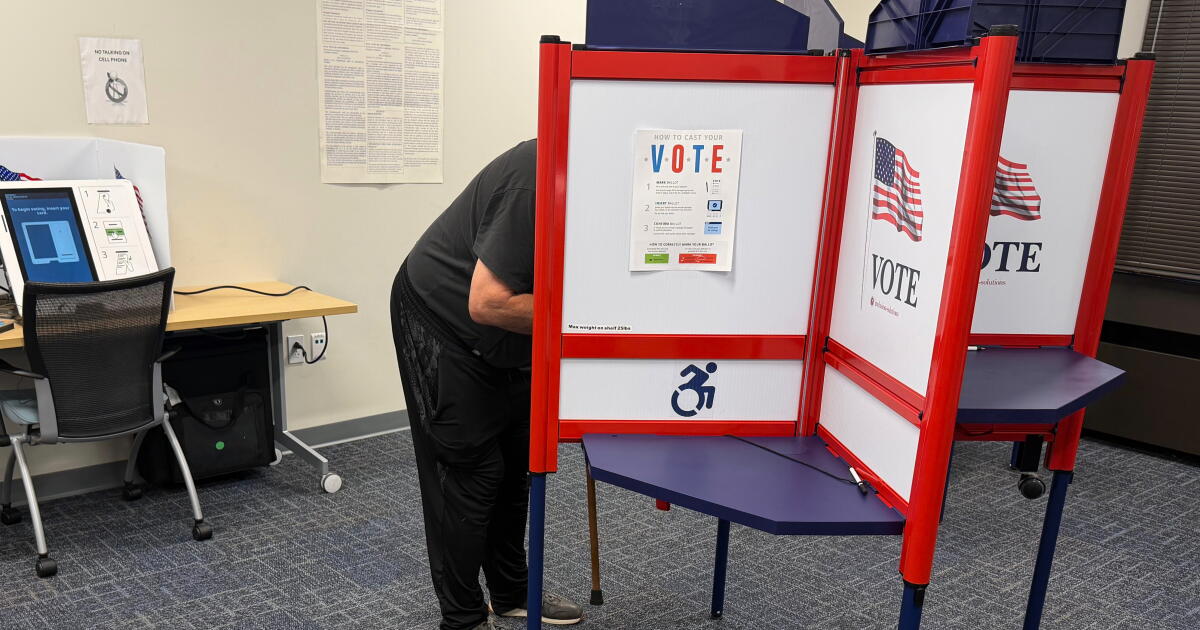
HENRICO, Va. — In-person voting for this year’s midterm elections began Friday, ushering in the final six weeks for Americans to decide which party they trust to lead Congress through a cost-of-living crisis, a prolonged war in Iran and other pressing issues.
Election administrators say they are prepared and confident the vote will be accurate and secure. Nevertheless, President Trump has continued with efforts to denigrate certain voting methods and reshape how elections are run, through court challenges, an expansive federal hunt for noncitizen voters and a pressure campaign to force election officials to share sensitive voter data.
Friday marked the start of early voting in Virginia. Voters in a handful of other states, including Idaho, Minnesota and South Dakota, can cast absentee ballots in person, typically at a local election office or voting center. More expansive early voting is scheduled to begin in those and other states in the coming weeks.
At a voting location in Fairfax, Virginia, 18-year-old college student Sanya Singhal was among the first to vote early in person Friday morning, arriving well before the site opened to get in line.
“Why not just have a little fun in life, you know, try to be the first early voter?” she said. “I really want to participate in my democracy.”
At a voting location in suburban Richmond, a poll worker rang a bell as the building opened and about a dozen voters in line began to file in. Stephen Gura was excited to be the first.
“This election is critical. We need to stop the Trump agenda. We need to start electing people who will stand up for people in this district,” said Gura, who added that he voted for U.S. Sen. Mark Warner, a Democrat, and Shannon Taylor, the Democratic nominee against Republican incumbent Rob Wittman in the 1st Congressional District.
The Nov. 3 election includes votes for governor and state legislature in most states and will determine whether Republicans maintain control of the U.S. House and Senate. If Democrats retake Congress, it will alter the trajectory of the final two years of Trump’s term, most likely leading to investigations and other oversight efforts.
Voting underway after unusual redistricting and Trump’s bid to control how elections are run
At the suburban Richmond voting center, a steady stream of voters flowed in and out for the first hour of early voting. William Curry, a 74-year-old retiree who described himself as a libertarian-leaning independent conservative, voted for Warner’s Republican challenger, Bert Mizusawa, and Wittman. Curry said he generally approves of the job Trump has done, apart from the war with Iran.
“He’s in a mess he can’t get rid of,” Curry said of the conflict.
On a rainy day in Sioux Falls, South Dakota, Bill Goehring, 67, said he voted early at the county office because he will be traveling later. He voted for a mix of Democrats and independents, and said Trump’s “dictatorial tendencies are bad for America.”
The start of early voting comes at a time of deep angst among many Americans about issues including rising gas and grocery prices, the war in Iran, the looming risks of artificial intelligence and Trump’s aggressive immigration enforcement campaign.
It also follows an unprecedented spate of mid-decade redistricting for the U.S. House that began when Trump urged the Republican-controlled legislature in Texas to redraw its congressional map to help the party. California and other states followed.
The changes affect millions of people: Research shows 1 in 10 Americans this fall is a resident of a different congressional district than in 2024.
Those partisan efforts are expected to continue before the 2028 elections after a landmark ruling this year from the U.S. Supreme Court weakened the federal Voting Rights Act’s protections against racially discriminatory redistricting.
As the start of early voting approached, Trump was focused on efforts to assert federal control over election administration, even as the Constitution bestows the power to run elections on the states and, in some cases, Congress. The nation’s highest court rejected Trump’s bid to restrict mail ballots this week, but several of his administration’s other efforts to influence the voting process and mine state voter lists for illegitimate voters continue.
Virginia’s attorney general said Thursday that Trump’s administration may have violated several of the state’s laws after a whistleblower accused federal employees of misrepresenting themselves on voter lookup tools to hunt for noncitizen voters. In a letter, Attorney General Jay Jones demanded that the Department of Homeland Security confirm in writing whether it had directed anyone to access Virginia voters’ information without first obtaining permission from those voters.
Trump for years has raised the specter of widespread noncitizen voting in U.S. elections, and this year is no exception. But despite his administration’s insistence that hundreds of thousands of people are illegally on voting rolls across the country, research continues to show noncitizen voting is exceptionally rare.
David Becker, executive director and founder of the Center for Election Innovation and Research, said he wouldn’t be surprised if the Republican president continues “his disinformation campaign and his attack on election officials.” But he said he thinks despite that and other challenges, “ultimately the process will hold as it has in past years.”
Advocates suggest voters cast their ballots early
Voting rights advocates have encouraged voters this year to cast mail ballots early, in part because of concerns about recent changes in U.S. Postal Service operations that could delay the application of postmarks to ballots.
“Voting early, whether in person or by mail, is good for all of our communities because it gives voters options, eases lines on Election Day and can even mean faster results,” said Hannah Fried, co-founder and CEO of the voting rights group All Voting Is Local.
The top official at the U.S. Postal Service also encouraged voters who cast ballots by mail to get them in early.
“We say seven days,” postmaster general David Steiner said in an interview. “Everything is solved if people vote early.”
In a news briefing Thursday, Minnesota Secretary of State Steve Simon urged people not to be swayed by stories they might have seen or read that cast doubt on election operations. They would be able to vote “just like they always have,” he said.
“I just want to reaffirm that Minnesota’s elections are fundamentally free, fair, accurate, honest and secure,” he said.
Swenson, Rankin and Raza write for the Associated Press. Swenson reported from New York and Raza from Sioux Falls, S.D. AP writer Mike Catalini in Philadelphia and AP video journalist Nathan Ellgren in Fairfax, Va., contributed to this report.
Hi, and welcome to another edition of Dodgers Dugout. My name is Houston Mitchell. Thirteen division titles in 14 seasons, and in the year they didn’t win, they had 106 victories. We don’t have a lot to complain about.
Are you a true-blue fan?
Get our Dodgers Dugout newsletter for insights, news and much more.
By continuing, you agree to our Terms of Service, which include arbitration and a class action waiver. You agree that we and our third-party vendors may collect and use your information, including through cookies, pixels and similar technologies, for the purposes set forth in our Privacy Policy such as personalizing your experience and ads.
Division titles and Ryan Ward
—The Dodgers won the division title again, clinching it Thursday with their win over the Reds. Remember the olden days of yesteryear when winning the division was a huge deal? Now it is blasé. Dodgers fans live in a time where they have an embarrassment of riches,
Let’s look at how many NL West titles each team has won since divisional play began in 1969:
Dodgers, 24 San Francisco, 9 Cincinnati, 7 Arizona, 5 Atlanta, 5 San Diego, 5 Houston, 2
There was no official winner in 1994, which was ended by a labor dispute.
I guess I’m feeling extra nostalgic today, but I remember growing up the Dodgers’ biggest divisional rival was the Cincinnati Reds, who moved to the Central division in 1994 and have since won a grand total of zero division titles.
If we narrow NL West titles since 2000, we get:
Dodgers, 16 San Francisco, 5 Arizona, 4 San Diego, 2
Poor Colorado.
—The Dodgers made room for pitcher Kris Bubic on the 40-man roster by designating outfielder Ryan Ward for assignment. Ward has been a favorite of newsletter readers for a couple of seasons now, but he really had no place on the team anymore. He’s too old (28) to really be a prospect and his best triple-A season came in his third season at that level. His numbers declined in triple-A this season (you can see his numbers here).
He’s not great defensively, and the team already has corner outfielders who aren’t great defensively. They passed him over for Josue De Paula when they needed someone to fill in for Shohei Ohtani, and there are several outfielders in the system who are considered better than Ward.
In all likelihood, another team will pick him up and give him more playing time in the majors, something he wasn’t going to get with the Dodgers. Hopefully we see him next season in the “There names seem familiar” section of this newsletter.
Evidence of Dave Roberts’ growth
One of the knocks on Dave Roberts has always been his poor postseason managing. But his postseason managing has dramatically improved the last few seasons, and I’m not just saying that because they won the last two World Series. His decisions appear to not always be guided by analytics, like they are during the regular season. And it appears Roberts has indeed learned some things during his tenure. He recently appeared on the 6-1-1 podcast, hosted by former major leaguers Ryan Howard and Jimmy Rollins, and had this to say:
“When you’re talking about winning 11 games in October, I couldn’t believe more that it’s about people, and players you can bet on,” Roberts said. “The heartbeat that the analytics doesn’t line up with. I think that early on, my mistake was I continued to use that same method of the regular season in the postseason….
He also had high praise for two of his players.
“Mookie has said to me, ‘Doc, we wouldn’t have won the World Series if it wasn’t for Shohei and Yamamoto. And his point was, the discipline that they had every single day, how they worked with intention every single day … it raised the level even higher for our guys.”
Forgotten Dodger: Pete Reiser
Pete Reiser in 1941.
(Associated Press)
Pete Reiser never met an outfield fence he didn’t like crashing into and it may have cost him a Hall of Fame career.
Harold Patrick Reiser was born on March 17, 1919, in St. Louis. He loved westerns and as a child often walked around wearing a cowboy hat and carrying toy guns, so people started calling him Pistol Pete, which stuck with him throughout his baseball career.
After playing in 58 games with the Dodgers in 1940, Reiser came into his own in 1941 when he hit a league-leading .343 to go with 117 runs, 39 doubles, 17 triples, 14 homers and 76 RBIs. He also played great defense in center. That got him second place in NL MVP voting behind teammate Dolph Camilli (Reiser should have won). Reiser led the league in nine categories.
He followed that by hitting .310 with 33 doubles and 10 homers in 1942, leading the league with 20 steals and making his second straight All-Star team. However, on July 18 of that year, he crashed full speed into the center-field fence, which was made of concrete, while chasing a fly ball. He ended up with a separated shoulder and fractured skull. In those days though, you didn’t let little things like a fractured skull slow you down. He returned to the lineup a week later, but he wasn’t the same. He hit .244 the rest of the season.
He then enlisted in the Army and spent three years there. In 1944, after a long march in below-zero weather, Reiser was diagnosed with pneumonia. The Army decided to put him in Fort Riley, Kan., so he could play for the camp’s baseball team. With Reiser on the team, they were virtually unbeatable and Reiser was given his own room and excused from all other duties.
Reiser returned to the majors in 1946 and broke his leg while stealing second. He crashed into the fence in St. Louis and missed some time. But he still led the league with 34 steals, though his batting average dropped to .277.
In 1947, he was chasing another fly ball when he crashed into the wall face first. This caused another fractured skull. He was given the Last Rites by a priest in the hospital before making a miraculous recovery. He ended up playing 110 games that season.
He was a bench player the following season, as he had put on a little weight and had been slowed tremendously by his numerous injuries. The Dodgers traded him to the Boston Braves after the season for Nanny Fernandez and Mike McCormick.
By unofficial count, Reiser’s injuries over the years included four fracture skulls, multiple dislocated shoulders, two broken ankles, torn ligaments in both knees and and two beanings. He was carried off the field on a stretcher eleven times—five times when he was unconscious.
He retired after the 1952 season and came back to the Dodger organization as a roving minor-league hitting instructor. He joined Walter Alston’s coaching staff in L.A. in 1960 and helped tutor Maury Wills on how to steal bases. In an interview with this newsletter a few years ago, Wills made sure to give praise to Reiser as being a big part of his 104-steal season.
Reiser had a heart attack in 1965, went on to coach for other teams. He smoked a pack of cigarettes a day throughout his adult life and died of emphysema in Palm Springs in 1981. He was only 62.
The postseason race
Here are the postseason seedings as of Thursday’s games. The three division winners get the top three seeds, followed by the three teams with the best records. The top two division winners get a first-round bye. Milwaukee and the Dodgers have clinched division titles.
Remember, there are no extra games to break ties anymore. It all comes down to tiebreakers. Atlanta and Milwaukee have the tiebreaker over the Dodgers. For the wild card, the Cubs have the advantage over the Phillies, having won six of seven games against each other. The Diamondbacks and Padres have split 10 games, but their final three games this season are against each other, so that very well could determine the final wild-card spot.
These names seem familiar
How notable players who were with the Dodgers the last couple of seasons are doing with their new teams (through Wednesday). Click on the player’s name to be taken to their full stats page:
Anthony Banda, Twins: 2-0, 4.46 ERA, 2 saves, 34.1 IP, 31 hits, 15 walks, 33 K’s, 95 ERA+, out for the season
Have a comment or something you’d like to see in a future Dodgers newsletter? Email me at houston.mitchell@latimes.com. To get this newsletter in your inbox, click here.
A HUGE expansion at a major American airport that was supposed to open this year has been pushed back to 2027.
New York‘s John F. Kennedy International Airport in America is currently undergoing one of its biggest-ever transformations costing £7.1billion.
John F. Kennedy International Airport in New York, America, is undergoing a massive £14.2billion transformationCredit: Port Authority BuildsThis includes the replacement of Terminal OneCredit: Port Authority Builds
The centre of the project is the New Terminal One, which was expected to open before the end of this year but has now been pushed back to the first quarter of 2027.
The airport has confirmed that testing is needed before the terminal opens to passengers.
Sign up for the Travel newsletter
Thank you!
Once open, the terminal – which will have replaced the old one – will have 13 gates plus a temporary gate in its first phase of opening.
When the first phase is complete, the airport will move on to the second phase, which includes demolishing the former terminal.
The second phase will also add nine gates, making a total of 23 gates at the completed terminal – 22 of which will be for wide-bodied planes commonly used for long-haul, international flights.
The 241,548sqm terminal will be the largest at the airport and inside there will be 27,871sqm of shops, restaurants and six lounges.
One of those lounges is Air France‘s largest lounge outside Paris, spread across two floors.
Inside the lounge, there will be seating for up to 400 travellers, with different dining areas celebrating French food and a bar with French wines and Champagnes.
The new terminal was meant to open before the end of this year but has now been pushed backCredit: Port Authority BuildsOnce it does open, it will have 23 gates – 22 of which will be for long-haul flightsCredit: Port Authority BuildsOther terminals at the airport, including Terminal 8 (pictured) are undergoing upgrades as wellCredit: Port Authority Builds
Other spaces inside the terminal will include an “indoor green space” and “family-friendly amenities”.
And travellers will be able to spot a variety of public art installations too.
Airlines that will feature at the New Terminal One include Air France, KLM, Etihad Airways, LOT Polish Airlines, EVA Air, Turkish Airlines, Air New Zealand, Air China and Philippine Airlines.
The project forms part of an even larger £14.2billion transformation at the airport, where there will also be a new Terminal 6 and upgrades at three other terminals.
Airlines at Terminal 6 are expected to include JetBlue, United Airlines and other Star Alliance carriers.
At Terminal 4, there will be 10 new gates and an expanded check-in and arrival area.
Terminal 8 will then undergo a £300million upgrade, including adding new gates and transforming the retail spaces.
New York is a popular destination among British travellers, with around one million Brits heading to the city each year.
Flights between the UK and New York typically take between seven and eight hours and cost from £380 return.
A solitary man believes he’s been wronged by a vast, overarching system. Feeling helpless to take it on directly, he picks up a gun and violently confronts the most powerful person he can think of who embodies his grievance.
It is a chilling dynamic that keeps repeating itself in American culture, and one at the heart of “American Hostage,” a dramatic miniseries making its debut Sunday on MGM+.
The eight-episode series re-creates the true story of Tony Kiritsis, an Indianapolis man who, in 1977, kidnapped Richard O. Hall, a mortgage broker whose family Kiritsis blamed for his own financial hardships.
The standoff lasted 63 hours, during which Kiritsis kept a shotgun attached by wire to Hall’s neck, and it became a national media spectacle. Throughout the crisis, Kiritsis made live calls to Fred Heckman, a local AM radio news broadcaster, pleading to listeners for the justice he believed he was due.
A half-century after this incident, not even the creators and stars of “American Hostage” can say for certain why we find stories like this so compelling — or why they keep happening in real life.
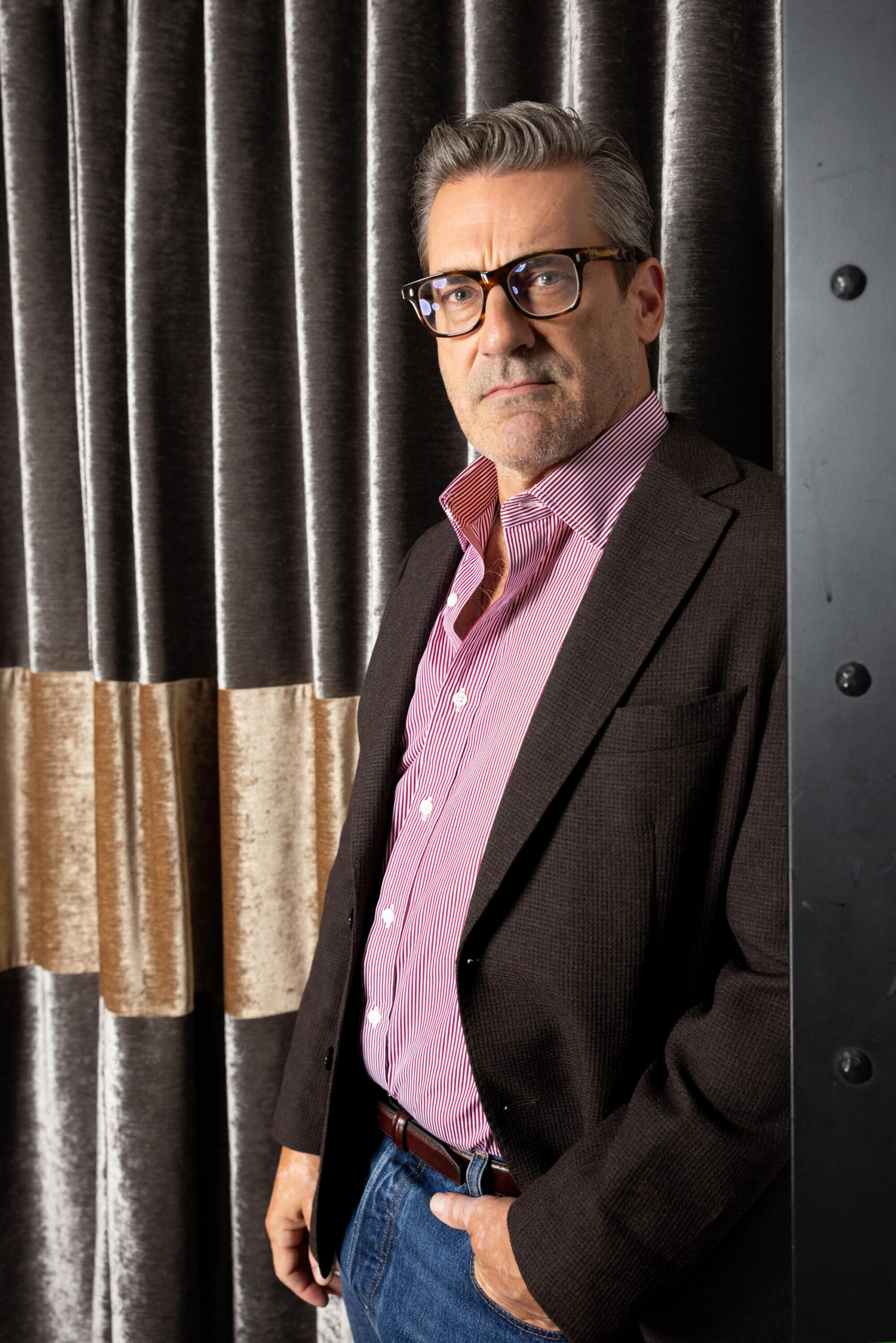
“We haven’t quite figured this situation out,” said Jon Hamm, who plays Heckman in “American Hostage” and is one of its executive producers.
Jon Hamm plays Fred Heckman, a radio news broadcaster, in “American Hostage” and is an executive producer.
(Jason Armond/Los Angeles Times)
The “Mad Men” star — no stranger to period pieces — said that beneath its retro production values and wide lapels, “American Hostage” is fundamentally about how people who feel voiceless in our society fight to be heard, even if the means is violence.
“There’s a lot that really resonates in the current media landscape and culture 50 years down the road, that people can still really connect with,” Hamm said.
Hamm and his colleagues hardly need to argue that point when the nation has been fixated on the case of Luigi Mangione, who in August pleaded guilty to federal charges in the December 2024 killing of Brian Thompson, the chief executive of UnitedHealthcare.
Though work on “American Hostage” had begun before Mangione’s crimes and the show was not inspired or motivated by them, series co-creator Shawn Ryan said that audiences have a boundless fascination with these types of stories — with or without any counterparts in current events.
“Dramatically, it’s always very interesting to see somebody do the wrong thing for the right reason,” Ryan said.
The TV series originated with a 2022 scripted podcast, produced by Criminal Content and also called “American Hostage,” on which Hamm also played the role of Heckman. It told of how Kiritsis, an Army veteran, enacted the kidnapping on his belief that the Hall family had swindled him on his mortgage — a loan for land where he had hoped to build a shopping center.
While Kiritsis sought to use Hall’s life as a bargaining chip for prosecutorial immunity, he also portrayed himself as an underdog taking on powerful financial interests. On the other end, Heckman wrestled with the moral predicament of giving airtime to a potential murderer while hoping to keep Hall alive. (Hall survived the ordeal and Kiritsis, acquitted of his crimes by reason of insanity, was later institutionalized.)
In the spring of 2022, Hamm approached Ryan, the creator of TV thrillers like “The Shield” and “The Night Agent,” with the idea of adapting the “American Hostage” podcast into a miniseries.
Ryan created the TV adaptation with Eileen Myers, a collaborator of his on shows like “Last Resort” and “Mad Dogs.” They both saw in the source material a story that was a combination of classic 1970s films like “Network” and “Dog Day Afternoon.”
(In a parallel development, Kiritsis’ story was also adapted into the Gus Van Sant film “Dead Man’s Wire,” which was a box-office disappointment earlier this year.)
Ryan and Myers said they were fascinated with how the American news media covered the kidnapping in instantaneous fashion and in an era long before the internet. In the 1970s, Ryan said, “There were fewer journalists and they were better and more trusted, and if Walter Cronkite said something, you believed it.”
Shawn Ryan, Jon Hamm and Eileen Myers executive produce the TV adaptation of “American Hostage.” Hamm approached Ryan, who brought in Myers to co-create and co-showrun the series.
(Jason Armond / Los Angeles Times)
The question that journalists like Heckman were confronted with, Myers said, was, “Do you allow a man who’s got a shotgun to somebody’s head dictate the terms of whether you’re going to put them on the air or not?”
Hamm, who has played alluring if ultimately disreputable characters on “Mad Men” and now Apple TV’s “Your Friends & Neighbors,” said he appreciated that “American Hostage” gave him a character who an audience can feel good about rooting for.
“I thought, I’m 55 years old,” Hamm said. “I was close to Fred’s age when this all went down. It was fun to play somebody morally conflicted that is actually on the good side.”
With some hesitation, Hamm pointed to the career trajectory of Bryan Cranston, who followed his celebrated heel turn on “Breaking Bad” with projects like “All the Way,” the play and TV film about President Lyndon B. Johnson.
“I don’t want to draw a comparison that’s stretching the bounds of reality,” Hamm said, “but Bryan went from Walter White to LBJ. You go, ‘All right — he’s still morally conflicted, but at least he’s on the right side of things.’”
“American Hostage” also benefited from the casting of Giovanni Ribisi (“Saving Private Ryan,” “Avatar,” “Sneaky Pete”), who brings a blend of volatility and humanity to the role of Tony Kiritsis.
Hamm recalled how Ribisi was in the midst of shooting another project — the upcoming Prime Video miniseries “The Greatest,” about Muhammad Ali — when he agreed to do a reading for “American Hostage” over Zoom.
“He brings value to every project he does, and he’s picky, as he should be,” Hamm said. “He’s a phenomenal DP — he might just go be a camera person or something if he wants to do it. So we were lucky to get him.”
Giovanni Ribisi plays Tony Kiritsis, the man who kidnapped Richard O. Hall. “So we were lucky to get him,” Hamm said.
(Steven Ackerman / MGM+/Sony Pictures Television)
There are of course unavoidable parallels between the stories of Kiritsis and Mangione, including the fact that both men were celebrated as folk heroes by some people who identified with their broader resentments.
But Hamm drew a crucial distinction between the two cases: Mangione “killed a guy,” he said. “He shot a man in cold blood. Like, I don’t care how good your point is. That’s not how we do it.”
Going back to the Boston Tea Party, Hamm said, every era of American history has had its dissidents who feel “wronged and done over by a system that is stacked against you” and are willing to take aggressive actions against it.
Hamm said that feeling persists and thrives today. “I think this is a big part of the rise of Trumpism,” he said. “I think this is a big part of the rise of the MAGA mentality, of ‘I have been done wrong and no one is hearing my complaints.’”
When those feelings go unaddressed for long enough, Hamm said, people will come to accept a certain amount of lawlessness from the figures they feel can solve their problems.
“We have a guy in the Oval Office right now who thinks that the laws don’t apply to him and a Supreme Court that said, ‘Yeah, they don’t — you can do whatever you want,’” he said.
For supporters of President Trump, Hamm said, “I think it’s fun for them to be able to flout the law and say, ‘Who cares?’ and all the things that they’re currently saying, but it’s not the principles that we were founded on.”
Hamm and Ryan make no secret of the fact that they’d like to keep “American Hostage” going as an anthology series and explore more of what Hamm called “these watershed moments of American life, to see how they rippled and how we got here from there.”
One could certainly imagine other events that would fit the show’s interest in real-life hostage crises that became media spectacles — the 1974 abduction of Patty Hearst; the 1963 kidnapping of Frank Sinatra Jr. — though Hamm kept any specific plans for the series close to the vest.
Perhaps the upper limits they face are the hours in a day to make and to broadcast the show.
“We’re living in great times right now for television,” Hamm said. “There’s so many opportunities to tell stories. Almost too many.”
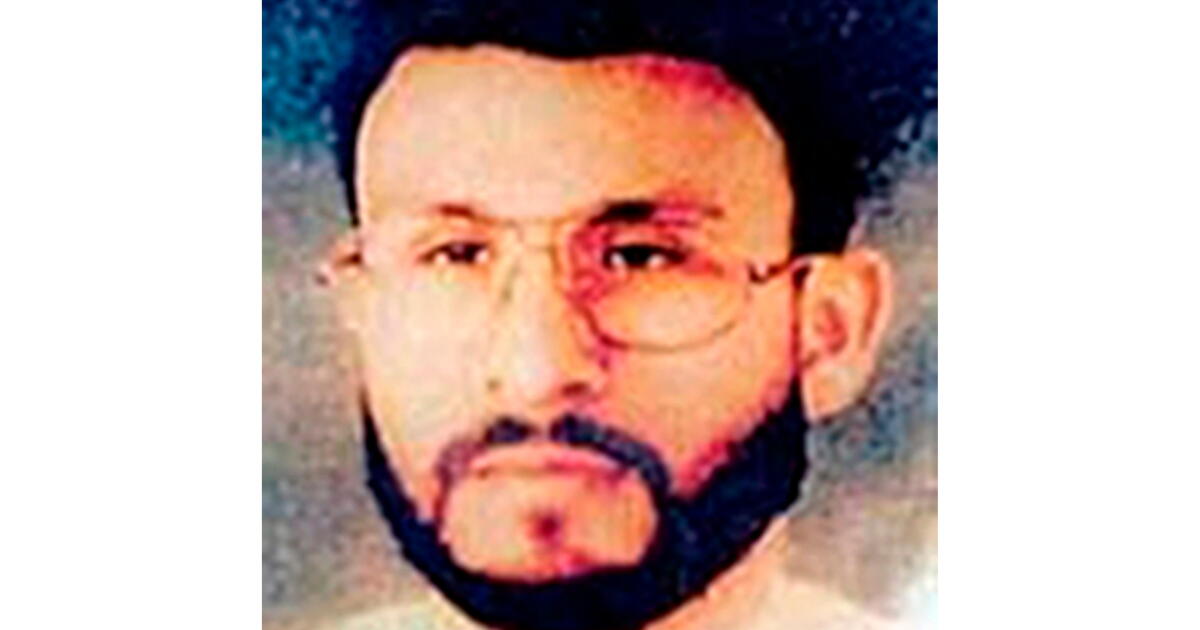
FT. MEADE, Md. — A man initially accused of being a high-profile Al Qaeda figure and who was tortured in CIA custody appeared Thursday at a hearing to review his detention at the U.S. military prison at Guantanamo Bay, Cuba, where he has been held for 20 years without charges.
A U.S. government official said Abu Zubaydah, who wore a neatly trimmed beard and glasses, had “probably” served as one of Osama bin Laden’s most trusted facilitators. The roughly 20-minute hearing offered rare visibility into the secretive military court proceedings of a suspect who had been tortured at CIA black sites during the U.S. war on terrorism and whose case still has not been resolved 25 years after the attacks of Sept. 11, 2001.
Zubaydah’s unidentified government-assigned representative and his private attorney, Annika Conrad, both acknowledged he had known Bin Laden, the 9/11 mastermind. But they said Zubaydah was never a member of the militant group that Bin Laden founded.
Conrad argued that Zubaydah poses no security threat to the United States and that it can no longer justify his detention. She said Zubaydah should be approved for transfer out of Guantanamo, which would kick off a multiyear process that includes finding a country to accept him.
Lawyer describes lasting injuries from torture and says Zubaydah could be monitored if released
Conrad said Zubaydah is prepared to accept a range of security measures, including continuous monitoring. Conrad said he has the financial and personal support of his family, has rejected any extremist views “and simply wants to live a life of peace.”
She also argued that a chief military prosecutor for U.S. military commissions, which oversees the 15 men still held at Guantanamo Bay, has said it is unlikely that Zubaydah will be charged. The Office of Military Commissions declined to comment.
Zubaydah’s attorney said the most the government can offer is a “probable association” to Bin Laden after more than two decades and noted that Zubaydah declined a direct request from Bin Laden to work for Al Qaeda.
Conrad also cited the torture that Zubaydah experienced, describing him as “a greatly injured man” who lost his left eye and his ability to write in English and “frequently struggles to recall words.”
Zubaydah’s detention is being reviewed by a U.S. government panel of senior defense, intelligence and homeland security officials. The Periodic Review Board was created under the Obama administration to evaluate prisoners and determine whether they could be released without posing a threat to national security.
The review panel did not immediately decide on the case
The review panel issued no immediate ruling Thursday. A live video feed of the unclassified portion of his hearing at Guantanamo was made available to reporters at Ft. Meade, an Army base in Maryland.
Detainees are not permitted to speak at their review hearings, and Zubaydah sat in silence next to his attorney and the government representative. Dressed in a gray suit jacket and patterned gray tie, he often pressed his left index finger to his left temple or fidgeted with something in his hands. A worn-looking book sat in front of him.
Zubaydah’s lawyers, Conrad and Ahmed Almudallal, said in a statement before the hearing that he may never face charges.
“For the first time in over two decades, the military’s chief prosecutor believes it is unlikely our client will ever be charged,” the attorneys said. “This is a major change in circumstances that warrants he be cleared for transfer.”
Almudallal and Conrad said Zubaydah has “no intent to engage in violence against the United States in the future.”
“Now, at 55 years old, he’s eager to reconnect with his family and live out the rest of his days as a free person,” they said. “Twenty-four years in prison plus being ‘patient zero’ in the U.S. government’s torture program has been punishment enough.”
He was first in the CIA’s ‘enhanced interrogation’ program after 9/11
Zubaydah was thought to be a high-ranking member of Al Qaeda when he was captured in Pakistan in 2002. A Palestinian born in Saudi Arabia, Zubaydah was tortured abroad before being transferred to Guantanamo in 2006.
The U.S. later dropped the claim that Zubaydah was one of the most senior figures in Al Qaeda, although it has continued to regard him as a security risk. Zubaydah’s lawyers have repeatedly said over the years that he was not an Al Qaeda member and point to waterboarding and other harsh treatment he experienced in the early 2000s.
Zubaydah was the first person in the CIA’s detention and interrogation program after 9/11 and subjected to what is now widely viewed as torture. He was held at CIA black sites in Poland and Lithuania, according to the European Court of Human Rights.
Zubaydah was waterboarded more than 80 times in a month at one point and confined over 11 days in a coffin-size box, among a raft of other mistreatment, a Senate report found.
In 2022, the Supreme Court dismissed a lawsuit by Zubaydah, who was seeking testimony from two former CIA contractors as part of an investigation into his treatment when he was held in Poland. The court rejected his case because the government said it would expose state secrets, despite much of the information having been widely reported.
In January, a lawyer for Zubaydah said the British government had agreed to pay a “substantial sum” to settle a lawsuit that said U.K. intelligence agencies were complicit in his torture. Attorney Helen Duffy said the confidential settlement was symbolically and practically significant for the “intolerable suffering” that Zubaydah endured.
A British parliamentary committee found in 2018 that U.K. security and intelligence services were aware Zubaydah was being tortured but continued to provide questions for the CIA to ask him without seeking assurances of his condition.
SACRAMENTO — With just over six weeks until the Nov. 3 election, the two candidates for California governor hit the campaign trail Thursday to promote plans to address the state’s high cost of living and continue rebuilding after the deadly wildfires that burned thousands of Los Angeles homes last year.
Democrat Xavier Becerra and Republican Steve Hilton are vying to replace termed-out Gov. Gavin Newsom, who is considering a run for president in 2028.
While Becerra holds a comfortable lead in the solidly-Democratic state, according to recent opinion polls, Hilton has aggressively attacked the veteran Democratic official as an “empty suit” who would bend to special interests in Sacramento.
“Xavier Becerra will be a rubber stamp for Democrat laws that raise your costs. That is the simple choice in this election,” Hilton said during a morning press conference in front of the state Capitol.
With a stack of file boxes representing the more than 1,100 bills passed by the legislature this year towering over him, Hilton, a former Fox News host and one-time advisor to a UK prime minister, pledged to veto any bill that would lead to higher costs if he is elected governor.
“We have to go in a new direction. Lower your costs, cut the BS, the bureaucracy, and these bills that raise costs for every Californian,” he said.
Hilton called out bills now on Newsom’s desk that would expand the state’s antitrust law and tighten rules for packaging made of recycled materials, measures opposed by business groups. Another signed by Newsom earlier this year allows Los Angeles and Contra Costa counties to surpass a 2% limit on local sales taxes.
California Republican gubernatorial candidate Steve Hilton speaks during a town hall with union film industry workers at Blue Cloud Movie Ranch on Wednesday in Santa Clarita.
(Justin Sullivan / Getty Images)
He has promised to slash state regulations and the government workforce to deliver $3 gas, tax-free earnings up to $150,000 and vehicle registration fees capped at $73.
Becerra, a former secretary of U.S. Health and Human Services, met with survivors of the devastating 2025 Altadena wildfires, first responders and community leaders before outlining his plans to prevent such destruction and to deal with fires when they do inevitably break out.
Becerra said his first priority is to secure the $30 billion in disaster aid that the federal government has failed to deliver.
“Job one, if I’m fortunate to become the governor, will be to fight, fight, and fight, get that money that people for nearly two years here in Altadena and the Palisades and elsewhere have been waiting for,” he said, speaking to reporters on what used to be the deck of a home belonging to a member of the Altadena Town Council.
Becerra recalled that during his 24 years in Congress there was widespread, bipartisan support for sending federal assistance to disaster areas, including areas devastated by hurricanes on the Eastern Seaboard or floods in the South. California deserves the same response, he said.
He said he would seek to leverage tax dollars to help communities better prepare for wildfires, creating buffers and hardening structures because of wildfires that will inevitably occur in certain communities.
“It’s not a matter of if, it’s a matter of when,” Becerra said.
Becerra said he would seek to work with local governments to create a functional emergency alert system throughout the state. In the aftermath of 2025 wildfires, there was heavy criticism about delayed emergency notifications and evacuation orders.
He also said that wildfires now occur year-round, not just during what was once called fire season, and it was critical to make sure that firefighters were prepared to respond year round by not expecting them to work more than 60 or 70 hours per week when a fire breaks out.
“We want people to stay in these positions because when the fires hit, we can’t be asking where is the fire force,” he said.
When asked about the cost of gas, Becerra blamed the Trump administration for a “reckless, illegal war in Iran” and “crazy, illegal” tariffs that have contributed to higher prices.
Hilton, who is endorsed by President Trump, blamed the state’s high cost of living squarely on state policies, not on fuel prices driven up by the war.
“We don’t need to make changes at the federal level to lower peoples’ costs in California,” Hilton said. “I’m focused on what I can do as governor to lower costs in California, and that is to roll back the Democrat policies that have given us the highest costs. It’s not federal policies that have given us the highest gas prices in the country, it’s Democrat policies in California.”
A Public Policy Institute of California survey released earlier this week showed Becerra with a 22-point lead over Hilton, driven by Democrats’ large voter registration advantage.
According to a May report from the Secretary of State’s office, just under 45% of voters were registered as Democrats, 25% Republicans and 22% with no party preference. The remaining 7% were registered with another political party.
Becerra and Hilton are scheduled to meet in a Sept. 30 debate hosted by CNN.
WASHINGTON — The White House said Thursday that it was withdrawing its nomination of Lance Schroyer, a former Oklahoma state trooper, to lead U.S. Immigration and Customs Enforcement, ensuring that an agency at the forefront of President Trump’s domestic agenda will remain without a Senate-confirmed leader for at least a while longer.
Schroyer, who has little experience in immigration, is close to Homeland Security Secretary Markwayne Mullin, a former U.S. senator from Oklahoma.
The White House offered no comment in a brief statement.
The latest setback comes as the agency remains under withering scrutiny over its handling of enforcement operations. Critics have question how ICE has recruited and trained officers as it raced to hire thousands to carry out Trump’s promise of mass deportations. Officers have shot and killed multiple people, including two American citizens in Minneapolis this year.
Sen. Rand Paul (R-Ky.), the chairman of the Senate Homeland Security and Governmental Affairs Committee, had refused to hold a hearing on the nominee until Homeland Security provided him with information he had been seeking about civilian deaths during ICE enforcement operations.
“I don’t have a concern with who the nominee was. I had asked them to give me an update on the internal investigation into civilian deaths,” Paul told The Associated Press. “And I’m still waiting.”
When Mullin took over the department in March, he pledged a lower-profile approach to immigration enforcement, pulling back on the aggressive, tumultuous crackdown on the streets of large cities that sparked widespread public condemnation.
Arrests have continued to accelerate, reaching nearly 51,000 in August, the highest single monthly arrest total during the second Trump administration.
Paul said he intended to hold a hearing on Schroyer’s nomination, but it never came to that. He heard about the nomination being withdrawn only when the White House made it public Thursday.
ICE has not had a Senate-confirmed leader since the Obama administration. David Venturella, a former executive at a private prison operator, returned to the agency as acting director this year after Todd Lyons resigned.
When Trump nominated Schroyer in June, Trump said on his Truth Social platform that his pick was “a PATRIOT with real operational experience” and a “proven leader with DECADES of experience locking up the worst of the worst.”
The administration did not indicate when it might announce another pick for the position.
YOUNGSTOWN, Ohio — In the wood-paneled basement of a union hall, retirees sat in folding chairs last week as they recalled how miles of steel mills and plentiful jobs had slowly disappeared.
“We told our children to get your education, get out, and don’t come back,” said Al Antonelli, who has been a member of Ohio Laborers’ International Union of North America Local 125 for nearly 50 years. “Because there’s no future here, especially blue collar.”
Versions of Youngstown’s story played out across the industrial Midwest, where disappearing jobs and frustration in longtime Democratic strongholds helped fuel Donald Trump’s political rise. When Trump visited as president in 2017, he promised the jobs that had left Ohio were “all coming back.”
“Don’t sell your house,” one of the retirees recalled Trump saying during his Youngstown visit.
Nearly a decade later, the old industrial economy Trump promised to revive has not returned, and Democrats hope the political tide is shifting again. Two years after Democrat Sherrod Brown lost his Senate seat, he’s attempting a comeback by trying to win back some of the same voters who turned on his party. Brown wants to harness dissatisfaction with the economy, the war in Iran and the expansion of artificial intelligence data centers to dislodge Republican Sen. Jon Husted in November.
Brown’s chances of returning to Washington depend largely on whether he can win again in parts of the state that have spent years drifting away from Democrats. His race is also part of a much broader challenge for Democrats, who need to make inroads in Republican-leaning states like Ohio, Iowa, Alaska and Texas if they are to win control of the chamber in November.
Brown outlasted Democrats’ decline in Ohio — until he couldn’t
For years, Brown was able to outrun the Democratic Party’s decline in Ohio. His pro-labor populism resonated with enough swing voters to deliver decades of victories from the statehouse to Congress.
Trump carried Ohio by 8 points in 2016, four years after Barack Obama won it. Yet Brown won his third term in the Senate two years later, in part by continuing to perform well in places like Mahoning County, anchored by Youngstown.
By 2024, even Brown could no longer hold on, losing his reelection campaign to Republican Bernie Moreno by 3.5 percentage points.
Trump carried Mahoning by more than 10,000 votes, a remarkable reversal in a previously loyal Democratic county that Obama had won by nearly 30 percentage points just 12 years earlier. With Trump’s endorsement, Moreno won the county by just 220 votes.
The transformation extends across the Mahoning Valley. Neighboring Trumbull County went from backing Obama by 23 points in 2012 to Trump by nearly 17 points in 2024.
“The Mahoning Valley has struggled with deindustrialization, job loss for years, and the politicians in power have seemed to understand that, but it doesn’t seem like they were doing enough about that,” said Cryshanna Jackson Leftwich, a politics professor at Youngstown State University. “So at some point, 20, 30 years of supporting the candidates, people are gonna say, well, look, this has never worked for us, right?”
Trump and other Republicans offered voters something different, Leftwich said.
“Did they keep their promises? Not at all. Is the county still poor? Absolutely,” she said. “But they at least said they were going to do something different.”
Brown faces a much different environment this year
Democrats’ bid to flip the Senate requires them to net four seats, including by competing deep in Republican territory.
Two months from the end of midterm campaigns, high gas prices stemming from the war in Iran have compounded discontent with the economy.
Trump has also escalated a trade war with neighboring Canada, a fight with particular implications for Ohio. The state exported $17.5 billion in goods to Canada in 2025, or nearly a third of the state’s total exports, according to federal statistics.
Tension from the economic strain is visible in Parma, a working-class Cleveland suburb that split its ticket in 2024, backing both Trump and Brown. At a watch party for the Republican midterm convention in Dallas, supporters who stayed late into the evening cheered Trump but acknowledged that other issues would most likely determine the midterms.
“The real thing that’ll move the needle is going to be economics. Gas prices, grocery prices,” said Parma City Councilor Kevin Kussmaul. “That’s really what’s going to help.”
Parma Republican Party President Doris Peters said similarly that “everyone’s concerned about the high gas prices.”
“It’s all about the economy,” she added. “People remember how much money’s in their wallet and how much is not in their wallet.”
Sen. Jon Husted (R-Ohio) speaks at the Republican convention in Dallas.
(Julia Demaree Nikhinson / Ap Photo/julia Demaree Nikhinson)
The limits of a Democratic rebound in Ohio
Husted presents a different opponent than the one Brown faced two years ago. His restrained demeanor contrasts with Moreno, the brash former car dealer who entered politics as an outsider. Husted spent nearly 25 years in Ohio politics, as a state lawmaker, House speaker, secretary of state and lieutenant governor, before being tapped to fill Vance’s Senate seat.
But Husted may not need to generate much enthusiasm of his own. Except for Brown and candidates for the Ohio Supreme Court, a Democrat hasn’t won a statewide race for state office in Ohio since 2008.
Adam Radogna, 37, who hosted the watch party Wednesday for Parma Republicans at his Italian restaurant, has attended more than 80 Trump rallies and remains an ardent Trump supporter. But Husted is not someone he’s followed closely.
“I don’t know him at all,” Radogna said of Husted. “But I mean, I will vote for him.”
Brown faces enthusiasm problems of his own as he asks voters to return to a 73-year-old former senator whom they rejected just two years ago.
Ellen Zban, 67, a longtime Youngstown resident who said she leans Democratic but has voted for Republicans, said she won’t support Husted because she doesn’t believe he has listened enough to the community.
“I really don’t think he’s done anything for us,” she said. “We never hear from him.”
But Brown isn’t necessarily the candidate she wishes Democrats were offering either.
“He’s my best option,” Zban said. “But I’d like to see younger people running.”
The race is being flooded with money as both sides try to drum up enthusiasm and define the choice for voters. Husted and allied Republican groups have already spent more than $80 million with $86 million more reserved through Election Day, according to AdImpact. Brown and Democratic groups have spent $69 million, with $67 million reserved.
Elon Musk has also waded into the race through his America PAC, which is running online and streaming ads attacking Brown over transgender issues.
“Billionaires are lying to try and bail out their ‘Golden Boy’ because Jon Husted has always put special interests ahead of Ohio,” Brown’s campaign manager, Patrick Eisenhauer, said in a statement.
Brown has attempted to make data centers central to the race, an issue that has seen bipartisan outrage in communities across the country. Brown’s allies have called Husted the face of Ohio’s data center boom, blaming the massive facilities for contributing to rising electricity costs. Husted helped promote Ohio as a destination for data centers while serving as lieutenant governor.
The ads and backlash have generated enough concern among Republicans that an internal party memo described data centers as an “anchor” around Husted in the race.
“Thirty-two years in Washington turned Sherrod Brown into a liar,” Amy Natoce, a spokesperson for Husted, said in a statement. “Jon Husted is fighting to lower costs and help Ohioans keep more of what they earn. Sen. Husted introduced legislation requiring data center companies to pay for the power they use and return excess electricity to the grid.”
The state’s politics could shift again
In Youngstown, the union retirees who watched the Mahoning Valley shift toward Republicans aren’t convinced the movement is permanent.
Rich Troisi, business manager of Laborers’ Local 127, said Republican candidates in recent elections could win support in the area largely by aligning themselves with Trump. This year, he said, that dynamic may not hold.
“I don’t think Donald Trump’s endorsement is going to be what it was,” he said.
Antonelli, the longtime union worker, pointed to independent voters, who he said tend to move with their economic circumstances.
“My dad used to say, it depends on how tight your shoes are. Tight meaning, how’s the money?” he said. “Right now, the shoes are pretty tight, no matter who you are.”
Cappelletti writes for the Associated Press. AP reporter Julie Carr Smyth contributed to this report from Columbus, Ohio.
Assailant sprayed vinegar at Representative Ilhan Omar, admitting political motives were behind the assault during her townhall.
Published On 17 Sep 202617 Sep 2026
The man who sprayed apple cider vinegar at Democratic United States Representative Ilhan Omar during a town hall meeting in her district in Minneapolis was sentenced to a 14-month prison term after he pleaded guilty to an assault charge.
Appearing before District Judge Joan N Ericksen on Thursday, 55-year-old Anthony James Kazmierczak pleaded guilty to planning the January 27 assault, admitting he targeted the congresswoman over opposing political views. He had been charged with assaulting a US officer.
Recommended Stories
list of 3 itemsend of list
It has been nearly eight months since Kazmierczak lunged towards the congresswoman and sprayed her with a dark water-and-vinegar mixture from a syringe, which landed on Omar’s clothing and skin.
The attack was captured on video and showed Kazmierczak, who sat in the front row of the town hall, leaping from the audience, after which he could be heard yelling, “You must resign” and that Omar was “splitting Minnesota apart”.
Kazmierczak was promptly subdued by Omar’s security team before being arrested. Omar was not injured in the attack and proceeded with the town hall.
The assault came as Omar had been calling for the abolition of the Immigration and Customs Enforcement (ICE) agency and the resignation of then-Department of Homeland Security (DHS) Secretary Kristi Noem over her management of federal border agents in Minneapolis during the shootings during “Operation Metro Surge,” President Donald Trump’s federal immigration crackdown in the state of Minnesota. The crackdown involved more than 2,000 officers in Minneapolis and Saint Paul and provoked intense civil unrest and led to the deaths of two US citizens, Renee Nicole Good and Alex Pretti, at the hands of federal agents.
In an earlier hearing, Kazmierczak could not explain what happened in the assault.
“It’s fuzzy,” he told US Judge Ericksen when asked what he remembered.
The government sentencing memorandum, submitted to the court by prosecutors, said he had texted at least three people indicating his actions were premeditated, though he refused to answer questions about his specific intent.
He also messaged a neighbour to arrange for dog care and contacts for a bail bond company.
The sentencing memo said Kazmierczak had long struggled with alcohol abuse, had “a history of mental and emotional health concerns”, and also had a string of health issues tied to a 2022 diagnosis of Parkinson’s disease. His lawyer, John Fossum, had argued that Kazmierczak had not been taking his mental health medication before the attack, lowering his inhibitions and contributing to what happened.
“I’ve spent enough time in jail thinking,” Kazmierczak said Thursday. “I really apologise to her for having put her through that,” he said, referring to Omar.
Kazmierczak wrote to Omar after the attack, “I’m sorry if I scared you.”
In social media posts, Kazmierczak had denounced former President Joe Biden and referred to Democrats as “angry and liars”, writing that Trump wants the US to be “stronger and more prosperous”.
“This assault is yet another example of a dangerous national trend: people channeling political hatred into criminal acts,” said US Attorney Daniel N Rosen after Kazmierczak pled guilty in May.
Omar, a Somali-American refugee and naturalised US citizen, has faced sustained mocking and anti-immigrant rhetoric from Trump throughout her congressional tenure.
LONDON — Ireland will boycott the Eurovision Song Contest for a second year over Israel’s participation, the country’s national broadcaster said Thursday.
RTÉ said it will not send an act to the 2027 competition in Bulgaria and will not broadcast the show because of the “appalling and ongoing loss of lives in Gaza and the humanitarian crisis there which continues to put the lives of so many civilians at risk.”
Ireland was one of five countries — along with the Netherlands, Iceland, Slovenia and Spain — to skip Eurovision this year to protest Israel’s inclusion in the pan-continental music contest.
Eurovision Director Martin Green said organizers regretted RTÉ’s decision but “fully respect” it.
“All broadcasters decide on an annual basis to participate in the following year’s contest. We will remain in dialogue with RTÉ and hope to welcome them back to the contest in the future,” Green said.
Dutch broadcaster AVROTROS announced last month it will also boycott next year, calling Eurovision a “platform for division.”
“AVROTROS will not participate in the Eurovision Song Contest in 2027 because the event can no longer be considered neutral, with a participating country still involved in a large-scale military conflict,” it said.
Next year’s competition is due to take place in Bulgaria’s Black Sea resort of Burgas in May, after Bulgarian singer Dara won the 2026 event with her infectious party anthem “Bangaranga.”
The contest was founded in 1956, in part to help unite a shattered continent after World War II. It pits acts from dozens of countries against one another for the continent’s musical crown.
Israel has taken part in Eurovision since 1973, one of a few non-European countries to compete. But calls for Israel to be kicked out have swelled over the conduct of Prime Minister Benjamin Netanyahu’s government in the Hamas-Israel war in Gaza.
The 2024 Eurovision contest in Malmo, Sweden, the 2025 in Basel, Switzerland and this year’s contest in Vienna saw pro-Palestinian protests and heightened security.
Moments after the final rapid-fire rhythm of Anthrax’s opening number “Caught in a Mosh” fades from the open air of the Sports Illustrated Stadium in Harrison, N.J., shaggy-headed vocalist Joey Belladonna addresses the audience. “I gotta ask everybody out there right now. Who’s never seen Anthrax before?” Around half of the 6,000-or-so crowd members who showed up by 6 p.m. for the three-band bill, headlined by heavy metal legends Iron Maiden, raise their hands. “Ah, yeah! We got a lot of new friends here today. Thank you for being here.”
Some bands with a four-decade career would be disappointed by the turnout, or by the realization that many fans not wearing Maiden shirts are dressed in Megadeth merch. But for Anthrax, preaching to the unconverted is an opportunity to expand their fan base beyond the somewhat insular community of thrash metal, a style of music that took the aggression of bands like Iron Maiden and turbocharged it with the speed and fury of hardcore punk. As much as Anthrax cherish being one of the “Big Four” — Metallica, Megadeth, Slayer and Anthrax — playing a 35-minute set well before dark is a great way to reach new listeners.
“We have a strong base of fans that are deeply into this band, but we know there are also people that have never listened to this type of music before,” says bald-headed, gray-bearded rhythm guitarist and lyricist Scott Ian from his home office outside of L.A. a week before the show. “They’ve heard band names, but maybe they haven’t dipped their toe in the water. So, it would be great to reach them and give them something they didn’t even know they wanted and then they’ll fall in love with it.”
A full 10 years have passed since Anthrax released their last studio album, “For All Kings,” which helps explain why they’re not as well-known as some metal veterans. Instead of rushing out an album after the pandemic, Anthrax took their time writing and fine-tuning new songs before entering Dave Grohl’s Studio 606 in L.A. in 2022. Then, they wrote more songs and massaged those for another two years before finishing the recording and sending the album to be mixed in 2025.
“I nitpicked over every detail of these songs before I even sent the demos to the other guys to put their two cents in,” says drummer and main songwriter Charlie Benante, clad in a black T-shirt and blue jean shorts, and sporting cropped black hair and a slanted mustache. “I wanted them to be as good as they could possibly be. Being good enough wasn’t OK.”
The 11 tracks on “Cursum Perficio” (Latin for “I complete my journey”) encapsulate the finessed brutality, incisive melodies and experimental flourishes from Anthrax’s years with Belladonna (from 1984-1992 and 2005 to the present), during which the band wrote its fastest, most aggressive songs. As much as Anthrax were driven this time by the desire to attract new fans, they were also motivated by many popular new metal albums — and not in a good way.
Anthrax’s meticulously crafted album was recorded at Studio 606, using Iron Maiden support slots to court new listeners beyond the thrash faithful.
(Travis Shinn)
“I hear bands with new records out, and they’re horrible,” Benante says, squinting his eyes and grimacing. “The genre has gotten stagnant to the point where you see a social media post by some band mentioning they have new music coming out, and you can tell exactly how it’s going to sound just by the way they look.”
While “Cursum Perficio” may be a bit heavy for some metal fans, it’s neither dull nor predictable. The album is loaded with Anthrax trademarks — serrated, crunchy riffs, soaring lead vocals, bludgeoning beats, and scorching guitar — but there are also galactic noise effects, angular song structures and atypical chord configurations. The most striking number, “The Edge of Perfection,” starts with chiming ethereal guitars and gently tapped cymbals, then detonates in a conflagration of feral blast beats, minor-key tremolo guitar picking (redolent of black metal), and chanted tribal vocals before climaxing in a slithering riff and ebullient chorus.
“After 30 years as a band, I can honestly say that’s the best song we’ve ever done,” says Ian, the most voluble member. “I feel like it’s genre-defying and can appeal to fans of atmospheric stuff and extreme metal, and anyone who likes aggressive music or even just guitar rock.”
For such a bruising cut, the lyrics of “The Edge of Perfection” are surprisingly optimistic. “It’s about striving for perfection, which, of course, is impossible. But that doesn’t mean you can’t reach for it,” says Ian. “To me, true perfection is happiness and health, and that comes from love, and it isn’t a given. I work hard at being an empathetic person and I only do things out of love and wanting to make everybody around me feel good as well.”
Lest Ian’s Zen-like proclamation color him a romantic, the guitarist stresses that much of the energy and anger of “Cursum Perficio” stems from the political, social and economic turmoil of the last decade. The problems, he stresses, are cutthroat capitalism, rampant partisanship and mankind’s seemingly innate instinct to destroy.
“Humans are really good at one thing and that’s murder, and we’ve excelled at it over the centuries,” Ian says, shattering the good vibes that flowed like a clean mountain spring just a minute ago. “Every year, we get better at treating each other terribly, which I can’t understand. I mean, there are people on this planet who, if they wanted to, could end world hunger. But I guess there’s no money in that. They would rather make the world a s— place by draining the resources. I swear to God, it’s just like [the 1971 Dr. Seuss book] ‘The Lorax.’”
While Ian purposely scrapped any early lyrics he wrote about politics in the age of Trump (“that would have been boring”), on “Everyone’s Got a Plan” he addresses the partisan strategy of “divide and conquer,” and in the first single, “It’s for the Kids,” he writes about the ubiquity of school shootings. Neither song has stopped naysayers from characterizing Anthrax as left-wing.
“I’m not a liberal,” he plainly states. “I’m a centrist. I like skeet shooting and I enjoy going to a range and shooting at targets. But I believe in common sense. And no matter what your political leanings, I think everybody can agree that nobody wants to see an 8-year-old shot in the face, which happens all too often.”
“I love this country,” interjects Benante. “But that doesn’t mean I don’t have some problems with it…. The way we go about things in this country is just wrong, and it makes me frustrated to the point where I’m like, ‘F— it. I’ll just put my head down and write a song.’”
“Cursum Perficio” delivers classic Anthrax crunch with experimental flourishes, anchored by genre-defying centerpiece “The Edge of Perfection.”
(Travis Shinn)
Much of “Cursum Perficio” caters to neither the left nor the right. “NYC 93” is about the celebratory chaos of band life in the early ’90s, “The Long Goodbye” addresses the horrors of dementia, and the title track is about closure, whether positive or problematic. The Latin translation of the phrase, along with Benante’s past comments that he can’t imagine writing another full Anthrax album anytime soon, have led to speculation that the band is nearing the end of the line; the theory is seemingly supported by lines like, “The journey’s over/ The threads that hold it all together.” But while there are no plans now to write any new songs, and four of the members are in their 60s (lead guitarist Jonathan Donais is the baby at 47), growing too old to headbang isn’t even a notion.
“I truly believe that going out and playing shows keeps us young,” concludes Benante. “We get in a zone, and the music takes over and the energy going through our bodies is the same as it was when we were 20. Why would we ever want to give that up?”
Wiederhorn is the co-author of Scott Ian’s 2014 autobiography, “I’m the Man: The Story of That Guy From Anthrax.”
Public broadcaster RTE says the country’s participation cannot be justified amid ‘appalling and ongoing loss of lives in Gaza’.
Published On 17 Sep 202617 Sep 2026
Ireland has become the second country, after the Netherlands, to announce a boycott of next year’s Eurovision Song Contest over Israel’s participation.
Irish public broadcaster RTE said in a statement on Thursday that the country’s participation could not be justified “given the appalling and ongoing loss of lives in Gaza” and that the humanitarian crisis in the enclave “continues to put the lives of so many civilians at risk”.
Recommended Stories
list of 3 itemsend of list
RTE, which manages Ireland’s selection and participation in Eurovision, added that it remained “deeply concerned by the continued denial of independent access [for] international journalists to the territory”.
The decision marks the second consecutive year that Ireland will neither participate in nor broadcast the competition, which is the world’s most popular television music show.
Earlier this month, Eurovision organisers said they were excluding any country involved in an armed conflict from hosting the competition.
However, the Dutch public broadcaster Avrotros said the exclusion of countries in conflict was not “sufficient”.
Avrotros announced last month that it was withdrawing from the 2027 competition.
It said Eurovision could “no longer be considered neutral” given Israel’s participation in “a large-scale military conflict” in Gaza.
Both Ireland and the Netherlands were among five countries that withdrew from Eurovision 2026 in Vienna earlier this year. Spain, Slovenia and Iceland also decided not to participate.
Eurovision Director Martin Green said on Thurday that organisers “fully respect” Ireland’s decision and that they “will be missed”.
“The Eurovision Song Contest is at its best when broadcasters and their artists from different countries come together to share music, celebrate creativity and create connections between audiences,” Green said.
“That power to bring people together is at the heart of what makes the Contest so special, and is even more important now in an increasingly difficult and divided world.”
The 2026 show, which Bulgaria won, attracted 132 million viewers, 34 million fewer than its 2025 edition.
Thousands of protesters gathered outside the venue in the Austrian capital during the final in mid-May to oppose Israel’s participation.
The European Broadcasting Union organises the annual music competition. It has faced accusations of applying a double standard for refusing to exclude Israel, despite banning Russia following its invasion of Ukraine in 2022.