A driver in the US state of Louisiana was charged with impaired driving after plowing into a crowd and injuring at least 15 people celebrating Lao New Year on Saturday. Footage from the scene showed injured people on the ground and at least one trapped under a vehicle.
SACRAMENTO — Every morning, Jack Kavanagh brews himself a cup of coffee or tea, pads down a short hallway, past the dining room, and turns left into his small home office, where he brings California to the world.
It’s been his routine for decades, through all manner of upheaval and events — social, political, natural and man-made.
Kavanagh, a somewhat-retired former TV newsman, has documented the policy and personalities behind those developments one curated paragraph at a time, complete with links, so others can follow his trail, feel the pulse of the state and take away what they will.
California: Unbiased and unvarnished.
What began as a summary for colleagues at a television station in Sacramento has developed a worldwide following, an achievement noteworthy not just for its duration — Kavanagh’s catalog may be the state’s longest-running news aggregator — but for all the things his website is not.
There are no flashy graphics on Rough & Tumble. No eyeball-grabbing videos, no partisan commentary or agenda, and none of the edge or snark that greases the gears of the perpetual-political-outrage machine.
There are just headlines and short summaries, presented as simply and unadorned as the plain-spoken Kavanagh himself. “The bottom line,” he said, “is trust” — vouching that an article is credible and worthy of a reader’s time.
“It all comes down to that. And now, with the age of AI fakes and all the other social media and stuff like that, it’s even more important. It’s even more unique.”
Kavanagh, 78, is a New Englander by birth and Californian by choice.
He grew up in Providence, R.I., and by his own account was aimless until his 21st year. One night, in June 1968, Kavanagh watched the small black-and-white television in his bedroom as live coverage of Robert F. Kennedy’s assassination unfolded. Captivated, he knew from that moment on what he wished to do with his life.
A low-level job at a local radio station led to an on-air position at its TV affiliate, where Kavanagh’s big break came in 1978 when a massive blizzard hammered the Northeast. His marathon coverage garnered national notice and, two years later, an offer to move to a larger market in Milwaukee. He was prepared to go, when another offer came from a TV station out West.
“Do you know many nanoseconds it takes,” Kavanagh asked rhetorically, “to make a decision between Milwaukee, Wisc., and Sacramento, Calif.?”
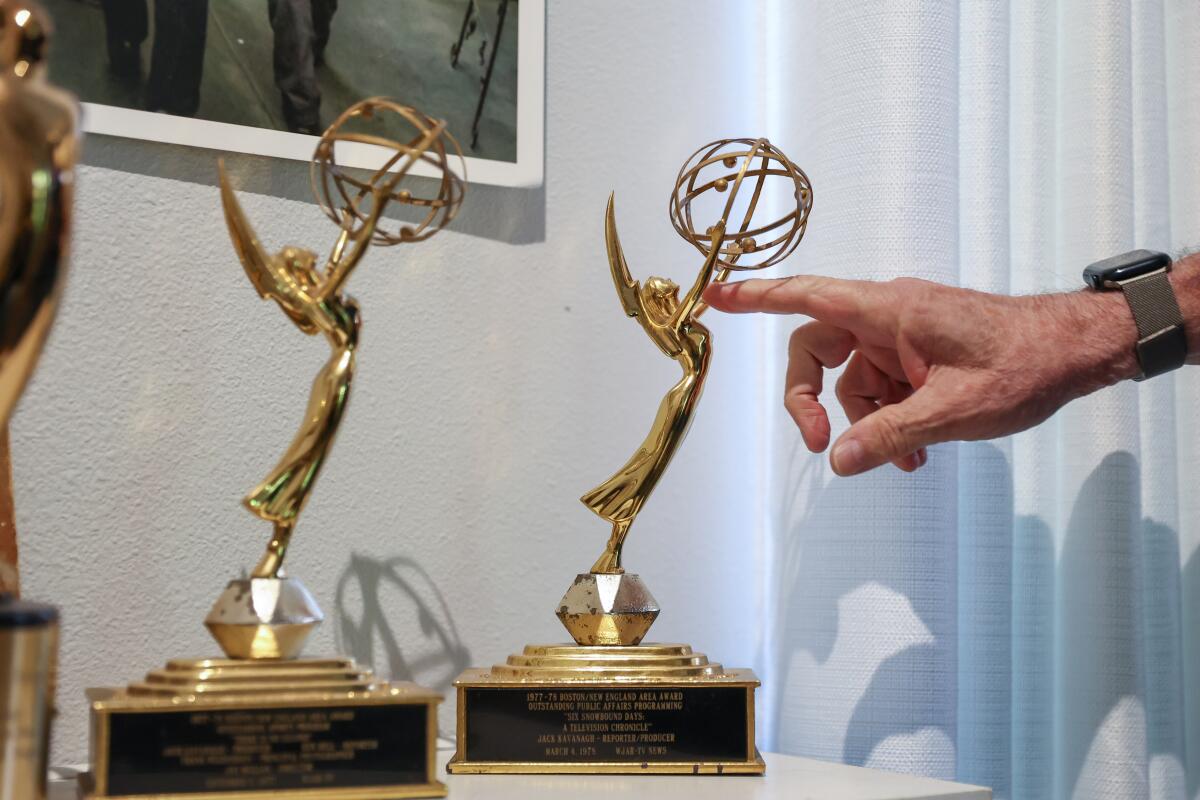
Two Emmys for television reporting adorn Jack Kavanagh’s home office in Sacramento.
(Sara Nevis/For The Times)
Kavanagh had never set foot in the state and part of his steep California learning curve was devouring as many newspapers — back when they abounded — as he could. He noticed a large stack that sat untouched each day in the newsroom; most of his colleagues, he said, were simply too busy to dive in. So he began typing up a summary of the top headlines and stuffing copies in people’s mailboxes.
When the internet was still in its infancy — Kavanagh guesses the year was 1994, or so — he began putting his compendium online, so those working at the station’s Stockton bureau could partake as well.
There wasn’t much interest. But people in the capital began noticing. Kavanagh’s daily wrap-up developed an audience among political insiders — lawmakers, lobbyists, legislative staffers — and then a following that grew to include other reporters and, eventually, readers throughout California and beyond.
Rough & Tumble — the name captures the sweat and grit of politics — has continued without interruption for 30-plus years. In that time, Kavanagh has missed only a few days here and there.
That includes in 2004, when he underwent quadruple bypass surgery. Another time, when Kavanagh was suffering ulcerative colitis, he brought his laptop and worked from a hospital bed. (The laptop also accompanies Kavanagh and his very indulgent wife of 42 years on their vacations.)
Kavanagh typically starts each morning scanning dozens of news sites. He posts the big headlines of the day. He also looks for trends and stories that connect the dots, which are collected beneath subheads — AI, water, housing, education and the like.
“I want it to be a tip sheet for anybody who is in a Fortune 500 company, or who is a kid on a scholarship in a high school somewhere,” Kavanagh said over lunch at a favorite Mexican restaurant. “I want them both to be able to zoom through this and figure out what’s going on and move onto something else.”
Mindful of his global audience, he updates his site with fresh headlines starting in the late afternoon. (Analytics allow Kavanagh to watch as the world wakes up and readers from as far away as Russia and China, represented by a blue dot, begin showing up on his computer monitor.) In all, he said, he devotes four to five hours a day to his one-man enterprise.
Rough & Tumble gets about 1.1 million page views a year, Kavanagh said, and while it’s not a huge moneymaker, the business allows him to write off his many subscriptions. A small amount of advertising also helps pay for the occasional trip.
Years after leaving the television business and a brief career as a media coach, Kavanagh runs the site as a kind of public service and a way to stay engaged and keep mentally fit. He’s still captivated by his adopted home state. “Every day,” he said, “I learn something new about California that I didn’t know yesterday.”
Kavanagh has no succession plan. He said Rough & Tumble will end the day he does — or sooner, if artificial intelligence renders Kavanagh and his role as host, news-gatherer and California guide obsolete.
One of the hottest tickets for the events surrounding Super Bowl LX in February was a party thrown at the Cow Palace in San Francisco by Sports Illustrated, where attendees could hang with Justin Bieber, Kevin Hart and Travis Kelce.
The magazine’s logo and a team of models from its latest annual swimsuit issue were present at another pre-game bash at the Michelin three-star restaurant Quince.
Sports Illustrated journalists were getting requests from peers looking to score invites to the gatherings, which symbolized a turnaround at the 72-year-old title. Just two years earlier, many of its writers were told their jobs were being eliminated.
But Authentic Brands Group, the New York-based company that purchased Sports Illustrated in 2019 for $110 million, says the title is now thriving after reducing its reliance on advertising and circulation revenue. The privately held firm — which expects $38 billion in global retail sales this year, up from $35 billion in 2025 — does not break out the finances for its businesses but says SI is highly profitable after a rocky period. Less than half of SI’s revenue comes from its media business.
“It took us a little while and we had a couple of bumps along the way,” Daniel W. Dienst, executive vice chairman for Authentic, said in a recent interview from his New York office, where a photo of baseball legend Hank Aaron taken by acclaimed SI photographer Neil Leifer hangs on the wall behind his desk.
For decades, SI was where every sports journalist aspired to work, hoping to become the next Frank DeFord or Gary Smith, whose 32-year career at the magazine is highly revered. Cover images of Muhammad Ali, Michael Jordan and other superstars are emblazoned in the memories of fans who eagerly awaited the title to arrive in the mail each week. For athletes and sports institutions, the cover remains a coveted honor.
“You go to LeBron James’ office in Akron, it’s got his 30 covers on the walls,” Dienst said. “You go to USC, they’ve got 21 covers with their athletes and coaches all over their athletic department.”
Now a monthly magazine, the flagship business of Sports Illustrated is no longer the first stop for fans looking for game analysis or profiles of athletes, many of whom have asserted greater control over their images through social media and podcasts.
Like other print magazines, SI has seen a sharp falloff in its circulation, currently at 400,000, down from 3 million in 2010. Authentic says SI has 52 million users a month on its web site and 21 million social media followers. ESPN had 229 million digital users in November.
But the famous SI name still resonates with generations of consumers and Authentic has sought ways to capitalize on it, from selling replica covers to opening branded resort hotels in Chicago and Nashville. International editions of the magazine have been launched in Germany, China and Mexico, with plans to launch in France and the U.K.
In January, Sports Illustrated launched its own free ad-supported streaming TV channel called SITV that features live shows with its journalists and includes films and shows from an archive stocked with documentaries and swimsuit issue specials going back decades.
The channel, which along with the other SI assets is managed by New York-based Minute Media, will also carry live sports coverage including college basketball. While Minute Media did not reveal early viewership figures, the company said the audience for the channel has grown 60% since its launch.
Cincinnati Bengals quarterback Joe Burrow on the cover of Sports Illustrated.
(Clay Patrick McBride)
The streaming channel is a major media initiative for brand that has seen more activity in other sectors.
In 2023, Authentic put the SI name on Lunatix, a sputtering ticket marketplace. Now called Sports Illustrated Tickets, the business has signage deals with 13 venues around the world including a New Jersey-based stadium — the home of the New York Red Bulls soccer team. The service expects to generate $500 million in revenue this year.
Authentic also uses Sports Illustrated-sponsored events such as the ones held at the Super Bowl to entertain clients for its other businesses and makes tickets available to the public. SI will host an event for Authentic at the Masters golf tournament in Augusta this week and has a permanent high-end, track-side hospitality space at Churchill Downs in Kentucky called Club SI.
Authentic specializes in acquiring and investing in famous retail properties that have foundered. The firm has acquired such names as the outerwear retailer Eddie Bauer, Brooks Brothers and Reebok, and in January took a 51% share in the fashion brand Guess.
ABG enlists outside operators to run the brands. Those operators pay an ongoing license fee to ABG, which also takes a cut of the revenues.
That was the plan when Authentic bought Sports Illustrated from Meredith Corp., now known as People Inc.
After the purchase, Authentic entered a $15-million-a-year licensing agreement with Arena Group (at the time known as Maven) to run Sports Illustrated. A New York-based digital media company, Arena operated such well-known titles as Men’s Journal, Parade and TheStreet. But the partnership unraveled when Arena used AI for sponsored content on Sports Illustrated’s website, which sounded alarm bells at the esteemed publication.
Sports Illustrated’s 2026 Super Bowl party at the Cow Palace in San Francisco.
(Sports Illustrated)
The Arena Group acknowledged it hired an outside firm to create product reviews that used fake bylines. The scandal coincided with the termination of its chief executive, Ross Levinsohn, who once held a leadership role at the Los Angeles Times.
The relationship with Authentic worsened when Arena’s majority owner, Manoj Bhargava, took over as interim chief executive. The founder of 5-Hour Energy, Bhargava tried to fire Sports Illustrated’s unionized editorial staff and renegotiate a lower licensing fee from Authentic. He also used the magazine’s editorial pages and website to promote his energy drink business.
The SI media business was unprofitable under Bhargava and Arena missed a payment to Authentic on its licensing deal. In March 2024, Arena announced it was shutting down the print edition of SI.
Around the same time, Authentic hired Minute Media, which runs the digital sites Fansided and Players’ Tribune, to take over Sports Illustrated. Bhargava didn’t go quietly; according to legal filings, he threatened to delete Sports Illustrated’s archive of intellectual property.
Authentic sued Arena for breaching the SI licensing agreement, which was settled. Many of the title’s laid-off journalists were rehired.
The experience with Arena was a harsh lesson for Authentic, which never had owned a media property before.
“The minute I make that phone call or anybody perceives that Authentic could control the newsroom, forget it, game over,” Dienst said, referencing Bhargava. “We had to move on.”
Minute Media has gotten high marks from the SI staff for its repair work on the media side of the business.
“It’s been a long time since we felt like we had an operator and support from the very top to not just grow what we’re doing day to day, but to grow what Sports Illustrated is going to look like 10 years down the road,” said Steve Cannella, editor in chief of Sports Illustrated.
SI’s union representing editorial employees praised Minute Media when it took over, and is close to agreeing on a new contract deal with the company.
Minute Media is aiming to expand the SI brand‘s reach across other media platforms to make up for the time lost under previous regimes.
“I’ve asked, ‘guys, what are all the things you wanted to do that you haven’t been able to do?’ ” said Minute Media President Rich Routman. “If we’re not trying new stuff, we’re failing.”
Some sports media types believe SI is largely a nostalgia play in a landscape where young fans go elsewhere for game highlights and turn to provocative hosts such as Pat McAfee on YouTube. But awareness goes beyond the audience of baby boomers and Gen Xers who grew up with the brand.
Lisa Delpy Neirotti, who leads the sports management program at George Washington University, recently conducted a study with her students on their media consumption habits. She said she was surprised to see high recognition of Sports Illustrated with the Gen Z crowd, and credits SI for Kids, the spin-off publication for younger readers launched in 1989.
“They would remember getting it in the mail, and it was the first thing that got them interested in sports,” Neirotti said. “There are a lot of positive memories that keep the brand alive.”
Dienst said the audience for SI has gotten younger under Authentic’s ownership. But he doesn’t disregard the oldsters who grew up with it.
“They’re very affluent and they’re super loyal,” he said.
Early in “The Drama,” things are still good between Emma (Zendaya) and Charlie (Robert Pattinson). The young happy couple, about a week away from getting married, have enjoyed a whirlwind romance. As this dark comedy’s opening credits roll, they’re blissfully practicing their first dance, laughing and stumbling as they try to get their twirls and steps right.
But the scene’s highlight is the song that plays in the background, airy, gentle and simple. Spare guitar chords give way to a female voice that sounds unpolished but beautiful: “I want to lay with you/ In an open field/ Where yellow flowers are suns of Earth.”
For many viewers, this will be the first time they’ve ever heard “I Want to Lay With You,” one of the most gorgeous love songs of the 1970s. It’s also likely they’ll have no idea who the singer is. Her name is Shira Small, and in 1974, she recorded an incredible album, “The Line of Time and the Plane of Now,” when she was 17. She never recorded another — at least, not yet. Now nearly 70, Small may finally be getting her moment in the spotlight.
“I’m cracking up,” says Small over Zoom from her Cooperstown, N.Y., home, “because I had no idea whatsoever that that movie was coming out until my dear sister informed me via you.” Flashing a relaxed smile and sporting long gray hair, Small knows little about the controversial “The Drama,” an A24 film with a heavily guarded twist.
Robert Pattinson and Zendaya in the movie “The Drama.”
(A24)
But it’s becoming a delightfully frequent occurrence that Small learns after the fact that her music is featured prominently in a movie or television show. “The record company does what they do and then they send me royalties and I get it in a statement,” she explains. “I had a song that HBO bought for ‘Pause With Sam Jay.’ They sent me an email that was not even to me — it was this interdepartmental thing. At the bottom, it said, ‘Oh, by the way, it airs tonight.’”
Jemma Burns, music supervisor for “The Drama,” had been a fan of Small’s album, thinking “I Want to Lay With You” would be perfect for this idyllic scene, right before Emma and Charlie’s relationship implodes over a disturbing revelation that turns their dream wedding into a nightmare.
“He was trying to set up the rom-com tone,” says Burns of the movie’s writer-director Kristoffer Borgli, “one that would contrast with the modernity of the setting and where the film goes. He wanted something that was from a bygone era, but also something that felt disarmingly charming. The two lead characters are very switched-on, fashionable, arty. So it felt like something they would’ve had in their record collection.”
The youngest of five siblings, Small always loved singing. But even as an adolescent growing up in Harlem, she felt like an old soul, her thoughts running deeper than the average kid’s.
“My focus was on not understanding war and hatred and bigotry,” she says. “I was seriously into trying to make love happen everywhere.”
Against the backdrop of the war in Vietnam and the Black Power movement, Small was well on her way to becoming a hippie, a transformation amplified by her enrollment in a private Quaker boarding academy, George School, in Newtown, Penn., on a full scholarship. When she arrived at George School, Small recalls, laughing, it was “very rich and very white. But I’ve always been a flotation device. I can walk around like I don’t have a clue about things.”
Shira Small, photographed in 1971 at George School in Newtown, Penn.
(Courtesy of Shira Small)
At George School, Small sported an Afro and smoked weed. She was drawn to theater and music, impressing music teacher and classical pianist Lars Clutterham, who saw she had talent. They worked on songs together, with Small coming up with the lyrics and vocal melodies. Every student had to complete a senior project, so Small proposed that hers be an album. Not long after, she and Clutterham drove to a Philadelphia studio for a one-day session.
The 10 songs on “The Line of Time and the Plane of Now” — each recorded in only one take — mix folk, soul and jazz, radiating innocence. The arrangements, awash in old-school analog warmth, are straightforward: guitar or piano supplemented with drums, leaving plenty of space for Small’s lilting voice, which contains both idealism and, even as a teen, traces of real-life sorrow.
Her mother died while she was at George School, inspiring “My Life’s All Right,” a ballad about surviving tough times, which later appeared on the Sam Jay show. “Eternal Life” sprang out of her in one burst, celebrating the power of love to transcend life’s harsh realities. As for the movie’s “I Want to Lay With You,” it was about a boy Small liked. She just can’t remember who anymore.
“It was somebody who was just as much a friend as a person that I had a crush on,” she recalls. “I honestly felt that we could have a life together.”
Small laughs at her adolescent self. “Like I knew what it would be like to have a freaking life together! To be able to wake up with somebody and have a beautiful day and always make them smile.”
According to Small, George School’s parents and students raised money to pay for the album and 300 copies were produced. “It was a joyous time,” she recalls. “I was on my way — to somewhere!” After graduation, though, she struggled to find her footing, eventually graduating summa cum laude from the City University of New York with a theater degree. But then she chose pre-med, becoming a physician assistant.
“When I became pre-med, it was so hard for me that I was just tunnel-visioned,” explains Small about why she said goodbye to music. “I had to devote my whole self to it. It was so all-encompassing that I could think of nothing else.”
But there was another reason she walked away from music. From an early age, Small suffered debilitating stage fright. “It was so bad that it would twist my stomach into a knot,” she recalls. She gutted it out to do plays at George School and, later, record her album. After a while, though, “It just got to be too much.”
Still, didn’t she miss singing? “Constantly,” replies Small, who retired about five years ago from the medical profession. “I sang unconsciously a lot. My patients always picked up on it — they’d be like, ‘Every time you come in, you’re singing.’”
But although Small abandoned music, “The Line of Time and the Plane of Now” never went away. In 2006, the Numero Group, an archival record label, put together a compilation, “Wayfaring Strangers: Ladies From the Canyon,” devoted to under-the-radar female singers from the 1970s. Numero Group co-founder Ken Shipley made sure “Eternal Life” was included.
“I was the first person to ever reach out to Shira,” he says proudly in a separate phone interview. Shipley heard “Eternal Life” on a burned CD of femme-folk artists that was making the industry rounds at the turn of the millennium while he was putting together his “Wayfaring Strangers” lineup. “Shira was a top want for me.”
The Numero Group put “Eternal Life” on Spotify in 2013. But when the label released the full album digitally in 2022, “I don’t know that anybody really cared,” Shipley says. Undeterred, he reissued it on vinyl the following year. Maybe listeners just needed time.
“Music finds a way,” Shipley says. “Music’s like water. It’s going to get down the creek into the river into the ocean. It’s going to find its audience.”
Sure enough, strange serendipitous moments started happening for Small. A future bandmate’s ex had one of her songs on a playlist, having no idea it was Small. She recently started working part-time at a local opera house and one of the opera singers adored “Eternal Life,” unaware that Small was an employee.
And now, royalty checks arrive for the usage of her songs in films like “The Drama.” It still feels unreal to Small that her album generates revenue. “It was never for commercial purposes,” she says. “I can’t believe that I am collecting any royalties on that music and that it just keeps going and going.”
Small’s husband died in 2019 after 34 years of marriage. It sent her spiraling, but then something remarkable happened. “The day I came out of it, the music was gushing out of me so fast that I couldn’t keep up with it,” she says. “I had to walk around with a voice memo. I hadn’t spoken to Lars in more than a decade. I sent him all of these voice memos and he sent me a note: ‘Shira, you still got it.’”
In 2024, she released her first song in 50 years, “Why,” which lays out her fears for the world. Her voice is different, deeper, possessing a lifetime of experience that her teenage self couldn’t have possibly imagined. Small is now plotting out an album and has some shows lined up. Even better, she’s worked through her stage fright.
Eventually, she’ll perform her old songs, but she’s figuring out how to hit that higher register from her youth. “I’ve gone through decades of hormones and cigarettes and all the other things that I did that I’m happy I lived through,” she says, wryly.
“I still have a thing about yellow flowers in open fields,” she admits. “We have these huge sunflower fields here. The whole idea of being in such a beautiful place with yellow flowers that light up a great day is what popped into my head when I wrote that lyric.”
I ask her what she makes of that young woman she hears on “The Line of Time and the Plane of Now” today.
“I know her so well,” replies Small. “You know why? Because she’s still here. I am, at this point, everybody I’ve ever been ever, leading up to this moment.
“I still feel the same way about many things,” she continues. “I’m probably angrier now than I was when I was a child, but I still have this underlying thing about looking at a bigger picture to help me keep my lid on. When I think back on ‘Eternal Life’ and ‘My Life’s All Right,’ that music was born from my core. And my core does not have an age.”
Having reached the Five-Timers Club, as addressed in an obligatory monologue sketch featuring Jonah Hill, Tina Fey, Candice Bergen and others, Black was a returning hero. He’s frequently cited as one of the favorite hosts among the cast. And while this time may not have reached the frenetic highs of last year’s manic and musical outing, it had some memorable moments.
Black paired up with Marcello Hernández to play martial arts instructors who teach unorthodox self-defense methods. It played to Black’s physical comedy chops, but something felt off about the execution, especially because of the hard-to-understand dialogue. Black played the last Spartan to be considered for inclusion in the group of 300 Greek fighters against Persia (spoiler: he doesn’t make it in). He played an intrusive Airbnb host with Melissa McCarthy, who was also on board for the Five-Timers sketch.
While the monologue was a blast of fresh chaos (or at least the sense of chaos) with Black jamming out with White, the rest of the show didn’t have the same kind of verve, falling back on familiar sketch formulas. That said, Black committed throughout and sang well when he had the opportunity.
Breaking a streak of cold opens featuring President Trump and/or members of his cabinet, this week’s opening sketch featured instead a March Madness NCAA post-game roundup featuring Ernie Johnson (James Austin Johnson), Kenny Smith (Kam Patterson), Charles Barkley (Kenan Thompson) and coach Bruce Pearl (Jeremy Culhane). The joke here was that Barkley, already known for being outspoken, has been getting kudos for speaking out in favor of immigrants on a CBS broadcast. On the show, he jokes that it’s “the first time I went viral without a prescription for Valtrex.” Emboldened, this version of Barkley keeps saying he’s going to be careful with his words, before weighing in on the Iran war, the Artemis II space mission (“A waste of money. They just flying around the moon.”) and the firing of former U.S. Atty. Gen. Pam Bondi. Bondi (Padilla) appeared to refute the comments, referring to “The final four… years of this country.” Barkley said he was going to choose his words carefully one more time before delivering, “Live from New York… It’s Saturday Night!”
For his induction to the Five-Timers Club, Black was joined by a jacket-clad Hill who revealed that there’s something wrong with the lounge where the Five Timers hang out. The room, indeed, appeared spooky and abandoned with cobwebs and Fey wearing a robe made out of Paddington, which she said she got after hosting “SNL UK” last month. Fey revealed the lounge has fallen apart after literally being run into the ground by too many Five-Timers Club sketches. The suave Hernández character Domingo appeared briefly but was conked on the noggin by White, who also achieved Five-Timers status, but as a musical guest. He left early to move his hearse: apparently musical Five Timers only get their parking validated for 15 minutes. Black chose to rock out to revive the lounge, launching into a version of White’s “Seven Nation Army” with the guitarist accompanying him. After a brief musical rockening, Black told the audience, “Stick around, we’ll be White Black!”
Best sketch of the night: If only we could remember why this song was so good
Beyond his spot-on Trump impression, Johnson has proven to be adept at musical impressions, and here he does a nice job launching into a country song, “Words to Live By,” about a man who hears his father’s dying words … and then forgets what the wisdom was that was imparted. Black takes over as a man who climbed a mountain in Tibet and spent 20 hours with a guru, only to forget what he learned while walking down the mountain and getting a text from his wife. That would have been plenty, but a third section features Andrew Dismukes as an annoyed father refusing to listen to his 6-year-old son’s words. “You don’t even know how to wipe your own butt,” he sings, “you maybe only know the names of like 30 weird Pokemon guys.” The three singers at least remember the name of the “Men in Black” device that erases your memory: The Neuralyzer.
Also good: There’ll be peace when you are done (watching this sketch)
What looked at first to be a repeat of a recent sketch about wine-drinking wives chatting in the kitchen and playing truth or dare instead pivoted to a scene about husbands stuck together in a den with nothing to talk about. That might have been premise enough for a piece about men having trouble making friends, but instead, a mumbled lyric for the Kansas song “Carry On Wayward Son” turned into a full-blown sing-along that peaks when the men jam out with ribbon sticks and strip their outerwear to reveal colorful jumpsuits. When you have a guest who can sing as well as Black, you’ve got to lean into that talent.
‘Weekend Update’ winner: A scandal that keeps ballooning
Patterson had some funny moments as the new Black version of Professor Snape slated to appear in the new “Harry Potter” series, but Sarah Sherman was tough to ignore as Kristi Noem’s husband Bryon, currently embroiled in a scandal over online chats. Sherman as Bryon Noem wore two giant balloons under a shirt, challenging “Update” co-host Michael Che and others to make fun of his kink. “I dare you to find one thing that’s funny about this whole situation,” Bryon said. The segment got more and more absurd as Bryon challenged the cue-card master Wally Ferensten, Lorne Michaels (shown having already left, leaving a spinning desk chair), Kristi Noem (Padilla) and even the dog she shot, shown in heaven with a halo. It was as distasteful a segment as you’d expect from “Update,” yet also somehow straddled the line between wallowing in the scandal and mining some genuine laughs out of it.
Authorities in New Iberia, Louisiana, have said the incident does not appear to be an intentional car-ramming.
Published On 4 Apr 20264 Apr 2026
An estimated 15 people have been injured in Louisiana’s Iberia Parish, after a car struck participants at a Lao New Year parade in the United States.
According to a statement from the Iberia Parish Sheriff’s Office on Saturday, some attendees were seriously injured.
Recommended Stories
list of 3 itemsend of list
“Based on the preliminary investigation, this does not appear to be an intentional act,” said Rebecca Melancon, a sheriff’s office spokesperson.
The Acadian Ambulance company confirmed on social media that it had taken 11 people to the hospital using ground transport, and another two victims were airlifted to seek urgent care. Ten ambulances and two medical helicopters were deployed to the scene.
The incident took place in New Iberia, a city of more than 28,000 in Iberia Parish, some 34km (21 miles) south of Lafayette, Louisiana. It is situated roughly 214km (130 miles) west of New Orleans.
The Louisiana Lao New Year Festival parade is an annual tradition on Easter weekend in the parish, and the celebration features live music, food vendors and a beauty pageant.
In the aftermath of the car crash, the festival issued a statement on social media, saying that all of its security resources had been surged to the scene.
“We are profoundly saddened by the news of the incident near the festival grounds,” festival organisers wrote. “We are awaiting additional details from authorities as they become available.”
They added that Saturday’s musical events were cancelled, though vendors were permitted to stay open until 9pm local time (2:00am GMT, Sunday).
“We are praying for the victims and for their families during this difficult time,” the organisers wrote. “As of now, and if security resources are restored for tomorrow (Sunday) we will reopen only the religious services of the festival, and vendors will stay open.”
The Lao New Year is a tradition typically associated with Buddhism, and it takes place each year in April, as the dry heat in Laos gives way to the wet monsoon season.
Louisiana is home to a small but vibrant Lao community. In New Iberia, one neighbourhood is called Lanexang Village — roughly translated to the “million elephants” village — and it is reportedly home to hundreds of Lao people.
Many arrived as a result of the Vietnam War, which bled into Laos, with communist and US-backed forces clashing over the course of nearly 16 years.
The Pathet Lao, a communist movement, ultimately took over the country in 1975, ending Laos’s monarchy. Hundreds of thousands of people fled in the aftermath, with many resettling in countries like Thailand and the US.
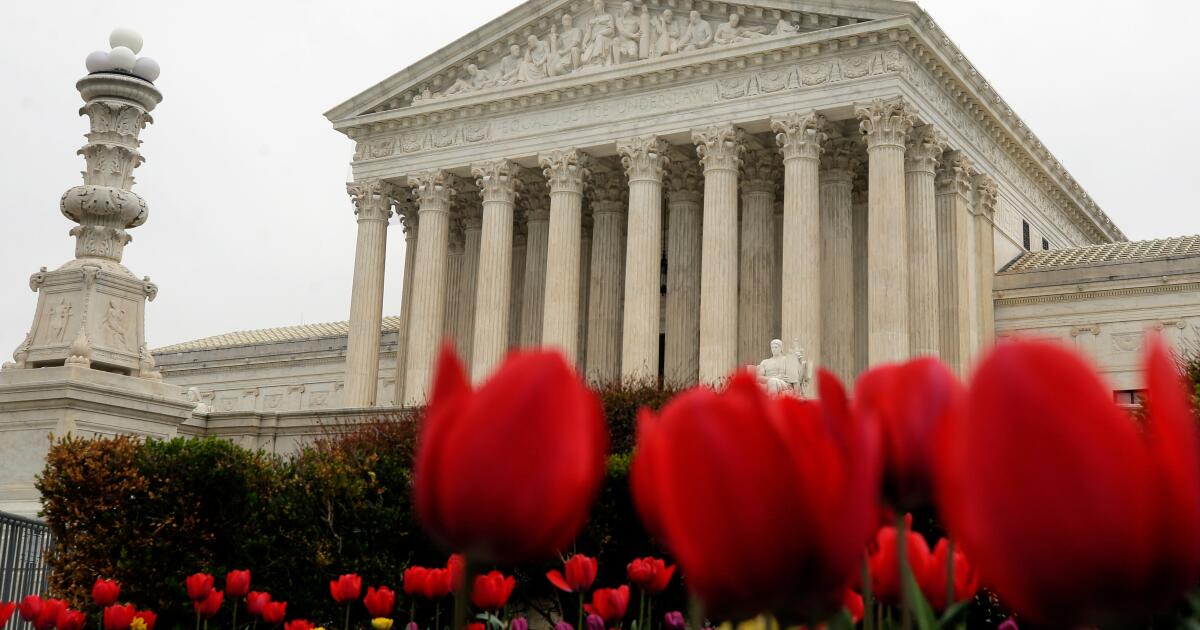
WASHINGTON — Supreme Court Justice Samuel A. Alito Jr. fell ill at an event in Philadelphia last month and was treated for dehydration before returning home to suburban Washington, the court’s spokeswoman said Friday.
Alito’s illness did not require an overnight hospital stay and he was back on the bench the following Monday, spokeswoman Patricia McCabe said in a statement.
Alito was an active questioner during arguments that day in an important case about mailed ballots and participated in all the court’s hearings over the ensuing two weeks.
Alito, who turned 76 on Wednesday, is the second-oldest member of the court, after 77-year-old Justice Clarence Thomas.
The episode was first reported by CNN, which also said the treatment was administered at a Philadelphia hospital. The court did not say where Alito had been taken.
The incident is the latest example of the justices’ reticence to discuss their health, at least until the news somehow leaks.
In 2020, the court confirmed that Chief Justice John G. Roberts Jr. had spent a night in the hospital after a fall that required stitches in his forehead, only after the Washington Post reported it first.
Alito was driven by his security detail from Washington to what CNN said was a dinner following a Federalist Society panel that looked at his 20 years on the court.
When he didn’t feel well in the evening, “he agreed with his security detail’s recommendation to see a physician before the three-hour drive home” to northern Virginia, McCabe said. He was given fluids for dehydration, she said.
While the justice has not said anything about retirement, speculation has swirled that Alito might soon step down, which would give President Trump the chance to appoint a fourth justice, after the three who were confirmed during his first term.
While Alito is young by Supreme Court standards, he might not want to stay around and gamble on the possibility of Democrats flipping the Senate in the November elections and seeing a Democrat capture the White House two years later.
Retiring in the summer would allow Trump to name a similarly conservative but much younger replacement who would almost certainly win confirmation from the Republican-led Senate.
PHOENIX — Candace Parker, Elena Delle Donne, Chamique Holdsclaw and the 1996 U.S. Olympic women’s basketball team will be enshrined in the Naismith Memorial Basketball Hall of Fame later this year.
Parker, Holdsclaw and members of the 1996 Olympic team were all in attendance Friday at halftime of the UConn-South Carolina game during the women’s NCAA Final Four, where the selections were announced, as was Amar’e Stoudemire and Mike D’Antoni.
They will be joined by longtime NBA official Joey Crawford, NBA coach Doc Rivers and Gonzaga coach Mark Few in the Hall of Fame.
Parker won three titles in the WNBA with three different teams: Los Angeles, Chicago and Las Vegas. She is the only player in league history to win both the MVP and Rookie of the Year in the same season.
She also won two titles while playing in college for Tennessee under Hall of Fame coach Pat Summitt, plus two Olympic gold medals and two WNBA MVP awards.
Delle Donne won two league MVP awards in 2015 and 2019, the second of which came when she led the Washington Mystics to their lone WNBA championship. Delle Donne became the first player in league history to shoot more than 50% from the field, 40% from three-point range and 90% from the free-throw line.
Holdsclaw won three straight titles at Tennessee from 1996-98, the first team to accomplish that. The 1998 championship was Tennessee’s first undefeated season at 39–0 and the Vols also set an NCAA record for the most wins in a season. Holdsclaw went on to have an 11-year WNBA career.
Stoudemire, who was the only NBA player in this year’s class, was Rookie of the Year in 2003 and became six-time All-Star. He spent the first eight years of his career with the Phoenix Suns, where he teamed with D’Antoni.
Rivers has nearly 1,200 victories on his resume, which puts him eighth on the all-time wins list. He led the Boston Celtics to the NBA championship in 2008 and also was in charge of the Los Angeles Clippers during their Lob City era.
Few has won more than 770 games at Gonzaga in his career at the school. He set the NCAA Division I men’s coaching record by winning 81 games in his first three years at the school.
Crawford officiated 2,561 regular-season NBA games and 50 Finals games over his 39-year career. He retired in 2016.
The enshrinement ceremony will take place in August at the Hall of Fame in Springfield, Mass.
Good morning, and welcome to L.A. on the Record — our City Hall newsletter. It’s Noah Goldberg and David Zahniser, giving you the latest on city and county government.
Los Angeles City Atty. Hydee Feldstein Soto and challenger Marissa Roy have sharply different views on how the office should be run.
Literally, the office.
Feldstein Soto said it’s important for attorneys to be in the office, and adopted a policy last year requiring most staff attorneys to be there at least three days a week, with supervisors required to be in four days weekly. Previously, the rule was up to three days of remote work per week.
“It builds teamwork. It ensures cohesion. It ensures that you have the opportunity to review and evaluate the work of new employees while they are still on probation,” she said in an interview.
That policy, however, has put Feldstein Soto at odds with the Los Angeles City Attorneys Assn., which endorsed Feldstein Soto in 2022 but has yet to weigh in this year.
Roy, the deputy state attorney general and the most well-funded of three challengers in the June 2 city primary election, recently told the city attorney’s union that the city’s lawyers should only have to show up at the office two days a month, not counting court appearances. That’s the policy at the state attorney general’s office, where Roy works for Atty. Gen. Rob Bonta.
“There’s no reason why the city attorney’s office can’t have that same policy,” Roy told The Times.
Many companies and public agencies adopted liberal work-from-home policies during the COVID-19 pandemic, although those policies have been largely rescinded to one degree or another. Still, Roy contends that the two days a month is reasonable given the sacrifices lawyers make to work for the government.
“You’re taking a pay cut from the private sector. You’re doing it because you care. You’re doing it for work-life balance and we have to respect that,” said Roy, who has been endorsed by the Los Angeles chapter of the Democratic Socialists of America as well as the county Democratic Party.
Feldstein Soto said Roy’s two-days-per-month proposal creates logistical issues since the city’s lawyers are required to appear in court and be present for legal questions that arise at city meetings. She also said liberal work-from-home policies make it too easy for lawyers to take on outside work.
Roy is Feldstein Soto’s most significant opponent, racking up endorsements and more than $450,000 in campaign contributions through the end of December. Feldstein Soto raised more than $685,000 through the end of last year.
Challenger Aida Ashouri, a lawyer and activist, said she supports the current policy, saying it provides flexibility to employees while also ensuring they confer in person.
“We want to continue to make sure that people see their co-workers, that we have meetings in person,” Ashouri said. “I think meetings in person can be very effective and better for communication purposes.”
The fourth candidate, Los Angeles County Deputy Dist. Atty. John McKinney, said remote work is a “valuable tool for work-life balance.”
He said he would build on Feldstein Soto’s existing remote work rules, though he did not outline exactly what his policy would be.
The Los Angeles City Attorneys Assn. filed an unfair employee relations claim against the city last year when Feldstein Soto toughened the rules. The attorneys claim that the changes should have been bargained with the union.
The Los Angeles City Attorneys Assn. endorsed Feldstein Soto when she first ran four years ago, but hasn’t yet made an endorsement in the city’s June 2 election. The endorsement is expected to be discussed by union officials next week, said union president Ann Rosenthal, who said the city policy makes it hard to recruit new attorneys. Citywide, departments make their own determinations on RTO, said Matt Szabo, the city administrative officer.
Szabo said the city is discussing a draft citywide policy on remote work with city employee unions.
You’re reading the L.A. on the Record newsletter
Sign up to make sense of the often unexplained world of L.A. politics.
By continuing, you agree to our Terms of Service, which include arbitration and a class action waiver. You agree that we and our third-party vendors may collect and use your information, including through cookies, pixels and similar technologies, for the purposes set forth in our Privacy Policy such as personalizing your experience and ads.
State of play
— DOCUMENT DROP: The Charter Reform Commission sent the City Council its written recommendations for changing the city’s government. Among the ideas: a larger City Council, a two-year budgeting cycle and greater authority for the council over policing policies. The council will decide how many of the proposals should appear on the Nov. 3 city ballot.
— A NEW FRONT-RUNNER? City Councilmember Nithya Raman came out ahead of incumbent Karen Bass in a new poll on the Los Angeles mayor’s race, though the poll’s director cautioned that it did not give the whole picture. Raman had a commanding lead, with 33% of voters supporting her, while Bass trailed at 17%, according to the poll by Loyola Marymount University’s Center for the Study of Los Angeles.
— OR MAYBE NOT: Meanwhile, a survey released by UCLA’s Luskin School of Public Affairs found Bass in the lead, with reality TV star Spencer Pratt coming in second and Raman a close third. With 40% undecided, the race remains “wide open,” said Zev Yaroslavsky, director of the Los Angeles Initiative at UCLA Luskin, a former L.A. council member and county supervisor. The poll’s margin for error is 4%.
— NEED FOR SPEED (CAMERAS): By the end of the summer, 125 speed cameras will be installed on dozens of streets throughout Los Angeles, specifically on roads that are in school zones, are known street-racing corridors or where speeding has resulted in a high rate of traffic accidents.
— EATON FIRE RECOVERY: At the end of March, just under 3,400 applications to rebuild residences destroyed in the January 2025 Eaton fire had been filed. That’s about 56% of the roughly 6,000 residential structures in Altadena that CalFire designated as destroyed, a Times review found.
— CAL-EXODUS: A new UC Berkeley study found that people who moved out of California dramatically improved their financial conditions. A surprising finding from the California Policy Lab: Those leaving the state are increasingly moving out of its wealthiest areas.
— PACK YOUR TRUNK: Nearly a year after the Los Angeles Zoo shipped Billy and Tina the elephants off to a zoo in Tulsa, Okla., animal rights activists have kept up the call to relocate them to a sanctuary. Actor Samuel L. Jackson is among those weighing in.
QUICK HITS
Where is Inside Safe? The mayor’s signature homeless relocation program was in North Hollywood and brought more than 40 people indoors in Councilmember Imelda Padilla‘s district.
On the docket next week: The City Council will remain in recess next week.
Stay in touch
That’s it for this week! Send your questions, comments and gossip to LAontheRecord@latimes.com. Did a friend forward you this email? Sign up here to get it in your inbox every Saturday morning.
SACRAMENTO — As Democratic leaders in California challenge President Trump’s latest effort to restrict the use of mail-in ballots, they also must grapple with a troubling development in the last election.
A significant number of mail-in ballots arrived too late to be counted in the Nov. 4 special election for Proposition 50, Gov. Gavin Newsom’s successful measure to reconfigure the state’s congressional districts, according to state data.
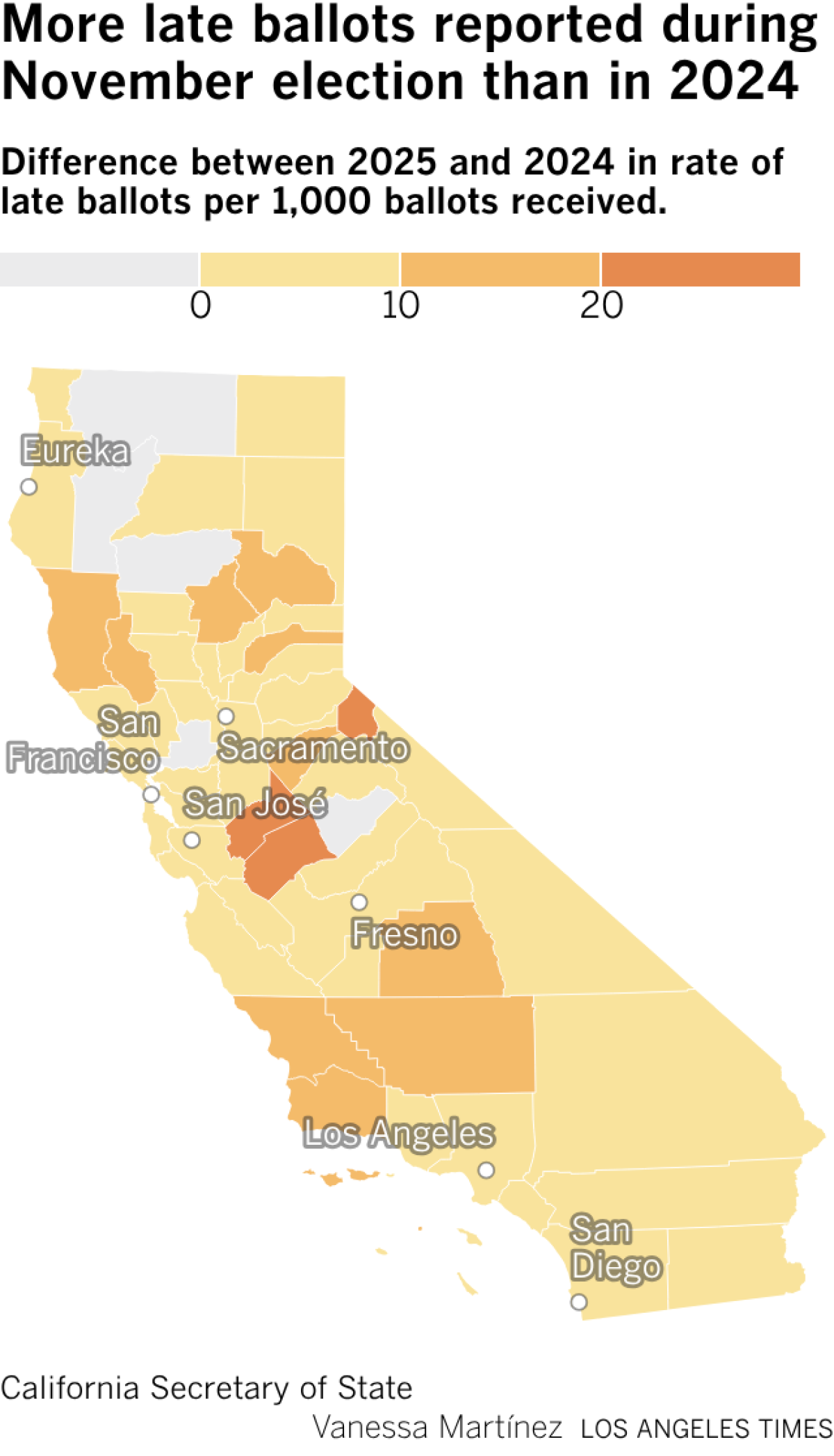
Ballots came in late at an average rate four times higher than that of the 2024 election, with rural counties seeing some of the biggest increases, according to a Times review.
“Something changed,” said Melvin E. Levey, who heads the Merced County Registrar of Voters. “We don’t like seeing late ballots and if someone has made the effort to vote, we want to count it.”
Merced saw almost a sevenfold increase in late-arriving mail ballots in the November election compared with the year before.
Vote-by-mail ballots are considered late if they are not postmarked on or ahead of election day or do not arrive within seven days of election day.
The issue appears to be linked to the U.S. Postal Service, which last year reduced the number of trips to pick up mail at post offices in mostly rural areas. Election officials warned before Nov. 4 that the Postal Service changes could delay the postmarking of ballots and lead to votes not being counted.
During the Nov. 4 election in California, an average of 8 out of every 1,000 vote-by-mail ballots were rejected by counties because they arrived too late, according to Secretary of State data. In the 2024 general election, which included the presidential race, an average of 2 of every 1,000 vote-by-mail ballots were rejected for being late.
In Kern County, for example, 3,303 mail-in ballots — or 1.95% of returned mail-in ballots — were not counted in the 2025 special election because they arrived too late. In 2024, that number was 332 — or 0.14%. And in Riverside County, 5,831 ballots — or 0.95% of those mailed in — were deemed too late to count, more than double the number of late ballots rejected in 2024.
Postal Service spokesperson Cathy Purcell recommended that voters mail their ballot a week in advance of when it must be received by election officials to ensure it arrives on time.
“You should never be mailing your ballot on election day,” Purcell told The Times.
Before last’s year’s special election, California Secretary of State Shirley Weber issued a similar warning about the delays. Anyone dropping off their ballot at a post office on election day should get it postmarked at the counter, she said.
“We don’t want anyone to just toss it into the mailbox as we have been able to do in the past and have it counted,” she said. “The Postal Service has said that they may not be counted in certain areas.”
California voter data expert Paul Mitchell expressed astonishment about the Postal Service’s guidance.
“We’ve had six, eight years of elections where people were feeling confident about mailing in their ballot,” said Mitchell, vice president of the voter data firm Political Data Inc. “Now the USPS is saying they have to mail it in a week early.”
“That is a dramatic change that can disenfranchise voters who are just following the same pattern that they’ve used in prior elections,” he added.
Democrats have been defending the vote-by-mail system in the face of Republican attacks. Trump recently signed an executive order to impose federal restrictions on mail-in ballots and, without evidence, has long criticized mail-in ballots as a source of fraud and a factor in his 2020 election loss to Joe Biden.
The Nov. 4 special election on Proposition 50 was the Democrats’ attempt to counter Trump’s push for Republican-led states, most notably Texas, to redraw their electoral maps to keep Democrats from gaining control of the U.S. House of Representatives in the 2026 midterms and upending his agenda. The ballot measure overwhelmingly passed.
Nearly 89% of votes in the Nov. 4 election were vote-by-mail ballots, according to Weber’s office. In addition to Proposition 50, tax measures were also on the ballots in some counties.
Postal Service changes
About a month before the Nov. 4 election, Weber and Atty. Gen. Rob Bonta held a news conference to encourage California voters to vote early because of service changes at the U.S. Postal Service.
Bonta told reporters that voters living 50 or more miles from six large mail processing centers in urban areas who mailed their ballots on election day would not have those ballots postmarked in time. The centers are in Los Angeles, Bell Gardens, San Diego, Santa Clarita, Richmond and West Sacramento, according to Bonta’s office.
The changes at the U.S. Postal Service are part of a 10-year plan that kicked off several years ago aimed at improving services and reducing costs at the independent federal agency.
In the 17 counties that are mostly or entirely within the 50-mile distance from the mail facilities, the average rate of late ballots doubled in the November 2025 election compared with the election the year before — from 2.5 per 1,000 ballots received in 2024 to 5.6 per 1,000 in 2025.
But in counties that are entirely or mostly outside of the 50-mile radius, the average rate of late ballots quadrupled — from 2 per 1,000 ballots received in 2024 to 9.3 per 1,000 in 2025, state election records show.
Similar complaints about late ballots because of the mail changes have been reported in other states, including in Snohomish County, Wash., according to the New York Times.
The U.S. Postal Services told the Times that there are “any number of factors” that may affect the timeliness of mail.
“The Postal Service has successfully delivered America’s election mail, and we are confident that we will do so again this year,” spokesperson Nikolaj Hagen said. “We rely on long-standing, robust and tested policies and procedures, which have proven successful in the secure and timely delivery of election mail.”
Hagen added that “adjustments to our transportation operations will result in some mailpieces not arriving at our originating processing facilities on the same day that they are mailed.”
Postmarks are generally applied at those processing facilities, Hagen said, so the postmark date may not reflect the date the mail was collected by a letter carrier, dropped off at a retail location, or placed in a collection box.
While the U.S. Postal Service uses postmarking as an internal tool to track the place and date the mail was accepted, outside entities also use the postmarks for their own purposes, including the Internal Revenue Service, which requires federal tax returns to be mailed by April 15.
Several U.S. senators, including Sen. Alex Padilla (D-Calif.), sent a letter in January to USPS Postmaster Gen. Dave Steiner warning that changes to postmarking will make it more difficult for people, particularly those in rural areas, to vote by mail and pay tax bills on time.
On Tuesday, Trump signed an executive order that seeks to put new federal controls on voting by mail in states, repeating his long-held but unsubstantiated claim that mail-in ballots are a source of widespread fraud in U.S. elections.
The order directs the U.S. Postal Service to take control of mail balloting by designing new envelopes with special bar codes that will allow the federal government to ensure that such ballots go out only to eligible voters.
States must follow the USPS process if they plan to use the federal mail system for sending or receiving ballots. They also must submit to the USPS lists of eligible voters in advance of such ballots passing through the mail system.
Separately, the Republican National Committee is challenging a Mississippi law that allows ballots that arrive up to five days after election day to be accepted and counted. The case was argued before the conservative-leaning U.S. Supreme Court in March.
Times staff reporter Kevin Rector contributed to this report.
The Angels celebrated their 2026 home opener on Friday, and the fans booed the ceremonial first pitch.
Magic Johnson, the Dodgers’ co-owner and the foremost winner in Los Angeles sports history, threw out the ceremonial first pitch before the Dodgers’ opener. Jeff Kent, just elected to the Hall of Fame, did the honors for the San Francisco Giants.
In Anaheim, John Carpino tossed the first pitch, even with popular alumni such as Torii Hunter and Tim Salmon in the house. Carpino is the Angels’ president, retiring Monday after 16 years in that role and 23 years in all as a loyal executive under Angels owner Arte Moreno.
Moreno thought it would be lovely for Carpino to throw out the first pitch and, under different circumstances, it would have been.
So Carpino, as a proxy for Moreno, was booed loudly. Then a few modest choruses of “sell the team” broke out.
Behind the Angels’ dugout, Dave and Chris Bloye of Upland wore red T-shirts. His shirt listed five priorities, in order: Affordability, good experience, safety, peanuts, fan surveys. Her shirt listed five priorities too, starting with “sell the team.” The Bloyes said they have had season tickets for more than 20 years.
“We’ve never had a survey,” Chris Bloye said.
Moreno is competitive, a hardcore fan who regularly attends even spring training games. Perhaps he did not mean his words to come out the way they did.
Moreno declined an interview request from The Times at the owners’ meetings in February. A team spokesman said last week that Moreno would pass on an opportunity to clarify his remarks about fan priorities.
But, if those were indeed the priorities, they would have been reflected by the fans that showed up more than six hours before game time for the free fan festival the Angels throw before the home opener every year.
Surely, the man in the jersey that read “FAN SINCE 81” and the Angels tattoo on his left leg would be here win or lose.
Angels fans stand in front of the stadium before the team’s home opener against the Seattle Mariners on Friday night.
(Ronald Martinez / Getty Images)
Yes, Jose Bocanegra of Chino said, he would be. But for Moreno to say winning was not a top fan priority?
“That’s crazy,” Bocanegra said. “If you’re not in it to win it, then what are we doing?”
How about the fan in the Nolan Ryan jersey? He held his 7-year-old daughter atop his shoulders. She wore a Mike Trout jersey, smiled broadly, and clutched a cup of ice cream.
His name was Nate Ryan, from Hemet. He and his daughter attend Dodgers and Angels games, but they particularly like visits to Angel Stadium. His daughter loves the rally monkey and the free games in the Pac-Man arcade, and he appreciates Moreno’s focus on affordability.
“The Angels are more economical,” Ryan said. “We have a good time.”
Jarod Venegas of Corona dressed in a white wrap, wearing a red cap topped by a gold halo. He was about to spend nine innings as — you guessed it — an angel in the outfield.
“I believe we have a team that can be the best,” he said.
What exactly do you mean by best?
“I mean World Series champions,” he said.
Venegas had something to say about fan priorities.
“Winning is our No. 2 priority,” he said. “No. 1 is getting a new owner.”
Johnny Estrada of Corona wore a T-shirt with eight lines on the back. All eight lines read the same: “Sell the team.”
He said he loves the team, supports the players, and does not believe Moreno chose his words poorly.
“I don’t necessarily feel it came out wrong,” Estrada said. “I feel he hasn’t cared for a while.”
Anaheim Mayor Ashleigh Aitken, who remains irked by Moreno branding the team with a Los Angeles name, has been a season-ticket holder far longer than she has been mayor. She’ll give Moreno a pass on his comments.
“I think it was a misstep,” Aitken said. “I’m willing to give him the benefit of the doubt. He knows that winning, for a true fan, is one of the most important things. Winning is a priority for our players. Winning is a priority to the loyal fan base.”
Even more so, perhaps, to the casual fans, the ones that determine whether the Angels sell three million tickets in any given year.
The Angels sold 2.6 million tickets last year, a testament to the strength of the market amid a second consecutive last-place finish.
The “Big A” sign outside Angel Stadium on Friday during the team’s home opener.
(Ronald Martinez / Getty Images)
However, attendance has fallen 20% over the past 20 years, a span that includes one postseason series victory and the current streaks of 10 seasons with losing records and 11 seasons without a playoff appearance.
Friday’s home opener was sold out. However, as of Friday afternoon, resale markets listed tickets for as little as $7 for Saturday’s game and $4 for Sunday’s game.
This is a great fan base, to me much more frustrated than angry, waiting to erupt in joy. The fan festival was dominated by fans wearing “sell” jerseys but a variety of Trout jerseys — home white, road gray, alternate red, City Connect, All-Star, World Baseball Classic, even one from the Salt Lake Bees.
Trout’s loyalty has been reciprocated by the fans. Moreno could feel that love too, with a renewed commitment to the excellence the Angels he displayed in his first decade as owner.
In Anaheim, the thunder sticks were glorious. Moreno does not want to sell at the moment, so best to demonstrate a dedication to returning October to the Angels’ schedule, lest their fans take home their giveaway calendars from the home opener and start the countdown to “wait ‘til next year.”
James Gadson, a prolific drummer who worked closely with Bill Withers and as a member of the widely sampled Watts 103rd Street Rhythm Band — and whose playing motored hits like Diana Ross’ “Love Hangover,” Marvin Gaye’s “I Want You” and Gloria Gaynor’s “I Will Survive” — died Thursday, according to Rolling Stone. He was 86.
Rolling Stone didn’t say where Gadson died or specify a cause but said the drummer’s wife, Barbara, had confirmed the news; she told the magazine that Gadson had experienced a fall recently and undergone surgery.
Described by the Roots’ Questlove as “breakbeats defined,” Gadson was known for a funky, laid-back style best exemplified perhaps by his playing in Withers’ 1972 “Use Me,” in which he seems somehow to keep finding space for an extra beat. Forty years later, Kendrick Lamar borrowed Gadson’s intricate rhythm pattern for “Sing About Me, I’m Dying of Thirst,” from the rapper’s 2012 breakthrough album, “Good Kid, M.A.A.D City.”
In “Love Hangover,” which topped Billboard’s Hot 100 in 1976, Gadson’s drumming anchors a production that moves from lush soul balladry to a frisky disco groove; Gaye and his producer Leon Ware got a similar thump out of the drummer for “I Want You,” which reached No. 1 on the R&B chart in 1976 and was later interpolated by Lamar for his Grammy-winning “The Heart Part 5.”
Among the many other songs from the ‘70s featuring Gadson’s playing are the Jackson 5’s “Dancing Machine,” Cheryl Lynn’s “Got to Be Real,” Smokey Robinson’s “Cruisin,’” Yvonne Elliman’s “If I Can’t Have You,” Tavares’ “Heaven Must Be Missing an Angel,” Peaches & Herb’s “Shake Your Groove Thing” and Thelma Houston’s “Don’t Leave Me This Way.” In later years he worked with the likes of Beck, D’Angelo, Paul McCartney, Justin Timberlake, Harry Styles and Sturgill Simpson.
Gadson was born June 17, 1939, and grew up in Kansas City. His father was a drummer, and when Gadson and his brother were teenagers they played in a doo-wop group called the Carpets. Gadson moved to Los Angeles in the mid-’60s following a stint in the Air Force and joined the Watts 103rd Street Rhythm Band, led by the singer and guitarist Charles Wright; the group scored hits such as “Do Your Thing” and “Express Yourself,” the latter of which N.W.A would eventually sample for its song of the same name from 1989’s “Straight Outta Compton.”
In the early ’70s, Gadson and several other Watts band members left the group and took up with Withers (who’d already broken out with “Ain’t No Sunshine”) to make his album “Still Bill.” In addition to “Use Me,” the LP spun off the hit single “Lean on Me,” which went to No. 1 and was later inducted into the Grammy Hall of Fame. Gadson backed Withers in 1972 for a concert at Carnegie Hall that was recorded for a classic live album; the record opens with a version of “Use Me” that stretches past the eight-minute mark.
Though Gadson’s crack at a solo career around the same time didn’t pan out, he quickly became an in-demand session drummer, particularly for acts signed to the Motown label, which had just moved to L.A. from its original home of Detroit. He played on Motown records by the Temptations, the Miracles, the 5th Dimension and the Supremes’ Mary Wilson; over the decades that followed, he also worked with Philip Bailey, Anita Baker, Ray Charles, Leonard Cohen, Norah Jones and Lana Del Rey.
On Friday, the jazz guitarist Jeff Parker wrote on Instagram about his experiences playing with Gadson.
“The last time we convened, he noticed me glaring at his drum kit in wonder — I knew that there had to be a LOT of history there,” Parker recalled. “He looked at me and said, ‘Jeff, that’s my disco kit.’ I said, ‘Are those the drums on “Love Hangover”?’ He nodded and said, ‘They’re the drums on a whooooole lot of records.’”
ALISON Hammond has declared she is “absolutely in love” with her boyfriend David Putman, despite their 22 year age gap, in a rare relationship admission.
Alison Hammond has gushed that she and boyfriend David Putman are ‘absolutely in love’ in a rare admissionCredit: InstagramThe pair have a 22-year age gap, something Alison says hasn’t impacted the romanceCredit: Darren Fletcher
Alison’s romance was a surprise to many due to David’s age, with her beau thought to be turning 29 next month.
However, Alison – who is a mum to 20-year-old son Aiden – has said their love transcends any age barriers in a new admission.
Addressing the difference, the TV star explained: “I completely understand why people are interested when there’s a 22-year gap, but what I find interesting is that it’s not as interesting when it’s the man who is older.”
Talking to the Daily Mail, she continued: “Why is that? I just want people to be happy for us.
Ahead of spending Christmas together, along with her son Aiden, Alison gushed over her other half.
“Things are going really, really well,” she told the Mirror.
She continued: “He just has the most beautiful energy and everyone feels it when they’re in his presence. It’s very rare.
“I am so grateful that he chooses to spend his life with me.”
Alongside working as a model, David is a massage therapist and first met Alison when she booked in for a massage back in 2023.
Hitting it off, the pair have been going strong ever since.
While they don’t often make public appearances together, Alison has shared a handful of snaps with David to Instagram over their relationship.
Previously addressing their age gap, she assured that David’s maturity makes things work so well.
Alison told Good Housekeeping: “I can see how, on paper, you’d notice the age difference.
“Yes, I’m 22 years older than he is, but if you saw us together, you’d understand. People have said to me, ‘We get it now.’”
Alison’s comments are a rare revelation, with the TV star choosing to keep her relationship fairly privateCredit: AlamyThe pair met in 2023 and have been going strong ever sinceCredit: Darren Fletcher
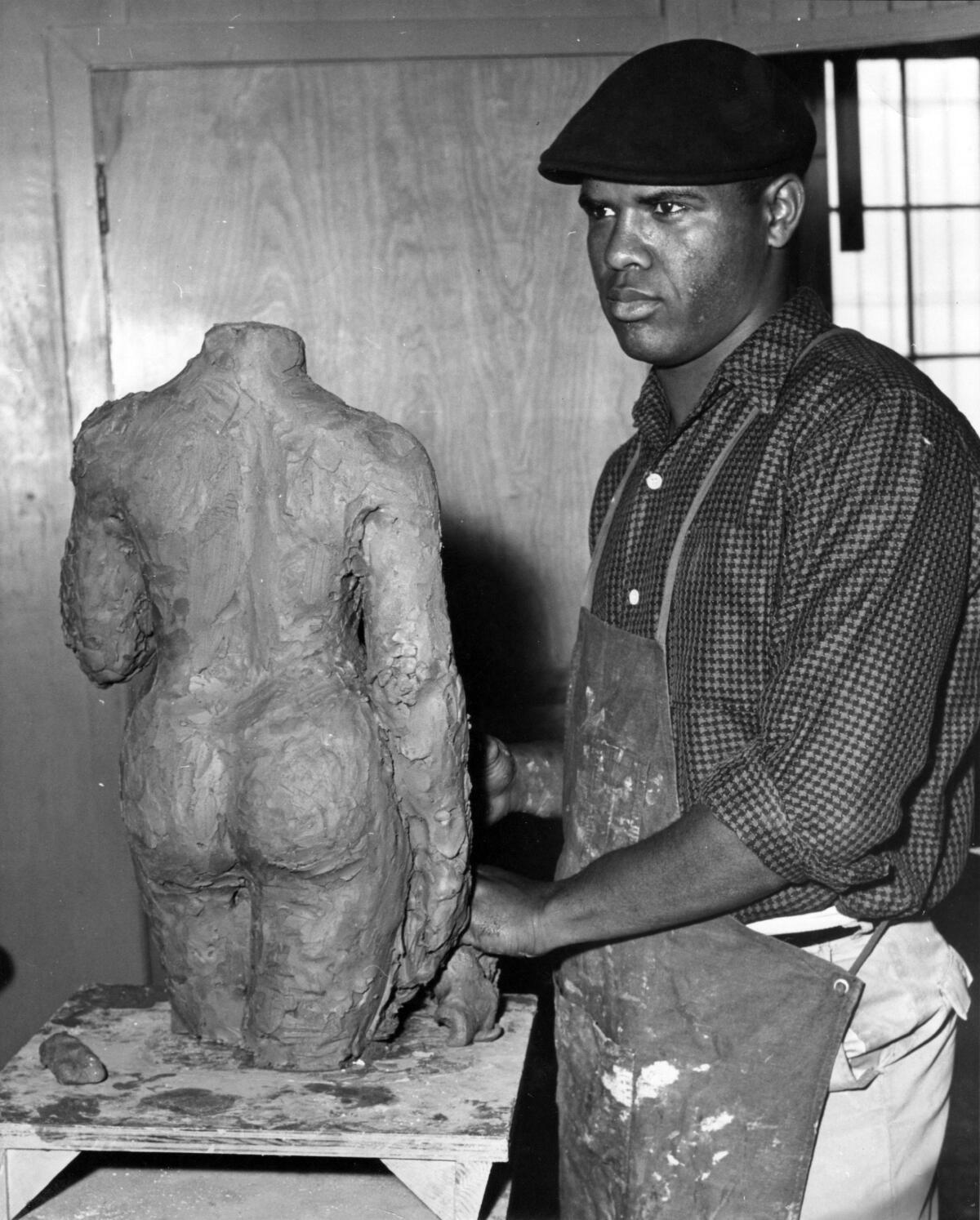
Melvin Edwards, a sculptor best known for abstract steel works that illustrated the history and resistance of African Americans, died March 30 at his Baltimore home. He was 88.
His death was confirmed by Alexander Gray Associates, the gallery that represents him.
Edwards rose to prominence in 1963 with the first works of what would become his most notable series, “Lynch Fragments.” A collection of small, wall-mounted sculptures, he combined fragments of found and recycled steel and welded them into forms of chains, sharp tools, barbed wire and other metal objects.
The series spans several decades, drawing inspiration from racial violence during the civil rights movement, the Vietnam War, his personal relationship to Africa, people in his own community and across the African diaspora.
Over the years, Edwards made more than 300 “Lynch Fragments.”
Recurring materials in his works held layered meanings. Barbed wire served as a symbol of violence and oppression, but also of agriculture, cultivation and survival.
“Melvin was somebody who looked at multiple dimensions of any situation or person,” said Alexander Gray, a gallery owner and close personal friend of Edwards. “He really looked at the world, not through any kind of binary lens, but through a personal lens that was respectful of other people’s perspective.”
Born May 4, 1937, in Houston, the eldest of four children, Edwards grew up surrounded by racial segregation. As a child, he took drawing classes and visited museums, and he also played football.
“The world that I came from was American racism, segregation. I may have been young, but I paid attention,” Edwards said in an introduction to “Lynch Fragments” at the Museum of Modern Art in New York.
Melvin Edwards, seen here in fellow sculptor Hal Gebhardt’s class at USC sometime between 1959 and 1960, died March 30 at his home in Baltimore.
His artistic career began while studying art on a football scholarship at USC, where he met and was mentored by Hungarian painter Francis de Erdely. Edwards’ L.A. roots were critical to his identity as an artist. Here, he began experimenting with welded steel, which became his primary medium.
After moving to New York City in 1967, he became, in 1970, the first African American sculptor to have a solo exhibition at the Whitney Museum of American Art.
Throughout his career, Edwards remained committed to public art, creating sculptures for universities, public housing projects and museums around the world.
Those who knew him described him as overwhelmingly positive, which shaped both his work and his relationships.
“Melvin’s community of artists was remarkable because it spanned the globe. You could spin a globe, land anywhere, say the name of the country or the city, and he would know three people there, minimum,” said Gray. “He could recall a conversation he had with a person 35 years ago without any hesitation. He had an incredible constellation of people that he was surrounded by.”
PHOENIX — You’d be forgiven if you thought this year’s Final Four was just a case of déjà vu.
On paper, that seems true — four No. 1 seeds who have dominated every round of the NCAA tournament arrived in Phoenix this week and they are the same four teams who reached the Final Four last year in Tampa, Fla.
Sustaining that level of success during the modern college basketball era, the four teams insist, isn’t as easy.
Connecticut doesn’t have Paige Bueckers; South Carolina doesn’t have Kamilla Cardoso; and UCLA coach Cori Close and the Bruins have a much different lineup.
“Getting here,” UConn coach Geno Auriemma said, “is the hard part.”
UCLA coach Close noted during the Sweet 16 that the work to stay competitive in this era is exhausting for coaches, and it’s only getting harder. She will have another rebuild ahead of her immediately after getting to the pinnacle of the sport during back-to-back campaigns.
The Bruins will graduate the majority of its rotation after this season, with all five starters and top bench player Angela Dugalic projected to be WNBA draft picks in April.
Does that make this a make-it-or-break-it year for UCLA?
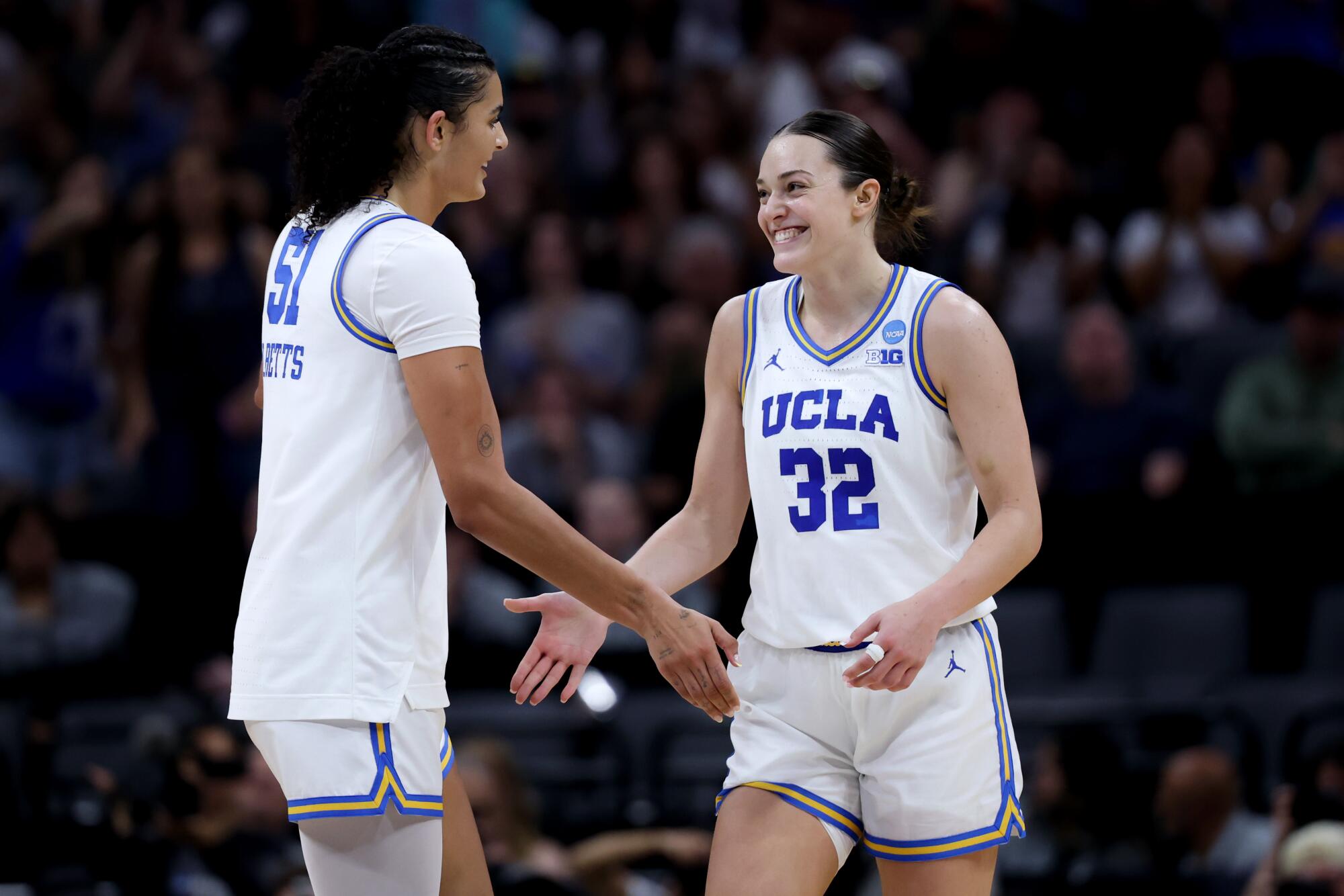
“I think in the back of our heads, we all know that this is our last go at this,” Bruins senior center Lauren Betts said. “It’s all or nothing for all of us.
”… I think when we do play, especially around this time, you can see throughout March Madness, we come out with a certain level of urgency because it is our last year. I think [Friday], we’re going to come out with that same level of urgency from the very beginning.”
UCLA’s Lauren Betts, left, and Angela Dugalic celebrate during the second half of the Bruins’ Elite Eight win over Duke on Sunday.
(Eric Thayer / Los Angeles Times)
UCLA senior forward Gabriela Jaquez added, “We’re just fighting for more days with each other at the end of the day.”
While the Bruins will bring back some young talent in Lena Bilic and Sienna Betts and add injured senior Timea Gardiner, they will essentially have to start from scratch. That’s not so unusual in the transfer portal era, where TCU went to the Elite Eight with five starters who transferred into the program.
“It is just brutal,” Close said on Thursday. “It’s a grind and that’s why all four of us should feel really proud that we’re here. That doesn’t make us any less competitive or wanting to win a national championship. But I think it is worth pausing and going, ‘Man, it’s amazing to be in this position, especially two years in a row.’”
To build this team, Close had to get Gianna Kneepkens in the portal, get Charlisse Leger-Walker healthy after transferring last season, coax career-best years out of Kiki Rice and Jaquez, help Lauren Betts come into her own as a defender along with a dominant offensive force and support a player like Dugalic willing to come off the bench.
The other three teams have starters they can build around for years to come. The Gamecocks, arguably the most successful program of the last half-decade-plus, landed Florida State scorer Ta’Niya Latson and Mississippi State center Madina Okot in the portal during the offseason to go along with returners Raven Johnson and Joyce Edwards.
“It’s not going to magically happen,” South Carolina coach Dawn Staley said, emphasizing strong habits are key.
The Huskies, the defending national champions with a strong recruiting pipeline and unmatched success during Auriemma’s tenure, are somewhat of an abnormality to the changing of the guard in the NCAA. South Carolina has been here for six straight years — with vastly different casts — while Texas hasn’t won a title since 1986 and UCLA never has.
“To do it at the level that the four teams that are here have done at this year, and really consistently, I think all four teams that are here, the only thing harder than building it is sustaining it,” Texas coach Vic Schaefer said. “When you sustain it at the level that the teams that are here have done it over the period and the course of years, it’s really incredible.
“What it takes to live there year in and year out, it’s hard. I think that’s what Coach [Close] was talking about a couple weeks ago. Man, she wasn’t looking for any sympathy or anything. It’s just a statement, man. It’s hard. Winning at this level is hard. It is.”
It might have seemed like a given that this tournament was going to go chalk, but that doesn’t make anything automatic and it doesn’t mean UCLA will stay at the top of the podium for years to come. UConn went three years between titles, after all.
UCLA coach Cori Close instructs her players during a win over Minnesota in the Sweet 16 of the NCAA tournament on March 27.
(Eric Thayer / Los Angeles Times)
None of the four No. 1 seeds have struggled much in their respective games this tournament. The closest was UCLA’s 70-58 win over Duke, when the Bruins trailed at halftime and came back to win for the first time all season.
But UConn went eight scoreless minutes against Notre Dame in the 70-52 win in the Elite Eight. Texas and South Carolina rolled, and Texas is 16-3 against top 25 teams and has arguably the best momentum of any team left standing.
UCLA might have a path back to this spot after teams have shown how quickly they can rebuild. After all, TCU was in the Elite Eight in consecutive years after having to forfeit games due to lack of players.
But UConn will return Sarah Strong and Blanca Quiñonez, South Carolina has Edwards back and Texas has another year of Madison Booker, and other up-and-coming squads like Michigan and USC will be dangerous.
It might not be the Bruins’ last chance to win the big dance, but it might be their best ever. Getting here, after all, is the hardest part.
“I think success leaves clues for who is next,” Dugalic said. “We’re trying to leave that for the next generation of basketball, to sustain that, to show it is hard. This isn’t a nine-to-five, it’s our lives, and that’s what it takes for everyone to be here.”
NEW YORK — This is not the run up to the midterm elections that Republicans wanted.
A year and a half after winning the White House by promising to lower costs and end wars, Donald Trump is a wartime president overseeing surging energy costs and an escalating overseas conflict that many in his own party do not like.
He offered little clarity to a nation eager for answers this week during a prime-time address from the White House, his first since the U.S. and Israel attacked Iran more than a month ago, simultaneously suggesting that the war was ending and expanding.
“Thanks to the progress we’ve made, I can say tonight that we are on track to complete all of America’s military objectives shortly, very shortly,” Trump said. “We’re going to hit them extremely hard over the next two to three weeks.”
Trump’s comments come roughly six months before voters across the nation begin to cast ballots in elections that will decide control of Congress and key governorships for Trump’s final two years in office. For now, Republicans, who control all branches of government in Washington, are bracing for a painful political backlash.
“You’re looking at an ugly November,” warned veteran Republican pollster Neil Newhouse. “At a point in time when we need every break possible to hold the House and Senate, our edge is being chipped away.”
Republicans confront evolving political landscape
It’s hard to overstate how dramatically the political landscape has shifted.
At this time last year, many Republican leaders believed there was a path to preserve their narrow House majority and easily hold the Senate. Now they privately concede that the House is all but lost and Democrats have a realistic shot at taking the Senate.
Republicans are also struggling to coalesce around a clear midterm message on Iran.
The Republican National Committee has largely avoided the war in talking points issued to surrogates over the last month. The leaders of the party’s campaign committees responsible for the House and Senate declined interview requests. Many vulnerable Republican candidates sidestep the issue, unwilling to defend or challenge Trump publicly.
The president remains deeply popular with Republican voters, and he has vocal supporters like Sen. Lindsey Graham of South Carolina.
“That was the best speech I could’ve hoped for,” he wrote on social media after Trump’s address on Wednesday evening. Graham said Trump “gave the American people a clear and coherent pathway forward.”
Trump made little effort to sell the conflict to Americans before the initial attack. Five weeks later, at least 13 U.S. service members have been killed and hundreds more injured. Thousands more troops have converged on the region, and the Pentagon requested $200 billion in new funding.
The Strait of Hormuz, a key passage for a fifth of the world’s oil, remains closed. The average price for a gallon of gasoline in the U.S. was $4.08 on Thursday, according to AAA, almost a full dollar higher than on President Joe Biden’s last day in office.
On Wednesday, Trump insisted that gas prices would fall quickly once the war concluded but offered no solution for reopening the Strait of Hormuz. Instead, he invited skeptical U.S. allies to do it themselves.
He insisted that the war would be worth it.
“This is a true investment in your grandchildren and your grandchildren’s future,” Trump said. “When it’s all over, the United States will be safer, stronger, more prosperous and greater than it has ever been before.”
Former Rep. Marjorie Taylor Greene, a Georgia Republican who was once among Trump’s most vocal allies in Congress, lashed out against his Iran policy.
“I wanted so much for President Trump to put America First. That’s what I believed he would do. All I heard from his speech tonight was WAR WAR WAR,” she wrote on social media. “Nothing to lower the cost of living for Americans.”
Time is not on Trump’s side
About 6 in 10 U.S. adults say the U.S. military action in Iran has “gone too far,” according to AP-NORC polling from March. Roughly a third approve of how he’s handling Iran overall.
The possibility of sending U.S. forces into Iran also appears politically unpalatable.
About 6 in 10 adults are “strongly” or “somewhat” opposed to deploying U.S. troops on the ground to fight Iran. That includes about half of Republicans. Only about 1 in 10 favor deploying troops.
At the same time, Trump’s approval ratings have remained consistently weak. About 4 in 10 Americans approve of how he’s handling the presidency, roughly in line with how it’s been throughout his second term.
Republican strategist Ari Fleischer, a senior aide in former President George W. Bush’s administration, acknowledged that Trump has not received the polling bump in this war that Bush got after invading Iraq.
Bush, of course, worked to build public backing for the Iraq War before going in. Immediately after the 2003 invasion, Bush’s popularity soared, as did the stock market.
Public sentiment and the economy soured only after the conflict stretched on. It ultimately spanned more than eight years, spawning a generation of anti-war Republicans — and sowing the seeds of Trump’s “America First” foreign policy.
“My hope is that the Trump experience is the exact opposite of the Bush experience,” Fleischer said.
He said Trump must win the war decisively and quickly to avoid a further backlash, saying there could be a “very significant political upside if things end well, oil comes down and markets rally.”
Fleischer added that Trump’s actions will matter much more than his words.
“Ultimately, he is not going to get judged on his persuasion or his explanations or his assertions, he’s going to get judged on results,” he said.
Peoples writes for the Associated Press. AP writer Linley Sanders in Washington contributed to this report.
As “The Super Mario Galaxy Movie” lands in theaters, coloring stations, collectible popcorn containers and mascot Marios are all in place to entice arguably the most prized moviegoers to Hollywood today: kids.
By Sunday, Universal Pictures expects the five-day opening of the “Super Mario” sequel to reach $186 million domestically, and around $350 million worldwide. That would make it easily the biggest hit of the year, surpassing a pair of successes that also launched with young moviegoers in mind: Pixar’s “Hoppers” ($297 million worldwide) and Amazon MGM’s “Project Hail Mary” ($300.8 million).
It’s not the start of a new trend but the culmination of one. In 2024, PG-rated movies outgrossed any other rating for the first time in decades, with $3.18 billion in domestic ticket sales according to Comscore. Five of the top six movies worldwide were PG movies: “Inside Out 2,” “Moana 2,” “Despicable Me 4,” “Wicked” and “Mufasa: The Lion King.”
Last year was no different. PG-rated films amassed $2.96 billion, again besting the longtime leader, PG-13. The top draws globally were “Ne Zha 2,” “Zootopia 2,” “Lilo & Stitch,” “A Minecraft Movie” and the PG-13-rated but not exactly kid-adverse “Avatar: Fire and Ash.”
Good news has been hard to come by in Hollywood. Contraction, most recently with Paramount Skydance’s planned purchase of Warner Bros. Discovery, has added to the anxieties of an already jittery industry. While ticket sales are up so far in 2026, they remain more than 20% below pre-pandemic levels. In February, AMC, the nation’s largest exhibitor, said it would continue to shutter underperforming theaters.
But despite a lot of talk about the imperiled future of moviegoing, future moviegoers — kids — are turning out in droves.
“There’s a recognition that this is an increasingly important group of movie fans and we’re doing everything we can to make sure their experience is wonderful,” says Michael O’Leary, president and chief executive of Cinema United, the trade group for theater owners.
Gen Alpha, those aged 12 or younger, may even be the movies’ best hope. A study last year by the National Research Group found that no generational group wanted to watch movies on the big screen, as opposed to at home, more than Gen Alpha.
“We’re emboldened by some of the research that indicates younger folks are the fastest growing demographic of people going to the movies,” O’Leary says. “We’re very much focused on the fact that we have to build the next generation of movie fans.”
Mario, Minions and more
In 2023, “The Super Mario Movie,” part of Universal’s collaboration with Nintendo and “Minions”-maker Illumination, grossed $1.36 billion. Its sequel is likely to get close to that, and add to a mounting string of $1 billion kids movies. The most recent was The Walt Disney Co.’s “Zootopia 2,” which became the highest-grossing Hollywood animated film of all time with a whopping $1.87 billion.
Increasingly, a generation that grew up with smartphones, iPads and Netflix is propelling today’s biggest blockbusters.
“What’s been true for a long time and is maybe even truer today: Families want to be out,” says Jim Orr, distribution chief for Universal, which recently announced the expansion of its exclusive theatrical window from three weekends to five. “They want to do things. They want to make memories.”
“No one talks about: Remember that great time when we sat on the couch?”
And this year may be the most kid-catered year at the movies yet. There are 26 wide-release PG movies slated for 2026, up from 24 in 2025 and 18 in 2024.
That includes a summer lineup that’s family friendly on a nearly week-to-week basis. Potential blockbusters lined up include “Toy Story 5” (June 19), “Minions & Monsters” (July 1) and the live-action “Moana” (July 10). Though currently unrated, “The Mandalorian and Grogu” (May 22) and “Supergirl” (June 26), not to mention “Spider-Man: Brand New Day” (July 31), will all also target young moviegoers.
A PG comeback
The PG surge comes several years after most family movies detoured to streaming during the pandemic, a shift that some, at the time, feared would become permanent.
“The family film has literally come back from near-extinction,” says Paul Dergarabedian, head of marketplace trends for Comscore. “The one genre that really took a major hit with the pandemic was the family film.”
But kids increasingly count among a key category for theaters: the habitual moviegoer. That’s considered going to six or more movies a year. And it’s not just younger kids. Last year, 41% of Gen Z moviegoers went to the movies at least six times, according to NRG, up from 31% two years earlier.
For cinephiles who have long feared movie theaters effectively turning into mini theme parks, the predominance of kid-oriented franchise blockbusters is unlikely to allay those concerns. Mid-budget, adult releases are increasingly rare. Dramas and comedies have struggled to attract audiences. Family-friendly movies occupying a bigger slice of cinemas is partially because adult moviegoing has waned.
But if older moviegoers are harder to coax away from the couch, families have been more eager. For them, the appeal of getting out of the house, despite rising ticket costs or the options on streaming services, is as strong as ever.
“In many instances, they’re going to the theater to get away from all of the other screens that inhabit their lives,” says O’Leary. “When I was a kid, you went to the movies, in part, to escape from something. So it’s a new variation on that old theme.”
Dergarabedian has taken to calling PG the new PG-13. If slightly adult-leaning movies once occupied the center of the multiplex, that territory now belongs to the PG movie.
“The kids that are going to the movies today are going to take their kids tomorrow,” Dergarabedian says. “As long as people keep making kids, the future of the movie theater experience is assured.”
After a major national debacle on live TV when she was only 20 years old, Ashlee Simpson Ross finally found a way to win back a small-screen audience’s love: She put a galaxy mask over her head and let the vocals rip.
Forget that 2004 incident where she got caught singing over a backing track in an appearance on “Saturday Night Live.” Sure, she did a weird little dance, then fled the set. Sure, her dad made excuses. But that’s in the past.
“I feel like I became Galaxy Girl and I had the best team ever,” Simpson told People. “So I mean, it felt great to do it. It felt great to perform, not being able to see where I’m going. You can hardly see where you’re going. I think just becoming that character of Galaxy Girl and people not knowing who I was, it was just a different way of performing that. I enjoyed that. It was definitely a moment of discovery.”
Back in fall 2004, Simpson, who’s now 41, was about to do her second song as the musical guest on “SNL.” Following in her famous sister’s footsteps as Jessica Simpson’s newlyweds reality show with then-husband Nick Lachey was hitting its stride, she had just released what would become the year’s top-selling album by a female singer.
Lorne Michaels would confirm later that it had been a first for the sketch show.
“What can I say? Live TV,” host Jude Law told the audience during the show’s goodbye sequence that night. Simpson, standing at his side, jumped in with a rapid-fire explanation of what had just happened, throwing her band under the bus and not making much sense at all.
“I feel so bad. My band started playing the wrong song and I didn’t know what to do, so I thought I’d do a hoedown. I’m sorry!” she said.
This was a year after her sister had asked, with cameras rolling, whether a can of Chicken of the Sea contained tuna or chicken, and whether Buffalo wings were made out of buffalo. So what stuck in people’s minds were those lyrics playing out of the ether. Ashlee Simpson, it was clear, intended to lip sync, which sort of implied to casual observers that she couldn’t sing. She became, to many, a laughingstock.
Her dad said afterward that acid reflux had made her vocal cords swell, necessitating the last-minute switch from live to Memorex. He called it a learning experience and said she would prove herself in future shows.
“Unfortunately, that happened to us on Saturday, so just like every other artist in America she has backing tracks … so you don’t have to hear her croaking through a song on national television,” Joe Simpson told Ryan Seacrest in a radio interview.
“She never used them before,” he said of the vocal tracks, but “you have to do what you have to do.”
A few months later, she was booed on national TV when she did the halftime show at the 2005 Orange Bowl. Folks joked that it was worse than what happened on “SNL.”
So, yes, her career continued, but it hasn’t been 100% smooth. After a couple more albums, she took a role in a Broadway musical and eventually she returned to acting. She said over and over that she was going to get back into music, but life kept getting in the way.
Then in 2025, after celebrating the 20-year anniversary of her breakout album release with a short gig at a WeHo nightclub the year prior, she announced a residency at the Venetian in Las Vegas. The gig proved popular enough that it was extended into 2026.
And over the course of “The Masked Singer” season, Simpson finally proved to those casual observers that she has a voice and knows how to use it. She even bested her husband, who competed this season as Stingray and was cast out in Episode 10.
“Performing is my happy place, and to be doing that again just feels so nice,” she told People. “I’m inspired to keep playing shows and creating new music. And moments like ‘Masked Singer’ and Vegas, and I’m looking forward to Pride and Stagecoach — those moments just make me realize, ‘Oh, this is what I love to do.’
WASHINGTON — One year ago, Donald Trump stood in a sun-kissed, unpaved Rose Garden and defiantly announced a new era of global trade, raising tariffs on countries worldwide and sending shock waves through the global economy.
The president promised short-term pain rippling through American households would make way for a U.S. economy that would soon take off. But experts say they are still waiting for receipts — and question whether they will ever come.
You’re reading the L.A. Times Politics newsletter
George Skelton and Michael Wilner cover the insights, legislation, players and politics you need to know. In your inbox Monday and Thursday mornings.
By continuing, you agree to our Terms of Service, which include arbitration and a class action waiver. You agree that we and our third-party vendors may collect and use your information, including through cookies, pixels and similar technologies, for the purposes set forth in our Privacy Policy such as personalizing your experience and ads.
A year of turbulence
Tariff rates shifted so unpredictably for so long — across countries and with remarkable speed — that companies are still struggling to build stable, long-term supply chains capable of supporting future planning and growth. U.S. markets recorded one of the most volatile years in history, marked by extreme swings and modest gains driven by a handful of stocks for tech companies largely inoculated from import duties.
A customer visits a Costco food court in San Diego on March 18.
(Kevin Carter / Getty Images)
Federal customs duties brought in tens of billions of dollars. But a study published this week by the European Central Bank found that U.S. importers and consumers, not foreign exporters, bore the brunt of the costs that paid for it — and that an even larger share of the burden will fall on American households and companies the longer Trump’s tariff policies stay in place.
Despite the president’s pronouncements, tariff earnings have barely made a dent in the federal debt.
Tax cuts and additional spending on defense and immigration enforcement have increased the annual deficit. In the months of January and February alone, net customs duties hit an average of $27 billion — a significant figure that has essentially offset the costs of Trump’s war with Iran, now estimated to be more than $57 billion since its start.
In February, the Supreme Court ruled that Trump had exceeded his authority by bypassing Congress to impose tariffs on an emergency basis. But the decision has merely prompted the Trump administration to look for ways to bypass the high court, as well.
“Even after the court ruling, the Trump administration continues to wield tariffs in a haphazard and ill-conceived fashion,” said Kimberly Clausing, a professor of tax policy and law at UCLA School of Law. “One year in, Trump’s tariffs have only generated higher prices, economic disruption, frayed alliances, and manufacturing job loss.”
Farmers in New Delhi take part in a March 19 protest demanding a minimum support price for crops.
(Sajjad Hussain / AFP / Getty Images)
Since the court ruling, Trump has moved away from using broad emergency powers to justify tariff rates, now citing laws on national security and unfair trade practices to keep them in place. Those are being challenged, as well.
“Trump’s tariff mania injected uncertainty into global business supply chains that he is refusing to let the Supreme Court undo,” said Aaron Klein, chair of economic studies at the Brookings Institution.
“It would be one thing if Trump replaced the existing tariff system with a coherent strategy approved by the very Republican Congress he controls,” Klein added. “Instead, Trump’s on-again, off-again tariff by tweet and let the courts figure it out months later destroys business’ ability to plan and undermines global confidence in America’s trustworthiness.”
‘Mounting downside’
Whether or not the president’s tariff policies survive, they have succeeded in ushering in a new era of international trade, shifting global reliance on the U.S. dollar and on the American consumer market, experts said.
“The euro, the Chinese yuan and crypto will be the biggest beneficiaries as the dollar loses market share,” said Kenneth Rogoff, an economist and professor at Harvard. “Future historians may well look back some day and see Liberation Day as marking the beginning of the end of the dollar’s absolute dominance in global markets, and the ‘exorbitant privilege’ it has given to the United States as issuer of what once upon a time was the world safest currency.”
Mary Lovely, a senior fellow at the Peterson Institute for International Economics, said that Trump’s tariff policies have upended global shipping, prompted China to increase offshore investments in countries like Vietnam to process Chinese inputs for the U.S. market, and elevated long-term uncertainty over investing in North America — a trifecta that has ensured that U.S. companies and consumers bear the costs.
“While the president promised an American ‘industrial renaissance,’ manufacturing jobs have been lost every month since early 2023,” Lovely said. “Easy to see the mounting downside of his tariff barrage, hard to find much upside.”
More than 100,000 net jobs in the U.S. manufacturing sector have been lost over the last year, in part due to the increased costs facing U.S.-based manufacturing companies for parts and inputs, said Michael Strain, director of economic policy studies at the American Enterprise Institute.
That has made domestic manufacturing less competitive. “The trade war has also increased the prices facing consumers at a time when affordability is their top concern,” Strain added.
Customers shop at the Sanya International Duty Free City in Sanya, in south China’s Hainan province, on Jan. 10. In December 2025, China launched special customs operations in the Hainan Free Trade Port, allowing easier entry of overseas goods and expanding zero-tariff coverage.
(Guo Cheng / Xinhua / Getty Images)
The policy has become a political albatross for the president, who now proceeds through a midterm year with a bipartisan majority of Americans dissatisfied with his approach to their top concern. Seven in 10 Americans believe that tariffs have increased their costs of living, according to a recent poll, including 64% of Republicans and 67% of independents.
Sung Won Sohn, a former commissioner at the Port of Los Angeles, said that inflation aggravated by Trump’s tariff actions has complicated policy at the Federal Reserve, fueling uncertainty in the U.S. stock market.
The Supreme Court’s decision, which prompted legal ambiguity on the administration’s path forward and opened the door to a flood of litigation for potential tariff refunds, further added to uncertainty. “The net result is decreased economic efficiency,” Sohn said.
Trump faces worse poll numbers on inflation than former Presidents Carter and Biden, both of whom faced challenges with increased prices on goods. Today, 72% of Americans disapprove of the president’s handling of rising prices, according to a CNN poll released this week.
“The real damage from the tariffs — and their uneven unwinding — is not captured in headline GDP figures,” Sohn added. “It shows up in slower decision-making, reduced productivity, and a persistent fog over the economic outlook.”
WASHINGTON — Defense Secretary Pete Hegseth has asked the Army’s top uniformed officer, Gen. Randy George, to step down, the Pentagon said Thursday, as the United States wages a war against Iran.
A Pentagon official, who spoke on condition of anonymity to discuss the sensitive matter, confirmed that George has been asked to take early retirement from the post of Army chief of staff, which he has held since August 2023.
The ouster of George is just the latest of more than a dozen firings of top generals and admirals by Hegseth since he first took office last year.
CBS News was first to report the ouster.
George is a graduate of West Point Military Academy and an infantry officer who served in the first Gulf War as well as Iraq and Afghanistan. He also served as Defense Secretary Lloyd Austin’s top military aide from 2021 to 2022, during the Biden administration, before taking on top leadership roles in the Army.
George survived the initial round of firings last February, which saw the removal of top military leaders, including Adm. Lisa Franchetti, the Navy’s top uniformed officer, and Gen. Jim Silfe, the No. 2 leader at the Air Force, by Hegseth. President Donald Trump also fired Gen. Charles “C.Q.” Brown, then the Chairman of the Joint Chiefs of Staff, at the same time.
Since then, more than a dozen other top military generals and admirals have either retired early or been removed from their posts.
Among these departures was George’s deputy, the Vice Chief of Staff of the Army, Gen. James Mingus, who was in the post for less than two years when Trump suddenly nominated Lt. Gen. Christopher LaNeve for the position. LaNeve was then serving as Hegseth’s top military aide, having been plucked for that post from commanding the Eighth Army in South Korea after less than a year in the job.
Hailee Steinfeld and Josh Allen have officially entered parenthood, welcoming their first little one.
“Our baby girl has arrived,” Oscar-nominated “True Grit” and “Sinners” star Steinfeld, 29, announced Tuesday in her latest Substack post. She wrote that she and her Buffalo Bills quarterback husband, 29, are “feeling incredibly grateful and blessed.”
“Savouring these early moments,” Steinfeld continued. “Thank you so much for the love and well wishes.”
The spouses married in June after two years of dating. People published photos from their outdoor California ceremony, in which Steinfeld wore a white strapless gown, mesh gloves and her veil and Allen wore a traditional tuxedo. They announced their engagement in November 2024.
Steinfeld announced she and Allen were expecting their first child in a Substack post in December, sharing photos from a snowy, bump-revealing maternity shoot. Steinfeld flaunted her pregnancy during the awards circuit earlier this year, cradling her baby bump at the red carpet for the Golden Globe Awards.
In an interview with Variety published in October, “Spider-Verse” star Steinfeld spoke about her marriage with Allen and balancing their conflicting schedules, noting “when the [NFL] offseason rolls around, it’s go-time for me.”
“I’ve gotten a lot better at understanding what it means to slow down and to share that with someone,” she said. “That’s the greatest thing ever.”
If you grew up in the ‘70s or ‘80s, your vision of suburban America probably looks a lot like South Pasadena. There’s good reason. The picturesque town on the western edge of the San Gabriel Valley was often used as a backdrop in films like “Halloween,” “Pretty in Pink” and “Back to the Future” (the street where George McFly, Lorraine and Biff lived is actually Bushnell Avenue).
Today in South Pasadena, you’ll still find this idyllic Anytown USA landscape — but with a twist: Along with verdant parks, Craftsman bungalows and tree-lined streets, the city gleams with cool new developments like the recently opened Sid the Cat Auditorium, an all-ages live music venue in a converted 1930s elementary school; the always-packed Cannonball from chef Matt Molina; L.A.’s first nonalcoholic bottle shop Burden of Proof and a high-tech head spa imported from Japan. Add on a walkable downtown and a bustling Thursday night farmers market and it’s easy to see why so many Angelenos are drawn to this increasingly hip community.
Get to know Los Angeles through the places that bring it to life. From restaurants to shops to outdoor spaces, here’s what to discover now.
“So few pockets of L.A. County are actually great for families and that’s what makes South Pas so compelling,” said my friend Tom, who moved to the area after having a baby two years ago. “Plus, it has light-rail.”
Located six miles from downtown L.A., South Pasadena was marketed as a “garden community” when it was founded in the late 19th century. New residents were promised homes with flowering vines and sweet-smelling gardens, all just a short cable car ride away from a bustling metropolis.
“It was that early promise of suburbia,” said Becky Nicolaides, a historian and author of the book “The New Suburbia: How Diversity Remade Suburban Life in Los Angeles After 1945.” “When it was incorporated, there weren’t cars, so the town was built to be walkable.”
But that peaceful facade hid an ugly truth. Like many suburbs in the L.A. area, the town’s officials put race restrictive covenants into place soon after its founding, making it illegal for residents to sell property to people of color.
Those covenants became illegal in 1948, but the town continued to discourage people of color from living within its boundaries for several more decades. That began to change in the 1960s and South Pasadena has diversified, particularly over the past decade. In recent years, town leadership has taken steps to acknowledge its racist past.
Now, even as a new energy permeates, the city continues to lean into its early suburban history. The town is just 3.4 square miles, but it encompasses 100 acres of parks and playgrounds as well as 21,000 trees. There’s an old-fashioned pharmacy where parents have taken their kids for a phosphate soda (or just a regular old milkshake) for over 100 years and volunteers from the community still decorate a float for the Tournament of Roses each year, just as they have since 1911.
And though its historic Red Car trolleys have been discontinued for decades, today it’s still a comfort to take the Metro home from work at the end of a long day and enjoy the peace and quiet of this pastoral suburb, just like its founders did more than a century ago.
What’s included in this guide
Anyone who’s lived in a major metropolis can tell you that neighborhoods are a tricky thing. They’re eternally malleable and evoke sociological questions around how we place our homes, our neighbors and our communities within a wider tapestry. In the name of neighborly generosity, we may include gems that linger outside of technical parameters. Instead of leaning into stark definitions, we hope to celebrate all of the places that make us love where we live.
Our journalists independently visited every spot recommended in this guide. We do not accept free meals or experiences. What L.A. neighborhood should we check out next? Send ideas to guides@latimes.com.