
X-Men

‘X-Men ’97’: Rogue and Wolverine voice actors on returning for Season 2

When the cast members and creators of the 1990s “X-Men: The Animated Series” reunited at the 2019 Hill Country Comicon in New Braunfels, Texas, they went out for dinner and collectively yearned to one day work together again.

“We said, ‘Let’s put it to the universe: Universe, why don’t you manifest that somebody buys the rights to the show and decides to reboot it and bring us all back.’ We toasted the universe and here we are,” recalls Canadian actor Lenore Zann, the voice of the irresistibly tough Rogue, during a recent video call while visiting Los Angeles.

The result of that metaphysical request is Marvel’s “X-Men ’97,” which debuted in 2024 on Disney+, not as a reboot but as a continuation of the original 1992 classic animated show.

The first season of this new era for the X-Men received an Emmy nomination for animated program. Now, the long-awaited second season has arrived, with the fourth episode streaming this week. Even after the controversial firing of showrunner Beau DeMayo, “X-Men ’97” has already been renewed through Season 4 and the voice cast has started recording their lines for Season 3, Zann says.

The show’s success with both fans and critics is in large part due to its commitment to honor the original ‘90s show, about a group of mutants fighting for themselves and for humanity, not only by preserving its hand-drawn animation style and mature themes but also the voices and personalities of the characters.

“When I pitched the show to Kevin [Feige], he got it immediately and his first question was, ‘Are you going to get the original cast back?’ And I was like, ‘Yes, we are,’” says Brad Winderbaum, head of Marvel Television, Animation, Comics and Franchise at Marvel Studios.

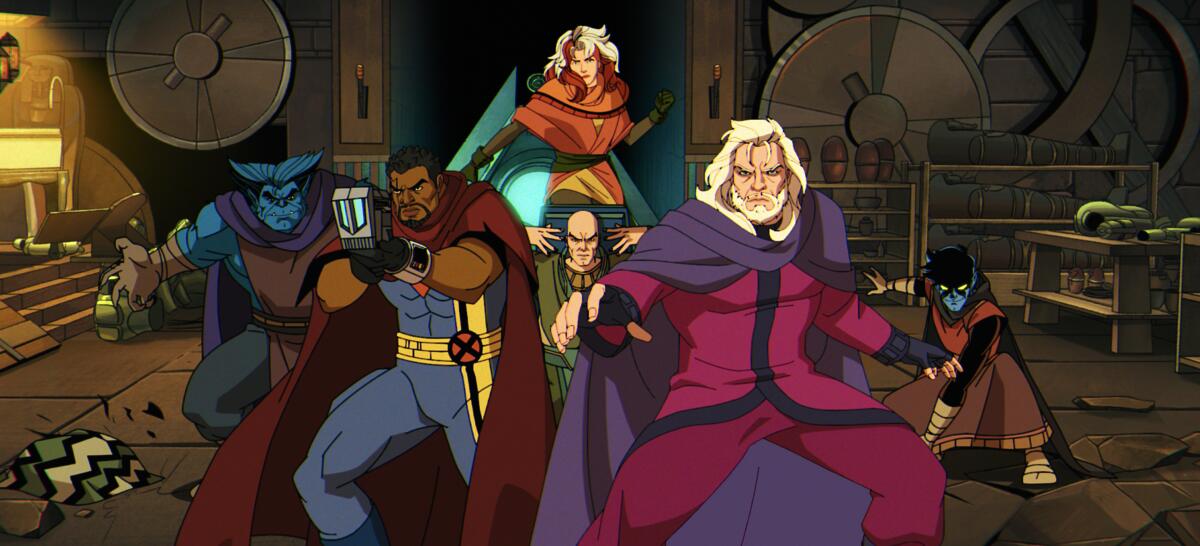
A cartoon rendering of six mutant superheroes standing together in a group in a workshop.

Several voice actors from the original “X-Men” animated series returned for “X-Men ‘97,” which has returned for Season 2. From left, Beast (George Buza), Bishop (Isaac Robinson-Smith), Rogue (Lenore Zann), Professor X (Ross Marquand), Magneto (Matthew Waterson) and Nightcrawler (Adrian Hough).

(Marvel)

Not everyone was still around to return — Norm Spencer, voice of Cyclops, died in 2020 — but in addition to Zann, actors George Buza (Beast), Alison Sealy-Smith (Storm), and Cal Dodd, the voice of the lovable clawed grouch Wolverine, have reprised their roles in “X-Men ’97.” Their emblematic voice performances, Winderbaum says, are baked into his psyche.

“Any time Lenore says the word ‘sugah,’ it just makes me melt into a puddle on the floor,” Winderbaum says, laughing. “She is Rogue and, when she turns it on, she becomes an icon.”

Busy with her political career as part of Canada’s parliament, Zann stepped away from the entertainment business for over a decade. Zann was back home in Truro, Nova Scotia, figuring out her next chapter when she received an email from a friend who said producers at Disney were looking to have her audition for a show. She was skeptical.

Zann eventually got a call from casting director Meredith Layne and a screenplay with lines that were instantly familiar from her time voicing Rogue, the spunky heroine whose touch can be deadly, in the ‘90s.

”I thought, ‘I guess they’re looking for Rogue, so I’ll just give them Rogue,’” she recalls, laughing. “And I did my Rogue voice, which is basically just my own, but with a bit of a Southern accent thrown on,” she adds with a slight twang.

The producers then asked her if she would reprise her superhero for a new generation of kids.

Doing her Rogue voice, Zann recalls: “I said, ‘You had me at hello, sugah.’”

She revels in the similarities between her and Rogue. “We’re both social justice warriors. We really fight for people to be accepted as who they are.”

In 2024, Zann published “A Rogue’s Tale: A Memoir,” a tome recounting her storied life, titled after a memorable episode in the ‘90s series that revealed her beloved mutant’s backstory.

A cartoon image of Wolverine wearing a blue and yellow uniform with his claws displayed and arm pulled back.

Wolverine in a scene from Season 2 of “X-Men ’97.”

(Marvel)

For Dodd, leaving behind Wolverine after five seasons of the original show felt like losing a part of himself. “X-Men ’97” offered him a chance to feel complete once again.

“I was so happy because when I first created the voice of Wolverine in ‘92, he became very quickly like my brother or my right arm,” Dodd says during a recent video call. “I got my arm back, and my brother.”

After all these years, Dodd was also pleased to see how the most important character of his career looked in the new series. “Out walks Wolverine and I just went, ‘Holy crap, you look great, bub,’” he recalls, laughing about his first time recording lines for “X-Men ‘97.”

When he first auditioned for the role in the ‘90s, Dodd had no idea who Wolverine or the X-Men were. At the time, he was making a living as a singer for commercials and jingles in Toronto.

Dodd remembers the lines he was asked to deliver were directed at the villainous mutant Sabretooth. He had never seen an image of Wolverine or any of the characters. “At one point, I said to them, ‘Is this an animal cartoon?’ They just thought I was a complete imbecile,” he recalls with a chuckle.

In that initial scene, where Sabretooth attacked Jubilee, a member of the X-Men who Wolverine sees as a daughter, his line was: “All right, you egg-sucking piece of gutter trash. You always like pushing around people shorter than you. Well, I’m shorter. Try pushing me.” Dodd recites it from memory in Wolverine’s voice with a growl.

“The lines I was reading, I’d heard them before in the small town that I grew up in Canada; it’s a fisherman’s town, a tough little town,” says Dodd about his reference for Wolverine’s voice. “I knew guys that were exactly like him, and I knew the way they sounded.”

Even without any notion of the X-Men, he nailed it.

“The next morning, they called me and said, ‘We would love to have you as our Wolverine for the very first X-Men animated series,’” Dodd recalls. “And I said, ‘I would love to be your Wolverine, whoever, and whatever he is.’”

1

A man in a black leather jacket and black T-shirt.

2

A blond woman in a denim jacket and pink scarf.

1. Cal Dodd, voice actor for Wolverine in “X-Men ’97.” 2. Lenore Zann, who voices Rogue. (Pauline Aguirre)

When Rogue came into Zann’s life, she already had a notable career as a screen and stage actor. Zann had starred as Marilyn Monroe in a rock opera about the actor’s life, for which she received much praise. “My agent called me and she said, ‘Lenore, they’re doing this animated series, and they’re looking for “a woman with a deep husky, sexy voice who can do a Southern accent,”’” Zann recalls, laughing. “And she said, ‘That’s you!’”

Back then, Zann wasn’t interested in doing voice work, so she missed the first auditions. But about a month later, she says, her agent called again. They still hadn’t found the right voice, so she pushed Zann to audition. She walked in and looked at a drawing of Rogue that Larry Houston, the storyboard artist and director of the show, had drawn.

“She had a very sassy attitude, and she had her hand on her hip and her head back with the hair flowing. I was like, ‘Yeah, I can do that.’ And then I went into the studio, put the headphones on, and opened up my mouth, did the first line: ‘I remember I had a boyfriend, when I kissed him, poor boy went into a coma for three days,’” she says in Rogue’s voice. That was enough for her to land the life-changing part.

At the end of the first season of “X-Men ’97,” both Rogue and Wolverine find themselves in difficult times. Wolverine’s clash with Magneto, the perennial antihero, left him severely injured, physically and mentally.

“He’s as tough as nails and he is more pissed off than anything that he was the only one that stood up to Magneto. He’s disappointed,” says Dodd. “And it’s a struggle for him in Season 2 for a lot of it. And then you see what happens. He’s in a funky place, but he’ll handle it.”

Part of that healing process will involve leaning into the humor tat Dodd imbues in his delivery. “What I think is surprising when you go back and watch that original animated series is how funny Cal is,” says Winderbaum. “Wolverine has amazing one-liners throughout that original series.”

As for Rogue, she is grieving the loss of Gambit, a.k.a. Remy LeBeau, who died in the first season. To voice Rogue’s sorrow, Zann leaned into her own grief over the passing of her 17-year-old niece from cancer. In Season 2, Rogue is trying to move forward.

“She’s still basically on a hero’s journey wanting to get justice for what happened to Remy and for the genocide that she witnessed and that she is a survivor of,” Zann says. “She still got survivor’s guilt, and she’s still trying to find her place within the X-Men now that the one that she loves is gone.”

At comic conventions, Zann and Dodd often meet fans of the original show, who are now adults, and their children, who have also come to love the characters. The emotions that people share with them are at times overwhelming.

“Many times, they tell us that this show saved their lives. They were either LGBTQ+ or they were bullied, or they just felt othered,” Zann explains. “A lot of folks who are Latino tell me that when they were little kids, their parents were agricultural workers, and they learned how to speak English from watching our show. We made them feel it’s OK to be different.”

“I see grown men in tears. They’re in their 40s and they’re crying,” Dodd says about meeting lifelong fans. “I can tell you that Wolverine can cry as well.”

Zann believes the X-Men are like modern-day mythological heroes. Through their fantastical ordeals, the X-Men illustrate qualities that inspire viewers, young and old.

“They are a group of misfits who band together to learn how to control the things that make them different and learn to accept and love themselves,” she says. “It’s an honor to be part of this incredible group of people and these characters that can really touch lives and help change them for the better.”

Source link

Michael Fassbender reveals the one thing he does ’10 times a day’ as he tells of major new role

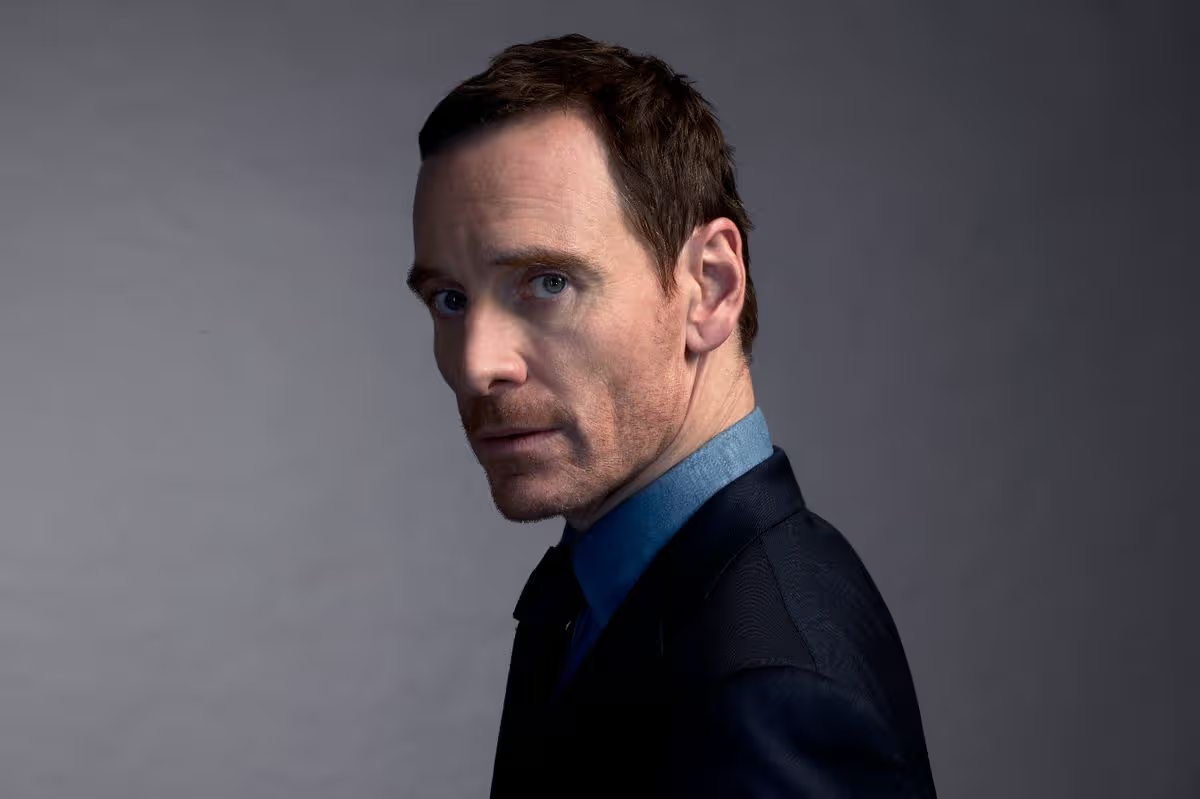
Actor and racing driver Michael Fassbender is returning this month as CIA Agent Martian in season two of The Agency. He talks sociopaths and obsessive preparation on set.

Leading a double life is nothing new for Michael Fassbender, who is returning as CIA agent Martian in season two of spy thriller The Agency. An actor and a professional racing driver, Michael, 49, has reached an optimum level in both careers. Yet, despite this enviable skill set, achieving success and fitting in perfectly in two very different worlds, it would not mean he would make a perfect spy.

For that, according to a real life agent, who he spoke to while researching his role, Michael would need to be a sociopath. He says of this revelation: “That was a real gateway into the character for me.”

The Agency, starring Michael as Brandon Colby, codenamed Martian; Jodie Turner-Smith as his lover Dr Samia Fatima and Richard Gere as CIA chief James Bradley, launches season 2 on Saturday June 21 on streaming service Paramount+. A dramatic trailer for the series hears Martian saying: “I betrayed my country, did I cause harm? Yes. I lied to my friends, my colleagues. I sacrificed people. I deserve my fate. If I had to do it again, I wouldn’t hesitate.”

Season one saw CIA covert operative Martian being suddenly ordered to abandon his long-term undercover assignment in Ethiopia – where he fell in love with Samia – and return to London. In Africa he was working under the false identity – known in the world of espionage as a ‘legend’ – of Paul Lewis.

Michael picks up the story in season two, saying: “Then she [Samia] arrives in London. Then he meets up with her, which he shouldn’t do and then he compromises her. She gets captured and his new objective is to basically get her to safety. But by doing that, he becomes a double agent and betrays his country, becomes a traitor and the walls are closing in on him.”

Born in Heidelberg, Germany, Michael’s mum, Adele, hailed from County Antrim, Northern Ireland, while his dad, Josef, was a chef, who had worked at The Savoy in London. Together with his older sister, Catherine, now a neuropsychologist, the family moved to Kilarney in County Kerry when he was two, where his parents ran a local restaurant, West End House.

A Catholic altar boy when he was young, Michael says this trained him to perform to an audience. And, after initially harbouring ambitions to be a heavy metal guitarist – growing his hair and listening to thrash metal – aged 17, he appeared in a local play and changed direction.

Relocating to London, aged 19, he enrolled at the Drama Centre, but dropped out before completing his third year to start his professional career in a touring production of Three Sisters by Anton Chekhov. Launching his film career in 2001 in Steven Spielberg’s Band of Brothers, his credits since include Hunger (2008) Shame (2011) 12 Years a Slave (2013) – for which he was nominated for a best supporting actor Oscar – and X-Men (2011).

He was also nominated for a best actor Oscar for playing the Apple co-founder in the 2015 movie Steve Jobs. Married to Swedish actress Alicia Vikander, 37, the couple and their two young sons live in Lisbon, Portugal, but retain strong ties with London, where they spent many years.

Known to completely immerse himself in a role – for example, losing 40 lb to play an IRA hunger striker in Hunger – when preparing for the role of Martian, he also met up with two genuine spies. Speaking on The Arts Hour, he says: “The first guy I talked to, I felt like I wasn’t going to need dirt or negative aspects, let’s say. Then I spoke to another guy. We were going through the character and I was like ‘is this guy a sociopath?’ And he was like ‘well let’s go through the characteristics of a sociopath.’”

Clinically diagnosed as antisocial personality disorder, sociopaths have a persistent disregard for the rights, feelings and safety of others – feeling neither empathy, nor remorse. Returning to his conversation with the spy, Michael continues: “We went through the list [of characteristics] and he was like ‘we’re ticking a lot of boxes here.’ I was like ‘yes, ok, so he is.’ And he was like ‘well, it’s a good thing to be in that job.’”

In the new season of The Agency, Martian will be seen desperately trying to claw back some semblance of humanity after being out on his own, as a covert operative, for 7 years. Michael explains: “A lot of spies work in the embassy, so if the heat comes on them, they have a passport and they can get out. But a non-official covert doesn’t have that.”

Describing Martian’s relationship with Samia and with his daughter in London, who he hasn’t seen for many years, he continues: “It’s sort of his fight for humanity. He’s been in the business for about 20 years, so he’s quite jaded. He’s crossed a lot of moral lines he didn’t think he’d do at the beginning of his career.”

As for his own career, for 10 years, Michael has pursued parallel interests in racing driving and acting. Between 2019 and 2023, he stepped away from Hollywood, pursuing a serious career as a professional sports car racer. Joining a development programme with Porsche back in 2018, his greatest racing achievement has been completing the 24 Hours of Le Mans endurance classic in 2022.

The 2023 documentary Road to Le Mans follows his journey. Michael has said of racing: “My first dream has always been to go racing. Even before acting.” Someone who doesn’t do anything by halves, it is unsurprising that Michael would never have been content to keep racing as a hobby. His desire to give everything his personal best applies both to racing and acting.

Reputed to have read the script for Shame around 350 times, so he could get inside the head of a sex addict, he claims to have reined in his obsessive preparation for The Agency. He laughs, saying he read the script “150 times.” He says: “I try and do it 10 times a day.”

Explaining the need for this degree of intensity, he shrugs: “I’m a slow learner! It’s just something I’ve always done. If I keep reading it, I feel like the dialogue is seeping into the bones and I’m thinking about the character as I’m reading.”

Hugely professional, Michael adds: “I just don’t want to turn up on set unprepared. A lot of things can fall through the cracks that are out of my control, but the worst thing is if I leave set and I’m ‘oh I messed up because I didn’t do my homework.’“ An anathema to the average sociopath, this sense of duty and consideration for others would probably make Michael a lousy spy.

*This interview has been adapted from The Arts Hour on the BBC World Service, available on BBC Sounds.

Source link