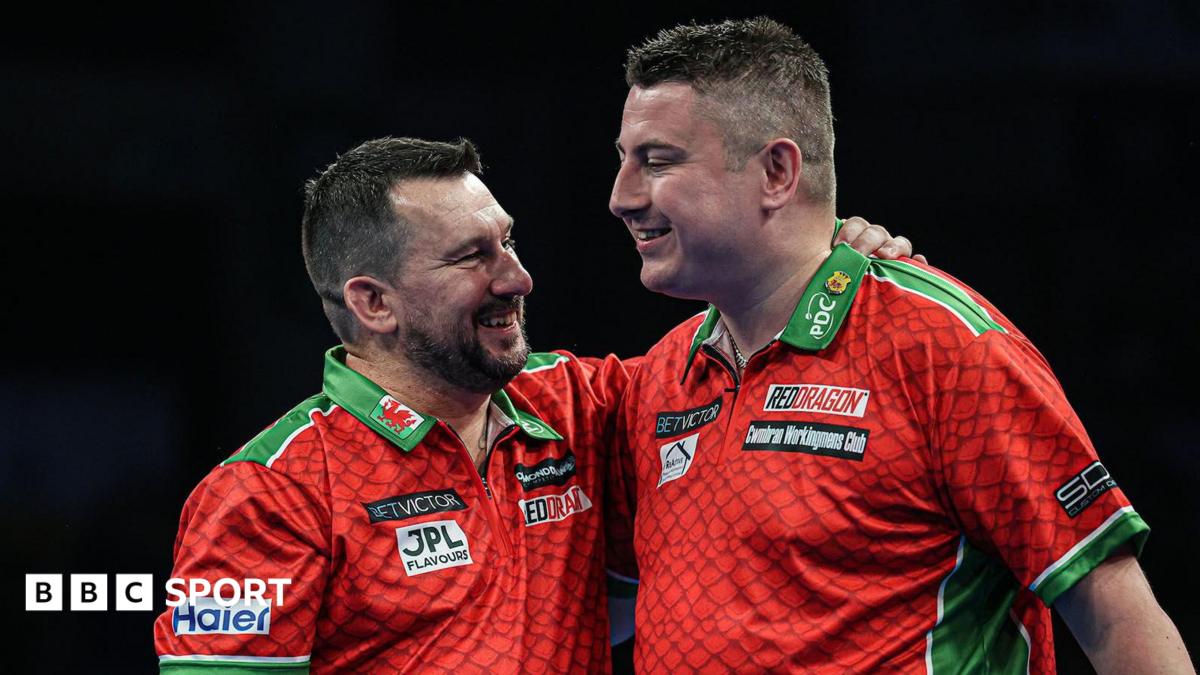
Wales pairing Jonny Clayton and Nick Kenny continued their impressive start to the World Cup of Darts with a resounding victory over Group C opponents Thailand in Frankfurt, Germany.
Having had to go through group qualifying after Gerwyn Price withdrew, the new Wales pairing opened their campaign by thumping Lithuania 4-1, and then followed that up on Friday by beating Thailand by the same score.
The Welsh duo topped their group to book a Saturday afternoon tie at the Eissporthalle against USA.
Hosts Germany again impressed with a 4-2 win over New Zealand as Martin Schindler and Ricardo Pietreczko secured their place in the second round where they will play the Czech Republic.
Republic of Ireland’s William O’Connor and Mickey Mansell clinched top spot in Group D by beating Gibraltar’s Craig Galliano and Justin Hewitt 4-2, earning a tie against Poland.
The top ranked nations – including England, Netherlands, Northern Ireland and Scotland – enter the tournament in the second round.
England pair Luke Littler and Luke Humphries – the top seeds – face Spain, while defending champions Northern Ireland’s Josh Rock and Daryl Gurney begin their title defence against Belgium.
Scotland duo Gary Anderson and Cameron Menzies face Norway, while Netherlands pairing Michael van Gerwen and Gian van Veen take on Sweden.
France against Latvia completes the round two fixtures.
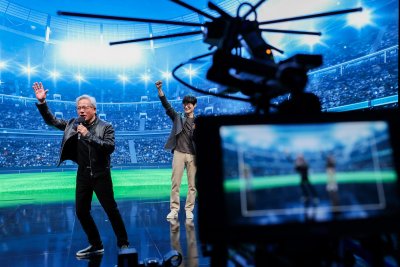
Nvidia chief executive officer Jensen Huang, left, and Naver Chairman Lee Hae-jin appear at Naver’s Vision Studio at its 1784 headquarters in Seongnam, south of Seoul, on Monday. Photo courtesy of Naver
June 12 (Asia Today) — OpenAI chief executive officer Sam Altman is expected to visit Naver on Monday, a week after Nvidia chief executive officer Jensen Huang met with the South Korean technology company’s leadership.
Industry sources said Altman plans to visit South Korea during a two-day trip beginning Sunday and meet officials from major Korean companies, including Naver, Kakao and Samsung Electronics, to discuss artificial intelligence cooperation.
The expected Naver visit comes shortly after Huang visited Naver’s 1784 headquarters in Seongnam, south of Seoul, on Monday and met with Lee Hae-jin, Naver’s founder and chairman.
The back-to-back visits by two of the most influential figures in the global AI industry are drawing renewed attention to Naver’s role in the sector. Industry officials said OpenAI may be interested in Naver’s data, service ecosystem and experience operating consumer platforms at scale.
Naver has built large user data assets through search, shopping, content, community, mapping and reservation services. As competition in generative AI increasingly depends on access to high-quality data, those assets are viewed as one of Naver’s main strengths.
Naver recently outlined what it calls a “product-native LLM” strategy, saying it will optimize AI for specific services such as search, shopping, maps and reservations rather than rely only on a single general-purpose model.
The company develops its own AI models and also operates a creator ecosystem of about 20 million people, with more than 630 million pieces of content produced annually. It also owns large-scale data center infrastructure and runs the services where AI can be applied directly to users.
A Naver official said competition in AI is changing quickly.
“In the past, the key was developing a better model,” the official said. “Now, the ability to secure high-quality data, service experience and the infrastructure to support them is emerging as a decisive factor.”
Naver is also seeking to expand AI search into agentic AI services, in which AI does not simply answer a user’s question but can help complete tasks such as reservations and purchases.
Global interest in Naver also grew after Huang’s visit this week. During his meeting with Lee, the Nvidia chief described Naver as a “world-class AI company.”
Huang cited possible cooperation with Naver in several areas, including participation in Nvidia’s Nemotron Alliance, the development of AI factories and robotics. He said Naver was selected because it has world-class cloud technology and AI talent.
Industry officials said Nvidia appears to view Naver as an AI infrastructure partner, while OpenAI may see potential in Naver’s data and service ecosystem.
“Naver’s combined strength in AI models, data, services and infrastructure is attracting attention from global AI companies,” one industry official said.
The World Cup continues on Saturday, with Brazil beginning their campaign and three more group-stage matches taking place across North America.
Brazil take on Morocco in the day’s biggest match, while Qatar face Switzerland, Haiti meet Scotland and Australia play Turkiye as more teams get their tournaments under way.
Recommended Stories
list of 4 itemsend of list
Away from the football, there has been plenty to talk about. Donald Trump skipped the United States’ opener, former Canadian Prime Minister Justin Trudeau was at the US game instead of Canada’s, and Ghana midfielder Thomas Partey will miss his team’s first match after Canada denied his visa application.
In Peru, police made headlines after carrying out a drug raid dressed as World Cup mascots.
Here is what to know:
What’s the World Cup schedule on June 13?
Qatar take on Switzerland at BC Place in Vancouver, with kickoff scheduled for 12pm local time (19:00 GMT).
The day’s action concludes with Haiti meeting Scotland at AT&T Stadium in Arlington, Texas. Kickoff is set for 8pm local time (01:00 GMT on June 14).
Australia and Turkiye then get Group D under way at Lumen Field in Seattle, with kickoff at 9pm local time (04:00 GMT on June 14).
What do the predictions say for Brazil vs Morocco?
Brazil and Morocco have only faced each other once before at a World Cup, with Brazil winning their 1998 group-stage meeting. Morocco got their revenge in a 2-1 friendly win in 2023.
Brazil have won seven of their eight World Cup matches against African opponents, with their only defeat coming against Cameroon in 2022.
The five-time champions have not lifted the trophy since 2002. Since then, they have usually exited in the quarterfinals, apart from their run to the 2014 semifinals.
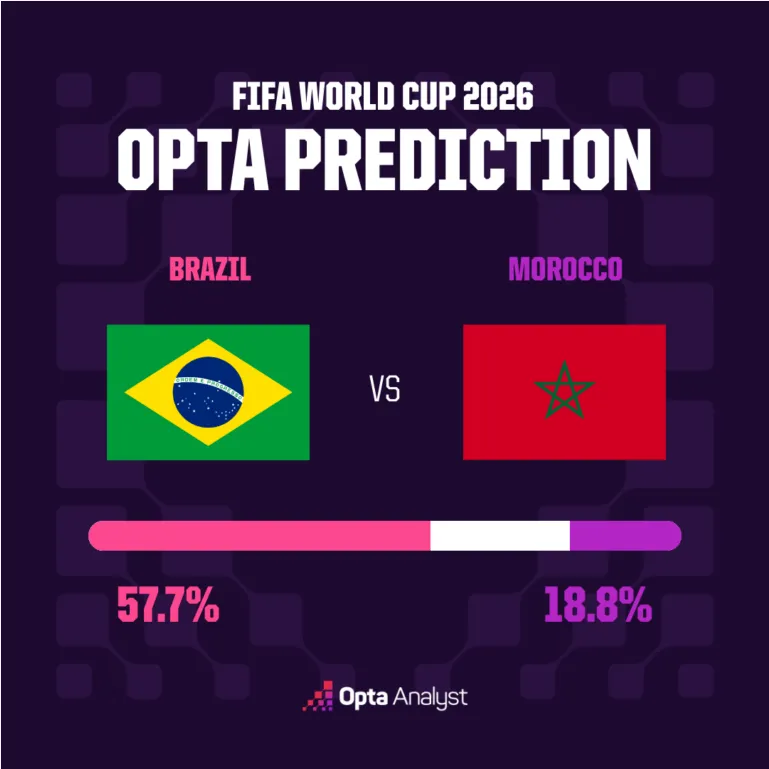
Opta’s 25,000 simulations give Brazil a 57.7 percent chance of winning. A draw happened in 23.5 percent of the projections, while Morocco won in 18.8 percent.
The winner could put themselves in a strong position to top Group C.
What do the predictions say for Qatar vs Switzerland?
Qatar and Switzerland have met only once before, with Qatar claiming a 1-0 friendly win in 2018 thanks to a late goal from Akram Afif. Afif is among nine players from that squad still in Qatar’s 2026 World Cup team, while Switzerland have seven survivors from that defeat, including Granit Xhaka and Remo Freuler.
Opta’s 25,000 simulations make Switzerland the clear favourites in this Group B clash, giving them a 76.0 percent chance of victory. Qatar won just 9.1 percent of the projections, while 14.9 percent ended in a draw.
A point would likely be considered a positive result for the Gulf side.
What do the predictions say for Australia vs Turkiye?
Australia and Turkiye have met only twice before, with Turkiye winning both friendlies in 2004. Turkiye have also won all four of their previous World Cup matches against Asian opponents.
Opta’s 10,000 simulations give Turkiye a 55.3 percent chance of victory, compared with 20.5 percent for Australia and 24.1 percent for a draw.
Neither side has a strong record in World Cup openers, however. Turkiye have lost both of their previous first matches, while Australia have lost five of their six opening games.
What do the predictions say for Haiti vs Scotland?
Haiti and Scotland have never faced each other before, making this one of several first-time matchups at the expanded 48-team World Cup. It will also be Haiti’s first-ever game against a team from the British Isles.
Opta’s 25,000 simulations make Scotland clear favourites, giving them a 59.0 percent chance of victory. Haiti won 19.2 percent of the projections, while 21.8 percent ended in a draw.
Haiti vs Scotland
What else is shaping the World Cup?
The football has only just started, but the World Cup is already making headlines away from the pitch, too.
Trump did not attend the US World Cup opener
The US president did not attend the US men’s national team’s World Cup opener against Paraguay in Los Angeles.
His absence drew attention because Trump has recently attended several high-profile sporting events, including Game 3 of the NBA Finals earlier this week. He is also expected to host a UFC event at the White House on Sunday.
A White House official said Trump instead plans to attend the World Cup final on July 19 at MetLife Stadium in East Rutherford, New Jersey.
The US president called into a USMNT team meeting with some words of support via Andrew Giuliani, the White House’s World Cup task force CEO.
Partey denied entry into Canada
Ghana midfielder Thomas Partey will miss his country’s World Cup opener against Panama after Canada denied his visa application while he awaits trial in the United Kingdom on multiple rape charges, which he denies.
FIFA confirmed on Friday that the 32-year-old would not be permitted to travel from Ghana’s base camp in Smithfield, Rhode Island, to Toronto for Wednesday’s match.
“His visa application has been refused by the Canadian government,” FIFA said in a statement.
“FIFA is not involved in the immigration processes of host countries, including the adjudication of visas. As with previous FIFA events, the host government ultimately determines who receives a visa and is admitted into the country.”
Trudeau attends the US’s World Cup
As Canada and the US kicked off their World Cup campaigns on the same day, former Canadian Prime Minister Justin Trudeau was in California rather than Toronto.
The 54-year-old did not attend Canada’s 1-1 draw with Bosnia and Herzegovina at BMO Field. Instead, he was at SoFi Stadium in Inglewood alongside pop singer Katy Perry, who performed during the pre-match opening ceremony before the US faced Paraguay.
Peruvian officers use World Cup mascot costumes in Lima drug bust
Peruvian police have gone viral after carrying out a drug raid in Lima dressed as World Cup mascots.
Video shared by police showed officers dressed as World Cup mascots breaking through a metal gate with a battering ram before entering the property.
Once inside, they arrested a suspected drug dealer and recovered weapons and bags of what authorities believe were narcotics.
The World Cup may be decided on the pitch, but another competition is already under way off it: Which host city has the best food?
In a report for Al Jazeera, Lou Browne travelled across North America to find out what fans can expect beyond the stadiums.
In Mexico City, taco vendors are hoping the tournament brings more customers. “Well, now the World Cup is coming, and we hope we’ll get customers,” a tortilla cook at El Califa de Leon told Al Jazeera. “I imagine there will be a lot of people, foreigners or locals.”
Philadelphia is proudly backing its famous Philly cheesesteak. Locals say visitors should learn how to order properly. “You want to tell them what kind of cheese you want,” Anthony Rossi, a cook at Geno’s Steaks, explained. “And you say if you want onions, which is ‘wit’ or ‘wit-out’ … Keep it simple.”
Across the border, Toronto is making the case for poutine, the Canadian dish of fries topped with gravy and cheese curds. “Poutine is the … not the best … dish, but poutine is from Canada,” said Lisa Deni, a French tourist.
In Kansas City, barbecue is a point of pride. “This is really good,” diner Camilla Thomas said. “We’ve been enjoying coming here. and bringing people from out of town here and giving them a little taste of Kansas City.”
And in Miami, locals insist the Cuban sandwich is a must-try. “The Cuban sandwich, croquetas, and cafecito are really the way to go,” said Daniel Figueredo, cofounder of Sanguich. “The Cuban sandwich really is the thing you have to have when you come to Miami.”
For fans travelling across North America this summer, the hardest choice may not be picking the World Cup winner, but deciding which host city serves the best food.
An overhead kick from Scott McTominay, a Lewis Ferguson corner that was going in until Lawrence Shankland helped it on its way, a curler to beat all curlers from Kieran Tierney and then a fourth from the other end of the earth – or the halfway line to be precise – from Kenny McLean.
It was the perfect night, a night that further reinforced the bond between these players, which is genuinely tight. That’s always said, but this group is extremely close, a club side in national team colours, a band of brothers who have each other’s back.
There was a collective swoon when news came through on Thursday that McTominay, the totem, had an iffy tummy, but he’s good now. The Napoli midfielder with the Midas Touch probably just waved his hand over his stomach and, hey presto, he was healed.
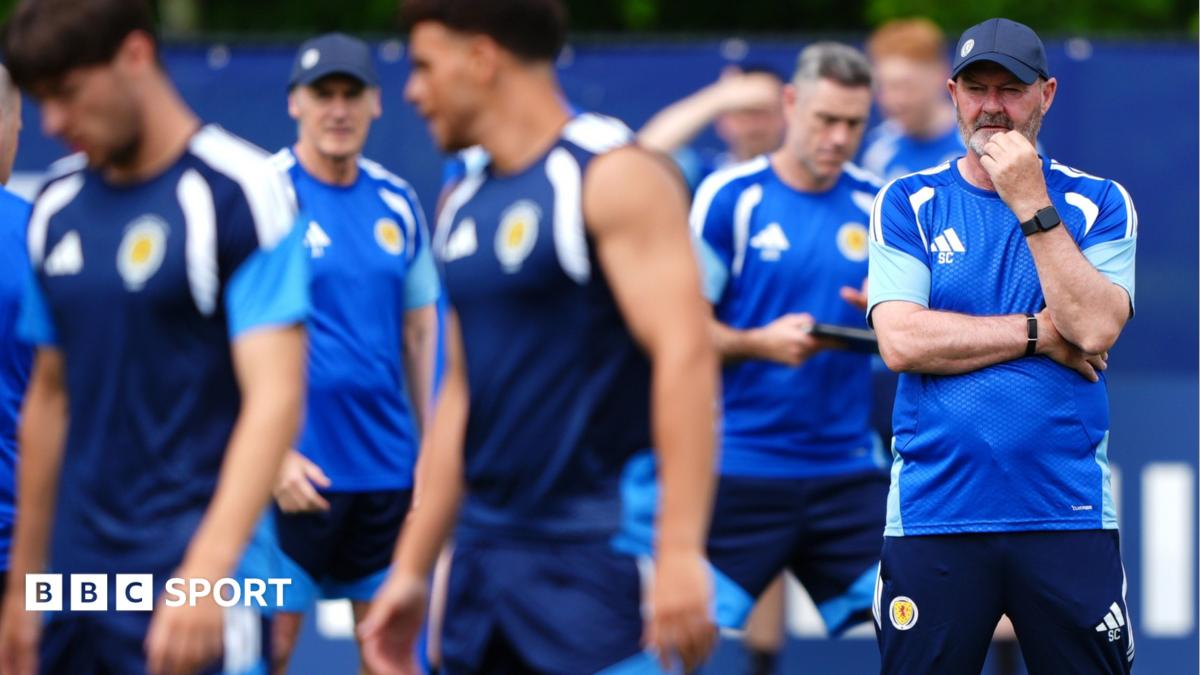
What’s absolutely fascinating about this game is the options that Clarke has and the way he’s talking about the utilisation of his bench, hinting that he might keep a heavy hitter in reserve.
On more than one occasion he’s suggested that the team that finishes the game might have to be as strong, or stronger, than the one that starts.
It’s inconceivable, for this game, that he’ll go away from his new approach of playing Shankland and Che Adams up front, so one of his star midfielders most probably won’t start.
Scotland are buoyed by the eight goals they scored in their last two games. There were caveats – Curacao had 10 men for much of it at Hampden and fell away to lose 4-1 and Bolivia were, well, not all that good.
But confidence is a valuable thing, no matter how you get it. Clarke, as is his wont, has been talking up the threat of Haiti, referring regularly to their size, their power and their athleticism.
In warm-up games, Haiti hammered New Zealand 4-0 before New Zealand lost just 1-0 to England soon after. That form line makes them a theat.
Haiti are a distant 83rd in the Fifa world rankings, but Clarke has been at pains to point out their strengths. One of those strengths is a mental fortitude that comes with representing a country that is riven by crisis and humanitarian disaster.
The capital, Port-au-Prince, is controlled by armed gangs – instability, hunger, killings, kidnappings and sexual violence is rife. Public services have collapsed. Thousands of schools have closed, 10% of the population have fled. The football team can’t play any games at home. Two years into his role as head coach, Sebastien Migne still hasn’t been able to set foot in Haiti.
That level of hardship could breed some amount of determination. Clarke knows it and you sense that his players know it, too.
Scotland have played 23 matches at World Cups and have won only four, a sobering stat when you set it alongside the memories of nightmares past, the loss to Costa Rica in 1990 chief among them.
So Clarke is taking nothing lightly. This is a must-win given the scale of what’s to come against Morocco and Brazil.
Nobody in Clarke’s camp is hiding from that. They have said repeatedly that they’re here to make history as the first Scotland team to make it through a group.
They have a vast travelling army with them and millions more at home, a strange amalgam of positivity and anxiety, belief and fear. All human emotion on the grandest stage.
Thrilling and terrifying. What a time to be alive.
The U.S. men’s national team made its first World Cup game on home soil in 32 years one to remember, defeating Paraguay 4-1 in front of a sold-out crowd at Los Angeles Stadium (SoFi Stadium) in Inglewood on Friday night.
Here’s a look at some of the best moments before and during the game as captured by the Los Angeles Times photography staff:
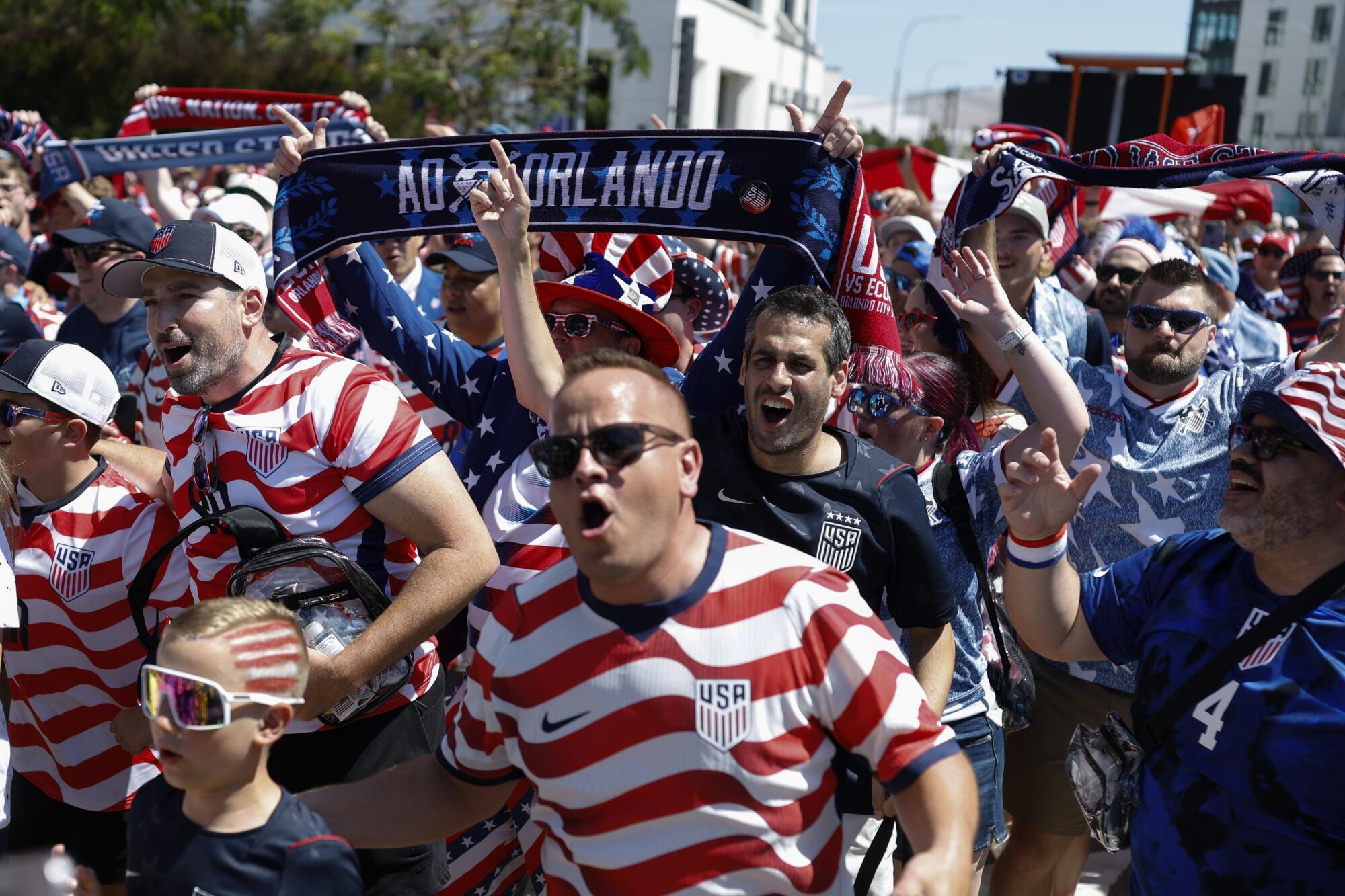
U.S. fans march to Los Angeles Stadium (SoFi Stadium) before the start of the U.S.-Paraguay World Cup match Friday.
(Ronaldo Bolanos / Los Angeles Times)
1
2
3
1.David Beckham, right, and Tom Cruise waves to fans before the World Cup group stage match.(Allen J. Schaben / Los Angeles Times)2.Katy Perry, right, and Tius Luka perform during the World Cup opening ceremony before the U.S.-Paraguay match.(Allen J. Schaben / Los Angeles Times)3.U.S. players, left, and Paraguay players enter the pitch before their World Cup group stage match.(Allen J. Schaben / Los Angeles Times)
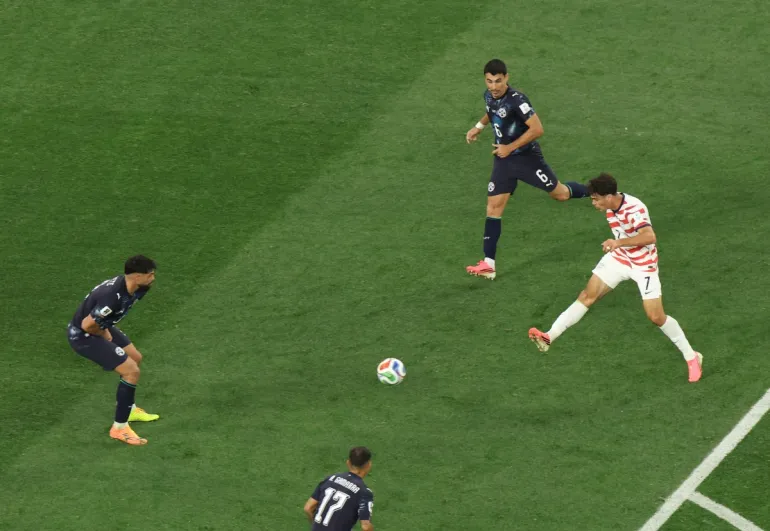
U.S. forward Christian Pulisic, right, controls the ball in front of Paraguay defender Juan Jose Caceres during the first half Friday.
(Ronaldo Bolanos / Los Angeles Times)
U.S. defender Antonee Robinson, right, and Paraguay midfielder Diego Gomez battle for the ball during the first half. (Kelvin Kuo / Los Angeles Times)
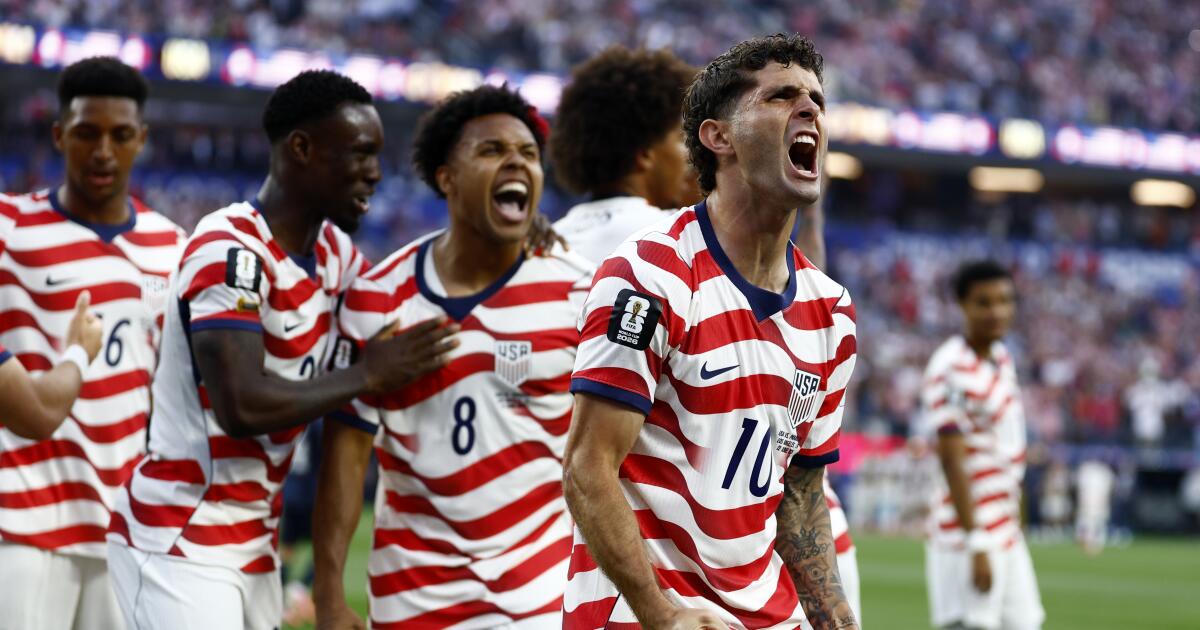
U.S. midfielder Weston McKennie celebrates after a U.S. goal in the first half against Paraguay. (Kelvin Kuo / Los Angeles Times)
U.S. star Christian Pulisic celebrates after a goal in the first half of a 4-1 win over Paraguay at the World Cup on Friday at Los Angeles Stadium (SoFi Stadium).
(Kelvin Kuo / Los Angeles Times)
U.S. players and coach Mauricio Pochettino, center, celebrate after a 4-1 win over Paraguay in the World Cup at Los Angeles Stadium (SoFi Stadium) on Friday night.
(Allen J. Schaben / Los Angeles Times)
1
2
3
1.Paraguay midfielder Cristian Roldan heads the ball over U.S. striker Folarin Balogun during the second half.(Robert Gauthier / Los Angeles Times)2.Paraguay forward Julio Enciso jumps over U.S. defender Chris Richards during the second half.(Robert Gauthier / Los Angeles Times)3.A stage is placed for the opening ceremony before the start of the U.S. vs. Paraguay match at Los Angeles Stadium (SoFi Stadium) on Friday.(Robert Gauthier / Los Angeles Times)
Fans cheer during the United States’ 4-1 win over Paraguay at the World Cup on Friday.
Los Angeles, United States – Draped with a US flag, Alex Saldivar could hardly contain his broad smile as he exited the stadium after the United States beat Paraguay 4-1.
Not only did his team win their World Cup opener, they did so on home soil – and the 23-year-old got to witness it.
Recommended Stories
list of 3 itemsend of list
“This is a dream come true, a serious dream come true. I don’t know what to say,” Saldivar said, as he swayed from side to side, alternating his standing foot.
His excitement sums up the historic day for US football.
Tens of thousands of fans had descended on SoFi Stadium, putting on an eccentric display of oversized hats and US flag-themed outfits.
White and red striped dungarees, blue and white hair, star-spangled trousers, painted faces and Uncle Sam suits – supporters represented their country’s colours in every possible way.
Ryan Schellhous, who came to Los Angeles from San Jose in northern California, was dressed literally from head to toe in US flag colours, including a mask that only showed his eyes.
He told Al Jazeera it was great to have the World Cup in the US.
“There’s a lot of excitement for soccer in America right now, and this is great,” Schellhous said, adding that he expected Team USA to go deep in the tournament if players perform to the best of their ability.
USA fans ahead of the World Cup game against Paraguay in Los Angeles, on June 12, 2026 [Al Jazeera/Ali Harb]
For many fans, the World Cup is offering a rare opportunity to experience football at its best. And they are cherishing the moment.
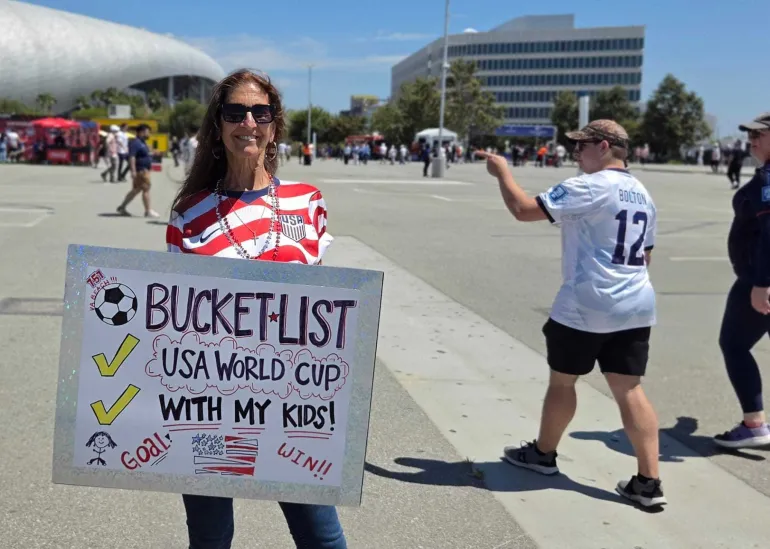
Michele Churchill, who travelled from Virginia with her three children to attend the opening match, called it a “bucket list” event.
Churchill also had a bold prediction for the US team’s fortunes at the tournament.
“They’re going to win. They’re going to take the cup,” she told Al Jazeera.
Law enforcement
Fans started streaming into the stadium four hours before the game. One was dressed in a Gulf-style thobe with a US flag as a headscarf. Another was in an outfit resembling George Washington, the first president of the US.
Despite concerns about logistics and organisation, everything went largely smoothly with armies of staff and volunteers ensuring safety and orderliness.
An alphabet soup of law enforcement agencies was present.
The Transportation Security Administration staffed entrances to oversee the airport-style security checkpoints. Agents from the Drug Enforcement Administration, Bureau of Alcohol, Tobacco, Firearms and Explosives, and Department of Homeland Security were also at the scene.
On the local level, heavily armed agents from the Los Angeles County Sheriff’s Department were also deployed around the stadium, as were Inglewood Police officers.
Many agents were accompanied by police dogs. Before crowds started to arrive, some had their canine companions pose for a photo next to the oversized World Cup ball outside the stadium.
Reports that President Donald Trump may attend the first game ultimately did not materialise to the apparent relief of many fans in mostly liberal Los Angeles.
Inside the stadium, it was celebrities – the likes of Tom Cruise and David Beckham – who got the cheers from the crowd.
USA fans are seen outside Los Angeles Stadium ahead of the Paraguay match at the World Cup 2026 [Al Jazeera/Ali Harb]
Stadium atmosphere
It took a while for the stadium to fill out.
About an hour from kickoff, during the first part of the opening ceremony, which featured several rappers, including Future and Rema, the venue was still almost half-empty and the crowd was quiet.
But coinciding with Katy Perry taking the stage before the first whistle, the stadium started to come to life, and chants of “USA, USA” grew louder.
It was really forward Christian Pulisic who electrified the crowd with his first-half display, running straight at his markers and producing dangerous crosses or shots.
The once faint chants turned into deafening roars when the US scored their first, courtesy of a Paraguayan own goal in the seventh minute.
The distinct screams of goal celebrations would ring out three more times for Team USA at the stadium, with Folarin Balogun finding the net twice and Giovanni Reyna scoring a gorgeous curler from the edge of the box to wrap up the game.
A stadium announcer said more than 70,000 people were in attendance.
“We have a full house,” he said to the cheers of the crowd.
But the announcement did not pass the eye test.
Many seats throughout the stadium remained empty, especially in the most expensive sections overlooking the middle of the field.
It is possible that organisers FIFA did sell every seat but resellers struggled to offload some tickets.
The bottom line – ticket prices and Trump’s travel policies may be dampening the buzz around the World Cup, but the tournament is still delivering what football promises: happiness, excitement and a sense of togetherness.
Tickets to watch the U.S. dominate Paraguay 4-1 on Friday night at Inglewood’s SoFi Stadium cost a fortune. But roughly nine miles north, fans such as Jose Santiago and Ivan Gonzalez enjoyed the match at a fraction of the price.
The pair each paid $10 for a ticket to watch the Stars and Stripes flourish in their first World Cup game on home soil in 32 years on big screens at the packed Coliseum on Day 2 of the Los Angeles FIFA Fan Festival.
“We bought these tickets [at the] last minute, not knowing what to expect,” said Santiago, of Fullerton. “And so far, we’ve been blown away. We definitely want to come back.”
“It’s dope,” added Gonzalez, of Yorba Linda. “You feel it. You feel the game. You feel the atmosphere. It’s fun. Everyone’s into it right now.”
Food and drink options. Pop-up tents featuring brands such as Galaxy and LAFC. A rare on-field experience at the home of USC football. And, of course, some good ‘ol collective effervescence.
“It makes you still feel like you’re a part of it,” Santiago said of his viewing experience. “It still makes you feel like you’re at the stadium, because we’re all watching the game.”
The U.S. took care of business in its World Cup opener. Presumably, those who could afford the intimidating ticket and parking prices at SoFi Stadium considered the experience worthwhile.
Santiago and Gonzalez, however, spoke for many who cherished their inexpensive night at the Coliseum, in the City of Angels itself, during their nation’s statement victory.
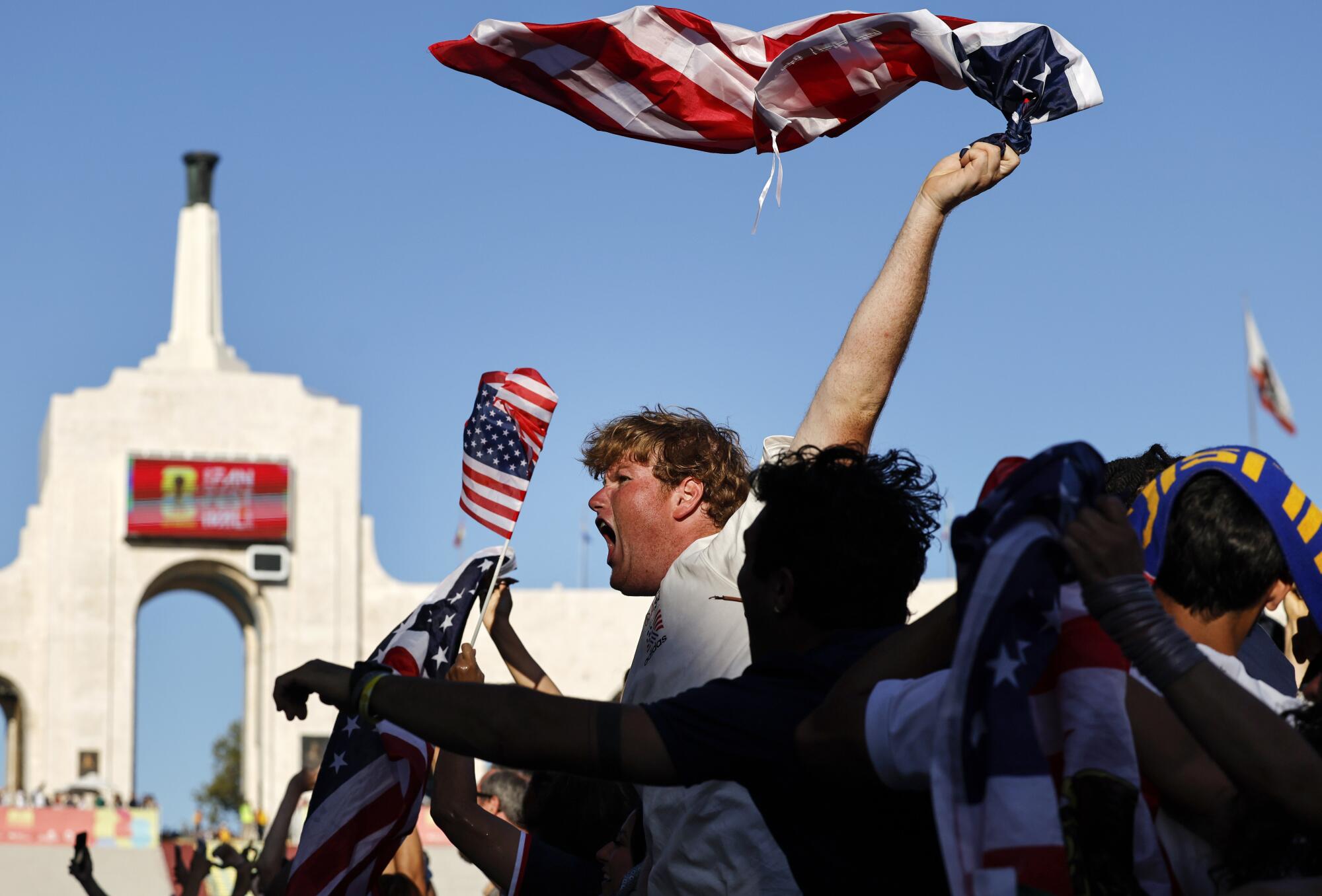
Fans cheer during a watch party at the Coliseum during the U.S. win over Paraguay Friday night.
(Mario Tama / Getty Images)
Several other attendees would agree — even those who aren’t backing the U.S.
Take Charlotte Cabeca, a 37-year-old from downtown L.A., is primarily rooting for Colombia — as well as “anybody from South America” — but was still grateful for the opportunity to watch the beautiful game with other fans at a bargain.
“It’s so fun,” Cabeca said with a laugh, as “USA” chants rang in the background. “It’s a really kid-friendly and family-oriented [environment.] It’s not as hectic as I had anticipated.”
Cabeca said she’ll attend more fan events in L.A. throughout the tournament, as Friday marked “the closest we can get [and] that we can afford” compared to actually attending a World Cup match.
U.S. fans celebrate during a watch party at the Coliseum as Americans beat Paraguay during the World Cup Friday.
(Mario Tama / Getty Images)
Perhaps more important, though, Cabeca appreciates the community engagement unfolding before her eyes.
“I love that the city is coming together,” Cabeca said. “I feel the unity. And even these fanfests, they bring us together. So even if we’re not at the game, it still brings all of us together as a country.
“It’s awesome. The traffic is not helpful, but other than that, it’s exciting. I really feel like everybody is for soccer right now, and that’s what we need right now to heal and be happy together.”
While Friday was a night of smiles, chants and relative affordability, there remain fans who wish FIFA and the U.S. would do more to make the World Cup more accessible, particularly by making everything, well, cheaper.
“Obviously, football is a very hard sport to monetize, because we don’t have the breaks like the NFL,” Kunal Mehrotra, a 25-year-old soccer fan from Koreatown, prefaced before saying, “Without the fans, it isn’t really a World Cup. So, it is disappointing from the U.S., and it’s not just the tickets. … It really shows that the U.S. is in it for the money and not at all for the football, which is disappointing.”
“It’s pretty ridiculous,” added Monica Unzueta, a Maywood resident and fan of Mexico and Spain. “But aye, at least FIFA’s holding some events. I mean, they should be free. But, I don’t know — that’s just FIFA.”
While they’d rather attend a World Cup game live, as Mehrotra and Unzueta noted, that isn’t realistic for most residents.
So, nights such as Friday at the Coliseum are the next-best thing.
A fan wears an American flag during a World Cup watch party at the Coliseum on Friday.
(Mario Tama / Getty Images)
And for fans such as Tyler David, a 24-year-old from Tampa, Fla., the trip to the home of the Trojans couldn’t have gone better.
“Beyond belief,” David said. “And it’s so cool to see everybody and the cultures colliding. Love it.”
Oh, and the USA’s big victory was splendid for fans too.
“Dude, absolutely magnificent,” David said, in disbelief of the U.S. leading 3-0 after 45 minutes against Paraguay. “Christian Pulisic, [coach Mauricio] Pochettino, all the guys, [Timothy] Weah. They’re playing at the top of the charts right now. I love to see it on the home soil in L.A.
“It’s getting me fired up; the fan base, the environment, the atmosphere — through the freaking roof.”
The United States opened their World Cup campaign with a fine win – but not before a sequence of events that left everyone inside SoFi Stadium scratching their heads as the video assistant referee (VAR) made history.
The co-hosts were comfortably leading Paraguay 3-0 when confusion reigned in the Group D game.
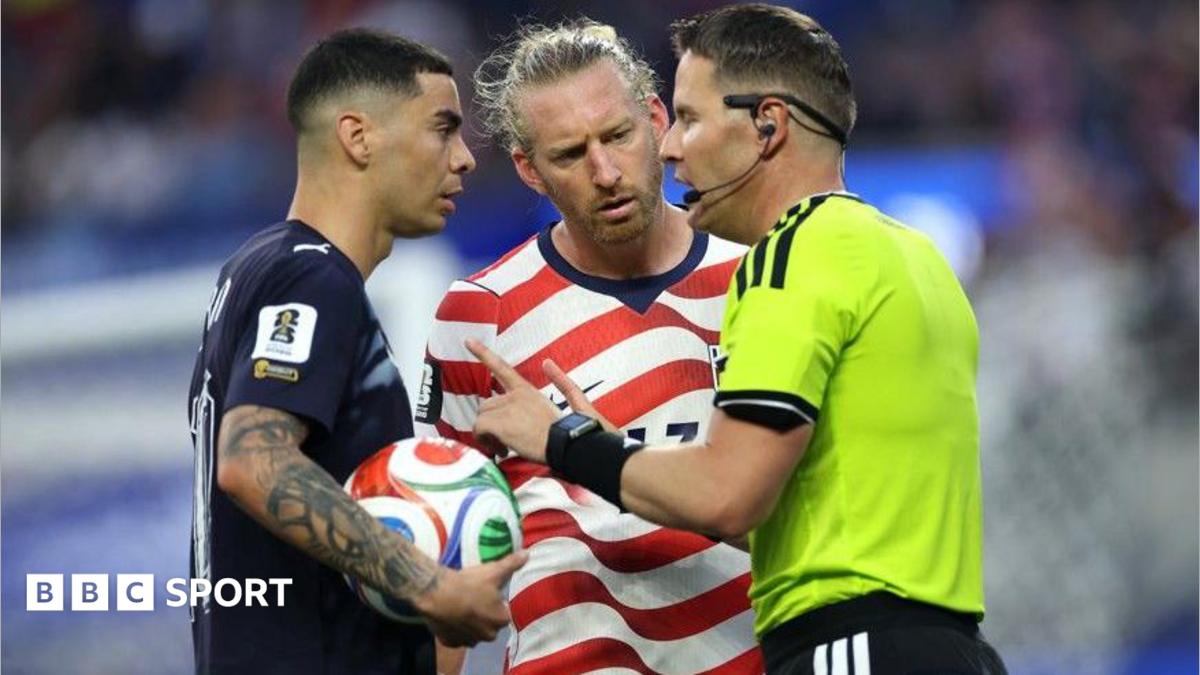
Veteran defender Tim Ream, 38, conceded a free-kick and was shown a yellow card for his ‘challenge’ on Miguel Almiron.
After the free-kick was taken, Dutch referee Danny Makkelie was sent to the screen by the VAR and overturned his decision – something officials have not previously been allowed to do.
After rescinding Ream’s caution, Makkelie instead booked former Newcastle United forward Almiron, who had clearly dived.
It is the first VAR intervention for mistaken identity at the World Cup, even if it perhaps was not used in the way most expected it to be.
Fifa has introduced of a number of rule changes for the tournament, with Pierluigi Collina, the head of referees, requesting one specifically for mistaken identity.
The rule states that if a player is booked or sent off – but the foul was actually committed by the opposition team – the decision can be changed.
Another new law is second yellow cards leading to a red card can be reviewed, but not first yellow cards. The only reason referee Makkelie was able to rescind the decision was by using the mistaken identity law.
The officials allowed the game to restart before stopping, which also confused fans as normally once the game resumes it cannot be pulled back.
Former Everton and Wales defender Ashley Williams, speaking to BBC Sport, added: “They let them take the free-kick, which was bizarre but clearly the right decision.
“It’s the first time we have seen it but fair play.”
Former England midfielder Danny Murphy, who was co-commentating for BBC Sport, added: “Any adaptation of the rules which means diving gets more punishment is good.”
The United States, managed by former Tottenham boss Mauricio Pochettino, won the match 4-1 to get their campaign off to a winning start in front of a jubilant home crowd.
Following an own goal by Damian Bobadilla, the US led 3-0 at half-time after Folarin Balogun scored twice.
In doing so he became just the second US player to score more than once in a World Cup match.
Paraguay pulled one back through Brazilian-born Mauricio before the goal of the night from substitute Giovanni Reyna, who curled a 20-yard shot home with the outside of his right foot with the final kick of the game.
Thousands of Bosnia fans turned Toronto blue as they marched to the chants of ‘Free Palestine’ in Toronto.
Toronto, Canada — Nadia, a Bosnia and Herzegovina supporter who did not share her surname, stood out in her deep blue shirt as a sea of red-adorned Canada fans swarmed around her outside the Toronto Stadium an hour before kickoff to their FIFA World Cup 2026 opening game.
With the blue and yellow Bosnian flag draped around her, she found herself among the minority of “away” fans on Canadian soil on Thursday, less than two weeks after her team was given a warm welcome to the World Cup cohost nation.
Recommended Stories
list of 4 itemsend of list
It reminded Nadia, an immigrant, of her arrival in Canada in the mid-1990s when her family fled the Bosnian genocide that killed about 100,000 people and displaced more than two million.
“I wish I had space for two hearts so I could properly support both my countries,” Nadia told Al Jazeera when asked about her allegiance as loud roars of the crowd spilled out of the stadium behind her.
Nadia admitted her heart was ultimately with Bosnia, but the Canada cap she sported was a nod to the country that became home when she had to flee hers.
Earlier in the day, thousands of Bosnia supporters turned Toronto into a sea of blue as they marched towards the match venue in the city’s downtown while chanting “Free Palestine” to thunderous claps.
“They [Palestinians] should be free, enough with the wars and genocide,” Nadia said as her eyes welled up with tears. She took a deep breath before adding: “There is so much suffering, especially for the children.”
Cultures blend in Toronto
Dan, a Bosnia supporter in his 40s, was the same age as his primary school-aged son when he fled the genocide in his country.
The father-and-son duo enjoyed the game and soaked in the atmosphere among the 45,000-plus fans at the stadium before heading back slightly upset with the draw.
The day Canada opened its first World Cup became an amalgamation of immigrant Bosnian fans’ identities as they shared high fives and traded jerseys with their opposing numbers.
Every shade of skin colour and a multitude of mother tongues made the stadium and a nearby fan festival a microcosm of Toronto’s reputation as a multicultural hotspot.
The fan festival boasted the full spectrum of football enthusiasts — the hardcore supporters with expert analyses, laced with expletives at missed chances, and those in attendance purely for the vibes.
Bosnian fans pose before the match [Michael Steele/Getty Images via AFP]
Football aside, several Canadian fans abhorred the immigration policies of their neighbour to the south. They were proud to be known for their hospitality at the 48-nation tournament across North America.
Admir, a travelling Bosnian fan, was full of praise for Canadian hospitality when he arrived from New Jersey.
“Everyone from ordinary people to stadium support staff to restaurant owners have been so accommodating since we got here,” he told Al Jazeera ahead of kickoff.
Compared with the barrage of immigration nightmare stories of World Cup supporters trying to enter the US, his journey to Canada was seamless.
Despite his home state hosting eight World Cup matches, Admir chose to pay an exorbitant price for tickets to see Bosnia, who returned to the World Cup after 12 years following a fairytale qualification.
The sun had drained most fans of their energy after the match, but not Tanya, who drove seven hours from New York to Toronto on Thursday morning.
“The atmosphere at the fan festival was amazing; Toronto has been great.”
“I think our boys played pretty well,” she said of the match. “We didn’t win, but it wasn’t a loss either.”
Bosnia fans cheer in the stands during their team’s opening game at the FIFA World Cup 2026 [Michael Steele/Getty Images via AFP]
USA beat Paraguay 4-1 in Los Angeles as each of the three World Cup cohosts have now staged a game in the 2026 edition.
Published On 13 Jun 202613 Jun 2026
The United States could scarcely have scripted a better start to their World Cup as a Folarin Balogun brace and a Gio Reyna curler fired the cohosts to a 4-1 drubbing of Paraguay in front of Hollywood royalty in Los Angeles.
The hosts took the lead in the tournament’s first game on US soil within seven minutes thanks to an own goal, and by the end of an utterly dominant half, the home fans were in dreamland, their side up by three.
Recommended Stories
list of 4 itemsend of list
Tom Cruise, Leonardo DiCaprio and Paris Hilton were among a sold-out 70,492 crowd as the US – cohosting the tournament with Mexico and Canada – piled wave after wave of attacks on the South Americans, with Reyna polishing off the win late in stoppage time after Mauricio had pulled one back.
The win and emphatic scoreline put the US in a favourable position already to progress from Group D, which also contains Australia and Turkiye.
The night’s only potential sour note was the half-time withdrawal of Christian Pulisic, the US attacking talisman who is carrying the hopes of the nation as they attempt a deep run into the World Cup knockouts for the first time since their quarterfinal appearance in 2002.
Paraguay could not have been more obliging guests from kickoff. In the seventh minute, Weston McKennie picked up the ball in the centre circle and drove upfield, finding Pulisic.
Pulisic darted between two defenders and returned the ball to McKennie, whose pass to striker Balogun was bundled into his own net by a hapless Damian Bobadilla.
The stadium erupted, and a US onslaught began.
The hosts oozed confidence. Both McKennie and Tillman played backheel through balls into the area, while captain Tim Ream sprayed out passes from the heart of defence.
USA midfielder Giovanni Reyna scores his team’s fourth goal [Valerie Macon/AFP]
Balogun had a goal ruled out in the 28th minute. He had strayed offside, as had Pulisic in the buildup.
But the Monaco striker had the ball in the net again three minutes later, thanks to a superb ball down the left flank by Antonee Robinson to Pulisic, whose cross to Balogun took a slight fortuitous deflection.
The US added a third on the cusp of half-time. Tillman found Balogun down the right, who evaded Omar Alderete’s challenge, skipped inside Gustavo Gomez and curled his shot perfectly into the top left corner.
It could have been four or five, with Chris Richards – returning from injury – flashing a header barely an inch wide. The US had 75 percent possession in the first half.
Now, without the dangerous Pulisic, the hosts sat back slightly in the second half.
Paraguay finally offered a threat. Their dangerous forward Julio Enciso, who started despite a hamstring injury, picked up the ball on the edge of the area and fed in Brazil-born substitute Mauricio, who pulled one back.
Reyna scored a superb fourth with the outside of his right foot that curled just inside the far post.
The game had been preceded by a Tinseltown-style opening ceremony. Katy Perry delivered the headline performance, accompanied by singers Future, Tyla, Anitta and K-pop singer Lisa.
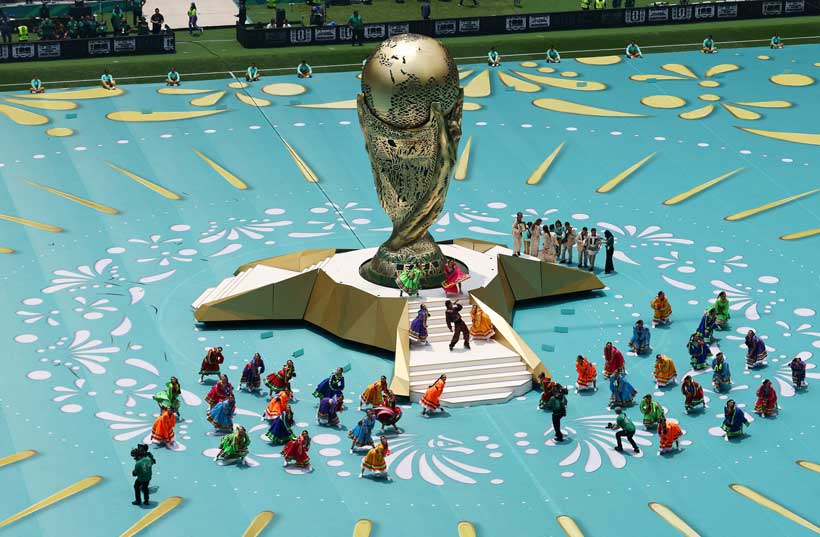
Performers danced around a giant World Cup trophy beneath enormous “FIFA” letters in the gold favoured by US President Donald Trump – who did not attend, instead wishing the team luck via phone before kickoff.
It was a game eight years in the making. The first World Cup match on American soil in more than a generation and the start of a tournament that has the potential to alter the direction of soccer in this country for the next generation.
And the U.S. seized on every bit of that opportunity Friday, with Christian Pulisic setting up two goals and Folarin Balogun scoring twice in his World Cup debut, sparking an impressive 4-1 victory over Paraguay in a game that was far more one-sided than the score indicated.
The U.S., which needed a big effort to start the tournament, was on the front foot from the start, going in front to stay in the seventh minute — although it was Paraguayan midfielder Damián Bobadilla who got credit for the goal after stepping in front of Balogun and deflecting in a cross from Weston McKennie.
Pulisic, the American star who is under intense pressure to perform in this tournament, set up the goal, pushing the ball between a pair of defenders before poking it on for McKennie in the center of the box. Bobadilla then did the rest, inadvertently sticking his right foot in front of the ball and bouncing it by Paraguayan keeper Orlando Gil.
Balogun appeared to double the lead coming out of the hydration break midway through the opening half, but the goal was negated by an offside call. That only delayed the second goal, however, with Balogun making it 2-0 by one-timing in a perfect feed from Pulisic from the penalty spot in the 31st minute.
Balogun added to the U.S. advantage just before the intermission, running on to a perfectly weighted through ball from Malik Tillman, stepping through a challenge from Omar Alderete entering the penalty area and turning around Paraguayan captain Gustavo Gómez before left-footing a shot into the top left corner to complete his first brace for the national team.
Gil was just a spectator on the play, with no chance to best the save. The goal marked the first time Paraguay had given up three scores in a World Cup game — much less one half — since 2002 and it came at the end of what was arguably the best opening 45 minutes a U.S. team has played in the tournament in decades.
Gio Reyna scored the fourth U.S. goal on the final play of the game.
Pulisic left in favor of Sebastian Berhalter to start the second but the U.S. continued to dominate in every way it was possible to dominate, controlling the ball for nearly 60 of the 90 minutes and completing more than twice as many passes. Paraguay’s first shot on goal didn’t come until the 73rd minute when Mauricio, a halftime substitute, took advantage of a slow-reacting U.S. defense to pull a goal back.
U.S. coach Mauricio Pochettino also got a solid game out of center back Chris Richards, playing for the first time since tearing two ligaments in his left ankle a month ago.
The Americans will face Australia in the second of three group-stage games next Friday in Seattle, where a draw will all but guarantee them a spot in the round-of-32, something Pulisic said should be just the first objective for this team.
This World Cup is the largest and most ambitious sporting event in history, with three host countries — Canada and Mexico, in addition to the U.S. — and a record 48 teams playing 104 games in 16 cities spread across four time zones. A long run by the American team, playing on home soil, could excite a nation and give soccer the kind of boost it hasn’t seen since 1994, the last time a World Cup was played here.
It could also change the narrative of a tournament whose run-up was clouded by outrageously high ticket prices, travel bans, the threat of ICE raids at tournament venues and the war in the Middle East, the first to pit a World Cup host against a World Cup qualifier.
And the U.S. portion of that tournament opened with pomp despite those circumstances, with Thai pop star Lisa, Nigerian recording artist Rema and Brazilian singer Anitta headlining a 10-minute mini concert staged before a massive replica of the World Cup trophy set over a blue map of the U.S. Katy Perry mounted a stage of her own an hour later to debut her song “Wonder” as the flags of the 48 participating countries circled around her.
President Trump did not attend the game, just as Mexican president Claudia Sheinbaum skipped her country’s opener Thursday in Mexico City and prime minister Mark Carney missed Canada’s first game Friday in Toronto. Secretary of State Marco Rubio took Trump’s place in the Hollywood-heavy crowd of 70,492 that packed SoFi Stadium, one which included Tom Cruise, David and Victoria Beckham, Halle Berry, Rob Lowe, Becky G, Jaime Foxx, Paris Hilton, Bill Gates, Justin Trudeau and Kareem Abdul-Jabbar.
That crowd was a sea of blue and red — the U.S. and Paraguay share the same colors — but the cheering was primarily for the Americans since Paraguay rarely mounted a threat.
Partey’s visa was denied due to the multiple charges of rape he faces in the United Kingdom.
Published On 13 Jun 202613 Jun 2026
Ghana midfielder Thomas Partey will not play in his team’s World Cup opener after Canada denied his visa application while he awaits trial on multiple charges of rape in the United Kingdom.
FIFA said on Friday in a statement that the 32-year-old Partey won’t be able to travel from his team’s base camp in Smithfield, Rhode Island, for Ghana’s opening match with Panama in Toronto on Wednesday.
“His visa application has been refused by the Canadian government,” the governing body of world football said.
“FIFA is not involved in the immigration processes of host countries, including the adjudication of visas. As with previous FIFA events, the host government ultimately determines who receives a visa and is admitted into the country.”
Immigration, Refugees and Citizenship Canada (IRCC) said in a statement that every person wanting to come to Canada is assessed individually “based on the facts available and the law that applies”.
“Canada is proud to be a host country for the 2026 FIFA World Cup and is working to facilitate a successful event while maintaining the safety and security of Canadians,” the IRCC said in the statement.
“Canada has been consistent that hosting major events does not change Canada’s immigration laws.”
Partey was travelling back to Ghana’s base camp in Rhode Island after his visa denial. He will be able to play on June 23 when Ghana play England in Foxborough, Massachusetts. Ghana conclude group play on June 27 against Croatia in Philadelphia.
Partey is scheduled to stand trial in November or later on allegations dating to his time with English club Arsenal from 2020-25. Partey, who now plays in Spain for Villarreal, has pleaded not guilty.
A second World Cup player, Morocco defender Achraf Hakimi, is awaiting trial on similar charges in Paris.
Ghana are making their fifth appearance in the last six World Cups.
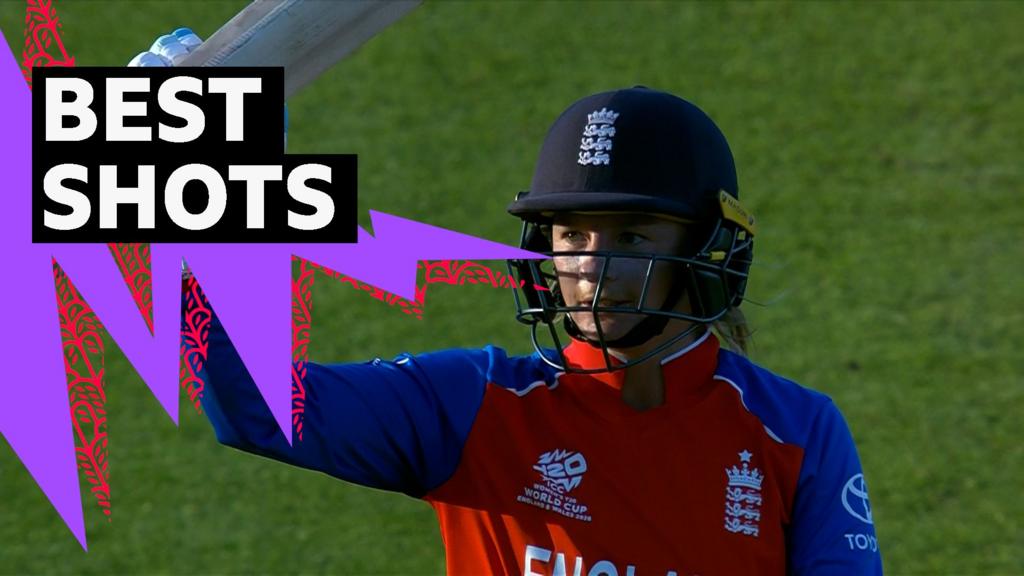
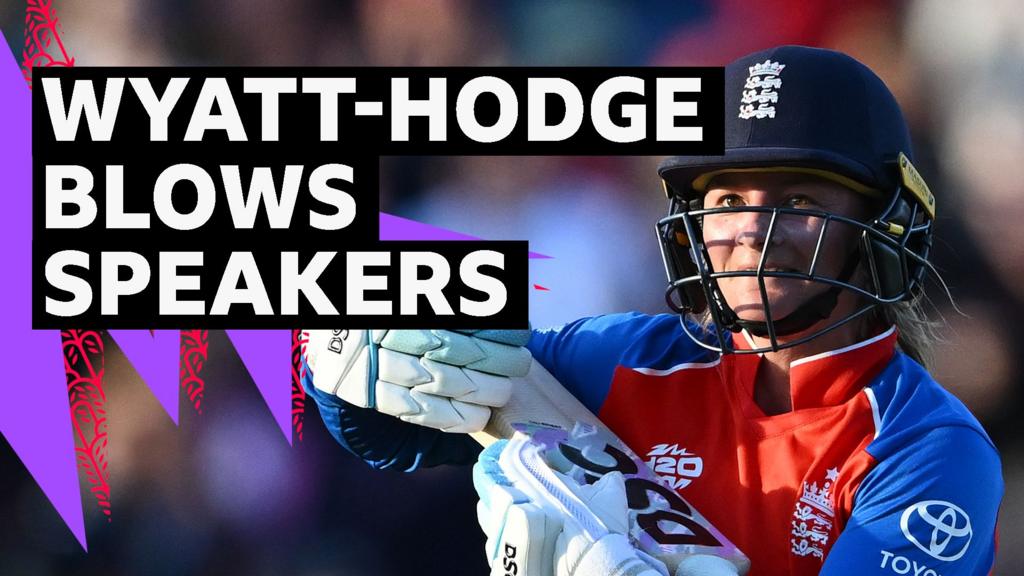
Watch the best shots as Danni Wyatt-Hodge hits an unbeaten 105 to guide England to an 85-run win against Sri Lanka, and give the hosts the perfect start to the ICC Women’s T20 World Cup.
Trade, Industry and Resources Minister Kim Jung-kwan addresses the first general congress of the Manufacturing AX Alliance at the headquarters of the Korea Chamber of Commerce and Industry in Seoul, South Korea. The government-led alliance groups businesses and organizations working for the artificial intelligence transformation of manufacturing industries. Photo by YONHAP / EPA
June 12 (Asia Today) — South Korea’s Trade Ministry is accelerating a project to convert master workers’ tacit manufacturing knowledge into artificial intelligence data as the country seeks to preserve industrial skills threatened by aging and labor shortages.
Tacit knowledge refers to experience and know-how that skilled workers often use without writing it down. In manufacturing, it can include judgment used in process optimization, quality control, welding, equipment checks and other work that depends on years of experience.
The Ministry of Trade, Industry and Energy held the fourth M.AX conference Friday at the Korea Chamber of Commerce and Industry in central Seoul. The conference focused on development and cooperation strategies for using master workers’ tacit knowledge in manufacturing AI transformation.
Officials and experts discussed how to build AI systems that can capture knowledge from industrial sites and how labor and management can cooperate in the process.
The ministry said skilled manufacturing experience is becoming a core asset in the AI era. Officials warned that if the know-how of retiring workers is lost, companies could face weaker process control, lower quality management and reduced manufacturing competitiveness.
The government is using 48 billion won, or about $31.2 million, from this year’s supplementary budget to support pilot projects for 30 manufacturing processes. The projects will build tacit knowledge datasets and develop AI models.
The ministry plans to prioritize processes with high safety risks or severe labor shortages. AI models developed through the project are also expected to be used to train new workers.
The conference included examples of AI already being applied in manufacturing. Sungwon, a stainless steel pipe maker, said it is using AI in welding work where skilled workers previously relied on visual judgment to support operators’ decision-making.
Participants said the project’s success will require data standardization, verification systems, proper compensation for workers who share their knowledge and sufficient communication with employees before implementation.
Some participants also proposed creating an advisory group of national quality masters so the project can better reflect expertise from actual manufacturing sites.
Kim Sung-yeol, head of the ministry’s industrial growth office, said the project is designed to protect South Korea’s manufacturing base.
“This project is about protecting manufacturing and manufacturing sites, which are among our core assets,” Kim said. “Because it is a project to preserve and transfer the tacit knowledge of master workers, we will do our best to help solve difficulties at manufacturing sites.”
Wyatt-Hodge always been one of England’s most fascinating cricketers. She jokes and smiles, but that should never be confused with anything but fierce determination.
As a cricketer, she as resilient as they come.
Wyatt-Hodge made her debut in the same Mumbai ODI as Heather Knight and the pair are now the longest-serving members of this England set-up.
From the World Cup win at Lord’s in 2017 to last year’s Ashes drubbing down under. Together they have witnessed it all.
But while Knight was front and centre nine years ago as captain, Wyatt-Hodge was a bit-part player. She played five matches before others returned from injury for the trophy tilt.
Now, at 35, there is still time for this career’s defining chapter.
While Wyatt-Hodge took her parental leave, debate bubbled about who would be England’s openers when the big time came in this tournament.
Sophia Dunkley’s form faltered and Amy Jones was promoted. The one certainty, despite her absence, was always England’s diminutive right-hander.
Bleary-eyed from the sleepless nights, she made 29 when she did return against India last month in Bristol. Three single-figure scores followed but again England did not waver.
“Some people just need a bit of pressure and a bit of ‘something’ on a game,” said another former team-mate Katherine Sciver-Brunt, who watched on from the commentary box.
“This is exactly the sort of environment she needs.
“As a cricketer you can thrive or you can go within yourself, and she thrives with situations like these.
“Don’t be surprised if she is the highest run-scorer of this tournament now.”
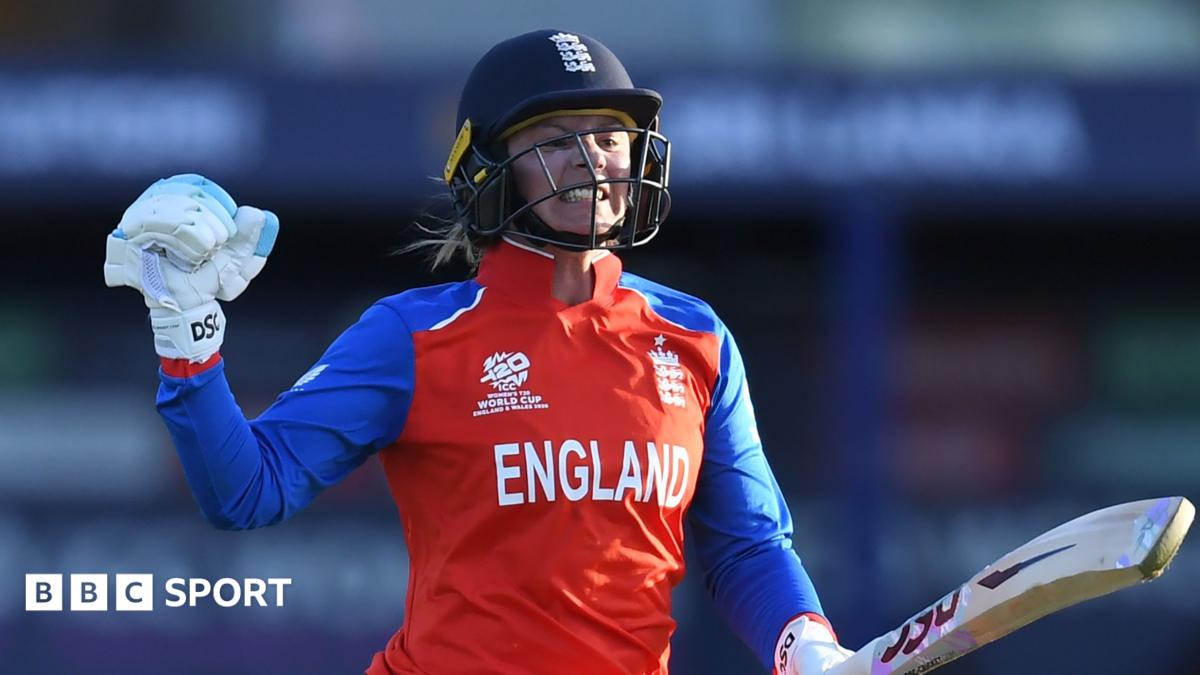
It was also fitting that when Wyatt-Hodge reached three figures, captain Nat Sciver-Brunt was at the other end.
Like Wyatt-Hodge she is a cricketer and mum. Like Wyatt-Hodge she rocked her bat to celebrate reaching three figures at last year’s 50-over World Cup.
Coincidentally both tons were against the same opposition.
“It was really nice to have her in the middle to celebrate that hundred – two mummies,” Wyatt-Hodge said.
“I got a bit nervous at the end when the crowd was cheering me on. Nat said just take a breath and time it. I was really determined.”
As Wyatt-Hodge took the crowd’s acclaim and left the field, it was the jettisoned Dunkley who met her first by the boundary edge.
There is a togetherness building in this squad and Wyatt-Hodge is one of its most popular members.
“It was pretty emotional. A few of the girls said they had a few tears,” she said of those moments returning to the dressing room.
It was Graham Gooch who coined the phrase ‘Daddy Hundred’. This was one of the mummy variety.
After everything, few are more deserving of this moment in the sun than Wyatt-Hodge.
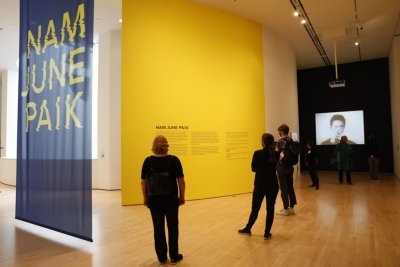
The San Francisco Museum of Modern Art (SFMOMA) presents the work of the late Nam June Paik, Korean American artist, who is considered to be the founder of video art, during a press preview of his first-ever retrospective exhibition in San Francisco, California. Photo by JOHN G. MABANGLO / EPA
June 12 (Asia Today) — Nam June Paik connected Seoul, Tokyo and New York by satellite in 1986.
His project, “Bye Bye Kipling,” brought Korean traditional dance, American popular music and Japanese avant-garde art together on one screen in real time. The work directly challenged British writer Rudyard Kipling’s famous line that East and West could never meet, presenting instead the possibility of communication across borders and cultures.
That history of encounter and exchange is at the center of “Road movie: Art between Korea and Japan since 1945,” now on view at the National Museum of Modern and Contemporary Art, Korea, in Gwacheon. The exhibition marks the 60th anniversary of normalized diplomatic relations between South Korea and Japan and traces 80 years of artistic exchange since Korea’s liberation in 1945.
The exhibition features about 200 works by 43 artists and artist teams from both countries. It was jointly organized by the Korean museum and the Yokohama Museum of Art. The show first opened in Yokohama late last year and drew about 37,000 visitors before coming to South Korea.
Featured artists include Nam June Paik, Lee Ufan, Lee Bul, Jung Yeondoo, Koki Tanaka, Jiro Takamatsu and Takashi Murakami, along with other major figures in contemporary Korean and Japanese art.
Paik is one of the central figures in the exhibition. He studied aesthetics and art history in Japan in the 1950s and later built close ties with Japan’s avant-garde art scene. It was there that he met Shigeko Kubota, his lifelong partner and artistic collaborator.
Alongside “Bye Bye Kipling,” the exhibition presents Kubota’s video work “Broken Diary: Korean Trip,” which documents Paik’s return to South Korea after 34 years abroad.
The exhibition, however, does not focus only on well-known artists. Its first section, “In Between: Zainichi Koreans’ Gaze,” examines the lives of Korean artists who remained in Japan after liberation. Cho Yanggyu’s “Sealed Warehouse” depicts a dark, enclosed labor site and reflects both the reality faced by Zainichi Koreans and the wounds left by national division.
The exhibition also explores the growth of artistic exchange after South Korea and Japan normalized diplomatic relations in 1965. Works by Lee Ufan, Park Seo-bo, Yun Hyong-keun, Jiro Takamatsu and Kishio Suga show how artists in the two countries influenced one another as modern art movements developed across borders.
Later works by Masato Nakamura, Takashi Murakami and Lee Bul show how artistic exchange expanded in the 1990s from official institutions to personal networks and collaborative relationships.
Lee Bul’s “Cyborg W5” presents a futuristic but incomplete body, questioning boundaries between humans and machines and between male and female identities. The work reflects the shared concerns about technology and identity that shaped Korean and Japanese contemporary art after the 1990s.
The exhibition’s final section shifts from past exchange to present-day solidarity. Koki Tanaka’s “Vulnerable Histories: A Road Movie” links the massacre of Koreans after the 1923 Great Kanto Earthquake to more recent anti-Korean demonstrations in Japan, asking viewers to consider histories of discrimination and exclusion.
Jung Yeondoo’s “Magician’s Walk” reflects on landscapes after the 2011 Great East Japan Earthquake and explores the possibility of empathy and solidarity with the suffering of others.
The exhibition also extends to the museum’s outdoor sculpture park in Gwacheon. Six sculptures by Korean artists based in Japan and Japanese artists, including Duckjun Kwak, Quac Insik and Lee Ufan, highlight the museum’s role as an important site of Korean-Japanese artistic exchange.
Kim Sung-hee, director of the National Museum of Modern and Contemporary Art, Korea, said the exhibition revisits “historical moments experienced by the two countries and the traces of artistic exchange formed within them.”
Kim said she hopes the exhibition will offer visitors a chance to rediscover “the status and possibilities of Korean and Japanese contemporary art.”
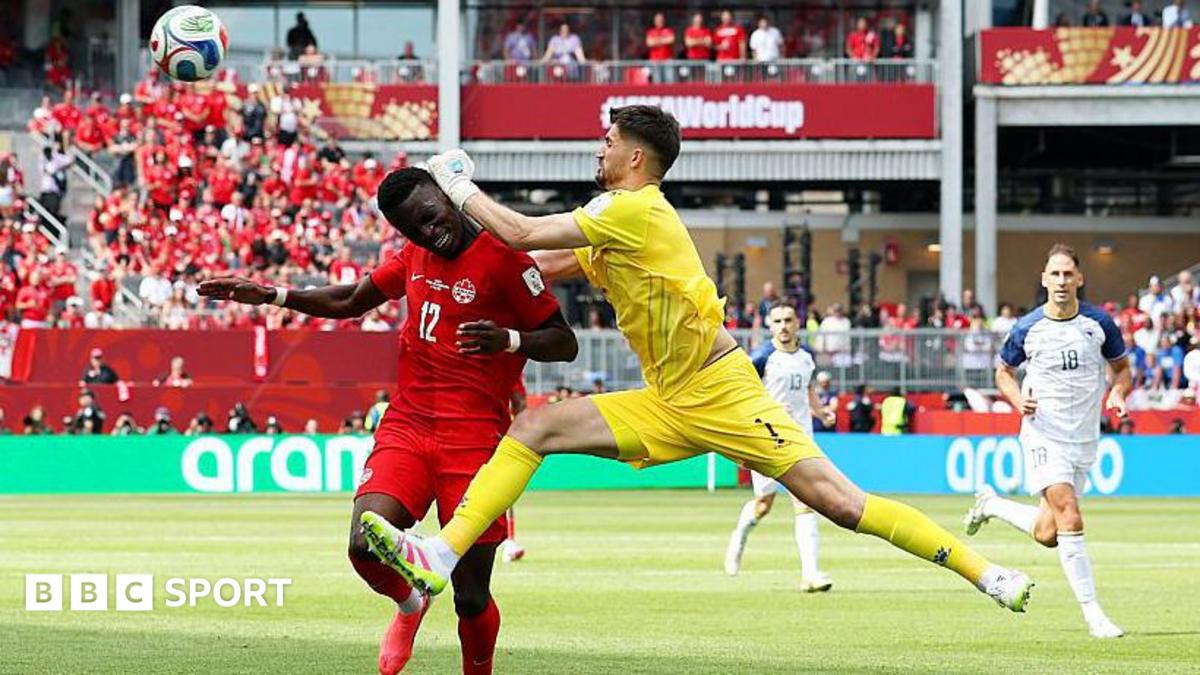
This is what Rooney said: “It is a red card. We have seen it before when players have gone through, and the whistle has gone, and it is a red card.
“It is a very dangerous play. I know he wins the ball, but the follow-through, he hits him in the temple. That is the worst place to be hit.
“He [Oluwaseyi] could get knocked out. He might come back in a week’s time and have delayed concussion. For me, that is a clear red card.
“I don’t think it is the first time we [himself and Darren Cann] have disagreed.
“When you see players win the ball, it is with reasonable force. They follow-through and then they go and get a red card, so it is the same, but with his hands. It is easier to move your hands back than it is with your leg.”
Former France forward Olivier Giroud, another member of the BBC team, was seeing both sides. He said: “As a striker, I would have been frustrated to not get a penalty on that one.
“On the other hand, I understand what Darren Cann says. You hit the ball first and it is hard for him to get his hands off the striker’s head.”
So now it is your turn to act as the referee and take part in a vote. Should it have been a red card or not? Have your say.
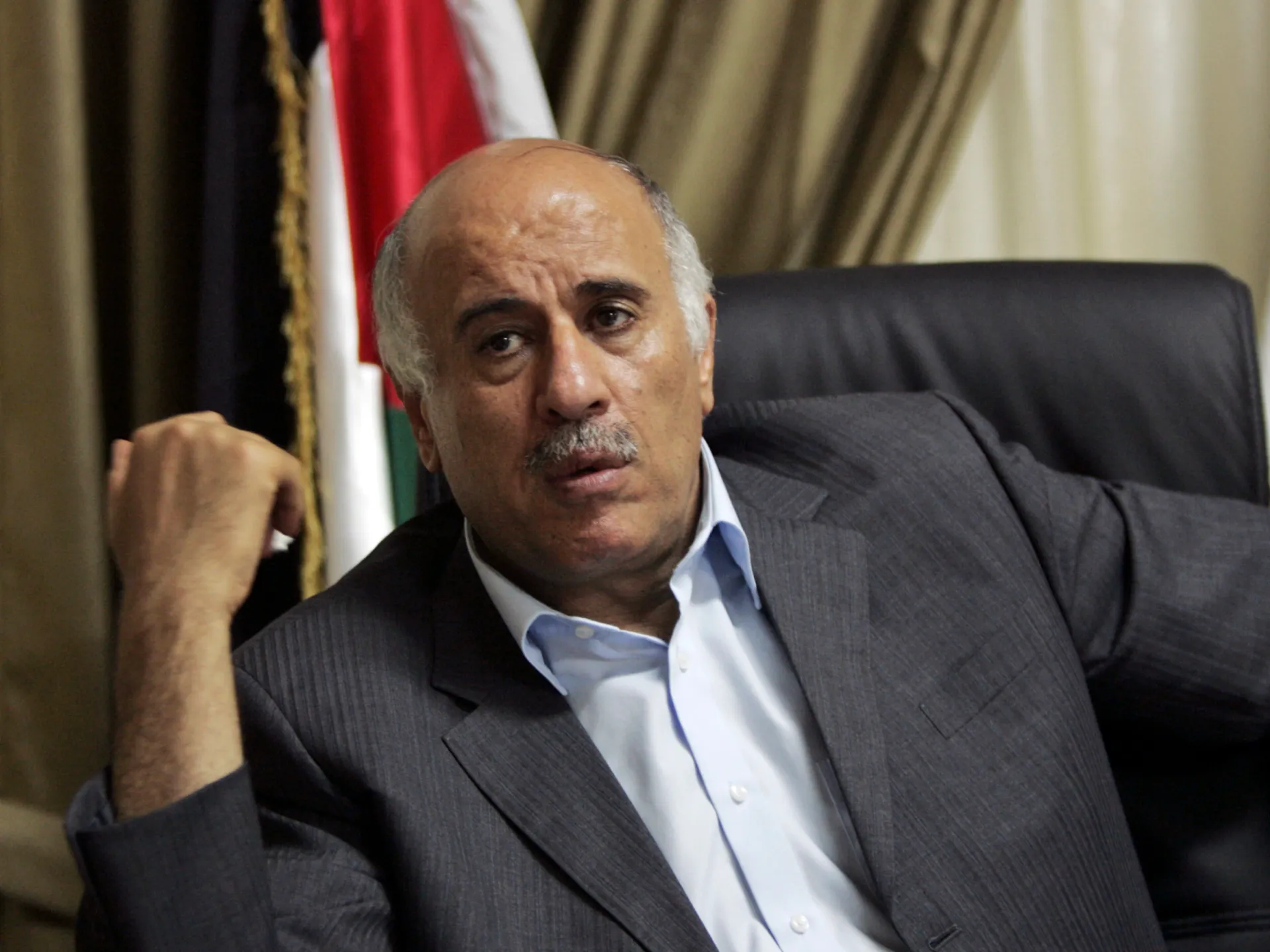
Jibril Rajoub is in Mexico awaiting a US visa to attend the World Cup 2026.
Published On 12 Jun 202612 Jun 2026
The head of the Palestinian Football Association says he is waiting in Mexico City for permission to enter the United States to attend the FIFA World Cup with other federation heads.
Jibril Rajoub attended the opening match between Mexico and South Africa on Thursday, but he has now joined several people accredited to attend the World Cup who have been denied visas or have yet to receive them from the US.
Recommended Stories
list of 2 itemsend of list
“I don’t believe that it’s fair to use or to abuse and deny the right of all footballers all over the world to attend,” the veteran Palestinian political figure told The Associated Press news agency.
The Palestinian team did not qualify for the World Cup, but FIFA typically invites the heads of football associations from around the world to the event every four years, which it frames as a celebration of global unity.
“Everyone will be welcome in Canada, Mexico and the United States for the FIFA World Cup next year. We are working exactly for that,” FIFA President Gianni Infantino said last year.
The US, however, has refused entry to delegates from several countries, including a referee from Somalia and a photographer travelling with Iraq’s team.
Infantino said this week that FIFA had been trying to resolve visa issues but could not overrule the US government.
“We need to respect that we are not the kings of the world who can rule over governments and police forces,” he told reporters on Wednesday.
The US Department of State had no immediate comment on Rajoub’s visa, but last year implemented new restrictions on Palestinian passport holders, including on anyone who had been employed by the Palestinian Authority.
It revoked a visa to allow Palestinian President Mahmoud Abbas to travel to the United Nations General Assembly last September.
Rajoub and other Palestinian football officials have long argued that Israel violates statutes by allowing teams from settlements in the occupied West Bank to play in Israel’s national league.
They have pushed FIFA to sanction Israel, highlighting restrictions on the movement of Palestinian players and how Israel’s genocidal war on Gaza has damaged or destroyed 80 percent of sports facilities and killed at least 565 players there, according to the association.
Last month, Rajoub refused to shake hands with the head of Israel’s football federation at Infantino’s behest because he said the gesture would not heal wounds but instead whitewash Israel’s actions.
Rajoub pointed out that when Russia hosted the 2018 World Cup, it did not implement comparable visa restrictions for people who were invited to the tournament.
Cyle Larin’s equaliser gives Canada first World Cup points after Jovo Lukic put Bosnia in the lead in the first half.
Published On 12 Jun 202612 Jun 2026
Canada striker Cyle Larin came off the bench to salvage a 1-1 draw for his side against Bosnia and Herzegovina in a frenetic Group B opener that had long looked like it would end in defeat for the World Cup cohosts.
Bosnia went ahead in the 21st minute of the game on Friday when Jovo Lukic steered home a flick-on from a corner for his first international goal in his country’s return to the World Cup after 12 years.
Jovo Lukic was mobbed by his teammates after scoring [Cole Burston/AFP]
Canada thundered forward and should have equalised through Richie Laryea in the 53rd, only for Bosnia’s Sead Kolasinac to miraculously steer his shot off the crossbar and away to safety.
The Canadians continued to attack relentlessly, but despite creating plenty of chances, they lacked precision in their finishing as the Bosnians dealt with a succession of crosses and looked to be heading for a narrow win.
Larin had other ideas, however, when introduced in the 76th minute and made an immediate impact, swivelling in the box and firing home a deflected strike less than three minutes later to equalise and send the home crowd into raptures.
The result gave Canada their first-ever World Cup point but left them short of the winning start they had craved.
Larin (celebrates after scoring [Cole Burston/AFP]
Jonathan David had a glorious chance to put Canada in front early on, but the country’s all-time leading scorer sent his well-struck shot from the centre of the area right at goalkeeper Nikola Vasilj.
After Lukic put the battle-tested Dragons on the board, it was Canada, roared on by a boisterous red-clad crowd, who took over.
Canada pressed for the rest of the half but were unable to establish much of a presence deep in the Bosnia half, with almost every ball they sent into the area quickly cleared from danger.
The hosts nearly drew level at the start of the second period when Laryea went through on goal and his shot looked certain to head over the line until Kolasinac stepped in at the last moment to clear via the bar.
With the game starting to open up, Bosnia nearly doubled their lead moments later when Ermedin Demirovic went through on goal, but Maxime Crepeau, making his World Cup debut after missing the 2022 edition with a broken leg, made a crucial save.
That set the stage for Southampton striker Larin, who earned the honour of scoring Canada’s first World Cup goal on home soil when he blasted home a right-footed shot from the centre of the box in the 78th minute, moments after entering the game.
Chinese media and think tanks view the United States’ hosting of the FIFA World Cup from a purely geopolitical, economic, and commercial perspective, critically assessing the infrastructure and political climate. Chinese circles see the tournament not merely as a sporting event but as a central tool for the United States to polish its image, bolster its global leadership amidst current international polarization, and advance its political agenda. This perspective is highlighted through several key points, the most important being the geopolitical dimension. Here, Chinese think tanks argue that the tournament reflects the level of competition between major powers, with Washington attempting to use hosting as a soft power tool to project its influence. However, Chinese media, in turn, emphasized the state of sharp international polarization and division, criticizing the political challenges and the wrangling that accompanied the broadcasting negotiations. Furthermore, a number of (commercial considerations) have been raised, with the tournament facing criticism from Chinese media due to its exorbitant cost and the significant time difference between North America and China, leading to a decline in Chinese public interest. This hesitation was reflected in the negotiations, as FIFA incurred financial losses after China Media Group (CMG) signed the broadcasting agreement late and at a price significantly lower than FIFA’s requested.
Regarding the (organizational and policy challenges), Chinese research and media institutions expressed reservations about the tournament’s logistical challenges, particularly the longer travel distances between host cities compared to previous editions, as well as concerns related to US immigration laws and security restrictions. Despite the absence of the Chinese national team from the tournament, China’s commercial involvement was substantial. Beijing demonstrated its active presence through Chinese commercial sponsors, such as Hisense, and sporting goods factories in eastern China, which reaped significant economic benefits from manufacturing tournament flags and souvenirs. Chinese media coverage, particularly through its official channels, was extensive. CGTN, the Chinese state broadcaster, developed comprehensive plans to broadcast and cover the matches, ensuring the event reached millions of Chinese fans across its various platforms.
Furthermore, Chinese state media and intelligence and military think tanks utilized Washington’s hosting of the FIFA World Cup to offer a number of strategic, media, and intellectual analyses regarding China’s calculations in response to American actions. Major events are often used as a primary arena for geopolitical competition between the two superpowers. Beijing’s vision can be summarized by its use of major sporting, cultural, and other events as a political tool. Beijing views Washington’s hosting of major international tournaments or events as more than just sporting or cultural occasions; it sees them as an extension of American information and decision-making strategies aimed at projecting American influence and hegemony globally. While China seeks to highlight international contradictions, Beijing has directed its media apparatus to demonstrate that Washington’s attempts to unilaterally assume leadership or project messages of unity are, in reality, met with sharp division and polarization within the international system. Here, China has attempted to counter American soft power. This media coverage of the FIFA World Cup in the United States reflects a continuous Chinese effort to neutralize Western and American soft power by focusing on structural issues in international relations, such as the absence of multipolarity, and by promoting the Chinese model as an alternative striving for a more balanced world.
In this context, Chinese media and think tanks view the United States’ hosting of the World Cup through the lens of soft power, geopolitical strategies, and trade, while sharply criticizing the infrastructure and political circumstances surrounding the tournament, particularly in the aftermath of the Iran War and a number of global geopolitical upheavals stemming from US policies. Chinese analyses focus on purely commercial interests, criticizing the exorbitant costs of broadcasting rights. Conversely, they highlight the role of leading Chinese companies in profiting from the event by providing innovative and advanced broadcasting technologies and exporting merchandise and fan supplies. However, they also offer several critical observations regarding the infrastructure and political climate. Chinese research centers express critical skepticism about the readiness of US cities, suggesting that complexities related to visa requirements and a strict security and political environment could hinder fans and undermine the freedom of movement necessary for such events.
Based on the preceding understanding and analysis, we can discern the perspective of Chinese media and research centers that the United States exploits hosting international sporting and political events as a prominent tool for employing sports to enhance American soft power, attempting to project influence to manage conflict, and solidifying its leadership of the global order. Therefore, Chinese think tanks and intelligence agencies have developed a comprehensive media and research plan to expose American polarization worldwide. Conversely, Chinese media and think tanks emphasize Washington’s failure to garner international consensus, highlighting the sharp division and widening gap between Western powers and the rising powers of the Global South. This underscores the mechanism of conflict transformation, where competition is no longer limited to the economic and military spheres but has expanded significantly to encompass soft power tools and media discourse. This reflects a picture of expanded strategic competition and its impact on international stability.
More than any other artist in the 20th century, David Hockney defined Los Angeles in the public imagination. When he first arrived in January 1964, age 26, his mental image of the city had been forged not by art but by Hollywood movies, which he had watched as a young boy in Yorkshire, England. In later life, he often recollected the sharp-edged shadows cast by the Californian sunlight in movies such as Laurel and Hardy’s “Big Business.
Before he ever went to L.A., Hockney — who died Thursday at 88 — knew that he would love it. Writing about his first descent into the city, he recalled how “as I flew over San Bernardino and looked down — and saw the swimming pools and the houses and everything and the sun, I was more thrilled than I’ve ever been arriving at any other city, including New York.” By this time, the glamour of Hollywood had been compounded by other influences, including the homoerotic magazines that an American friend had given him at the Royal College of Art in London. Titles such as Physique Pictorial, published in L.A. by the pioneering “beefcake” photographer Bob Mizer, held out a promise of California as a paradise of rippling men and permanent sunshine. A darker, no less thrilling image of the city had arisen from Hockney’s reading of “City of Night,” the 1963 novel by John Rechy that tells the story of a hustler in the gay underworld of downtown L.A.
Los Angeles itself felt young to Hockney. He loved the light, the architecture, the sense of space and the sense of possibility — not least the possibility of greater sexual freedom. West Hollywood boasted a large gay bar, the Red Raven on Melrose Avenue, that was unlike anything he had found in London or New York. There was also the lure of the beach, with its pageant of sculpted physiques. Venice Beach struck him as a more body-beautiful version of London’s Portobello Road.
Before long, his work shifted from generic fantasies of the city (a young man showering in Beverly Hills, for instance) to vivid portrayals of its real-life pools, palm trees, architecture and people. American artists such as Edward Ruscha and Edward Kienholz were producing their own canonical images of L.A. in these years, but for Hockney, there were no artistic precedents — “no ghosts,” as he later put it — to live up to. “People then didn’t even know what it looked like,” he once said. “And when I was there, they were still finishing up some of the big freeways.… I suddenly thought: ‘My God, this place needs its Piranesi, Los Angeles could have a Piranesi, so here I am!’ ”
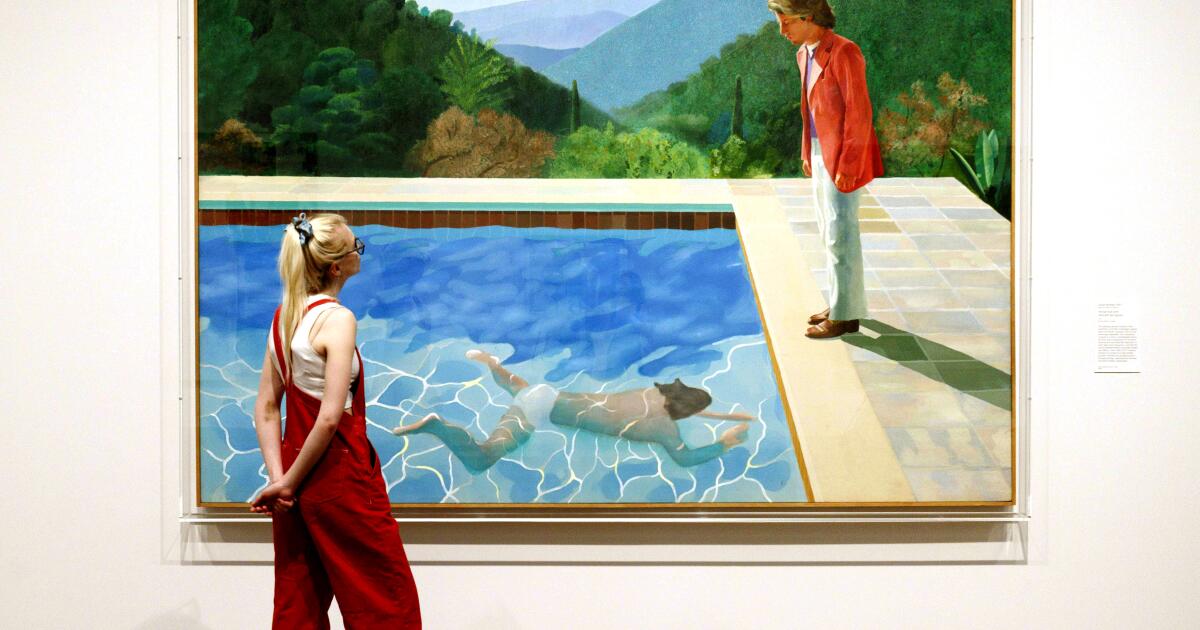
He was true to his word, even if his luminous, serene images of the city were a far cry from Giovanni Battista Piranesi’s feverish visions of Baroque Rome. “Beverly Hills Housewife” (1966), a portrait of a pink-dressed collector in her modernist home, marked the onset of a realist style that would define Hockney’s work for the next decade. This era gave rise to paintings that became icons of their time and place. Among them were “A Bigger Splash” (1967), which was based on a magazine cover that he came across on a newsstand, and “Christopher Isherwood and Don Bachardy” (1968, sold last year at Christie’s New York for $44.3 million). Inspired by Hans Holbein, this portrait of the English novelist and his artist partner was one of the first celebratory portrayals of a gay couple. Hockney would later recount how Isherwood proclaimed: “Oh David, we’ve so much in common; we love California, we love American boys, and we’re both from the north of England.” Hockney’s beloved American boy at this time was Peter Schlesinger, a young artist he had met while teaching at UCLA in the summer 1966 — and a recurring presence in the early L.A. pictures.
According to Norman Rosenthal, who curated a major survey of Hockney’s art at the Fondation Louis Vuitton in Paris last year: “It is astonishing that a boy from a poor family in Bradford became the person — partly because of his gayness, but also his talent — who defined what everybody now thinks of as California. L.A. had no real image in the world before then, unlike New York.”
Despite his enchantment with Los Angeles, Hockney didn’t settle there until 1978, after a decade of bouncing between America and Europe. In the summer of 1979 he moved into a house in the Hollywood Hills, and soon adorned its pool with swishing strokes of blue paint. In the early 1980s, he converted the paddle tennis court into a studio. The meandering routes and Mediterranean scenery of the Hills were a fresh source of amazement, giving rise to monumental depictions of Mulholland Drive and Nichols Canyon in a newly abstract style.
By this time, the city was deeply familiar — a second home — and he had a close circle of friends around him who included the patron Betty Freeman (subject of “Beverly Hills Housewife”), the designer Gregory Evans, the gallery owner Nicholas Wilder and the film producer Joe Simon. “L.A. had represented a whole new world for him,” says Simon, who remained in regular contact with the artist until his final days. “He just loved the light. He was like a kid in a candy store when he first came. But David was all about the work. Everything came back to that.”
In recent decades, Hockney’s name had become synonymous with the landscapes of his native Yorkshire, which he began painting prolifically in the early 2000s. But Los Angeles never lost its newness and promise. His house in the Hills remained a sanctuary until his final years, when he was too frail to travel. L.A. was where he had come of age, and it remained an indelible part of his life and psyche — not least in terms of its egalitarian spirit and its tendency toward the horizontal. “The great thing about Hockney was that he spoke to everybody,” says Rosenthal. “Few artists of his world and his generation could do that.”
James Cahill, a novelist and an art critic, is the author of, among other books, “David Hockney” and the forthcoming “The Beverly Hills Housewife: Hockney’s Californian Muse and the World Beyond the Pool.”
Watch the moment Danni Wyatt-Hodge reaches a century in the opening match of the ICC Women’s T20 World Cup as England reach a record-breaking 219 from their 20 overs against Sri Lanka at Edgbaston.