world cup fan

World Cup fans flock to In-N-Out, Erewhon for a taste of California

World Cup tourists are coming to L.A. for the soccer, but they’re staying for the $21 smoothies and Double-Doubles.

As the last Los Angeles FIFA World Cup event ended Friday, soccer fans were eating like locals and famous chains from the region were cashing in.

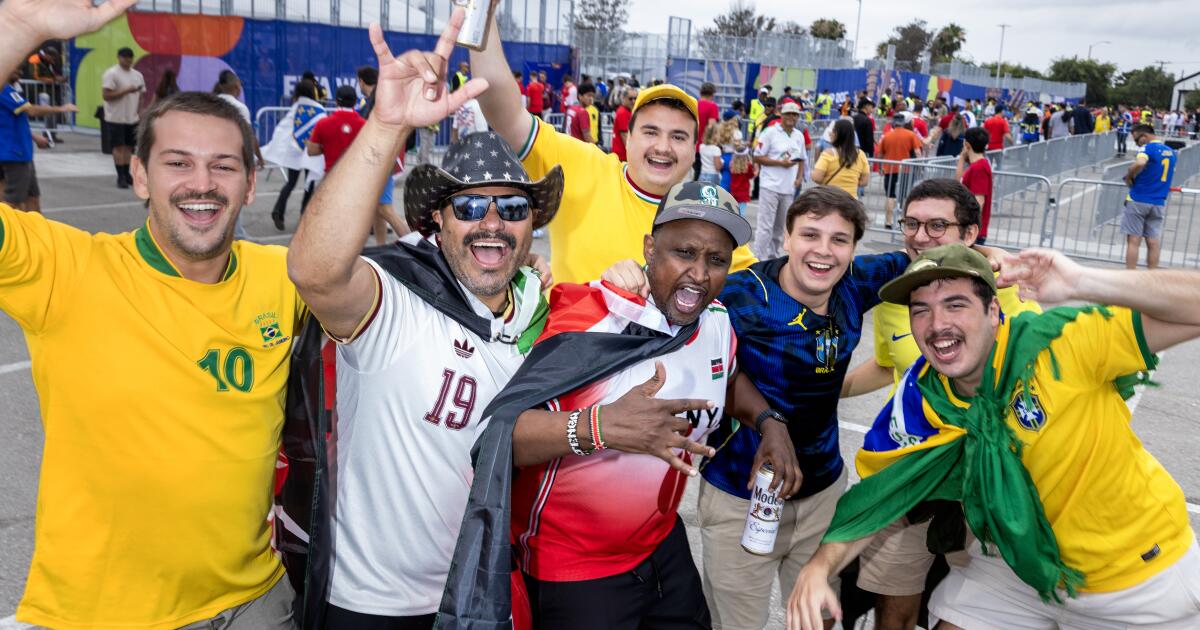
In the weeks that L.A. has hosted the World Cup, international soccer enthusiasts have flocked to big brands from the area, often in large groups wearing their countries’ jerseys.

It is a phenomenon seen at many of the host cities. In Dallas, giant gas station Buc-ee’s is the main attraction. For people visiting New Jersey, deli shops have been a hot ticket. In L.A., the place to be between matches was Erewhon.

Thirsty international sports fans gathered for pictures outside different Erewhons, wandered their aisles smiling, and, of course, picked up pricey smoothies.

While Erewhon would not comment on its business, mobility data company Arity, which uses phone data to track consumers, said Erewhon visits at the outlets around SoFi Stadium were quadruple what they were a week earlier on June 12, the day of the U.S. national soccer team’s opening match there.

Arity looked at what stores people visited within a 10-mile radius of SoFi that day and also found surges in visitors to nearby El Pollo Loco and Trader Joe’s.

Locals have spotted groups of people in Korea jerseys huddled together, trying to decide what to order at In-N-Out.

Some complained on social media that international tourists at Trader Joe’s were buying up all the mini canvas tote bags.

Soon after the Belgium vs. Spain quarterfinal ended Friday, the In-N-Out near SoFi had a long line of soccer fans stretching out the door in bright red and yellow and black jerseys and matching striped hats and scarves.

One of the workers said he had to explain “spread” and “animal style” to foreign football fans.

“I didn’t know this place existed,” a fan from Romania said while waiting in line.

Los Angeles and other cities and states that have hosted the event need the soccer fans to spend money to make the event worth all the time, effort and money it requires.

A rosy 2024 report projected the World Cup could bring more than $800 million to the L.A. region as 180,000 people converge on the area to sleep, eat and spend.

There were early concerns people weren’t turning up for the event because of the high ticket prices and the difficulty of obtaining visas for citizens of some countries.

However, at least for some L.A. hotels, there was a surge of last-minute visitors which pushed up occupancy and room rates.

While sports fans are not in the region to shop, they do make time for it.

World Cup customer spending is also apparent in beer sales. Andrew Heritage, the chief economist at the Beer Institute said beer purchases at entertainment and attractions in L.A. – outside of World Cup spaces – were up around 10% from normal.

“That tells me that fans in the L.A. area have decided to extend their stay and take in all the other things that the area has to offer, rather than just the match itself,” he said.

On social media, the purpose of these shoppers is clear: grab a quick souvenir or local specialty and take a selfie.

The data from Arity suggests that fans are very efficient when they spend at local spots, diving in, getting what they want and getting out as soon as possible, said Jeff Schlitt, a director at the company.

“Normally you’re there for an hour. They’re going to be there for 15, 18 minutes,” he said. “Why is that? Because they were purpose-driven shoppers.”

For some travelers, the more popular American chains aren’t unfamiliar. But some of the native L.A. fare still comes as a surprise.

As one Belgium-Spain matchgoer from the Netherlands stood taking a picture of the In-N-Out sign after the game, he said he’d never had a burger like the one he’d just tried.

“We only have McDonald’s and Burger King,” he said. “It’s way better.”
Source link

California soccer fans sue StubHub after it fails to deliver expensive World Cup tickets

StubHub is getting a red card from some World Cup fans

Two World Cup customers are suing the New York-based ticket-selling company, alleging “false and misleading” advertising that left them without tickets or a refund for the World Cup games they paid to attend.

In federal court in New York last week, two Californians — Julia Reeker Moghal and Reuben Renteria — sued StubHub seeking monetary damages and a ban on the company selling World Cup tickets. The lawsuit aims to become a class action and comes after weeks of fierce criticism and complaints from customers regarding the company’s practices.

Throughout the World Cup, videos have emerged on Instagram and TikTok of StubHub customers describing their nightmare experiences with the ticket-selling platform.

Some said they had purchased tickets to World Cup games as early as November of last year, booked flights and hotels and arranged travel plans, then StubHub notified them days to weeks before the match of a refund for their tickets, which they never requested.

There were similar complaints about last-minute cancellations from people who bought Coachella tickets on StubHub.

In the lawsuit, Moghal said she had purchased three tickets for nearly $2,000 for the June 18 match between Switzerland and Bosnia-Herzegovina at SoFi Stadium in Inglewood, which were then canceled by StubHub. Moghal said she was contacted by StubHub and told her tickets would remain canceled, then was later told the tickets would be available one hour before the game.

When the match began, Moghal said she was at SoFi Stadium, but the tickets never came.

Renteria said he paid around $2,300 for the June 18 Mexico versus South Korea match in Guadalajara, Mexico, but they were canceled

“Devoted soccer fans have traveled from around the world to attend World Cup matches — and they reasonably relied on StubHub to provide the tickets they paid for as well as on StubHub’s warranty,” Blake Hunter Yagman, the attorney representing the two, said in a statement. “Instead of rewarding their business, StubHub sold them World Cup tickets that they either could not provide or on speculation, only to be stranded, in many cases, at the stadium gates without any recourse.”

According to StubHub’s website, its Fan Protect Guarantee states the platform will deliver valid tickets or refund in the event of a ticket issue, and that it will “go out of our way to find replacement tickets” of a comparable value. The lawsuit alleges the replacement tickets many fans were given by StubHub were worse than their original tickets.

FIFA, the World Cup organizer, states in its terms and conditions that the FIFA Marketplace, its own ticket-selling platform, is the only authorized platform for World Cup tickets, and that only tickets purchased through it are guaranteed by FIFA to be valid.

Despite the risk of purchasing through a third-party platform such as StubHub, many fans opted to do so to avoid the 30% FIFA resale tax, believing that the Fan Protect Guarantee would safeguard their order.

Since World Cup tickets began selling on FIFA Marketplace last September, fans have expressed disappointment in the expensive price tag. FIFA utilized a dynamic pricing system for the sale, and as sales phases progressed leading up to the games, the cost of tickets increased tremendously. In March, the extreme cost of tickets prompted 69 members of Congress to write a letter to FIFA urging them to lower their prices.

Tickets for the upcoming Friday match between Spain and Belgium in Los Angeles are selling on StubHub for over $1,300.

StubHub said in various statements to the news and in legal proceedings that ticket cancellations were a result of transfer problems and issues with FIFA’s ticketing infrastructure.

StubHub did not respond to requests for comment.

A FIFA spokesperson responded to this accusation in a statement, saying, “FIFA has no visibility over, or control of, secondary market ticket transactions carried out on third-party platforms. The transactions facilitated on these platforms occur entirely independently of FIFA’s official ticketing platform. With reference to the reliability of the services available to fans on FIFA’s official ticket platform, FIFA rejects any suggestion that the functional issues being experienced by users of third-party platforms with respect to FIFA World Cup 2026 tickets are the result of FIFA’s ticketing infrastructure.”

Source link

World Cup fans squeezed by botched ticket sales, steep water prices

It wasn’t too good to be true, but it was too good to remain true.

World Cup fans still reeling from FIFA’s pricey water policy change have a new gripe: Soccer’s governing body is demanding payment from about 60 people who secured tickets for free because of a glitch on the FIFA website during checkout.

FIFA confirmed the mistake with a swift response, issuing a statement that said pay up or stay home:

“The tickets requested by these fans remain reserved, and the affected fans have been invited to complete payment of the correct amount. FIFA regrets the error and any inconvenience caused.”

What, did anyone think a governing body denying fans free water in the summer heat would allow 60 souls into stadiums without paying admission? Even when FIFA admitted its mistake?

One week before matches begin in 16 North American venues, including SoFi Stadium that will be referred to during the tournament as Los Angeles Stadium, FIFA reversed its policy that allowed refillable plastic bottles when temperatures were high enough to justify it.

Now, no plastic water bottles are allowed except the ones sold in the stadium. Last summer during the Club World Cup, bottled water at FIFA venues fetched $4 to $6.

Coca-Cola products will be sold at all World Cup venues, including Dasani water. In a statement to the Athletic on Thursday night, FIFA skirted questions about whether it was influenced by commercial priorities.

“The decision to prohibit capped water bottles is based on a number of factors related to safety and security, including mitigating risks to players and spectators, ensuring a safe and efficient ingress experience for all attendees, and the presence of additional heat mitigation and alternative hydration strategies at FIFA World Cup 2026 stadiums,” the statement read.

Toronto Mayor Olivia Chow questioned FIFA’s motive.

“Why do you need to buy a water bottle when you can just carry your water in? It is cheaper that way and it is good for the environment,” Chow told CTV News. “It is outrageous. They are just trying to make more money. They are already making billions of dollars. Stop it.”

Chow’s ire likely grew upon learning that the group-stage matches the 60 people who now must pay for tickets FIFA mistakenly provided them are all in Toronto.

Complaints have mushroomed for months about World Cup ticket price fluctuations caused by sophisticated algorithms that can dramatically increase costs based on demand. Prices adjust in real time, increasing when interest surges.

The attorneys general of New Jersey and New York a week ago launched an investigation into World Cup ticket sales following reports that fans were misled about the locations of seats they purchased.

The attorneys general sent subpoenas to FIFA, requesting details about ticketing practices for eight World Cup matches hosted in New Jersey, including the World Cup final.

FIFA has about $6.14 billion in total assets and $3 billion in cash reserves.

The organization has defended its steep ticket prices, saying they reflect standard practices for major global sporting and entertainment events.

Longtime soccer journalist Simon Kuper explained to The Times’ Kevin Baxter that FIFA can maximize profits because it has no competition.

“If you think of McDonald’s or Nike, they’re trying to please consumers because they know the consumers can go someplace else,” Kuper said. “There’s only one World Cup, so FIFA is a monopoly purveyor. It’s more like one man running the cash box.”

Parking will be another opportunity to generate revenue. A spot nearly two miles from SoFi Stadium will cost $300 for the U.S. opener against Paraguay next week.

Source link