The United States Equal Employment Opportunity Commission (EEOC) has found that the networking technology company Cisco may have violated the civil rights of Middle Eastern and Muslim employees amid a wave of anti-Arab and anti-Muslim comments on internal messaging platforms at the company.
In June, the EEOC, which is tasked with enforcing the US’s anti-discrimination laws, said Cisco subjected its employees to a hostile work environment, according to a letter of determination obtained by Al Jazeera.
Recommended Stories
list of 4 itemsend of list
The letter, which was first reported by Politico Pro, stemmed from a complaint filed with the EEOC in December 2024 by a group of Cisco employees called “Bridge to Humanity” (B2H), who had been voicing concerns that the company’s technology was provided to the Israeli military for use in Israel’s genocidal war on Gaza.
Several months earlier, the group of employees had sent a separate open letter calling on the San Jose, California-based company to stop providing its technology to the Israeli government. The document was signed by more than 1,700 of the company’s more than 86,000 employees.
In its December complaint filed with the EEOC, the employees alleged that Cisco had removed the open letter from an internal site and that it was “under review”, and that subsequently, many of the signatories were harassed. Among the allegations was a remark that one employee had told another to “quit living”.
The employees also alleged that Cisco had not responded to their complaints until they created a 76-page report cataloguing the hate comments they had been subjected to in an internal messaging group called Connected Jewish Network.
The report, which was provided to Cisco’s Employee Relations and Ethics offices, according to documents made public by The Guardian, outlined the waves of hate comments. In one of these, from November 2023, an unnamed employee had said that “Israeli passersby killed 2 members of a Palestinian family in Jerusalem this morning, and I for one am extremely grateful.”
“These Cisconians have, among other things, repeatedly glorified violence, joked about sending people to their deaths, likened Palestinians and those with opposing viewpoints to animals, labeled Palestinians, Arabs, and Muslims as murderous, violent terrorists, joked about respecting a person’s gender identity,” the 76-page report said. It added that the Connected Jewish Network was not even a “safe space for all of our Jewish colleagues”.
The EEOC’s determination said that the company had retaliated against one unnamed staffer for “her involvement in pro-Palestine efforts by terminating the individual”.
‘Important step’
The employees’ complaint with the EEOC was filed by Legal Aid at Work, a nonprofit legal services organisation.
“The EEOC’s determination is particularly significant because it appears to be the first time in any legal context where a governmental or judicial finding has sided with Big Tech workers who have collectively organised to fight for corporate accountability around their employers’ sales of their technology to Israel,” Christopher Ho, director of the national origin and immigrants’ rights programme at Legal Aid at Work, told Al Jazeera.
Advocacy groups like the Council on American-Islamic Relations (CAIR) praised the decision.
“The EEOC’s finding is an important step toward accountability and a reminder that federal civil rights protections apply equally to Muslim, Arab, Palestinian, and other employees who speak out about Palestine,” civil rights managing lawyer Jeffrey Wang at CAIR’s San Francisco Bay-area chapter said in a statement.
“Employers have a legal responsibility to address harassment and discrimination fairly and consistently. Workers should not have to fear retaliation or a hostile work environment because of their religion, national origin, or association with protected communities.”
According to reporting by The Guardian, although the EEOC issues its determination in June, the agency’s mediation with the company has “not gone anywhere”.
Legal Aid at Work told Al Jazeera that it has also submitted a complaint against Cisco to the National Labor Relations Board (NLRB) and the California Labor Commissioner.
“[The complaints] allege, respectively, that Cisco unlawfully interfered with our clients’ federally protected right to engage in concerted activity to improve working conditions, and unlawfully interfered with their right to engage in political activities that is protected by the California Labor Code. Both these complaints are still pending at the respective agencies,” Ho said.
Al Jazeera reached out to the EEOC for comment.
“Under federal law, both charges filed with, and charge inquiries made to the EEOC are confidential. The EEOC can neither confirm nor deny the existence of any charge or charge inquiry,” an EEOC spokesperson said.
Cisco did not respond to Al Jazeera’s request for comment.
For California businesses, 2020 will be a year of reckoning.
Sweeping new laws curbing longtime employment practices take effect, aimed at reducing economic inequality and giving workers more power in their jobs.
Under one, companies could be forced to reclassify hundreds of thousands of independent contractors as employees with broad labor law protections. Under another, bosses could no longer force workers into closed-door arbitration proceedings, a tactic which protects businesses from costly lawsuits.
The new laws are about “job quality — what it means to work in a just workplace,” said California Labor Secretary Julie Su. “California leads the way on labor standards and we’re not going to let employers do end runs around those standards. We want to support businesses who look at their role in a holistic and humane sense.”
Many new measures, she added, are “not big splashy things, but day-to-day things.” She cited a law giving working mothers a place to express breast milk besides a bathroom. And a law making it easier for firefighters and other first responders to gain workers’ compensation for post-traumatic stress disorder.
Other new statutes ban discrimination based on hairstyle, such as Afros, braids, cornrows and dreadlocks; grant organ donors additional guaranteed leave; and extend whistleblower protection to patient rights advocates at county mental health centers.
The California Chamber of Commerce, a leading voice for business, picked its fights. It did not list Assembly Bill 5, the independent contractor bill, on its annual “job killer” list, preferring to help negotiate for a slew of professionals, such as doctors and real estate agents, to gain exemptions.
“We felt it was important to participate in the compromise,” said Chamber President and Chief Executive Allan Zaremberg. “This is a work in progress, and it will continue to be.”
But the chamber, along with the National Retail Federation and other business groups, filed suit against Assembly Bill 51, the first-in-the-nation law preventing companies from making workers sign arbitration agreements as a condition of employment. And it helped defeat other bills favored by the Legislature’s labor-friendly majority, including one extending unemployment benefits to striking workers and another curbing the University of California’s ability to hire temporary workers.
“A lot of employers feel the rules are complex and tough to deal with,” Zaremberg said. “Our job is to make sure laws are reasonable and fair … and they can afford to stay in business. From that perspective, it has been a successful year.”
Here are a few of the changes coming to California workplaces in 2020:
Minimum wages
On Jan. 1, the statewide minimum wage steps up to $13 an hour for employers with more than 26 employees, and to $12 an hour for those with 26 or fewer employees. The increases are mandated by a 2016 law that gradually raises the floor to $15 an hour for nearly all workers by 2023.
Several local jurisdictions have higher minimums including the city and county of Los Angeles, Santa Monica, Malibu and Pasadena, all of which will raise them on July 1 to $14.25 an hour for small employers and $15 an hour for large employers.
“People talk about prosperity and GDP growth, but that’s not enough,” Su said. “One in 3 California workers makes less than $15 an hour. That is not how we want to build an economy.”
Some 2.6 million Californians will be due a raise in January under the statewide floor, according to a UC Berkeley study. California will have the nation’s second-highest minimum next year after Washington state’s $13.50.
Meanwhile, several large businesses have already raised their floors to $15 an hour or more, including Costco, Spectrum, Amazon and Disneyland Resort.
Independent contractors
In April 2018, the California Supreme Court dropped a bomb on a vast swath of companies, from Uber and Lyft to yoga studios and hair salons, which have built their businesses on independent contractors. To classify workers as contractors rather than employees subject to minimum wage and overtime laws, companies would have to satisfy a strict three-pronged test.
Under the “ABC test,” a business may only contract with independent contractors who satisfy all three of these conditions: a) they are free from control and direction of the hiring entity; b) they perform work outside the usual course of the hiring entity’s business; and c) they are customarily engaged in an independently established business of the same nature as that of the work involved.
The court decision set off a scramble in the Legislature. Backed by labor unions that see an opportunity to organize newly empowered employees, Assemblywoman Lorena Gonzalez (D-San Diego) authored AB 5 to codify the decision, expanding it to areas such as workers’ compensation and unemployment and disability insurance.
Even under a previous, looser standard, state officials estimated misclassification was costing California some $7 billion a year in payroll taxes. Companies also avoid paying federal Social Security and Medicare taxes for contractors.
“Structural reform was necessary because more and more companies want to reduce their obligations,” Gonzalez said. “We’re playing whack-a-mole trying to protect workers while companies try to get more profit for shareholders.”
A lobbying frenzy led to exemptions for some professions in which workers have more negotiating power or autonomy than in low-wage jobs. Among them: lawyers, accountants, architects, dentists, insurance brokers and engineers.
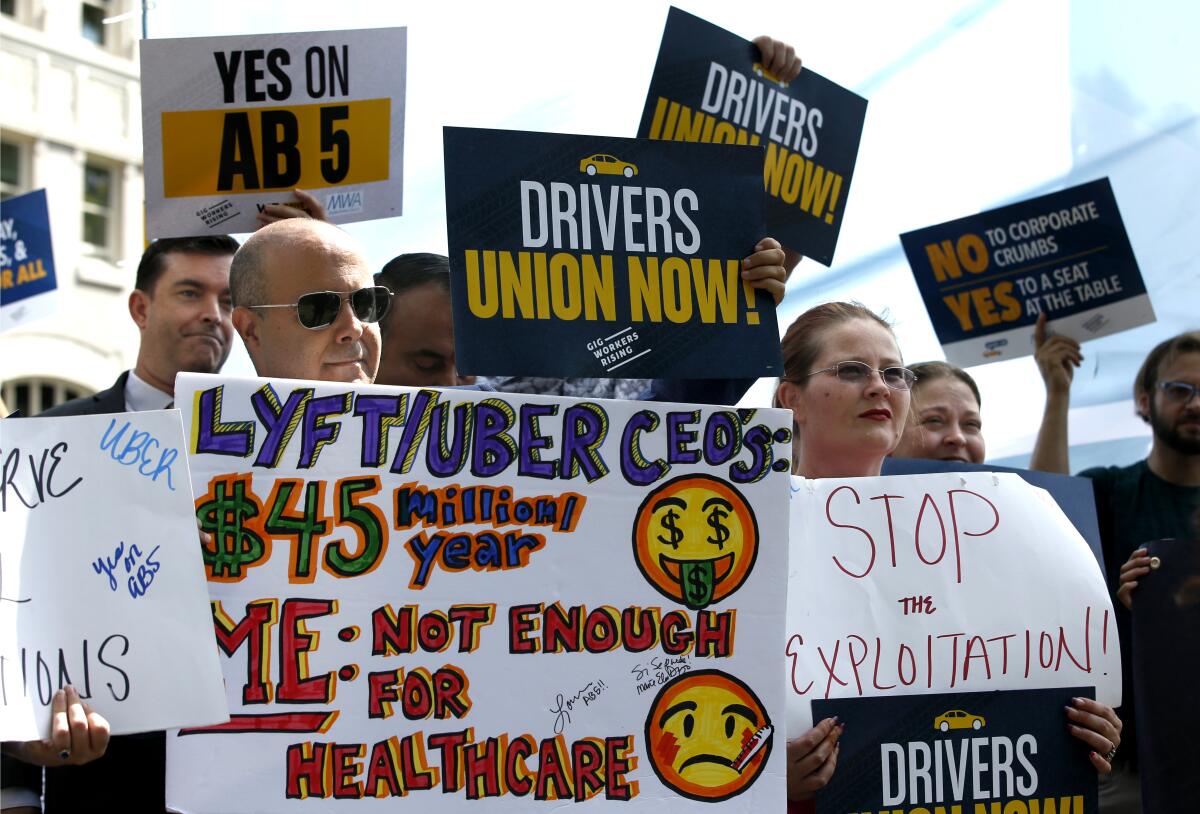
But the Legislature declined to exempt app-based ride-hailing or food delivery companies, whose workers complain they often earn less than minimum wage and are subject to arbitrary dismissals. Uber, Lyft, DoorDash, Postmates and Instacart, arguing that they are technology companies, not transportation employers like taxi businesses, set aside $110 million to mount a ballot initiative exempting them from the law.
Supporters of AB 5, a California law requiring companies to reclassify many independent contractors as employees, rally in August in Sacramento.
(Rich Pedroncelli / Associated Press)
Trucking associations, freelance writers and photographers filed suits to avoid the new law’s strictures.
“AB 5 fundamentally disrupts the right of Californians to have independent working relationships with their clients or employers,” said Sen. Mike Morrell (R-Rancho Cucamonga). By favoring some industries over others, he added, “Sacramento Democrats embrace a slide towards socialism.”
Gonzalez said she is open to changes in the bill next year, including an exemption for musicians — but not for app-based ride-hailing and delivery giants. “We will continue to clarify this law, but rest assured, it won’t be repealed,” she added.
Arbitration
Former Gov. Jerry Brown twice vetoed bills to curb the exploding practice of mandatory arbitration, which allows companies to make employees resolve disputes in a private, closed-door session rather than in public court proceedings.
Brown argued that a U.S. Supreme Court decision allows the practice. And businesses contend that in conflicts over wages, discrimination, disability, harassment and other issues, arbitration saves them, and workers, the needless expense of class-action lawsuits.
But in the last year, allegations of sexual harassment and assaults by serial perpetrators, many of whom were protected by arbitration agreements, fueled public outrage, as in the cases of Hollywood producer Harvey Weinstein and CBS Chief Executive Leslie Moonves. At Google, 20,000 workers staged a global walkout demanding an end to forced arbitration. Other tech workers, including at Los Angeles’ Riot Games, followed suit.
Gov. Gavin Newsom signed a new version of the law, which avoids invalidating existing agreements. “AB 51 just prohibits firing or threatening employees who refuse to sign,” said UC Berkeley law professor Catherine Fisk. “Forced arbitration is clearly used as a device to prevent workers from bringing claims. So it allows companies to violate the law.”
But Zaremberg argues: ”Our employment laws are more complex than those in the rest of the country. People make honest mistakes every day trying to comply with them. With arbitration, they can be resolved through an expedited process.”
An estimated 67% of California workplaces had mandatory arbitration policies in 2018, higher than the national average, and the number may have grown this year as attorneys advised companies to get ahead of the new law.
A new activist strategy this year — filing thousands of individual arbitration claims against Uber, Lyft, DoorDash and Postmates — hit companies with millions of dollars in processing fees. Companies used to dealing with employee grievances one by one refused to pay. A new law, Senate Bill 707, imposes stiff penalties on businesses that stall payments, and allows workers to then take their grievances to court.
#MeToo
#MeToo scandals lent impetus to other measures besides the arbitration statute.
Under current law, workers have a year to file complaints of discrimination, harassment and retaliation in court. AB 9 extends the deadline to three years. Brown had vetoed the bill in 2018, saying claims should be filed “while memories and evidence are fresh.” Victim advocates contend a year is often insufficient for workers to come to terms with what happened to them and seek counsel.
Often companies will require a worker who gains a financial settlement for harassment or discrimination to quit his or her job. Assembly Bill 749 prohibits “no re-hire” clauses affecting the “aggrieved employee.”
Assembly Bill 547 requires training for janitors to be conducted by their peers. “We’ve seen reports of rape on the night shift,” Su said. “This law means immigrant women with lived experience will make the training real. So companies can’t just pay lip service to training, letting people go through the motions and check a box.”
Child-care workers
Home-based child-care workers are not covered by federal labor law. Now, some 40,000 private family day-care providers, paid by California to service more than 360,000 low-income children, will gain the right to bargain collectively with the state under Assembly Bill 378.
The new law sets the stage for California’s largest union election since 1997, when home-care workers were granted the right to bargain over wages and working conditions. Child-care workers, who are largely Latino and African American, earn close to minimum wage — pushing many out of the industry. The new law will lead to “creating quality jobs, not poverty jobs,” said Assemblywoman Monique Limón (D-Santa Barbara), the bill’s author.
Corporate diversity
Senate Bill 826, enacted last year, requires publicly traded companies headquartered in California to have at least one woman on their boards of directors by January 2020. By the end of 2021, boards with five directors must include two women, and boards with six or more directors need to include three women.
Noncompliant companies could be fined as much as $100,000.
Several European countries have similar laws. But California’s is the first U.S. board diversity mandate. When the law passed, 188 of 650 affected California companies had all-male boards, according to filings with the Securities and Exchange Commission compiled by Clemson University scholars.
Two conservative groups, the Pacific Legal Foundation and Judicial Watch, have filed lawsuits to overturn the statute, but businesses have largely complied. According to Clemson finance professor Daniel Greene, just 32 companies had failed to add any female directors as of Dec. 26.