WASHINGTON — Immigrant advocates fear a Trump administration proposal released Friday amounts to an indefinite pause on new work permits for asylum seekers.
The draft regulation from U.S. Citizenship and Immigration Services would halt the acceptance of work permit applications when average processing times at the agency exceed 180 days.
The regulation also would extend the time asylum seekers must wait before becoming eligible to apply for a work permit, lengthening the period from 150 days to 365 days.
The proposal says USCIS expects that new work permit applications for asylum seekers “would be paused for an extended period, possibly many years.”
Conchita Cruz, co-executive director of the Asylum Seeker Advocacy Project, said the regulation would be catastrophic for asylum seekers, their families and U.S. communities.
“Forcing individuals who are working and living in the United States legally out of their jobs is not only cruel, but it is bad policy,” she said. “If this regulation goes into effect, it will hurt U.S. families, businesses and the U.S. economy.”
The proposed regulation change comes amid broad efforts by the Trump administration to end humanitarian benefits and restrict legal immigration.
For example, Homeland Security has sought to terminate Temporary Protected Status benefits that provided work permits and deportation protection to hundreds of thousands of immigrants. And in a memo released this week, the agency said agents are authorized to detain refugees who have not yet filed applications for lawful permanent residence after their first year in the U.S.
Under the first Trump administration, agency officials in 2020 similarly proposed increasing the employment eligibility waiting period to one year.
Despite Linda Carter and Max Branning sharing a kiss and his claims that he loves her – to his daughter’s disbelief – another woman seems set to become his new love interest
08:52, 19 Feb 2026Updated 08:52, 19 Feb 2026
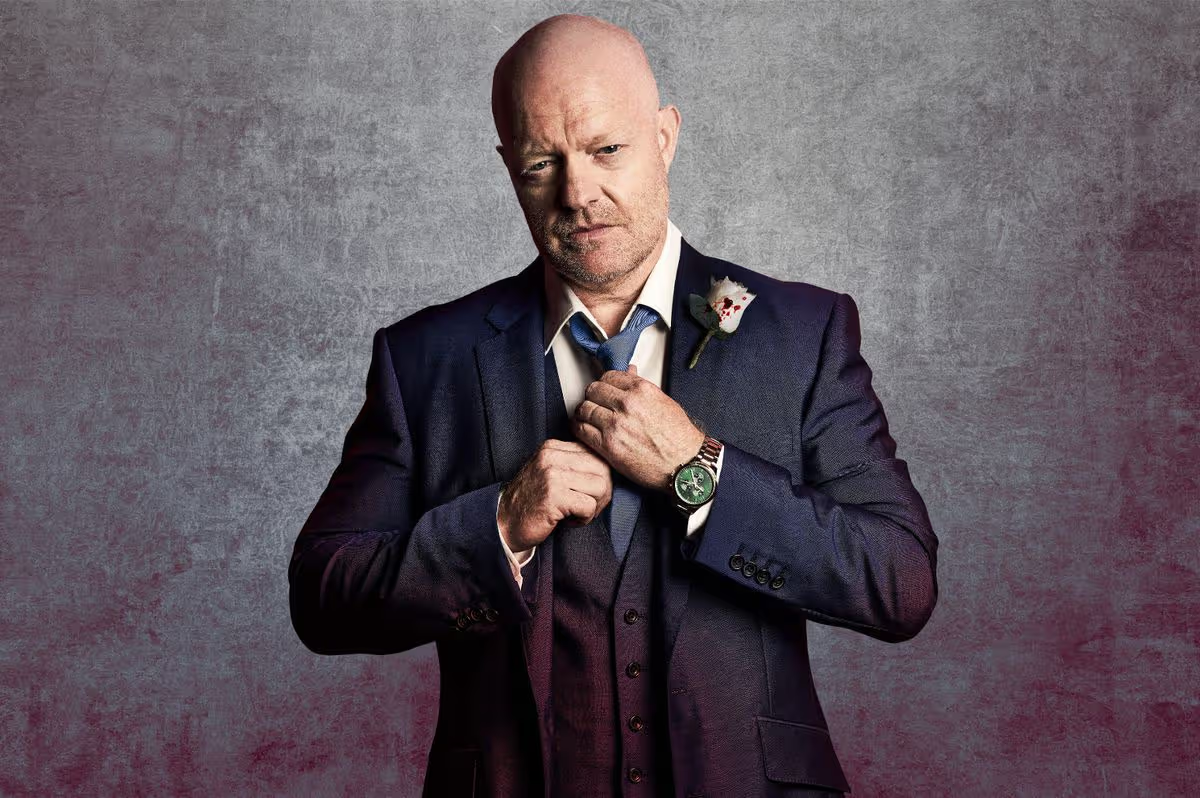
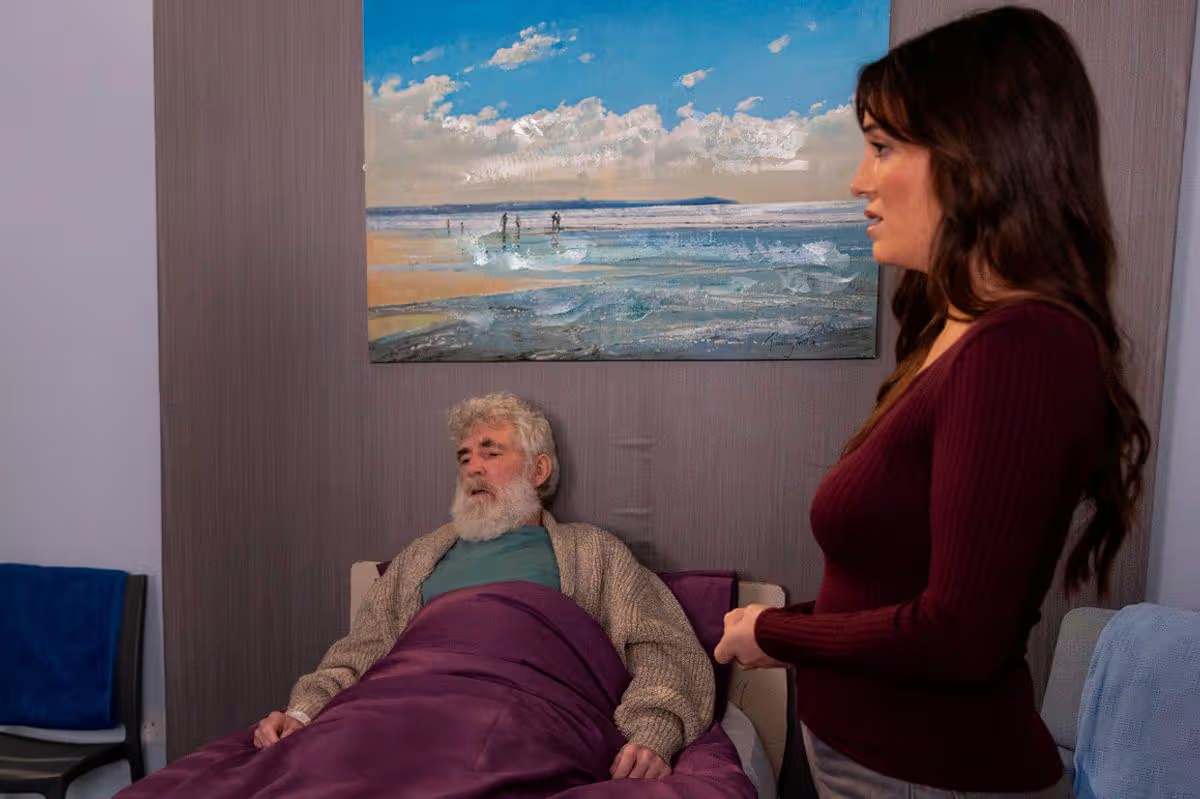
EastEnders fans ‘work out’ who Max’s bride is – and it’s not Linda(Image: CREDIT LINE:BBC/Kieron McCarron)
The Walford Womaniser has struck again! While Max Branning seems convinced he’s in love with his ex Linda Carter, he’s found himself in another flirty interaction with a different woman has led EastEnders fans to say they know who his next love interest is.
Since he returned, many have thought Max (Jake Wood) might eventually marry his former flame Linda (Kellie Bright) in 2027. In the flashforward to next year, he was about to walk down the aisle to a mystery woman, and Linda was teased to be one of them.
But, during Tuesday’s episode (17 February), Max had a date with Linda that couldn’t be described as anything other than a disaster. For starters, Linda didn’t even know it was a date. When Max turned up with flowers and tried to kiss her, she firmly rejected him, leaving the worst philanderer in Walford to dejectedly lick his wounds.
The devastated Max then gave the flowers to Gina Knight (Francesca Henry), wishing her a happy birthday. The brief interaction had many thinking Gina would be the next woman added to Max’s long list of lovers.
“They’re gonna do max and gina as a couple,” said one fan. Another added: “I do think there’s something in Max giving Gina the flowers.” Others, though convinced that the show was hinting and a Max and Gina romance, were clear that they did not want it to happen.
Ensure our latest headlines always appear at the top of your Google Search by making us a Preferred Source. Click here to activate or add us as your Preferred Source in your Google search settings.
“I refuse to be in a reality where Gina and Max have a baby,” a fan said, referring to the pregnant woman seen in Max’s bed during the flashforward.
Another said: “Please for the love of god do not put Gina and Max together – he’s got form for younger women and Gina is already in a complex relationship with Harry after George and Nicola’s baby news. Gina can do better then him and he’s too much baggage for her.”
A third posted a TikTok where they pointed out that Max had previously had a relationship with Gina’s half sister Lucy Beale (Hetti Bywater) just before she died. At the time, Lucy was 21 and Max was not only 45, but her best friend’s father. The TikTok poster said: “Ewww were these scenes foreshadowing Max trying it on with Gina or something?
“Is that why Peter [Beale, Gina and Lucy’s brother] is p***ed off at him in the flashforward and why Cindy [Beale, their mother] didn’t look happy with him? As if getting with Lucy wasn’t bad enough…”
Max has been romantically linked to many women over the years and has a tendency to go for younger women. One of his major storylines in the late 2000s involved an affair with Stacey Slater (Lacey Turner), who was his own son’s wife.
Jake Wood, who plays Max, has previously said that he thinks Stacey is the love of Max’s life. When asked at a press event who Max’s true love is, Jake mentioned Tanya (Jo Joyner), the mother of three of his children, but settled on Stacey.
The actor said: “Obviously, Tanya is very high, but I think probably Stacey as well. I think we saw that when Max came back a couple of months ago. The connection is still really strong between the pair of them; they really understand each other. I think wherever they are in different parts or wherever they are in their lives, they’d always have that connection. So, if you asked Max, he would probably say Stacey.”
“Do you mind if I smoke?” asks German photographer Wolfgang Tillmans with a laugh during a recent video call from his home in Berlin.
As he lights his cigarette, he looks every bit the renegade artist he is known for being. At 57, Tillmans is in the midst of staging his 10th exhibition in Los Angeles since the mid-1990s at Regen Projects. He is one of the most celebrated photographers of his era, with a practice that collapses the distance between fine art and the pulse of street culture, spanning epic abstractions and the familiar textures of contemporary life.
At the same time, Tillmans has another life as a serious electronic musician, recording a series of experimental albums, including his most recent, 2021’s “Build From Here.” He is deeply connected to the music world, and photographed the cover for Frank Ocean’s acclaimed “Blonde,” making him a rare artist to be in major museums while genuinely engaged with popular music and the club scene — a bit of a rock star in his own right.
The official opening of his Regen show, “Keep Movin’,” attracted a line that wrapped around the building. Fans are drawn to his varied strands of work, which move instinctively between disparate approaches and subject matter, from famous faces to images sensitive to light and shape, in subjects as simple as the curve of paper folded softly over itself.
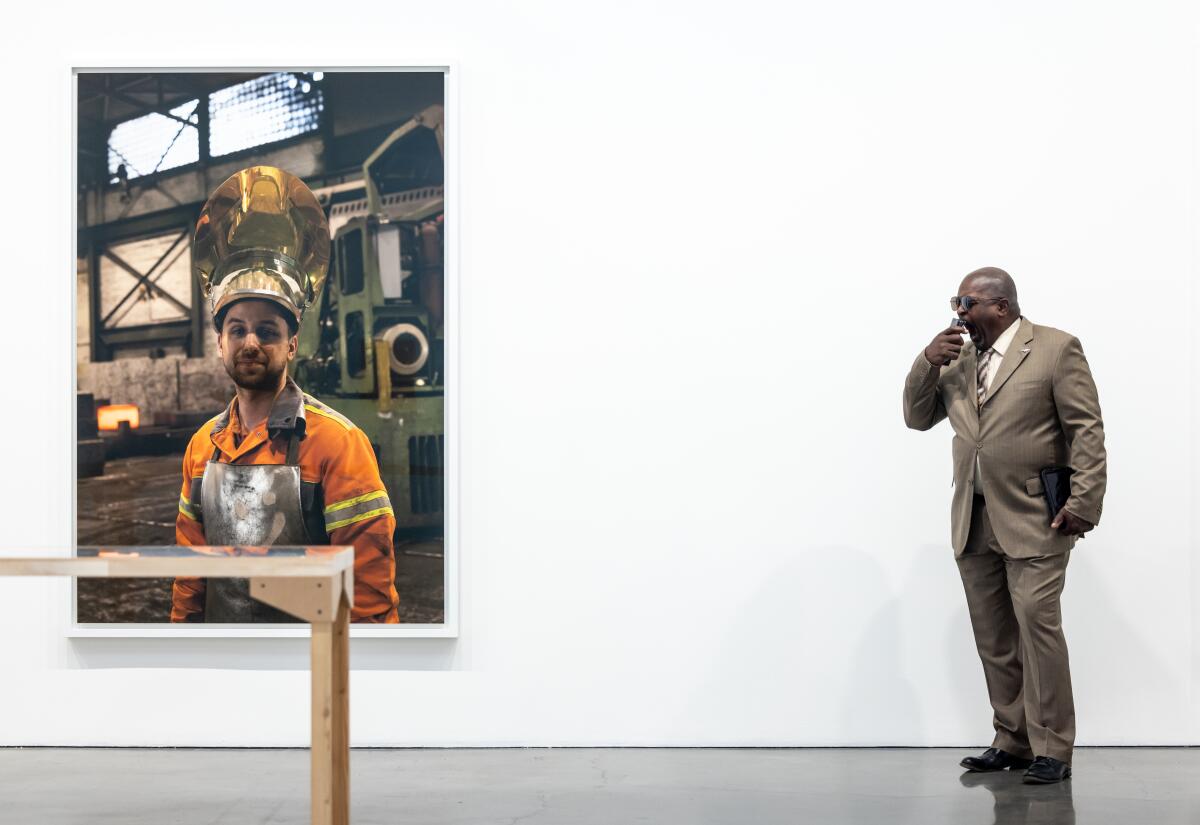
A security guard, right, stands near the work “Robin Fischer, Dirostahl, Remscheid 2024” in German-based photographer Wolfgang Tillmans’ current exhibition, “Keep Movin’,” at Regen Projects.
(Christina House / Los Angeles Times)
During an early walk-through for a few dozen invited guests, Tillmans held forth on his personal cosmos, surveying pictures from the experimental to the deeply intimate. Portraits, politically charged tabletop collages and quiet photographs that capture the simple vibrance of daily life are strewn across Regen’s 20,000 square feet of gallery space.
“I see my work evolve more in evolutions, rather than in revolutions,” Tillmans said, gesturing to a conceptual wall-sized image created with a photocopier.
His Regen show, through March 1, also features short video works and the abstractions of camera-less images he considers “pure photography,” created in the darkroom by shining light directly onto photosensitive paper. There are pictures relating to human sexuality and images from nature. Each subject and approach is an ongoing concern left intentionally open-ended, and never contained within a single project, title or grouping. They are all inseparable in his own mind, free from categories or a finite series of pictures.
“I am aware that these art historical categories exist in my oeuvre, but I’m not seeking them out,” Tillmans explained after the walk-through. His practice is not about “working through one series or genre and then moving on to another.”
Installation view of Wolfgang Tillmans’ “Keep Movin’” at Regen Projects.
(Evan Bedford / Regen Projects)
On his trip to Los Angeles, Tillmans made a long-planned visit to the Mt. Wilson Observatory to satisfy his lifelong interest in astronomy. He used the giant telescope to capture the twinkling of Sirius, the brightest star in the night sky. This preoccupation resurfaces at Regen in a large-scale print of 2023’s “Flight Honolulu to Guam,” revealing a star field above the clouds.
Tillmans’ interest in stargazing goes back to his adolescence, and images of the moon and cosmos recur in his work. “It gave me a sense of not being lonely, seeing the infinite sky and universe,” he says. “I always felt it was a very grounding experience that all humans share. I always got something from this — besides the beauty and the formal marvel of it all — this sense of location and locating myself.”
His depiction of the heavens is just one of many threads and themes that run through his decades of work.
A piece of work personally hung by photographer Wolfgang Tillmans in his current exhibition, “Keep Movin’” at Regen Projects.
(Christina House / Los Angeles Times)
Early in his career, Tillmans began shooting for the British street style magazine i-D, creating portraits of the famous and unfamous, while also documenting club life and gay culture. In 1995, Taschen published his first book, which made a stir with portraits of soft, indirect illumination, emphasizing naturalness. By avoiding the dramatic lighting and exaggerated special effects often seen in pictures of youth culture, he landed on a distinctive visual style.
“I felt the heaviness of life and the joy of life,” Tillmans says. “I saw myself as a multifaceted complex being, not just as young. So I experimented with lighting and film — how can I photograph my contemporaries in a way that approximates the way that I see through my eyes? And that was stripping back anything effectful, almost taking away the camera.”
He continues to do assignment work for magazines, which he considers part of his artistic practice. Several recent portraits are at Regen, including a foundry worker in Tillmans’ hometown of Remscheid and another of actor Jodie Foster. The editorial work brings him into contact with people and places he might not otherwise meet.
In 2000 Tillmans became the first photographer and first non-British artist to win the prestigious Turner Award. Tate Britain staged his mid-career retrospective in 2003 and the Hammer Museum in Westwood mounted his first major U.S. retrospective that same year, which traveled to Chicago’s Museum of Contemporary Art and the Hirshhorn Museum and Sculpture Garden in Washington, D.C.
Coming after major retrospectives at the Pompidou Centre in Paris last year and the Museum of Modern Art, New York City, in 2022, the Regen show dispenses with the retrospective frame while quietly performing a similar task — taking in the main currents of Tillmans’ work over the past two decades, and a few images dating to the late ‘80s. His relationship with the gallery began with his first Los Angeles exhibition.
Visitors walk through photographer Wolfgang Tillmans’ exhibition, “Keep Movin’,” at Regen Projects in Los Angeles.
(Christina House / Los Angeles Times)
As ever, the images are displayed in a startling range of shapes and sizes: framed and unframed, huge wall-size prints hang alongside tiny, snapshot-scale pictures. One of the largest, “Panorama, left” (2006), spans nearly 20 feet and hangs only from bulldog clips. Smaller pictures are simply taped to the wall, but nothing is meant to indicate hierarchy.
“The biggest may not be the most important, and the smallest might be overlooked,” he explains. “It’s a little bit like projecting the way that I look at the world.”
In his first decade of exhibitions, he had no frames at all. “I taped those photographs to the wall, not as a gesture of disrespectful grunginess, but as a gesture of purity,” he adds. “That sense of immediacy — and not imbuing something with outside signifiers of value — lets the fragile piece of paper speak for itself.”
One of the current show’s larger conceptual pieces, “Memorial for the Victims of Organized Religion II,” fills a corner with 48 rectangular portrait-sized photographs, all of them solid black or dark blue. It’s a near-replica of a work shown at the Pompidou with the same solemn title, created to recognize those “physically maimed or mentally harmed” by doctrine and intolerance.
“I myself have a spiritual side,” says Tillmans, still grateful for positive experiences attending a Lutheran church in his youth. “But over the years I’ve become ever more distrustful of organized religions and seeing the role of religion in government. I find it incredibly immodest for humans to tell other humans what God wants.”
When he’s not exploring his spirituality and creativity visually, he focuses his energy on the music world. It’s a natural setting for Tillmans, who is increasingly active releasing his own electronic-based pop music. He’s occasionally worked as a DJ, and has been involved in acid house, techno and other electronic music. Despite his notoriety in the art world, he has no concern about hitting the charts.
“This is part of my work. I’m doing it the same way that I’m doing a photograph. I’m not doing a photograph to be peak popular in two months’ time,” Tillmans said. “It’s there and it’s still there in 24 years.”
Wolfgang Tillmans, “Keep Movin’”
Where: Regen Projects, 6750 Santa Monica Blvd., Los Angeles
Connor Cipolla, an Eaton wildfire survivor, last year praised Southern California Edison’s plan of burying more than 60 miles of electric lines in Altadena as it rebuilds to reduce the risk of fire.
Then he learned he would have to pay $20,000 to $40,000 to connect his home, which was damaged by smoke and ash, to Edison’s new underground line. A nearby neighbor received an estimate for $30,000, he said.
“Residents are so angry,” Cipolla said. “We were completely blindsided.”
Other residents have tracked the wooden stakes Edison workers put up, showing where crews will dig. They’ve found dozens of places where deep trenches are planned under oak and pine trees that survived the fire. In addition to the added costs they face, they fear many trees will die as crews cut their roots.
“The damage is being done now and it’s irreversible,” homeowner Robert Steller said, pointing Maiden Lane to where an Edison crew was working.
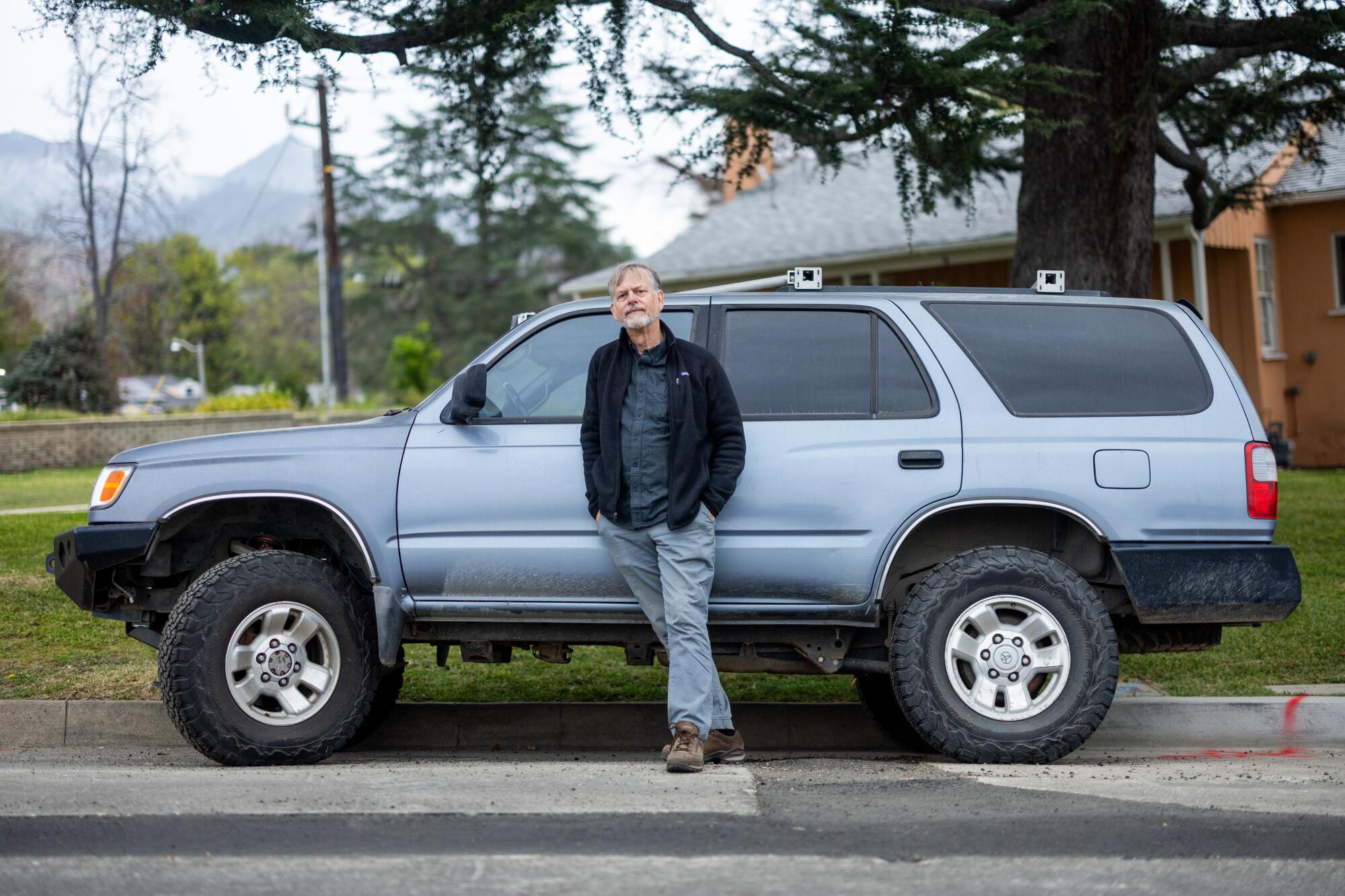
For a week, Steller, who lost his home in the fire, parked his Toyota 4Runner over a recently dug trench. He said he was trying to block Edison’s crew from burying a large transformer between two towering deodar cedar trees. The work would “be downright fatal” to the decades-old trees, he said.
Altadena resident Robert Steller stands in front of his Toyota 4Runner that he parked strategically to prevent a Southern California Edison crew from digging too close to two towering cedar trees.
(Ronaldo Bolaños / Los Angeles Times)
The buried lines are an upgrade that will make Altadena’s electrical grid safer and more reliable, Edison says, and it also will lower the risk that the company would have to black out Altadena neighborhoods during dangerous Santa Ana winds to prevent fires.
Brandon Tolentino, an Edison vice president, said the company was trying to find government or charity funding to help homeowners pay to connect to the buried lines. In the meantime, he said, Edison decided to allow owners of homes that survived the fire to keep their overhead connections until financial help was available.
Tolentino added that the company planned meetings to listen to residents’ concerns, including about the trees. He said crews were trained to stop work when they find tree roots and switch from using a backhoe to digging by hand to protect them.
“We’re minimizing the impact on the trees as we [put lines] underground or do any work in Altadena,” he said.
Although placing cables underground is a fire prevention measure, consumer advocates point out it’s not the most cost-effective step Edison can take to reduce the risk.
Undergrounding electric wires can cost more than $6 million per mile, according to the state Public Utilities Commission, far more than building overhead wires.
Because utility shareholders put up part of the money needed to pay for burying the lines, the expensive work means they will earn more profit. Last year, the commission agreed Edison investors could earn an annual return of 10.03% on that money.
Edison said in April it would spend as much as $925 million to underground and rebuild its grid in Altadena and Malibu, where the Palisades fire caused devastation. That amount of construction spending will earn Edison and its shareholders more than $70 million in profit before taxes — an amount billed to electric customers — in the first year, according to calculations by Mark Ellis, the former chief economist for Sempra, the parent company of Southern California Gas and San Diego Gas & Electric.
That annual return will continue over the decades while slowly decreasing each year as the assets are depreciated, Ellis said.
“They’re making a nice profit on this,” he said.
Tolentino said the company wasn’t doing the work to profit.
“The primary reason for undergrounding is the wildfire mitigation,” he said. “Our focus is supporting the community as they rebuild.”
It’s unclear if the Eaton fire would have been less disastrous if Altadena’s neighborhood power lines had been buried. The blaze ignited under Edison’s towering transmission lines that run down the mountainside in Eaton Canyon. Those lines carry bulk power through Edison’s territory. The power lines being put underground are the smaller distribution lines, which carry power to homes.
A power line outside the home of Altadena resident Connor Cipolla.
(Ronaldo Bolanos/Los Angeles Times)
The investigation into the fire’s cause has not yet been released. Edison says a leading theory is that one of the Eaton Canyon transmission lines, which hadn’t carried power for 50 years, might have briefly reenergized, sparking the blaze. The fire killed 19 people and destroyed more than 9,000 homes, businesses and other structures.
Edison said it has no plans to bury those transmission lines.
The high cost of undergrounding has become a contentious issue in Sacramento because, under state rules, most or all of it is billed to all customers of the utility.
Before the Eaton fire, Edison won praise from consumer advocates by installing insulated overhead wires that sharply cut the risk of the lines sparking a fire for a fraction of the cost. Since 2019, the company has installed more than 6,800 miles of the insulated wires.
“A dollar spent reconductoring with covered conductor provides … over four times as much value in wildfire risk mitigation as a dollar spent on underground conversion,” Edison said in testimony before the utilities commission in 2018.
By comparison, Pacific Gas & Electric has relied more on undergrounding its lines to reduce the risk of fire, pushing up customer utility bills. Now Edison has shifted to follow PG&E’s example.
Mark Toney, executive director of the the Utility Reform Network, a consumer group in San Francisco, said his staff estimates Edison spends $4 million per mile to underground wires compared with $800,000 per mile for installing insulated lines.
By burying more lines, customer bills and Edison’s profits could soar, Toney said.
“Five times the cost is equal to five times the profit,” he said.
Last spring, Pedro Pizarro, chief executive of Edison International, told Gov. Gavin Newsom about the company’s undergrounding plans in a letter. Pizarro wrote that rules at the utility commission would require Altadena and Malibu homeowners to pay to underground the electric wire from their property line to the panel on their house. He estimated it would cost $8,000 to $10,000 for each home.
Residents who need to dig long trenches may pay far more than that, said Cipolla, who is a member of the Altadena Town Council.
An oak tree stands tall in an area impacted by the Eaton fires. Homeowners worry such trees could be at risk in the undergrounding work.
(Ronaldo Bolanos/Los Angeles Times)
Last week, Cipolla showed a reporter the electrical panel on the back of his house, which is many yards away from where he needs to connect to Edison’s line. The company also initially wanted him to dig up the driveway he poured seven years ago, he said. Edison later agreed to a location that avoids the driveway.
Tolentino said Edison’s crews were working with homeowners concerned about the company’s planned locations for the buried lines.
“We understand it is a big cost and we’re looking at different sources to help them,” he said.
At the same time, some residents are fuming that, despite the undergrounding work, most of the town’s neighborhoods still will have overhead telecommunications lines. In other areas of the state, the telecommunications companies have worked with the electric utilities to bury all the lines, eliminating the visual clutter.
So far, the telecom companies have agreed to underground only a fraction of their lines in Altadena, Tolentino said.
Cipolla said Edison executives told him they eventually plan to chop off the top of new utility poles the company installed after the fire, leaving the lower portion that holds the telecom lines.
“There is no beautification aspect to it whatsoever,” Cipolla said.
As for the trees, Steller and other residents are asking Edison to adjust its construction map to avoid digging near those that remain after the fire. Altadena lost more than half of its tree cover in the blaze and as crews cleared lots of debris.
1
2
3
1.A pedestrian walks past Christmas Tree lane in Altadena. Christmas Tree Lane was officially listed in the National Register of Historic Places in 1990.2.A “We Love Altadena” sign hangs from a shrub on Christmas Tree Lane.3.Parts of a chopped down tree rest on a street curb in Altadena.
Wynne Wilson, a fire survivor and co-founder of Altadena Green, pointed out that the lot across the street from the giant cedar trees on Maiden Lane has no vegetation, making it a better place for Edison’s transformer.
“This is needless,” Wilson said. “People are dealing with so much. Is Edison thinking we won’t fight over this?”
Carolyn Hove, raising her voice to be heard over the crew operating a jackhammer in front of her home, asked: “How much more are we supposed to go through?”
Hove said she doesn’t blame the crews of subcontractors the utility hired, but Edison’s management.
“It’s bad enough our community was decimated by a fire Edison started,” she said. “We’re still very traumatized, and then to have this happen.”
Artist Ako Castuera is best known for her work on the award-winning animated series “Adventure Time.” As a writer and storyboard artist, she helped intrepid heroes Jake the Dog and Finn the Human become iconic toon characters.
Though she brought flying rainbow unicorns and a platoon of plotting penguins to life on screen, there’s more to Castuera’s resume than hyper-imaginative animation.
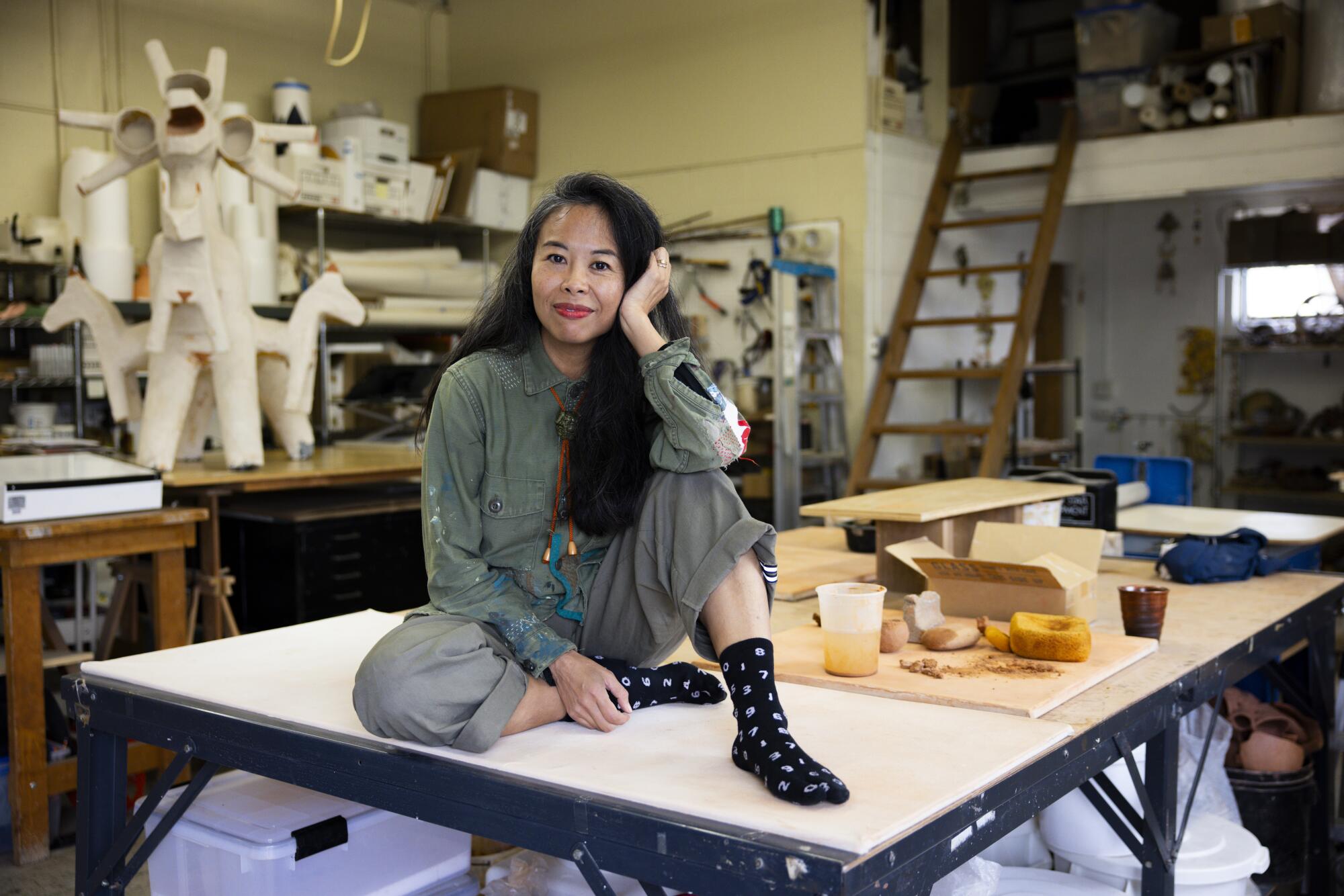
Ceramist, writer and storyboard artist Ako Castuera in her studio.
(Kayla Bartkowski / Los Angeles Times)
The Echo Park-based creative is also a professional ceramicist whose hand-built vessels and sculptures have been on display at the Japanese American National Museum of Art, Oxy Arts and the Oakland Museum of Art.
In this series, we highlight independent makers and artists, from glassblowers to fiber artists, who are creating original products in and around Los Angeles.
While Castuera’s studio is filled with its fair share of playful “Pee-wee’s Playhouse”-themed ceramic charms and anthropomorphic banana figurines, her craft is just as much devoted to highlighting Southern California’s natural resources and Indigenous people, as well as her own Mexican-Japanese heritage.
“‘Whimsy’ is a word that’s been applied to my work a lot. This is not my word,” she said during a recent tour of the Monrovia workspace she shares with her husband, artist Rob Sato, and fellow ceramicist Rosie Brand.
Ako Castuera’s work is anthropological and at times unusual, like her foot box sculptures. She also feels a special connection to her tools.(Kayla Bartkowski / Los Angeles Times)
“Not that whimsy is negative, but I do feel like it doesn’t really get a handle on the substance of what I feel I’m working with, as far as the depth of the clay, the depth of the experience, of the land.”
She sat perched on a stool at her workbench, using a smooth stone to grind soil clumps into fine dust as she talked. She collects the red earth during nature walks around the San Gabriel Mountains area — whether the riverbed of the Arroyo Seco, or the foothills of Claremont, her hometown.
“This is special dirt,” she explained.
To her, it has a presence, a life of its own and a cherished history. She uses it to make anything from trinket boxes to ornate geometric vases to statuettes of quizzical creatures.
Some of her most recent creations stand on a nearby wooden shelf. They’re ceramic depictions of Pacific tree frogs and great herons, both denizens of the L.A. River. The waterway has long been a source of inspiration for Castuera.
Ako Castuera’s work ranges from massive pieces to the miniature, like these figurines.
(Kayla Bartkowski / Los Angeles Times)
“I love the L.A. River,” she said. “It’s my neighbor. It’s my teacher. It’s a place where I walk and bike.”
She regards the river as a muse and wants to inspire Angelenos of all ages to appreciate it. To that end, she teaches youth workshops at the riverside arts hubs Clockshop and Sooki Studio. What’s more, the river was a “main character” on “City of Ghosts,” the L.A.-celebrating, Emmy-winning Netflix animated series she directed. She’s even been known to use some of its water to transform soil into moldable clay.
“The more people who are brought into a sense of kinship with the river, the better,” she said. “Because then, they really feel like ‘The river takes care of me; I want to take care of the river.’”
Castuera’s work has an anthropological bent, as well as an ecological one. For example, her research into Southern California’s Kumeyaay and Cahuilla Indigenous tribes inspired a series of large jars patterned after ollas, traditional pots used for water and seed storage. She plans to incorporate these jars into an immersive installation that will be on view at the Candlewood Arts Festival in Borrego Springs in March and April. And last fall, she hosted a community event with Los Angeles Nomadic Division in which she discussed how soil played a vital role in the societies of both the Gabrielino-Tongva tribes of L.A. and the Ryukyuan people of her mother’s native Okinawa.
Finding the sweet spot where cultures combine is a constant source of motivation for Castuera. She’s created her own twist on shisa, lion-dog statues that are common sights all around Okinawa. And she’s currently working on a collection of small sculptures honoring her patrilineal ties to Puebla, Mexico. Her “taco babies” were inspired by one of the region’s best-known dishes, tacos árabes, which combine flavors from Mexico and the Middle East.
“I was thinking about the beauty of being in a living mix and what that would look like personified,” she said of the wee figures wrapped in colorful tortilla-like blankets.
Ako Castuera makes ceramics for the love of the process, not the final product.
(Kayla Bartkowski / Los Angeles Times)
Some of Castuera’s work makes it into gallery shows and some she sells. But just as often, she smashes it and takes the soil back to where she originally found it. It’s a habit of creating and destroying that she formed as a student at Claremont High School, where she studied the craft for two semesters, yet fired zero pieces.
“I don’t think I could’ve articulated this at 15, but it’s about the process of building, not the process of creating a product. It’s about working with the material — just making the space and the time for that practice,” she said.
“The excitement and the magic is really about the discovery of the unexpected. It’s so engrossing and it really just gets me engaged with life.”
1.Yoshiki Ideguchi, who traveled from Tokyo, watches at Dodgers spring training at Camelback Ranch in Arizona Monday.(Ronaldo Bolanos/Los Angeles Times)2.Children lean against a fence and wait to greet players during Dodgers spring training at Camelback Ranch in Arizona on Monday.(Ronaldo Bolanos/Los Angeles Times)3.A fan holds a World Series bobblehead while waiting to greet players at Dodgers spring training at Camelback Ranch in Arizona on Monday.(Ronaldo Bolanos/Los Angeles Times)
Frederick Wiseman, a preeminent documentary filmmaker, has died. He was 96.
The filmmaker’s death was announced by his family Monday in a statement released by Zipporah Films, Wiseman’s distribution company.
In a career that lasted nearly 60 years, Wiseman produced and directed 45 films beginning in 1967 with “Titicut Follies,” a documentary on the the patient-inmates of Bridgewater State Hospital for the Criminally Insane in Massachusetts, through 2023’s “Menus-Plaisirs — Les Troisgros,” a documentary on the Troisgros family’s Michelin three-starred restaurant in Ouches, France. His final film earned universal critical acclaim, and was recognized as the best nonfiction film of 2023 by the New York Film Critics Circle, the Los Angeles Film Critics Assn. Awards and the National Society of Film Critics.
“Wiseman, whose observational approach has often been mischaracterized as objective or omniscient, here drops any pretense to neutrality, so potent and overpowering is his sense of kinship with a fellow artist,” wrote Justin Chang in his 2023 review. “The marriage of sensibilities in front of and behind the camera is the stealthiest meeting in ‘Menus-Plaisirs — Les Troisgros,’ and the most unexpectedly satisfying.”
A scene from Frederick Wiseman’s “Menus-Plaisirs – Les Troisgros.”
(PBS)
The filmmaker considered both Cambridge, Mass., and Paris his homes. His films, to an extent, reflected that transatlantic residency in their freshness of perspective. They display an innate curiosity and astonishing degrees of empathy, intelligence and perceptiveness, with subjects ranging from public and social institutions to cultural and specialized spaces and the minutiae of human interactions.
Wiseman’s other films included “High School” (1968), “Welfare” (1975), “Juvenile Court” (1973), “Public Housing” (1997), “La Danse” (2009), “National Gallery” (2014), “Ex Libris — The New York Public Library” (2017) and “City Hall” (2020). The varied body of work earned three Emmy Awards and an honorary Academy Award. Wiseman was also awarded Guggenheim and MacArthur Prize fellowships.
Beyond documentaries, the director also made three fiction films, “Seraphita’s Diary” (1982), “The Last Letter” (2002) and “A Couple” (2022). In reviewing the last, Chang wrote, “I suspect [Wiseman] is no more likely to impose himself on one of his fictions than he would on one of his documentaries, which ‘A Couple’ may resemble more than it appears. Wiseman has spent a career probing the complex inner workings and painfully human errors of America’s establishments, but in marriage itself, he may have found the most fraught, mysterious and unreformable institution of all.”
Nathalie Boutefeu in the movie “A Couple.”
(Film Forum)
Frederick Wiseman was born Jan. 1, 1930, in Boston. He graduated from Willams College and Yale Law School before embarking on a filmmaking career in the mid-1960s. He remained staunchly independent, establishing Zipporah Films, named for his wife, in 1971, in order to maintain control over distribution of his work.
In addition to his filmmaking career, Wiseman worked as a theater director and actor, including a recent appearance in Rebecca Zlotowski’s 2025 film “A Private Life,” starring Jodie Foster.
Wiseman’s wife of 65 years, Zipporah Batshaw Wiseman, died 2021. He is survived by his two sons, David (Jennifer) and Eric (Kristen Stowell), and three grandchildren, Benjamin, Charlie and Tess, as well as his friend and collaborator Karen Konicek, with whom he worked for 45 years.
I’m Glenn Whipp, columnist for the Los Angeles Times, host of The Envelope newsletter and the guy wondering about the profit margin on a $6 churro.
In the meantime, welcome back to the newsletter as we push through to the Oscars on March 15. Have you been catching up on the nominated movies? “Sentimental Value” is a delight … though just how delightful has been the subject of some debate.
Sign up for The Envelope
Get exclusive awards season news, in-depth interviews and columnist Glenn Whipp’s must-read analysis straight to your inbox.
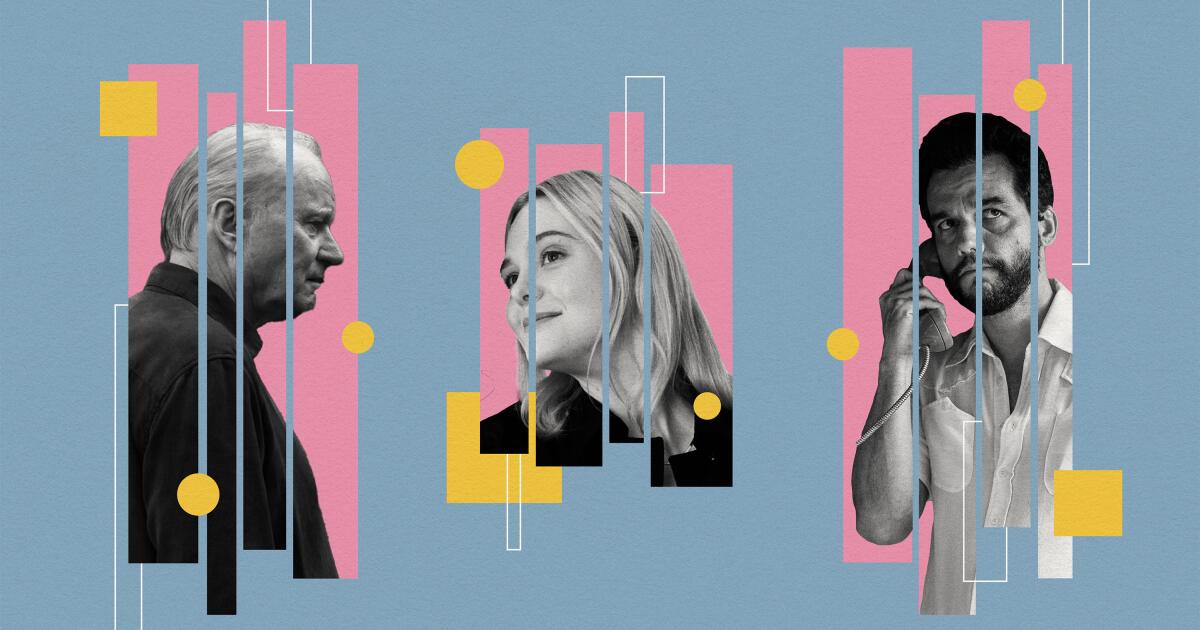
Its primary quartet of actors — Stellan Skarsgård as a legendary director angling for a comeback, Renate Reinsve and Inga Ibsdotter Lilleaas as his daughters and Elle Fanning as an A-list actor who becomes entangled in the family drama — all received nods. Fanning’s name was the first called when nominations were announced, signaling that Scandinavian melancholy would be notably absent that morning. Never mind the hour: Champagne glasses were raised.
The celebratory scene stood in stark contrast to the vibe just two weeks earlier when “Sentimental Value” was blanked at the Actor Awards (formerly known as the Screen Actors Guild Awards). And it wasn’t the only international film ignored. The 2,500 SAG-AFTRA nomination committee voters also shunned Wagner Moura, the lead of celebrated Brazilian drama “The Secret Agent.” Moura went on to nab an Oscar nomination, one of four noms, including best picture, that Kleber Mendonça Filho’s drama earned.
The disparity between the choices of the motion picture academy and SAG-AFTRA could be an anomaly. Or it might be the latest evidence of an Oscar trend this decade. As the academy’s membership has become more global — 24% of Oscar voters live outside the United States — the Academy Awards have become increasingly an international affair, leading to a widening divide with the Hollywood guilds.
Is this a bad thing? It depends who you ask. If you queried the actors that SAG-AFTRA nominated who ended up being Oscar also-rans, the answer would be no. Those who believe that cinema is global, particularly now that American studios have largely abandoned making movies geared toward grown-ups, would have a different response.
“The fact that not one international film got in says a lot,” says a veteran awards consultant, who, like others interviewed, requested anonymity in order to speak freely about the industry. Indeed, one journalist tabbed SAG’s Actor Awards nominations the “‘America First’ List,” which, while technically accurate, might have taken the perceived xenophobia a bit far.
“The SAG Awards or Actor Awards — whatever they’re called now — are in danger of looking like a middlebrow affair,” another awards campaigner notes. “I know this is going to sound elitist, but it’s true. There’s a big difference between an organization where you have to be invited or apply to join versus one where, if you’re a disc jockey in Kansas City, you have voting rights.”
To be fair, DJs, Kansas City-based or otherwise, probably don’t vote for the Actor Awards’ nominations — just for the final awards. In the nominations round, 2,500 randomly selected active SAG-AFTRA members make the choices. To serve on the committee, members must be categorized as an actor/performer, dancer, singer or stuntperson in the SAG-AFTRA database. Could a DJ be classified as a performer? Probably not. In the guild’s view, actor and performer are synonymous, encompassing both principal and background players.
And sure, since only 7% of SAG-AFTRA actors and performers earn $80,000 or more a year, that means there are going to be a few full-time waiters on those nomination committees. But as the speeches at the Actor Awards remind us annually, it’s a profession where you’re just one job away from making it. Think of Connor Storrie, who worked at restaurants for eight years before getting his break on “Heated Rivalry.”
There’s still the question of why, say, SAG-AFTRA dancers and singers are voting on the merits of an acting performance, however. In contrast to the Actor Awards, nominations for the Oscars are decided by the academy’s various branches. Actors vote for actors, writers for screenplays and so on, with the general membership voting for best picture.
“Peer groups are deciding what’s worthy, and that’s the way it should be,” says an academy member from the public relations branch. “I’m not voting for visual effects.”
Not initially, at least. Academy members vote for all 24 categories in the final round, provided, per a rule change that went into effect this year, they attest to watching all the nominated work in the category.
SAG-AFTRA voters have rewarded non-English-language work over the years, but usually when a particular film or TV show — Bong Joon Ho’s 2019 masterpiece “Parasite” or Netflix’s “Squid Game” — is undeniable. Voters ignored recent lead turns from Fernanda Torres (“I’m Still Here”), Yalitza Aparicio (“Roma”) and Sandra Hüller (“Anatomy of a Fall”). All three went on to earn lead actress Oscar nominations.
This year’s snubbing of “Sentimental Value” is particularly puzzling as the movie featured well-known actors like Fanning and Skarsgård, an institution from roles in blockbuster franchises like “Pirates of the Caribbean” and most recently the TV series “Andor.” It’s also a film about, among other things, the blurring of art and reality and the challenges of acting. And, in the scenes featuring Fanning, it’s in English.
What gives? Like every other contender, “Sentimental Value” screened four times for voters and was available for streaming.
“I just think people are less inclined to watch a movie with subtitles at home,” says one awards consultant, alluding to the ways that passive, multiscreen viewing has encroached upon our multitasking lives. Maybe that’s why Skarsgård, when he accepted the Golden Globe award for his work in the movie, preached that “cinema should be seen in cinemas” in his speech.
Does that sound elitist? It shouldn’t. But it does seem to be a belief from a time that’s slipping away. One certainty: With the academy nominating two international features for best picture for the third straight year, global cinema is now entrenched at the Oscars. Whether SAG-AFTRA voters decide to join the party is now a question for next year.
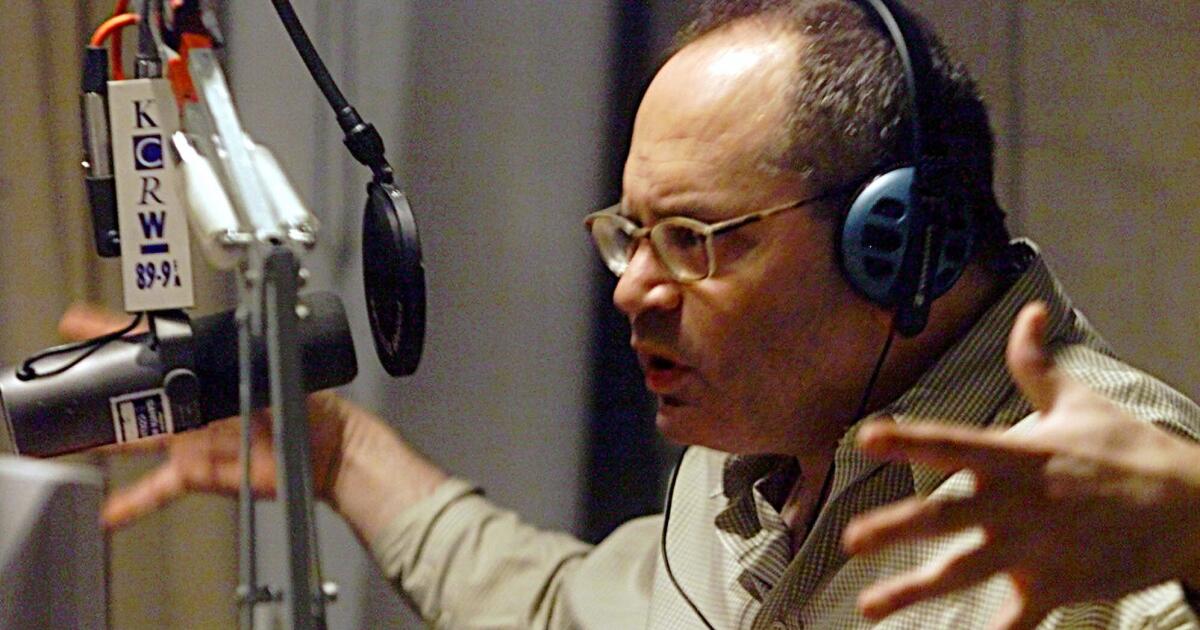
Michael Silverblatt, the longtime host of the KCRW radio show “Bookworm” — known for interviews of authors so in depth that they sometimes left his subjects astounded at his breadth of knowledge of their work — has died. He was 73.
Silverblatt died Saturday at home after a protracted illness, a close friend confirmed.
Although Silverblatt’s 30-minute show, which ran from 1989 to 2022 and was nationally syndicated, included interviews with celebrated authors including Gore Vidal, Kazuo Ishiguro, David Foster Wallace, Susan Orlean, Joan Didion and Zadie Smith, the real star of the show was the host himself, the nasal-voiced radio personality who more than once in life was told he did not have a voice for his medium.
His show represents one of the most significant archives of conversations with major literary powerhouses from the late 20th and early 21st centuries.
But Silverblatt knew that he was as much a character as the people he interviewed.
“I’m as fantastical a creature as anything in Oz or in Wonderland,” he said during a talk in front of the Cornell University English department in 2010. “I like it if people can say, ‘I never met anyone like him,’ and by that they should mean that it wasn’t an unpleasant experience.”
Born in 1952, the Brooklyn native learned to love reading as a child when he was introduced to “Alice’s Adventures in Wonderland.” Neighbors would see him walking the streets of Brooklyn with his head in a book and would sometimes call his parents out of fear he might get hurt.
But until he left home for the University at Buffalo, State University of New York, at the age of 16, Silverblatt has said, he had never met an author.
His college, however, was filled with such famous authors as Michel Foucault, John Barth, Donald Barthelme and J.M. Coetzee, who were all working as professors.
Silverblatt was shy and too embarrassed to speak during class because of his inability to clearly pronounce the letter “L,” which appears three times in his own name. Yet he considered the authors to be his friends, even if they did not know it yet, he said during the Cornell talk.
He would approach them after class to speak about their work.
Despite his interest in literature, Silverblatt’s parents wanted him to become a mail carrier, he said. The summer after his freshman year, Silverblatt worked a New York City mail route, delivering letters to the mayor’s mansion on an Upper East Side route that took him past numerous old bookstores and used-books shops. During that job, he said in the Cornell talk, he purchased the complete works of Charles Dickens.
Silverblatt moved to Los Angeles after college in the mid-1970s and worked in Hollywood in public relations and script development.
Like many young writers in Los Angeles, he wrote a script that never got made.
It was in Los Angeles that Silverblatt met Ruth Seymour, the longtime head of KCRW.
Seymour had just returned to the United States from Russia and was at a dinner party where everyone was discussing Hollywood. There, she and Silverblatt became immersed in a one-on-one discussion of Russian poetry.
“He’s a great raconteur and so the rest of the world just vanished,” Seymour told Times columnist Lynell George in 1997. “Afterward I just turned and asked him: ‘Have you ever thought about doing radio?’”
For the next 33 years, that’s exactly what he thought about.
“Michael was a genius. He could be mesmerizing and always, always, always brilliant,” said Alan Howard, who edited “Bookworm” for 31 years.
“It’s an extraordinary archive that exists, and I don’t think anyone else has ever created such an archive of intelligent, interesting people being asked about their work,” Howard said. “Michael was very proud of the show. He devoted his life to the show.”
Silverblatt once dreamed of being on the other side of the microphone, as a writer in his own right, Howard said. But he faced bouts of writer’s block through his 20s and gave up writing.
“Eventually, he came to find peace with the reality of that,” Howard said.
Instead of writing, he became an accumulator of a vast amount of other writers’ work — in his library as well as the repository in his head. He had an incredible memory for the books he read.
Silverblatt converted the apartment next to his Fairfax apartment into a library where he kept thousands of books, Howard said.
“It was heaven,” he said. “It was a fabulous library.”
“He was such a singular person,” said Jennifer Ferro, now the president of KCRW. “He had a voice you would never expect would be on radio.”
Alan Felsenthal, a poet who considered Silverblatt a mentor, called Silverblatt’s voice “sensitive and tender.”
Felsenthal said the show was about creating a space of “infinite compassion,” where writers could share things they might not share in everyday conversation.
“Michael was one of a kind, truly singular. And his voice is too,” Felsenthal said.
One of the most important tenets of Silverblatt’s approach was that he not only read the book he was discussing on his show that day, but also read the entire oeuvre of the authors he interviewed.
“A significant writer would come in and be bowled over by Michael’s depth of vision of the work at hand,” Howard said.
David Foster Wallace, in one interview, said he wanted Silverblatt to adopt him.
Silverblatt said he strove to read an author’s entire body of work, but he never claimed to have read it all if he hadn’t.
“In general I try to read the author’s complete work. … That’s not always true, and I never say it if it isn’t true. But more often than not, I have, at least, read the majority of the work. And sometimes it’s a superhuman challenge,” he said in the 1997 Times column.
The voracious reader said that the best books, those that brought him happiness, were not the ones that ease our way in this strange and difficult world.
“The books I love the most made it harder for me to live,” he said.
Silverblatt is survived by his sister, Joan Bykofsky.
“In the interest of the country, we must remain united.” Bangladeshi Prime Minister-in-waiting Tarique Rahman urged opposition parties to work with the incoming BNP government after its landslide victory in the first elections since Sheikh Hasina’s ouster.
Doctors Without Borders, known by its French initials MSF, has suspended some operations at a Nasser Hospital in Gaza after its staff and patients saw “armed men, some masked” posing “serious security threats” inside the building.
The Geneva-based medical charity reported on its website that non-essential work at the hospital in Khan Younis was halted on January 20 due to concerns with the “management of the structure, the safeguarding of its neutrality, and security breaches”.
Recommended Stories
list of 4 itemsend of list
“MSF teams have reported a pattern of unacceptable acts, including the presence of armed men, intimidation, arbitrary arrests of patients, and a recent situation of suspicion of movement of weapons”, said the site’s “frequently asked questions” section, last updated on February 11.
“Hospitals must remain neutral, civilian spaces, free from military presence or activity to ensure the safe and impartial delivery of medical care”, it said, adding that the charity expressed concern to the “relevant” authorities.
Under the suspension, MSF will continue supporting critical services, such as inpatient and surgical departments, but will end support to the paediatrics and maternity wards, including the neonatal intensive care unit, and will no longer offer a range of outpatient consultations and other services.
The organisation was not able to indicate the armed men’s affiliation, but said its concerns were heightened by previous, deliberate Israeli attacks on health facilities.
Israel has decimated the enclave’s health infrastructure and continues to hold captive 95 Palestinian doctors and medical workers, including 80 from Gaza.
Zaher al-Waheidi, the head of the records department at Gaza’s Ministry of Health, said that MSF’s suspension will have a significant impact as hundreds of patients are admitted to the maternity and burn wards daily. He said the ministry would take over maternity patient care.
Gaza’s Ministry of Interior said in a statement that it is committed to preventing any armed presence inside hospitals, and that legal action will be taken against violators. It suggested that armed members of certain families recently entered hospitals, but did not identify those involved.
Israeli ban on aid organisations
MSF’s announcement comes after Israel recently ordered the charity and dozens of other international organisations to stop their work in Gaza and the Israeli-occupied West Bank if they did not meet new rules, including sharing details about their staff.
Two weeks ago, MSF – which provides international staff for six hospitals, and operates two field hospitals and eight primary health centres, clinics and medical points – said it would not submit a staff list to Israel after failing to receive assurances for their safety.
Israel has repeatedly attacked hospitals and healthcare workers throughout its genocidal war on Gaza.
In other developments on Saturday, Israel’s military said its troops “eliminated” a person in northern Gaza, alleging that the unidentified individual crossed the “yellow line“. The demarcation divides Gaza into an eastern area under Israeli military control and a western area where Palestinians face fewer movement restrictions but are under constant threat of air strikes and forced displacement.
Palestinian President Mahmoud Abbas slammed Israel for violating the US-brokered “ceasefire”, during which Israel has killed nearly 600 Palestinians since October 10.
In a speech by Prime Minister Mohammed Mustafa at an African Union summit in Ethiopia, he called on Israel to remove all “obstacles” to implementing phase two of the “truce” deal, including the work of a technocratic committee that will oversee the daily governance of Gaza.
More than 72,000 Palestinians have been killed and 171,000 wounded in attacks in Israel’s genocidal war on Gaza since October 2023.
Akshay Bhatia shot an eight-under-par 64 to share the second-round lead with Ryo Hisatsune at 15 under at the AT&T Pebble Beach Pro-Am.
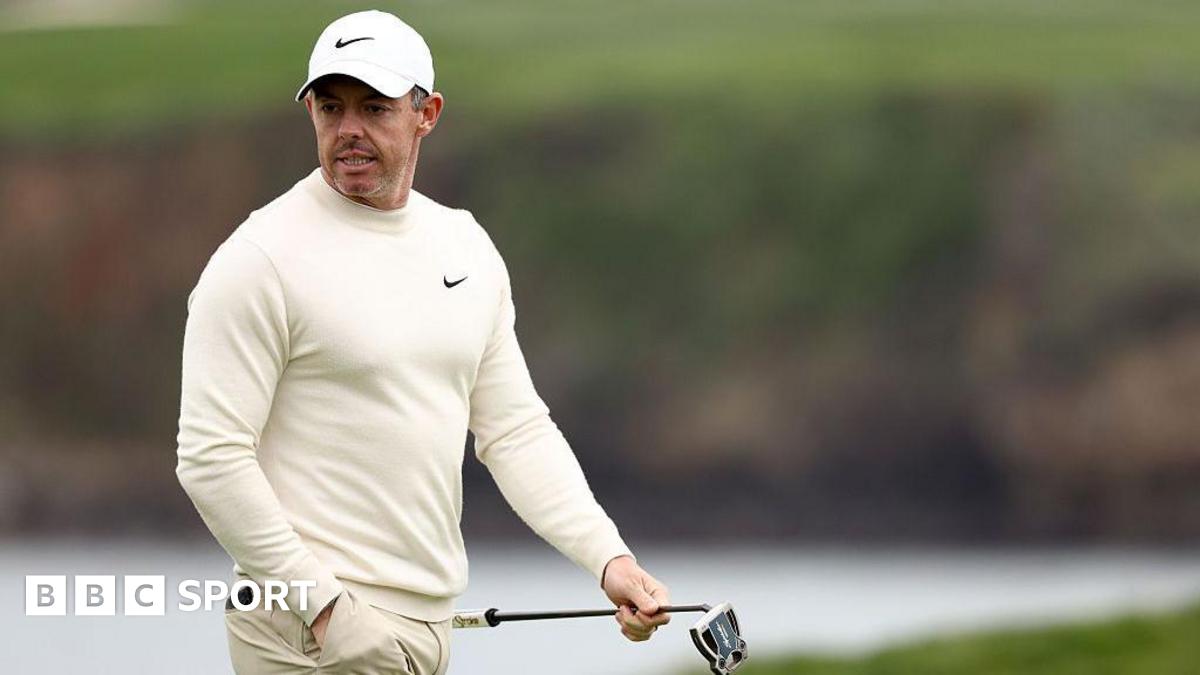
Defending champion Rory McIlroy birdied the final hole to sign for a 67 but sits six strokes off the pace heading into the weekend.
The Northern Irishman made five birdies and an eagle but was left to rue bogeys on the 10th and 14th, although his four on the par-five 18th proved a more than satisfactory conclusion to the five-time major winner’s day.
American Bhatia had earlier produced one of the rounds of the day at Spyglass Hill, while Hisatsune recovered from dropping shots either side of the turn to pick up four shots in his final five holes.
Rickie Fowler was equally as impressive as he moved into a tie for second alongside Sam Burns, at 14 under as he chases his first win since July 2023.
Austria Sepp Straka is currently the best placed European player at 12 under, with England’s Matt Fitzpatrick two shots further back along with the likes of Keegan Bradley, Jordan Spieth and Xander Schauffele.
Englishman Tommy Fleetwood followed his 67 on Thursday with a 68 to sit at nine under with McIlroy, with Ireland’s Shane Lowry one shot further back.
A charging Scottie Scheffler brought himself back into picture with three birdies and an eagle on a five-hole stretch after the turn to reach the clubhouse at six under across the first two days.
England’s Justin Rose and Harry Hall are at five under with Scotland’s Robert MacIntyre, with each player in the field having played one round at Pebble Beach and Spyglass Hill.
All the third and fourth-round action will take place solely at Pebble Beach, with there also being no 36-hole cut at the $20m (£14.7m) PGA Tour signature event.
When the Justice Department released an additional 3 million pages of documents related to convicted sex trafficker Jeffrey Epstein at the end of January, ARTnews unearthed and published excerpts from dozens of emails between Epstein and David A. Ross, a former director of the Whitney Museum of American Art who started his career in the 1970s as deputy director and curator of video art at the Long Beach Museum of Art.
Ross, who served as the chair of the MFA art practice program at New York’s School of Visual Arts since 2009, promptly resigned.
If the emails had been less damning, the revelation of Ross’ connection to Epstein might have played out differently, but that was not the case. In one letter, dated Oct. 1, 2009, Epstein wrote to Ross that Roman Polanski’s attorney was coming to see him and that he was considering funding an exhibit titled, “Statutory.”
“Girls and boys ages 14 – 25, where they look nothing like their true ages,” Epstein wrote. “Juvenile mug shots, photo shop, make up. Some people go to prison because they can’t tell true age. Controversial. Fun. Maybe it should be a web page with hits, tallied.”
“You are incredible,” Ross wrote back. “This would be a very [sic] owerful and freaky book. Do you know that total porno commercial kiddie picture of Brooke Sheilds that Richard Prince appropriated for an exhibition in the early 1980’s?”
Epstein replied in the affirmative to Ross’ reference to a Prince photo titled, “Spiritual America,” which appropriated a 1976 photo of a naked, 10-year-old Shields taken by commercial photographer Gary Gross.
“They closed it off in the London show,” Epstein noted.
Ross also expressed sympathy for Epstein’s legal travails in 2009 following a 13-month sentence he served in Florida after pleading guilty to reduced state charges of procuring a minor for prostitution.
“Glad the nightmare is over, Jeffrey,” Ross wrote. “It was an undeserved punishment foisted upon you by jealous creeps.”
In an email to ARTnews, Ross expressed remorse that he “fell for” Epstein’s lies.
“Like many he supported with arts and education patronage, I profoundly regret that I was taken in by his story,” Ross wrote. “I continue to be appalled by his crimes and remain deeply concerned for its many victims.”
Ross noted that he first met Epstein when he was director of the Whitney in the mid-1990s. Ross also served as director of the San Francisco Museum of Modern Art and the Institute of Contemporary Art in Boston.
“I knew him as a wealthy patron and a collector, and it was part of my job to befriend people who had the capacity and interest in supporting the museum,” Ross wrote, adding that when Epstein was jailed in 2008, he told Ross that it was a political “frame-up” resulting from his support for former President Bill Clinton. Ross said he believed him.
It seems lots of men believed Epstein. Meanwhile, behind all the power lunches, private plane rides and callous late-night emails, far too many women and girls suffered.
I’m Arts editor Jessica Gelt with your arts and culture news for the week.
You’re reading Essential Arts
On our radar
Michael Feinstein and the Carnegie Hall Ensemble will perform Valentine’s Day at Segerstrom Hall in Costa Mesa.
(Segerstrom Center for the Arts)
Michael Feinstein: A Broadway Valentine The singer, musician, conductor and stalwart proponent of the Great American Songbook celebrates the holiday of the heart with the Carnegie Hall Ensemble. Timeless love songs and lush orchestrations seem like a perfect way to spend the evening. 7:30 p.m. Saturday, Segerstrom Center for the Arts, Segerstrom Hall, 300 Town Center Drive, Costa Mesa. scfta.org
A detail of miniature “sportraits” from Lyndon J. Barrois, Sr.’s exhibit, “Fútbol Is Life,” at LACMA.
(Allen J. Schaben / Los Angeles Times)
Fútbol Is Life: Animated Sportraits GOOOOOOOOAAAAAAAL! Ahead of this summer’s World Cup, with L.A. as one of 16 host cities across the U.S., Canada and Mexico, arrives this unique exhibition celebrating the beautiful game. Portraying transcendent moments in men’s and women’s soccer, award‑winning animator and visual effects artist Lyndon J. Barrois, Sr. fashions engrossing scenes in miniature from gum wrappers, glue, paint and other materials. The handmade sculptures and stop-motion animations on display bring together the visual and emotional elements that make it the world’s most popular sport. Jasmine Mendez spoke to Barrois about his process and Times photographer Allen J. Schaben provides more marvelous images. Sunday through July 12. LACMA Resnick Pavilion, 5905 Wilshire Blvd. lacma.org
The Academy Museum’s exhibition “Studio Ghibli’s Ponyo” opens Saturday.
(Nibariki-GNDHDDT)
Studio Ghibli’s Ponyo A deep dive into Hayao Miyazaki’s 2008 animated film about a goldfish who longs to be human honors the traditional hand-drawn animation processes used by its creators. The exhibition includes more than a hundred items handpicked by Studio Ghibli: art boards, posters, a Studio Ghibli animation desk and original hand drawings by Miyazaki and others. “Because writer-director Miyazaki very much follows his own star when it comes to story, narratives like ‘Ponyo’ remind you of no one else’s tales,” wrote Times film critic Kenneth Turan upon the film’s U.S. release. “Not only do they offer up fantastical images, like Ponyo running on the crests of waves, they make deep connections to our emotions without following conventional paths, using the logic of dreams to excellent effect.” Screening 2:30 p.m. Saturday; exhibition, Saturday through Jan. 10. Academy Museum, 6067 Wilshire Blvd. academymuseum.org
The week ahead: A curated calendar
FRIDAY Nitrate Festival The American Cinematheque’s annual tribute to the beautiful, if highly volatile, film format that was used from the 1890s until the 1950s, offers audiences the rare opportunity to see this work on the big screen. The festival opens with the 1947 noir “Dead Reckoning,” starring Humphrey Bogart and directed by John Cromwell, and continues with William Wyler’s “The Good Fairy” (1935), Gregory La Cava’s “My Man Godfrey” (1936), William Wellman’s “Nothing Sacred” (1937), Mikio Naruse’s “Wife! Be Like A Rose!” (1935), David Lean’s “Blithe Spirit” (1945) and Cecil B. DeMille’s “Samson and Delilah” (1949). 7 p.m. Friday, through Feb. 22. Egyptian Theatre, 6712 Hollywood Blvd. americancinematheque.com
Foursome Matthew Scott Montgomery, Adrián Javier, Jimin Moon and Calvin Seabrooks star in Montgomery’s comedy about a quartet of queer friends who reunite for an emotionally fraught, desire-filled weekend at a cabin. Directed by Tom DeTrinis. Through March 23. Atwater Village Theatre, 3269 Casitas Ave. iamatheatre.com
Guards at the Taj Two sentries at the Taj Mahal have their friendship, faith and sense of duty challenged in Rajiv Joseph’s play set centuries in the past with contemporary resonance. Behzad Dabu and Kausar Mohammed star. Directed by Behzad Dabu. 8 p.m. Friday and Saturday; 2 and 7 p.m. Sundays, through Feb. 22 El Portal Theatre, 5269 Lankershim Blvd., North Hollywood elportaltheatre.com
Alfredo Rodriguez, left, and Pedrito Martinez will perform Friday at the Nimoy.
(Anna Webber)
Alfredo Rodriguez and Pedrito Martinez Pianist Rodriguez and percussionist-vocalist Martinez perform traditional Cuban songs, original compositions and some surprises. 8 p.m. UCLA Nimoy Theater, 1262 Westwood Blvd. cap.ucla.edu
Incitation To The Dance A young man upends an older gay couple’s relationship in the world premiere of writer-director Michael Van Duzer’s dark comedy. Through March 15. Theatre West, 3333 Cahuenga Blvd. https://theatrewest.org/on-stage/incitation-to-the-dance
Roksana Pirouzmand The Iranian-born, L.A.-based multidisciplinary artist’s solo exhibition “everything was once something else” explores the contrasting properties forged by earth and fire through clay and metal works. Through April 11. Oxy Arts, 4757 York Blvd. oxyarts.oxy.edu
SATURDAY Attune 1.0 A free public light- and sound-art experience happens simultaneously across L.A. County locations presented by NXT Art Foundations with community support. 4:30-7:30 p.m. Barnsdall Park, East Hollywood; Sycamore Grove Park, Northeast Los Angeles ; Jessie Brewer Jr. Park, Exposition Park; Jane and Bert Boeckmann Park, Porter Ranch; Hansen Dam, Lake View Terrace; Leimert Park, South Los Angeles; Wende Museum, Culver City; Promenade Square Park, Long Beach; Tongva Park, Santa Monica and Loma Alta Park, Altadena. nowartpublic.com
Desert Dreams and Coastal Currents The exhibition tracks the concurrent emergent of artistic hubs in Southern California and the Southwest, featuring work by artists in areas such as Laguna Beach, and Taos and Santa Fe, N.M. The Autry, 4700 Western Heritage Way, Griffith Park. theautry.org
Wally Hedrick “Sex Politics Religion” is a two-venue retrospective of the Pasadena-born artist, who established himself in the burgeoning post-war San Francisco art scene. Hedrick eschewed “style” in favor of pursuing a vision including welded assemblage junk sculptures, Bauhausian abstraction, black monochromes, gestural figuration, graphic signage, pictographic diagrams and near-photorealism. Through April 4. Parker Gallery, 6700 Melrose Ave.; The Box 805 Traction Ave., downtown L.A. parkergallery.com
Honour The Ruskin’s grand opening on the Kaplan Stage features Joanna Murray-Smith’s drama on the precariousness of marriage, directed by Max Mayer and starring Marcia Cross, Matt Letscher, Ariana Afradi and Jude Mayer. 8 p.m. Thursdays-Saturdays; 2 p.m. Sundays, through March 22. Ruskin Group Theatre, 2800 Airport Ave., Santa Monica.
Artist Takashi Murakami.
(Shin Suzuki)
Takashi Murakami The new solo exhibition “Hark Back to Ukiyo-e: Tracing Superflat to Japonisme’s Genesis” features 24 paintings by the Japanese artist. 4-7 p.m. opening, free and open to the public; exhibition continues through March 14. Perrotin, 5036. W Pico Blvd. perrotin.com
Mythical Creatures: The Stories We Carry Immigrant narratives and pan-Asian mythology infuse this immersive exhibition featuring contemporary artists including Dinh Q. Lê, Dominique Fung, Lily Honglei, Greg Ito, Wendy Park, Momoko Schafer, Kyungmi Shin, Sanjay Vora and Lauren YS. Conceived by L.A.-based Korean American artist and muralist Dave Young Kim. Through Sept. 6. USC Pacific Asia Museum, 46 N. Los Robles Ave. Pasadena. pacificasiamuseum.usc.edu
PASSION + MYSTERY Los Angeles Chamber Orchestra, led by conductor Jaime Martín, celebrate Valentine’s Day weekend with Fauré’s “Pelléas et Mélisande” and Gernot Wolfgang‘s “Desert Wind,” and are joined by pianist Fazıl Say for Beethoven’s “Piano Concerto No. 3.” 7:30 p.m. Saturday. Colburn School, Zipper Hall, 200 S. Grand Ave., downtown L.A.; 4 p.m. Sunday, The Wallis, 9390 N. Santa Monica Blvd., Beverly Hills. laco.org
Red Harlem Four Black actors in 1932 Harlem are recruited by the Communist Party to make a film in the Soviet Union in Kimba Henderson’s drama based on true events. Directed by Bernadette Speakes. Through March 15. Company of Angels, 1350 San Pablo St. companyofangels.org
Retro Romantics: An Academy Film Archive Trailer Show in 35mm Vintage cinematic love stories unspool in their original abridged glory, seductively beckoning you to the movies. 7:30 p.m. Academy Museum, 6067 Wilshire Blvd. academymuseum.org
SUNDAY Black History Month at The Ebell Soprano Gertrude Bradley performs a tribute to Joel Graham, accompanied by pianist Greg Schreiner in an African Americans for LA Opera recital; and Inner City Youth Orchestra of Los Angeles (ICYOLA) salutes the 250th anniversary of the Declaration of Independence in “I, Too, Sing America,” a nod to the Langston Hughes poem. AALAO Recital, 12:30 p.m. Sunday; LA Voices: ICYOLA, 4:30 p.m. Sunday. Ebell of Los Angeles, 743 S. Lucerne Blvd. https://www.ebellofla.org/
Isidore String Quartet The group performs “Brahms: the Admirer,” an exploration of the composer’s work alongside complementary pieces by Bach and Beethoven. 3:30 p.m. Caltech Beckman Auditorium, 332 S. Michigan Ave. Pasadena. colemanchambermusic.org
What Happened to Flamenco Clap your hands as dancer and choreographer Fanny Ara brings the folkloric tradition to life. 7 p.m. Fountain Theatre, 5060 Fountain Ave. fountaintheatre.com
TUESDAY Seth MacFarlane The erstwhile animator, writer, producer, director, actor and comedian picks up the mic, backed by an orchestra, for a program dedicated to the music of Frank Sinatra. 8 p.m. Walt Disney Concert Hall, 111 S. Grand Ave., downtown L.A. laphil.com/events
WEDNESDAY I Love You, You’re Perfect, Now Change Barry Pearl directs the long-running off-Broadway musical comedy revue on modern love, featuring book and lyrics by Joe DiPietro and music by Jimmy Roberts to open ICT’s 41st season. Through March 8. International City Theatre, 330 E. Seaside Way, Long Beach. ictlongbeach.org
Patti LuPone The Broadway star marks the 25th anniversary of her “Matters of the Heart,” which ran on Broadway and London’s West End and toured the globe. 8 p.m. Segerstrom Center for the Arts, Segerstrom Hall, 300 Town Center Drive, Costa Mesa. scfta.org
Preservation Hall Jazz Band Can’t get to New Orleans for Mardi Gras? The Soraya brings it to the Valley via the deep roots of this legendary French Quarter ensemble. 8 p.m. The Saroya, 18111 Nordhoff Street, Northridge. thesoraya.org
Emma Elizabeth Smith as Catherine of Aragon in The North American touring company of “Six.”
(Segerstrom Center for the Arts)
Six The national tour of the Broadway musical by Toby Marlow and Lucy Moss, a modern pop take on the sextet of women who were the wives of Henry VIII. Through March 9. Hollywood Pantages Theatre, 6233 Hollywood Blvd.; March 10-15. Segerstrom Center for the Arts, 300 Town Center Dr., Costa Mesa. sixonbroadway.com
THURSDAY Compagnie Hervé Koubi: Sol Invictus The French-Algerian choreographer’s dance troupe performs “Sol Invictus,” with a score featuring music by Swedish composer Mikael Karlsson, minimalist composer Steve Reich and digital composer Maxime Bodson. 7:30 p.m. Friday and Saturday; 2 p.m. Sunday. February 19 – 21, 2026 The Wallis, 9390 N. Santa Monica Blvd. Beverly Hills. thewallis.org
Culture news and the SoCal scene
The cast of “Brassroots District” performs on Sunday.
(Gabriella Angotti-Jones/For The Times)
Features columnist Todd Martens checked out “Brassroots District: LA ’74,” a piece of immersive theater he describes as “part concert, part participatory theater and part experiment, attempting to intermix an evening of dancing and jubilation with high-stakes drama. How it plays out is up to each audience member. Follow the cast, and uncover war tales and visions of how the underground music scene became a refuge for the LGBTQ+ community. Watch the band, and witness a concert almost torn apart as a group on the verge of releasing its debut album weighs community versus cold commerce. Or ignore it all to play dress-up and get a groove on to the music that never stops.”
Enjoying this newsletter? Consider subscribing to the Los Angeles Times
The UCLA Hammer Museum has announced the winner of the $100,000 Mohn Award.
(Eric Staudenmaier)
Artist Ali Eyal, who grew up in Baghdad in the late 1990s and early 2000s during U.S. military operations in Iraq, is the recipient of the $100,000 Mohn Award, which honors artistic excellence, in conjunction with the Hammer Museum’s Made in L.A. 2025. In addition to the award money, the Hammer will produce a publication for Eyal. The Hammer also announced that sculptor Carl Cheng has been given the $25,000 Career Achievement Award; and that painter Greg Breda won the $25,000 Public Recognition Award.
The news out of the Kennedy Center continues to be grim. This week, Trump-appointed center president Richard Grenell sent an email to staffers informing them that significant cuts would be implemented when the center closes for renovations, beginning July 4. “Over the next few months, department heads and I will be evaluating the needs and making the decisions as to what these skeletal teams left in place during the facility closure and construction phase will look like,” Grenell wrote in the email obtained by The Times.
I’m Glenn Whipp, columnist for the Los Angeles Times, host of The Envelope newsletter and the guy answering all of the above to this newsletter’s initial question.
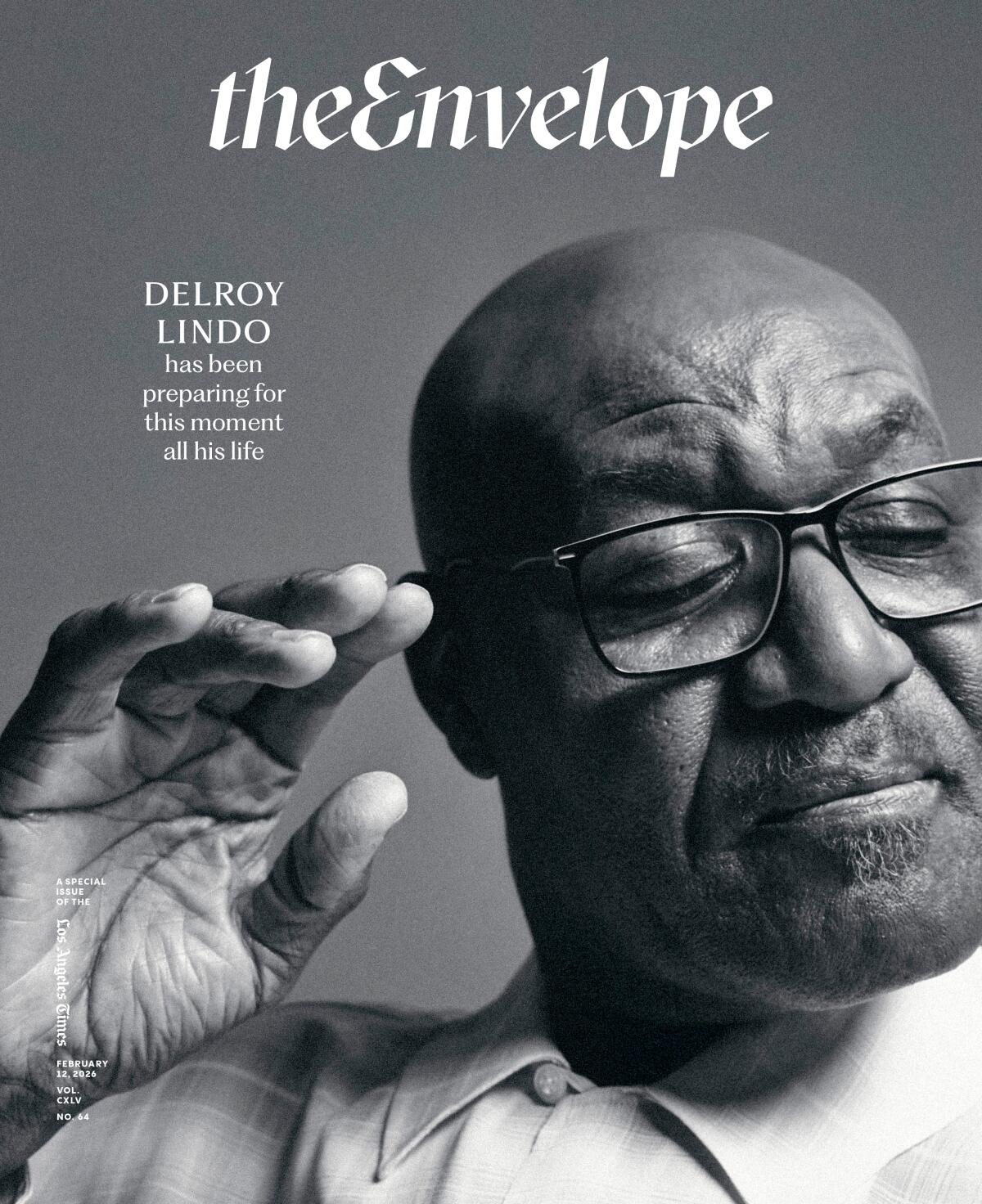
Everyone loves a surprise or two on Oscar nominations morning, and this year gave us the gift of Delroy Lindo, 73, finally earning his first Oscar nomination for his standout performance as bluesman Delta Slim in “Sinners.”
Some people are still smiling about the news. Lindo certainly is.
Lindo and I talked about the lessons he has learned as an actor over the course of a career that has spanned a half-century. He recalled the self-doubts that plagued him when he first played the lead in “A Raisin in the Sun,” the story of a struggling Black family dealing with discrimination in 1950s South Chicago, and how he overcame those fears when he revisited the role three years later.
“This was an absolute period of growth for me as an actor all because I learned the most important thing: preparation, preparation, preparation,” he told me.
But even when you exercise that level of care, you still deal with doubt. Actors will be the first to tell you that they’re needy, neurotic.
To play Delta Slim, Lindo read books on the blues, listened to Son House, Muddy Waters and Howlin’ Wolf and immersed himself in the culture of the Mississippi Delta. Musicians helped him hone his harmonica and piano playing. He was ready.
But that doesn’t mean he couldn’t use a little affirmation for a final boost.
Lindo says there were two such “seminal moments” for him while making “Sinners.” The first came when they filmed the scene where Lindo stands as his car passes a chain gang. Delta Slim exhorts the prisoners to “hold your heads.”
“[Director] Ryan [Coogler] was very nervous,” Lindo says. “He didn’t want any accidents.”
Shortly after shooting the scene, the movie’s unit publicist, Anna Fuson, emailed Lindo’s agents, telling them how his work had moved her and the crew.
“That doesn’t happen,” Lindo says, his voice cracking with emotion.
Later they shot Delta Slim’s monologue, in which he recalls the lynching of a fellow musician, ending with Lindo breaking into a guttural humming and drumming, expressing pain that transcends words. That night Zinzi Coogler, Ryan’s wife and a producer on “Sinners,” wrote Lindo telling him how much that scene had meant to her.
“Those two moments gave me a grounding,” Lindo says quietly. “It let me know this work is impacting people. And you can’t put a value on that kind of thing.”
When “Dawson’s Creek” premiered on Jan. 20, 1998, I was 11 years old. I had never been in a love triangle or gotten drunk at a house party. Yet, like so many other millennials, I religiously set the VHS player to record “Dawson’s Creek” every week on the WB.
My parents didn’t approve of their impressionable child devouring the semi-debaucherous teen melodrama, so I labeled the VHS tapes “The Brady Bunch,” then routinely snuck out of bed late at night to quietly watch Dawson, Joey, Pacey and Jen navigate their hormonal angst via unbelievably erudite dialogue.
On Wednesday, “Dawson’s Creek” star James Van Der Beek died at 48 after being diagnosed with colorectal cancer. He left behind six kids, a wife and decades of work across film and television.
But for many millennials, he will always be Dawson Leery.
Van Der Beek’s health was already in decline when I profiled “Dawson’s Creek” creator Kevin Williamson for The Times last year. Still, the actor kindly agreed to answer questions for the piece via email. His commentary went beyond what was expected, graciously detailing his time on the show and praising his co-stars and collaborators.
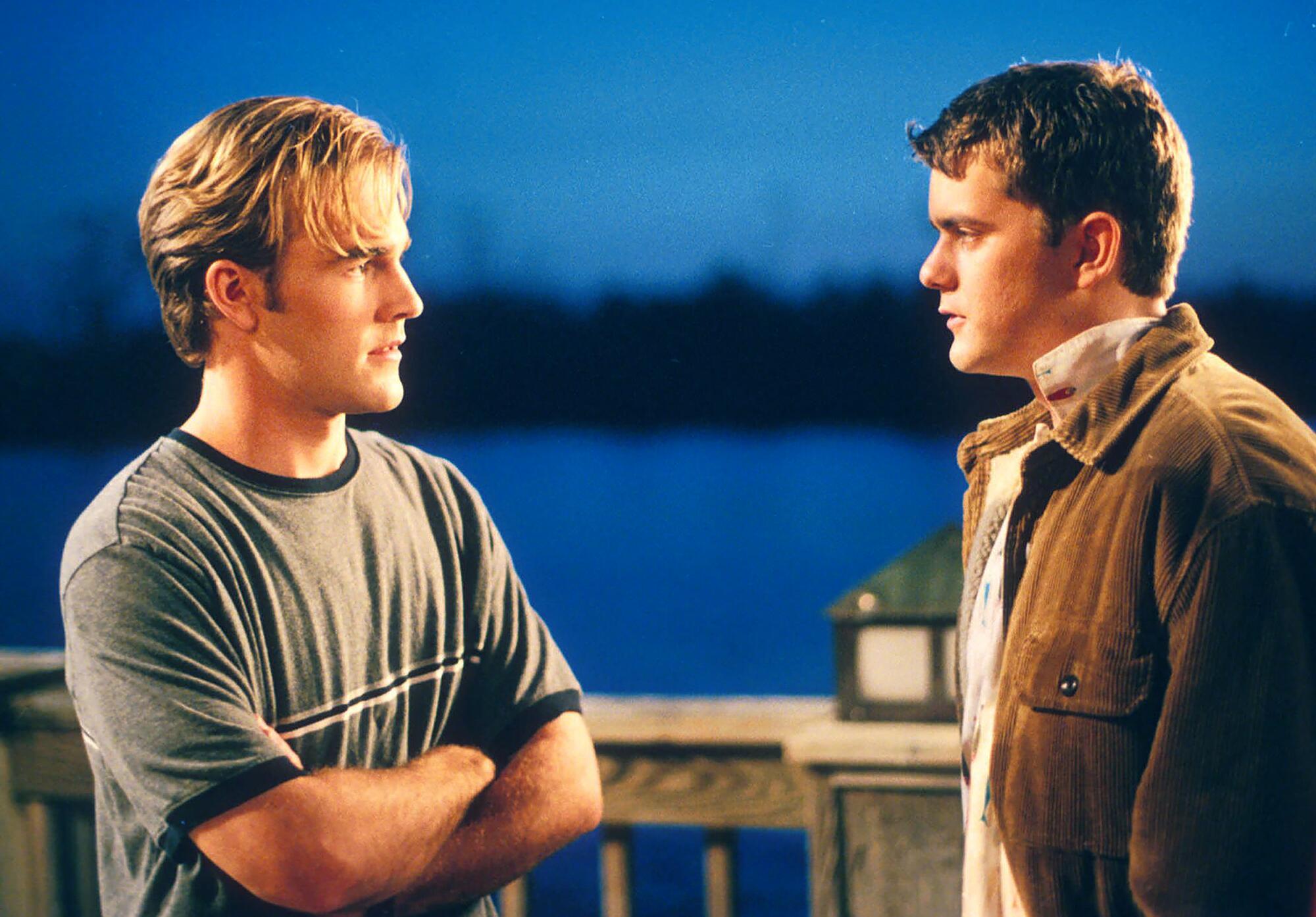
In the “Dawson’s” audition room, for example, Van Der Beek said his soon-to-be co-star Joshua Jackson “stood out because while other actors nervously went over their sides (myself included), he had the energy of a guy who was ready for a prize fight. I remember thinking, ‘THAT GUY is really interesting. If they cast him as Pacey, this is going to be really good.’”
James Van Der Beek, left, and Joshua Jackson in “Dawson’s Creek,” which would launch them to stardom.
(Fred Norris/The WB)
Van Der Beek likewise effused that, as a showrunner, Williamson “felt like a friend who was excited to go make a movie in his backyard. Even the way he ‘pitched’ storylines — it was never a pitch. It was a campfire story about people he cared about that he’d unfold in such a simple, compelling way that you couldn’t help but care about them too.”
Millennial viewers did care. Alot.
“Dawson’s Creek,” a simple drama about four friends growing up in a small, coastal town, quickly became a defining touchstone of Y2K culture, a major hit for the WB network — the series finale drew more than 7 million viewers — and a star-making machine for its four leads: Van Der Beek, Jackson, Katie Holmes and Michelle Williams.
The floppy-haired, often flannel-clad Van Der Beek wasn’t the show’s breakout heartthrob. (That honorific belonged to Jackson, who played Pacey, Dawson’s charming best friend and Joey’s end-game paramour.)
But as the title character and a partial avatar for Williamson — who had similarly spent his own teen years dreamily pining and aspiring to be a filmmaker — Dawson was the boy-next-door pillar around which the show orbited.
Yes, Dawson was whiny and moody and extremely self-centered, but so are a lot of teenagers. Through Van Der Beek’s wistful performance, viewers were given a window through which to grapple with betrayal, death, heartbreak and a litany of bad decisions.
For better or worse, Dawson served as an emotional, often cautionary, proxy for millennials’ own coming-of-age messiness.
In the years since the series ended in 2003, Dawson has largely been reduced to the “Dawson crying” meme: a Season 3 screenshot of Van Der Beek, face contorted in pain and on the verge of crying messy, heaving tears as Dawson tells Joey she should choose Pacey over him.
The emotional relationship between Joey and Dawson was core to the series.
(Fred Norris/The WB)
Van Der Beek later revealed that the tears weren’t scripted. So attuned had he become to his character’s sensitivity by that point that the emotions flowed naturally.
“I think at the heart of [Williamson’s] projects are characters that he himself cares about deeply — flaws and all,” Van Der Beek said in his email last year. “They’re authentic to their background, sincere according to their world view… and vulnerable.”
Van Der Beek was vulnerable, too. As his cancer progressed, he was open with fans about his health struggles and the early warning signs. He appeared via video at a “Dawson’s Creek” reunion event in New York City last September, the proceeds of which raised money for cancer awareness.
In Van Der Beek’s death, there is no real-world instrumental score or innate montage of his best moments to soften the blow, as would have happened with a character on “Dawson’s Creek” (though the internet will surely be awash in such fan-made edits).
But through his work on “Dawson’s,” a generation can take comfort in a starry-eyed boy on a dock in Capeside who once invited us into his messy, emotional world.
Once he officially takes the helm of the Mouse House in mid-March, he must tackle several key areas to chart the future of the 102-year-old media and entertainment giant.
For one, he’ll need to bolster Disney’s pipeline of content. As the saying goes, “content is king.”
The Burbank company already has a strong stable of franchises and stories that power its entertainment and streaming businesses, theme parks, merchandise and cruise ships, but Disney will need to keep building on that.
Strong sequels like last year’s “Zootopia 2” and live-action adaptations such as “Lilo & Stitch” — both of which grossed more than $1 billion in worldwide box office revenue — show that good stories can keep paying dividends in new ways, Moffett Nathanson senior research analyst Robert Fishman wrote in a note to clients last week.
On the bright side: This year’s film lineup has several historically strong franchise contenders, including Disney and Pixar’s “Toy Story 5,” Lucasfilm’s “Star Wars: The Mandalorian and Grogu” and Marvel Studios’ “Avengers: Doomsday.” (Marvel, however, has struggled in recent years to pump out consistent hits at the box office.)
You’re reading the Wide Shot
Samantha Masunaga delivers the latest news, analysis and insights on everything from streaming wars to production — and what it all means for the future.
But Disney also needs to develop new stories — which has been more of a struggle.
Disney and Pixar’s “Elio” misfired at the box office last year, as original animated movies have had a harder time bringing in the massive audiences they once did because of the drop-off in theater attendance since the pandemic.
That puts more pressure on Disney and Pixar’s upcoming “Hoppers,” an original animated film out in March. The film has gotten strong early traction in online trailer views, Fishman wrote.
The content investment also extends to scripted series, which Fishman noted are a “critical component of success and cannot become an afterthought to theatrical.” He singled out Disney-owned FX as a “prestige outlet” that can contribute to both television and streaming lineups. The network has had a number of successes, including 2024’s “Shogun,” which was one of my favorites.
D’Amaro likely will get help on the content side from soon-to-be president and chief creative officer Dana Walden, a longtime television executive who is respected in Hollywood and well-versed in the entertainment knowledge he lacks.
D’Amaro’s area of expertise is Disney’s experiences sector, which includes the theme parks, cruise line, merchandise and Aulani resort and spa in Hawaii and brings in the lion’s share of operating income for the company. In the fiscal first quarter of this year, the experiences business hauled in a record $10 billion in revenue.
The challenge there will be maintaining Disney’s market dominance in the theme park space while continuing to invest to drive growth and managing attendance in the face of ongoing competition from arch rival Universal Studios.
On the investment front, Disney is all in. The experiences business is in the midst of a 10-year, $60-billion expansion project that would add new themed lands to parks around the world, including at Anaheim’s Disneyland Resort. The company also is building a park in Abu Dhabi and added new cruise ships.
In the near term, however, are concerns about “international visitation headwinds” at Disney’s U.S. parks. The company signaled in its most recent earnings call that those foreign visitor trends could contribute to “modest” operating income growth for the experiences division in the fiscal second quarter, along with pre-launch costs for a new cruise ship and an upcoming “Frozen” land in Disneyland Paris.
To keep attendance rates up, the company shifted its marketing and promotional focus to a more domestic audience, said Hugh Johnston, senior executive vice president and chief financial officer, on the earnings call. But stock analysts — and D’Amaro — undoubtedly will be keeping an eye on international attendance rates and what that will mean for the theme parks going forward.
The part of the company with the potential to drive the most growth, analysts say, is its streaming business.
After recording billions of dollars in losses, Disney’s streaming services, which included Disney+, Hulu and ESPN+, finally reached profitability in 2024. The company’s next goal is to reach 10% operating margins in its entertainment streaming business comprised of Disney+ and Hulu — a milestone that would give investors confidence in its vision.
To get there, continued investment in local language content will be a key priority to increase international subscriptions, as well as bolstering the tech that powers the platforms and provides recommendations.
In short, D’Amaro faces a choice.
“Some investors are thinking, ‘Will he choose to be the same? Or can he start a new era?’” asked Laurent Yoon, senior analyst at Bernstein.
At least one former Disney CEO has weighed in.
“My advice to Josh is continue Bob Iger’s strategy that creativity will handle profits, always protect the brand, and keep close the words of Walt Disney: ‘We love to entertain kings and queens, but the vital thing to remember is this — every guest receives the VIP treatment,’” Michael Eisner posted on social media last week.
But D’Amaro’s own words provide an idea of what he’s thinking. At a global town hall meeting with Disney employees last week, D’Amaro spoke about the company’s legacy — and its path forward.
“We are 100 years old, but we’re 100 years young as well, willing to embrace new technology, new creators and new markets,” he said. “That willingness to change and take risks is what keeps the brand going, and it’s something I intend to continue to push on.”
Stuff We Wrote
Film shoots
Number of the week
Post-apocalyptic horror film “Iron Lung” has grossed $34.3 million in worldwide box office revenue, a remarkable number given the film’s reported $3 million production budget and self-distribution route.
Written, directed and executive produced by YouTuber Mark Fischbach, who goes by the online alias of Markiplier and also stars in the film, “Iron Lung” follows the story of a convict who sails a blood ocean in a submarine. The movie had a $17.8-million opening during the weekend of Jan. 30, placing it right behind Disney’s 20th Century Studios’ “Send Help,” which grossed about $19.1 million in its debut. “Iron Lung” picked up an additional $6 million this past weekend.
Its success reignited the debate about self-distribution and the theatrical draw of content creators.
What I’m watching
Since the Olympics started last week, I’ve been all in on figure skating, a sport I’ve watched since I was a kid who marveled at the artistry and athleticism of stars like Kristi Yamaguchi, Scott Hamilton, Brian Boitano and Michelle Kwan.
“When a movie is the best possible incarnation of itself, it’s a universe you fall into; as the youth says, it’s a vibe,” Del Toro says during an interview at the Sundance Film Festival in Park City, Utah, where he was in attendance to screen a restoration of his 1992 feature debut, “Cronos.”
Like Victor Frankenstein, who diligently selects body parts from corpses to stitch together his humanoid creation, the Mexican director carefully assembled his troupe of movie magicians. Of course, their talents mattered immensely to him, but so did their drive and their willingness to participate in the “team sport” of filmmaking.
“The cohesive personality of the film, the expressiveness of the film, depends on every aspect being orchestrated without an ego,” Del Toro says. “Each department sustains the department next to them.”
Del Toro clearly knows how to pick them. The Envelope recently caught up with makeup effects veteran Mike Hill, seasoned production designer Tamara Deverell, costume virtuosa Kate Hawley and acclaimed composer Alexandre Desplat, all Oscar-nominated for their work on “Frankenstein.”
And just like organs that constantly communicate with each other, their work is intimately intertwined. Nothing is conceived in isolation on a Del Toro film. “We all know what everyone’s doing within the different departments, so we all echo each other,” says Hawley.
1
2
1.Tamara Deverell.2.Kate Hawley.(Lauren Fleishman / For The Times)
In casting his acolytes, Del Toro seeks the alchemy that only human minds and hands can accomplish building tangible worlds. “The audience knows when something is digital, and when something has been crafted with real materials,” Del Toro explains. “I really believe people can tell the difference. Maybe they can’t articulate it, but they can feel it.”
Hill agrees. His mandate to create the prosthetics and makeup that transformed Jacob Elordi into the Creature aimed to make him look like an artwork that Victor Frankenstein handcrafted. Every part of him was by design, with the scars on his body reflecting incisions that those studying human anatomy in the 18th century would have made.
“If the monster felt fake, we would’ve lost the movie,” says Hill. “The Creature had to feel real. Not to put down VFX, but there’s a human quality they can’t catch.”
For Deverell, “Frankenstein” represented both the continuation of a creative partnership that dates back to the 1990s and an opportunity to showcase her multi-faceted skills. “Guillermo and I speak in a language of art history, and he is steeped in cinematic history,” she says.
With a team of technicians and craftspeople, Deverell constructed breathtaking sets, including Victor’s laboratory with giant batteries that required intricate steam and lighting mechanisms.
Undoubtedly, her pièce de resistance is the full-size Arctic ship where the opening sequence unfolds. Though the production considered existing vessels, none of them measured up. “There were specific action beats that Guillermo wanted, and a look that we all wanted,” she says. “To have complete creative control, there’s only one way to do it.”
To anyone who disagreed with the need for a ship, Del Toro would explain that it was not an extravagance. “It’s actually what tells the audience the scale of the movie,” he says.
1
2
1.Alexandre Desplat.2.Mike Hill.(Lauren Fleishman / For The Times)
The first half hour of the film, Del Toro believes, establishes its ambition and operatic quality. There are no digital doubles in that sequence, but real stunt performers aboard a ship that’s not a miniature but a massive structure that moves thanks to a giant gimbal.
It’s the way Del Toro pursues ideas by way of collaboration that brings Hawley back to his worlds (she even worked with him on his unmade version of “The Hobbit”). She’s learned to conceive her pieces considering that in his movies real water, mud, snow and fake blood might be in play.
“There’s something that happens with real materiality, real construction, there’s an alchemy to it,” Hawley says. “What a fabric does and performs is not always predictable, but the outcome and the potential you see in something then becomes the magic.”
As production timelines get shorter and A.I. utilization creeps into the filmmaking process, Hawley believes artists are trying to hold onto the craft as much as possible. “We came here to build worlds,” she says. “That’s what we did as kids. That’s what we do. This is our church.”
Del Toro admits he can be a “pain in the ass,” especially when dealing with his film’s production design and makeup effects. He atones by constantly reassuring his artisans. “They need to know that even if you are torturing them you admire them,” he says.
The only element of the film where Del Toro actively hopes to be surprised is the score. And Desplat is committed to delivering.
“Writing music is using your imagination. It’s not using references. It makes no sense to me,” says Desplat, who believes most scores today sound like work that has come before. “I hear many composers use references, but what for? That’s not what we do. We have the film to be inspired by. That’s enough.”
For “Frankenstein” — his third creature movie with Del Toro, after “The Shape of Water” and “Pinocchio” — Desplat thus avoided Gothic compositions to create a counterpoint to the images, highlighting the fragility of Elordi’s Creature, who he thinks of as the core of the film.
Also tying together the film’s craftsmanship is Del Toro’s awards campaign for “Frankenstein,” which he’s navigated to the tune of “F— AI.” The chant has resonated with those fighting to keep art made by humans for humans. “Frankenstein,” in turn, is the director’s latest monument to the beauty of imperfection.
“Art is the thing that we should never let go of, never surrender to mechanization or artificial intelligence,” Del Toro adds. “We need to grasp on it because this is the last point of contact between humans.”
Coronation Street fans met Shona Platt and Jodie Ramsey’s father on Monday on the ITV soap, but his warning to Shona left fans convinced they knew what had happened to him
09:47, 10 Feb 2026Updated 09:48, 10 Feb 2026
Coronation Street fans met Shona Platt and Jodie Ramsey’s father on Monday (Image: ITV)
Sinister scenes on Coronation Street may have revealed Jodie Ramsey did something terrible to her own father.
Shona Platt was stunned during Monday’s episode of the ITV soap, after suspecting her sister Jodie was hiding something. She followed her to a hospital where she was left reeling to be reunited with her father after decades apart.
She had decided to track her father down, after Jodie recently claimed to Shona that her upbringing wasn’t great, with her father apparently being controlling in the wake of Shona fleeing years ago. Shona failed to find a lead on her dad’s whereabouts though, before managing to locate him by following Jodie to the hospital.
It was clear their dad, who was laying still but awake in a bed, was dazed and confused. Initially he didn’t talk or move and he didn’t even react to Shona entering the room.
Jodie claimed she had to care for him after he spiralled in the wake of Shona and her mum leaving. She said he often had angry outbursts and in the end she could no longer look after him, admitting him to the hospital for daily care.
Suddenly the father started shouting out, seemingly calling Jodie a liar and warning Shona about her. Jodie claimed he didn’t know what he was saying most of the time, but later proved he had reason to be worried.
He seemed genuinely scared when Jodie commented that she didn’t need him anymore, and hinted that things didn’t go his way when he didn’t stay in line. So did Jodie do something to her dad?
Fans certainly think so with one writing: “I think Jodie abuses him,” as another commented: “The father looked a bit frightened of Jodie I thought.” A third added: “OMG Does Jodie abuse her dad?”
A fourth fan commented: “I think Jodie has been drugging her father. Anything that comes out of her mouth is lies and I think she wants to destroy Shona’s life because she abandoned her when she left home.”
Another said: “Jodie is definitely hiding something else I bet she’s the one abusing her dad.” Meanwhile one viewer posted: “That’s what I’m thinking as she’s probably the one who put him in that hospital to get his money.”
Other fans shared their belief that Jodie was out to steal her sister Shona’s life. A fan posted: “It’s giving me ‘single white female’ vibes. Jodie definitely wants Shona’s life.”
Another agreed: “Not sure what the story is actually. Why did Shona leave? Presume Jodie was left to look after the dad so Jodie is full of resentment. Found Shona and saw she had a good life so wants a bit of it???????”
The photograph is so intimate, so vulnerable, it’s painful to look at.
It depicts a woman in her early 20s lying on a hospital bed twisted to the side, her wrists and ankles restrained. The black-and-white image — nearly five feet wide — is so crisp that bits of the woman’s toenail polish glimmer and the hair on her thigh appears to spark. Most pronounced: the loneliness and resignation on her face.
“I was 20 or 21 then. I’d had a psychotic episode and was taken to a public hospital in Massachusetts,” says Palm Springs-based artist Lisa McCord of the self-portrait she later staged. “I’m very transparent and I wanted to share my experience afterward. It was the ‘70s. I’d tell people, in school, I’d been in a psychiatric hospital and no one wanted to hang out with me — it was a very lonely time.”
McCord’s work is part of an exhibition at the Los Angeles Center of Photography addressing the idea of loneliness, now considered an epidemic in America. The exhibition, “Reservoir: Photography, Loneliness and Well Being,” was curated by LACP‘s executive director, Rotem Rozental, and includes participation from more than 40 artists representing “a wide array of geographies, approaches, ages, nationalities and lived experiences,” she says.
Rozental had been thinking about loneliness in our society — how increasingly pervasive it is — since the start of the pandemic. In late 2024 she began having conversations about it with LACP board chair and artist Jennifer Pritchard. Art reflects the world that we live in and Rozental felt that, as a photography center, LACP had an obligation to amplify “some of the larger issues” our society is grappling with.
“There’s something about photography that really brings people together around their vulnerabilities,” Rozental says. “Even if it just means you’re seeing, through an image, that someone else is experiencing what you’re experiencing.”
In this case: loneliness — “something that is looming heavy on everybody,” Rozental adds.
Asiya Al. Sharabi’s “Inward” (2025) addresses the uncertainty, and sometimes loneliness, of being a woman and an immigrant.
“Most recent studies indicate that 50% of Americans are often lonely,” Nobel says, adding that a December 2025 study found that “loneliness is increasing, even after the pandemic. And it’s driving a change in behavior, the big one being that people are disengaging from each other and community activities, so that also isolates them.”
What’s more, chronic loneliness has tangible, dangerous effects on our health, he says.
“Loneliness increases the risk of heart attack and stroke and general early mortality by up to 30%. Dementia risk goes up by 40%, diabetes risk goes up 35% from being chronically lonely. That’s increased the urgency to address it as a public health crisis.”
It’s important to note, Nobel says, that there’s a difference between being alone and being lonely, with the former potentially good for your health.
“Being alone means you don’t have social connection. Loneliness is the subjective feeling that you don’t have the social connections you want,” Nobel says. “You can be lonely in a crowd, you can be lonely in a racist workplace, you can be lonely in a failed relationship or marriage. But being alone can actually be quite positive — solitude. You can be in touch with thoughts and feelings and can have emotional growth.”
Nobel consulted with many of the artists during the development of “Reservoir.” It was a natural pairing as his more than 20-year-old nonprofit, the Foundation for Art & Healing, explores how creative expression helps individuals and communities heal. The experience “definitely validated ‘how do creative people use their creative orientation to further explore and reveal what’s going on with loneliness,’” he says. “That’s the power of this exhibit.”
A detail shot from Diane Meyer’s “The Empty Space of Nothing #43” (2025)
(Diane Meyer)
To create the exhibition, Rozental selected six photographic mentors, all established artists, each of whom chose a theme around loneliness — “aging,” “immigration,” “technology and hyper-consumerism” or “the solo creative process,” for example. The mentors then invited artists to create new work responding to their themes. Over nine months last year, the groups of artists met monthly on Zoom — “six countries and seven time zones,” says Rozental — along with therapists, scholars and others to plumb the topic.
The resulting exhibition features mostly two-dimensional photography but also includes multimedia works and 3D installations.
L.A.-based artist Diane Meyer sourced about 100 old black-and-white photographs from private collections. Then she hand-painted each of them, blocking out most everything in the image except select figures with white paint. The individuals in the photos appear to float in a sea of clouds or snow, disconnected.
In one image, two young boys teeter on a seesaw, as if suspended in midair; in another, a middle-aged man lies on a blanket in the fetal position, white paint spilling over onto his blanket and body, as if he is sinking into a void. The creative process — which the work speaks to — is evident here, the artist’s hand noticeable. The paint is splotchy in places and the photographs are pinned delicately to a dark surface, their edges curling, giving the overall installation a textured materiality.
Meyer’s work is in stark contrast to Jacque Rupp’s installation on the opposite wall. Rupp’s slick multimedia work speaks to both technology and societal perceptions of aging women. After recently becoming a grandmother, the Bay Area-based artist asked AI to “imagine a grandmother in 2025.” The result is a black-and-white photo grid of several hundred female faces staring blankly into the camera, mouths closed and eyes vacant. Beside it is a TV monitor on which their faces morph into one another, without audio. The overall effect is polished and high-tech, touching on the perceived invisibility of women as they age.
“I felt that these two works needed to be in conversation,” Rozental says.
Julia Buteux’s “Have We Said Hello” (2025)
(Rotem Rozental)
Nearby, Julia Buteux’s three-dimensional installation of transparent fabric panels hang from the ceiling, shimmying in the air and inviting guests to walk around it. The Rhode Island-based artist downloaded images from social media and deleted the people from them. The backgrounds are colorful but all that’s left of the subject is a transparent imprint of their face and upper body. “So you’re getting the absence of the user,” Rozental says. It speaks to how isolating online social milieus can be.
Asiya Al. Sharabi — who is Yemeni American and lives between Egypt and Virginia — created large-scale, conceptual self-portraits that she manipulated in the printing process. One is a double exposure depicting the front and side of her face. It addresses issues of duality and the uncertainty of her standing in society as both a woman and an immigrant. In another, the artist sits in a rocking chair in a home beside a vase of dead flowers — but her body is transparent. “She almost disappears within the domestic space,” Rozental says.
McCord’s photograph is part of a larger interactive installation that includes a “visual diary” guests can flip through featuring photographs of her life over the decades paired with handwritten diary entries from 1977 to 2021. McCord narrates snippets from the diary, which visitors may listen to on headphones.
“Reservoir” aims, of course, to shine a light on the condition of loneliness. But it also hopes to serve as a public health intervention by hosting creative workshops — incorporating the photography in the exhibition — to address loneliness and spark connection.
“Creative expression changes our brains,” Nobel says. “It reduces levels of the stress hormone cortisol, it increases the levels of the feel-good hormones, so you’re less anxious about the world and in a better mood. It’s then easier to engage with others. It invites us to be less lonely and more connected, not just to other people, but ourselves.”
The exhibition, which closes March 14, is planned to travel internationally, including to the Museo Arte Al Límite in Chile, the Inside Out Centre for the Arts in South Africa and to the Karuizawa Foto Fest in Japan. The goal is to use the workshop element as a model that can be replicated in community arts organizations around the world.
Rozental says photography is the perfect conduit for that, calling the medium “a language, a space for connection and communication.”
“We hope that people will walk into this space and see themselves on the walls,” she says. “Maybe their burden will ease a little bit by knowing that they might feel lonely, but they’re not alone.”
In the 1930s, the white matriarchs of tiny Natchez, Miss. — one of the 19th century’s wealthiest American towns thanks to the slavery-driven cotton trade — opened their stately antebellum mansions to save themselves from economic ruin. Tourism dollars flowed in, even if the prettified Southern history being sold ignored the immoral plague that built its riches in the first place.
By turns cheeky and disturbing, blunt and nuanced, Suzannah Herbert’s excellent documentary “Natchez” offers its own guided tour of a memory-challenged community (population: 14,000) struggling to reconcile its exquisite, carefully scrubbed façade with the inconvenient truths some would like to see better represented in the narrative.
That longstanding erasure has made Natchez a less commercially friendly prospect to younger generations of visitors. And meaningful progress turns out to be much harder than simply refashioning an exhibit or a docent’s spiel.
Can a place like Natchez — home to both a cherished tourist pageantry called the Pilgrimage and the slave market site called Forks of the Road — find a harmonious existence between its green-and-serene sightseeing pleasures and its terrible past? Its optimistic mayor seems to think so, if the first scene is any indication, in which he exalts a “new Natchez” at a spirited ladies’ luncheon held by the tour-umbrella association, the Garden Club, and featuring that group’s first Black member, Deborah Cosey.
Cosey, we learn, runs Concord Quarters, a burned-down plantation’s last remaining building, which once housed its enslaved. (She also lives there.) Centering the work and lives of these forgotten souls is a mission she sees as telling “the rest of the story.” In one tense scene with her white colleagues, Cosey winces at their version of historical enlightenment — the reclamation project is moving at a horse-drawn carriage’s pace.
The big house is still the main show, antiquated customs and preserved finery still the plot, even as some of these hosting descendants, faced with declining revenues, grasp that there’s an increasing awkwardness to the “Gone With the Wind” myth they’re peddling. Meanwhile, charming and knowledgeable Black pastor Tracy “Rev” Collins offers a lively van tour (“See the real Mississippi”), an educational reality check about slavery’s legacy laced with witty asides.
The divide gets more complicated when the documentary trails openly gay veteran Garden Club member David Garner, whose charity work benefiting the LGBTQ+ community would seem to point to an old world’s shifting tolerance. But when this outlier’s intensely Southern-fried tour patter reveals a chillingly deep-seated racism, it slaps you right back into sobriety about Natchez’s roots — a neo-Confederate mindset that doesn’t care if a camera is there to record it.
“Natchez” is full of quietly charged moments in dreamily scenic surroundings, one result of Noah Collier’s lush cinematography, deployed like a deliberately performative nostalgia that lets us know there’s always more to see if we look (and listen) closely enough. This stylistic approach allows Herbert to expertly avoid inadvertently selling Natchez itself, instead focusing on how this town’s peculiar relationship to an overwhelming past still lives inside those doing the selling.
AMANDA Holden ditched her bra and a showed off her slim waist in yet another stunning work outfit.
The Heart Radio star, 54, looked chic as ever in a pale blue long sleeve top with a dark red rim and teamed with a brown suede skirt.
Sign up for the Showbiz newsletter
Thank you!
Amanda Holden ditched her bra for another stylish work lookCredit: InstagramThe BGT judge was seen strutting through the corridor and posed for a toilet selfieCredit: Instagram
Amanda mentioned that the colours were also nod to football team Aston Villa.
The BGT judge was seen strutting through the corridors as she gave fans a rundown on her outfit, which was from designer Karen Millen.
Amanda then posed for a toilet selfie which showcased her braless look.
The TV star often showcases her stylish looks on social media.
But just last week, she revealed she once prepared a Sunday roast in front of her family — while naked.
Amanda said she stripped off while cooking the meal because it was a hot day.
And she added that her two daughters Lexi, 19, and Hollie Rose, 13, were used to seeing her without clothes.
She told the Table Manners podcast: “You know on the cusp between winter and summer where you have to give up roast dinners and turn it into a barbecue?
“My whole family moan about Sunday roast, but I make them have it, and then this one particular Sunday it was boiling hot so I did just strip off and cook everything naked.”