Media company Run-A-Muck has announced that it is developing “Courtside,” a sports romantic comedy set in the world of professional basketball. WNBA All-Star Gabby Williams, two-time WNBA champion Sydney Colson and 2022 WNBA champion Theresa Plaisance are among those set to appear in the movie, according to Deadline.
“If you like ‘Love & Basketball’ and ‘Bend It Like Beckham’ and ‘Bring It On’ but you found yourself wondering, ‘Could this maybe be a little bit gayer?’ We have great news for you,” Colson said in a Thursday Instagram post. “The answer is yeah, you could always make it gayer.”
Colson, a Texas A&M standout who was drafted to the WNBA in 2011, is also one of the executive producers on “Courtside.”
Written by “Abbott Elementary” writer-producer Brittani Nichols and directed by Carly Usdin, the movie will follow an injury-plagued women’s basketball superstar with championship ambitions who is thrown for a loop when she falls for a teammate.
“Making a movie like this is super exciting to me because I grew up playing basketball,” Colson added. “I would have loved as a young person to see my story depicted … on screen so to see a team of people who want to ensure that others can see characters and storylines that feel personal and familiar to them. I’m so excited about it.”
Colsen and Plaisance, who won a championship together as teammates on the Las Vegas Aces in 2022, share a podcast and also starred in the unscripted buddy comedy “The Syd + TP Show” together. Williams, who plays for France in international competition, currently plays on the Golden State Valkyries.
“It feels like I’ve been waiting my whole life for this kind of excitement to surround women’s basketball, and I’m excited to blend my love of sports, lesbian tension, and comedy into one project,” Nichols told Deadline. According to the outlet, Run-A-Muck co-founder and “The L Word” star Jennifer Beals is also slated to appear in the project.
WASHINGTON — Seeking to reassure U.S. allies, a bipartisan group of senators is departing for a tour of Arctic nations. And this time they’re leaving the men behind.
From the eight senators to their staff and military liaison officers, the all-female group will pay diplomatic visits to government officials in four Arctic nations, witness the challenges for militaries in the region and visit a Norwegian archipelago so remote they will need escorts to avoid run-ins with polar bears.
“I want them to experience, first of all, the awesomeness of the Arctic,” said Republican Sen. Lisa Murkowski of Alaska, who is leading the trip alongside Democratic Sen. Jeanne Shaheen of New Hampshire, the top Democrat on the Senate Foreign Relations Committee.
The trip was born out of both senators’ work to stabilize relations with U.S. allies in North America and northern Europe at a time when President Trump has taken an aggressive, go-it-alone stance in the region. Just this week, the Pentagon announced that the U.S. would pause participation on a joint board with Canada for continental defense that dates back to World War II.
Murkowski and Shaheen said that is the wrong approach in an Arctic region that has increasing strategic value and unique challenges.
“We will reassure our allies that we recognize and appreciate the importance of our allies and partners in the Arctic as in so many other areas,” Shaheen told the Associated Press, adding that she expected the group to discuss “what more we can do as members of Congress to support those relationships.”
The group is split evenly between Democrats and Republicans, with Sens. Cindy Hyde Smith, Katie Britt and Cynthia Lummis making up the Republican side, and Sens. Maggie Hassan, Kirsten Gillibrand and Catherine Cortez Masto from the Democrats. Departing Friday, they will visit Arctic or sub-Arctic regions in Canada; Greenland, which is an autonomous territory of Denmark; Svalbard, a Norwegian archipelago that is one of the northernmost inhabited areas on Earth; and Iceland.
Understanding the Arctic
Murkowski and Shaheen said they want the group to come away with a deeper understanding and appreciation for Arctic communities that are experiencing the effects of climate change, as well as the unique challenges of conducting military operations in the region.
“It’s to understand what it means to go into a remote, isolated community that has no access by road,” Murkowski said, adding that the group would see how military sites need airplane hangars because aircraft cannot be kept outside overnight in the Arctic cold.
NATO has recently tried to foster cooperation in the High North through a series of joint military exercises, especially as nations like China and Russia increase their activities there.
As climate change thins the Arctic ice, it could potentially create a northwest passage for international trade as well as reignite competition with Russia, China and other countries over access to the region’s mineral resources. The region is also host to a number of undersea cable projects that hold strategic value.
The group will also visit Indigenous communities that have lived in the region for generations and understand the environment. Murkowski said she hopes the senators come away from the trip “excited and intrigued and hopefully inspired.”
As Trump threatened to take Greenland earlier this year, Shaheen and Murkowski also teamed up to push for legislation that would prevent the U.S. from attacking any fellow NATO member. They are among the lawmakers pushing to include language in this year’s defense legislation that would prevent the Trump administration from withdrawing military commitments to NATO allies.
Shaheen said, “I also want to know if there are policy directives that we should be thinking about. And it will be great to have a strong bipartisan group there to discuss what we might want to do when we get back.”
How an all-female trip will be different
For some of the nations the group will be visiting, a high representation of women is nothing new. Iceland’s parliamentary body is comprised of roughly 46% women, one of the top ranking countries globally for female political representation.
Shaheen said that research suggests that “when women are the negotiating table, that agreements that are made have a much better chance of lasting for a longer period of time.”
She added that data show that representation of women in government leads to more stable societies, as well as investments back into their communities.
“There are very real reasons why we need to make sure that women are at the table,” she added.
MINNEAPOLIS — A judge on Thursday handed down an extraordinary prison sentence — nearly 42 years — to the former leader of a Minnesota nonprofit who was convicted in a staggering $250-million fraud case that helped ignite an immigration crackdown by the Trump administration.
Aimee Bock ran Feeding Our Future, which had claimed it helped provide millions of meals to children in need during the pandemic. The U.S. Justice Department, however, said she was atop the “single largest COVID-19 fraud scheme in the country.”
“I understand I failed. I failed the public, my family, everyone,” Bock said in federal court.
President Trump used the fraud cases against Bock and many others to initially justify a massive surge of federal officers to the Minneapolis-St. Paul area last winter, leading to a pushback by residents and the deaths of two people.
“Feeding Our Future operated like a cash pipeline, open to anyone willing to submit fraudulent claims and pay kickbacks,” prosecutors said in a court filing.
Bock had long proclaimed her innocence but was convicted last year of conspiracy, fraud and bribery.
“This case has changed our state forever,” Joe Thompson, formerly the lead prosecutor in the case, said outside the courtroom. “Aimee Bock did everything she could to earn this long sentence.”
The nonprofit sat atop a fraud network that included a web of partner organizations, phony distribution sites, kickbacks and fake lists of children supposedly being fed, prosecutors say. Dozens of people, many from the state’s large Somali community, have been convicted in a series of overlapping food fraud cases that have spent years in the courts.
Bock and co-conspirators enriched themselves with international travel, real estate purchases, luxury vehicles and other lavish spending, the government said.
Bock’s lawyer, Kenneth Udoibok, argued for no more than three years in prison, saying she had provided key information to investigators. He argued that Bock had been unfairly painted as the mastermind and insisted that two co-defendants were responsible for running the scams.
Meanwhile, authorities this week filed additional charges against others in a sprawling investigation into federal social service spending in Minnesota.
The targets include Fahima Mahamud, who was CEO of Future Leaders Early Learning Center, a childcare center in Minneapolis. Over three years, Mahamud’s organization was reimbursed approximately $4.6 million for services on behalf of people who didn’t make a required copayment, prosecutors allege.
A message seeking comment from her lawyer was not immediately returned Thursday. Mahamud was charged separately in February with fraud related to meals. She has pleaded not guilty.
Two other people were charged with conspiring to get $975,000 in Medicaid subsidies for housing services that were not provided. They’re expected to plead guilty in June, according to a court filing.
Two additional people were accused of receiving $21.1 million by billing Medicaid for autism therapy that was either unnecessary or not provided. Investigators said the two paid families as much as $1,500 per child per month to add their names to the program and get reimbursement.
Trump, who has long derided Somalis, last year blasted the state as “a hub of fraudulent money laundering activity.” He also criticized the leadership of Gov. Tim Walz, the Democrats’ vice presidential nominee in the 2024 election.
“Somali gangs are terrorizing the people of that great State, and BILLIONS of Dollars are missing. Send them back to where they came from,” Trump wrote on social media.
Bock is white and the U.S. Attorney’s Office says the overwhelming majority of defendants in the cases are of Somali descent. Most are U.S. citizens.
The immigration surge led to repeated protests and confrontations between residents and federal officers and resulted in the killings of Renee Good and Alex Pretti.
Long before Billie Jean King won dozens of Grand Slam tennis titles, founded the Women’s Tennis Assn., became part owner of the Dodgers and was awarded the Presidential Medal of Freedom, she enrolled in what was then called Los Angeles State College.
Three years later in 1964, King left without a degree to devote full attention to her burgeoning tennis career.
Failing to earn the degree bothered her, and King would correct anyone who said she had graduated.
“I said, ‘Don’t ever say ‘graduated.’ I haven’t earned it — yet,’” she said.
“Yet” became a reality Monday when King, 82, received her bachelor’s degree in history from the same school she attended more than 60 years ago — now called Cal State Los Angeles — walking across the Shrine Auditorium stage with the rest of the Class of 2026.
King also served as a commencement speaker, telling the roughly 6,000 fellow graduates, “It is a privilege for me to be here.
“Yeah, baby, only 61 years!”
King mentioned that “like many of you,” no one in her immediate family had graduated from college.
She noted that her lifelong fight against discrimination began when she realized at age 12 that nearly everyone at tennis clubs was white.
“I asked myself, ‘Where is everybody else?’” King said. “From that day forward, I committed my life to equality and inclusion for all. Tennis is a global sport and it became my platform, but equality was my dream — to make the world a better place.”
“We can never understand inclusion unless we’ve been excluded.”
Known then as Billie Jean Moffitt, she chose Los Angeles State because tennis coach Scotty Deeds trained men and women together. She soon became an international star, winning a Wimbledon doubles championship at 18 with Karen Hantze, who was only 17.
She married her college sweetheart Larry King in 1965 and they divorced in 1987. Afterward, King and Ilana Kloss, an accomplished tennis player in her own right, were a couple for decades before marrying in 2018 in a secret ceremony in the apartment of former New York City Mayor David Dinkins.
“You’re finding your truth, and it doesn’t have to stay the same,” King told People magazine at the time. “I only liked guys when I was young. I didn’t think about girls. And then all of a sudden I’m like, ‘Oh my God, what’s happening?’ My truth was changing over time. It took me forever.”
King became a trailblazer for LGBTQ+ and women’s civil rights and was awarded the Presidential Medal of Freedom in 2009 in part for her advocacy for equality. King and Kloss co-founded the Billie Jean King Leadership Initiative to promote inclusive workplaces and gender equality.
Shortly after they married, King and Kloss became part owners of the Dodgers and the Sparks, acquiring undisclosed minority stakes in the franchises through an invitation from controlling owner Mark Walter.
“We believe all professions, and professional sports, need to be more inclusive and equitable,’’ Walter said at the time. “It’s going to be wonderful to have a role model like her in both clubhouses from time to time.’’
King returned to Cal State L.A. in the 2025 spring semester. She also earned course credit for her interaction with fellow students enrolled through the university’s Prison Graduation Initiative.
“They have made a commitment to improving their lives through education,” she said, and “getting their degree will be life-changing for them.”
King now knows the feeling firsthand. At the graduation ceremony on Monday, she wore a gold stole embroidered with a multicolored tennis racket and the letters G.O.A.T — greatest of all time.
“It means a lot more to me than I thought,” she told reporters. “I am so glad I did it. My hope is that one other person will go back to school.
“It’s never too late, whatever age you are, whatever your abilities are, go for it if you want it.”
Mandy Moore shared her take on the drama swirling around her celebrity mommy group, months after fellow child actor Ashley Tisdale shaded the bunch in scathing essay last winter.
The “This Is Us” star and mother of three, during a recent appearance on Andy Cohen’s Sirius XM show “Radio Andy,” said she found the former “Suite Life of Zack & Cody” star’s article “very upsetting” and that it shocked both herself and fellow mommy group member Hilary Duff. “We have both grown up in this business and had people dissect who we are and the choices we make and all of that,” Moore, 42, told the Bravo host, “but this was something altogether different and decidedly way more upsetting … because it just cuts to the core.”
In December, New York magazine published “High School Musical” star Tisdale French’s essay for its “It’s Been a Year” series. The actor’s piece, titled “Breaking Up With My Toxic Mom Group,” accused other group members of snubbing Tisdale French from various gatherings and group chats. “‘This is too high school for me and I don’t want to take part in it anymore,’” Tisdale French, who shares two children with composer Christopher French, recalled texting the group.
As Tisdale French’s essay sparked speculation online about the identity of the group members, Duff’s husband Matthew Koma appeared to confirm his wife’s membership in a since-expired Instagram story post throwing the shade right back at Tisdale French.
For Moore, married to musician Taylor Goldsmith, kindness is “the most important thing” in her life, as is creating a legacy of kindness, she told Cohen. She said that she finds “anyone even insinuating that might not be the case” to be “very upsetting.” Moore said she is a “huge proponent” of addressing conflict head-on via face-to-face communication.
“‘I wouldn’t have handled the situation this way,’” she recalled feeling about the essay. Moore did not mention Tisdale French by name.
Moore said she also felt the scandalous essay “perpetuates this silly trope that women can’t be supportive of one another” and that women, specifically mothers, are “inherently petty” and committed to “one-up each other.”
“I have not felt that one iota since becoming a parent,” Moore said, adding she has formed “meaningful relationships” with other parents. She further stressed the importance of parents finding their community wherever they can.
Duff, 38, addressed the mommy group drama with The Times in February, telling pop music critic Mikael Wood that “this is not new for me” and she felt the situation was “escalated by the talking heads on TikTok that need clickbait.” Amid the social media chatter, Duff said her family is her focus.
”Knowing that I get to open up the back doors and play soccer as a family and take a hot tub and go get our chicken eggs — that’s the purpose of life,” she said. “On the days when crazy s— happens, I go home and quiet the noise.”
This story is part of Image’s May Momentum issue, which looks at art as a sport and sport as an art.
I’m haunted by the perfection of Roxy board shorts from the early aughts. As a teen surfer girl in El Porto, they were my holy grail. In those years, all the cool surf brands made cute surf clothing, but the emphasis was decidedly more on the aesthetic than the function, which was a bummer when it came to, you know, surfing. Roxy board shorts changed that, especially the particular style I’m thinking of: slightly longer to actually prevent thigh chafe from the board, they sat perfectly on my hips and stayed on with their Velcro and lace-up fly. Unlike when I tried to borrow from the boys section, the board shorts weren’t comically long or baggy or cut straight across the waist. These were made for girls who actually surfed. I bought them in every (very cute) color I could find and surfed them until I couldn’t any longer.
Sonia Kasparian, the original designer of Roxy’s board shorts back in the mid-’90s, smiles in our recent conversation when I recount my astonishment at their discovery. She’s grinning because of course they fit — that was the ethos behind her design. “I wanted [the board shorts] to be totally functional, exactly to the same standards that the men’s were, but designed for women. There was a completely different fit for women than men.” And true to Roxy’s style bona fides, the board shorts looked good enough to pair with a T-shirt. “Everything was designed with the idea of being something that women would not only want to wear in the water, but just wear out walking around in everyday life,” Kasparian explains. “But if you were to go out in the water, those shorts would stay put. They would be comfortable — and they would be completely authentically built.” The brand was testing prototypes in the surf, eventually with pros like longtime Roxy team rider Lisa Andersen, but initially with Kasparian and her fellow Roxy and Quiksilver colleagues Lissa Zwahlen, Melissa Martinez and Amy Grace Patrick, among others. They’d paddle out in the board shorts in the morning to try out their designs before heading into the office, their noses dripping saltwater later in the day as they bent over fabric bins and sales reports.
Some of the first pairs of Roxy board shorts from designer Sonia Kasparian’s personal archive.
(Sonia Kasparian)
The functional ethos was always part of Quiksilver too. For the uninitiated, Roxy is the women’s brand of Quiksilver, the legendary Australian company that began in 1969 and made board shorts that performed as well as they looked. Their innovative, stylish design quickly became a nonnegotiable for the best and coolest surfers, and when Angeleno Bob McKnight discovered the board shorts on a surf trip in the early ’70s, he knew they’d become ubiquitous among surfers in California too. But when McKnight brought the brand to the U.S., he was met with skepticism. As McKnight tells it during our conversation at Quiksilver HQ, when he first approached Walter Hoffman, the renowned California maker of Hawaiian print fabric and eventual supplier and mentor, Hoffman exclaimed that board shorts were “the worst idea I’ve ever heard in my life.” The apparel business, according to him, was an impossible one to succeed in. McKnight protested to Hoffman, though: “We’re not in the apparel business. We’re making equipment for surfers.” The distinction paid off with pros and wannabes alike, and by the time Quiksilver launched Roxy with Kasparian in 1990, they were a cultural juggernaut. PacSun, anyone?
When I ask Kasparian about being a part of my personal archives, about being part of the historical surfwear archives, she’s “just so happy.” Despite Roxy’s eventual runaway success — it’s responsible for about 30% of Quiksilver’s sales — it was hard work to convince others in the industry that there was absolutely a need and a desire for fashionable, functional surfwear for girls. “I mean, you would go into the surf shops and you’d see all this men’s product, and you’d see a poster of the Reef girl with her butt in your face, wearing a thong,” Kasparian recounts. It’s not an exaggeration to say that Kasparian and her team made history, not just for teenage me but for countless other girls who wanted to look and feel confident in and out of the surf. “[Roxy board shorts] changed the dynamic of where women fit in the surf industry. They weren’t just the girls that sat on the sideline with the thong and watched their boys out in the water. They were the ones out in the water. And that was huge.”
I haven’t had any luck in finding the grown-up surfer girl version of Roxy board shorts. I still comb thrift racks and bulk bins for something close enough, even trying on the odd pair of early aughts Quiksilver men’s board shorts, as if, just by wanting it enough, I can somehow manifest the completely different fit that Kasparian was so intentional about designing. But board shorts for women these days just don’t hit the same way, especially the longer ones. They read midlife modesty, not stoke; they’re lacking in the joyous, playful audacity that Kasparian and her team infused into their groundbreaking designs. Maybe the board shorts I’m seeing aren’t the vibe because, well, they’re made for women, not girls, and despite my best efforts to never grow up (see: still surfing), I am in fact an adult woman and no longer a girl. And maybe, most of all, when I say I long for those Roxy board shorts from long ago, what I really mean is that I’m nostalgic for a younger version of myself: a surfer girl who was just discovering clothes that made her feel more like herself, with all the evolutions of that person still ahead of her.
A federal judge has ordered the Trump administration to bring a Colombian woman back to the U.S. from Congo, after she was deported to the African nation that had refused to accept her.
The deportation of Adriana Maria Quiroz Zapata “was likely illegal,” U.S. District Judge Richard J. Leon ruled Wednesday.
Zapata, 55, who has diabetes and a thyroid condition, “has been sent to a country that refused to accept her because they cannot provide sufficient medical care,” the ruling said. “As a result, she faces a daily risk of medical complications, up to and including death.”
Black spots began to grow on Zapata’s back and foot while she was in detention, her skin started to peel and her nails blackened, according to a declaration that Zapata submitted in court, and which was provided to the AP by her lawyer.
“She’s not doing well and does worry that she’s going to die,” her lawyer, Lauren O’Neal, said.
Zapata entered the U.S. from Mexico in August 2024 and was taken into Immigration and Customs Enforcement custody. Since being deported, she has lived in a hotel in Kinshasa, Congo’s capital. The hotel gates are locked, O’Neal said. Zapata and other deportees are rarely allowed out, and only with supervision, she said.
Zapata was among thousands of immigrants living legally in the U.S., waiting for rulings on asylum claims, when they were suddenly issued deportation decrees that ordered them expelled to countries where most had no connections.
More than 15,000 third-country deportation orders were issued in the White House push for ever more immigrant expulsions, advocacy groups say, though only a fraction of the orders have been carried out.
Few details are known about the agreements to accept these deportees, though the U.S. has signed them with a range of countries, including Ecuador, Honduras, Uganda, Cameroon and Congo. Advocacy groups estimate only a couple of hundred third-country deportations, at most, have been carried out.
A World War II veteran who just turned 105 shared his secret as he appeared on ITV’s Good Morning Britain
Flight Lieutenant Colin Bell floored GMB viewers with his “ageless” appearance(Image: ITV screengrab)
A World War II veteran who just turned 105 shared his secret as he appeared on Good Morning Britain.
Flight Lieutenant Colin Bell, the last surviving World War II Mosquito bomber pilot, was on the ITV show on Thursday (May 14) and viewers were “amazed” at how youthful he looked.
Hosts Kate Garraway and Richard Madeley quizzed him about his secret, and Colin shared that being “lucky” had a role as he paid tribute to his late wife of 73 years. He also told the presenters that he avoids negative people “like the plague”.
Colin was talking about a recent return to the skies and writing his bestselling book, Bloody Dangerous, when Richard said: “Colin, I, I just don’t know how you manage to be so trim and fit and so strong.” “You’ve got you’ve got a quick secret of 105, haven’t you, of how you managed to be so fabulous?” Kate added.
“Well, I’m not fabulous,” the former pilot replied. “But I’m very lucky. And that plays a very large part in one’s life. I’ve been very lucky all the time. I was lucky to be married to the best woman in the world for 73 years.
“And unfortunately, I lost her eight years ago. But, you know, you just have to get on with life, don’t you?”
Richard suggested that after every mission he flew, Colin’s chances of coming back safely from the next one went down.
But the centenarian said: “No, I disagree with you. It’s like flipping a coin. You stand the same chance when you flip a coin as it is when you’re coming back from an operation. The chances of survival are exactly the same for every trip that you go out, except that you’re most vulnerable in your early stages when you haven’t got experience.
“Because without experience see, until you’ve actually been out and experienced being shot at… nobody can tell you what it’s like. But when you’ve experienced it and you know how, then you become less vulnerable.”
After Kate commented on his “positive” view, Colin replied: “Well, you would need to be positive. I like positive people, and I avoid negative people like the plague.
“Let’s put it this way. It was a job that had to be done. I think I lacked quite a lot of imagination, which was in my favour. I think I was pretty thick. But I got on with it because, as I said, it was a job that had to be done.”
Viewers watching at home were impressed by Colin’s story and youthful appearance, with several posting messages on X.
“105!? Woah, Amazing…! What a man,” one said on the platform, which was formerly Twitter. “105, good for him,” said another.
One wrote: “Colin Bell, where’s his knighthood!!! 105 still going strong and he’s amazing, totally on the ball still. Thank you for your service Sir.”
Good Morning Britain airs weekdays from 6am on ITV1 and ITVX
WASHINGTON — The Supreme Court is leaving access to a widely used abortion pill untouched until at least Thursday, while the justices consider whether to allow restrictions on the drug, mifepristone, to take effect.
Justice Samuel A. Alito Jr.’s order Monday allows women seeking abortions to continue obtaining the pill at pharmacies or through the mail, without an in-person visit to a doctor. It prevents restrictions on mifepristone imposed by a federal appeals court from taking effect for the time being.
The court is dealing with its latest abortion controversy four years after its conservative majority overturned Roe vs. Wade and allowed more than a dozen states to effectively ban abortion outright.
The case before the court stems from a lawsuit Louisiana filed to roll back the Food and Drug Administration’s rules on how mifepristone can be prescribed. The state claims the policy undermines the ban there, and it questions the safety of the drug, which was first approved in 2000 and has repeatedly been deemed safe and effective by FDA scientists.
Lower courts concluded that Louisiana is likely to prevail, and a three-judge panel of the U.S. 5th Circuit Court of Appeals ruled that mail access and telehealth visits should be suspended while the case plays out.
The drug is most often used for abortion in combination with another drug, misoprostol. Medication abortions accounted for nearly two-thirds of all abortions in the U.S. in 2023, the last year for which statistics are available.
The current dispute is similar to one that reached the court three years ago.
Lower courts then also sought to restrict access to mifepristone, in a case brought by physicians who oppose abortion. They filed suit in the months after the court overturned Roe.
The Supreme Court blocked the 5th Circuit ruling from taking effect over the dissenting votes of Alito and Justice Clarence Thomas. Then, in 2024, the high court unanimously dismissed the doctors’ suit, reasoning they did not have the legal right, or standing, to sue.
In the current dispute, mainstream medical groups, the pharmaceutical industry and Democratic members of Congress have weighed in cautioning the court against limiting access to the drug. Pharmaceutical companies said a ruling for abortion opponents would upend the drug approval process.
The FDA has eased a number of restrictions initially placed on the drug, including who can prescribe it, how it is dispensed and what kinds of safety complications must be reported.
Despite those determinations, abortion opponents have been challenging the safety of mifepristone for more than 25 years. They have filed a series of petitions and lawsuits against the agency, generally alleging that it violated federal law by overlooking safety issues with the pill.
President Trump’s administration has been unusually quiet at the Supreme Court. It declined to file a written brief recommending what the court should do, even though federal regulations are at issue.
The case puts Trump’s Republican administration in a difficult place. Trump has relied on the political support of antiabortion groups but has also seen ballot question and poll results that show Americans generally support abortion rights.
Both sides took the silence as an implicit endorsement of the appellate ruling. Alito is both the justice in charge of handling emergency appeals from Louisiana and the author of the 2022 decision that declared abortion is not a constitutional right and returned the issue to the states.
Sherman, Mulvihill and Perrone write for the Associated Press. Mulvihill reported from Haddonfield, N.J.
A WOMAN was left £900 out of pocket and missed her own 50th birthday abroad because of a passport mistake STILL being made by thousands.
Ali Burridge, from Suffolk, was due to fly to Benidorm with 15 of her friends during the May bank holiday weekend for celebrate her big birthday.
Sign up for the Travel newsletter
Thank you!
Ali Burridge (right) was forced to miss her holiday abroad because of her passportCredit: SWNSShe was due to fly to Benidorm with her friends for her 50th birthdayCredit: SWNS
Having spent £900 on flights and accommodation, she ran into problems after arriving at the airport
Staff behind the counter at London Stansted gave her the “heartbreaking” news that she couldn’t board the plane due to a passport rule she had “no idea about”.
This also caught Ali out, who bought her passport before the new rules and meant she didn’t realise the extra time on her passport was no longer valid.
She said: “It was awful when I was told the news, to be honest, I’m still in shock.
“I had been looking forward to this since my 40th birthday – we had spent the previous year organising it all. In reality, the rule has cost me money and memories.”
Her sister Tracey said the girls were “in tears” after they landed and heard the news, with them travelling out on an earlier flight.
Instead her friends called her from their holiday while she was stuck at homeCredit: SWNS
Ali also said that no issues were raised on the website when she checked in two weeks before, despite it asking for her expiry date.
She continued: “If it had flagged the issues, I would have been able to get a new one, which is annoying.”
Despite driving to Peterborough with an attempt to get a new one at the Passport Office, she was unable to in time for her trip.
Instead, she was forced to stay home whilst some of her friends that had already made it out there enjoyed the sun – who managed to FaceTime her while out there.
She added: “I still know and see a lot of people travelling on the old passport, so I want to raise awareness so this doesn’t happen to others.
“You could be easily caught out like me if you don’t travel often. I’m seeing this situation as a valuable life lesson.”
In Congress, Katie Porter’s blunt, combative style helped rocket her to progressive stardom. It has also become her biggest vulnerability as she campaigns to be California’s next governor.
Her brusque approach, prosecutorial instincts and suburban mom appeal fueled Porter’s rise during her three terms in the U.S. House of Representatives, where she rattled CEOs and Trump administration leaders and batted away GOP challengers in a competitive Orange County district.
Her tack, however, made her a polarizing force within her own party, where fidelity remains an essential currency of success and power. In Congress, Porter clashed with then-House Speaker Nancy Pelosi and L.A.’s Rep. Maxine Waters.
The same rough edges that endeared Porter to many voters have also alienated some Democratic insiders and interest groups whose support could prove critical in the race to replace outgoing Gov. Gavin Newsom.
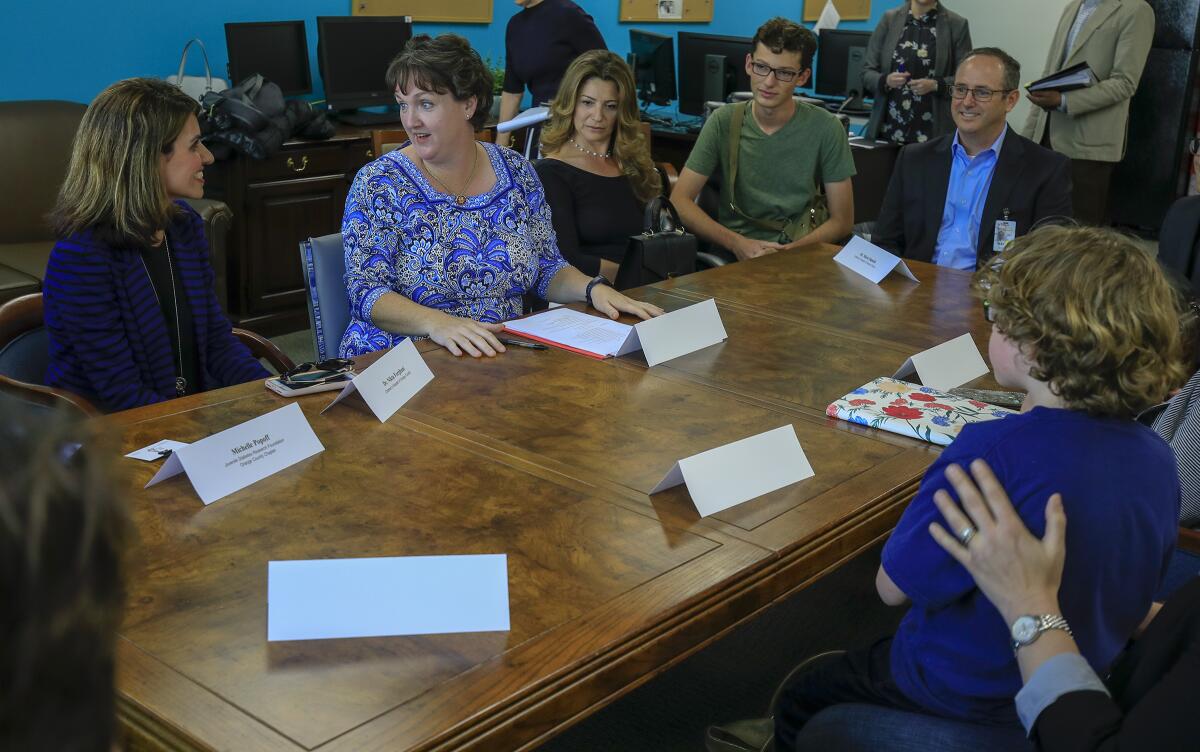
Then-Rep. Katie Porter meets with parents, doctors and diabetic patients in her Irvine office in 2019.
(Mark Boster / For The Times)
“She came in [to the governor’s race] as an outsider, as a mom, as a fighter. She wasn’t pulled into the establishment,” said Lorena Gonzalez, president of the California Federation of Labor Unions. “I think that’s why she’s popular with voters, because they want somebody who’s going to fight, and sometimes that ruffles feathers.”
In the campaign for governor, Porter, a single mother of three, has struggled to convert grassroots popularity into broader institutional support. Even after former Rep. Eric Swalwell dropped out of the race amid allegations of sexual assault, she has yet to see a major surge in support or endorsements from Democratic power brokers.
A pair of embarrassing videos continue to hang over her campaign. The videos, which surfaced in October, showed Porter yelling at a staff member and threatening to walk out of a television reporter’s interview.
As former U.S. Health and Human Services Secretary Xavier Becerra has ascended and she remained stagnant in polls following Swalwell’s exit, Porter has increasingly sought to redeem her image. She poked fun at the incident with her staffer in an ad, smilingly asking a group of whiteboard-wielding supporters behind her to “please get out of my shot.”
In recent debates, Porter has sought to play up the qualities that made her a standout among resistance-era progressives, needling former hedge fund executive Tom Steyer over his past investments in private prisons and the pressing Becerra for a “yes” or “no” on statewide single-payer healthcare. Porter emphasizes her support for single-payer healthcare, providing free child care and college tuition and making wealthy corporations pay their “fair share” in taxes.
Porter said she wants to increase taxes on the state’s wealthiest residents but doesn’t support the proposed billionaire’s tax ballot measure because it is a “one-time tax” that won’t solve the state’s underlying budget issues.
“I can’t believe, with [the] interrupting and name-calling and shouting and disrespect for everyone up here who’s stepping into public service that anyone wants to talk about my temperament,” she said during the May 5 debate on CNN.
Though she acknowledged she mishandled both caught-on-tape situations and said she apologized to the staffer, the videos hindered her early momentum and have undercut her efforts to make inroads with potential allies in the race.
Porter speaks at a gubernatorial candidates forum on Sept. 28, 2025, in Los Angeles.
(Carlin Stiehl / Los Angeles Times)
Influential lawmakers, labor groups and party insiders have coalesced behind Becerra and Steyer, her top Democratic rivals.
Porter has scored some key endorsements. She is one of three candidates backed by the California Federation of Labor Unions, along with Steyer and former Los Angeles Mayor Antonio Villaraigosa. She also has support from Teamsters California, the National Union of Healthcare Workers and progressive groups such as Emilys List and California Environmental Voters, which dual-endorsed her and Steyer.
Union support is pivotal for Democratic candidates in California, sending a clear signal that they support the priorities of working-class voters. For Porter, who has proudly refused to accept corporate donations throughout her political career, the labor endorsements also help her attract the small-dollar donations that are essential to her campaign.
While in Congress, Porter proved to be a prodigious fundraiser. In her last reelection campaign for the House of Representatives in 2022, she raised more than $25.6 million in contributions — the second-most in Congress, behind only Bakersfield’s Rep. Kevin McCarthy, who was then the House Republican leader.
Still, her backing from elected Democrats remains comparatively thin. Along with her mentor, Sen. Elizabeth Warren (D-Mass.), just three members of Congress have endorsed her gubernatorial bid: Reps. Robert Garcia of Long Beach, Dave Min of Irvine and Derek Tran of Huntington Beach. She also picked up an endorsement from Assemblywoman Cottie Petrie-Norris (D-Irvine) after Swalwell dropped out.
Though none would speak publicly, multiple sources who work in and around the state Capitol expressed concerns about Porter’s temperament and her willingness to work collaboratively with people she disagrees with.
“Katie Porter hurt herself big time because she needs anger management and she doesn’t have the temperament” to be governor, Democratic former Sen. Barbara Boxer said during a recent interview with NewsNation’s Leland Vittert.
Through her campaign spokesperson, Porter’s declined to be interviewed for for this story.
Porter questions Tim Sloan, president and chief executive officer of Wells Fargo, during a House Financial Services Committee hearing in Washington in 2019.
(Andrew Harrer / Bloomberg)
Defenders argue the backlash reflects a double standard for women in politics — a salient point in a state that, despite its liberal reputation, has never elected a woman as governor.
“Sacramento sizes up every gubernatorial candidate the same way: Can they win, and is this someone I actually want to work with?” said Elizabeth Ashford, a Democratic consultant who is not working with any of the candidates running for governor. “The videos showed an angry woman, and for a lot of people that translated to ‘I don’t want her as my boss.’
“It’s a double standard that dogs women in politics. Jerry Brown was famous for his loud, unfiltered outbursts and nobody questioned whether he was up to the job,” said Ashford, who served as the former governor’s deputy press secretary.
Gonzalez agreed, arguing that women who stand up for themselves “are often labeled as ‘difficult.’ Probably a lot of people think I’m difficult,” the labor leader added with a laugh.
Born in Iowa, Porter often connects her politics to her family’s financial struggles after losing their farm during the 1980s farm crisis. She earned degrees from Yale and Harvard, where she studied bankruptcy law under Warren. In 2012, while working as a law professor at UC Irvine, Porter was appointed by then-Atty. Gen. Kamala Harris to oversee California’s $18-billion mortgage settlement.
After defeating Republican incumbent Rep. Mimi Walters in 2018, Porter quickly emerged as one of the Democratic Party’s most recognizable progressives. Armed with a whiteboard and other visual aids in congressional hearings, she confronted banking and pharmaceutical executives over drug prices, consumer debt and corporate profits.
The props, theatrical at times, seemed to aggravate Waters, then the Democratic chairwoman of the Financial Services Committee. On several occasions, Waters sided with Republicans who challenged Porter’s use of visual and audio aids during hearings.
“Please do not raise your board. We’ve talked about this before,” the chairwoman scolded when Porter tried to hold up a “Financial Services Bingo” card during a 2019 hearing on debt collection. (She later got to show the board on “Late Night with Seth Meyers.”)
Eager to force change they campaigned on, Porter and other freshmen, including members of “The Squad,” at times clashed with Pelosi and other Democratic leaders.
Porter speaks to volunteers while campaigning in Mission Viejo in 2018.
(Victoria Kim / Los Angeles Times )
Porter has slammed lawmakers, including Democrats, for stock trading and funneling earmark funding to their home districts, arguing that such practices breed corruption and mistrust in Congress. The critiques irked Pelosi, a powerful force in California politics.
In her second term, the Orange County Democrat lost her coveted spot on the Financial Services Committee after she listed it as her third choice and requested a waiver to stay on it. Typically, members prioritize such high-profile committees and request waivers to serve on lesser ones in addition. The move was seen as a risk, the result a check on Porter’s ambition.
“So many of us, regardless of ideology, run on ‘shaking up Washington.’ But then when you actually come here, there’s a lot of consequences for doing that,” Rep. Alexandria Ocasio-Cortez (D-N.Y.) told The Times after Porter lost the committee position.
Porter’s willingness to buck party norms also raised eyebrows during her Senate campaign, when she entered the race for Sen. Dianne Feinstein’s seat before Feinstein had announced retirement plans in early 2023. Although then-Rep. Adam Schiff also launched an early campaign, he did so only after privately seeking Feinstein’s blessing. She ultimately finished third in the primary.
Her decision to run for Senate did not ingratiate her with Washington’s Democratic leadership. The party was forced to spend millions to ensure another Democrat was elected to her contested Orange County congressional seat, and Schiff, her top rival in the race, was a close ally of Pelosi — who endorsed him — and helped lead the first impeachment effort against President Trump.
Controversy surrounding Porter’s personal relationships have also surfaced during previous campaigns. In 2024, she obtained a five-year restraining order against a former boyfriend who she said bombarded her and her children with threatening messages.
When a whisper campaign about the end of her marriage threatened her first House run, Porter shared details of her 2013 divorce with the Huffington Post, including that her ex-husband, Matthew Hoffman, physically intimidated and verbally abused her. Hoffman also claimed to be the victim of abuse, including an incident in which Porter allegedly threw hot mashed potatoes at him. Both filed for restraining orders and sought anger management during the divorce.
Former employees have also rallied to her defense. In an open letter last month, 30 former staffers described Porter as a “workhorse” who “asked of us what she expected of herself.”
“She demanded a lot, but she also fought for us, mentored us, and stood by us when life got hard,” the former aides wrote. “We believe the public should understand the full person we know, not a caricature built from a few clips on a bad day.”
Porter has argued that voters are looking for someone willing to challenge powerful interests rather than accommodate them.
Katie Porter is interviewed after the California Gubernatorial debate at Skirball Cultural Center on Wednesday.
(Jason Armond/Los Angeles Times)
“It’s on me to keep campaigning and keep demonstrating that,” she told reporters after a recent gubernatorial debate in San Francisco. “It’s also not lost on me that the last time the Democratic Party had a woman nominee for governor was 1994, when I was in college.”
The affordability crisis is at the forefront of the race to replace term-limited Newsom. As a single parent, Porter argues she is acutely aware of gas and grocery prices — as well as higher-stakes consequences.
She described feeling shocked when, during a recent conversation with her 17-year-old son, he asked if she would visit him if he moved to another state.
“I said, ‘Paul, you love California, why would you leave California?’ And he said, ‘Well, I’m thinking I might want to have a family and I might want to have a house, and I know that means I’ll have to leave California,’” Porter recounted at a March forum hosted by the California Assn. of Realtors. “We need to be a state that doesn’t just retain people like my son … but welcomes new families.”
The centerpiece of her proposed “affordability solutions” are free child care, free tuition at UC and CSU schools for students who complete two years of community college, and ending income taxes for those who earn less than $100,000 — an idea she acknowledges she “stole” from Republican candidate Steve Hilton. “I will take a good idea anywhere I can get it,” she said at a recent forum.
To pay for it, Porter would impose a progressive corporate tax, meaning more profitable businesses and corporations would pay a higher rate. A less than 1% tax hike on businesses that earn hundreds of millions in profit would bring in around $8 billion, according to her website.
“I think she deeply and personally understands the everyday struggles that so many Californians are grappling with right now,” said Petrie-Norris, who last month became the first state legislator to endorse Porter.
While Petrie-Norris describes herself as more politically moderate than Porter, the Irvine assemblywoman praised her as a “pragmatic problem-solver” and “proven fighter” who has taken on corporate interests and the Trump administration.
For a while, Porter was one of four women among the major candidates running for governor. One by one they have dropped out of the race, citing difficulties raising money and support.
After sharing the debate stage with five men recently, Porter was asked whether California is ready for a female governor.
The last time the Supreme Court threatened to end access to the country’s most popular abortion method, California’s network of online providers and their pharmaceutical suppliers scrambled to respond.
Now, with the fate of the cocktail used in roughly two-thirds of U.S. terminations once again in the balance, they’re not even breaking a sweat.
Dr. Michele Gomez, co-founder of the MYA Network, a consortium of virtual reproductive healthcare providers, said the supply chain is “ready to switch in a day” to an alternative drug combination.
“It’s not going away and it’s not going to slow down,” Gomez said.
On May 1, the 5th U.S. Circuit Court of Appeals ruled to block the drug mifepristone from being prescribed virtually and shipped through the mail, making such deliveries illegal across the country. On Monday, the Supreme Court stayed that decision, allowing prescriptions to resume until the court issues an emergency ruling next week.
Mifepristone is the first half of a two-drug protocol for medication abortion, which made up 63% of all legal abortions in the U.S. in 2023.
Between a quarter and a third of those abortions are now prescribed by healthcare providers over the internet and delivered by mail — a path Louisiana and other ban states are fighting to bar.
“Abortion access has gone up with all the telehealth providers,” Gomez said. “We uncovered an unmet need.”
But the cocktail’s second ingredient, misoprostol, can be used to produce abortion on its own — a method that’s often more painful and slightly less effective.
It would be easy for suppliers to switch to a misoprostol-only protocol — and much harder for courts to block it, experts said.
“We heard about this on Friday and organizations that mail pills were mailing misoprostol on Saturday,” Gomez said. “They already knew what to do.”
After the Supreme Court overturned Roe vs. Wade in 2022, California became one of the first states to enshrine abortion rights for residents in its Constitution and legislate protection for clinicians who prescribe abortion pills to women in states with bans.
Last fall, legislators in Sacramento expanded those protections by allowing pills to be mailed without either the doctor or the patient’s name attached.
But cases like the one being decided next week could still sharply limit abortion rights even in states with extensive legal protections, experts warned.
“Even though California has built a fortress around its own constitutional protections of reproductive freedom, those [protections] become vulnerable to the whims of antiabortion states if the Supreme Court gives those states their imprimatur,” said Michele Goodwin, professor at Georgetown Law and an expert on reproductive justice.
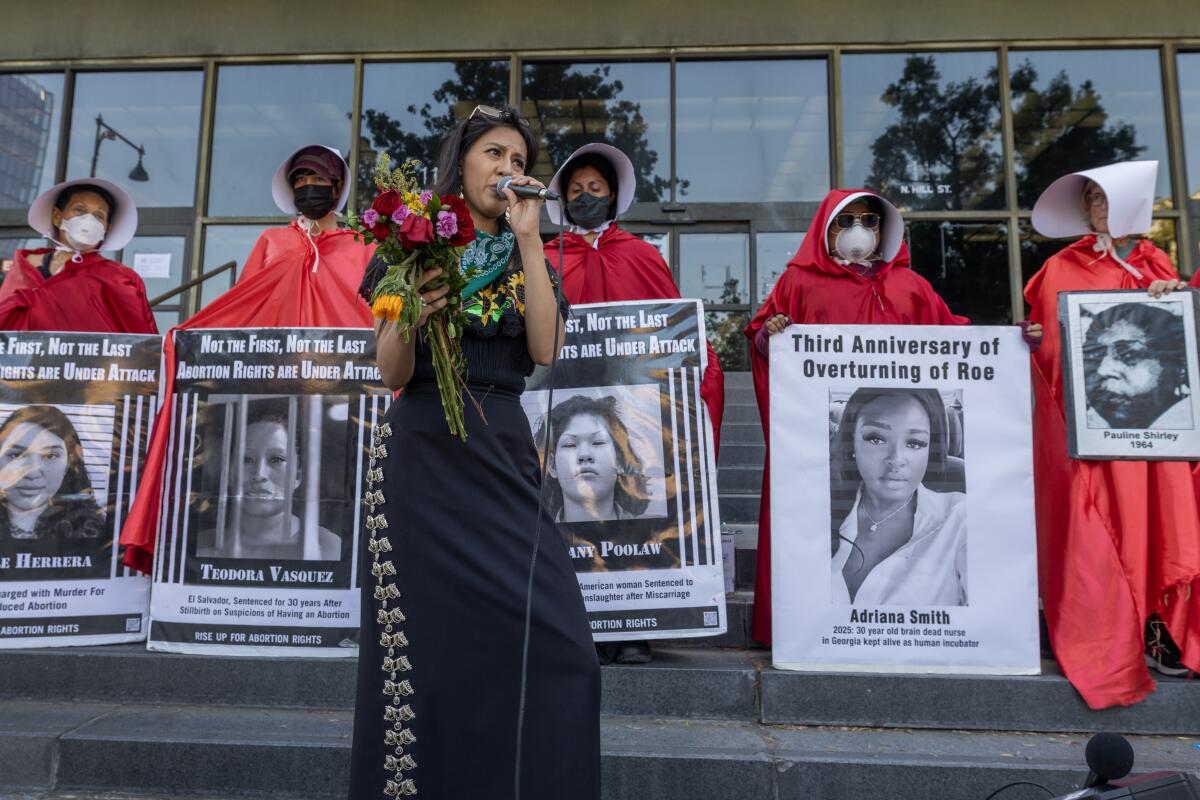
Coral Alonso sings in Spanish as protesters rally on the three-year anniversary of the U.S. Supreme Court decision overturning Roe vs. Wade on June 24, 2025, in Los Angeles. The ruling ended the federal right to legal abortion in the United States.
(David McNew / Getty Images)
Legal experts are split over how the justices will decide the medication’s mail-order fate.
“This is a case where law clearly won’t matter,” Eric J. Segall, a law professor at Georgia State University and an expert on the Supreme Court.
“In a very important midterm election year, I think there’s at least two Republicans on the court who will decide that upholding the 5th Circuit would really hurt the Republicans at the polls,” he said. “If women can’t get this by mail in California or other blue states where abortion is legal, it’s going to have devastating consequences, and I think the court knows that.”
But he and others believe it’s no longer a matter of if — but when and how — the drugs are restricted, including in California.
“This is curating a backdrop for a legal showdown that may surely come,” Goodwin said.
The court’s most conservative justices could find grounds to act in the long-forgotten Comstock Act of 1873. The brainchild of America’s zealously anti-porn postmaster Anthony Comstock, the law not only banned the mailing of the “Birth of Venus” and “Lady Chatterley’s Lover,” but also condoms, diaphragms and any drug, tool or text that could be used to produce an abortion.
Though it hasn’t been enforced since the 1970s, the antiabortion provision of the law remains on the books, experts said.
“The next move is with the Comstock Act, which Justices Alito and Thomas have already been hinting at,” Goodwin said. “In that case, it’s like playing Monopoly — we could skip mifepristone and go straight to contraception. The goal is to make sure none of that gets to be in the mail.”
That move would upend how Americans get both abortions and birth control, and put an unassuming L.A. County pharmacy squarely in the government’s crosshairs.
Although doctors in nearly two dozen states can safely prescribe medication abortion to women anywhere in the U.S., only a handful of specialty pharmacies actually fill those mail orders, Gomez explained. Among the largest is Honeybee in Culver City, which did not reply to requests for comment.
Even if the justices don’t reach for Comstock, a decision in Louisiana’s favor next week could create a two-tiered system of abortion across California and other blue states, experts said.
“The people this case hurts the most are the poor and the rural,” said Segall, the Supreme Court expert.
National data show that abortion patients are disproportionately poor. Most are also already mothers. Losing mail access to mifepristone would leave many with the more painful, less effective option while those with the time and means to reach a clinic continue to get the gold standard of care.
“There are fundamental questions of citizenship at the heart of this,” said Goodwin, the constitutional scholar. “Under the 14th Amendment, women are supposed to have equality, citizenship, liberty. It’s as though the Supreme Court has taken a black marker and pressed it against all of those words.”
For Gomez and other providers, that’s tomorrow’s problem.
“The lawyers and the politicians are just going to do their thing,” the doctor said. “The healthcare providers are just trying to get medications to people who need them.”
WASHINGTON — Louisiana’s state attorneys on Thursday urged the Supreme Court to stand aside for now and to uphold an appeals court ruling that would stop the mailing of abortion pills nationwide.
They blamed former President Biden for undermining the state’s strict bans on abortion and the Trump administration for slow-walking a study on the federal regulations that permit sending the pills through the mail.
The justices are likely to act soon on emergency appeals filed by two makers of mifepristone. They argued the pills have been shown to be safe and effective for ending an early pregnancy.
But last week, the conservative 5th Circuit Court of Appeals in New Orleans ruled for Louisiana and revived an earlier regulation that would require women to obtain the pills in person from a doctor.
The three-judge panel also took the unusual step for putting its order into effect immediately. On Monday, Justice Samuel A. Alito, who oversees the 5th Circuit, issued an administrative stay that will keep the case on hold through Monday.
The justices have to decide whether Louisiana had standing to sue over the federal drug regulations, and if so, whether judges have the authority to overrule the Food and Drug Administration.
Two years ago, the Supreme Court by a 9-0 vote dismissed a similar challenge to the abortion pills that came from the 5th Circuit. And Chief Justice John G. Roberts has said in the past that judges should usually defer to the federal agency that is responsible fo regulating drugs.
In response to anti-abortion advocates, Trump’s Health and Human Services Secretary Robert F. Kennedy Jr. agreed to have the FDA review the safety record of mifepristone.
It was approved in 2000 as safe and effective for ending early pregnancies. And in the past decade, the agency had relaxed earlier restrictions, including a requirement that pregnant women visit a doctor’s office to obtain the pills.
But the FDA said last month its review is far from complete.
In October, Louisiana Atty. Gen. Liz Murrill decided to bypass the FDA review and went to federal court seeking a ruling that would prevent the pills being sent by mail.
A federal judge refused to decide on the issue while the FDA was undertaking its review. But the 5th Circuit chose to act now. The Louisiana state attorney put the focus on the Biden administration.
When the Supreme Court was considering the Dobbs case, which overruled Roe vs. Wade and the right to abortion, “the Biden Administration was preparing a plan that predictably would undermine that decision,” she wrote in Thursday’s response.
“Although Louisiana law generally prohibits abortion and the dispensing of mifepristone to pregnant women, out-of-state prescribers—freed from the in-person dispensing requirement — are causing approximately 1,000 illegal abortions in Louisiana each month by mailing FDA-approved mifepristone into the state,” she said.
The Trump administration has yet to tell the court of its views on this case.
The NCAA announced Thursday that it will expand its two March Madness tournaments by eight teams each next season, a long-expected move that will drop more games into the first week of the highly popular and lucrative showcase without substantially changing its overall form.
The new, 76-team brackets will jam eight extra games — for a total of 12 involving 24 teams — into the front half of the first week of the men’s and the women’s tournaments. It will turn what’s now known as the First Four into a bigger affair that will now be called the “March Madness Opening Round.”
The 12 winners will move into the main 64-team bracket that will begin, as usual, on Thursday for the men and Friday for the women.
It is the first expansion of the tournaments in 15 years, when they were bumped to 68 teams each.
The NCAA said it will distribute more than $131 million in new revenue to schools that make the tournament. That money will come via expanded TV advertising opportunities for alcohol, the likes of which were previously restricted. It said the value of the rights agreement will increase $50 million each year on average over the course of the six years.
Most of the eight new slots are expected to go to teams from the power conferences that were already commanding the lion’s share of entries in the bracket. Two years ago, the Southeastern Conference placed a record 14 teams in the men’s bracket. Last season, the Big Ten had nine.
Keith Gill, the chairman of the Division I men’s basketball committee, called the expansion “a nice way to create some access but make sure we have the bracket we all love when we start Thursday at noon.”
The move is a product of the times, which includes massive expansion — the Atlantic Coast Conference, for instance, has grown from nine to 17 teams since 1996 — and the reality that mid-major schools with top-notch players will often see them plucked away by programs with bigger budgets and the ability to pay them through revenue sharing.
Cinderella? There will still be room for those stirring runs in the tournaments, though not a single mid-major advanced past the first weekend of either tournament the last two seasons.
This is hardly a concern of the decision-makers anymore, who will point to TV ratings that traditionally spell out fans’ preference for the likes of Duke and North Carolina over St. Peter’s and San Diego State, especially once the Sweet 16 starts.
What matters more to the biggest schools is that their teams have a chance to compete in what remains the best postseason in college sports and that they aren’t iced out by lower conference champions who earn automatic bids.
“You’ve got some really, really good teams who are going to end up in that 9, 10, 11 [seed] category that I think should be moved into the” 64-team bracket, SEC commissioner Greg Sankey said last year in discussing how he favored expansion.
Also, the money. The new beer and wine money will add to what the NCAA can distribute in “units” that are earned for placing teams in the bracket and then for every round those teams advance. Last year, that amounted to about $350,000 per unit for the men’s tournament. The Big Ten made nearly $70 million from both tournaments, won by conference members Michigan [men] and UCLA [women].
Leaders in the SEC, Big Ten, Big 12 and ACC have all acknowledged that smaller programs help make March Madness what it is, all the while steadily expanding their own power in NCAA decision-making. That brings with it the tacit threat of fracturing the single thing the NCAA does best — the basketball tournament.
This move might forestall that. What it isn’t expected to do is drastically change the TV deal beyond the advertising.
The current deal for the men’s tournament is worth $8.8 billion and runs through 2032. Adding a few extra games between mid-level Power Four teams on Tuesday and Wednesday won’t change that much.
One reason this took as long as it did was the NCAA negotiations with CBS and TNT, which themselves have been in negotiations over their own ownership.
The more drastic option of expanding the tournament to 96 teams or beyond would involve adding an extra week to a tournament that has thrived in part because of the symmetry of a six-round bracket that gets whittled down over three weeks.
That basic shell began in 1985, with only slight tweaks, the latest of which came in 2011 when it was upped to 68.
Events: Men’s baseball gold medal finals, women’s basketball gold medal finals, men’s soccer gold medal finals, swimming preliminary and tennis quarter final mixed doubles
Thoughts: ”My uncle made a spreadsheet. The tickets are for me, my uncle, friends and I’m hoping to take my nephew as well. I was 10 years old at the 1984 Olympics and got to go to gymnastics, swimming and closing ceremonies, and my nephew will be 10 in 2028. I know L.A. is going to have an amazing Olympics, we are Los Angeles! Ten million creative, beautiful people, always dreaming and we know how to wow people. I can’t wait and hopefully traffic is smooth, a glamorous sequel to ’84.”