Winnie-the-Pooh’s 100th birthday is a great excuse to explore the Sussex forest that inspired the books | Sussex holidays
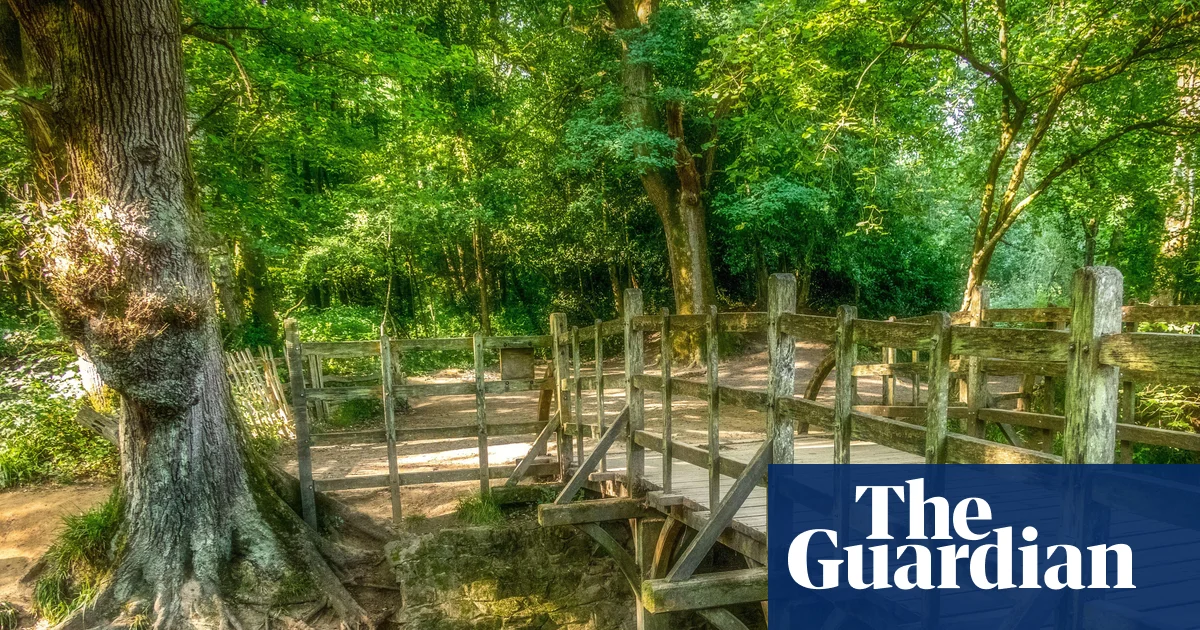
Deep in a medieval hunting forest, amid 6,500 acres of heathland, a wooden bridge spans a tributary of the River Medway. Every single day, no matter the weather, people flock to stand on its slats and cheer on sticks as they float downstream.
I know this because on a frosty but sunny morning, (“a very long time ago now, about last Friday”, as children’s author AA Milne might have said), I stood with two such adults jumping up and down with delight as my little piece of oak stormed ahead and won the race.
The game is Pooh Sticks, originally described by Milne in Winnie-the-Pooh, which was published in 1926. It was inspired by the game he and his son, Christopher (Robin), would play on Posingford Bridge in Ashdown Forest (AKA the Hundred Acre Wood) in East Sussex. Just 30 miles south of London, this sprawling open heathland lies within the High Weald Area of Outstanding Natural Beauty.
To mark the 100th anniversary of the book, a programme of free cultural events is planned for this summer in the forest and throughout the county. Highlights include a series of interactive performances by “the Curious Adventurer”, a puppet brought to life by 10 puppeteers. Five new walks themed around different species are launching too, encouraging people to visit more of the forest.
I joined ranger Beth Morgan to explore the real places inextricably linked to the make-believe world where Christopher Robin once played. The bridge is a short walk from the 16th-century farmhouse known as Cotchford Farm where Milne once lived (now an Airbnb), and easily accessed from the public car park off Chuck Hatch Road. “That,” Beth said as we passed a small red wooden door, tucked into the lower roots of a tall, moss-covered birch tree, “is Piglet’s house; Pooh-lovers have added them along the path.” I felt as if I was walking into a storybook.
For fans of the book – and later Disney cartoons – the easy-to-follow 2.5-mile (4km) stroll to Pooh Sticks Bridge is the most popular. Just beside the bridge is Pooh’s postbox, which usually contains offerings of honey that visitors leave for the sweet-toothed bear.
The way Milne captured the magic of this place has been key to helping preserve it. “The low heath habitat we have here is rarer than tropical rainforest,” said Beth. “And people’s interest in it – thanks to the Pooh connection – is what has brought in funding to help conserve it.”
Until Brexit, the forest received about £500,000 a year from EU grants; now it is constantly short of funds. But the hope is that the anniversary plans and new walking trails will help bring more people and donations to the area.
One surprising thing about the forest is that back in Milne’s day just 10% of this open heathland would have been woodland. Now it’s 40%, meaning that trees and gorse are actually encroaching on the ancient landscape, which presents the biggest challenge and cost.
A 20-strong herd of free-roaming ponies, along with Galloway cattle and Hebridean sheep, help manage it. As I watched them meandering slowly through the bracken munching on gorse and saplings, I couldn’t help but picture Eeyore, the grumpy donkey from Winnie-the-Pooh.
Suitably, my next stop, Pooh Corner, a former post office in the village of Hartfield to the north of the forest, was actually visited by the real Eeyore (Christopher’s real-life donkey Jessica). It’s now a cafe, gift shop and museum. “So many people have either grown up watching the movies or reading the books,” said owner Neil Reed as I tucked into a pile of honey-laden treats, “but really the fascinating story is the one where we learn what happened beyond the pages – who the father and son really were.”
His small museum tells that story, through school photos of Milne, newspaper cuttings (including the first Pooh story, which was published in London’s Evening News on Christmas Eve 1925) and even a note from Milne’s former science teacher HG Wells. Also on display are the understated illustrations of EH Shepard and the more gaudy souvenirs made by Disney, who acquired the rights to Pooh back in 1961.
After my deep dive into Pooh history, I checked into Helix, a new cabin from Unplugged and Healf, on the Buckhurst Estate close to the forest. With its own wood-fired sauna and ice bath, and huge picture windows making the surrounding trees part of the bedroom walls, the emphasis is on bringing the outdoors indoors.
The following day I discovered perhaps the most enchanting thing about Ashdown Forest – that the place hasn’t been Disneyfied. The only real mention of Pooh is on the official Long Pooh Walk from Gills Lap, a 2-mile circular (a route map is available from the Ashdown Forest Centre or online for 50p). And even on that route there are no cutesy bear faces, just a sweeping sandy plateau, punctuated by clumps of trees, AKA the Enchanted Place, and clusters of heather.
Over the next couple of hours I took my time, wandering with map in hand, visiting the Gloomy Place – where Eeyore lost his house (and Christopher Milne’s donkey was put out to pasture), the Heffalump Trap (a striking lone pine with views over the Weald), Roo’s Sandy Pit (a white sand quarry) and ending with a pause at the Milne and Shepard Memorial.
Later that afternoon, I walked from my doorstep to Birchden Vineyards a few miles away. I sampled some of the white and sparkling wine varieties the family-run winery is known for, as well as apple juice and raw, unfiltered honey made by bees who feed on the flora of Ashdown Forest. Pooh would have approved.
On my final day, I decided to take a lesson from the bear I’d been following and do nothing at all. I spent the day at my cabin – where you are encouraged to lock up your mobile phone to be properly off-grid. I sat outside and listened to the call of a warbler, the tap-tap-tapping of a woodpecker and, as night fell, the hoot of an owl. I lay in the sauna and watched a family of fallow deer wander by as though I was invisible, and later I shrieked like Tigger as I plunged into an ice bath under a sky filled with stars.
Winnie-the-Pooh once said: “We didn’t realise we were making memories. We just knew we were having fun.” Perhaps, I mused, as the last of the light faded, he wasn’t such a silly bear after all.
The trip was provided by Visit England and Explore Wealden, with accommodation in Helix: The Wellbeing Cabin with Healf provided by Unplugged. Three nights from £660. For more information about Ashdown Forest and the Winnie-the-Pooh celebrations, see ashdownforest.org.