Winehouse

Fifteen years on from her passing, the love for Amy Winehouse and her music only gets stronger and deeper

JULY 23, 2011, was one of those days when most of us remember where we were.

It was the day Amy Winehouse died.

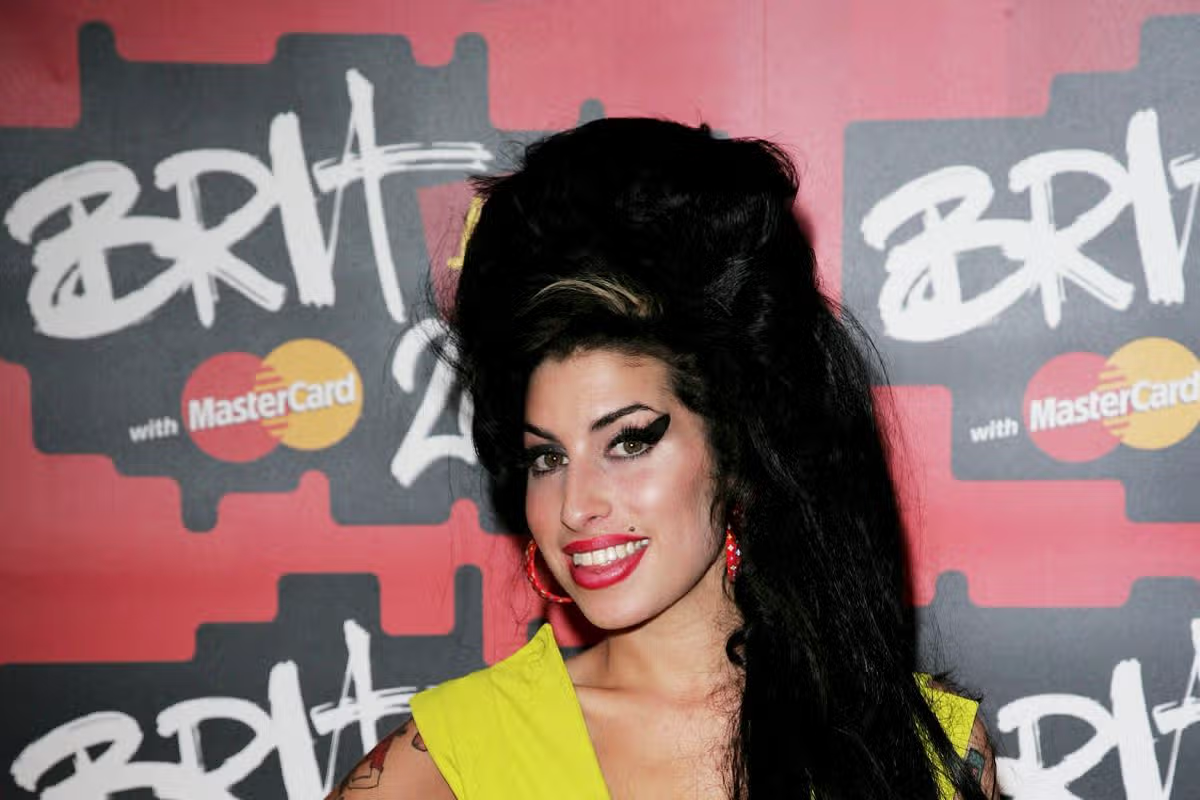
Amy in a 2006 shoot for the NME Credit: CAMERA PRESS/Dean Chalkley / NME
Free spirit Amy on stage in Cambridge in 2007 Credit: Geoff Robinson/Shutterstock

In my case, it was a music festival in Gateshead on the banks of the river Tyne.

The tragic news spread through the crowd like wildfire that balmy late Saturday afternoon.

The initial reaction was a combination of shock and dismay at the loss of Britain’s finest female singer.

But, for me and for those I spoke to that day, there was also an air of inevitability about Amy’s death at 27, joining an unwanted “club” with Jimi Hendrix, Janis Joplin, Jim Morrison and Kurt Cobain.

Read more on Amy Winehouse

MADE BY AMY

How Amy Winehouse inspired today’s biggest stars 15 years after tragic death


‘OWN ENEMY’

Amy Winehouse was a lost jewel – I tried to help in last chat, says Ronnie Wood

She was a shooting star, burning bright for a fleeting moment and then she was gone.

Fifteen years on from her passing, the love for Amy and her music only gets stronger and deeper.

She had the voice, the image, the songs, the wit, the heart and the soul — but the story she told through her music was also filled with pain.

Her second album Back To Black charted in unflinching detail her turbulent relationship with Blake Fielder-Civil as well as her persistent problems with alcohol.

Of course, it scored an emotional bullseye with her listeners, becoming a ­Grammy-grabbing chart-topping sensation.

Rehab, You Know I’m No Good, Love Is A Losing Game, Tears Dry On Their Own and the title track are all indelibly etched into our collective consciousness.

Though she drew comparisons with some of the greatest soul/jazz voices — Billie Holiday, Sarah Vaughan and Etta James — there has been nothing quite like Back To Black before or since.

With that rich expressive contralto, she could hold us in the palms of her outstretched hands.

Amy with Mark Ronson at the Brits in 2008 Credit: UK Press via Getty Images
Amy with her bassist and close friend Dale Davis Credit: supplied

In 2004, the year after she released her debut album Frank, Amy, then 20, was asked by Jonathan Ross if music industry types had told her to change the way she looked or spoke or behaved.

“Yeah, one of them tried to mould me into a big triangle shape,” she replied, laughing and forming a triangle with her ­fingers. “And I went, ‘Nooo’.

“I’ve got my own style and I write my own songs. If someone has so much of something al­ready, there’s very little you can add.”

When she chatted to my SFTW colleague Jacqui Swift to mark Back To Black’s release, Amy, 23 by then, opened up about her inspirations while also displaying more of a fiercely independent nature.

She described reaching her lowest ebb and being begged by management to go into rehab, to which she famously responded “No, no, no!”

“Rehab is like Butlin’s — it’s a holiday camp,” she said. “It’s an everyday thing for some people, like going to Tesco’s.”

She elaborated further: “I was having a particularly nasty time with things and just drinking and drinking.

“My management decided to stop buying for me and said they were taking me to rehab. I asked my dad (Mitch) if he thought I needed to go. He said: ‘No, but give it a try.’

“So I did, for 15 minutes. I went in, said hello, and explained that I drink because I am in love and have f***ed up a relationship. Then I walked out. I didn’t need help because, if I can’t help myself, I can’t be helped.”

Five years after she aired those feelings, Amy lost her life at her house in Camden, North London, the coroner recording a verdict of “death by misadventure”, an unintended consequence of heavy drinking after a period of sobriety.

The tragedy led to acrimony and blame games around why she wasn’t given enough support.

Blake, her family and record company execs were all in the firing line at various times.

Some believed it was her own self-destructive nature — but it is Amy’s voice and songs that define her legacy.

Musically, she and legendary “Godmother Of Punk” Patti Smith had little in common apart from their raw, honest approach and unbridled spirit.

But soon after Amy died, Patti recorded a heartfelt tribute in the form of a poem set to music, beginning with the lines, “This is the girl for whom all tears fall”.

During a trip to London, she told me: “I’m heartbroken as a fan and as a human being.

“What Amy did was magnificent and I had been looking forward to see how she would evolve. It would have been wonderful to go through life hearing what Amy did next.”

Though Patti vividly remembered herself at Amy’s age, wild and impulsive, This Is The Girl came from a different perspective.

“I actually looked at Amy in a maternal way, she was a similar age to my kids,” she said. “I was very concerned about how things were managed around her.”

What to her, I asked, was so special about Amy’s music?

Singer Amy’s flame still burns as bright as ever Credit: Getty
Amy’s legacy is plain to witness through those who followed in her wake Credit: Getty

“I loved Joan Baez when I was young and Darlene Love and all the R&B singers,” said Patti. “I really love Adele’s voice but Amy was a cut above us all I think.

“She had a gift you seldom hear. There was an authenticity to her voice. She understood R&B and jazz from the deepest part of her. It was organic.

“Not only did Amy have that thing from the Forties, Fifties and Sixties but she was modern. When she sang Rehab or Back To Black, she wasn’t stuck in the past or nostalgic.”

In 2026, Amy’s legacy is plain to witness through those who followed in her wake, including fellow BRIT School alumni Raye and current chart favourite Olivia Dean.

Just as she was breaking through, Olivia paid this tribute to her fellow Londoner: “I don’t think Amy had any interest in being a pop star — she just wanted to be herself.

“It was clear in her music that she was using it as a form of therapy and then we just so happened to be hearing it. It was so personal.”

Of Back To Black, she added: “My interpretation of the lyrics is that you can’t have all of her. Amy was a free spirit. We were very lucky to have her.”

Another BRIT School success story, Adele, had this to say: “Amy paved the way for artists like me. She made people excited about British music again.

“I don’t think she ever realised just how brilliant she was and how important she is.”

From the States, where Back To Black was equally huge, Lady Gaga gave a typically singular view: “I don’t believe what I do is very digestible and somehow Amy was the flu for pop music.

“Everybody got a little bit of the flu — and fell in love with Amy Winehouse. And now, when more flu comes along, it’s not so unbearable.”

Lana Del Rey, a singer like Amy known for her retro styling, said: “I believe in Amy Winehouse. I know she’s not with us any more but I believe in who she was, and, in that way, she got it right.”

As if to prove that Amy’s flame burns as bright as ever, the Rolling Stones recorded her You Know I’m No Good for their recent No1 album Foreign Tongues.

Guitarist Ronnie Wood told me that he, Mick Jagger and Keith Richards jumped at the chance to pay their respects.

“Amy was such a jewel,” he told me last month. “A very lost jewel in a jewell­ery box but she was ­wonderful.”

Ronnie remembered how he had provided a shoulder to cry on “shortly before she died”.

“She was asking me, ‘Oh Ron, what am I going to do? And I was going, ‘Don’t worry because everyone knows you’ve got vodka in your water bottle. Just don’t hide it and try to go on stage tonight’.

“Amy needed a carer or else she went off the rails.”

But Ronnie also recognised her stellar talent and added: “She was like Billie Holiday. She had that once-in-a-lifetime deep blues.”

Back To Black co-producer Mark Ronson told SFTW: “Amy was an incredible singer. She had so much power in that tiny frame.

“I was so spoilt because everything she was coming out with was so spectacular.”

Salaam Remi, who worked on both of her studio albums, gave us a wonderful insight into Amy’s playful character.

He said: “She was one of those people who could make you cry with laughter — or say something deep. Her character was a big part of her talent.

“She cleaned my kitchen one time and it was better than any cleaning lady.

“It was three or four shades whiter when she’d finished. She said, ‘I’m meant to be a Jewish mum, of course it’s sparkling.’ ”

One of Amy’s final recordings was with the last of the legendary crooners, Tony Bennett.

She was so nervous that there were several false starts before they nailed the sultry jazz standard Body And Soul.

It was typical of Bennett’s kind manner that he was able to put his duet partner at ease.

He said afterwards: “People think that anyone can sing jazz, but it’s a spirit you’re born with . . . or not. Amy was born with that spirit.”

It’s also important to salute Amy’s striking image, developed during the Back To Black era in step with her Sixties girlband influences such as The Shangri-Las — her sky-high bee­hive, that winged cat-eye make-up and those daring halterneck minidresses.

She once said: “I’ve always had my own style. I’ve always been different.

“I don’t like to wear anything that anyone else is wearing because it’s very important for me to make a statement.”

In her short life Amy made a statement — and then some.

The last words are with Dale Davis, her bass guitarist and musical director who still leads The Amy Winehouse Band on its frequent tours.

He told me: “For a long time I was her favourite person to go anywhere with — then I was second after Blake. After they split up, I was back to being her favourite person.

“If she liked you, she really liked you. If she loved you, she loved you hard.

“She was a warm, beautiful, generous person who made me feel special right from the off.”

Dale estimated they played around 170 shows together, the last being a desperate performance at an outdoor venue in Belgrade in June 2011.

“That final one was my most difficult night on stage,” he said. “To this day, I can’t believe we played for an hour and 20 minutes.

“It was a funny thing with Amy because I thought she only needed to take one step to be happy, but that step was too difficult. She was never far from being OK.”

Amy and Dale’s final conversation took place by phone on the night she died at her Camden townhouse.

Clearly finding the memory painful, he recalled: “I talked to her at 11.30pm, three hours before she went to bed. She was on good form.

“She said, ‘Dale, I’ve just been watching myself on YouTube and I can sing, can’t I?’.

“I replied, ‘Of course you can sing. You’re the best’.”

Source link

How Amy Winehouse inspired some of today’s biggest stars as her legacy continues to grow 15 years after her tragic death

IT was 15 years ago today that the shocking news broke that Amy Winehouse had died, aged just 27.

She had released just two albums during her eight-year career, but her massive success and larger-than-life character meant her death sent shockwaves around the world — and today her impact on culture is more apparent than ever.

Amy Winehouse died 15 years ago aged 27, but her influence on music and culture continues to grow Credit: Camera Press
Raye says Amy’s impact is ‘irreplaceable’ and no one can match what she achieved Credit: Shutterstock Editorial

In music, fashion and art, she has inspired an entire generation of artists. British music is being dominated by women whose sound, style and brand is packed with references to the late superstar.

In recent weeks rapper Cardi B and actress Zendaya have been spotted dressed like Amy, with her trademark beehive hairdo.

And one artist who is frequently compared with Amy is Raye, who, much like the late singer, has become a celebrated industry darling, thanks to her brassy Motown influences and brutally truthful lyrics.

But Raye feels the weight of comparison more than most, and said: “I’m aware that what she did is irreplaceable and inimitable.

WORTHY SIGNING

‘Amazing’ Brit pop star lined up to headline Glasto alongside Harry Styles


SHAK OF THE NET

Shakira makes history as Dai Dai tops Spotify’s global music video chart

“Amy did it so well that no one can ever do what she did. And, God rest her soul, she gave her whole life for us to enjoy the music that she left behind.”

Like Amy, Raye went to South London creative arts academy The Brit School, whose starry former pupils also include Adele and Olivia Dean.

Raye recalled her years at the school, and how she would walk down the corridors and see photos on the wall of alumni such as Amy and say: “That’s gonna be me one day.”

Amy’s star certainly burned brightly, but all too briefly. Her body was discovered at her home in Camden, North London on July 23, 2011, by her security guard Andrew Morris.

Toxicology reports later revealed her blood alcohol content was five times the legal drink-drive limit, and the coroner’s report stated her “sudden and unexpected” death was caused by misadventure due to alcohol poisoning.

Amy had battled drug addiction for years, inspiring her 2006 single Rehab, but she had got clean from illegal substances before she died.

Lola Young echoes Amy Winehouse’s gritty London style and shares the Rehab star’s former manager Credit: Getty
Billie Eilish says Amy ‘changed a whole generation of music’ and inspired countless artists Credit: Getty

As a fiercely unapologetic woman in the music world, she blazed a trail for a new way to be an artist — and for future star Lola Young, who was just ten years old when Amy died, she was an inspiration.

The One Thing singer carries a gritty London identity similar to Amy’s and produces familiarly confessional lyrics.

She is even managed by Nick Shymansky, the same industry executive who guided Amy’s career during her breakout success.

After Amy, he swore he would never manage another artist, but was so won over by Lola’s talent — and subtle similarities to Amy — that he decided to take her on, and she has since sold millions of records.

When Amy found fame in the Noughties the music landscape was dominated by indie and processed pop, but she forged a new path with her neo-soul, Sixties pop and jazz sound — and now that sound is everywhere.

Olivia Dean’s easy-listening collection The Art Of Loving is on course to be the biggest-selling album in the UK this year, despite the fact it was released last September.

And even more recently, British newcomer Sienna Spiro has followed Amy with her vintage aesthetic and her breakout single Back To Blonde — mirroring Amy’s 2006 album and single Back To Black.

It is paying off, as last week Sienna shot to No2 in the charts with her debut album Visitor.

The impact of Back To Black, Amy’s second album, was felt worldwide. With classic songs such as Rehab and Tears Dry On Their Own, it became the fifth best-selling album of the 21st century so far, shifting 20million copies.

Amy sang about toxic co-dependency, addiction, dating disasters and her flaws, all in graphic detail, then wrapped them up in palatable and catchy songs.

Olivia Dean’s Amy-inspired album The Art Of Loving is on course to be the UK’s biggest seller this year Credit: Shutterstock Editorial
Mark Ronson says writing Back To Black with Amy changed his life forever Credit: Getty

It was all the more interesting for listeners, as her tumultuous personal life, including a rollercoaster relationship with her boyfriend and then husband Blake Fielder-Civil, and her drug use, became front-page news.

The saga taught lessons to youngsters such as future superstar Billie Eilish, who saw the tragedy unfold as she was growing up in California.

She said: “The things that inspire me about Amy are also the kind of things that are sad about it.

“You knew she wasn’t doing anything that she did for attention or in a weird, fake way because from what I gather, she didn’t really want that s**t, you know.

“It showed me that she was kind of raw for what she was creating, and she wasn’t trying to be anything she wasn’t, because she didn’t even want to be that.

“She changed a whole generation of music. Everyone, when listing off the people that inspired them, Amy Winehouse is always in that list.

“Everything about her, she just mixed a whole bunch of stuff together, and created the most beautiful things.”

And it’s not just female fellow stars who are Amy’s admirers.

Mark Ronson, who produced her Back To Black album and co-wrote the song of the same name, has credited Amy with his entire career.

Accepting the Outstanding Contribution to Music prize at February’s Brit Awards, he said his multiple chart-topping collaborations with other artists would never have happened if it wasn’t for her.

Sienna Spiro released Back To Blonde mirroring Amy’s 2006 hit Credit: Getty
Rapper Cardi B shows off her new Amy-style hairdo Credit: Getty

He said: “I realised on the way here that on Thursday, March 6, it’ll be 20 years to the day that Amy Winehouse came up to my studio in New York City. We went upstairs and talked for four hours and that night we wrote Back To Black, and that day changed my life for ever.”

Mark has since gone on to sell millions of records by working with superstars such as Lady Gaga, Bruno Mars and Miley Cyrus.

But he added: “I know the music I made with Amy is the reason any of them know who I am anyway. That’s why I’ll always treasure her voice, her talent, our bond, all of it.” And this month The Rolling Stones have celebrated Amy’s legacy by covering her song You Know I’m No Good on new album Foreign Tongues.

Guitarist Keith Richards said: “Loved the song. Always thought that Amy was a sad story in many ways, but she was one of the best to come out of England, and probably had so much more potential.”

Such was her star power, she shared the stage with the Stones at the 2007 Isle of Wight Festival, covering the Temptations’ Ain’t Too Proud To Beg, just four years after releasing her debut album Frank.

Street artist Pegasus was a close friend of Amy’s and launched his career on the day she died.

He has since become famous for his stencilled portraits of the singer, such as his “Fallen Angel” mural near Camden Lock, close to where they used to hang out.

Pegasus, whose real name is Chris Turner, told The Sun: “Amy was one of those people who come along every so often, makes a massive impact, unfortunately isn’t around for long but leaves a lasting legacy.

Her light will always shine bright. Her unique style, her love for the greats, like Etta James, Billie Holiday and Nina Simone, introduced and inspired a generation of artists that came after her.

“I am always seeing bits of Amy everywhere and it makes me so proud.”

Source link

Amy Winehouse was a lost jewel

THE Rolling Stones and Amy Winehouse — somehow it was a match made it heaven.

On June 10, 2007, the original rock and roll miscreants invited the supremely gifted but wayward singer on stage at the Isle Of Wight Festival.

Ronnie Wood opens up about his close friendship with Amy calling her ‘a very lost jewel in the jewellery box but she was wonderful’, above Ronnie with Amy in 2007 Credit: Richard Young/Shutterstock
Now the Stones are releasing a cover of Amy’s You Know I’m No Good, above Ronnie, Mick and Keith now Credit: Unknown

Amy was all the rage that summer with her second (and final) album Back To Black riding high in the charts. Britain and the world had taken her songs to their hearts — Rehab, You Know I’m No Good, Tears Dry On Their Own and Love Is A Losing Game among them.

At the festival, Amy wore a pristine white shirt, skinny black jeans, a chunky belt, ballet flats and THAT towering beehive.

She looked every inch at home next to the man with all the moves, Mick Jagger — a lean, sinewy T-shirted figure in an all-black outfit.

Together, they belted out a wild rendition of The Temptations’ soul classic Ain’t Too Proud To Beg.

Together, they perfectly captured the rebellious spirit of rock and roll.

When Amy died four years later aged just 27, the world lost a generational talent — a sultry, emotionally wrought voice for the ages.

Now, in 2026, the Stones are releasing a cover of Amy’s You Know I’m No Good on their vibrant, age- defying 25th studio album, Foreign Tongues.

I’ve had the chance to speak to guitarist and lovable rogue Ronnie Wood about the song, his close friendship with Amy — and all things related to the eclectic 14-track album.

By Stones standards, it’s a rapid-fire follow-up to 2023’s Hackney ­Diamonds and a freewheeling ­confection of rock, soul, dance, country, blues and balladry.

“We just loved to pay tribute to Amy because she was such a jewel,” Ronnie says with typical warmth.

“A very lost jewel in the jewellery box but she was wonderful.”

At the time of Isle Of Wight, Ronnie was still battling alcohol addiction himself and he discovered an immediate bond with troubled Amy.

“We came back on the ferry together and had such a laugh,” he recalls. “Then shortly before Amy died, I had a real in-depth [chat] with her in the garden of a hotel in Rio.

“She was asking me, ‘Oh Ron, what am I going to do? And I was going, ‘Don’t worry because everyone knows you’ve got vodka in your water bottle. Just don’t hide it and try to go on stage tonight.

“Her band pleaded with me. They went, ‘Ronnie, please get her to go on — she’s trying to pull out of the gig.’ Anyway, I talked her through stuff and she did go on.”

“Amy needed a carer all the time otherwise she went off the rails, which of course she did.”

Amy and Mick’s duet with the Stones at the Isle of Wight in 2007 Credit: Getty Images
Ronnie with Mick at Metropolis Studios this week Credit: Unknown

I ask Ronnie where Amy ­Winehouse should be placed in the pantheon of great female singers, past and present.

“There are some lovely singers around,” he answers. “They arrive in spasms. Chanel Haynes from my band is great — she played Tina Turner [in the stage musical] and really has the essence of Tina. I also like Jessie J.

“But Amy was like Billie Holiday. She had that once-in-a-lifetime deep blues. It’s a pity she was her own worst enemy.”

Of the Stones’ rousing rendition of You Know I’m No Good, Ronnie says: “I love the way Mick has put the harmonica over the brass riff.”

Mick himself reflected on the song this week at an intimate fan playback at Metropolis Studios in Chiswick, West London, where much of Foreign Tongues was recorded.

“We decided we wanted to cover this Amy Winehouse song. We do it in the same key as her. There’s a well-known horn lick on that record and I thought, ‘Yeah, I can do that. I’ll do it on the harmonica.”

Mick is accompanied by Ronnie but minus Keith Richards, who’s at home in the States and sends a video message saying “god bless you all”.

Wearing a floral shirt beneath a black leather jacket despite the heat outside, Mick, the planet’s most sprightly octogenarian, is in expansive mood. He saunters into the room and greets the assembled throng from countries far and wide with a World Cup quip, “Apologies to anyone from Mexico!” Cue much laughter.

The Stones seen in New York in 1978 Credit: Getty Images
Paul McCartney and Mick Jagger pictured in 2011 Credit: Penske Media via Getty Images

With his face wreathed in smiles, he peers around the sound-proofed room and says: “We had a lot of fun making this record in this very room.

“It didn’t look quite like this,” he adds before waving his arms in ­different directions.

“The drums were over there, Ronnie was there, I was there, Keith was there.” Ronnie also can’t help a reference to important football matters when he describes the band’s preparations for the sessions at Metropolis.

“We had a lot of rehearsals — a bit like practising for the World Cup — at Electric Lady Studios in New York and on the West Coast at Jim Henson’s studios.”

The subject soon moves on to how the Stones have kept going nearly 65 years after Jagger and Richards met on Platform 2 of Dartford railway station and decided to be in a band together.

Listen to Foreign Tongues and you’ll be astonished by Mick’s still jaw-dropping range.

So how does he keep his most precious instrument — his vocal cords — in shape?

He says: “With other instruments, you can see them — a guitar, a piano — but you can’t see your vocal cords.

“So, you can’t say, ‘Oh they look really good today, I’ll do this.’

“If anything goes wrong, the doctor has to look at them. You have to keep them in shape like a muscle.” How does Ronnie keep his fingers nimble enough to dance across the fretboard? “There are exercises for the hands,” he replies. “And I put arnica [a herbal remedy] on them because they can hurt a lot.”

Mick says: “The thing with Ronnie is that he’s very good because he doesn’t stop playing, either with another band or doing his own gigs.”

This helps explain why Ronnie’s guitar work is a prominent feature of Foreign Tongues.

“When the first mix was finished, Ronnie came to my house and I played him the whole record,” reveals Mick. “I said, ‘So, what do you think Ron?’ And he said, ‘I didn’t really get any solos.’”

That comment was a classic piece of Ronnie mischief because, as Mick points out, “No one else gets a guitar solo on the record apart from Ronnie!

“I get a harmonica solo but Keith doesn’t really get a solo,” he adds before turning to his bandmate and asking, ‘Why is that, Ronnie?’ Ronnie gives a knowing smirk and says: “Keith told me, ‘Anyone can play a solo, it’s the riff that matters!’

“And I said, ‘OK, you’ve done the groundwork there but I’ve got the icing on the cake.”’

This brings us to a wider discussion about the Foreign Tongues sessions which prompts Ronnie to chip in with: “We’re much more civilised than we used to be.”

Mick picks up the thread: “I’m always the last to arrive. I’m not sure how that happens.

“We usually start about half past three and finish at about ten, ­having agreed the night before what we’re going to do.”

Ronnie salutes producer Andrew Watt, the live-wire American ­producer who helmed Hackney Diamonds and Paul McCartney’s recent album, The Boys Of ­Dungeon Lane. “We need someone to boss us around, and Andrew did that.”

Mick interjects: “Otherwise, it would all fall to bits! So we’re very pleased that Andrew herds us into doing it.”

Ronnie comes back in with a very telling comment: “Mick never lets anything fall to bits because the Rolling Stones is his baby — and he won’t let anything destroy that.”

The Stones’ approach these days clearly has something to do with the fact they’re all sober.

Yet Foreign Tongues has drawn comparisons to 1978’s Some Girls, Ronnie’s first album as a full-time member — recorded when things were far less civilised.

For instance, the disco-inflected Jealous Lover, with Mick still able to produce his best falsetto, is reminiscent of Miss You. Elsewhere, the band summons the raw energy of Respectable or Shattered.

The frontman sifts through the mists of time to the sessions at Pathé Marconi in Paris: “In the late Seventies, I’d have to dig Ronnie and Keith out of a late-night pizza place. I’d go in there at 1am and say, ‘It’s time for the studio, lads!’

“And poor Bill Wyman [bassist] had been in the studio since six o’clock waiting for us.

“We’d get there at 2am and we’d leave at eight. We’d run into the factory workers getting their ­morning coffees.”

Ronnie laughs: “We played for so long back in those days that Bill would have a sleep, come back and we’d still be playing.”

With the album out tomorrow, Mick is asked about his hopes for a good reception for Foreign Tongues. It prompts a comparison with an album many regard as the Stones’ finest, released in 1972.

With 14 new songs about to be unleashed, he accepts that it’s “a lot of music” and says: “It’s longer than Exile On Main St. When that came out, reviewers generally said things like, “It’s kind of rambling and all over the place.”

“It was too much for people to take in all at once. But, from the reviews I’ve seen, we are getting very good ones [for Foreign Tongues].

The album is notable for guest appearances — Steve Winwood, The Cure’s Robert Smith and Red Hot Chili Peppers’ Chad Smith.

One song, the “punky” Hit Me In The Head features the late effortlessly cool Stones drummer Charlie Watts. Mick explains: “People would say, ‘Charlie’s such a subtle drummer, he loves jazz — you can hear that soft touch.

“Well, not on this one. This one sounds banging, banging, banging — very punk. We recorded it in 2021.”

In my chat with Ronnie, he talks about Paul McCartney’s bass playing on Covered In You, reprising his role on Hackney Diamonds track Bite My Head Off.

He says: “Oh Paul was so lovely.  He said playing with the Stones was one of his biggest ambitions. He loved it, like a kid in a toy shop.”

He remembers how in The Beatles and Stones’ early days, he was a bystander in a band called The Birds,” but told himself that one day he would join Mick, Keith and co.

Why the Stones? “Because I’m more of a jazzer and a bluesman,” he replies. “I respected The Beatles’ music, their adventurousness, but I liked the funk and the women around the Stones.

“I thought, ‘That looks like a good job.’ Then, like a jigsaw, all the pieces fell into place.”

Finally, I beg the question: Is there’s more in the tank from the world’s greatest rock and roll band?

“There is, but what we’ve got to do is survive!” says Ronnie.

ROLLING STONES

Foreign Tongues

★★★★★

The Stones’ age-defying 25th studio album, Foreign Tongues Credit: Unknown

AS Mick Jagger says, this is “a lot of music.”

But over 14 tracks, the Stones have a blast.

There’s the ragged majesty of Rough And Twisted, the dance floor-primed Jealous Lover, the politically charged Mr Charm, the country twang of Ringing Hollow, the three-minute punk mayhem of Hit Me In The Head, a yearning Keith Richards lead vocal on Some Of Us and the raw delta blues of Chuck Berry’s Beautiful Delilah.

At times, it needs to be a little rougher around the edges, but this high-energy album is nothing short of a miracle from rock and roll’s great survivors.   

Source link

Rapper Cardi B pays homage to Amy Winehouse with beehive hairstyle 15 years after tragic Brit star’s death

RAPPER Cardi B pays homage to the late Amy Winehouse with a style just like the Brit singer’s — including her trademark beehive.

The US star, 33, sported winged eyeliner, similar to Amy’s signature look, along with a purple, figure-hugging dress to a party at Paris Fashion Week.

Rapper Cardi B channels Amy Winehouse with a beehive tribute to the late singer at Paris Fashion Week Credit: Splash
It has been 15 years since Amy’s tragic death at the age of just 27 Credit: Getty

Amy also wore a purple frock to the premiere of the film Psychosis in London in 2010.

This month marks 15 years since the Back To Black singer’s death at the age of just 27.

During her career, Amy had a string of showbiz spats, including mocking singer Dido and putting an Alexander McQueen dress on a barbecue after a fall-out.

She also called US rapper Kanye West the C-word on stage at Glastonbury in 2008.

THE MASTERPLAN

Oasis to play record-breaking 6 Knebworth shows & 12-night Etihad residency


WHAT LEW DRINKING?

Lewis Capaldi splashes £2k on drinks for England fans in pub after win

Cardi B on stage Credit: Getty
Sabrina Carpenter was also spotted out attending a Paris Fashion Week event Credit: Getty

Now Cardi has revealed her own feuds have cost her lucrative brand deals, following ding-dongs with fellow rappers Nicki Minaj, Latto and BIA.

The New York-born star told her followers on X: “No lie, last year when I went off, I lost about three deals.

“I lost about three deals when I was bugging out and violating, and giving b*****s the f***ing business.”

Paris Fashion Week will continue until tomorrow evening, with a series of A-listers travelling to the French capital for a schedule of high-end events.

Fresh from attending Taylor Swift’s wedding to Travis Kelce in New York on Friday, Jennifer Lopez, 56, was photographed heading to a party on Monday in a halter-neck evening gown.

Meanwhile, singer Sabrina ­Carpenter, 27, wore a white dress to Dior’s haute couture autumn/winter fashion show held on the same evening.

Source link