Al Jazeera put nine leading AI models to the test to predict the 2026 FIFA Men’s World Cup champion.
Published On 14 Jul 202614 Jul 2026
As the 2026 FIFA Men’s World Cup enters its final stages, AJLabs asked nine leading AI models to predict the tournament’s final podium based on all available data for each team, including:
Team strength
Squad quality
Coaching
Historical performance
Team’s performance during the current tournament
France emerged as the favourite to lift the trophy, receiving five (Gemini, Grock, DeepSeek, Le Chat and Qwen) of the nine champion votes.
Argentina, the defending world champions, received the remaining four votes (ChatGPT, Claude, Copilot and Meta AI).
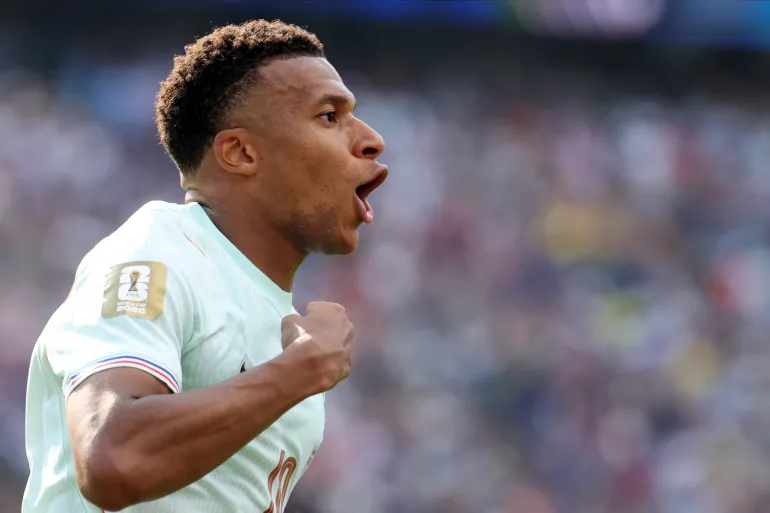
France’s forward #10 Kylian Mbappe celebrates scoring his team’s first goal during the 2026 World Cup football tournament quarterfinal match between France and Morocco at Boston Stadium in Foxborough on July 9, 2026 [Odd Andersen/AFP]
Predictions for the runner-up were more divided: France and Argentina each received three votes, followed by England with two and Spain with one.
Spain was the clear favourite to finish third, receiving six of the nine third-place predictions, while England and France each received fewer votes.
Lamine Yamal celebrates after the match as Spain qualify for the semifinal stage of the World Cup [Gary Vasquez/Reuters]
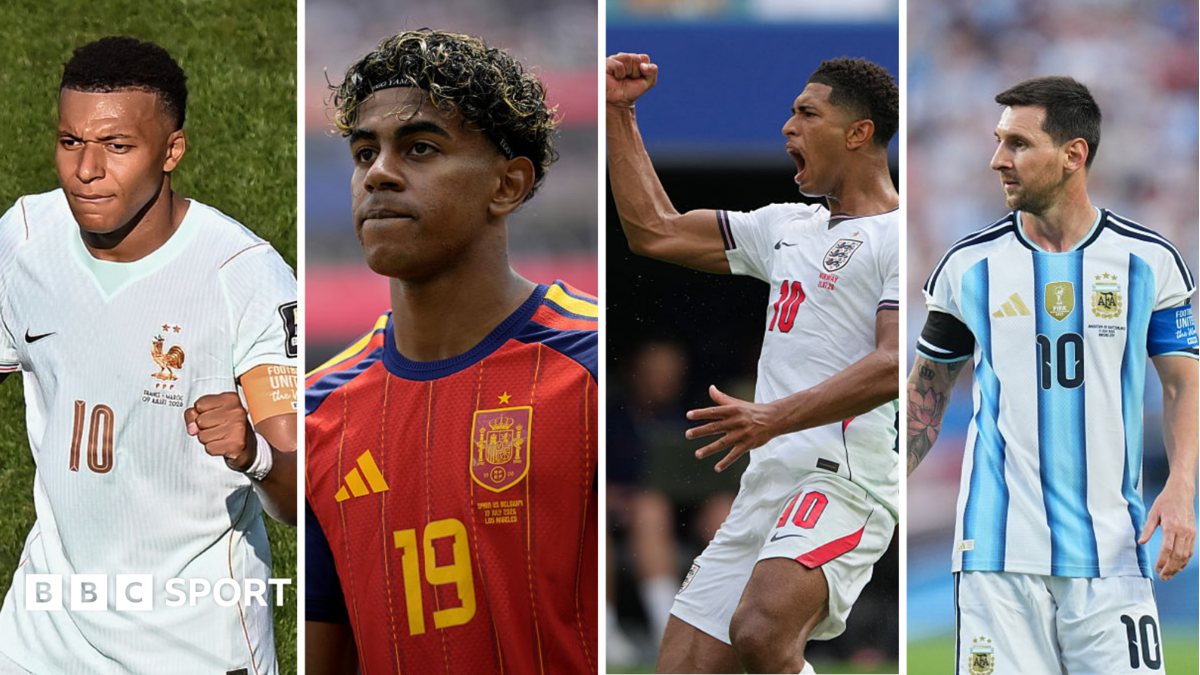
The predictions reflect a broad AI consensus around the four remaining contenders, France, Argentina, Spain and England, but also highlight differences in how leading language models weigh recent performances, squad depth and tournament momentum.
The AI predictions come as the tournament reaches the semifinals. France will face Spain on July 14 at AT&T Stadium in Arlington, Texas, while England will meet Argentina on July 15 at Mercedes-Benz Stadium in Atlanta, Georgia.
The third-place playoff will be played on July 18, before the World Cup final on July 19 at MetLife Stadium in East Rutherford, New Jersey.
ARLINGTON, Texas — Before it could rise in the World Cup, France first had to fall.
And the fall was spectacular.
In 2010, four years after reaching the final for the second time in three World Cups, the players revolted against coach Raymond Domenech during the tournament. In response, the managing director of the country’s soccer federation resigned in disgust, and the team left South Africa winless after scoring just once in three games.
That matched France’s worst World Cup performance in 76 years. The team, outsiders agreed, had become impossible to coach.
Four years later France made the quarterfinals, beginning a streak in which it has reached the final eight in four consecutive World Cups for the first time. If France, ranked No. 1 in the world, beats Spain in the semifinals Tuesday — Bastille Day in France, a patriotic holiday that is the equivalent of the Fourth of July in the U.S. — it will advance to the final for a third straight time.
Only Brazil and Germany have done that.
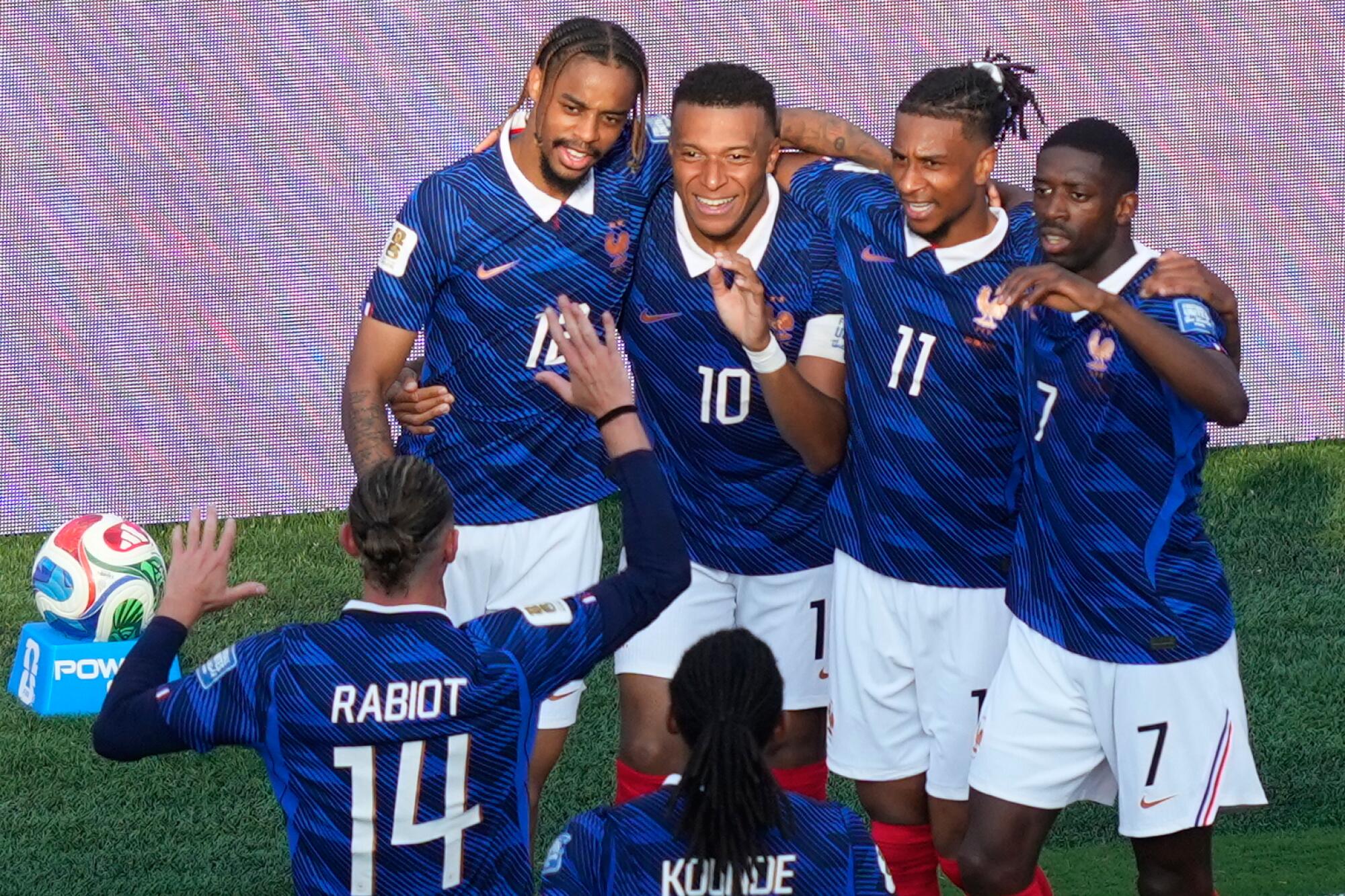
France’s Kylian Mbappé (10) celebrates with teammates after scoring against Sweden.
(Yuki Iwamura / Associated Press)
The base for that success was laid a generation before the collapse in South Africa, when a series of poor performances led the French Football Federation to create a series of 16 government-subsidized academies known as Centres de Formation. The main training center opened in 1988 in Clairefontaine, about 30 miles southwest of Paris, and many players from the 1998 championship team — including Zinedine Zidane, Thierry Henry and Robert Pires — passed through its doors.
“What is true about French football is that they started building academies very early and structuring them very early,” said Rudi Garcia, who played 10 seasons in France before becoming a coach of the Belgium national team. “A lot of the good work that’s being done by French football in general is due to the academies.”
But if Clairefontaine set the foundation, Didier Deschamps, the coach who took over the “uncoachable” team in 2012, built much of what went on top.
“It’s not luck,” Henry said on Fox. “This guy is a serial winner. I can also tell you how hard it is to have a lot of alphas and make sure that only one will be the alpha.”
Deschamps was a lunch-bucket player, a hard-working defensive midfielder who excelled at winning back possession in a 16-year career that included captaining France to both a World Cup and European Championship before he retired to become a coach, guiding Monaco to the Champions League final in his first stop. If he has a super power, both as a captain and coach, it’s his ability to manage big egos and get them to buy into the team concept. He did that first as captain of the star-studded 1998 squad and has been even better at it as the coach.
“The collective spirit,” Deschamps said, “is our strength.”
France coach Didier Deschamps celebrates with William Saliba after a World Cup quarterfinal win over Morocco.
(Lars Baron / Getty Images)
“He’s got credit in the bank,” added former World Cup goalkeeper Kasper Schmeichel, another Fox analyst. “Who can question him? His record speaks for itself as a player and as a coach.”
About that record: Deschamps heads into Tuesday’s semifinal with 20 wins and just two losses in 25 matches as a World Cup coach. He has won more World Cup games and more knockout-stage games, 11, than any other manager. And he was unbeaten in the tournament as a player, going 6-0-1.
Add those wins together and Deschamps, 57, has been on the field or in the technical area for 26 of France’s 48 World Cup victories. Before him, France never had won a World Cup.
By Sunday, the French could be lifting the trophy for the third time in 28 years. Only Brazil has won that many titles in a shorter span. And this team could be France’s best.
All that is thanks in large part to the FFF and government investment in the Centres de Formation. France is now the greatest developer of elite soccer talent in the world. Of the 1,248 players chosen to play for the 48 teams in this World Cup, 99 — nearly 8% — were developed in France, according to Opta. At least 13 teams in this tournament had at least one French-born player, among them Spain and Cape Verde. No other country comes close.
There are several reasons for that. The Ile-de-France region, which includes Paris, is home to large communities of working-class immigrants from the country’s former colonies. Eleven of the 26 players on this French team came from these banlieues, as they are called, among them captain Kylian Mbappé, who has the most goals in the last two World Cups.
The talent pool there is so deep, France probably could have fielded a B team in this World Cup and made it to the quarterfinals. And because the competition to make the national team is great, it raises the level of play for everyone.
For those who fall short, their immigrant backgrounds allow them to play for other countries. For example Riyad Mahrez, a former African player of the year, was born in Clichy, France, but plays for Algeria, while Senegal’s Ibrahim Mbaye is from Trappes.
“It’s quite an incredible pool of talent in a relatively small area,” Hubert Fournier, technical director of the French Football Federation, told the New York Times. “There’s a high concentration of players with very well-structured clubs. And then everyone draws from this Ile-de-France pool because afterwards they go to other clubs; they don’t all stay in Ile-de-France.”
The energy and diversity of the banlieues also fuels the national team. Nine of the 11 starters in France’s win over Morocco either immigrated to France or are the children of immigrants from Madagascar, Lebanon, French Guiana and Cameroon, Guinea-Bissau and elsewhere.
And Deschamps, who grew up in modest circumstances in Basque country, is the one who has made all those disparate parts work together. If France wins its next two games, he’ll become the second man to coach two World Cup champions.
But when asked for the secret to his success after France’s quarterfinal win over Morocco, a team with six French natives, Deschamps praised the French team, one thought to be uncoachable when he took over.
“Having great, great players, excellent players. My credit goes to the players,” said Deschamps, whose team hasn’t given up a goal in its three knockout-stage wins. “But maybe I do my job well.
“The human aspect is of paramount importance. I am extremely happy on a personal level as well as seeing my players enjoy themselves.”
Lamine Yamal insists he would take no fear into Spain’s World Cup semifinal against France when both sides meet after he celebrated his 19th birthday.
The Barcelona prodigy raised eyebrows following Spain’s 2-1 quarterfinal defeat of Belgium last week after being quoted as saying that France rather than Spain ought to be “afraid” given recent defeats against La Roja.
A relaxed-looking Yamal addressed those comments as he spoke to reporters on Monday at a press conference.
“I was asked if I was afraid of France, and I said no,” Yamal explained. “We are European champions. It’s simply football,” the teenager explained.
Yamal said he had marked his 19th birthday by buying a chunky jewel-encrusted necklace he wore to his press conference. The real birthday present, though, would be a place in Sunday’s World Cup final.
“I haven’t received many gifts yet. The best gift would be a win on Tuesday and a trip to New York,” he said.
While other stars at this World Cup have been in blistering goal-scoring form, Yamal so far has only found the net once during the tournament – but is ready to add to his tally against France.
“I don’t focus on goals, but it’s always special to score in a match like this. I accept the challenge. That’s why I came here,” Yamal said, promising a “beautiful match for the spectators”.
“It’s the game everyone was waiting for,” he added.
While acknowledging the momentous nature of Tuesday’s game, Yamal remained laid-back in his approach.
“There are far more difficult situations in life than a football match, so I’m calm,” he said. “I don’t feel any extra pressure; I’ll go out and play like always and give my all for the team.”
Spain’s players formed a guard of honour for Yamal to celebrate his birthday [Maurio Pimentel/AFP]
‘We’ve known each other for a while’
Spain coach Luis de la Fuente says his team plan to go on the “front foot” against tournament favourites France when they face off in a heavyweight semifinal showdown.
De la Fuente’s Spain will attempt to impose their possession-based game on France in what is shaping up as a gripping clash of styles.
While France coach Didier Deschamps insists Spain remain favourites for the World Cup, betting markets overwhelmingly back France to clinch a second title in three attempts.
Les Bleus have powered into the last four with a scintillating brand of attacking football based around such talents as Kylian Mbappe, Michael Olise and Ousmane Dembele.
But De la Fuente, whose team have beaten France in their last two meetings, is quietly plotting another ambush at the AT&T Stadium in Arlington, Texas on Tuesday.
“We’ve already analysed France in great detail; we’ve known each other for a while now,” De la Fuente said.
“We faced each other for a few years now, and they have great players, but so do we. We have to put all of our virtues on the table and try to counteract the strengths of the opponent.
“And that’s what football is about – the team that strikes a better balance is usually closer to getting the victory.
“We’ll have to think about their players. We’ll try to win those duels and will try to be on the front foot during the game, imposing our style.”
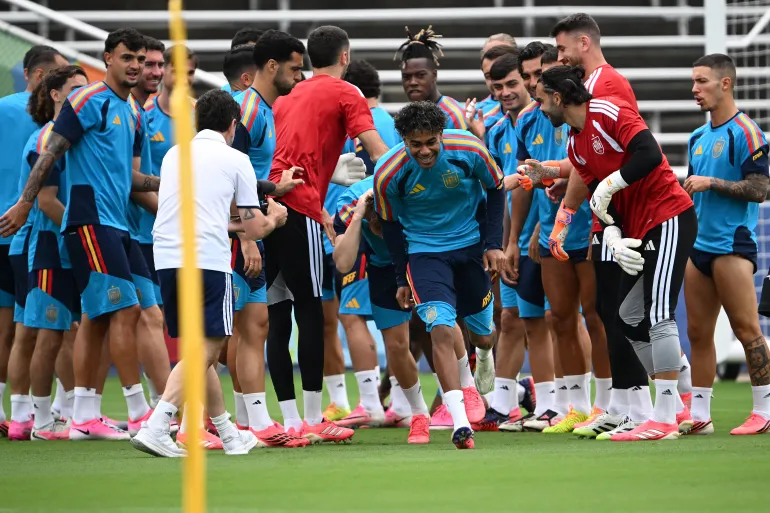
Spain’s players train at Cotton Bowl Stadium, in Dallas, Texas, US on July 13, 2026 [Albert Gea/Reuters]
France ‘far better’
De la Fuente, though, is under no illusions about the difficulty of the task facing his side.
France, he said, have improved significantly since Spain defeated them 5-4 in a hectic UEFA Nations League semifinal in Stuttgart last year, when the Spaniards led 5-1 before a late French rally. That encounter would bear no resemblance to Tuesday’s game, De la Fuente said.
“We’re talking about two very different matches,” he admitted.
“Tomorrow is another semifinal. I will just try to repeat the positive scenarios, but there were other details where things weren’t that positive.
“We were winning 5-1, and in a few minutes they managed to make it 5-4. So we’re trying to repeat what we did well and the opposite of what we didn’t do well.
“We need to try and impose our game. We have completely antagonistic playing styles, so we’ll try to be on the front foot and take the initiative.”
De la Fuente also believes a maturing France squad will be a tougher proposition.
“I think they are a better team, far better, because those players have grown, and what they are doing now is better than what they were doing then,” he said.
“So they’ve improved their skills in the past two years, and that’s the reality.”
While controlling possession and tempo will be key, De la Fuente will also tell his players to savour the challenge. Asked what his final message to his team would be, he replied: “Let’s get out there and enjoy it.
“We are in a unique setting. Who knows whether we will come back? We must be the team that we know that we can be. We must be strong and try to counter the strength of the opponent.”
France – the best player and the most frightening attack.
Argentina – the best idea: doing more with less than anyone else.
England – two world-class players on form.
All four semi-finalists have what is needed to win the tournament.
If Spain take the ball off France and stop their counters – plus if they are more efficient than they have been – they have a very good chance of making it to the final.
But they have to play the perfect game, with the perfect (or a very good) Lamine Yamal.
Argentina will try to make the game against England uneventful, and then wait for a moment of brilliance from Lionel Messi or Julian Alvarez. But they have been playing with fire.
England are still trying to find their identity but they have a huge amount of personality and two world-class stars.
A final of Spain v England would be incredible. And in a way a win-win for me, but I would like England to win a World Cup soon. This could be the summer.
Spanish fans in the United States:
Lionel: France will be tough but I think we can beat them and, if we do, we have a strong chance. We are strong in attack and strong in defence. The only downside is Pedri hasn’t played at this top level yet.
Jack: Argentina are looking strong but England can’t be ruled out. They have Harry Kane, who is one of the most difficult strikers in the world.
Michel: Spain will win the tournament, I have no doubt. No one is giving us a chance against France but we will control the match and beat them. The winners of that game will win the tournament.
The football teams of forty-eight countries set out with a chance of winning the World Cup on June 11, and the hopes of just four nations remain alive.
The top four teams in the FIFA rankings, with eight previous titles between them, will lock horns on Tuesday and Wednesday to try to secure a place in what is set to be the grandest of showpiece occasions in sport: the World Cup Final at New York New Jersey Stadium on Sunday, July 19.
Recommended Stories
list of 4 itemsend of list
Al Jazeera ranks the contenders for the title:
Argentina’s Lionel Messi takes a break during the quarterfinal [Lee Smith/Reuters]
4. Argentina
What’s this? The defending champions as the outsiders?
Well, Algeria, Austria, Jordan, Cape Verde, Egypt and Switzerland must be one of the kindest ever paths to the business end of a World Cup, and La Albiceleste have not exactly been convincing along it.
They were made to sweat by Cape Verde and Egypt in the knockout stages before finding a way to prevail in dramatic circumstances, and the pattern was repeated against Switzerland in Kansas City on Saturday night, when they went almost 90 minutes without a shot on target following Alexis Mac Allister’s early opening goal.
Their ageing side eventually prevailed after 120 minutes in sweltering conditions. Had Switzerland kept 11 men on the field, things might have been very different, but, once again, in the end, the defending champions found a way to win when they were well below their best.
Surely they cannot get away with another performance like that against England? Well, England fans might well be saying the same about the Three Lions. Both Harry Kane and Lionel Messi fell well short of their best in the last-eight matchups too.
The outpouring of emotion from Messi at full-time in the comeback win over Egypt showed just how close the three-time winners came to being eliminated. In an already emotionally charged matchup with England, expect tempers to rise and tears to flow on either side come full-time.
If Argentina, and – in his first-ever appearance against the Three Lions – Messi, are able to rediscover their swagger and win, ousting their old foes from the tournament in the knockout stages for a third straight time, then the confidence and momentum they would take into the final would be huge.
However, nothing they have shown in the US this summer would suggest that is likely to happen.
And even if it did, whether it would be enough to give them the edge against European champions Spain, or a vengeful France side they vanquished on penalties in the epic final of Qatar 2022, is another matter entirely.
England’s Jude Bellingham and Harry Kane celebrate after beating Norway [Paul Childs/Reuters]
3. England
Have we seen the best of England in this tournament? Probably not. And yet, here they are, in the semifinals for just the fourth time ever.
The win over Norway was neither pretty nor convincing, and manager Thomas Tuchel admitted they were lucky to get through, thanks largely to Jude Bellingham putting the team on his shoulders at a couple of key moments once again. Could a midfielder really win the Golden Boot? He is only two behind Messi and Kylian Mbappe with six goals already.
Much to Tuchel’s frustration, bar a 20-minute purple patch in the second half of the 4-2 opening game win against Croatia, England have yet to dominate a team, and relied on counterattacking bursts to give them a 3-2 lead to defend in the epic round-of-16 victory over Mexico in the cauldron of the Azteca.
What they have shown is character, in abundance, and they will likely need plenty more of that if they are to end 60 years of longing for a second World Cup title.
The game against Argentina will be far more than 11 vs 11; the ghosts of football history will line up alongside both teams, and the hype and pressure are sure to be enormous.
A few possible positives for England will be that they have already made par for this tournament: Ranked fourth in the world, they have reached the last four. Anything else would be a bonus. Nobody really considers them a top-two team in the world, which might help to alleviate some of the burden of expectation.
After a trip to the altitude of Mexico City, and the oppressive heat and humidity of Miami, a return to the 22-Celsius (71.6F) climate-controlled confines of Atlanta, where England overcame DR Congo in the round of 32, will be welcome.
They also have no new suspensions to deal with, with Jarell Quansah left with one game of his two-match ban to serve; and there were minutes for Reece James against Norway. England will meanwhile be hoping Declan Rice recovers fully after a 45-minute cameo in which he was patently not fit following illness.
An ageing Argentina side have struggled against the pace, movement and trickery of Cape Verde, Egypt and Switzerland in the past three rounds, and Bukayo Saka, Anthony Gordon, and even Marcus Rashford will be even better placed to exploit that.
Beyond Messi, Argentina have not posed too many attacking questions themselves, though Julian Alvarez’s stunning strike against Switzerland might just be the start of his own World Cup.
All things considered, expect England to make it through to the final, but France would likely be a step too far, and even Spain would be a big ask, despite the additional motivation of revenge for their Euro 2024 final defeat.
Spain’s Mikel Merino celebrates the victory against Belgium [Jessie Alcheh/Reuters]
2. Spain
They are the third semifinalists yet to find top gear at this tournament, bar a one-sided display against Austria in the round of 32.
La Roja’s stoic defence might have been punctured for the first time this summer by Belgium in the last eight, but the 649 minutes that preceded that goal were the longest streak in World Cup history without conceding, and they have still allowed just seven shots on target in their six matches so far.
Though the goal contribution stats might not reflect it, Lamine Yamal has shown flashes of a return to top form after that season-ending hamstring injury in April, while La Roja’s carousel of tricky attackers has posed problems for defences in all six matches so far, and Mikel Merino has written himself into folklore with last-gasp winners against Portugal and Belgium.
Four-goal leading scorer Mikel Oyarzabal has gone off the boil in the past couple of games, however, and is unlikely to strike too much fear into the French backline.
While teenage defender Pau Cubarsi looks at home on the biggest stage of all, he is yet to face the kind of test that Kylian Mbappe, Michael Olise and Ousmane Dembele will pose.
If they make the final, Spain will be favourites to win it, and they have won the World Cup the only time they previously reached the last four, but despite having beaten France in their past two encounters, a third should be beyond them.
France’s forward line of Kylian Mbappe (bottom), Ousmane Dembele (top), Bradley Barcola (right), and Michael Olise (left) is considered the strongest at the tournament [Mauro Pimentel/AFP]
1. France
Before their last-eight matchup with Morocco, we asserted that France were the class of the field with a fearsome foursome in attack and a defence that, although it had not really been tested yet, had only allowed two goals in five matches.
Well, make that two in six, even if they still have not really been tested, such was the Atlas Lions’ toothless attack on the night in their 2-0 defeat.
Mbappe further enhanced his credentials for the Golden Boot and all-time World Cup scoring record with another quality goal against Morocco, and Olise, Dembele, Desire Doue and Bradley Barcola continue to threaten across the field in a way no other team on earth can.
Spain, and in particular their defence, will pose a different challenge, and the underworked French defence will likely get their own test this time, too, with the likes of Dani Olmo, Alex Baena, Ferran Torres and Fabian Ruiz getting into promising positions around Oyarzabal, and that’s not to mention super-sub Merino.
Whoever beats France will surely lift the World Cup, but none of the remaining teams can match the dynamism of Les Bleus’ forwards. Although Spain will likely be their hardest challenge, it is one you can expect Didier Deschamps’s men to overcome, not least fuelled by the additional motivation of having lost to La Roja in the Euro 2024 and Nations League semifinals over the past two years.
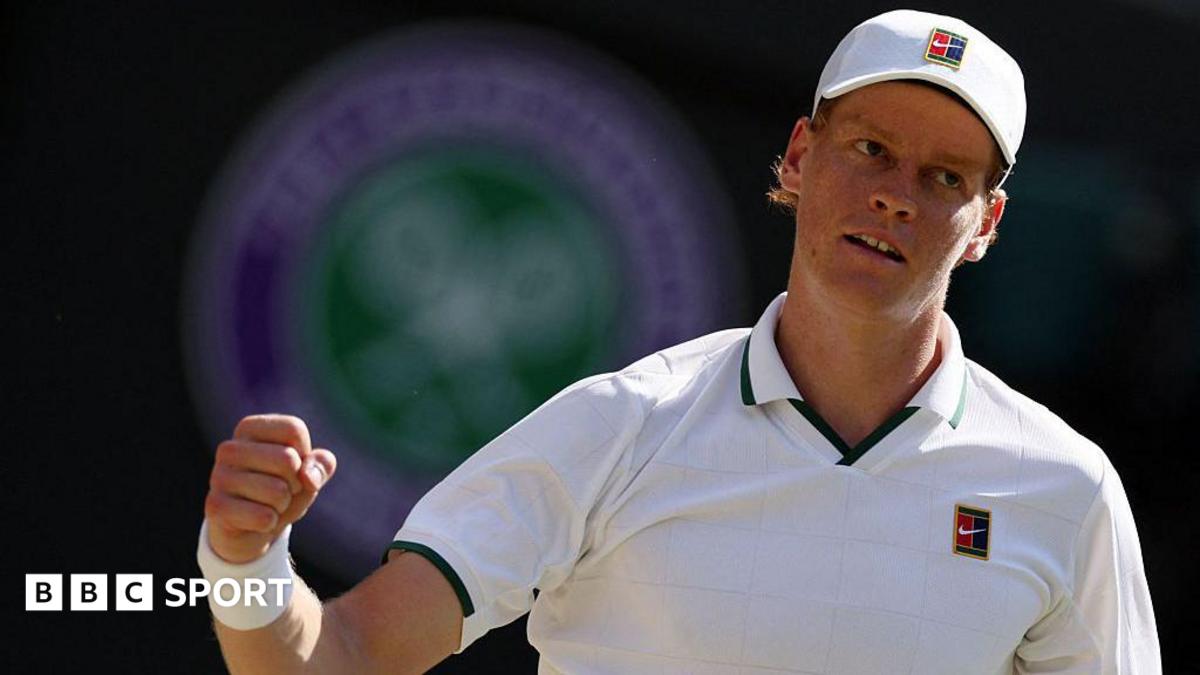
LONDON — Jannik Sinner is starting to make a habit of responding to adversity in Paris with titles at Wimbledon.
The top-ranked Sinner beat Alexander Zverev 6-7 (7), 7-6 (2), 6-3, 6-4 Sunday for his second consecutive title at the All England Club after his German opponent appeared bothered by a knee injury following a slip to the grass on a key point in the third set.
Sinner’s fifth Grand Slam title came in his first tournament since a second-round meltdown at the French Open, when he wilted in a Paris heat wave.
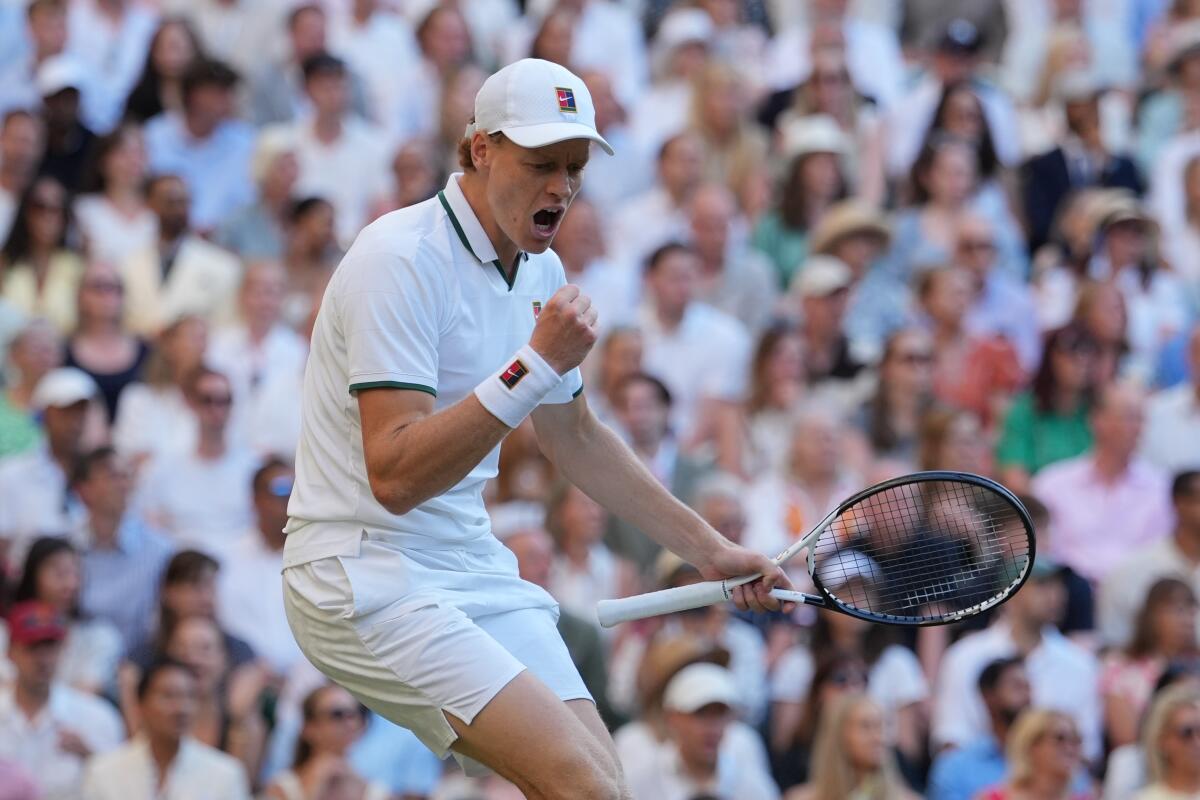
When Sinner ripped a forehand winner up the line on his first match point, the Italian dropped to the grass on his back in celebration.
Jannik Sinner celebrates after winning a point against Alexander Zverev during the men’s singles Wimbledon final in London on Sunday.
(Kin Cheung / Associated Press)
A year ago, Sinner beat Carlos Alcaraz in the final at the All England Club after wasting three match points against his rival in the Roland Garros final.
It was Sinner’s 10th straight victory over Zverev, who was coming off his first Grand Slam title at the French Open.
Linda Noskova beat Karolina Muchova in an all-Czech women’s final on Saturday for her first Grand Slam title.
Prince William joined his wife Kate and two of their children for the final in a star-studded Royal Box that also included actors Dustin Hoffman, Nicole Kidman and Ben Stiller.
Zverev slips
The top two seeds appeared perfectly matched until Zverev earned his first break point of the match at 3-3 in the third set — 2 hours and 42 minutes in. Sinner produced a drop shot and Zverev slipped and appeared to hyperextend his right knee as he attempted to change directions behind the baseline.
Zverev grasped his knee in apparent discomfort and Sinner went around the net and helped his opponent up off the grass. Zverev quickly resumed playing but he appeared slightly hampered and slung his racket across the baseline in frustration when he missed a forehand and handed Sinner the first break of the match and a 5-3 lead in the third. Sinner then served it out.
Zverev had also lost 14 straight sets to Sinner and when he claimed the opening set of the final with a forehand winner up the line to conclude a tight tiebreaker, he let out a loud roar toward his box as he bent over in celebration.
Zverev continually cranked out serves at up to 139 mph, while Sinner produced a series of well-placed aces at a slightly lower speed.
But Sinner began to read Zverev’s serve better in the second-set tiebreaker and Zverev started to miss forehands.
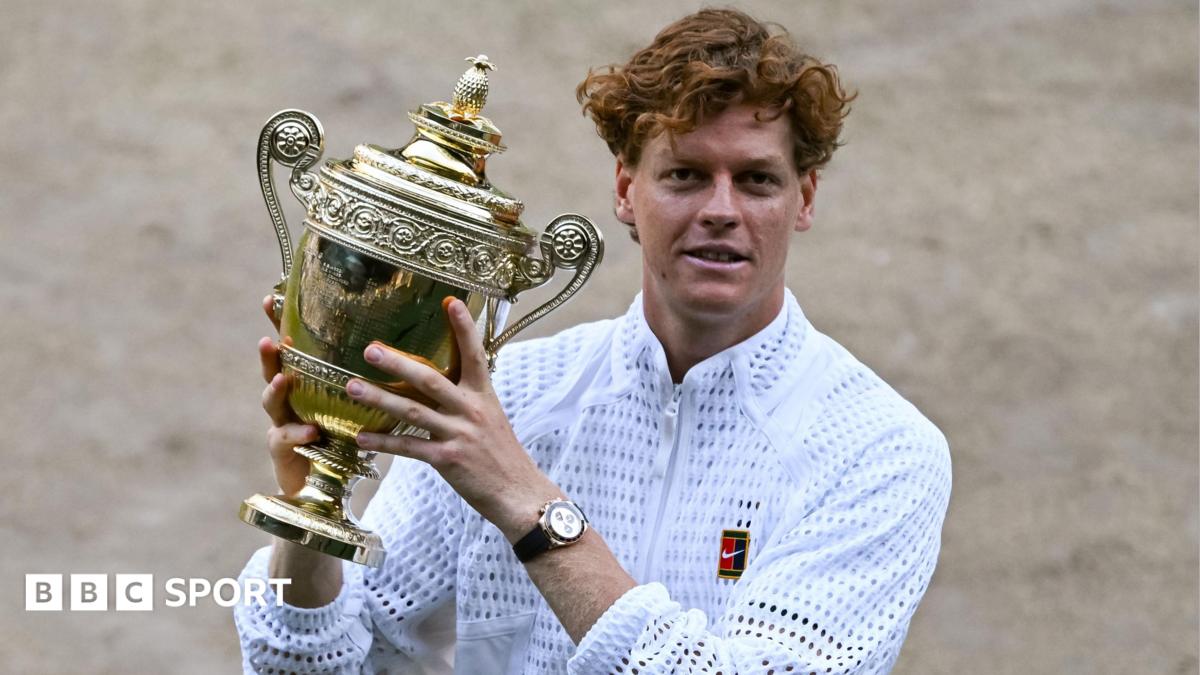
Jannik Sinner kisses his trophy after defeating Alexander Zverev to win the men’s singles Wimbledon title in London on Sunday.
(Kirsty Wigglesworth / Ap Photo/kirsty Wigglesworth)
Paris meltdown
Amid stifling heat and humidity in Paris in late May, Sinner had his 30-match winning streak ended after coming within one game of a straight-set victory over Juan Manuel Cerundolo, who was ranked No. 56.
Conditions were cooler in southwest London for the final, with clear skies and a temperature of 82 degrees but it was also breezy — which led to a series of shanked shots from both players.
Sinner went in for medical exams in Milan after the Paris defeat and didn’t play an official match again until he arrived at Wimbledon, where he twice had to come back from a set down in a five-set marathon against Miomir Kecmanovic in the first round.
Sinner then didn’t drop a set the rest of the way until the final, having dominated against Novak Djokovic in the semifinals.
Despite the defeat in the final, Zverev will leapfrog Alcaraz into the No. 2 spot in the rankings on Monday.
Alcaraz missed both the French Open and Wimbledon this year because of a right wrist injury.
Women’s doubles
Kristina Mladenovic won a seventh career Grand Slam women’s doubles title by teaming up with Guo Hanyu to defeat Gabriela Dabrowski and Luisa Stefani 6-3, 7-5 in the final Sunday.
Mladenovic has won the French Open doubles tournament four times and the Australian Open twice with different partners but lost her only previous Wimbledon final in 2014.
“It’s really a dream,” said the French player, who missed much of last year with an injury. “I definitely cannot believe what just happened now.”
Mattias Karén contributed to this report. Dampf and Karén write for the Associated Press.
One month after the world number one suffered a seismic shock at the French Open, another upset was brewing.
Confronted with unwanted history, Sinner would have to come from behind to beat Miomir Kecmanovic in five sets and avoid becoming only the third defending Wimbledon men’s champion to lose in the first round.
The 24-year-old’s durability in marathon encounters has long been a concern, with Sinner having lost eight of his previous nine matches that went the distance.
There had also been a shattering event in Paris for the second year in a row.
Sinner arrived at Wimbledon having not competed since his extraordinary collapse in the French Open second round, when he lost to Argentine Juan Manuel Cerundolo from two sets and 5-1 up.
He had recovered from a far greater catastrophe to triumph at the All England Club in 2025, taking revenge on rival Carlos Alcaraz just 35 days after losing their epic Roland Garros final from two sets and three championship points up.
But now his physical resilience was under the spotlight – and the early signs at Wimbledon offered encouragement to those eyeing his throne.
Both junctures would have taken others months to recover from. For Sinner, they became catalysts for greater heights.
“This one means a lot because it was a tough one after Paris, again,” Sinner said.
“Last year was also tough. But coming here, I tried to put myself in the best position to be as competitive as possible.
“We put in a lot of long days, sacrificing a lot to be in this position.”
Noskova’s second-set collapse was excruciating to watch for the 15,000-strong crowd on Centre Court, but the way in which she mentally reset in the decider was admirable.
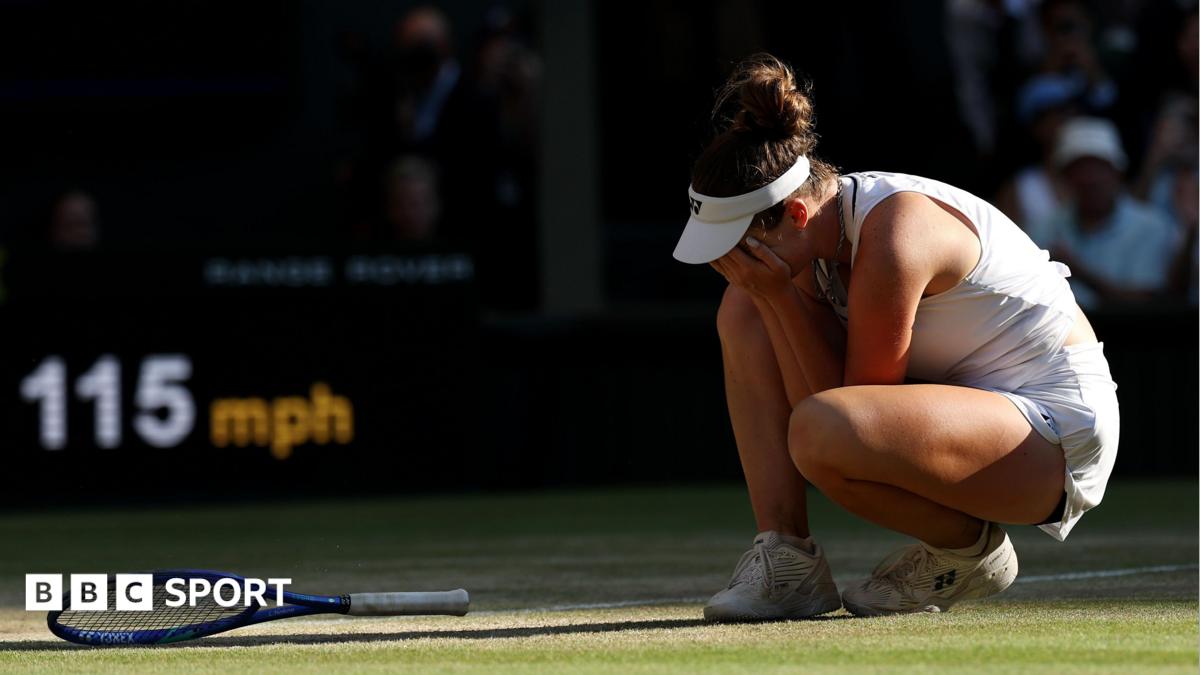
Serving for the title again an hour after her first attempt, Noskova hit an ace to set up a sixth championship point and converted it with a service winner.
Noskova immediately fell to the court as her relief poured out, with 29-year-old Muchova walking around the net to congratulate her Paris 2024 Olympics doubles partner.
“It’s really tough to find any words, but I’ll start with Linda – my ex-friend,” joked Muchova.
“The way you handled it and the way you played was unbelievable. You deserve it.”
Noskova hid under her towel towards the end of the second set and did the same again in the moments after securing a testing victory.
The ninth seed is the third Czech champion in the past four years at the All England Club, after victories for compatriots Marketa Vondrousova and Barbora Krejcikova in 2023 and 2024 respectively.
Fittingly, Noskova’s crowning glory watched by Czech-born Martina Navratilova – a nine-time singles champion – and one of her idols Petra Kvitova, who won in 2011 and 2014.
As well as lifting the iconic Venus Rosewater Dish, Noskova will receive £3.6m in prize money and move up to a new career-high ranking of seventh in the world.
One of the latest of a long line of Czech talents, Noskova had been tipped as a future star who could challenge for Grand Slam titles.
She was a highly-rated junior who became the youngest player inside the top 100 in 2022 and a run to the Australian Open quarter-finals in 2024 underlined her ability.
Making consistent runs at the majors had been rare, but reaching the fourth round at Wimbledon last year made her feel “comfy” on the grass when she returned this year.
Noskova set herself up for a deep run in SW19 by winning the Berlin title last month but, in her speech during the Centre Court trophy presentation, acknowledged how difficult the tournament has been both physically and emotionally.
On court, Noskova had to fight back from match point down in her third-round encounter against Romania’s Sorana Cirstea.
She is only the third player – after Venus Williams in 2005 and Serena Williams in 2009 – to win the Wimbledon women’s singles title from such a position.
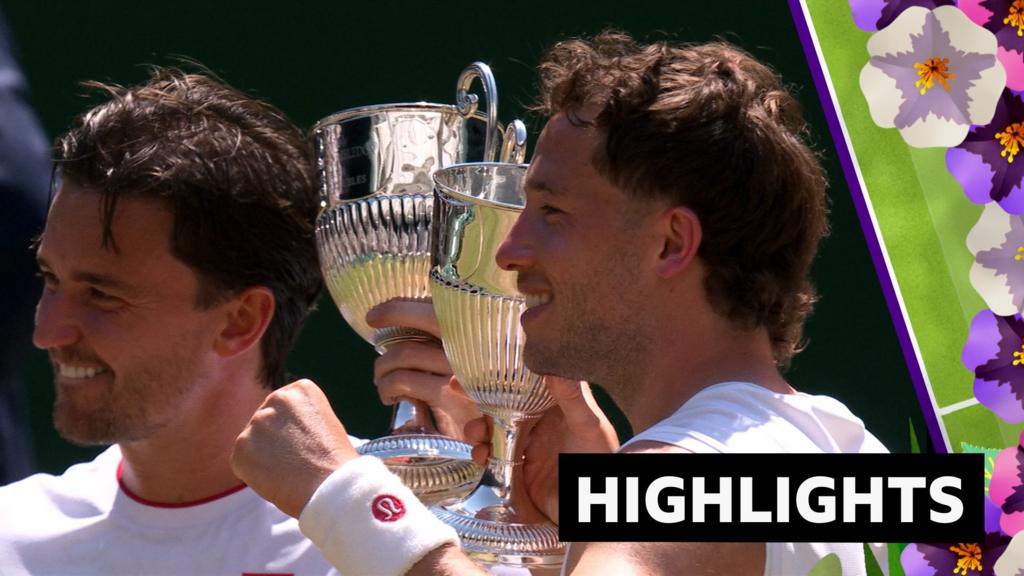
Great Britain’s Gordon Reid and Alfie Hewett come from a set down against Gustavo Fernandez and Tokito Oda to win a seventh Wimbledon men’s wheelchair doubles title.
Jackson didn’t get a chance for revenge after tearing an anterior cruciate ligament in May, making the Sparks’ 102-87 win at Crypto.com Arena not a true litmus test. Veteran guard Ariel Atkins, who was shipped out of Chicago in the Jackson deal, had her best game with the Sparks, finishing with a season-high 17 points.
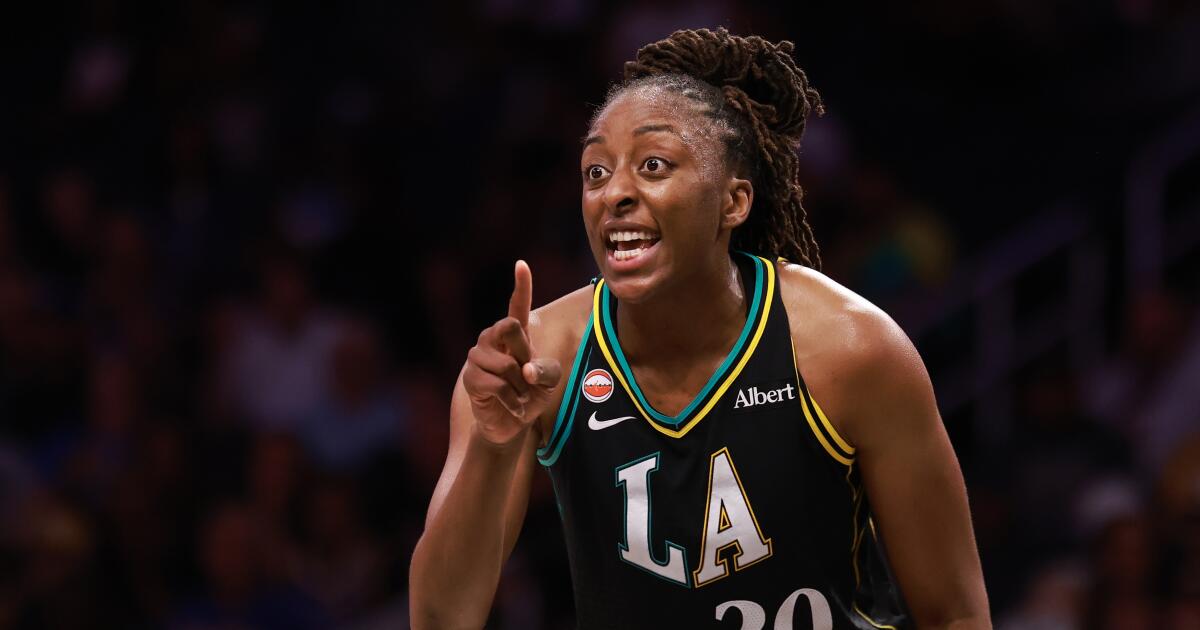
The Sparks showcased their potential en route to their second straight win, even with All-Star Kelsey Plum (lower left leg) and Cameron Brink (left ankle) out. Nneka Ogwumike, the Sparks’ other All-Star, posted 25 points and 12 rebounds, Dearica Hamby and Rae Burrell both scored 17, and Erica Wheeler had 15 points and eight assists.
“The ball’s got to move,” Sparks coach Lynne Roberts said. “It can’t be a lot of one on one. And that’s what happens when you have 32 assists, the ball’s moving. So it’s just the continued emphasis of ball movement, player movement, getting those high-quality shots, and we’ve got players that are going to make them for percentage.”
Still a game under .500, the Sparks (10-11) have a long way to go to be considered serious postseason contenders. Chicago also has struggled mightily outside of a win against Phoenix this week and has been engulfed in drama around veteran guard Skylar Diggins, who sat out because of a knee injury.
“After the game on Monday, I think there was just kind of like an ‘enough’ mentality, and we all felt it,” Roberts said. “We all kind of just said, ‘enough.’ That doesn’t mean that we’re going to go undefeated the rest of the way, but we play like that. We give ourselves a chance in every game.”
For the second straight game, all five starters scored in double digits. Hamby had a late backhanded layup over 6-foot-7 Kamilla Cardoso to help close out the win.
Brought in to be Plum’s partner in the backcourt, Atkins has had an inconsistent offensive season, with career-low scoring and shooting numbers. Against her former squad, she showed why the Sparks wanted her, and why they need her to produce with Plum out of the lineup for the foreseeable future.
“It feels good to see shots go in,” Atkins said. “My biggest thing is that it feels good when we all feel good too. When they lead to wins, it makes it even better.”
After the Sparks opened up a 16-8 lead, Chicago (7-15) stormed back to keep it tight throughout the second quarter. The Sparks led 73-70 after three quarters before pulling away late.
Ogwumike made three three-pointers in the fourth to carry the Sparks across the finish line.
“Just to have that poise, like we haven’t shown that in a very long time,” Wheeler said. “So for us to display that tonight, like that should be the standard, and it felt good to have that poise.”
The Sparks scored 25 points off 15 Sky turnovers. They shot 51% from the field.
Ball movement has been emphasized all season, “so it’s good that we’re starting to figure it out,” Roberts said. “When you look at the assists, it wasn’t like one person had 16 or something, right? So it’s balanced. The ball’s moving. There’s [the thought of] ‘we need to get the win,’ not ‘I need to get the bucket.’ And I think that’s the mentality of great teams.”
Veteran forward Emma Cannon played 12 minutes and scored nine points as a key post presence late when Cardoso was in foul trouble.
Ogwumike moved into fifth on the Sparks’ all-time assists list with her third helper in the first quarter, passing Mwadi Mabika.
The Sparks are half a game outside the final playoff spot, not bad given how poor some of their performances have been. They head to Atlanta (13-9) to face a slumping Dream squad on Monday as they try to win three consecutive games for the third time this season.
“It took us a bit with KP out to figure out kind of how we can still flow,” Roberts said. “I think we’ve figured it out.”
LAS VEGAS — The highlight dunk was proof that Adou Thiero is just fine. Thiero delivered a breakaway windmill dunk in the second quarter Friday that brought cheers from the fans, a moment in which the second-year Lakers forward displayed his athleticism.
Thiero’s confidence seemed to grow from that point on, his play for the Lakers during their Las Vegas Summer League opener at the Thomas & Mack Center a sign of his development.
He ran the floor and caught a lob for a dunk. He sprinted back on defense and blocked a shot. He finished the third quarter with a last-second shot off the backboard, a basket that gave the Lakers an 86-66 lead over the Oklahoma City Thunder. Thiero came back in the game in the fourth quarter and threw down another lob dunk.
Thiero completed his night with 20 points during the Lakers’ 96-84 win.
He played an all-around game, collecting four rebounds, four assists, three steals and two blocks with zero turnovers in 30 minutes. He was eight for 14 from the field. He missed all five of his three-pointers, but Thiero finished the game plus-13.
“I feel like I was capable of doing this,” Thiero said. “It’s not different from things I was doing in the G League last year. I feel like I got real comfortable in the G League, how to play and everything and just took that break and still trying to get back to healthy and everything and finally getting to go out and play. I feel like I sped myself up a little bit and now I’m slowing down and letting the game come to me.”
Thiero played after missing the Lakers’ final game at the California Classic in San Francisco because of a right wrist injury.
He looked far more in control and at ease than he did in San Francisco.
“He just wasn’t rushed tonight,” Lakers summer league coach Ty Abbott said. “He took what was in front of him. He attacked matchups. He understood that there was going to be some paint swarming. Those guys are going to try to flood and meet him at the rim and he made the right pass. And then when he started doing that, it started to open up for him and he was able to finish at the rim.”
Thiero was asked to critique his windmill dunk, which was his first highlight of the game and one that had fans cheering.
But Thiero was not impressed.
“The windmill was nice, but it wasn’t my best windmill,” Thiero said. “I’d probably say that was one of my worst windmills. I didn’t have my footing. I went back and watched it on video and I didn’t really like it.”
Thiero believed his chemistry with rookie Cameron Carr and his defense stood out. He also said Lakers coach JJ Redick had conversations with him about being a better defender.
“Just trying to go out there and cause havoc,” Thiero said. “JJ, he says that the things he wants, you know, we need a point-of-attack, on-ball defender and everything. So, just trying to go out there and be that, try and get reps in defending and then, offensively, just trying to play basketball, just trying to make the game more simple for myself.”
Carr also played against the Thunder after being limited by a bothersome toenail in his last game. He had another solid game with 18 points on seven-for-13 shooting.
Spanish star has scored just one goal in the World Cup, where he’s been sharing celebrations with his little brother.
Published On 11 Jul 202611 Jul 2026
Despite not scoring a goal in Spain’s quarterfinal win over Belgium, Lamine Yamal was named the player of the match for his contributions and capped off the win by sharing a touching moment with his little brother during the post-match celebrations in Los Angeles.
Yamal, who has not scored since Spain’s group-stage win over Saudi Arabia on June 21, said after the match on Friday that nobody will care about his lack of goals if Spain win the World Cup.
Recommended Stories
list of 4 itemsend of list
At a tournament where stars like Lionel Messi, Kylian Mbappe, Erling Haaland and Harry Kane have been prolific, 18-year-old Yamal has just one goal to date, in a routine 4-0 group drubbing of Saudi Arabia. He failed to find the net once again as Spain booked their place in the World Cup semifinals for the second time.
“Obviously I want to score, but I don’t go onto the pitch thinking about that. I do it thinking about helping the team,” said Yamal.
“If we win the World Cup, no one will remember whether I scored goals … The important thing is winning,” said the Barcelona star, after the victory in Los Angeles set up a semifinal clash with France.
“I know I can contribute even if I don’t score. I know my movements draw in many opponents, so I do everything I can to help the team,” he said.
Despite the lack of goals, Yamal has performed consistently for La Roja and has also broken records along the way.
On Friday, he made his sixth FIFA World Cup appearance, the outright most by a player aged 18 or younger in the competition.
Breakout star
Two years ago, then aged 16, Yamal was the breakout star of the Spanish team that won the European Championships in Germany.
“There’s an idea that I should be scoring more, like at the Euros, but we won the Euros with me scoring just one goal. And I have one goal here too, so I’m relaxed about it,” he said, with a smile.
But Spain will be hoping Yamal, who turns 19 the day before the semifinal, can bag further goals if his side is to see off the free-scoring tournament favourites France.
“There are two possibilities – either they reach three consecutive World Cup finals, or we beat them three times in a row. We’ll see what happens,” said Yamal.
“We aren’t afraid at all.”
Yamal shares endearing moment with brother Keyne
Amid Spain’s post-match celebrations, Yamal and his half-brother Keyne were caught in a sweet moment when the younger sibling was shown on the big screen.
The three-year-old was screaming and stuck his tongue out when the camera panned on him. Keyne then blew a kiss at his brother, making the teen Spanish star laugh and wave at him.
Keyne, who often accompanies Yamal to award shows and other public events, has been a fan favourite for the crowds at the World Cup.
He has been picked up by the cameras on multiple occasions, drawing a chuckle from his older brother and cheers from the crowd around him.
Kenye, younger brother of Yamal, is seen on the screen at the quarterfinal in Los Angeles [David Ramos/Getty Images via AFP]
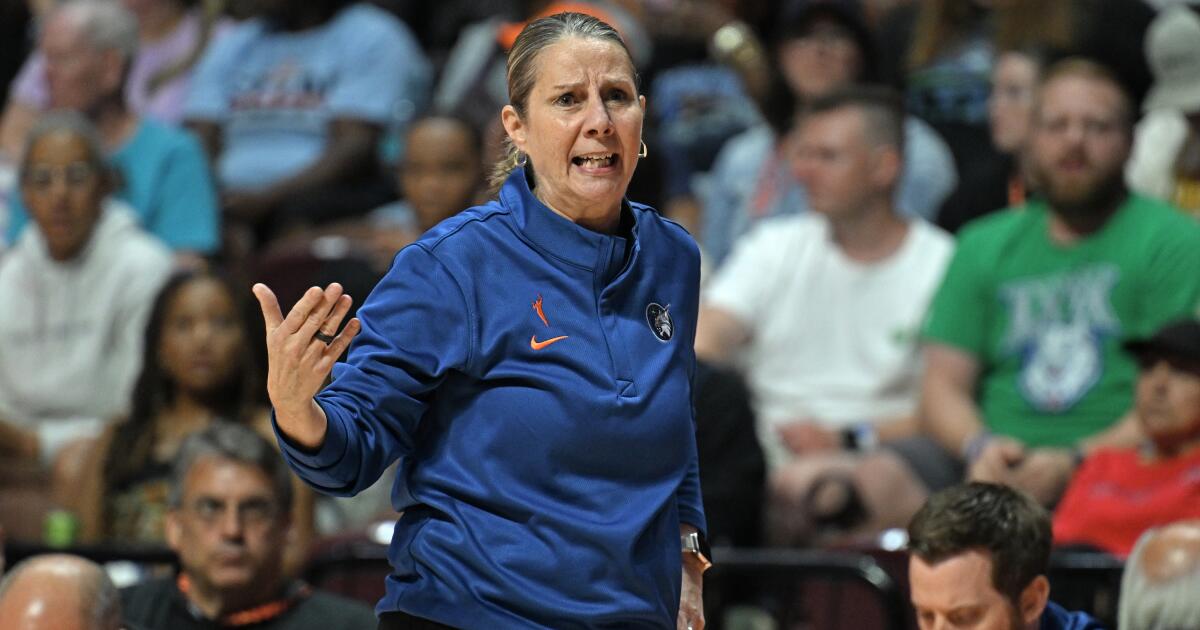
The longtime Minnesota Lynx coach tied WNBA legend Mike Thibault for most career wins on June 28. The two remained deadlocked, with the league-leading Lynx losing two straight games for the first time all season.
But the losing streak is over — and the WNBA has a new all-time winningest coach. Minnesota defeated the Connecticut Sun 86-80 on Wednesday night for Reeve’s historic 380th career victory.
“I am so glad this is over,” Reeve, 59, said during a postgame interview on USA Network.
Reeve was a four-year starter at La Salle from 1984-1988 and ranks fifth in career assists (420) for the Explorers. After serving as an assistant coach at her alma mater and George Washington, Reeve became head coach at Indiana State, going 63-72 over five seasons with winning records in each of the last two.
Jumping to the WNBA in 2001, Reeve was an assistant coach for the Charlotte Sting (two stints), Cleveland Rockers and Detroit Shock before becoming head coach of the Lynx in 2010. Since then, she has compiled a record of 380-196, won four WNBA titles (2011, 2013, 2015, 2017) and been named the league’s coach of the year four times (2011, 2015, 2020, 2024).
Reeve has missed the postseason only twice during her time with the Lynx, and her 49 playoff wins are the most in league history. She was inducted into the Women’s Basketball Hall of Fame last month.
“A milestone fit for the Hall of Famer,” the WNBA wrote in an X post congratulating Reeve.
While Reeve has compiled her total over 16-plus seasons, Thibault reached 379 victories over the course of 20 WNBA seasons, 10 with the Connecticut Sun (2003-2012) and 10 with the Washington Mystics (2013-2022). Currently the head coach of Belgium’s national women’s basketball team, Thibault was a three-time WNBA coach of the year and led Washington to the league title in 2019.
Reeve was head coach of the U.S. national team, with Thibault as her assistant coach, when it won gold at the 2022 World Cup in Australia and the 2024 Paris Olympics. Thibault’s son, former Mystics coach Eric Thibault, has been on Reeve’s staff in Minnesota as associatehead coach the past two seasons.
“Learned a lot from Mike through the years,” Reeve said after Wednesday’s game. “Tremendous coach and just so much respect that we’ve had for each other through the years. I know he’s happy for me. And somebody’s going to pass me and I’ll be happy for them too.”
Reeve was correct about Thibault’s feelings.
“Congrats, Cheryl, so much from all the Thibault family,” Thibault said in a video posted on X by the Lynx. “If anyone was going to break my record, I most wanted it to be you. Our friendship means a lot, but the job you’ve done as a coach and mentor in this league is appreciated by so many people. And I couldn’t be more proud to have you as a friend.”
Toronto’s Sandy Brondello is the closest active coach to Reeve’s mark. She ranks sixth all-time with 280 wins.
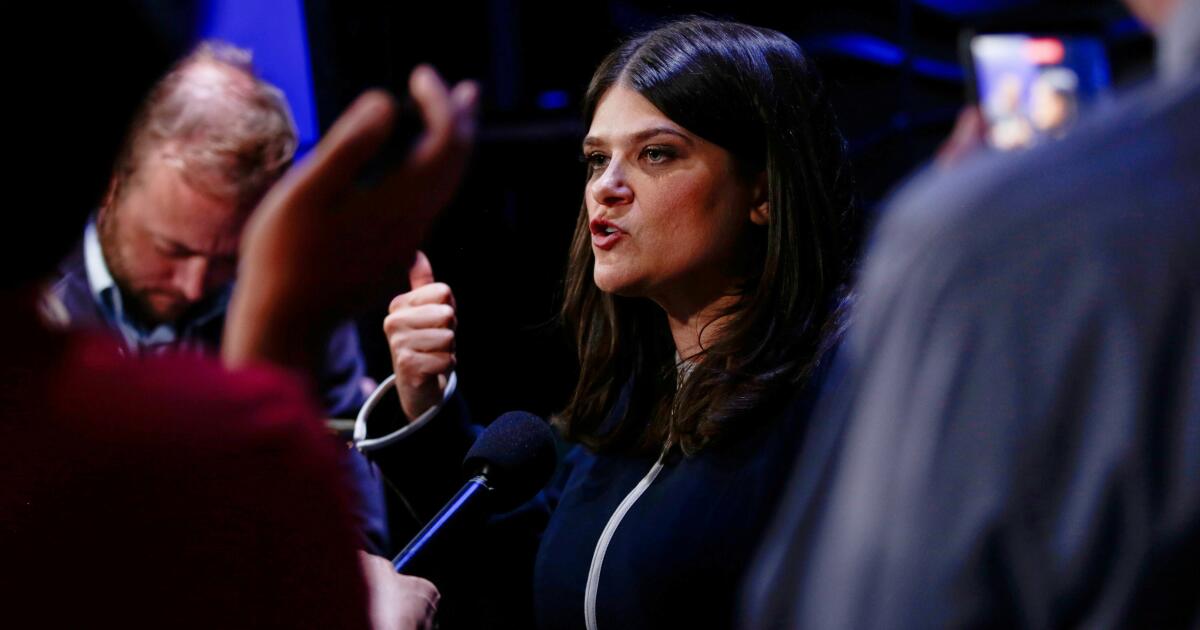
SOUTH HAVEN, Mich. — U.S. Rep. Haley Stevens is spending the closing weeks of Michigan’s Democratic Senate primary making a simple case: she’s the candidate who wins.
Stevens flipped a Republican-held House seat in suburban Detroit in 2018 and hasn’t lost since, including surviving a bruising primary against a fellow Democratic incumbent after redistricting in 2022. She says it’s what sets her apart from her opponent in the Aug. 4 primary, progressive Abdul El-Sayed.
“It is not a hypothetical that I beat Republicans,” Stevens told The Associated Press after a campaign stop in West Michigan this week. “I win tough races. I have had Republicans throw everything at me and still managed to win.”
Holding Michigan’s Senate seat is essential to any Democratic path back to the Senate majority this fall. That imperative only grew this week after Democrats’ nominee in Maine, Graham Platner, said he planned to drop out after he was accused of sexual assault, threatening another seat the party had hoped to keep competitive. While no Republican has won a U.S. Senate seat in Michigan since 1994, former U.S. Rep. Mike Rogers came within 20,000 votes of doing so in 2024.
That calculation has led Senate Democratic leader Chuck Schumer and influential Michigan Democrats, including former Sen. Debbie Stabenow, to rally behind Stevens, arguing she gives Democrats their strongest chance in November against Rogers, who is running again.
But if electability is the party establishment’s top priority, it’s an open question whether Democratic primary voters agree.
“Democratic leadership should think more in terms of what we want to accomplish, and less about, ‘We’ve got to make it appeal to everybody,’” said Dave Burdick, 71, of Douglas, Michigan. He’s backing El-Sayed, who has surged by arguing that Democrats don’t have to run to the middle to win.
El-Sayed has built his campaign around bold policy proposals, rejecting corporate PAC money and casting himself as an alternative to the status quo of the Democratic Party.
“People don’t want a moderate. They want somebody who’s going to come in and effect change,” Burdick added.
Stevens makes the case for retail politics
On a summer afternoon in South Haven, a community along Lake Michigan, Stevens walks into a pet supply store with the ease of a seasoned campaigner. Within minutes, she’s chatting with the owner about the area, greeting reporters by first name and striking up conversations with customers. She slips easily between small talk and campaign mode, asking about customers’ lives before mentioning legislation she’s championed and asking for their vote.
“I thought she was great fun,” said owner Roxanne Leder. “She was energetic and had a positive outlook.”
It’s the kind of campaigning Stevens’ allies say has defined her political career. They acknowledge she lacks the viral progressive moments that have fueled El-Sayed’s rise, but say she’s at her best in small rooms, union halls and local businesses — which they say is where elections are won.
Stevens has leaned into that contrast herself.
“Unlike my opponent, I’m not running at the first mic or camera I see,” Stevens said during a debate Tuesday. “We do not need a celebrity senator. We need a workhorse.”
It’s also a style familiar to Michigan Democrats. From former Gov. Jennifer Granholm to current-Gov. Gretchen Whitmer, successful statewide candidates have often paired an upbeat, personable campaign style with a pragmatic message centered on economic issues.
But unlike Granholm or Whitmer, Stevens has yet to generate the kind of broad grassroots enthusiasm that defined their statewide campaigns. El-Sayed, meanwhile, has packed rallies with progressive supporters and high-profile endorsers.
Stevens has leaned more heavily on tens of millions of dollars in outside spending, which could become one of Stevens’ biggest liabilities in the primary. Outside groups have spent more than $30 million to boost her candidacy, dwarfing the spending behind El-Sayed. The largest spender, United Democracy Project, the super PAC affiliated with the American Israel Public Affairs Committee, or AIPAC, has spent more than $13 million on Stevens’ behalf and reserved another $7 million before the primary.
For Burdick, the 71-year-old El-Sayed supporter, that spending is disqualifying. He said he would not vote for Stevens in the general election because of her support from AIPAC.
Leder, by contrast, said she expects to vote for Stevens in August because she’s far more familiar with the congresswoman than with El-Sayed. She said she still plans to do more research before making a final decision.
“I’m just a Democrat,” said Leder. “Please, please no Mike Rogers.”
Michigan has a populist streak
El-Sayed is running on Medicare for All, campaign finance reform, abolishing the U.S. Immigration and Customs Enforcement agency and ending all U.S. weapons sales to Israel. He’s also a Muslim who has never held elected office.
To many Democratic leaders in Washington, that makes him a risky nominee in a battleground state often viewed as moderate and centered on manufacturing.
But Michigan has repeatedly rewarded candidates who cast themselves as outsiders challenging the political establishment. In 2016, Sen. Bernie Sanders defeated Hillary Clinton in the state’s Democratic presidential primary by running against party leaders. Donald Trump later built his own anti-establishment coalition, carrying Michigan in 2016 and again in 2024.
Burdick, a self-described “old white guy living in rural Michigan” who is a democratic socialist, said Trump and Sanders resonated with voters because they were upset.
“Well, you know what? They’re still mad,” he said. “They portray people like Abdul as unrealistic, but I think it’s unrealistic to think that we can continue the way that we’re heading.”
A two-person race changes the calculus
On Sunday, state Sen. Mallory McMorrow suspended her campaign. It prompted establishment Democrats to jump off the sidelines and back Stevens, including Democratic group EMILY’s List and Attorney General Dana Nessel.
“Haley is wicked smart, has won multiple highly competitive races, and she connects with people on a level so sincere and genuine that everyone who meets her feels truly seen and heard,” Nessel said in a statement.
El-Sayed has also built support among labor groups that have played an influential role in Democratic politics, including an endorsement from the United Auto Workers.
Fems for Dems, an influential Democratic grassroots group in the state, is not endorsing in the primary. But its founder, Lori Goldman, told AP in an interview that she planned to vote for El-Sayed.
“I personally am not going to have business as usual when I go to the ballot box. I want to vote for people, candidates that are going to go there and fight on our behalf,” she said.
Goldman, who founded the group 10 years ago in the politically important Oakland County, acknowledges the changing dynamics of Democratic primaries.
“Who would the natural choice be 10 years ago? Haley Stevens, right? Because we just followed the party line,” she said.
“People are breaking away from the party line. People want change.”
Ninety-six games in the books, just eight more matches to come. FIFA World Cup 2026 has lived up to its billing as the biggest of all time, and may yet end up in the conversation as the best tournament, too.
We’re down to the final eight nations with hopes of winning the trophy – four of them for the first time – while the other four are aiming to write a new glorious chapter in their football history.
Recommended Stories
list of 4 itemsend of list
But now the last 16 and the first rest day of the competition are out of the way, who has the best chance of being crowned champions in New York/New Jersey on July 19?
Al Jazeera ranks the contenders for the title:
Switzerland’s Johan Manzambi has been one of the breakout start of World Cup 2026 [Alex Grimm/Getty Images via AFP]
8. Switzerland
It feels like a place in the last eight for the first time in 72 years is already a win for the Swiss, and don’t expect them to make further history.
Murat Yakin’s men benefitted from a kind draw which pitted them against the cohosts Canada, Bosnia and Qatar, and they only managed to ensure top-spot in that group by withstanding late pressure from the Maple Leafs after being held to a 1-1 draw by Qatar in their opening match.
They overcame Algeria without too much alarm in the last 32 but needed penalties to eliminate an off-form Colombia in the last round, with the Swiss failing to register a shot on target after the 32nd minute of normal time.
The potential loss of speedy 20-year-old Johan Manzambi, one of the tournament’s breakout stars, to a knee injury in training will diminish their hopes against Argentina, and even if they did manage to shock the world and send Messi and co home early, the chances are they would struggle in a semifinal against either England or Norway, let alone a final against France or Spain.
Star Morocco midfielder Brahim Diaz (#10) will clash with Real Madrid teammate Kylian Mbappe of France in the quarterfinal [Ronaldo Schemidt/AFP]
7. Morocco
When Morocco flew out of the blocks in the opening 45 minutes of their Group C game with Brazil, the world thought this was a new and improved version of the Atlas Lions which had made a shock run to the last-four in Qatar, however they failed to put that game to bed, despite their dominance.
A 1-0 win over Scotland followed in their second match before twice having to come from behind to see-off Haiti in the final gropup match day.
They then played the Netherlands in the last 32, and although they recovered from falling behind in the final 20 minutes to force extra-time with a goal in stoppage-time, they needed penalties to progress from another game they might well have won.
In the last 16, the played their best match of the tournament against Canada. The North African side was clinical, scoring three second-half goals to set up a France quarterfinal meeting.
They will need all that and more to avoid a one-sided defeat against France, who knocked them out in the last-four in 2022.
While only a handful of the XI beaten four years ago are likely to feature, the loss of leading scorer Ismael Saibari will also not help their cause against a nation where six of their squad were born. Indeed teenage midfielder Ayyoub Bouaddi captained the French under-21 side in a European Championship qualifier just 101 days before he is set to face Les Bleus in Boston, but switched allegiance on the eve of the tournament.
If Morocco are able to rediscover their form and spring an almighty surprise to see-off their old foes then all bets are off. They already know what it takes to beat Spain or Belgium, they did so in Qatar, while a potential final would not only make history as the first African and Arab country to take part in the showpiece, it might provide the wave of momentum which takes them all the way to the trophy itself.
Youri Tielemans (#8) and Belgium have been one of the surprise teams of the tournament but will face a huge test against unbeaten Spain in the quarterfinal [Alex Grimm/Getty Images via AFP]
6. Belgium
Belgium would have been at the No 8 ranking a few days ago but they had a reshuffle against the US and looked far better than they did in any of the group stage games or the first 75-minutes or so against Senegal in the Round of 32.
Inspired by the attacking play of Leandro Trossard, coach Rudi Garcia might have stumbled across a formula which works, leaving Kevin De Bruyne on the sidelines for the first time in 38 Belgium games and having Jeremy Doku and Romelo Lukaku as other potential game-changers off the bench.
The Red Devils certainly began slowly and only a 5-1 thumping of New Zealand in their final group game saw them through as group winners on goals scored, after failing to beat Egypt or Iran.
They made even harder work against Senegal, who should have been out of sight long before the comeback, when Lukaku and Youri Tielemans capitalised on some slack defending to score in the final four minutes of normal time before the latter dispatched a penalty five minutes from the end of extra-time to complete the unlikely turnaround.
It feels like the end of the road, and an era, for Belgium’s ageing golden generation, and if they did somehow get past Spain, then France would surely represent an insurmountable hurdle in the last four anyway.
Norway’s star forward Erling Haaland is equal-second in the Golden Boot race heading into the quarterfinal tie against England [AFP]
5. Norway
We’re officially in uncharted territory for these dark horses. They came into the tournament never having won a knockout match at the World Cup – now they are eyeing a third straight.
Ruthlessly efficient is one way to describe Norway’s passage to the last eight. They arrived at their first World Cup in 28 years with a plan, and they have they stuck to it.
After an opening group game victory against Iraq, the pivotal match of their summer was always likely to be the second group game against Senegal. They won it 3-2. It ensured their passage to the knockout stages as runners-up and allowed Stale Solbakken to rest 10 players for the group finale against France.
Much was made of the decision not to try and match-up to Les Bleus for a potential top-spot in Group I, but despite the 4-1 defeat, it still looks like a great call.
Norway left it late before seeing-off Ivory Coast in the round of 32. Against Brazil in the last 16, they also left it late but finished strong with two goals in the final 11 minutes from Erling Haaland.
The 25-year-old has scored seven goals from just 18 shots across four games in this tournament, though the game management of midfielder Martin Odegaard, particularly against Brazil, has gone under the radar. The Arsenal player has three assists already, the same as left-sided super-sub Andreas Schjelderup, while corner taker Patrick Berg has two more.
Quarterfinal opponents England will have to figure out a way to deal with crosses into the middle better than they have done in their previous games and their management of Odegaard, and their own fitness levels, could be key to determining which European nation goes through to the semifinals to face, in all likelihood, Argentina.
However for all their attacking efficiency, Norway have kept one clean sheet in their past dozen matches and, were it not for the heroics of keeper Orjan Nyland, they might already be on their way home.
Harry Kane and Jude Bellingham will fancy their chances against defenders Kristoffer Ajer and Torbjorn Heggem and we could be in for another ding-dong battle with goals galore in sapping conditions, rather than any cagey defensive battles.
Lionel Messi and Argentina needed to rally to defeat Egypt in the round of 16 [Paul Childs/Reuters]
4. Argentina
Algeria, Austria, Jordan, Cape Verde, Egypt, Switzerland. It’s not a bad run for a defending champion, is it?
However it has been far from plain sailing for the Albiceleste, who have had to lean heavily on the 39-year-old legs and ageless football brain of Lionel Messi just to make it to the quarterfinals.
Messi leads the Golden Boot race with eight goals – though it should be double figures already with two penalty misses to his name.
Staring at the end of his World Cup career and trailing Egypt 2-0 with 11 minutes remaining, Messi put the nation on his back and registered his first assist of the tournament as Cristian Romero halved the deficit before thumping the equaliser himself four minutes later before the turnaround was completed in controversial fashion in stoppage-time.
The outpouring of emotion from Messi at fulltime showed just how close the two-time winners came to being eliminated, and expect them to try and learn their lesson against Switzerland, who possess less of the counterattacking threat than either of the African teams, especially if Johan Manzambi is ruled-out by the knee injury sustained in training.
Expect a potential semifinal with England to be a massive occasion – it’s a rivalry which runs deep, on and off the pitch. While this Argentina side boast extraordinary experience and clearly demonstrated their hunger, their starting XI against Egypt was the second oldest they have ever fielded in a World Cup, and they continue to look suspect at the back, something that Harry Kane, or even potentially Haaland – should Norway get through – would be sure to test.
If it is to be a rematch against France in the final – as many predicted before and during the competition – then we can look forward to another extraordinary climax, with Les Bleus set on revenge for their penalty shootout heartache in Qatar after a pulsating 3-3 draw.
Who knows what mastery Messi is capable of summoning on any given day, but this France team is older, wiser and extra-motivated to land their third title, and it would take something extraordinary to stop them.
England will rely heavily on stars Jude Bellingham, left, and Harry Kane, to take them to the semifinal [Yuri Cortez/AFP]
3. England
The Three Lions were seeded fourth in this tournament and, as a result, a run to the semifinals should be the minimum expectation for Thomas Tuchel’s men. It also comes with the added bonus of avoiding France or Spain until the final.
England capped off an up and down World Cup in the round of 16, recording one of their most memorable wins of all-time to overcome Mexico in the cauldron of the Azteca, playing out 58 minutes with 10 men and holding on for a 3-2 victory.
Norway will be a very different proposition in the sweltering conditions of Miami, and England have the most potential injury disruption of any side, with fitness issues over the likes of key players Declan Rice, Bukayo Saka and Reece James while stars Harry Kane and Jude Bellingham know a booking in the quarterfinal would rule them out of any potential semifinal.
If they can keep Haaland quiet and prevent Odegaard from dictating the play, they will fancy their chances of reaching the last four for the fourth time.
If they do, and with Kane and Bellingham available, don’t discount them winning it to reach their first World Cup final since 1966.
Switzerland would hold little fear for the now tournament-savvy Three Lions in a potential semifinal, while an ageing Argentina side have been caused issues by the width, trickery and counter attacking threat of both Cape Verde and Egypt in the past two rounds, opening the door of opportunity for the likes of Saka, Anthony Gordon and Marcus Rashford to exploit, should England make it to the last four.
France or Spain in the final might be a different matter, however.
Les Bleus knocked England out in the quarterfinal in Qatar after an epic encounter while Spain bested them in the dramatic Euro 2024 final.
There would be the motivation of revenge, of course, but France’s front four would likely cause England’s makeshift back-line plenty of issues. The Spain game would likely be more equal, though reliant on England to win the midfield battle and for whoever plays full-back to try to keep Lamine Yamal quiet.
Mikel Oyarzabal, left, is Spain’s leading goal scorer at World Cup 2026 [Etienne Laurent/AFP]
2. Spain
It’s not how you start it’s how you finish. Spain did not begin well, having to settle for a goalless draw with Cape Verde – although hindsight makes that result look a lot more respectable.
They made light work of Saudi Arabia in the group stage and then Austria in the round of 32, although they had to grind out victories over Uruguay in their group finale and then Portugal in the last 16 courtesy of a stoppage-time winner.
Their hopes are built on their defence and they have not conceded a goal in the tournament. Spain have six straight World Cup clean sheets dating back to Qatar 2022, the longest streak in history – and they have allowed just five shots on target across their opening five matches.
At the other end, Mikel Oyarzabal has bagged four goals but he’s missed a few chances to truly cement himself in the Golden Boot race and while their defence and midfield look solid enough, the X-factor Lamine Yamal has been visible in flashes only.
The European Champions should have enough to see-off Belgium in the quarters, despite the Red Devils’ improved showing against the USA, but a semifinal against, in all likelihood, France, will be a different matter.
While teenage defender Pau Cubarsi looks at home on the biggest stage of all, he’s yet to face the kind of test that Kylian Mbappe, Michael Olise and Ousmane Dembele will pose, while either Desire Doue or Bradley Barcola would cause problems for Spain’s right-back, whether Luis de la Fuente opts for Pedro Porro or Marcos Llorente.
If they make the final, Spain will be favourites to win it, but ‘if’ remains the biggest two-letter word in all of sports.
France’s Ousmane Dembele, right, celebrates with Kylian Mbappe and other teammates after scoring his side’s third goal during the World Cup Group I soccer match between Norway and France [Martin Meissner/AP]
1. France
France are the class of the field with a fearsome foursome in attack and a defence which, although it hasn’t really been tested yet, has only allowed two goals in five matches.
The most uncomfortable France have looked in any game was the opening half of their opening game against Senegal, when Mbappe looked off the pace and Senegal were guilty of missing good chances.
In every match since, it has been largely plain sailing: seeing off Iraq and Norway’s B-team to top the group, then sweeping Sweden aside and keeping their composure to see-off Paraguay in a feisty round of 16 encounter.
Morocco will be a big step-up, but with Mbappe eyeing both the Golden Boot and all-time World Cup scoring record, and Olise, Dembele, Doue and Barcola all providing a threat across the pitch, they will fancy their chances of extending their unbeaten record against the Atlas Lions to seven matches and will hope Olise avoids another caution which would rule him out of the semifinal after a booking against Paraguay.
Spain, and in particular their defence, would pose a different challenge, but one which Didier Deschamps’ men would back themselves to overcome, while a potential grudge match against Argentina or England in the final would provide the greatest stage of all for some of the greatest players of all to shine.
Don’t be surprised if the all-time World Cup scoring record is broken in the showpiece, a fitting finale to a summer for the ages.
For the first time in more than two weeks, the Sparks won a game.
Nneka Ogwumike scored 24 points with eight rebounds, Rae Burrell added 22 points and Dearica Hamby had 21 in what felt like a near must-win game against Indiana on Wednesday night to snap a three-game losing streak, 106-92.
“I think people were tired of how we were losing,” Ogwumike said. “Not just losing, but how we were losing, and we knew that there was more that we could give. … I think we all individually held ourselves accountable to be able to do more, to pour more into what we got going on. I took it upon myself to try my best to like, you know, play harder in possessions.”
The Fever committed 17 turnovers, which the Sparks (9-11) converted into 22 points, and All-Star Caitlin Clark scored her second-fewest points this season with just nine in limited minutes while returning from injury. Kelsey Mitchell scored 29 points for the Fever, but the Sparks seemed to have an offensive answer each time.
Indiana (12-9) was without star center Aliyah Boston (lower right leg), who Fever coach Stephanie White said would play in the second game of a back-to-back set Thursday in Phoenix. Clark, in and out of the lineup because of a back injury all season, never got going and was an abysmal minus-16.
Coming off an 18-point loss to Seattle at home on Monday, Ogwumike said that injured All-Star guard Kelsey Plum gave the team an inspired speech Tuesday.
“Everyone had a little bit of feedback that she gave, both encouragement and also points of improvement for each person, and I think it was received,” Ogwumike said. “It was received in a way that not only did we want to change how we, you know, approach today, but also to familiarize ourselves with sustaining the way that this feels moving forward.”
“KP lit a fire under our ass,” Burrell added.
All five Sparks starters scored in double digits, and the 106 points were the most the franchise has scored in a home game.
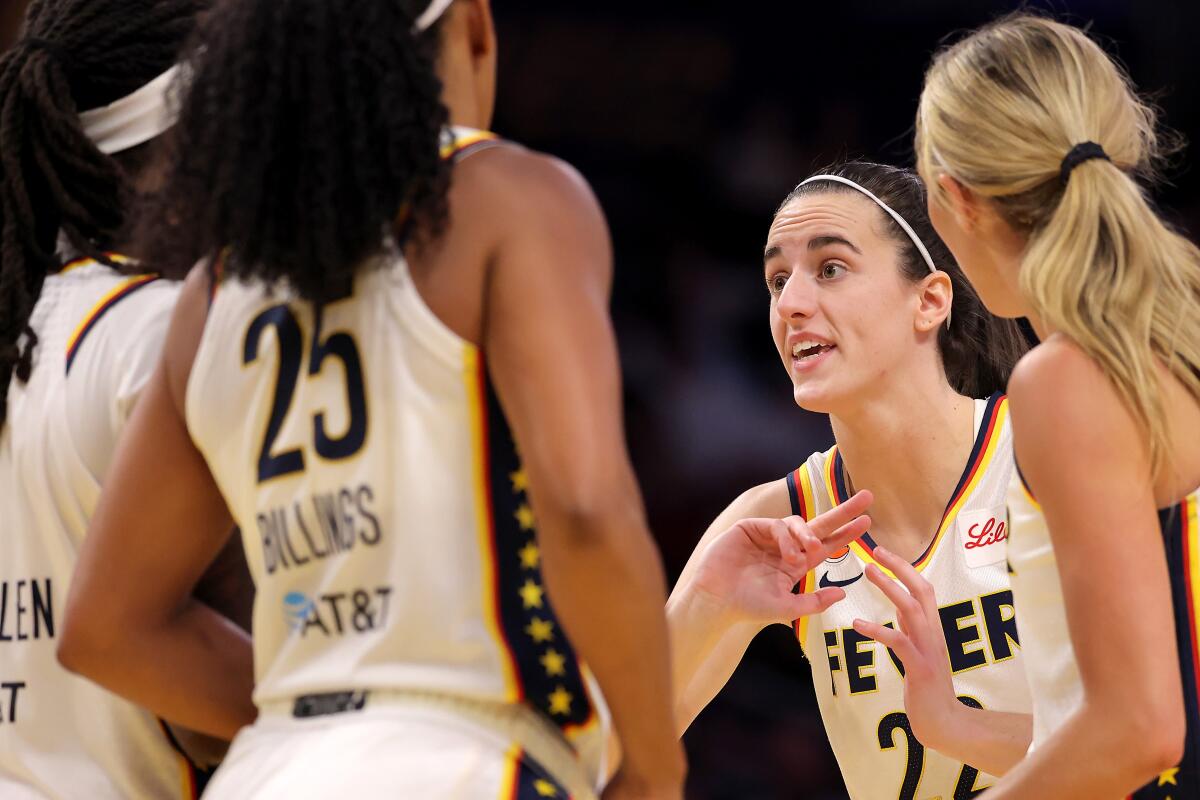
Caitlin Clark of the Indiana Fever talks with teammates during the second quarter.
(Katelyn Mulcahy / Getty Images)
“I’m happy we won, obviously, but I’m more happy with how we played,” coach Lynne Roberts said. “The response that we showed from just laying an egg on Monday to coming back and, you know, we talked about playing more connected, having a little more smarts out there, defensively emptying the tank, getting out and running and playing with pace.”
The Sparks rode a 16-2 run midway through the second quarter to lead by as many as eight before the half.
They didn’t slow down going into the third frame, opening with 18 points in the first five minutes to take a 13-point lead. Burrell and Kiana Williams hit consecutive threes late in the third after the Fever cut the lead to eight points, and it was never close again.
Plum (lower left leg) and center Cameron Brink (left ankle) remained out of the lineup, and the Sparks extended their bench to give significant minutes to Alissa Pili, Jihyun Park and Williams.
Pili, signed to a developmental deal this week, scored four points with five rebounds in her first WNBA action since last September because of a right ankle injury.
Wednesday’s win also snapped a three-game losing streak to the Fever dating to last season.
The Sparks will complete their three-game homestand against Chicago (7-14) on Friday.
“We wanted to play harder,” Ogwumike said. “We wanted to own each possession and to compete at every level for the full 40 minutes of play. It’s really that simple. I think when you put your heart into playing that hard, the schemes, the plays, the execution, it comes to fruition. And tonight, it felt good. It felt good emptying the tank.”
Mookie Betts’ first hit this series against the Rockies couldn’t have come at a more opportune time. With the crack of the ball against his bat, Tommy Edman scored from third, giving the Dodgers the lead.
And as Betts reached first, he pointed to Freddie Freeman, whose single put Edman in scoring position. It had taken a team effort to overcome another middling start from Roki Sasaki, and Betts, who had little to show before his game-winning hit, took the chance to highlight the joint contribution in the Dodgers’ 4-3 rubber-match win over Colorado (38-56).
“It feels great,” Betts said of his nine-pitch battle. “Helping the boys win, that’s really all it is. We play the game to win, and coming through in a big moment is kind of what, when you’re a kid, playing in the backyard, getting that hit is what you always strive to do, and fortunately, I was able to do it.”
Given a three-run lead in the first inning, brought to the Dodgers by a wild pitch and Kyle Tucker’s two-run, line-drive single to left field, Sasaki seemed set up for success.
Still, he gave away the lead as quickly as it came. In the second inning, he left a fastball too far over the plate, and third baseman Kyle Karros drove the ball over the left-center wall. The slider he dealt two batters later to second baseman Edouard Julien also crossed the zone too far over the plate, and Julien rounded the bases with another homer. In the third, a sacrifice fly by Mickey Moniak evened the scored, 3-3.
Sasaki’s troubles this season have been hard to pin down since his last win on May 23, as Sasaki tries to claw back the triple-digit velocity that’s escaped him as of late.
Against the Rockies, his fastball topped out at 99.1 miles per hour before steadily dropping to 98. He had managed five strikeouts in his six innings when manager Dave Roberts replaced him with Jack Dreyer, though the three earned runs couldn’t be ignored.
But Roberts also acknowledged the possibility that the pitcher had been tipping his pitches, possibly since he was playing in Japan, and Sasaki has tried to address it after a three-inning, six-run start last week. Even if he had fully self-corrected, his control issues remain. In the third inning, he walked the tying runner, Brett Sullivan.
“I’ve been working on a lot of things like the tipping stuff,” Sasaki said through interpreter Kensuke Okubo. “Also, I need to make quality pitches.”
Sasaki regained some of his confidence in the fourth when he worked out of a two-base jam with two strikeouts and a flyball to right, something that didn’t go unnoticed by Roberts.
“You can see the demeanor walking off the mound, the confidence,” Roberts said. “For me, it was more of let him end on a high note, feeling good about his outing, and then go from there.”
The Dodgers’ problems were compounded by Alex Call wasting the team’s two challenges in his at-bat in the first inning when the team had already taken the lead. And maybe it would’ve been excusable if Call had driven in the runners on first and second, but instead he ended the inning on a strikeout, stranding both. Roberts called the situation an “outlier” and didn’t feel as though he needed to have a conversation with Call regarding the situation.
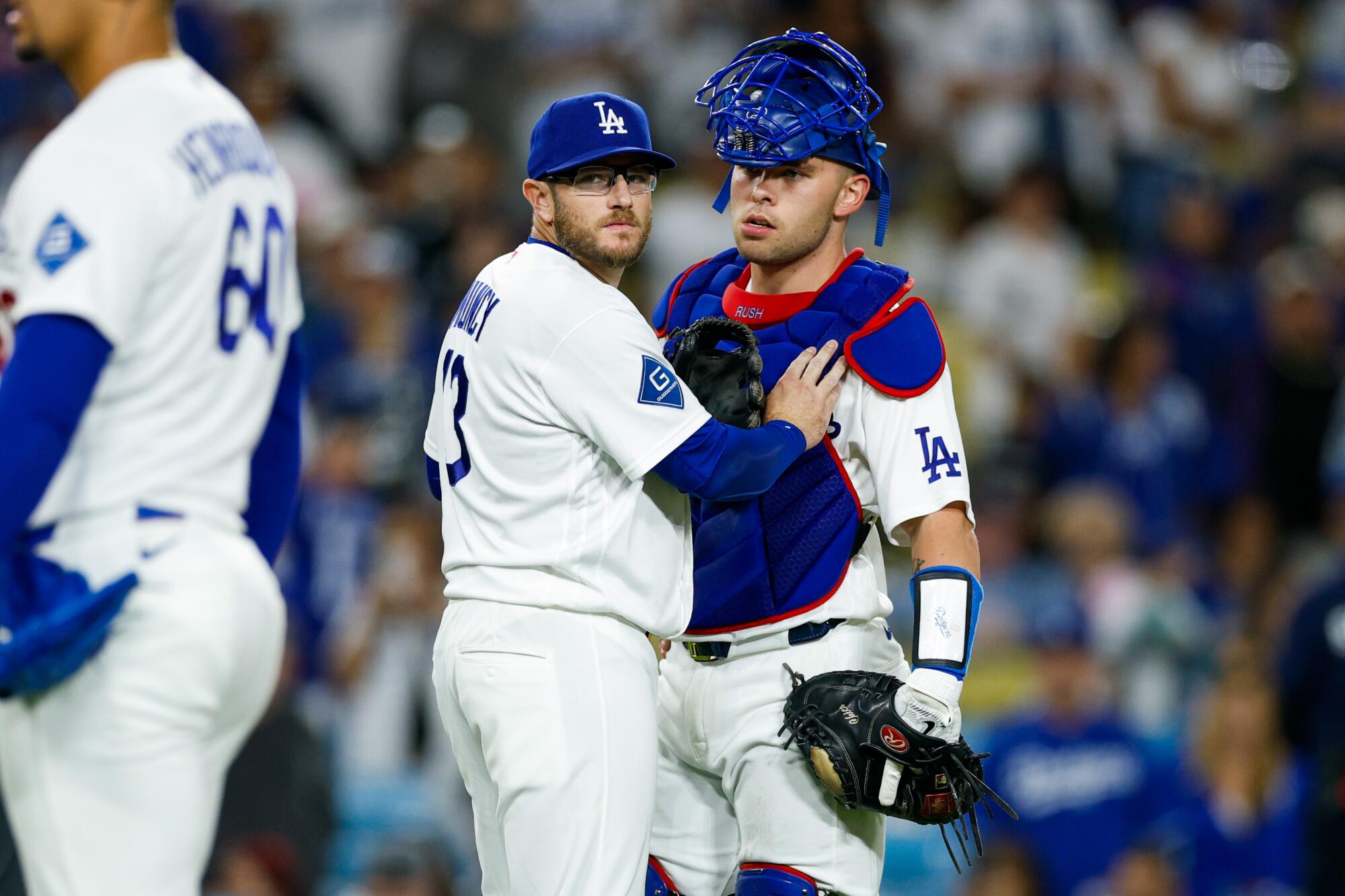
After the three-run first, the Dodgers (61-33) remained hitless until Max Muncy laced a double down the right-field line in the sixth, though to little avail. As the innings ticked forward, Colorado’s chances seemed to increase. The Rockies hold the best league batting average (.297) in the eighth and ninth innings (the Dodgers are fourth with .268). And the Dodgers relievers, within the same constraints, have a 3.83 ERA — not bad, but not in the top 10 either.
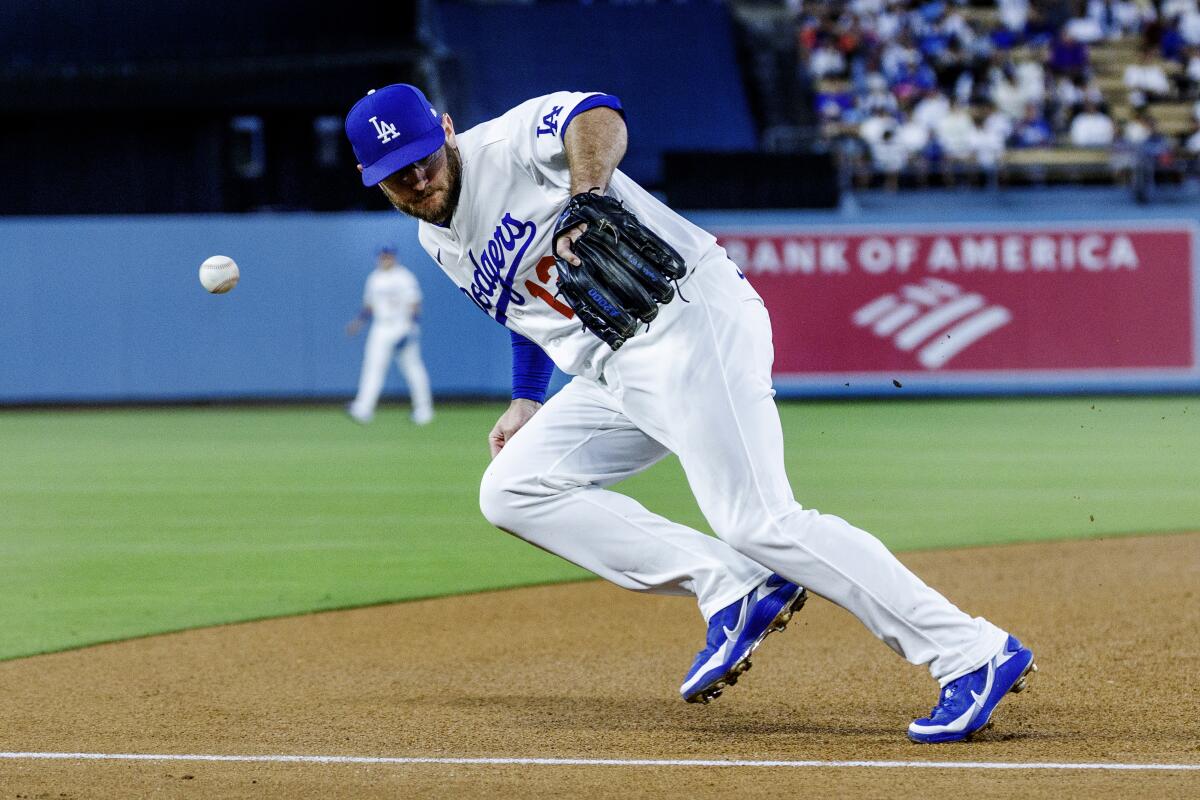
Third baseman Max Muncy can’t get his glove on a line-drive double by Kyle Karros in the fourth inning.
(Gina Ferazzi/Los Angeles Times)
So when Alex Vesia struggled against the Rockies in the eighth inning and Muncy suffered a throwing error, Colorado seemed in position to score with the bases loaded and one out. Vesia struck out TJ Rumfield and Edgardo Henriquez (4-0), his replacement, retired Karros on a fly ball to right.
After Betts’ single allowed the Dodgers to take the lead, Tanner Scott (13) shut down the Rockies with back-to-back strikeouts, avoiding the team’s eighth series loss of the season.
“Didn’t feel great,” Roberts said. “Fortunately, we won a series, but that’s not the kind of way you want to do it.”
The prime minister has given a heavy hint that there will be an extra bank holiday if England win the World Cup.
Thomas Tuchel’s team will play Norway in the quarter-finals on Saturday night.
The final will take place a week on Sunday, on 19 July.
It is widely expected Sir Keir Starmer will step down as prime minister the day after, to be replaced by Andy Burnham.
Should England make the final, it would be likely the prime minister would go to the game, which could briefly delay the handover of power.
As for the idea of an extra day off for people in England were the team to win the World Cup, Sir Keir said: “On the question of a bank holiday, I think I don’t want to jinx it, but ask me again if we get to the final.”
It is understood the extra bank holiday would be on the Friday following England’s triumph – 24 July.
There is, though, the not insignificant matter of England winning a quarter-final, semi-final and final first.
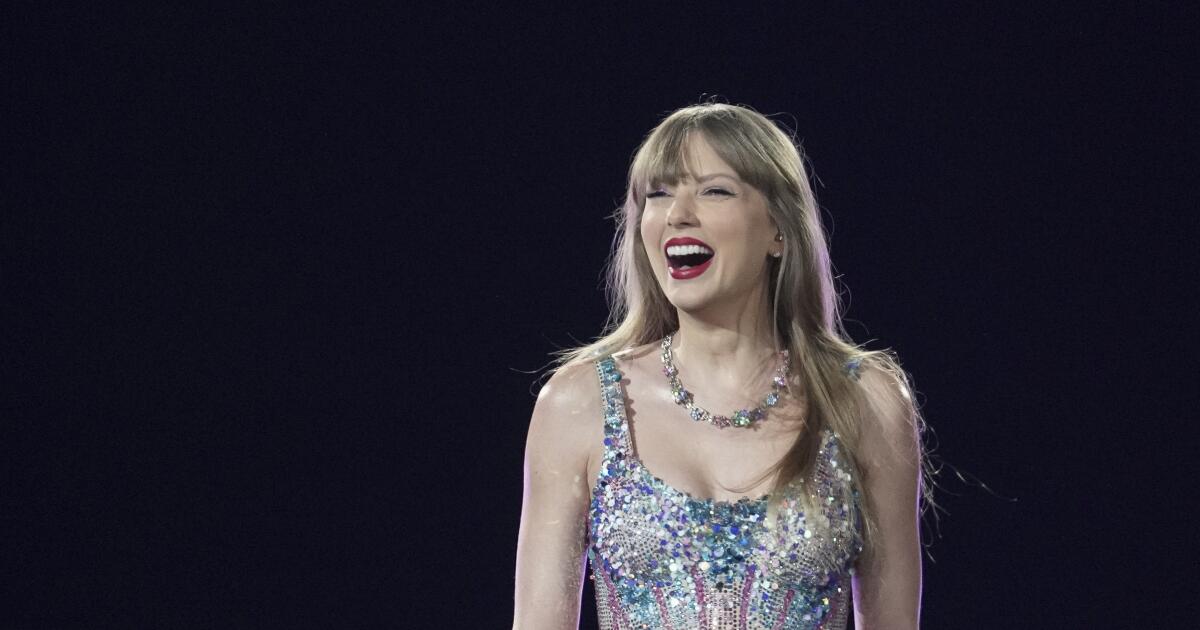
Taylor Swift has yet another new thing to celebrate.
Now in her newlywed era, the pop superstar’s concert film, “The Eras Tour: The Final Show,” earned five Emmy nominations Wednesday. This includes nods for variety special (pre-recorded), sound mixing for a variety series or special, directing for a variety special, picture editing for variety programming, and technical direction and camerawork for a special.
The nomination for variety special (pre-recorded) means Swift herself is a nominee as the performer and a producer of the concert film, which showcased the final performance of her record-breaking tour. This marks the “The Life of a Showgirl” singer-songwriter’s second career Emmy nomination. She previously won in 2015 in the category of creative achievement in interactive media — original interactive program, as the executive producer of the mobile app AMEX Unstaged: Taylor Swift Experience.
The accolades come just five days after Swift married beau Travis Kelce in an extravagant — yet secretive — Manhattan affair at Madison Square Garden. The Kansas City Chiefs tight end has spoken about his failed attempt to slide Swift his phone number (via friendship bracelet) when he attended an Eras tour concert in 2023.
The Emmy nominations follow her latest legal win. On Monday, a federal judge in Florida dismissed with prejudice a copyright lawsuit that accused Swift of plagiarizing a self-published poet.
In February 2025, Kimberly Marasco, representing herself, filed a lawsuit that alleged Swift copied “unique expressions” such as short phrases and specific words from her poetry in numerous songs, including “The Man,” “Down Bad,” “I Can Do It With a Broken Heart,” “Hoax,” “Guilty as Sin?” and “It’s Time to Go.” A similar lawsuit Marasco filed against Swift and other named defendants was dismissed by the same judge last September.
Swift’s lawyers called the lawsuit “absurd and legally baseless” in their filings. “For instance, the concept of betrayal or the words ‘fire’ or ‘love’ cannot be owned by one person, as basic themes or words are not protectable by copyright law,” reads the motion to dismiss submitted by attorneys James Douglas Baldridge and Katherine Wright Morrone, who also represented co-defendants Republic Records and Universal Music Group.
In her order granting Swift and her record label’s motion, U.S. District Judge Aileen Cannon agreed, reiterating that “the allegedly infringed material — basic ideas, themes, metaphors, isolated words, and short phrases — is not protected expression and cannot be infringed.”
Cannon mentioned these allegedly plagiarized words and phrases included “tears,” “running,” “fire,” “rain,” “sky,” “love,” “invisible,” “caged me,” “flesh and blood” and “it’s time to go.”
Even if they were protected expressions, “the works are not even substantially similar — a point Plaintiff effectively concedes by characterizing the alleged copying as ‘paraphrase[s],’ ‘rephrase[s],’ and copying with ‘minor word substitutions,’” Cannon wrote.
But it appears Swift has not completely shaken off Marasco’s copyright lawsuit. The Florida poet has already filed an appeal.
The clamour surrounding the World Cup’s controversy involving US President Donald Trump and FIFA chief Gianni Infantino had barely died down when another arose in the aftermath of Argentina’s controversial 3-2 win over Egypt in the round-of-16 match in Atlanta.
As the defending champions staged a stunning comeback against the Pharaohs in the knockout match on Tuesday, questions were raised about an unusually late VAR call that saw Egypt’s second goal rescinded, followed by a chain of events that led to Argentina’s victory.
Recommended Stories
list of 4 itemsend of list
A day earlier, Trump had revealed that he had asked FIFA to review, and overturn, USA striker Folarin Balogun’s one-game suspension for a red card, and the governing body controversially obliged. The matter was dusted off by Belgium as they dumped the hosts out of the tournament with a 4-1 win in the match Balogun was initially suspended from but ended up playing – to no avail.
Trump watch on the World Cup
While the anger surrounding FIFA’s red-card decision was directed at both the football governing body and Trump, Egypt’s outburst was solely aimed at the organisation, which, according to Egypt’s manager, had “wanted to keep the world champions in the competition”.
Head coach Hossam Hassan speculated that match officials had been put under pressure to ensure that one of the biggest names, Argentina’s Lionel Messi, stayed in the tournament.
“Perhaps they wanted Messi to stay in the running,” Hassan told beIN Sports after the match.
“In football, there are sometimes external factors that go beyond the technical aspects. The world champions received support at every level.”
While the tournament has been no stranger to the political spotlight of questionable integrity, experts say the lines between sport and politics have been blurred even further.
“After the Balogun affair, who knows which decisions are legitimate and can be trusted, and which can’t?” Simon Chadwick, professor of Afro-Eurasian sport at the Emlyon Business School in Shanghai, told Al Jazeera.
“If the Trump administration is maintaining a watching brief over the tournament, it’s worth remembering: Argentina’s president, Javier Milei, is a staunch Trump supporter.”
Trump and his Argentinian counterpart share a close relationship. Milei is a regular feature at pro-Trump political gatherings in the United States, and Trump has described Argentina’s far-right populist leader as his “favourite president”.
Chadwick also opined that Hassan’s vociferous support for Palestine at the World Cup could have prompted some officials to “have built-in biases when making decisions”.
Hassan dedicated part of his pre-match news conference on Monday to making an impassioned plea for the people of Palestine, especially those in the besieged Gaza Strip.
Advantage, Argentina
Circling back to the VAR call that sliced Egypt’s lead in half and was followed by decisions that conveniently favoured Argentina, Chadwick said the period of play was “unusual”.
He wondered why the referee had not called a foul in real-time that VAR picked up several moments later and only once Egypt scored their second goal.
“There was something distinctly unusual about the goal and VAR decision, something that was amplified when Argentina scored one of its goals,” Chadwick said, questioning refereeing standards in the match.
“In the build-up, an infringement was perpetrated by an Argentina player, which could have been interpreted as a similar offence to that supposedly committed earlier by the Egyptian player. At the very least, refereeing standards during the game were somewhat inconsistent, although critics are clearly making much more serious claims.”
But while many social media commentators and football experts were outraged at the decisions – Portuguese football icon Jose Mourinho reportedly termed the match “daylight robbery” – some football experts said it was a closer call.
“Robbed might be a strong word,” football analyst Ali El Garni said.
“I’d say decisions made by both the referee and VAR could have gone either way, and Argentina benefitted from all the 50/50 incidents.
“The incident leading to the Egyptian disallowed goal was an indisputable foul. The question is how far VAR should go back to check the legitimacy of a goal,” said El Garni, who has extensively reported on European and North African football.
However, he did wonder if VAR would have been involved had the scoreline been 2-0 in Argentina’s favour instead.
“Would the goal have been disallowed had it been scored by Argentina? It’s unlikely,” he said.
“What’s making it worse for Egypt is the fact that a similar incident involving what appeared to be a foul on [Mohamed] Salah took place before Argentina’s third goal, and VAR didn’t intervene,” he said.
Meanwhile, Chadwick questioned why VAR officials had raised the issue if the on-field officials did not call a foul when Egypt‘s Marwan Attia lightly tugged the shirt and stepped on the foot of Lisandro Martinez.
A logical solution to the VAR issue, Chadwick proposed, would be “for fans and viewers to listen to an assessment of the alleged offence, hear the various arguments, and have a clear insight into the basis for a decision”.
Chadwick admitted that although Egyptian players should not have become overwhelmed with emotion, “a sense of injustice was induced by the VAR decision”.
“This technology was supposed to minimise doubt and bring consistency. Instead, its use during this match had significant cognitive and behavioural effects,” he said.
“Indeed, rather than brandishing cards and inflaming the situation even further, the referee should have used his discretion and judgement to defuse the situation.”
While Chadwick dismissed rumours of match-rigging in favour of Messi and Argentina, he acknowledged the pull of the iconic footballer’s star power.
“There is no doubt that Messi is a box office attraction the tournament really can’t afford to be without.”
After being taken to a decider against Miomir Kecmanovic in his opening match, Sinner has not dropped a set in his past four matches.
However, not all of those victories have been straightforward as the scoreline suggests, and the top seed has yet to find his best form at SW19.
That has yet to prove a major problem for the 24-year-old, who has upped his level when needed to claim the decisive breaks and get himself over the finish line.
But, with world number 48 Nuno Borges being the highest-ranked opponent he has faced so far, it remains to be seen how he will fare against someone like Djokovic or fourth seed Auger-Aliassime.
Against Struff, Sinner endured a slow start and was taken to deuce in three successive service games, while the 6ft 4in German cruised through his.
But Sinner clung on and remained composed to first break for a 6-5 lead before serving out the opener to take the lead.
After trading breaks in the second set, Struff had the chance to level the tie when he brought up a set point, but Sinner’s serve saw him out of trouble and he breezed through the tie-break.
The four-time major winner remained relaxed as he dropped just four points on his serve in the third set and, after striking the decisive blow at 4-3, confidently served out the victory to seal his spot in the final four.
Dodgers catcher Dalton Rushing spun to face home plate umpire Dan Iassogna, holding up his mitt with the ball inside.
When that didn’t change the safe call, Dalton immediately pointed to the Dodgers dugout, mask in hand urging manager Dave Roberts to challenge.
Robert’s hands flew up to his ears, asking for a replay review.
The tension in Dodger Stadium broke with the announcement: “The catcher touched the runner’s hand before he reached the plate…”
The crowd’s applause drowned out the rest.
The go-ahead run had been on the line with that challenge in the Dodgers’ eventual 8-7 win over the Rockies in 11 innings. And it started a wild sequence to the Dodgers’ first extra-innings game of the season that ended with Rushing hitting a walk-off single to center field to score Teoscar Hernández.
That brawl with the Rockies — figuratively and almost literally — finished with the Dodgers becoming the first team to win 60 games this season.
“That’s a lot of wins,” Roberts said.
It looked as if the Dodgers would coast to the mark. Dodgers closer Tanner Scott took the mound in the ninth with a three-run lead. But after giving up an RBI double to Kyle Karros and a two-run double to Cole Carrigg the score was tied. Only a strong relay throw home by second baseman Miguel Rojas and a successful challenge prevented Hunter Goodman from scoring a go-ahead run.
In the bottom of the ninth, the Dodgers got runners on first and second with two outs. That brought up Andy Pages with two outs, but a successful Rockies ABS challenge confirmed a strikeout, sending the game into the 10th.
That ended the Dodgers’ streak of 91 games without extra innings, the second-longest a team has gone without playing an extra-inning game in the modern era, behind only the 2005 Red Sox (99).
The drama wasn’t over. Two batters into the 10th, the benches cleared.
With one out and Carrigg on third, Jake McCarthy hit a sharp ground ball to Dodgers first baseman Freddie Freeman, who stepped on the bag and fired home.
Rushing flung his body into the tag, but Carrigg was called safe.
Carrigg said something as began to walk away, and Rushing spun around.
As the two exchanged words, Dodgers reliever Edgardo Henriquez pulled his catcher away. But players from both dugouts and bullpens already began to spill onto the field.
Dodgers third baseman Max Muncy holds back Dalton Rushing after the Dodgers catcher got into a confrontation with Colorado’s Cole Carrigg in the 10th inning Monday.
(Ronaldo Bolanos / Los Angeles Times)
“I think that what happened is Carrigg said something aloud, not directed at Dalton,” Roberts said. “Dalton thought something was directed at him. We cleared the air. Basically a big misunderstanding.”
Said Rushing: “I didn’t mean any harm by the tag or the way I reacted to the ball. Made sure he knew that. Told him I was just reacting to the baseball. I don’t expect it to go any further.”
After a brief stoppage, Henriquez escaped without further damage. And the Dodgers got another shot, with Pages on second to start the inning.
Freeman’s groundout moved him to third. Then Mookie Betts drove him in with a comebacker over the mound and past flailing second baseman Edouard Julien.
Tucker then looped a single into no-man’s land. But the rally ended when Hernández’s liner up the middle landed in the glove of Rockies right-hander Jimmy Herget, who just entered the game, catching Kyle Tucker off first base for a double play.
In the 11th, Henriquez got out of the inning unscathed. He got Julien to pop out on a sacrifice bunt attempt and then started a double play himself. He punched the air as he walked off the mound.
“He’s calm in big spots, you’re starting to see it,” Roberts said. “He’s throwing strikes, throwing the breaking ball when he needs to and he’s now unfazed by certain moments and higher leverage. He’s a guy, certainly, we trust.”
In the end, Rushing — who already hit a pair of doubles and scored on Shohei Ohtani’s third-inning home run and fourth-inning two-run single — was the hero.
After Hernández made it to third on a sacrifice bunt by Tommy Edman, Dalton got the end of his bat on a changeup and sent it up the middle, just out of reach of a diving Julien.
“Infield’s in, they’re kind of doing you a favor,” Rushing said. “So move the ball forward, good things happen. And it wasn’t pretty, but it worked.”
Rushing’s helmet twirled in the dirt behind him as he jogged from first toward the center of the field, ready for the celebration that would meet him there.
“He plays with a lot of moxie,” said Dodgers starting pitcher Eric Lauer, who held the Rockies to three runs in six innings. “And he definitely doesn’t back down to anybody, and we love him for that. He’s a great guy that you want on your team.”
Dodgers star Shohei Ohtani rounds the bases after hitting a two-run home run in the third inning against the Rockies on Monday.
(Ronaldo Bolanos / Los Angeles Times)
Roster moves
Dodgers right-hander Evan Phillips is in line to make his first major-league appearance since May 2025. Phillips only made seven appearances last season, starting on the injured list with a strained rotator cuff before undergoing Tommy John surgery in June.
“It’s going to be a lot different tonight getting back out there in a competitive game, the full atmosphere,” Phillips said. “Really excited about that. I feel like probably the past two weeks or so I really took a good turn in my rehab, started bouncing back even better, pitching more like myself, feeling more like myself. So really just happy to carry that over to these games and see how the second half treats us.”
In a pair of corresponding moves, the Dodgers optioned right-handed reliever Paul Gervase to triple-A Oklahoma City and released left-hander Jake Eder.
The Dodgers also designated catcher Chuckie Robinson for assignment and added right-hander Carlos Duran to the 40-man roster. Both players are set to stay in Oklahoma City, with Robinson accepting his outright assignment.