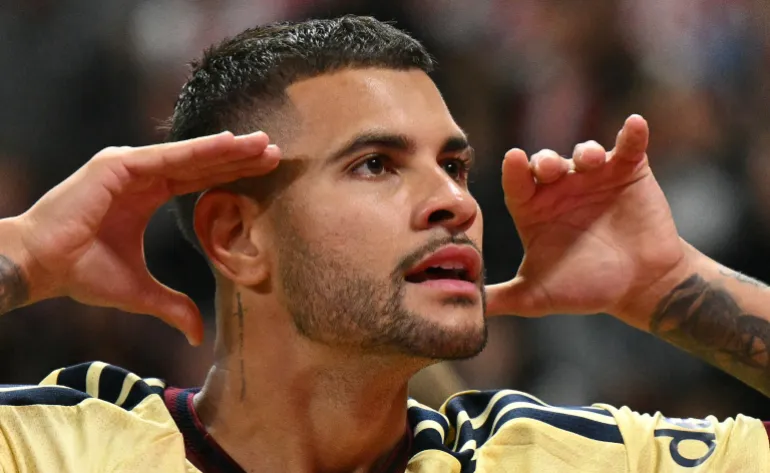
Morocco’s Ismael Saibari embraced his mother after scoring the winning penalty against Netherlands to reach the World Cup last 16. The players danced and cheered in the dressing room after the dramatic win in Monterrey, Mexico.
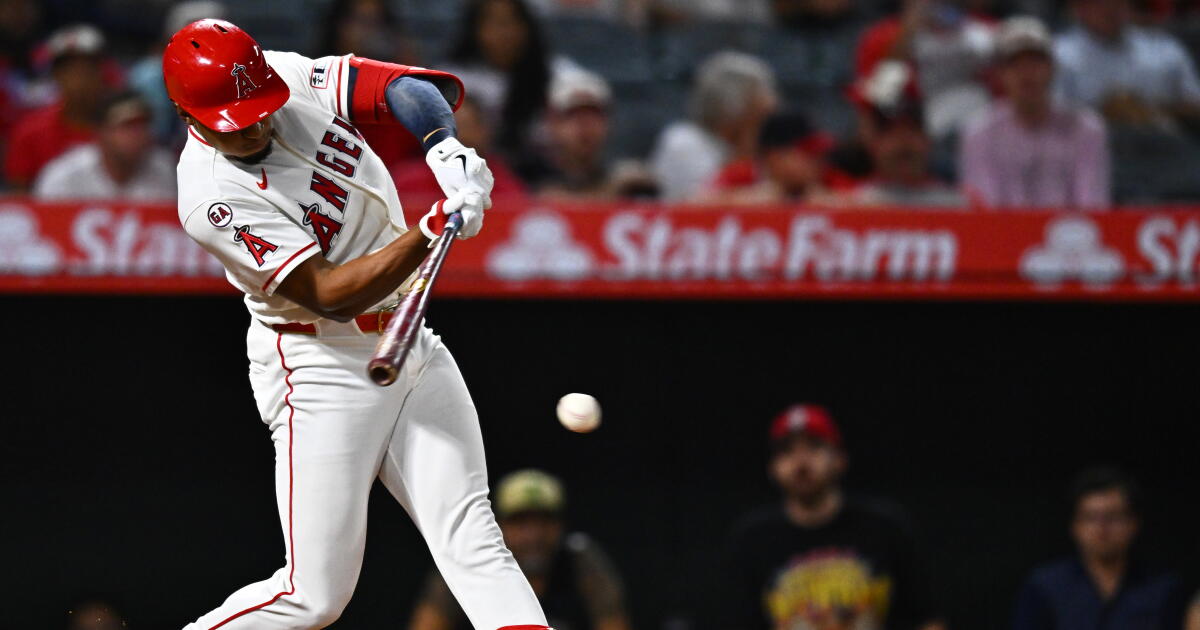
SEATTLE — Cole Young hit two home runs to back eight strong innings from George Kirby as the Seattle Mariners came from behind to beat the Angels 6-2 on Monday night.
Dominic Canzone also went deep to help Seattle (43-43) get back to .500 and stay a half-game behind the first-place Texas Rangers in the American League West.
Zach Neto doubled to center field leading off the game against Kirby (7-7), and Denzer Guzman singled two pitches later for a 1-0 lead. Neto hit his 18th home run in the third — a two-out shot that made it 2-0.
Kirby gave up a one-out double to Josh Lowe in the fifth but struck out the side — including Neto — to end the inning. The right-hander used 16 pitches to get six straight outs from there until Lowe doubled leading off the eighth.
Kirby issued his only walk, to Neto, with one out before striking out Guzman looking and Nolan Schanuel swinging on his 100th pitch.
Kirby gave up seven hits and fanned seven before José A. Ferrer pitched a scoreless ninth.
Young led off the third against Angels rookie Ryan Johnson (1-3) with his eighth homer to cut it to 2-1. Josh Naylor walked and stole second in front of Young’s two-out shot in the sixth off Mitch Farris to make it 6-2.
Randy Arozarena was hit by a two-out pitch in the fourth before advancing on a two-base fielding error by Guzman at third base on a grounder from Naylor. Both runners scored on Cal Raleigh’s bloop single for a 3-2 lead.
Canzone hit his 13th homer to make it 4-2 in the sixth, a leadoff shot against Farris.
Johnson gave up three runs (one earned) in five innings. Farris was tagged for three runs in three innings.
South American football expert Tim Vickery felt a typical Paraguayan spirit shone through on the day.
“Paraguay love adversity,” he said.
“If you’re looking for someone to relate to in this World Cup, look for Paraguay. That Welsh word ‘hwyl’, that grit and drive, when it gets difficult, that’s when they come alive.
“They’ve come through adversity to knock out a giant of European football. It’s not always pretty, they play within their limitations, but what drama, what a story.
“The objective in this tournament was to make Paraguay feel represented and they’ve done that in full.”
Paraguay now play either two-time champions France or Sweden iin Philadelphia on Saturday (22:00 BST).
Paraguay’s president Santiago Pena had already declared a public holiday after they had sealed World Cup qualification with a game to spare.
Now, with a place in the last 16 secured, attention turns to what he might have in store next for the celebrations.
Head coach Alfaro said he spoken to the president yesterday.
“He might declare another national holiday,” he joked.
“I want all of Paraguay to enjoy this. We may have our defects, but we have a heart that never gives up, and that’s what keeps us alive.”
California officials cheered a U.S. Supreme Court ruling Monday that allows states to continue counting mail ballots postmarked by election day but received in the days after — calling it a win for voter participation and access, including in the upcoming November midterm.
They also acknowledged delays in recent vote counting have spurred frustration, and promised to speed the process through other solutions — including by investing millions into new election infrastructure and vote processing capabilities.
Gov. Gavin Newsom — who called the court ruling a “win for voters, plain and simple” — has previously said the state should be able to count ballots faster, and his latest budget includes $29 million for “increased staffing, technology and equipment upgrades and purchases for counties,” $10 million for voter education and outreach at the state and county levels and $750,000 for combating election misinformation.
The court decision, a loss for President Trump and other critics who contend such policies contribute to unacceptable delays in vote counting, specifically upheld a Mississippi policy to accept mail ballots received within five business days of an election.
But it also lets stand similar policies in other states — including California, which counts ballots postmarked by and received within seven days of an election.
California Secretary of State Shirley Weber, who has long prioritized voter participation over a speedy count, called the high court’s ruling a “win for voters, for the rule of law, and for the future of our democracy.”
She said that she will “keep working to ensure every eligible Californian has the opportunity to be heard, because our democracy is strongest when every voice and vote count.”
Dean Logan, head of the Los Angeles County registrar-recorder/county clerk’s office, said in a statement to The Times that the ruling “affirms what Los Angeles County voters deserve: the assurance that a ballot cast by Election Day will be counted if received within the legal timeframe established in State Law.”
“Our office will continue to provide voter education, multilingual outreach, and leverage available resources to ensure voting access for our 5.8 million registered voters,” Logan said.
Many voting rights experts agree California’s vote counting should and could be faster, but disagree with the Trump administration’s efforts to step in with policies such as election day deadlines.
In 2024, California counted more than 406,000 late-arriving mail ballots, but they represented only about 2.5% of the statewide total. Experts say California’s delayed results have far more to do with the massive influx of mail ballots that are placed in ballot drop boxes or arrive at processing facilities on or just before election day.
Rick Hasen, an election law expert and director of the Safeguarding Democracy Project at UCLA Law, said the court’s decision was a “symbolic loss” for Trump, in that the court rejected his preferred policy on mail ballots, but “doesn’t appreciably change how long it takes to count ballots” because late-arriving ballots were never the problem.
In a report published Thursday, the California Voter Foundation recommended statewide adoption of “sign, scan, and go” programs that allow elections officials to immediately process mail ballots that voters submit in person at polling centers or drop boxes.
The foundation recommended ballot curing programs that speed up the process by utilizing a secure text platform when double checking whether a ballot is legitimate when a voter’s signature doesn’t match state records.
It also urged the state to invest $35 million in a voter education campaign to encourage early ballot returns, and more than $55 million in improving counting capacity and efficiency in county elections facilities.
Trump and other conservatives had called for an end to state policies allowing late-arriving mail ballots to be counted as an overdue fix to a voting system that often can’t produce election results in close races for days after polls close, as was the case in California’s recent primary races for governor and L.A. mayor.
Trump has pointed to California’s time-consuming count as proof of widespread fraud to undermine Republican candidates, though he has never produced evidence to support that claim and Democrats have fiercely denied it.
On Monday, Trump called the high court’s decision to uphold such state policies a “tremendous loss,” and more reason to pass the Save America Act — a bill he has backed that would enforce new voter ID and proof of citizenship requirements and ban mail ballots except for military personnel, individuals suffering from illness, disability, and in other rare circumstances.
He said politicians have “no excuse” other than “CHEATING!” to oppose such measures, especially at “a time when there is a powerful Communist Movement taking place in our Country, one more dangerous than World War I, World War II, Pearl Harbor, or September 11th.”
But California leaders rejected that — saying the criticisms of mail ballots are baseless and an attempt by Trump and his allies to undermine elections in which they are poised to lose, particularly in big blue states such as California, by attempting to wrest control over voting processes that have always been the purview of states, not the federal government.
California Atty. Gen. Rob Bonta said Monday that states have been “primarily responsible for regulating elections” since the nation’s founding, and his office was “pleased that the U.S. Supreme Court has respected that authority.”
“Today’s decision recognizes a basic reality: Mail delays happen. When people vote by election day, their ballots should not be discarded because of those delays,” he said.
Sen. Alex Padilla (D-Calif.), the ranking Democrat on the Senate Rules and Administration Committee, which has oversight over federal elections, praised the high court Monday for acknowledging that nothing in federal law precludes states from counting mail ballots in the days after an election.
“Today’s decision is a victory for voting rights and a rejection of Trump’s attacks on mail and absentee voters,” Padilla said.
Liberal groups and many voting rights experts also hailed the ruling as a win for voters.
Moving up deadlines for mail ballots is just one effort in a much broader political war over voting and the rules that govern it. The U.S. Constitution generally gives states the authority to run their own elections, but the Trump administration has been trying to assert greater federal control — especially around mail ballots.
Earlier this year, Trump signed an executive order directing the U.S. Postal Service to assert control over mail balloting by designing new envelopes with special bar codes that would allow the federal government to ensure ballots only go to and get returned by eligible voters. The order prompted the Postal Service to propose new rules requiring states to hand over their voter mailing lists so it could implement Trump’s directive.
In a letter to U.S. Postmaster General David Steiner on Wednesday, Democratic senators denounced the proposed rule as an “unconstitutional and illegal attempt to transform [USPS] into an election administration agency controlled by the White House and President Trump.”
In a Senate hearing the same day, Steiner said that under the new rule, the USPS would not mail the ballots of a state that refused to turn over its voter lists, but also that his agency would adhere to any court orders curtailing its implementation.
On Thursday, just such an order came down in a federal case in which California and other Democrat-led states challenged Trump’s executive order. U.S. District Judge Indira Talwani ruled that the Constitution does not grant the president “any specific powers over elections,” and blocked his order as unlawful.
Nevada Secretary of State Cisco Aguilar, who is chair of the Democratic Assn. of Secretaries of State, said states such as California were right to focus on increasing investment in their own election infrastructure rather than accepting the Trump administration’s “bad policy ideas” for speeding things up.
Newsom’s office on Monday said that is exactly what California has been doing. It pointed to laws passed by the state Legislature last year that allow election officials to begin processing mail ballots earlier and require them to finish counting ballots sooner.
Josh Lowe‘s first career grand slam was all the offense the Angels needed Sunday in a 4-1 victory over the Athletics at Anaheim Stadium.
Lowe was 10 for 33 with 27 RBIs with the bases loaded during his six-year career, but had managed only two extra-base hits in those situations prior to going deep off starter Aaron Civale in the second inning.
The center fielder fouled off a pair of 1-2 pitches before sending a high cutter 403 feet to the right-field corner for his first homer since May 20.
Angels starter Sam Aldegheri (3-3) allowed one run and five hits in five innings, striking out four. José Fermin threw two scoreless innings and Samy Natera Jr. got four outs for his first major league save.
Joey Meneses drove in Jeff McNeil with a sacrifice fly in the fifth for the A’s, who finished with six hits. They went 0 for 8 with runners in scoring position and left eight on base overall.
The A’s threatened to cut into the lead after two straight walks to open the eighth, but Ryan Zeferjahn struck out the next two batters before giving way to Natera, who retired Nick Kurtz on a fly ball.
Civale (5-5) permitted seven hits in five innings, striking out two. José Suarez tossed two scoreless innings in relief.
Up next: Angels RHP Ryan Johnson (1-2, 8.84 ERA) starts Monday night in Seattle against RHP George Kirby (6-7, 3.94) to begin a three-game set.
Heinrich Malan has stood down as head coach of Ireland’s men’s cricket team, less than 24 hours after the historic Twenty20 series win over world champions India.
The South African will leave as part of what Cricket Ireland says as a “planned transition”, and a new head coach is set to be in place for a five-game one-day international series with Afghanistan in August.
The 45-year-old has been in charge of Ireland since 2022 and his final game was a dramatic one-run victory over India to clinch the T20 series on Sunday in Belfast, which followed a first-ever victory over the world champions in any format on Friday.
SAN DIEGO — The Dodgers claimed a series win against the San Diego Padres with a 4-2 victory Sunday, widening the gap between division rivals to 10 games.
The Dodgers (54-30), who have the best record in the majors, have won five of the first six games of a three-city trip that ends in Sacramento.
A bounce-back start from right-hander Emmet Sheehan made the Dodgers’ win Sunday possible. He held the Padres to one run, on Manny Machado’s fourth-inning homer, through five innings.
“Maybe being a little more comfortable in my mechanics,” Sheehan said after limiting the Padres to two hits. “But also just the focus in between starts of trying to get a little more execution instead of delivery thoughts. I had seven days, so I got to throw two bullpens this week, which is nice.”
It was the first time Sheehan held an opponent to a single run since May 8, when he threw 4⅔ innings against the Atlanta Braves.
“He just beared down and made pitches when he needed to,” manager Dave Roberts said, “versus feeling it with the mechanics or being uncertain.”
Mookie Betts stayed hot with his bases-loaded, two-run single off Padres starter Michael King to spearhead a three-run rally in the fifth. Betts also singled in the seventh.
Freddie Freeman had an RBI on a nine-pitch walk in the fifth, and Shohei Ohtani drove in the Dodgers’ first run with a single in the third.
“The last six weeks, Shohei’s been out of this world,” Roberts said. “Freddie’s been very consistent all year, and then now we got Mookie this last week on track. So it has been the better part of the season that we haven’t had all three of those guys. You can see it — when those three guys are threats, it just kind of takes a lot of pressure off everybody else.”
Over the three-game series, the Dodgers outscored the Padres 20-12. Here are offensive takeaways from the series:
Tucker ‘grinding’ through
Kyle Tucker hits a two-run home run against the San Diego Padres on Saturday in the Dodgers’ 15-3 win.
(Orlando Ramirez / Getty Images)
Dodgers right fielder Kyle Tucker never had been through a stretch like this. He entered Sunday with a .719 on-base-plus-slugging percentage, the lowest he’s had 77 games into a season in his career.
“I feel fine coming to the field and everything, it’s just not being as productive as I normally am, or as I want to be, kind of sucks,” Tucker said in a conversation with The Times a couple of weeks ago. “But I’ve just got to come back for the next at-bat, or the next day, and whatever, and just move on.”
Has battling this uncharacteristic slump taught him anything?
“I’d rather not suck,” he said. “But just try and grab through and just whenever anything works or clicks or whatever, just don’t let it go.”
Tucker has had moments this season when it looked like he was heading toward an offensive turnaround.
In mid-April, he homered twice in three games, including a three-hit performance. In early May, he went on a six-game hitting streak. He hit .303 over a nine-game stretch in mid-June. But none led to sustained success.
So, when Tucker logged three hits, including a home run, on Saturday as the Dodgers routed the Padres 15-3, he was cautious in his optimism. Tucker even nitpicked the nine-pitch at-bat that ended in the pull-side homer.
“There were some pitches I swung at earlier in the at-bat that I thought should’ve gotten the job done earlier, just didn’t put a great swing on it,” he said after the game.
Manager Dave Roberts was more enthusiastic about that at-bat.
“He’s handled it well,” Roberts said. “He’s frustrated, certainly. But he hasn’t run from the work. Even [Friday] night after the game, he was hitting in the cage. … You hear the word ‘grind’ a lot, but he’s grinding. It’s good to see him have some success. I just liked that one at-bat tonight where it was just compete. It wasn’t about mechanics. It was about competing and getting the job done.”
On Sunday, Tucker singled in four at-bats.
Edman’s consistency
Tommy Edman hits against the San Diego Padres on Friday.
(Derrick Tuskan / Associated Press)
There were times last year when utility player Tommy Edman could look at video of his swing and think, “OK, that doesn’t look like how I want it to look.” But there was only so much he could do in the middle of the season, while playing through nagging ankle issues.
“Part of it is kind of just breaking habits that I built last year,” said Edman, who underwent surgery on his right ankle in the offseason. “Was just getting into some bad movements with the lower body, probably just compensating for the ankle, and hips get out of whack, and that kind of stuff. So I’m hopeful that I’ll just be able to keep this up the rest of the year and just be consistent with it.”
Since returning from the injured list on June 16 to make his season debut, Edman is hitting .333 (11 for 33) with a .405 .on-base percentage. He hit his first triple and second double of the season in the Dodgers’ blowout win Saturday.
“I feel like this is kind of one of the rare times where both swings feel good, both from the right and left,” switch-hitting Edman said after that game. “It’s really tough to maintain both swings over the course of the season, so just happy that I feel that way.”
Betts is back
When Betts went three for four, a triple short of the cycle, in the Dodgers’ series finale in Minnesota last week, he couldn’t put his finger on a cue that had snapped his swing into shape over the last couple of weeks.
“Today, I was able to just find something,” he said then. “I don’t even know really what I found. After the home run the first at bat, I wasn’t sure what I did, but I just kind of stayed there. And I think that was the beauty of it. And not really fully knowing and just kind of going to play kind of let me know my training is paying off.”
It continued playing off. That performance kicked off a three-game homer streak. And by the end of his two-week heater, Betts had raised his OPS from .591 to .737.
By Saturday night, Roberts was ready to declare that Betts was back.
“I say ‘back’ because I just think there’s more intent with him in the batter’s box and a lot less indecisiveness,” Roberts said. “So for me, if he can have that kind of proactive approach, aggressive approach, then everything else is going to take care of itself.”
Betts credited his resurgence to a shift in how he prepares for games. Instead of taking 100 swings in the cage with a specific cue, he’s building up from a blank slate every day.
“I used to have things I would think about that would produce a swing, and now I’m actually just training my body every day,” he said. “So kind of one in the same, but they’re just two completely different ways of going about it. And still trying to get fully used to it, but it’s working, so I’m not changing it.”
From the prime minister to sport celebrities and fans on social media, Canadians have revelled in their team’s win.
Canada have enjoyed a historic run at the FIFA World Cup 2026, and it will continue thanks to Stephen Eustaquio’s 92nd-minute goal against South Africa, which sent the cohosts into the global tournament’s round of 16 for the first time.
The 29-year-old midfielder’s strike on Sunday rewrote Canadian football history, capping off a narrative that Jesse Marsch has been scripting since taking the reins two years ago.
Recommended Stories
list of 4 itemsend of list
“Think about how we talked about sticking to the plan, sticking to who we want to be, playing aggressive, accessing the quality, you guys showing your character,” an impassioned Marsch told his team as they circled around him on the pitch following their victory.
“You guys are Canadian heroes! Canadian heroes for the future children of this country, who play this sport. This sport has a big future because of you guys.
“You should be so proud of who you are. You should be so proud of this game. You went after it, moment after moment.”
The same words were echoed by Prime Minister Mark Carney, who had barely exited his flight and watched the final minutes of the game on his phone.
“What a game. What a team. What a country,” Carney wrote on social media.
Doug Ford, the premier of Ontario, where Eustaquio was born and raised before his family moved to Portugal, congratulated the team for advancing to the next round, as did Leader of the Opposition, Pierre Poilievre.
Mayor of Vancouver, Ken Sim, wrote to the team, saying: “You wore your hearts on your sleeves, gave everything on the field, and gave all of us a memory we’ll never forget.”
Social media was flooded with footage of Canada fans turning watch parties and fan festivals into a sea of red. Even Los Angeles Stadium, where Canada came down the West Coast to play South Africa, was thronged with fans supporting the World Cup cohosts.
Football enthusiasts and analysts on social media said the victory felt surreal for Canada, where sport like ice hockey, basketball and baseball enjoy far more popularity than football.
Fellow Canadian athletes joined in the social media celebrations. Multiple Olympic champion swimmer Summer McIntosh, tennis star Felix Auger-Aliassime, and Olympic champion runner Andre de Grasse were some of Canada’s top athletes to back the men’s football team after their win.
Famed Canadian astronaut Chris Hadfield also congratulated the team after wishing them well earlier on Sunday.
FC Bayern congratulated Alphonso Davies for returning to international duty after he sustained a hamstring injury with them in May, during the UEFA Champions League semifinal. The game saw a noticeable shift in pace and tactic when Davies was subbed in on the 74th minute.
From the opponent’s side, South African President Cyril Ramaphosa congratulated Canada for winning “with Bafana Bafana breathing down your necks”.
Former German footballer Bastian Schweinsteiger, however, who was called out by Ivory Coast manager Emerse Fae for racist undertones in his remarks on the African team, seemed unfazed by Canada’s historic win.
“Overall, not a convincing performance, but thanks to the clearer chances, progressing is fine. Alphonso Davies brought fresh wind after coming on as a substitute,” he wrote on social media.
“However, against the Netherlands or Morocco, the team will have to improve significantly.”
Ireland won the second T20 by one run over India, who did not hand a debut to teen sensation Sooryavanshi.
Published On 28 Jun 202628 Jun 2026
Ireland have secured a landmark series win over T20 world champions India in Belfast with a tense one-run victory after India again denied teenage sensation Vaibhav Sooryavanshi a debut.
Harry Tector marked his 100th T20 international appearance with a fine 50, as Ireland recovered from a slow start to post 154-8 at Stormont.
India-born Jai Moondra, who struck with his first ball in international cricket on Friday, had Sanju Samson lbw off the first ball of India’s chase.
He also dismissed Abhishek Sharma in the same over, before soon removing India captain Shreyas Iyer.
India regrouped after a rain delay, with Tilak Varma making 55 and Harshit Rana 21 late on, but that was not enough, as they finished on 153-9.
India’s 15-year-old batting prodigy Sooryavanshi forced his way into the squad for the white-ball tours of Ireland and England following several stunning displays in the 20-overs-per-side Indian Premier League.
Sooryavanshi emerged as the leading run-scorer in this season’s edition after amassing 776 runs for the Rajasthan Royals, a tally that included one century and five fifties.
But as had been the case in the first of the two-match series on Friday, when Ireland won by 34 runs for their first international men’s win over India in any format, the rising star was left out.
Sooryavanshi’s next chance to make an international debut will come in Wednesday’s first T20 against England at Chester-le-Street, the headquarters of county side Durham.
On the back of eight straight losses things could hardly have got off to a worse start for the Giants when Johnstone got in at the corner and prop McMeeken then dotted down, after Rourke flicked Jake Trueman’s kick back.
However, they did not go under and two solo efforts in four minutes from Gagai and Geyer saw them turn the match on its head for the first time.
Sinfield’s first Super League try since joining from Leeds in the off-season gave Wakefield a 16-12 lead at the break, but Russell kicked a 40/20 in the first play of the second half and O’Donnell crashed over.
Huddersfield, who were looking for a first wince since 4 April, could not hold on to their narrow lead as Jowitt kicked a penalty after a high shot on McMeeken to level and Rourke held off the attentions of three players to get in at the corner.
The visitors fought back once more when Swift cut in off the left edge and grounded the ball to make it 22-22.
Sinfield’s drop-goal nudged Wakefield back into the lead before Russell’s long ranger levelled the scores yet again.
But the former Trinity man was left desolate when his pass was grabbed by Rourke who managed to get away from the chasers and win it.
Huddersfield will raise the curtain on Magic Weekend when they play York Knights at Everton’s Hill Dickinson Stadium next Saturday, with Daryl Powell’s men playing his former side Castleford in Sunday’s first match.
Great Britain’s Ben Whittaker marked his American debut with an impressive second-round victory against Richard Rivera at Barclays Center in Brooklyn.
The flamboyant Whittaker dropped the American at the end of the first round with a right hand, although Rivera pointed that the punch had caught him on the back of the head.
But Whittaker, nicknamed ‘The Surgeon’, clinically caught his rival with a left-hander at the start of the second and, although Rivera staggered to his feet, the referee stopped the light-heavyweight bout.
The win improved Whittaker’s record to 12 wins and a draw from his 13 professional fights, while Rivera suffered the third defeat of his 30 fight career.
“Brooklyn, that’s how you do it man,” said Midlands boxer Whittaker, who is renowned for his showboating and did a little dance at the end of the first round on the way back to his corner.
The fight took place on the undercard of Xander Zayas, who attempted to defend his WBA and WBO super-welterweight titles against Jaron Ennis.
But Zayas succumbed to a seventh-round stoppage, with the referee ending the contest after the Puerto Rican boxer had been knocked down for a third time in the fight.
It was the first defeat Zayas had suffered in his 24-fight career, while unbeaten American Ennis has 36 wins from as many fights.
St Helens strongly came through an attritional contest with Bradford Bulls to move back up to fourth in Super League.
They were quickly 10-2 behind after a Phoenix Steinwede try, but from there the visitors fought back to take control.
Jacob Douglas and Curtis Sironen tries had them in front by half-time, but they dominated after the restart with 28 unanswered points and further scores from Jack Welsby (2), Joe Shorrocks and Jackson Hastings, who had a 20-point haul with eight kicks too.
The victory took Saints up two places in the table, level again with Wigan Warriors but with an inferior points difference.
Having faded after a good start, this was a third straight defeat for Bradford, who stay 11th in their first year back at this level.
This was Saints’ first visit to Odsal since 2014 and the home side responded to the sight of one of the great names of rugby league being back at this famous old ground.
It made for a very physical start following a hard-fought game at the Brewdog Stadium in March.
Hastings kicked an early goal for Saints, before Shane Wright was yellow-carded for a late hit on Chris Atkin.
With the Australian forward off for 10 minutes, Bradford scored 10 unanswered points, highlighted by Steinwede’s hard run into the line and a smart sidestep taking him over the line.
But that was the high point for the Bulls as the visitors turned the scoreline around with two tries in the space of seven minutes.
Winger Douglas finished well in the left corner to mark his debut with a try, coming in with injuries leaving a big hole in the backline.
Then second-rower Sironen, on his 100th St Helens appearance, proved unstoppable from close range as Paul Rowley’s side went in ahead at the break.
That advantage was extended within a few minutes of the restart as Welsby got his hand down to Hastings’ grubber kick before the ball went dead.
Shorrocks took advantage when his own little kick bounced up kindly to dive over. Hastings then grabbed a try of his own after Harry Robertson had parried down the Australian’s chipped kick to move the lead out to 20 points and effectively seal the success.
Welsby got his second and St Helens’ sixth try, but the match ended on a worrying note after a very serious-looking injury for Bradford forward Will Gardiner, who needed treatment on the field from both sets of medical teams before he was carried off on a stretcher.
Turkey come out on top in the last minute of an end-to-end 3-2 win over a second string USA side, in their final Group D match at SoFi Stadium in Los Angeles.
Wins for India and South Africa at the Women’s T20 World Cup ensured the fight for semi-final qualification will go to the final day of the group stage.
India beat Bangladesh by five wickets and face Australia, who are top of Group Two, in the final fixture at Lord’s on Sunday knowing they will likely need to beat the six-time champions to qualify.
South Africa thrashed winless Netherlands by 88 runs and will need to beat Bangladesh in their final game and hope that India lose, otherwise it will go down to net run-rate. Bangladesh also retain a slim chance of progression.
In Thursday’s first game, India chased a below-par 137 at Old Trafford as opener Shafali Verma struck 53 from 34 balls, and they reached their target in 16.5 overs.
But if they are to overcome the unbeaten Australians, India’s fielding will need to improve significantly. A sloppy performance saw them drop four catches in the first five overs and the innings was littered with misfields.
Despite that, there was a glaring difference in quality between the teams as Bangladesh were unable to punish the mistakes as they scraped to 136-8.
Juairiya Ferdous top-scored with 33 while captain Nigar Sultana Joty added 32, but India’s spin-heavy approach prevailed once more as Radha Yadav took 3-28 and Sree Charani 2-21.
India lost Smriti Mandhana early before Shafali took charge and the chase slowed after her dismissal in the ninth over, but Jemimah Rodrigues’ 26 from 15 helped them over the line.
It’s crunch time at the 2026 FIFA World Cup with teams throughout the 48-strong field looking to stay in contention for the knockout stage or improve their placing in the round of 32.
The U.S., Mexico, Argentina, Germany, Brazil and Switzerland have already clinched spots in the round of 32 by winning their respective groups. France, Norway, Canada, Colombia, Morocco, Bosnia-Herzegovina and South Africa also are advancing. Haiti, Tunisia, Turkey, Jordan, Uzbekistan, Panama and Czechia, however, have been eliminated from knockout-round contention.
Here’s everything you need to know about World Cup matches being played Thursday and Friday across the U.S., Mexico and Canada (all times Pacific).
Thursday’s Group D matchups:
U.S. vs. Turkey
U.S. coach Mauricio Pochettino instructs his players during a 4-1 win over Paraguay at SoFi Stadium on June 12.
The buzz: There’s not much at stake since the U.S. has won the group and Turkey has been eliminated. Expect the U.S. to rest many of its regulars, especially those with yellow cards, while Turkey will be chasing its first World Cup win since 2002, when it finished third.
Paraguay vs. Australia
Paraguay midfielder Matias Galarza controls the ball against Turkey on June 19.
The buzz: The winner finishes second in the group and will go through to the elimination rounds. Australia, with an edge in goal differential, would get the second spot in the event of a draw. It’s not a do-or-die game for either team since three points could be enough to advance.
Thursday’s Group E matchups:
Ecuador vs. Germany
Germany’s Nadiem Amiri celebrates a goal against Ivory Coast on June 20.
The buzz: Germany is already through to the knockout stages while Ecuador could finish second and clinch a spot in the round of 32 with a win coupled with an Ivory Coast loss or draw. However, that would require Ivory Coast losing or drawing. A victory could send Ecuador on as a third-place team no matter what Ivory Coast does, but that path is less certain.
Curaçao vs. Ivory Coast
Curaçao’s Livano Comenencia shoots against Germany on June 14.
(Eric Gay / Associated Press)
Where: Lincoln Financial Field, Philadelphia Time: 1 p.m. TV: FS1, Universo
The buzz: Ivory Coast is all but through to the knockout round, at least as a third-place team. But a draw would give it the No. 2 spot in the group and an easier route through the knockout stages. Curaçao still has a chance of advancing despite having been outscored 7-1, and it could finish second with a win and an Ecuador loss.
Thursday’s Group F matchups:
Tunisia vs. Netherlands
Netherlands’ Crysencio Summerville celebrates after scoring against Sweden on June 20.
The buzz: Tunisia has lost two games under two coaches — getting outscored 9-1 in the process — and can’t advance. But there’s much at stake for the Dutch, who can finish anywhere from first to third depending on the results of the final group-stage games. The Netherlands and Japan are tied on points, wins and goal differential and played to a draw in their head-to-head match, so whoever does better on the final day wins the group.
Japan vs. Sweden
Japan’s Ayase Ueda celebrates after scoring against Tunisia on June 20.
The buzz: Both teams are assured of a top-three finish and a likely spot in the next round, but a win could secure first in the group. Although Japan and the Netherlands are the favorites to win the group, Sweden could overtake both with a win, provided the Dutch do no better than a draw.
Friday’s Group G matchups:
New Zealand vs. Belgium
Belgium midfielder Kevin De Bruyne (7), left, kicks the ball in front of Iran defender Hossein Kanaanizadegan on June 21 at SoFi Stadium.
(Robert Gauthier / Los Angeles Times)
Where: BC Place, Vancouver Time: 8 p.m. TV: FS1, NBC Univserso
The buzz: If New Zealand earns its first-ever World Cup win, it’s mathematically possible the Kiwis could win the group. The same scenario holds for winless Belgium, however, it is still looking for its first goal of the tournament.
Iran vs. Egypt
Iran forward Alireza Jahanbakhsh, left, battles Belgium defender Maxim De Cuyper for the ball during a World Cup match at SoFi Stadium on June 21.
The buzz: Egypt entered the final day of group play atop the group and with a firm hold on a spot in the round of 32. It would win the group with a victory, although a draw could also be enough, depending on the score of the Belgium-New Zealand match. Unbeaten Iran can also win the group with a victory; a draw probably will get it to the knockout stage.
Friday’s Group H matchups:
Cape Verde vs. Saudi Arabia
Cape Verde’s Helio Varela celebrates after scoring against Uruguay at the World Cup on June 21.
The buzz: With a win here, Cape Verde would not only go through to the knockout stage, but it could win the group depending on the result of the Spain-Uruguay game. The island nation of about 530,000 people, the third-smallest country to qualify for a World Cup, is unbeaten after draws with Spain and Uruguay. Saudi Arabia is looking for its first World Cup win since upsetting eventual champion Argentina in its 2022 opener.
Uruguay vs. Spain
Spain’s Mikel Oyarzabal celebrates after a goal against Saudi Arabia in the World Cup on June 21.
The buzz: Spain will take the group with a win or draw, provided it maintains its goal-differential advantage over Cape Verde. Uruguay, however, needs a victory to finish atop the table. A third straight draw, which would leave it unbeaten, would probably be enough to see it through to the next round, but a loss will likely send Uruguay home.
Friday’s Group I matchups:
Norway vs. France
France’s Kylian Mbappé controls the ball during a win over Iraq at the World Cup on June 22.
The buzz: This game will not only decide the group winner but it could affect who wins the Golden Boot as the tournament’s top scorer. Both teams won their first two games and are on to the round of 32, and Norway’s Erling Haaland and France’s Kylian Mbappé each have scored four goals. Mbappe, whose eight goals led the tournament four years ago, already has 16 World Cup goals for his career, tied for second all-time.
Senegal vs. Iraq
Senegal’s Sadio Mane play against France in a World Cup match on June 16.
(Steve Luciano / Associated Press)
Where: BMO Field, Toronto Time: Noon TV: FS1, Universo
The buzz: Senegal and Iraq, both losers in their first two games, have a chance of advancing as a third-place team, but they need a win to make that happen. For Iraq, a victory would be its first in World Cup competition while Senegal, a quarterfinalist in 2002, would like to get a win for Sadio Mane, one of Africa’s most iconic players, who may be playing in his final World Cup.
A bowl of lemons sits on a table in the conference room Mauricio Pochettino has turned into an office at the U.S. men’s soccer team’s beachfront resort in south Orange County. The citrus fruit, the coach believes, has the spiritual ability to absorb negative energy. On the corner of another table, the flame from a candle flickers.
“I like candles,” says Pochettino, who believes they release therapeutic fragrances and create a calming environment.
But it is the massive, blood-red mural covering the entire south side of the room that truly reveals what Pochettino believes. In the center of the wall, just behind the coach’s desk, white block letters spell out “Why Not” above a script “U.S.,” which, despite the periods, is meant to be read as “us.”
Pochettino has turned the question in a mantra for a World Cup team that has answered it with two wins in as many games and has a chance to win a third match in the tournament for the first time when it meets Turkey at SoFi Stadium on Thursday.
The idea came to him during a team meeting last November when he sensed his players had doubts about their upcoming World Cup run. So Pochettino turned those doubts into a question. If South Korea could come from nowhere and make the semifinals of the 2002 World Cup, and if Morocco could do the same four years ago in Qatar, why not the U.S.?
Why not us?
“Hey, come on, guys, are you listening to me?” Pochettino said he asked the group. “We need to believe.”
Before he could convince his players, however, he had to convince himself. And that might have been the hardest part.
The 54-year-old Pochettino is a benevolent Svengali with a whistle; Ted Lasso with an Argentine accent. Belief isn’t so much a concept for him as it is a way of life. But when he and his coaching staff took over the U.S. team in the fall of 2024, following its disastrous performance in the Copa América, he said he inherited a demoralized, dispirited group.
“We received a big bang,” Pochettino said, mimicking a punch to the face. “We were knock[ed] out for a while.”
“We were so naive,” he continued. “The situation was way worse than we really believed.”
Pochettino refused to change the system that has brought him success at European clubs Tottenham, Paris Saint-Germain and Chelsea. So he set out to change the players instead. That would take time, something he had very little of since he took over with the World Cup just 20 months away.
“It’s difficult to analyze the process, you know,” Pochettino said during an informal, 40-minute discussion at his team’s Dana Point hotel, the sun setting over the ocean through the open patio doors of his office.
“When you put the seed on the soil, [the] first seed, you don’t see nothing. Then you start to grow the tree. It was difficult to explain the plant because it’s not easy.”
The seed Pochettino planted with the national team took time to sprout. He lost five of his first 10 games, including a disastrous four-game stretch that included Nations League losses to Panama and Canada in the spring of 2025. The team’s supporters revolted, but Pochettino rejoiced.
“What happened, that was [a] good crash,” he said. “When we detect all the problems, we go for the solution. And we knew that the solution will arrive. The object is to challenge people.”
U.S. men’s soccer coach Mauricio Pochettino during the second half of his team’s World Cup match vs. Paraguay at SoFi Stadium.
(Robert Gauthier / Los Angeles Times)
So he stayed the course.
“That was the process. Now is not a coincidence,” he said of the team’s success.
Pochettino has long believed that building a roster isn’t about picking the best players, but picking the right players. Players who fit his tactical approach, players who get along with one another, players who contribute to the team chemistry.
For him, the human connection, human respect is as important — if not more important — than the ability to dribble through tight spaces. And those traits are particularly important in a World Cup since the team will spend every day together for six weeks or more.
Although Pochettino’s team includes 13 holdovers from the 2022 World Cup roster, it also includes five players who made their national team debuts in the last 18 months.
Sometimes, he concluded, it is easier to simply change the player than it is to change what the player thinks or believes. And the newbies have totally bought in.
“We’re all in total belief. We’re all totally supportive and have faith in the process that he’s been outlining,” said goalkeeper Matt Freese, who made his first appearance for the national team more than 12 months ago and now is starting in a World Cup. “Our task was to keep believing, keep working hard and keep trusting. And we did that. We fully bought into the process.”
That process has made Pochettino the first U.S. coach to win a group stage in 16 years while his two victories in as many games match Bruce Arena, the most successful World Cup coach in U.S. history, who managed eight games over two tournaments.
The lemons and candles Pochettino keeps in his office are manifestations of energia universal or universal energy, a foundational concept common to many Eastern philosophies that believe a fundamental life force connects all things. Pochettino said he has long felt this connection and it has been a foundational part of his coaching.
But it doesn’t stop with the candles and citrus fruit. Pochettino also has filled the mural behind his desk with inspirational sayings.
“The talent has brought us here, but it is heart, effort and unity that will make us unforgettable,” one reads.
“If I dream of touching the moon, maybe I can get close to it. If I only dream of getting close, I’ll stay on Earth,” another says.
Each ends with the coach’s initials, similar to the way a painter signs his portraits.
Pochettino’s faith in the power of fruit and candles and his penchant for penning aphorisms hasn’t taken away from the ferociousness of his approach to soccer. Many players say the training sessions under Pochettino — which are intricate, focused and highly physical — are frequently more intense than the games. But most also are punctuated with laughter.
“Training is still very competitive, it’s very intense,” said midfielder Max Arfsten, who made his national team debut under Pochettino last year. “That’s the culture that the coaches created. Everyone’s still trying to prove something.”
Although Pochettino has spent his life in Argentina and Europe and still splits his time between houses in Barcelona and London, flying to the U.S. for matches and training camps, he’s been a quick study in this country’s culture and quirks.
“One of the things that we really like, and we learn from you, is in the way that you approach life. It’s more casual than formal,” said the coach, whose English is still a work in progress. “People are very approachable and make you feel comfortable. That, for me, was a massive surprise. You always want to welcome people.
“Even the music, even the food. People say ‘no, Americans have crazy food.’ Yes, you have crazy food. But also you have Whole Foods. In Europe, you don’t have a Whole Foods.”
And Pochettino has adopted it all. He’s become a big fan of country artist Lainey Wilson, went to hear Teddy Swims, a uniquely American genre-blending singer, last winter in New York, and is learning the words to John Denver’s “Take Me Home, Country Roads,” the unofficial victory anthem of the World Cup team.
Perhaps more important, at times he’s taken his lemons and his candles and pushed them aside, replacing them with another distinctly American trait: the in-your-face confidence to will yourself to victory from the most hopeless situations.
It’s how Americans won at Valley Forge even before they were Americans and how they won on the beaches of Normandy when the concept of America was threatened. It’s how Americans went to the moon and invented the internet.
“We’re American. We don’t take s—,” midfielder Sebastian Berhalter said Pochettino told the team during one meeting. “Even though he’s Argentinian, he has that mindset of, ‘Look, this is what we do. This is who we are. This is what America’s about.’ Even from an outside perspective, he showed us Americans what we’re about.
“He really drills that into us.”
For decades Americans have measured World Cup success in advancing beyond the group stage. Pochettino entered this summer’s tournament predicting a run to the semifinals, runs like South Korea and Morocco made.
“When people believe in each other, impossible dreams become possible,” reads another message the coach has scratched onto the wall of his office.
Mateo Chavez opened the scoring in the 55th minute, and Julian Quinones scored his second goal of the tournament in the 61st.
Published On 25 Jun 202625 Jun 2026
Mateo Chavez and Julian Quinones scored goals in the span of six minutes early in the second half, and Mexico beat Czechia 3-0 to win all three of its World Cup group-stage matches for the first time.
The 22-year-old Chavez, in his first World Cup, opened the scoring in the 55th minute, and Quinones scored his second goal of the tournament in the 61st. Alvaro Fidalgo added a goal in second-half stoppage time on Wednesday night.
Recommended Stories
list of 4 itemsend of list
Mexico’s previous best group-stage performance was two wins and one draw, achieved in 1986 and 2002, both featuring Javier Aguirre, the first as a midfielder and the second as El Tri’s coach.
Already the winner of Group A, Mexico will play again at Azteca Stadium on Tuesday in a round-of-32 match against an opponent to be determined.
Czechia were eliminated, finishing with one point in three games.
The match included nods to Mexico’s past and future. Gilberto Mora became the youngest Mexico player to start in a World Cup at age 17.
Mexico goalkeeper Guillermo Ochoa is celebrated by his team after the World Cup Group A match between Czechia and Mexico in Mexico City, June 24, 2026 [Natacha Pisarenko/AP]
Homophobic chant returns in Azteca Stadium
Fans at the game chanted a slur that has previously led to fines and other sanctions against Mexico’s Football Federation.
The slur, which literally means “male prostitute” in Spanish, could be heard at the Azteca Stadium towards the end of the first half when Czech goalkeeper Matej Kovar took a goal kick, according to The Associated Press news agency.
The chant has cost Mexico hundreds of thousands of dollars in fines levied by FIFA. It rose to popularity roughly 25 years ago and is used to intimidate goalkeepers when they take goal kicks.
It went viral in the 2014 World Cup in Brazil, and was heard again in Russia during the 2018 World Cup, and then again four years later in Qatar. It has persisted despite attempts by the Mexican Football Federation to stop it.
Bosnia and Herzegovina are on the verge of reaching the knockout stages of the World Cup for the first time after beating Qatar 3-1 in their final Group B match.
Bosnia move on to four points and are in a strong position to be one of the best eight third-placed teams to progress to the last 32.
Recommended Stories
list of 4 itemsend of list
Qatar, meanwhile, exit at the group stage, just as they did four years ago when they hosted the World Cup.
Goals from Bosnia’s youngest-ever World Cup player, 18-year-old Kerim Alajbegovic, and an own goal by Qatar goalkeeper Mahmoud Abunada looked to have put the European side in the box seat.
However, Qatar made a game of it when 35-year-old Hassan Alhaydos, their most capped player, pulled one back late in the first half.
Ermin Mahmic then put the game beyond the Qataris when he scored for the second successive match in the 80th minute.
Bosnia flew out of the blocks as soon as the whistle went, testing Abunada twice inside the first four minutes.
First, Abunada denied Ermedin Demirovic’s fierce drive, and then he tipped away Ivan Sunjic’s shot.
Bosnia’s dominance finally paid off, but it was not the 40-year-old talisman Edin Dzeko who broke the deadlock, but the sublimely talented teenage left-wing.
Edin Dzeko of Bosnia and Herzegovina and his teammates celebrate the second goal [Stephen Buddhist/EPA]
Abunada was unable to do anything about Alajbegovic’s screamer from outside the area, after he had beaten two players.
The youngster was mobbed by his teammates, and once they had trotted back to the halfway line, he stood and milked the moment, putting a finger to his lips.
Dzeko, winning his 150th cap, came more and more into the game, and not wishing to have his thunder stolen by the new kid on the block, he played an integral role in their second five minutes later.
His shot took a wicked deflection off Sultan Albrake and then Abunada on its way into the net.
Dzeko was well into his stride now, and he broke clear a few minutes later, his shot beating Abunada but rebounding off the post.
Bosnia’s earlier sprightliness dipped in the heat, and it was the doyen of Qatari football, Alhaydos, who repaid coach Julen Lopetegui’s faith by slotting home in the 42nd minute.
The Bosnian defence failed to learn from that, and in time added on, they had the far post to thank for keeping their noses in front as Pedro Miguel’s shot came back off it.
Alhaydos’s World Cup, and perhaps his distinguished international career, ended in tears as he trudged disconsolately off the pitch, injured in the 55th minute.
Chances were few and far between until Esmir Bajraktarevic stole in from the right wing and came close to emulating Alajbegovic’s effort, but Abunada turned it away for a corner.
Bosnian frustration gave way to ecstasy when Mahmic prodded the ball home – the scorer ripping his shirt off in celebration, and the 21-year-old paid little notice to being booked for it.
Presidential candidate Ivan Cepeda accepted the victory of his opponent Abelardo de la Espriella.
Published On 24 Jun 202624 Jun 2026
Bogota, Colombia – Colombian presidential candidate Ivan Cepeda officially conceded defeat to hard-right populist Abelardo de la Espriella this morning following a tight run-off race.
While Cepeda had recognised the legitimacy of the preliminary results on Sunday, which gave de la Espriella a less than 1 percent lead, he said he would wait for the final, legally binding vote count, known as the scrutiny, before accepting defeat.
Recommended Stories
list of 3 itemsend of list
“I have decided to accept the result of this process, which indicates that Abelardo de la Espriella is the new president of the Republic,” said Cepeda in a livestreamed address on Wednesday.
While the voting verification process has not been fully completed, the National Registry, which oversees the elections, said yesterday that Sunday’s preliminary vote count was “99.997 percent” accurate after revision by judges at the municipal level. The vote must now be verified at the departmental and national levels.
There had been doubts among the Cepeda camp about the legitimacy of the vote process, with President Gustavo Petro – who was closely involved in the leftist candidate’s campaign – openly alleging fraud and foreign interference before and after the election.
“Electoral manipulation has been proven; I cannot say for certain that what has been uncovered guarantees an electoral victory [for Cepeda], but it is a fact,” wrote Petro on Monday.
For months, the president has warned about vulnerabilities in vote-counting software and clashed with the National Registry.
The president’s mistrust is largely based on the 2022 legislative election, in which his Historic Pact coalition recouped roughly half a million votes following the scrutinised vote count.
The recent memory of that vote led Petro and many Cepedistas (supporters of Cepeda) to believe that the roughly 250,000-vote margin between Cepeda and de la Espriella on Sunday could be overturned.
But the National Registry recorded high accuracy in both the preliminary count for March’s legislative election and the first round of the presidential race on May 31.
Petro also said that Washington’s interference in the election undermined the final result because President Donald Trump had endorsed Abelardo, breaking with tradition.
“President Donald Trump’s direct intervention nullifies the elections in Colombia,” wrote Petro in an X post yesterday.
But Cepeda’s concession appears to put distance between him and the president, who founded the Historic Pact movement.
“This suggests some sort of schism between Petro and Cepeda. While Petro’s term is sunsetting, Cepeda will likely become the leader of the opposition,” said Sergio Guzman, director of political risk consultancy Colombia Risk Analysis.
Cepeda, who is now expected to lead the Historic Pact party in the Senate, struck a conciliatory tone in his speech this morning: “I am doing this as an act of democratic responsibility, to contribute to harmony, peace and dialogue among Colombians.”