The internet’s most controversial looksmaxxer is in hot water again.
Clavicular, born Braden Eric Peters, has been charged in Florida’s Miami-Dade County in connection with a video that circulated on social media showing an alligator, which appeared to be dead already, being shot repeatedly in the Everglades. Two others are also facing charges in connection with the incident: Andrew Morales, 22, known online by the moniker “Cuban Tarzan,” and Yabdiel Anibal Cotto Torres, 26, who goes by “Baby Alien.”
Peters is facing a misdemeanor charge of unlawfully discharging a firearm in a public place, according to court records obtained by The Times. The Miami-Dade state attorney’s office filed the charges April 29.
Steven Kramer and Jeffrey Neiman, attorneys for Peters, told The Times in a text message, “Our client has been summoned to appear for a misdemeanor charge that stems from following the instructions of a licensed airboat guide. He relied on that guidance. No animals or people were harmed. We are confident that once the full picture is understood, people will see this for what it is.”
The shooting took place at the Everglades and Francis S. Taylor Wildlife Management Area boat ramp dock on or about March 26, court records said. The video shows the men aboard an airboat firing at the alligator more than a dozen times.
“Yeah, it’s definitely dead,” Peters is heard saying after firing.
Shortly after the video went live on social media, the Florida Fish and Wildlife Conservation Commission announced it had launched an investigation into the incident.
“Florida’s wildlife and waterways deserve respect, not content farming,” Lt. Gov. Jay Collins said March 26 on X. “Under my watch, anyone who abuses wildlife in Florida will be held accountable to the fullest extent of the law.”
Morales’ attorney Richard Cooper emailed The Times a statement Wednesday. “We urge the public not to rush to judgment. Importantly, there is no allegation that any animal was injured, and the available evidence does not support the sensationalized narrative that has circulated online,” the statement read. “My client relied on information and guidance provided by those in authority and had no criminal intent.”
The same week Peters’ alligator video caught the authorities’ attention, the manosphere influencer was arrested on suspicion of misdemeanor battery. He was taken into custody on a warrant issued by the Osceola County Sheriff’s Office and released soon after on bond. Police allege that in February the 20-year-old internet celebrity instigated a fight between his girlfriend, Violet Lentz, 24, and a 19-year-old influencer at a Kissimmee, Fla., short-term rental. That incident was also live streamed to his hundreds of thousands of followers.
Then in April, Peters was live streaming from a Miami nightclub when he appeared to overdose on camera. In the video, Peters is seen taking a swig of an unknown substance and then subsequently starting to mumble, sway and close his eyes as the camera panned away.
TMZ obtained the audio from a 911 call alerting emergency services to the possible overdose of a 20-year-old man. Additional videos, taken by bystanders, showed Peters being carried out of the nightclub.
A source close to Peters told The Times that he was hospitalized for the overdose and checked himself out the following morning. Within hours of his release from the hospital, he was back on streaming platform Kick and telling his followers he would be out at a nightclub that night to promote its grand opening.
The bridge will provide a safe passage for wildlife(Image: Mario Tama/Getty Images)
After multiple setbacks and delays, the opening of the world’s largest wildlife bridge has finally been revealed. Spiralling costs and building delays pushed the project back by at least a year.
Work has been underway on the bridge for four and a half years. Now, it has been confirmed that the Wallis Annenberg Wildlife Crossing over the 101 Freeway in Agoura Hills, north of Los Angeles, will open on December 2.
The project leaders made the announcement on Earth Day. Managers said: “What a journey this has been! And we cannot wait to celebrate with you all.”
The main section of the bridge, which spans 10 lanes of the freeway, has largely been completed and landscaped. Work still left to do includes building over Agoura Road and connecting both ends of the bridge to the open space on either side.
It will eventually allow wildlife to safely pass through. California’s regional director for the National Wildlife Federation, Beth Pratt, has already seen some wildlife enjoying the bridge.
She told KNX News Radio: “I’ve recorded multiple species of butterflies up here. We’ve had, I think, eight species of birds.
“We’ve had red-tailed hawks and American kestrels fly by, so wildlife are already responding to it, even though it’s not connected to the landscape.”
The goal of the project is to reinvigorate the mountain lion population in the area. Animals that are frequently hit by cars on the freeway are also set to benefit, which include bears, bobcats, foxes, coyotes and deer.
The bridge has faced multiple delays and criticism. In 2022, the project broke ground with a $90million price tag (£66.5million) and was set to be completed by 2025.
However, reports today say the total has climbed to $114million (£84.5million), which has been paid for through private donations and public funds.
Project leaders have said near-record rainfall, which saturated the site in 2023 and 2024, delayed work. Project costs were also pushed higher due to inflation, labour shortages and the complexity of the project.
In a blog post, project leaders said: “The criticism often flattens a far more complicated reality. This is not a standard overpass. Engineers are effectively building a living ecosystem over 10 lanes of one of the busiest freeways in the country.”
It added: “Projects of this scale should be questioned, audited and debated—especially when it’s the public’s money being used.
“But they should also be judged on their purpose. In a region where wildlife populations face genetic isolation and frequent freeway deaths, doing nothing carries its own cost.
“The real question is not whether the crossing is ambitious—it clearly is. It’s whether Southern California is willing to invest in repairing the environmental missteps that made the project necessary in the first place.”
COLUMBUS, Ohio — As President Bush was out promoting his stalled plan to allow drilling in an Alaskan wildlife refuge, the leader of a Senate committee said Wednesday that he would try a new strategy to navigate the proposal through Congress.
Senate Budget Committee Chairman Judd Gregg (R-N.H.) said he would add into a budget bill a measure to allow companies to drill for oil and gas in Alaska’s Arctic National Wildlife Refuge.
Because Senate rules treat the budget measure differently from other legislation, successfully attaching the drilling provision to it means it could pass with support from 51 senators. That would end opponents’ chances to block the drilling measure with a filibuster. A filibuster would force supporters to find 60 votes.
In 2003, Senate Democrats and several Republicans blocked a proposal for drilling in the refuge by a vote of 52 to 48. The GOP has gained four seats in the Senate since then, giving them 55.
Traveling to Ohio, Bush toured a technology development institute and made his first major speech on energy in his second term, calling on Congress to adopt his energy policy.
“We have had four years of debate about a national energy bill,” Bush said. “Now is the time to get the job done.”
The president called for greater reliance on coal and nuclear power, as well as for greater efforts at conservation and the modernization of the energy infrastructure. He said the U.S. could achieve all of that while remaining a good steward of the environment.
The energy bill before Congress includes a number of politically popular features, such as requiring greater use of ethanol, an alternative fuel made from corn. It also has measures that supporters say would strengthen the nation’s electric grids and prevent fuel shortages and price spikes, such as those that occurred during California’s electricity crisis in 2000 and 2001.
Bush’s speech comes at a time when gas prices have been rising — to an average of nearly $2 per gallon nationwide as of Monday, according to Energy Department figures. Retail prices on average are 26 cents higher than at this time last year. Prices in California are nearly $2.23 on average.
The president said that “higher prices at the gas pump and rising home heating bills and the possibility of blackout are legitimate concerns for all Americans. And all these uncertainties about energy supply are a drag on our economy…. To meet America’s energy needs in the 21st century, we need a comprehensive national energy policy.”
White House Press Secretary Scott McClellan told reporters that Bush remained opposed to tapping the Strategic Petroleum Reserve as a way to increase supply and cut prices. Some Democrats have called for releasing oil from the reserve, which they say could be replaced after prices decline.
Speaking about plans to drill in the Arctic refuge, Bush said the Department of Energy believed the effort would yield 10 billion barrels from “a small corner” of the reserve — “just 2,000 acres,” or roughly the size of the airport here in Ohio’s capital. By using innovative techniques, he said, such development would have “almost no impact” on the land or local wildlife.
He noted that no nuclear power plant had been ordered since the 1970s, and declared: “It’s time to start building again,” adding that decades of experience and advances had proven the reliability and security of nuclear power.
Bush, whose environmental policies have been condemned by groups such as the Sierra Club, renewed his push for energy legislation just as Congress was preparing to take up one of his most controversial initiatives: opening a portion of the Arctic National Wildlife Refuge to oil and gas exploration.
“The votes are extremely close,” Senate Minority Leader Harry Reid (D-Nev.) said. He called Gregg’s maneuver to attach the drilling approval to the budget bill an aberration of the budget process.
By contrast, Sen. Pete V. Domenici (R-N.M.), chairman of the Senate Energy and Natural Resources Committee, welcomed Gregg’s approach. He told the Budget Committee, of which he is also a member, that “the cleanest energy development in the world” was proceeding in the North Slope, near the Arctic reserve.
Energy legislation has been one of Bush’s priorities virtually from the day he took office, during the California energy crisis. An energy bill that included measures to promote conservation and production passed the House in 2003, but fell two votes short of overcoming a filibuster in the Senate.
A significant hurdle to passage of an energy bill is a dispute over whether it should limit manufacturers’ liability in lawsuits over the controversial fuel additive MTBE, or methyl tertiary butyl ether.
Senators from states contaminated by the fuel additive — including California’s Democratic senators and New Hampshire’s Republican senators — have objected to the provision, complaining it could force their taxpayers to pick up the tab for cleaning up the contamination.
But House Majority Leader Tom DeLay, whose home state of Texas has been a big producer of the fuel additive, has insisted on the liability shield.
*
Chen reported from Columbus and Simon from Washington. Times staff writer Joel Havemann in Washington contributed to this report.
Right-wing pundits and politicos recently attacked the gargantuan wildlife crossing being constructed over the 101 Freeway in Agoura Hills over ballooning costs and delays.
A March 18 post in an outlet published by a conservative think tank set the outrage in motion, calling the now $114-million project a “bridge to nowhere” and “jobs program for environmentalists.” The Murdoch-owned California Post republished it and social media lit up. In an X post, U.S. Transportation Secretary Sean Duffy compared it with the state’s long-delayed, budget-busting high-speed train.
In short, they painted it as a boondoggle. One that might never get done.
But now the Wallis Annenberg Wildlife Crossing has a completion date: Dec. 2, announced at an Earth Day news conference held on the structure rising over a 10-lane stretch of the freeway. Cars whizzed by below.
You’re reading Boiling Point
The L.A. Times climate team gets you up to speed on climate change, energy and the environment. Sign up to get it in your inbox every week.
By continuing, you agree to our Terms of Service, which include arbitration and a class action waiver. You agree that we and our third-party vendors may collect and use your information, including through cookies, pixels and similar technologies, for the purposes set forth in our Privacy Policy such as personalizing your experience and ads.
That’s when the ribbon will be cut and mountain lions suffering from a lack of genetic diversity are expected to get their ticket out of the freeway-locked Santa Monica Mountains to seek mates elsewhere. Lions there have already shown alarming signs of inbreeding, including kinked tails and deformed testicles. The population could go extinct without intervention, and state wildlife officials listed the pumas as threatened earlier this year.
“This is a visionary project that was the impossible dream,” said Beth Pratt, California regional executive director with the National Wildlife Federation and the public face of the crossing. “This is something that’s captured the imagination of Angelenos, captured the imagination of the world.”
Driving under the crossing feels unremarkable; just another concrete behemoth. But it’s another world on top. Under a blue sky and puffy clouds, a gentle wind blew through a sea of about 6,000 native plants — Santa Barbara milk vetch, golden yarrow and purple sage.
It melts into the surroundings — and that’s the point. Soil that was hauled in was inoculated with the same microbes and mycorrhizal fungi that thrive in the nearby hills. The plants were grown just for the crossing, with another 40,000 on the way.
Miguel Ordeñana, senior manager of community science at L.A. County’s Natural History Museum, who discovered the late, great mountain lion P-22 in Griffith Park, saw the whole thing unfold.
Standing atop the suspended habitat, he envisioned bobcats hiding behind the bushes and ambushing ground squirrels: “I can see it now as this thing is coming to life.”
The event drew representatives from Caltrans, National Park Service, Santa Monica Mountains Conservancy, Agoura Hills City Council and other partners.
The plight of P-22, a celebrity mountain lion that once inhabited Griffith Park, helped inspire the wildlife crossing being built over the 101 Freeway in Agoura Hills
(Miguel Ordeñana)
There’s still significant work to be done before bobcats can come aboard.
Crews are currently building a second overpass over Agoura Road.
Once that’s completed over the summer, they’ll haul in 3 million cubic feet of soil — enough to fill half of SoFi Stadium — to bridge the gap between the two structures. Berms will be constructed to block out noise and light.
Like many dreams in California, the project didn’t come cheap. When it broke ground in 2022, it was expected to cost nearly $93 million. That held until last spring, when bids for the second stage of the project went out and “came back through-the-roof high,” Pratt told The Times earlier this year. The current estimate is $114 million but could potentially top out several million higher.
The surge came amid inflation and tariff-driven price increases. The National Highway Construction Cost Index, a figure calculated by the Federal Highway Administration, has increased by 67% since 2021. Torrential rains in 2022 and 2023 delayed the completion by a year.
There’s also the scale: It’s the largest wildlife crossing in the world, with two structures that together span roughly 320 by 175 feet.
The effort appears to be paying off. Driving down to L.A. earlier this month, Pratt was distressed because she was hitting painted lady butterflies in the midst of their long-distance migration. When she ascended the crossing the following day, she saw the dainty orange, black and white insects fluttering about. It moved her to tears.
They weren’t the only lepidoptera. American lady butterflies were laying eggs and white-lined sphinx moth caterpillars were inching along plants.
Then there’s Bob, a western fence lizard that’s taken up residence at the top of stairs that lead to the crossing. A rattlesnake has claimed the bottom. Birds like yellow-rumped warblers and California scrub jays round out the initial cast.
“I can say with some certainty that this is going to be the most popular reality show that L.A. produces,” Pratt said. Cameras will capture the action, though it won’t be broadcast live because “this is L.A. and someone will go try to pet the mountain lions.”
L.A. deserves a good show. The region is reeling from devastating wildfires, immigration raids and the upending of the state governor’s race. County residents reported record-low quality of life in a UCLA survey this year, with the high cost of living looming large.
Much is uncertain, uneasy. The soon-to-open crossing offers one non-abstract finish line.
More recent wildlife news
California lawmakers are considering a bill to create a statewide program to promote coexistence between people and wildlife, an issue reinvigorated by the euthanization of a beloved black bear with two cubs in Monrovia, writes Times reporter Katie King. The state’s wildlife agency operated a similar program until two years ago, when funding ran dry.
Blondie the bear wanders across a porch in Monrovia. The mama bear was euthanized by the California Department of Fish and Wildlife following two incidents where she swiped at residents.
(Brian Gordon)
The Golden State expanded the area in which boats are asked to slow down in an effort to avoid hitting and killing whales, reports the San Francisco Chronicle’s Brooke Park. Ship strikes are a leading cause of death for several whale species off California, where some of the world’s largest cargo ships pass through key feeding and migration routes.
Nutria, a hefty rodent with the tail of a rat, reappeared in California in 2017 — close to 40 years after it was deemed eradicated. As my colleague Samantha Lee explains, California wildlife officials recently published a study indicating the animal — considered a pest — was deliberately brought back to the state.
A few last things in climate news
California is in the midst of a powerful late-season storm, bringing significant rain to northern regions of the state. However, as fellow Times writer Ian James broke down, the state experienced the hottest March on record — a phenomenon that prematurely melted snow in the Sierra Nevada. The heat and early melt is expected to dry out forests earlier than normal, increasing the risk of wildfires.
After years of debate between fire officials arguing for the removal of anything that can burn within the first five feet of homes and ecologists backing selective landscaping, California proposed a compromise, reports my colleague Noah Haggerty. New regulations create a strict one-foot “Safety Zone” around homes where nothing burnable is allowed, while permitting some spaced-out plants beyond it.
Some who lost their homes in the Eaton and Palisades fires are rebuilding all-electric due to health and climate concerns. Per Times staffer Blanca Begert, burning gas and propane for cooking, as well as water and space heating, in California homes and businesses creates 10% of the state’s greenhouse gas emissions.
One last thing
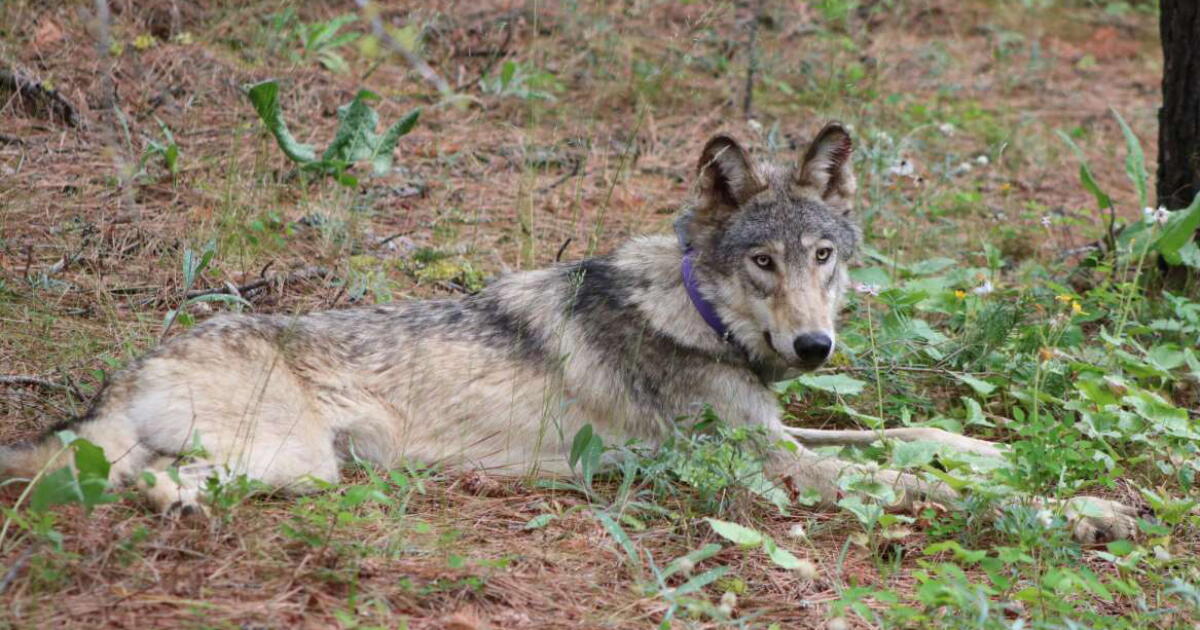
BEY03F, the wolf pictured, briefly visited L.A. County before making her way to the Eastern Sierra.
This is the latest edition of Boiling Point, a newsletter about climate change and the environment in the American West. Sign up here to get it in your inbox. And listen to our Boiling Point podcast here.
SACRAMENTO — A month after a public uproar over a mama bear being euthanized after swiping at a resident in Monrovia, state lawmakers are considering mandating the use of nonlethal ways to help allow wildlife and humans to coexist.
Sen. Catherine Blakespear (D-Encinitas) said she believes the bear’s death, and the state’s decision to kill four wolves last year that were preying on cattle, raised public concern.
“That made everybody realize we have to do better here,” she told The Times on Thursday. “We need to recognize the importance of seeing ourselves, humans, as part of a larger ecosystem that includes animals and plants and our world and trying to protect it.”
Senate Bill 1135, introduced by Blakespear, would direct the California Department of Fish and Wildlife to create the Wildlife Coexistence Program, which would provide public education, offer technical assistance and maintain a statewide incident reporting system. It would help communities deploy nonlethal devices to deter predators, like barriers or noise and light machines.
At a legislative hearing on Tuesday, Blakespear told the Senate Committee on Natural Resources and Water that a three-year state initiative offering similar services was seeing positive results — until it was discontinued two years ago after funding ran dry. She said it was time to implement a permanent program.
“Human population growth, habitat loss and the growth of industry across California inevitably leads to interaction between humans and wildlife,” Blakespear told legislators. “No two animal species are the same and each has unique behavior patterns and territories. SB 1135 recognizes these differences and gives communities the tools to prevent conflict and respond when it occurs.”
The bill would also rename a state program that reimburses ranchers who lose livestock to wolves, calling it the Wolf-Livestock Coexistence and Compensation Program. It would require ranchers seeking compensation to show they were using nonlethal deterrents approved by the department.
Sen. Shannon Grove (R-Bakersfield) stressed that life in rural areas is different than living in a city. She said some families and cattle ranchers have a genuine fear of predators.
“When these baby calves drop on the ground and then two wolves start ripping them apart, it’s not the prettiest thing you’ve ever witnessed,” said Grove, who abstained from voting on the measure. “These wolves are not puppies.”
More than 30 organizations are supporting the legislation, including the National Wildlife Federation, Defenders of Wildlife, California State Assn. of Counties, Animal Legal Defense Fund and Citizens for Los Angeles Wildlife.
The California Farm Bureau and the California Cattlemen’s Assn. are in opposition due to concerns over funding.
Last month, Blakespear sent a letter to the chair of the Senate Committee on Budget and Fiscal Review requesting $48.8 million to implement the legislation, with $25 million earmarked for addressing wolf encounters. Half of the money for wolf conflicts would go toward deterrents; the remainder would compensate ranchers for their losses.
Kirk Wilbur, vice president of government affairs cattlemen’s association, said the organization is concerned about that division of funding — especially if funding is reduced.
Wilbur told legislators Tuesday that the organization supports some aspects of the bill and was having productive conversations with Blakespear to address their concerns.
The bill ultimately passed the committee with a 5-to-1 vote and now heads to the Senate Committee on Appropriations.
Human wildlife conflicts have made headlines in California recently, with a bear refusing to leave a basement for weeks in Altadena and a mama bear dubbed Blondie crossing paths last month with a woman walking her dog in Monrovia.
Blondie swiped the woman’s leg, and wassubsequently euthanized by the California Department of Fish and Wildlife. Her two cubs were sent to the San Diego Humane Society’s Ramona Wildlife Center. The bear’s death upset many in the community, as thousands had signeda petition calling for other solutions, like relocation.
Deadly wildlife attacks on humans, however, are rare in California.
There have been six reported human fatalities from mountain lions since 1890, according to the state Fish and Wildlife Department. The agency recorded one human fatality from a coyote in 1981 and another fatality from a black bear in 2023. The department has no recorded human fatalities from gray wolves.