
wildfire

3 firefighters killed, 2 others burned battling western Colo. wildfire

Three firefighters were killed and two more were injured Saturday during a “burnover” incident while battling the a 28,000-acre wildfire along the Colorado-Utah border, officials announced. File Photo by Peter DaSilva/UPI | License Photo

June 28 (UPI) — Three firefighters were killed while battling a wildfire in western Colorado, the Department of the Interior announced Sunday.

Two others were being treated for burn injuries sustained in the Saturday “burnover” incident at the Knowles and Gore fires in Mesa County near the Colorado-Utah border, officials in a statement.

The identities of the fallen Wildland Fire Service and Forest Service firefighters were not immediately released pending notifications of their relatives.

Colorado Gov. Jared Polis said he was “devastated about the loss of three heroic firefighters who died in the line of duty in Western Colorado.”

In a statement, the he praised “the men and women who serve on the front lines of these fires risk their lives to keep us safe and to protect the lands and communities we love.

“To the loved ones of those lost, and to their fellow crew members — some who are still battling the flames — know that the State of Colorado mourns alongside you.”

Polis said the Colorado National Guard, the federal Bureau of Land Management and local officials and firefighters have been deployed to fight the Snyder-Mesa Fire, which on Sunday was estimated to be more than 28,000 acres, and to recover the bodies of the three fallen firefighters.

The governor said the two surviving firefighters had been extracted by helicopter.

On Saturday he activated the State Emergency Operations Plan and directed the Colorado Department of Public Safety to take responsibility for all response, recovery and mitigation efforts on the Snyder Mesa Fire.

The deaths came as powerful wind gusts, extremely low humidity and the threat of dry lightning fueled an outbreak of large wildfires across the southwestern United States.

Utah has been the hardest hit. Including the deadly blaze along the Colorado border, multiple fires exceeding 10,000 acres have erupted over the past week across the state. The Cherry and Iron Fires southwest of Provo, along with the Cottonwood Fire in south-central Utah, are among the largest active wildfires.

The weather pattern responsible for the heightened wildfire danger is expected to persist through much of the week, forecasters say.

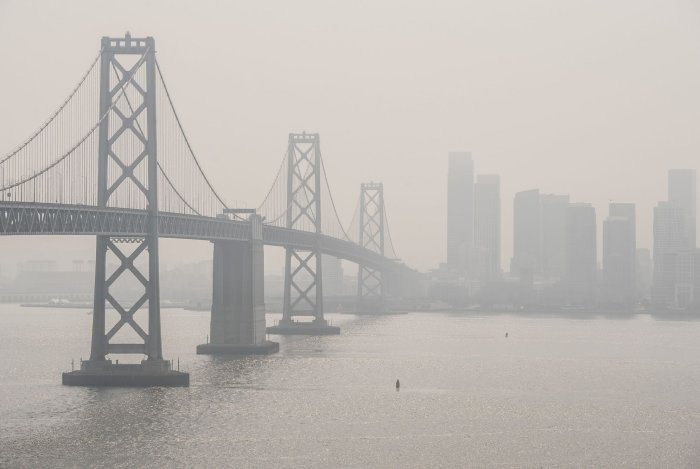
Smoke from fires in Northern California lowers visability of the Bay Bridge and San Francico as viewed from Yerba Buena Island on October 2. Photo by Terry Schmitt/UPI | License Photo

Source link

California’s wildfire prevention funding at risk of drying up

With California facing increasingly destructive wildfires, experts and officials have long urged the strategic removal of dense, flammable vegetation that can erupt into particularly destructive flames from a lightning bolt or the spark of a power line.

But after years of record investment by the state in such wildfire risk mitigation, two key money sources are drying up, potentially reducing the state’s annual budget for vegetation removal by hundreds of millions of dollars.

Wildfire resiliency advocates are warning that the loss of these funds will leave the state vulnerable to devastation, and are calling on California’s next governor to take that threat seriously.

Currently, California relies heavily on two funding sources for wildfire mitigation work: A state program that charges polluters for their emissions and a climate bond approved by voters in 2024.

Late Friday, however, state officials adopted a new structure for the emissions program, called cap-and-invest, that analysts say will likely reduce wildfire mitigation funding by $200 million per year. At the same time, the governor’s latest budget proposal puts the state on track to allocate the majority of the climate bond’s $1.5 billion in wildfire prevention money within just three years.

As a result, California could go from routinely pulling more than $600 million a year from these sources, to just $150 million, according to an estimate from the Wildfire Solutions Coalition — a group of more than 80 organizations representing conservationists, business owners, fire officials and tribal leaders.

The coalition is urging the state to find new sources of funding for the work.

“We have the scientists, we have the technicians, we have the advocates,” said Michelle Decker, who is on the coalition’s executive committee and serves as president and CEO of the Inland Empire Community Foundation. “We see this problem. We can get ahead of this problem. It is a revenue issue.”

California wildfires have become increasingly costly. The 2025 L.A. fires alone caused an estimated $250 billion in damage and economic loss. Insurance companies have already paid out $22.4 billion.

In attempt to reduce the risk of damage to communities and ecosystems, the state has employed a wide range of tactics. These includes fortifying homes against wildfires, replanting fire-ravaged forests and thinning out vegetation with prescribed burns, goat grazing and manual thinning with heavy machinery to reduce the intensity of potential fires.

Research suggests wildfire mitigation work pays off. A recent analysis of 285 fires in the western U.S. found that every dollar spent on landscape projects saved about $3.75 in wildfire damage.

But as funding from cap-and-invest and the climate bond dwindle, the state must increasingly turn to Cal Fire, which devotes only a small portion of its budget to mitigation work.

“This is not an issue that can be pushed off to a timeline based solely on politics,” said Steve Frisch, a founding member of the coalition and president of the Sierra Business Council. “Fire happens whether we want it to or not.”

After a series of destructive wildfires in Northern California and the 2017 Thomas fire in Southern California, the state legislature began to explicitly focus on funding wildfire mitigation.

In 2018, lawmakers directed $200 million per year of cap-and-invest funds to wildfire mitigation projects.

As the Woolsey fire in Southern California and the Camp fire in Paradise raged later that fall, Trump accused the state of “gross mismanagement” of forest lands and threatened to cut off federal funds unless it was corrected.

Gov. Gavin Newsom and the legislature, with a significant budget surplus, began earmarking even more funds, leading to a peak of $1.1 billion in wildfire mitigation investments during the 2021-2022 fiscal year.

After the surplus dwindled, the legislature opted in 2024 to put a $10-billion climate bond in front of voters — $1.5 billion of which was dedicated specifically for wildfire mitigation work.

Newsom has since pointed to this high state funding to call on the federal government to step up its own investments into forest management work.

The federal government manages 57% of all forests in the state. While the U.S. Forest Service spent $3.1 billion mitigating wildfire conditions in the state over the last few years, California spent $4.3 billion, according to the California Forest Resilience and Wildfire Task Force.

However, the state has already allocated about $600 million of the climate bond’s wildfire mitigation pot for the 2024-2025 and current fiscal years. The latest budget proposal would allocate more than $300 million for this upcoming fiscal year. While many advocates support allocating the money quickly, it leaves little for future years.

Once that money is spent, California has to pay off the $10 billion bond with interest. The result is an estimated price tag of $16 billion, paid in roughly $400 million increments every year, for 40 years, according to the state’s Legislative Analyst’s Office.

As for the cap-and-invest funds, a fraught months-long debate at the California Air Resources Board on how to extend the program beyond 2030 resulted in a compromise that will cut the revenue it generates in half, the Legislative Analyst’s Office estimates.

Since other projects get priority — including $1 billion every year for California’s high-speed rail project — the new proposal would “likely leave no funding” for the wildfire and forest resilience line item, the Legislative Analyst’s Office found.

Cal Fire still holds a modest annual budget for wildfire mitigation work. In the 2024-2025 fiscal year, the agency had $500 million for forest management and fire prevention that was not directly tied to cap-and-invest or the bond — up from about $65 million two decades prior.

As for the federal government, independent analyses by Grassroots Wildland Firefighters and NPR found that Forest Service wildfire mitigation work is on the decline amid federal staffing cuts. The Forest Service claims the decrease in work was primarily due to poor weather conditions for activities like prescribed burns and staff being occupied with firefighting.

Both the state and federal government’s investments pale in comparison to the spending of California’s investor-owned utilities. In 2025 alone, the utilities planned to spend more than $9.2 billion on preventing their equipment from sparking the next devastating wildfire, primarily funded by Californians’ electricity bills.

Record heat. Raging fires. What are the solutions?

Get Boiling Point, our newsletter about climate change, the environment and building a more sustainable California.

Times staff writer Hayley Smith contributed to this report.

Source link

Newsom to propose fund to help California wildfire victims rebuild

Gov. Gavin Newsom will propose a new $100-million fund to help wildfire victims afford loans to rebuild their homes under a revised budget plan set to be released Thursday.

The Newsom administration estimates that thousands of victims of the Los Angeles wildfires cannot afford to rebuild, blaming a lack of access to affordable loans and a gap between insurance payouts and the cost to build again.

“We have been on the ground in L.A. since Day One of recovery from these fires, and we aren’t turning our backs now,” Newsom said in a statement. “This community deserves continued support to help them get back on their feet, and rebuild their homes and their lives. “

The new fund would be designed to cover loan-loss guarantee to lenders, in which the state would commit to paying back a percentage of a loan amount if a borrower defaults, in order to lower the risk for lenders and encourage them to award construction loans to borrowers who might not otherwise qualify or only be eligible for loans at high interest rates. The money would also be available for homeowners to buy down their interest rates during the construction period, according to Newsom’s office.

The Eaton and Palisades fires killed 31 people and destroyed over 16,000 structures in January 2025.

A recent survey of the wildfire victims found that homeowners estimate they need more than $600,000 on average above their insurance payouts to rebuild their homes, according to a report from a wildfire recovery nonprofit called the Department of Angels. The gap in Altadena was about $550,000, and between $1.19 million and $1.73 million in Pacific Palisades and Malibu.

Under Newsom, California has also provided mortgage relief to more than a thousand wildfire survivors under CalAssist, a program that provides grants to eligible homeowners to cover mortgage payments for 12 months up to $100,000.

The governor’s new proposal will be included in his funding plan for the upcoming 2026-27 budget year that begins July 1.

State revenue from income tax collection is higher than initially forecast, a boon that is expected to wipe out a projected deficit in the year ahead. Analysts attribute the revenue increase to an artificial intelligence boom in the stock market.

Though likely temporary, the extra funding is expected to give Newsom enough cushion to balance the state budget without major cuts and lower a projected shortfall in 2027-28.

The proposal to create the rebuilding fund requires support from both houses of the California Legislature and would move forward as a trailer bill accompanying the state budget. The funding would be available to disaster survivors, though details on eligibility will be determined during the legislative process.

Source link