wild

A new off-grid cabin stay in Scotland – on a farm where kids can run wild | Scotland holidays

On a January morning in 1938, Pitmiddle’s last resident, James Gillies, closed the door to his cottage for the final time and walked away through the snow. High on the south-facing slopes of the Sidlaw Hills in Perthshire, the village is now little more than a jumble of half-ruined walls gradually being reclaimed by the land.

My children pick around the overgrown stones like explorers discovering a lost civilisation, before scampering back through the gate and over the grass to our cabin in a neighbouring field. Called the Pitmiddle Hut, it’s the latest addition to Guardswell Farm, which spans 81 hectares (200 acres) of countryside halfway between Perth and Dundee (an hour and a half from Glasgow or Edinburgh). “People gradually moved away from Pitmiddle’s way of life,” says Anna Lamotte, who runs Guardswell with her husband, Digby Legge, often aided by their four-year-old daughter and a smiley 10-month-old in a vintage pram. “Villagers each had a pendicle, the small area they could farm, a system of outfields, infields and ‘kailyards’ – a Scots word for a kitchen garden.” Anna and Digby grew up on farms and small-holdings nearby, and today they rear cattle, sheep, goats and chickens and tend to the vegetable gardens, alongside welcoming guests to stay.

The boat-turned-bothy called Girl Linda’s cabin. Photograph: Claire Fleck

The Pitmiddle Hut sits in the old village’s pendicle field and the slim volume Pitmiddle Village and Elcho Nunnery in our cabin inspired the names of Guardswell’s huts: the Pendicle with its wildflower roof, the Infield with a stargazing window above the bed and shepherd’s hut the Kailyard. They can be rented alongside two cottages and a large farmhouse, all clustered around the Steading, once a dilapidated barn that is now a smart events space for weddings, craft and cuisine classes including cheese-making, and a popular monthly market. It’s also home to a small shop (stocked with the farm’s meat, eggs and Diggers cider), smart washrooms and a cosy room filled with games and wellies.

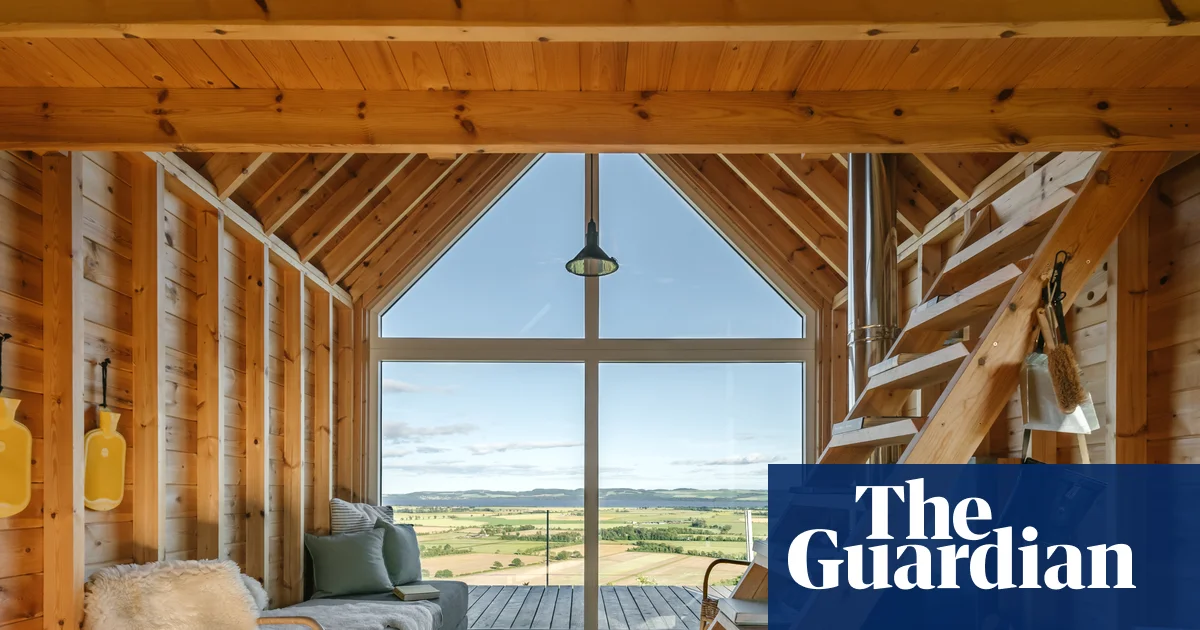
All the existing cabins were made for two, but as Anna and Digby’s family grew, and couples who married at Guardswell returned with first a dog then a baby, a bigger hideout made sense. The Pitmiddle Hut is a 10-minute stomp uphill and has a mezzanine bed up above the kitchen for grownups and a second bedroom for children to pile into the set of bunks and a double bed. The two are linked by a central indoor-outdoor space, with sliding doors for sunnier days. It’s the end of March when we stay, and the thick blankets (made with wool from Digby’s parents’ farm) and douglas fir planks lining the cabin give it a deep cosiness.

Fiona Kerr’s children loved being largely off-grid in the Pitmiddle Hut. Photograph: Fiona Kerr

As a somewhat reluctant camper in a tent-loving family, it’s an ideal balance. We build fires in the Esse Bakeheart stove to cook dinner and keep the wool-insulated cabin toasty (there’ll soon be an outside kitchen and a firepit for toasting marshmallows too). My son dashes in and out fetching ingredients from the giant coolbox on the deck. The hut is off-grid, but uses solar-power for lights and the single induction hob. There’s a proper loo, but it’s a walk down to the Steading in the morning for a shower. It quickly becomes our favourite part of the day, saying good morning to fluffy Shetland cows, dinky Hebridean sheep, donkeys Ollie and Hugo, and cheeky pygmy goat Jimmy, who once escaped his pen and crashed a wedding. It feels as though we have the farm to ourselves.

There’s no wifi, no TV and, on my phone at least, blissfully little phone signal. Instead, a basket beside the kindling is filled with Uno, playing cards, drawing pencils and a watercolour set. My daughter washes a page with streaks of blue sky and green fields that are framed by the hut’s huge picture window, before taking a nature scavenger hunt sheet around the farm, checking off pine cones and primroses.

There are four huts, a cottage and farmhouse rooms at Guardswell. Photograph: Hidden Scotland

It would be easy to simply roam here for a couple of days, foraging for wild garlic, helping feed the animals and exploring the Big Wood at the bottom of the farm, counting the 198 steps cut into the hillside among the trees. But with all of Perthshire on the other side of the Sidlaws and Fife across the River Tay there’s plenty to get stuck into, from sandy beaches at East Neuk to Highlands hills just beyond the foodie town of Dunkeld, where the Taybank pub and Aran Bakery make a delicious detour. We swerve the Munros and instead stride out on the nearby Scone circular, starting at Old Scone Church, rebuilt stone by stone in 1805 when the village moved a couple of miles east from its original site next to Scone Palace, and climbing through gorse-thick moorland to MacDuff’s Monument and the Lynedoch Obelisk with their sweeping views to Perth beyond.

We get back to the farm just as some wet weather blows in and hole up in the boat-turned-bothy called Girl Linda’s cabin at the top of a field. Scooping up a bottle of Diggers cider and apple juice from the hut, we run for it, the kids screaming into the wind. We light candles and the tiniest wood-burning stove – the valley below now so lost in mist that it feels like the River Tay might rise up and sweep us out to sea. We play Monopoly Deal as the rain whips against the portholes, before rousing a sing-song with the boat’s motley crew of instruments – bongos, guitar, glockenspiel and a giant metal triangle. “Let it go, let it go, I am one with the wind and sky …” My daughter’s favourite, suddenly apt.

We wake on the final morning to milk-glass skies and the rhythmic whirl of two woodpeckers in the trees as the sun rises through a fringe of woodland below us. There are recorded Guardswell morning meditations to start the day, a gentle prompt to pause. But stillness is low on my children’s agenda, so we throw on boots and fleeces over pyjamas and head for the swings on the hill above the hut. Pitmiddle’s simple way of life might not have survived against the advances of the modern world, but for a few days its slower rhythm feels within reach.

Accommodation was provided by Guardswell Farm. The Pitmiddle Hut sleeps six (two adults and up to four children) from £220 a night (two-night minimum), guardswell.co.uk
Source link

‘Wild’ author Cheryl Strayed mourns death of husband Brian Lindstrom

Brian Lindstrom, a filmmaker whose documentaries shined a light on society’s underdogs and inspired social change, has died. He was 65.

Lindstrom’s wife, author Cheryl Strayed, confirmed the news on Instagram Friday.

“Brian Lindstrom died this morning the way he lived — with gentleness and courage, grace and gratitude for his beautiful life,” she wrote. “Our children, Carver and Bobbi, and I held him as he took his last breath and we will hold him forever in our hearts. The only thing more immense than our sorrow that Progressive Supranuclear Palsy took our beloved Brian from us is the endless love we have for him.”

According to the National Institute of Neurological Disorders and Stroke, PSP is caused by damage to nerve cells in areas of the brain that control thinking and body movements. The rare neurological disease progresses rapidly.

Strayed, who penned the bestselling memoir “Wild,” which was later adapted for the big screen and starred Reese Witherspoon, announced just weeks ago that Lindstrom had been diagnosed “with a serious, fatal illness.”

Lindstrom was born Feb. 12, 1961. The son of a bartender and a liquor salesman, he was raised in Portland, Ore. — which he and his family still called home.

He was the first member of his family to attend college, which he paid for by taking out student loans, landing work-study jobs and working summers in a salmon cannery in Cordova, Alaska. During a 2013 TEDx Talk, Lindstrom said that after he’d exhausted all the video production classes at Portland’s Lewis & Clark College, his professor Stuart Kaplan gave him a gift certificate to a class at the Northwest Film Center. There, Lindstrom made a short film about his grandpa that landed him a spot in the MFA program at Columbia University.

It was a train trip with his grandpa that inspired Lindstrom to tackle challenging topics with a lens that restored dignity to his subjects. His grandpa was a binge-drinker, and on day three of the trip, he woke up with a hangover and was missing his dentures. Lindstrom, only 5 at the time, noticed the way other passengers treated him and his grandpa differently.

“I think what my films are about is that search for my grandfather’s dentures, the humanizing narrative that bridges the gap between us and them and arrives at we,” he said.

Lindstrom said he returned to Portland after film school and “did several projects with the Northwest Film Center that had me putting a camera in the hands of kids on probation, homeless teens, newly recovering addicts, hard-hit people who had hard-hitting stories to share.”

“Those projects taught me so much about the transformative power of art, and they gave me permission I felt in my personal films to ask people if I might follow them, so that an audience could better understand what they were going through, and by extension, better understand themselves,” he said.

Lindstrom’s 2007 award-winning cinéma-vérité-style film, “Finding Normal,” followed long-term drug addicts as they left prison or detox and tried to rebuild their lives with the help of a recovery mentor.

“What I’m most proud about is that ‘Finding Normal’ is the only film to ever be shown to inmates in solitary confinement at Oregon State Penitentiary, and not, I might add, as a punishment,” Lindstrom said.

In 2013, he released “Alien Boy: The Life and Death of James Chasse,” a documentary that illuminated the life of a man who grappled with schizophrenia and examined his death, which happened in police custody. Discussing the film with LA Progressive in 2018, Lindstrom said that he doesn’t make films for audiences.

“I make them for the people in the film. It is my small way of honoring them,” he told the outlet. “That doesn’t mean I don’t delve into dark areas or that I ignore that person’s struggles. I’m much more concerned with trying to achieve an honest depiction of that person’s life than I am with any potential audience reaction.”

Lindstrom’s work aimed to inspire empathy and humanize those suffering in the margins of society, but it also catalyzed policy change. His acclaimed 2015 documentary, “Mothering Inside,” followed participants in the Family Preservation Project (FPP), an initiative helping incarnated moms establish and maintain bonds with their children.

Midway through filming the documentary, the Oregon Department of Corrections announced it planned to nix funding for the FPP. Lindstrom hosted early screenings of the film, which inspired grassroots advocacy that reached then-Gov. Kate Brown, who subsequently signed legislation that restored funding. The film’s release also helped make Oregon the first state in the U.S. to pass a bill of rights for children of incarcerated parents.

Partnering with Strayed, Lindstrom made the documentary short, “I Am Not Untouchable. I Just Have My Period,” for the New York Times in 2019. The film highlighted the experience of teen girls in Surkhet, Nepal, and the menstrual stigma they faced. Most recently, the filmmaker released, “Lost Angel: The Genius of Judee Sill,” which examined the folk-rock singer’s life from her traumatic childhood and drug-addled adolescence through her rise in the Laurel Canyon music scene and untimely death.

Lindstrom, discussing “Judee Sill” and his style as a filmmaker, told Oregon ArtsWatch, “It’s the chance to kind of focus on the question: What does it mean to be human? The person that the film is about, what can they teach us, what can we learn from them? What can they learn from themselves?”

In 2017, Lindstrom received the Civil Liberties Award from the American Civil Liberties Union of Oregon for his work advancing civil rights and liberties. That same year, he received the Distinguished Alumni Award from Lewis & Clark College.

In Strayed’s post announcing Lindstrom’s death, she described their more than 30-year partnership as a stroke of “tremendous luck.”

“We loved each other and our kids with deep devotion and true delight. He was a stellar husband. He was the most magnificent dad. He was a man whose every word and deed was driven by kindness, compassion, and generosity,” she wrote. “He saw the goodness in everyone. He believed that we are all sacred and redeemable.

“His work as a documentary filmmaker was dedicated to telling stories of people who, as he put it, ‘society puts an X through.’ He erased that X with his camera and his astonishing heart.”

Strayed’s memoir — which followed her as she hiked 1,100 miles along the Pacific Crest Trail in the wake of her mother’s death, a battle with drug addiction and divorce from her first husband — concludes with a happy ending. She finished the months-long hike and sat on a white bench near the Bridge of the Gods, a stone’s throw from the spot where, she writes, she’d marry Lindstrom four years later.

“His greatest legacy is Carver and Bobbi, who embody everything good and true about their father. Their extraordinary grace, courage, and fortitude during this harrowing time was unfaltering and grounded in the undying love Brian poured into them every day of their lives,” she wrote. “We do not know how we will live without him. We’re utterly bereft. We can only walk this dark path and search for the beauty Brian knew was there. It will be his eternal light that guides us.”


Source link