The WhatsApp ‘general’ behind Lula’s election comeback in Brazil | Elections News
As Luiz Inacio Lula da Silva celebrated his election victory on Sunday in Sao Paulo, he placed his hand on the head of a man standing beside him and beaming in a green and yellow Brazilian football jersey.
Lula thanked him for his role in the campaign, calling him “our general”.
Recommended Stories
list of 4 itemsend of list
Andre Janones, a 42-year-old Brazilian congressman who had spent the final weeks of the presidential run-off building a mass online movement to get Lula re-elected, then embraced the president.
“He played an exponential role in this campaign in lifting the morale of our troops every day, morning, noon and night,” Lula told thousands of supporters who packed Paulista Avenue, the city’s main artery.
Just three weeks earlier, the president seemed to be in trouble. He had finished behind his right-wing rival Flavio Bolsonaro after the first round of voting, his campaign struggling to keep up with the right’s powerful social media operation.
Janones, who had also helped coordinate Lula’s digital operation in his run-off against Jair Bolsonaro in 2022, was convinced Lula’s campaign needed a change – and that he could help turn things around.
He posted a video declaring, “We are going to win this election. Lula will be re-elected president of Brazil.”
His plan centred on a WhatsApp channel he had launched months earlier.
Called Exercito do Lula, or “Lula’s Army”, it had about 60,000 followers after the first round.
By election day, Lula’s Army had grown to almost 11 million subscribers, with Janones widely credited with helping Lula stage his comeback.
How Andre Janones built Lula’s WhatsApp army
Janones is a lawyer and congressman who grew up in a working-class family in Minas Gerais. He made a name for himself through his social media commentary during Brazil’s 2018 truckers’ strike and was elected to Congress that year.
In 2022, he dropped his own presidential bid to endorse Lula, joining his run-off campaign.
“At the time, he became widely known for employing tactics similar to those used by Bolsonarism, despite operating on the left,” said Viktor Chagas, a professor at Fluminense Federal University who studies digital politics and online campaigning.
Janones coined the term “cultural Janonism” to describe his approach, which relied on urgent messages, memes and calls for supporters to take action, as well as what Chagas described as the occasional use of negative campaigning and “content of questionable origin”.
But the scale of Lula’s Army in 2026 was unprecedented, Chagas said.
In the video declaring that Lula would win, Janones urged supporters to enlist as “soldiers” by posting saluting emojis and joining his WhatsApp channel, where he assigned them what he called “missions”.
The tasks were simple, from recruiting three friends to sharing campaign videos to promoting hashtags.
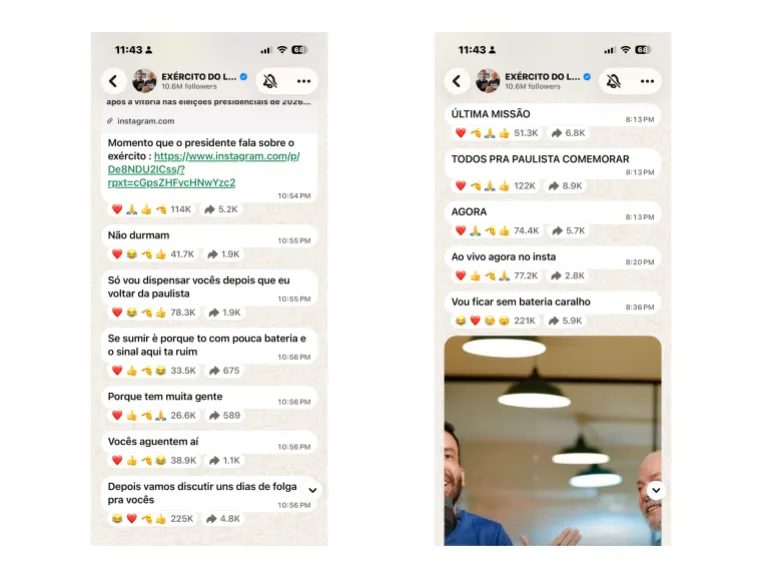
They came in a relentless stream of messages from Janones himself, often written in capital letters. Supporters couldn’t reply, but they could forward the messages or react with emojis, often doing so in the tens of thousands.
Chagas described the strategy as a form of “electoral gamification”, with Janones setting targets for supporters to reach together.
For Andre Pagliarini, an assistant professor of history and international studies at Louisiana State University and the author of a book on Lula, the appeal of Janones’s approach was giving people something they could actually do to help Lula win.
“It became an organising platform that grew exponentially because it spoke to a desire that many Lula supporters evidently had to do something tangible to defeat Flavio Bolsonaro,” he said.
How Lula’s campaign changed its message
But the path to victory wasn’t just about mobilising supporters online.
Pagliarini credited the campaign for also finding a more effective way to tell the story of the president’s working-class past.
“The campaign’s mistake in the first round was to present this history as a finished monument, worthy of admiration but distant from the lives of the people it was meant to represent,” he wrote.
After Bolsonaro mocked the president for having nine fingers during the final televised debate, for example, Lula responded by recalling how he lost a finger at 17 while working a night shift at a factory. He then linked his experience to workers injured as a result of employers’ negligence.
“Unlike Flavio, he reminded voters, he knew the world of work because he had lived in it,” said Pagliarini.
After the debate, Janones spread the message online, promoting the hashtag #SomosTodos9Dedos, or “We Are All Nine Fingers”. Supporters shared the slogan, with some posting photographs of their own amputated fingers in solidarity.
Janones had also publicly called for simpler, less polished campaign videos that showed a more relatable side of Lula, drinking coffee, visiting people’s homes and talking to ordinary Brazilians. Around the same time, the campaign started posting more informal, selfie-style videos.
“Lula was looser in his political communication, less mediated,” Pagliarini said.
![Screenshots from Andre Janones’s WhatsApp channel, Exército do Lula, or “Lula’s Army,” show messages urging supporters to gather on São Paulo’s Paulista Avenue to celebrate Luiz Inacio Lula da Silva’s election victory on October 25, 2026 [Exército do Lula]](https://i0.wp.com/occasionaldigest.com/wp-content/uploads/2026/10/Untitled-1-21-1793120665.jpg?w=640&ssl=1)
Did Lula’s WhatsApp army help him win?
It is difficult to establish whether Janones’s digital army actually delivered votes.
“I am not sure there is a way to empirically connect the group to the outcome,” Pagliarini said.
But he believes Janones helped turn the campaign around.
“Janones himself became a kind of character in the campaign, a cheerleading strategist who seemed confident in a plan that had been missing throughout much of the race,” wrote Pagliarini.
Chagas agreed that it was “difficult to imagine the outcome we achieved without Lula’s Army”, adding that the channel brought together left-wing supporters who had previously been scattered across fragmented online communities, and gave them a way to work together.
The challenge now is keeping that momentum going, Chagas said, pointing to the far right’s use of “permanent campaigning”, maintaining the engagement of supporters between elections.
On election night, at least, Janones kept his soldiers busy.
“EVERYONE TO PAULISTA TO CELEBRATE,” he wrote, urging them to gather on Sao Paulo’s Paulista Avenue. “NOW.”
Later, he asked them not to go to sleep, adding that he’d let them go once he got back from the celebrations.
“Then we’ll discuss a few days off for you,” he joked in a message that drew more than 225,000 reactions.