WASHINGTON — President Trump asked Chinese President Xi Jinping if he wanted to buy weapons from the United States, the U.S. ambassador to China said.
David Perdue said Trump raised the prospect of the arms sales from the U.S. to its ascendant geopolitical rival, an unlikely offer that if consummated would upend generations of U.S. policy toward China and Taiwan and expose U.S. technology to a potential foe. Perdue, speaking to Shannon Bream on Fox News Channel’s “Fox News Sunday” days after Trump hosted Xi for a state visit in Washington, didn’t specify when the offer was made.
Perdue said Sunday that Trump, a Republican, was downplaying longstanding U.S. arms sales to Taiwan — which have drawn protest from Beijing for years — by couching it as just one of many sales Washington makes around the world — and even asking Xi if he’d be in the market for U.S. weaponry.
Bream had cited concerns from Republican and Democratic lawmakers over delayed aid packages and weapons orders to Taiwan, the self-ruled democracy that seeks to defend itself from China’s threat to invade the island. Bream asked if the U.S. is denying arms to Taiwan to appease the Chinese president, who visited Trump last week.
Perdue pushed back on the suggestion, stating that Trump “is as strong on Taiwan as I’ve ever seen anybody” and has sold it plenty of weapons. Perdue also said Trump and Xi continue to talk about future U.S. weapons sales to Taiwan.
“But President Trump continues to say, ‘Hey, we sell arms to other people around the world,’” Perdue said. “He actually asked President Xi, would he like to buy some, at one point.”
The U.S. is bound by its own laws to provide Taiwan with the means to defend itself. While not recognizing Taiwan as a country, the U.S. is the island’s strongest informal backer and arms provider. But multiple U.S. leaders have left ambiguous whether they would commit military force to defend the U.S. ally should China invade.
China has pressed Washington to halt the arms sales, most prominently during a previous summit in May between Trump and Xi in Beijing. After that meeting, the United States paused the sale of a record-breaking $14 billion package — and Trump described arms sales to Taiwan as a “very good negotiating chip” with China.
In their private talks at the White House last week, Xi pressed Trump to oppose Taiwan independence, according to Chinese state media.
In Beijing, China’s foreign ministry spokesperson Guo Jiakun did not confirm Perdue’s remarks when asked about the matter on Monday. But he told reporters that China has always strengthened its national defense capabilities based on its needs and is committed to maintaining world peace and stability.
When it comes to scary movies, the motion picture academy has historically been a bit squeamish. Horror has been a cornerstone of the industry since the beginning, but Oscar voters have rarely embraced it. Only one horror film has ever won best picture: 1991’s “The Silence of the Lambs.” Even “Sinners,” which made history this year with a record 16 nominations, couldn’t close the deal.
Now, though, horror has gotten inside the house.
Opening Saturday and running through July 25, 2027, the Academy Museum of Motion Pictures’ new exhibition, “The Horror Show,” explores more than a century of horror, from silent-era landmarks “The Cabinet of Dr. Caligari” (1920) and “Nosferatu” (1922) through “Psycho” (1960) and “The Exorcist” (1973) to “Midsommar” (2019) and “Weapons” (2025). Drawn from the academy’s collection and 62 private lenders around the world, it brings together costumes, props, prosthetics, creatures and production art.
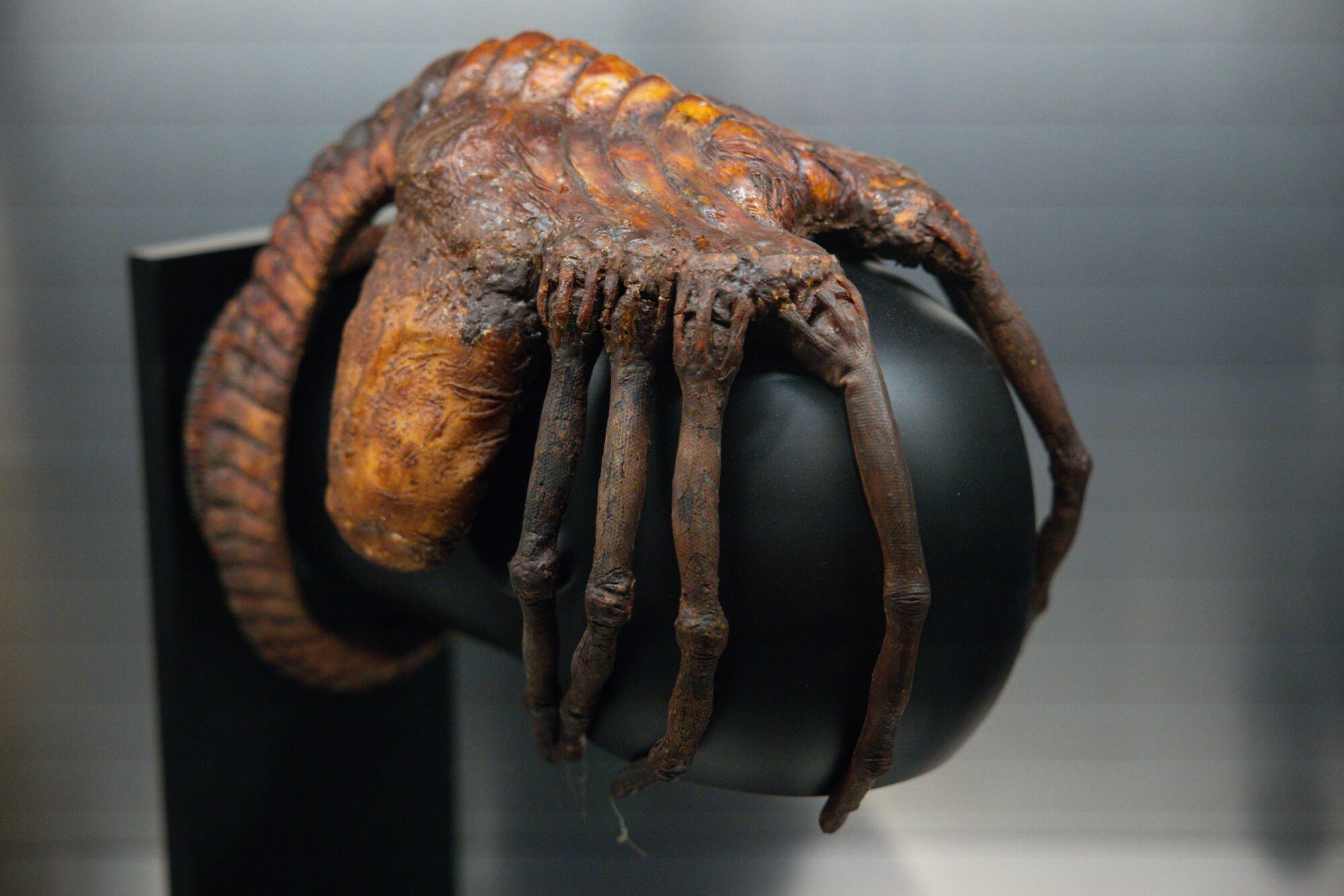
An original facehugger from Ridley Scott’s “Alien” (1979), part of the exhibition’s collection of creatures and production materials from the sci-fi series.
(Kayla Bartkowski / Los Angeles Times)
Introducing the exhibition at Thursday’s press preview, Robert Englund, who played the razor-fingered Freddy Krueger in the “Nightmare on Elm Street” films, recalled how the genre was once regarded in Hollywood. “Back when I started, we would sort of get the lousy table in the commissary by the kitchen door,” he said. Now, with the academy mounting an exhibition devoted to horror and the genre continuing to thrive at the box office, Englund added, “I think we’re getting some respect.”
Rather than a simple chronological tour through the genre’s history, the exhibition is organized into six themed “chambers” devoted to Gothic horror, psychological horror, science, slashers, religion and ghosts, with settings ranging from a shadowy crypt to a killer’s house and a haunted living room.
Storyboards from 1973’s “The Exorcist,” a clapperboard from 1976’s “The Omen” and the original Necronomicon from 1987’s “Evil Dead II” are among the artifacts in the exhibition’s religion-themed chamber.
(Kayla Bartkowski / Los Angeles Times)
Senior exhibitions curator Jessica Niebel says the idea was to walk a line between a traditional museum exhibition and a haunted-house experience.
“Horror films are about evoking an emotional response and we’re hoping the exhibition will do the same,” she says. “These are all original objects and they tell a story. We wanted to place them in an environment that brings them to life and activates them.” (The museum advises parental guidance; a smaller, family-friendly “Zombies!” exhibition is next door.)
So what’s lurking inside? Here are 10 sights worth braving. Read on, if you dare.
See Bela Lugosi’s original Dracula cape
Bela Lugosi’s original cape from 1931’s “Dracula,” on public display for the first time after undergoing an extensive restoration.
(Kayla Bartkowski / Los Angeles Times)
Nearly a century after Bela Lugosi first swept it around his shoulders, Dracula’s cape doesn’t need much introduction. Worn by Lugosi in Universal’s 1931 “Dracula,” the simple black cape became as inseparable from the character as his hypnotic stare and Hungarian accent, establishing the visual language of the screen vampire for generations to come. Lugosi, who had first played the Count onstage in 1927, kept the cape after filming and continued wearing it for stage and public appearances until his death in 1956. Now part of the Academy Museum’s collection, the nearly century-old garment underwent an extensive restoration before “The Horror Show.” Remarkably, this is the first time it has ever been put on public display.
Come face-to-face with Hannibal Lecter
Anthony Hopkins’ Hannibal Lecter costume and restraints from 1991’s “The Silence of the Lambs” are on display, including the serial killer’s unmistakable mask.
(Kayla Bartkowski / Los Angeles Times)
Anthony Hopkins’ Hannibal Lecter, the brilliant psychiatrist and cannibalistic serial killer at the center of Jonathan Demme’s “The Silence of the Lambs,” is unsettling enough standing perfectly still. When he has to be moved, the precautions are extreme. Hopkins wore this orange prison uniform, straitjacket and muzzle when Lecter is transported under heavy security, strapped upright to a hand truck. Costume designer Colleen Atwood devised the ensemble, while Ed Cubberly created the famous fiberglass muzzle, deliberately leaving it uncoated to evoke the look of dried, taut skin. Seeing the outfit up close is a reminder of just how little Hopkins needed to work with: Even with virtually his entire body immobilized and much of his face obscured, Lecter somehow became more frightening.
Trace the evolution of the Xenomorph
A towering Xenomorph created by Legacy Effects for 2024’s “Alien: Romulus” offers an up-close look at one of horror’s most enduring monsters.
(Kayla Bartkowski / Los Angeles Times)
Nearly half a century after Ridley Scott’s “Alien” introduced H.R. Giger’s nightmarish vision to moviegoers, the creature still looks like nothing else in science fiction. The exhibition brings together original Giger artwork depicting the alien egg and an original facehugger from the 1979 film, the spidery parasite whose method of reproduction helped make “Alien” a landmark of body horror. There’s also an original drawing by James Cameron, who took over the franchise with 1986’s “Aliens.” But the hardest thing to miss is a towering Xenomorph created by Legacy Effects for 2024’s “Alien: Romulus.” Up close, its elongated head, skeletal body and glistening double set of jaws reveal just how much unsettling detail goes into a creature often glimpsed onscreen in darkness.
See Dracula’s armor go from page to screen
Eiko Ishioka’s blood-red armor for Gary Oldman’s Count Dracula in Francis Ford Coppola’s 1992 “Bram Stoker’s Dracula.”
(Kayla Bartkowski / Los Angeles Times)
Before Gary Oldman’s Dracula became a pale, bewigged count, he was Vlad the Impaler, encased in one of the most striking costumes in Francis Ford Coppola’s 1992 “Bram Stoker’s Dracula.” Eiko Ishioka designed the blood-red battle armor with a ribbed surface evoking both exposed human musculature and an armadillo’s shell, while the pointed helmet foreshadows the wolf Dracula later becomes. Displayed alongside several of Ishioka’s original design drawings, the armor offers a fascinating look at how her ideas evolved from pencil on paper into something almost anatomical. Ishioka, a celebrated Japanese graphic designer making her first foray into Hollywood costume design, won an Oscar for her work on the film.
Log on to the original ‘Blair Witch’ website
Visitors can explore the groundbreaking viral promotional website for 1999’s “The Blair Witch Project,” which blurred the line between the film’s fictional story and reality.
(Kayla Bartkowski / Los Angeles Times)
Long before viral marketing had a name, 1999’s “The Blair Witch Project” was using the still-young internet to convince moviegoers that three student filmmakers might actually be missing in the woods. Directors Daniel Myrick and Eduardo Sánchez created the film’s promotional website in 1998, filling it with fake police reports, evidence photographs and an elaborate mythology while carefully avoiding any suggestion that their story was fictional. They posted on message boards and continually updated the site before the film’s release, helping turn a tiny found-footage horror movie into a grassroots phenomenon. Here, you can sit down at a chunky late-’90s computer and explore the original site yourself. Nearby is one of the movie’s crudely constructed stick figures — a reminder that sometimes a few twigs and some twine are all it takes to lodge an image permanently in the culture.
Meet the slashers
Costumes and props from some of horror’s most notorious killers fill the exhibition’s slasher chamber, including Candyman, Ghostface, Michael Myers, Freddy Krueger and Art the Clown.
(Kayla Bartkowski / Los Angeles Times)
Slasher movies have always depended on a memorable killer, and the genre has produced some of horror’s most instantly recognizable figures. Freddy Krueger, Michael Myers, Ghostface and Art the Clown are gathered here in full costume, looking less like museum pieces than a welcoming committee you’d rather not encounter. Nearby cases turn slasher movies’ grisly tools of the trade into artifacts, with masks and weapons from “Saw,” “Us,” “M3GAN,” “The Black Phone” and other films. It’s a reminder of how little a slasher movie really needs to get under your skin.
Open the Babadook’s book
The handmade “Mister Babadook” pop-up book created by illustrator Alex Juhasz for Jennifer Kent’s 2014 “The Babadook.”
(Kayla Bartkowski / Los Angeles Times)
Sometimes the scariest special effect is a pop-up book. In Jennifer Kent’s 2014 “The Babadook,” the sinister children’s book “Mister Babadook” heralds the arrival of the top-hatted creature that terrorizes a widowed mother and her young son, while giving physical form to the grief consuming them. Kent turned to illustrator Alex Juhasz to create the handmade book, drawing inspiration from the eerie silhouetted animation of German filmmaker Lotte Reiniger from the 1920s. Opened to one of its more elaborate spreads, the original prop is both beautifully crafted and deeply unsettling, its seemingly innocent children’s-book mechanics revealing a grinning black figure and the ominous command: “LET ME IN.”
Take a selfie with Norma Bates
A re-creation of the mummified Mrs. Bates from Alfred Hitchcock’s immortal “Psycho” gives visitors a chance to pose with Norman Bates’ dearly departed mother.
(Kayla Bartkowski / Los Angeles Times)
The Academy Museum wanted the original mummified Mrs. Bates head from Alfred Hitchcock’s “Psycho,” but there was one problem: She was too fragile to travel. The Cinémathèque Française, which owns the 1960 prop, declined the museum’s loan request. “I was really disappointed about that, but it’s totally understandable,” Niebel says. “We probably wouldn’t have lent her if she were in our collection.” So the museum commissioned Oscar-winning makeup artist and sculptor Mike Hill, fresh off his work on Guillermo del Toro’s “Frankenstein,” to research and create a full-body Mrs. Bates instead. Unlike the many delicate original artifacts elsewhere in the exhibition, this one was made to let visitors get close and take home their own slightly unsettling family portrait. Just don’t get too close. As a nearby sign warns, “Mother isn’t quite herself today — do not touch, she needs her space.”
Get grossed out by Monstro Elisasue
The spectacularly gross Monstro Elisasue bust, created by makeup and special-effects artist Pierre-Olivier Persin for Coralie Fargeat’s 2024 “The Substance.”
(Kayla Bartkowski / Los Angeles Times)
By the time Coralie Fargeat’s 2024 “The Substance” reaches its gloriously grotesque climax, Demi Moore’s Elisabeth Sparkle and Margaret Qualley’s Sue have effectively fused into the spectacularly deformed creature known as Monstro Elisasue. The exhibition puts designer Pierre-Olivier Persin’s bust of the creature alongside the syringes, vials and other medical paraphernalia from the mysterious Substance kit that sets the movie’s nightmare in motion. Fargeat has described body horror as a “weapon of expression” for confronting the pressures placed on women’s bodies, particularly as they age. As Fargeat puts it in the exhibition’s wall text, she wanted audiences to see that women’s “pearly smiles are made of so many horrendous things that we have to keep within ourselves.”
Make your escape through the Blood Room
The Blood Room, streaked and splattered with cinematic gore, provides the only way out of “The Horror Show.”
(Kayla Bartkowski / Los Angeles Times)
Fittingly, there is no clean getaway from “The Horror Show.” Every visitor must exit through the Blood Room, a gruesomely immersive space whose walls are streaked, smeared, splattered and practically dripping with the red stuff. To get the gore just right, Niebel turned to Oscar-winning special makeup effects artist Howard Berger, a veteran of such splatterific films as “Evil Dead II” and “Kill Bill.” Berger worked with the museum and its fabricators to create the room’s layers of fake blood, varying the colors and consistencies to suggest everything from dark, dried stains to fresh blood still running down the walls. Just when you think you’ve made it through, the exhibition has one last gruesome touch: To escape, you have to push your way through a set of bloody butcher curtains.
Israel’s Rafael and Lockheed Martin are working to accelerate integration of the 1,000-pound-class SPICE standoff weapon with the Israeli Air Force’s F-35I Adir. The development could potentially open the door for the precision-guided munition to be offered to other Joint Strike Fighter operators.
Rafael Advanced Defense Systems announced the effort September 15 during the Air & Space Forces Air, Space and Cyber Symposium that TWZ is attending. The work is being conducted as a joint project with Lockheed Martin at the U.S. contractor’s facilities in the United States and is expected to take several months.
AFA 2026: For the first time, Rafael’s SPICE 1000 is being integrated on the F-35
Rafael Advanced Defense Systems Ltd. is integrating its SPICE 1000 air-to-surface munition on the F-35 Adir fighter aircraft.
Rafael says the effort could eventually make the weapon available to other F-35 operators. “At a later stage, F-35 operators worldwide will be able to field SPICE 1000,” the company said.
The effort was previously referenced in U.S. government documentation before Rafael’s announcement. Published in August, the Pentagon F-35 Modernized Selected Acquisition Report identified the weapon as the “Israel-unique Smart, Precise Impact, Cost-Effective 1000B,” or SPICE 1000B, and said its integration was progressing “with a strategy to accelerate the implementation via a SPICE Lite process.”
The report does not explain what the “SPICE Lite” process entails.
SPICE — which stands for Smart, Precise Impact, and Cost-Effective — is a family of electro-optically guided standoff weapons developed by Rafael. The family includes SPICE 2000, SPICE 1000, and SPICE 250, with the numbers corresponding broadly to the weight class of the underlying warheads.
Based around a 1,000-pound-class bomb, SPICE 1000 uses pop-out wings to achieve a manufacturer-stated range of approximately 125 kilometers, or 78 miles. Rafael gives the weapon a claimed circular error probable of around three meters.
The glide bomb combines inertial and satellite-aided navigation with an electro-optical seeker. During the terminal phase, its seeker can compare the observed target area with stored imagery using scene-matching algorithms, allowing the weapon to continue its attack without relying exclusively on GPS. That feature allows it to engage targets autonomously, offering the launch aircraft a true ‘fire and forget’ capability, and provides resilience in GPS-denied or GPS-degraded environments.
SPICE can also be programmed to approach a target from a particular azimuth and impact angle. This provides flexibility in selecting the terminal attack geometry and can support steep attack profiles against targets where penetration from above is desirable.
SPICE 1000 is not a new Israeli capability. It has been operational with the Israel Air Force since 2017 and is already integrated with Israeli F-16I Sufa, F-16C/D Barak, F-15I Ra’am, and F-15 Baz fighters.
An F-15 Baz configured for precision strike, with a pair of 2,000-pound Rafael SPICE standoff weapons on the underwing pylons. Amit Agronov
“SPICE 1000 has been sold to several countries and is in operational service with a number of air forces worldwide,” Rafael said. “It has served as a primary munition of the Israeli Air Force for several years, including extensive use in recent long-range operations flown from F-15 and F-16 aircraft.”
The Israeli Air Force has released footage showing SPICE weapons being used during recent operations, including imagery from the weapon’s own perspective during its terminal attack.
Israeli Air Force F-15 Bazs preparing for a strike on Iran, each carrying a pair of Spice 1000 glide bombs.
Notably, one of the F-15s, tail no. 450, took part in Operation Wooden Leg exactly 40 years ago, striking PLO targets in Tunisia. pic.twitter.com/FEy6PiDkdU
Combat validated. The stand-off strike capability air forces are asking about. SPICE 250 at Farnborough. Pinpoint accuracy against high-value targets. Real operational results.
— Rafael Advanced Defense Systems (@RAFAELdefense) July 22, 2026
Israel’s F-35I is already unusual within the international Joint Strike Fighter fleet. The IDF has developed and demonstrated an external Joint Direct Attack Munition (JDAM) carriage capability, and said in March 2025 that the Israeli Adir was the only F-35 to have conducted operational strikes with an external weapons configuration. You can read more about that here.
The unique instrumented F-35I assigned to the Israeli Flight Test Center carrying four external 2,000-pound class GBU-31 JDAMs. A single AIM-120 AMRAAM air-to-air missile can be seen in one of the internal weapons bays, which may also house another internal JDAM. Israeli Air Force
However, according toThe Jerusalem Post, the SPICE weapon is expected to be carried internally by F-35Is equipped with Technology Refresh 3, or TR-3, hardware, which would maintain its low-observable configuration. Neither Rafael nor Lockheed Martin has publicly detailed the specific carriage configuration, aircraft modifications or software associated with the current integration effort.
The long-delayed TR-3 is a major upgrade to the F-35’s computing architecture and provides the processing infrastructure required for subsequent Block 4 capabilities. Israel received its first three F-35Is equipped with TR-3 hardware in January of this year.
Lockheed Martin describes Block 4 as the F-35 program’s “most significant evolution of F-35 capabilities to date,” encompassing more than 70 major upgrades, including increased weapons capacity, advanced electronic warfare capabilities, and improved target recognition.
Some of the unclassified upgrades within Block 4. The exact configuration has not been publicly disclosed. U.S. Department of Defense
It remains unclear if the SPICE 1000 integration itself requires the full Block 4 configuration.
The potential significance of the Israeli integration extends beyond the Israel Air Force. If SPICE 1000 ultimately becomes available to other F-35 operators, the completed Israeli integration could provide those countries with another pathway toward fielding a precision standoff weapon rather than requiring them to begin an integration effort entirely from scratch.
Integrating national weapons onto the F-35 can be a lengthy process. It involves not only the weapon itself, but aircraft software, interfaces, weapons-bay compatibility, flight testing, mission-system integration and certification within the U.S.-led F-35 program.
In 2022, the U.K. Ministry of Defence said that scheduled delivery dates for SPEAR 3 had been delayed because of “prioritisation in the overall F-35 development programme,” which is managed by the U.S.-led F-35 Joint Program Office.
An artist’s impression of an F-35 armed with SPEAR 3 and Meteor missiles. MBDA
The program has continued to progress, including F-35B integration work and flight testing. But in June 2026, the U.K. government said that completion of mission-systems integration and jettison trials remained part of a wider weapons-integration program and that SPEAR 3 integration and subsequent release to service would occur in the early 2030s.
Nevertheless, another F-35 operator would not be able to adopt the Israeli SPICE integration without additional work. National configurations, software baselines, certification requirements, weapons procurement, and export approvals would still have to be addressed.
Already, however, aided by its uniquely configured test jet, Israel has demonstrated an unusual ability to integrate nationally developed capabilities onto its F-35I. This has been aided by privileged access to the Joint Strike Fighter’s closely guarded software codes.
The Israeli Air Force F-35I test jet on the flight line together with an F-15I strike fighter. Amit Agronov/Israeli Air Force
A U.K. parliamentary report noted delays in integrating British weapons onto the F-35B while contrasting that with Israel’s ability to integrate domestic electronic warfare systems, sensors, and communications technology onto its Adir.
Meanwhile, Rafael and Lockheed Martin already have experience working together on the SPICE family.
The companies signed a teaming agreement in 2019 covering the joint development, marketing and manufacture of SPICE guidance kits for the U.S. market. In 2021, they expanded the agreement to include SPICE 250, including development for potential sales to the United States and Poland. With some unque capabilities, SPICE could be of particular interest to the U.S. military, especially as it seeks to leverage multiple sources of precision munitions.
The SPICE family also extends beyond the 1,000-pound-class weapon now being integrated with the F-35.
At the other end of the family is SPICE 250, a much smaller weapon designed around a 250-pound-class payload. It incorporates a man-in-the-loop capability that allows an operator to redirect the weapon during its flight and abort the attack if necessary.
SPICE 250 – Stand-Off Air-to-Surface Weapon System
Its smaller dimensions also allow substantially greater weapon carriage. Rafael has marketed configurations in which a fighter can carry as many as 16 SPICE 250 weapons.
SPICE 1000, by comparison, is a substantially heavier weapon intended to provide longer-range precision attack capability with a larger warhead.
The SPICE effort is taking place alongside several other Israeli initiatives aimed at extending the F-35I’s range and weapons capabilities.
The Pentagon’s F-35 documentation has referenced ongoing work on extended-range fuel tanks and electronic warfare pods for the Israeli Air Force, although it did not provide fielding dates.
In May 2026, Israel’s defense ministry awarded an extended-range capability development contract for the F-35I to Elbit Systems subsidiary Cyclone. The capability is intended to increase the aircraft’s radius of action and reduce its reliance on aerial refueling during long-range missions.
For the F-35I, SPICE 1000 adds a long-range strike option that pairs the aircraft’s low observability with substantial standoff range and a relatively heavy warhead. This offers a survivability advantage in increasingly contested environments, allowing attacks from farther outside capable air defense systems and under heavy electronic warfare conditions. This factor will only become more important as integrated air defense systems become more capable and the F-35 more detectable.
Exactly how the weapon will be integrated remains undisclosed. Rafael and Lockheed Martin have not announced the final carriage configuration, aircraft software requirements, flight-test schedule, or expected date for operational clearance.
At the same time, Rafael is explicitly positioning the effort as a potential pathway for SPICE 1000 to become available to the wider F-35 community. This would conceivably give other operators another option at a time when integrating a new standoff weapon onto the fighter can take years.
After his existential suburban horror epic “Weapons” became an Oscar winner (for Amy Madigan’s chilling supporting performance as Aunt Gladys), filmmaker Zach Cregger has dashed off a fun little riff on one of his favorite video games. His “Resident Evil” reboot is the eighth film in the big-screen franchise based on the Japanese zombie survival game, though Cregger’s “Resident Evil” is its own beast — put those Milla Jovovich movies out of your head entirely.
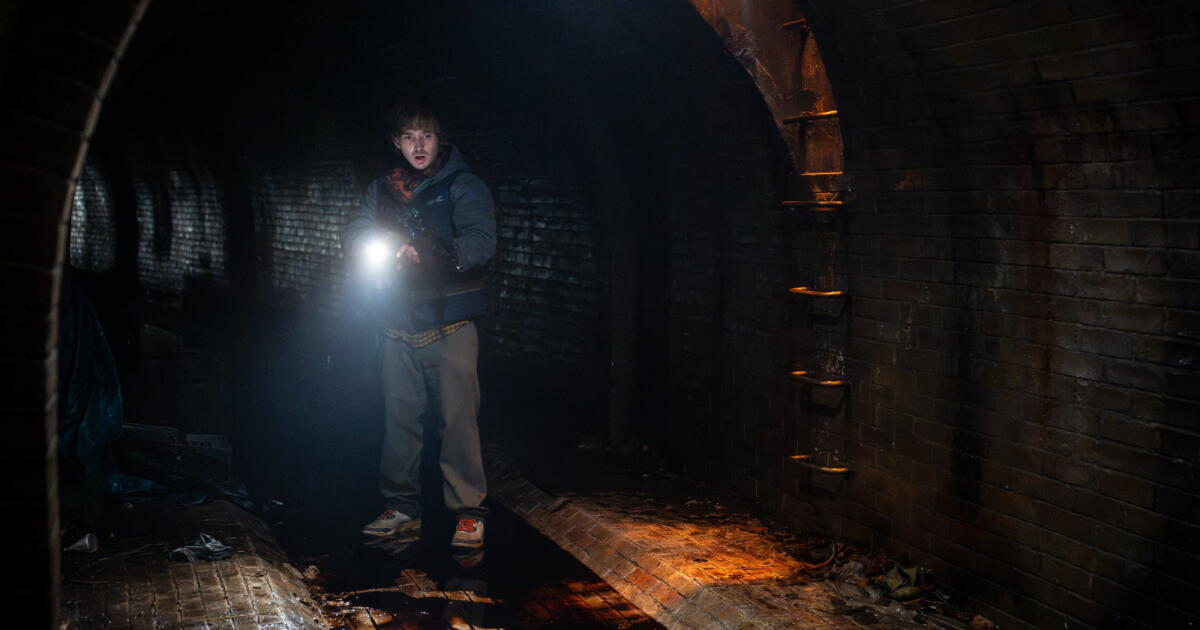
There are, of course, a few shared strands of DNA in the screenplay by Cregger and Shay Hatten: an evil company, Umbrella Corporation, responsible for a virus that mutates humans into zombies and all manner of monsters, located in the lovely Raccoon City. But our hero, Bryan (Austin Abrams), a hapless medical courier, knows none of this when he takes a gig delivering what he thinks is an organ on the snowy mountain roads to the metropolis.
Abrams, who was a standout in the ensemble cast of “Weapons,” has another big movie out this fall in which he stars as the lone protagonist, “Whalefall,” and the two films comprise an apt survival thriller double feature. In “Resident Evil,” Abrams’ Bryan spends much of his lonely mission muttering to himself in annoyance and sometimes victory, much like a gamer would. During one self-reflective moment, Bryan yells, “Yeah! Video games!” elated at how his shooting is improving.
Cregger’s approach to “Resident Evil” is to seamlessly blend the cinematic with a gaming experience and his adaptation best mimics the feeling of playing an actual game or watching someone else play one. At one point, Bryan and a comrade he meets along the way (Paul Walter Hauser) marvel at the shooting skills of Maxine (Kali Reis) as if they’re watching her play the game too.
Immediately, Cregger establishes a camera that follows closely behind Bryan, a similar motif to the cinematography he used in “Weapons.” As Bryan starts to encounter the strange beings who appear on the outskirts of Raccoon City, the game mechanisms click into place. Different characters — villains and helpers — pop up along his journey, as well as different tools and weapons. He frequently encounters locked doors, obstacles and empty spaces that he has to explore. Cregger uses first-person-shooter point-of-view shots, with the long barrel of a rifle or automatic weapon lining up our sights; one running gag sees Bryan, completely hopeless with guns, having to shoot the locks off of gates.
What was already a very darkly funny and incredibly gross film gets even more disturbing as Bryan ventures into the Raccoon City hospital, trying to make his delivery. He encounters monsters that vomit acid or explode with zombie rats; one particular ward is full of undulating sacs of bloody viscera.
Cregger remains one of our finest horror image-makers, creating surreal and snowy landscapes that are as beautiful as they are disturbing: the red and blue lights of a flipped police car in a blizzard, dark pools of blood and mysterious footsteps, tentacles greeting and meeting each other, stomach acid decimating an elevator. With impeccable sound design and an eerie score by Ryan and Hays Holladay, Cregger delivers a textured, wholly realized world.
But our guide is just a regular guy, which lends to the charm. Bryan is dealing with relationship problems that add to the urgency of his desire to survive, but he’s also just a dude with questionable self-preservation instincts, which makes for a good adventure. He has an overwhelming desire to help, which leads to some ridiculous circumstances and is a quality that Cregger plays for laughs. Abrams plays the goofball well and we’re constantly rooting for him, even as his fortunes take a turn in a tragic reversal that we’ve seen in monster movies before.
Cregger wears his influences well and they aren’t just video games but pulled from the history of horror. Still, he blends it all into his own vision so it doesn’t feel derivative. While the unwieldy ending might get away from him, the tightly controlled and efficient stretch that precedes it is the work of a new master, one who delivers imaginative, terrifying and hilarious thrills and chills, whether he’s reanimating a dead franchise or dreaming up his own uncanny vibe. “Resident Evil” might be his most playful — and gooey — film yet.
Katie Walsh is a Tribune News Service film critic.
‘Resident Evil’
Rated: R, for strong bloody violence, gore and language throughout
WASHINGTON — The United States has confirmed for the first time that it has deployed weapons in space.
Air Force Secretary Troy Meink told the Air and Space Cyber Conference in Maryland on Monday that the U.S. has fielded “on-orbit space control weapons capable of defending the Joint Force against hostile adversary action.”
Meink did not detail what the weapons were or how they work. In 2024 the U.S. said Russia was developing a new anti-satellite weapon that could be launched from space. At the time the White House said the danger wasn’t imminent.
But reports of the anti-satellite weapon reflected longstanding worries about space threats from Russia and China, given that much U.S. infrastructure is dependent on satellite communications.
In his remarks, Meink also said the Air Force was adding more autonomous systems to its capabilities and predicted the service would look “radically different” by 2032. For example, he foresaw one-way attack drones replacing artillery as the “primary killer.”
“We are increasing readiness against existing threats,” he said.