wealth tax

Why California’s billionaire tax failed to get the support many had anticipated

Despite a nationwide blue wave in the midterm election, California’s much-debated billionaire tax didn’t get the support many expected in one of the country’s most liberal states.

Since the Golden State’s powerful healthcare union proposed the new tax, supporters of Proposition 40 have faced a fierce, expensive battle against the world’s richest people.

In what has been described as a David-versus-Goliath fight, the underdog appears to have lost. The proposition, which would have imposed a one-time 5% tax on the assets of California billionaires to mostly fund healthcare, seemed headed toward defeat as votes were tallied Wednesday.

“In a deep blue state like California, most voters are going to support additional funding for healthcare, especially to replace Trump funding cuts. But in retrospect, the sponsors may wish they’ve been a little bit less ambitious,” said Dan Schnur, a politics and communications professor at USC, UC Berkeley and Pepperdine.

Nearly 56% of California voters rejected the proposal while 44% voted for Proposition 40. However, with roughly 6 million votes still needed to be counted, the results are still too close to call.

The battle over the billionaire tax has been one of the most expensive ballot-measure fights in California’s history, sparking a debate over wealth inequality and taxing the ultrawealthy. It also highlighted how billionaires have wielded more influence in politics.

Well-known politicians such as U.S. Sen. Bernie Sanders (I-Vt.), the California Democratic Party, healthcare workers and Hollywood celebrities including actor Mark Ruffalo, backed the wealth tax. But the idea drew opposition from California Gov. Gavin Newsom, the teachers union, Planned Parenthood, business groups and others who expressed fears that billionaires could flee the state.

The state’s next governor, Xavier Becerra, who just won, also opposed the tax.

Though California’s $4.25-trillion economy remains a global powerhouse, and a major draw for investments in AI and aerospace, thousands of businesses have moved to Texas and other states in recent years due to lower costs.

Opponents of the wealth tax heavily outspent Proposition 40 supporters, flooding televisions, radio, social media and smartphones with ads. Their message: the wealth tax is a reckless experiment and a tax on everyone, not just billionaires.

UC Berkeley law professor Brian Galle, who helped write the wealth tax proposal, said it’s tough to “fix a broken system” and get the facts to people when they were up against the ultrawealthy. Billionaires also own media outlets and social media companies, megaphones that help spread political messaging.

“When billionaires have half a dozen different strategies for buying this election, it shows that they already have too much money and pay too little back,” he said.

Support for the billionaire-bashing proposition had already begun to wane in recent months.

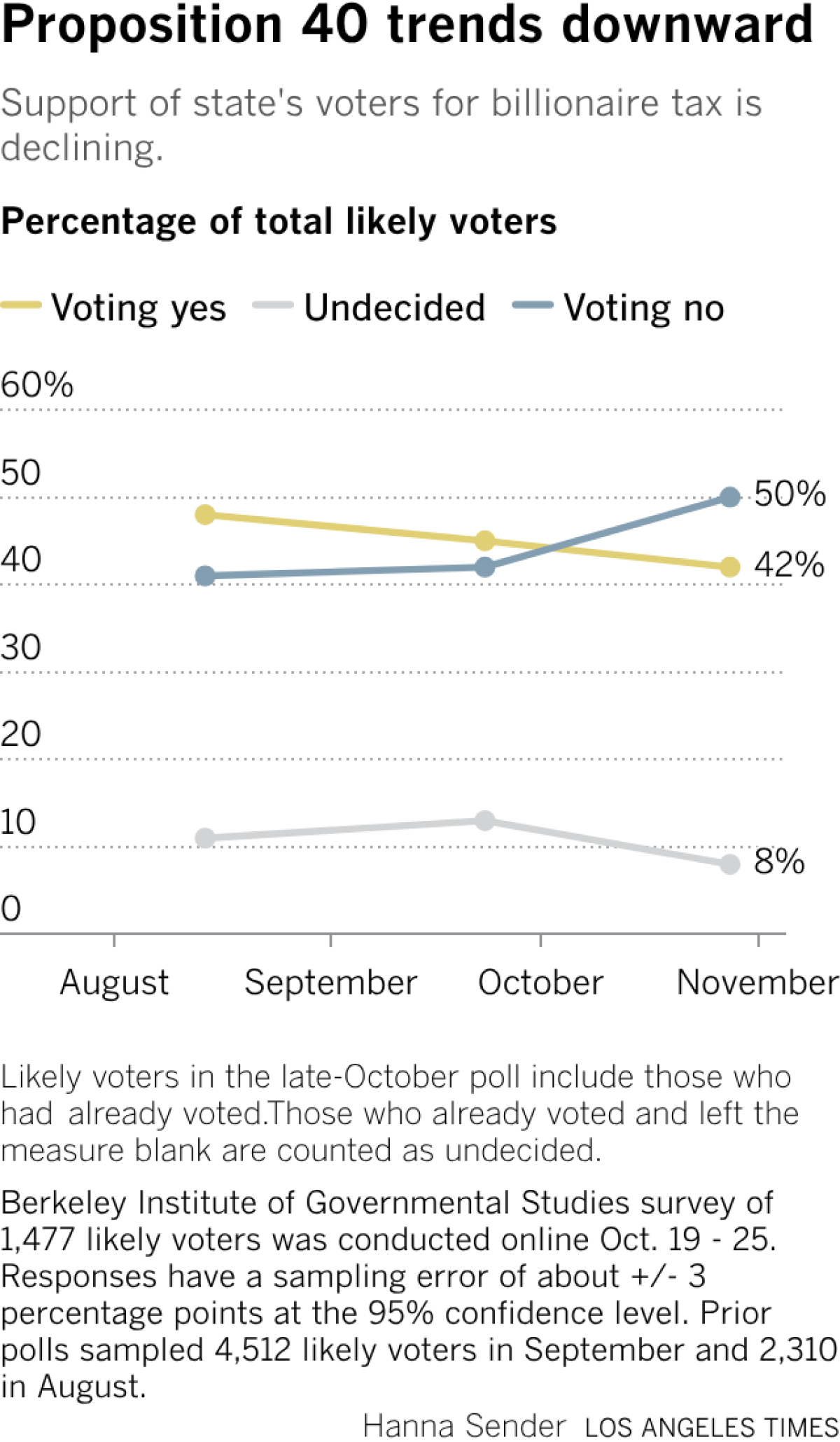
A poll by UC Berkeley’s Institute of Governmental Studies, co-sponsored by the Los Angeles Times and released last week, showed that voter support for Proposition 40 had fallen to 42% of voters surveyed last month from 48% in August.

The measure also may have lost fans because taxing assets rather than income can be a complicated and confusing process and sparks concerns among even non-billionaires on whether they want to allow the state to start demanding a slice of the value of the things that they own.

No matter the result, Proposition 40 also fueled a conversation about taxing billionaires that will continue, Galle said.

As of Wednesday afternoon, roughly $489 million has been raised to support and oppose Proposition 40 along with two ballot measures — Propositions 41 and 42 — that could block the wealth tax, data from the California secretary of state show.

The vast majority of that funding, more than $380 million, went toward killing the billionaire tax. Supporters of the wealth tax, including the Service Employees International Union-United Healthcare Workers West, trailed far behind, contributing roughly $100 million, according to filings with the California secretary of state.

Billionaires such as Google co-founder Sergey Brin contributed millions to a group called Building a Better California that funded ads against the wealth tax and propositions that could block it.

Money doesn’t always win an election, but a big funding imbalance is tough to overcome, Schnur said.

“As important as the money was to beat Prop. 40, the coalition against it may have been just as important. You didn’t see Sergey. You didn’t see tech billionaires in the ads. You saw teachers and nurses and firefighters,” he said.

The four richest Californians — Brin, Nvidia Chief Executive Jensen Huang; Google co-founder Larry Page and Meta Chief Executive Mark Zuckerberg — would owe 40% of the estimated taxes to be collected from the billionaire tax, according to an L.A. Times analysis.

Ahead of the election, billionaires made moves to prepare for the potential tax. Zuckerberg expressed concerns that if he had to sell his stock to pay the tax that could reduce his control over the company, but Meta’s board struck a deal to address that fear.

The billionaire tax proposal also faced other big hurdles. Proposition 42, which could have blocked the billionaire tax, was on track to pass. It would prohibit new taxes on “retirement holdings, individually-owned assets, and other forms of personal savings” and bar retroactive taxes.

“They didn’t just reject a single bad tax idea — millions of Californians backed the strongest protections available to protect their hard earned life savings from double taxation. They joined firefighters, law enforcement officers, building trades workers, seniors, veterans and small businesses in doing so,” said Nathan Click, a spokesman for Proposition 42.

On the other hand, Proposition 41 — a proposal that would have required audits for new state special taxes, and also could have blocked the billionaire tax — was headed for defeat.

Supporters of Proposition 40 tried to convince voters that taxing roughly 200 billionaires was the solution to raise $100 billion needed to offset federal healthcare cuts.

This week, the wealth tax’s supporters emphasized the high stakes. People won’t be able to afford healthcare coverage, children will die and hospitals will shutter, they said, if California lawmakers don’t find a way to get more funding.

“If Sacramento fails to protect patients and deliver a real solution that makes billionaires pay their fair share, healthcare workers will pursue every available avenue, up to and including returning to the ballot in 2028 with a billionaire tax,” said Suzanne Jimenez, chief of staff for the SEIU-UHW.

Source link

Proposed wealth tax could disproportionately impact California teams

The billionaires targeted by the wealth tax on the November ballot include owners of some of California’s top sports teams and, among them, there will be winners and losers if voters approve the measure.

Which owners would be ensnared by the proposed tax on billionaires’ assets remains unclear, since it’s largely dependent on whether they are declared official California residents, at least for state tax purposes. And that’s before lawyers and accountants get involved, an almost certain bet if the ballot measure is approved by California voters.

So it’s possible that the majority owner of the Los Angeles Chargers, Dean Spanos, would have to pay the the wealth tax while the owner of the Los Angeles Rams, San Kroenke, would not — even though both their teams are playing on the same home field at SoFi Stadium in Inglewood. It all depends on whether the state considers Spanos or Kroenke official California residents and how their assets are tallied.

Other wealthy team owners or co-owners who have residences in California and could be subject to the tax include the Golden State Warriors’ Joe Lacob and Peter Guber, the San Diego Padres’ José E. Feliciano and Kwanza Jones, the San Jose Sharks’ Hasso Plattner and the Anaheim Ducks’ Henry Samueli.

Among those who appear to live out of state, according to news reports, and may not be impacted: the San Francisco 49ers’ Denise DeBartolo York and John York, the Los Angeles Clippers’ Steve Ballmer, the San Francisco Giants’ Charles Johnson, the L.A. Kings’ and the L.A. Galaxy’s Philip Anschutz.

In August, embattled billionaire Mark Walter agreed to sell the L.A. Lakers to former Disney chief executive Bob Iger and venture capitalist Joshua Kushner. The proposed billionaire tax would apply to Iger, who lives in California, but not Kushner, who lives in New York. A spokesperson for Iger declined comment. Walter, who also owns the Dodgers and has been under federal investigation, told the California Post on Wednesday that he has no plans to sell the team.

There is uncertainty and disagreement about how the tax would be levied on sports team owners, and how their ownership stakes would be evaluated by the state when assessing their assets.

Representatives of the Warriors and Chargers, declined comment. Spokespeople for the Kings, Padres, Sharks and Ducks did not respond to requests for comment, nor did representatives of Kroenke or Sun Microsystems co-founder Vinod Khosla, who lives in California and whose $9.6-billion purchase of the Seattle Seahawks was finalized in September.

Legendary sports agent Leigh Steinberg warned that the proposed tax would have unintended consequences. “It creates an uneven playing field,” he said. “Out-of-state owners get an advantage over in-state residents.”

Steinberg, who has represented more than 300 professional athletes including Troy Aikman, Drew Bledsoe, Michael Vick and Oscar De La Hoya, said the increased tax could be passed on to fans if voters approve Proposition 40 on Nov. 3.

“Ticket prices are high enough anyway, and somewhat prohibitive to a working person or young person attending a game live,” Steinberg said. “The last thing in the world positive for the growth of sports is passing on that surcharge.”

Dodgers fans put condiments on their Dodgers Dogs

Dodgers fans buy food at Dodgers Stadium.

(Gina Ferazzi/Los Angeles Times)

Proposition 40 would impose a one-time 5% levy on many of the assets of billionaires, including their holdings in companies. It was crafted by a healthcare union to compensate for federal healthcare cuts signed by President Trump last year that will cost California an estimated $100 billion, impacting the state’s most vulnerable residents.

David Gamage, a tax law and policy professor at the University of Missouri’s law school, countered that consumers would be far more hurt by the impacts of the impending federal healthcare funding cuts than by potentially higher prices at sporting events.

“The billionaire wealth tax would address the healthcare crisis caused by the Trump administration slashing Medicaid and other healthcare funding. Passing the billionaire wealth tax would be expected to reduce healthcare costs and thereby keep the prices of hot dogs and other consumer goods lower,” Gamage said. “Trying to fool voters by implying otherwise is shameful.”

More than 200 billionaires live in California, some of whom moved themselves or their businesses out of the state because of the proposed tax. Facebook creator Mark Zuckerberg, the chief executive of social media giant Meta, told company leaders that he planned to leave the state to avoid his control over the company being substantially diluted by being forced to sell enough stock to pay the proposed levy. Last week, the company announced the creation of a new nonvoting type of stock that would allow Zuckerberg to sell enough shares to pay the proposed tax while retaining his voting power in exchange for him agreeing to remain in the state for eight years.

Protesters gather outside of JP Morgan's New York Headquarters

Protesters in New York demonstrate against Elon Musk following the launch of the SpaceX initial public offering.

(Spencer Platt / Getty Images)

Proposition 40 supporters say that billionaire sports team owners have benefited from Trump’s tax cuts — dividends they didn’t share with the fans who spend hard-earned money to bring their families to games — and that they need to pay their fair share.

Opponents argue that professional sports are among myriad California economic engines that will suffer if voters approve the proposition, in part because owners based in the state would be subject to the tax while those who reside in other parts of the country would be exempt.

The measure “will also drive up the cost of operating a sports team in California, increasing the price of tickets, concessions and merchandise,” said Rob Lapsley, president of the California Business Roundtable. “This is just one of many ways Proposition 40 will cost Californians.”

A poll by UC Berkeley’s Institute of Governmental Studies released Thursdayshowed public sentiment had turned against the billionaire tax, with half of likely voters opposing it and 42% supporting it.

Los Angeles Clippers owner Steve Ballmer addresses the crowd on the court

Clippers owner Steve Ballmer addresses the crowd.

(Lindsey Wasson / Associated Press)

More than $404 million has been donated to efforts supporting and opposing the wealth tax, according to the California Secretary of State’s Office. Proponents of the ballot measure had raised $36.5 million as of Thursday, while opponents received nearly $368 million.

The residency of billionaires is often difficult to ascertain, given that many have multiple properties across the nation and around the world. It is not solely based on where the person is registered to vote.

Among the “facts and circumstances” the California Franchise Tax Board considers are the person’s employer, their spouse’s and childrens’ locations, where mail is delivered, and the location of doctors, accountants, lawyers, country club memberships and houses of worship. The number of days spent in California also is factored into the board’s assessment of residency.

Lakers minority owner Patrick Soon-Shiong sits beside actress Jessica Alba during a Lakers game.

Lakers part-owner Patrick Soon-Shiong at a game.

(Gina Ferazzi/Los Angeles Times)

Los Angeles Times owner Dr. Patrick Soon-Shiong, a billionaire, owns 4% of the Lakers and recently became a co-owner of a new women’s professional volleyball team in Los Angeles expected to start competing next year.

Soon-Shiong noted that it’s not only wealthy Californians who oppose the tax. Teachers, firefighters and other groups oppose Proposition 40 because of concerns about long-term impacts on the state. And, as a businessman with stakes in sports teams, he predicted bad effects on pro sports.

“It’s really, really expensive to bring a family to watch a professional game, whatever that game may be,” he said during an interview in September. “All those costs will go up, and for sure, it’ll be passed down to the cost of the ticket.”

Times Library Director Cary Schneider contributed to this report.

Source link

Support dwindles for wealth tax, voter ID ballot measures, poll shows

California voters are souring on a Nov. 3 ballot measure to impose a one-time tax on billionaires to help fund healthcare programs, a proposal that has triggered one of the most expensive political battles in state history.

Half of likely voters plan to vote against Proposition 40, the proposed wealth tax on billionaires’ assets, while 42% support it, according to a new poll by UC Berkeley’s Institute of Governmental Studies that was co-sponsored by the Los Angeles Times. The findings mark a significant decline in support of the measure, which was crafted by an influential California healthcare union to compensate for an estimated $100 billion in federal healthcare cuts approved by President Trump and congressional Republicans.

The survey also found that a solid majority of likely voters opposed Proposition 39, which would require Californians to provide identification when voting and election officials to verify registered voters are U.S. citizens. The findings come as the Trump administration continues to attack California as a haven for voter fraud, including unfounded allegations of rampant illegal voting by undocumented immigrants.

Mark DiCamillo, the poll’s director, said previous surveys showed support for Proposition 40 has been fragile, and the most recent shows its prospects have dimmed as election day approaches.

The increase in opposition to Proposition 40 is “broad-based and spans virtually all major segments of the electorate,” DiCamillio said. The ballot measure was leading in a Berkeley poll conducted just six weeks ago, albeit by a slim margin, so its reversal of fortune is significant, he said.

The declining support comes after an onslaught of money spent opposing Proposition 40, including a torrent of television and social media ads airing everywhere from NFL games to “Everybody Loves Raymond” reruns. Nearly $368 million has been contributed to efforts opposing the billionaire tax, while $36 million has been donated to support the proposed levy.

Proposition 40 would impose a one-time 5% tax on the assets of billionaires who resided in California as of Jan. 1, with some exceptions. Democrats and their allies are splintered over the proposal. Some, including Gov. Gavin Newsom, argue it will prompt the wealthy to flee California, further harming its volatile budget, which is dependent on the state’s richest residents. The California Democratic Party and leading progressives support the measure, with Sen. Bernie Sanders (I-Vt.) calling it a modest tax necessary to help Californians struggling because of cuts imposed by Republicans to pay for tax breaks for the wealthy.

While Republican voters overwhelmingly oppose Proposition 40, nearly two-thirds of Democrats support it and more than a quarter opposing it. There is also a generational divide, with 6 out of 10 voters 65 years old or older opposing the measure, while more than two-thirds of those under 30 supporting it, according to the poll.

The findings are similar to a Public Policy Institute of California poll released Tuesday, which found 52% of likely voters would vote against Proposition 40, while 46% supported it.

The campaign against the wealth tax, funded by some of California’s richest tech moguls, is centered on three intertwined ballot initiatives: Proposition 40 and Propositions 41 and 42, both of which would undercut Proposition 40 through a series of changes to state tax laws and spending restrictions.

Proposition 41 would cut wasteful government spending by requiring audits of new state special taxes and would bar new state taxes that are exempt from a state spending limit. Proposition 42 would prohibit new taxes on retirement holdings, individually owned assets and other personal savings. Both Propositions 41 and 42 would nullify the billionaire tax if it passes, provided either measure receives more votes.

A plurality of voters oppose Propositions 41 and 42, a reversal from just six week ago, according to the poll.

In mid-September, voters were closely divided about Proposition 41 — 37% in favor and 33% opposed — with a large number of undecided. In the current poll, 38% of likely voters favor the measure and 47% oppose it. Proposition 42 led by 9 percentage points in the Berkeley/L.A. Times poll in September — 43% in favor and 34% opposed. Now, 43% of likely voters support it and 45% oppose it.

DiCamillo said backers of a ballot measure also should be concerned any time support registers below 50%, since voters who are undecided or unsure tend to vote no.

“It’s below 50%, and it’s trending down. Both of those are ominous signs,” DiCamillo said. Proposition 42 is “still very close. I’m not saying it’s definitely going down, but it’s moving in the wrong direction late in the campaign, and usually movement in a late poll is even more significant than the actual numbers themselves,”

He added that while many voters were unaware the two proposed ballot measures were designed as poison pills to kill the billionaire tax, among those who knew, the opposition was significantly greater.

If all three measures fail, that still would be a victory for the billionaires who spent aggressively to tank the wealth tax.

Another notable finding was voters’ support of Proposition 3, which would make permanent a higher income tax rate on the wealthy that funds education. A majority of voters — 54% — support continuing the levy, while 37% oppose it, according to the poll. DiCamillo says the disparity in support of the proposed billionaire tax and the extension of the existing wealth tax has been consistent in IGS’s polls, and is likely because of the differing foundations of the levies.

“Proposition 3 is already in place, and if you read the fiscal impact, if this were to pass, it maintains $5 billion to $15 billion of annual funding,” he said, “It’s a big revenue generator, and I think that is something that’s already in place.”

“Voters kind of understand the progressive nature of California’s tax system, and they kind of support that, but they don’t support nearly as much the idea of some new kind of tax, the wealth tax, which is taxing assets rather than income,” he said. “So that’s the distinction.”

These ballot measures are among 14 that voters will decide on Nov. 3, as well as statewide, congressional, local and judicial elections.

Among the other controversial measures is Proposition 39, a measure pushed by Republicans that would require all voters in future elections to show government-issued identification every time they vote in person or provide a special PIN or the last four digits of their Social Security number when submitting mail-in ballots.

The measure also would require the California secretary of state and county election officials to verify that registered voters are U.S. citizens by “using government data,” which according to supporters could include information in the federal Social Security Administration database, jury summons information and other government records.

Nearly 6 in 10 likely voters oppose the effort, while more than a third support it, split largely along party lines. More than half of voters who are registered as “no party preference” or with a smaller political party oppose the proposal, which DiCamillo said was an indication of trouble for the proposition given the state’s Democratic majority electorate and the proximity of the election.

“It’s hard for Republicans to push something over the finish line by themselves,” he said.

Other prominent ballot measures:

  • Proposition 43, which would prohibit local governments from imposing certain new special taxes unless two-thirds of voters approve the proposal. Such proposals need a simple majority vote to be approved. While 46% of likely voters oppose the proposal, 36% support it, challenging numbers this close to election day, DiCamillo said. “It needs to get to 50,” he said. “We’ll see how you do that this late in the campaign.”
  • Proposition 4, which would repeal a prohibition of public financing of campaigns, allowing state and local governments to support candidates if they abide by several rules. Likely voters are evenly split about the proposal, with 41% supporting it and opposing it, and 18% undecided. “It’s close, but it’s still below 50%. Most voters tend to vote no in the late going if they’re not convinced,” DiCamillo said, adding that he viewed the lack of support among voters who do not affiliate with a political party as a signal of potential failure.

The poll of 2,787 registered California voters was conducted online in English and Spanish Oct. 19-25 and has a margin of error of about 3 percentage points in either direction.

Source link

More than $351 million spent on wealth tax on November ballot.

More than $351 million in political donations has been poured into a high-stakes contest about a proposed wealth tax on the November ballot, making it one of the most costly campaigns in California history.

About 90% of the money is being spent to defeat a statewide initiative to impose a new tax on the assets of billionaires, a multifaceted opposition effort bankrolled primarily by ultra-rich Californians being targeted by a measure that supporters call an economic reckoning.

The billionaire tax, Proposition 40, would levy a one-time, 5% tax on many assets of California billionaires who lived in the state as of Jan. 1.

Millions of dollars continue to flow into the campaigns of three intertwined ballot initiatives at the center of the debate: Proposition 40, and Propositions 41 and Proposition 42, which would neuter the Proposition 40 through strategic, esoteric tax law changes.

“The pro-40 campaign picked a fight and then came to that fight with a butter knife against a nuclear arsenal,” said GOP strategist Rob Stutzman, who is not involved in any of the wealth-tax-related ballot measures. “Because they’re so well funded, in today’s multifaceted media world, they are able to show up everywhere from network TV to inside video games. That is a very, very large advantage few campaigns ever get to have.”

But, Stutzman warned, money does not guarantee a win.

In the most expensive ballot measure fights in California history, $463 million was spent on two gambling proposals 2022. The initiatives pitted some of California’s most successful Native American tribes with gaming interests against gambling corporations, including online sports gaming companies DraftKings and FanDuel. Both side’s measure failed.

People attend a rally against Proposition 40 at the Iron Workers Apprenticeship Training Center

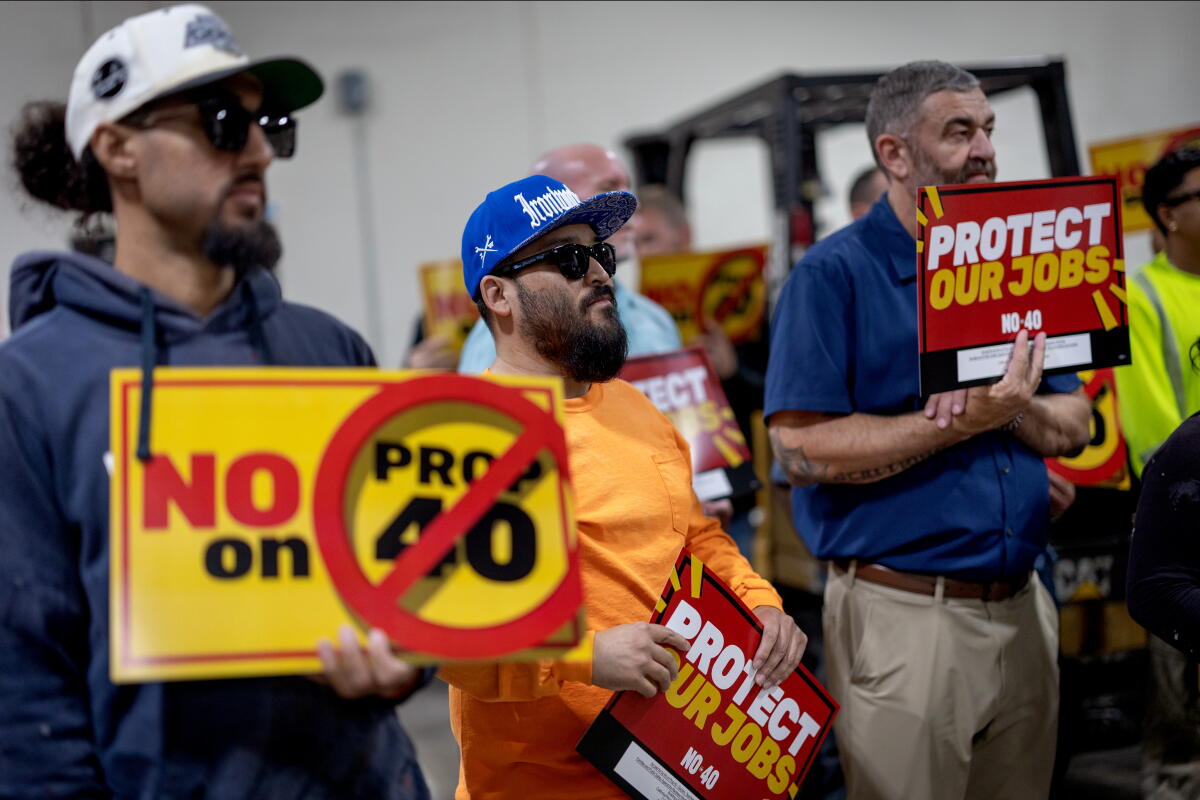
People attend a rally against Proposition 40 at the Iron Workers Apprenticeship Training Center on Oct. 5 in La Palma.

(Eric Thayer/Los Angeles Times)

The tax measure was crafted by Service Employees International Union-United Healthcare Workers West in response to federal healthcare funding cuts signed by President Trump last year that are expected to reduce California’s healthcare budget by $100 billion, burdening the state’s most vulnerable residents.

“Trump’s ‘Big Beautiful Bill’ slashes healthcare funding, with major coverage cuts scheduled to hit after the midterms,” said Suzanne Jimenez, the union’s chief of staff. “More than 3 million Californians could lose their health insurance. Hospitals and emergency rooms face closure. Patients will die unnecessarily when the care they need is no longer there. Proposition 40 is an emergency response to that looming disaster.”

The proposition’s supporters raised $34.3 million, nearly all of it from Jimenez’s union.

The two other measures, Propositions 41 and 42, would nullify the billionaire tax if either receives more votes.

Proposition 41 supporters say the measure aims to cut wasteful government spending by requiring audits for new state special taxes and would bar new state taxes that exempt their revenue from a state spending limit. Backers of Proposition 42 argue it would prohibit new taxes on retirement holdings, individually owned assets and other forms of personal savings.

Advocates for the billionaire tax say both are well-financed smokescreens to undercut Proposition 40.

Opposition campaigns to the wealth tax as well as the two countermeasures have received enormous donations from several of the state’s billionaires. But Building a Better California, the main funder of efforts to defeat the wealth tax, noted that its allies included Democratic and Republican politicians, prominent labor groups and business leaders.

“It’s rare for such a broad coalition to unite around any single cause in California, but it reflects the potentially devastating impact of this measure on healthcare, education, and our state’s economy,” the group said in a statement.

Among the largest donors opposing the wealth tax are billionaires Sergey Brin, a co-founder of Google who has donated more than $100 million to anti-wealth-tax efforts, and former Google leader Eric Schmidt and venture capitalist L. John Doerr, who each kicked in $40 million.

Brin, Schmidt and Doerr did not respond to requests for comment.

US tech entrepreneur Sergey Brin and Gerelyn Gilbert-Soto arrives for the 2026 Met Gala

US tech entrepreneur Sergey Brin and Gerelyn Gilbert-Soto arrive for the 2026 Met Gala celebrating “Costume Art” at the Metropolitan Museum of Art in New York in May.

(ANGELA WEISS/AFP via Getty Images)

The spending disparity also reflects a divide among Democrats and their allies, many of whom support wealth taxes, but argue that the way Proposition 40 was written is disastrous to California’s volatile budget, which is dependent on the state’s wealthiest residents.

Jodi Hicks, chief executive and president of Planned Parenthood Affiliates of California, said that while her organization would support a nationwide or a California wealth tax, their primary concerns are about 40’s impacts on the state budget and healthcare in the state.

“We are opposed to this particular proposal because we think it does more harm than good,” she said, adding that after what her organization “faced last year having to scramble for dollars because of [federal funding cuts] we are committed to work with the stakeholders facing cuts and not harming the budget and finding revenue in a smart way.”

The cash imbalance between supporters and opponents of the billionaire tax is vast. Those opposed to the measure raised $316.7 million, while proponents raised nearly $34.3 million.

protesters

The Fair Games Coalition, made up of community leaders, labor organizations and advocates, announce the launch of the Overpaid CEO Tax Initiative in front of the Tesla Diner in West Hollywood in January.

(Genaro Molina/Los Angeles Times)

The supporters of the wealth tax spent nearly all of their money gathering signatures to place the measure on the ballot. They had $1.6 million on hand as of Oct. 17.

Now, as voters cast ballots, their campaign appears reliant on public events and media coverage, such as of Sen. Bernie Sanders’ (I-Vt.) recent rally in support of Proposition 40 in downtown Los Angeles.

“What you are showing people from coast to coast and all over is that, yes, we can take on the greed of the oligarchs,” he said, calling it the most important ballot measure in the country. “Yes, we can create an economy and a government that works for all of us, not just the 1 percent.”

Facebook creator and Meta chief Mark Zuckerberg was among the California billionaires Sanders name-checked in his remarks. After Zuckerberg told company leaders that he planned to leave the state to avoid his control over the company substantially reduced by being forced to sell enough of his stock in the social media giant to pay the proposed levy, the company on Wednesday announced the creation of a new, non-voting type of stock that would allow Zuckerberg to sell enough shares to pay the proposed tax while retaining his voting power in exchange for him agreeing to remain in the state for eight years.

Meta CEO Mark Zuckerberg listens as President Donald Trump speaks to reporters

Meta CEO Mark Zuckerberg listens as President Trump speaks to reporters at the White House on Sept. 29.

(Jacquelyn Martin / Ap Photo/jacquelyn Martin)

The pro-wealth-tax campaign is sending voters emails and texts and has an online presence.

“Remember: it’s not enough to vote YES on 40. You also need to vote NO on 41 + 42,” read an email sent to voters on Tuesday. “Don’t be fooled: Props 41 and 42 are billionaire-funded initiatives designed specifically to undermine Prop 40, the California Billionaire Tax.”

Meanwhile, the anti-40 and pro-42 campaigns are inundating voters on television, streaming services, in mailboxes, through online influencers and even in digital video games such as Sim City.

Jimenez said voters will see through the blizzard of campaign messaging.

“The billionaires think voters are stupid. They think they can bury the facts under millions of dollars in advertising and disguise Prop. 42 … as protection for ordinary taxpayers,” she said. “Their spending also makes our case for us. When billionaires can afford to spend millions a day protecting their fortunes, voters can see that billionaires have plenty of money to spare.”

Sheri Sadler, a veteran Democratic media buyer, questioned how much voters were hearing about the rationale for the proposed billionaire tax.

“The yes side is severely lacking in getting their message through while the no side is dipping into different kinds of pockets,” she said.

Jessica Levinson, an election law professor at Loyola Law School, said that beyond voter confusion about the competing ballot measures, it is certain to face legal challenges, notably about the retroactive nature of the tax, which would apply to any billionaire who lived in California as of Jan. 1. She described that as “the biggest legal pressure point.”

“It’s kind of a mess,” she said.

Times staff writer Gabrielle LaMarr LeMee contributed to this report.

Source link

Billionaire tax backers plan to attack Newsom in early presidential primary states

Foes of Gov. Gavin Newsom, who is widely viewed as a likely 2028 presidential candidate, are launching television and digital ads this weekend in early primary states that criticize the governor’s opposition to the proposed billionaire tax on California’s November ballot.

The ad, funded by backers of the wealth tax, castigates Newsom for opposing Proposition 40, the ballot measure that would impose a 5% tax on California billionaires’ assets to offset federal healthcare funding cuts approved by congressional Republicans and signed by President Trump last year.

“We’re all struggling with the high cost of healthcare. In California, Democrats are championing a one-time tax on billionaires that would save coverage for millions,” a narrator says in the 30-second ad. “So why [has] presidential hopeful Gavin Newsom betrayed his own supporters by trying to sabotage the billionaire tax? Maybe it’s because the same billionaires who oppose Prop. 40 also gave millions of dollars to Newsom. Gavin Newsom turned his back on working Californians. Will he do the same to you?”

The ad specifically calls out billionaires Stewart Resnick, who owns several businesses including Pom Wonderful, Fiji Water and Justin Wines; crypto executive Chris Larsen; former Google leader Eric Schmidt; and venture capitalist Michael Moritz, all of whom have backed Newsom’s political ambitions.

Newsom has argued that, although he supports wealth taxes, they ought to be enacted at the national level, rather than a state-by-state patchwork that could drive the rich to leave California, a state with a volatile budget heavily dependent on the state’s wealthiest residents.

The primary funders of the ad are the Service Employees International Union – United Healthcare Workers West, which crafted Proposition 40; Saikat Chakrabarti, a climate change warrior and political advisor who made his wealth in part as a founding engineer at Stripe; and Ross Boucher, an early engineer at Stripe.

The ad buy is six figures but could grow, according to its backers. Among the states where the ad is expected to air are South Carolina, Nevada, New Mexico, Virginia and New Hampshire.

Earlier this month, Newsom stumped for candidates in New Hampshire, his latest foray to early presidential primary states.

The ad launch comes amid a contentious, expensive battle over the proposed wealth tax, which has divided Democrats and their allies. Although Newsom is among Democrats who oppose it, the ballot measure was endorsed by the state Democratic Party and Sen. Bernie Sanders (I-Vt.). Voters are closely divided about the measure.

Source link