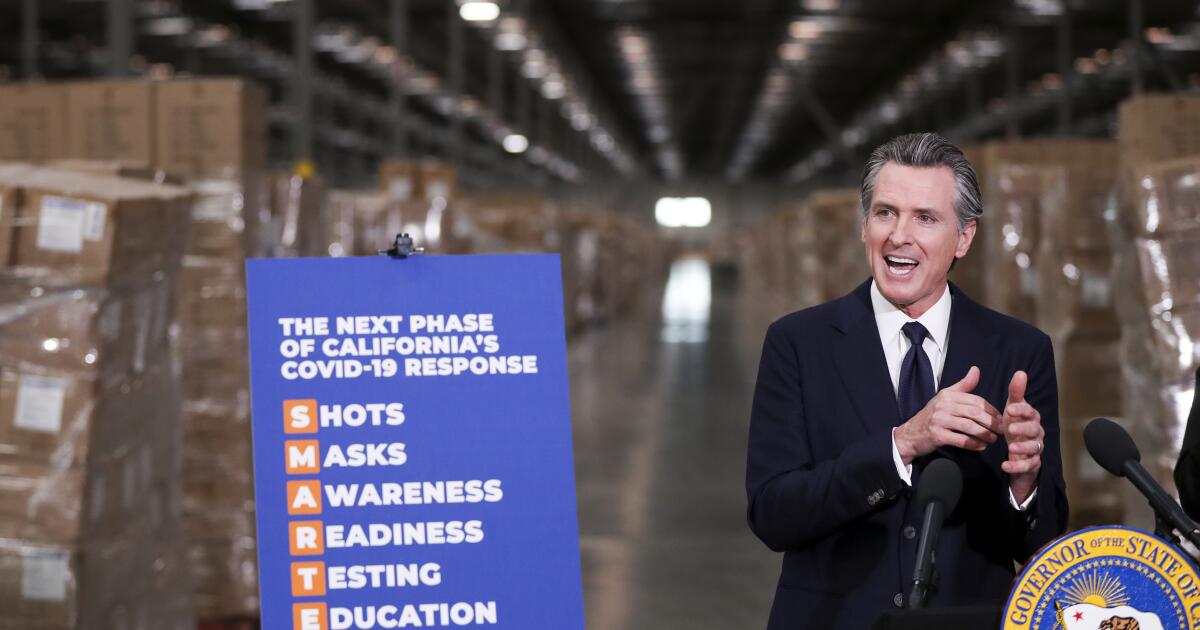
SACRAMENTO — The year opened with President Trump declaring that “the fraud investigation of California has begun,” a move that quickly set off a barrage of allegations from his administration and Republican allies questioning the integrity of state programs and the leadership of Gov. Gavin Newsom.
The accusations, amplified across social media and conservative outlets, have pushed California and its Democratic leadership to the center of a broader national political fight over waste, fraud and abuse.
Newsom has dismissed the claims as politically driven, arguing that the administration is singling out Democratic-led states while ignoring similar problems elsewhere. The governor also responded by highlighting fraud cases in Republican-led states and by criticizing Trump’s own record and business dealings.
Against that backdrop, it has become increasingly difficult to separate substantiated fraud from fabricated or recycled claims, to distinguish old findings from newly raised allegations and to determine who can credibly claim credit for uncovering wrongdoing — all amid a toxic and deeply polarized political climate.
Dan Schnur, who teaches political communications at USC and UC Berkeley, said allegations of malfeasance in California is a particularly ripe target for Republicans because Democrats have controlled the state Legislature and governor’s office for years.
Democrats hold a supermajority in both the Assembly and the Senate, meaning they hold at least two-thirds of seats in both houses, and not a single Republican has been elected to statewide office in California since 2006, when Gov. Arnold Schwarzenegger and Insurance Commissioner Steve Poizner were reelected.
“There is no shared responsibility here for Republicans,” Schnur said. “If you had a state in which Republicans were actually competitive, they would bear some responsibility for these problems.”
Audits and prosecutions show that California has experienced its share of fraud, particularly in complex programs involving emergency aid, healthcare and unemployment insurance. The state paid out billions of dollars in fraudulent unemployment claims during the COVID-19 pandemic, and the California State Auditor has issued repeated warnings about state agencies that are “at high risk for waste, fraud, abuse, or mismanagement.”
Along with recycling a barrage of years-old allegations of financial malfeasance in California and other Democratic states, the Trump administration elevated claims of child-care fraud in Minnesota last month, prompting Gov. Tim Walz to drop his reelection plans to focus on the growing political crisis in his state.
Fraud allegations are increasingly being deployed as a political weapon against Newsom, a leading Trump critic and a potential 2028 Democratic presidential contender. Politicians have always railed against government waste, fraud and abuse, but now those issues are being “weaponized into a partisan issue,” Schnur said.
For the public, it can be hard to discern the truth. Here is a look at three of the central fraud allegations — and what the evidence shows.
Child-care funding
President Trump used his social media platform, Truth Social, to accuse California of widespread fraud last month, drawing a link between his administration’s investigation into child-care spending in Minnesota and programs in the Golden State, and announcing a major federal “fraud investigation” into the state’s actions.
“California, under Governor Gavin Newscum, is more corrupt than Minnesota, if that’s possible???” wrote Trump, using a disparaging nickname for the governor.
The Trump administration then moved to freeze $10 billion in federal funding for child care in five Democrat-led states — California, New York, Colorado, Illinois and Minnesota — over “serious concerns about widespread fraud and misuse of taxpayer dollars.”
In a trio of Jan. 6 letters addressed to Newsom, the U.S. Department of Health and Human Services said it was concerned there had been “potential for extensive and systemic fraud” in child care and other social services programs that rely on federal funding, and had “reason to believe” that the state was “illicitly providing illegal aliens” with benefits.
The letters did not detail evidence to support the claims. The governor’s office dismissed the accusation as “deranged.”
A federal judge subsequently blocked the Trump administration temporarily from freezing those funds. In that ruling, U.S. District Judge Vernon Broderick said he didn’t understand why the government was making it harder for states to access child-care money before any wrongdoing had been discovered.
“It just seems like the cart before the horse,” he said.
Hospice funding
Days after Trump’s social media post about alleged corruption under Newsom’s watch, Dr. Mehmet Oz, administrator for the Centers for Medicare & Medicaid Services, and Bill Essayli, the top federal prosecutor in Los Angeles, held a joint news conference on public benefits fraud, but offered few details about the scope of their investigation.
The officials accused “foreign actors” of draining billions from public healthcare programs in California, referencing bogus hospice providers first exposed by The Times in 2020 and later investigated by California Atty. Gen. Rob Bonta.
Essayli placed the blame for bad actors squarely on Newsom, calling him “the fraud king.”
Weeks later, Oz released a video of himself walking in the Los Angeles neighborhood of Van Nuys as he questioned why dozens of alleged hospices were operating along four blocks. He blamed the “Russian Armenian Mafia” and made his remarks while pointing to an Armenian bakery, prompting accusations of racism from the Armenian community.
Newsom’s office last week hit back by highlighting state efforts to fight fraud, while pointing to a 2025 Axios story on the Trump administration’s decision to pause a federal program to crack down on bad hospice operators.
Bonta’s office said it has filed criminal charges against 109 individuals over hospice fraud-related offenses and launched dozens of civil investigations.
Newsom, speaking at a Bloomberg event Thursday in San Francisco, said the allegations have been recycled and misrepresented. Later that day, he filed a civil rights complaint against “baseless and racist allegations against Armenian Americans in California” made by Oz.
“Hospice, we’ve been after that for years and years before Oz was even on the scene,” Newsom said. “In 2021, we did a moratorium on new hospice programs, 280 we shuttered.”
The Center for Medicare & Medicaid Services said earlier this year that — in addition to California — Arizona, Nevada, Texas, Ohio and Georgia are being monitored following allegations of fraud and waste.
EDD fraud
The state’s Employment Development Department, known as EDD, reported in 2021 that approximately $20 billion was lost due to fraud, largely in the federal Pandemic Unemployment Assistance (PUA) program.
While unemployment fraud was rampant across country during the pandemic as governments rushed to provide support, California’s problems stood out.
The state itself admitted in 2021 that it failed to take precautions that had been implemented in other states, including using software to identify suspicious applications and cross-checking benefit claims against personal data on state prison inmates.
Rep. Kevin Kiley (R-Rocklin) said department mismanagement and fraud often overlap and cited EDD as a prime example.
“When there is a lack of internal controls, a lack of diligence of how funds are used, that makes it easier for those who want to take advantage of the system to profit,” Kiley said.
EDD’s own tracker said the state has recovered more than $6 billion in stolen funds and opened more than 2,300 unemployment fraud investigations since the pandemic began, leading to nearly 1,000 arrests and more than 670 convictions.
The department said it has expanded fraud enforcement through partnerships with law enforcement, new identity-verification technology and a dedicated fraud task force.
But, reports of mismanagement at EDD have continued. A recent audit also found EDD wasted $4.6 million by paying monthly service fees for more than 6,200 cellphones that went unused for at least four consecutive months between November 2020 and April 2025 — including some devices that were inactive for more than four years.
At the same time, “EDD continues to have high rates of improper [unemployed insured] payments, including fraudulent payments, and it needs to improve the customer service it provides to UI claimants,” another report found.
What’s next?
Newsom said there is a reason the Trump administration is not pointing to fraud in Republican-led states.
“This is about polarization, politicalization, weaponization,” Newsom said Thursday.
Asked what the Trump administration will discover in probing California for fraud, Newsom said investigators will find a state “taking that issue very, very seriously.”
“We absolutely are here to be a partner, to go after waste, fraud and abuse,” Newsom said.
State audits show vulnerabilities persist. The California State Auditor has repeatedly flagged Medi-Cal eligibility discrepancies that have exposed the state to billions of dollars in questionable payments, while also warning that weaknesses in information security across state agencies remain a high-risk issue.
Curtailing waste could be particularly important during the upcoming year as California and its state-funded programs head into a period of volatile fiscal uncertainty, driven largely by events in Washington and on Wall Street. Newsom’s own optimistic budget proposal projects a $3-billion state deficit for the next fiscal year despite no major new spending initiatives.
The nonpartisan Legislative Analyst’s Office warned in November that California faces a nearly $18-billion budget shortfall.
It will also be a key issue in upcoming elections. A group of Republicans running for statewide offices, including California gubernatorial candidate Steve Hilton, pegged that the state’s annual estimate of fraud, waste and abuse across state programs at $250 billion, an estimate that includes unverified public tips submitted to a campaign-run website.
The group cited the estimate as justification for creating their own “California Department of Government Efficiency,” or CAL DOGE, a nod to a similarly named federal initiative promoted by Elon Musk that generated headlines but has not produced documented savings or formal audit findings. CAL DOGE is not currently a state department, despite its name.
Who deserves credit when fraud is prosecuted has also become a point of contention. After a man was arrested last month for fleecing L.A.’s homeless services program for $23 million, critics of Newsom were quick to blame the governor. Newsom responded by saying the case was uncovered by local investigators working with law enforcement, which he added is “exactly the kind of accountability and oversight the state has pushed for.” (The Los Angeles district attorney’s office ran a parallel, independent investigation.)
Essayli responded on social media by saying no one made an arrest until Trump and Atty. Gen. Pam Bondi “appointed me to investigate and charge fraud offenses in California.”
Kiley, the California Republican congressman, said despite the partisan fighting over fraud, the issue should rally both parties.
The “easiest” way to solve the state’s budget problems and improve government services for taxpayers is to “minimize and eventually eliminate fraud,” said Kiley.