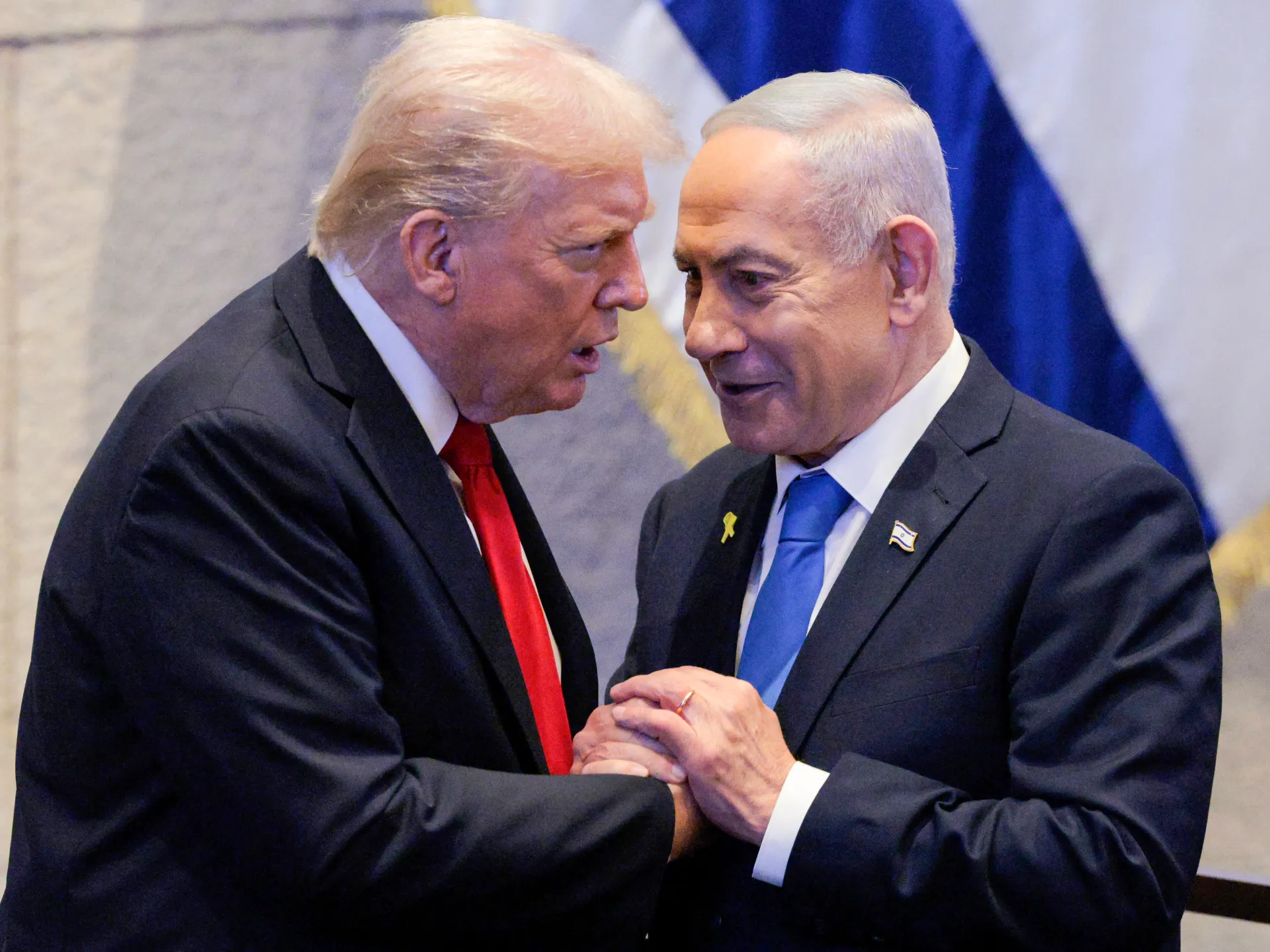
United States President Donald Trump has said a nuclear agreement currently being negotiated with Iran will be “far better” than the 2015 Joint Comprehensive Plan of Action (JCPOA), which he withdrew from in 2018 during his first term in office.
The original 2015 accord took roughly two years of negotiations to reach and involved hundreds of specialists across technical and legal fields, including multiple US experts. Under it, Iran agreed to restrict the enrichment of uranium and to subject itself to inspections in exchange for the relaxation of sanctions.
Recommended Stories
list of 3 itemsend of list
But Trump took the US out of that pact, calling it the “worst deal ever”. Before the initial US-Israeli strikes on Iran at the end of February, the US had made new demands – including additional restrictions on Tehran’s nuclear programme, the restriction of its ballistic missiles programme and an end to its support for regional armed groups, primarily in Lebanon, Yemen and Iraq.
Trump’s latest remarks come amid growing uncertainty about whether a second round of talks will proceed in the Pakistani capital Islamabad, as a two-week ceasefire between the US-Israel and Iran approaches the end in just a day.
So, what was the JCPOA, and how did it compare to Trump’s new demands?
What was the JCPOA?
On July 14, 2015, Iran reached an agreement with the European Union and six major powers – China, France, Russia, the United Kingdom, the US, and Germany – under which these states would roll back international economic sanctions and allow Iran greater participation in the global economy.
In return, Tehran committed to limiting activities that could be used to produce a nuclear weapon.
These included reducing its stockpile of enriched uranium by about 98 percent, to less than 300kg (660lb), and capping uranium enrichment at 3.67 percent – far below weapons-grade of 90 percent, but high enough for civilian purposes such as power generation.
Before the JCPOA, Iran operated roughly 20,000 uranium-enriching centrifuges. Under the deal, that number was cut to a maximum of 6,104, and only older-generation machines confined to two facilities, which were subject to international monitoring.
Centrifuges are machines which spin to increase the concentration of the uranium-235 isotope – enrichment – in uranium, a key step towards potential bomb-making.
The deal also redesigned Iran’s Arak heavy water reactor to prevent plutonium production and introduced one of the most intrusive inspection regimes ever implemented by the global nuclear watchdog, the International Atomic Energy Agency (IAEA).
In exchange, Iran received relief from international sanctions which had severely damaged its economy. Billions of dollars in frozen assets were released, and restrictions on oil exports and banking were eased.
The deal came to halt when Trump formally withdrew Washington from the nuclear deal in 2018, a move widely criticised domestically and by foreign allies, and despite the IAEA saying Iran had complied with the agreement up to that point.
“The Iranian regime supports terrorism and exports violence, bloodshed and chaos across the Middle East. That is why we must put an end to Iran’s continued aggression and nuclear ambitions. They have not lived up to the spirit of their agreement,” he said in October 2017.
He reimposed crippling economic sanctions on Tehran as part of his “maximum pressure” tactic. These targeted Iran’s oil exports, as well as its shipping sector, banking system and other key industries.
The goal was to force Iran back to the negotiating table to agree to a new deal, which also included a discussion about Tehran’s missile capabilities, further curbs on enrichment and more scrutiny of its nuclear programme.
What has happened to Iran’s nuclear programme since the JCPOA?
During the JCPOA period, Iran’s nuclear programme was tightly constrained and heavily monitored. The IAEA repeatedly verified that Iran was complying with the deal’s terms, including one year after Trump announced the US’s withdrawal from the agreement.
Starting in mid-2019, however, Iran began incrementally breaching the deal’s limits, exceeding caps on uranium stockpiles and enrichment levels.
In November 2024, Iran said it would activate “new and advanced” centrifuges. The IAEA confirmed that Tehran had informed the nuclear watchdog that it planned to install more than 6,000 new centrifuges to enrich uranium.
In December 2024, the IAEA said Iran was rapidly enriching uranium to 60 percent purity, moving closer to the 90 percent threshold needed for weapons-grade material. Most recently, in 2025, the IAEA estimated that Iran had 440kg (970lb) of 60-percent enriched uranium.
What are Trump’s latest demands for Iran’s nuclear programme?
The US and its ally, Israel, are pushing Iran to agree to zero uranium enrichment and have accused Iran of working towards building a nuclear weapon, while providing no evidence for their claims.
They also want Iran’s estimated 440kg stock of 60pc enriched uranium to be removed from Iran. While that is below weapons-grade, it is the point at which it becomes much faster to achieve the 90 percent enrichment needed for atomic weapons production.
In March 2025, Tulsi Gabbard, the US director of national intelligence, testified to Congress that the US “continues to assess that Iran is not building a nuclear weapon”.
On Sunday, Iranian President Masoud Pezeshkian, in a strongly worded statement, said Trump had no right to ”deprive” Iran of its nuclear rights.
(Al Jazeera)
What else is Trump asking for?
Restrictions on ballistic missiles
Before the US-Israel war on Iran began, Tehran had always insisted negotiations should be exclusively focused on Iran’s nuclear programme.
US and Israeli demands, however, extended beyond that. Just before the war began, Washington and Israel demanded severe restrictions on Iran’s ballistic missile programme.
Analysts say this demand was at least partly triggered by the fact that several Iranian missiles had breached Israel’s much-vaunted “Iron Dome” defence system during the 12-day war between the two countries in June last year. While Israel suffered only a handful of casualties, it is understood to have been alarmed.
For his part, Trump has repeatedly warned, without evidence, about the dangers of Iran’s long-range missiles, claiming Iran is producing them “in very high numbers” and they could “overwhelm the Iron Dome”.
Iran has said its right to maintain missile capabilities is non-negotiable. The JCPOA did not put any limits on the development of ballistic missiles.
However, a United Nations resolution made when adopting the nuclear agreement in July 2015 did stipulate that Iran could not “undertake any activity related to ballistic missiles designed to be capable of delivering nuclear weapons”.
Ending support for proxy groups
The US and Israel have also demanded that Iran stop supporting its non-state allies across the Middle East, including Hezbollah in Lebanon, the Houthis in Yemen and a number of groups in Iraq. Together, these groups are referred to as Iran’s “axis of resistance”.
In May last year, Trump said Tehran “must stop sponsoring terror, halt its bloody proxy wars, and permanently and verifiably cease pursuit of nuclear weapons”, during a GCC meeting in Riyadh.
Three days before the war on Iran began in February, during his State of the Union address to Congress, Trump accused Iran and “its murderous proxies” of spreading “nothing but terrorism and death and hate”.
Iran has refused to enter a dialogue about limiting its support for these armed groups.
Can Trump really get a new deal that is ‘much better’ than the JCPOA?
According to Andreas Kreig, associate professor of Security Studies at King’s College, London, Trump is more likely to secure a new deal that closely resembles the JCPOA, with “some form of restrictions on enrichment, possibly with a sunset clause, and international supervision”.
“Iran might get access to frozen assets and lifted sanctions much quicker than under the JCPOA, as it will not agree to a long drawn-out, gradual lifting of sanctions,” Krieg pointed out.
However, he warned that the political landscape in Tehran has hardened. “Iran now is a far more hardline and less pragmatic player that will play hardball at every junction. Trump cannot count on any goodwill in Tehran,” he said.
“The IRGC is now firmly in charge… with likely new powerful and tested levers such as the Strait of Hormuz,” he said, referring to the Islamic Revolutionary Guard Corps, which operates as a parallel elite military force to the army and has a great deal of political and economic power in Iran. It is a constitutionally recognised part of the Iranian military and answers directly to the supreme leader.
Overall, Krieg stressed, the US-Israel war on Iran “leaves the world worse off than had Trump stuck to the JCPOA”, even if a new compromise is eventually reached.
Moreover, since the revocation of the JCPOA, the US and Israel have waged two wars on Iran, including the current one. The 12-day war in June last year included attacks on Iran’s nuclear sites and killed more than 1,000 people.
Attacks on Iran’s nuclear infrastructure have continued since the latest war began on February 28, including on the Natanz enrichment facility, Isfahan nuclear complex, Arak heavy water reactor, and the Bushehr nuclear power plant.
Nevertheless, King’s College’s Krieg said there is still room for a negotiated outcome if Tehran and Washington scale back their demands.
“Both sides can compromise on enrichment thresholds, and on temporary moratoriums on enrichments. But Iran will not surrender its sovereignty to enrich altogether, and the Trump administration will have to meet them halfway,” he said.
“While the Iranians will commit on paper not to develop a nuclear weapon, they will want to keep R&D [research and development] in this space alive.”
Economic incentives will be central, he added. “Equally, Iran would want to get immediate access to capital and liquidity. Here, the Trump administration is already willing to compromise.”
Sina* is a 28-year-old video editing assistant who fought hard to build a life in Tehran. After completing mandatory military service, he refused to return to his hometown of Neyshabur in eastern Iran, knowing opportunities for a young man with a background in film editing and independent student theatre were bleak there. Through a college friend, he found his footing at a video content creation studio in the capital, climbing from camera assistant to assistant video editor within six months, before losing his job as a result of the US-Israel war on Iran. As told to Arya Farahand.
It has been a few days since the guns fell silent, and the sliver of hope I felt when the ceasefire was announced is already fading. Out of all the resumes I sent in desperation, only one company called me for an interview. The salary they offered would not cover the bare minimum to survive. My family keeps calling from Neyshabur, repeating the same line: “Come back, there’s work for you here.” What they intend as a lifeline feels like salt in the wound.
Recommended Stories
list of 3 itemsend of list
I had stopped taking money from my father, my salary grew, and I was buying gifts for my two sisters. I was, for the first time in my life, truly independent. Now, I am sitting in my grandmother’s empty apartment in Tehran, staring at a phone with almost no internet, waiting for a job offer that’s not coming.
This is what the war has done to me. Not a scratch on my body, but everything else – gone.
Croissants on the roof
The morning the war started, we were in a briefing meeting, drinking tea. A colleague had brought fresh croissants. Then we heard the roar of a fighter jet, a whistle, and seconds later, an explosion.
Our initial instinct wasn’t terror, but naive curiosity. Against every survival guide we had read from the previous war, we piled into the elevator and went up to the roof, mugs still in hand. Pillars of smoke were rising across the city. Then, another explosion hit, deafeningly close. We sprinted for the stairs.
Our manager sent us home. The city had seized up. My driver called to say he couldn’t get through the gridlock, so we started walking – 40 minutes under the glaring sun, past stranded people and stalled cars. At one point, a middle-aged driver lost his nerve, swerving into the bus lane against traffic. A bus appeared head-on and deadlocked the lane. Trapped, he looked ready to explode. I didn’t stick around. I just kept walking.
I went to my grandmother’s house. Hard of hearing, she hadn’t heard a single blast and was simply overjoyed to see me. I drank tea, sat in front of the television, tried to process what was happening, then ate lunch and slept.
The city hollowing out
When I woke up, I reached for my phone, only to be reminded that the internet was dead. I am someone who fills every spare moment with online gaming or Instagram. Without either, the boredom was stifling. I couldn’t smoke in front of my grandmother, and the forced abstinence only added to my agitation.
In the days that followed, the city hollowed out. Whenever I stepped into the alley – using a quick errand as a pretext to sneak a cigarette – I saw fewer and fewer people. In our building, only five of the 12 units remained occupied. I could tell by the empty spaces in the parking garage.
When my cigarette supply ran out, the corner shop didn’t have my brand and the supermarket was charging double. With no certainty that my March salary would be paid, I settled for a cheaper, unknown brand. It was like inhaling truck exhaust.
The days blurred: the unemployment anxiety, the stifling boredom, the desperate secret cigarettes. I tried buying VPNs twice. The first worked for a single day. The second – the seller blocked me the moment I transferred the money.
The closest I have come to death
The true nightmare came on the night of March 5. A mild explosion jolted me awake around 4m. I walked to the kitchen for water. Then a blast ripped through the air – a sound seared into my brain for life. I froze. My grandmother stumbled out of her bedroom in terror. I pulled her into the kitchen.
Then came the barrage. More than 10 consecutive explosions, each less than 10 seconds apart. My grandmother sat on the floor beside me, arms wrapped tightly around my leg, head buried. It was the closest I have ever felt to death.
When it finally stopped, the windows held. My grandmother, shaken, recalled how during the Iran-Iraq war, sirens had warned them in time to reach shelters. What she found most painful about this war was the absolute lack of warning – no sirens, no shelters. Just sitting, waiting for the next blast. With tired legs, she climbed back into bed. I did not sleep until morning.
Ten voices in my head
Through all of it, I kept telling myself, “Hold on”. Our manager had hoped this war, like the previous conflict, would end in under two weeks. Whenever my parents called, begging me to return to Neyshabur, I said no.
On March 17, we had our final online meeting. The studio’s debts were mounting, invoices unpaid, and our manager saw no end in sight – for the war or the internet blackout. For the new Iranian year, starting on March 21, only 200 resources staff would remain. The rest of us were laid off, without pay.
As the call ended, it felt like 10 different voices were screaming in my head. I couldn’t rely on my grandmother’s meagre pension. My father was already supporting a family of four. The calculation was merciless: move back to Neyshabur and work at my uncle’s supermarket. Instead of planning how to improve my life, I was plotting survival.
I packed up and left. It was a gruelling 10-hour bus ride through eerily quiet roads. What haunted me most were the final moments in Tehran. The city felt hollow, silent, swallowed by a darkness I had never seen before.
The void
From Neyshabur, I called my manager, hoping against hope. He laid out the brutal math. During the previous war and the December protests, waiting out the shutdowns had been viable. But a relentless year of economic bleeding, capped by this blackout, had driven revenue to zero. Even if the internet were restored tomorrow and we worked nonstop for months, it wouldn’t be enough. The studio hadn’t paused. It had collapsed.
I updated my resume, bought a return bus ticket, and went back to my grandmother’s apartment. There was nothing to go back to. I just needed to feel like I was doing something.
When the ceasefire was announced, I felt a sliver of hope. It lasted about a day.
My life used to be a blur of motion: the studio, independent theatres, cafes with friends, early mornings and late nights. Now, my entire existence has shrunk to four walls. The war has ended, at least for now. The internet remains largely throttled, the economy is in ruins, and the job market that existed before February 28 has not returned with the ceasefire.
Outside, people are beginning to move through the streets again. For them, perhaps, something is resuming. For me, there is nothing to resume.
THE conflict in Iran has added as much as $100 (£77) per person to the price of long-haul flights from Europe, new figures have revealed.
The Transport & Environment (T&E) said in a statement that disruption to jet fuel supplies is likely to trigger higher ticket prices for passengers.
Sign up for the Travel newsletter
Thank you!
The conflict in Iran has caused the price of jet fuel to sky rocketCredit: AlamyFor families – the cost of long-haul holidays could increase by as much as £308Credit: Getty
T&E added that the rise in jet fuel prices has increased the average fuel cost by £77 for each passenger on long-haul flights leaving Europe.
For a family of four heading on a long-haul holiday that’s an increase of £308.
For short-haul flights within Europe, they’ve increased by £25.26 per passenger – or more than £100 per family.
In the report, T&E then predicted that jet fuel for a flight from Barcelona to Berlin would be €26 (£22.64) more expensive per passenger.
Long-haul journeys, for example Paris to New York could even cost €129 (£112.35) more in fuel.
Since the Iran conflict began and the closure of the Strait of Hormuz, jet fuel prices have risen to well over $100 (£74) a barrel.
And there are fears that more turmoil is on the cards, as atemporary ceasefire ends tomorrow,with concerns the Middle Eastern conflict could spark back into life – as thousands of US troops are on standby to launch fresh attacks.
A second round of crunch peace talks are due to resume in the Pakistani capital of Islamabad shortly – but they have already been plagued by no show claims.
Iran has refused to confirm if it will attend even after the US delegation, led by JD Vance, prepared to board a jet for the Middle East.
Trump has already said it is “highly unlikely” the two-week ceasefire will be extended past the deadline especially if a permanent end to the fighting can’t be hashed out.
The impact of the rising costs of fuel have been felt everywhere from the petrol pumps to Brits’ summer holidays, as airlines have offset rising costs by increasing ticket fares and adding additional baggage fees.
In total, Air France and KLM will have increased their round-trip fares by €100 (£87) on most of their long-haul flights.
It comes after the head of the International Energy Agency warned that Europe has just six weeks left of jet fuel.
IEA Executive Director Fatih Birol said mass flight cancellations will begin “soon” if the Strait of Hormuz remains closed.
Airlines including United, Scandinavian Airlines and Lufthansa have already been forced to cancel hundreds of flights in recent weeks due to fears of shortages.
The Sun’s Head of Travel explains further
The Sun’s Head of Travel Lisa Minot, explains more.
There’s no doubt the current jet fuel crisis represents the greatest challenge to the travel industry since the pandemic.
Passengers face higher fares and less choice if the Strait of Hormuz remains closed in the coming weeks.
While flights – and prices – are relatively stable in the short term, it is inevitable that we may see more flights cancelled and surcharges added to existing flights and holidays if the war continues into May.
But given the scale of the global aviation network – and the fact we rely on the Middle East for part but not all of our jet fuel imports – the UK is relatively well placed to deal with the fallout.
With so much uncertainty, we’ve seen a surge in those looking to book staycations.
But there are still some fantastic deals out there for those willing to get booking – particularly to destinations in the Eastern Mediterranean that are completely safe yet have suffered a drop in interest.
Some airlines – including Air Canada and Virgin Atlantic – have already started applying a surcharge to flights or have increased prices for checked luggage as they anticipate the inevitable rise in fuel prices.
And package holiday operators have the right to impose a surcharge of up to eight per cent in the light of fuel increases – if they ask for any more than eight per cent, holidaymakers have a right to an automatic refund as well.
So far – none have chosen to do so.
Birol’s deadline means airports could face critical fuel shortages by May, causing travel chaos for Brits heading abroad during the school May half-term holidays.
Despite the chaos, there are still great holiday deals to be made as Egypt tour operators have dropped prices of all-inclusiveholidays with thousands in savings.
Getaways should not be seriously impacted immediately as airlines bought fuel far in advance at a fixed rate.
But if the crisis continues into June, operators may start adding a surcharge to holiday prices.
A limited number of flights may be cancelled, but mostly on well-served routes with alternatives.
If supplies start to dry up, cancellations would increase.
2. Am I entitled to a refund?
IF some or all of your holiday is cancelled by the provider, your refund depends on whether you booked your trip as a package holiday, or individually.
Your money tends to be much better protected with a package deal.
3. Is now a bad time to book?
There are some great deals, but book with caution.
You must take out travel insurance as, if your flight is cancelled, you may have protection against the cost of other elements of your holiday, such as accommodation.
The price of jet fuel could increase the cost of holidays for families to as much as £308Credit: Alamy
Morbi, India – For seven years, Pradeep Kumar would walk into the ceramics factory in western India at 9am, load raw materials – clay, quartz and sand – into the kiln, and spend the day around the heat and dust of the furnaces.
He handled the clay at different stages, sometimes feeding it into machines, sometimes moving semi-processed pieces towards firing. The work was repetitive and demanding, with no protective gear, such as gloves and masks, against the high temperatures.
Recommended Stories
list of 4 itemsend of list
“It would be very challenging in the summers since the heat would be at its peak,” he told Al Jazeera.
But on March 15, he lost his job – not because of anything he or the company behind his factory had done, but because the United States and Israel attacked Iran, triggering another war in the Middle East and a global fuel crisis.
Barely two weeks after the war began, the ceramics company where he worked shut down due to a shortage of propane and natural gas. The company, in Morbi in Gujarat state – like all of its peers in the ceramics industry – depends on these critical ingredients.
Morbi is the centre of India’s ceramics industry that employs more than 400,000 people. More than half of these workers, like Kumar, are migrants from poorer Indian states like Uttar Pradesh and Bihar.
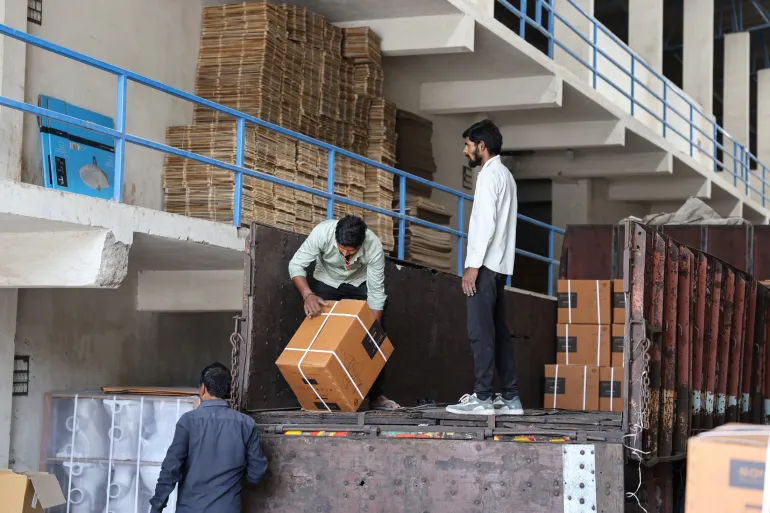
Workers inside a ceramics factory in Morbi [Jigyasa Mishra/Al Jazeera]
Five days after Kumar lost his job, the 29-year-old took his wife and their three children back to their home in Uttar Pradesh’s Hardoi district.
“I am here until every other migrant worker who came back home with us goes back,” he told Al Jazeera.
“We don’t want to suffer like dogs, like we did during the COVID-19 pandemic,” he added, referring to the 2020 and 2021 exodus of migrant workers from India’s more industrialised western states to the poorer east, with millions of starving families, including children, walking on foot for days and sometimes weeks to reach their homes amid a coronavirus lockdown.
About 450 of 600 companies shut
With more than 600 companies, Morbi produces about 80 percent of India’s ceramics in the form of tiles, toilets, bathtubs and wash basins. But at least 450 of those companies have been forced to shut down as a standoff on the Strait of Hormuz, a lifeline for India’s gas imports, continues.
Meanwhile, the war continues, with the US on Sunday capturing an Iranian cargo vessel, even as Washington says it is willing to hold another round of talks with Tehran in Pakistan to reach a deal. Tehran has refused to commit to peace talks after its ship was seized.
The developments came as a fragile ceasefire agreed by Iran and the US after a month of fighting expires on Wednesday. But a re-escalation in hostilities has seen Iran shutting down Hormuz for traffic, disrupting global fuel supplies and raising oil prices.
“All manufacturing units in Morbi rely on propane and natural gas to fire kilns at high temperatures. While propane is supplied by private companies, natural gas is provided by the state to those with connections. Around 60 percent of manufacturers use propane because it is comparatively cheaper,” Siddharth Bopaliya, a 27-year-old third-generation manufacturer and trader in Morbi, told Al Jazeera.
With more than 600 companies, Morbi produces about 80 percent of India’s ceramics [Jigyasa Mishra/Al Jazeera]
Manoj Arvadiya, president of the Morbi Ceramic Manufacturers Association, said they had shut down the units till April 15, hoping that the Middle East crisis would be resolved by then.
“But even today, only around 100 units have opened, and most have still not begun the manufacturing process. For at least another 15 days, it is likely to remain the same,” he told Al Jazeera.
Arvadiya said the closure has impacted 200,000 workers, with more than a quarter of them forced to go back to their homes in other states.
India’s ceramic industry is valued at $6bn.
“About 25 percent of Morbi’s ceramics are exported to countries in the Middle East, Africa and Europe, with a net worth of $1.5bn. But exports are now delayed and, in some cases, completely halted, especially to Middle Eastern countries, due to the production slowdown over the past month,” Arvadiya told Al Jazeera.
Factories that rely on propane remain shut in Morbi. Though natural gas is mostly available, many units have not made the switch yet, as new connections are being priced at 93 rupees a kilo, while existing users receive it at about 70 rupees.
Khushiram Sapariya, a manufacturer of washbasins who relies on propane, said he will wait this month before deciding on reopening his factory.
“Because then I have to call hundreds of staff who have gone to their homes, and I want to be sure before taking their responsibility,” he said.
Returned home with ‘Morbi disease’
Among the workers who left Morbi last month is 27-year-old Ankur Singh.
“The shutdown of my company did not send me back alone, but with a Morbi disease – silicosis. I would often have fever and cough but kept ignoring it, until I came back to my hometown near Patna in Bihar and found after a check-up that it was silicosis,” he told Al Jazeera.
Silicosis is an incurable lung disease caused by inhalation of silica dust found in rock, sand, quartz and other building materials. One of the oldest occupational diseases in the world, it kills thousands of people every year.
Gujarat-based labour rights activist Chirag Chavda says the disease is “widespread in Morbi because workers are routinely exposed to fine silica dust generated during ceramic production”.
“Even those not directly involved in moulding or kiln work often inhale the particles due to poor ventilation and prolonged exposure across factory spaces,” he told Al Jazeera.
Chavda said most ceramic companies do not follow the government regulations regarding the safety of workers.
Harish Zala, 40, had worked in different ceramic companies in Morbi for two decades before he got silicosis two years ago. He said he received no help from his employer, who allegedly abused and threatened his father when he visited the company after the diagnosis.
“Every year, at least one labourer dies of silicosis in each company, while several get detected for silicosis,” Zala told Al Jazeera. “Some like me get lucky and survive, but have no choice but to quit the job immediately.”
Harish Zala has silicosis and struggles to walk due to severe breathlessness [Jigyasa Mishra/Al Jazeera]
Zala said many companies do not provide the workers with written proof of employment, such as appointment letters, salary slips, or identity cards. “This is done so that if a worker later demands labour rights or legal entitlements, they have no concrete evidence to prove that they were employed by the company.”
Chirag added that such workers are also denied social security under various Indian laws regarding salaries or pension funds, since doing so would establish proof of employment.
“As a result, even after working for years, workers are deprived of their labour rights due to a lack of evidence. This leaves employers with little to no legal accountability,” he said.
In Morbi, there are also migrants like Sushma Devi, 56, who did not go back to her home in West Bengal because the tile company her son works at has promised to continue giving them shelter and food as it waits for manufacturing to resume.
“I am here with a few more people because we did not want to spend money on travelling. Here, at least our ration is sorted,” she said as she walked with a bundle of dry twigs, wood and discarded plywood for the cooking.
“We step out to collect these every day to be able to cook our two-time meal,” said Devi. “I hope the kilns and manufacturing resume soon, but I also hope they don’t stop giving us rice and potatoes even if the kilns don’t start running anytime soon.”
Devi’s husband, Debendar, and their son Ankit live in a one-room set given to them by their company. The family has access to a common toilet for 10 families on one floor.
Kumar, meanwhile, is running out of his meagre savings and fears he could fall into a debt trap.
“Initially, we ate from whatever we had saved. But the house needed repair and we had to borrow 20,000 rupees ($214) from a relative, which we have no idea when or how we will repay,” he said, looking at the reworked roof of his brick house in Hardoi.
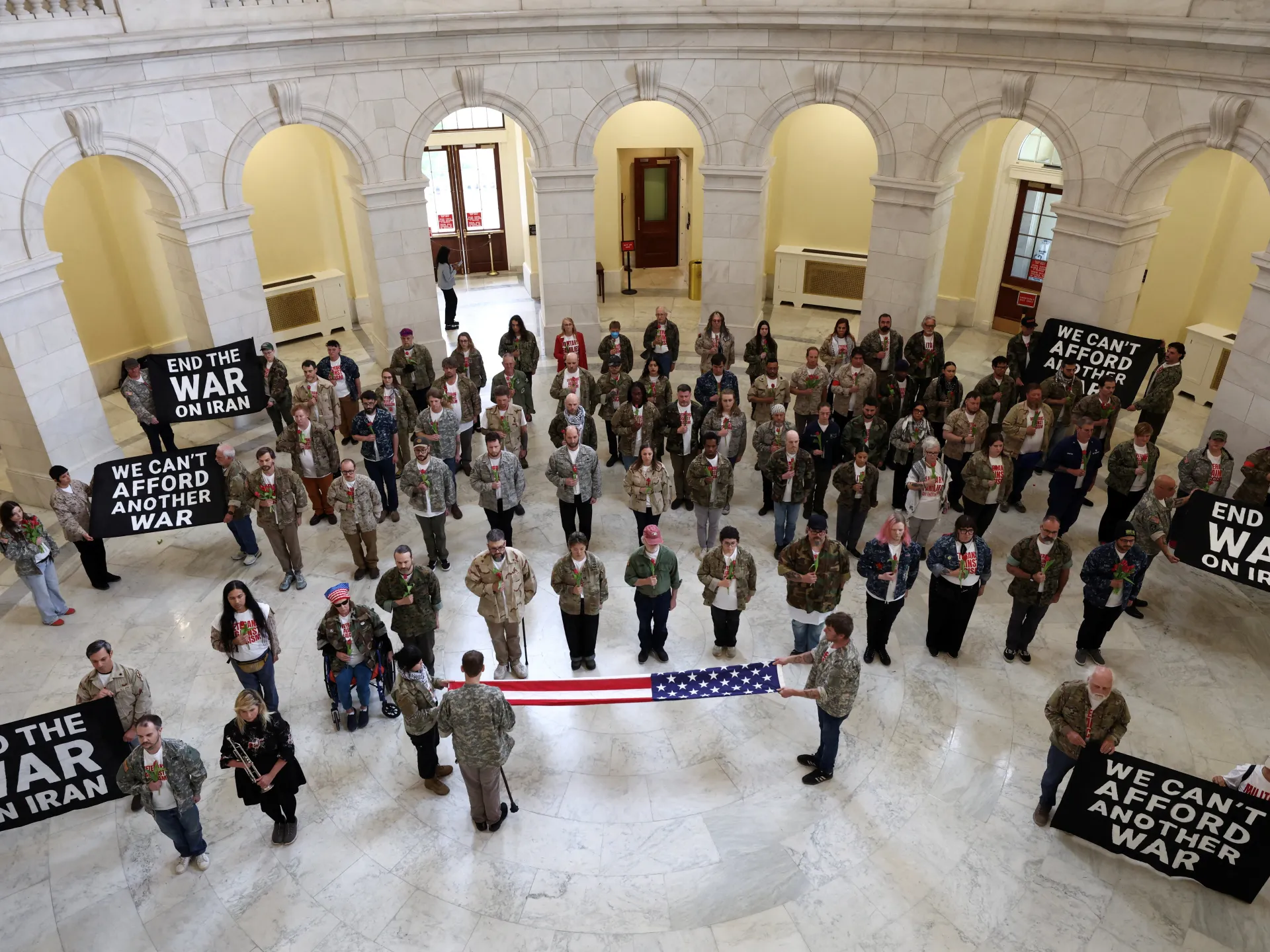
Dozens of US veterans and family members of military personnel have been arrested while staging a protest in the US Capitol building in opposition to the war on Iran.
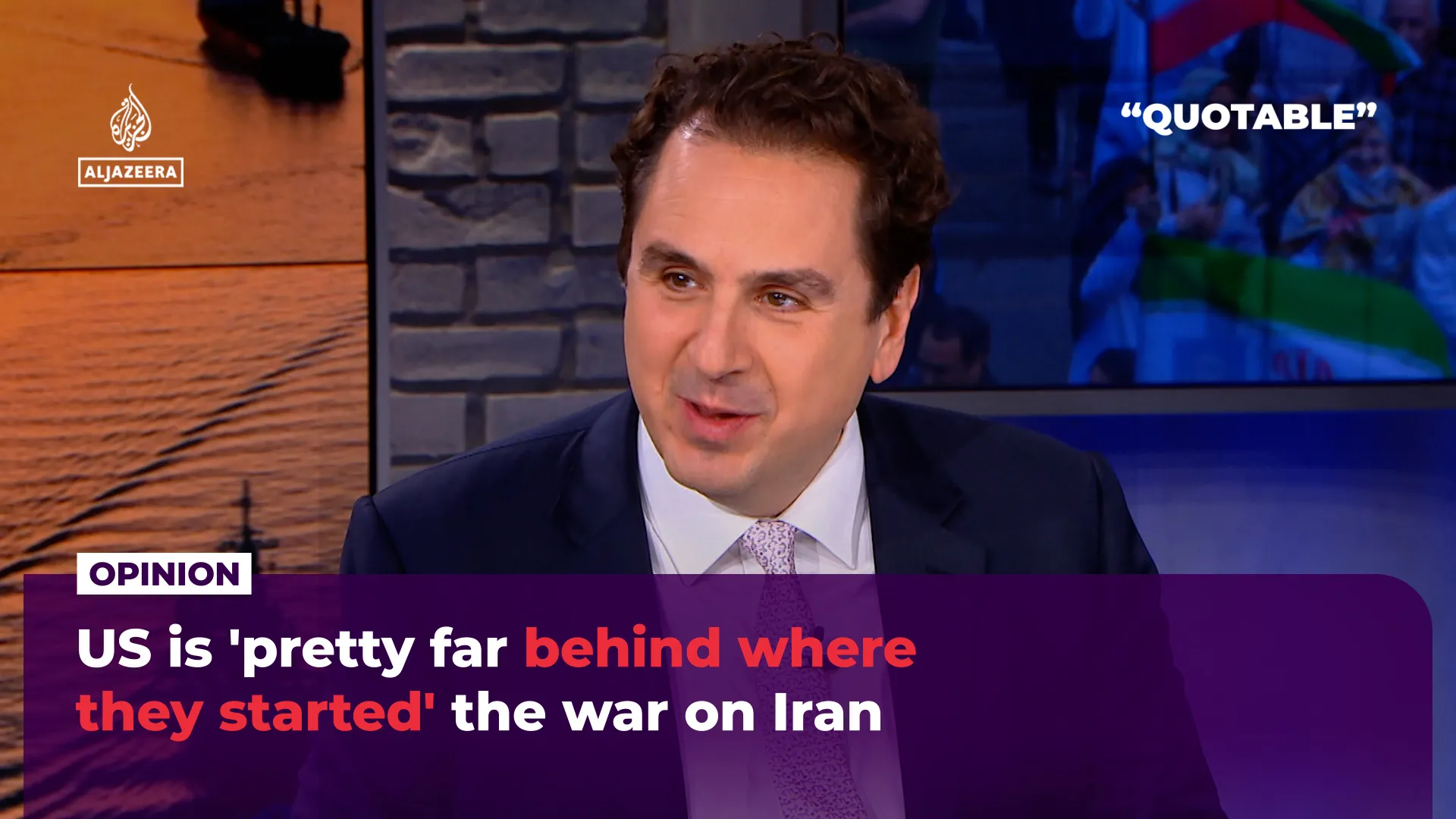
Daniel Benaim, the former US Deputy Assistant Secretary for Arabian Peninsula Affairs, says the US missed the early off-ramps to declare victory over Iran, and now finds itself behind where it began on all its objectives.
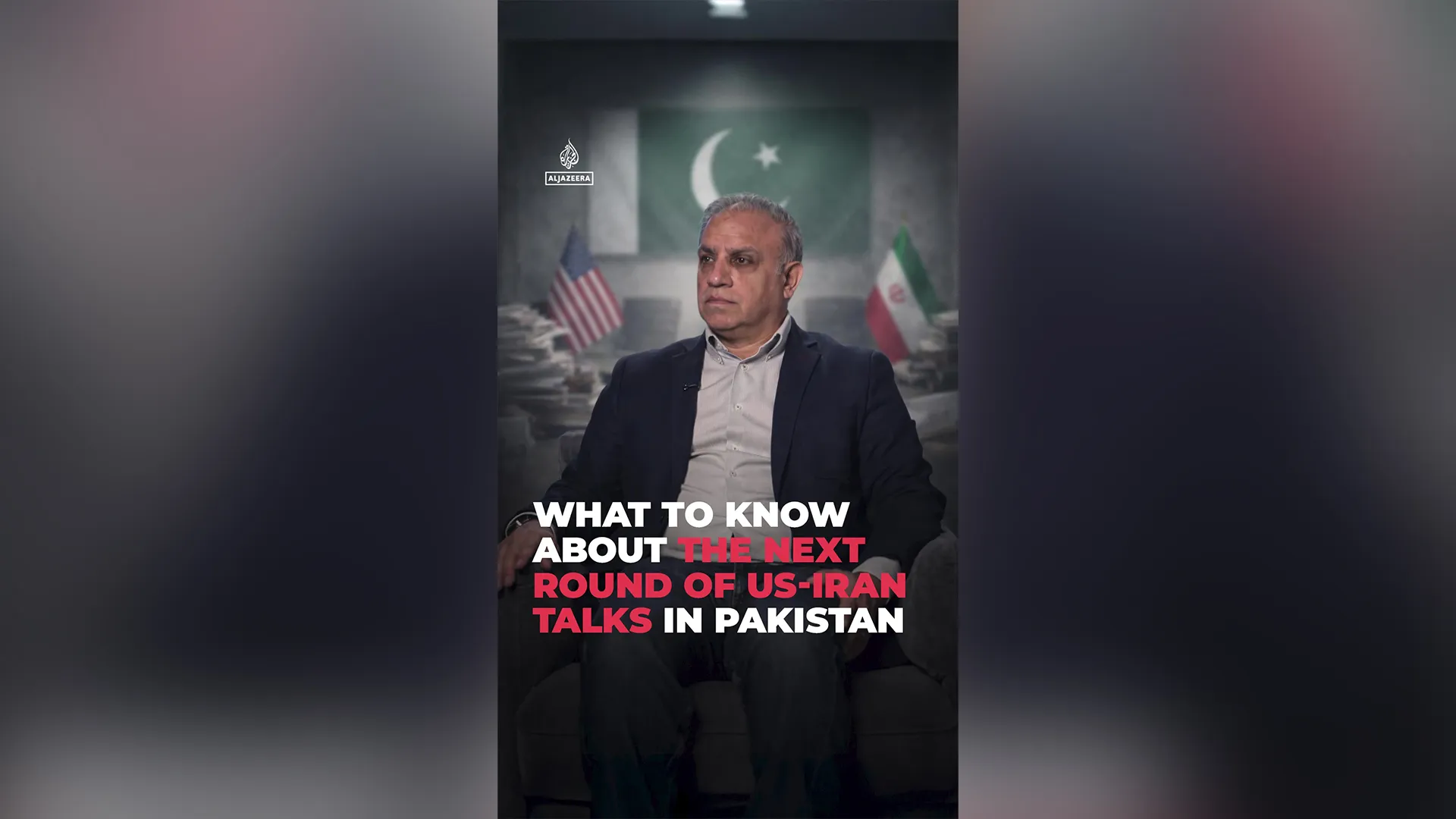
The US and Iran are supposed to have another round of direct talks in Pakistan on Tuesday, but will the Iranians skip it like they are threatening and what do all sides want? Al Jazeera asked political analyst Mahjoob Zweiri.
Tehran, Iran – Iranian authorities have been slowly expanding a list of individuals and entities deemed eligible to have limited internet access. However, the action serves only to illustrate that most of the population of more than 90 million people remains disconnected during the war with the United States and Israel.
The government imposed a near-total internet shutdown across Iran within hours of the first bombs falling in downtown Tehran on February 28. The move has seen internet connectivity reduced to about 2 percent of pre-war levels at most, according to monitors.
Recommended Stories
list of 3 itemsend of list
A limited intranet functions to keep some local services and apps alive, but people are highly frustrated, and the economy has suffered billions of dollars in lost revenue as a result of more than 1,200 hours of the digital blackout. One business, however, is thriving: the black market for internet connections.
This week, tens of thousands of people and organisations selected by the state based on their positions and professions signed up or received text message invitations to connect through a service called Internet Pro.
That is the name selected for a limited and metered internet connection through which thousands of sites and most global messaging services are blocked but some applications, app stores and Google services function.
The service is being sold in the form of 50-gigabyte data packages by three top state-linked telecommunications companies. State authorities can also issue limited internet protocols (IPs) for global connectivity to designated office spaces of approved companies and businesses.
Applicants need to provide full identification and professional or referral documents. Business owners and traders introduced to the Ministry of Information and Communications Technology and other authorities through their guilds and chambers of commerce were among the first to be connected this month.
Doctors, university professors, researchers and academics in various fields were nominated by the Ministry of Science this week. Freelancers were told to sign up through a webpage set up by the state-linked Iranian ICT Guild.
This is a separate service from that enjoyed by holders of “white SIM cards”, which offer less restricted connections and are reserved for officials, state-linked entities and individuals, journalists and some civilian supporters of the establishment perceived to be helping “get the message out” on behalf of the government.
A tiered system in action
For years, Iranian authorities have stressed that they are against a tiered internet system, which in effect renders connectivity a privilege, not a fundamental right in an age of rapid digital advancement.
But with such a system now in action and expanding, some state media are now framing it as a necessity despite harsh criticism regarding such an idea from the population over the years.
The state-linked ISNA news agency this week branded Internet Pro an “expert option providing a stable connection for professional activities”. The outlet encouraged potential applicants to contact the three telecommunications companies to see if they are eligible.
No such tiered system was implemented at a significant scale around the short-lived internet blackout imposed during the 12-day war with Israel in June or the 20-day near-total shutdown in January during deadly nationwide protests.
But the extended and unprecedented internet shutdown now in place sees eligible people and businesses giving in and electing to sign up.
Not all are convinced, however. Many are reported to have taken to state-run online platforms and news sites with demands for the full restoration of the internet.
On the local technology-focused site Zoomit, which can be reached through the intranet, thousands of people have recounted experiences of lost jobs and disrupted lives as a result of the shutdown.
“I’m a cybersecurity and network expert. Our servers and systems have not received security updates for about two months, and we’ve lost all our integration with open-sourced communities,” one user wrote. “This has significantly increased risks and stopped development, it’s unclear if my team will have its contract renewed this year in these economic conditions.”
Iranians circumventing the filternet through virtual private networks (VPNs) and other methods have also rejected the tiered system.
Aliasghar Honarmand, the editor in chief of an online privacy news website and an online medical news and research service, wrote on X that he has ignored multiple offers for Internet Pro over recent days.
“Access to the free internet is a fundamental and basic right for all people,” he wrote, adding that giving it to elites based on state classifications leads to normalising severe internet disruptions, creating an illusion of free connectivity, undermining social cohesion, violating personal privacy and propagating a black market.
Getting around the gatekeepers
Since the start of the war, Iranians going online from inside and outside the country have observed a battle between developers working on behalf of the state to deepen internet restrictions and those trying to skirt them.
This week, a circumvention method known as SNI (server name indication) Spoofing became popular after an unidentified user reported that he managed to establish a secure connection and published a guide.
The method tricked internet censors into thinking the users were visiting a permitted site or service when they were accessing blocked content. However, the authorities quickly moved to block gateways allowing the method to work, resulting in its demise within days.
Two experts who spoke with Al Jazeera said authorities are now deploying a heavily restrictive and centralised internet architecture through something called a national NAT (network address translation): a single country-scale gateway that all internet traffic must pass through.
This allows the authorities to reroute and bundle connectivity across Iran through a central operator with the aim of achieving higher levels of control and monitoring and an improved capacity to combat circumvention efforts.
But the method is hardware-intensive and costly, can lead to degraded or lagging connections and could potentially act as a single point of failure for saboteurs to exploit, the experts said.
One young resident of Tehran who has used Internet Pro issued for her university professor mother told Al Jazeera that most platforms considered essential by many people, such as Telegram, WhatsApp and Instagram, remain blocked on the service. ChatGPT was also blocked, but China’s DeepSeek was available on the service, she added.
“This is ridiculous and stupid because all groups of society, for whatever reason, need and deserve the internet. This move excludes most people who have no links to get them connected, including the elderly, and serves to keep the internet out for longer,” she said.
Donald Trump has denied being dragged into war with Iran by Israel, as the United States president faces increasing criticism over the conflict, including from segments of his own base.
“Israel never talked me into the war with Iran, the results of Oct. 7th, added to my lifelong opinion that IRAN CAN NEVER HAVE A NUCLEAR WEAPON, did,” Trump wrote in a social media post on Monday.
Recommended Stories
list of 3 itemsend of list
There is no public evidence linking Iran directly to Hamas’s October 7, 2023 attack against Israel. Trump’s own intelligence chief Tulsi Gabbard also testified to Congress in March that Iran is not building a nuclear weapon.
For eight months prior to the war, Trump had been saying repeatedly that the June 2025 US strikes on Iranian facilities “obliterated” the country’s nuclear programme.
Many of Trump’s critics have argued that Iran did not pose an imminent threat to the US, and that the war only advances the interests of Israel at the expense of the safety and prosperity of Americans.
Iran responded to the joint US-Israeli strikes – which killed the country’s Supreme Leader Ali Khamenei, other top officials and hundreds of civilians on February 28 – by blocking the Strait of Hormuz, sending oil prices soaring.
In the US, energy costs have skyrocketed, fuelling inflation. The price of one gallon (3.8 liters) of petrol has remained over $4 – up from less than $3 before the war, more than a week after the truce between Washington and Tehran came into effect.
A recent poll by NBC News suggested that two-thirds of Americans disapprove of Trump’s handling of the war.
With dissatisfaction growing, many of the president’s critics have pointed to Israel as the real power behind the war – portraying Trump as a weak leader following Israeli Prime Minister Benjamin Netanyahu.
“He entered a war – got pulled into it by Bibi Netanyahu, let’s be clear about that – entered a war that the American people do not want,” Kamala Harris, Trump’s 2024 Democratic opponent, said last week.
Harris served as vice president in the Joe Biden administration, which provided diplomatic and military support for Israel’s genocidal war on Gaza for more than two years.
During the 2024 campaign, Trump presented himself as the “peace” candidate, promising to end wars that were started under the Biden administration.
Trump’s National Security Strategy, released last year, also said that Washington would pivot its foreign policy and military resources from the Middle East to the Western Hemisphere.
But Netanyahu, who has visited Trump in the US six times in one year, has continued to push for a hardline against Iran. The most vocal supporters of the war in Washington have also been Israel’s closest allies.
On Monday, Trump renewed his attacks on the mainstream media for its coverage of the war with Iran.
“I watch and read the FAKE NEWS Pundits and Polls in total disbelief. 90% of what they say are lies and made-up stories, and the polls are rigged, much as the 2020 Presidential Election was rigged,” the US president wrote.
He also touted his policies in Venezuela, where the country has remained stable and become more friendly to Washington after US forces abducted President Nicolas Maduro in January.
In Iran, however, the US-Israeli strikes led to the closure of Hormuz and sustained Iranian attacks across the region for nearly six weeks.
The conflict is now paused, and further talks between US and Iranian officials could take place in Pakistan this week. But both sides have threatened to renew the fighting if a deal is not reached.
“Just like the results in Venezuela, which the media doesn’t like talking about, the results in Iran will be amazing – And if Iran’s new leaders (Regime Change!) are smart, Iran can have a great and prosperous future!” Trump wrote.
US forces have released video appearing to show the capture of an Iranian-flagged ship near the Strait of Hormuz, which President Donald Trump says was attempting to breach its naval blockade. Iran has condemned the operation as ‘maritime piracy,’ warned of retaliation, and cast doubt on new talks with the US. Here’s what we know.
Russia’s FSB accused the woman, found with a bomb in her backpack, of taking part in a plot hatched by Ukraine.
Published On 20 Apr 202620 Apr 2026
Russian authorities say they have thwarted a Ukraine-linked bomb plot against security services and arrested a German woman found with a makeshift bomb in her backpack.
Russia’s FSB security agency said the unnamed woman was detained on Monday in the southern city of Pyatigorsk.
Recommended Stories
list of 3 itemsend of list
In a statement cited by Russia’s state-run TASS news agency, the FSB said it had “prevented a terrorist attack planned by the Kyiv regime against a law enforcement facility in the Stavropol region, involving a German citizen born in 1969”.
It said the woman had been recruited by a citizen from a Central Asian country, who was working on orders from Ukraine. That man was found and arrested near the targeted site.
According to the FSB, the device contained an explosive charge equivalent to 1.5kg (3 pounds) of TNT and was intended to be detonated remotely. The agency said the blast was ultimately prevented by electronic jamming.
Video of the purported arrest published by Russia’s state RIA Novosti news agency showed armed Russian security agents approach the woman as she was face down in a car park.
Another video showed masked plainclothes agents pulling a man into a station, followed by a controlled explosion of the backpack.
Russia’s previous allegations
Russia has arrested dozens of people throughout the four-year war, mostly its own citizens, on allegations of working for Ukraine to carry out sabotage attacks.
Russia has previously accused Ukraine of working with Islamic fundamentalists to carry out attacks inside Russia, without providing evidence.
Officials initially alleged that the perpetrators of a 2024 massacre at a concert hall on the outskirts of Moscow that killed 150 people were ISIL (ISIS) members in coordination with Ukraine.
ISIL claimed responsibility for that attack, making no reference of any Ukrainian involvement, for which no evidence was presented by Moscow and which Kyiv denies.
Sparked by the Iran war and the effective closure of the Strait of Hormuz, oil is no longer flowing out of the Middle East as it did earlier this year, which is having a major impact on the aviation industry
A jet fuel shortage is looming in Europe(Image: Getty Images)
Holidaymakers face soaring flight prices and more expensive package breaks even if they’ve already booked because of the looming shortage of jet fuel.
Sparked by the Iran War and the effective closure of the Strait of Hormuz, oil is no longer flowing out of the Middle East as it did earlier this year. Supplies of jet fuel built up by European countries have been severely depleted.
In general, some European countries hold several months’ worth of jet fuel inventory at a time, according to an IEA report released last week. “Every passing day that the Strait of Hormuz remains shut, Europe is edging closer to supply shortages,” said Amaar Khan, head of European jet fuel pricing at Argus Media. “The Strait accounts for around 40% of Europe’s jet fuel imports, but no jet fuel has passed the Strait since the war broke out.”
There are four main ways that the jet fuel shortage could impact British holidaymakers: rising flight prices, extra fees, cancelled flights and package break surcharges. We’ve explained each one below.
Jet fuel — a refined kerosene-based oil product — is airlines’ biggest cost, making up about 30% of overall expenses, according to the International Air Transport Association. And jet fuel prices have roughly doubled since the war began. Shortages could start next.
Already, a number of airlines have started bumping up the cost of tickets.
Just last week, it emerged that Virgin Atlantic had increased some flight costs with an extra £50 fuel surcharge on economy-class tickets, while premium economy fares are climbing by £180 and business class by £360.
Air France and KLM fares are also going up. They are likely to cost an additional €50, bringing the fuel surcharge to €100 (£86.98) on top of the standard fare. Meanwhile, flights to the United States, Canada and Mexico could increase by €70 (£60.89), and an economy round trip could cost an extra €10 (£8.70).
If you’ve already got your flights booked, you don’t need to worry. You are not going to be asked retrospectively to pay extra on your air fare. Once you have paid, the airline will not come after you for any more cash – unless the government hikes aviation fees, which they don’t appear poised to do.
Extra fees
Many passengers will have booked their flights months in advance, before the US and Israel attacked Iran and fuel prices started rising. Because airlines can’t bump up fares that’re already booked but for which they’re now making less money, they have started looking for other ways to make a bit of extra cash.
American Airlines has said it would hike checked baggage fees by $10 (£7.40) each for the first and second checked bags and by $150 (£111) for the third checked bag on domestic and short-haul international flights. Southwest Airlines has said it will hike checked baggage fees by $10 for the first and second bags, raising costs to $45 (£33) for the first bag and $55 (£40) for the second.
As passengers often add extra luggage just before they fly, these rises could impact passengers who booked flights before the invasion.
No major European airlines have made similar changes.
Cancelled flights
Last week, International Energy Agency Director Fatih Birol said Europe has “maybe six weeks” of remaining jet fuel supplies and said the global economy faces its “largest energy crisis.”
Many major airlines have already cancelled flights because of the fuel price rises and falling demand, and more are likely to do so.
Swedish flag carrier SAS has said it would cancel 1,000 flights in April because of high oil and jet fuel prices, after cancelling a “couple hundred” flights in March. United Airlines said that five per cent of flights would be cancelled in the second and third quarters of 2026, while Dutch airline KLM has cancelled 160 flights for the coming month.
Other airlines, such as BA, have suspended whole routes to parts of the Middle East due to the conflict, while Virgin Atlantic announced earlier this month that it would be permanently scrapping its London flight to Riyadh from April.
Under UK law, if your flight is cancelled more than 14 days before it is due to depart, you are not entitled to compensation. However, your airline does have to offer you a full refund or help you find an alternative flight.
In the latter case, it’s up to you whether to fly as soon as possible after the cancelled flight, or at a later date that suits you. Although most airlines will book you onto another of their flights to the same destination, if an alternative airline is flying there significantly sooner or other suitable modes of transport are available, then you may have the right to be booked onto that alternative transport instead. You can discuss this with your airline.
Given that airfares may be significantly higher than when you booked, opting for an alternative flight rather than taking a refund may work out in your favour.
Extra package break costs
A largely overlooked clause in package holiday terms and conditions could result in the price of a package holiday increasing by hundreds of pounds – even after you’ve already made your booking and payment.
An article by Which? drew attention to the obscure clause found within Package Travel Regulations. It reveals that UK holiday companies can impose an additional charge of up to 8% on a package holiday price, without being required to provide a free cancellation option, under three specific circumstances.
These circumstances include: a destination introducing additional taxes or other charges, a significant shift in currency exchange rates, or a rise in the price of fuel or power. Given the ongoing Middle East conflict, fuel costs have been rising noticeably, which means there’s potential for package holiday operators to invoke this rule for Brits who’ve already booked their holidays should these expenses continue climbing.
Ukraine’s military intelligence says it struck two large landing ships in Sevastopol Bay in Russian-occupied Crimea.
Published On 20 Apr 202620 Apr 2026
Ukraine and Russia have attacked each other overnight, with Ukrainian drones striking Russian assets in Black Sea ports and Russia hitting several regions across Ukraine, including the capital Kyiv.
Ukraine’s GUR military intelligence unit claimed attacks on two Russian landing ships and a radar station in Sevastopol Bay in Russian-occupied Crimea. It says the $150m vessels were successfully hit and radar equipment destroyed.
Recommended Stories
list of 3 itemsend of list
In Russia, Ukrainian drones targeted the port of Tuapse, killing at least one person, injuring another and damaging transport infrastructure, according to regional governor Veniamin Kondratiev.
The strike was the second on the port in three days, hours after a fire from a previous attack was extinguished.
Russia’s Defence Ministry said air defences destroyed 112 Ukrainian drones overnight.
(Al Jazeera)
Ukraine reported a series of Russian attacks on Ukrainian territory overnight, including in Kyiv, Kharkiv, Kherson, Sumy and Zaporizhia regions.
Drones hit a car in the city of Putyvl in Ukraine’s border region of Sumy, injuring three women, as well as two homes in Kyiv’s Brovary district, damaging them and injuring one person, according to Ukrainian officials.
“Tonight, the enemy is again attacking the Kyiv region with drones. Under the sights are peaceful people, homes,” said Kyiv regional military administration head Mykola Kalashnyk.
Russian attacks also damaged railway infrastructure in the northeastern city of Kharkiv, according to the Interfax-Ukraine news agency.
Over the past 24 hours, Russian attacks in the Kherson region killed one person and injured seven, while injuring four others in the Zaporizhia region, Ukrainian officials said.
Moscow’s forces have hit civilian areas almost daily since the all-out invasion of its neighbour more than four years ago, with the regular assaults occasionally punctuated by massive attacks.
More than 15,000 Ukrainian civilians have died in the strikes, according to the United Nations.
There have been several rounds of United States-brokered negotiations in recent months, but they have failed to reach an agreement to stop the fighting, with the process further stalled since the outbreak of the US-Israel war on Iran.
Even before the war on Iran, progress towards a peace deal in Ukraine had been slow, due to differences over territorial issues.
Ukraine has proposed freezing the conflict along current front lines. Russia rejects that, saying it wants the whole of the Donetsk region, despite it being partly controlled by Ukraine – a demand Kyiv says is unacceptable.
New video from the US military is said to show an operation by its forces to seize an Iranian-flagged ship which attempted to bypass the US blockade of Iranian ports. The US says the cargo ship Touska was linked to a sanctioned company, while Iran condemned the move as ‘piracy’ and a violation of the ceasefire.
Islamabad, Pakistan – Pakistan is gearing up to host the second round of talks between the United States and Iran aimed at ending their war, but rising tensions in recent hours have cast uncertainty over Tehran’s participation, as the deadline nears for the end of the two-week ceasefire.
Unlike the first round of talks held in Islamabad on April 11, the upcoming negotiations could last for multiple days until a temporary deal – mediators are calling it a memorandum of understanding – is signed, effectively extending the ceasefire, sources close to these efforts have told Al Jazeera. If the MoU is agreed, it would give negotiators a longer window – even up to 60 days – to secure a longer peace deal.
Recommended Stories
list of 4 itemsend of list
But all of that hinges on the participation of Iran, which – as of Monday morning – has not confirmed that it will be sending its negotiators to Islamabad. That follows a rapid escalation in tensions over the past 24 hours.
US President Donald Trump announced on Sunday that his representatives were heading to Pakistan for a second round of negotiations with Iran, as a fragile ceasefire, due to expire on Wednesday, edges towards its deadline. But Trump accompanied his announcement with a revival of earlier pre-ceasefire threats to bomb Iran’s energy and power facilities.
“My Representatives are going to Islamabad, Pakistan. They will be there tomorrow evening, for Negotiations,” Trump wrote on Truth Social. He accused Iran of a “Total Violation of our Ceasefire Agreement” after Iranian gunboats fired on vessels in the Strait of Hormuz on Saturday, hitting ships including a French vessel and a British freighter.
“We’re offering a very fair and reasonable DEAL, and I hope they take it because, if they don’t, the United States is going to knock out every single Power Plant, and every single Bridge, in Iran,” Trump wrote. “NO MORE MR. NICE GUY!”
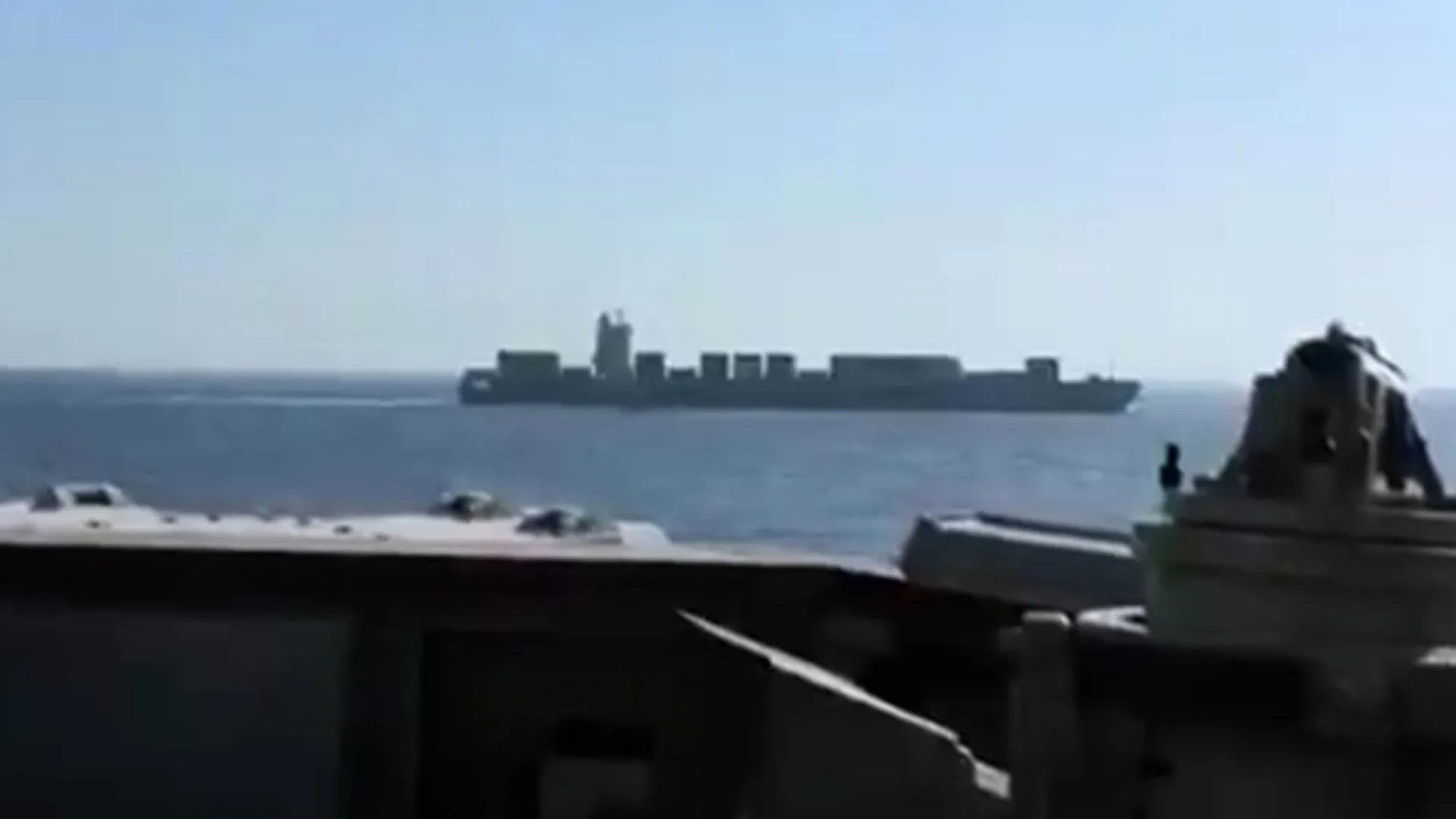
The tensions did not ease overnight. In the early hours of Monday, Trump announced on Truth Social that the US Navy guided missile destroyer USS Spruance had intercepted an Iranian-flagged cargo ship, the Touska, nearly 900 feet (274 metres) long, in the Gulf of Oman after its crew refused to heed warnings to stop.
“Our Navy ship stopped them right in their tracks by blowing a hole in the engine room,” Trump wrote. US Marines have now taken charge of the vessel, which Trump alleged was under US Treasury sanctions for prior illegal activity.
Iran has described the seizure of the ship as “piracy”.
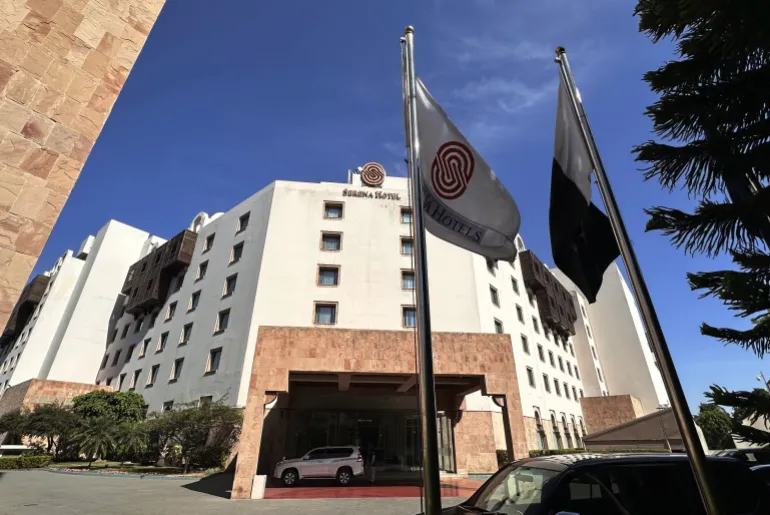
The Serena Hotel is scheduled to host the anticipated next round of talks between the US and Iran. [Sohail Shahzad/EPA]
Pakistan’s preparations
Amid those military and social media exchanges between Iran and the United States, Pakistan has been busy getting ready to host talks that it – as the principal mediator between Washington and Tehran – hopes will yield a deal to end the war, now into its eighth week.
Islamabad’s Marriott Hotel asked guests to vacate by Sunday afternoon. The Serena Hotel, just a few kilometres away and the venue for the first round of talks a week earlier, soon issued the same order and stopped taking reservations.
Roads into the Red Zone, the capital’s most heavily fortified area, were sealed. The district houses key government buildings, including the National Assembly, foreign embassies and both five-star hotels. Thousands of additional police and paramilitary personnel arrived from across the country.
Barbed wire and barricades lined the streets, and most access routes were shut.
But even before Trump’s latest threat to blow up Iranian energy and power facilities, and the subsequent hijacking of the Iranian ship, Tehran was unclear about whether it would join the talks.
Minutes before Trump’s Truth Social message, Iran’s ambassador to Pakistan, Reza Amiri Moghadam wrote on his social media that violations of international law, the continuation of the US naval blockade of the Strait of Hormuz, threats of further strikes, and what he described as unreasonable demands could not be reconciled with a genuine pursuit of peace.
“As long as the naval blockade remains, faultlines remain,” he added.
The negotiators: The US and Iranian teams
Trump first said on Sunday that Vice President JD Vance, who had led the US team in the first round of Islamabad talks, would not visit the Pakistani capital this time around, because of security concerns.
But White House Press Secretary Karoline Leavitt later said that Vance would join the US delegation, alongside special envoy Steve Witkoff and Trump’s son-in-law, Jared Kushner, the same team that led the first round.
Flight tracking data showed at least four US government aircraft carrying communications equipment and motorcade support landed on Sunday at PAF Base Nur Khan in Rawalpindi, the primary VIP entry point for Islamabad.
However, by late night, sources close to mediators told Al Jazeera that it was once again unclear whether Vance would travel to Islamabad on Monday. They said that the US might now send Witkoff and Kushner to Islamabad first, and if the talks actually happen, Vance might join them.
Amid Iranian hesitation over whether to join the Islamabad talks, Pakistani Prime Minister Shehbaz Sharif spoke with Iranian President Masoud Pezeshkian. The call lasted about 45 minutes, the Pakistan PM’s office said.
Sharif briefed Pezeshkian on his recent visits to Saudi Arabia, Qatar and Turkiye, where he met with their leaders, describing those engagements as helpful in “building consensus in support of a sustained process of dialogue and diplomacy”.
But by early Monday morning, Trump’s revived threats and the capture of the Iranian cargo ship have left the prospects of talks in Islamabad even more on edge than before.
Iran pushes back
Tehran pushed back sharply against Trump’s flurry of social media posts on Sunday.
Iran’s state news agency IRNA said reports of a second round of talks in Islamabad were “not correct”, and blamed the lack of progress on what it described as American “greed”, unreasonable demands, shifting positions and “continuous contradictions”.
According to IRNA, the naval blockade – imposed by Trump last Monday, two days after the first round of Islamabad talks – violated the ceasefire understanding and had “so far prevented progress in negotiations”.
It added that “no clear prospect for productive negotiations is foreseen” under current conditions and dismissed US statements on talks as “a media game”, aimed at pressuring Iran through a “blame game”.
A satellite image shows shipping movement in the Strait of Hormuz on April 17, 2026, in Space. [Handout/ European Union/Copernicus Sentinel via Reuters]
In a post on X, foreign ministry spokesman Esmaeil Baghaei went further, describing the US naval blockade as “unlawful and criminal” and saying it amounted to “war crime and crime against humanity”.
Despite the public denials, Iranian sources earlier on Sunday indicated a delegation was expected in Pakistan on Tuesday. It could include Parliamentary Speaker Mohammad Bagher Ghalibaf, who led Tehran’s team in the first round, and Foreign Minister Abbas Araghchi, who had joined him then.
Pakistan’s foreign ministry said Araghchi and his Pakistani counterpart Ishaq Dar spoke by phone on Sunday and discussed “the need for continued dialogue and engagement as essential to resolving the current issues as soon as possible”.
Analysts say the gap between Iran’s public stance and private signalling reflects a deliberate strategy.
“This gap reflects a dual-track negotiation strategy,” Seyed Mojtaba Jalalzadeh, an international relations analyst based in Tehran, told Al Jazeera. “At the public level, Iran maintains a hardline position to preserve domestic legitimacy and increase its leverage; at the non-public level, by dispatching a team to Islamabad, it signals that it has not abandoned diplomacy but is instead testing its conditions.”
Fahd Humayun, an assistant professor of political science at Tufts University, agreed.
“When warring parties come to the table to negotiate, they come with the understanding that there is occasionally a gap between public posturing and private positions,” he told Al Jazeera. “My sense is that they will pick up from where they left off, rather than getting too caught up in the rhetoric that has emerged since”.
That divergence extends to the pace of negotiations.
Washington has pushed for a rapid resolution, with Trump repeatedly declaring the war “close to over” even as fighting continues. Tehran, by contrast, has shown little inclination to be rushed.
A diplomat in Islamabad, who has followed the talks closely, described the contrast.
“The previous round of talks is a great example. It appeared as if the Americans brought a stop-watch, whereas the Iranians came armed with a calendar,” the diplomat said on condition of anonymity.
What is achievable?
Officials do not expect a final deal this week.
The immediate goal is likely to be a ceasefire extension, with both sides in Islamabad working towards a limited understanding.
Pakistani officials expressed cautious optimism, saying the process was moving in a positive direction while stressing that a final agreement would require sustained engagement and compromise.
Unlike the first round, talks could run for several days, with the aim of agreeing on a framework for broader negotiations in the coming weeks and months.
Pakistan’s Prime Minister Shehbaz Sharif with Iranian Parliament Speaker Mohammad Bagher Ghalibaf before anticipated peace talks in Islamabad, April 11, 2026. [Handout/Office of the Iranian Parliament Speaker via Reuters]
Humayun cautioned against viewing the first round as a failure.
“I wouldn’t characterise the first round as having failed, that assumes expectations of resolving the most difficult issues early on, which is unlikely in talks of this nature where the issues are so complex,” he said.
For this round, a ceasefire extension would be “a meaningful outcome in itself”, while both sides would likely be “probing for any shifts or flexibility in positions since they last spoke”.
It is that movement, he added, that would allow both sides to “politically sanction an extension of the ceasefire”.
“A ceasefire extension could represent the most minimal form of agreement achievable in this round,” Jalalzadeh said, adding that the deal Washington seeks is “far broader in scope and is rooted in a history stretching back 47 years”.
Iran’s Deputy Foreign Minister Saeed Khatibzadeh, speaking on the sidelines of the Antalya Diplomacy Forum in Turkiye over the weekend, said “significant progress” had been made in the previous round but stressed that a framework must be agreed upon before talks could advance.
He described US demands on Iran’s nuclear programme as “maximalist”.
Ghalibaf was more direct. “There are many gaps and some fundamental points remain,” he said in televised remarks on Saturday night. “We are still far from the final discussion”.
The core sticking points, Iran’s nuclear programme and control of the Strait of Hormuz, remain unresolved since the first round, held on April 11, which lasted 21 hours and ended without agreement.
A separate Israel-Lebanon ceasefire is now in place, removing one of Tehran’s stated conditions for talks.
But Jalalzadeh said the ceasefire fell well short of satisfying Iran’s demands. “The current Israel-Lebanon ceasefire is temporary, fragile, and incomplete,” he told Al Jazeera, noting that Hezbollah – Tehran’s most powerful regional ally – was absent from the agreement, which the Lebanese government negotiated with Israel.
“This ceasefire is a tactical palliative, not a substitute for Iran’s strategic demand,” he said, adding that Tehran’s insistence on Lebanon being part of any broader deal, rather than handled through a separate arrangement, remained unchanged.
Humayun said Iran would want the Israel-Lebanon truce to hold and ideally include “some form of assurance against violations”.
US Vice President JD Vance with Pakistan’s Prime Minister Shehbaz Sharif for talks about Iran in Islamabad, April 11, 2026. [Jacquelyn Martin/Pool via Reuters]
The broader question, he said, is “whether Iran can secure at least some degree of US pressure on Israel to adhere to the ceasefire and to refrain from further escalation”.
The Sharif-Pezeshkian call capped an intensive week of Pakistani diplomacy.
Field Marshal Asim Munir travelled to Tehran last Wednesday, carrying what officials described as a new message from Washington.
Iranian Ambassador Reza Amiri Moghadam said last week in Islamabad that Tehran would “do talks in Pakistan and nowhere else, because we trust Pakistan”.
Analysts say Pakistan’s value as a mediator lies in the rare credibility it holds with both sides.
Humayun said that even if this round produces no breakthrough, it would not necessarily erode trust in Islamabad.
“All parties understand how difficult these issues are and that, without Pakistan’s facilitation, they may not have reached this point at all,” he said.
Jalalzadeh offered a more cautious assessment, saying Pakistan’s role ultimately depends on results.
“If this round also fails, its standing as an effective mediator will be weakened, even if it continues to function as a minimal communication channel,” he said.
Still, he noted, Islamabad has already distinguished itself among countries that have attempted mediation, filling a gap left by others and establishing itself as a credible host.
Trump, however, insisted a deal would come regardless.
“It will happen. One way or another. The nice way or the hard way,” he told ABC News. “You can quote me.”
Islamabad talks in limbo as Tehran says it will retaliate after US marines capture an Iranian-flagged ship near the Strait of Hormuz.
Published On 20 Apr 202620 Apr 2026
Donald Trump announced on Sunday that a second round of US-Iran talks is to be held in Pakistan on Monday – but Tehran has not confirmed participation, two days before a ceasefire deal expires.
The capture by US Marines of an Iranian-flagged container ship near the Strait of Hormuz on Sunday has further clouded the Islamabad talks, as Tehran has pledged to retaliate.
Recommended Stories
list of 4 itemsend of list
The attack came hours after President Trump announced he is sending a team to Islamabad for talks, while once again threatening to knock out Iran’s power plants and bridges if there is no deal. The ceasefire, which ended more than a month of war, expires on Wednesday.
Pakistan’s Prime Minister, Shehbaz Sharif, spoke on Sunday with Iranian President, Masoud Pezeshkian, as he reaffirmed his government’s readiness to mediate the conflict.
Here is what we know:
In Iran
Iran’s top joint military command, Khatam al-Anbiya, accused the US of violating the ceasefire by shooting at an Iranian ship in the Gulf of Oman and vowed to retaliate.
President Trump posted on Truth Social on Sunday that US Marines captured a vessel that tried to get past the American blockade on Iranian ports, adding that US forces stopped the ship by blowing a hole in its engine room.
Iran executed two men convicted of cooperating with Israel’s Mossad intelligence service and planning attacks inside the country, the judiciary’s news outlet Mizan reported on Sunday.
French shipping company, CMA CGM, confirmed on Sunday that “warning shots” were fired at one of its ships in the Strait of Hormuz on Saturday.
Iran’s armed forces turned back two tankers attempting to transit the Strait of Hormuz on Sunday after issuing warnings. The semi-official Tasnim news agency said that was a result of the continuing US maritime blockade on Iran.
International flights from Mashhad airport in northeast Iran will resume on Monday, the civil aviation authority said.
War diplomacy
Iranian state media reported that Tehran had rejected new peace talks, citing the ongoing blockade, threatening rhetoric, and Washington’s shifting positions and “excessive demands.”
Iranian state media reported on Sunday that Tehran was not planning to take part in talks with the United States, hours after Trump said he was dispatching negotiators to Islamabad.
The US president posted on Truth Social on Sunday that representatives are going to Islamabad “tomorrow night” for Iran negotiations. “We’re offering a very fair and reasonable deal, and I hope they take it because, if they don’t, the United States is going to knock out every single power plant, and every single bridge, in Iran,” Trump wrote.
Pakistan’s Prime Minister Sharif said on Sunday that he spoke with Iran’s President Masoud Pezeshkian about the conflict in the Gulf. Sharif posted on X that he shared insights with Pezeshkian regarding his recent conversations with the leaders of Saudi Arabia, Qatar and Turkiye.
“I appreciated Iran’s engagement, including its high-level delegation to Islamabad for the historic talks, and recent discussions with Field Marshal Syed Asim Munir in Tehran,” Sharif said.
Turkiye’s Foreign Minister, Hakan Fidan, said on Sunday he was “optimistic” that a two-week ceasefire between Iran and the United States, which expires on Wednesday, would be extended, allowing more time for talks between the sides. Vice President JD Vance led the US delegation for the first round of talks in Islamabad. They ended without a deal [Jacquelyn Martin/Pool/AP Photo]
In the US
Trump said on Sunday that the guided-missile destroyer, USS Spruance, fired on and seized the Iranian-flagged cargo ship, Touska, in the Gulf of Oman, and US Marines were “seeing what’s on board!”
The US president said Iran has committed a “serious violation” of the ceasefire but still thinks he can get a peace deal, ABC News reporter Jonathan Karl posted on X on Sunday. Trump added that a peace deal “will happen. One way or another”.
In Israel
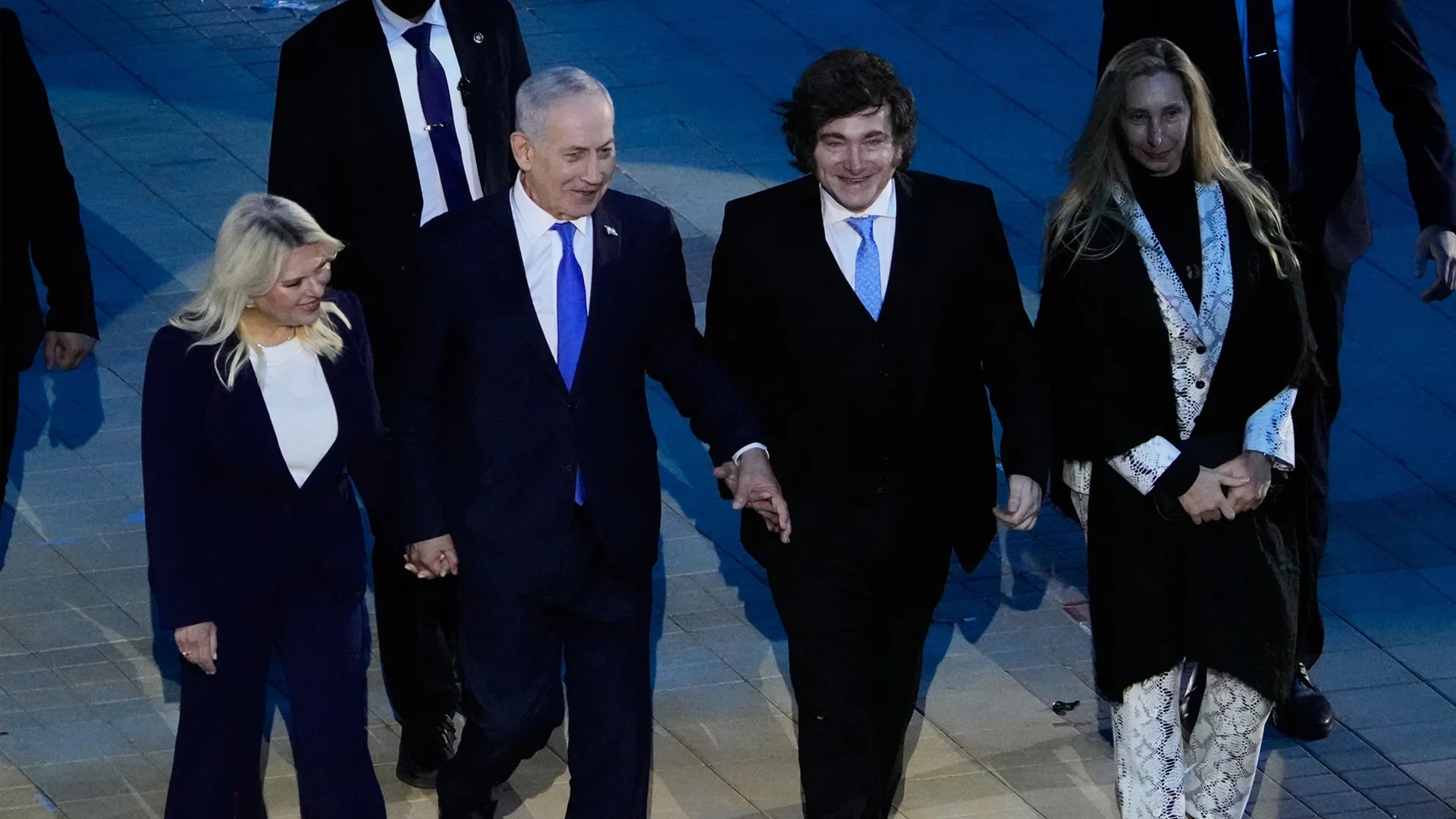
Argentine President Javier Milei, has reaffirmed his country’s support for the campaign against Iran, citing his government’s earlier decision to designate the Iranian Revolutionary Guards as a “terrorist organisation”.
Milei, who is visiting Israel for the third time since taking office, declared on Sunday that the joint US-Israel war against Iran was the “right thing to do”, as he signed on to the so-called Isaac Accords aimed at deepening bilateral ties between Israel and Latin American countries.
In Lebanon
The Israeli military on Monday warned residents in southern Lebanon not to move south of a specified line of villages or approach areas near the Litani River, saying its forces remain deployed in the area during a ceasefire due to what it described as continued Hezbollah activity.
The Israeli army also said it had determined that an image circulating on social media showing a soldier in south Lebanon hitting a statue of Jesus Christ is authentic and depicts one of its troops.
The viral photo of the Israeli soldier hitting the Jesus statue with a sledgehammer has sparked outrage.
French President Emmanuel Macron is due to meet Lebanese Prime Minister Nawaf Salam in Paris on Tuesday. The announcement follows the killing of a French peacekeeper in Lebanon during the fragile 10-day ceasefire between Israel and Iran-backed militant group Hezbollah.
Israel’s Defence Minister Israel Katz said the military will use “full force” in Lebanon – even during the ongoing ceasefire – should Israeli troops face any threat from Hezbollah.
Lebanon’s military said it has reopened a road and bridge between Nabatieh and Khardali, which were damaged by Israeli strikes in the south.
Oil prices rise
Oil prices surged on Monday following the re-escalation of hostilities in the Middle East war However, lingering hopes that a deal to end the seven-week crisis continued to support equities, despite Tehran saying it was not planning to attend peace talks.
Brent crude rises more than 7 percent as Washington and Tehran offer conflicting accounts on ceasefire negotiations.
Published On 20 Apr 202620 Apr 2026
Oil prices have risen sharply following attacks on commercial vessels in the Strait of Hormuz and conflicting messages about the prospect of renewed negotiations between the United States and Iran.
Brent crude futures, the primary benchmark for global prices, jumped more than 7 percent in Asia on Monday as the outlook for peace between Washington and Tehran darkened.
Recommended Stories
list of 4 itemsend of list
Prices eased somewhat later in the morning, with the benchmark at $94.69 a barrel as of 02:05 GMT, up from just under $90.40 on Friday.
The latest price surge came after US President Donald Trump said US forces seized an Iranian-flagged cargo vessel that had attempted to evade the US blockade of Iran’s ports.
Trump’s announcement followed reports by the United Kingdom Maritime Trade Operations (UKMTO) Centre over the weekend that two vessels came under attack while transiting the strait.
Iranian gunboats fired on a tanker, while an “unknown projectile” struck a container ship, according to the UKMTO.
After declaring the strait “completely open” on Friday, Tehran reversed course less than 24 hours later, citing the ongoing US blockade.
Earlier on Sunday, Trump said that a US delegation would travel to Pakistan on Monday to hold a second round of ceasefire talks with Iranian officials.
Iranian state news outlet IRNA later reported that Tehran would not participate in the talks, citing the US blockade and Washington’s “excessive demands” and “unrealistic expectations”.
A two-week ceasefire between Washington and Tehran is set to expire on Wednesday if the sides cannot agree on an extension.
An initial round of talks held in Islamabad earlier this month broke down without any agreement between the sides.
Iran’s effective closure of the strait, which usually carries about one-fifth of global oil and natural gas supplies, has driven a surge in fuel prices worldwide, forcing governments to tap emergency supplies and roll out energy-saving measures.
Nineteen vessels crossed the strait on Saturday, up from 10 the previous day, but far below the historical average of 138 daily transits, according to the UKMTO.
Asia’s main stock markets opened higher on Monday despite the dimming prospects of de-escalation.
Japan’s Nikkei 225 rose more than 1 percent in morning trading, while South Korea’s KOSPI gained about 1.3 percent.
Hong Kong’s Hang Seng Index rose about 0.5 percent, while the SSE Composite Index in Shanghai gained more than 0.4 percent.
US Central Command has published a video said to show a guided-missile destroyer firing at an Iranian-flagged cargo ship near the Strait of Hormuz. The USS Spruance fired several rounds into the Touska’s engine room for ‘violating the US blockade’, before marines boarded it.
Israel and the US have been at war with Iran since February 28th. The impact of the conflict has become global and all sides have suffered casualties, but it wasn’t always this way.
Al Jazeera’s Ruby Zaman explains how Iran and Israel once had a very different kind of relationship.
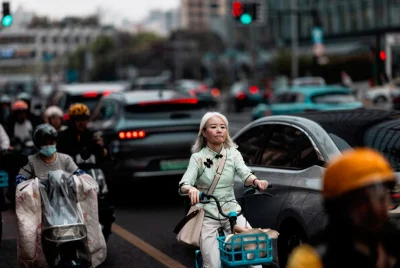
People ride on bicycles and scooters on a street, in Shanghai China, 10 April 2026. Photo by ALEX PLAVEVSKI / EPA
April 16 (Asia Today) — China’s economy grew 5.0% in the first quarter, exceeding expectations despite concerns over the impact of the Iran conflict, official data showed Thursday.
The National Bureau of Statistics said gross domestic product rose 5.0% from a year earlier, topping the 4.8% forecast by economists surveyed by Reuters and Bloomberg.
The stronger-than-expected growth was driven by manufacturing and exports. Industrial production rose 5.7% in March from a year earlier, while retail sales increased just 1.7%, highlighting weak consumer recovery.
High-tech industries showed particularly strong momentum. Output in the sector rose 12.5% in the first quarter, with industrial robot production up 33% and integrated circuit output increasing 24%. Manufacturing accounted for about one-third of overall economic growth.
The impact of the Iran conflict has so far been limited. Bloomberg reported that China’s efforts to bolster energy security, along with prolonged deflationary pressures, helped cushion the shock from rising oil prices. However, some effects were visible, including a 2.2% decline in refined oil production in March.
Domestic demand remains a key concern. Real per capita consumption rose just 2.6%, while wage growth slowed. The urban unemployment rate reached 5.4%, the highest level in a year.
Investment indicators were also weak. Fixed-asset investment increased 1.7% in the first three months of the year, while real estate investment fell 11.2%. Private investment declined for the first time outside the pandemic period.
Analysts said China’s economy continues to show an “imbalanced structure,” with growth driven by exports and manufacturing while domestic demand lags. Falling sales of automobiles, home appliances and furniture further point to soft consumption.
Policy responses are expected to remain measured. With growth exceeding expectations, pressure for large-scale stimulus has eased, and the government has set a relatively modest annual growth target of 4.5% to 5%.
Still, targeted fiscal support and cost-cutting measures are likely to continue to address rising energy prices and external uncertainties. Some economists also see room for monetary easing, including a possible reduction in banks’ reserve requirement ratio.