war

Air War Against Iran Enters Week Two (Updated)

Over the last seven days, we have watched a joint air campaign unlike what we have ever seen before. New capabilities and evolved threats have made headlines as the world watched much of the Middle East become a free-fire zone. At the same time, many questions surrounding how long the war will take and its true scope and goals grow louder. These calls for clarity are becoming more pronounced globally, as well, as the Strait of Hormuz is experiencing a heart attack of sorts, with energy shipments stopped on the strategic waterway’s northern edge.

While missile and drone launches have decreased significantly, these weapons continue to score major hits. Beyond U.S. military-related sites in Gulf Arab states, Iran continues to pummel energy production infrastructure. There are real concerns about the ability to defend against these attacks over the long term as interceptor stocks dwindle.

The London insurance market is willing and able to cover vessels looking to transit the Strait of Hormuz, according to Gallagher https://t.co/rUogubsv6g

— Bloomberg (@business) March 5, 2026

All this is occurring while Iran is experiencing a power vacuum the likes of which it has never experienced. As the U.S. and Israel ramp up strikes across the country during the transition from standoff to direct attacks, what will come of Iran’s fractured government remains a total unknown. Fears are growing that the default control of Iran could fall to its most well-armed and fanatical arm, the Islamic Revolutionary Guard Corps (IRGC), a top possibility we laid out in our feature published before the strikes commenced.

So much has happened in one week, and we were right there providing rolling coverage and breakouts nearly around the clock. Now, once again, we look at the present. Here’s what’s going on as we flow through day eight of the war.

LATEST UPDATES

We have concluded our rolling coverage in this piece.

UPDATE: 4:29 PM EST-

Check out our feature on the major alarm bells that should be ringing after Iran successfully targeted multiple missile defense radars in the region.

Iranian Attacks On Critical Missile Defense Radars Are A Wake-Up Call

Iran’s successful targeting of prized missile defense radars in the Middle East highlights global vulnerabilities.

Feature:https://t.co/CkleCjkKBB

— The War Zone (@thewarzonewire) March 7, 2026

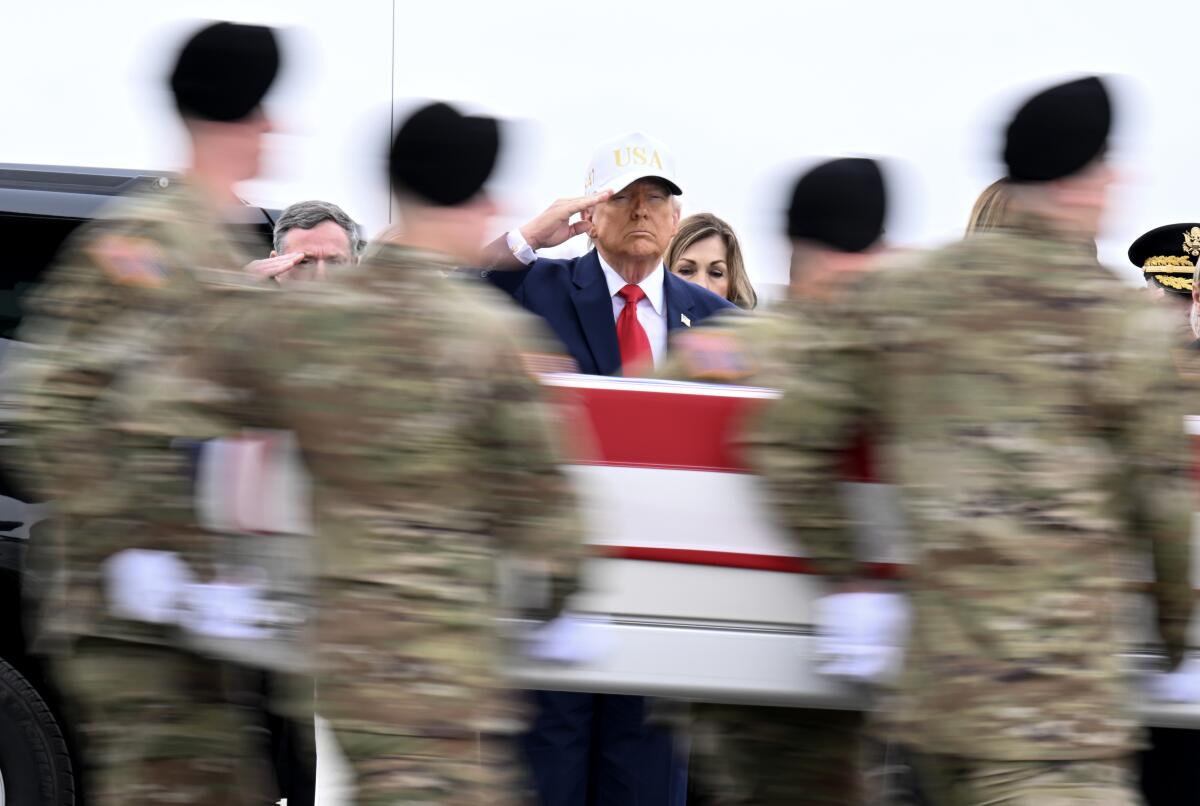
More video has emerged from the dignified transfer of the remains of six soldiers killed in Kuwait on March 1.

U.S. President Donald J. Trump and First Lady Melania Trump attended the dignified transfer at Dover Air Force Base of the 6 U.S. Army soldiers killed during an Iranian strike on their operations center.
🇺🇸Capt. Cody Khork
🇺🇸Sgt. 1st Class Noah Tietjens 
🇺🇸Sgt. 1st Class Nicole… pic.twitter.com/akSQntnUnM

— OSINTdefender (@sentdefender) March 7, 2026

Ali Larijani, Iran’s de facto wartime leader in the wake of the death of Supreme Leader Ali Khamenei, issued a direct threat against Trump via X.

We will relentlessly avenge the blood of our of our Leader and our people. Trump must pay and will pay. #Trumpmustpay

— Ali Larijani | علی لاریجانی (@alilarijani_ir) March 7, 2026

Meanwhile, in Iraq, pro-Iranian members of parliament are shouting the long-familiar phrases “America is the Great Satan” and “Death to America.”

Members of parliament from the pro-Iranian factions in the Iraqi parliament are shouting “America is the Great Satan” and “Death to America” https://t.co/78WrtfLsvK

— Guy Elster גיא אלסטר (@guyelster) March 7, 2026

Hezbollah, the Lebanon-based Iranian proxy group, is launching volleys of rockets at Israel.

UPDATE: 2:35 PM EST –

Trump arrived in Dover for the dignified transfer of six soldiers killed by an Iranian drone attack in Kuwait on March 1.

Today, we honor six American heroes who made the ultimate sacrifice in service to our nation.

Capt. Cody Khork
Sgt. 1st Class Noah Tietjens
Sgt. 1st Class Nicole Amor
Sgt. Declan Coady
Maj. Jeffrey O’Brien
Chief Warrant Officer 3 Robert Marzan

May God hold them in His eternal… pic.twitter.com/pNMHg7MdPz

— Rapid Response 47 (@RapidResponse47) March 7, 2026

Turkish Foreign Minister Hakan Fidan said Saturday that U.S. Secretary of State Marco Rubio told him Washington has no intention of arming Kurdish groups in Iran, a direct response to reports that have rattled Ankara as the U.S.-Israeli military campaign against Tehran enters its second week.

Given the ambiguity of the situation, the Kurds say they are not rushing into Iran.

“Certainly, we are staying neutral as Iraqi Kurds b/c there’s no clarity for us on US policy,” a KRG official said. “Our assessment is there can’t be regime change w/o boots on the ground and that the US is not sending [them].” @BarakRavid, @MarcACaputohttps://t.co/kKj6GWOCHs

— Shalom Lipner (@ShalomLipner) March 7, 2026

To counter Iranian drone and missile fire, a U.S. Counter Rocket, Artillery and Mortar (C-RAM) system was activated near the American embassy in Baghdad.

A Counter Rocket, Artillery, and Mortar (C-RAM) system was activated a short time ago in the area of the American embassy in Baghdad, Iraq, due to reported drone and missile fire. pic.twitter.com/f2VOtE1ZbU

— Joe Truzman (@JoeTruzman) March 7, 2026

U.S. IndoPacific Command took to X to dispute some claims about the recent sinking of the Iranian frigate IRIS Dena by a USN fast attack submarine.

🚫 Iran claims IRIS Dena was unarmed – FALSE
✅ Law of Armed Conflict authorized the use of force to target and destroy valid military targets – TRUE
✅ U.S. forces planned for and Sri Lanka provided life-saving support to survivors in accordance with the Law of Armed Conflict -… pic.twitter.com/DdY5RNFUYf

— U.S. Indo-Pacific Command (@INDOPACOM) March 7, 2026

The IDF said it is continuing to strike Iranian ballistic missile production sites.

🎯 STRUCK: 2 main ballistic missile production sites in Parchin and Shahrud.

Over the past week, hundreds of IAF fighter jets struck the Iranian regime’s production industries, which are used for the development and production of missiles and weapons.

Among the targets struck:… pic.twitter.com/sF3rRCvWqb

— Israel Defense Forces (@IDF) March 7, 2026

The IDF launched strikes Saturday evening on Iran’s national oil facilities in Tehran for the first time since the start of the war, targeting dozens of fuel storage tanks, YNET News reported, citing Israeli officials.

“The attack was carried out under directives from the political leadership and with IDF support, marking a significant escalation in Israel’s campaign against Iranian regime infrastructure,” the outlet explained.

An Israeli security official says recent strikes targeted fuel tanks used by Iran’s regime, adding pressure on the government is increasing and it may soon struggle to provide citizens with basic necessities. “We have not said the last word,” the official said. – N12 https://t.co/5yX69pUMl2

— Faytuks Network (@FaytuksNetwork) March 7, 2026

The Israel Defense Forces says it’s demolished a majority of Iran’s ballistic-missile launchers, causing the number of missiles targeting Israel and other countries in the region to fall throughout the week, Bloomberg News reported.

More than 60% of such launchers have been “neutralized and destroyed,” Eyal Zamir, chief of the general staff of the IDF, said in a televised statement on Thursday. Zamir did not say how many had been struck, but the IDF had cited the number as 300 earlier that day.

Israeli assessments say Iran now has about 100 operational missile launchers remaining out of roughly 420 before the war.

Around 150 launchers were destroyed, while another 150 were struck and buried in underground sites, leaving them currently unusable. pic.twitter.com/LnYpNdGIm0

— Open Source Intel (@Osint613) March 7, 2026

UPDATE: 1:45 PM EST—

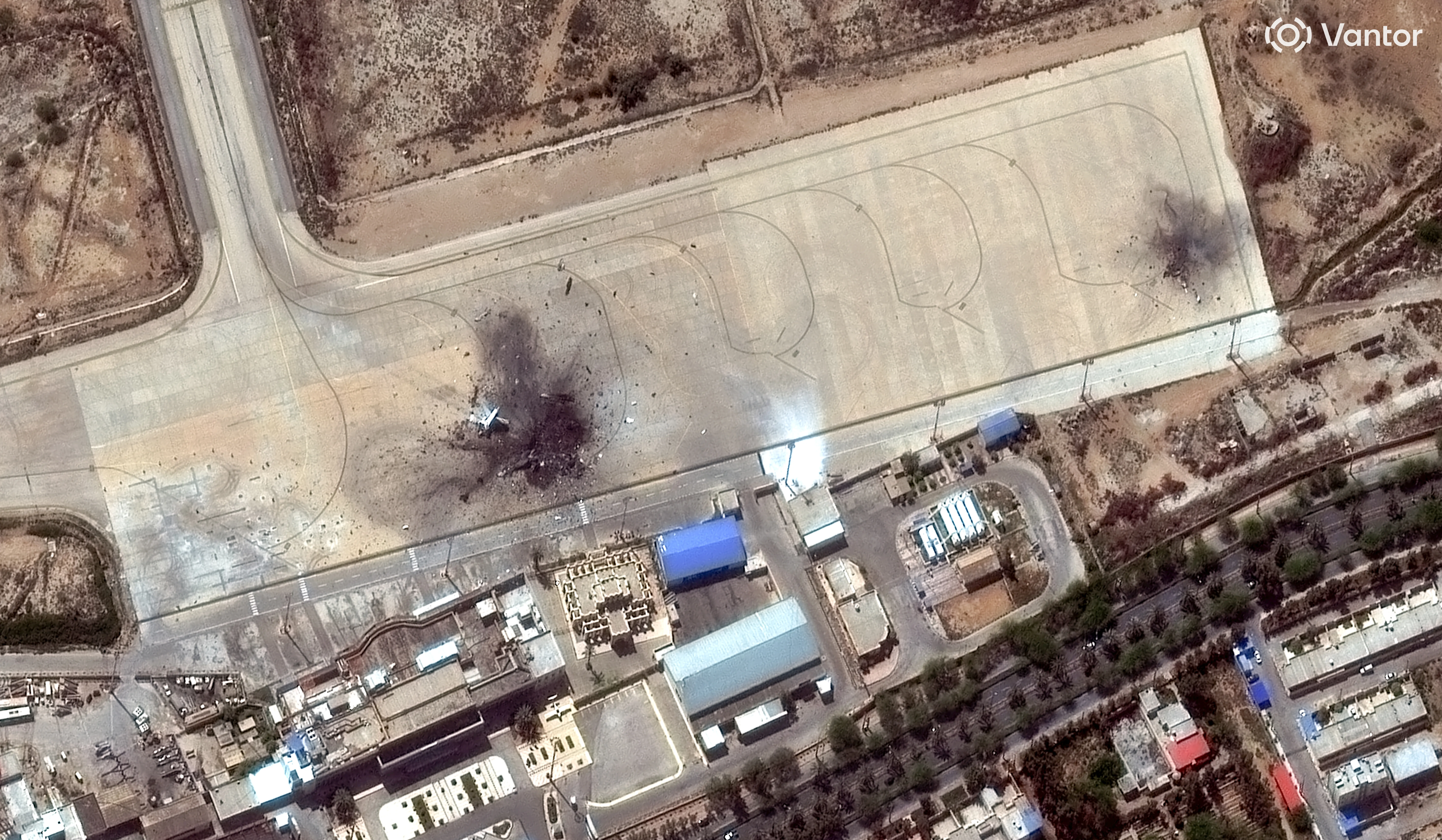
We are getting new satellite images of bomb damage in Iran from Vantor. The images show the airport and port in the city of Bushehr, which sits along the northeastern shore of the Persian Gulf. We also get a shot of the tunnel entrances at the underground facility in Natanz and what looks like a vehicle destroyed nearby, possibly a short-range air defense system.

The entrance to the naval base doesn’t look to inviting anymore:

We are also getting a satellite view of the destruction at Tehran International from the IAF’s strikes there last night:

Satellite imagery shows that at least 17 aircraft, most of which appear to be passenger planes, were destroyed in last night’s US and Israeli attacks on Mehrabad International Airport.

Credit: @planet pic.twitter.com/ov1OBa1Ks3

— Farzad Seifikaran (@FSeifikaran) March 7, 2026

Another drone strike on a highrise tower in Dubai:

UPDATE: 1:20 PM EST—

Israel is now clarifying its attack on Iran’s international airport, stating they targeted aircraft used by the IRGC for weapons transfers to proxies. These aircraft are well known and include some of the country’s last airworthy 747s.

STRUCK: 16 IRGC Quds Force aircraft used to transfer weapons to Hezbollah.

The IAF conducted a wave of precise strikes in Tehran, targeting military infrastructure at Mehrabad Airport, a central hub used by the IRGC to arm and fund its terror proxies across the Middle East.… pic.twitter.com/ZbZJMvikI6

— Israeli Air Force (@IAFsite) March 7, 2026

Looks like a lot of aircraft destroyed:

Aftermath of the Israeli air raid that hit Tehran’s Mehrabad International Airport last night, reportedly destroying 16 aircraft.

Burnt out wrecks and plane parts can be seen scattered around. pic.twitter.com/l2yQGjXQez

— OSINTtechnical (@Osinttechnical) March 7, 2026

South Korea is rushing deliveries of SAMs to the UAE as the interceptor crunch deepens:

South Korea announced that it will send around 30 ballistic missile interceptors to the UAE via C-17 right tomorrow. It would appear that they brought ROKAF’s reserves. Among the 10 batteries under contract, currently, two M-SAM-II batteries are operating in the UAE. The… pic.twitter.com/WIA3bQE0oo

— Mason ヨンハク (@mason_8718) March 7, 2026

The scarcity of interceptors continues to raise alarms amongst allies around the globe:

Bloomberg: “Several European Union states warned at a closed-door meeting in Brussels this week that there is a shortage of interceptors across the world, according to people familiar with the matter.”https://t.co/UNB27op4nb

— Vivian Nereim (@viviannereim) March 7, 2026

Another round of B-2 strikes appears to be on the way. It will be interesting to see if they recover in Diego Garcia this time instead of the United States:

Emirati fighters are seen prowling over the Gulf Of Oman in search of Iranian drones to kill.

Emirati Vipers and Mirages on counter-UAS patrols in vicinity of Fujairah Port and the surrounding oil infrastructure. These are also flown much farther out for forward intercepts. pic.twitter.com/6DQuvimTTO

— Abd (@blocksixtynine) March 7, 2026

More indications that the Kurds are going to go into Iran, but just how shallow those movements would be isn’t clear.

BREAKING: The Secretary-General of Khabat, a Kurdish organization based in Iraq, tells Al Jazeera that Kurdish fighters in Iraq will “likely” stage a ground operation in Iran, confirming communication with the US

— Faytuks Network (@FaytuksNetwork) March 7, 2026

The Iranian drone attack on Dubai’s international airport may have been targeting the air traffic control tower. It is possible that this radar is tied into the military’s air defense architecture, but even if it is not, it would be another blow to the economy of the country as it would impact air travel.

An unconfirmed report states that the US warned the Iranian warship Dena to abandon ship multiple times before the Los Angeles class fast attack submarine sunk it via torpedo. This is supposedly coming from one of the sailors aboard that survived.

An Iranian sailor who was killed when the warship Dena was struck by the US near Sri Lanka had called his father shortly beforehand, saying American forces had issued two warnings for the crew to abandon the vessel, a source close to the family told Iran International.

The… pic.twitter.com/ujm2NJej76

— Iran International English (@IranIntl_En) March 7, 2026

UPDATE 12:25 PM EST—

Iran is going after the heart of Saudi oil production.

Saudi Arabia says it intercepted and destroyed 16 drones heading toward the Shaybah oil field, one of the kingdom’s largest energy sites producing about 1 million barrels per day. The defense ministry did not say where the drones came from.https://t.co/MuYLumDuPY

— Clash Report (@clashreport) March 7, 2026

There are additional indications that America’s involvement in this conflict will be longer than some anticipated:

A joint letter from the Commanding General and Command Chief of the Air National Guard have published a letter to their subordinates indicating that their continued support will be necessary in the weeks ahead.

This is following reports yesterday that CENTCOM is requesting the… pic.twitter.com/bPJyMvvn0P

— TheIntelFrog (@TheIntelFrog) March 6, 2026

NBC News reports that Trump has a high interest in deploying ground troops for the war effort.

It appears that U.S. Army AH-64 Apache attack helicopters are active in countering Iranian-aligned militias in Iraq.

Reported footage of a US Army AH-64 Apache attack helicopter targeting Iranian-backed milita positions outside of Mosul, Iraq tonight.

Seen here firing Hydra 70mm rockets. pic.twitter.com/HsZgPtJYuw

— OSINTtechnical (@Osinttechnical) March 6, 2026

IAF states it has intercepted over 110 long-range drones launched from Iran since the war began.

מטוס קרב של חיל-האוויר יירט כלי טיס בלתי מאויש מאיראן לפני שחצה לשטח מדינת ישראל

מתחילת המבצע יורטו יותר מ-110 כלי טיס בלתי מאוישים ששוגרו מאיראן

חיל-האוויר ממשיך להסיר איומים על אזרחי מדינת ישראל במקביל להעמקת הפגיעה בכלל מערכיו של משטר הטרור האיראני.

צפו בתיעוד: pic.twitter.com/fxkhN8H53K

— Israeli Air Force (@IAFsite) March 7, 2026

The Israel Defense Forces have posted a video from one of its aerial assets running down what it says are missile launch operators and bombing them:

‼️هر فردی که در سامانه پرتاب موشک‌ها فعالیت می‌کند باید بداند: شما تحت تهدید هستید.

ما به هر عامل پرتاب موشک بالستیک که تهدیدی علیه شهروندان اسرائیل باشد خواهیم رسید -در میدان، در پایگاه‌ها، در مراکز فرماندهی و حتی در خانه.

هر فردی که میخواهد زنده بماند باید فوراً سلاح خود را… pic.twitter.com/sjMDUD2eSS

— ارتش دفاعی اسرائیل | IDF Farsi (@IDFFarsi) March 7, 2026

Israel also says the chief of the Israeli Air Force (IAF) just flew a combat mission over Iran.

There are reports of additional US wounded from Epic Fury, but CENTCOM tells us that the tally still stands at six troops killed and 10 seriously wounded. This could be due to a delay in information or just erroneous reports, and we will keep you posted.

What appears to be a HIMARS launcher firing a rocket (likely PrSM ballistic missile, the first of which was used operationally in this war) from the beach in Bahrain. It hasn’t been clear where the United States is firing these weapons from, but it would appear that, assuming this video is authentic, Bahrain is one of those locales. It is just 125 miles from Bahrain to Iran, so PrSM would be able to reach nearly two hundred miles into Iran from this distance.

Footage confirms a U.S. M142 High Mobility Artillery Rocket System (HIMARS) launching a Precision Strike Missile (PrSM) toward Iran from Bahrain. pic.twitter.com/aQBubFQEYS

— Egypt’s Intel Observer (@EGYOSINT) March 7, 2026

Israel says it destroyed Iran’s central hub of its air defense efforts:

⭕️The IDF dismantled the air defense situation room of the IRGC Air Force, responsible for the aerial situational assessment and to defend Iran’s airspace.

Additionally, the Israeli Air Force struck air defense systems, a site used to manufacture & launch ballistic missiles,… pic.twitter.com/DYNKhz03e3

— Israel Defense Forces (@IDF) March 7, 2026

B-1B bombers are now operating out of RAF Fairford in the United Kingdom. This comes after the U.K. government denied US access to Fairford and Diego Garcia. We should expect bombers in Diego Garcia soon. These will likely include B-2 and possibly B-52s. Forward deploying the bombers will drastically increase sortie rates and put less stress on aerial refueling assets.

USAF B-1B Lancer heavy bomber landing in Britain, following a mission that saw it take off from the U.S. and strike Iran. pic.twitter.com/idujAR9eeY

— OSINTtechnical (@Osinttechnical) March 7, 2026

A fairly unique bomber mission #FreeIran
— Operation EPIC FURY —

Yesterday, a total of 4x B-1B “Lancer” bombers departed the USA heading towards Europe. 1 airframe, which used the callsign “PIKE72” (86-0120 #AE6BFA) went to RAF Fairford, while the other 3 aircraft… pic.twitter.com/XMFgf2mwFv

— DefenceGeek 🇬🇧 (@DefenceGeek) March 7, 2026

While Iranian launches have decreased, they certainly are far from stopping. Just overnight alone, Iran launched nearly 140 weapons at the UAE alone.

Iran fired 16 ballistic missiles and 121 drones at UAE overnight. Fifteen of the missiles were shot down, one fell into the sea. All drones intercepted except two: MoD

One drone slipped through and hit Dubai’s international airport.

— Lucas Tomlinson (@LucasFoxNews) March 7, 2026

Multiple MQ-9s have been lost over Iran in the conflict so far, but they have been extremely effective in taking out all types of Iranian targets, from missile launchers to drones to fighter aircraft to vessels. As we noted in our previous update, they are also far more expendable and less risky to deploy deep in Iran than crewed alternatives. But as we have explored in depth, air supremacy over Iran has not been achieved and won’t for some time.

Another US MQ-9 Reaper UCAV was shot down by IRGC Aerospace Force air defense over Hormozgan province. Some sources write that this is an Israeli Hermes-900, but this is clearly US MQ-9 with Hellfire missiles pic.twitter.com/7nvOEEoGUz

— Yuri Lyamin (@imp_navigator) March 7, 2026

Iran’s new leadership has stated that the country will stop attacking its neighbors if they do not participate in attacks on Iran. Iranian officials have also made clear that they see the basic act of hosting U.S. bases as contributing to the current campaign. The drones and missiles have continued to be launched at Arab Gulf states, regardless.

This is a misinterpretation, btw, which the President’s office corrected.

“President Pezeshkian’s message is clear: If the regional countries do not participate in US attacks on Iran, we will not attack them.” https://t.co/cD18bCugv4 pic.twitter.com/H4S8e9YTWM

— Hassan Mafi ‏ (@thatdayin1992) March 7, 2026

#Iran’s President has issued a new video message: The idea of Iran surrendering unconditionally is a dream they will take to their graves… Interim Leadership Council decided yesterday to end strikes on neighboring countries unless Iran is attacked from those territories. pic.twitter.com/TPyMSVPLWz

— Iran Nuances (@IranNuances) March 7, 2026

Some in the Iranian parliament are not pleased with even indicating the country may cease its retaliation efforts aimed at Arab countries across the Persian Gulf:

Iranian parliament member is furious about the remarks made by Iran’s president, Pezeshkian, today.

Iranian MP says:
“Mr. Pezeshkian’s weak, unprofessional, and publicly unacceptable televised address has made it the definitive duty of the Presidium and members of the Assembly… https://t.co/D1tF98QV4D

— Arya – آریا (@AryJeay) March 7, 2026

U.S. intel agencies warned prior to Operation Epic Fury that favorable regime change in Iran is unlikely to occur regardless of the military operation used to achieve it, according to The Washington Post.

NEW: A classified report by the National Intelligence Council, representing the collective wisdom of America’s 18 intelligence agencies, found that even a large-scale assault on Iran would be unlikely to oust its entrenched military and clerical establishment 🧵

— John Hudson (@John_Hudson) March 7, 2026

The lack of preparedness by the Uited Kingdom in responding to the conflict is becoming an issue back home and internationally.

EXC: The US first asked about the use of UK bases to attack Iran on February 11, SIXTEEN days before the first missiles flew. The first warship HMS Dragon will not sail until next week, by which point at least 26 days will have passed https://t.co/tXRyQ2Gq5A

— Tim Shipman (@ShippersUnbound) March 5, 2026

Jordan was “fucking furious,” a former minister with friends in Amman says. “The Emiratis, Kuwaitis, and even the Canadians are all asking, ‘What the fuck are you doing? Whose side are you on?’” The Emiratis pointed out that Britain was failing to help protect the 240,000 British… https://t.co/648pMme7C8

— Mark Dubowitz (@mdubowitz) March 7, 2026

The United Kingdom is moving ahead with its deployment of Wildcat helicopters to Cyprus to help in the counter-drone mission after a successful attack on the RAF’s base there that originated in Lebanon.

The RAF has also shared imagery of Typhoon fighters operating in Qatar to help defend against drone attacks.

Four RAF Typhoon aircraft have deployed from RAF Coningsby to Qatar, strengthening the UK’s air presence in the Middle East.

Operating alongside 12 Squadron and the Qatari Typhoon squadron, the aircraft will support Bahraini and Emirati air defence. pic.twitter.com/3rzhN7UMB0

— Royal Air Force (@RoyalAirForce) March 7, 2026

Turkey may also deploy fighters to Cyprus to defend against any possible drone attacks.

🇹🇷 BREAKING: Turkiye is considering deploying F-16 fighter jets to Northern Cyprus, according to a Defence Ministry source.

Source: Reuters pic.twitter.com/u4wltMKRrb

— Defence Index (@Defence_Index) March 7, 2026

We could also be seeing the deployment of a Royal Navy carrier very soon.

Drones continue to hit civilian areas in the Gulf Arab states, including a drone attack on the UAE’s international airport:

Watch the moment a drone struck Dubai International Airport’s runway, forcing the suspension of all flights on Saturday. pic.twitter.com/uU2msQeSX1

— Al Jazeera English (@AJEnglish) March 7, 2026

A stunning image of the destroyed AN/TYP-2 anti-ballistic missile radar, one of a number of prized radars that have been struck by Iranian weapons. We have a major story coming on this and its implications today. This is a scenario we have been warning about for years. Stay tuned.

Photos have now confirmed the destruction of a AN/TPY-2 Forward Based X-band Transportable Radar operated by the U.S. Army, following an Iranian drone attack earlier this week targeting Muwaffaq Salti Air Base in Jordan. The AN/TPY-2 is the primary ground-based air surveillance… pic.twitter.com/54QyQCxNVW

— OSINTdefender (@sentdefender) March 7, 2026

Another commercial vessel appears to have been attacked in the Persian Gulf:

Israel is back to fighting on two fronts, with major operations in Lebanon ongoing since Hezbollah broke the ceasefire in retaliation for Israel’s air campaign against Iran.

Local sources tell me that the IDF have reportedly conducted an air assault near the village of Al-Nabi Shayth in Lebanon’s Beqaa Valley.

Intense fighting underway. pic.twitter.com/3A0j42sVF2

— GMI (@Global_Mil_Info) March 6, 2026

Reports state that China is working with Iran to get safe passage of oil tankers through the Strait. China has a high degree of dependence on energy resources from the Middle East.

China in talks with Iran to allow safe oil and gas passage through Hormuz, sources say
https://t.co/hJ1KsNsQ68

— Sal Mercogliano (WGOW Shipping) 🚢⚓🐪🚒🏴‍☠️ (@mercoglianos) March 6, 2026

Trump again lauded the achievements of the air war so far, highlighting how the country’s conventional fighting capabilities have been ‘wiped out.’

🚨 JUST IN — PRESIDENT TRUMP ON IRAN: “Their army is gone. Their navy is gone. Their communications are gone. Their leaders are gone. Two sets of their leaders are gone. They’re down to their third set. Their Air Force is wiped out entirely. Think of it.”

“They have 32 ships.… pic.twitter.com/xxhdzYqHu1

— Eric Daugherty (@EricLDaugh) March 6, 2026

Iran’s attack on the CIA’s station in Saudi Arabia appears to have put it completely out of action:

Airstrikes overnight pummeled Iran, including its largest airport:

Massive cloud of smoke rising over the port city of Bushehr in southern Iran following American/Israeli airstrikes on Saturday afternoon. pic.twitter.com/Cf0AGhGtuy

— Status-6 (War & Military News) (@Archer83Able) March 7, 2026

Contact the author: Tyler@twz.com
Tyler’s passion is the study of military technology, strategy, and foreign policy and he has fostered a dominant voice on those topics in the defense media space. He was the creator of the hugely popular defense site Foxtrot Alpha before developing The War Zone.


Source link

Two killed in Saudi Arabia after ‘projectile’ falls on residential building | US-Israel war on Iran News

Iran’s IRGC had earlier said they targeted radar systems in locations including Al-Kharj, home to Prince Sultan base.

At least two people have been killed after a projectile fell on a residential location in Saudi Arabia‘s Al-Kharj city, Saudi authorities reported, as Iranian counterattacks on Gulf nations hosting US military assets entered a second week.

The Saudi civil defence said in a post on X on Sunday, without mentioning Iran, that an unspecified “military projectile” had hit a residential area in Al-Kharj, killing two foreign nationals – one Indian and one Bangladeshi – and injuring 12 people.

Recommended Stories

list of 3 itemsend of list

Iran’s Islamic Revolutionary Guard Corps (IRGC) had said earlier that it had targeted radar systems in locations including Al-Kharj governorate, which is home to the Prince Sultan airbase used by United States forces, and has come under repeated attack over the past week in the US and Israeli war against Iran.

Reporting from Doha, Al Jazeera’s Laura Khan said the projectile had landed on a residential site belonging to a maintenance and cleaning company.

“This is getting very volatile and dangerous for people across the Gulf,” she said. “It’s really important to emphasise that over 200 nationalities live and work across the Gulf nations. Many of these could be labourers.”

On Sunday, the Saudi Defence Ministry reported intercepting 15 drones, including an attempted attack in the diplomatic quarter of the capital Riyadh.

Kuwait, meanwhile, said an attack hit fuel tanks at its international airport, and Bahrain reported a water desalination plant had been damaged.

Sunday’s attacks came after Israeli warplanes hit five oil facilities around the Iranian capital, killing several people, according to a state oil executive, and blanketing the city in acrid smoke.

A spokesperson for the IRGC said Iran would retaliate if US-Israel attacks on its energy infrastructure did not let up.

“If you can tolerate oil at more than $200 per barrel, continue this game,” said the spokesperson.

As the war extended into its ninth day, the IRGC said it had enough supplies to continue drone and missile attacks across the Middle East for up to six months.

Ahmed Aboul Gheit, secretary-general of the Arab League, said Iran’s attacks on several member states were “reckless”, urging Tehran to reverse what he called a “massive strategic mistake”.

Iran’s Health Ministry said Sunday that at least 1,200 civilians had been killed and around 10,000 wounded since the US and Israel launched their war on Iran on February 28.

Source link

Trump says U.S. ground troops in Iran ‘possible’

The war between the United States and Iran entered its ninth day Sunday with no clear path toward deescalation, as President Trump said deploying American ground troops to the Middle East remains under consideration and Iran’s foreign minister rejected calls for a ceasefire.

Speaking to reporters on Air Force One on Saturday, Trump declined to rule out the possibility of sending U.S. forces inside Iran, saying it could “possibly happen” as the conflict intensifies.

“There would have to be a very good reason,” Trump said. “I would say if we ever did that they would be so decimated that they wouldn’t be able to fight at the ground level.”

As Trump weighs sending ground troops into the widening conflict, Iran has signaled it is not prepared to halt fighting and said it would be ready to fight American soldiers if they descend into the country.

“We have very brave soldiers, who are waiting for any enemy who enters into our soil to fight with them, and to kill them and destroy them,” Iran’s foreign minister, Abbas Araghchi, said in an interview with NBC’s “Meet the Press” on Sunday.

Araghchi added that Iran is not considering a ceasefire at this time. He said the United States and Israel would first need to explain “why they started this aggression and then guarantee there would be a permanent end of the war.”

“Unless we get to that, I think we need to continue fighting for the sake of our people and our security,” he said.

Araghchi also pushed back on Trump’s demand last week that he be involved in determining Iran’s future leadership as part of condition to end the conflict.

“We allow nobody to interfere in our domestic affairs. This is up to the Iranian people to elect their new leader,” Araghchi said. “It’s only the business of the Iranian people, and nobody else’s business.”

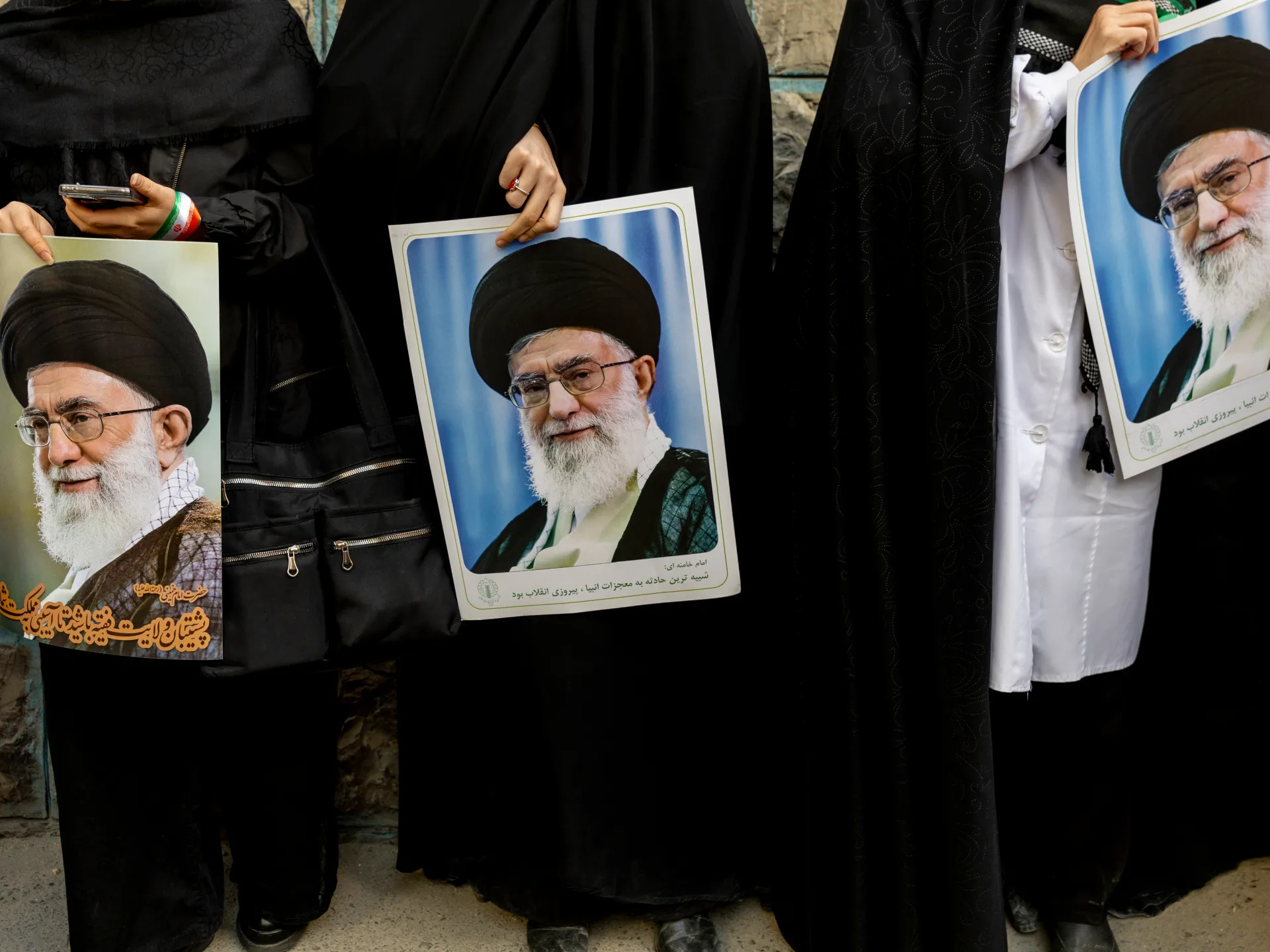
As of Sunday, it remained unclear who would succeed Iran’s former leader Ayatollah Ali Khamenei, 86, who was killed by American and Israeli strikes on the first day of the war. But the clerical body that will choose Iran’s next supreme leader appeared to be close to reaching a majority consensus on its pick, according to several news reports.

Trump said last week that Mojtaba Khamenei — the son of the former leader — would be an “unacceptable” choice.

As the war’s end remains nebulous, the battlefield actions continue to have an economic impact domestically, particularly on oil prices.

“If the war continues like this, there will be neither a way to sell oil nor have the ability to produce it,” Iran’s parliament speaker Mohammad Bagher Ghalibaf said in a social media post Sunday. He added the war would affect not just the U.S., but also the rest of the world “due to [Benjamin] Netanyahu’s delusions,” referring to the Israeli prime minister.

Israeli strikes on Sunday hit an oil storage facility in Tehran, marking what appears to be the first time a civil industrial facility has been targeted in the war.

U.S. Energy Secretary Chris Wright said Sunday that there’s currently a “fear premium in the marketplace” and sought to assure Americans that the soaring oil prices are a short-term problem.

“We never know exactly the timeframe of this,” Wright said in an interview with CNN’s “State of the Union.” “But in the worst case, this is a weeks, this is not a months thing.”

White House Press Secretary Karoline Leavitt echoed the same assurances in an interview with Fox News‘ “Sunday Morning Futures,” calling the rising gas prices a “short-term disruption.”

“Ultimately taking out the rogue Iranian regime is going to be a good thing for the oil industry,” Leavitt said. “Those prices are going to come back down just like they have over the course of the past year, because of President Trump’s American energy dominance agenda.”

The strike on the oil storage facility came as Netanyahu promised “many surprises” for the next phase of the conflict.

Iran also hit a desalination plant in Bahrain, and according to Araghchi, a U.S. airstrike damaged an Iranian desalination plan on Qeshm Island that is a critical drinking water supply in the parched deserts of the gulf.

“Attacking Iran’s infrastructure is a dangerous move with grave consequences. The U.S. set this precedent, not Iran,” Araghchi wrote in a post on X.

The United States has also come under scrutiny after evidence suggested that an American strike was likely responsible for an explosion at an Iranian elementary school that killed more than 165 people, most of them children.

Trump administration officials have said the matter is under investigation and that no determination has been made as to who was responsible for the strike. But on Saturday, Trump said Iran was to blame for the explosion.

“It was done by Iran,” Trump told reporters. “They’re very inaccurate as you know with their munitions. They have no accuracy whatsoever. It was done by Iran.”

Asked Sunday if Iran had any evidence that the strike was conducted by the Americans, Araghchi said it had to have been either the U.S. or Israeli military and said that Trump’s suggestion that Iran was responsible for the attack was “funny.”

“It is our school, these are our students and our girls and they are attacked by an American fighter, a jet fighter and they have been killed. Why [is] Iran responsible?” Araghchi said.

Source link

How targeting of desalination plants could disrupt water supply in the Gulf | US-Israel war on Iran News

Bahrain has said an Iranian drone attack caused material damage to a water desalination plant in the country, marking the first time a Gulf nation has reported targeting any such facility during the eight days of the war between Iran and the US and Israel.

The attack on Sunday comes a day after Iranian Foreign Minister Abbas Araghchi said a freshwater desalination plant on Qeshm Island in southern Iran was attacked by the United States.

Recommended Stories

list of 3 itemsend of list

“Water supply in 30 villages has been impacted. Attacking Iran’s infrastructure is a dangerous move with grave consequences. The US set this precedent, not Iran,” he said on X on Saturday.

While Tehran has not yet commented on the Bahrain attack, it has raised questions about the vulnerability of the Gulf countries, which depend on desalination plants for the majority of their water supply.

How important are water desalination plants to the Gulf region? Can water security in the Gulf be guaranteed amid a widening of military targets to include energy and other civilian sites?

What are desalination plants?

A desalination plant primarily converts seawater into water suitable for drinking purposes as well as for irrigation and industrial use.

The process of desalination involves removing salt, algae and other pollutants from seawater using a thermal process or membrane-based technologies.

According to the US Department of Energy, desalination systems “heat water so that it evaporates into steam, leaving behind impurities, and then condenses back into a liquid for human use”.

Meanwhile, membrane-based desalination involves “a class of technologies in which saline water passes through a semipermeable material that allows water through but holds back dissolved solids like salts”.

Reverse osmosis is the most popular membrane technology. Most countries in the Gulf Cooperation Council (GCC) use reverse osmosis since it is an energy-efficient technique.

Why are desalination plants important to the Gulf?

Water is scarce in the Gulf region due to the arid climate and irregular rainfall. Countries in the Gulf also have very limited natural freshwater resources. Groundwater, together with desalinated water, accounts for about 90 percent of the region’s main water resources, according to a 2020 report by the Gulf Research Center.

But in recent years, as groundwater has also begun to deteriorate as a result of climate change, Gulf countries have begun relying heavily on energy-intensive seawater desalination to meet their water needs.

More than 400 desalination plants are located on the Arabian Gulf shores stretching from the United Arab Emirates (UAE) to Kuwait, providing water to one of the most water-scarce regions in the world.

According to a 2023 research paper published by the Arab Center Washington DC, GCC member states account for about 60 percent of global water desalination capacity, producing almost 40 percent of the total desalinated water in the world.

About 42 percent of the UAE’s drinking water comes from desalination plants, while that figure is 90 percent in Kuwait, 86 percent in Oman, and 70 percent in Saudi Arabia. Saudi Arabia also produces more desalinated water than any other country.

Desalination has also played a crucial role in enabling economic development in the region, according to Naser Alsayed, an environmental researcher specialising in the Gulf states.

He noted that after the discovery of oil in the late 1930s, Gulf states had very limited natural freshwater resources and could not meet the demands created by population growth and expanding economic activity.

“Desalination plants were therefore introduced,” he told Al Jazeera, adding that the importance of desalinated water in supporting the Gulf’s development is often overlooked.

“As a result, targeting or disrupting desalination facilities would place much of the region’s economic stability and growth at significant risk,” he said.

“Secondly, desalination is the main source of freshwater for most GCC states, especially smaller and highly water-scarce countries such as Bahrain, Kuwait and Qatar. Because this water is primarily used for human consumption, desalination carries a strong humanitarian dimension and is essential for sustaining daily life in the region, making any disruption to these facilities particularly significant for the population,” he added.

Iran also uses desalination plants, which have been installed in coastal areas such as Qeshm Island in the Gulf. But Iran also has many rivers and dams and is not as heavily reliant on desalination plants as other countries in the Gulf region.

If a desalination plant is attacked, what is the impact?

The Gulf’s heavy reliance on desalination plants has made it vulnerable during times of conflict.

During the 1990-1991 Gulf War, Iraqi forces intentionally destroyed most of Kuwait’s desalination capacity, and the damage to its water supply was severe.

Raha Hakimdavar, a hydrologist, told Al Jazeera that in the long-term, attacking these plants can also impact domestic food production, which mostly uses groundwater.

“However, the pressures from competing needs can divert this water away from domestic production. This can be especially challenging because the region is also highly food import dependent and is facing potential food security challenges due to the compromising of the Strait of Hormuz,” said Hakimdavar, who is a Senior Advisor to the Deans at Georgetown University in Qatar and the Earth Commons.

A 2010 CIA report (PDF) also warned that while “national dependence on desalinated water varies substantially among Persian Gulf countries, disruption of desalination facilities in most of the Arab countries could have more consequences than the loss of any industry or commodity.”

According to Alsayed, the impact of a plant being attacked in the region, however, depends on the local scenario.

“For Saudi Arabia, which is the least dependent on desalination and has significant geographic space, facilities on the Red Sea provide resilience. The UAE has 45 days of water storage aligned with its 2036 water security strategy, so contingency plans are in place to manage potential disruptions,” he said.

“The effects are likely to be felt more acutely in smaller states that are highly dependent on desalination like Qatar, Bahrain, and Kuwait, which have minimal strategic reservoirs,” he noted.

“The most significant impact, in my view, is psychological,” Alsayed said. “Water is essential to human life, and the perception of risk can cause fear and panic, which is particularly challenging in the current environment in the region and where authorities are working to maintain calm.”

How can water security be guaranteed?

As attacks on Gulf countries continue, with energy and civilian infrastructure being targeted, Alsayed highlighted that it is important for GCC countries to view water security as a regional issue rather than an independent concern for each member state.

“The countries need to coordinate more closely and work together. The GCC has a strong platform to prepare for water challenges, but has not fully utilised it,” he said.

Alsayed noted that the GCC Unified Water Strategy 2035 called for all member states to have a national integrated energy and water plan by 2020, but this has not yet been achieved.

“Whether through unified desalination grids, shared regional strategic water reserves, or diversifying water resource goals, this is the way to usher a new era to strengthen Gulf water security,” he said.

Hakimdavar, the hydrologist, said there is no replacement for desalination in the GCC in the near-term.

But she added that the GCC countries can rely on strategic water storage reservoirs – many countries maintain large water reserves that can supply cities for several days or longer.

“Countries can also diversify water supply systems, and also invest in smaller, more distributed desalination plants powered by renewable energy to reduce reliance on a few very large facilities,” she added.

Source link

Amid escalation, Iran religious scholars signal new leader to be named soon | US-Israel war on Iran

Tehran, Iran – Senior religious leaders have signalled that Iran’s government may soon announce a new leader as hardliners and sidelined reformists deliberate their futures amid the quickly escalating United States-Israeli war on Iran.

Mohammad Mehdi Mirbagheri – a top figure in the 88-member Assembly of Experts, which will appoint the new supreme leader after Ayatollah Ali Khamenei was killed in Tehran on February 28 – said the choice had to be made with care so it would be indisputable internally.

Recommended Stories

list of 4 itemsend of list

“An almost decisive opinion has been reached. A significant majority has been formed, but at the same time, some obstacles have to be removed, which we hope will happen soon,” the head of the Qom Academy of Islamic Sciences said in a video released on Sunday by the Fars news agency, which is affiliated with the Islamic Revolutionary Guard Corps (IRGC).

The top ultraconservative Muslim leader representing the holy Shia city of Mashhad in the Assembly of Experts, Ahmad Alamolhoda, said on Sunday that the leader has been chosen and the secretariat of the Assembly of Experts must soon announce the result.

Abbas Kaabi, a senior member of the Guardian Council, said on Friday that the powerful 12-member constitutional body was not given any names to consider for the next supreme leader by Khamenei during his lifetime, only attributes.

“He said: Among all attributes, the financial piety of the supreme leader is of primary importance because, given the important powers and responsibilities of leadership, if financial deviation occurs, it will spread to all other matters,” Kaabi was quoted as saying by the IRGC-affiliated Mehr news agency.

The religious leader also quoted Khamenei as pointing to “a rooted belief in the fundamentals of the [1979] Islamic revolution, having insight and knowledge of enemies and sedition, and especially being anti-arrogance and having faith and resistance in confronting America and the Zionist regime” as being among other top attributes for a future leader.

Mojtaba Khamenei, the second son of the late supreme leader, is believed to be a frontrunner for the position as he enjoys wide backing from powerful commanders in the IRGC who have been launching missiles and drones across the region over the past week.

US President Donald Trump, who has said he wants to play a role in determining the future leadership of Iran, has objected to the younger Khamenei’s ascension.

The Israeli army has said it will try to assassinate Iran’s remaining leaders and has bombed their offices and gathering spots in Tehran, Qom and other cities. Israel and the US have repeatedly expressed their interest in changing the government of Iran.

Israeli media reported on Saturday that Asghar Hejazi, a senior religious leader who was Khamenei’s acting chief of staff, was killed in a series of overnight air strikes targeting an underground compound in downtown Tehran used by the supreme leader and other officials. Iran has not commented.

Reformists weigh in as Pezeshkian creates row

President Masoud Pezeshkian came under fire after he released a video from an undisclosed location on Saturday and apologised to regional neighbours who have been fighting off Iranian missiles and drones.

The armed forces leading the military attacks, including the Khatam al-Anbiya Headquarters of the IRGC and interim leadership council member and chief justice of the Supreme Court, Gholam-Hossein Mohseni-Ejei, quickly released statements to emphasise that the strikes would continue, with Iran as well as the US and Israel, saying they are ready for months of war if necessary.

The row prompted more hardliners, including religious leaders, lawmakers and IRGC-affiliated media, to call on the Assembly of Experts to move quickly to announce the next supreme leader. Ayatollah Hossein Nouri-Hamedani said the process should be expedited to “disappoint the enemy and preserve the unity and solidarity of the nation”.

The disagreement has broken out after reformist factions within the establishment have been pushed aside by hardliners in recent years while the conservatives also have lost favour among an increasingly disillusioned public.

Mohammad Khatami, a reformist religious leader who was president from 1997 to 2005, released a statement to mourn Khamenei last week but also signalled that he sees a future for a reformed Islamic Republic.

The establishment is in need of “reforming approaches and practices objected to by the people”, he said without naming any examples.

“Our path is the path of freedom, independence, people-centrism and fair living, and that is a difficult path to tread and requires wisdom and tolerance,” he said.

Khatami and the Reformist Front of Iran also released general calls for reform after thousands of people were killed during nationwide protests in January.

The Iranian government said “terrorists” backed by the US and Israel were responsible for the killings, but the United Nations and international humanitarian organisations blamed state forces for a lethal crackdown against peaceful protesters.

The leaders of the Reformist Front were arrested or summoned by Iranian intelligence and judicial authorities last month for what the establishment called an attempt to “disrupt the country’s political and social order” and working “for the benefit” of Israel and the US during the antigovernment protests.

Most have since been released on bail, but some remain incarcerated as do many of the tens of thousands of people believed to have been arrested during and in the aftermath of the protests.

Hassan Rouhani, the moderate religious leader who was president from 2013 to 2021 and who rejected being part of a reported power grab last month, has remained publicly silent during the deliberations over the next supreme leader.

Former President Mahmoud Ahmadinejad, another influential figure, survived an assassination attempt last week, according to Iranian media.

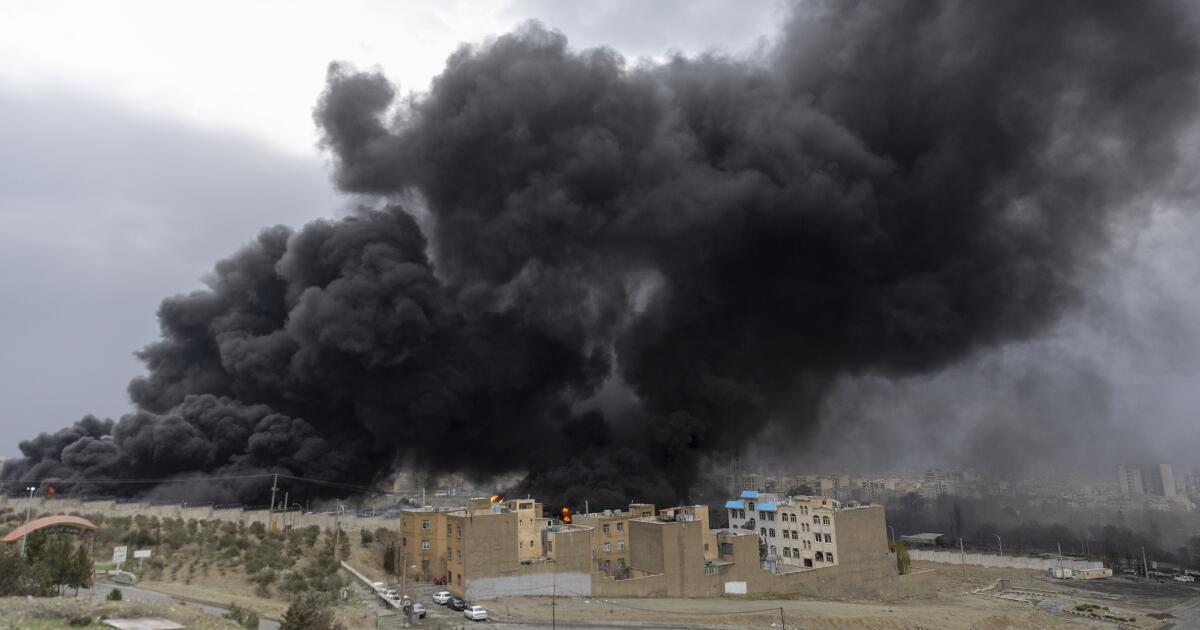
Fuel reserves and oil refineries in Tehran were bombed by the Israeli military overnight into Sunday, leaving thick plumes of smoke enveloping the sprawling city of 10 million people during the day as oil residue fell as part of a heavy rain.

Source link

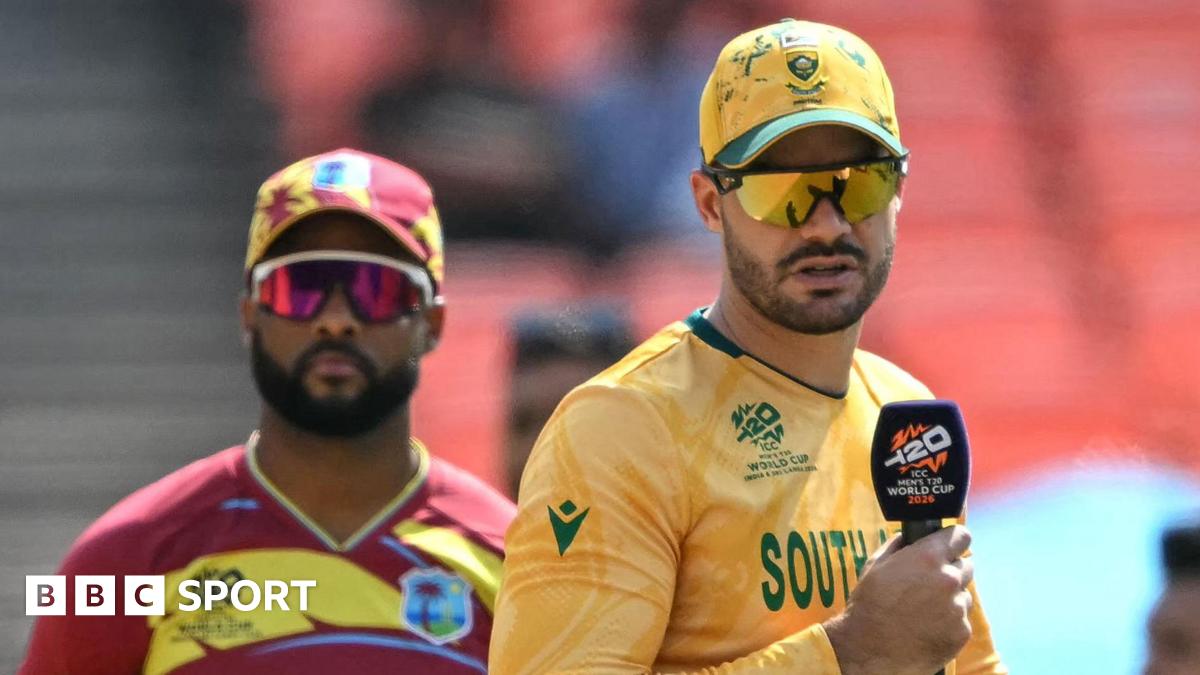
T20 World Cup: ICC rejects claims of “bias” over travel issues caused by Iran war

Windies coach Daren Sammy has been vocal on social media throughout the issue. On Thursday he posted “I just wanna go home”. “At least an update, tell us something,” he also said.

After England’s departure was confirmed, South Africa batter Quinton de Kock said “Funny, we have heard nothing! Strange how different teams have more pull than others.”

West Indies, South Africa and England were all scheduled to depart India via the Gulf – a situation made difficult by the Iran war and subsequent air strikes across the region.

England departed via Egypt on Saturday. West Indies and South Africa will finally travel together on a chartered plane on Monday.

“The safety and well-being of players, support staff, officials, and our own workforce remain our absolute priority as we respond to the evolving situation affecting air travel across parts of the Middle East,” the ICC said.

“The current disruption to multiple airspaces has created a highly complex and fast-moving logistical challenge.

“For instance, the England team and their staff were able to fly out from Mumbai without restriction due to the route’s airspace being unaffected and flights operating as usual.

“The ICC categorically refutes any claims of bias in this or other instances, and has been fully accommodating of specific demands and conditions put forth by teams.

“The ICC’s logistics and events teams have been working continuously with governments, aviation authorities, airlines and charter providers to secure safe travel options for all participating teams and tournament personnel.

“Furthermore, they and the ICC chief executive have maintained regular dialogue with the members’ representative ICC directors, board chairs and CEOs to assure all involved of their teams’ safety and the impact of the rapidly-changing situation.”

Source link

Iran war threatens prolonged impact on energy markets as oil prices rise | US-Israel war on Iran News

The United States-Israeli war on Iran could leave consumers and businesses worldwide facing weeks or months of higher fuel prices even if the conflict, which is now in its eighth day, ends quickly, as suppliers grapple with damaged facilities, disrupted logistics, and elevated risks to shipping.

The outlook poses a global economic threat and a political vulnerability for US President Donald Trump leading into the midterm elections, with voters sensitive to energy bills and unfavourable to foreign entanglements.

Recommended Stories

list of 4 itemsend of list

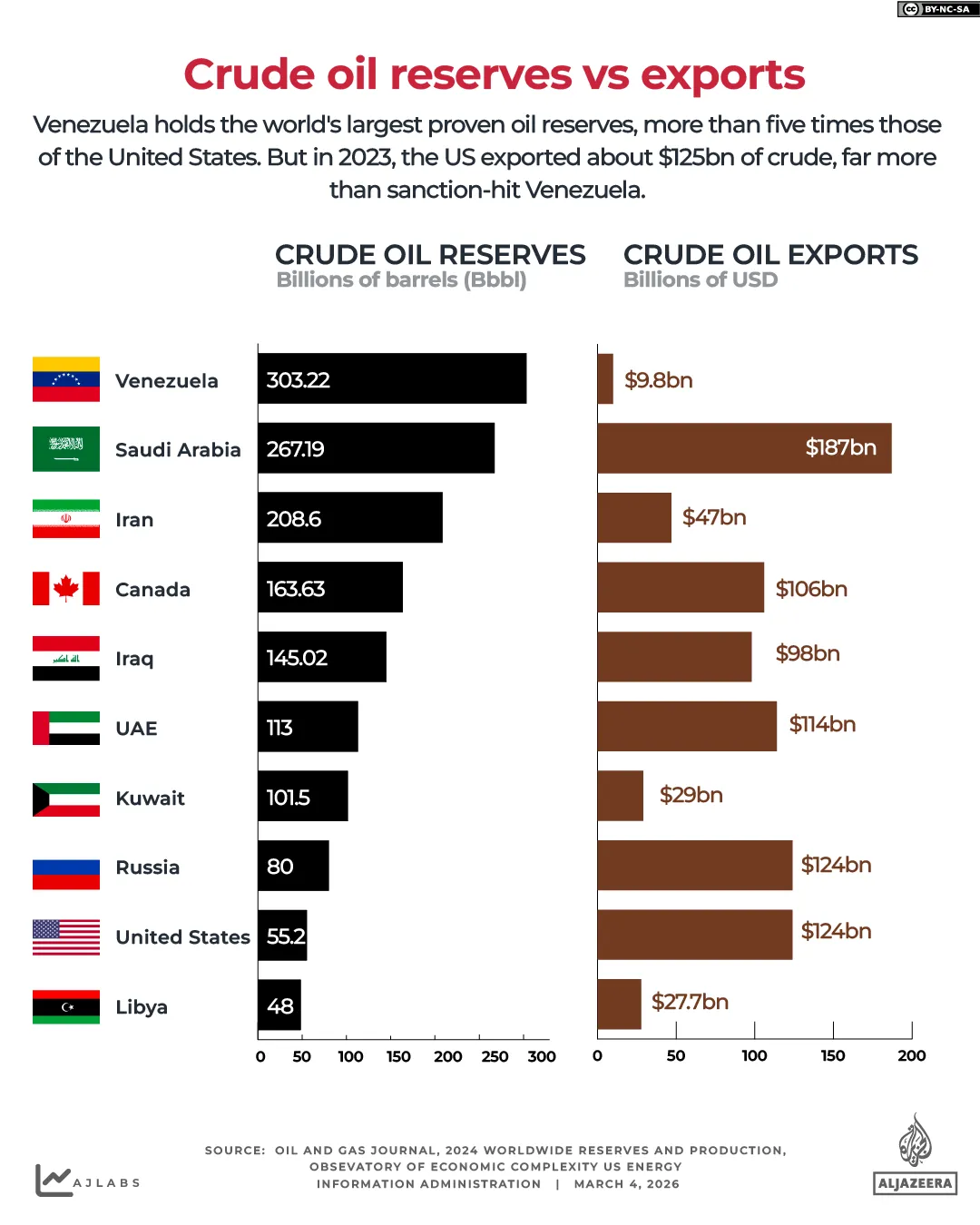
Global oil prices have surged by more than 25 percent since the start of the war, driving up fuel prices for consumers worldwide.

The national average petrol price reached $3.41 per gallon ($0.9 a litre) on Saturday, according to the American Automobile Association (AAA), rising by $0.43 over the past week. Goldman Sachs warned oil prices could climb above $100 per barrel if shipping disruptions continue.

The US crude oil settled at just below $91 per barrel on Friday – its largest weekly gain on record in data dating back to 1983, indicating prices could continue to rise.

“The market is shifting from pricing pure geopolitical risk to grappling with tangible operational disruption, as refinery shutdowns and export constraints begin to impair crude processing and regional supply flows,” JP Morgan analysts said earlier this week, according to the Reuters news agency.

The conflict has already led to the suspension of about a fifth of global crude and natural gas supply, as Tehran targets ships in the vital Strait of Hormuz between its shores and Oman, and attacks energy infrastructure across the region.

A nearly complete shutdown of the strait means the region’s top oil producers – Saudi Arabia, the United Arab Emirates, Iraq and Kuwait – have had to suspend shipments of as much as 140 million barrels of oil – equal to about 1.4 days of global demand – to global refiners.

More than 80 percent of global trade moves by sea, according to the World Bank, meaning disruptions in the waterway could increase freight costs and delay deliveries of goods.

Storages in the Gulf filling

As a result, oil and gas storage at facilities in the Gulf is rapidly filling, forcing oilfields in Iraq and Kuwait to cut oil production, with the UAE likely to cut next, analysts, traders and sources told Reuters.

“At some point soon, everyone will also shut in if vessels do not come,” a ⁠source with a state oil company in the region, who asked not to be named, told Reuters.

INTERACTIVE_IRAN_GCC_OIL AND GAS SUPPLY-CRUDE_OIL_MARCH4_2026

Oilfields forced to shut in across the Middle East as a result of the shipping disruptions could take a while to return to normal, said Amir Zaman, head of the Americas commercial team at Rystad Energy.

“The conflict could be ended, but it could take days or weeks or months, depending on the types of fields, age of the field, the type of shut-in that they’ve had to do before you can get production back up to what it once was,” he said.

Iranian forces, meanwhile, are targeting regional energy infrastructure, including refineries and terminals, forcing them to shut down too, with some of those operations badly damaged by attacks and in need of repairs.

Qatar declared force majeure on its huge volumes of gas exports on Wednesday after Iranian drone attacks, and it may take at least a month to return to normal production ‌levels, sources told Reuters. Qatar supplies 20 percent of global liquefied natural gas (LNG).

Saudi Aramco’s mammoth Ras Tanura refinery and crude export terminal, meanwhile, has also closed due to attacks, with no details on damage.

Economists warn that the situation could create a combination of higher prices and slower growth.

Source link

What is Trump’s true objective in the Iran war? U.S. targets provide a clue

The Defense Department last week outlined a concise set of military objectives in President Trump’s war against Iran, claiming its ultimate goal is to dismantle Tehran’s ability to project power beyond its borders. Yet it may be targets the Pentagon has largely left unacknowledged that offer the clearest insight yet into Trump’s true intentions.

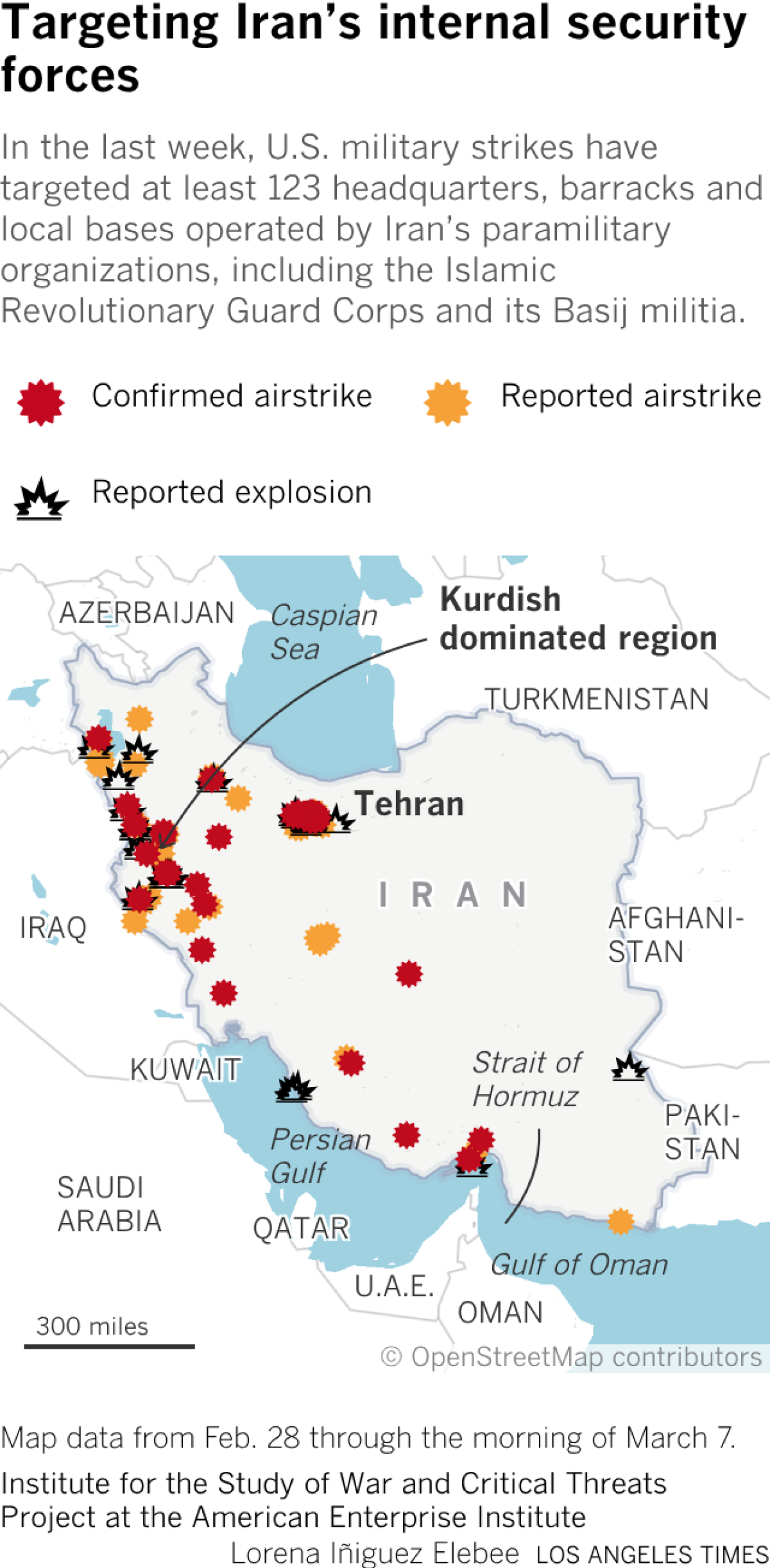
U.S. military strikes have focused on Iran’s ballistic missile, drone and nuclear programs, as well as its naval assets, according to U.S. Central Command. But strikes have also increasingly targeted Iran’s internal security forces, used by the Islamic Republic to suppress public dissent, according to an analysis from the Institute for the Study of War and the Critical Threats Project shared with The Times.

The strikes have targeted at least 123 headquarters, barracks and local bases operated by Iran’s paramilitary organizations, including the Islamic Revolutionary Guard Corps and its Basij militia. Regional police forces, primarily in the capital region around Tehran and in western Iran, near areas dominated by Kurdish groups hostile to the Iranian government, have also been targeted.

Some of those groups are being armed and supported by the U.S. intelligence community, a U.S. official said, speaking on the condition of anonymity to speak candidly.

Nicholas Carl, with the Critical Threats Project, said the pattern indicates the campaign is already underway to set the conditions for a revolution.

“As we are going after these repressive institutions, we are degrading the ability of the regime to monitor its population, to repress its population,” Carl said. “And so it looks as though the strike campaign may be organized around trying to erode the ability of the regime to repress in those areas.”

Analysts said that strikes against internal forces could be greater than they have measured thus far, noting the difficulty of tracking targets in the war based on publicly available data due to an internet blackout strictly enforced by the Iranian government.

Smoke and fire near a cooling tower.

An explosion erupts after strikes near Azadi Tower close to Mehrabad International Airport in Tehran on Saturday.

(Atta Kenare / AFP / Getty Images)

The quieter side of the U.S. campaign suggests a political strategy by the Trump administration that goes beyond simply containing the Iranian government, and may instead aim to lay the groundwork for its overthrow.

Trump and his top aides have been inconsistent in their messaging on their goals for the war, vacillating between calls for regime change and far shorter ambitions, such as an Islamic Republic that remains in power under leadership more acquiescent to the United States.

Before the war began, Trump was presented with an intelligence assessment that large-scale military action was unlikely to topple the Iranian government, two sources familiar with the assessment said. The assessment led analysts at the CIA, the State Department and the Pentagon all to advise the White House against proceeding with the operation. The intelligence analysis was first reported by the Washington Post.

  • Share via

Greasing the wheels for domestic unrest, for insurgency or revolution could serve other strategic purposes for the Trump administration beyond effecting regime change, adding new sources of pressure on an Islamic Republic that, if still intact by war’s end, would face renewed internal pressures at a moment of historic weakness.

Rob Malley, lead negotiator on the 2015 Iran nuclear deal and special U.S. envoy for Iran under President Biden, said that a sustained U.S. campaign that cripples Iran’s ability to maintain domestic control could mean “the regime collapses, in the sense that it can no longer, genuinely and effectively, govern the entirety of the country.”

“Right now, what Trump is saying suggests an extremely ambitious, extremely long-term, extremely perilous campaign that will only end with Iran’s surrender, and it’s very hard to see Iran surrendering,” Malley said. But the campaign may already be working. “Their communications have certainly been penetrated — they cannot meet without being targeted by Israel or the United States,” he added.

A women holds a portrait of the late Ayatollah Ali Khamenei at a protest

A woman holds a portrait of the late Ayatollah Ali Khamenei at a protest Saturday by medical professionals outside Gandhi Hospital in Tehran, which was damaged in an airstrike earlier this week.

(Majid Saeedi / Getty Images)

“Either the regime stays in place weakened, bloodied, finding it harder to govern a more fragmented, chaotic country,” Malley continued, “or the regime no longer can govern.”

An Israeli official did not deny that internal security forces were being targeted, although the official said that Israel was focused on assassinating Iran’s political and security leadership — “tiers one, two and three,” the official said. The vast majority of the strikes against internal security services thus far have been conducted by the United States.

“Our goal is to weaken the ayatollah regime, to a point where the Iranian people can choose their fate,” the official told The Times. “It’s still not at the point where they can do that, but there is work still to be done.”

By all accounts, the campaign against Iran’s military assets has achieved success. Iranian ballistic missile attacks against Israel and U.S. forces and allies in the region have decreased by 90% after just a week of combat, Defense officials said. Drone strikes have decreased by 83%. Over 30 Iranian vessels, including those used as launching pads for drones and aircraft, have been destroyed — a significant number for Iran’s aged and ill-funded naval fleet.

Trump could simply declare victory based on these results alone, said Elliott Abrams, who served as Trump’s special representative for Iran in 2020.

“They will get weaker as they use up resources and we bomb more and more relevant sites. Already air traffic is starting up again,” Abrams said, noting that commercial flights in the region began resuming this weekend. “So I doubt that the president will need a protracted campaign.”

But that would leave the regime in place, leaving open the possibility of a revanchist Islamic Republic that could reconstitute its military and crack down further on democratic protesters — an outcome that could create political backlash for Trump, Abrams said, after losing U.S. service members in combat.

A woman jogs along a street amid closed shops

A woman jogs amid closed shops in south Tel Aviv on Saturday.

(Olympia de Maismont / AFP / Getty Images)

“The outcome remains entirely in doubt — regime collapse after a wave of protests, civil war, a deal that leaves the regime in place behind a new face,” Abrams added. “A real test for Trump would arise if there is a wave of protests as in January, and the regime again starts shooting. Can he do nothing? Unlikely.”

In his initial speech announcing the start of the campaign, Trump addressed the people of Iran, telling them to shelter in their homes until the U.S. bombing campaign concludes.

“When we are finished, take over your government. It will be yours to take. This will be probably your only chance for generations,” the president said. “For many years, you have asked for America’s help. But you never got it. No president was willing to do what I am willing to do tonight. Now you have a president who is giving you what you want. So let’s see how you respond.”

But the president’s message grew muddled over the course of the last week, after he offered conflicting goals in a series of interviews with reporters.

He at once said he was expecting to hand-select the next ayatollah, after assassinating Iran’s longtime supreme leader, Ali Khamenei, in the opening salvo of the war. In other interviews, he said that the joint U.S.-Israeli campaign had killed many of the potential leaders that Washington could have worked with.

On Friday, Trump called for Iran’s “unconditional surrender.” He did not specify whether he was referring to a surrender of Iran’s nuclear program, its ballistic missile program, or on control over the country itself, and in a subsequent interview, said it could simply mean “when Iran no longer has the ability to fight.”

Over the last week, Kurdish leaders have shared accounts of Trump and his top aides reaching out to them and encouraging their involvement in the war, including a ground incursion in western Iran from Iraqi Kurdistan. But the president seems to have placed that effort on hold for the time being. “The war is complicated enough without having — getting the Kurds involved,” he told reporters Saturday aboard Air Force One.

At Central Command headquarters on Thursday, Defense Secretary Pete Hegseth told reporters that Trump maintains his promise to the Iranian people at the outset of the war, that a time will come for an uprising.

Defense Secretary Pete Hegseth addresses the audience as President  Trump listens

Defense Secretary Pete Hegseth addresses the audience as President Trump listens during “The Shield of the Americas Summit“ on Saturday, a gathering with heads of state and government officials from 12 countries in the Americas at the Trump National Doral Golf Club in Doral, Fla.

(Roberto Schmidt / Getty Images)

“No one’s done more than President Trump to reopen the opportunity for those who want a free Iran to do so,” Hegseth said. “Ultimately, it’s common sense, as he said up front, don’t go out and protest while bombs are dropping inside Tehran and elsewhere. There will come a moment where he determines, or they determine, that it’s time to seize that advantage.”

Suzanne Maloney, vice president and director of the foreign policy program at the Brookings Institution and an expert on Iran, said she expects the government to survive the U.S. assault, “still easily able to outgun and outmaneuver any challenges from the streets.”

But a concerted, prolonged campaign could change that assessment.

“Of course, months of full-scale war certainly could also break the system,” Maloney said, adding: “I don’t think the short-term result would be a stable transition to a more liberal system — but rather a collapse of the state itself, and at least for some period of time, a dangerous vacuum of power and order in the heart of the Middle East.”

Source link

Trump says US does not need UK’s aircraft carriers for Iran war | Military News

United States President Donald Trump has posted on social media that he does not need the United Kingdom to deploy aircraft carriers to the Middle East, amid the ongoing war with Iran.

Saturday’s post on Truth Social follows a statement from the UK’s Ministry of Defence that one of its two flagship aircraft carriers, the HMS Prince of Wales, has been placed on “high readiness”.

Recommended Stories

list of 3 itemsend of list

“The United Kingdom, our once Great Ally, maybe the Greatest of them all, is finally giving serious thought to sending two aircraft carriers to the Middle East,” Trump wrote.

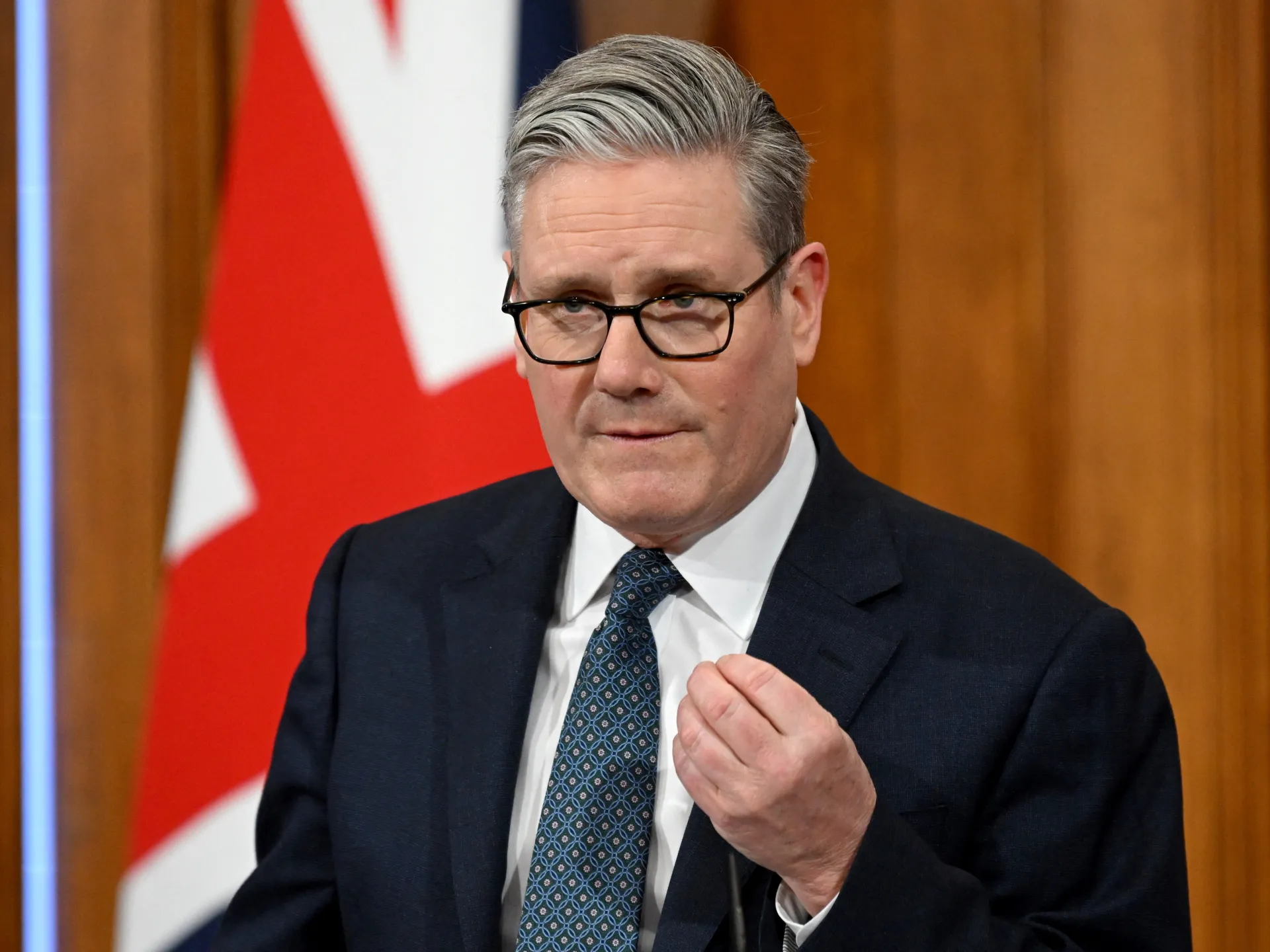
“That’s OK, Prime Minister Starmer, we don’t need them any longer — But we will remember. We don’t need people that join Wars after we’ve already won!”

The post, with its reference to the UK as a “once great ally”, signals a deepening rift between the two countries that has emerged since Trump returned to office last year.

The divide appears to have deepened over the past week, as the US and Israel continue to hammer Iran as part of a war they launched on February 28.

The conflict has sparked fears across the Middle East, as retaliatory strikes from Tehran target US allies across the region.

Already, an estimated 1,332 people have been killed in Iran, and the US has confirmed the deaths of six of its service members. More deaths have been reported in countries like Lebanon, Kuwait, the United Arab Emirates and Iraq.

The UK government has increased its involvement in the war on Iran, widely considered illegal under international law.

The UK Defence Ministry, for instance, said on Saturday that the government of Prime Minister Keir Starmer had allowed the US to use its military bases for what it termed “limited defensive purposes”.

The bases include RAF Fairford in Gloucestershire and the Diego Garcia site in the Chagos Islands, located in the Indian Ocean. Initially, there had been reports that Starmer had blocked the US use of the bases.

In the immediate aftermath of the initial US-Israeli strike, Starmer appeared to blanche at the prospect of joining the war.

He and the leaders of France and Germany issued a joint statement, underscoring that any actions they might take would be defensive in nature.

“We will take steps to defend our interests and those of our allies in the region, potentially through enabling necessary and proportionate defensive action to destroy Iran’s capability to fire missiles and drones at their source,” the joint statement said.

“We have agreed to work together with the US and allies in the region on this matter.”

But Starmer has had to push back on domestic criticism both for and against joining the war.

On Monday, he told the UK Parliament, “We are not joining the US and Israeli offensive strikes”, citing the need to protect “Britain’s national interest” and “British lives”.

The war in Iran remains largely unpopular in the UK. The polling firm Survation conducted a survey over the last week of 1,045 British adults, in which 43 percent of respondents called the war not justifiable.

When asked if they supported Starmer’s initial decision not to allow the US to use UK bases, 56 percent of respondents approved. Only 27 percent said it was the wrong choice.

Thousands of protesters gathered outside the US Embassy in London on Saturday to call for an end to the ballooning conflict.

The US president, meanwhile, has upped his criticism of Starmer over the past week, further fraying relations with the UK government.

On March 3, for instance, Trump held an Oval Office meeting with German Chancellor Friedrich Merz, in which he said repeatedly he was “not happy with the UK”.

Of Starmer, Trump said, “This is not Winston Churchill that we’re dealing with.”

Trump has long admired Churchill, and last year installed a bust of the late UK wartime leader in the Oval Office, just as he had during his first term.

By contrast, Trump has issued a flood of criticism against Starmer, particularly for his 2024 decision to transfer control of the Chagos Islands to Mauritius.

The transfer came after the International Court of Justice found the UK acted unlawfully in 1965 by separating the islands from Mauritius to create a separate colony.

The deal with Mauritius allows the US and the UK to maintain a military base on Diego Garcia, part of the archipelago.

However, Trump has repeatedly slammed the transfer, writing on social media that “giving away extremely important land is an act of GREAT STUPIDITY”.

Tensions between the US and UK also rose in January after Trump told Fox News that NATO allies had “stayed a little off the front lines” during the US war in Afghanistan.

Starmer had responded that he found Trump’s comments “to be insulting and frankly appalling”.

The Trump administration has signalled it is pivoting away from its traditional European allies in favour of more politically aligned countries.

At a summit on Saturday with right-wing Latin American leaders, US Secretary of State Marco Rubio appeared to praise the attendees while casting shade on other allies.

“At a time when we have learned that, oftentimes, an ally, when you need them, maybe may not be there for you, these are countries that have been there for us,” Rubio told the summit.

Source link

An end of war declaration is dangerous for the Republic of Korea-U.S. alliance

A declaration would signal political will for peace and reduce tension on the peninsula, but a declaration may not change the reality there. File Photo by Jeon Heon-Kyun/EPA

March 7 (UPI) — The author prefers to use the lowercase “n” to challenge the Kim family regime’s legitimacy.

Calls for an end of war declaration on the Korean peninsula return with steady rhythm. Each time they appear, they promise a step toward reconciliation.

The latest proposal came when South Korea’s Unification Ministry urged a political declaration formally ending the Korean War as part of a broader effort to restart dialogue with north Korea and move toward a peace regime.

The argument is simple: A declaration would signal political will for peace and reduce tension on the peninsula.

The desire for peace is genuine. Koreans want peace. Americans want peace. Soldiers who have stood watch along the Demilitarized Zone for seventy years want peace.

The real question is not whether peace is desirable. The real question is whether a declaration contributes to peace when the military reality remains unchanged.

Paper and rhetoric do not trump steel.

The Military Reality That Has Not Changed

The Korean War ended in July 1953 with an armistice agreement, not a peace treaty. The armistice halted the fighting but preserved the underlying conflict.

The security architecture that followed rests on deterrence. It rests on the Republic of Korea-U.S. alliance, the presence of American forces in Korea, extended deterrence and the readiness of combined forces.

Across the DMZ sits the fourth largest army in the world, as north Korea fields roughly 1.2 million troops.

More than seventy percent of those forces remain deployed between Pyongyang and the Demilitarized Zone. Their posture is offensive. Their purpose has not changed since 1950.

The Republic of Korea’s forces are organized differently. They are structured for defense. They rely on alliance integration and American reinforcement in crisis. The combined posture has deterred major conflict for seven decades.

None of that changes with a declaration.

Artillery remains within range of Seoul. Ballistic missiles remain deployed. Nuclear weapons remain part of the regime’s strategy.

Words do not move artillery tubes.

The Strategic Misreading Behind the Proposal

Supporters of an end of war declaration often argue that symbolic gestures can change political dynamics in Pyongyang.

The belief is that such a declaration would demonstrate that the alliance is abandoning what the regime calls its “hostile policy.” This signal, the argument goes, might restart negotiations and encourage denuclearization.

This logic rests on a misunderstanding of the Kim family regime.

For more than seventy years the regime has pursued the same strategic objective. It seeks to dominate the Korean peninsula under its rule. The tools have changed over time, but the objective has not.

The regime uses coercion, subversion, diplomacy, and military pressure in combination. Negotiations are not an alternative to this strategy. They are part of it.

When the regime speaks about hostile policy, it does not refer to rhetoric. It refers to the structural pillars of deterrence. The regime defines hostile policy as the ROK/U.S. alliance, the presence of U.S. forces in Korea, and the nuclear umbrella that protects South Korea and Japan.

Removing these pillars is central to the regime’s long-term strategy.

How a Declaration Can Undermine Deterrence

Advocates often describe an end of war declaration as symbolic and not legally binding. That may be correct in a narrow legal sense. In strategic terms, however, symbolism matters.

Politics follows narrative.

Once the war is declared over, critics of the alliance will ask a simple question. If the war is over, why are U.S. forces still stationed in Korea?

The argument will not remain academic. Political factions in both countries will push for reductions in American troop presence. They will question combined exercises. They will challenge extended deterrence.

The declaration would not cause these debates, but it would accelerate them. It would provide rhetorical oxygen to arguments that already exist.

From Pyongyang’s perspective this outcome would be ideal. The regime has long defined the alliance and U.S. military presence as the central obstacles to its objectives. Weakening alliance cohesion through political pressure achieves what military confrontation cannot.

The Political Warfare Dimension

An end of war declaration would not occur in a vacuum. It would unfold in a contested information environment shaped by political warfare.

north Korea, China, and Russia have repeatedly used narrative and diplomacy to shape perceptions about security on the peninsula. If negotiations over a declaration stall, the narrative battlefield will shift quickly.

Pyongyang will argue that peace is blocked by American hostility. Beijing and Moscow will echo that message in international forums. The United States will be portrayed as the obstacle to reconciliation.

Sanctions policy will become the central battleground. north Korea has already signaled that meaningful progress requires sanctions relief. Yet the United Nations Security Council resolutions remain in force precisely because of the regime’s nuclear and missile programs.

If sanctions remain in place, the regime and its partners will claim that Washington refuses to embrace peace. The propaganda line will be clear. The United States talks about diplomacy while clinging to confrontation.

The goal is not persuasion alone. The goal is alignment. By shaping public debate in South Korea and internationally, these narratives seek to weaken alliance unity and pressure policymakers.

This is political warfare conducted through diplomacy, media narratives, and strategic messaging.

Diplomacy Without Illusions

None of this means the United States or South Korea should reject diplomacy. Peace on the peninsula remains the long-term objective of the alliance.

Diplomacy, however, must be grounded in reality.

An end of war declaration can only contribute to security if it is tied to concrete military measures. Negotiations would need to address conventional force deployments near the DMZ. They would need to include ballistic missile programs and nuclear weapons. Verification would be essential.

Absent those steps, a declaration would alter language while leaving the balance of power untouched.

The alliance cannot afford that illusion.

Strategic Theater Versus Strategic Stability

Political leaders understandably seek symbolic achievements that demonstrate progress toward peace.

A declaration ending the Korean War would carry powerful historical meaning. But symbolism is not strategy.

A declaration without corresponding changes in military posture risks becoming strategic theater. It produces headlines but not stability. Worse, it may erode the deterrent structure that has preserved peace for generations.

The paradox is clear. A gesture meant to signal peace could weaken the very mechanisms that prevent war.

The Question That Matters

The central question remains unchanged.

Will the Kim family regime behave like a responsible member of the international community?

If it reduces conventional forces, dismantles nuclear weapons, and abandons its hostile posture, then an end of war declaration could become part of a genuine peace settlement.

If those conditions remain absent, the declaration becomes something else. It becomes leverage in a broader campaign aimed at weakening the alliance.

History suggests caution.

For seven decades the regime has used negotiations to gain concessions while preserving its core capabilities. It has advanced nuclear weapons even during diplomatic engagement.

Why should a symbolic declaration suddenly transform that pattern?

Conclusion

Peace on the Korean peninsula is a worthy goal. It is a goal shared by Koreans, Americans, and the broader international community.

But peace is not achieved through declarations alone.

It is secured through credible deterrence, alliance unity, and diplomacy grounded in the behavior of adversaries rather than hopes about their intentions.

The ROK/U.S. alliance has preserved stability for generations because it rests on credible military power. That credibility depends on readiness, presence, and integration. Until the military threat from the north changes, the war cannot truly be declared over.

Paper and words do not trump steel.

David Maxwell, executive director of the Korea Regional Review, is a retired U.S. Army Special Forces colonel who has spent more than 30 years in the Asia-Indo-Pacific region. He specializes in Northeast Asian security affairs and irregular, unconventional and political warfare. He is vice president of the Center for Asia Pacific Strategy and a senior fellow at the Global Peace Foundation, where he works on a free and unified Korea. After he retired, he became associate director of the Security Studies Program at Georgetown University. He is on the board of directors of the Committee for Human Rights in North Korea and the OSS Society and is the editor at large for the Small Wars Journal.

Sen. Markwayne Mullin, R-Okla., speaks to the press outside the U.S. Capitol on Thursday. Earlier today, President Donald Trump announced Mullin would replace Kristi Noem as Secretary of the Department of Homeland Security. Photo by Bonnie Cash/UPI | License Photo

Source link

Trump vows to escalate war as divisions in Iran emerge

Signs of division emerged in Iran’s leadership Saturday as U.S. and Israeli strikes continued battering targets throughout the country, with Tehran sending mixed signals on whether it would keep attacking Washington’s Arab allies entering the war’s second week.

Iranian President Masoud Pezeshkian began the day offering an apology “on behalf of Iran to the neighboring countries affected,” promising to halt the attacks that have affected nearly every nation in the Middle East. But strikes continued within hours, hitting Qatar, Bahrain and the United Arab Emirates, and Pezeshkian quickly issued a statement walking back his remarks.

President Trump vowed on social media to “hit Iran very hard” on Saturday, shortly before flying to Dover Air Force Base in Delaware for the dignified transfer of six service members killed in the war.

Speaking at a summit of Latin American leaders in Miami before his trip to Delaware, the president said the fallen service members were heroes “coming home in a different manner than they thought they’d be coming home.” He said it was “a very sad situation,” and he pledged to keep American war deaths “to a minimum.”

And Israel launched its own wave of fresh attacks against Iran while taking incoming fire from Hezbollah, Iran’s allied force in Lebanon, that set off sirens in Tel Aviv. Reports of a fire at a major oil refinery outside Tehran sparked fears the conflict was only escalating, marking the first attack on Iran’s energy infrastructure, if confirmed.

The burst of activity over the weekend underscored that Trump’s unexpected war with Iran, launched alongside Israel just a week ago, is continuing at full force with no sign of slowing.

Missile and drone strikes by Iran against Arab nations, targeting U.S. military assets in the region as well as civilian targets, including hotels and airports, have been an effort by Iran’s Islamic Revolutionary Guard Corps to pressure regional governments to in turn press Trump to end the U.S. air campaign. The strikes have jolted markets worldwide and sent the price of oil soaring.

President Trump salutes as soldiers carry a flag-draped coffin

President Trump salutes Saturday as soldiers carry the coffin of Sgt. Declan Coady, 20, of West Des Moines, Iowa. Coady and five others were killed in a drone strike in Kuwait.

(Roberto Schmidt / Getty Images)

While the attacks have decreased substantially over the course of the week, with U.S. Central Command recording a 90% decrease in ballistic missile launches and an 83% drop in drone attacks as of Friday, Iranian strikes are still penetrating regional air defenses. One drone hit the world’s busiest airport, in Dubai, on Saturday, dashing hopes that flights could resume from the regional hub.

Hours after Pezeshkian’s apology, Iran’s Foreign Ministry issued a statement vowing to continue strikes on territories that host U.S. offensive forces. Iran’s Defense Ministry said that its strategic stockpile of munitions was sufficient to sustain a protracted campaign. And a Revolutionary Guard spokesperson issued a statement addressing Trump, calling him “the corrupted island man,” referring to his former friendship with Jeffrey Epstein, the late sex offender who allegedly trafficked girls to his private island.

“The ground and the map of the war is in our hands,” the Revolutionary Guard official said. “This will continue.”

In his videotaped remarks, Pezeshkian also rejected Trump’s call for Tehran’s “unconditional surrender.” Trump later said he would be satisfied reaching a point at which Iran is no longer capable of fighting back.

“The idea of Iran surrendering unconditionally is a dream they will take to their graves,” Pezeshkian said.

A member of Iran’s Assembly of Experts, a council of 88 clerics responsible for naming the country’s supreme leader, was quoted in local state media vowing to select a new ayatollah within the next day, more than a week after U.S. and Israeli forces assassinated Ayatollah Ali Khamenei in the opening salvo of the war.

Trump has said he expects a say in that decision, preemptively rejecting the late supreme leader’s son, Mojtaba Khamenei, who is seen as the most likely successor.

Mojtaba Khamenei is seen as even more ideological than his father, with deep ties throughout Iran’s security apparatus — and with a potential vendetta against Trump, on the heels of U.S. forces killing much of his family.

Ali Larijani, secretary of Iran’s Supreme National Security Council who formerly served as the late Khamenei’s top advisor, said in his first remarks since the ayatollah’s killing that his assassination was unprecedented. “The price for this is not small,” Larijani said.

“They shouldn’t think we’ll let America quickly sweep this under the rug and say, ‘We hit, now let’s move on,’” Larijani continued. “Things will only resolve when they understand they no longer have the right to violate Iran, and when they compensate the Iranian people for their losses.”

More that 1,200 people have been killed in Iran since the war began, according to Iranian officials.

“He killed and martyred our leader,” Larijani added. “We’re not letting it go.”

Source link