vote

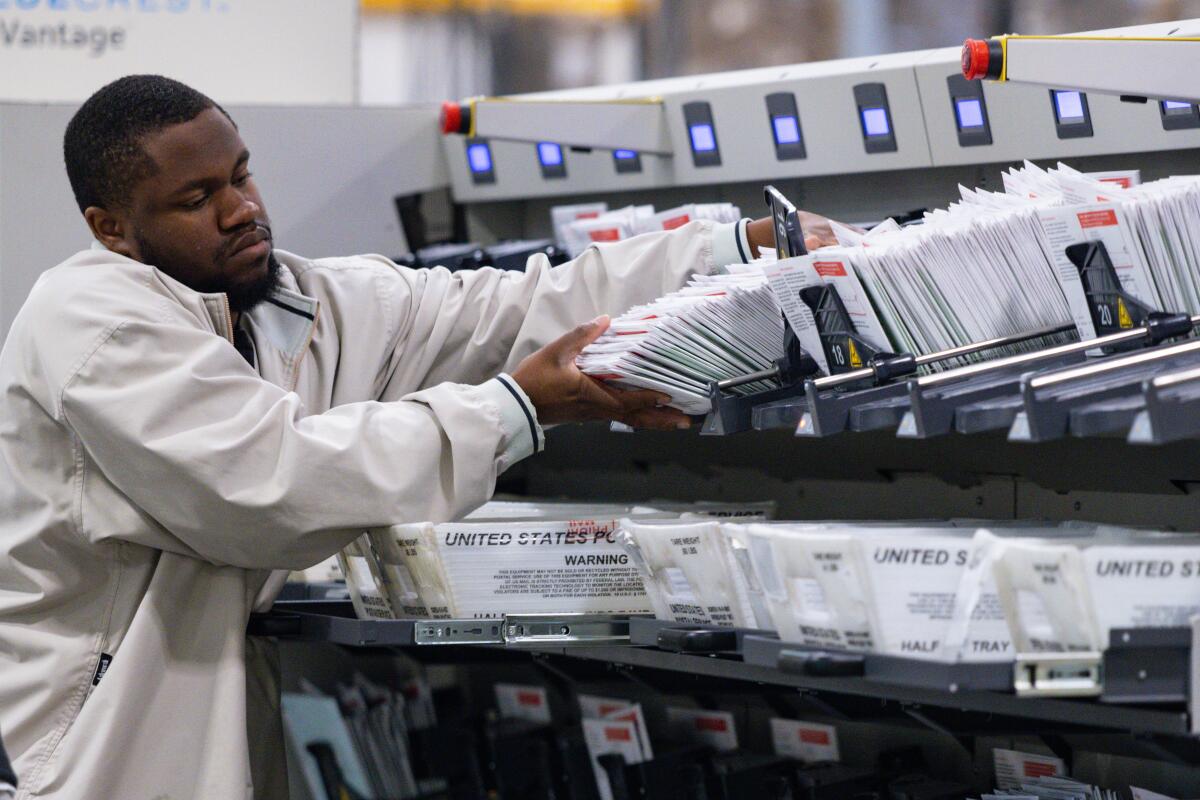
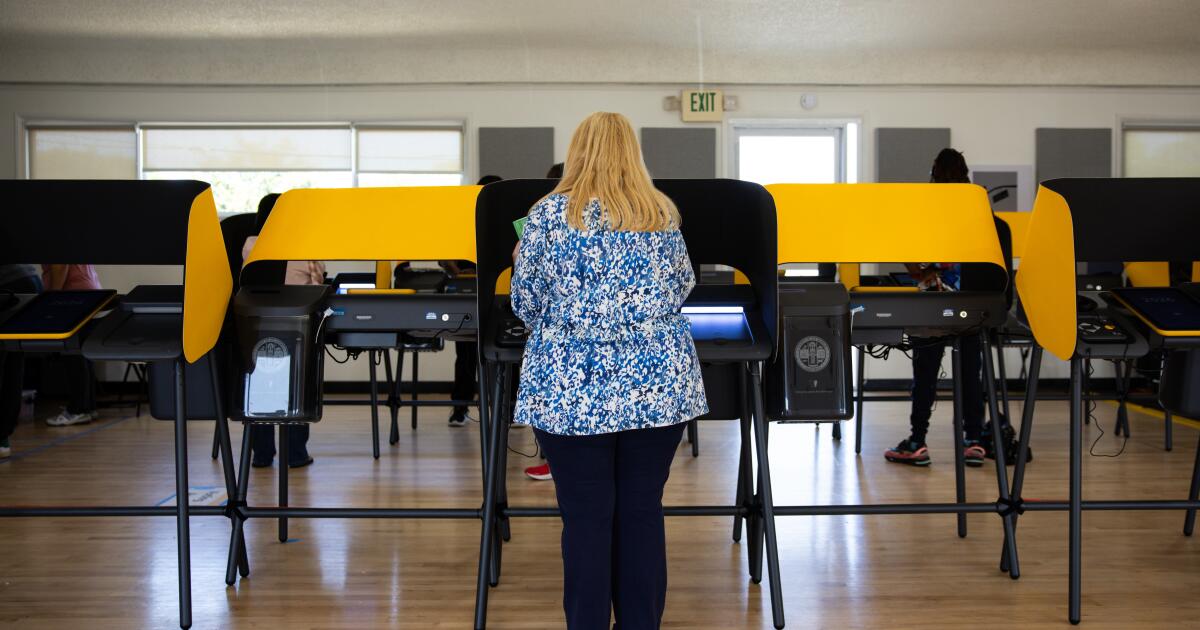
How to vote in California’s June 2026 primary election

p]:text-cms-story-body-color-text clearfix”>

Vote-by-mail ballots will not be forwarded to a new address, so your ballot will be returned to your local county election office if you haven’t updated your voter registration.

The Los Angeles Registrar-Recorder/County Clerk recommends voters who have been impacted or displaced by wildfires update their mailing address or request a replacement ballot be sent to their temporary address or new permanent address. Los Angeles County residents can follow a guide created for Pacific Palisades and Altadena fire survivors online. Residents can also make updates by phone by calling the Registrar-Recorder/County Clerk’s office at (800) 815-2666, Option 2.

You also can update your mailing address by re-registering to vote online. In the “residential address” section, enter your former place of residence and in the “mailing address” section, check the box that says your mailing address is different from your home address and then enter your temporary mailing address.

Source link

Analysis: Trump loomed over midterms and GOP suffered for it

The protracted uncertainty over control of Congress reverberated through both major political parties on Wednesday, as Democrats basked in the relief of the red wave that wasn’t and Republicans became increasingly clear-eyed that the lingering influence of former President Trump had hamstrung their party.

President Biden’s emphasis during the campaign season on the extremism of “MAGA Republicans” had been greeted skeptically by many. In the Democratic Party’s better-than-expected showing, though, he saw vindication of his appeals for civility and normalcy.

“This election season, American people made it clear: They don’t want every day going forward to be a constant political battle,” Biden said at a White House news conference. “The future of America is too promising to be trapped in endless political warfare.”

Amid high inflation and Biden’s lackluster approval numbers, Democrats’ hopes had hinged on voters being more put off by Trump’s imprint on the Republican Party — be it the divisive candidates he endorsed, the political violence that festered from his lies about election fraud, or the reversal of federal abortion protections made possible by justices he appointed to the Supreme Court.

“We knew going into the cycle that there was going to be an opportunity to rally a moral majority that is an anti-MAGA coalition,” said Tory Gavito, president of Way to Win, a progressive donor network. “When I say that, I include everyone from [GOP Rep.] Liz Cheney to [democratic socialist Sen.] Bernie Sanders. Think about that spectrum of the middle to the left coming together to say Republicans are just too damn extreme.”

If recent history is any guide, Trump’s not going anywhere. The once and likely future presidential candidate is unpopular, but he continues to exercise outsized sway over the Republican base, and could hobble the party for the next two years and beyond.

“While in certain ways yesterday’s election was somewhat disappointing, from my personal standpoint it was a very big victory,” Trump said on his conservative social media network, Truth Social, pointing to the record of candidates he endorsed. “219 WINS and 16 Losses in the General – Who has ever done better than that?”

The specter of the former president hampered the GOP’s ability to frame the midterm as a referendum on Biden, said Ken Spain, a GOP strategist and former spokesman for the party’s House campaign arm.

“Trump was always a looming shadow over this election, more than Republicans probably wanted to admit,” he said. “This essentially became a choice election between an unpopular president and an even more unpopular Trump.”

There were signs that patience was running thin among Republican power brokers. Notably, Trump’s much-beloved New York Post, the tabloid owned by conservative media magnate Rupert Murdoch, featured Florida Gov. Ron DeSantis on its cover Wednesday with the headline “DeFuture.” DeSantis is widely considered Trump’s biggest threat for the 2024 GOP presidential nomination.

Republicans still had a chance of winning both chambers of Congress as vote-counting continued Wednesday. House Minority Leader Kevin McCarthy (R-Bakersfield) projected confidence that his party would win the five additional seats necessary to take the majority there, and announced his intention to run for speaker of the House.

Whether he secures a majority may come down to his home state. California’s 11 competitive races remained unsettled as of Wednesday evening, with results trickling in slowly, as is common with the state’s methodical ballot-counting procedures.

Republicans had targeted incumbent Democratic Reps. Katie Porter and Mike Levin in Orange County, as well as an open seat in the Central Valley, as possible pick-ups. But Democrats were also watching the returns for the potential to oust vulnerable GOP Reps. David Valadao of Hanford and Ken Calvert of Corona.

Republican Sen. Ron Johnson of Wisconsin notched a close win over Democratic challenger Mandela Barnes, giving Republicans a 49-48 advantage in the Senate, with races in Georgia, Arizona and Nevada yet to be decided.

With neither candidate in Georgia winning more than 50% of the vote, the race will go to a Dec. 6 runoff, like the one that decided Senate control in 2020. A 50-50 split in the Senate would let Democrats maintain control with Vice President Kamala Harris’ tiebreaking vote.

Republicans made some successful pushes into blue territory; in New York, for example, they appeared likely to win four Democratic-held House seats. Rep. Sean Patrick Maloney, a New York Democrat who led his party’s efforts to keep the House, conceded his own race Wednesday morning to Mike Lawler, a Republican state assemblyman.

Still, the night was distinctly underwhelming for a party that contemplated a blowout win in the House and an assured majority in the Senate.

“Definitely not a Republican wave, that’s for darn sure,” Sen. Lindsey Graham (R-S.C.) said Tuesday night on NBC as he predicted a narrow win for Republicans in the Senate.

Paradoxically, a small Republican majority in the House would likely give Trump more leverage there, as McCarthy would have to depend on continued support from acolytes of the former president, such as Rep. Marjorie Taylor Greene, to exercise the GOP’s majority power.

Biden, speaking at the White House on Wednesday, said he had not had much occasion to interact with McCarthy but planned to talk with him later in the day. The president promised to work with Republicans in Congress, but noted pointedly that the American people had also sent the message that they wanted the GOP to show similar cooperation.

The president was happy to point out that his party had defied expectations, noting that “while the press and the pundits [were] predicting a giant red wave, it didn’t happen.”

National exit polls gave a glimpse into why Republicans fizzled. The surveys showed inflation was a top concern among voters. But abortion ranked second. That, and the relative weakness of Trump-backed candidates, helped Democrats stay in the fight.

Many voters appeared willing to swallow their disappointment with Biden. An NBC exit poll showed Democrats narrowly winning — 49% to 45% — among voters who “somewhat disapprove” of Biden’s performance.

Results in Michigan underscored the extent of the Republican Party’s disappointments. Democratic Gov. Gretchen Whitmer, whom Trump had attacked relentlessly, defeated his endorsed candidate, Tudor Dixon, and Democratic incumbents held on to the state’s attorney general and secretary of state posts and gained control of the Legislature as well.

The GOP failed to oust Rep. Elissa Slotkin, a vulnerable Democrat in a Michigan swing district that barely backed Biden two years ago. Elsewhere in the state, a Trump-backed candidate — who in the primary beat Rep. Peter Meijer, a Republican who had voted to impeach the former president — lost in the general election, costing Republicans a seat in the surprisingly tight battle for control of the House.

Michigan voters also approved a ballot measure striking down a 1931 ban on abortion, and voters in Kentucky rejected an initiative that would have amended the state constitution to make clear it did not protect abortion rights.

The Republicans’ loss of a Senate seat in Pennsylvania could prove the most consequential if Democrats keep the chamber. Lt. Gov. John Fetterman defeated Mehmet Oz, a television doctor and first-time candidate backed by Trump. Fetterman, still recovering from a stroke, painted the untested Oz as an elite carpetbagger.

Many of the gubernatorial candidates Trump backed also lost or were in danger of losing as of Wednesday afternoon. DeSantis’ double-digit win in Florida, as well as his strong coattails for Republicans in the House, served as a stark contrast. But Trump has said he will run again even if party leaders prefer DeSantis. Opinion polls, at least for now, show the former president as the prohibitive favorite to capture the party’s nomination.

Jason Miller, an advisor to Trump, told the BBC on Wednesday morning that he was urging Trump to postpone an announcement that he will run again from next week — as he has been teasing — to December, to avoid distracting from a potential Senate runoff in Georgia. But Miller said he remained 100% certain that Trump would run.

“Many of the people who are championing Ron DeSantis for president are the same people who were skeptical of President Trump ever since he came down the escalator in 2015,” Miller said, recalling Trump’s improbable announcement for the 2016 race.

Miller predicted that Trump would “have his hands full” but would ultimately win the nomination again.

Mason reported from Los Angeles and Bierman from Washington. Times staff writer Erin B. Logan contributed to this report from Washington.


Source link

Sen. Thom Tillis will vote to confirm Trump nominee for Fed chair

Sen. Thom Tillis, R-N.C., said on Sunday that he will vote to confirm President Donald Trump’s nominee for Federal Reserve chairman after the Department of Justice assured him it has ended its investigation into current chair Jerome Powell. Photo by Bonnie Cash/UPI | License Photo

April 26 (UPI) — U.S. Sen. Thom Tillis, R-N.C., said on Sunday that he will end his blockade of Kevin Warsh’s confirmation as Federal Reserve chair after the Department of Justice ended its investigation into current chair Jerome Powell.

U.S. Attorney Jeanine Pirro on Friday said the Justice Department was ending its investigation into Powell over the Fed’s budget for renovations to its headquarters and has threatened him with criminal charges over testimony he gave about the costs.

Tillis made the announcement during an interview on NBC News’ “Meet The Press,” because the department assured him that it has “completely and fully ended” the investigation.

He had previously said he would block all Trump nominees until the probe was dropped.

“We worked a lot over the weekend to make sure that we were very clear that we have assurances from the Department of Justice that I needed to feel like they were not using the department as a weapon to threaten the independence of the Fed,” Tillis told NBC News.

The Justice Department launched a criminal investigation into Powell in January after President Donald Trump questioned the Fed being over budget on renovations to its headquarters in Washington, D.C.

The investigation was condemned by several members of Congress as improper, including Tillis, because it was seen as politically motivated punishment from Trump for not setting interest rates at levels he preferred.

Pirro said Friday that she has asked the Federal Reserve’s inspector general to investigate the renovation costs, which she said is “billions of dollars” over budget, and that she expects a “comprehensive report” on the matter.

She noted, however, that she “will not hesitate to restart a criminal investigation should the facts warrant doing so.”

President Donald Trump and first lady Melania Trump participate in the 2026 White House Correspondents’ Association Dinner in Washington on April 25, 2026. Photo by Yuri Gripas/UPI | License Photo

Source link

Palestinians in Gaza vote in first election in 20 years

People cast votes in the municipal elections in Deir al-Balah, in the central Gaza Strip, on Saturday — the first election held in Gaza in 20 years, and the first in the West Bank since the outbreak of the war. Photo by Haitham Imad/EPA

April 25 (UPI) — Palestinians in Gaza held an election for the first time in 20 years as municipal elections were held there and in the West Bank on Saturday.

People in Deir al-Balah, a city in central Gaza, voted for the first time since 2006 because it was the least destroyed area after two years of airstrikes by Israel after the attacks of Oct. 7, 2023, CNN reported.

The elections, which also were held in many parts of the West Bank, were run by the Palestinian Authority and required candidates to agree with Palestinian Liberation Organization to recognize the state of Israel and support a two-state solution.

Elections were last held in the West Bank in 2022, The BBC reported, and had not been held in Gaza since Hamas took the enclave over two decades ago. Hamas was not permitted to participate in the elections.

Election results will be reported either late Saturday or on Sunday.

Salama Badwan, who voted with his wife and daughter, told Al Jazeera that the first election “is a truly Palestinian democratic celebration.”

“We must change everything through the ballot box,” Badwan said. “Whoever wins, it is their right, but not through inheritance … change must be through the hands of the people.”

Roughly 70,000 Palestinians — or 5% of the entire Gazan population — in Deir al-Balah were eligible to vote because many of the places that would have been used for voting were destroyed, as were supplies like ballot boxes.

The Palestinian Authority’s Fatah party dominated ballots as votes were held for 90 municipal councils and 93 village councils — leaving 42 other municipal councils and 155 village councils to be decided without votes.

Hamas praised the vote in Gaza and expressed hope for the rest of the territory to also choose its own leaders, although after its election in 2006 it forced Fatah out of Gaza in often violent battles and had not held an election since.

Thousands of displaced Palestinians walk along the Rashid coastal road toward Gaza City on October 10, 2025, after the implementation of a cease-fire agreement between Israel and Hamas. Photo by Hassan Al-Jadi/UPI | License Photo

Source link

Police raid Peru’s election authorities after outcry over slow vote count | Elections News

Anticorruption police gathered material from the homes of election officials including former office leader Piero Corvetto.

Police in the Peruvian capital of Lima have raided a home belonging to the former head of its national election agency, amid growing frustration in the aftermath of the country’s presidential election.

As of Friday, results still had not been finalised for the presidential race, which took place on April 12.

Recommended Stories

list of 3 itemsend of list

Delays in ballot deliveries forced the voting in some areas to be extended by an extra day, and the slow vote count has led to accusations of wrongdoing. But the European Union’s election mission to Peru found no indication of fraud.

Law enforcement was seen entering the home of Piero Corvetto, the former head of Peru’s National Office of Electoral Processes (ONPE), on Friday as part of a judicial warrant.

The officers with the local anticorruption police unit were tasked with removing mobile phones, laptops and documents, according to local broadcaster RPP.

The homes of five other officials were also targeted by police raids, as were offices belonging to Galaga, a private company that transports election ballots.

Corvetto resigned on Tuesday, though he denied any wrongdoing or irregularities in the election process. In a statement, he said he hoped his departure would boost public confidence.

On Friday, his lawyer, Ricardo Sanchez Carranza, told the news agency Reuters that a judge authorised the raid but denied prosecutors’ request to put Corvetto in preliminary detention.

But one of the leading presidential candidates, Lima’s former far-right mayor, Rafael Lopez Aliaga, has accused Corvetto of being a “criminal” and pledging to pursue him “until he dies”.

Lopez Aliaga is currently in a narrow race for second place in the presidential election.

With 95 percent of the ballots tallied, right-wing candidate and former First Lady Keiko Fujimori is in first place with 17 percent of the vote. She is all but assured of proceeding to the run-off on June 7.

Lopez Aliaga, meanwhile, is in third place with 11.9 percent, behind left-wing Congress member Roberto Sanchez at 12.03 percent.

Roughly 20,000 votes separate Sanchez from Lopez Aliaga, who has increasingly denounced the election as illegitimate, though he has yet to provide evidence to support that claim. Still, he has called the vote tally an “electoral fraud unique in the world”.

The final results are expected on May 15.

Source link

Democrats win in Virginia but it won’t be the final say in a national redistricting competition

Democrats on Wednesday celebrated an election win in Virginia that could put them slightly ahead in the national redistricting competition that President Trump triggered in an attempt to preserve his party’s House majority in this year’s midterms, but it will not be the final round.

Now that it’s been approved by voters, the new Virginia map will have to clear additional legal hurdles. On Wednesday, the state attorney general’s office said it would immediately appeal a ruling earlier in the day from a judge in rural southern Virginia who ordered that the results of Tuesday’s vote not be certified.

Ultimately, the Virginia Supreme Court will decide whether Democratic lawmakers violated procedural rules when they referred a constitutional amendment to the ballot authorizing the new U.S. House districts that could help Democrats win as many as four additional seats in the state. If so, that could invalidate the map voters narrowly approved Tuesday.

What happens next in Florida also will matter.

The state’s Republican-controlled Legislature is to meet in a special session next week that GOP Gov. Ron DeSantis called in part to draw a new map to expand the party’s congressional majority there. The U.S. Supreme Court is scheduled to issue an opinion by the end of June in a Louisiana case that could overturn a key provision of the Voting Rights Act and lead to redrawn political maps across the South, though almost all of those could not happen until 2028.

After voters passed the Virginia amendment, Democrats could tentatively claim that they netted 10 seats nationally from the mid-decade redistricting, compared with the nine that Republicans claim. Even if things swing again in the GOP’s favor, the net result of Trump’s campaign would be at best an incremental increase in the number of GOP-leaning House seats at a time when his approval rating is dropping and Republican anxiety over losing control of Congress in November is rising.

“We have successfully blunted Trump’s attempt to completely hijack the midterms,” said John Bisognano, president of the National Democratic Redistricting Committee.

Many Republicans agreed.

“The GOP will now lose net seats across the country. If you’re going to pick a fight, at least win it,” Ari Fleischer, who was a spokesman for President George W. Bush, posted on the social media site X after the Virginia vote. “All this was foreseeable and avoidable. We should not have started this fight.”

Adam Kincaid, executive director of the National Republican Redistricting Trust, argued that it is too soon to declare one party a victor.

“It’s an ongoing process with many legal challenges pending, and it’s far too early for sweeping statements on the final outcome,” he said.

Trump on Wednesday tried to undermine the Virginia result by leveling groundless accusations of fraud similar to ones he made after losing the 2020 presidential election. He called the Virginia vote “RIGGED” and “Crooked” in a post on his social media site and added, “Let’s see if the Courts will fix this travesty of ‘Justice.’”

Redistricting spread from Texas to other states

Redistricting is typically done every 10 years after each census, unless ordered by a court. But last summer, Trump pushed a redrawing in Texas, prodding the state’s Republican-controlled Legislature to add up to five winnable House seats for his party. Trump then began pressuring other Republican-run states to follow. Missouri, North Carolina and Ohio have since created more GOP-leaning seats in addition to Texas.

Democrats began to fight back, even though they were more constrained because several Democratic-controlled states had maps drawn by independent commissions rather than lawmakers and governors.

To counter Texas, California’s Democratic governor, Gavin Newsom, pushed the Democratic-controlled Legislature to place a redistricting initiative on last fall’s ballot. After voters overwhelmingly approved it, the measure will replace a commission-approved map with one that could gain Democrats five seats.

Democrats reclaimed the Legislature and governor’s office in November in Virginia and swiftly moved to replicate California’s move with an even more aggressive redistricting plan. It replaces a congressional map imposed by a court after the last census that had resulted in a 6-5 edge for Democrats with one that could allow Democrats to win as many as 10 seats.

“We are not going to let anyone tilt the system without a response,” state Senate President L. Louise Lucas said at a news conference Wednesday.

Courts could still have a say on redistricting

In Washington, U.S. House Democratic leader Hakeem Jeffries of New York warned Florida Republicans, who have been openly nervous about redrawing their district boundaries and potentially spreading their core voters too thin before an election that appears to be trending against them.

“Our message to Florida Republicans right now is, ‘F around and find out,’” Jeffries said.

House Majority Forward, the nonprofit arm of the super political action committee aligned with House Democrats, has spent nearly $60 million to push back against Republicans’ redistricting efforts. Some $40 million of that was on the Virginia campaign.

Another obstacle in Florida is an anti-gerrymandering constitutional amendment that was approved by state voters in 2010. It is likely that any new Florida map would trigger significant litigation, although six of the state Supreme Court’s seven justices were appointed by Republicans.

Nicholas Stephanopolous, a Harvard law professor, said a challenge for DeSantis is that the Florida amendment forbids drawing lines for purely partisan purposes, so he has to find some other excuse for revising the map. “Even with that sort of acquiescent state supreme court, I don’t think it’s a done deal,” Stephanopolous said.

The Virginia move comes with its own legal issues. Republicans have challenged the process that Democrats used to place the measure on the ballot and the state Supreme Court opted to wait for the vote before even scheduling arguments in the case. It is unclear when a ruling could come.

Wednesday’s ruling stopping certification came from a separate case that Republicans filed with the same lower court judge, whose initial ruling against the initiative was put on hold by the state supreme court.

“The ballot box was never the final word here,” Terry Kilgore, the Virginia House Republican leader, said in a statement after Tuesday’s vote. “Serious legal questions remain about both the wording of this referendum and the process used to put it before voters.”

The biggest legal wild card is held by the U.S. Supreme Court. Its conservative majority could throw out a requirement under the Voting Rights Act that in areas with a large minority population, mapmakers draw districts that are more favorable to the election of minority candidates.

That provision has led to the creation of several majority-minority congressional seats, especially in the South. Without it, Republicans in conservative states could shrink the number of U.S. House seats winnable by Democrats even further.

But it’s unlikely that any state other than Louisiana, which brought the lawsuit the high court will rule on, would be able to adjust its congressional lines in time for November even if the court eliminates that provision, known as Section Two. That’s because the November election is already officially underway in most states and candidate filing deadlines — and, in some cases, primary elections — have already passed.

Riccardi and Lieb write for the Associated Press. AP writers Lisa Mascaro and Leah Askarinam in Washington contributed to this report.

Source link

Peru’s election chief steps down amid frustration over long vote count | Elections News

Ballot delivery delays and other missteps on election day have contributed to frustration with electoral authorities.

The head of Peru’s election authority has resigned from his role amid widespread anger over the country’s chaotic general election earlier this month, with vote counting still under way.

Piero Corvetto said in a social media post on Tuesday that he was stepping down as head of the National Office of Electoral Processes (ONPE), a government body tasked with organising elections in Peru.

Recommended Stories

list of 3 itemsend of list

In a letter to the National Board of Justice (JNJ), Corvetto denied that irregularities had taken place, as some politicians have alleged.

But he explained that he was leaving in a bid to increase public confidence, ahead of an anticipated second round of voting in the presidential race on June 7.

The first round of the election, held on April 12, was marred by logistical issues that led to the extension of voting hours around the capital Lima and elsewhere.

Election observers have acknowledged missteps with the electoral process but cautioned that there is no firm evidence of fraud.

Peru’s National Jury of Elections (JNE) said the voting results will be finalised no later than May 15, with the top two presidential candidates advancing to the final round.

Right-wing candidate Keiko Fujimori leads with about 17 percent of the vote and is likely to advance to the run-off.

But who will face her remains a mystery. Left-wing Congressman Roberto Sanchez and Lima’s former far-right mayor Rafael Lopez Aliaga remain virtually tied, with 12 percent and 11.9 percent respectively.

The hectic first round of voting could deepen dissatisfaction with the country’s political system at a time of protracted instability and sloping trust in government institutions.

Even before the April election, about 68 percent of Peruvians said that they had little to no trust in the country’s election authorities, according to a poll conducted by the Institute for Peruvian Studies (IEP) and the Institute Bartolome de las Casas (IBC).

Some presidential candidates, including Lopez Aliaga, have pushed unconfirmed claims of fraud and have called for the first round of voting to be nullified.

Election authorities have begun to review thousands of contested ballots that were challenged due to inconsistencies, missing details or tally sheet errors.

Source link

Virginia voters deciding on redistricting plan that could boost Democrats’ seats in Congress

Virginia voters on Tuesday are deciding whether to ratify an unusual mid-decade redrawing of U.S. House districts that could boost Democrats’ chances of flipping control of the closely divided chamber, as the state becomes the latest front in a national redistricting battle.

A proposed constitutional amendment backed by Democratic officials would bypass the state’s bipartisan redistricting commission to allow use of new congressional districts approved by state lawmakers in this year’s midterm elections.

The referendum, which needs a simple majority to pass, tests Democrats’ ability to push back against President Trump, who started the gerrymandering competition between states after successfully urging Texas Republicans to redraw congressional districts in their favor last year. Virginia is the second state, after California last fall, to put the question to voters.

It also tests voters’ willingness to accept districts gerrymandered for political advantage — coming just six years after Virginia voters approved an amendment meant to diminish such partisan gamesmanship by shifting redistricting away from the legislature.

Even if Democrats are successful Tuesday, the public vote may not be the final word. The state Supreme Court is considering whether the redistricting plan is illegal in a case that could make the referendum results meaningless.

Virginia Democrats are following California’s lead

Congressional redistricting typically is done once a decade after each U.S. census. But Trump urged Texas Republicans to redistrict ahead of the November elections in hopes of winning several additional seats and maintaining the GOP’s narrow House majority in the face of political headwinds that typically favor the party that is out of power during midterms.

The Texas gambit led to a burst of redistricting nationwide. So far, Republicans believe they can win up to nine more House seats in newly redrawn districts in Texas, Missouri, North Carolina and Ohio.

Democrats think they can win up to five more seats in California, where voters approved a mid-decade redistricting effort last November, and one more seat under new court-imposed districts in Utah. Democrats hope to offset the rest of that gap in Virginia, where they decisively flipped 13 seats in the state House and won back the governor’s office last year.

Voters focus on fairness, with different perspectives

The stream of voters was steady Tuesday at a recreation center in the Old Town area of Alexandria, Virginia.

Matt Wallace, 31, said he votes regularly but this election has additional emphasis.

“I think the redistricting issue across the country is unfortunate, that we’ve had to resort to temporary redistricting in order to sort of alter our elections across the country,” Wallace said. He said he voted for the Democratic redistricting amendment “to help balance the scales a bit until things get back to normal.”

Joanna Miller, 29, said she voted against the redistricting measure, “because I want my vote to count in a fair way.” Miller said she was more concerned about representation in Virginia than trying to offset actions in other states.

“I want my vote and my representation to matter this fall,” she said.

Political parties made a big push in Virginia

Leaders of both major parties see Tuesday’s vote as crucial to their chances to win a House majority in the fall. Trump weighed in via social media Tuesday morning, telling Virginians to “vote ‘no’ to save your country!”

Former Virginia Gov. Glenn Youngkin, a Republican, rallied with opponents of the measure Monday night, calling the redistricting plan “dishonest” and “brazenly deceptive.” House Minority Leader Hakeem Jeffries told reporters at the Capitol earlier in the day that a vote to approve the redraw “will serve as a check and balance on this out-of-control Trump administration.”

A committee supporting the Democratic redistricting effort had raised more than $64 million — three times as much as the roughly $20 million raised by opponents, according to finance reports filed less than two weeks before the election.

The back-and-forth battle over congressional districts is expected to continue in Florida, where the Republican-led legislature is scheduled to convene April 28 for a special session that could result in a more favorable map for Republicans.

A lobster-like district could aid Democratic efforts

In Virginia, Democrats currently hold six of the 11 U.S. House seats under districts that were imposed by the state Supreme Court in 2021 after a bipartisan commission failed to agree on a map based on the latest census data.

The new plan could help Democrats win as many as 10 seats. Five are anchored in Democratic-heavy northern Virginia, including one shaped like a lobster that stretches into Republican-leaning rural areas.

Revisions to four other districts across Richmond, southern Virginia and Hampton Roads dilute the voting power of conservative blocs in those areas. And a reshaped district in parts of western Virginia lumps together three Democratic-leaning college towns to offset other Republican voters.

The Virginia redistricting plan is “pushing back against what other states have done in trying to stack the deck for Donald Trump in those congressional elections,” Democratic Gov. Abigail Spanberger said during an online rally last week.

Ads for the “yes to redistricting” campaign featuring former President Barack Obama have flooded the airwaves.

Opponents have distributed campaign materials citing past statements from Obama and Spanberger criticizing gerrymandering, but those were before Trump pushed Republican states to redraw their congressional maps in advance of this year’s midterms.

Democrats “were all against gerrymandering before they were for it,” Virginia Republican Party Chairman Jeff Ryer said.

Virginia court weighs whether lawmakers acted illegally

Virginia lawmakers endorsed a constitutional amendment allowing their mid-decade redistricting last fall, then passed it again in January as part of a two-step process that requires an intervening election for an amendment to be placed on the ballot. The measure allows lawmakers to redistrict until returning the task to a bipartisan commission after the 2030 census.

In February, they passed a new U.S. House map to take effect pending the outcome of the redistricting referendum. Republicans have filed multiple legal challenges against the effort.

A Tazewell County judge ruled that the redistricting push was illegal for several reasons. Circuit Court Judge Jack Hurley Jr. said lawmakers failed to follow their own rules for adding the redistricting amendment to a special session.

He ruled that their initial vote failed to occur before the public began casting ballots in last year’s general election and thus didn’t count toward the two-step process. He also ruled that the state failed to publish the amendment three months before that election, as required by law.

If the state Supreme Court agrees with the lower court, the results from Tuesday’s vote could be rendered moot.

Lieb writes for the Associated Press. AP writers Gary Fields in Virginia and Lisa Mascaro in Washington contributed to this report.

Source link

Virginia redistricting vote: What polls suggest and what voters will decide | US Midterm Elections 2026 News

Voters in Virginia head to the polls on Tuesday to decide on a measure that could redraw the state’s congressional map and potentially shift the balance of power in Washington.

Major political figures, including former President Barack Obama and House of Representatives Speaker Mike Johnson, have weighed in on the high-stakes vote, with nearly $100m spent on campaigning around it.

Part of a broader redistricting battle that began in Texas and spread nationwide, the vote may be the Democrats’ last chance this year to gain seats by changing district maps. The vote comes about six months before the 2026 midterm elections.

Here is what we know:

What is Virginia voting on?

Virginia currently sends 11 members to the House. At the moment, six of them are Democrats, and five are Republicans, reflecting the state’s balance.

Democrats now want to redraw the map to favour them in a way that could help them win up to 10 of the 11 seats. Under the proposal, most districts would be safely Democratic or lean towards the party, with only one strongly Republican.

A breakdown would be:

  • Eight districts would be safely Democratic
  • Two would be competitive but lean Democratic
  • Only one would be safely Republican

If approved, this could give the Democrats several extra seats in Congress, helping them win back or strengthen control of the House in Washington, where majorities are often decided by just a few seats.

That would be a big political shift for the state, which was once closely contested but has become more Democratic-leaning in recent years.

Supporters depart a campaign rally against Virginia Democrats' proposed state redistricting constitutional amendment
Supporters depart a campaign rally against Virginia Democrats’ proposed state redistricting constitutional amendment [FILE: Ken Cedeno/Reuters]

How would the vote work?

Voters in Virginia can cast their ballots either early or on Election Day.

Polling stations will be open across the state on Tuesday:

  • Polls open at 10:00 GMT
  • Polls close at 23:00 GMT

Votes will be counted after polls close, with early results expected later that evening and fuller results overnight or the next day.

What are voters being asked to decide?

The proposed constitutional amendment is the only statewide contest on the ballot.

It reads:

“Should the Constitution of Virginia be amended to allow the General Assembly to temporarily adopt new congressional districts to restore fairness in the upcoming elections, while ensuring Virginia’s standard redistricting process resumes for all future redistricting after the 2030 census?”

A “yes” vote would support allowing the General Assembly to redraw congressional districts before the midterms.

A “no” vote would leave current boundaries unchanged until the next round of regularly scheduled redistricting after the 2030 census.

What do the latest polls suggest?

The result is expected to be close.

A recent poll by State Navigate, a nonpartisan research group, suggests a small lead for supporters, with about 53 percent in favour and 47 percent against.

Why do district lines matter so much?

District lines decide how voters are grouped, which can shape who wins elections.

Moving the lines can make a district more favourable to a Democratic or Republican win, by adding or removing neighbourhoods and communities that lean one way or the other.

It can turn a close race into a safe seat, or the other way around. It affects which communities are kept together and who represents them.

This process, often called gerrymandering, allows parties to draw maps that benefit them.

In a closely divided state like Virginia, even small changes to the map can shift several seats and influence who holds power in Congress.

A 2023 study by Harvard University researchers found that gerrymandering often creates “safe” seats for politicians, meaning their races are less competitive.

In turn, those politicians become less responsive to the needs of their constituents, who become discouraged about voting as a result.

Supporters pray during a campaign rally against Virginia Democrats' proposed state redistricting constitutional amendment
Supporters pray during a campaign rally against Virginia Democrats’ proposed state redistricting constitutional amendment [Ken Cedeno/Reuters]

When could new maps take effect?

If approved, the new map could be used as early as the next election cycle, including the upcoming midterms, depending on legal approval.

However, the plan could face legal challenges. Critics have questioned the ballot wording and the process used by lawmakers.

The Virginia Supreme Court has allowed the vote to go ahead while reviewing those concerns.

If it later finds that rules were broken, the results could be overturned, and the current maps would remain.

Why this vote could shape power in Washington?

A handful of seats could decide control of the US House.

Republicans currently hold a narrow 218–213 majority, but Democrats are seen as competitive heading into the midterms.

Political leaders have underscored the stakes.

Hakeem Jeffries, the Democratic Party’s leader in the House, has pointed to Virginia as a crucial battleground, while Mike Johnson has said the result will be closely watched across the country.

U.S. House Speaker Mike Johnson (R-LA) speaks during a campaign rally
US House Speaker Mike Johnson (R-LA) speaks during a campaign rally [Reuters]

What it means to control the US House

The party with the majority (more seats) in Congress can:

  • Set the agenda, deciding which bills are brought up for debate
  • Control committees, including investigations and hearings
  • Pass legislation more easily (if they stay united)
  • Block bills from the minority party.

The majority party also chooses the speaker of the House, who has major influence over what reaches the floor.

Where else has this happened?

Virginia’s redistricting vote is part of a larger political battle playing out in the US. Republicans in Texas, encouraged by Donald Trump, have redrawn district maps to strengthen their advantage, prompting similar efforts in other states.

In rare cases, voters have been asked to decide directly, including in California last year and now in Virginia.

In California, voters backed the changes despite concerns about fairness. Now it’s Virginia’s turn to decide.

What Democrats are saying, and why?

Democrats argue the plan is a response to Republican actions in other states, not just a power grab.

Leaders like Obama had long opposed gerrymandering in principle, but have now backed the Virginia move, even releasing a video asking voters to go out and vote for the constitutional amendment.

Source link

What is Trump-backed SAVE America Act and what could it mean for US vote? | US Midterm Elections 2026 News

Washington, DC – United States President Donald Trump has been unambiguous about his desire for Congress to pass the SAVE America Act, a sweeping voting law that supporters say will boost election security and that detractors say risks disenfranchising millions of voters.

The push has gained new urgency, with the US Senate continuing debate on the law following a two-week recess.

Recommended Stories

list of 3 itemsend of list

The president has said the bill, which at its core would create higher documentation standards for proving citizenship when registering to vote and casting a ballot, is his top priority ahead of the midterm elections in November, which will determine which party controls the Senate and the US House of Representatives.

The bill has near-total support from Republicans, with Democrats remaining largely unified in opposition. It passed in the Republican-controlled House of Representatives in February along party lines.

The measure has since remained stalled in Congress, where Republicans control 53 out of 100 seats, short of the 60 votes it will likely need to pass.

That is, unless party leaders move to change the chamber’s longstanding rules, a transformative approach considered a”nuclear” option that will reverberate for years to come.

Here’s what to know.

What would the SAVE America Act do?

The version of the Safeguard American Voter Eligibility (SAVE) America Act passed by the House in February would require voters to provide proof of citizenship – a birth certificate or passport – when registering to vote. It would also implement stricter voter identification requirements for individuals casting ballots, whether by mail or in person.

Under the US Constitution, states administer elections, and currently have different processes for registering voters and confirming citizenship. Voting by noncitizens is already illegal, and all people registering to vote attest they are US citizens under threat of perjury.

The bill does not provide any funding for the new verification processes, which would be effective immediately upon the bill being signed into law.

The legislation would also require all states to run their voter rolls through a US Citizenship and Immigration Services (USCIS) “Alien Verification Eligibility” system to identify potential noncitizens already enrolled.

It would include criminal penalties for election officials who register voters without the required documentation.

What has Trump said about the SAVE Act?

The US president has long maintained that elections in the country are marred by widespread fraud, including noncitizen voting, despite there being no evidence to support these claims.

Even the conservative Heritage Foundation, which has influenced many of Trump’s policies, has found only exceedingly rare instances of voter fraud over decades of US elections.

Trump’s focus on election administration dates back to his 2020 loss to former US President Joe Biden, which he continues to maintain was the result of the vote being “stolen”. Again, no evidence has emerged to back those claims.

The president has called the SAVE America Act “one of the most IMPORTANT & CONSEQUENTIAL pieces of legislation in the history of Congress, and America itself”.

In March, he vowed not to sign any other bills into law until the legislation was passed. He has further vowed not to endorse any Republicans who do not support the legislation.

Trump also told members of his party in March that passing the bill would “guarantee” their success not only in the midterm elections but in the years to come.

Several top Republicans have embraced Trump’s messaging, with US House Speaker Mike Johnson saying opponents of the legislation “want illegal aliens to vote in our elections”.

What have critics said about the SAVE Act?

Critics have said the bill would be tantamount to widespread voter disenfranchisement, creating onerous barriers to address what several studies show to be the fleetingly rare problem of noncitizens registering to vote.

Several studies have shown that about 11 percent of eligible voters do not have access to birth certificates, while 52 percent do not have valid passports. All told, a recent study by several election-monitoring groups found that about nine percent of eligible voters in the US do not have easy access to documents proving citizenship, accounting for about 21.3 million people.

Several groups, including the Bipartisan Policy Center, have argued the legislation risks doing more damage than good. Data from a USCIS voter verification system, which some states already use to identify noncitizens in their voter rolls, found that only 0.04 percent of reviewed cases were flagged as potential noncitizens.

But as noted by the Bipartisan Policy Center, evidence indicates that the rate may be considerably lower, pointing to a review by Travis County, Texas that found that a quarter of the voters flagged by USCIS had actually provided proof of citizenship.

In another example, a review of all registered voters in Utah from 2025 to 2026 found only a single instance of a noncitizen registered to vote out of more than two million voters. There were no confirmed instances of a noncitizen actually voting.

Top Democrats have echoed those criticisms, while charging that Trump is seeking to influence the outcome of the midterms as part of what they call a years-long effort to politicise voting administration.

“The only thing Republicans are trying to save with this legislation is their own skin in the next election,” Chuck Schumer, the top Democrat in the Senate, said earlier this week.

Could it affect women and name changes?

A main point of contention for opponents of the legislation is the additional barriers it could create for individuals, primarily women, who changed their last names after marriage or for other reasons.

An estimated 69 million women in the US lack easy access to documentation linking their current legal names to those at birth, according to the League of Women Voters, which has been a leading opponent of the bill.

The requirement for extra documentation for some married women creates inherent inequality in the system, the organisation has argued.

The law would further create extra barriers for individuals who move regularly, including members of the military, and those who have been afflicted by disruptive life changes, including natural disasters, opponents have argued.

How does this relate to the filibuster?

The so-called “filibuster” is a procedural rule in the Senate that can be used to require 60 votes to pass most bills, as opposed to a simple majority of 51 votes in the 100-seat chamber.

Parties in the minority have long used the rule to temper the party in the majority, with Republicans and Democrats rarely holding a filibuster-proof 60 seats.

Being a rule of the Senate’s own making, it could be easily scrapped by the party in power. However, doing so has long been seen as a “nuclear” option. While it would offer short-term benefits to the majority party, it would undermine the same party if it becomes the minority in future elections.

Nevertheless, Trump has heaped pressure on Republican leaders in the Senate to scrap the rule, writing on Truth Social in March, they need to “Kill the Filibuster”.

What happens next?

Debate remains ongoing in the Senate over the legislation, but major shifts in support are seen as extremely unlikely.

Republicans are unlikely to bring the legislation to a vote if they do not have the support for it to pass.

Currently, there is no plan to hold a vote to do away with the filibuster, which would require only a simple majority.

Lawmakers have also not yet pursued other, more incremental procedural manoeuvres to pass the bill without 60 votes.

Source link

How popular are the Dodgers? Even the Lakers look up at them. Way up.

The Dodgers are too good, and too rich. If the owners of other major league teams ultimately deem that combination so objectionable that they shut down the sport this winter because of it, they will risk a rupture in one of the greatest fan bases in American sports history.

The four million tickets the Dodgers sold last season tells one part of the story. Here is an arguably better one: For decades, the Dodgers and Lakers have dominated Los Angeles sports and left every other team far behind in popularity.

For now, after back-to-back World Series championships, the Dodgers have left even the Lakers far behind in popularity, and every other team in town even further behind.

In a Loyola Marymount survey asking Los Angeles County residents to identify their favorite among the 12 pro sports teams within the local media market, nearly half picked the Dodgers.

The Dodgers’ lead over the Lakers — 43% to 28% — represented the largest gap between the teams in the nine editions of the survey, first conducted in 2014 by the Thomas and Dorothy Leavey Center for the Study of Los Angeles.

The Rams ranked third, at 7%, followed by the Kings at 5% and the Angels at 4%.

The two women’s teams — Angel City FC and the Sparks — tied for last, each with less than 1% of the vote. Even when the study separated votes by gender, the two women’s teams got less than 1% of the vote from women.

As recently as 2018, five teams beyond the Dodgers and Lakers — the Angels, Clippers, Galaxy, Kings and Rams — attracted at least 4% of the vote. In this year’s survey, only the Rams did.

“I’m a big Rams fan,” said Fernando Guerra, the center’s director, “and I still put the Dodgers first.

“I love all these teams. But, when you have to choose one, it’s the Dodgers.”

Dodgers president Stan Kasten pointed to the popularity and excellence of the players, the cherished ballpark and the generational fan support as factors contributing to the top ranking.

“If you have a lot of good elements but you don’t win, you’re not going to be as high,” Kasten said. “And, if you win but you don’t have the other elements, you’re not going to be as high.

“I think, right now, we’re as close as you can be to clicking on all cylinders.”

Beyond the winning, Guerra cited Shohei Ohtani as a driving force behind the Dodgers’ popularity, and not just as a tourist attraction, merchandise driver, and the foremost product endorser in sports.

In 2018, Ohtani’s debut season with the Angels, 8% of fans that identified themselves as Asian picked the Angels as their favorite team and 34% picked the Dodgers — a terrific showing for the Angels, since the study polls residents in L.A. County, not Orange County.

That demographic this year: 4% picked the Angels, 47% picked the Dodgers.

In their 10 years since returning to Los Angeles, the Rams have made seven playoff appearances and two Super Bowl appearances, winning one. All that, and a half-century in their previous run in L.A., and their membership in the most popular sports league in America, and the best they could do was 7%.

“It’s just tough to break the Lakers’ and Dodgers’ hold,” Guerra said. “It’s not like we don’t love the Rams or the others. It’s just not your top priority.”

The Lakers and Dodgers have combined to win 20 championships in Los Angeles. The other 10 teams that call this market home have combined to win 16.

In the 13 seasons since Mark Walter and Co. bought the Dodgers, the team has won 12 division titles, made five World Series appearances, and won three championships. In the same time, the Lakers have won three division titles, advanced past the first round of the playoffs twice, and won one championship.

Walter bought a controlling interest in the Lakers last year. He has installed Lon Rosen, formerly the Dodgers’ executive vice president and chief marketing officer, as the Lakers’ president of business operations.

“When the Lakers are winning a lot of championships, they’re No. 1,” Rosen said. “When the Dodgers are, they’re No. 1.

“It’s a good position to be in, since we control both teams, and both teams are highly successful.”

In this moment, the Dodgers are highly successful.

“The Lakers and Dodgers are going to be neck and neck very soon,” Rosen said. “The Lakers will 100% be champions again soon.”

The Dodgers do not concede the days of neck and neck will return. Kasten, remember, said the Dodgers were as close as they could be to clicking on all cylinders.

“We don’t take that for granted,” he said. “We know we can do even better.”

Source link

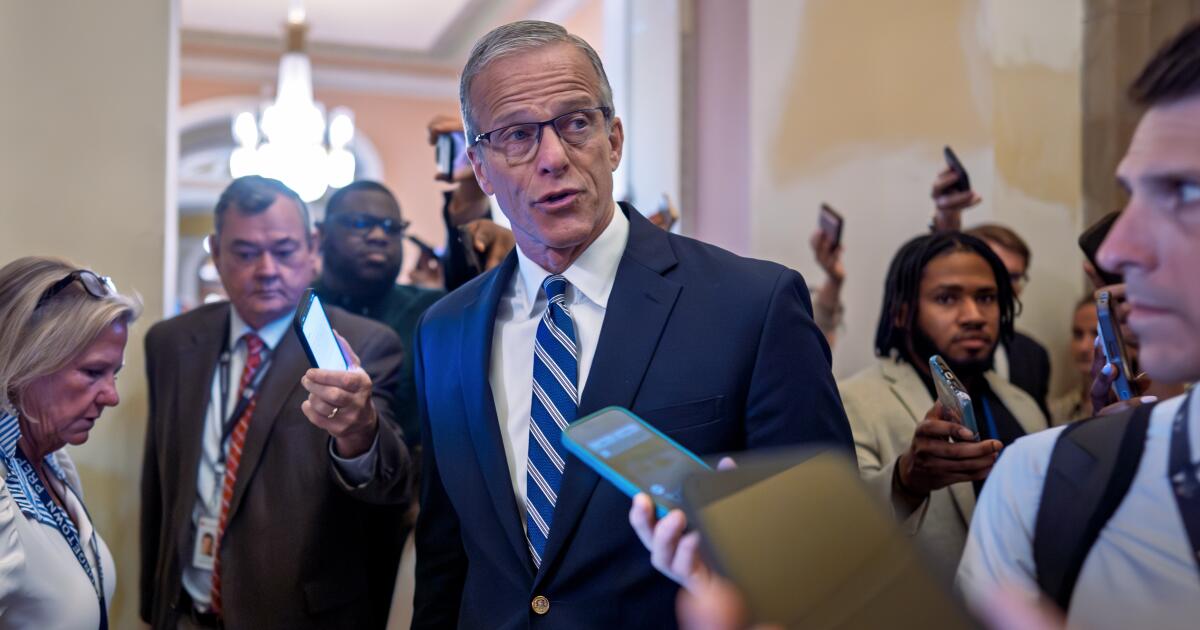
Thune: Senate may vote next week on ICE, Border Patrol funding

April 14 (UPI) — A budget resolution to fund federal immigration enforcement could hit the Senate floor by next week, Senate Majority Leader John Thune said Tuesday, as Republicans seek to bypass Democratic demands for reforms to Immigration and Customs Enforcement and Border Patrol.

Federal funding for Immigration and Customs Enforcement and Border Patrol lapsed on Feb. 14 after Republicans agreed with the Democrats to remove the Department of Homeland Security from a larger spending package and avert a government shutdown.

Neither agency has been funded through regular DHS appropriations since, though they continue operating through other, emergency funding.

Democrats began demanding reforms to the federal immigration enforcement agencies before agreeing to restore funding after two U.S. citizens were killed by federal immigration officers amid President Donald Trump‘s aggressive immigration crackdown.

Amid a stalemate in negotiations, Republicans are considering passing three years of funding for the agencies through a complicated legislative mechanism called a budget reconciliation bill that permits certain spending legislation to pass with a simple majority rather than 60 votes, Thune told reporters Tuesday in the Capitol.

“Republicans are going to stand with our Border Patrol, with our law enforcement agencies and we’re going to ensure that they are funded, not only today but well into the future,” Thune, R-S.D., said.

Sen. Lindsey Graham, R-S.C., is preparing the resolution to fund the agencies that will be followed by the reconciliation bill “to ensure the job gets done,” he said.

Democrats have blocked funding for ICE and Border Patrol until reforms — including requiring judicial warrants and banning officers from wearing masks — are made, but the reconciliation bill tactic could ensure funding without any votes from Democratic lawmakers.

The same tactic was used last year to pass Trump’s sweeping spending and tax cut bill, which provided $75 billion for ICE.

“All of the things that the Democrats made this about, which was supposed to be about reforms to the way that ICE and Border Patrol operate — they get none of that,” Thune said.

“And now, we’re going to fund those agencies for three years into the future. The only thing the Democrats got out of this was they now own the issue of open borders and defund law enforcement.”

Republicans hold a narrow 53-47 majority in the Senate, with two independents caucusing with the Democrats, as well as a 218-213 majority in the House.

The Senate has twice passed bipartisan bills to fund DHS aside from ICE and Border Patrol, which the House has balked at. Democrats blame the Trump administration’s influence on the lower chamber.

“Republicans are dragging the Senate through a partisan circus just to avoid basic accountability for ICE and Border Patrol,” Senate Minority Leader Chuck Schumer told reporters at the Capitol during a separate press conference on Tuesday.

He said Democrats will continue to push for immigration enforcement reforms.

“So, the pattern, unfortunately, with this administration is clearer and clearer,” the veteran New York Democrat said. “Chaos abroad — the war; chaos at home with not funding DHS with reforms. A failed war overseas, a manufactured crisis here in Washington — in both cases Republicans aren’t leading, they are following orders.”

Source link