virginia

Jay Rockefeller, former West Virginia governor and U.S. senator who was part of a dynasty, dies at 89

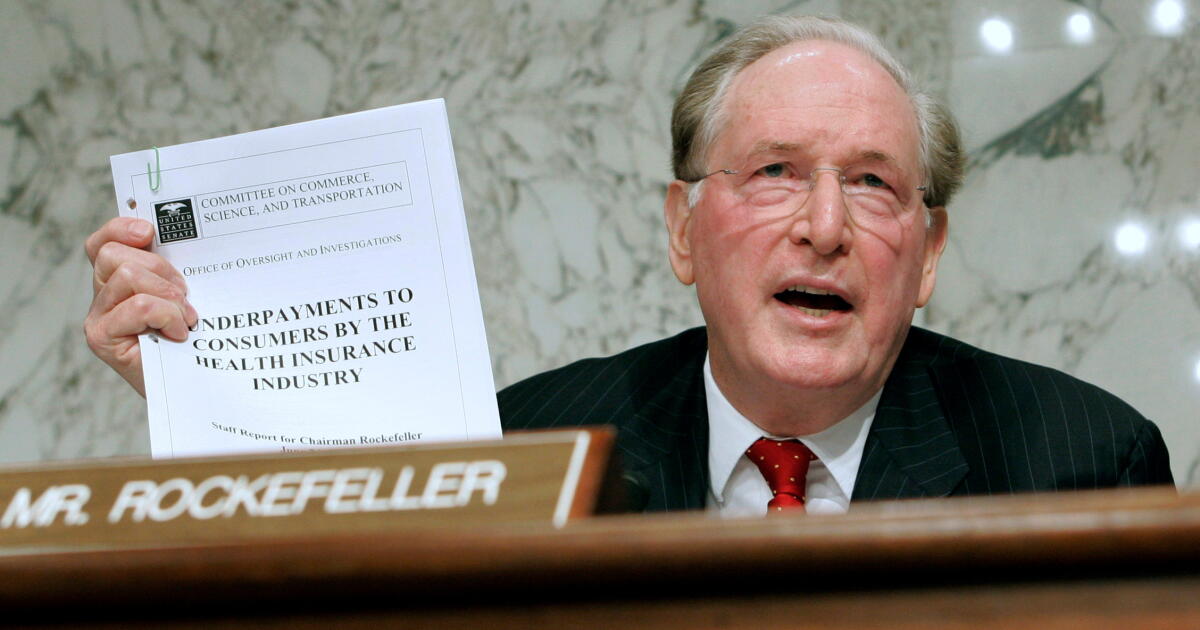
Jay Rockefeller, the last member of his family’s political dynasty — and the only Democrat — who served as West Virginia’s governor and later a longtime U.S. senator, has died. He was 89.

Rockefeller died Thursday night at his home in Washington, said Mary Stewart, vice president for external affairs at WETA, the public broadcasting station where Rockefeller’s wife, Sharon, serves as president and CEO.

Rockefeller came from one of the nation’s richest families to spend a half century in public service in one of the poorest states. He arrived in 1964 as a worker in an anti-poverty program, was elected governor a dozen years later and served two terms, then spent 30 years as a U.S. senator.

“I could not imagine a more rewarding career,” Rockefeller said upon his retirement in 2015.

He was born John D. Rockefeller IV in New York City. His great-grandfather, Standard Oil Co. founder John Rockefeller, died a month before Rockefeller’s birth. His father, John D. Rockefeller III, was a well-known philanthropist. Uncles Winthrop (Arkansas) and Nelson (New York) were Republican governors. Another uncle, David Rockefeller, ran Chase Manhattan Bank.

Jay Rockefeller went in a different direction.

A few years out of college at age 27, Rockefeller moved to the West Virginia mining community of Emmons to participate in the Volunteers in Service to America program, a time that Rockefeller said proved transformative.

“It explains every policy I pursued and every vote I have cast. It was where my beliefs were bolted down, and where my passions met my principles,” he said in an emotional farewell speech from the Senate floor on Dec. 4, 2014.

While he intended for his stay in the state to be brief, Rockefeller broke from his family’s Republican tradition and was elected to the state House of Delegates as a Democrat in 1966. By combining money with hard work in a traditionally Democratic state, Rockefeller overcame suspicions of political opportunism and rose from state legislator to secretary of state to governor.

A turning point came after Rockefeller’s only political defeat in the 1972 governor’s race to Republican Arch A. Moore Jr., whose daughter, Republican Shelley Moore Capito, was elected in 2014 to Rockefeller’s Senate seat upon his retirement.

After the defeat, Rockefeller remained in West Virginia, a decision he called the most important of his career. He became the first without a theological degree to become president of West Virginia Wesleyan College in 1973. His popularity there — and a change in his stance to embrace strip mining — translated to a landslide win over Republican Cecil Underwood in the 1976 governor’s race.

As governor, Rockefeller emphasized development of the state’s infrastructure, such as roads, sewers and bridges. Those issues, he said, are “not very sexy things, I grant you but very, very necessary in West Virginia.”

After Rockefeller defeated Arch Moore in a rematch in 1980, he won a U.S. Senate seat in 1984 after the retirement of longtime Democrat Jennings Randolph. It came despite a landslide victory that year for Republican President Ronald Reagan.

Rockefeller and his wife, Sharon, daughter of former Republican Sen. Charles Percy of Illinois, fit easily into the capital’s social scene, purchasing a multimillion-dollar estate for their family. Never shy or apologetic about using his inherited $150 million fortune to win his races, he spent millions upon millions from his own pocket. He won by comfortable margins in each of his five terms.

Rockefeller’s vast wealth was always a source of conversation and an undercurrent in his political races. He spent at least $21 million of his own money in his political campaigns, including $9 million to win a close 1984 Senate race against Republican novice and fellow multimillionaire John Raese. In Rockefeller’s 1980 gubernatorial race against Republican Arch Moore Jr., bumper stickers appeared saying: “Make Him Spend It All, Arch.”

The state’s junior senator for 25 years, Rockefeller carved his own path of influence in Sen. Robert C. Byrd’s immense shadow. Byrd died in 2010 as the longest-serving senator in U.S. history, winning an enduring reputation for steering billions of dollars over many decades to boost his impoverished state.

Rockefeller’s influence was less showy. As chairman of the Senate Committee on Commerce, Science, and Transportation, he championed consumers’ rights, upgrading broadband infrastructure and sponsoring a bill to block companies from tracking online activity of their customers. He authored legislation in 1997 that created the Children’s Health Insurance Program, which assists poor families whose incomes are too high to qualify for Medicaid.

He also was head of committees on Veterans Affairs and Intelligence, frequently sparring with President George W. Bush over foreign policy. Rockefeller said he regretted his 2002 vote to authorize the war against Iraq.

But Rockefeller also differed with the Democratic administration of President Barack Obama over mining-related regulations. With his state the nation’s second-biggest coal producer, Rockefeller was among several West Virginia officials who opposed the Obama-era Environmental Protection Agency’s oversight of the mountaintop removal method of surface mining.

College studies in Tokyo laid the groundwork for Rockefeller’s efforts to bring business from Japan to West Virginia. He had known Toyota’s founding family since the 1960s and was instrumental in helping the Japanese automaker pick a Buffalo, West Virginia, cornfield for an engine parts plant in 1996. The $2 billion plant now employs about 2,200 workers.

Raby writes for the Associated Press.
Source link

District of Columbia and Virginia sue to block Trump’s triumphal arch plans | Donald Trump News

The District of Columbia (DC) and the state of Virginia have filed a joint lawsuit to halt the construction of a large triumphal arch sought by United States President Donald Trump.

Filed on Saturday, the lawsuit denounces the project as “flagrantly unlawful” and “legally indefensible”.

Recommended Stories

list of 3 itemsend of list

It calls on the federal court system to bar construction before it starts.

Otherwise, the lawsuit warns, Trump could claim that pausing construction already under way would pose a national security risk, as he has done with other controversial projects in the past.

“This is not the first time that Defendants have rushed to dramatically remake the District too quickly for courts to intervene,” the lawsuit reads. “This Court should not allow this effort to escape judicial scrutiny.”

Saturday’s complaint brings the total number of lawsuits against the arch to three.

Trump has championed the prospect of building a triumphal arch, similar to the Arc de Triomphe built in Paris during Napoleonic times.

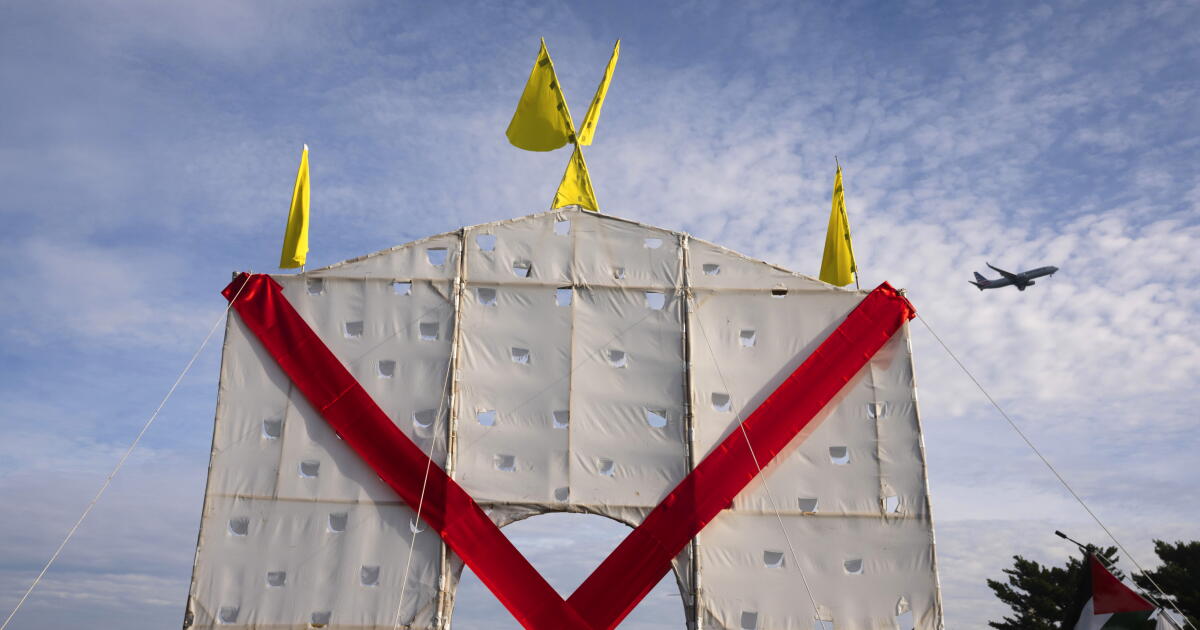
Trump’s arch, however, is designed to stand 30 metres (100 feet) taller than the Statue of Liberty. It would tower from the Memorial Circle in Washington, DC, at 76 metres (250ft).

That colossal scale has prompted outrage, particularly from veterans’ groups who fear the arch would block views of Arlington National Cemetery, a hallowed military grave site.

White House officials maintain that ground could be broken as early as next week, on or around November 5.

On Friday, the administration unveiled a 106-page proposal for the arch to be a 12-storey megastructure, featuring a winged bronze statue of Lady Liberty lifting an eternal flame.

The arch would include two mezzanines and an observation deck with panoramic east-west views, as well as programme spaces, offices and a “fire command centre”.

Trump has previously said the arch would double as a military hub with snipers and drone capabilities.

Construction on the arch would also result in significant traffic changes in the area, including rerouting traffic to nearby roads.

In Saturday’s lawsuit, Attorneys General Brian Schwalb of Washington, DC, and Jay Jones of Virginia pointed to the project’s disruptive footprint as a major concern.

“As soon as defendants break ground on this project, they will inflict irreparable harm on both the District and Virginia,” the lawsuit said.

It warns that the anticipated three-year construction project will stymie commuter traffic, slow down emergency vehicles and generate significant pollution, including “stormwater runoff into the Potomac”.

The lawsuit calls on the court to force the Trump administration to get congressional authorisation before any construction can begin.

The new legal challenge comes on the heels of an October 8 filing by Arlington County, which was the first governmental body to mount a legal action against Trump’s planned monument.

In that lawsuit, the county’s governing board argued that the project would cause “significant harm” to its residents and likely require changes to nearby flight paths.

The first complaint came in February, when a group of Vietnam War veterans and an architectural historian launched an effort to stop the arch.

District Judge Tanya Chutkan is overseeing that case, and she is weighing whether to issue a preliminary injunction to temporarily freeze any construction plans while the court hears arguments.

At a hearing on Friday, Chutkan deferred an immediate ruling but signalled that she would be issuing a decision expeditiously.

She previously ordered the administration to give the court 48 hours’ notice before undertaking any activities related to the construction of the arch.

The monument has already received early approval from the US Commission of Fine Arts, whose members were all tapped by Trump.

Source link

Powerful Democratic Virginia state Sen. Lucas is accused of leading a marijuana criminal conspiracy

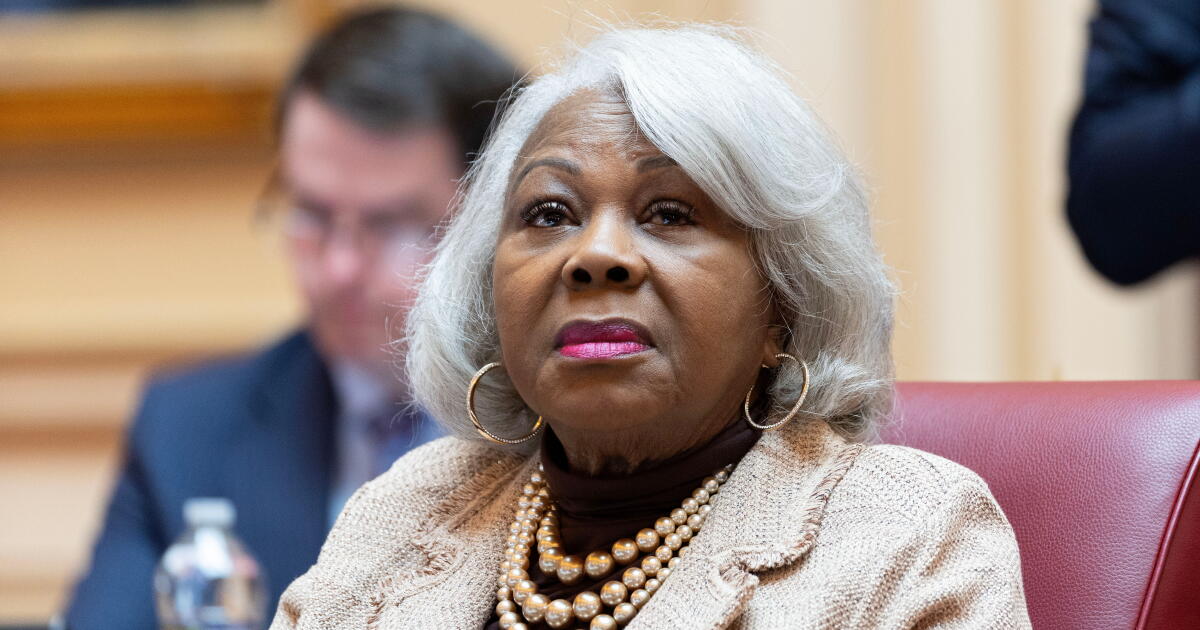
Virginia state Sen. L. Louise Lucas, one of the state’s most powerful Democrats, was charged Thursday with leading what authorities alleged was a wide-ranging criminal enterprise that acquired and distributed large quantities of marijuana and laundered the proceeds.

Lucas, who has been in elected office for decades, used her political power to insulate the operation from scrutiny, according to an indictment charging her and six other defendants, including several of her relatives. She “put her own financial interests before the people she was elected to serve,” said U.S. Atty. Gen. Todd Blanche, who spoke at a news conference with FBI Director Kash Patel.

Lucas surrendered, the Justice Department said. She made a brief appearance in federal court on Thursday afternoon, where she was released on her own recognizance, according to court records. She left the court without addressing media gathered outside and went straight into a waiting vehicle.

The charges, including drug trafficking and money laundering, came after the FBI searched Lucas’ hometown office and a cannabis shop in which she has a stake in May. At the time of the search, Lucas — who has been a vocal critic of Republican President Trump’s administration — characterized it as an attempt to intimidate her.

“This is the circus we always expected it to be,” said Brian Woolfolk, chief counsel for the L. Louise Lucas Legal Defense Fund.

Lucas says she won’t be bullied by the federal government

A statement attributed to Lucas posted on her social media account did not directly address the substance of the charges but said Thursday’s actions amounted to the federal government wielding its “full weight” against a great-grandmother.

“I will not be intimidated. I will not be bullied. And I will not back down,” Lucas said in the statement.

The brash 82-year-old lawmaker has spent decades ascending the ranks of Virginia politics and has served since 1992 in the state Senate, where she’s the president pro tempore, overseeing the chamber in the lieutenant governor’s absence. More significantly, she leads the powerful Senate finance committee, through which all legislation with any budget impact must flow. She’s used the position to kill legislation she opposes.

Justice Department denies politics played a role

The indictment comes as Trump’s Justice Department has faced intense scrutiny over investigations and prosecutions against foes of the president that critics have called politically motivated.

Blanche rejected any suggestion politics played a role in Lucas’ case, noting the investigation began well before the second Trump administration started in January 2025.

“We don’t do political paybacks,” Blanche told reporters.

A person familiar with the May search told the Associated Press at the time that the probe was opened during Democratic President Biden’s administration. The person spoke on condition of anonymity to discuss a continuing criminal investigation.

FBI alleges a ‘criminal marijuana enterprise’

Patel said in a statement that “Lucas and a close-knit group of family members and associates orchestrated a multi-year scheme to enrich their own criminal marijuana enterprise, ‘the Lucas Enterprise’ — using Lucas’ position as Chairwoman of the Senate Finance and Appropriations Committee to insulate the enterprise from criminal scrutiny and influencing legislation to financially benefit themselves.”

The indictment describes Lucas as the “leader of the enterprise” who “approved and directed criminal activities,” including arranging for the acquisition and distribution of marijuana and supervising the laundering of the proceeds.

The indictment alleges Lucas worked this year with another of the defendants to use her political position to obtain a recreational marijuana license for him, with the understanding that the proceeds from sales under the license would be shared with her to support the “enterprise.”

Since 2021, marijuana has been legal to possess in Virginia, and many shops across the state have sold cannabis-derived products. But full recreational sales are not yet underway; legislation enacted earlier this year will allow them beginning in July 2027.

Law enforcement made multiple controlled purchases of marijuana from Lucas’ shop, which purported to sell hemp products, in 2024 and 2025, the indictment said.

In addition to drug and money laundering charges, Lucas faces a charge of racketeering conspiracy, conspiracy to commit honest services fraud and maintaining a drug-involved premises. An arraignment is scheduled for next month.

Among the other defendants who face a mix of those and other charges are two daughters of Lucas and a grandson. It was unclear if they had obtained legal representation. They were also scheduled to make an initial court appearance Thursday afternoon.

Virginia officials react

A forceful advocate of legalizing marijuana, Lucas partnered in opening the shop, The Cannabis Outlet, in 2021. She has publicly spoken about her ownership stake as recently as June, though her most recent financial disclosure forms do not list the business by name.

At the time of the search — when marijuana was recovered at The Cannabis Outlet, according to the indictment — many Democrats spoke up to defend Lucas.

On Thursday, Scott Surovell, the Democratic leader of the state Senate, said in a statement that the indictment contained “serious allegations” but emphasized that “Senator Lucas has the right to defend herself, and she has my full support as she does so.” Atty. Gen. Jay Jones, a Democrat who is close with Lucas, said the allegations against her must be tested in a “full and fair” legal process.

House Speaker Don Scott, Lt. Gov. Ghazala Hashmi, and Gov. Abigail Spanberger, all Democrats, echoed those sentiments, with Spanberger adding that the timing of the indictment so close to the midterm election would “further erode” Americans’ trust in the Justice Department. Lucas herself is not on the ballot this year.

Ryan McDougle, the Senate Republican leader, said he would not comment while the court proceedings play out.

The senator draws comparisons to Trump

Lucas, who represents a district that includes her hometown of coastal Portsmouth, operates with a sometimes-profane, unapologetic style that’s drawn comparisons to Trump.

She amassed a six-figure following on X and national attention, using the social media platform to advocate forcefully for her priorities and to bash her critics, including former GOP Gov. Glenn Youngkin. She’s also occasionally blasted members of her own party, including Spanberger, with whom she’s had disagreements.

Earlier this year, Lucas helped lead Democrats’ ultimately unsuccessful plan to gerrymander the blue-leaning state’s congressional districts into a map intended to elect 10 Democrats and only one Republican. Along the way, she posted quips about four GOP members the intended map sought to oust, joking that they soon would be working at McDonald’s. She and other Democrats defended the maps as a reasonable response to Trump-backed efforts to boost the GOP’s midterm advantage in other states.

Lucas has been in politics for decades

Lucas has notched several historic firsts in her career. According to a biography from the state library, in 1971 she became the Norfolk Naval Shipyard’s first female shipfitter, a physically demanding job that involves working on metal assemblies for vessels.

She launched her political career in 1984, when, the biography said, she became the first Black woman elected to the Portsmouth City Council.

In the state Senate, Lucas has been a staunch advocate for abortion rights and increased public school funding and a leading voice on issues of racial justice and civil rights.

In 2019, after Democrats flipped control of the chamber, her peers elected her to serve as president pro tempore. And in 2024, she was tapped to lead the chamber’s budget committee, gaining enormous sway over any legislation tied to the state budget.

Richer and Rankin write for the Associated Press. Richer reported from Washington and Rankin reported from Richmond, Va. AP journalists Eric Tucker in Washington and Steve Helber in Norfolk, Va., contributed to this report.

Source link

Trump’s memorial arch faces a new lawsuit from Arlington County, Virginia

The Arlington County Board in Virginia filed a lawsuit Thursday opposing the construction of the Triumphal Arch, becoming the first governmental body to take legal action against President Trump’s planned monument.

The lawsuit, filed in the Eastern District of Virginia, criticized the speed at which the project slated for Memorial Circle has moved without going through the full review process.

“The National Park Service, the agency responsible for projects on national park land such as Memorial Circle, is proceeding full-speed toward ground-disturbing construction,” the lawsuit said. “Although the agency has claimed that a final decision to construct the Arch has not yet been made and purports to be engaged in a routine decisional process, that rushed process appears to be a pretext designed to shore up justifications for building the Arch in accordance with the President’s repeated marching orders.”

The lawsuit asks that “the agency’s feverish pace toward construction of the arch” be halted to ensure that the requirements of the National Environmental Policy Act be followed and proper analysis and testing be done.

“The Arlington County Board has filed this lawsuit because our community has the most to lose from this egregious and unlawful proposed project,” Arlington County Board Chair Matt de Ferranti said in a statement. He added that the county has acted in good faith in the review process, pointing out the “severe, unique, and wide-ranging negative impacts” the project will have on the county and its residents, only to see them ignored.

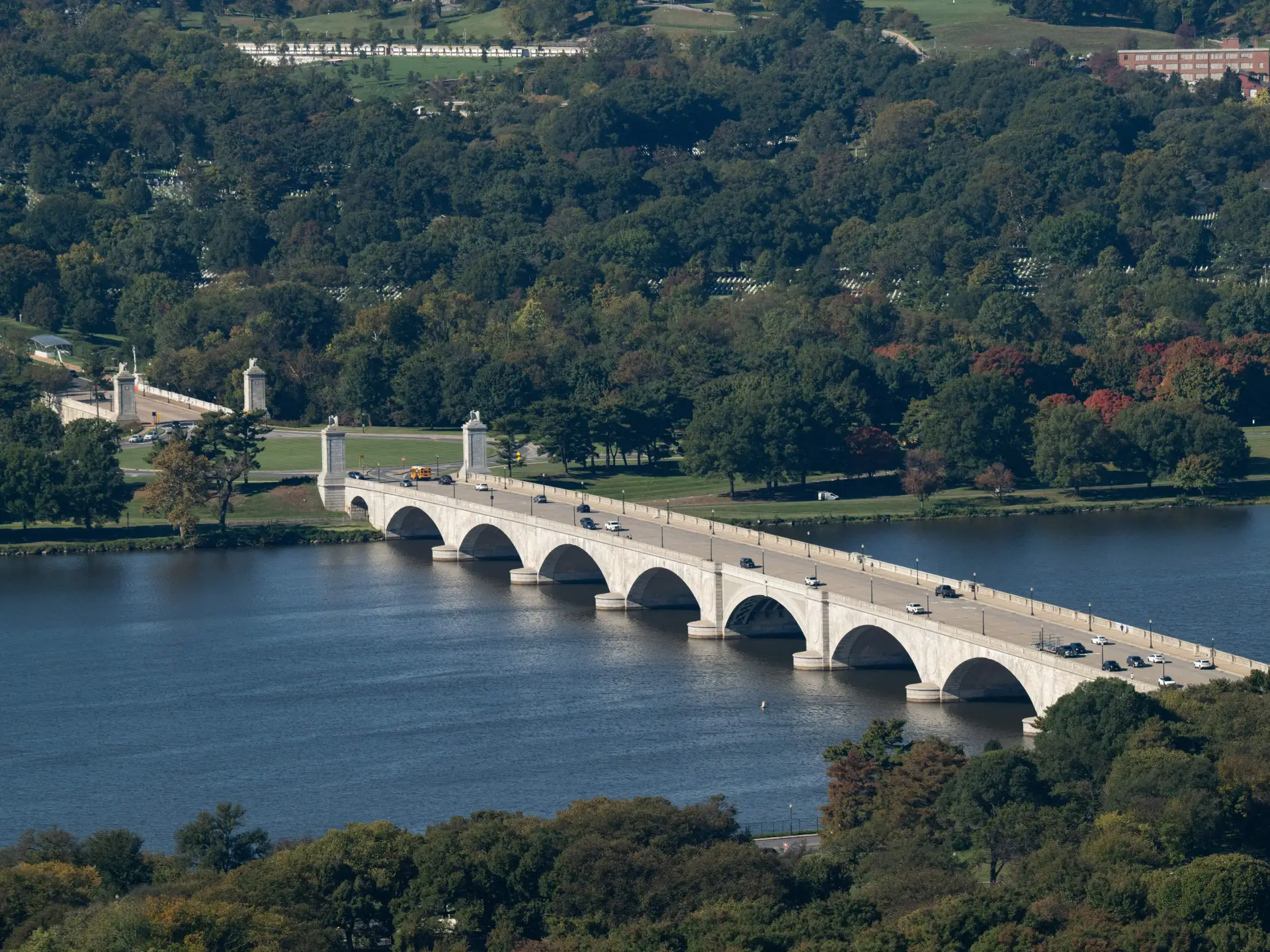
Memorial Circle sits on federal parkland west of the Potomac River across the Memorial Bridge and immediately adjacent to Arlington County.

The county is being represented in the lawsuit by legal advocacy group Democracy Forward.

White House spokesman Davis Ingle said the Trump administration and White House have been “fastidiously compliant with all procedural and legal requirements and are certain this meritless and dilatory lawsuit will be dismissed.”

The arch will become one of the world’s most iconic landmarks, he added. “It will enhance the visitor experience at Arlington National Cemetery for veterans, the families of the fallen, and all Americans alike.”

The lawsuit came a day after the Association of Flight Attendants-CWA President Sara Nelson expressed concerns that the 250-foot arch compounds multiple safety issues that she said have gone unaddressed since a deadly January 2025, crash over the Potomac River that killed 67 people. Nelson also criticized Trump’s plan to turn the arch into “a top grade military complex” able to host drones and snipers while storing ammunition.

Though the arch has received early approval from the U.S. Commission of Fine Arts, whose members were all tapped by Trump, a group of three veterans and an architectural historian sued in federal court in Washington, D.C., saying the project needs to be approved by Congress. The judge in that lawsuit said the administration must give the court 48 hours before undertaking any activities related to or in preparation for construction of the arch.

The arch is one of several projects around Washington that Trump has undertaken as he remakes the city, from renovating one of its storied public golf courses to threatening to demolish the John F. Kennedy Center for the Performing Arts.

Fields writes for the Associated Press.

Source link