Croatia’s World Cup was seconds away from being over and Portugal was seconds away from the round of 16 when Ivan Perisic sent a long, desperate cross into the penalty area. The ball bounced off bodies like a pinball before magically, unbelievably, caroming into the net.
Gooooooallllllll!!!!
Fate had given Croatia a reprieve.
But as pandemonium broke out in the stands and on the pitch, Norwegian referee Espen Eskas stood in the middle of the celebration in Toronto, hand to his ear, listening to a voice half a continent away in Dallas.
So Eskas trotted over to a TV monitor, watched a video replay over and over again, and more than 2½ minutes after the goal was recorded, he took it off the board. Perisic’s cross had brushed the hair of teammate Igor Matanovic, leaving Mario Pasalic in an offside position when the ball reached him near the far post. The contact was imperceptible to the naked eye, but a space-age sensor in the ball had confirmed it.
A VAR review led a referee to overturn a Croatia goal during its 2-1 World Cup loss to Portugal in Toronto, eliminating Croatia from the tournament.
(Dan Mullan / Getty Images)
Croatia’s World Cup was over, another victim of VAR, which has had an outsized influence on this summer’s tournament.
It wasn’t supposed to be this way. When VAR was introduced to soccer nine years ago, its mission was clear: to alert the head referee to potential clear and obvious errors or serious missed incidents. At least that’s what Major League Soccer, one of the first leagues to use the system, wrote in the news release introducing it.
“It was really to stop the headlines,” said Mark Geiger, who helped implement VAR as an MLS referee. “These super-egregious errors in a game that impact the outcome. The mantra for VAR was always minimum interference but maximum benefit.”
Under the VAR system, officials sitting before a bank of monitors in a centralized control room review match footage in real time and advise the on-field referee of potential errors. If the video assistant referees believe a mistake has been made, they communicate that through an earpiece the match referee is wearing. If the match official agrees, they will stop play, signal a review by motioning their hands in the shape of a rectangular TV screen, then watch the play themselves on a pitch-side monitor before either confirming or reversing the original decision.
It is comparable to the Automated Ball-Strike review added this year in Major League Baseball, tennis’ Hawk-Eye line-calling system and long-standing centralized instant replay review in the National Football League and National Basketball Assn., systems that have both corrected errors and stoked debate.
But VAR has morphed into something far greater. In this World Cup, there have been more than 100 VAR interventions, encompassing both confirmed on-field calls and overturned decisions, through the end of the round of 16, according to Antonio Vuksanovic, a publication relations and communications professional at Sofascore, a Croatian technology company and sports statistics website.
“When it comes to actual overturned decisions, we’re looking at roughly 0.5 per match, which is higher than the last World Cup and higher than what we saw across the most recently completed club season,” Vuksanovic said.
Even though the officials have gotten most of those calls right, many of the infractions reviewed have been so imperceptible yet so consequential, it has raised a question: if human error on the part of players and coaches is part of the sport, is allowing a game to be decided by electronic evidence of a touch detectable only through NASA-level technology violating the spirit of the game?
Iran’s Shoja Khalilzadeh shoots past Egypt’s Mostafa Shobeir, but the goal was overturned after VAR review during a World Cup match in Seattle on June 26.
(Maddy Grassy / Associated Press)
Christina Unkel, a former FIFA referee, state referee administrator in Florida and a rules of the game analyst for multiple TV networks, believes it does.
“Football is an art. And that’s why we love it,” she said. “It truly isn’t the referee’s fault. We’re not the ones seeking more advanced technology. We don’t want to look like robots out there. But the stakeholders are like ‘more, more, more.’
“When you do pursue black and white — objectivity is what they’re trying to get to, and I get it; they want to eliminate as much subjectivity as possible — what everyone is hating is this perfection thing.”
FIFA, the major stakeholder in the World Cup, declined multiple requests to answer questions about the officiating, but it has clearly doubled down on the technology for this tournament, introducing the semi-automated offside system which uses player-tracking cameras, computer-generated offside lines and, in some cases, data from a measuring instrument inside the match ball, to identify everyone’s position on the pitch when the ball is played.
“The whole genesis of VAR was not to fix every mistake or to make the referees perfect,” said Geiger, the first American to officiate a World Cup knockout game and now general manager of the Professional Referees Organization (PRO), which oversees referees for MLS and the NWSL. “Is the referee correct? That’s not the right question. They should be asking themselves, ‘is the referee clearly and obviously wrong?’”
Geiger, however, remains a huge proponent of the system and was careful not to criticize how it’s been used in this World Cup.
Belgium’s Youri Tielemans on a penalty kick that sails by Senegal goalkeeper Mory Diaw during a World Cup round of 32 match in Seattle on July 1. The game-deciding penalty kick was awarded after VAR review.
(Manu Fernandez / Associated Press)
Still, the frequent use of VAR and other technologies has clearly robbed the World Cup of much as its drama, with spontaneous celebrations of game-winning goals turning to grief moments later when the referee steps away from the monitor and takes away a score.
Reviews not only ended Croatia’s tournament, but they showed Shoja Khalilzadeh was a toe offside when he scored the goal that would have sent Iran to the knockout stages, one of three goals Iran had disallowed by VAR in the tournament; it gave Belgium a late penalty, based on light contact, that Youri Tielemans converted to end Senegal’s World Cup; and it cost Egypt a goal for a perceived foul that took place nearly 100 yards away from the ball in its 3-2 loss to Argentina.
“What happened to us wasn’t fair,” Egypt coach Hossam Hassan said.
Unkel agreed with that sentiment too.
“Everyone hates it,” she said. “According to VAR, that’s correct to take that goal away. That’s not the spirit of the game. But it’s the correct decision by law.”
What Unkel would prefer — and she believes a majority of officials are on her side — is for referees to have discretion to ignore or even overrule VAR if common sense and their understanding of the game suggest they should, just as judges have discretion to use common sense in applying the law.
“A lot of our game, the majority of it, is very subjective,” she said. “When we’re all sitting there saying, ‘No, that doesn’t gain an unfair advantage,’ then that’s when we have to start reconsidering things back to the spirit of the law. That’s the catchall loophole for saying, ‘Do we want this to be part of our game?’
“And I think everyone’s universally saying there a lot of different kinds of decisions we do not want part of our game. Toenail offsides, hair follicle arguments.”
Without the use of video replays, its unlikely any of those calls would have been made and the World Cup quarterfinals would probably look quite different.
England players react as referee Alireza Faghani shows a red card to England’s Jarell Quansah during a World Cup match against Mexico on July 5.
(Natacha Pisarenko / Ap Photo/natacha Pisarenko)
England coach Thomas Tuchel, upset about a penalty call on captain Harry Kane and a red card given to defender Jarell Quansah, both following video reviews in his team’s round-of-16 win over Mexico, said rulings were being overturned in the tournament “in a very questionable way.”
“The referees can send any team out in any moment,” he added. “It’s just not good enough. It’s just erratic. It’s just unreliable.”
An apparent misuse of the technology also led to the most controversial incident in the tournament. In the second half of an elimination game between the U.S. and Bosnia-Herzegovina, American Folarin Balogun stomped on the ankle of Bosnia’s Tarik Muharemovic, something Brazilian referee Raphael Claus initially decided did not merit even a caution. But after VAR official Juan Soto of Venezuela urged him to watch a replay, Claus flashed a red card at Balogun, expelling him from the game and banning him from the next match in the round of 16.
Claus had watched the replay in slow motion, allowing him to see what wasn’t apparent at game speed. FIFA later intervened by lifting Balogun’s one-game suspension, igniting ever greater controversy because it was just the second time that has happened in a World Cup.
U.S. forward Folarin Balogun steps on Bosnia-Herzegovina defender Tarik Muharemovic’s foot and received a red card after VAR review during the World Cup.
(Robert Gauthier/Los Angeles Times)
The heavy use of VAR has also interrupted the flow of games by halting matches that weren’t meant to be halted, leaving everyone standing on the field while the referee goes off to watch TV, sometimes for minutes at a time.
“When calls are reviewed and when goals are reviewed, sometimes it could take away from the momentum,” U.S. defender Chris Richards said. “Look under anything with a microscope, you could probably find something. But ultimately it was meant to be helpful for the game.”
And it has been. Because if officials have become over-reliant on VAR to review decisions that were not, or could not, be seen in real time, at least they’re getting those decisions right.
“I wish we had it in the 2002 World Cup,” said Bruce Arena, who coached the U.S. in that tournament. “We might have made it to the semifinals.”
In the quarterfinals of that tournament, with Germany leading 1-0 in the 40th minute, an obvious handball by Germany’s Torsten Frings kept out a shot from American Gregg Berhalter. If VAR had been available, Scottish referee Hugh Dallas could have corrected the missed call, awarding a penalty and giving Frings a red card, expelling him for the final 40 minutes.
“Look at every sport now in the world,” said Arena, coach of the San José Earthquakes. “They have some version of VAR. Why not make decisions correct?”
“There are still plenty of opportunities for the referees to control the game and make mistakes and not make mistakes,” he continued in reference to the human element. “It’s not like every moment is evaluated. But key moments are.”
As for interrupting the flow of play, Arena says the three-minute hydration breaks FIFA has introduced each half — ostensibly for player welfare, but in practice to give the TV networks additional commercial breaks — have been more disruptive.
“You don’t want VAR to officiate the game completely,” Arena said. “You have to pick your spots. For the most part, I think VAR is good.”
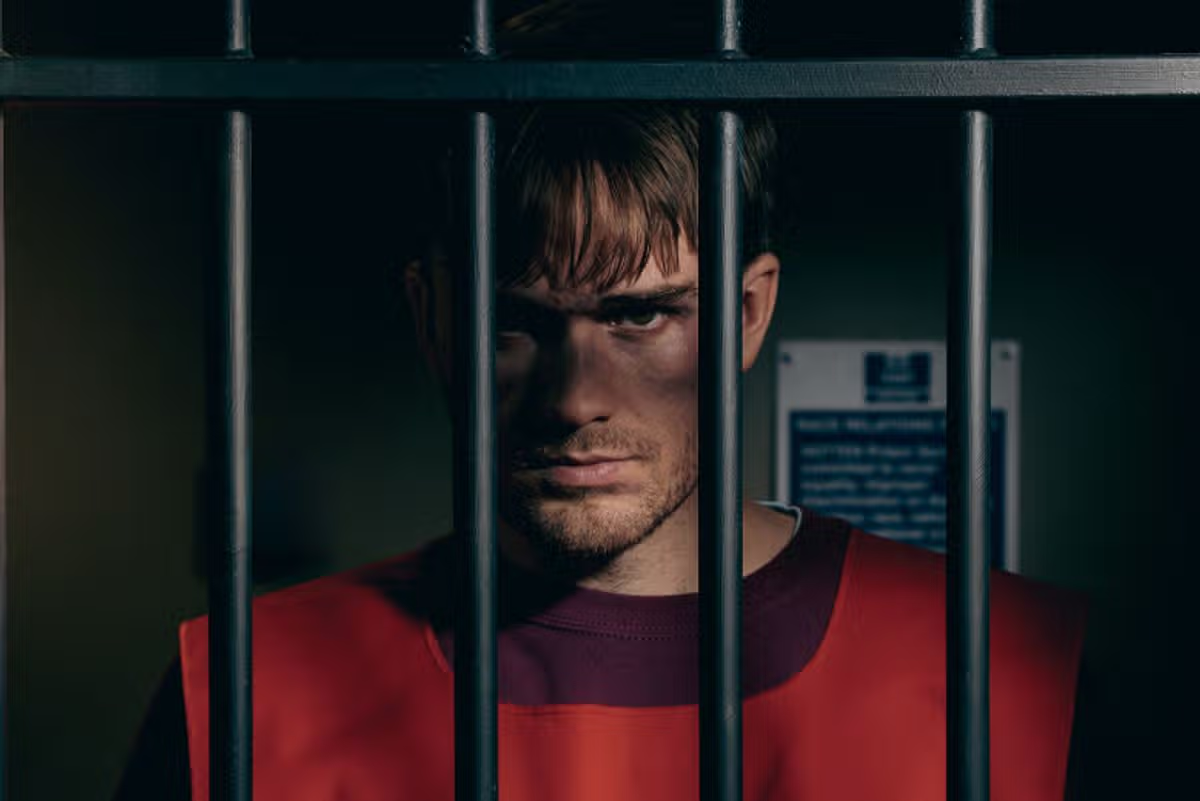
Gray Atkins has made a return to EastEnders as Toby-Alexander Smith reprises his iconic villainous role. He was last seen in the Square back in 2022
Gray Atkins has made a return to EastEnders(Image: CREDIT LINE:BBC/Jack Barnes/Kieron McCarron)
Gray Atkins has made a return to EastEnders as Toby-Alexander Smith reprises his iconic villainous role.
The villain was last seen in Albert Square in 2022 when he was sent to prison for murdering Chantelle Atkins, Kush Kazemi and Tina Carter. The serial killer has not been seen since, with Toby-Alexander Smith now reprising his role for a short stint.
Speaking about his return, he said: “It’s been very surreal returning to EastEnders and stepping back into Gray’s shoes.
“He’s one of the most complex characters I’ve had the opportunity to play and revisiting him after several years has been an exciting challenge to get my teeth into. Exploring who Gray is now has been, fascinating, and I’m excited for the audience to see this version of him and watch the storyline play out.”
Gray is currently serving a life sentence in prison but needs the help of his grandmother Sheila (Sheila Ruskins) to get close to ex-wife Chelsea Fox after Jordan’s harrowing accident.
With motives still unclear, there’s trouble ahead but what does Gray want?
Ben Wadey, EastEnders Executive Producer, added: “We’re delighted to welcome Toby-Alexander Smith back to the role of Gray Atkins. Although his character remains in prison, it will soon become apparent to viewers that Gray’s physical separation from Walford is no match for his levels of manipulation.”
However, some fans have been left puzzled by his return and connection to Sheila.
“It’s weird to me how they made it seem like Sheila was still in contact with gray with the way she was stroking his photo in her wallet like she kept in contact with him even though he murdered 3 people. But then when we actually see gray he says she hasn’t visited him in the 4 years he’s been locked up,” one fan wrote.
A second added: “I was a bit confused by this. I thought they would be building toward a story where she’s a bit obsessed and thinks that he’s done nothing wrong. Maybe under his spell, doing what he wants, and maybe seeing him in Jordan. Instead, it seems more like she just wants her grandkid and is going to use him to help her along.”
A third shared: “This confused me too. The impression I got is that they were always in contact and maybe she was going to try and convince Chelsea to let Gray his child. Sheila trying to get Gray to get Chelsea to let her see the kid is strange.”
In China, Elon Musk has gained both admiration and criticism. While he is seen as a visionary, he has faced scrutiny from regulators and the public due to issues with customer complaints. The success of Musk’s SpaceX and its Starlink satellite service has also led to concerns from the People’s Liberation Army, especially as Tesla faces growing competition from Chinese electric vehicle (EV) manufacturers, which threatens Musk’s standing in the market.
Musk recently attended a summit in Beijing with U. S. President Donald Trump, alongside other CEOs like Tim Cook and Jensen Huang, focusing on resolving business issues with China. After a formal welcome, Musk expressed his desire to achieve “many good things” in the country. At the same event, Xiaomi’s CEO Lei Jun, an admirer of Musk, took a selfie with him, which became popular on social media, showcasing the public’s interest in Musk.
Despite facing competition on technology and pricing from local companies, Musk and Tesla remain influential in China. Experts note that Musk’s business goals align with China’s technological priorities, including electric vehicles, AI, and advanced robotics, making Tesla’s self-driving technology the standard in the industry. In 2018, Tesla became the first foreign automaker permitted to operate in China without a local partner, and its sales in the country reached about 626,000 vehicles last year, contributing significantly to its revenue.
Other Chinese carmakers, like Chery, draw inspiration from Tesla’s focus on innovation, blending it with Toyota’s emphasis on quality. However, Musk’s other ventures, particularly SpaceX, provoke concern among Chinese military and government officials due to its dominance in satellite communications, especially in light of geopolitical tensions, hinting at efforts to develop domestic alternatives.
Though Musk’s social media platform, X, is banned in China, he has a significant following on Weibo and has been celebrated as a global icon in the country. His recent visit pertains to an attempt to purchase $2.9 billion in solar manufacturing equipment from Chinese suppliers, although this may be affected by China’s potential export restrictions on advanced technologies to the U. S.
Musk’s company is also seeking regulatory approval for more advanced self-driving technology. However, his relationship with China has been delicate, particularly when Tesla faced backlash in 2021 over its handling of customer complaints, highlighted by a public protest at an auto show. Additionally, Teslas were previously banned from military areas due to security concerns.
Looking ahead, organizations believe that Tesla’s standing might challenge Musk’s popularity in China as local companies continue to progress. However, he is likely to remain an influential figure in China’s tech scene for his achievements in the automotive and technology industries.
This story includes spoilers for Episode 8 of “Daredevil: Born Again” Season 2.
By the end of “Daredevil: Born Again’s” first season, showrunner Dario Scardapane knew they were heading toward Matt Murdock’s big reveal in Season 2.
The second season finale of the Marvel series, out now on Disney+, sees Murdock (played by Charlie Cox) declare to the world that he’s the vigilante Daredevil.
“Coming in with Season 1, I wish I could say I knew exactly where we were going,” says Scardapane during a recent video call. “But I knew that moment in the courtroom where Daredevil outs himself, we were definitely heading towards that.”
Iain B. MacDonald, who directed Episodes 7 and 8, said that everybody involved understood that it “was going to be a super significant moment” while they were filming the scene.
“When that’s out, that’s out,” MacDonald says. “That moment clearly has a domino effect for the rest of the episode. … I’m super excited to just to see how that’s received by the fans … because as a director, you want to deal with big moments in what you direct, and that is, for me, one of them.”
A continuation of Netflix’s “Daredevil,” which initially concluded in 2018, “Born Again” has followed Wilson Fisk’s (Vincent D’Onofrio) rise from criminal kingpin to the supposedly reformed mayor of New York. Fisk’s authoritarian tactics and campaign targeting vigilantes pushes Daredevil underground to try to assemble allies in order to bring the Kingpin down.
Matt Murdock (Charlie Cox) returned to the courtroom to make his case.
(JoJo Whilden / Marvel)
Their much anticipated showdown occurs in a courtroom in the season finale during the trial of Karen Page (Deborah Ann Woll).
“Myself and my DP [director of photography], Jeffrey Waldron, looked at a lot of courtroom dramas, just to really think about how we can tell those courtroom stories really well, and do it creatively and imaginatively … and in the language of ‘Daredevil,’ ” said MacDonald. “It was a challenge, for sure, [but] I really, really enjoyed shooting them.”
While Murdock may have triumphed in the courtroom, his revelation has consequences as teased in the episode. Scardapane says those consequences will be explored in Season 3.
“That last scene in Season 2 tells you where we’re going,” says Scardapane. “If the question is, are we doing a specific comic book run that is beloved by all, including me, I think that it’s pretty obvious what we’re doing in that last scene.”
The fallout for Murdock, as seen in the episode, is his arrest and imprisonment. In the final moments of the finale, the Man Without Fear is shown getting locked up at Rikers Island. Murdock appears to have accepted his fate, but a glimmer of smile hints that this is not the end of his story.
“Charlie and I talked about [the scene], and we knew that we wanted to end on that close-up of his face,” MacDonald says. “He said we can do two things here, one which is like acceptance of circumstances, like he’s resigned. He has made the sacrifice of outing himself to the world about who he really is [and] he has put himself away in service of the greater good … as well as have that little moment of a hint of a smile to say, this is a beginning. This is a new adventure. This is a new challenge.”
In a conversation edited for clarity and length, Scardapane discussed Murdock and Fisk’s arcs in Season 2, “Daredevil: Born Again’s” timely political themes and what to expect in Season 3.
Karen Page (Deborah Ann Woll) and Matt Murdock (Charlie Cox) get a chance to celebrate in the “Daredevil: Born Again” Season 2 finale.
(JoJo Whilden / Marvel)
At what point did you know that what you were building toward in Season 2 would end with Matt Murdock in jail?
It’s kind of a process that snowballs. They had started before me. They were doing the Mayor Fisk run. It was much more procedural, much different tone. They did six episodes, and I came in, and we moved it more in line as a continuation of the Netflix series. When Fisk becomes the mayor of New York, you put the villain at a really, really elevated place. So, Season 1 was the rise of Fisk. Season 2 has got to be the rise of that which takes him down — the resistance.
That moment that Matt stands up in court and says, “I am Daredevil,” that’s like the record scratch. Everything has changed from this moment on. At the end of Season 1, beginning of Season 2, we knew we were heading toward that moment. That moment’s consequences, for Matt and for Fisk, are kind of the fodder for Season 3.
There are comic book runs that I shall not name — although they’ve been named — that take that dilemma that Matt put himself in and go to really great places with it. Coming in with Season 1, I wish I could say I knew exactly where we were going. But I knew at the very beginning, that moment in the courtroom where Daredevil outs himself, we were definitely heading toward that.
It felt significant that Matt and Fisk’s big showdown this season happened in a courtroom.
The fun of Daredevil since the comics started is here you have a lawyer who really believes in the justice system who goes out and breaks bones at night. He’s a vigilante lawyer. That’s such a dichotomy. When the villain takes power, when the villain is the police — this situation, the villain is the Anti-Vigilante Task Force — the villain has now become the power structure of New York and has become the justice system. How does Matt fight back? He fights back as a vigilante until it gets to a crucial moment where Karen is pulled into this flawed justice system. Now there’s nowhere he could go. He’s put in this place where both his personas have to integrate, have to kind of collide, for him to beat Fisk. I think that Charlie’s performance in that courtroom scene is his best courtroom performance in any episode of “Daredevil” ever. Building to that moment of Fisk and Matt facing off in court, it was pretty important because all four of them are in court there: Wilson Fisk, Kingpin, Matt Murdock and Daredevil are all there in that scene.
Wilson Fisk’s (Vincent D’Onofrio) ambitions are thwarted in “Daredevil: Born Again” Season 2.
(JoJo Whilden / Marvel)
Fisk, the villain, ultimately loses this battle. Can you speak a bit about his arc this season?
One of the joys of this job is working with Vincent D’Onofrio, full stop. He’s done such a good job of humanizing a monster. I don’t write Fisk as a villain. I don’t think Vincent plays him as a villain. And that’s where the fun comes in.
Building up a man whose appetite, whose isolation, whose just general hunger to dominate, making that character and then giving him this one lifeline to humanity in Vanessa — that’s all calculated. We knew in Season 1 when Foggy was killed that Vanessa was going to be the cost for Fisk. The idea that Vanessa set up Foggy to die using Bullseye, and Bullseye ended up inadvertently killing Vanessa, that was 100% in the DNA from jump. Vanessa passed away in the comic books in two different ways, but that takes Fisk now into a place where, for me, all bets are off. I think that the Fisk that Vincent is playing in Episode 6, 7 and 8 and beyond are a different animal entirely. We just finished a very special episode that is pretty much all Fisk in this new incarnation and it was pretty exciting. Vincent’s in rare form in Season 3.
I understand that the Anti-Vigilante Task Force stuff was shot before the the story and imagery became extremely timely.
It’s really strange because there’s footage in the finale that’s intentionally supposed to reflect certain events. One of the things that I really wanted to do with this story, when you’re dealing with politics and everything, is we’re living in a time where these values of mutual respect, mutual listening, mutual live and let live … what I would say, democratic values are being thrown out the window when you’re dealing with the other side. If somebody doesn’t share your beliefs, it’s free game. And I’ve never really seen a time like that. So we took that story, where the mayor’s side has no quarter for the vigilante side and the vigilante side has no quarter for the mayor’s side. When they storm the rotunda, it looks very familiar. That is intentional. I’m not going to dodge that. Because it’s the idea that everybody sees themselves as a hero of this story, where they’re treating the people on the other side horribly. There’s no lesson there. It’s just the idea that when mobs get involved, when large groups of people get involved, the higher morals and higher sense of humanity falls apart.
You’ve mentioned that in writing and filming this show, you were looking at history. But what was it like when the present started mirroring what you already made based on the past?
The sequence in Episode 2, when the bodega is raided and people are dragged away by the Anti-Vigilante Task Force, that was filmed before Los Angeles, before Minnesota — before all of it. The whole thing got really strange in that the real world started to feel cartoony, and I don’t mean that in a positive way.
I think we were, as writers and directors, tapping into an unease and a malaise that’s just out there. Having it look exactly like things that then happened on the news, that was chilling. It was really hard to get my head around it. It was hard for the people involved, the directors, the fact that some of those sequences in our show, of people being dragged away and thrown into vans, looked exactly like what we were seeing on the news.
There have been other touch points, like the affinity some Task Force officers have for the Punisher logo, that crosses from the fictional into reality.
I’ve been wrestling with this since working on “The Punisher.” The map of what you do when you want to be an autocrat: You form a militia, you empower them beyond, you target a group that you want to make scapegoats, you round them up. When Charles Soule was doing the Mayor Fisk run in the comic books, that’s what he was thinking about. S—, Tony Gilroy did it in “Andor.” When you build any kind of story about an autocrat, it follows the same script. Weirdly, the script’s now playing out outside our door, and that’s become really hard to deal with. The funny thing about this show in these times is, no matter what I say, somebody’s gonna get all like, “Oh, they put politics in our comics” and “they’re trying to teach us a lesson.” Nobody’s trying to teach you a lesson. We’re just laying out a story about a guy who’s a criminal who becomes a mayor and a guy who’s a lawyer who tries to take him down. But does that have echoes in what’s going on outside our window? Yes, it does.
There is a sect of the audience that gets very vocal about the MCU getting ”too woke” or comic books and superheroes ”becoming political.”
One thing that just broke me when we started Season 3, I posted a picture of our writers room, and it’s just some of the best genre writers in the television business. I posted it [on Instagram] and I said “so stoked to get into it with these guys.” The first comment was, “Looks like a pretty woke room. Don’t ruin the show.” How does a room look woke? Oh, so you’re looking at the makeup of the people in that room, and you’re saying that that is something you don’t like? I can’t help you [with that]. I’ve just got to go into that room and write stories.
It’s also not like superhero comic books haven’t had storylines about marginalized communities or interrogating people in power.
Guys, comic books are political. They’ve always been political. The first graphic novel that ever won a Pulitzer Prize was “Maus.”
Jessica Jones (Krysten Ritter) gets in on the action.
(JoJo Whilden / Marvel)
I think I’ve waited long enough to ask about Luke Cage, played by Mike Colter, showing up in the finale. How did all of that come together?
One of the things that I’ve said a bunch about this show is we lean into the idea that these characters have grown up. The time that has passed between the end of the Netflix shows and the beginning of this show, we acknowledge and we lean into. Their lives have matured. As anybody knows, in the comics, Luke and Jessica had a child, Danielle. Now for me, as a writer, that’s just great story. We have a family of two very interesting people who were made iconic by the performances of Krysten Ritter and Mike Colter. What does that little family look like moving forward? So that tease at the end has seeds for acres and acres of stories. There’s a world that I’m super interested in, that a lot of the characters from the Netflix shows live in, that I’d love to see go forward. A lot of that’s out of my hands. But Mike and Jessica and that family are important to these stories.
Can you say anything more about what Luke has been up to since audiences last saw him?
Luke went to do some work for Mr. Charles. That’s a little bit of an Easter egg, a storyline that will play out in the future. Mr. Charles’s interest in alternatively abled people, or people who can do special things, that interest has long tentacles. It touched Luke and Jessica. It touches Bullseye at the end of the season, and that moves forward.
I think everybody’s been curious since Charlie Cox’s return. Matt’s back. Now Jessica and Luke are back. Are we going to see all of the Netflix era heroes assembled?
The best way I can answer that question is that we take comic book runs, fan desires and unfinished business. On “Punisher,” we were planning for a Season 3. I know [“Daredevil” showrunner] Erik Oleson was getting ready to work on a Season 4. That all ended very abruptly. None of the shows really got an ending that brought it all together. I wouldn’t say that “Defenders” was an ending that brought it all together. There’s so much unfinished business in those Netflix shows. We definitely, definitely knew from way back, how the ending of the Mayor Fisk rise and fall, where that was going to go next. And it’s funny because I’m talking to you as we’re trying to end where it goes next, and we’re thinking about, “OK, now what happens after that?”
I’m just going to throw it out there that I’d like to see Misty Knight and Colleen Wing back also.
[Jessica Henwick, who plays] Colleen has already said that she is not in Season 3, and that’s a real sad thing for us. It was not for lack of trying. I want to do Daughters of the Dragon, come on! That was teed up in “The Defenders.”
I wish I could be more forthright, but I have to save some some secrets for Season 3. But I do believe that we set a launching pad at the end of Season 2 that takes us into some pretty fun places that we’re in right now, and I gotta go finish that.