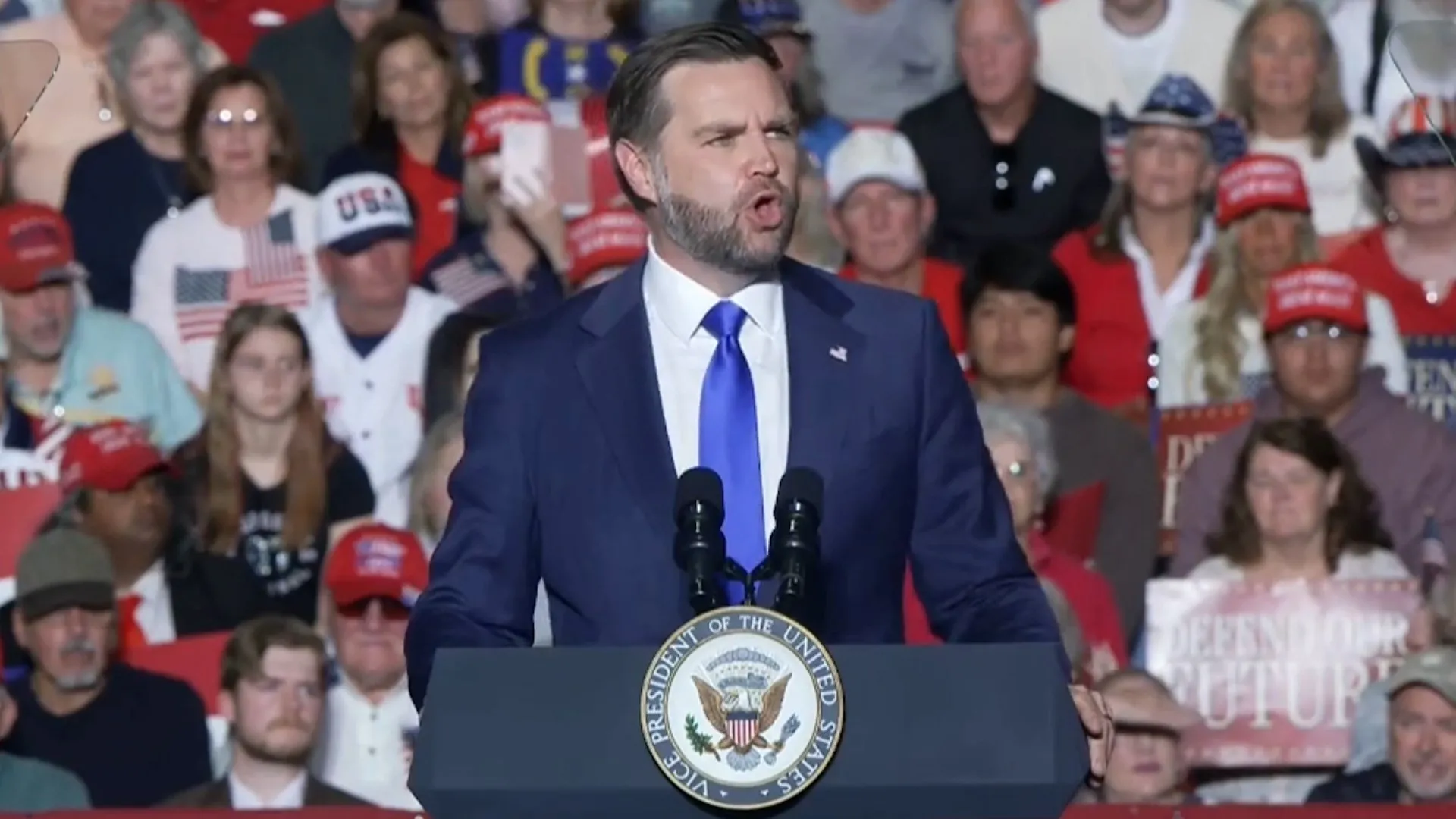
Vances

JD Vance’s 2028 strategy is starting to take shape | Opinions

In a recent interview with the New York Times, Vice President JD Vance denied that there was an “intense rivalry” between him and Secretary of State Marco Rubio. And yet, reports and speculations about tensions between them continue to emerge, with the Rubio camp allegedly spreading rumours that Vance was thinking about pulling out of the presidential campaign before it even starts

In response, perhaps, during the past two weeks, the vice president has stepped out of his routine public persona that usually avoids controversy to make bold statements critical of Israel. Rubio, on the other hand, has continued to hold the party line of unconditional support for Israel. While Vance has led efforts to negotiate a peace deal with Iran, which have rattled Israel, Rubio has spearheaded efforts to pressure the Lebanese government into an agreement on Israel’s terms.

By becoming the face of Republican scepticism of Israel and clashing with his likely presidential election rival Rubio, Vance appears to be charting his own way to the presidency – one that distances the vice president from what increasingly seem to be unpopular foreign policy positions.

Rubio, until recently, had been on the upswing, assigned ever-more important responsibilities by Trump. He has been a leading voice within the administration for a hawkish approach that has encompassed military action from Venezuela to Iran, outweighing the counsel of the more isolationist Vance.

When it comes to Israel, Rubio has made a point of being as public and proactive as possible in his support for that country and its prime minister, Benjamin Netanyahu, supporting his appeal for the US to enter the war with Iran, and even going so far as to put his name on determinations leveraging claims of national security threats to deport foreign students critical of Israel.

While the bulk of his public statements have been directed at the Netanyahu government, it is hard not to read some of Vance’s recent comments as being directly responsive to Rubio’s actions not only abroad, but at home as well.

As Vance put it, “…pro-Israel people in the United States make two critical mistakes. One, on the one hand, is not delineating between America’s interest and Israeli interests because they’re not the same. But the second is always conflating criticism of a particular government with Jew hatred, because if everything is Jew hatred, then nothing is Jew hatred.”

But, if Vance is creating space between himself and Rubio (including, apparently, by eschewing the increasingly weaponised terminology of “antisemitism”), it must also be the case that there is a political case for his doing so. That case has yet to be tested on the Republican side, where the political elites well beyond Rubio continue to move in lockstep with Israel’s Netanyahu.

But Vance, as ever, is reading the base. The same polls that show an absolute collapse of Democratic grassroots support for Israel also show an unmistakable weakening of that support in the Republican base, with one recent survey finding that 57 percent of Republicans under 50 now hold negative views of Israel.

Despite the inability of Republican elected officials to rally support behind their criticism of Israel (neither of the two most visible examples, Representatives Marjorie Taylor Greene and Thomas Massie will re-enter Congress next year), the demand signal for more frank conversation has propelled right-wing commenters like Tucker Carlson and Candace Owens to ever-greater prominence. Looking into the social media landscape, Republican questioning of the Israel relationship – particularly under the banner question of whether it represents “America First” or “Israel First,” is inescapable.

Which is not to say it will be an easy path. As sitting vice president, Vance must defer to Trump; while the latter is currently frustrated with Netanyahu, there are no guarantees that the relationship will not warm up between now and 2028 – or that if Israel elects a new leader this autumn, that that person would not be able to rebuild much of Israel’s political capital in Washington.

And similarly, if Vance’s stance on Israel helps him capture the “America First” – which is no easy task given the cohesion within that movement of the Christian Zionist camp that remains strongly pro-Israel – he may then have to contend with a Democratic competitor who seizes the Israel-sceptic mantle more credibly.

Or not. It is still early, but the favoured nominee on the Democratic side appears to be California Governor Gavin Newsom, whose few forays into commentary on Palestine and Israel have quickly been walked back to appease the pro-Israel backers of the party establishment. Indeed, the Democrats will have their own complicated, and likely ugly, battle to fight when it comes to Israel.

What does appear certain, however, is that Israel will be a wedge issue in the upcoming election – and in the wake of the failed Iran war and increasingly unpopular attacks on free speech, both greatly driven by the government of Israel or its aligned lobbies, there is an opening here that Vance, given his competition with Rubio, would have been foolish to ignore.

So is Vance’s public criticism of Israel – and pro-Israel voices within his own party genuine, or calculated? As Vance put it in his book Hillbilly Elegy, “I don’t believe in epiphanies. I don’t believe in transformative moments, as transformation is harder than a moment. I’ve seen far too many people awash in a genuine desire to change only to lose their mettle when they realised just how difficult change actually is.”

Until now, little is harder in Republican politics than to go against the prevailing dogma on Israel. And while Vance has long demonstrated what might be termed isolationist tendencies, there is no reason to think that his recent comments represent an epiphany. Rather, like any politician, he is reading the tea leaves, and sensing an opportunity on the back of a change that is filtering across American public opinion.

Vance may not be committed to driving that change. But he may be smart enough to ride it.

The views expressed in this article are the author’s own and do not necessarily reflect Al Jazeera’s editorial policy.

Source link

Vice President JD Vance’s visit gives ‘The View’ a ratings boost

The June 16 appearance by Vance gave the program its most-watched episode since November 2024.

The first appearance by Vice President JD Vance on ABC’s “The View” delivered the most-watched edition of the talk show since November 2024.

The June 16 program averaged 3.3 million viewers, according to Nielsen data. The figure was well above the average of 2.6 million viewers for “The View” in the 2025-26 season.

Vance appeared on the liberal-leaning program to promote his new book on his decision to become a Catholic. While the co-hosts mostly questioned him on the Trump administration’s policies on immigration and race, the discussion was cordial.

The panel of co-hosts — Whoopi Goldberg, Joy Behar, Ana Navarro, Sunny Hostin and Alyssa Farah Griffin — did not ask Vance to address the program’s ongoing tension with the Federal Communications Commission.

FCC Chairman Brendan Carr has questioned whether “The View” should have the status of news programs, which are exempt from giving equal time to the opponents of political candidates who appear as guests.

ABC has asked the FCC to rule on the status of “The View,” which received an exemption from the rarely enforced equal time provision in 2002. ABC has maintained that “The View” books politicians based on newsworthiness and not partisanship.

The FCC is currently taking comments from the public on the matter. ABC is running on-air spots urging viewers to support the program.

“‘The View’ has welcomed your favorite guests and covered the issues you care about for nearly 30 years,” the spot says. “Now the FCC wants to control who is allowed to appear on the show.”

The National Republican Senatorial Committee and the National Republican Congressional Committee submitted comments Monday, asserting that “The View” takes advantage of its exemption and favors Democratic candidates and permits “only rare appearances by Republican-aligned figures.”

ABC has told the FCC that “The View” has invited politicians from both sides of the aisle to appear on “The View,” including Health Secretary Robert F. Kennedy, Jr., Secretary of State Marco Rubio and entrepreneur Elon Musk. They have declined the invitation as did Vance before his appearance last week.

The letter from the GOP committees also cited the ideological leanings of the co-hosts, saying they are “not selected for their journalistic talent or excellence in commentary, but for their partisan tilt.”

Over the last two decades, “The View” has used five liberal hosts and filled one seat designated for a conservative voice. The right-leaning co-host role has had the most turnover.

“The View” has been the most-watched daytime program for the last nine years. As a live, topical program, it has remained an important media platform while the rest of the talk show genre has largely faded due to diminishing audiences.

Carr’s targeting of “The View” is part of his ongoing criticism of broadcast platforms that annoy President Trump, who has urged that TV station licenses be pulled when he’s been unhappy with coverage.

Source link

Vance’s trip to Pakistan for Iran talks delayed; Trump expects bombing or ‘great deal’

April 21 (UPI) — Uncertainty over Iran peace talks put Vice President JD Vance’s trip to Pakistan on hold Tuesday, as Iranian officials were silent on whether they intend to take part in the talks at all.

The New York Times reported that talks could, however, restart at any time. Officials in Tehran were divided on whether to take part in negotiations while the United States held firm on its embargo on ports in Iran, Axios reported.

President Donald Trump said earlier in the day that he expects to reach a deal with Iran in negotiations to end the war on Tuesday, but if no deal is made, he is prepared to resume bombing.

The two-week cease-fire Trump agreed to is set to expire on Wednesday, with the Strait of Hormuz remaining a centerpiece to the conflict between the United States and Iran.

“What I think is that we’re going to end up with a great deal,” Trump said in an interview on CNBC on Tuesday. “I think they have no choice. We’ve taken out their navy. We’ve taken out their air force. We’ve taken out their leaders, frankly. It is regime change, no matter what you want to call it. Which is not something I said I was going to do but I’ve done, indirectly maybe, but I’ve done it.”

Trump said the United States’ blockade of the Strait of Hormuz has been a “tremendous success,” adding that “we totally control the strait.”

The president added that he does not want to extend the cease-fire, noting that negotiations will take place near the time the two-week cease-fire ends.

If a deal is not agreed to on Tuesday and Wednesday, Trump said, “I expect to be bombing,” and “we are raring to go.”

“We’re totally loaded up. We have so much of everything; much more powerful than it was four or five weeks ago,” Trump said. “We caught a ship yesterday that had some things on it, which wasn’t very nice. A gift from China perhaps, I don’t know.”

Trump claimed that Iran has executed 42,000 protesters in the last two months, a number that has not been verified, though former Iranian Supreme Leader Ayatollah Ali Khamenei said thousands were killed earlier this year.

On social media, Trump shared a post saying the Islamic Republic is “preparing to hang eight women.” Trump called on Iranian leaders to release the women.

“I would greatly appreciate the release of these women,” Trump wrote. “I am sure that they will respect the fact that you did so. Please do them no harm! Would be a great start to our negotiations!”

Secretary of Health and Human Services Robert F. Kennedy, Jr. speaks during a House Appropriations Subcommittee on Labor, Health and Human Services, Education, and Related Agencies hearing on the budget for the Department of Health and Human Services in the Rayburn House Office Building near the U.S. Capitol on Thursday. Photo by Bonnie Cash/UPI | License Photo

Source link