USIsrael

Iran attacks cut 17% of Qatar’s LNG capacity for up to 5 years: QatarEnergy | US-Israel war on Iran News

CEO Saad al-Kaabi says QatarEnergy may have to declare force majeure on long-term contracts for up to five years.

Iranian ⁠attacks on Qatar have wiped out ⁠17 percent of its liquefied natural gas (LNG) export capacity, causing an estimated $20bn in lost annual revenue and threatening supplies to Europe and ⁠Asia, QatarEnergy’s CEO says.

Saad al-Kaabi told the Reuters news agency on Thursday that two of Qatar’s 14 LNG trains, the equipment used to liquefy natural gas, and one of its two gas-to-liquids facilities were damaged in Iranian strikes this week.

Recommended Stories

list of 3 itemsend of list

The repairs will sideline 12.8 million tonnes of LNG production per year for three to five years, he said.

“I never in my wildest dreams would have thought that Qatar would be – Qatar and the region – in such an attack, especially from a ‌brotherly Muslim country in the month of Ramadan, attacking us in this way,” al-Kaabi said in an interview.

His comments came hours after Iran on Wednesday launched a series of attacks on oil and gas facilities across the Gulf region after the Israeli military bombed its South Pars offshore gasfield.

Tehran has been firing missiles and drones across the Middle East in response to the United States-Israeli war on Iran, which began on February 28.

It also has essentially blocked the Strait of Hormuz, a critical Gulf waterway through which about one-fifth of the world’s oil and LNG supplies transit, fuelling soaring petrol prices and global concerns about rising inflation.

Iran’s attacks on energy infrastructure have heightened tensions with its Arab Gulf neighbours, who have condemned the strikes as a violation of international law.

Iranian Foreign Minister Abbas Araghchi said on Thursday that his country would show “ZERO restraint” if its infrastructure is struck again as the Israeli attack on the South Pars gasfield continued to spur condemnation.

“Our response to Israel’s attack on our infrastructure employed FRACTION of our power. The ONLY reason for restraint was respect for requested de-escalation,” Araghchi wrote on X.

“Any end to this war must address damage to our civilian sites.”

‘Stay away from oil and gas facilities’

During Thursday’s interview with Reuters, al-Kaabi said QatarEnergy may have to declare force majeure on long-term contracts for up to five years for LNG supplies bound for Italy, Belgium, South ⁠Korea and China due to the two damaged trains.

“I mean, these are long-term contracts that we have to declare force majeure. We already declared, but that was a shorter term. Now it’s whatever the period is,” he said.

QatarEnergy had declared force majeure on its entire output of LNG after earlier attacks on its Ras Laffan production hub, which came under fire again on Wednesday. “For production to restart, first we need hostilities to cease,” al-Kaabi said.

The damaged units cost about $26bn to build, al-Kaabi said. He also told Reuters that the scale of the damage from the attacks has set the region back 10 to 20 years.

“If Israel attacked Iran, it’s between Iran and Israel. It has nothing to do with us and the region,” he said.

“And so now, in addition to that, I’m saying that everybody in the world, whether it’s Israel, whether it’s the US, whether it’s any other country, everybody should stay away from oil and gas facilities.”

Source link

US East Asian allies in legal quandary as Trump seeks help in the Middle East | US-Israel war on Iran News

South Korea and Japan are facing uncomfortable questions about their mutual defensive obligations as the United States seeks support from its allies in the war on Iran, now nearly three weeks in and escalating by the day.

Earlier this week, US President Donald Trump urged the United Kingdom, China, France, Japan, and South Korea to send warships to the Strait of Hormuz, which has remained de facto closed since Washington launched its war with ally Israel on Tehran on March 28.

Recommended Stories

list of 4 itemsend of list

The president backpedalled on his position on Tuesday – declaring on social media that “we no longer ‘need,’ or desire, the NATO Countries’ assistance – WE NEVER DID! Likewise, Japan, Australia, or South Korea” – but observers say US allies may not yet be out of the hot seat.

Trump is expected to raise the issue of warships when he meets with Japanese Prime Minister Sanae Takaichi at the White House on Thursday, according to Al Jazeera correspondent Jack Barton.

“People do expect him to put pressure on Takaichi again to send warships to the Strait of Hormuz. It makes sense in a way because Japan is so dependent on energy supplies” from the Middle East, Barton said on Thursday from Seoul.

Japan’s Maritime Self-Defence Force is one of the largest and most advanced navies in the world, he said, which makes it an attractive target for the Trump Administration.

Although Japan and the US share a mutual defence, Tokyo’s pacifist constitution places restrictions on when it can deploy its Self-Defense Force. Legal scenarios include when it is attacked or facing a “survival-threatening” scenario, as well as acting in “collective self-defence” of its allies.

Takaichi told legislators this week that her government is considering what can legally be done to protect Japanese ships and interests, according to Japanese public broadcaster NHK World, although deployment is still a hypothetical scenario.

Japan relies heavily on Middle Eastern oil imports, of which 70 percent pass through the Strait of Hormuz, according to Japanese media. Tokyo began releasing oil from its strategic reserve on Monday to make up for the shortfall.

Stephen Nagy, a professor at the International Christian University, Tokyo, told Al Jazeera it was not unexpected that the US – a treaty ally – would call on it for help, but Japan will need to consider what is expected.

“The question is if they are going to be on the front line of the attack from Iran or if they are going to provide some kind of supporting role, such as anti-mining activities, refuelling missions, maritime domain awareness,” he said.

“It’s not so much of a problem going there and being involved in the challenges associated with the Hormuz Strait; what is more important is what exactly they are going to do in that role. I think the Japanese are going to find a way to legally add value to the Trump administration, but don’t expect warships there fighting Iranian proxies,” he continued.

South Korea finds itself in a similar predicament as it is both a US treaty ally and a country that is heavily dependent on Middle Eastern oil and gas exports.

Seoul last week took the extraordinary measure of imposing a price cap on domestic fuel prices for the first time since the 1997 Asian financial crisis, to keep prices from rising too quickly for consumers. Despite their concerns, legislators continue to urge caution from the government in deploying its navy or military assets to the Middle East, according to Al Jazeera’s Barton.

In-Bum Chun, a retired South Korean lieutenant general, told Al Jazeera that it is not immediately clear whether Seoul’s Mutual Defense Treaty with the US applies to the Strait of Hormuz.

Seoul must also weigh helping the US against maintaining a credible deterrence against North Korea. Recent media reports suggest that the US is considering moving some of its Terminal High Altitude Area Defense (THAAD) missiles from South Korea to the Middle East. The missiles were installed to deter North Korea, and their removal, along with naval assets, could make voters nervous.

“Seoul must also consider the persistent threat from North Korea and the fact that a South Korean warship is already deployed to the Middle East,” Chun told Al Jazeera. “At the same time, because about 70 percent of Korea’s oil imports pass through the Strait of Hormuz, freedom of navigation is not an abstract principle but a core national interest. These competing realities must all be weighed before any final decision is reached.”

Source link

Strikes kill two PMF fighters in northern Iraq amid wider war, group says | US-Israel war on Iran News

Air strikes come hours after pro-Iran armed group Kataib Hezbollah announces conditional suspension of US embassy attacks.

Air strikes have killed two fighters from the Popular Mobilisation Forces (PMF) in northern Iraq, the paramilitary group says from one of the fronts in the sprawling war engulfing the Middle East.

The two attacks targeted PMF positions early on Thursday in the Nineveh region, where Mosul city is located, and a military airport in Salah al-Din province, according to statements from the PMF, a predominantly Shia group that is part of Iraq’s security apparatus and includes several groups aligned with Iran.

Recommended Stories

list of 3 itemsend of list

The PMF blamed the attack on Israel and the United States. Iraq has been drawn into the US-Israeli war on Iran, now in its third week.

The PMF was formed in 2014 as a volunteer force supporting Iraqi security forces in the fight against ISIL (ISIS).

Strikes have targeted Iran-backed groups, which in turn have claimed near-daily attacks on US interests in Iraq and across the region.

Elsewhere, a fire broke out at a naval base in southern Iraq when it was hit by a drone overnight. An Iraqi security source told Al Jazeera that a drone crashed into a water treatment station at the Umm Qasr naval base near the border with Kuwait.

Footage from the scene circulating on social media and verified by Al Jazeera showed flames and smoke rising from the site.

US embassy attacks to be suspended

Hours before the attacks on PMF fighters, the pro-Iranian armed group Kataib Hezbollah said its secretary-general had “issued orders to suspend operations targeting the US embassy in Baghdad for a period of five days”.

Designated by Washington as a “terrorist organisation”, Iraq’s Kataib Hezbollah listed several conditions of the suspension, including Israel ceasing its bombardment of the southern suburbs of Beirut.

Kataib Hezbollah also demanded “a commitment to refrain from bombing residential areas in Baghdad and other provinces”.

Whenever “the enemy violates” the truce, “the response will be immediate”, the group said, warning of more strikes after the five-day period.

The US embassy has been targeted by drone and rocket attacks several times in recent days. Air defences have intercepted most of the projectiles.

The embassy is in the Green Zone, a heavily fortified district in central Baghdad that houses Iraqi government institutions and embassies.

A US diplomatic and logistics centre at Baghdad International Airport that houses military personnel has also been regularly targeted.

Source link

Saudi FM warns Iran that patience in Gulf not ‘unlimited’ amid attacks | US-Israel war on Iran News

Saudi Arabia’s Foreign Minister warns Iran that regional neighbours have ‘significant’ capabilities with which to respond to Tehran’s aggression.

Saudi Arabia’s Foreign Minister Prince Faisal bin Farhan Al Saud has warned Iran that tolerance of its attacks on his country and those of neighbouring Gulf states is limited, calling on Tehran to immediately “recalculate” its strategy.

Warning that Saudi Arabia and other Gulf states have “very significant capacities and capabilities” that could be drawn on should they “choose to do so”, the foreign minister told a news conference early on Thursday that Iran had carefully planned its strategy for striking regional neighbours, despite denials from Tehran’s diplomats.

Recommended Stories

list of 4 itemsend of list

“The level of accuracy in some of this targeting – you can see it in our neighbours as well as the kingdom – indicates that this is something that was premeditated, preplanned, preorganised and well thought out,” Prince Faisal said.

“I’m not going to lay out what would and would not precipitate a defensive action by the Kingdom [of Saudi Arabia] because I think that is not a wise approach to signal to the Iranians,” the foreign minister continued.

“But I think it’s important for the Iranians to understand that the kingdom, but also its partners who have been attacked and beyond, have very significant capacities and capabilities that they could bring to bear should they choose to do so,” he said.

“The patience that is being exhibited is not unlimited. Do they [the Iranians] have a day, two, a week? I’m not going to telegraph that,” he added.

“I would hope they understand the message of the meeting today and recalculate quickly and stop attacking their neighbours. But I am doubtful they have that wisdom.”

Prince Faisal’s warning followed a meeting of foreign ministers from Arab and Islamic countries in the Saudi capital earlier in the day to discuss the expanding war in the region, which on Wednesday saw Iranian attacks on Gulf energy sites, including Qatar’s Ras Laffan gas facility, where significant damage was reported, and the United Arab Emirates’ Habshan ⁠ gas facility.

Qatar’s Ministry of Foreign Affairs expressed its “strong condemnation and denunciation of the blatant Iranian attack targeting Ras Laffan Industrial City”, located 80km (50 miles) northeast of the Qatari capital Doha, which is the world’s largest liquefied natural gas (LNG) production facility, producing some 20 percent of the world’s LNG supply.

Iran’s Islamic Revolutionary Guard Corps (IRGC) had warned earlier that oil and gas facilities in Qatar, Saudi Arabia and the UAE would face retaliation for an Israeli strike on Iran’s South Pars gasfield.

Iranian state media reported that facilities linked to the country’s huge offshore South Pars field – located off the coast of southern Iran’s Bushehr province – had come under attack.

Saudi Arabia’s Ministry of Defence also said on Wednesday that its air defences had intercepted four Iranian ballistic missiles that targeted Riyadh and two launched towards the country’s eastern region.

Air defences in the UAE dealt with 13 ballistic missiles and 27 drones, according to the country’s Defence Ministry, while operations ⁠were ⁠suspended at the Habshan ⁠gas facility as authorities responded to ⁠incidents caused by fallen debris after the successful interception of a ‌missile.

The Saudi foreign minister also told the news conference on Thursday that while the war will end one day, it will take much longer to restore relations with Iran as trust “has completely been shattered” due to Tehran’s tactics of targeting its neighbours.

“We know for a fact that Iran has been building this strategy over the last decade and beyond,” Prince Faisal said.

“This is not something that is a reaction to an evolving circumstance where Iran is improvising. This has been built into their war planning: targeting their neighbours and using that to try and put pressure on the international community,” he said.

“So when this war eventually ends, in order for there to be any rebuilding of trust, it will take a long time. And I have to tell you, if Iran doesn’t stop … immediately, I think there will be almost nothing that can re-establish that trust,” he added.

Source link

What are Iran’s options as war goes on? | US-Israel war on Iran

Tehran defiant as US and Israeli attacks continue.

Relentless United States and Israeli attacks on Iran. Senior officials killed, with thousands of air strikes across the country.

Iran has retaliated, hitting Israel and its Gulf neighbours, targeting energy facilities and supply routes.

So what are Iran’s options now?

Presenter: Imran Khan

Guests:

Elijah Magnier – Military and political analyst specialising in wars in the Middle East

Setareh Sadeqi – Assistant professor in the Faculty of World Studies at the University of Tehran

Mehran Kamrava – Iranian studies unit at the Arab Center for Research and Policy Studies

Source link

Nigeria’s President Tinubu meets royals in UK state visit | US-Israel war on Iran News

With trade between the two countries at a record high, Charles is using the two-day visit to highlight the pair’s deep cultural and commercial links.

The UK’s King Charles III has welcomed Nigerian President Bola Tinubu at Windsor Castle in the first state visit by the leader of Africa’s most populous nation in nearly four decades.

More than 1,000 soldiers were out in force on Wednesday for the diplomatic show of soft power by the royal family.

Recommended Stories

list of 3 itemsend of list

With trade between the two countries at a record high, Charles is using the two-day visit to highlight the pair’s deep cultural and commercial links.

Tinubu has made less formal visits to the United Kingdom several times during his tenure, and the two countries remain major partners in trade, aid and defence. London is also home to a large Nigerian diaspora of about 300,000 people.

Nigeria’s presidency said the visit signalled a “renewed chapter” and reflected a shared commitment to “advancing trade and strengthening diplomatic ties”.

Calling the visit “historic”, London announced Nigerian companies, including banks, are expanding operations and creating hundreds of jobs in the UK, strengthening it as a global hub for African business.

Nigerian flags and Union Jacks

King Charles and Queen Camilla greeted the president and his wife in Windsor, west of London, as artillery fired salutes.

Both Nigerian flags and Union Jacks fluttered amid the procession.

The Nigerian president and his wife earlier chatted with heir-to-the-throne Prince William and his wife Catherine, at a hotel in the town.

The party then rode in carriages to the historic Windsor Castle.

Later, the king and queen showed the president and first lady items from the UK’s colonial rule of Nigeria, which existed until 1960.

Later on Wednesday evening, a lavish state banquet took place.

On Thursday, Tinubu is expected to meet British Prime Minister Keir Starmer, as well as members of the Nigerian community abroad, according to the official schedule.

Missing from the official schedule is the traditional meeting between the visiting head of state and the British opposition.

Conservative Party leader Kemi Badenoch, who is of Nigerian descent, has repeatedly publicly criticised the country she was raised in over corruption and violence.

The last Nigerian state visit to the UK took place in 1989, although Tinubu was received by Charles in September 2024.

Before the death of his mother, Queen Elizabeth II, in 2022, Charles also visited Nigeria four times as prince of Wales.

Tinubu’s visit went ahead, despite a deadly bombing in northeastern Nigeria’s Borno State on Monday, which killed 23 people and injured more than 100, with the president condemning the attacks and insisting “Nigeria will not succumb to fear.”

Source link

Qatar says Iran missile attack sparks fire, causes damage at gas facility | US-Israel war on Iran News

Qatar’s Foreign Ministry strongly condemns attack that caused “extensive damage” at the Ras Laffan complex.

Qatar’s Ministry of ⁠Interior says civil ⁠defence teams are responding to a fire at the country’s main gas facility after an Iranian attack.

In a statement on Wednesday, QatarEnergy said there was “extensive damage” following the “missile attacks” on Ras Laffan Industrial City.

“All personnel have been accounted for and no casualties have been reported at this time,” the world’s largest liquefied natural gas (LNG) producer added.

The announcements came hours after Iran threatened to attack oil and gas facilities across the Gulf region in retaliation for an Israeli attacks on its South Pars gasfield as the fallout from the United States-Israeli war on the country continues to escalate.

Iran’s warning was directed at Qatar’s Mesaieed Petrochemical Complex, Mesaieed Holding Company and Ras Laffan Refinery; Saudi Arabia’s Samref Refinery and Jubail Petrochemical Complex; and the United Arab Emirates’s Al Hosn Gas Field.

In a statement, Qatar’s Foreign Ministry strongly condemned “the brutal” Iranian targeting of Ras Laffan Industrial City.

“Qatar considers this assault a dangerous escalation, a flagrant violation of its sovereignty, and a direct threat to its national security,” it said.

On March 2, Qatar suspended LNG production following an attack on at its giant Ras Laffan facility, as well as on a water tank at a power plant in Mesaieed Industrial City.

Source link

US intel chief Gabbard says Iran was not rebuilding enrichment prior to war | US-Israel war on Iran News

Washington, DC – Tulsi Gabbard, the director of US National Intelligence, said that the United States intelligence community had assessed that Iran was not rebuilding its nuclear enrichment capabilities following US and Israeli attacks last year.

The revelation on Wednesday appeared to undercut one of President Donald Trump’s key justifications for joining Israel in launching the latest war against Iran.

Recommended Stories

list of 3 itemsend of list

Trump and his top officials have repeatedly cited Iran’s nuclear ambitions as one of the main reasons for abandoning ongoing diplomatic talks in favour of military action.

“As a result of Operation Midnight Hammer,” Gabbard said in written testimony to the Senate intelligence committee, referencing the June 2025 US strikes on Iran’s nuclear facilities, “Iran’s nuclear enrichment program was obliterated”.

“There have been no efforts since then to try to rebuild their enrichment capability,” Gabbard said in the written testimony.

Notably, Gabbard did not read that portion of her testimony, which was provided to members of the committee, during her publicly televised oral testimony. When pressed on why she omitted the portion, Gabbard said simply that she did not have enough time. She did not deny the assessment.

“You chose to omit the parts that contradict Trump,” Senator Mark Warner, a Democrat, responded.

Trump has repeatedly said the June 2025 attacks, which came at the end of a 12-day war between Israel and Iran, had “obliterated” Iran’s nuclear capacity, even as he warned that Iran’s alleged nuclear ambitions presented an immediate threat to the US.

Tehran has for years denied it is seeking a nuclear weapon. Nuclear and arms monitors have maintained that even if Tehran were seeking a nuclear weapon, it did not represent a short- or medium-term threat.

The foreign minister of Oman, who had mediated the latest round of US-Iran indirect nuclear talks ahead of the war, has refuted Trump officials’ claims that the most recent negotiations were not yielding any progress.

The Guardian newspaper also reported this week that the United Kingdom’s national security adviser, Jonathan Powell, had attended the final session of talks and assessed that the Iranian position did not justify an immediate rush to war, citing sources familiar with the situation.

The administration has not settled on any single justification for launching the war, also pointing to Iran’s ballistic capabilities, its potential threat to Israel and US forces in the Middle East, and the totality of the Iranian government’s actions since the 1979 Islamic Revolution.

The concept of an “imminent threat” is significant in determining the legality of Trump’s decision to strike a sovereign country under international law.

It is also significant for US domestic law, under which presidents can commit the military only in instances of immediate self-defence. Only Congress can officially declare war or authorise extended military campaigns.

Iran’s government ‘intact but largely degraded’

The White House said earlier this week that Iran’s ballistic missile capacity was “functionally destroyed”, with the Iranian navy “effectively destroyed” and the US and Israel dominating the country’s airspace.

Experts have assessed that Iran still maintains the military capacity to inflict significant damage in the region, and it has continued to wield its military influence over the Strait of Hormuz.

Gabbard, meanwhile, offered a more sober assessment than the White House, saying that despite the killings of Iranian supreme leader Ayatollah Ali Khamenei, top military officials, and most recently the head of the Supreme National Security Council, Ali Larijani and the intelligence minister, Esmail Khatib, “the regime in Iran ⁠appears to be intact but largely degraded by Operation Epic Fury”.

“Even so, Iran and its proxies remain capable of and continue to attack US and allied interests in ⁠the Middle East. If a hostile regime survives, it will seek to begin a years-long effort to rebuild its missiles and UAV [drone] forces,” she said.

Gabbard also listed Iran, alongside Russia, China, North Korea and Pakistan, as among the countries “researching and developing an array of novel, advanced, or traditional missile delivery systems, with nuclear and conventional payloads, that put our homeland within range”.

The Washington, DC-based Arms Control Association has said that US intelligence as of 2025 had said it may take Iran until 2035 or longer to develop a missile capable of hitting the US, if it did indeed seek to do so.

High-profile resignation

Gabbard spoke a day after a top official in her agency, Joe Kent, the director of the US National Counterterrorism Center, resigned in opposition to Trump’s war with Iran.

In his resignation, Kent said that Iran “posed no imminent threat” to the US and that Trump’s decision to enter the war went against his “America First” pledges.

Kent is the first high-profile member of the Trump administration to step down in response to the war.

Gabbard herself had previously been a vocal opponent to indefinite military engagement in the Middle East and war with Iran. A former member of the US House of Representatives from Hawaii, she left the Democratic Party and supported Trump, in part, due to his anti-war vows.

However, in a post on X on Tuesday, Gabbard defended Trump’s decision to go to war.

“As our Commander in Chief, he is responsible for determining what is and is not an imminent threat, and whether or not to take action he deems necessary to protect the safety and security of our troops, the American people and our country,” she said.

She said her agency’s role was to funnel US intelligence to Trump.

“After carefully reviewing all the information before him, President Trump concluded that the terrorist Islamist regime in Iran posed an imminent threat and he took action based on that conclusion,” she said.

Source link

How Los Angeles’s Iranian diaspora is confronting the US war on Iran | US-Israel war on Iran News

Concerns over US involvement

The war has reignited a debate within the Iranian diaspora about what role the US should play in Iran’s future.

This question is more than a distant geopolitical issue for Iranians in Los Angeles.

Many residents explained that their family histories had been shaped by US involvement in the region, whether it was through US support for Iran’s fallen monarchy or through the US decision to back Iraq’s invasion of Iran in 1980.

Aida Ashouri, a human rights lawyer who is running to be Los Angeles city attorney, was among those publicly condemning the latest US campaign in Iran at the city hall protest on February 28.

“This is a US imperialist war, and we have to make that clear,” she said. “Call a spade a spade. This war is not to liberate the women of Iran or the people of Iran.”

Ashouri was born during the Iran-Iraq war in the 1980s. Her hometown, Isfahan, was also bombed in June last year during the US and Israel’s 12-day war with Iran.

For Ashouri, it was telling that the US and Israel once again launched the first strike in the current conflict. For many legal experts, that made the conflict an unprovoked war of aggression, in violation of international law.

“A war implies two sides are actively engaged, but Iran has done nothing to be involved,” Ashouri said.

“This is a unilateral military invasion, an aggression of the United States and Israel. They are the ones with the power to end it by stopping the bombing.”

She and other protesters drew parallels between the current Iran war and the US-led wars in Iraq and Afghanistan, launched in 2003 and 2001, respectively.

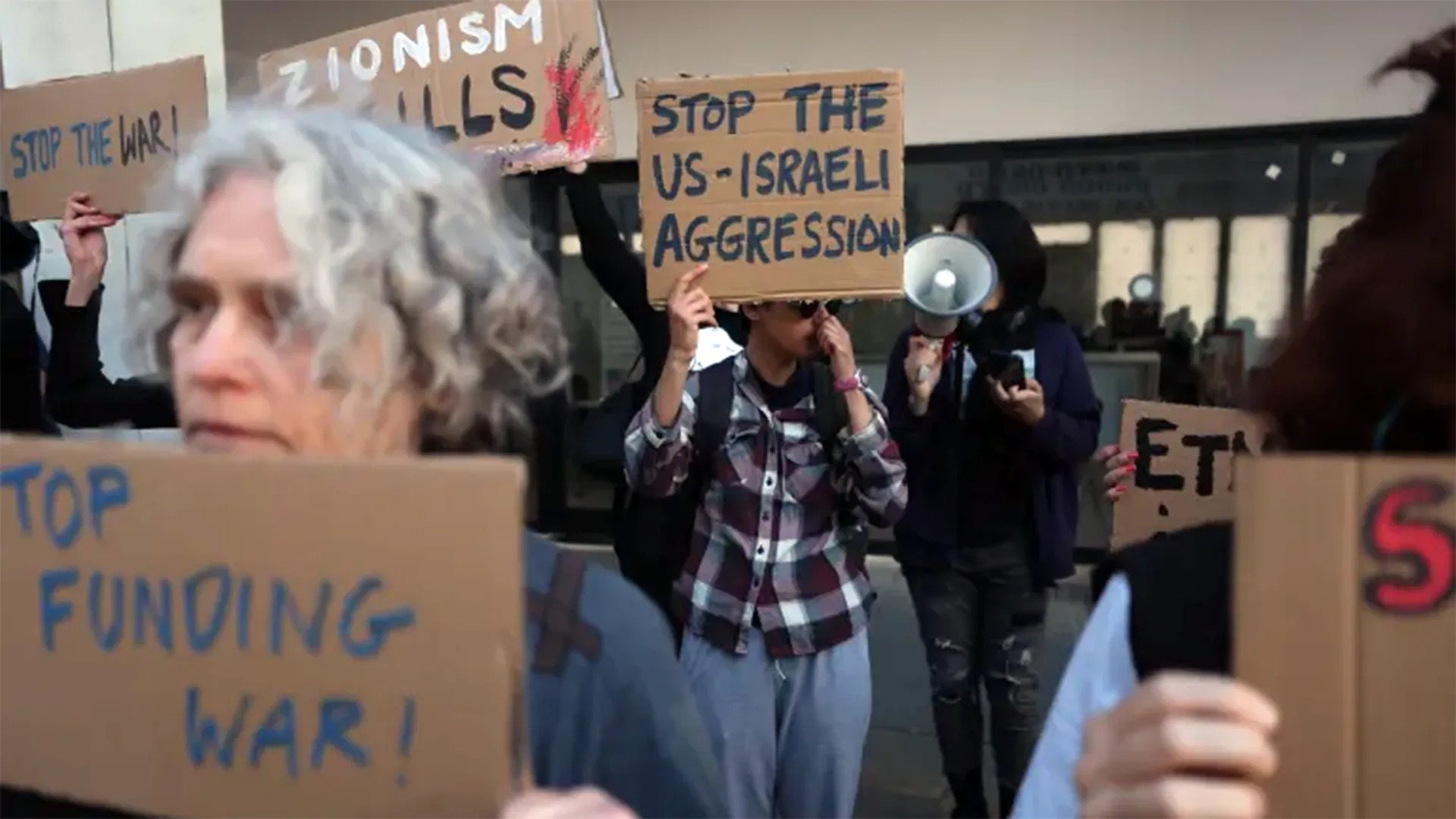
“I lived through the shadow of the war on terror, all the propaganda talking points,” said Shany Ebadi, an Iranian American antiwar organiser with the ANSWER Coalition. “What the Trump administration is saying reminds me a lot of the Iraq war.”

As someone who follows the news closely, Ebadi remembers feeling alarm when the first strikes were launched in February.

“When I got the breaking news notification of the initial attack, my whole body felt paralysed. I felt anger and frustration,” she said.

She and Ashouri both said they fear the military operation in Iran could spark a regional war that might further destabilise not just Iran, but the entire Middle East.

“I fear that war will repeat the disasters seen in Palestine, Iraq, Libya, and Afghanistan,” Ashouri said, listing countries targeted in the US’s “war on terror” over the past two and a half decades.

The question of whether bombs can pave the way to freedom in Iran is a simple one for Ashouri and her fellow antiwar activists. The answer, they say, is simply no.

Source link

Israel says it killed Iranian intelligence chief Khatib | US-Israel war on Iran

NewsFeed

Israel’s Defence Minister Israel Katz said an overnight strike killed Iran’s Intelligence Minister Esmail Khatib. There has been no confirmation from Iran but Katz says Israel’s military is authorised to target senior Iranian officials without additional approval from the government.

Source link

How Iran defied Trump threats to emerge as Strait of Hormuz gatekeeper | US-Israel war on Iran News

As United States President Donald Trump tries to build a coalition of navies willing to open the Strait of Hormuz, some countries are negotiating safe passage directly with Iran, underscoring a new de facto reality, analysts say: Regardless of military results, Tehran is calling the shots on who gets to use the world’s most important energy waterway.

After US-Israeli strikes on Iran began on February 28 and killed Supreme Leader Ali Khamenei, the Iranian military leadership responded by focusing on its most potent form of leverage – Iran’s geography. The country controls the northern shore of the Strait of Hormuz, through which 20 percent of global crude oil and natural gas supplies pass. It is 33km (20 miles) wide at its narrowest point, so any naval force that wants to cross it becomes easy prey for Iranian attacks coming from the mainland.

Recommended Stories

list of 3 itemsend of list

Considering insurance companies’ low appetite for risk, it took relatively few attacks on vessels in the strait – or just the threat of them – to undermine market confidence and send insurance premiums shooting up, causing a near paralysis in maritime traffic. About 20 vessels have been attacked since the start of the war.

“Iran has effectively proven that it dictates the terms of passage through the strait. They have now shown they are the gatekeeper of this important chokepoint. This will elevate the status of Iran in the geography of the Gulf,” said Andreas Krieg, an associate professor in Security Studies at King’s College London and a fellow at King’s Institute of Middle Eastern Studies. This will be the new reality for the foreseeable future, he added.

Meanwhile, crude prices have risen above $100 a barrel, more than 20 percent higher than pre-war prices, forcing countries to make the biggest releases of emergency reserves in history. Gas prices have risen by more than 40 percent since the war began.

Trump initially floated the idea of ordering the US Navy to escort vessels through the waterway. He then appealed to some countries to send warships and warned NATO members they would face “a very bad” future if these allies failed to help in opening the strait. But the appeal was either turned down or received noncommittal responses. Japan said it had no plans to deploy naval vessels. Australia ruled out sending ships. The United Kingdom said it would not be drawn into the wider war. Germany sent a clear message: “This is not our war”.

Others decided to take action – but not of the kind that Trump asked for. On Saturday, two India-flagged gas tankers passed through the strait after days of negotiations between New Delhi and Tehran, including a phone call between Indian Prime Minister Narendra Modi and Iranian President Masoud Pezeshkian. Ships from Pakistan, Turkiye and China also have transited through the Strait of Hormuz. The Financial Times has reported that Italy and France have also reached out to Iran for deals although Italian authorities have rejected making such an overture.

Meanwhile, Windward, a maritime intelligence tracking group, said that while traffic in the strait on Tuesday remained 97 percent below average, a growing number of ships have been passing through Iran’s territorial waters, suggesting that Tehran is allowing “permission-based transit”.

‘It is up to us to decide’

There is a precedent for US naval forces to escort convoys through the strait dating back to the Iran-Iraq War in the 1980s. But today’s scenario is different, experts said. Back then, the US, while it was backing Iraqi leader Saddam Hussein, was not a direct party to the conflict. Iran was still in a post-revolutionary process of consolidating power, and its Islamic Revolutionary Guard Corps was nowhere near as organised as it is today.

Today, Iran has drones that its factories are capable of producing on a large scale and has been using them. Iranian forces could also use small boats to assault tankers, deploy mines and engage in other guerrilla-style tactics. While there are conflicting reports on whether Iran has placed mines in the strait, experts said it would be a counterproductive move for Tehran because it would disrupt the passage for any ships – Iranian vessels included – and it would take away from Tehran the power to choose who may pass.

Iranian officials are aware of their geographic advantage. “This is up to our military to decide,” Iranian Foreign Minister Abbas Araghchi said on Sunday, referring to who will be allowed to use the strait.

Pro-government figures increasingly frame the Strait of Hormuz as a strategic bargaining tool beyond the war itself, suggesting the waterway could be used to extract compensation, sanctions relief or broader economic concessions after the war, Hamidreza Azizi, an expert on Iran and visiting fellow with the German Institute for International and Security Affairs, commented on X.

Recent attacks seem to suggest that Iran wants to increase its pressure on the energy market.

On Tuesday, a drone attack caused a fire at the port of Fujairah, the United Arab Emirates’s only crude export terminal. It is located outside the eastern entrance of the Strait of Hormuz, allowing its exports to circumvent it. The Iran-backed Houthis in Yemen could also further squeeze oil prices by disrupting the Bab al-Mandeb strait. That would force the US to operate across multiple maritime theatres. So far, the Houthis have not carried out such attacks, but this month, they said they were ready to strike at any ‌moment.

Still, the US is focused on applying maximum pressure on Tehran and forcing it to open the Strait of Hormuz. The US Central Command, the US military’s combat command responsible for operations in the Middle East, said early on Wednesday that its forces had used 2,270kg (5,000lb) bunker-busting munitions against antiship missile sites along Iran’s coastline near the Strait of Hormuz.

Trump has also ordered amphibious ships carrying thousands of US Marines to move to the Middle East, and some experts believe the US might try to seize Kharg Island, a tiny piece of land in the northern Gulf where 90 percent of Iranian crude oil is exported from. The US has already bombed what it said were military sites on the island.

Such an operation, however, might do little to force Iran into opening the Strait of Hormuz, Krieg said. The island is 500km 310 miles) from the strait, and should the US take control of it, it would expose US Marines to Iranian fire. Should Iran see its key terminal being seized, it could also opt to mine the strait outright, having fewer reasons to allow some vessels to pass through.

“The issue with the Strait of Hormuz is really not a military one. … It’s a market issue, and confidence cannot be restored by the military. Confidence can be restored through diplomacy only,” Krieg said.

Source link

Israel bombs central Beirut, killing 6, strafes south, east Lebanon | US-Israel war on Iran News

Wave of Israeli air attacks launched as ground offensive widens in south where Hezbollah are fighting Israeli forces.

Israel has attacked a building in Bashoura, a neighbourhood in the heart of Beirut, Lebanon’s National News Agency (NNA) reported, with a blast and smoke rising over the area shortly after Israel issued an evacuation threat for the site.

The attack was part of a deadly wave of Israeli strikes across Lebanon that killed at least 20 people and wounded 24 on Wednesday, according to the country’s Ministry of Public Health, with raids stretching from the capital through southern and eastern parts of the country, a devastating front in the wider United States-Israel war against Iran embroiling the region.

Recommended Stories

list of 2 itemsend of list

At least six people were killed in the air strikes in Beirut, with dozens injured.

Al Jazeera’s correspondent in Beirut, Zeina Khodr, reported that intense Israeli attacks hit multiple regions across Lebanon, including central Beirut, overnight.

Speaking from in front of a 15-storey building struck in one of the attacks, Khodr said its lower floors had been targeted a week earlier. In the early hours, however, the structure was completely demolished, with the Israeli army claiming Hezbollah had stored cash there.

“You can see the widespread damage across this whole neighbourhood,” Khodr said.

Israel’s military said it had launched what it described as limited ground operations in southern Lebanon, issuing evacuation threats for residents of four towns near the Zahrani River and the Tyre area, warning them to head north immediately.

Lebanon’s NNA also reported strikes on Tyre and the nearby area of Al-Burj Al-Shamali in the pre-dawn hours.

At least four people were killed in an Israeli attack that targeted four houses in the town of Sahmar in eastern Lebanon’s Bekaa Valley.

The intensifying assault has now killed at least 912 people in Lebanon, including 111 children, and wounded more than 2,200 since Israel launched its offensive on March 2, according to Lebanese Health Ministry figures.

More than one million people have been forced from their homes. The United Nations warned on Tuesday that Israeli attacks on residential buildings and civilian infrastructure may constitute war crimes under international humanitarian law.

A spokesperson for the UN human rights office said that deliberately targeting civilians or civilian objects “amounts to a war crime”, adding that Israel’s sweeping displacement orders for southern Lebanon may themselves violate international law.

Khodr said that Hezbollah’s secretary general, Naim Qassem, last night laid down conditions for the war to end, including Israel stopping attacks, displaced people being permitted to return to their homes, those detained over the last two years by Israel being released and the Israeli army withdrawing.

Across southern Lebanon, Khodr said Hezbollah was “still present in the area, trying to repel the Israeli army’s advance”, adding that Hezbollah’s aim was not just territorial control of the region, but preventing Israel from gaining new positions in the country.

The conflict was ignited on February 28 when US and Israeli forces assassinated Iranian Supreme Leader Ali Khamenei in Tehran, prompting Hezbollah to launch rockets into northern Israel on March 2.

Israel has since killed more than 2,000 people across Iran and Lebanon in its attacks.

German Chancellor Friedrich Merz, a staunch Israeli ally, added his voice to growing international concern, warning that Israel’s ground offensive in Lebanon was an “error” that risked worsening what he described as an already dire humanitarian situation.

Source link

Iran fires missiles, drones across Gulf, region remains in war crosshairs | US-Israel war on Iran News

Qatar, UAE, Kuwait and Saudi Arabia report new blasts, interceptions, with war edging to 3-week mark.

Iran has fired missiles and drones at several Gulf Arab nations, which have sought to intercept them, in a now-daily fallout from the United States-Israel war launched on Iran nearly three weeks ago that has engulfed the Middle East with deaths, destruction, assassinations, and an energy crisis spreading far beyond the region.

Early Tuesday, Qatar’s Ministry of Defence said its armed forces intercepted a missile attack against the country.

Recommended Stories

list of 4 itemsend of list

The Kuwait National Guard said it shot down an unmanned aircraft at dawn. The statement came hours after the Kuwaiti army said it was intercepting hostile missile and drone attacks.

The UAE, Saudi Arabia and Bahrain have also reported intercepting missiles and drones in recent hours.

Saudi Arabia’s Ministry of Defense reported the interception and destruction of a drone in the Eastern Region.

Earlier Tuesday, the UAE Ministry of Defence said the country’s air defences were “currently responding to incoming missile and drone threats from Iran”. The announcement came four hours after another reported attack from Iran. Later, a loud bang was heard in Dubai as authorities said air defences were dealing with a missile threat.

Al Jazeera’s Zein Basravi, reporting from Dubai, said, “The UAE has been the hardest hit by Iran’s retaliation. For instance, there have been 3000 different projectiles – missiles and drones – fired at GCC countries by Iran in terms of its retaliation. More than half, well over half, have targeted places in the UAE. Overnight was no different … Multiple explosions heard throughout the city.

“That glow of defensive weapons and interceptions in the night skies, something that has become all too familiar, not just in Dubai, but in cities across the GCC. Once again seen over the skies here.

“Dubai’s media office confirming that they were the result of air defence interception operations,” he added.

There have been several deaths in the Gulf nations, where an economic effect is also being acutely felt since the war began.

Gulf economies bear brunt of Iran war

The economies of the Gulf are suffering some of the worst damage.

Iran has launched continuous attacks on Gulf states since the onset of the conflict on February 28, arguing that it is attacking military bases used by the US for the war. Gulf nations have rejected Tehran’s claims, insisting the attacks on them are unjustified.

The Iranian strikes have upended energy production and inflicted major disruption to tourism and travel, putting the region at risk of some of the most severe economic harm since the 1990-1991 Gulf War.

After nearly three weeks of war, the economic effect on the region has already been substantial.

Middle Eastern oil producers’ daily output declined from 21 million barrels to 14 million barrels after a little more than a week of conflict as they deal with the closure of the Strait of Hormuz, according to Rystad Energy.

Source link

Araghchi: Iran’s system holds despite targeted leaders | US-Israel war on Iran

NewsFeed

Iran’s foreign minister is pushing back after the killings of top officials Ali Larijani and Basij commander Gholamreza Soleimani. Abbas Araghchi says the Islamic Republic is built to withstand shocks, insisting that no single figure, no matter how powerful, can destabilise the system.

Source link

Over 200 Ukrainian military experts in Gulf region to counter Iran’s drones | US-Israel war on Iran News

Ukrainian President Zelenskyy says Moscow and Tehran are ‘brothers in hatred’; claims Iran’s drones ‘contain Russian components’.

More than 200 Ukrainian military experts are in the Gulf region and wider Middle East helping governments in their defence against Iran’s drone attacks, Ukraine’s President Volodymyr Zelenskyy has said.

In an address to dozens of members of the United Kingdom Parliament in London on Tuesday, the Ukrainian leader said 201 Ukrainian anti-drone experts are in the region and another 34 “are ready to deploy”.

Recommended Stories

list of 4 itemsend of list

“These are military experts, experts who know how to help, how to defend against Shahed drones,” Zelenskyy said in his speech, referring to the Iranian-designed “kamikaze” drones that Russia has been using in its war against Ukraine since 2022.

“Our teams are already in the Emirates, Qatar, Saudi Arabia, and on the way to Kuwait,” the Ukrainian leader said.

“We are working with several other countries – agreements are already in place. We do not want this terror of the Iranian regime against its neighbours to succeed,” he said.

Last week, the Ukrainian leader said military teams had been sent to several Gulf states and Jordan.

Zelenskyy, who met with UK Prime Minister Keir Starmer and NATO chief Mark Rutte earlier on Tuesday, said Russia had received the Shahed-136 drones from the Iranians, who had “taught Russia how to launch them and gave it the technology to produce them”.

INTERACTIVE - SHAHED 136 drone


“Russia then upgraded them. And now we have clear evidence that Iranian Shaheds used in the region contain Russian components,” Zelenskyy said, describing the drones as designed for “low-cost destruction of expensive critical infrastructure”.

“So what is happening around Iran today is not a faraway war for us, because of the cooperation between Russia and Iran,” he said.

“The regimes in Russia and Iran are brothers in hatred, and that is why they are brothers in weapons. And we want regimes built on hatred to never win – in anything,” he added.

The Ukrainian leader then addressed his country’s newly developed prowess in drone warfare and manufacturing, claiming that 90 percent of Russian losses on the front lines in Ukraine are being “caused by our drones”.

Ukraine has moved on from making sea and aerial drones to producing interceptors that target drones, he said, adding that Ukraine is capable of producing at least 2,000 interceptors per day – half of which are required for its own defence and the remainder available for use by Kyiv’s allies.

“If a Shahed needs to be stopped in the Emirates – we can do it. If it needs to be stopped in Europe or the United Kingdom – we can do it. It is a matter of technology, investment, and cooperation,” he said.

While Ukraine has become one of the world’s leading producers of sophisticated, battlefield-proven drone interceptors, US President Donald Trump has said he does not need Ukraine’s help with countering Tehran’s drones targeting military targets in the Middle East.

After meeting with Zelenskyy at 10 Downing Street, Starmer said Russian President Vladimir Putin “can’t be the one who benefits from the conflict in Iran, whether that’s oil prices or the dropping of sanctions”.

During Zelenskyy’s visit on Tuesday, London and Kyiv signed a deal on a “defence partnership”, which is said to combine “Ukraine’s expertise and the UK’s industrial base to manufacture and supply drones and innovative capabilities”.

Source link

UN warns of record hunger, 45 million more at risk, if Iran war continues | US-Israel war on Iran News

The Middle East conflict risks adding a staggering 45 million to acute hunger levels, warns the UN’s World Food Programme.

Tens of millions more people will face acute hunger if the United States-Israel war on Iran, and its reverberations through Iran’s retaliation, continue through to June, the United Nations warned.

“If the Middle East conflict continues through June, an additional 45 million people could be pushed into acute hunger by price rises,” Carl Skau, the deputy executive director of the UN’s World Food Programme (WFP), said on Tuesday.

Recommended Stories

list of 4 itemsend of list

“This would take global hunger levels to an all-time record, and it’s a terrible, terrible prospect,” Skau said, with 319 million people, already a historic high, currently acutely food insecure.

The US-Israeli attacks on Iran that began on February 28 have choked up key humanitarian aid routes, delaying life-saving shipments to some of the world’s worst crises.

Skau said shipping costs are up 18 percent since the war began and that some have had to be rerouted.

The extra costs come on top of deep spending cuts by the WFP, as donors focus more on defence, he added.

Hunger crises in Gaza, Sudan

In Gaza, residents are rushing to stockpile dwindling goods as border closures and the Iran war further strain already fragile supplies, with shortages worsening across the besieged enclave as Israel presses on with its genocidal war there.

Israel is set to partially reopen Gaza’s Rafah crossing with Egypt on Wednesday, ending a two-week shutdown that has deepened an already catastrophic humanitarian crisis in the decimated territory.

Israel shut the crossing the same day it and the US launched strikes on Iran, citing “security” reasons.

The World Health Organization’s regional director for the Eastern Mediterranean warned last week that only about 200 trucks a day were entering Gaza, far short of the estimated daily requirement of 600.

Meanwhile, more than 21 million people in Sudan, nearly half of the population, face acute hunger. Famine has been confirmed in areas where months of fighting have made access for aid workers largely impossible.

In January, the UN warned that aid to Sudan could run out within months unless hundreds of millions of additional dollars are pledged.

Three years of brutal war between the military government and paramilitary Rapid Support Forces have killed tens of thousands of people and displaced 14 million.

Source link

Could the Iran war trigger a global recession? | US-Israel war on Iran

Energy prices are surging as the Iran war disrupts supply, raising risks for the US, China and Europe.

All eyes are on the Strait of Hormuz.

The longer it remains closed, the greater the damage to the global economy.

Iran continues to block tankers from shipping close to 20 percent of the world’s oil supply.

That is roughly twice the disruption the world suffered during the energy shock of the 1970s.

Big oil shocks have historically led to considerable economic turmoil, high inflation, stagnation and recession.

Oil and gas prices are already surging, and economies are expected to slow.

From American consumers to Chinese factories and European households, people across the world are already feeling the effect.

Source link