US-Israel war on Iran

Iranian officials ‘laugh’ at Trump’s claim Iran wants a ceasefire | US-Israel war on Iran

NewsFeed

A senior Iranian official has laughed in response to US President Donald Trump’s claim that Iran’s president has asked for a ceasefire, Al Jazeera’s Ali Hashem says Trump’s comments come a day after Iran’s foreign minister said his country was not looking for a ceasefire.

Source link

Can Russia help fill the global energy gap? | US-Israel war on Iran

Higher crude prices due to the disruption in the Strait of Hormuz have helped Russia earn more from energy exports.

One nation that’s hoping to gain from the United States-Israel war on Iran is Russia, the world’s third largest oil producer. Higher crude prices due to the disruption in the Strait of Hormuz have allowed Russia to earn more from its oil and gas exports. A sanctions waiver announced by the US is also helping Moscow.
But its revised budget plans are at risk after repeated Ukrainian attacks on its ports and oil refineries. Russia has banned petrol exports to protect against domestic fuel shortages. So can Russia help fill the global energy gap, or is its capacity already under threat?

Source link

US messages via Witkoff and intermediaries are not negotiations: Araghchi | US-Israel war on Iran

Iran’s foreign minister says message exchanges continue with Washington, but insists there are no negotiations, and no trust.

Iran’s Foreign Minister Abbas Araghchi tells Talk to Al Jazeera that Iran is not negotiating with the United States, despite ongoing exchanges of messages, including direct communication from US envoy Steve Witkoff.

Araghchi says talks lack trust, adding that no response has been given to US proposals, and that there is no basis for negotiations. Araghchi outlines Iran’s conditions for ending the war, warns against threats and deadlines, and signals a readiness to continue defending the country as regional tensions escalate.

Source link

Iran attacks cause fire in Kuwait, Bahrain; kill man in UAE | US-Israel war on Iran News

Shrapnel from an Iranian drone interception kills a Bangladeshi national in the UAE’s Fujairah city.

Iran’s drones have hit fuel tanks at Kuwait’s international airport, causing a large blaze, and authorities in Bahrain have reported a fire at an undisclosed company facility, as the United States-Israel war on Iran continues for a fifth ⁠week.

Abdullah al-Rajhi, a spokesman for the General Directorate of Civil Aviation in Kuwait, on Wednesday said the airport had been subjected to “brazen attacks by drones from Iran and the armed factions it supports”.

Recommended Stories

list of 3 itemsend of list

The raids targeted fuel tanks at the airport, “leading to a large fire breaking out at the site”, al-Rajhi was quoted as saying by the official Kuwait News Agency (KUNA).

Emergency teams were on site, and “the damage is material with no human injuries,” he said.

Bahrain’s Ministry of Interior said civil defence crews were “extinguishing a fire in a facility of a company as a result of the Iranian aggression”.

“Relevant authorities are taking their measures at the site,” it added, without naming the company.

Vessel hit

A tanker was ‌hit by an unknown projectile near the Qatari capital Doha, causing damage to the hull at the waterline, the United Kingdom Maritime Trade Operations said, adding the crew were safe.

The vessel was struck about 17 nautical miles (equivalent to about 32km) north of Qatar’s Ras Laffan industrial hub, the country’s main gas production facility, which was hit by Iranian missiles last month, causing significant damage.

Confirming the incident, Qatar’s Ministry of Defence said the country was targeted by three cruise missiles launched from Iran, one of which struck an oil tanker.

In a post on X, the ministry said it intercepted two of the missiles, while the third hit a tanker leased to QatarEnergy. The tanker’s 21-person crew was evacuated, the ministry said. No injuries were reported.

In the United Arab Emirates (UAE), the official WAM news agency said shrapnel from a drone interception fell on a farm in the al-Rifaa area of Fujairah city and killed a Bangladeshi national. It said authorities were dealing with the incident.

Saudi Arabia’s Ministry of Defense said several drones were “intercepted and destroyed”, without reporting any injuries.

The oil-rich Gulf has borne the brunt of Iran’s attacks in response to the US-Israeli air strikes on the country.

Iran has claimed to be attacking US assets in the region, but Gulf nations say Tehran has targeted civilian infrastructure.

On Tuesday, a United Nations Development Programme (UNDP) report said gross domestic product (GDP) in the Arab world was estimated to decline by approximately 3.7 to 6 percent after a month of war, equivalent to a contraction of $120bn to $194bn.

Meanwhile, US President Donald Trump and his administration have sent contradictory statements about how and when the war might end.

“We’ll be leaving very soon,” Trump told reporters at the White House on Tuesday, saying the exit could take place “within two weeks, maybe two weeks, maybe three”.

Washington had previously threatened to intensify operations if Tehran did not accept a 15-point US ceasefire ⁠framework that had, among its core demands, commitments by Iran not to pursue nuclear weapons, halt all uranium enrichment and fully reopen the Strait of Hormuz.

Tehran dismissed the proposal as “maximalist” and “unreasonable”, stressing it is not seeking war and wants a permanent end to the conflict. It also demanded compensation for the destruction caused by US-Israeli attacks against the country.

Source link

Al-Sharaa says Syria to stay out of war on Iran unless attacked | US-Israel war on Iran

NewsFeed

’14 years of war is enough for Syria’: Syrian President Ahmed al-Sharaa says Syria will remain outside the US-Israeli war on Iran unless it is directly targeted. His comments come as fighting continues across the region for a 31st day.

Source link

US-Israel launch major attacks as Iranian authorities maintain defiance | US-Israel war on Iran News

Tehran, Iran – Strikes by the United States and Israel have hit Tehran, Isfahan, and other Iranian cities, as local commanders said they were prepared for a war of attrition involving potential US ground incursions.

Numerous air raids struck areas across the capital before and after midnight – and periodically throughout Tuesday – once more leading to electricity outages in multiple areas. The Ministry of Energy confirmed that shrapnel and shock waves damaged a main power transfer line, but said the disruption was fixed within hours.

Recommended Stories

list of 3 itemsend of list

A number of industrial areas in nearby Karaj and surrounding towns were also struck, while the Israeli army released a new aerial map to warn citizens to stay away from an area of Vardavard, located west of Tehran, pending attacks. The area is a base for multiple pharmaceutical companies.

Authorities reported extensive damage was done to a major pharmaceuticals company, Tofigh Darou, which was believed to have been targeted with multiple projectiles.

Iran produces more than 90 percent of its medicine domestically due to US sanctions, and the company is among the top producers of ingredients used in a wide range of drugs, including cancer medication and immunomodulator medication used to treat multiple sclerosis.

In central Iran’s Isfahan, residents were shocked after a large number of heavy bunker-buster bombs were dropped over a mountainous area next to the metropolis in an apparent attempt to target military installations. The munitions caused secondary explosions that were some of the largest recorded since the start of the war over a month ago and lit up the night sky, followed by massive sounds that reverberated across the city.


In Zanjan to the northwest of Iran, local media showed footage of considerable destruction after a building described as the “administrative department” of Hosseinieh Azam, a major religious centre, was hit. At least four people were killed and others injured, according to local authorities, who did not identify the deceased.

Iranian authorities say that more than 2,000 people have been killed in US-Israeli strikes since the start of the war on February 28, and a large number of residential units, schools, hospitals, and historical sites have been impacted.

US and Israeli warplanes this week also bombed multiple civilian nuclear sites, the country’s top steel manufacturers and their electricity sources, petrochemical plants, and the Iran University of Science and Technology in Tehran, where an imaging satellite had been developed. A professor at the university, who had helped advance Iran’s missile programme, was assassinated along with his two children at their home in northern Tehran last week.

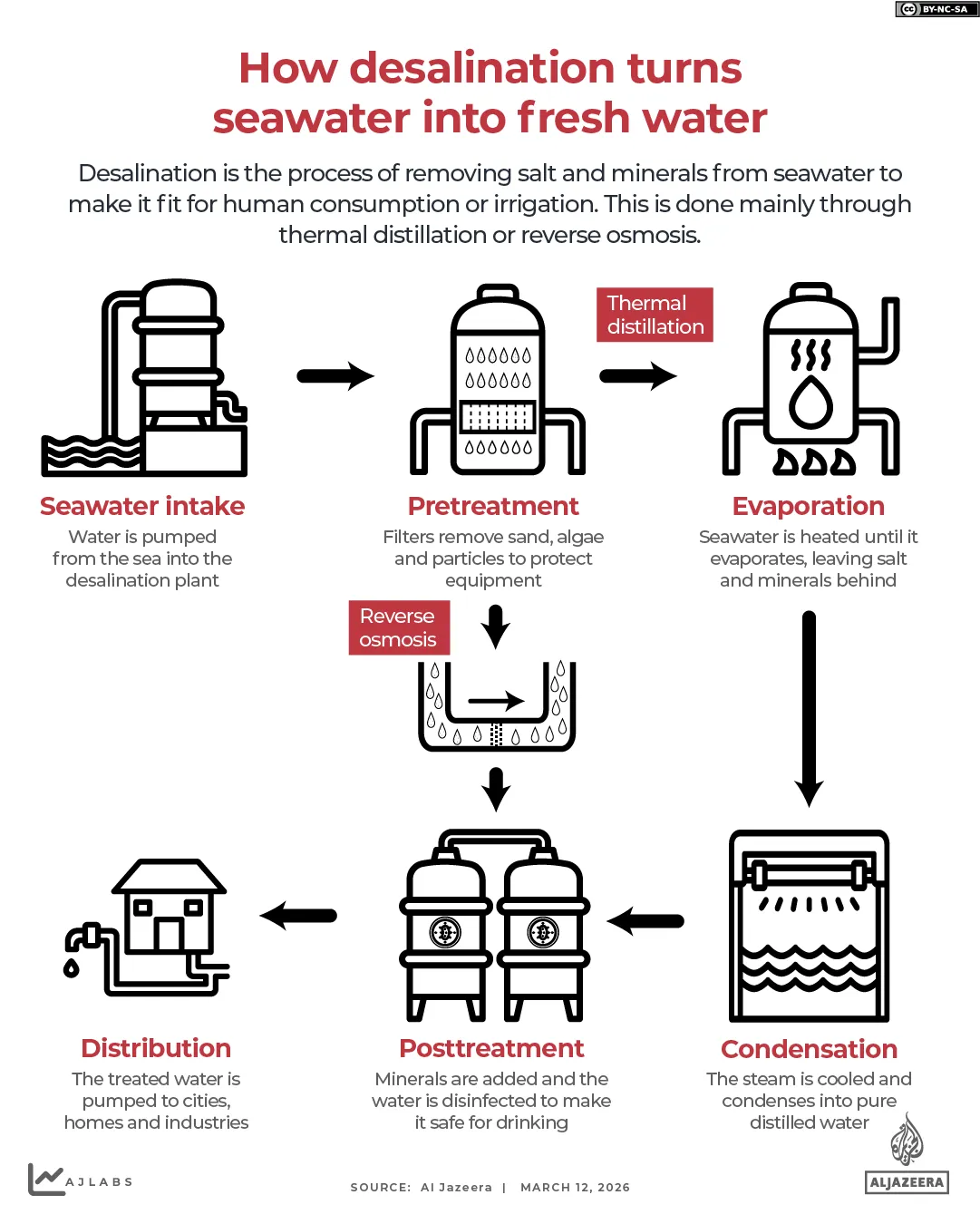
US President Donald Trump again threatened to attack oil and gas installations, destroy power generation plants, and “possibly” obliterate all of Iran’s water desalination plants.

‘Wish they will take to the grave’

The top commanders of Iran’s Islamic Revolutionary Guard Corps (IRGC), currently believed to be running the war and deciding the future of the country, have continued to signal defiance after this week’s attacks.

The spokesman of the Khatam al-Anbiya Central Headquarters of the IRGC said on Tuesday that Tehran’s enemies are “humiliated and on the path of destruction” as the US raises the prospects of launching ground attacks on strategic islands on Iran’s southern shores.

The idea of gaining dominance over the Strait of Hormuz through military attack is a “wish they [the US] will take forever to the grave”, Ebrahim Zolfaghari said in a video message as an Iranian drone attack sparked fire on a Kuwaiti tanker at Dubai Port.

The IRGC also released footage of ballistic missiles fired towards Israel and countries across the region, as well as footage of shooting down what it said were two of the US military’s advanced MQ-9 Reaper drones. It said retaliatory attacks would be launched against technology companies linked to the US and Israel in the region.

State television aired a programme where analysts said they believed a ground military incursion by US soldiers amassing in the region could militarily benefit the Islamic Republic, as they could sustain losses while trying to take over fortified positions held by the IRGC on the islands.

“American vessels are the most vulnerable point of the enemy,” Ali Fadavi, one of the most senior remaining commanders of the IRGC, told state television during an interview broadcast on Tuesday.

He claimed that US warships are generating “fake signals” from their transponders and are actually situated far further from Iranian shores than they show, which the commander said reflected “full preparedness of our forces”.

Ali Akbar Velayati, a former foreign minister and longtime foreign policy adviser to the late Supreme Leader Ayatollah Ali Khamenei, said in a social media post that any ground aggression would escalate the war into an “historical and civilisational defence”, in reference to Israel and US officials branding the conflict a war for civilisation.

Iran announces more executions

Iranian authorities continue to warn through state media that they take any form of local dissent seriously, and are prepared to exact punishments that include execution by hanging.

Two more people were executed on Tuesday morning, the judiciary confirmed, saying they were armed members of the foreign-based Mojahedin-e-Khalq (MEK) group that is considered a “terrorist” outfit by Tehran.

This comes after executions on Monday, as well as others over recent weeks, some of which were also related to Iran’s nationwide protests in January, when thousands were gunned down on the streets of Tehran and cities across the country.

The United Nations and human rights organisations accuse state forces of carrying out an unprecedented crackdown against peaceful protesters, but the authorities blame “terrorists” and “rioters” backed by the US and Israel.

Iran’s judiciary spokesman Alireza Jahangir told state television on Tuesday that new indictments have been issued against 200 “mercenaries” who are accused of assisting the US and Israel, including by recording footage of air strikes and sending them to foreign-based outlets in defiance of the theocratic establishment.

The judiciary reiterated that punishments for national security charges will include full confiscation of assets, as well as execution. A number of local and foreign-based Iranian celebrities and businesspeople have already had their assets seized for opposing the Islamic Republic.

The government of President Masoud Pezeshkian late on Monday held its first cabinet meeting since the start of the war, with an image showing a makeshift space decorated with a blue covering at an undisclosed location serving as the meeting place.

Israel’s Channel 14 alleged in a report that Pezeshkian has been pushing to gain negotiating powers with the US, as Trump claims talks have advanced. But the Israeli outlet said IRGC chief Ahmad Vahidi declined the request and did not want to give concessions to the US and Israel. Iran has not commented on the report.

“Any decision-making about ending the war will be adopted strictly while considering all raised conditions and in the framework of ensuring dignity, security and interests of the great Iranian nation,” Pezeshkian was quoted as saying during the cabinet meeting, in reference to Iran’s demands for guarantees and reparations.

Source link

Trump attacks NATO allies as pressure mounts over Strait of Hormuz | Donald Trump News

US President Donald Trump has released a series of posts attacking NATO countries including France, Spain and the UK over their role in securing the Strait of Hormuz. Al Jazeera’s Alan Fisher explains what Trump’s latest criticism of US allies means.

Source link

What can nations do to make up for the ongoing energy shortfall? | US-Israel war on Iran

The Middle East conflict has cut off 20 percent of the world’s fuel supply. Countries are scrambling for alternatives.

The disruption in the Strait of Hormuz has cut access to one-fifth of the world’s oil and gas supply, leaving many countries scrambling for alternatives.

So what can they rely on to make up for the shortfall in a quick time?

Many Asian countries are turning to coal, reopening shuttered plants and expanding production.

Policymakers say immediate energy needs supplant environmental concerns.

Others are hoping to turn to renewables. Solar power is now the cheapest form of electricity in many parts of the world. But renewables, especially wind, have faced hostility from the Trump administration.

Source link

Pentagon denies that Hegseth’s broker sought investment before Iran war | Business and Economy News

US Department of Defense demands retraction of report alleging broker sought multimillion-dollar investment for Hegseth.

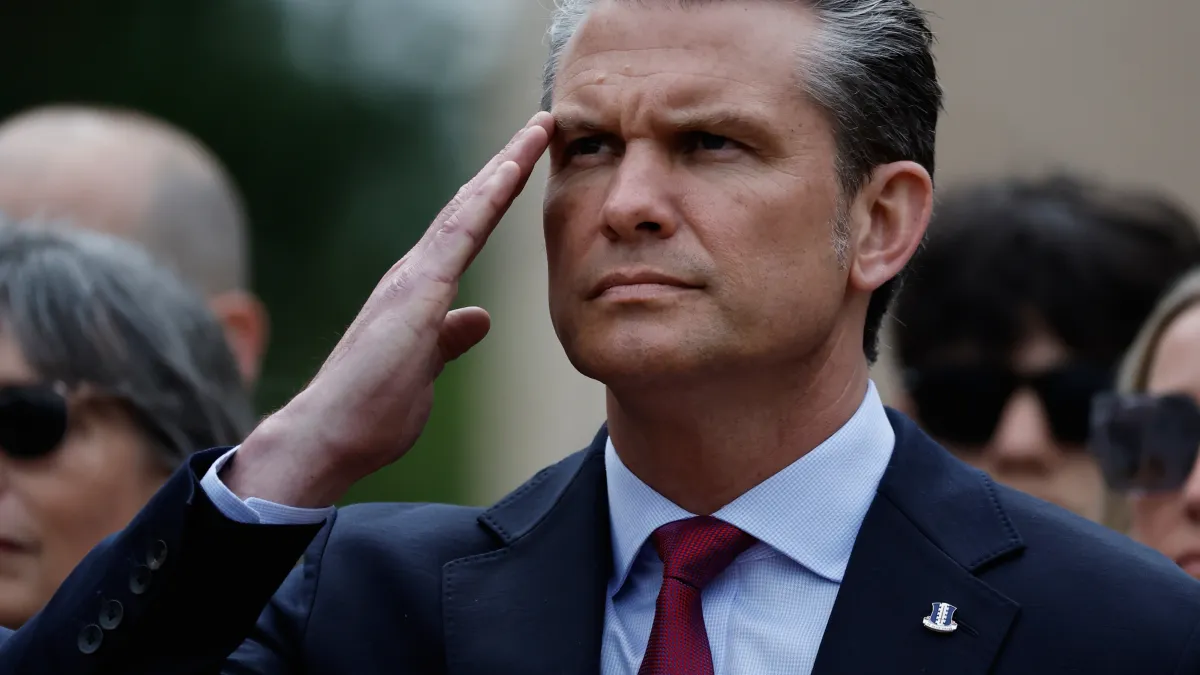
The United States Department of Defense has demanded the retraction of a newspaper report alleging that a broker for defence chief Pete Hegseth attempted to make a large investment in weapons companies in the run-up to the war on Iran.

Pentagon spokesman Sean Parnell demanded the “immediate” retraction on Monday after The Financial Times reported that a wealth manager for the defence secretary contacted BlackRock about making a multimillion-dollar investment in a defence-related fund in the weeks leading up to the war.

Recommended Stories

list of 4 itemsend of list

Hegseth’s broker at Morgan Stanley ultimately did not go ahead with the investment in the exchange-traded fund, whose holdings include Lockheed Martin and Northrop Grumman, because it was not yet available for purchase at the time, The Financial Times reported, citing three unnamed sources.

“This allegation is entirely false and fabricated. Neither Secretary Hegseth nor any of his representatives approached BlackRock about any such investment,” Parnell said in a post on social media.

“This is yet another baseless, dishonest smear designed to mislead the public.”

Hegseth and his department “remain unwavering in their commitment to the highest standards of ethics and strict adherence to all applicable laws and regulations,” Parnell said.

Al Jazeera could not independently confirm the Financial Times report.

The Defense Department did not immediately respond to a request for comment sent outside of usual business hours.

The Financial Times and Morgan Stanley also did not immediately respond to inquiries.

BlackRock declined to comment.

The report comes amid scrutiny of well-timed trades in financial and prediction markets that have fuelled speculation that figures with insider knowledge may be profiting off of US President Donald Trump’s war plans.

While The Financial Times reported that the attempted investment by Hesgeth’s broker did not go ahead, the defence chief would not have made money on such a purchase in the month since the war began.

While the iShares Defense Industrials Active ETF has risen more than 25 percent over the past year, it has fallen nearly 13 percent since the US and Israel launched strikes on Iran on February 28.

Source link

Al Jazeera’s full interview with Marco Rubio on US war on Iran | US-Israel war on Iran

NewsFeed

In an exclusive interview with Al Jazeera, US Secretary of State Marco Rubio outlines Washington’s position on Iran, saying US objectives will be achieved ‘within weeks, not months’. Rubio says talks are taking place between parties inside Iran and the United States, mainly through intermediaries, while warning that the Strait of Hormuz ‘will be opened one way or another’ after the military operation ends. He also says Iran must take concrete steps to abandon any ambition to acquire nuclear weapons.

Source link

The war in Iran: Key takeaways from Al Jazeera’s interview with Marco Rubio | US-Israel war on Iran News

US Secretary of State Marco Rubio has said that talks with Iran are under way through intermediaries and that Washington will continue its military campaign until Tehran abandons its nuclear and missile programmes.

He warned on Monday that the Strait of Hormuz will be kept open “one way or another” and that US war objectives could be achieved “in weeks, not months”.

Recommended Stories

list of 2 itemsend of list

He also said the United States would welcome political change in Iran if the opportunity arose, but said it was not an official objective. Rubio criticised some NATO allies for refusing US access to bases during the war, and said Washington is closely watching developments in Cuba and Venezuela.

Here are the key takeaways from Rubio’s exclusive interview with Al Jazeera’s Hashem Ahelbarra:

Marco Rubio says talks with Iran are happening

Much of the communication between Tehran and Washington is indirect and through intermediaries, but Rubio insisted that it is ongoing.

He said there are “messages and some direct talks going on between some inside of Iran and the United States, primarily through intermediaries”, adding that the US president “always prefers diplomacy, always prefers an outcome”.

His comments come as US President Donald Trump escalated his rhetoric on social media, threatening to “obliterate” Iran’s energy infrastructure if a ceasefire is not reached soon, Al Jazeera’s Kimberly Halkett reported from Washington.

“Taken together, Rubio’s statements and Trump’s posts suggest the US is pursuing a dual-track approach: keeping diplomatic channels open through intermediaries while simultaneously increasing military and economic pressure on Iran,” she said.

US demands Iran abandon nuclear and missile programmes

Rubio said Iran must abandon its nuclear weapons ambitions and stop producing missiles and drones that can threaten countries across the Gulf region, and insisted “The Iranian regime can never have nuclear weapons.”

He said Iran’s missile programme poses a direct threat to countries across the Gulf, and claimed “These short-range missiles that they’re launching, they only have one purpose, and that is to attack Saudi Arabia and the UAE and Qatar and Kuwait and Bahrain.”

Rubio said Iran could pursue civilian nuclear energy, but not in a way that would allow it to quickly develop a nuclear weapon.

“What they cannot have is a system that allows them to quickly weaponise it,” he said. “They have to abandon all these weapon programmes and all their nuclear ambitions.”

However, Hassan Ahmadian, an assistant professor at the University of Tehran, questioned the narrative that Iran poses an offensive threat in the region.

“When was the last time Iran attacked its neighbours over three centuries?” Ahmadian asked, arguing that Iran’s military strategy is shaped by deterrence in an asymmetric conflict.
“Why is it doing this now? Because it’s the underdog in an asymmetric war that it wants to shield itself by expanding.”

Ahmadian added that Iran has been a central focus of US policy for years.

“With the break of two wars in less than a year, we have experienced, Iran has been on the table in different US administrations – all options are on the table,” he said.

Strait of Hormuz will be kept open ‘one way or another’

Rubio said the US would not accept Iran claiming sovereignty over the Strait of Hormuz and warned that the waterway would remain open regardless of Iran’s actions.

“Not only is the sovereignty over the Strait of Hormuz not acceptable to us, it won’t be acceptable to the world.”

“It sets an incredible precedent … nations can now take over international waterways and claim them as their own.”

“The Strait of Hormuz will be open … It will be open one way or another,” he said, adding that otherwise, Iran would “face real consequences” from the US and other countries.

Iranian analysts suggested the closure of the strait is a temporary wartime measure and could be reversed once the conflict ends.

“It’s opened partially,” Ahmadian said, adding “I think there is no Iranian interest to not open it beyond the war.”

“It’s an asymmetric way of putting pressure on Americans, just as they are bombing Iran, and so after the war there would be no need,” Ahmadian explained. “There will be an arrangement, according to the Iranians, with the GCC [Gulf Cooperation Council] countries to reopen it and see how things are managed.”

War objectives will be achieved ‘in weeks, not months’

Rubio said the US military campaign is progressing quickly and outlined the military objectives Washington is trying to achieve.

“Those objectives are the destruction of their air force, which has been achieved, the destruction of their navy, which has largely been achieved.”

“A significant reduction in the number of missile launchers… and we are going to destroy the factories that make those missiles and those drones.”

“We are well on our way or ahead of schedule.”

“We will achieve them in weeks, not months.”

“That’s a matter of weeks. I’m not going to tell you exactly how many weeks, but a matter of weeks, not months.”

Rubio says status of Iran’s new supreme leader is uncertain

Asked by Al Jazeera about his thoughts on Iran’s new Supreme Leader, Mojtaba Khamenei, Rubio said his status remains unclear.

“We don’t even know he’s in power. I know they say he’s in power. No one has seen him. No one has heard from him,” Rubio said.

“It’s very opaque right now. It’s not quite clear how decisions are being made inside of Iran.”

Iran’s leadership change is not an objective of the military operation

The US secretary of state suggested the US would welcome political change in Iran, though he said it was not the official objective of the military operation.

“We would always welcome a scenario in which Iran was led by people that had a different view of the future,” Rubio said. “If that opportunity presents itself, we’re going to take it.”

He said the Iranian people “deserve better leadership” and indicated Washington would not oppose a change in government if it occurred.

“Do we think the people of Iran deserve better leadership than what they’ve gotten from the clerical regime? One hundred percent,” Rubio said. “Would we be heartbroken if there was a change in leadership? Absolutely not.”

He also suggested the US would be willing to play a role if political change became possible.

“If there’s something we could do to facilitate that, would we be interested in participating? Of course.”

However, analysts said Washington’s position on regime change appears to have shifted over time.

“Originally bringing down the government was the goal; there has been a constant drawdown from that,” Paul Musgrave, a professor of government at Georgetown University in Qatar, told Al Jazeera.

“And now we have President Donald Trump on Truth Social saying he is negotiating with elements of what could become a new regime, so there is a lot of confusion here, but it is no longer the number one goal. It’s not something they are laying out,” he noted.

Rubio criticises NATO allies and warns alliance may be reviewed

Rubio said some NATO countries denied the US use of airspace and bases during the conflict and suggested Washington may need to reassess the alliance after the war.

“We have countries like Spain, a NATO member that we are pledged to defend, denying us the use of their airspace and bragging about it, denying us the use of their bases.”

“And so you ask yourself, well, what is in it for the United States?”

“If NATO is just about us defending Europe from attack, but them denying us basing rights when we need them, that’s not a very good arrangement.”

“All of that is going to have to be re-examined.”

Source link

Trump wants to ‘take Iran’s oil’: Can he, and what would that mean? | US-Israel war on Iran News

United States President Donald Trump said on Sunday that he wishes to “take the oil” in Iran, as the US-Israel war against Iran enters its second month.

On Monday, President Trump threatened to target Iran’s energy infrastructure, including oil wells, if Tehran does not reopen the Strait of Hormuz, which has been under a de facto Iranian blockade for weeks, triggering a global energy crisis.

The Trump administration has unveiled no clear goal behind its military campaign against Iran, one of the world’s biggest oil producers and under US sanctions for decades.

Here is more about what Trump says, how much oil Iran has, and whether Trump could take it.

What has Trump said about Iran’s oil?

Trump told the Financial Times that his “preference would be to take the oil” in Iran and that US forces could seize Iran’s export hub at Kharg Island.

Kharg is a 22-square-kilometre (8.5-square-mile) coral outcrop in Iran’s Bushehr province. Closely guarded by the Islamic Revolutionary Guard Corps (IRGC), entry to the island is restricted to those with official security clearance.

Kharg processes 90 percent of Iran’s total oil exports, handling approximately 1.5 million barrels every day.

On March 14, Trump announced that the US Air Force had bombed Iranian military facilities on the island.

“For reasons of decency, I have chosen NOT to wipe out the Oil Infrastructure on the Island. However, should Iran, or anyone else, do anything to interfere with the Free and Safe Passage of Ships through the Strait of Hormuz, I will immediately reconsider this decision,” Trump wrote on Truth Social.

Critics say the Trump administration was emboldened by the success of its brazen military operation in January to abduct Venezuelan President Nicolas Maduro from Caracas. Washington says it is now in control of Venezuela’s oil exports.

Earlier this month, Trump claimed that 100 ⁠million barrels of Venezuelan oil had been brought to refineries in Houston, Texas in the US. He added that ⁠an additional 100 ⁠million barrels of Venezuelan ⁠oil were on the way.

Ties between Venezuela, which has the world’s largest proven reserves of crude oil, and Washington had deteriorated under former President Hugo Chavez, who decided to nationalise the oil sector. Relations collapsed further under Maduro, who succeeded Chavez in 2013. Venezuela’s current interim president, Delcy Rodriguez, has since opened the sector for private investment.

How much oil does Iran have?

Iran is one of the world’s biggest oil producers.

The country holds the world’s second-largest proven natural gas reserves and the third-largest crude oil reserves, according to the United States Energy Information Administration.

Iran holds around 24 percent of the Middle East’s and 12 percent of the world’s proven oil reserves, with about 157 billion barrels of proven crude oil.

It is the ninth-largest oil producer globally, and the fourth-largest within the Organization of the Petroleum Exporting Countries (OPEC), producing about 3.3 million barrels of crude oil per day.

Before the war, Iran was exporting around two million barrels of crude and refined fuel each day, though its exports dropped dramatically after Trump slapped sanctions on Iran in 2018 during his first term in power. The Iran nuclear deal signed under US President Barack Obama in 2015 – the Joint Comprehensive Plan of Action (JCPOA) – placed limits on Iran’s nuclear programme in exchange for sanctions relief in place for decades.

The US cut diplomatic ties with Iran after pro-Washington ruler Shah Mohammad Reza Pahlavi was toppled in the 1979 Islamic Revolution and the subsequent hostage crisis involving US citizens.

Can the US seize Iranian oil?

The Pentagon is preparing for limited ground operations in Iran, potentially including raids on Kharg Island and coastal sites near the Strait of Hormuz, according to US officials quoted by the Washington Post newspaper.

The plans, which fall short of a full invasion, could involve raids in special operations and by conventional infantry troops, the newspaper reported on Saturday.

However, even if the US invades or occupies Kharg Island, this would not give the US access to Iranian oil.

In order to access Iranian oil, the US would have to occupy Iran’s oil production sites and refineries. In essence, the US would need to occupy mainland Iran.

INTERACTIVE-IRAN-OIL-MAP-JUNE 17, 2025-1772104794
(Al Jazeera)

What would it mean if the US were to take Iranian oil?

In 2023, Iran’s gross domestic product (GDP) was around $457.5bn, according to World Bank data.

In the same year, Iran’s net oil export revenues were estimated at $53bn.

That export figure is equivalent to roughly 12 percent of Iran’s GDP, although export revenues and GDP are not directly comparable.

At the same time, if the US were to lift sanctions on Iranian oil after seizing it, it could lead to a flow of more Iranian oil into global markets, bringing down oil prices.

Iran is one of the most heavily sanctioned countries in the world. The US first imposed sanctions on Iran in November 1979, after Iranian students stormed its embassy in Tehran and took Americans hostage. The hostage crisis ended when dozens of US citizens were released after more than a year.

The US-Israeli war on Iran has sent global oil prices soaring. Benchmark Brent crude rose to more than 3 percent on Monday to $116 a barrel – the highest level in nearly two weeks. The oil price was about $65 per barrel before the war.

Has the US tried to interfere in Iranian oil before?

Yes; this is not the first time the US has shown an interest in Iranian oil.

In 1953, the government of Mohammad Mossadegh, Iran’s first democratically elected prime minister, was toppled in a CIA-orchestrated coup after he nationalised the British-controlled firm Anglo‑Iranian Oil Company (AIOC), the predecessor of modern-day BP.

Washington framed the operation – codenamed “Operation Ajax” – as a Cold War necessity to keep Iran and its energy reserves out of Soviet hands.

The coup restored and entrenched the shah’s rule, a turning point that still haunts Iran’s relationship with the West.

Neighbouring Iraq’s oil revenue is still effectively under US control more than two decades after the US invaded the Middle East nation. Iraq’s oil revenues are deposited into an account at the Federal Reserve Bank in the US before making it to Baghdad.

Source link

Why have the US and Israel bombed more than 75 Iranian police facilities? | Armed Groups News

In the densely populated neighbourhoods of southern Tehran, the 11th Criminal Investigation Base once stood as a mundane symbol of local law enforcement. Its detectives investigated economic crimes, fraud and petty thefts.

The building housed no ballistic missiles, no uranium centrifuges and no military command centres. Today, it is a crater. In the opening wave of the United States-Israel war on Iran, warplanes wiped the local police station off the map.

Satellite imagery provided by Planet Labs shows the complete destruction of the 11th Criminal Investigation Base in southern Tehran between February 26 and March 6, 2026.
Satellite imagery provided by Planet Labs shows the destruction of the 11th Criminal Investigation Base in southern Tehran on February 26 and March 6, 2026. [Al Jazeera/Planet]

It was not an isolated incident. An investigation by Al Jazeera’s Digital Investigations unit has verified that at least 75 internal security sites were destroyed or damaged in bombardments by Israel and the US from February 28 to March 10. The targeted facilities included local police stations, criminal investigation headquarters, public security offices and checkpoints operated by the Basij paramilitary force.

Al Jazeera mapped the strikes using open-source data, cross-referencing field reports with satellite imagery to confirm the destruction. However, conducting independent verification has grown increasingly difficult. On March 6, commercial satellite providers Planet Labs and Vantor restricted imagery over the Middle East, later expanding the blackout to impose a 14-day delay on all images of Iran.

While the companies said the blackout prevents hostile actors from endangering civilians, independent journalist Ken Klippenstein recently revealed a leaked US Space Force directive dictating how commercial satellite firms describe damage. The leak exposed a deliberate US effort to control the flow of information and obscure the reality of the battlefield.

Targeting population centres

The spatial distribution of the 75 verified strikes revealed a clear and deliberate strategy. Warplanes bypassed isolated military installations to hit the infrastructure Tehran uses to police its citizens.

An Al Jazeera map detailing the geographic distribution of the 75 internal security sites targeted by US and Israeli strikes, showing a heavy concentration in Tehran and the western provinces.
An Al Jazeera map details the geographic distribution of the 75 internal security sites targeted by US-Israeli strikes, showing a heavy concentration in Tehran and western provinces. [Al Jazeera]

The capital alone absorbed 31 strikes, more than 40 percent of the total targets. Sanandaj, the capital of Kurdistan province, suffered eight strikes. The remaining targets were clustered tightly in major western and central cities, including Isfahan, Kermanshah and Hamedan. Meanwhile, Iran’s sprawling eastern and southeastern provinces remained largely untouched by this campaign.

By overlaying the strike coordinates with demographic maps, the investigation shows a near-perfect alignment with urban density. More than 70 percent of Iran’s population lives in these targeted western urban areas.

INTERACTIVE - Iran population density - FEB26, 2026-1772104770
A population density map of Iran demonstrates how the strike locations closely align with the country’s most heavily populated urban centres. [Al Jazeera]

The strikes systematically targeted the Law Enforcement Command, known as FARAJA, and the Basij network. FARAJA, elevated in 2021 by late Supreme Leader Ali Khamenei to operate alongside the military, is currently led by Ahmad-Reza Radan. It manages daily urban law enforcement and riot control. The Basij, an immense volunteer paramilitary force deeply embedded in Iranian neighbourhoods, acts as the state’s ultimate tool for social control.

Engineering state collapse

The pattern of the US-Israeli air strikes points to an objective far removed from dismantling nuclear facilities or degrading military infrastructure. It reveals a calculated attempt to engineer the collapse of the Iranian state.

On February 28, US President Donald Trump launched the war and in a video address urged Iranians to take over their government once the bombs stopped falling. Israeli Prime Minister Benjamin Netanyahu echoed this sentiment in Farsi, calling on millions of Iranians to take to the streets and describing the military strategy as breaking the Iranian government’s bones.

The military planning, however, preceded events on the ground that Trump and Netanyahu pointed to for justification for their war. Israeli Defence Minister Israel Katz revealed in early March that Israel had been planning to strike Iran in mid-2026, long before January’s deadly government crackdown across Iran against economic protests.

Satellite imagery captures the extensive damage inflicted on the Beheshti Basij headquarters in Tehran's District 8 following the initial wave of strikes. (Al Jazeera/Planet).
Satellite imagery captures extensive damage to the Beheshti Basij headquarters in Tehran’s District 8 after the initial wave of strikes. [Al Jazeera/Planet]

This approach aligns with a broader Israeli doctrine. Daniel Levy, a former Israeli government adviser, previously told Al Jazeera that Israel has no interest in a smooth political transition in Tehran. What Israel wants is the collapse of the government and the state, Levy said, adding that if the repercussions spread to Iraq, the Gulf and the entire region, that is better from Israel’s point of view.

A failing strategy

Still, a month into the war, the US-Israeli strategy to spark an internal revolution through the systematic destruction of Iran’s internal security apparatus appears to be failing.

Iranians are living under daily bombardments. As missiles destroy civilian infrastructure and oil refineries burn, daily survival has eclipsed any coordinated political uprising. The United Nations special rapporteur on human rights in Iran has warned that civilians are facing a simultaneous military and human rights crisis.

Rather than collapsing, Iran’s internal security apparatus has adapted. During Ramadan, FARAJA deployed 24-hour patrols across Tehran, and riot police shut down public gatherings before the Persian New Year holiday. After the March 17 assassination of Basij commander Gholamreza Soleimani, Israeli forces released footage of strikes on mobile Basij checkpoints, indicating that Iranian security forces are still controlling the streets.

The US attempt to dismantle state security from the air mirrors its disastrous 2003 de-Baathification policy in neighbouring Iraq, which barred members of the former ruling Baath Party from holding government jobs, dismantled local policing and birthed a devastating sectarian war. Unlike in Iraq, Washington today has no troops on the ground in Iran to fill a security void it is trying to create.

Beneath the rubble of the 11th Criminal Investigation Base and dozens of stations like it, the US and Israel are aiming to bury the Iranian state and spark a popular revolt. Instead, they have trapped millions of civilians in a burning country.

Source link