
unleashed

Children ‘unleashed’ to grab all the sunbeds at hotel on £3,000 Spain holiday

One mum says her family was unable to use the pool because of the tactics used to grab all the spaces

Mum films moment kids ‘unleashed’ to bag sunbeds on £3,000 Spain holiday

A mum says sunseekers recruited their children to sprint over and claim sunbeds at a Spanish hotel – leaving her family unable to sunbathe onsite for half of the holiday. Cait Fennel, from Liverpool, set off to Salou, Spain, with her husband Matty Fennel, 34, and five-year-old son Ralphy Fennel for a week-long holiday.

After arriving at Hotel Best Oasis Park, Cait noticed there were no free sun loungers. The 42-year-old said holidaymakers would begin queuing outside the pool area at around 8:45am, despite the doors not opening until 10am.

The mum-of-one said the second the doors opened, holidaymakers would ‘charge’ towards the sunbeds, with speedy children apparently ‘unleashed’ to get there first. Cait said guests would leave their beach bags in a queue to reserve their place and would even ‘sneak’ in through the hotel gym to get to the pool first.

After three days of being unable to bag a sunbed, Cait conceded defeat and eventually joined the early queues – but didn’t run. The administration worker posted footage of the sunbed wars online, with the caption: “The sunbed wars are wild! Pool doors open at 10am – it’s survival of the fittest!”

Footage shows kids sprinting to the sunbeds while adults speedwalk behind, chucking towels onto the loungers. Photos also show desperate sunseekers dumping their beach bags in the hour-long queue.

Cait said: “The door opened at 10am and people started queuing at 8.45am. It was kids and adults every day, some were queuing inside as well. They’d leave their bags in the queue – there was a queue of beach bags.

“The second they opened the doors they would charge. They definitely enlisted the kids to run and get the sunbeds. It was madness. I’ve been on a lot of holidays and never experienced anything like that.

“There was a gym in the hotel and what people were doing was sneaking in the gym and as soon as the doors opened they would come out. That was the lengths people went to.”

Cait said the situation became so chaotic that her family avoided the pool altogether for the first three days of their holiday. Cait said: “The first three days we didn’t go to the pool for that reason. We saw how busy it was and never got beds. We had to get involved to an extent. We actually went down and attempted to get a bed, we didn’t run. The rest of the time we spent our time on the beach.”

Cait said the daily scramble took the relaxation out of their £3,000 holiday and believes the hotel could have done more to prevent the chaos. Cait said: “It’s not what you’re on holiday for, you go on holiday to relax. It was chaos, it was stressful. There were beds you had to get yourself and there were people running to the beds stacked up, which contributed to the chaos.

“It is just madness, it made no sense. The holidaymakers did what they had to do. We didn’t want to get involved in the chaos but we ended up having to queue.”

Cait’s post racked up more than 27,000 views with commenters slamming the situation. One wrote: “Worst nightmare.”

Another commented: “Sad people.” One added: “It is absolutely embarrassing.”

Best Oasis Park has been contacted for comment.
Source link

Assassinations unleashed under Trump haunt Iran war endgame

Shortly before President Trump ended a ceasefire with Iran this week, Israeli officials presented his team with intelligence indicating Tehran was hatching new plots to kill him.

It was not the first such warning. U.S. law enforcement and intelligence agencies have tracked evidence for years of Iranian efforts to target the president, with signals only increasing since the start of the war.

Their desire to target Trump and his top aides began six years ago, just outside Baghdad International Airport, when the president ordered a drone strike that killed Iran’s most powerful general. The assassination of Qassem Suleimani brought the two countries to the brink of war.

Yet even as full-scale war was averted, top Iranian officials vowed revenge for the strike, authorizing attempts on the lives not just of the president, but of his secretary of State and national security advisor, among others, even after they had left office.

Now, calls for revenge have reached a sharper pitch in Tehran, after a joint U.S.-Israeli operation killed Iran’s supreme leader, Ayatollah Ali Khamenei, at the start of the war in February.

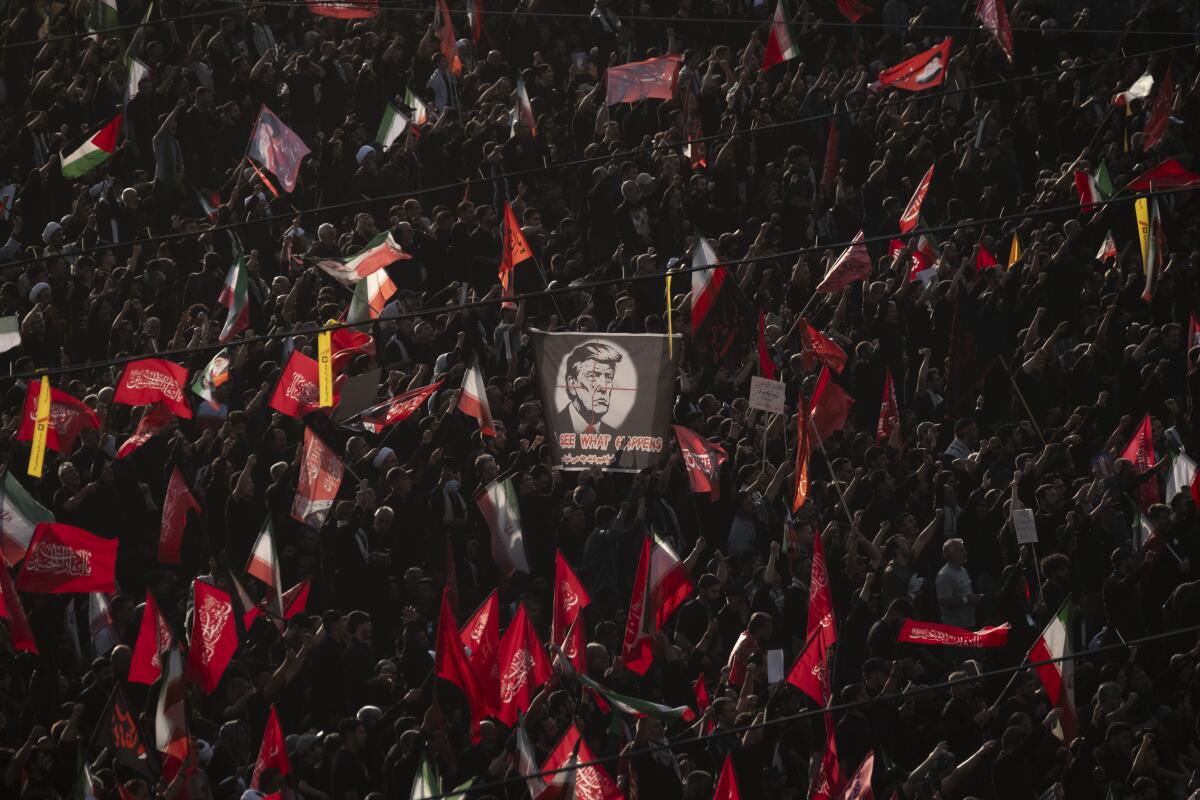
At Khamenei’s funeral ceremonies this week, red flags of vengeance flew throughout the capital as protesters explicitly called on their government to “kill Trump.” His son, Mojtaba, the new supreme leader, was absent from the commemorations, fearing assassination himself.

Mourners hold an anti-U.S. President Trump banner at the Imam Khomeini Grand Mosque during mass funeral prayers

Mourners hold an anti-President Trump banner at the Imam Khomeini Grand Mosque during mass funeral prayers for Iran’s late Supreme Leader Ayatollah Ali Khamenei and his family in Tehran on Sunday.

(Morteza Nikoubazl / NurPhoto via Getty Images)

The prospect of foreign assassination plots targeting U.S. leaders puts the United States in dangerous new territory, where its embrace of political killings could ultimately place its own officials at unprecedented risk. And experts fear the existential threat of assassination has pushed peace further out of reach: When both sides believe their survival is at stake, the trust required for diplomacy becomes far harder to achieve.

Israeli news organizations have reported that Israel’s prime minister, Benjamin Netanyahu, cited Iranian attempts to kill Trump in recent years as part of his case to go to war in the first place.

A U.S. official told The Times that a range of serious threats exist against the president, including from Iran, but that Israel’s intelligence pointed to a more specific plot. The official did not provide further details. Israeli officials did not respond to requests for comment.

Iran’s president, Masoud Pezeshkian, has said in recent months that the government sees vengeance against U.S. officials as “its legitimate duty and right,” and “will fulfill this great responsibility and duty with all its might.”

“The Suleimani killing accelerated a lifting of restraints on foreign assassinations — and the taboo on targeting and killing foreign leaders, with U.S. military assets, has been more or less lifted,” said Matt Dallek, a political professor at George Washington University.

“If the United States sets the example of how to conduct international relations, and it is using assassination of foreign leaders as a political weapon, it’s only logical that other countries will be more inclined to also engage in assassinations,” Dallek added. “It does seem likely that Trump will have a bigger target on his back.”

Returning from a NATO summit in Turkey on Wednesday, Trump was forced to switch back to an old model of Air Force One — equipped with specialized defensive technologies — from a new plane given as a gift by Qatar, after the Secret Service warned of potential threats to the aircraft from Iran.

“They want to take out the U.S. leader — me,” Trump told reporters aboard the plane. “I’m on whatever list. I saw this morning I’m on every single one of their lists. And so far, I guess I’ve been a bit lucky, but maybe that doesn’t last very long.”

The threat has remained on his mind in the days since. In an interview with the New York Post, Trump told the reporter, “I hope you’ll miss me,” adding that he has “been on their list for a long time.” And in a subsequent social media post Friday night, he warned of a catastrophic response he instructed the administration to pursue in the event Tehran succeeds.

“1000 Missiles are Locked and Loaded and aimed at the Islamic Republic of Iran,” he wrote, “with thousands of more to immediately follow, should the Iranian Government act on its threat, pronounced in many corners of the Globe, to assassinate, or attempt to assassinate, the sitting President of the United States of America, in this case, ME!”

The United States had a decades-old prohibition against assassinating foreign leaders before Trump’s presidency, codified in an executive order signed by President Ford in 1976 over concerns of a CIA plot to kill Fidel Castro.

The policy was only strengthened further by subsequent administrations, fearing a new international standard for targeted killings could result in unintended consequences in the halls of Washington.

Other administrations have been accused of targeting foreign leaders before. Under the Obama administration, an international coalition targeting the Libyan regime of Moammar Kadafi during the country’s 2011 civil war struck his fleeing convoy, leading to his capture and killing by rebel fighters.

But experts say Trump’s explicit targeting of Suleimani and Khamenei — and his public celebration of their deaths — marks a new paradigm.

“Through words and actions, President Trump has done more to normalize political violence than any other U.S. president, certainly in modern times,” said Robert Pape, a professor at the University of Chicago and author of “Our Own Worst Enemies: America in the Age of Violent Populism.”

“On the international front alone, the president routinely brags about killing Iranian leaders and seizing the leader of Venezuela, among others,” he added, “to the point that assassination is becoming the new normal in international politics.”

Source link