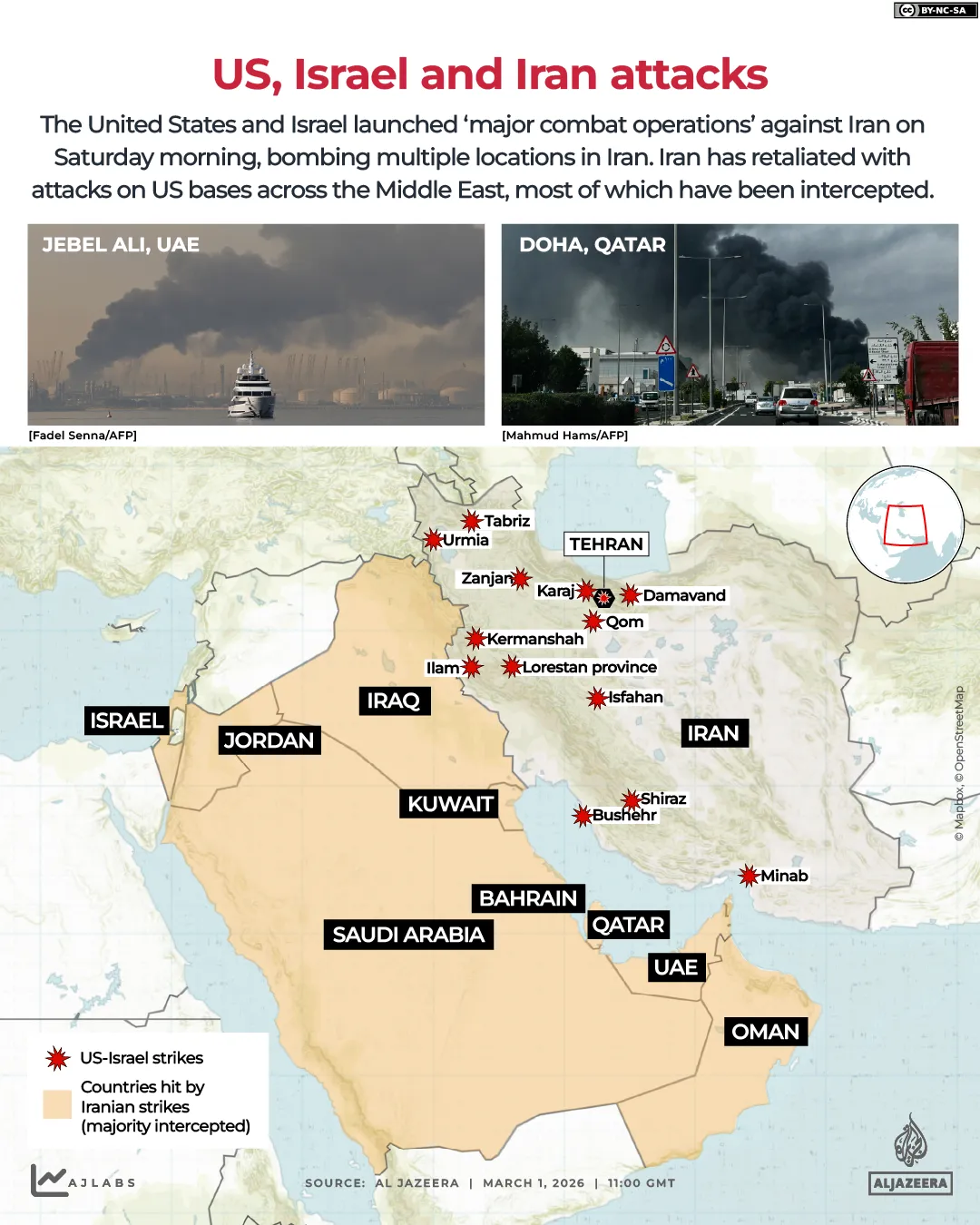
Explosions are being heard in Iran, Israel and across several Middle Eastern states after the United States and Israel began attacking Iran on Saturday.
Tehran has responded by launching waves of missiles and drones at Israel and towards several military bases in the Middle East where US forces operate.
Iran had previously warned that if it were attacked, it would respond by targeting US military facilities across the region, which it considers legitimate targets.
Which countries have been attacked?
Israel’s air force says it dropped more than 1,200 munitions across 24 of Iran’s 31 provinces over the past day in its joint attack with the US.
Iran’s Islamic Revolutionary Guard Corps (IRGC) says it has launched attacks on 27 bases in the Middle East where US troops are deployed as well as Israeli military facilities in Tel Aviv and other parts of Israel.
So far, Iran has launched strikes across eight countries in the region: Bahrain, Iraq, Jordan, Kuwait, Oman, Qatar, Saudi Arabia and the United Arab Emirates.
Most of these attacks have been intercepted.
(Al Jazeera)
US military presence in the Middle East
The US has operated military bases in the Middle East for decades.
According to the Council on Foreign Relations, the US operates a broad network of military sites, both permanent and temporary, across at least 19 locations in the region.
Of these, eight are permanent bases in Bahrain, Egypt, Iraq, Jordan, Kuwait, Qatar, Saudi Arabia and the UAE.
As of mid-2025, there are about 40,000 to 50,000 US soldiers in the Middle East stationed in both large, permanent bases and smaller forward sites.
The countries with the most US soldiers are Qatar, Bahrain, Kuwait, the UAE and Saudi Arabia. These installations serve as critical hubs for US air and naval operations, regional logistics, intelligence gathering and force projection.
(Al Jazeera)
How many people have been killed or injured?
Below are the confirmed casualties across the 10 countries that have been subject to attacks as of Sunday at 13:40 GMT.
Due to the rapidly evolving situation, all figures may change as more information becomes available.
Iran – killed: 201, injured: 747
As of Sunday morning, the Iranian Red Crescent Society and official state-linked media have reported preliminary casualty figures of 201 people killed and at least 747 injured as rescue operations continue.
Since then, explosions continue to be heard across Iran with Israel saying it has carried out a large aerial attack on the “heart of the capital”.
The deadliest single incident occurred in the city of Minab in southeastern Iran, where a strike on an elementary girls school reportedly killed at least 148 people and injured 95. The attack occurred on Saturday, and the death toll has been climbing since.
Israel – killed: 9, injured: 121
On Sunday afternoon, an Iranian ballistic missile strike on central Israel’s Beit Shemesh killed eight people and injured about 20. Rescue workers are still combing through the rubble.
Late on Saturday, one woman in the Tel Aviv area was confirmed killed after being struck by falling shrapnel.
At least 121 others have been reported injured, at least one seriously.
At least 40 buildings in Tel Aviv were damaged in Iranian strikes on Saturday, the Israeli newspaper Haaretz reported, citing the city government.
An explosion occurs in Tel Aviv on February 28, 2026, after Iran launched missiles into Israel [Gideon Markowicz/Reuters]
Bahrain – killed: 0, injured: 4
Iranian missiles targeted the headquarters of the US Navy’s 5th Fleet in Bahrain’s Juffair area.
Bahrain’s Ministry of Interior also confirmed that the country’s international airport was targeted with a drone, “resulting in material damage without loss of life”.
On Saturday night, several residential buildings in the capital, Manama, were struck by Iranian drones.
Government hospitals said four people were receiving treatment for shrapnel-related injuries.
A building was damaged in the Seef commercial district of Manama, Bahrain, on March 1, 2026, in an Iranian drone attack [Hamad Mohammed/Reuters]
Iraq – killed: 2, injured: 5
The US and Israel also targeted the Jurf al-Sakher base, also known as Jurf al-Nasr, in southern Iraq, which houses the Popular Mobilisation Forces, made up of mostly Shia fighters, and the Iran-supported Iraqi paramilitary group Kataib Hezbollah.
Iraqi state media and sources within Kataib Hezbollah confirmed that two fighters were killed in the strikes and five were wounded.
In northern Iraq‘s semiautonomous Kurdish region, where the US is reported to still have troops, several powerful explosions were reported near the US consulate and international airport in Erbil.
Air defences intercepted the drone attacks on Saturday, according to reports.
A plume of smoke rises near Erbil International Airport in Erbil, Iraq, on March 1, 2026 [Shvan Harki/AFP]
Jordan – killed: 0, injured: 0
The Jordanian armed forces reported intercepting 49 drones and ballistic missiles that entered Jordanian airspace. While their fragments caused localised property damage, there have been no deaths or injuries within the kingdom.
Kuwait – killed: 1, injured: 32
Kuwait’s Ministry of Defence says Ali al-Salem Air Base came under attack by a number of ballistic missiles, all of which were intercepted by Kuwaiti air defence systems.
A drone targeted Kuwait International Airport on Saturday, resulting in minor injuries to a number of employees and limited damage to the passenger building.
On Sunday, Kuwait’s Ministry of Health said one person had been killed and 32 wounded.
Kuwait City in the aftermath of strikes by Israel and the US on Iran [Stephanie McGehee /Reuters]
Oman – killed: 0, injured: 5
On Sunday morning, the Oman News Agency, quoting a security source, said two drones had targeted the Duqm port, injuring one foreign worker.
Later, Oman’s Maritime Security Centre said a Palau-flagged oil tanker was attacked about 5 nautical miles (9km) off Oman’s Musandam governorate, injuring four people.
Qatar – killed: 0, injured: 16
As of Sunday morning, the Qatari Ministry of Interior confirmed that the number of injured was at 16 people. Most injuries were reported to be from falling shrapnel and debris with one person seriously hurt.
The Qatari Ministry of Defence confirmed that two ballistic missiles struck the Al Udeid military base, where US forces are stationed, while a drone targeted an early warning radar installation.
Qatari air defence systems, in coordination with regional partners, successfully intercepted about 65 missiles and 12 drones over Qatari airspace, it said.
The Qatar Civil Aviation Authority suspended all air navigation indefinitely. Qatar Airways grounded all flights and advised passengers that updates will be provided on Monday by 9am (06:00 GMT).
All schools have moved to remote learning, and public gatherings for Ramadan have been suspended until further notice to ensure public safety.
Saudi Arabia – killed: 0, injured: 0
The Saudi Ministry of Foreign Affairs confirmed that Iranian attacks targeted both the capital, Riyadh, and Eastern Province, home to major oil infrastructure and the King Abdulaziz Air Base.
The kingdom has officially reported no casualties as of Sunday afternoon.
United Arab Emirates – killed: 3, injured: 58
As of Sunday afternoon, at least three people in the UAE were confirmed killed and 58 others wounded.
A Pakistani national was killed and seven people were injured when debris from intercepted missiles and drones fell on a residential area near Zayed International Airport in Abu Dhabi.
The Ministry of Defence confirmed that another individual, identified as an Asian national, was killed by falling shrapnel in a residential district of the capital.
Additionally, four airport staff at Dubai International Airport sustained injuries, and four people were injured at Palm Jumeirah after a fire in a building caused by falling debris.
As of Sunday afternoon, The UAE’s Defence Ministry says it detected 165 ballistic missiles, destroying 152, and intercepted two cruise missiles.
More than 240,000 Brits live in Dubai, but others are now considering moving to an alternative city in the United Arab Emirates according to a UK entrepreneur in the Persian Gulf
Alan Johnson Social News Reporter
16:27, 25 Feb 2026
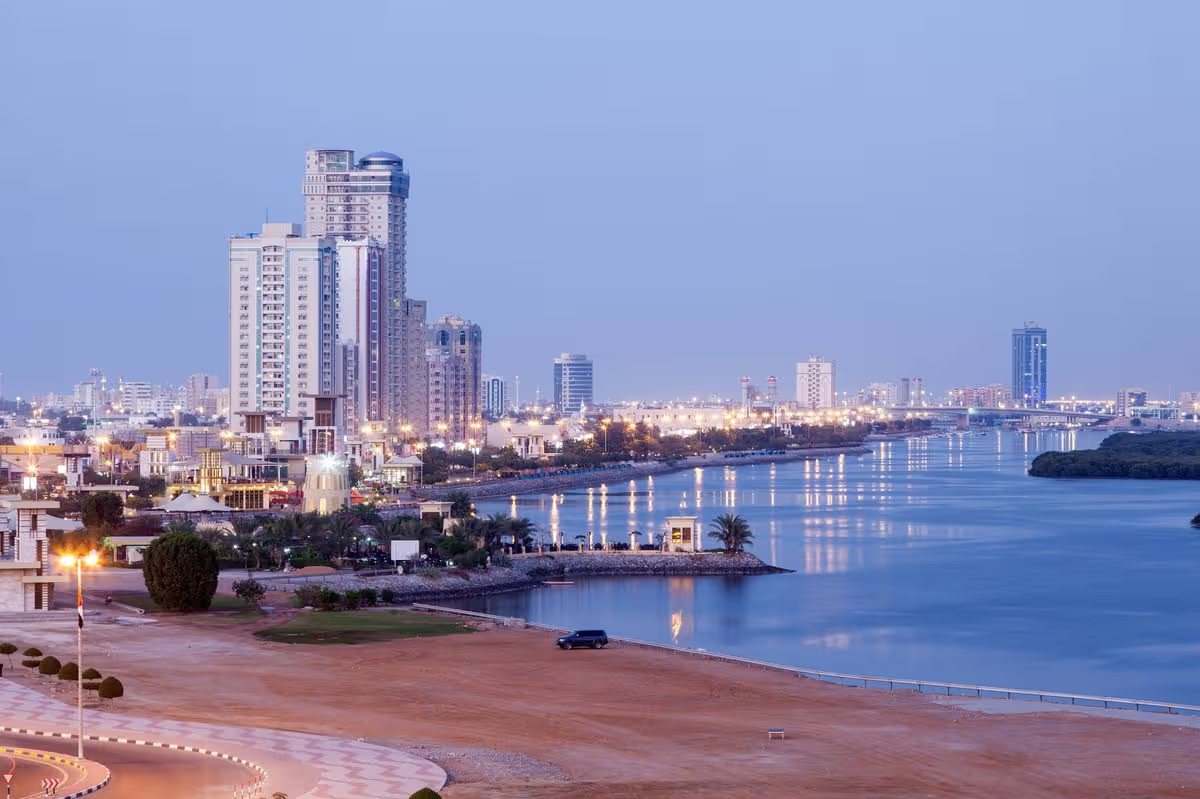
A British expat has identified an up and coming alternative to Dubai(Image: typhoonski via Getty Images)
It’s estimated that more than 240,000 Brits have relocated to Dubai, making them one of the largest expat communities currently living in the United Arab Emirates. Drawn by benefits such as year-round sunshine, tax-free salaries and a buzzing lifestyle, many have no intention of returning from the Persian Gulf.
However, as the destination grows increasingly popular with influencers, some claim Dubai is rapidly becoming “soulless” and are seeking to escape the “Dubai Depression”, as it has been dubbed by international residents. According to one British entrepreneur in the region, Ras Al Khaimah (RAK) is quickly emerging as the new hotspot.
Content cannot be displayed without consent
Dubbed the ‘nature Emirate’, it features 42 miles of coastline along the spectacular Arabian Gulf and while it provides many of the advantages of Dubai, it avoids its congestion and excessive tourism – for now at least.
“The British are moving directly to Ras Al Khaimah,” Ben Moss disclosed. “It used to be that they’d move to Dubai first and spend a year or two there then potentially move to Ras Al Khaimah.”
Now, however, the businessman maintains that when speaking to people back home, they tell him they’re more keen on relocating to the appealing alternative.
“You know you’re doing something right when you’re attracting the British,” he commended the destination. “That’s because the British are fantastic people who you want in your city. Rak’s definitely doing something right to attract them directly.”
In a follow-up video, Ben shared one of the main reasons he’s settled with life in Ras Al Khaimah. “You can just pop down to the beach and go for a nice swim,” he revealed. “The water is beautiful here.”
When it comes to the best spots to reside in Ras Al Khaimah, Ben highlighted Mina Al Arab, Al Hamra and Al Marjan island. “These are where all the fun and action is happening,” he gushed.
Ben disclosed he’s currently living in the Deira Corniche, roughly 30 minutes away. “You have this amazing mountain backdrop and it’s a very affordable place to live,” Ben boasted of the area.
“However, if you’re an expat you are definitely going to want to get as close to that casino as possible and Mina Al Arab is proving to be super cool.”
Ras Al Khaimah’s tourism website proudly states: “With a rich heritage spanning over 7,000 years, the city offers one of the UAE’s most authentic historical and cultural experiences.
“Visitors can explore its long-standing traditions, diverse cultural sites, and archaeological wonders that reflect its ancient past. This Emirate is not only a symbol of Arabian history but also a welcoming destination that encourages cultural awareness and understanding.”
It goes on to say: “Ras al Khaimah is celebrated for its breathtaking natural landscapes, which include pristine beaches, lush mangrove forests, vast terracotta desert dunes, and the rugged Hajar mountains.”
“Home to Jebel Jais, the UAE’s tallest mountain, this Emirate provides spectacular highland scenery and fresher conditions, approximately 10 degrees cooler than at sea level. Renowned for its open and hospitable character, Ras Al Khaimah also features a wide array of attractions, from upmarket resorts and boutique accommodation to genuine Emirati cultural encounters.”
Ensure our latest headlines always appear at the top of your Google Search by making us a Preferred Source. Click here to activate or add us as your Preferred Source in your Google search settings.
Days after Israeli Prime Minister Benjamin Netanyahu proposed forging a network of allied nations, including in the Middle East and Africa, to stand against what he called “radical” adversaries, the country’s president is on an official visit to key ally, Ethiopia.
It is not yet known which Arab and African countries will form part of Netanyahu’s hypothetical “hexagon of alliances”, which he said on Sunday will include Israel, India, Greece, Cyprus and others to stand against their enemies in the Middle East. Chief among those enemies is presumably Iran and its network of resistance groups from Hezbollah in Lebanon to the Houthis of Yemen.
Recommended Stories
list of 3 itemsend of list
Analysts doubt Israel could secure enough influence over nation-states to form a formal security pact.
However, the country is deepening its ongoing charm offensive in Africa, which it began during the genocide in Gaza, as its reputation suffered a decline on the continent, with the African Union (AU) releasing multiple statements condemning Israeli attacks on Palestinian civilians.
In a rare visit, Israeli President Isaac Herzog arrived in Ethiopia on Tuesday. The last presidential trip to the East African country took place in 2018.
“The relationship between our peoples is woven deep into the pages of history and human tradition,” Herzog said in a statement upon his arrival. “At the heart of the story of both our nations lies a clear common thread – the ability to join hands, unite resources of spirit and substance, to innovate, develop, and grow for the benefit of all.”
Herzog, on Wednesday, met with Prime Minister Abiy Ahmed who said the two leaders talked about “ways to improve collaboration in areas of mutual interest,” without revealing further details.
But beneath the surface, observers say the visit also represents a battle for influence over Addis Ababa, which has received similar high-level delegations from Turkiye and Saudi Arabia in recent days.
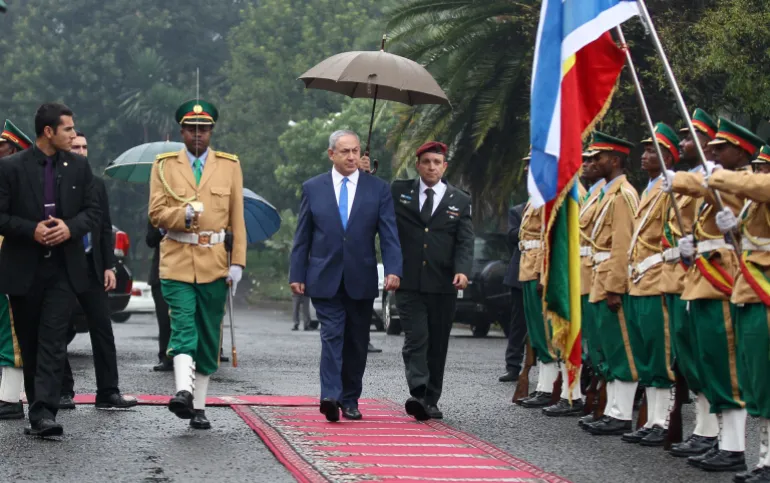
Israeli Prime Minister Benjamin Netanyahu inspecting a guard of honour at the National Palace during his State visit to Ethiopia in 2016 [File: Tiksa Negeri/Reuters]
Shared ties and shared anger
Ethiopia and Israel are bound by several links, from shared histories of their people to shared scrutiny over recent political moves in the Horn of Africa that have angered several of the region’s influential nations.
Both countries maintain friendly ties largely due to the Beta Israel community, or Ethiopian Jews, who hail from northern Tigray and Amhara. Historically, Ethiopian Jews suffered religious persecution, and after Israel’s formation, it sought their emigration under its Law of Return policy. Between the late 1970s and mid-1990s, tens of thousands of Ethiopian Jews were covertly transported to Israel – during a time when several African countries, including Ethiopia, had cut off ties with Israel over the 1973 Yom Kippur War and its invasion of Egypt.On the cusp of a civil war in Ethiopia in 1991, Mossad, Israel’s spy agency, launched a daring operation that airlifted 14,000 Ethiopians over the course of just two days.
About 160,000 Ethiopian Jews now live in Israel. Many within the community have struggled to integrate and have complained of discrimination and racism. In 2019, tens of thousands of Ethiopian Jews flooded the streets in protest across Israeli cities after a 19-year-old of Ethiopian origin was shot dead by the police.
Ethiopia-Israel state relations have, meanwhile, remained steady. In 2016, when Netanyahu visited the country in his first prime ministerial visit – Addis Ababa became one of the first African countries to voice support for Israel’s long-sought observer status at the AU. Fierce opposition from South Africa, Algeria and other countries supporting Palestine delayed the process until 2021. Later, in 2023, the AU confirmed it had withdrawn the status.
Mashav, Israel’s aid agency, has, in the past decade, provided aid to Ethiopia in the form of agriculture and water cooperation projects, although Addis Ababa receives much more significant funding from wealthier partners like China. When Israel sponsored several African journalists on media trips to the country last year, Ethiopia was among the countries it invited journalists from.
More recently, both countries are bound by their support for Somaliland, which Somalia claims as part of its territory and which Israel sees as critical to its own national security, Hargeisa-based analyst Moustafa Ahmad told Al Jazeera.
In December, Israel recognised Somaliland’s statehood, becoming the first country to do so. Months before, there were unconfirmed talks about plans to move displaced Palestinians to Somaliland or to South Sudan, another key Israeli ally in the region. Analysts speculate that countries like South Sudan and the United Arab Emirates, another close friend of Israel, may also recognise Somaliland.
Israel’s focus on the Horn of Africa intensified after a late 2024 report from a United Nations expert panel, which found that the Somalia-based armed group, al-Shabab, was actively collaborating with Yemen’s Houthis. Where the Houthis were providing weapons and drone training, al-Shabab was, in return, granting access to a smuggling corridor stretching along the Somali coast and connecting to the Gulf of Aden, where Iranian weapons could be smuggled into Yemen.
The move to recognise Somaliland was therefore meant to disrupt that cooperation by stationing an Israeli naval base in the region, analysts note.
“It’s part of their calculations even if they haven’t said it publicly,” Ahmad said.
Several countries, as well as the AU, have pushed back on Israel’s recognition of Somaliland, calling it a violation of Somalia’s sovereignty. In Somaliland, however, many have celebrated the move.
Turkish President Recep Tayyip Erdogan holds hands with Somali President Hassan Sheikh Mohamud and Ethiopian Prime Minister Abiy Ahmed, left, following a media conference in Ankara, on December 11, 2024 [File: Murat Kula/Presidential Press Office/Handout via Reuters]
Addis Ababa under pressure
While neither Israel nor Ethiopia has provided details of topics on the agenda during Herzog’s visit, Somaliland is likely at the top of the list.
Addis Ababa had in 2024 enraged its neighbours after it signed a controversial port deal with Hargeisa that would allow it access to the sea, reportedly in exchange for a future recognition of Somaliland. Although massive and rapidly industrialising, Ethiopia is landlocked, having lost its sea access after Eritrea seceded in 1993. Prime Minister Abiy has often said sea access is critical for his country.
The fall-out between Ethiopia and Somalia was so severe that analysts sounded the alarm over possible armed conflict between the two neighbours until Turkiye, a key development partner for Mogadishu, stepped in to smooth things over by pressuring Addis Ababa to coordinate with Mogadishu instead.
It is likely, analysts say, that Israel is now hoping to push Ethiopia further towards recognising Somaliland, which boasts a 850km (528-mile) coastline. In Hargeisa, many are disappointed after more countries failed to follow Israel’s steps, Ahmad said.
Addis Ababa, though, might not appreciate further pressure at the moment as it faces increasing regional isolation on several fronts.
One key reason is the controversial Grand Ethiopian Renaissance Dam (GERD), which Egypt and Sudan say is blocking the water supply they need for irrigation.
A source of national pride for Ethiopians, the dam was funded almost entirely through citizens’ donations and government funds. Israeli engineers participated in the project, and Israel reportedly sold weapons to Ethiopia to protect the dam amid tensions with its neighbours, although the Israeli government denies this.
At the same time, Addis Ababa is also facing tensions with Eritrea, which has moved closer to Somalia and Egypt. Both countries have historically feuded, and recently, tensions have again risen over the 2020 Tigray War and Abiy’s repeated statements about his country needing access to the sea.
“Addis Ababa is cautious of making a decision that will cement its regional isolation at this time [because] it is clearly hedging among various actors seeking to influence the Horn of Africa and Red Sea region,” Ahmad said.
Pressure is also mounting on Addis Ababa from countries eager to keep the status quo.
On Sunday, Turkiye’s President Recep Tayyip Erdogan visited Ethiopia and said in his speech: “I would like to emphasise that Israel’s recognition of Somaliland does not benefit Somaliland or the Horn of Africa.”
His statement drew a backlash from Hargeisa, which called it “unacceptable interference” aimed at wrecking relations between Somaliland and its partners.
Meanwhile, Saudi Arabia, which is embroiled in an ongoing rift with the United Arab Emirates over how to deal with the conflict in Yemen, also intervened in the fray in February. Vice Minister of Foreign Affairs Waleed Elkhereiji was in Addis Ababa this week to discuss “regional peace”, just two weeks after Foreign Minister Prince Faisal bin Farhan Al Saud arrived in the city for talks with Abiy.
So far, it is unclear if Riyadh has recorded any success in influencing Addis Ababa.
How Israel will fare in that regard is also still unclear.