A former top officer of the Los Angeles Fire Department’s labor union was arrested Wednesday and charged with grand theft and forgery for allegedly stealing more than $82,000 from a charity for injured firefighters.
Prosecutors from the state attorney general’s office announced the charges against Adam Walker, former secretary of the United Firefighters of Los Angeles City, at a news conference.
Walker “abused a position of trust for personal gain,” Atty. Gen. Rob Bonta said alongside Los Angeles County Dist. Atty. Nathan Hochman.
Walker opened a foundation bank account and transferred funds to his personal accounts, Bonta said, attempting to conceal those transfers with fake reimbursement records and forging receipts to mislead auditors. He used the funds for personal expenses, including online gambling, Bonta said.
Walker has been under scrutiny since 2024, when the local union’s parent organization, the International Assn. of Fire Fighters, suspended him from his union position and accused him of improperly depositing more than $75,000 of the charity’s funds into his personal accounts from December 2022 to January 2024. The IAFF accused him of using $5,000 for personal expenses.
Walker, who continued to work as a firefighter, told The Times last year that those allegations were false. He said the account he drew from was not for the charity, the UFLAC Fire Foundation, but was set up for two golf tournaments to raise money for a disabled former firefighter. He said all of the deposits were reimbursements for his legitimate out-of-pocket expenses for the tournaments.
“Not one penny of the money was foundation money,” he said. He said he understood that the deposits “look bad” but were a reflection of his “poor bookkeeping” and not any wrongdoing.
The Washington D.C.-based IAFF also suspended Walker from his positions as chairman and director of the foundation, which aids injured firefighters and their families, provides scholarships and is helping firefighters who lost their homes in the January fires.
Ukraine has officially opened the first phase of membership talks with the European Union on Monday. President Volodymyr Zelenskyy welcomed the opportunity and said it sent a clear message that “Europe’s progress cannot be stopped.”
The European Union will begin accession talks with Ukraine and Moldova after Hungary’s new government withdrew its veto, paving the way for negotiations. Both countries believe EU membership would provide them with greater security against Russian aggression.
Adrian Vestea nominated as prime minister after previous choice, Eugen Tomac, withdraws.
Published On 14 Jun 202614 Jun 2026
Romanian President Nicusor Dan has nominated Adrian Vestea, a National Liberal Party member and former mayor, as prime minister to form a new government after the previous choice for the post withdrew.
“Eugen Tomac withdrew his mandate this morning and as such I nominate Adrian Vestea as prime minister,” Dan, a centrist, said in a post on X on Sunday.
Recommended Stories
list of 3 itemsend of list
Vestea, 52, is the county council president of the central Romanian county of Brasov. Eugen Tomac had been seeking to lead a government of technocrats but lacked support from the parties in parliament.
Vestea, who served as a development minister from 2023 to 2024, said in a statement that he wants a “political government that will undertake real reforms and keep Romania on a pro-Western path”.
“We are the sixth largest country in Europe, and we need to put a major emphasis on development. Which I will do from day one,” he said.
Dan’s two nominations for the prime ministerial role this month come after a no-confidence vote toppled former Prime Minister Ilie Bolojan in May. A general election is not scheduled until 2028.
Dan said Vestea was suitable for the role because he had “gone through all the administrative stages” throughout his political career.
“He was a successful mayor, a successful county council president, a successful minister, and he attracted European funds, being focused on development, for example the Brasov airport, which is a success,” Dan said.
Parliamentary parties have previously said a minority government, whose members do not hold a majority of the seats in parliament, would be better than a government of technocrats.
Vestea will have 10 days to form a government and must win a parliamentary vote of confidence to take up his new post.
Romania has one of the highest budget deficits in the European Union and suffers from rampant inflation and a technical recession.
When a coalition government came to power in June 2025, it made reducing the budget deficit a priority. Bolojan was sworn in with the aim of ending one of Romania’s worst political crises in its post-communist history, but his government lasted less than a year.
WASHINGTON — The Supreme Court on Wednesday struck down part of a historic California law inspired by Cesar Chavez and the farm workers union, ruling that agricultural landowners and food processors have a right to keep union organizers off their property.
The justices by a 6-3 vote said the state’s “right of access” rule violates property rights protected by the Constitution, which states private property shall not be “taken for public use without just compensation.”
Writing for the court, Chief Justice John G. Roberts Jr. said “the access regulation is not germane to any benefit provided to agricultural employers or any risk posed to the public…The access regulation grants labor organizations a right to invade the growers’ property. It therefore constitutes a per se physical taking,” he wrote in Cedar Point Nursery vs. Hassid.
He cited as precedents a pair of California cases. One ruled for the owner of a beachfront home in Ventura who objected to giving the public access to the shore and a second from 2015 which ruled for a grape grower from Fresno who objected to giving his grapes to a government-sponsored cooperative.
“The upshot of this line of precedent is that government-authorized invasions of property — whether by plane, boat, cable, or beachcomber — are physical takings requiring just compensation,” Roberts said.
The three liberal justices dissented. They described the rule as a regulation, not a taking of property.
The California Legislature in 1975 became the first in the nation to extend collective bargaining rights to farm workers. Months later, a new agricultural labor board adopted the “right of access” rule to allow organizers to seek out those who were working on farmland.
Earlier this year, the state’s lawyers said the rule was still needed because farm laborers often worked in remote areas and were not fully aware of their rights to join a union.
It has come under attack in recent years by agribusinesses that have called it a “union trespassing” rule that violates their property rights.
A lawyer for the Pacific Legal Foundation, which represented the farm owners, cheered the ruling as “a huge victory for property rights.” It “affirms that one of the most fundamental aspects of property is the right to decide who can and can’t access your property,” said Joshua Thompson, a senior attorney for the group, based in Arlington, Va..
Karla Walter, a director of employment policy for the liberal Center for American Progress, called it a major setback for union organizing.
“Today the Supreme Court’s conservative majority overturned nearly a half-century of progress for California’s farm workers, who have struggled to exercise their right to bargain for decent wages and to protect their health and safety,” she said. “Reaching farm workers — the overwhelming majority of whom are Latinx and migrant workers — where they work is critical to protecting their rights and interests.”
The case decided Wednesday began in 2015. The owners of the Fowler Packing Co. in Fresno, which produces grapes and citrus fruit, refused to allow union organizers onto their property.
A few months later, union organizers entered a strawberry packing plant near the Oregon border and disrupted the work, according to Mike Fahner, owner of the Cedar Point Nursery.
The two companies then joined in a lawsuit seeking to have the California union access regulation declared unconstitutional. They lost before a federal judge and the 9th Circuit Court of Appeals in San Francisco, but the Supreme Court voted to hear their appeal.
Lawyers for the Pacific Legal Foundation representing the farm owners argued the Constitution “forbids the government from requiring you to allow unwanted strangers on to your property.”
In defense of the rule, California officials called it a temporary regulation of property, not a taking of the grower’s land. Union organizers may enter a farm for one hour before the start of the workday or for an hour at the end of the day.
The state’s lawyers said the rule is similar to federal and state laws that allow meat and poultry inspectors to go into packing plants or health and safety inspectors to visit warehouses, manufacturing plants or construction sites.
Progress for Kyiv’s membership bid given the green light after Hungary’s new government lifts Budapest’s veto.
Published On 12 Jun 202612 Jun 2026
The European Union has announced that the accession process for Ukraine and Moldova will launch next week.
At a meeting in Brussels on Friday, ambassadors from the 27 EU nations agreed to officially recommence negotiations with the two countries in Luxembourg on Monday.
Recommended Stories
list of 3 itemsend of list
EU leaders agreed to open accession talks with Ukraine and Moldova in December 2023. However, negotiations were paused due to opposition from Hungary, led at the time by pro-Russian Prime Minister Viktor Orban, to Kyiv’s membership bid.
Both Kyiv and Chisinau view EU membership as additional security against Russian aggression. Moscow insists that maintaining control over its “near abroad” – its term for the post-Soviet states – is key to its national security.
“All member states agreed to open the first accession negotiations cluster with Ukraine and Moldova,” European Council President Antonio Costa and European Commission President Ursula von der Leyen said in a joint social media post.
Hungary’s new government, which took power in May, agreed last week to drop Orban’s veto, allowing the accession process to resume.
“This is a recognition of the determination, courage and hard work shown by both countries in advancing reforms, even in the face of immense challenges,” Costa and von der Leyen said.
“Enlargement is a strategic choice,” they said, adding, “In a world marked by growing uncertainty, a larger European Union is in our common interest.”
Entry negotiations with Kyiv were formally opened in June 2024, kickstarting a complex process that usually takes years and involves negotiations on everything from agriculture to the rule of law.
The move was largely symbolic, intended as a powerful show of support for Ukraine after Russia’s full-scale invasion in 2022.
New Hungarian Prime Minister Peter Magyar struck a deal with Kyiv on the rights of Ukraine’s Hungarian ethnic minority last week. The issue has long been a sticking point between the neighbouring countries.
But Magyar has said Hungary does not support a fast-track procedure for Ukraine to join the EU.
He said Budapest will hold a referendum on Ukraine’s membership, should it “succeed in closing all 33 accession chapters within the next 10 to 15 years”.
Talks will begin on Monday with the opening of the “fundamentals” section of the process, Costa and van der Leyen said in their statement.
This covers basic principles such as rule of law that the two candidate countries will be expected to adhere to.
The Directors Guild of America’s national board on Friday unanimously recommended its membership vote in favor of a four-year contract with the major studios that would increase wages, boost contributions to its health plan and establish guardrails surrounding AI technology.
“We entered this negotiation with three main priorities: secure our Health Plan, protect jobs, and ensure that our members remain secure as AI continues to impact our industry,” DGA President Christopher Nolan said in a statement. “We succeeded in these areas and gained in many others.”
Under the proposed contract, major studios would increase their contributions to the DGA’s health plan by 24.4% over four years, the largest since the plan was founded. In return, the DGA would recommend changes to its plan’s trustees including “modest” increases to the eligibility threshold and annual premiums, the DGA said on Friday.
The contract also increases minimum salaries for most jobs by 2.5% in the first year and up 3% for each of the following years in the agreement. Directors of network non-prime time strip dramatic programs will see their minimum salaries increase 2.5% for each year under the agreement.
The union, which represents more than 19,500 directors and members of directorial teams in areas such as film, commercials and news, said the agreement helps the union’s push for a federal production incentive. Hollywood creatives believe such a benefit could prevent U.S. entertainment jobs from moving overseas where production costs can be significantly lower. The proposed agreement secures a commitment that most senior management at the major studios represented by the Alliance of Motion Picture and Television Producers “would engage in meaningful advocacy for a federal production incentive above and beyond the ongoing lobbying efforts of the Motion Picture Association,” according to the DGA.
The contract also adds more guardrails to AI technology, including treating footage created by artificial intelligence as the same as footage shot by a camera, meaning it will still be under the director’s control, according to the DGA. Major studios will also be required to notify the DGA if an employer decides to license a director’s work to train a generative AI system to create new work, the union said. The agreement also establishes an employer-funded program to enhance directors’ AI skills.
“With these gains, a four-year Agreement was both appropriate and necessary to provide stability and potential for growth at a moment when the industry has been experiencing contraction,” Nolan said in a note to members on Friday.
DGA and AMPTP reached the tentative contract earlier this week. At that time, AMPTP said “we appreciate the hard work and commitment of our guild partners in achieving a fair deal that helps advance a stable and successful entertainment industry.”
DGA members will have until June 25 at 5 p.m. to vote on the plan. If approved, the contract would go into effect July 1 and run through June 30, 2030.
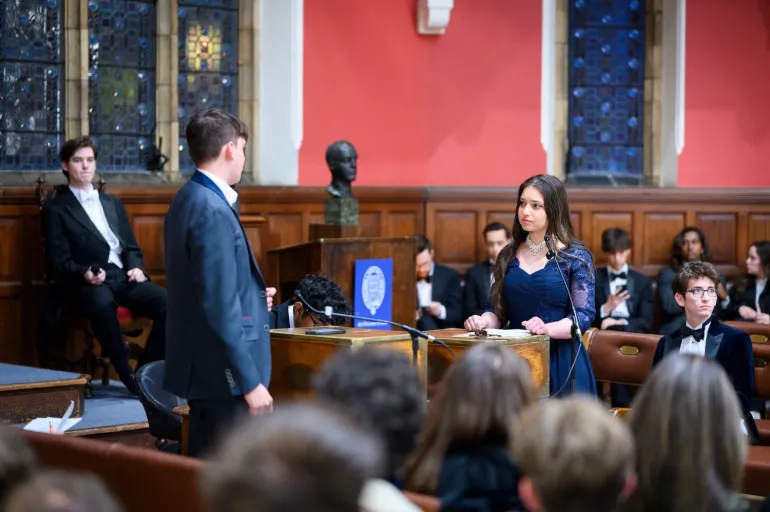
At a motion for a vote of no confidence against Arwa Elrayess, the first Palestinian president of the University of Oxford’s debating society, Oxford Union, she was accused by a 20-year-old student of contributing to “an atmosphere of hostility and harassment”.
In a video of the forum last week at the prestigious university, which was shared with Al Jazeera, Elrayess is seen replying to Ben Ashworth, “Not just in my career within the union but in my existence as a Palestinian, there seems to always be this post-mortem vilification of Palestinians.”
Recommended Stories
list of 4 itemsend of list
The room was full of onlookers as Elrayess, who became the head of the Oxford Union late last year, stood tall in a green sequinned dress.
“Palestinians, when they talk, are for some reason a danger. Our very existence is something that is scary,” she added.
The motion was filed after screenshots of text messages from Elrayess were quoted in outlets including The Telegraph and the BBC as saying that the Hamas-led incursion into southern Israel on October 7, 2023 was “proportional”.
The text also said groups branded as terrorists were often later “lauded as heroes”.
Ashworth cited the Sunday Telegraph directly in his accusation. The newspaper’s political editor, Camila Turner, whose father serves as chief executive of UK Lawyers for Israel, had carried the claim that Elrayess said Hamas would be “lauded as heroes”.
But Elrayess did not make any statement of support for Hamas.
Nine months ago – before Elrayess was president – she was in a group chat of students meant to discuss politics.
In the group chat, October 7 and Palestine – and broader conversations on resistance groups – were discussed.
“Analysing something is not giving it moral legitimacy,” she told Al Jazeera. “Even though I described explicitly in all the messages that I’m not describing this as legitimate or morally justified, I’m just providing analysis; all of this was stripped away when it was reported in The Telegraph or the Daily News.”
The full quote in question on the group chat read: “Any resistance group will inevitably be deemed a terrorist organisation by the West until they achieve their liberation, by which time they’ll be lauded as heroes as history has historically proven.”
‘Entirely misquoted’
The messages were not meant as commentary on Hamas specifically, she argued.
“It was entirely misquoted; I believe it was entirely intentional to frame as having said something that I simply did not say,” she told Al Jazeera.
To the Jewish Chronicle, though, Elrayess reiterated her position by saying, “I condemn Hamas’ targeting of innocent civilians, just as I condemn the targeting of innocent civilians by the [Israeli army] or any other actor.”
After refuting the allegation and misquotations, Ashworth is seen in the video yelling at Elrayess, asking whether she condemns Hamas again.
Ashworth, who is not Jewish, has faced criticism for recently visiting Israel with the Pinsker Centre, a think tank formerly known as the Pinsker Centre for Zionist Education.
The motion for a vote of no confidence overwhelmingly failed, receiving 126 votes, 116 of which were online signatures, far below the 150 needed to proceed to a poll.
This is not the first misinformation campaign against Elrayess.
In October 2025, just before her election as president of the debating society, falsified minutes were ratified by an unnamed member of the union, alleging that Elrayess “argues that alumni members shouldn’t be allowed to vote, reiterating her claims that they are incapable of making a rational judgement”.
Elrayess believes that the minutes were made up and spread to “paint me as someone who hates alumni of this institution”.
After an internal disciplinary process, the person who falsified the minutes was suspended from office and the minutes were de-ratified.
Shortly after her win, opposition within the Union brought forward a number of charges against Elrayess, ranging from misuse of social media to antisemitism. In January, it was found that the charges were un-evidenced. By this point, however, Elrayess had lost two months of her presidency.
Alongside this, an article was published in the Oxford Standard alleging that she was related to a leader of Hamas who happened to share the same surname as her, and that she had created and shared a cartoon of herself stepping on a lizard and a hook-nosed anti-Semitic caricature to celebrate her victory.
The claims, again, were false. The cartoon linked to an anonymous meme page that Elrayess had nothing to do with, and she had no family ties to Hamas. The article had no author attributed to it, and the Oxford Standard did not contact Elrayess or reply to her emails, fact-checking the article.
Within days, Elrayess had emails from journalists at The Jerusalem Post, Jewish Chronicle and The Telegraph, asking her to clarify her family affiliation with Hamas and her views of Jewish people, stemming from the stark untruths shared in the nameless Oxford Standard article.
Arwa Elrayess said she is the victim of a smear campaign after media outlets selectively quoted and misinterpreted some of her text messages [Courtesy of Arwa Elrayess]
The only cause for the allegations, some have observed, appeared to be Elrayess’s Palestinian identity.
A colleague and friend of Elrayess, who wished to remain unnamed, described to Al Jazeera a sense of distress among Elrayess and her friends.
“The level of attacks that Arwa and her friends received was astounding,” he said.
The Oxford Standard, which no longer exists, deleted both the article and their website altogether. But the rumours they began, with no facts to back them up, have snowballed into national news headlines of Oxford Union’s first Palestinian president being a supporter of Hamas and a proud anti-Semite.
Tweets by prominent Zionist influencers like Eylon Levy, former spokesperson for Israel, sharing the lie that Elrayess is a Hamas heiress, with now-broken Oxford Standard links and no factual corrections.
‘I’m a very proud Palestinian’
Elrayess’s dedication to debate and free speech has brought controversy to her tenure. She invited prominent Israel supporter Tommy Robinson to a debate, triggering widespread protest in Oxford, and has engaged with conservatives and Zionists in her union and her own appointed committee.
Oliver Jones-Lyons, director of finance of the Oxford Union, works alongside Elrayess and describes himself as a “pretty public Zionist”.
Still, despite their diametric positions, Lyons-Jones does not endorse the growing smear campaign against Elrayess.
“I have never felt oppressed, abused or discouraged from sharing my views openly, quite the opposite in fact,” said Jones-Lyons in a statement to Al Jazeera. “Me and Arwa obviously vehemently disagree on a lot of issues; however, our conversations about issues that are deeply personal to both of us have never once been aggressive and have always been productive, in fact I can certainly say Arwa has changed my mind on issues I never thought I would.”
Oxford Union member Oliver Goldstein said, “Personally, I like Arwa. I don’t agree with many of her comments, but do I feel unsafe as a Jewish student at the Oxford Union? No … I don’t think she’s an anti-Semite.”
Despite the inundation of misinformation, Elrayess remains determined.
“My father is from Gaza,” she said. “He would always tell me, ‘It doesn’t really matter what you say or do not say; people will always find a way to spin it in such a way that you become a target, because you’re already a target.”
She said she lives by her father’s words.
“I’m not resigning from my position. They can throw 1,000 different letters in 1,000 different articles. I’m very vocal, and I’m a very proud Palestinian.”
The looming impact of federal Medicaid cuts has reignited a long-simmering, costly battle between California’s medical industry and one of its largest health worker unions.
SEIU-United Healthcare Workers West, with about 120,000 members, has put forward two ballot initiatives to cap the pay of medical executives and require community clinics to spend the bulk of their revenues on patient care.
The California Hospital Assn. has responded with its own ballot proposal that would make it tougher for unions to spend money on political initiatives in the future. It would require approval by a union’s rank-and-file membership for any spending of $1 million or more on statewide measures, or $100,000 or more on local ones.
The competing measures, which have drawn enough verified signatures to qualify for the November ballot, come at a time when the rising cost of healthcare is emerging as a top voter concern.
The Service Employees International Union affiliate has seized upon affordability angst to resurrect a proposal for a cap on healthcare executive compensation, which it has failed to achieve multiple times before. The proposed measure garnered more than 1 million petition signatures.
“This initiative reflects the serious crisis we face and that affordability is a real thing,” said Vikas Saini, president of the Lown Institute, a Massachusetts-based healthcare think tank. “I think it also reflects grassroots anger and a desire to do something.”
Mikey Vaughn, a certified nursing assistant at Cedars-Sinai Medical Center, said the hospital often lacks supplies and staffing levels that he and his colleagues need in order to do their jobs effectively and without undue stress, despite its reputation as the go-to place for the rich and famous.
“The executive pay initiative would, I hope, be used to hire staff and to actually provide better resources for our patients,” he said. Vaughn is also a member of SEIU-UHW’s executive board and political committee.
Thomas Priselac, then-president and CEO of Cedars-Sinai Medical Center, made $8.8 million in fiscal year 2024, according to the organization’s most recent available federal tax filing. Kaiser Permanente’s CEO, Gregory Adams, made nearly $13 million in 2024. Warner Thomas, head of Sutter Health, made just under $12 million.
Cedars-Sinai spokesperson Duke Helfand said the hospital would be unable to recruit and retain physicians, nurses, and specialists if the measure passed, dramatically impairing its ability to provide healthcare.
“Such a scenario would be disastrous not only for Cedars-Sinai but for hospitals across Los Angeles and California,” Helfand said.
The union wants to cap compensation at $450,000 a year for senior hospital and medical group executives, as well as other administrative and managerial staff. However, the initiative does not stipulate how dollars diverted from payroll must be spent.
Carmela Coyle, CEO of the hospital association, called the measure a cynical political ploy.
“It’s bad policy and it’s going to have bad consequences across California,” she said.
Glenn Melnick, a healthcare economist at the University of Southern California, said even if the initiative were fully implemented and pay cuts enacted, he doubts it would reduce the cost of healthcare for patients.
SEIU-UHW does not have an estimated total amount the initiative would claw back from pay packages that exceed the limit.
Opponents of the initiative note that it doesn’t just target executive pay; it would affect medical practitioners who are also managers. That could include chief medical officers and chief nursing officers, as well as heads of surgery, emergency rooms, oncology, obstetrics, cardiology and other specialties, they say.
It would be up to each hospital, health system and physician group to report which staff members exceed the cap and by how much.
Ultimately, who is subject to the pay cap “probably will have to be battled out in court,” Coyle said . “That’s why we are throwing everything we can at it.”
The second SEIU-UHW ballot initiative, on community clinics, is already in court. The California Primary Care Assn., which represents clinics, filed a federal lawsuit in April seeking to invalidate it before it reaches the November ballot.
The proposed measure would require federally designated community clinics to spend at least 90% of their revenues on activities directly related to their mission of providing care for low-income populations. If it were to pass, more than 90% of those clinic organizations would be on the hook for penalties totaling $1.7 billion in the first year alone and “would face similarly crippling penalties every year,” according to a report commissioned by the primary care association and conducted by the Berkeley Research Group, an international consulting company.
Louise McCarthy, president and CEO of the Community Clinic Assn. of Los Angeles County, said many pivotal services the clinics provide — such as translation and transportation — would likely not be counted toward the spending requirement.
“They are targeting a group of what they see as employers and we see as the safety net,” she said.
The lawsuit cites the harm to clinics and claims the proposed spending requirement would interfere with federal authority.
Renée Saldaña, a spokesperson for SEIU-UHW, characterized the lawsuit against the initiative as “a really desperate attempt by the clinic industry to try and avoid accountability.”
SEIU-UHW, proud of its political activism, is also behind a controversial billionaire tax proposal that would impose a one-time 5% levy on California residents with fortunes over $1 billion to backfill the funding gap created by federal cuts coming down the pike under Republicans’ One Big Beautiful Bill Act. The law, passed last July and signed by President Trump, is projected to squeeze nearly $1 trillion from the Medicaid health coverage program for low-income people by 2034, including as much as $30 billion annually in California.
The hospital association, the community clinic group and the California Medical Assn., which represents physicians, are neutral on the wealth tax proposal thus far. But Saldaña said all three of the union’s ballot proposals tie into an overarching strategy to counter the widening healthcare disparities caused by the federal law.
“We believe the primary concern of healthcare providers, including executives, should be to serve the community, heal patients, and not be in healthcare just to enrich themselves,” she said on the proposed pay cap.
Over the years, the union has submitted dozens of local and statewide ballot initiatives, including ones to cap the pay of hospital executives, regulate dialysis clinics, and raise the minimum wage of healthcare workers.
The hospital association calculates that SEIU-UHW has spent nearly $125 million on local and statewide initiatives since 2012. But healthcare industry groups have spent far more opposing them. The hospital association data shows that the union spent nearly $36 million on three ballot proposals to regulate the dialysis industry, but dialysis companies poured in $302 million to defeat them, according to state campaign finance records.
The union’s ongoing political efforts “threaten patient access to quality health care,” according to the hospital association’s ballot initiative, which could limit how much unions spend on future ballot measures.
Saldaña hinted at a possible lawsuit should that measure pass, saying “we don’t see the legal viability” of it. The proposal, she said, is an attempt “to silence the front-line healthcare workers.”
Ultimately, a ballot initiative won’t cure the ills that plague healthcare in the United States, said the Lown Institute’s Saini. What’s needed, he said, is “an evaluation and reimagination of healthcare.”
Wolfson writes for KFF Health News, anational newsroom that produces in-depth journalism about health issues and is one of the core operating programs at KFF — an independent source of health policy research, polling, and journalism.
Musicians have been left out of settlements between major record labels and AI companies, a new lawsuit alleges.
The American Federation of Musicians of the United States and Canada (AFM), which has 70,000 members, said Universal Music Group and Warner Music Group “received significant compensation” from the AI companies for past copyright violations and licensed “substantial” portions of their music catalogs to them, but haven’t shared that with the musicians.
UMG and WMG sued AI companies Udio and Suno in 2024, accusing them of copyright infringement. Both companies settled with Udio last year. In November, WMG announced a partnership with Suno, but Universal Music Group’s lawsuit against Suno is pending.
“While the Defendants protected their own interests and created a significant source of new revenue with the retrospective settlements and prospective licenses, they have refused to compensate the musicians whose work — created with their own instruments and through their talent, creativity, and hard work — is fed into AI machines for profit,” AFM said in its lawsuit, filed in U.S. District Court in New York on Friday.
AFM said it believes the AI settlements fall under the “new use” provision of its collective bargaining agreements, which requires music companies to notify the union of new licenses for purposes not covered by the contract and to compensate musicians, whose work was used to train AI models.
UMG and WMG said in statements that they are in negotiations on a collective bargaining agreement with AFM.
“Warner Music Group is growing the value of music by establishing guardrails and architecting a healthy AI ecosystem on behalf of artists everywhere,” the company said in a statement.
Universal Music Group said it will continue to work to resolve issues during the negotiations.
“Universal Music Group has been at the forefront of protecting the rights and advancing the interests of artists and songwriters in the age of AI — striking responsible AI licensing agreements to ensure they are compensated, leading the charge for legislation to further protect them and taking legal action against bad actors,” the company said in a statement. “We expect to continue our strong working relationship with the AFM built on mutual respect for the talented musicians in our industry.”
AI has become more popular among consumers, dramatically changing the landscape in the entertainment industry. Many startups have popped up allowing users to type text prompts into AI systems to generate original songs, video clips and stories.
Some creatives say the AI tools help them brainstorm or illustrate bold ideas on a budget. But critics have raised concerns about whether AI systems are trained on copyrighted works without permission or payment to artists. Others are worried AI could eliminate their livelihoods.
Udio said it would create a new platform that would train on licensed and authorized music with artists having the ability to opt-in. Suno agreed to change its platform, launching new licensed models, and place download restrictions.
Bradford Auerbach, a partner at law firm OGC, said he expects to see more of these types of lawsuits filed by unions.
“You’ve got the unions always protecting the status quo, so you’ve got this invariable conflict of new technology coming in, and moving the cheese for a lot of people that were accustomed to having their business set up the way it was,” Auerbach said.
Under the news network’s editor-in-chief Bari Weiss, on-air correspondents Scott Pelley, Cecilia Vega, Sharyn Alfonsi and the program’s executive producer, Tanya Simon, have all been ousted from the legacy newsmagazine. The two unions, which represent journalists, said the recent actions appear to compromise editorial independence.
WGA East president Tom Fontana wrote in a letter to members on Thursday that the changes at CBS News “are more than mere ideological interference with the news. They display a profound contempt for the journalism profession.”
He added, “it is clear that CBS brass is engaged in a near-constant level of editorial interference that would have previously been unthinkable.”
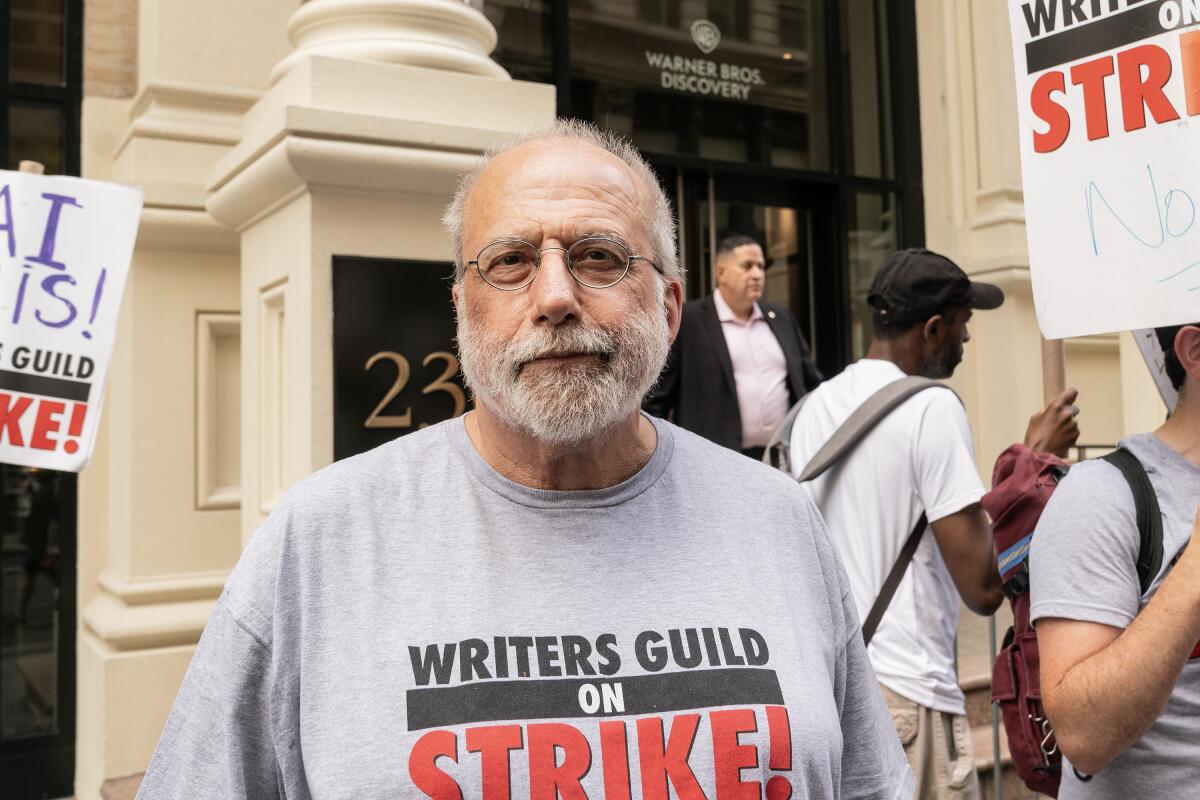
Tom Fontana joined WGA and SAG-AFTRA members on the picket line in the strike over contract negotiation at Netflix and Warner Bros. Discovery offices on Aug. 15, 2023, in in New York City.
(Lev Radin / VIEWpress via Getty Images)
SAG-AFTRA similarly said in a statement Thursday that these “decisions can only be seen as part of a broader strategy to gut the crucial independent journalism that is so important to our democratic system.”
A spokesperson for CBS News said in a statement, “There is no political interference at CBS News, not from ownership, not from Bari Weiss. The only ‘interference’ is the normal back and forth between editor and correspondent that happens in every newsroom.”
Pelley, one of the program’s most high-profile correspondents, was fired on Tuesday after speaking out during a team meeting. He reportedly said Weiss “is murdering ‘60 Minutes.’ … She does not love this place. She was brought in to kill it, and she’s been doing exactly that.” He also questioned the newly hired executive producer, Nick Bilton, and his ability to run the show, citing his lack of TV news experience.
Pelley accused CBS News management of favoring the Trump administration by instructing him to put “falsehoods and bias into a politically sensitive story.”
“I’ve been told to include assertions that are unverified,” he said in a statement. “To date, in every case, I have ignored these instructions or refuse them.”
“60 Minutes” is now down four correspondents, following Anderson Cooper’s departure and the firings of Vega and Alfonsi. These are only the most recent controversial moves from Weiss, who’s set on remaking the institution long defined by tradition. She arrived at CBS News in October with no television experience, installed by Paramount Chief Executive David Ellison after he acquired her digital news outlet, the Free Press, with a mandate to change the network.
“I’m only interested in working in a newsroom that is built on trust and mutual respect,” Weiss said of Pelley’s firing during a meeting on Wednesday morning. “That foundation was broken on Monday, and despite our attempts to engage with Scott Pelley and to find a way back, unfortunately we weren’t able to do so, and so we had to part ways.”
The lack of reporters means “60 Minutes” will have to line up new talent quickly to fill the correspondent roles, as production of the 2026-27 season is already underway.
WGA’s Fontana added, “To our friends and colleagues at CBS News: We see you, and you are not alone. Thousands of your union brothers, sisters, and siblings have your backs.”
SAG-AFTRA also said the union is prepared to take “legal actions related to the company’s conduct over the last several weeks.”
Times staff writer Stephen Battaglio contributed to this report.
Nearly 2,000 food and beverage workers at SoFi Stadium voted overwhelmingly Friday to authorize a strike just a week before the venue will stage the first World Cup game on U.S. soil in more than three decades.
Negotiations on a labor contract between Unite Here Local 11, the union representing the cooks, dishwashers, concession workers and bartenders at SoFi and, Legends Global, the stadium’s food-service operator, are expected to continue Monday despite the vote. But Kurt Petersen, the union’s co-president, said if an agreement isn’t reached workers will walk off the job and the 70,000 fans arriving for the June 12 match between the U.S. and Paraguay will be greeted by hundreds of picketers.
Union members have been working without a contract for a year and Petersen said Unite Here is demanding salary increases, protection against subcontracting and job loss through automation, and are protesting the collection of sensitive private information such as nationality and home addresses that FIFA, organizer of the World Cup, said it needs to accreditate workers.
Workers are also demanding the right to walk off the job if federal immigration enforcement enters the stadium and creates a reasonable fear for their safety. Ninety-six percent of the vote was in favor of strike authorization.
Legends Global, the stadium’s food-service operator, responded to the vote with a statement.
“Legends Global has presented progressive wage proposals to Unite Here Local 11 throughout our negotiations and remains confident an agreement is within reach,” it read. “While we expect a contract will be finalized in time, a contingency staffing plan is in place to ensure seamless operations and no disruption to fans. We remain committed to delivering an outstanding hospitality experience at the FIFA World Cup matches.”
That contingency plan would involve hiring replacement workers who would have to undergo the same detailed accreditation procedures demanded by FIFA, plus job training. SoFi Stadium is scheduled to play host to eight World Cup matches, including two of the U.S. team’s three group-stage games. The first of those is on June 12 when the U.S. faces Paraguay in its World Cup opener.
Petersen said the union is looking for “substantial increases” in hourly pay, to more than $30 an hour. Legends’ most recent proposal calls for wage freezes for some workers and a 25-cent hourly increase for cooks and dishwashers, the union said.
But perhaps the biggest sticking point is FIFA’s demand for workers’ sensitive personal information, including Social Security numbers and fingerprints, to process background checks. Under California privacy laws, workers have the right to know exactly what personal information their employer collects, how it will be used, and who it will be shared with. Local 11 said its members fears such information, if collected, could be made available to the Department of Homeland Security and ICE.
According to Petersen, when workers were originally hired by Legends they submitted the documentation necessary for employment, and under the current collective bargaining agreement the company does not have the right to request it again for FIFA.
FIFA has refused to comment on the contract talks, saying they are “between Legends Global and Unite Here Local 11.” But its insistence on collecting personal information is something Legends cannot address during contract talks, which makes a resolution impossible.
FIFA said it was partnering with the governments of the U.S., Canada and Mexico, the three countries in which the 39-day tournament will be played, “to enhance safety and security of all workers, staff, team members, vendors, journalists, volunteers, and spectators by mitigating potential insider threats. … Such name checks do not constitute pre-employment checks.”
All data collected during the name-check process, FIFA said, will be processed “in accordance with applicable data protection and privacy laws, and will be deleted by FIFA as soon as it is no longer needed for purposes of adjudicating requests for credentialed access to FIFA-controlled spaces.
SAG-AFTRA members overwhelmingly approved a four-year TV and film deal with major studios including Netflix, Disney and Warner Bros. Discovery on Thursday night, increasing minimum wages and addressing concerns about the use of AI performers.
The deal, which was expected to be approved, received the support of 91% of SAG-AFTRA members who voted on the agreement, which starts July 1 and ends June 30, 2030. The union represents 160,000 performers, including actors, stunt performers and influencers.
“This agreement builds on the foundation members fought to establish and carries that work into the next chapter of our industry,” said SAG-AFTRA President Sean Astin in a statement. “It delivers meaningful gains in compensation, strengthens protections around artificial intelligence and digital identity, reinforces the long-term security of members’ benefit plans and recognizes the realities of how performers work today.”
Under the new deal, the length of the agreement between SAG-AFTRA and major studios represented by the Alliance of Motion Picture and Television Producers expands from three years to four years.
It also boosts minimum wage by 3% annually, increases contributions to the health plan by 1% and expands the bonus to the union’s Success Bonus Distribution Fund based on residuals that performers get for popular streaming programs.
The contract also addresses concerns about the growing use of artificial intelligence in TV and film and its impact on actor jobs. Last year, many actors spoke out about Tilly Norwood, a computer-generated “actor” and whether synthetic characters like her could threaten their livelihoods. Some performers have also advocated for getting paid if their likenesses are used to create such characters made through AI systems.
Not all members were in favor of the contract, saying it did not go far enough in protecting performers against AI.
“It normalizes the use of AI replicas and synthetic performers rather than drawing a firm line protecting human performers and their jobs,” said Chuck Slavin, a background actor and performer.
Slavin, a former New England local board member, ran against Astin for SAG-AFTRA president last year.
Producers agreed to “a principle strongly favoring human performances” and that producers would only use a synthetic if it “brings significant additional value to the motion picture.” If a producer decided to use a synthetic in a role that could be done by a human, they would need to notify the union and bargain in good faith.
Additionally, the contract merges the pension plans of the Screen Actors Guild and the American Federation of Television and Radio Artists, which were previously separate but combined in 2012 to form SAG-AFTRA.
Their health plans were consolidated in 2017, but the pensions have remained separate . That was a major sticking point with members, some of whom couldn’t qualify for benefits as their contributions were split between two plans. Studios agreed to boost their overall contributions to the combined plan by 1%.
SAG-AFTRA’s deal comes after the Writers Guild of America members also approved an agreement with the AMPTP in April.
“SAG-AFTRA’s leadership brought a genuine commitment to partnership, and together with the WGA agreement, these deals demonstrate what is possible when the industry works toward practical solutions that support its long-term stability,” AMPTP said in a statement.
The Directors Guild of America began negotiations with AMPTP last month, with its contract expiring on June 30.
Staff writer Cerys Davies contributed to this report.
At the AI on the Lot media conference last week in Culver City, speakers laid out a view of artificial intelligence that was very much complementary to human workers.
Artificial intelligence is a tool that must be wielded by humans, several said. The idea was to help skilled artists and production specialists do their jobs and experiment, others said.
Of course, to many in Hollywood, AI is not that simple.
Guardrails on its usage emerged as a central issue in the 2023 writers’ and actors’ strikes, and additional rules were added in the recent Screen Actors Guild-American Federation of Television and Radio Artists and Writers Guild of America contracts. There are still big questions about AI’s effect on jobs in the entertainment business, as well as copyright and ethical concerns.
Whether it’s good or bad or some combination of both, AI, in some form, is probably here to stay.
So, eight months ago Amazon MGM Studios opened an AI Studios division to start work on Project Nara, an AI production toolkit built on Amazon’s AWS cloud computing platform that could be used by teams of filmmakers. Project Nara is still in beta mode, and the company set up a GenAI Creators’ Fund to give filmmakers interested in using the toolkit financial support, while also giving the studio feedback.
The beta testers got eight weeks to produce an animated short and, out of those, the company greenlighted three animated series.
Shortly after the conference, filmmaker Jorge Gutierrez, whose stop-motion-style “Punky Duck” was chosen as one of the greenlighted series, pulled out after an online backlash over his use of AI.
You’re reading the Wide Shot
Samantha Masunaga delivers the latest news, analysis and insights on everything from streaming wars to production — and what it all means for the future.
By continuing, you agree to our Terms of Service, which include arbitration and a class action waiver. You agree that we and our third-party vendors may collect and use your information, including through cookies, pixels and similar technologies, for the purposes set forth in our Privacy Policy such as personalizing your experience and ads.
“We respect Jorge’s decision, as well as his incredible talent, his voice and the world he created with ‘Punky Duck,’” an Amazon MGM Studios spokesperson said in a statement. “We continue to be excited about the innovative work moving forward at our studio and the GenAI Creators’ Fund.”
Before the flap over “Punky Duck,” I spoke with Albert Cheng, head of Amazon MGM Studios’ AI Studios, about the goal of the division, what’s next for AI and his belief that humans are at the center of creativity. The conversation has been edited for length and clarity.
Why was AI Studios formed?
AI Studios was started last fall because we wanted to learn how to leverage AI technology to build tools that would help enhance or redefine the workflows for film and TV production.
When you look at the horizon of what it takes to drive continued engagement of a global streaming service like Prime Video, we need more original programs. So if you can figure out how we take the same amount of money that we spend and be able to make more shows, that’s ultimately what we want, and we think AI is going to be a help to drive that.
With AI, now we’re looking at how does technology change the way we actually create our cinematic storytelling? It could mean that with AI, we will hear from a lot more voices. If we can actually get the biggest costs down, we will be able to have more voices, be able to take more risks and creative risks most of all.
There’s always concern about what does AI mean for jobs. We believe that it actually creates more jobs and different types of jobs. In fact, people with experience, plus the tools, become even more valuable in terms of their ability to produce excellent quality work. So it’s always about the human behind it.
You mentioned that some of these production crews had more than 100 people, but crews in the past would have been much larger. How do you respond to concerns about that?
You may have smaller crews, but we’ll do more of them [productions], and more in a short period of time. When you actually have smaller productions and you do more of them, you’re increasing your throughput. Your turnover rate of the available jobs is much faster, so your job totals are actually going to be bigger.
You spoke about the idea of AI filmmaking bringing jobs back to L.A. and expanding California’s production incentive eligibility to include AI-assisted filmmaking. Can you elaborate on that?
When you look at AI production, it can be done on a soundstage. We don’t need to go to London, we don’t need to go to other places.
We do have technology companies in California that are driving this, we have people here in the city that have experience, if given the AI tools, can produce great work. So, how can we not incentivize more companies to use our soundstages and finally make productions and make more of them?
Have you or anyone else at Amazon spoken with government officials about this idea of expanding the incentive criteria?
We’ve been talking to a number of bodies about whether it’s possible. The question is, who’s going to take the ball?
How much can you decrease a show’s production budget by using AI?
I think we can get a show to half the cost, [or] to almost a fifth of the cost.
What was the thinking behind the GenAI Creators’ Fund?
We wanted to provide a support and invest in creators who wanted to try it, and then also give us feedback.
We also wanted to show that storytelling is the thing that drives the content. It’s not the technology; the technology just enabled them to make it.
What is the biggest misconception of AI use in production?
There’s a narrative that AI can do so many things by itself, that you don’t need people. That’s absolutely not true. It’s just a technology, it can’t make decisions.
In order for something actually quality to be made, a person actually needs to be behind that, and that’s been proven over and over again. People are still responsible for the output.
The $10-million horror flick, which stars Chiwetel Ejiofor as a furniture store owner who finds a mysterious portal in his basement, was directed by 20-year-old YouTuber Kane Parsons and is based on his online series of the same name. Worldwide, the film made nearly $118 million in its debut weekend.
Focus Features’ “Obsession” also had a big weekend with a 10% jump in domestic box-office revenue in its third outing. The horror movie, which had a production budget of less than $1 million, was directed by Curry Barker, who also built his reputation on YouTube.
Together, the two films highlight the growing power of YouTube — and online culture as a whole — on the big screen. They beat out franchise film “Star Wars: The Mandalorian and Grogu,” which dropped 69% from its debut last weekend to rank third at the box office.
What I’m watching
I’m just one episode away from finishing this season of “Bridgerton” on Netflix. While I liked that the show dived into the social class dynamics behind Benedict and Sophie’s romance, I have to say that I loved the secondary focus on Violet Bridgerton and Lord Anderson finding a second chance at love.
That means there’s no chance of a Republican sweep in this blue state, and suddenly, what has up until now been a pretty dry governor’s primary race has turned into one that has a slim-but-genuine chance at a surprise ending — two Democrats on the November ticket.
“It’s a low probability,” political data guru Paul Mitchell told me, “But there’s always a chance.”
Those of you who have hung on to your ballots like winning lottery tickets, and those who plan on voting in person, will largely decide what happens next: An Xavier Becerra-Steve Hilton top two is a virtual election for Becerra since there just aren’t enough Republican voters in the state to carry a general election. A Becerra-Steyer face-off would force both candidates to define a vision of California beyond generic liberal ideas.
Personally, I wouldn’t mind seeing California have that Dem-on-Dem showdown so that voters of all parties (or none) have the chance to pin these would-be leaders down on the details of their policies. So far, this election has been light on the specifics, but the state faces real problems — from a failing healthcare system to gas prices that literally mystify even lawmakers.
Everything changes when a candidate becomes a winner, so maybe it would be good for democracy to have an old-fashioned war of ideas in this moment when the future of California holds so many unknowns.
Is Steyer just a billionaire dilettante trying to buy an office? Is Becerra beholden to the many corporate interests who have funded his campaign? Those are just the top-line questions many voters still have.
“There’s lots of shades of blue,” pointed out Chad Peace of the Independent Voter Project, on a press call to support open primaries. “When we only look at things as, ‘Oh, there’s red and there’s blue,’ we forget that.”
But voters remain nervous, and the ballot is still packed — along with the top three, former Rep. Katie Porter and San José Mayor Matt Mahan are still campaigning, though with falling support.
Voters, Mitchell said, “are really thinking about the implications” of their vote, and perhaps don’t want to throw it away on a candidate they perceive as having no chance. That’s why the new polls showing Steyer as a contender have the potential of stirring up momentum, especially for voters who originally saw themselves filling in the bubble for one of those candidates on the decline.
Recent polls have put Steyer in a near-dead-heat with Republican front-runner Hilton, both hovering slightly above or below 20%. Becerra, the former California attorney general and a former Biden Cabinet secretary, leads them both by a few points, especially among Latino voters. As my colleague Gustavo Arellano has pointed out, Becerra would be the state’s second Latino governor, after Romualdo Pacheco, who held the office for 10 months in 1875.
“A Dem-Dem race, maybe we’ll get more people involved, because it’s going to be a harder fight, you know?” Diane McClure told me. She’s a board member of the California Nurses Assn., which endorsed Steyer early — in large part because he supports a plan for single-payer health insurance, which that union has long fought for.
McClure, of course, would love to see Steyer take the top spot in that easy-win scenario against Hilton, though that seems doubtful. But a Steyer-Becerra race?
“Maybe it’s a good thing, maybe it’ll wake some people up,” she said.
For his part, Steyer is staying the course. At a Sacramento stop Friday, he bounded around chatting with about four dozen mostly union supporters, wearing trademark Nikes, this time a vintage pair with a tartan plaid swoop.
“Four days,” Steyer said when he finally took the microphone. “I really need you to stand with me. But let me say this: you stand with me, I stand with you.”
Unlike his debate performances, Steyer is passionate, and, though it seems unlikely based on his television appearances, has an amiable charisma dotted with a fair amount of light profanity.
“Make a decent living, buy a house, have a great education for your kids, and retire,” he said. “That’s what we’re trying to build here. We can easily do that. When people say that’s not possible, bull—, that’s bull—.”
It was enough to sway Ricky Carter, one of the few non-union members in the room, who was invited because his wife, Barbara, was on a prayer chain with another invitee. An older Black man originally from South Los Angeles, Carter represents a demographic where Steyer has growing popularity.
“I believe him. He got it right in here,” he said, pounding a fist over his heart. “It ain’t about no color, creed and race. … It’s about the people.”
Indeed, elections are about the people, though it doesn’t always feel like it. But suddenly, this one does.
The top candidates for California governor crisscrossed the state Friday, all venturing to friendly political territory to woo voters and undermine their rivals as the June 2 primary election fast approaches.
The top Republican in the race, former Fox News host Steve Hilton, spent the day railing against transgender athletes before a high school track event in the Central Valley, an event sure to appeal to his base of President Trump supporters.
The front-running Democrats, former Biden administration Cabinet member Xavier Becerra and billionaire environmentalist Tom Steyer, rallied one of their party’s most influential constituencies: union members.
While both stuck with mostly an upbeat message and reiterated promises to lift up Californians struggling to make ends meet, Steyer afterward accused Becerra of being “a corporate Democrat who’s taking money from all these big corporations” who “doesn’t want to change things.”
Steyer’s had good reason to go after Becerra.
A new poll from the UC Berkeley Institute of Governmental Studies and co-sponsored by the Los Angeles Times showed Becerra leading the race with 25% support from likely voters, followed by Hilton at 21% and Steyer within striking distance at 19%. The two candidates who finish in first and second place in the primary will advance to the November general election, leaving the third-place finisher on the sideline.
Though he told reporters Friday morning that “I don’t pay attention to polls,” Steyer was energetic at a Northern California campaign event, where he held a private meeting with leaders of a union representing long-term caregivers. In brief remarks at the offices of SEIU Local 2015, Steyer described the race as a choice between a billionaire champion of working people and the corporate-backed Becerra.
“Does California work for Californians or does California work for corporations? The corporations think it works for them. They want it to continue to work for them and they’re putting up tens of millions of dollars to make sure they continue to make record profits,” he told dozens of home-care workers, teachers, construction workers and nurses at the West Sacramento gathering.
Groups including PG&E, the California Assn. of Realtors and the California Chamber of Commerce have spent more than $34 million opposing Steyer’s candidacy. The former hedge fund manager has pledged to lower energy bills by breaking up large electric utility monopolies.
As a billionaire who has so far poured $216 million of his own money into his gubernatorial campaign, Steyer has faced skepticism from some left-wing and working-class voters. But he is endorsed by progressives, including Rep. Ro Khanna (D-San Jose), and unions including the California Nurses Assn. and both major teachers unions.
“I voted for Tom. I was looking for a change,” said Alvenia Scott, a union board member who works as an in-home caregiver to her disabled sister.
“He really has some good ideas,” she said, adding that she had more qualms about Steyer’s lack of government experience than his wealth. “He made his way in life, more power to him.”
Hundreds of miles south in the Inland Empire, Becerra pledged to be on the side of unions if he is elected governor and urged voters to turn in their ballots in what has so far been a remarkably low-turnout election.
“I am with you. When I become governor and I sit behind that desk, you’ll have a union man sitting at that desk,” Becerra told about 500 people at the United Food and Commercial Workers hall in Bloomington.
He asked the crowd if they had cast their ballots and noted that not everyone raised their hand.
“Less than one in five Californians have actually cast their vote so far. We got to get that number way, way up,” he said, arguing that the election is about “sending a message all across the country that California will be counted, that California cannot be neglected, and that California will not take a knee to anyone in Washington, D.C.”
Only 12% of the state’s registered voters have cast ballots as of Thursday evening, according to the election tracking firm Political Data Inc.
Community college counselor Diego Rodriguez, 32, said he decided to vote for Becerra in recent weeks after seeing the former U.S. Health and Human Services secretary’s momentum in the race and researching his record.
“Also just his story. As someone who works in higher education, and seeing how Xavier, being first-generation, has benefited from higher education, and how he advocates for higher education,” the Rialto resident said. “Additionally, today, him being here at a labor union and advocating for the working class and labor, I think, is very important.”
“I think that people became aware of him more because of that,” Rodriguez said. “There was a lot of conversation online regarding that, but I think it allowed the spotlight to be brought onto him and it made people aware of his record.”
At a campaign stop in Clovis in the central part of the state, Hilton marveled that his campaign had spent only about $2 million in campaign advertising but was still polling above Steyer, according to the latest Berkeley IGS survey.
“We’re feeling confident,” said Hilton, standing in a suburban stretch of the city. Still, he warned that voters need to get out to support him and avoid a “complete disaster for California” of two Democrats advancing to the November election.
Hilton, who was endorsed by Trump in April, joined other politicians and leaders in Clovis in opposing trans athletes from competing at the 2026 CIF State Track & Field Championships.
The group met near where the championship events were scheduled to take place this weekend.
Asked why he was focusing on sports and gender in the final days of the race, Hilton said it’s “one of the main issues” that come up at town halls. If elected, he said he would seek to overturn the state’s 13-year-old law that allows students to participate in school activities and use facilities such as bathrooms based on their gender identity.
Hilton argues the law violates the state Constitution and will “suspend” it while he initiates legal proceedings to overturn it.
He also praised Spencer Pratt, a Republican and former reality TV star who is running for Los Angeles mayor, saying his candidacy has brought “excitement and energy” to the state’s primary election.
“For a long time in California, there’s been this sense that it’s all inevitable — there’s nothing you can do, Democrats run this place, just the way it is,” Hilton said. “I think that that’s changing. I think there’s this sense that something’s happening.”
Eurasian Economic Union (EAEU) countries are moving towards deeper economic integration through digitisation and AI, as leaders of the bloc met in Astana for a two-day summit.
ADVERTISEMENT
ADVERTISEMENT
During the high-level talks, member states discussed creating a unified digital environment to build a seamless market across a shared economic space of more than 20 million square kilometres.
Delegations focused on trade, joint projects and the development of shared digital tools and AI systems designed to strengthen cooperation and reduce fragmentation across the bloc.
Last year, trade within the union more than doubled, while turnover with third countries rose by 72%, while around 90% of settlements are now conducted in national currencies, as EAEU states also mull a single transit system.
With digitisation driving developments across the union, Kazakhstan’s President Kassym-Jomart Tokayev said trade turnover between EAEU members could increase by around 6%, exceeding €85 billion this year, compared with €80 billion last year.
He added that GDP growth across EAEU countries is projected at around 2.5% for 2026–2027.
Now in its 12th year, the EAEU functions as a single integrated market and free trade zone for its five members – Russia, Belarus, Kazakhstan, Kyrgyzstan and Armenia.
The bloc already has agreements in place with a number of countries including Serbia, Vietnam, the UAE, Mongolia and Indonesia. China remains the bloc’s key partner, accounting for around one-third of external trade.
Integration through AI
Kazakhstan’s Tokayev said that during its chairmanship of the EAEU, the country has proposed the practical use of AI to help implement the bloc’s so-called four freedoms, with the aim of strengthening the competitiveness of member states.
Member states also proposed developing common principles for the responsible use of AI, as well as shared computing capacity and joint model development.
Meanwhile, Russia proposed a high-level AI get-together next year to further cooperation on domestic AI models and connecting its IT and energy infrastructure, according to Russian President Vladimir Putin.
On the ground, pilot projects are already being tested at the EAEU level.
In Kazakhstan, several AI-powered digital assistants have been developed by both government agencies and startups to help citizens navigate legal and regulatory systems more easily.
According to Deputy Minister of Artificial Intelligence and Digital Development Dmitry Mun, these AI legal assistants are designed to simplify legislation, reduce bureaucracy, and make regulatory systems more accessible for citizens and businesses.
Some of these tools are now being tested to streamline processes across member states.
Trade corridors and logistics modernisation
Around 85% of goods travelling from China to Europe are routed through the Middle Corridor, according to officials.
Artificial intelligence is increasingly being deployed alongside the TDN and the Digital Transport Corridor along the Trans-Caspian International Transport Route. Together, these measures are expected to increase non-commodity exports by around 30% over the next two years.
Kazakhstan’s Minister of Trade and Integration Arman Shakkaliyev said the country also aims to leverage major transport routes, including the Middle Corridor and the North–South Corridor, to build a fully integrated logistics ecosystem.
The goal, he said, is to position Kazakhstan as a key regional hub where transport routes converge and large export flows are consolidated.
The ambition is to develop a fully functioning system by 2030, with cargo volumes reaching around 10 million tonnes. Work is already under way, including railway modernisation and new infrastructure development.
Putin visit and bilateral agreements
The summit followed Putin’s state visit to Kazakhstan, during which the two countries signed seven key pillars of bilateral cooperation, along with a broader package of agreements covering energy, transport, finance, education and industrial development.
Russia remains Kazakhstan’s largest investor, with nearly €25 billion already invested and plans to increase that figure further. It is also building Kazakhstan’s first nuclear power plant, valued at around €14 billion.
Putin said the plant would account for around 20% of Kazakhstan’s electricity consumption, adding that financing conditions for such projects are in line with international practice.
He noted that the project supports Russian industrial capacity through equipment orders and long-term maintenance contracts, while also strengthening cooperation between the two countries in uranium and nuclear technology.
For Kazakhstan, officials say the project represents both energy security and a step towards moving beyond raw-material exports to high-value technological cooperation.







![Arwa Elrayess [Courtesy of Arwa Elrayess]](https://i0.wp.com/occasionaldigest.com/wp-content/uploads/2026/06/original-1C35F445-DBD0-445D-9835-200DAAC9C332-1781175489.jpeg?w=640&ssl=1)