Construction Of Iran’s “Eagle 44” Underground Airbase Hasn’t Stopped Despite War
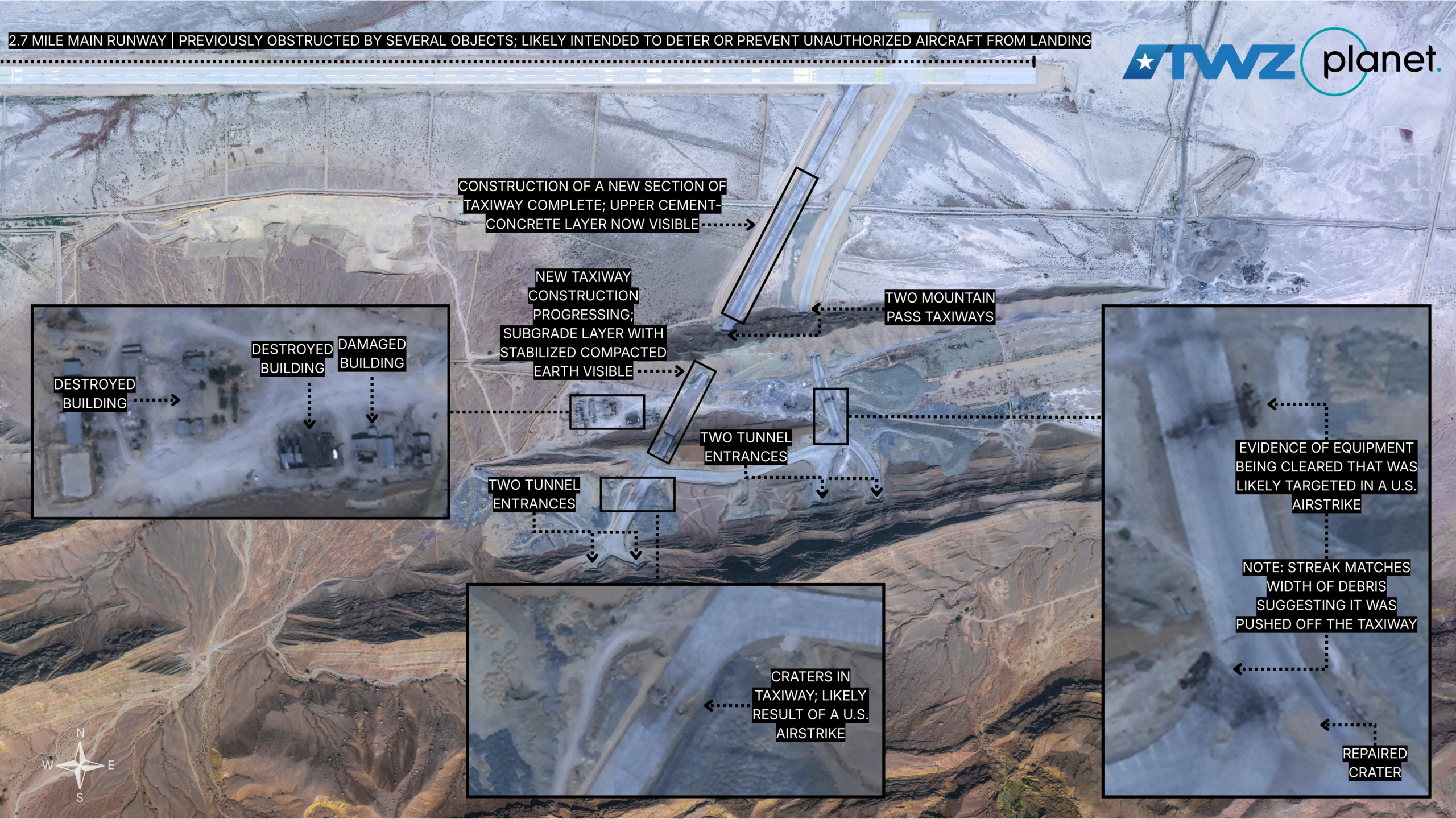
Iran is rebuilding Eagle 44, a hardened underground airbase carved into the side of a mountain that can shelter fighter aircraft, drones, and potentially cruise and ballistic missiles, despite the remote facility absorbing at least three rounds of airstrikes this year. High-resolution satellite imagery captured by Planet Labs in late September and reviewed by TWZ shows a new section of taxiway completed, several support buildings still destroyed or damaged, wrecked equipment cleared off the pavement, and obstacles that were placed to obstruct the runway now removed. Construction is ongoing at a time when the Pentagon and Trump administration maintain there is little remaining of the Iranian air force for such a facility to protect.

Eagle 44, also called ‘Oghab 44’ after the 44th anniversary of the 1979 revolution, was unveiled by Iranian state media in February 2023 when senior officials visited what was described as the country’s newest underground airbase. Islamic Republic of Iran Air Force (IRIAF) F-4D/E Phantom IIs, armed with AGM-65 Maverick air-to-ground missiles, laser and electro-optically guided bombs, unguided ‘dumb’ bombs, as well as domestically produced anti-ship missiles, were shown using the facility in the footage. The IRIAF had roughly 60 examples in service at the time, its most numerous combat jet by some margin, though how many remain today, and are actually operational, is unknown. In addition to the Phantoms, one-way attack drones were also seen in the background.


The IRIAF, rather than the Islamic Revolutionary Guard Corps (IRGC) Aerospace Force, operates the base, which is located in Hormozgan province and sits in the foothills of the Zagros Mountains, approximately 100 miles northwest of the Strait of Hormuz. Iranian state media described it as “one of the army’s most important air force bases, with fighters equipped with long-range cruise missiles and built in the depths of the Earth.” Then-Chief of Staff of the Armed Forces Maj. Gen. Mohammad Bagheri, who was present at the unveiling, warned that “any attack on Iran from our enemies, including Israel, will see a response from our many air force bases including Eagle 44.” He was eliminated in the opening strikes of the Twelve-Day War, which Israel dubbed Operation Rising Lion, in June 2025.

Work on the cavernous underground tunnel complex began in 2013. Construction of a 2.7-mile main runway, situated on the northern side of the base on a valley floor below the mountain range, started roughly eight years later. Two taxiways run through a smaller ridge connecting the runway to four entrances to the primary tunnel complex, where the jets and weapons are stored, although only one taxiway is currently operational.
The promotional video released in 2023 revealed at least one internal blast door, as well as branches from the main tunnel to revetment areas to park fighters and drones. A support compound of several buildings is on the west side of the base, next to the unfinished taxiway. The purpose of each structure is unclear, but a functioning airbase requires maintenance and repair facilities, crew quarters, reserves of fuel and munitions, security and force protection assets, and infrastructure to coordinate air traffic control and command and control functions.
The United States kicked off Operation Epic Fury alongside Israel on February 28, launching a massive wave of strikes against Iran from the west and south. Eagle 44 is located within striking distance of the munitions carried by air wings embarked on U.S. Navy aircraft carriers operating in the northern Arabian Sea and missiles fired by the guided-missile destroyers that escort them, as well as Air Force tactical and strategic aircraft and Army assets in the region. However, low-resolution images reviewed by TWZ through March 16 indicated that while the base was targeted, little damage was visible.


As the U.S. and Israel continued the relentless air campaign over the next several weeks, the base was targeted again at the end of March, with greater effect, according to a report from The New York Times. High-resolution images the paper reviewed revealed impact craters on the taxiways near the tunnel entrances, one building leveled, and small mounds placed along the runway, presumably to prevent enemy aircraft from landing. Battle damage assessments suggested the strikes were intended to cut the underground caverns off from the runway, trapping whatever was inside and preventing takeoff. The report did not state whether U.S. or Israeli aircraft carried out the attack, and Israeli officials declined to comment. However, the U.S. was primarily responsible for pressuring Iran’s southern flank, while the Israelis attacked the western front.
After the fragile April ceasefire collapsed and the U.S. imposed a second blockade, U.S. Central Command (CENTCOM), based out of MacDill Air Force Base in Tampa, Florida, and responsible for executing day-to-day operations of the war, launched multiple strikes across Iran on July 15, and Eagle 44 was hit for at least a third time. An analysis published by Soar Atlas, a satellite imagery provider, identified four aimpoints on July 16, with cratered taxiways and damage to additional infrastructure. According to that analysis, the structures targeted were related to the base’s construction unit, but TWZ has not independently verified this claim. The Pentagon and CENTCOM have not specifically named Eagle 44 in any press briefing or release, and Iran has not acknowledged the base was struck.

The Planet Labs satellite imagery from September 29, obtained exclusively by TWZ, indicates that Iran began reconstruction after the July attacks and that the effort is ongoing.
The main runway, previously blocked by obstacles meant to deter and prevent unauthorized aircraft from landing, is now clear. On the western taxiway (marked in red below), a new section leading into the ridge ‘pass-through’ is complete, with its finished upper cement-concrete layer visible. On the other side of the pass, construction of the next segment is underway, with a subgrade layer of stabilized, compacted dirt laid down but not yet paved (orange). Farther south, in front of the western tunnel entrances, impact craters (blue) are still visible. When finished, the second taxiway will provide a direct link between the western hangars and the runway, allowing additional aircraft to move freely without sharing a single taxiway, a major bottleneck for higher operational tempos and more complex sortie launches and recoveries. A second functional taxiway and tunnel would also provide critical redundancy if the other is hit.

On the primary eastern taxiway, two dark streaks (green) that appeared following the strikes in July run off the edge of the pavement, likely debris left by equipment that was struck and removed. Notably, the streak marks match the width of the wreckage, suggesting it was bulldozed or pushed off the taxiway to reopen it. There is no sign of the equipment being recovered, only that it was cleared out of the way.
In the main support compound (yellow) next to the western taxiway, two buildings are clearly destroyed and a third is damaged. They have not been rebuilt yet, which is consistent with previous reporting from The Times and Soar Atlas that the attacks degraded construction capabilities, and suggests the regime may be focused on completing and repairing the taxiways rather than the installations.

The four entrances to the main tunnel complex (white), arranged in two pairs less than half a mile apart at the end of each taxiway on the southern part of the base, appear to be intact, although the angle makes it unclear whether they are open or sealed. What’s inside the mountain, and how many fighters remain in Iran’s inventory, is unknown. Regardless of the status of the fighter fleet, as we noted earlier, the base can also store drones and could be packed with cruise or ballistic missiles.
The U.S. and Israel have a range of bunker buster bombs that could be used in an attempt to collapse the tunnel entrances, a major choke point for any underground weapons storage site. While not destroying what is being held within, doing so would block anything inside from leaving — and being used — for a period of time. Additionally, the pass-through tunnels make for easy targets, and hitting them would keep fixed-wing aircraft from reaching the runway. No impact points on the mountain itself or damage to the portals inside is apparent, but they could have been sealed and hit farther in, which may not be highly visible via satellite imagery. Reaching the main storage caverns themselves would likely be far harder. Larger bunker busters in the U.S. inventory include the GBU-57 Massive Ordnance Penetrator (MOP) guided munition, which could be capable of reaching deeper into the main site, but these are very limited in number and can only be delivered by the Air Force’s B-2A Spirit stealth bombers. It’s highly unlikely the U.S. would expend such resources on a site like this over many others of higher strategic importance.
Eagle 44 is not the only base that Iran is fixing during the lull in hostilities. By the end of May, Iran had cleared 50 of 69 tunnel entrances struck at 18 underground facilities, including some “missile cities,” according to a report by CNN − and that number is likely higher now. Planet Labs, Airbus, and Vantor imagery reviewed by The Wall Street Journal in July showed rebuilt entrances near Kangavar, fresh excavation at Dezful, and repairs near Kermanshah. “They have very impressive industrialization and reconstruction capabilities,” Israeli Brig. Gen. Ran Kochav told the paper. “They refilled their stockpiles,” he added.
A Western official told Bloomberg earlier this month that Iran “remains well-stocked with ballistic missiles and some anti-ship missiles, and can quickly add more,” and a U.S. official posited in May that “the Iranians have exceeded all timelines the IC [Intelligence Community] had for reconstitution.” Both assessments are at odds with what the White House and Pentagon have repeatedly claimed. Secretary Pete Hegseth stated in April that Iran’s air force was “wiped out” and its missile program was “functionally destroyed; launchers, production facilities, and existing stockpiles depleted and decimated,” while acknowledging a week later that the regime was “digging out” launchers, missiles, and bombed facilities but had “no ability to replenish offensive or defensive capabilities.” In May, CENTCOM Commander Adm. Brad Cooper told Congress, “Before Operation Epic Fury, the Iranian Air Force flew between 30 and 100 sorties each day; today that number is zero.” More recently, at a campaign rally in Kansas on Monday, U.S. President Donald Trump said, “They have no air force… their 229 beautiful fighter jets are now scattered all over the runways, the beautiful runways of the Islamic Republic of Iran.”
At the very least, strikes on Eagle 44 cratered the taxiways and degraded support infrastructure, which likely put at least some of whatever airpower is stored there, if any, out of action. But even after enduring months of war and extreme economic pressure due to the ongoing U.S. blockade and sanctions, as well as dealing with damage across the country, Tehran continues to prioritize construction on the remote base. That fact alone could put it back on the target list if the U.S. and Israel launch another operation. But above all else, it points to how important this facility is to the regime, for whatever reason.
Contact the author: ian@twz.com or @ianellisjones