Uganda

Wednesday 3 June Martyrs’ Day in Uganda

From the start of his reign in 1884, King Mwanga had viewed foreign missionaries as the greatest threat to his kingdom and power base. He expelled missionaries and threatened converts to renounce their new faith or face execution.

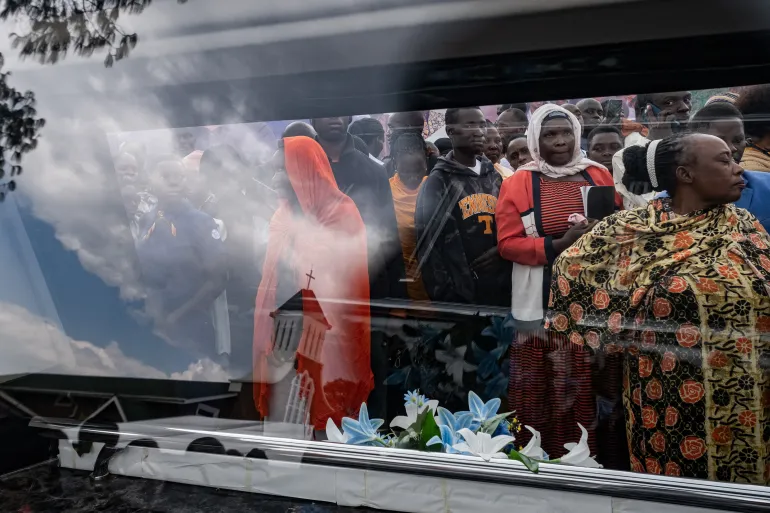
In total, 23 Anglican and 22 Catholic converts to Christianity were executed between January 31st 1885 and January 27th 1887. On June 3rd 1886, 32 young men were burned to death at Namugongo for their refusal to renounce Christianity. They were a combination of Anglican and Catholic converts.

Mwanga’s actions led to a British backed revolution which overthrew the King in 1888. Mwanga negotiated with the British and in exchange for handing over some of his sovereignty to the British East Africa Company, the British helped reinstate Mwanga to the throne in 1889. After a further spate of double-crossing, he was finally deposed in 1897. While in exile he was converted to an Anglican.

There are Catholic and Anglian shrines to the Martyrs’ close to each other in Namugongo. Each year Martyrs Day attracts millions of pilgrims to the area with many coming from beyond Uganda.

The Catholic Church beatified the 22 Catholic martyrs in 1920 and canonized them as Saints of the universal Church in 1964.

In 2015, Pope Francis visited Namugongo, where he celebrated Holy Mass. Before the Mass, Pope Francis paid homage to the Anglican martyrs at the Anglican shrine.

Women bear the brunt of DRC’s Ebola outbreak | Ebola News

NewsFeed

Women in eastern Democratic Republic of the Congo are disproportionately impacted by Ebola as shortages of protective gear amid funding cuts accelerate the spread of disease. Al Jazeera’s Imogen Kimber reports how these caregivers to the living and the dead are most at risk.

Source link

Uganda confirms three new Ebola cases, bringing total to five | Ebola News

The new cases in Uganda include a driver who transported the country’s first ⁠confirmed patient and a ​health worker.

Uganda has confirmed three new ⁠cases of Ebola, bringing ⁠the total number of infections in the country in this outbreak to five, as authorities stepped up contact tracing to try to contain the spread.

The update from Uganda’s Ministry of Health on Saturday came a day after World Health Organization Director-General Tedros Adhanom Ghebreyesus announced the risk assessment for the Bundibugyo strain of Ebola was being revised to “very high at the national level, high at the regional level, and low at global level”.

Recommended Stories

list of 3 itemsend of list

Nearly 750 suspected cases and 177 suspected deaths ‌have been recorded in Uganda’s neighbouring country, Democratic Republic of the Congo (DRC), the centre of the outbreak.

First responders in the DRC say they lack basic supplies, which some have attributed to foreign aid cuts by major international donors, particularly the United States.

The WHO has said late detection, the absence of a vaccine or virus-specific therapeutics, widespread armed violence and high mobility among the population make the DRC especially vulnerable.

Uganda suspended all public transport to the DRC on Thursday after confirming two cases of Ebola – one infection and one death – involving Congolese nationals who crossed the border.

The new cases in Uganda reported on Saturday include a driver who transported the country’s first ⁠confirmed patient and a health worker ⁠exposed while caring for that patient.

Both are receiving treatment and were identified among known contacts, the Health Ministry said in a statement.

The third case is a woman ⁠from DRC who entered Uganda with mild abdominal symptoms and later travelled from Arua, close ⁠to the border, to Entebbe before seeking ⁠care at a private hospital in the capital, Kampala.

The patient initially improved and returned to DRC but later tested positive for Ebola after a follow-up prompted ‌by a tip-off from a pilot involved in transporting her.

All identified contacts linked to the confirmed cases are being closely monitored, ‌the ‌ministry said, urging the public to remain vigilant and report suspected symptoms.

“At this critical moment in the outbreak response, it is vital that authorities maintain high vigilance to control expansion of the virus,” Tedros said on Saturday.

“The WHO is working side by side with Africa Centres for Disease Control and Prevention, and partners in the DRC and Uganda, to contain the outbreak, support affected people, and bolster a coordinated response.”

Source link

Will the latest Ebola outbreak in DR Congo and Uganda spread further? | Health News

The World Health Organization declares the epidemic a global health emergency.

It’s a global health crisis – not a pandemic.

But the World Health Organization is warning that the Ebola outbreak in the Democratic Republic of the Congo and neighbouring Uganda could be much larger than what has been detected so far.

The global health body is advising countries to activate national disaster mechanisms and introduce cross-border and internal screening.

Presenter: James Bays

Guests:

Ariel Kestens – Head of the Kinshasa delegation, International Federation of Red Cross and Red Crescent Societies

Dr Margaret Harris – Lecturer at the United Nations Institute for Training and Research

Dr Ahmed Ogwell Ouma – Former deputy director-general of the Africa Centres for Disease Control and Prevention

Source link

WHO declares Ebola health emergency in the DRC, Uganda

Medical workers check temperatures at the Mpondwe border point with DR Congo, near Bwera, Uganda, on May 9, 2019. File Photo courtesy the WHO

May 17 (UPI) — The World Health Organization has declared a public health emergency of international concern in reaction to an Ebola outbreak in Uganda and the Democratic Republican of the Congo.

Health officials believe the disease, also known Ebola hemorrahagic fever, has killed dozens of people in the two countries in recent days. In the DRC’s Ituri province, there have been 336 cases and 88 deaths possibly linked to the disease. Eight cases have been confirmed.

Cases have also been suspected in Kampala, Uganda.

The WHO declared the public health emergency Saturday, one day after confirming the existence of an outbreak. The international health organization, which is an arm of the United Nations, said the outbreak doesn’t meet the criteria of a pandemic, but the spread of the virus could be bigger than currently known.

“There are significant uncertainties to the true number of infected persons and geographic spread associated with this event at the present time,” the WHO said.

This Ebola outbreak has been linked to the Bundibugyo virus, making it particularly challenging to treat. Unlike the Ebola-zaire strains of the virus, there are no approved approved therapeutics or vaccines for the Bundibugyo strain, the WHO said.

Source link

Ebola Outbreak in Congo and Uganda 2026: What We Know So Far About Cases, Spread, and Response

The World Health Organization (WHO) has declared an Ebola outbreak in the Democratic Republic of Congo (DRC) and Uganda as a public health emergency of international concern. This outbreak is caused by the Bundibugyo strain of the virus, which is less understood than the Zaire strain and lacks effective treatments or vaccines. The WHO notes that while this outbreak does not qualify as a pandemic emergency, countries bordering the DRC are at high risk for spread.

Ebola is a severe virus that causes symptoms like fever, body aches, vomiting, and diarrhea, spreading through contact with infected individuals or materials. The DRC has experienced 17 outbreaks of Ebola since it was first discovered in 1976.

Currently, the outbreak in the DRC is the most severe, with the WHO reporting eight confirmed cases, 80 suspected deaths, and 246 suspected infections. Goma, a town in the DRC, has reported a confirmed case, and Uganda has also identified a second case. The true number of infections and the outbreak’s geographic spread are still uncertain, according to the WHO.

With information from Reuters

Source link

Africa’s richest man plans new Mombasa oil refinery: Why this matters | Business and Economy News

After successfully launching Nigeria’s only operational oil refinery in 2024, billionaire businessman Aliko Dangote has set his sights on East Africa as the next location for another mega refinery project, according to recent reports.

It comes as African countries are actively seeking ways to make energy more secure, following huge global disruptions amid the US and Israel’s war on Iran and Tehran’s subsequent closure of the Strait of Hormuz, through which about 20 percent of the world’s oil and natural gas is shipped.

Recommended Stories

list of 3 itemsend of list

Dangote, Africa’s richest man, appeared to be one of the winners from this fallout when his newly operational refinery, located in Nigeria’s commercial Lagos State, began selling large volumes of crude oil across the continent as the war on Iran escalated in March and global oil prices soared.

At present, West, South and East Africa rely primarily on importing refined petroleum products from the Middle East, meaning they are highly vulnerable to disruptions there.

Neighbours of Nigeria – Cameroon, Togo, Ghana and even Tanzania, further to the east – are among the countries that have turned to Nigeria as supplies from the Middle East dry up.

By the end of March, the refinery, which has the capacity to produce 650,000 barrels per day (bpd), reported it was also receiving orders from beyond the continent, especially for severely scarce jet fuel as hundreds of flights were cancelled across regions.

Supply from Dangote’s refinery has cushioned the impact of the war in terms of fuel supply for Nigeria and neighbouring countries, analysts say.

Nigeria is Africa’s largest oil producer, and the $19bn project in Lagos is currently the world’s largest single-train refinery, meaning it employs a single processing line rather than multiple units. But it hit full production capacity in February 2026, the same month the war with Iran started.

Nigeria has no functional state-owned refinery, so Dangote’s refinery is now positioning the country to be a net exporter of jet fuel and diesel.

Here’s why more refining capacity in Africa matters for the continent:

Dangote
Petroleum trucks line up at the gantry inside the Dangote Industries oil refinery and fertiliser plant site in the Ibeju Lekki district of Lagos, Nigeria, March 2, 2026 [Sodiq Adelakun/Reuters]

What is Dangote’s plan for an East Africa refinery?

In April, Kenya’s President William Ruto announced that East African countries were in talks to build a joint oil refinery at Tanzania’s Tanga port, which would have a similar capacity to Dangote’s Lagos operation.

“We do not want to be held hostage any more by the Strait of Hormuz,” Ruto said at a Nairobi business event in April, which Dangote was present at.

“We do not want to be held hostage by wars that are started by other people. We have our resources here, and we are saying we are going to use our African resources to industrialise our region.”

In an interview with the Financial Times on Sunday, however, Dangote said he would prefer to build the new operation in Kenya rather than Tanzania.

“I’m leaning more towards Mombasa because Mombasa has a much larger, deeper port,” the billionaire told the UK newspaper.

“Kenyans consume more. It’s a bigger economy,” he said, adding that “the ball is in the hands of President Ruto … Whatever President Ruto says is what I’ll do.”

He has projected construction costs of between $15bn and $17bn.

But venturing into East Africa, which has a very different commercial landscape from West Africa, could prove a challenge, analyst Dumebi Oluwole of Lagos-based intelligence firm Stears told Al Jazeera.

“Dangote has proven it [his operation] can build at scale,” she said. “The East African test will be whether it can also navigate the political and logistical landscape of a fragmented, multi-country market.”

Why aren’t African countries already producing more oil?

Despite having sizeable crude reserves, African countries only refine about 44 percent of the total oil consumed themselves, with imports making up the rest, according to a 2022 African Union report.

The top producers of refined oil are Algeria, Egypt and South Africa. There are about 21 refineries in North Africa.

Southern Africa has another seven, while West Africa has 14. However, most refineries in the two regions are either not operating or are producing below the capacity they are equipped to.

East Africa’s only existing refinery is in Mombasa, but it stopped operating in 2013 due to a combination of slow government policies and exiting investors, who deemed it commercially unviable as a result.

There is currently no refining capacity at all in East Africa, despite the region having about 4.7 billion barrels of crude reserves, according to the African Union, mainly in Uganda, South Sudan, Kenya and the Democratic Republic of the Congo.

Kenya imported 40 million barrels of petroleum in 2025. It regularly buys oil from the UAE, Saudi Arabia, India and Oman, all of which have been hampered by Iran’s closure of the Strait of Hormuz.

Nigeria itself is Africa’s biggest net crude producer with a 1.5 million to 1.6 million bpd capacity. The country has not refined meaningfully since 2019.

What difference will local refineries make for African countries?

Exporting most of its crude to then import refined products is expensive and puts Africa on the back foot, analyst Oluwole said.

More oil refined on the continent would mean lower petrol pump prices, lower transport costs, and more energy available for people and businesses, in theory. It would also mean greater access to by-products like fertilisers for farmers, for example, or petrochemicals for manufacturers.

“Dangote has demonstrated that a viable, scalable, intra-African energy supply option is possible – that proof of concept matters enormously,” said Oluwole.

“It reflects a growing continental conviction that Africa can provide for itself, and that this is no longer wishful thinking,” she added.

In Nigeria’s case, Dangote’s refinery is yet to ease pressures, though. Local airlines, for example, have complained about having to pay high prices for jet fuel even with improved local supplies. Analysts say that could be because Nigeria’s government removed fuel subsidies in 2023. Bureaucracy within the state oil company also forced Dangote’s refinery to import crude.

Still, the refinery is contributing to “a more transparent and competitive market”, Oluwole said, adding that results should eventually show.

Other countries are stepping up. Last week, Angola’s $470m Cabinda refinery began supplying domestic as well as foreign markets. The project is owned primarily by the United Kingdom’s Gemcorp Capital and has a capacity of 30,000bpd, with plans to double by the end of 2026.

Dangote’s planned refinery in Kenya, if completed, could also help to reduce East Africa’s reliance on the Middle East.

A separate, government-funded refinery project in Uganda’s Hoima region is also in the works. Authorities expect the project to be able to refine 60,000bpd when it starts operations in 2029. It will be fed by the joint Uganda-Tanzania East African Crude Oil Pipeline (EACOP), an ongoing project which will transport crude from Uganda’s Lake Albert to Tanzania’s Tanga Port.

Uganda also plans to produce diesel, jet fuel, kerosene and Liquefied Petroleum Gas (LPG).

With big plans in place, Oluwole says it’s now left to African governments to create enabling business environments for the private sector.

“Dangote has opened the door,” she said. “The question now is whether African institutions and governments will walk through it.”

Source link