USC’s new President Beong-Soo Kim faces high stakes on Trump, trust and Trojan football
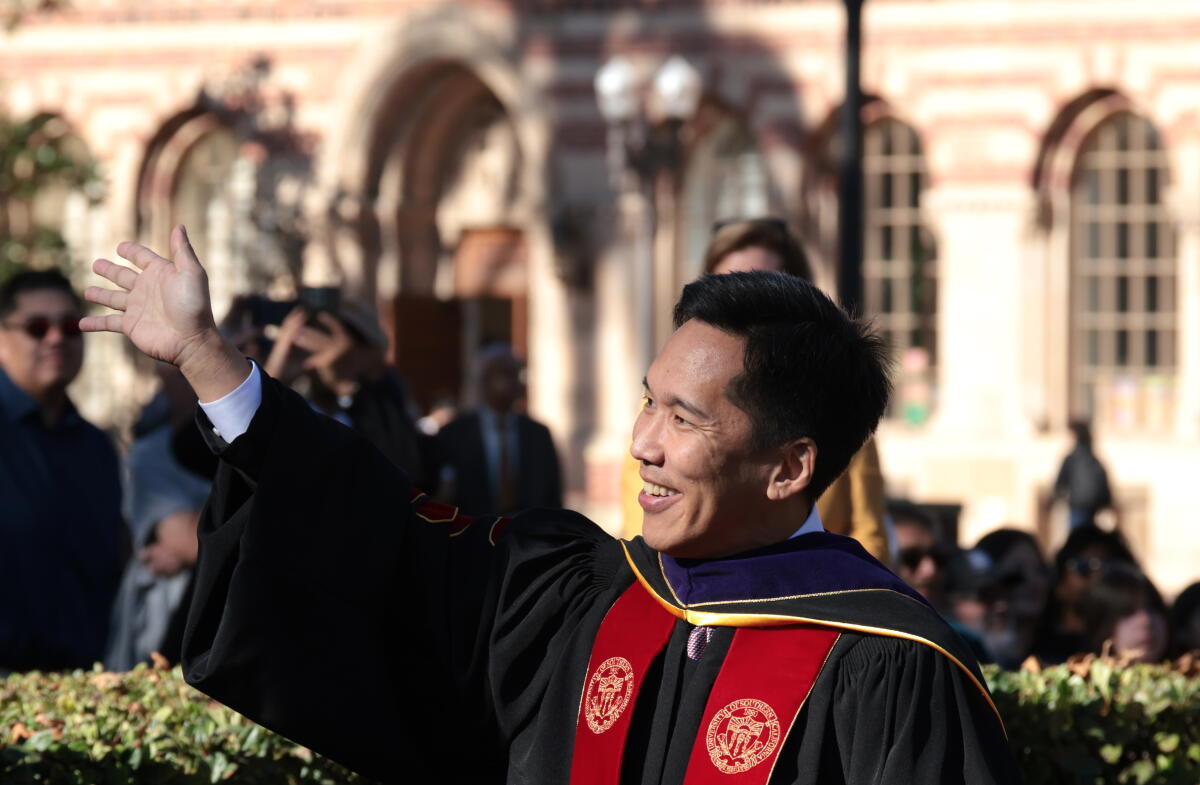
Eyo-Dae Kim and Susan Kim attended the University of Southern California decades ago, two international students with little money and no family in the U.S. On Friday, their son, Beong-Soo Kim, stood before an Alumni Park crowd and was formally installed as the 13th president of their alma mater.
“It is wonderful to have you here, Dad, facing the same library where you and Mom studied together at USC,” Kim, 53, said to his father, who took doctoral courses in economics. Kim’s late mother fled during the Korean War and earned a USC master’s degree.
“They certainly would never have imagined, as international students, that this day could possibly come,” Kim had said earlier.
In a wide-ranging interview before the event, Kim — who was appointed in February after holding an interim presidential role — said he leads USC at a time of promise and deep challenges:
The Los Angeles Memorial Coliseum, leased and operated by USC, will be a showcase site for the 2028 Olympics. A recent $200-million gift is fueling a university-wide push into artificial intelligence. USC admitted 12.6% of first-year applicants this fall for sought-after slots.

Beong-Soo Kim was formally installed as USC’s 13th president during an investiture ceremony Friday.
(Myung J. Chun / Los Angeles Times)
Yet he faces steep hurdles. The former federal prosecutor who spent five years as USC’s general counsel inherited a deficit of more than $200 million. Among his first actions, Kim approved the layoffs of more than 900 workers and ordered deep cost-saving measures. USC is still recovering from years of scandal and controversy that scarred its national reputation, including a $1.1-billion payout to settle sexual abuse allegations against a campus gynecologist, its involvement in the “Varsity Blues” admissions bribery scheme and its handling of pro-Palestinian protests.
Then there is Trojan football.
Fans chanted this month for the firing of football coach Lincoln Riley — after years of underachieving — though the Trojans have defeated Washington and Penn State after an Oregon loss.
Although fans and analysts have soured at times on Riley — whose pay exceeds $11 million and whose reported buyout is about $70 million — Kim declined to say whether USC could afford a coaching change, saying, “We’re not thinking about that.”

-
Share via
Amid fan chants to fire Trojan football coach Lincoln Riley, USC President Beong-Soo Kim declined to say whether USC could afford a coaching change, saying “we are laser-focused on the next game.”
“We are laser-focused on the next game, and then the game after that, and really having the best possible season that we can have in football,” he said.
After the stinging rounds of layoffs, Kim said, the university expects to “significantly exceed” the roughly $30-million surplus he forecast for USC earlier this year during his state-of-the-university speech, though final numbers are pending.
In his speech, Kim said that public trust in universities has declined and “we must regain trust by earning it.” USC is among the elite universities targeted last year by the Trump administration over alleged campus antisemitism, though it has not faced major federal funding freezes or lawsuits as the UC system has.
On Friday, deans and faculty in academic regalia processed into Alumni Park, where the Trojan Marching Band accompanied the national anthem as temperatures climbed toward the 90s during the nearly two-hour ceremony.
USC religious life dean Varun Soni opened an invocation by describing the cello’s sound post — a small wooden piece called its “soul” in Italian and French — and comparing it to the soul of a university. Kim, a cellist, later joined USC Thornton School of Music students to play “Prelude,” the first movement of Grieg’s “Holberg Suite,” Op. 40, as Kaufman School of Dance students performed.
Morton Schapiro, Northwestern’s president emeritus and a former USC dean, represented visiting academic delegates and praised Kim’s “creativity, character and commitment to community” before Suzanne Nora Johnson, chair of the Board of Trustees, formally installed Kim. Jewish, Christian, Muslim, Hindu, Buddhist and humanist blessings closed the ceremony. In the afternoon, a “Trojan Family celebration” in McCarthy Quad was scheduled to feature food stalls and performances by singer-songwriters Aloe Blacc, a USC alumnus, and Allen Stone.
Money, medicine and priorities
When he took over as interim president in 2025, upon the departure of Carol Folt, Kim immediately confronted the university’s financial crisis. The campus had long spent more than it brought in, an imbalance driven by rising athletics costs, pandemic expenses and major legal settlements. A weak year for USC’s health system deepened the shortfall. Kim maintained a hiring pause, stopped merit raises and took “a hard look at a lot of our administrative expenses and our operations,” he told The Times.
Keck Medicine of USC took a significant hit in the layoffs after running a deficit in the tens of millions in recent years. Last month, dozens of layoffs took place at the Viterbi School of Engineering.
Kim said Keck’s performance “has been good, but it can get better.” The health system is “making very positive progress” to cut expenses while focusing on “patient care, patient quality.”
Across campus, he credited staff and faculty with “stepping up, asking how can we do more with less.”
USC is also challenging a faculty union before the National Labor Relations Board. Non-tenure-track faculty voted in June to join United Faculty-UAW, with about 70% in favor. USC has asked the labor board to review the decision that allowed the vote, arguing the union is too broad. Faculty leafleted Friday during Kim’s event.
Kim said he wants USC to build strong partnerships with Los Angeles industries, including entertainment, biotechnology, sports and “the new space economy.”
He cautioned in his speech that “great universities do not become greater by trying to do everything.”
During the interview, he did not say which university programs need to shrink but said such decisions will come through a strategic plan that will “engage the whole community.”
“One of the things that I frankly pride myself on as a university president is that I readily admit that I don’t have all the answers, and certainly not the best answers,” he said.

Beong-Soo Kim speaks at USC’s commencement in May.
(Jason Armond / Los Angeles Times)
Admissions
A pressing debate — particularly within the University of California system — is whether standardized tests should be required for admissions. Many of the nation’s most elite institutions have recently turned away from test-blind or test-optional admission policies. UC, which does not consider SAT scores in admissions, is reviewing whether to resume SAT and ACT requirements.
Kim said USC, which is test-optional, is studying the issue too. USC considers SAT and ACT scores if applicants submit them but does not require them.

-
Share via
As the University of California evaluates whether to reintroduce SAT and standardized testing requirements for admission, USC President Beong-Soo Kim said USC is also looking at the question. He said USC, which is test-optional, has not made a final decision.
“It’s absolutely something that has been under discussion, particularly with respect to STEM students,” he said, referring to science, technology, engineering and math majors. He cautioned that no final decision has been made and that the new provost, David Madigan, will be looking at the issue.
Kim said UC’s test-blind policy is “one of the contextual factors that we have to consider.” Many California students who plan to apply to UC skip the tests, and many of them also apply to USC, he said.
USC said last year it would keep weighing applicants’ family ties to the university despite a state ban on legacy and donor preferences. In 2024, while the ban was pending, USC said it would “comply with state law” if it were signed. Schools that keep the preferences are listed publicly as out of compliance and must report more admissions data to the state.
Kim said USC chose to keep “considering whether someone is a member of the Trojan family” as one of many factors. He said he is “actually quite proud” that USC maintained its “holistic admissions practices” in a way that “provides more transparency about our admissions.”
Image and trust
Legacy preferences have fed a stereotype of USC as a college for the wealthy and well connected. Kim disputed that image.
He pointed to USC’s transfer students, Pell Grant recipients and first-generation students. USC opens its doors to “so many people in California, throughout the country, and throughout the world,” he said.
Still, Kim acknowledged that trust in education has fallen, though he said that trust in American institutions “across the board has been declining.”

-
Share via
USC violates state law by considering legacy and donor ties in admissions, a practice President Beong-Soo Kim defended as part of a holistic review while touting the university’s transparency in reporting admissions data to the state.
“Some might have to do with events from several years ago,” he said.
He did not say which events, though USC has had its share. As general counsel, Kim helped steer it through the aftermath of the national Varsity Blues admissions bribery scandal and the sex abuse payout to former patients of campus gynecologist George Tyndall, the largest in higher education history.
His answer to falling trust has been the Open Dialogue Project, which he launched in October 2025 to bring clashing views to campus. Guests have included National Institutes of Health Director Jay Bhattacharya, former ACLU President Nadine Strossen and legal scholar Jonathan Turley.
In September, the Foundation for Individual Rights and Expression gave USC its top “green light” rating for several speech policies. After the group recalculated its college free speech rankings, USC rose from 198th to 37th out of 261 schools.
White House pressure
Last fall, the Trump administration invited USC and eight other universities to sign a higher education compact offering favorable access to federal research grants. Signers would cap international undergraduates at 15%, require the SAT or ACT and freeze tuition for five years.
USC rejected the compact last October — about two weeks after the administration offered it.
Some faculty viewed USC’s initial reluctance to reject the overture as a sign it was unwilling to openly challenge Trump’s education demands. They also point to USC’s closure of its university-wide Office of Inclusion and Diversity last year amid a federal anti-DEI push and its removal of pages for cultural heritage months from its “Culture Journey” website earlier this year.
Kim disagreed that USC bends quickly to the White House.
“It would have been highly presumptuous for me just to make a rash decision about what we were going to do without listening,” he said of the compact.
International students have also faced pressures, as the government restricts some visa programs and significantly increases costs for others.
About 26% of USC students are international, with 15% of the undergraduate population coming from other nations. Kim said international students “have been part of USC for decades” and called their presence “a win-win.”
AI risks
USC is also leaning into artificial intelligence, with a $200-million gift from Nvidia board member Mark Stevens and his wife, Mary Stevens, meant to infuse AI across the campus and recruit AI researchers.
But leaders of OpenAI and Anthropic have warned that the technology’s fast development poses serious risks to jobs and human existence.
“We have to take those warnings very seriously,” Kim said. Universities, he said, can help clarify what it means for AI to be “aligned” and “safe.”
Kim said USC wants to make sure its students “are leading in terms of how to use it ethically, how to use it morally.”
The future
On July 14, 2028, the Coliseum — USC’s campus-adjacent home stadium — will share the Olympics’ opening ceremony with SoFi Stadium in Inglewood.
Kim said he hopes Olympic visitors will see “a university that has an incredible Olympic tradition,” but also one whose reach goes well beyond sports.
The Games will also bring alumni and students “from across the globe,” he said. “I think that’s going to make for a very magical moment.”