u.s. soccer

Infantino’s FIFA presidency in peril after World Cup sell-off blunder

Heading into the final weekend of this summer’s World Cup, The Guardian reported that support for FIFA president Gianni Infantino had climbed to record levels. More than 200 of FIFA’s 211 member associations formally endorsed Infantino’s bid for a fourth term as head of world soccer’s governing body, the paper reported, making next March’s vote more of a coronation than an election.

Two weeks later, that support disappeared. Not only is Infantino’s reelection campaign in tatters, but there’s a chance he won’t survive until the spring, with British Prime Minister Andy Burnham and Javier Tebas, president of Spain’s soccer association, calling for his resignation and close confidants such as Carlos Cordeiro, the former president of U.S. Soccer, and Kevin Lamour, FIFA’s chief operating officer, publicly breaking with their boss.

At the center of that reversal was a closely guarded scheme to raise $4.2 billion by selling a 20% stake in the World Cup to private investors, who would be given influence in planning and executing future events, including broadcasting and commercial deals tied to the tournament.

In short, Infantino was planning, in secret, to sell shares in the World Cup. And once details began leaking in the media, he was forced Friday to scrap the whole thing, an embarrassing retreat that has left him vulnerable just two weeks after he had seemingly reached the heights of his third term as FIFA president.

Infantino’s idea, called the FIFA Forward Enterprise, was intended to turn the World Cup, FIFA’s milk cow, into a golden calf. But to do so, he needed the approval of at least 106 of FIFA’s 211 member countries, so he promised countries that backed him that they would receive $20 million each by mid-September. Those who declined would get just a fraction of that.

Infantino was certain the piles of cash would buy the acquiescence — or at least the silence — of enough members for the plan to go through. Instead, the bribe blew up in his face and FIFA issued a statement late Friday, under Infantino’s name, that basically said “never mind.”

“Having listened carefully to all the views, it has become clear that the project has created divisions of a nature that, regardless of the level of support, are no longer in the interest of the objective set out in the first place,” the statement read.

The question now becomes whether Infantino’s presidency will proceed.

He wouldn’t be the first FIFA president to be grievously wounded by unbridled ambition, but the speed and depth of his fall is staggering. The 2026 World Cup was, by nearly every measure, wildly successful. The largest and most complex sporting event in history the tournament, hosted by the U.S., Mexico and Canada, exceeded expectations, drawing more than 6.8 million live fans and a global TV audience of more than six billion. The four-year World Cup cycle brought FIFA revenues of about $15 billion, making it the first sporting event in history to earn more than $10 billion.

Infantino has never been shy about pushing boundaries despite heading a Swiss-based organization that, its wealth notwithstanding, is officially a nonprofit. Nor was this the first time he tried to bring private equity into the World Cup: In 2018, two years into his first term as FIFA president, he considered a plan to raise $25 billion to fund tournaments, only to cave in the face of massive opposition.

He didn’t give up the idea of squeezing more money out of the World Cup, though.

This summer, he introduced three-minute hydration breaks in the middle of each half — ostentatiously a nod to the heat and humidity, but in reality a ruse that allowed broadcasters to generate millions in additional revenue through TV commercials. FIFA also staged a halftime show for the first time ever during the final, sold VIP tickets priced at more than $1 million each and introduced dynamic pricing for the tournament’s 104 games, driving prices for some seats to four times what fans paid four years ago in Qatar.

That pushed the tournament beyond the reach of many of the sport’s most loyal supporters — and soccer, more than any other sport, belongs to the fans. It’s why teams are called clubs and fans are called supporters.

The World Cup, then, wasn’t Infantino’s to sell. So the pushback to his latest idea was immediate and unsparing.

“Football does not belong to investors,” Burnham said in an Instagram post. “Once you have sold a piece, you have sold out. Football belongs to the fans. It always has, and it always will.”

What really angered stakeholders, however, was Infantino’s brazen move to develop the FFE in secret, only to have its details leak out.

Bernd Neuendorf, president of the German soccer association and a member of the FIFA Council, the group’s most influential body, said he first learned of the FFE by reading about it.

“I was very surprised, and also annoyed, that we had to find out about something like this from the press,” he told a German news outlet last week.

Another self-inflicted wound was Infantino’s decision to launch the project with Thrive Eternal, a venture capital firm founded by Joshua Kushner, the 41-year-old brother of Jared Kushner, President Trump’s son-in-law and a kind of all-purpose White House advisor and negotiator. Thrive Eternal focuses on long-term investments in scarce cultural institutions that technology cannot replace, but it has little relevant experience in managing something as large and complicated as a World Cup.

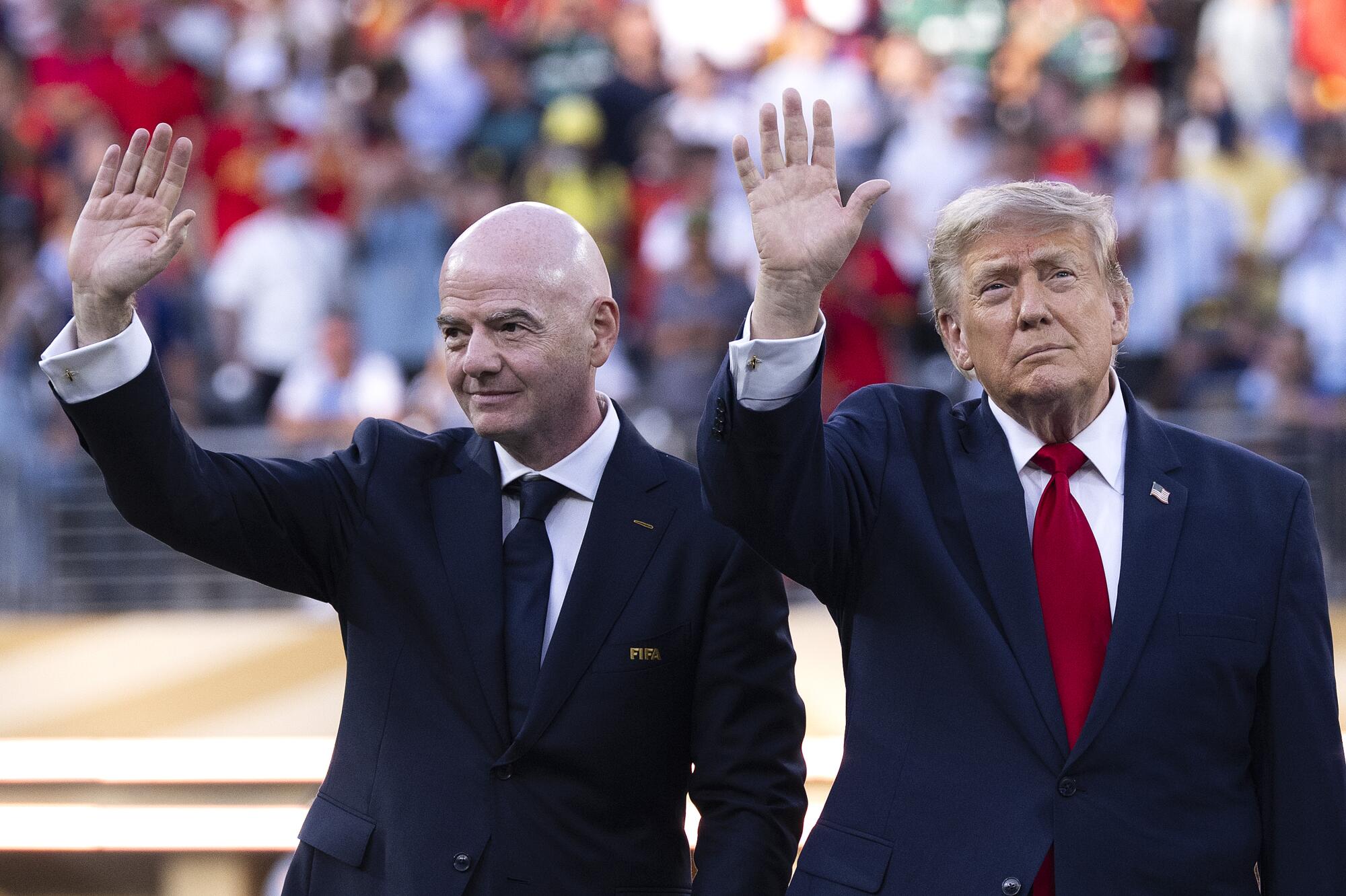
FIFA president Gianni Infantino, left, and President Trump wave during an award ceremony.

FIFA president Gianni Infantino, left, and President Trump wave during an award ceremony following Spain’s win over Argentina in the World Cup final July 19.

(David Ramos / Getty Images)

Moreover, the partnership would draw Infantino further into the orbit of Trump, whom the FIFA president has openly courted for years. Infantino, who has been a frequent visitor to the Oval Office and Trump’s Mar-a-Lago estate in Florida, attended the president’s inauguration and accompanied him on visits around the world.

Trump’s relationship to Infantino was questioned when Infantino presented him with the first FIFA Peace Prize last December, then became even more controversial when Trump phoned Infantino three times to lobby to have the red-card suspension of U.S. forward Folarin Balogun overturned ahead of a World Cup elimination game last month.

FIFA eventually cleared Balogun to play, marking just the second time in tournament history a red card ban has been lifted. For some, Infantino’s decision to partner with someone close to Trump on his latest venture was a bridge too far.

“It’s a really bad look for Infantino given the concerns about political interference that were already there after Balogun,” said Steven A. Bank, a professor of business law at UCLA who has written and lectured extensively on the economics of soccer. “Especially with the fund led by Jared Kushner’s brother.”

Once details of Infantino’s secret plan began to leak, UEFA, the confederation that governs European soccer, held an emergency meeting during which all 55 members — including Spain, the reigning men’s and women’s World Cup champion — voted to boycott all FIFA competitions.

“Some things are simply too important to sell. The FIFA World Cup belongs to football. It always will,” UEFA, the largest and most powerful of FIFA’s six continental confederations, said in a statement.

CONCACAF, which oversees soccer in North America, Central America and the Caribbean, said its 41 countries also rejected the plan, an opinion the U.S. Soccer Federation backed in a sparse post on X.

“U.S. Soccer stands with CONCACAF and its members,” it wrote.

The Asian Football Confederation joined in, saying in a statement its 47 members stand “in solidarity with UEFA and CONCACAF in expressing serious concerns over FIFA’s proposal to introduce private investment into FIFA’s flagship competitions.”

When it became obvious Infantino would not get the votes he needed to go forward, he pulled the plug on his plan. But it may not have been so much that the idea was bad as it was the execution.

Soccer is awash with private investors. The biggest clubs are owned by billionaires or sovereign wealth funds and many leagues — including Spain’s La Liga, which Tebas oversees — have sold commercial stakes to private equity firms in much the same way FIFA proposed.

Alan Rothenberg, a former U.S. Soccer president and the driving force behind the 1994 men’s World Cup and 1999 women’s World Cup, among the most successful tournaments in history, said the idea of selling a private equity stake in the World Cup isn’t a bad idea. But the way Infantino tried to implement his plan led it to failure.

“What is proposed is not that revolutionary,” Rothenberg said. “There have been private equity investors in MLS, in one of the subsidiaries of the NFL, in F1.

“But I think the combination of everything has doomed it. It does raise the possibility that Infantino, he’s finally become Icarus and gotten too close to the sun. It actually may doom him politically.”

Others including Cordeiro, a former vice chairman at Goldman Sachs, questioned the need to bring in outside investors.

“FIFA already has access to extraordinary financial resources. The organization sits on billions of dollars in reserves and no debt,” Cordeiro pointed out in his resignation letter. “If member associations believe additional investment is needed to develop the game, FIFA already has the financial capacity to provide that support from its existing resources.”

Infantino has flaunted consensus before without significant consequence, cozying up to autocrats while overseeing the 2018 World Cup in Vladimir Putin’s Russia and the 2022 tournament in Qatar before being accused of awarding the 2034 tournament to Saudi Arabia in a rigged vote.

This time, however, the stakeholders within FIFA were pushed too far by Infantino’s penchant for wielding unilateral power, so they pushed back and the president blinked. Hours before he backed down, an ally of Infantino’s told the Financial Times that he would not bend, seeing the standoff as “a fight to the death.”

Infantino’s presidency might not be dead, but it is surely in critical condition.
Source link

Seven reasons why U.S. soccer keeps crashing out of World Cup

p]:text-cms-story-body-color-text”>

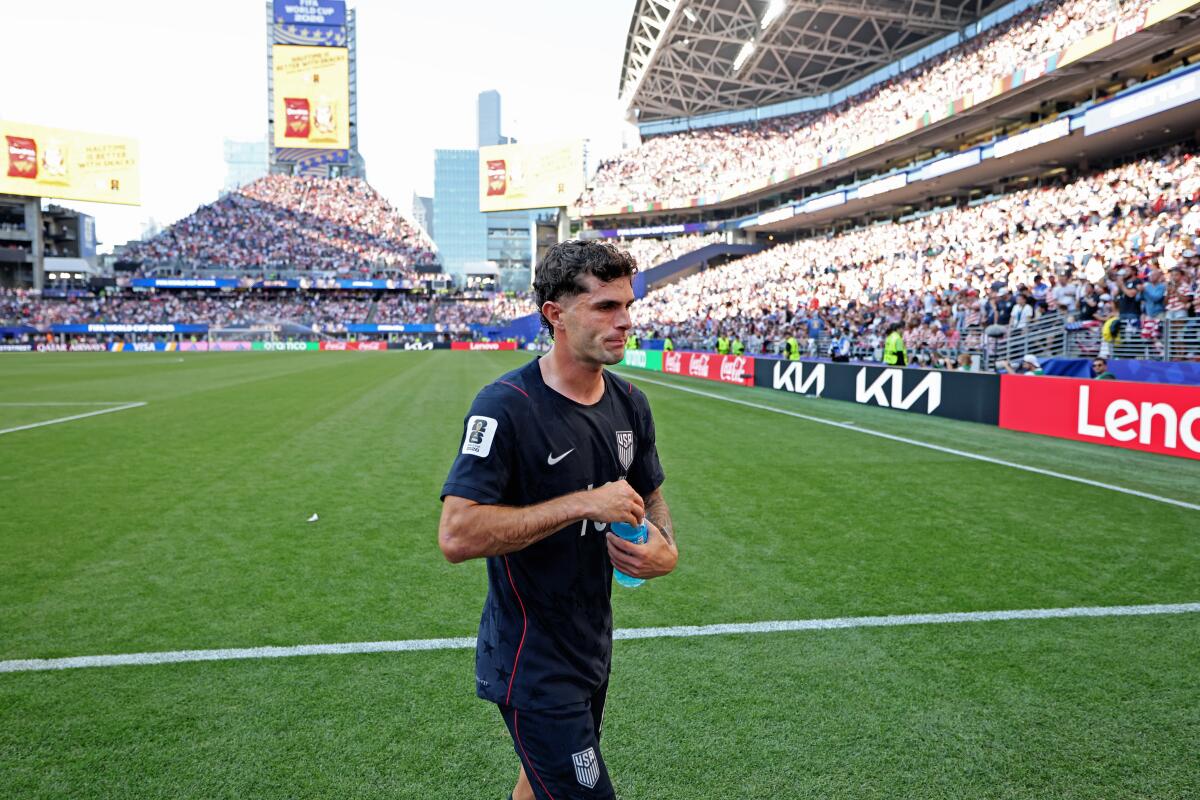
U.S. forward Christian Pulisic heads to the locker room at halftime during the loss to Belgium.

U.S. forward Christian Pulisic heads to the locker room at halftime during the loss to Belgium.

(Allen J. Schaben / Los Angeles Times)

More Americans are playing for bigger clubs and having more success in Europe than ever before, but that pipeline has yet to produce a true superstar. Many of the teams that have had success in this tournament have at least one player — Mbappé, Haaland, Lionel Messi, Harry Kane — who can change the game on their own.

The U.S. doesn’t have anyone who would be sure to start on any of the World Cup semifinalists and until it does, closing the gap will be difficult.

“We are USA and [we’re] competing against Belgium, Portugal,” Pochettino said last March. “I think for sure Belgium and Portugal have [players] in the top 100. We don’t.”

He is right. When the Guardian published its annual list of the world’s top players last winter, Christian Pulisic, the top American, didn’t make the top 100. And he didn’t play a full game in this tournament, missing one to injury, leaving three early and entering another as a late second-half substitute. He played just 223 minutes — 19 more than Ricardo Pepi — and finished with one assist.

Landon Donovan was arguably the closest thing to a game-changing player the U.S. had, so it’s no surprise he scored key goals in the team’s most important World Cup games in the last 32 years: one against Algeria in stoppage time in 2010 that allowed the Americans to finish atop their group for the first time since 1930, and another against Mexico in the round of 16 in 2002, sending the team to the quarterfinals for the only time.

If those are structural things that have long held U.S. Soccer back, there also were issues specific to this team, a supposed Golden Generation whose core was formed in the wake of the failure to qualify for the 2018 World Cup.

The talent was undeniable, which led to great expectations. But what has this generation accomplished? Two round-of-16 exits in the World Cup, one Gold Cup title in the last four tournaments — the team’s worst stretch this century — a fourth-place finish in the last Nations League and a group-stage departure in the last Copa América.

Impressive wins over Paraguay and Australia to start the World Cup gave the Golden Generation a bit of a shine and suggested progress. But when the Americans met a top-10 team in Belgium, the matchup proved a mismatch.

“We want to have higher hopes,” Pulisic said. “We want to be able to go and compete with some of the best in the world. We just still have that next step to climb.”

Against Belgium, that step looked as steep as Mt. Everest.

Source link

World Cup: U.S. cannot appeal Folarin Balogun’s red card suspension

The U.S. cannot appeal Folarin Balogun’s red card and ensuing suspension for the Americans’ round of 16 match against Belgium, U.S. soccer officials confirmed.

FIFA rules governing the 2026 World Cup, first cited by the Athletic, state that “a sending-off automatically incurs suspension from the subsequent match. The FIFA judicial bodies may impose additional match suspensions and other disciplinary measures.”

The only instance in which the U.S. could appeal is if FIFA’s disciplinary committee decides to suspend Balogun for more than one game after reviewing the incident.

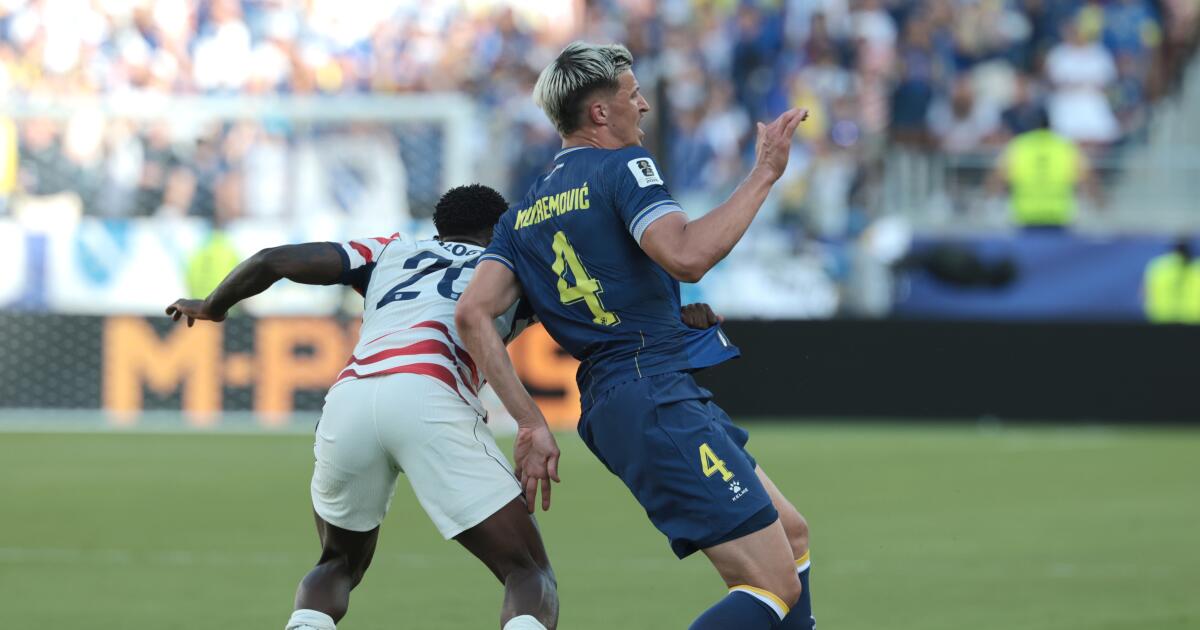
Broadcast commentators and fans immediately questioned the decision after Balogun was shown a red card during the U.S.‘s win over Bosnia-Herzegovina on Wednesday at Levi’s Stadium.

Balogun crashed into Bosnia’s Tarik Muharemović, landing his foot on top of Muharemović’s during the physical match. Muharemović hit the pitch, howling in pain, and was treated on the field. The referee used the video assistant referee to review the play and determined it merited a red card.

U.S. fans accustomed to appeals in the NBA and NFL suggested that an appeal include video of Lionel Messi receiving no discipline for stepping on an opponent’s calf earlier in the tournament.

The red card on the field, however, remains the final word barring any extra games added to Balogun’s suspension.

Source link

U.S. soccer delivers big unifying win to open 2026 World Cup

The U.S. men’s soccer team chose an incredible day to have an incredible day.

Crucially, the United States aced its only chance to make a first impression, kicking off this colossal World Cup it’s co-hosting with Mexico and Canada with a 4-1 victory over Paraguay.

Consider it a save for the tournament, three points for soccer in America and maybe even a win for uniting the States.

The Americans on the pitch did all that, including making sure a sellout crowd of 70,492 fans got their money’s worth for their exorbitantly high-priced seats to watch football under Friday Night Lights at SoFi Stadium.

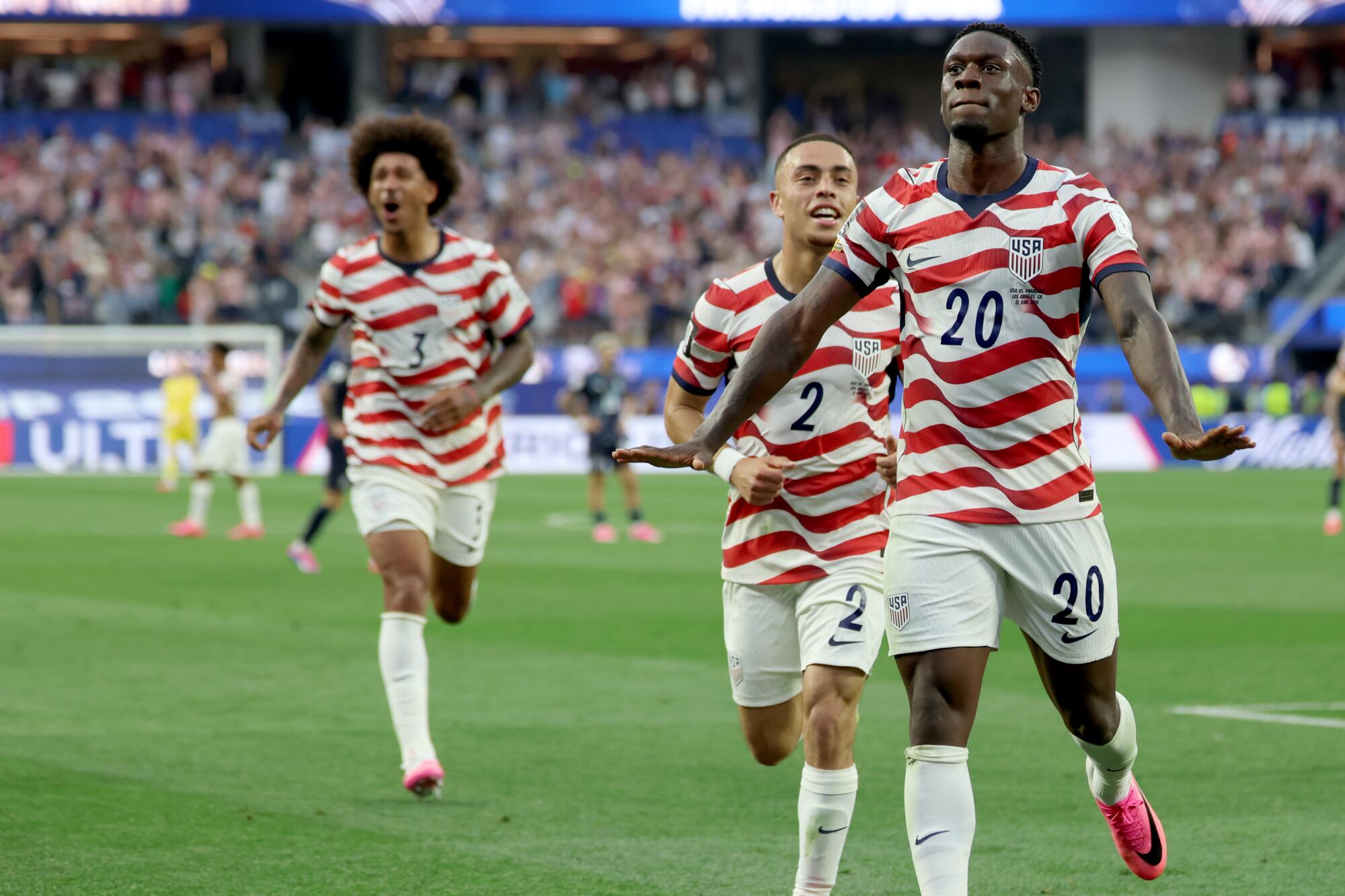
U.S. forward Folarin Balogun celebrates with Sergino Dest and Chris Richards after scoring during a World Cup win.

U.S. forward Folarin Balogun, right, celebrates with Sergino Dest and Chris Richards after scoring during a World Cup win over Paraguay on Friday at SoFi Stadium.

(Robert Gauthier/Los Angeles Times)

It was not a clean sheet. And it wasn’t an elixir for all the issues — visas, tickets, transportation — that ailed the tournament in its buildup.

But the opening statement by the United States confirmed what we thought might be true. Only one thing could save this soccer tournament: soccer.

The U.S. delivered a performance to change the conversation — for the next few weeks and maybe longer.

Making history to alter history.

The United States scored multiple goals in a World Cup first half for the first time since 2002.

It got two of them from Folarin Balogun, the Brooklyn-born, England-raised forward of Nigerian descent who became just the second USMNT player to score two goals in a World Cup game and the first since 1930.

Got a perfect match from Chris Richards, the afro-rocking defender with the long, loping strides, who was 83 for 83 on his passes. That’s better than any player at a World Cup since 1966.

And if possession is nine-tenths of the law of attraction, know that the Americans possessed the ball 71% of the first half, most in the first half of a World Cup game in the modern era.

Landon Donovan, star of the 2002 team that reached the World Cup quarterfinals — a record that still stands — posted on X: “From start to finish, that was the most enjoyable day of soccer I’ve ever experienced.”

That’s the stuff that will get the American people going. Get us invested, get us behind them. That could convert even devout casuals.

Americans love a good underdog story. We also want the best, the finest, the biggest — and this, with its expanded field of 48, is the biggest version of the biggest and best tournament in the world.

And the only thing we love more than winning is dominating. The United States did that Friday against a Paraguayan team that had allowed only 10 goals in 18 World Cup qualifying matches, and whom the United States beat 2-1 in a tense match in November.

Fans cheer during the U.S. win over Paraguay in their World Cup opener Saturday at SoFi Stadium.

Fans cheer during the U.S. win over Paraguay in their World Cup opener Saturday at SoFi Stadium.

(Robert Gauthier/Los Angeles Times)

That was Mauricio Pochettino and his players helping us help them.

“The fans, amazing,” said Pochettino, the team’s accomplished Argentine coach. “On behalf of the whole team, a massive thank you to the fans. Because the energy that they [gave] to the team was amazing. We can do amazing things if the fans are in this as well.”

Friday was so good for soccer in America.

And so good for America. The kind of butt-kicking that’s chicken soup for a nation’s soul.

Maybe it’s idealistic and naive, or apple-pie-in-the-sky wishful thinking, but I believe that they can win. (And by win, I mean make the quarterfinals again.)

There’s no removing politics from this World Cup, but wouldn’t it be fun to all rally behind a team together? Can’t you see the country coalescing behind the right wingers and left wingers on the pitch? Picture people celebrating the freedom inherent in Pochettino’s system? Cheering the all-for-one and one-for-all of this team of dual nationals and Americans raised abroad — or in Alabama?

Postmatch, Pochettino refused to single out any one player, instead giving reporters a recitation of his roster: “[Christian Pulisic] was amazing [setting up two goals]. Balogun was amazing, of course. Tim Ream was amazing, of course. Chris Richards was amazing, yes. Weston McKennie, he was amazing, amazing. Antonee Robinson, Alex Freeman, amazing. Sergiño Dest, amazing …”

Like they put it on the @USMNT Instagram account: “Together as Won.”

U.S. soccer, amazing.


Source link

Inside U.S. soccer’s World Cup camp at Orange County Great Park

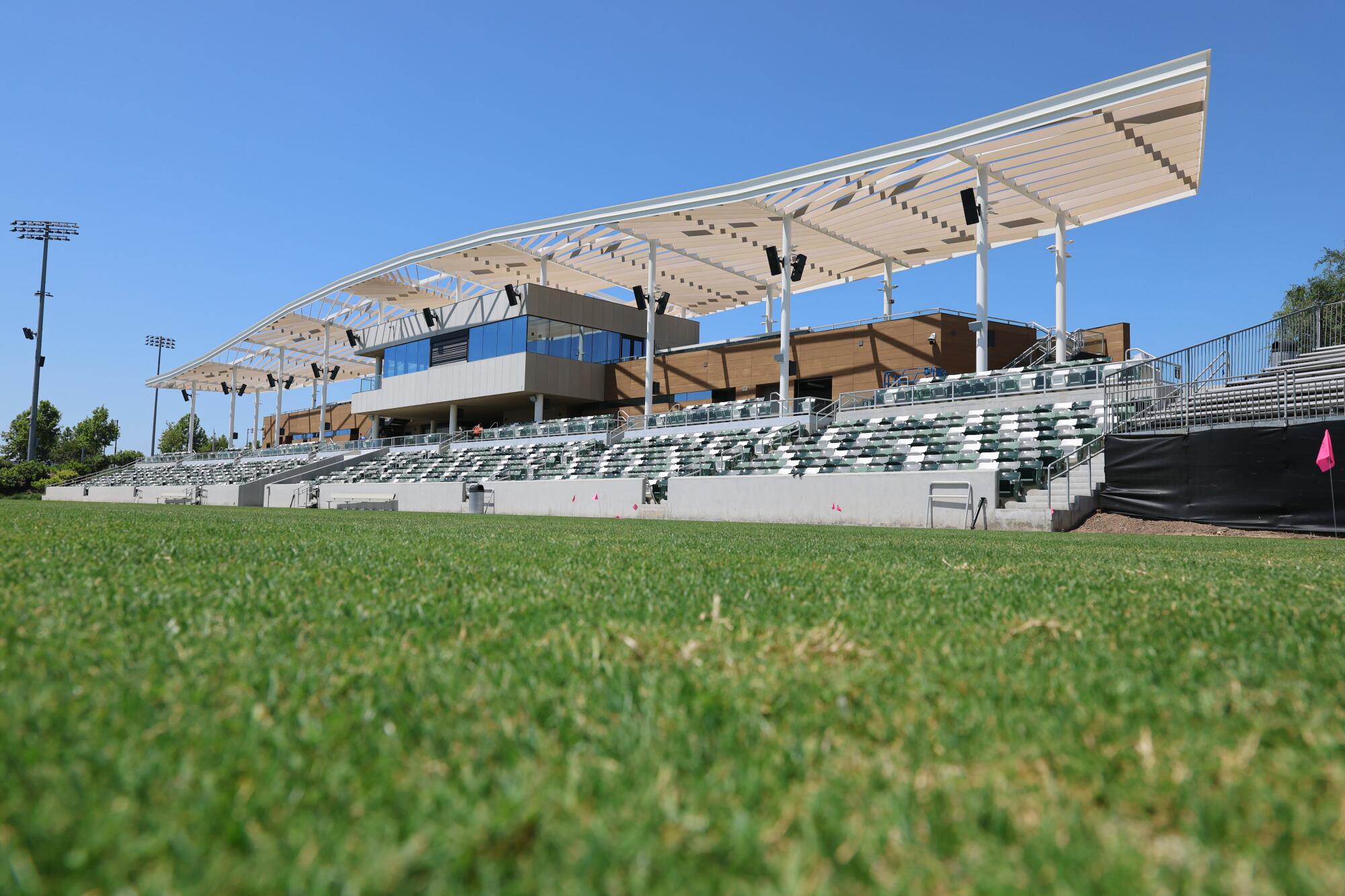
On a recent spring morning, Championship Soccer Stadium, which sits in a corner of the Orange County Great Park in Irvine, was quiet and empty save for the dozen sprinklers quenching a newly laid grass carpet.

Normally the well-used stadium is a buzz of activity. But its main tenant, the Orange County Soccer Club, which plays in the second-division USL Championship, has been temporarily evicted, left to train in the nearby park and play its final home game before the World Cup at Eddie West Field in Santa Ana, 12 miles away. (Not that it was necessarily a bad thing since the club drew a home-record crowd of 7,651 to its 3-2 win over Oakland on Saturday, which allowed it to hold onto second place in the Western Conference table.)

During the next month, the nine-year-old venue will have just one occupant, the U.S. national soccer team, which has chosen the stadium as its main training base for the World Cup. The temporary change in ownership is heralded by a giant orange orb the size of a hot-air balloon, adorned with the U.S. Soccer logo and tethered to a rise just outside the stadium.

Why and how the federation wound up in Irvine is unknown; U.S. Soccer declined to respond to multiple requests for comment. But it’s safe to say location was a factor since the Orange County Great Park is the closest World Cup training base to SoFi Stadium, where the U.S. will play two of its three group-stage games.

Crews work to prepare the training area for the U.S. soccer team at Championship Soccer Stadium in Irvine.

Crews work to prepare the training area for the U.S. soccer team at Championship Soccer Stadium in Irvine.

(Allen J. Schaben/Los Angeles Times)

The U.S. team’s first training session there, on June 8, will be the only practice open to the public. Four days later, the team will open its World Cup schedule against Paraguay in Inglewood, a 45-mile bus ride away. The Americans are one of seven World Cup teams to choose base camps in California. Australia and Paraguay will train in the Bay Area; Switzerland and New Zealand will be in San Diego; and Austria and Qatar will stay in Santa Barbara.

For the Orange County Soccer Club, which has just a humble spot on the U.S. soccer landscape, even a temporary association with the World Cup and the national team is worth celebrating.

“How can you not be excited about the host nation training in your facility when you are a club who prides itself on developing young talent,” said Dan Rutstein, the team’s president of business operations. “Sharing a stadium with the U.S. national team is a great opportunity.”

One that comes with great perks. FIFA, which vetted the location for World Cup teams a couple of years ago, has replaced the stadium’s grass field with one the Orange County team could never have paid for itself and will install security fencing in the next week or so, as it will at all 48 tournament training fields. U.S. Soccer is also expanding and improving the team’s tiny locker room and adding a media work room.

Alvaro Leon, Brian Biniasz, and Joesph Frausto install rubber flooring in the U.S. Soccer World Cup locker room.

Alvaro Leon, Brian Biniasz, and Joesph Frausto install rubber flooring in the U.S. Soccer World Cup locker room.

(Allen J. Schaben/Los Angeles Times)

The Orange County Soccer Club is paying for those perks with a little inconvenience, however. The players will have to dress at home for practice, which will be held in the adjoining park. And the club’s next six games will all be on the road. The team also had to take down any signs or placards that mentioned the Orange County Soccer Club; they were replaced with USMNT signage.

“It’s their stadium now,” Rutstein said.

“If you look at what the club is trying to achieve and where we are as an organization, any short-term pain is more than offset by the medium- and long-term benefits of being associated with the World Cup and the U.S. national team,” he added.

The team is trying to sell naming rights to the stadium, for example, and its association with the national team and the World Cup could be a big help in that.

When FIFA first released potential World Cup training sites two years ago, Championship Soccer Stadium was on the list and Rutstein said about a dozen national teams sent representatives to have a look. How many bid on the site is unknown but FIFA rules say if two or more teams make a claim on the same venue, the team with the lowest FIFA world ranking gets first dibs.

The U.S. is ranked 16th, which clearly gave it an edge.

An aerial view of crews preparing the training area for the U.S. soccer team at Championship Soccer Stadium in Irvine.

An aerial view of crews preparing the training area for the U.S. soccer team at Championship Soccer Stadium in Irvine.

(Allen J. Schaben/Los Angeles Times)

Besides, Orange County is no stranger to world-class soccer. The only other time the World Cup was hosted in the U.S., in 1994, the American team trained in Mission Viejo. And when European champion Paris Saint-Germain came to Southern California for last summer’s Club World Cup, it trained at UC Irvine.

“Being away from the glare of a big city is appealing,” Rutstein said.

“The World Cup is going to do wonders for soccer in this country, as it did over 30 years ago,” he continued. “And we’re excited to make the most of that growth.”

Source link