On America’s birthday, U.S. soccer team embodies founders’ dreams
SEATTLE — James Wilson, one of just six men who signed both the Declaration of Independence and the Constitution, never could have imagined how grand the country he was founding would become. But he knew how it could get there.
Wilson envisioned a steady stream of foreigners coming to America every year, reinvigorating the energy and vitality the nation needed if it were to survive, much less thrive. Which is why Wilson, who moved to the colonies from Scotland at 22, argued against barriers on immigration that would “deprive the government of the talents, virtue and abilities of such foreigners as might chose to remove to this country.”
What Wilson had in mind, then, is something such as the U.S. national soccer team, which gathered to train Saturday morning, on the country’s 250th birthday.
Six of the 26 players on the team, which will face Belgium in a World Cup elimination game Monday, are foreign-born. Five others were born to immigrant parents and two others have immigrant grandparents or great-grandparents. Nearly half have dual nationality.

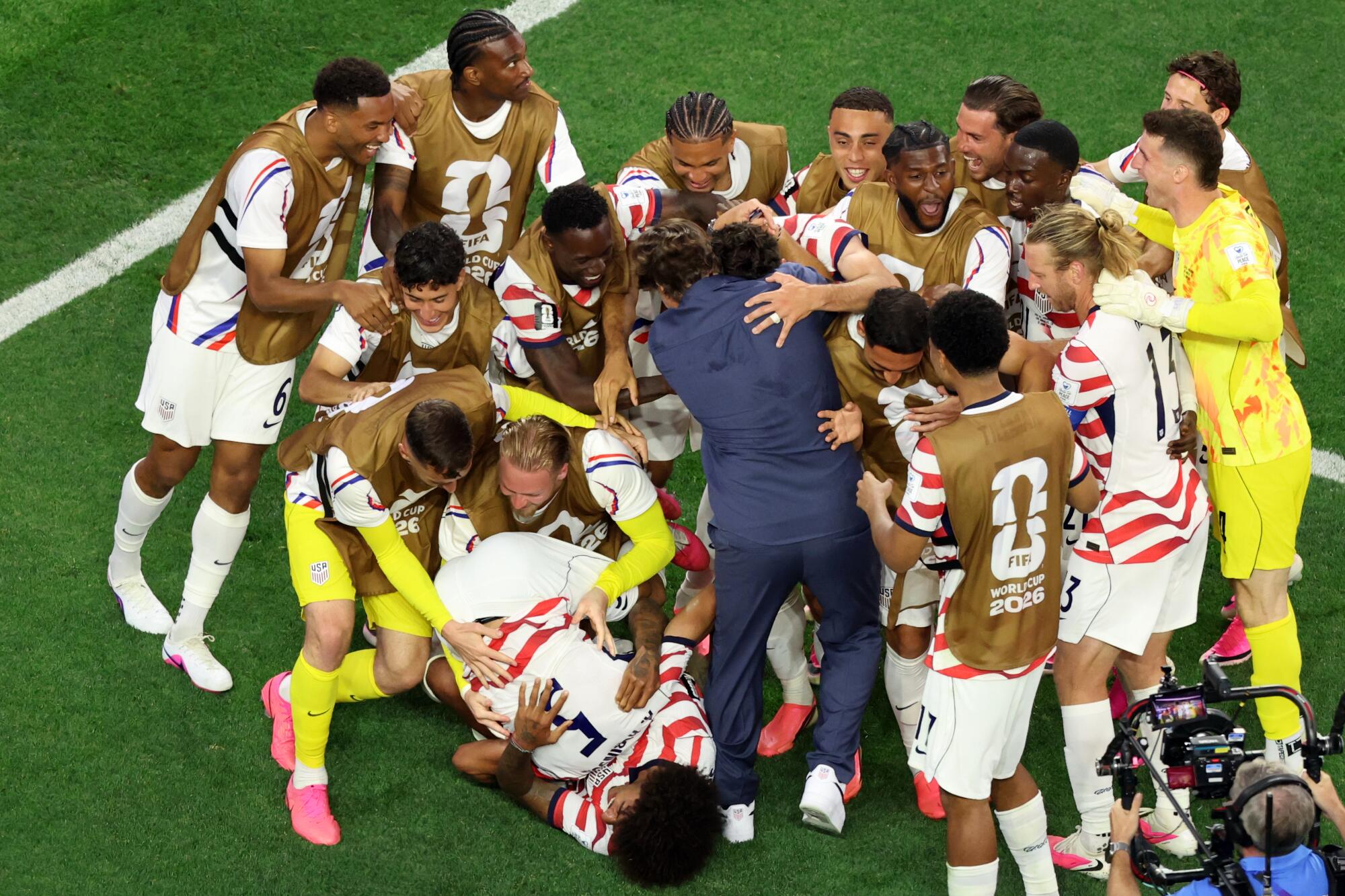
U.S. coach Mauricio Pochettino jumps into the arms of his players after their World Cup win over Paraguay at SoFi Stadium on June 12.
(Allen J. Schaben/Los Angeles Times)
Yet they all play with the U.S. flag stitched over their hearts. What could be more American than that?
“It is special,” U.S. captain Tim Ream said of having the team together on Independence Day. “Obviously, doubly special because it’s during a World Cup and triple special because it’s here in the U.S. “As a group, with all our different backgrounds, it’s a true representation of what America is. It’s a melting pot of, of people, of personalities, of characters.”
And it’s led by a country-music-listening Argentine coach, Mauricio Pochettino, who first learned to throw a baseball last week so he could perform first-pitch duties at a Seattle Mariners’ game. (He threw a strike.)
“That sort of stuff can only happen in America,” said striker Folarin Balogun, who grew up in England with Nigerian parents but plays for the U.S. because he was born in Brooklyn, qualifying for birthright citizenship through the 14th Amendment to the constitution Wilson helped write.
It would be hard for the U.S. soccer team to more closely resemble the architects who founded the country, nor the vision those architects had for their creation.
Eight the 56 signers of the Declaration of Independence and eight of the 55 framers of the Constitution were immigrants. That’s about the same percentage of immigrants on this summer’s World Cup roster. Another 20 of the Founding Fathers were the sons of immigrants; again, the same percentage as the national team.
“That is the U.S. experience of taking different people from all over the world, the immigrant experience, and mixing it into something that the world has never seen,” said Adam Sawyer, a co-founder of Relevant Research, a Baltimore firm which provides support to immigration researchers and organizations.
“One in seven Americans was foreign-born. Our soccer team is like one in four. I always think of soccer [as] leading society and it’s pulling us with it,” continued Sawyer, who recently published an analysis of the role global migration has played on World Cup success. “Our sporting teams push us forward towards further integration.”
The signers of the Declaration of Independence never foresaw a World Cup, much less an American World Cup team. But they did see immigration as such a fundamental strength, they used America’s founding document to condemn King George III for endeavoring “to prevent the population of these States; for that purpose obstructing the Laws for Naturalization of Foreigners.”
Without that naturalization, Christian Pulisic might not be playing for the U.S.; in fact, he might not even be in the U.S. His paternal grandfather Mate immigrated from the former Yugoslavia in search of opportunity and was later naturalized as a U.S. citizen. The paternal ancestors of goalkeeper Matt Turner became naturalized citizens after fleeing to the U.S. to escape religious persecution in Lithuania and midfielder Cristian Roldan’s parents escaped civil wars in El Salvador and Guatemala, then gained permanent residency through President Reagan’s amnesty program.
“This soccer team is reflecting America at its best,” said Faisal Al-Juburi, co-chief executive of RAICES, a Texas-based humanitarian aid and immigration services nonprofit. “Its global roots, its shared purpose, its one jersey.”
Soccer in the U.S. has long been an immigrant sport. In the years after World War II, when soccer was still an amateur and semi-pro game, the best teams in the country had names such as the Philadelphia Ukrainian Nationals, New York German-Hungarian SC and the Los Angeles Danes. Joe Gaetjens, one of the country’s first stars and the man who scored the goal that beat England in the 1950 World Cup, was a Haitian immigrant.
In recent years, however, the national team has begun recruiting dual-nationals from overseas, among them World Cup midfielder Malik Tillman, who was born to a U.S. serviceman in Germany, and Antonee Robinson, who was born in England to a naturalized U.S. citizen father, and Sergiño Dest, a Dutch native whose father is Surinamese American.
“It is definitely a team that embraces their diverse backgrounds, and that’s quite meaningful, especially now,” said Al-Juburi, the son of Iraqi immigrants. “This notion that we are stronger with impenetrable walls that divide us is definitely not reflected in this team. It credits a lot of its success to its immigrant roots.
“And I think that’s incredibly powerful to see that and to see a nation cheering and getting behind that diversity. It is a reminder that we are stronger from that coexistence.”
But Al-Juburi doesn’t see the result as a melting pot, which burns away the unique flavors and characteristics of each ingredient. For him, it’s more a gumbo in which every ingredient changes and improves the mix.

U.S. players huddle seconds before playing Bosnia-Herzegovina during a World Cup knockout round match at Levi’s Stadium on Wednesday.
(Robert Gauthier/Los Angeles Times)
“You’re looking at lineage from Nigeria, from Guatemala, from El Salvador, from Mexico, from Liberia, Jamaica, Croatia,” he said. “All these disparate ingredients work together so beautifully and in such a balanced way.”
And when that team succeeds, as the U.S. has this summer, it not only underscores the wisdom of the Founding Fathers, but it offers a lesson for today as well.
“This team contains a different picture of inclusion really mattering, just by being exactly who they are,” said Jules Boykoff, a political science professor at the University of Portland (Ore.) and a former U.S. youth international. “They don’t have to say anything. They just have to be who they are and do their best on the pitch.”