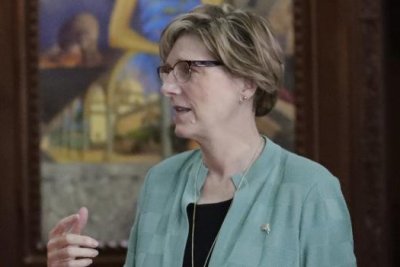
1 of 2 | South Korean Trade, Industry and Energy Minister Kim Jeong-kwan speaks during a meeting with the American Chamber of Commerce in Korea and U.S.-affiliated companies investing in South Korea at the Seoul Government Complex on Thursday. Photo by Asia Today
Jan. 9 (Asia Today) — South Korea’s industry minister Kim Jeong-kwan on Thursday urged U.S.-affiliated foreign-invested companies to continue expanding investment in South Korea, saying the government will work to reflect concerns raised by member companies of the American Chamber of Commerce in Korea in its policies.
Kim, the minister of Trade, Industry and Energy, made the remarks during a meeting with representatives of chamber member companies and U.S.-affiliated firms investing in South Korea at the Seoul Government Complex, the ministry said.
The meeting was held at the chamber’s request to review the domestic investment environment, discuss challenges faced by U.S.-affiliated firms and consider government support measures, the ministry said.
The session was the first formal communication event since the signing of what the ministry described as a South Korea-U.S. strategic investment memorandum of understanding in November and the proposal of a bill it called a special act on strategic investment management.
Kim thanked U.S. companies for what the ministry described as record-high investment in South Korea last year. The ministry cited figures showing U.S. investment fell from $8.7 billion in 2022 to $6.1 billion in 2023 and $5.2 billion in 2024, before rising 86.6% year-on-year to $9.77 billion in 2025.
Kim said the jump in U.S. investment came as South Korean corporate investment in the United States has been expanding following the conclusion of South Korea-U.S. tariff negotiations, calling it a symbolic outcome that reflects mutually beneficial investment cooperation.
“I consider all companies operating in Korea to be Korean companies, and especially value those investing in Korea,” Kim said, according to the ministry. He said the chamber and companies present were valuable partners.
Kim said he hopes to see continued investment in areas such as AI data centers, semiconductors and bio, adding that he wants this year to be one in which bilateral economic cooperation moves forward more dynamically.
AMCHAM Chairman James Kim said this year marks the 250th anniversary of the founding of the United States and the 144th anniversary of South Korea-U.S. diplomatic relations, calling it a meaningful year, according to the ministry.
He said rapid advances in AI and shifts in the geopolitical environment have heightened the importance of the bilateral partnership for economic security and sustainable growth.
He also referenced CES 2026 in Las Vegas, saying South Korea ranked third globally in the scale of national participation and that South Korean companies won about 60% of this year’s CES Innovation Awards, with many of the winners being small and medium-sized enterprises, the ministry said.
Companies at the meeting shared views on item-specific tariff talks and on the operation of foreign investment incentive systems, the ministry said, adding it will review suggestions raised and continue communication with major foreign-invested companies.
Accused Capitol riot pipe-bomber Brian Cole Jr. in federal court on Friday pleaded not guilty to charges accusing him of planting two pipe bombs outside of respective political party headquarters in Washington, D.C., on January 5, 2021. File Photo by Bonnie Cash/UPI | License Photo
Jan. 9 (UPI) —Brian Cole Jr. pleaded not guilty Friday to federal charges accusing him of placing pipe bombs outside political party headquarters ahead of the Jan. 6, 2021, Capitol protest.
Cole entered his plea during an arraignment hearing in the U.S. District Court for the District of Columbia. He faces charges of interstate transportation of explosives, malicious attempt to use explosives and related federal charges.
Cole, 30, allegedly placed a pipe bomb near the entrances of the Republican National Committee and Democratic National Committee headquarters in Washington, D.C., on the night of Jan. 5, 2021, but neither exploded.
Federal prosecutors said he admitted to placing the explosive devices and that he hoped they would explode and generate news coverage.
Cole said the 2020 election was stolen from voters and that he blamed both political parties because they are the ones in charge of the nation’s politics.
Prosecutors said Cole bought materials to make the bombs over several months ahead of the Capitol protest, and investigators used cellular tower data, credit card records and a license plate reader to identify him.
His attorney said Cole has been peaceful, was diagnosed with autism and the pipe bombs were incapable of exploding, CNN reported.
Cole is a resident of Woodbridge, Va., where he lives with other family members inside his mother’s house that is about 30 miles from the capital.
He was employed by a bail bond business and was arrested at his mother’s home on Dec. 4.
A federal grand jury indicted him on the charges for which he was arraigned on Friday.
He has another court hearing scheduled on Jan. 28 to determine if he should remain in detention or be allowed to post bail and be released from custody while the case is argued in court.
GUATIRE, Venezuela — The United States and Venezuelan governments said Friday that they were exploring the possibility of restoring diplomatic relations between the two countries, and that a delegation from the Trump administration arrived in the South American nation Friday.
The small team of U.S. diplomats and diplomatic security officials traveled to Venezuela to make a preliminary assessment about the potential reopening of the U.S. Embassy in Caracas, the State Department said in a statement.
Venezuela’s government on Friday acknowledged that U.S. diplomats had traveled to the country and announced that it will send a delegation to Washington, but it did not say when.
In a statement, Delcy Rodríguez’s government said it “has decided to initiate an exploratory process of a diplomatic nature with the Government of the United States of America, aimed at the re-establishment of diplomatic missions in both countries.”
President Trump has placed pressure on Rodriguez and other former Maduro loyalists now in power to advance his vision for the future of the nation — a major aspect of which would be reinvigorating the role of U.S. oil companies in a country with the worlds’ largest proven reserves of crude oil.
The U.S. and Venezuela cut off ties in 2019, after the first Trump administration said opposition leader Juan Guaidó was the rightful president of Venezuela, spiking tensions. Despite the assertions, Maduro maintained his firm grip on power.
The Trump administration shuttered the embassy in Caracas and moved diplomats to nearby Bogotá, Colombia. U.S. officials have traveled to Caracas a handful of times since then. The latest visit came last February when Trump’s envoy for special missions, Richard Grenell met with Maduro. The visit resulted in six detained Americans being freed by the government.
Garcia Cano and Lee write for the Associated Press. Lee reported from Washington. AP reporter Megan Janetsky contributed to this report from Mexico City.
Jan. 9 (UPI) — President Donald Trump and executives for several U.S. oil and gas companies discussed a potential $100 billion investment in Venezuela’s energy sector Friday after Venezuelan President Nicolas Maduro‘s capture.
Trump met with executives from Chevron, ConocoPhillips, ExxonMobil and other U.S. oil and gas firms and encouraged them to invest $100 billion to refine and sell seized Venezuelan oil, CBS News reported.
The president offered to guarantee the security of oil and gas companies if they returned to Venezuela, which decades ago seized infrastructure owned and built by U.S. firms when former President Hugo Chavez nationalized the country’s oil and gas industry.
With the backing of the United States and security assurances, Trump said the oil and gas companies would “get their money back and make a very nice return,” as reported by CNBC.
He offered to make a deal with the oil and gas companies as soon as Friday and said it would help to lower energy costs for U.S. consumers.
Venezuela has an estimated 303 billion barrels of proven reserves of crude oil, which equals about 17% of the world’s supply, according to the U.S. Energy Information Administration.
That amount is the most anywhere, but Venezuela’s nationalization of its oil and gas industry led to years of neglect and greatly reduced its daily output from 3.5 million barrels per day in the 1990s to about 800,000 per day now, according to the Kpler energy consulting firm.
For Venezuela to meet a 3 million barrels-per-day target, energy firms would have to invest more than $180 billion over the next 14 years, analysts with Rystad Energy said.
Such an investment level has U.S. oil and gas executives publicly expressing skepticism, although they do acknowledge the president’s proposal is an enticing offer.
Trump said a decision on the matter should be reached very soon, if not on Friday.
WASHINGTON — President Trump is meeting with oil executives at the White House Friday in hopes of securing $100 billion in investments to revive Venezuela’s ability to fully tap into its expansive reserves of petroleum — a plan that rides on their comfort in making commitments in a country plagued by instability, inflation and uncertainty.
Since the U.S. military raid to capture former Venezuelan leader Nicolás Maduro on Saturday, Trump has quickly pivoted to portraying the move as a newfound economic opportunity for the U.S., seizing tankers carrying Venezuelan oil, saying the U.S. is taking over the sales of 30 million to 50 million barrels of previously sanctioned Venezuelan oil and will be controlling sales worldwide indefinitely.
On Friday, U.S. forces seized their fifth tanker over the past month that has been linked to Venezuelan oil. The action reflected the determination of the U.S. to fully control the exporting, refining and production of Venezuelan petroleum, a sign of the Trump administration’s plans for ongoing involvement in the sector as it seeks commitments from private companies.
It’s all part of a broader push by Trump to keep gasoline prices low. At a time when many Americans are concerned about affordability, the incursion in Venezuela melds Trump’s assertive use of presidential powers with an optical spectacle meant to convince Americans that he can bring down energy prices.
The meeting, set for 2:30 p.m. EST, is currently set to occur behind closed doors, according to the president’s daily schedule. “At least 100 Billion Dollars will be invested by BIG OIL, all of whom I will be meeting with today at The White House,” Trump said Friday in a pre-dawn social media post.
Trump is set to meet with executives from 17 oil companies, according to the White House. Among the companies attending are Chevron, which still operates in Venezuela, and ExxonMobil and ConocoPhillips, which both had oil projects in the country that were lost as part of a 2007 nationalization of private businesses under Maduro’s predecessor, Hugo Chávez.
The president is meeting with a wide swath of domestic and international companies with interests ranging from construction to the commodity markets. Other companies slated to be at the meeting include Halliburton, Valero, Marathon, Shell, Singapore-based Trafigura, Italy-based Eni and Spain-based Repsol.
Large U.S. oil companies have so far largely refrained from affirming investments in Venezuela as contracts and guarantees need to be in place. Trump has suggested on social media that America would help to backstop any investments.
Venezuela’s oil production has slumped below one million barrels a day. Part of Trump’s challenge to turn that around will be to convince oil companies that his administration has a stable relationship with Venezuela’s interim President Delcy Rodríguez, as well as protections for companies entering the market.
Secretary of State Marco Rubio, Energy Secretary Chris Wright and Interior Secretary Doug Burgum are slated to attend the oil executives meeting, according to the White House.
South Korean President Lee Jae Myung (R) and Chinese President Xi Jinping wave to children as they attend a welcome ceremony for the South Korean leader before their summit talks at the Great Hall of the People in Beijing on Monday. Photo by YONHAP/ EPA
SEOUL, Jan. 9 (UPI) — South Korean President Lee Jae Myung flew to China this week for a summit with his Chinese counterpart, Xi Jinping, for the second time in two months. Lee is the first president of the country to visit Beijing since 2019.
Lee said that the two leaders should meet at least once a year, stressing the significance of shoring up the bilateral relationship between the two neighbors, whose ties at times have been strained.
Observers point out that Lee’s meetings with Xi showcases Seoul’s delicate position amid the intensifying rivalry between the United States and China.
“Despite its security alignment with Washington, South Korea relies heavily on China for trade, although the dependence has declined somewhat in recent years. As a result, Seoul is in a delicate position,” Myungji University political science professor Shin Yul told UPI.
“In the past, there was a simple formula — the U.S. for security and China for trade. But at a time when the world’s two most powerful countries are at odds and conditions are changing so fast, such an approach may no longer work,” he said.
Relations between Seoul and Beijing became worse in 2016 and 2017, when South Korea cooperated with the United States to deploy the Terminal High Altitude Area Defense, or THAAD, missile defense system to tackle North Korea’s threats.
However, the decision provoked China, which feared the advanced radar system would provide a window into the communist country’s internal airspace.
Beijing eventually initiated with what Seoul described as unofficial economic retaliation, including restrictions on Korean cultural content, group tourism bans and regulatory pressure on Korean businesses operating in China.
Officially, however, Beijing has consistently denied taking retaliatory measures over the past decade. Against this backdrop, Lee expressed hope to deal with them during a meeting Tuesday with Chen Jining, Communist Party secretary of Shanghai.
“Korea-China relations will advance to an entirely new stage through this visit to China,” Lee said. “I believe this trip will serve as a valuable opportunity to resolve the minor frictions that existed in the past.”
Strategic ambiguity
Improved ties with China would offer short-term economic benefits for South Korea, as China is South Korea’s largest trading partner. Last year, South Korea’s exports to China totaled $130.81 billion, compared with $122.87 billion to the United States.
However, analysts caution that Seoul cannot prioritize relations with Beijing in isolation, as Beijing’s rivalry with the United States directly affects its core security alliance.
“We cannot closely collaborate with China in such sensitive industries as semiconductors and nuclear reactors,” economic commentator Kim Kyeong-joon, formerly vice chairman at Deloitte Consulting Korea, said in a phone interview.
“In addition, China is our competitor in many industries, including steel, automobiles, rechargeable batteries and petrochemicals. There have also been recurring conflicts over intellectual property issues between the two,” he added.
Concerns have grown among Korean corporations over technology leakage and imitation by their Chinese competitors, particularly in such high-tech sectors as semiconductors and displays.
In this climate, South Korea has little choice but to carefully balance its approach, said political commentator Choi Soo-young, who worked at the presidential house in the 2010s.
“We should shun a situation in which we are forced to single-handedly side with one of the two superpowers, the United States and China. That would be the worst-case scenario,” Choi said.
“In other words, we are required to maintain the so-called ‘strategic ambiguity.’ However, it is a tall task to achieve, as amply demonstrated by Japan’s case,” he said.
From the perspective of Seoul, strategic ambiguity refers to avoiding explicit alignment choices at a time when Washington and China have competing strategic interests, according to Choi.
China’s relationship with Japan has frayed in recent months amid geopolitical tensions, leading to economic standoffs with direct trade impacts.
For example, China imposed export restrictions on dual-use goods this month, targeting Japan. It also curbed exports of rare earth elements, which are vital to Japan’s electronics and automotive supply chains.
Meanwhile, the Seoul administration announced Friday that Lee is scheduled to visit Japan early next week for a summit with Japanese Prime Minister Sanae Takaichi.
In explaining the U.S. incursion into Venezuela to capture President Nicolás Maduro, President Trump accused Maduro and his wife of conducting a “campaign of deadly narco-terrorism against the United States and its citizens,” and Maduro of being “the kingpin of a vast criminal network responsible for trafficking colossal amounts of deadly and illicit drugs into the United States.”
“Hundreds of thousands — over the years — of Americans died because of him,” Trump said hours after U.S. special forces dragged Maduro from his bedroom during a raid that killed more than 50 Venezuelan and Cuban military and security forces.
Experts in regional narcotics trafficking said Trump was clearly trying to justify the U.S. deposing a sitting head of state by arguing that Maduro was not just a corrupt foreign leader harming his own country but also a major player in the sweeping epidemic of overdoses that has devastated American communities.
They also said they are highly suspicious of those claims, which were offered up with little evidence and run counter to years of independent research into regional drug trafficking patterns. Countries such as Mexico and Colombia play much larger roles, and fentanyl — not the cocaine Maduro is charged with trafficking — causes the vast majority of American deaths, the research shows.
Maduro’s indictment spells out some overt criminal acts allegedly committed by him, including selling diplomatic passwords to known drug traffickers so they could avoid military and law enforcement scrutiny in Venezuela.
Attorney General Pam Bondi arrives at the U.S. Capitol on Monday to brief top lawmakers after President Trump directed U.S. forces to capture Venezuelan President Nicolás Maduro.
(Jacquelyn Martin / Associated Press)
It alleges other crimes in broad strokes, such as Maduro and his wife allegedly ordering “kidnappings, beatings, and murders” against people who “undermined their drug trafficking operation.”
However, Trump’s claims about the scope and impact of Maduro’s alleged actions go far beyond what the indictment details, experts said.
“It’s very hard to respond to the level of bulls— that is being promoted by this administration, because there’s no evidence given whatsoever, and it goes against what we think we know as specialists,” said Paul Gootenberg, a professor emeritus of history and sociology at Stony Brook University who has long studied the cocaine trade. “All of it goes against what we think we know.”
“President Trump’s claim that hundreds of thousands of Americans have died due to drug trafficking linked to Maduro is inaccurate,” said Philip Berry, a former United Kingdom counter-narcotics official and a visiting senior lecturer at the Centre for Defence Studies at King’s College London.
“[F]entanyl, not cocaine, has been responsible for most drug-related deaths in the U.S. over the past decade,” he said.
Jorja Leap, a social welfare professor and executive director of the UCLA Social Justice Research Partnership who has spent years interviewing gang members and drug dealers in the L.A. region, said Trump’s hyper-focus on Maduro, Venezuela and the Venezuelan gang Tren de Aragua as driving forces within the U.S. drug trade not only belies reality but also belittles the work of researchers who know better.
“Aside from making it a political issue, this is disrespecting the work of researchers, social activists, community organizers and law enforcement who have worked on this problem on the ground and understand every aspect of it,” Leap said. “This is political theater.”
Venezuela’s role
The U.S. State Department’s 2024 International Narcotics Strategy Report called Venezuela “a major transit country for cocaine shipments via aerial, terrestrial, and maritime routes,” with most of the drugs originating in Colombia and passing through other Central American countries or Caribbean islands on their way to the U.S.
Federal officers stand guard outside the Metropolitan Detention Center.
(Leonardo Munoz / AFP via Getty Images)
However, the same report said recent estimates put the volume of cocaine trafficked through Venezuela at about 200 to 250 metric tons per year, or “roughly 10 to 13 percent of estimated global production.” According to the United Nations 2025 World Drug Report, most cocaine from Colombia is instead trafficked “along the Pacific Coast northward,” including through Ecuador.
The same report and others make clear Venezuela does not play a substantial role in fentanyl production or trafficking.
The State Department’s 2024 report said Mexico was “the sole significant source of illicit fentanyl … significantly affecting” the U.S., and the U.S. Drug Enforcement Administration’s 2025 National Drug Threat Assessment said Mexican organizations “dominate fentanyl transportation into and through the United States.”
The Trump administration suggested Venezuela has played a larger role in cocaine production and transport in recent years under Maduro, who they allege has partnered with major trafficking organizations in Venezuela, Colombia and Mexico.
Maduro pleaded not guilty at an arraignment in Manhattan federal court this week, saying he was “kidnapped” by the U.S.
While many experts and other political observers acknowledge Maduro’s corruption and believe he has profited from drug trafficking, they question the Trump administration’s characterization of his actions as a “narco-terrorist” assault on the U.S.
Former Rep. Marjorie Taylor Greene (R-Ga.), the Trump ally turned foe who this week stepped down from her House seat, condemned the raid as more about controlling Venezuela’s oil than dismantling the drug trade, in part by noting that far greater volumes of much deadlier drugs arrive to the U.S. from Mexico.
“If it was about drugs killing Americans, they would be bombing Mexican cartels,” Greene posted.
The Trump administration pushed back against such arguments, even as Trump has threatened other nations in the region.
U.S. Drug Enforcement Administrator Terry Cole said on Fox News that “at a low estimate,” 100 tons of cocaine have been produced and shipped to the U.S. by groups working with Maduro.
Expert input
Gootenberg said there’s no doubt that some Colombian cocaine crosses the border into Venezuela, but that much of it goes onward to Europe and growing markets in Brazil and Asia, and there’s no evidence large amounts reach the U.S.
“The whole thing is a fiction, and I do believe they know that,” he said of the Trump administration.
Berry said Venezuela is “a transit country for cocaine” but “a relatively minor player in the international drug trade” overall, with only a “small portion” of the cocaine that passes through it reaching the U.S.
Both also questioned the Trump administration labeling Maduro’s government a “narco-terrorism” regime. Gootenberg said the term arose decades ago to describe governments whose national revenues were substantially connected to drug proceeds, such as Bolivia in the 1980s, but it was always a “propagandistic idea” and had gone “defunct” as modern governments, including Venezuela’s, diversified their economies.
The Trump administration’s move to revive the term comes as no surprise given “the way they pick up atavistic labels that they think will be useful, like ‘Make America Great Again,’” Gootenberg said. But “there’s no there there.”
Berry said use of the term “narco-terrorism” has oversimplified the “diverse and context-specific connections” between the drug industry and global terrorism, and as a result “led to the conflation of counter-narcotics and counter-terrorism efforts, frequently resulting in hyper-militarised and ineffective policy responses.”
Gootenberg said Maduro was a corrupt authoritarian who stole an election and certainly had knowledge of drug trafficking through his country, but the notion he’d somehow become a “mastermind” with leverage over transnational drug organizations is far-fetched.
Several experts said they doubted his capture would have a sizable effect on the U.S. drug trade.
“Negligible. Marginal. Whatever word you want to use to indicate the most minor of impacts,” said Leap, of UCLA.
The Sinaloa Cartel — one of Maduro’s alleged partners, according to his indictment — is a major player in Southern California’s drug trade, with the Mexican Mafia serving as middleman between the cartel and local drug gangs, Leap said. But “if anyone tries to connect this to what is happening now in Venezuela, they do not understand the nature of drug distribution, street gangs, the Mexican Mafia, everything that goes on in Southern California. There is no connection.”
Berry said in the wake of Maduro’s capture, “numerous state and nonstate actors involved in the illegal narcotics trade remain unaffected.”
Jan. 9 (UPI) — Minnesota Gov. Tim Walz on Friday said he authorized the state’s National Guard to be “staged and ready” amid protests against the Trump administration after a federal immigration law enforcement officer fatally shot a woman in Minneapolis.
Protests have been reported in cities nationwide after a DHS officer shot and killed 37-year-old Renee Nicole Macklin Good on Wednesday in Minneapolis, with the city again being thrust into the national spotlight for protests against the federal government.
While the Trump administration is claiming the officer shot in self-defense, many activists and politicians say videos of the shooting contradict their explanation.
Amid the protests on Thursday, Walz, a Democratic and political opponent of President Donald Trump, ordered the Minnesota National Guard to be ready to assist local and state law enforcement in protecting critical infrastructure and maintain public safety.
“Minnesotans have met this moment. Thousands of people have peacefully made their voices heard. Minnesota: Thank you. We saw powerful peace,” Walz said in a Friday statement.
“Yesterday, I directed the National Guard to be ready should they be needed. They remain ready in the event they are needed to help keep the peace, ensure public safety and allow for peaceful demonstrations.”
Videos of the shooting show masked officers approaching Good in her car parked across a street. The Immigration and Customs Enforcement officer can be heard cursing and demanding Good to exit the vehicle before reaching into her driver-side window and trying to open the seemingly locked door.
The vehicle then backs a small amount before the wheels of the car are turned right and going forward. An ICE officer standing in front of the car then fires multiple shots, first into the front windshield and then through the opened driver-side window.
Trump and members of his administration have claimed the mother of three was a domestic terrorist trying to ram the ICE officer who fired on her in self-defense. Democrats and state and local officials have staunchly challenged the Trump administration’s claims.
“The Trump Administration is brazenly lying to justify murder, telling us to ignore what we’ve seen on video,” Rep. Don Beyer, D-Va., said in a statement.
NASA’s SpaceX Crew-11 members, NASA pilot Mike Fincke, NASA commander Zena Cardman, mission specialist Oleg Platonov of Roscosmos and mission specialist Kimiya Yui from the Japan Aerospace Exploration Agency walk out of the operations center before boarding a SpaceX Falcon 9 rocket at Kennedy Space Center, Fla., in July. File Photo by Pat Benic/UPI | License Photo
Jan. 8 (UPI) — NASA said Thursday that four astronauts aboard the International Space Station will return to Earth a month earlier than scheduled after one of them suffered a “serious medical condition.”
Neither the astronaut nor the medical issue were made public, with NASA officials saying they were withholding the information due to medical privacy.
NASA Administrator Jared Isaacman told reporters in a press conference that they expect to announce an anticipated undock and re-entry timeline in the next 42 hours.
It will be the first medical early return of an astronaut in the 25-year history of the orbiting laboratory.
“After discussions with chief health and medical officer Dr. J.D. Polk and leadership across the agency, I’ve come to the decision that it’s in the best interest of our astronauts to return Crew-11 ahead of their planned departure,” Isaacman said.
NASA astronauts Zena Cardman and Mike Fincke, Japan Aerospace Exploration Agency astronaut Kimiya Yui and Roscosmos cosmonaut Oleg Platonov make up Crew-11, which launched on Aug. 1 for the ISS aboard a SpaceX Crew Dragon spacecraft.
Polk said the affected astronaut was “absolutely stable” but had suffered a medical incident “sufficient enough” that they would be best served by a complete evaluation on Earth.
“Again, because the astronaut is absolutely stable, this is not an emergent evacuation,” he said. “We’re not immediately disembarking and getting the astronaut down, but it leaves that lingering risk and lingering question as to what that diagnosis is, and that means there’s some lingering risk for that astronaut aboard.”
Though it is ISS’ first medical evacuation, Polk said it was being carried out as NASA was “erring on the side of caution for the crew member and in their best interest and their best medical welfare.”
The announcement came hours after NASA postponed Thursday’s spacewalk from the ISS due to an astronaut medical issue involving a single crew member.
“Safely conducting our missions is our highest priority, and we are actively evaluating all options, including the possibility of an earlier end to Crew-11’s mission,” NASA said in a statement. “These are the situations NASA and our partners train for and prepare to execute safely.”
Crew-11 was originally scheduled to complete its mission and return to Earth in late February, after being relieved by Crew-12.
Isaacman said they are now looking at earlier launch opportunities for Crew-12 to reach the ISS.
Until then, NASA astronaut Christopher Williams, who launched to the station late November, will maintain a U.S. presence on the orbital laboratory.
Along with Williams, the ISS is inhabited by cosmonauts Sergey Kud-Sverchkov and Sergei Mikayev, who arrived via Russian Soyuz on Nov. 27.
Jan. 8 (UPI) — Seventeen House Republicans joined their Democratic colleagues Thursday evening to pass legislation that extends Affordable Care Act premium tax credits for three years.
The House lawmakers voted 230-196 in favor of House Bill 1834, known as Breaking the Gridlock Act, sending it to the Senate where passage is anything but assured. The Senate already shot down the proposal last month. President Donald Trump would also have to sign it.
“We did it!” Rep. Lauren Underwood, D-Ill., said in a recorded statement following the bill’s passing.
“And, honestly, I’m just a little bit hopeful that we might be able to get this across the finish line and save our healthcare.”
Affordable Care Act premium tax credits have greatly reduced the costs of healthcare coverage for more than 20 million people annually. The tax credits expired at the turn of the new year, setting the stage for premiums to double for millions of people.
Debate over how to address the expiration of premium tax credits was a key point of contention during the record 43-day government shutdown that ensued in October.
Nine Republicans broke from party leadership on Wednesday to join Democrats in forcing a vote on the House floor with a rarely used discharge petition after House Republicans prevented it from moving forward. Only four Republicans pushed for a floor vote last month when lawmakers tried to pass an extension before the end-of-year deadline.
House Minority Leader Hakeem Jeffries, D-N.Y., who had expected the extension to pass, applauded his party for standing strong on their months-long commitment to “fix our broken healthcare system and address the Republican healthcare crisis, beginning with the extension of the Affordable Care Act tax credits.”
To reporters after the vote, Jeffries called on Senate Majority Leader John Thune, R-S.D., to “immediately” bring the bill up for a vote and “stop playing procedural games that are jeopardizing the health, the safety and the well-being of the American people.”
Rep. Rob Bresnahan Jr. of Pennsylvania was one of the 14 Republicans to vote “yes” to H.B. 1834. In a statement, the junior House member criticized the Affordable Care Act, which is frequently called Obamacare, for allegedly failing to deliver on its promise to lower insurance costs.
“But the only thing worse than a three-year extension of these credits is to let them expire with no solution or off-ramp,” he said.
“I voted for this because, as of right now, it is the only path forward that keeps discussion alive to protect the 28,000 people in my district from immediate premium spikes.”
Rep. Mike Lawler, R-N.Y., is among the Republicans who supported voting on an extension last month. He said ahead of the vote that House members have been working with members of the Senate on a proposal that could pass through with reforms.
“We’ve been working with senators for weeks,” Lawler said. “I think that’s ultimately where we can get.”
Jan. 8 (UPI) — Despite the Trump administration withdrawing the United States from 31 U.N. entities, the U.S. is obligated to continue providing assessed funding amounts, U.N. officials said on Thursday.
Despite the changes, U.N. Secretary-General Antonio Guterres the U.N.’s work will continue, and all member states, including the United States, are obligated to provide assessed contributions to the U.N.’s “regular and peacekeeping budgets” that have been approved by the General Assembly.
U.N. officials said they will continue to “deliver for those who depend on us” and “will continue to carry out our mandates with determination,” spokesman Stephane Dujarric said in a prepared statement.
“The secretary-general regrets the announcement by the White House regarding the United States’ decision to withdraw from a number of United Nations entities,” Dujarric continued.
“Assessed contributions to the United Nations’ regular budget and peacekeeping budget, as approved by the General Assembly, are a legal obligation under the U.N. Charter for all member states, including the United States,” he said.
“All United Nations entities will go on with the implementation of their mandates as given by member states.”
President Donald Trump announced the U.S. is withdrawing its participation in and funding for 66 international organizations, treaties and conventions and signed an executive order proclaiming such on Wednesday.
The decision affects U.S. participation in 31 U.N. entities, including its Population Fund that supports maternal and child health and combats sexual and gender-based violence.
The U.S. also is withdrawing from the U.N. Framework Convention on Climate Change, the U.N. Democracy Fund and other units within the U.N. Secretariat that are based in New York City and elsewhere.
The U.S. withdrawal from the UNFCCC marks a significant change in global cooperation on climate change, UNFCC Executive Sec. Simon Stiell said.
“While all other nations are stepping forward together, this latest step back from global leadership, climate cooperation and science can only harm the U.S. economy, jobs and living standards, as wildfires, floods, mega-storms and droughts get rapidly worse,” Steill said.
“It is a colossal own goal which will leave the U.S. less secure and less prosperous,” he added.
The U.S. also is withdrawing from and ceasing all participation in the U.N.’s regional commissions for the Asia-Pacific, Western Asia, Africa and Latin America and the Caribbean regions.
Jan. 8 (UPI) — Officials for the Paramount Skydance Corp. said Thursday their offer of $30 per share to buy Warner Bros. Discovery is “superior” to a competing offer from Netflix.
The Paramount officials made the claim in response to a formal rejection of its offer by WBD officials earlier this week.
“Paramount’s offer is superior to WBD’s existing agreement with Netflix and represents the best path forward for WBD shareholders,” Paramount said in a news release.
“Netflix’s transaction, on the other hand, contains multiple uncertain components and has already decreased in total value,” Paramount said.
“When announced in December, the Netflix transaction offered WBD shareholders $23.25 in cash, $4.50 in Netflix stock and a share in the pending spin-off of Discovery Global,” Paramount added.
“Today, Netflix’s stock price is trading well beneath the low end of its collar, reducing the value offered to WBD shareholders.”
Paramount’s offer includes a guarantee from Larry Ellison, who is the majority shareholder of Paramount’s parent corporation, National Amusements Inc.
WBD officials say the Netflix offer would benefit shareholders the most, CNN reported, but Paramount Skydance might up its offer.
WBD on Wednesday said the Paramount Skydance offer is “inadequate” and “poses materially more risk for WBD and its shareholder” if that offer were to fall through, while the Netflix offer is more certain.
Paramount Skydance Chief Executive Officer David Ellison countered WBD’s comment, saying “our offer clearly provides WDB investors greater value and a more certain, expedited path to completion.”
Paramount and Netflix officials are embroiled in a de facto bidding war for WBD and HBO, which earlier accepted an initial offer from Netflix before Paramount Skydance made its competing offer.
As the impasse continues, Paramount Skydance officials are offering WBD shareholders $30 per share if they reject the WBD board of directors’ advice to stick with the Netflix offer.
Jan. 8 (UPI) — The U.S. House will vote Thursday on overriding two vetoes issued by President Donald Trump last week.
Lawmakers in the House are expected to pass the two bills again, based on their overwhelming support when they voted to send them to the president’s desk.
A two-thirds vote in support of the bills is required in the House and Senate to override a presidential veto. Thursday’s vote in the House is the first step toward overriding these vetoes.
The first bill, the “Finish the Arkansas Conduit Act,” would reduce payments for Colorado communities that receive water from a water pipeline tapped into the Pueblo Reservoir. The second, the “Miccosukee Reserved Area Amendments Act,” expands the Miccosukee Tribe’s land in Florida.
Both bills received bipartisan support, including strong support from Republicans in the affected states.
Rep. Lauren Boebert, R-Colo., pushed back on Trump following his veto of the Colorado-focused bill, writing on social media “This isn’t over.”
Boebert, typically a staunch Trump ally, was also one of the first Republicans to sign the petition forcing lawmakers to vote on the release of the Epstein files, despite Trump’s opposition. This was prior to him issuing the veto.
Republican senators in Florida championed the bill to add to Miccosukee Tribe land, including a portion of Everglades National Park. However, Trump has targeted this land to expand the immigrant detention center that opened last year, the Everglades Detention Facility referred to as “Alligator Alcatraz.”
Rep. Carlos Gimenez, R-Fla., introduced the bill to the House.
President Donald Trump holds a signed executive order reclassifying marijuana from a schedule I to a schedule III controlled substance in the Oval Office of the White House on Thursday. Photo by Aaron Schwartz/UPI | License Photo
Jan. 8 (UPI) — President Donald Trump said he would ask Congress to approve a massive $500 billion increase in defense spending to fund his “Dream Military,” taking the Pentagon’s 2027 budget to a record $1.5 trillion.
In a post on his Truth Social platform on Wednesday, Trump said “these very troubled and dangerous times” required the 50% hike for the good of the United States and that he had reached his determination after protracted, thorny debate with his cabinet and lawmakers.
“This will allow us to build the ‘Dream Military’ that we have long been entitled to and, more importantly, that will keep us SAFE and SECURE, regardless of foe. If it weren’t for the tremendous numbers being produced by tariffs from other countries, many of which, in the past, have ‘ripped off’ the United States at levels never seen before, I would stay at the $1 trillion dollar number,” he wrote.
The extra funding would pay for new hardware headed by his “Golden Dome” air defense scheme and a new class of guided-missile battleship — items totally out of reach at current budget levels.
Trump said the income that tariffs generated, unthinkable in the past, meant the United States was easily able to afford the $1.5 trillion, while at the same time producing “an unparalleled Military Force,” paying down debt and granting a “substantial dividend” to moderate-income Americans.
That claim was disputed by the Committee for a Responsible Budget, which said tariffs would only generate around half of the estimated $5.8 trillion the higher defense budget would add to the national debt through 2035.
In a post on X, the watchdog said its preliminary calculations showed the spending increase would boost defense spending by $5 trillion, plus $800 billion in interest, while revenue flowing into the Treasury from higher tariffs over the same period would only run $2.5 trillion, or about $3 trillion with interest.
Tariffs are import levies paid by U.S. companies when they bring in goods and materials from other countries, a cost they either absorb or pass onto to their customers in the form of high prices. Overseas companies may also opt to absorb tariff costs to preserve their market in the United States.
Despite Congress having yet to pass a defense spending bill for the $1 trillion Trump is seeking for FY26, was hailed by some Republican lawmakers and Defense Secretary Pete Hegseth who described it as “PEACE through STRENGTH.”
“President Trump is rebuilding our military — larger, stronger and more lethal than ever before,” Hegseth wrote in a post on X.
Raising the budget by such a significant amount will be tough, despite Trump convincing Congress to pass a reconciliation bill topping up this year’s budget by $150 billion, spread over five years, and support from some Republicans pushing for defense spending to rise to 5% of GDP, up from its current 3.5% level.
Rep. Don Bacon, R-Neb., an advocate of higher defense spending, called it “a good news story.”
“We think we need a permanent 4 % or better. That’s what it’s gonna take to build our Navy, our Air Force, our ICBMs, our bombers, and take care of our troops,” said the retired U.S. Air Force Brigadier-General.
Until recently known as the Bella-1 before it was re-registered and the crew painted a Russian flag on it, the Marinera is part of a so-called shadow fleet. These vessels are transporting oil for Russia, Iran and Venezuela in violation of sanctions imposed by the United States and other countries. The Coast Guard attempted to board the ship, which never made it to port in Venezuela and is empty, on Dec. 20. However, the crew refused to allow it. As we noted yesterday,CBS News reported that the U.S. is drawing up plans to interdict the boat. You can catch up to our most recent coverage of the pursuit for this ship in our story here.
The video posted by RT shows the cutter following the Marinera on a roughly parallel course in choppy seas in the North Atlantic. It is unclear from the video which cutter is following the Marinera. The oil tanker is reportedly located between Iceland and Scotland.
The 418-foot-long Legend class cutters often perform interdictions and can accommodate two MH-65 Dolphin helicopters, or one MH-65 or MH-60 Jayhawk helicopter and two vertically launched unmanned aerial vehicles. A Coast Guard official told us that the service is phasing out its Insitu ScanEagle drones in favor of Shield AI V-BAT drones.
It is unclear from the video if any aircraft are embarked.
The cutters are armed with a Mk. 110 57 mm deck gun; a Phalanx 20 mm close-in weapon system (CWIS), a Mk. 53 decoy launching system (NULKA); and four M2 .50-caliber machine guns.
USCG Legend class cutter Hamilton. (USCG)
Regardless of how many aviation assets it carries or how it is armed, a lone cutter in the high seas has not proven adequate to board the Marinera. Concerns about the effort have been exacerbated by Venezuelan officials having discussed “the placement of armed military personnel on tankers — disguising them as civilians for defense purposes — as well as portable Soviet-era air defense systems,” CBS reported. That’s likely why the U.S. is planning a much larger and far more capable and well defended force to do so.
In December, when the U.S. boarded the M/T Skipper, another sanctioned Russian oil tanker, law enforcement and military personnel were fast-roped from a Navy MH-65 Seahawk embarked aboard the world’s largest aircraft carrier, the USS Gerald R. Ford, not too far from Venezuela. You can see that boarding in the following video.
Today, the Federal Bureau of Investigation, Homeland Security Investigations, and the United States Coast Guard, with support from the Department of War, executed a seizure warrant for a crude oil tanker used to transport sanctioned oil from Venezuela and Iran. For multiple… pic.twitter.com/dNr0oAGl5x
As word has spread of a possible U.S. boarding, Russian milbloggers say the Marinera may be headed for the Baltic Sea, “where it will be met and escorted by the Russian fleet, unless the Americans or British manage to board the Marinera beforehand.”
Russian milblogger Military Informant says the tanker Marinera will likely be met and escorted by the Russian fleet once it enters the Baltic Sea. The vessel is currently being pursued by the US in the North Atlantic. pic.twitter.com/occZFLsH8n
Meanwhile, as the Legend class cutter follows the Marinera on the water, the U.S. and allies continue their aerial surveillance efforts.
According to flight tracking data, U.K. Typhoon fighters, accompanied by KC-2 aerial refueling tankers, flew over the North Atlantic in the area where the tanker was last seen.
The Typhoons join U.S. Navy P-8 Poseidon maritime patrol jets, and Irish Air Corps C-295W maritime search aircraft in tracking the Marinera.
Beyond the ongoing flights, the U.S. is continuing to add aviation assets to the U.K. that could take part in any effort to track and board the Marinera. On Tuesday, a U.S. Air Force U-2 Dragon Lady high altitude surveillance jet was deployed to RAF Fairford, according to online flight tracking data. It isn’t clear if this high-flying asset is there for a potential raiding operation or other taskings. U-2s fly out of RAF Fairford regularly.
10:30~ DRAGON 86 USAF U-2/s Dragon Lady Inbound RAF Fairford from Beale AFB. Maintaining FL600 and not yet requested descent. Calling “DRAGON OPS” uhf 33#.## in the red #DRAGON86 (no mode-s) pic.twitter.com/qOhoHoZ0cR
A future boarding effort is not the only reason these aircraft may have been deployed to England, which you can read about in our previous report. However, those possibilities are looking less probable as the pursuit of the Marinera continues.
An AC-130J Ghostrider gunship at RAF Mildenhall on Sunday. (Andrew McKelvey)
Meanwhile, Moscow is watching all this with a wary eye.
The Russian Foreign Ministry said it was “monitoring with concern the anomalous situation surrounding the Russian oil tanker Marinera,” NBC News reported.
“For several days now, Marinera has been followed by a U.S. Coast Guard ship, despite the fact that the vessel is located approximately 4,000 kilometers (2,485 miles) from the U.S. coastline,” the statement added.
“At present, the vessel is navigating international waters of the North Atlantic under the state flag of the Russian Federation and in full compliance with international maritime law,” the Foreign Ministry continued. “At the same time, for reasons that remain unclear to us, the Russian vessel is receiving heightened attention from U.S. and NATO military forces that is clearly disproportionate to its peaceful status. We expect that Western countries, which consistently declare their commitment to freedom of navigation on the high seas, will begin by adhering to this principle in their own actions.”
‘We are monitoring the abnormal situation around the Russian tanker Marinera with concern’ — Russian MFA tells RT
Despite being 4,000 km from US shores, the civilian vessel is shadowed for days by US and NATO assets
Despite any concerns, Russia has yet to deploy ships or aircraft to support the Marinera. Given its location, it will be days before the ship could reach the Baltic. There, a more robust Russian presence not too far from its shores could complicate any interdiction efforts.
For the moment, the oil tanker is making its way toward Russia unimpeded and it remains unknown if President Donald Trump will give the order to board it. Whether that happens is something we will be following closely.
Update: 8:39 PM Eastern –
The Russians have sent a submarine and other naval assets to escort the Marinera, The Wall Street Journal reported Tuesday night.
Update: 1/7/2026
U.S. forces have now boarded and secured the Marinera. You can find our continuing courage here.
Jan. 8 (UPI) — Salt Lake City police are searching early Thursday for suspects after two people were killed and six others wounded in a shooting outside a church where a funeral was taking place Wednesday evening.
No suspects are in custody, and authorities said they are following leads and won’t stop until those responsible have been apprehended.
“Our officers are working hard, and we will work until we bring these individuals to justice,” Salt Lake City Police Chief Brian Redd told reporters during a press conference.
“We are confident we will bring these individuals to justice.”
Authorities said that the shooting occurred outside The Church of Jesus Christ of Latter-day Saints following an altercation in the parking lot on Redwood Road.
Police are investigating if there were more than one shooter involved, and Redd said they do not believe that the shooting targeted the church.
“It’s probably too early to say it’s gang related, but yes, our gang detectives are here and we are definitely looking at that angle,” he said.
Of the wounded, three were in critical condition, according to a Salt Lake City Police Department statement on X.
Dozens of people were attending the funeral when the shots rang out, and they are currently being interviewed, Redd said.
We are on scene of a shooting at 660 N. Redwood Road.
2 people were killed and at least 6 more have been injured with at least 3 of those in critical condition.
The suspects are still outstanding, but our officers have obtained solid leads and are working to locate those… pic.twitter.com/SleDVievfv— Salt Lake City Police Department (@slcpd) January 8, 2026
Salt Lake City Mayor Erin Mendenhall said the shooting should never have happened.
“This should never have happened at a place of worship. It should not have happened at a celebration of life that was occurring inside of the church tonight,” she said.
“Our condolences continue to grow and we know that this impacts not only those victims and their families, the community that was at the church, but the entire community here in Salt Lake City on the West Side.
A spokesman for The Church of Jesus Christ of Latter-day Saints said in a statement to local media that they were aware of the shooting and were cooperating with law enforcement.
According to The Gun Violence Archive, which tallies gun violence in the United States, the incident was the 9th mass shooting to take place in the country so far this year.
There were 406 mass shootings, which involved four or more victims, for all of 2025.
Weekly insights and analysis on the latest developments in military technology, strategy, and foreign policy.
U.S. forces have secured the runaway Russian-flagged oil tanker Marinera, a U.S. official has confirmed to TWZ. Elements of the U.S. Army’s 160th Special Operations Aviation Regiment and other American aviation assets had previously deployed to the United Kingdom ahead of an apparent effort to board the ship. Readers can get caught up on the pursuit with our latest coverage here.
Personnel from the U.S. military and the U.S. Coast Guard carried out the boarding operation, according to reports from Reuters and The Wall Street Journal. Russian news outlet RT had earlier released imagery said to have been taken from the deck of the Marinera showing an MH-6 Little Bird helicopter, a type operated by the 160th SOAR, approaching the ship.
In the past several hours, open source flight tracking had also shown a large number of aircraft from bases in the United Kingdom heading north toward where the ship is located.
UPDATE 1200Z 07/JAN/2026 – We’ve confirmed a few of the earlier RAF flights are involved in other routine operations, but we now have a confirmed stream of US support aircraft, ISTAR and other platforms heading for the UK-Iceland gap, likely staging for the tanker Op!#BELLA1… https://t.co/knpNOL2oNKpic.twitter.com/wX2dBUluUQ
Ship tracking data available online had also shown the Marinera, which had been shadowed by a wide range of aviation assets and a U.S. Coast Guard cutter for weeks now, making a sharp turn to the south in the direction of the United Kingdom and Ireland.
Marinera (IMO 9230880) formally Bella 1 made a sudden southbound turn at 11:26 UTC near 60.9386N, 16.37014W, slowing from ~9 kn to ~8 kn.
Known until recently as the Bella-1 before it was re-registered and the crew painted a Russian flag on it, the Marinera is part of a so-called shadow fleet. These vessels are accused of transporting oil for Russia, Iran, and Venezuela in violation of sanctions imposed by the United States and other countries. On December 20, the Coast Guard had previously attempted to board the ship, which is not carrying any oil at present, as it headed toward Venezuela. However, the crew refused to allow it, and the ship began sailing back toward Europe. Reports earlier this week said that new U.S. plans to interdict the boat had subsequently been drawn up, tied to the aforementioned deployment of special operations forces and other assets to the United Kingdom.
The Wall Street Journal reported yesterday that the Russian military had sent a submarine and other naval assets to escort the Marinera. Reuters has reported that Russian Navy vessels were in the vicinity when the boarding operation occurred.
Where the Marinera may now be headed and what its ultimate fate may be remains to be seen.
TWZ will continue to update this story as it develops.
Update: 9:14 AM Eastern –
U.S. European Command released a statement about the seizure on X.
It has been pointed out that Little Birds are not capable of being refueled in flight and likely would not have had the range to reach the tanker from bases on land in the region. It is more likely that any MH-6s involved in this operation launched from a ship closer by. The 160th SOAR is known to train to operate its Little Birds from Coast Guard cutters. Night Stalker helicopters also have a long history of flying from U.S. Navy ships, including recently during the operation to capture Venezuelan dictator Nicolas Maduro.
A Little Bird aboard the Coast Guard cutter Diligence during a 2023 interdiction mission. (USCG)
We have reached out to the Pentagon and U.S. Coast Guard for more details and will update this story with any pertinent information provided.
Update: 9:32 AM Eastern –
The U.K. Defense Ministry (MoD) provided us with a statement about its aircraft observed over the North Atlantic.
“Quick Reaction Alert Typhoon fighter aircraft were launched on 6 Jan from RAF Lossiemouth…after unidentified aircraft were tracked flying towards UK airspace. The aircraft remained outside of our area of interest (UK FIR) and no intercept took place. The launch of RAF QRA aircraft from RAF Lossiemouth and supporting AAR Voyager from RAF Brize Norton was not associated with any form of maritime surveillance operations.”
Update: 9:36 AM Eastern –
War Secretary Pete Hegseth weighed in on the seizure, saying that “the blockade of sanctioned and illicit Venezuelan oil remains in FULL EFFECT – anywhere in the world.” The Marinera, however, never arrived in port and was not carrying any fuel.
Meanwhile, as the seizure of the Marinera was taking place, the U.S. also boarded another sanctioned oil tanker in the Caribbean, according to U.S. Southern Command (SOUTHCOM).
“In a pre-dawn action this morning, the Department of War, in coordination with the Department of Homeland Security, apprehended a stateless, sanctioned dark fleet motor tanker without incident,” SOUTHCOM announced on X. “The interdicted vessel, M/T Sophia, was operating in international waters and conducting illicit activities in the Caribbean Sea. The U.S. Coast Guard is escorting M/T Sophia to the U.S. for final disposition. Through Operation Southern Spear, the Department of War is unwavering in its mission to crush illicit activity in the Western Hemisphere. We will defend our Homeland and restore security and strength across the Americas.”
In a pre-dawn action this morning, the Department of War, in coordination with the Department of Homeland Security, apprehended a stateless, sanctioned dark fleet motor tanker without incident.
The interdicted vessel, M/T Sophia, was operating in international waters and… pic.twitter.com/JQm9gHprPk
Officials in the U.K. would likely have had to sign off on this operation, The Times reported.
The British government would have given the green light for the American mission to seize a Venezuela-linked oil tanker, a senior UK military source tells @thetimeshttps://t.co/RNMph9P1zz
British aviation journalist Gareth Jennings notes that the Little Birds can be equipped with a 62-gallon auxiliary fuel tank, giving them an operating radius of about 670 kilometers (about 416 miles).
They can be equipped with a 62 US gallon auxiliary Goliath fuel tank to double the capacity of the 62 US gallon main fuel tank. Would give an approx 670 km operating radius.
There are several ways Little Birds can take part in a mission like this, as our editor-in-chief Tyler Rogoway notes.
Update: 9:57 AM Eastern –
U.S. Homeland Security Secretary Kristi Noem also released a statement, confirming that the Coast Guard Legend class cutter trailing the Marinerawe wrote about yesterday was the Munro.
“One of these tankers, Motor Tanker Bella I, has been trying to evade the Coast Guard for weeks, even changing its flag and painting a new name on the hull while being pursued, in a desperate and failed attempt to escape justice,” Noem stated on X. “The heroic crew of the USCGC Munro pursued this vessel across the high seas and through treacherous storms— keeping diligent watch, and protecting our country with the determination and patriotism that make Americans proud. These brave men and women deserve our nation’s thanks for their selfless devotion to duty.”
In two predawn operations today, the Coast Guard conducted back-to-back meticulously coordinated boarding of two “ghost fleet” tanker ships— one in the North Atlantic Sea and one in international waters near the Caribbean. Both vessels —the Motor Tanker Bella I and the Motor… pic.twitter.com/EZlHEtcufX
“In accordance with the norms of the 1982 UN Convention on the Law of the Sea, a regime of freedom of navigation operates in the waters of the high seas, and no state has the right to use force against ships properly registered in the jurisdictions of other states,” the message said.
“According to the department, the ship received a temporary permit to sail under the Russian state flag on December 24th,” the official Russian RIA Novosti media outlet reported on Telegram. The vessel was boarded at 3 p.m. local time (7 a.m. Eastern).
The first official statement from the Russian government following the seizure of Russia-flagged MARINERA / BELLA-1 tanker by the United States.
Russian Ministry of Transport refers to the UN Convention on the Law of the Sea:
— Status-6 (War & Military News) (@Archer83Able) January 7, 2026
Update: 10:39 AM Eastern –
Flight tracking data claims to show that U.S. Air Force Special Operations Command (AFSOC) AC-130J Ghostrider gunships were overhead during the Marinera operation. While we can’t independently confirm this, TWZ has written about the value Ghostriders can bring to this kind of maritime interdiction operation, which you can read about here.
Ok so we have N103MC, and N167MC. We’ll have to find more.
I totally think these are tactical regs/hexes they are using for ops. https://t.co/imxwlH2gfY
As we previously reported, these aircraft arrived at RAF Mildenhall on Sunday. Local photographer Andrew McKelvey shared some photos of one of those Ghostriders, ARSON17, taking off from Mildenhall at about 9:45 a.m. local time (4:45 a.m. Eastern). AFSOC declined comment.
In a post on his Truth Social site yesterday, Trump explained that Venezuela will be turning over tens of millions of barrels of oil to the U.S. to sell.
“I am pleased to announce that the Interim Authorities in Venezuela will be turning over between 30 and 50 MILLION Barrels of High Quality, Sanctioned Oil, to the United States of America,” Trump proclaimed on Truth Social. “This Oil will be sold at its Market Price, and that money will be controlled by me, as President of the United States of America, to ensure it is used to benefit the people of Venezuela and the United States! I have asked Energy Secretary Chris Wright to execute this plan, immediately. It will be taken by storage ships, and brought directly to unloading docks in the United States.”
( @realDonaldTrump – Truth Social Post ) ( Donald J. Trump – Jan 06 2026, 6:46 PM ET )
I am pleased to announce that the Interim Authorities in Venezuela will be turning over between 30 and 50 MILLION Barrels of High Quality, Sanctioned Oil, to the Unit… pic.twitter.com/OKsLNqPShe
— Donald J Trump Posts TruthSocial (@TruthTrumpPost) January 7, 2026
Update: 12:04 AM Eastern –
The rhetoric from Moscow about the Marinera operation is ramping up.
“We need to attack with torpedoes and sink a couple of American patrol boats,” Alexei Zhuravlev, the first deputy head of the State Duma’s Defense Committee, said today. “The U.S. needs a military response to the Marinera situation. The U.S., which is enjoying a kind of euphoria of impunity after the special operation in Venezuela, can only be stopped now with a slap in the face like this.”
Update: 12:42 PM Eastern –
During her afternoon briefing, White House Press Secretary Karoline Leavitt was asked several questions about the seizure of the Marinera, as well as the Sophia. She was also queried about whether she had any information about the Russian submarine that The Wall Street Journal on Tuesday said was deployed to escort the ship. Below are some of those interactions.
Q: Russia specifically asked the United States not to seize that tanker. Does this action risk a larger conflict with Russia?
A: The vessel this morning was seized in the North Atlantic pursuant to a warrant issued by a U.S. Federal Court after being tracked, and this was a Venezuelan shadow fleet vessel that has transported sanctioned oil. And the United States of America under this president is not going to tolerate that. I would also just add the vessel had a judicial seizure order and the crew, so that means the crew is now subject to prosecution for any applicable violation of federal law, and they will be brought to the United States for such prosecution.
Q: Are you concerned about increasing tensions with Russia because of the tanker?
A: “…with respect to these ships seizures, that means enforcing the embargo against all Dark Fleet vessels that are illegally transporting oil and only legitimate commerce. To answer your question … that’s the policy of this administration, and he’s not afraid to implement it.
Q: Was there any engagement with that submarine … and what is the deconfliction on the Russian use ahead of that type of warning package?
A: Again, this was a Venezuelan shadow fleet vessel that has transported sanctioned oil. The vessel was deemed stateless after flying a false flag, and it had a judicial seizure order, and that’s why the crew will be subject to prosecution.
Update: 12:57 PM Eastern –
The U.K. “provided enabling support to the United States at their request to interdict the vessel,” according to the MoD, which is using the ship’s previous name to reference it.
“U.K. armed forces provided pre-planned operational support, including basing, to U.S. military assets interdicting the Bella 1 between the U.K. and Iceland following a U.S. request for assistance,” the MoD said in a statement. “RFA Tideforce is providing support for U.S. forces pursuing and interdicting the Bella 1, while the RAF provided surveillance support from the air.”
“This ship, with a nefarious history, is part of a Russian-Iranian axis of sanctions evasion which is fuelling terrorism, conflict, and misery from the Middle East to Ukraine,” Defense Secretary John Healey said. “The UK will continue to step up our action against shadow fleet activity to protect our national security, our economy, and global stability – making Britain secure at home and strong abroad.”
“Deterring and disrupting the Russian shadow fleet is a priority for the U.K.,” MoD added. “To date, we have imposed sanctions on 520 Russian shadow fleet vessels. This is working. For example, Russia’s critical oil revenues are down 27% compared to October 2024, the lowest since the start of the war in Ukraine.”
Update: 1:57 PM Eastern –
Speaking to reporters on Capitol Hill in between Congressional briefings on Venezuela, Secretary of State Marco Rubio claimed that the Venezuelans want the oil from the seized tanker Sophia to be part of the aforementioned deal Trump stated on Truth Social.
NEW: Sec. Hegseth and Sec. Rubio speak after Senate briefing on Venezuela:
“They want that oil that was seized to be part of this deal. They understand that the only way they can move oil and generate revenue and not have economic collapse is if they cooperate and work with the… pic.twitter.com/EbUz1LNaA4
“We are going to take between 30 and 50 million barrels of oil. We’re going to sell it in the marketplace at market rates, not at the discounts Venezuela was getting. That money will then be handled in such a way that we will control how it is dispersed in a way that benefits the… pic.twitter.com/HdUEYRi8zO
Jan. 7 (UPI) — President Donald Trump said Wednesday night that he will withdraw the United States from dozens of international organizations and treaties, escalating the U.S. policy shift from multilateral engagement under his second administration.
The 66 international organizations, conventions and treaties affected were those deemed “contrary to the interests of the United States,” according to a statement from the White House.
The withdrawal was initiated via a presidential memorandum, which names 35 non-United Nations organizations and 31 U.N. entities. Among them are the landmark U.N. Framework Convention on Climate Change, established in 1992, and several others that fight climate change, the U.N. Entity for Gender Equality and the Empowerment of Women, U.N. Oceans and the U.N. Alliance of Civilizations.
“The Trump administration has found these institutions to be redundant in their scope, mismanaged, unnecessary, wasteful, poorly run, captured by the interests of actors advancing their own agendas contrary to our own, or a threat to our nation’s sovereignty, freedoms and general prosperity,” Secretary of State Marco Rubio said in a statement.
“President Trump is clear: It is no longer acceptable to be sending these institutions the blood, sweat and treasure of the American people, with little to nothing to show for it.”
Since returning to the White House in January, Trump has used his executive powers to expunge left-leaning ideology and initiatives from U.S. domestic and foreign policy. Rubio argued that the dozens of organizations and treaties the United States was exiting are those where progressive ideology “detached from national interests.”
“From DEI mandates to ‘gender equity’ campaigns to climate orthodoxy, many international organizations now serve a globalist project rooted in the discredited fantasy of the ‘End of History,'” he said.
“These organizations actively seek to constrain American sovereignty,” he continued. “Their work is advanced by the same elite networks — the multilateral ‘NGO-plex’ — that we have begun dismantling through the closure of USAID.”
A fact sheet from the White House claims that many of the organizations named Wednesday “promote radical climate policies, global governance and ideological programs that conflict with U.S. sovereignty and economic strength.”
“By exiting these entities, President Trump is saving taxpayer money and refocusing resources on America First policies.”
Trump has frequently rallied against international organizations that have stood counter or even criticized his policies. He has twice removed the United States from the World Health Organization, first during his first term and again on his first day in office of his second after President Joe Biden reinstated the United States’ membership in the world’s leading health organization.
The same day he pulled the United States from the WHO he directed the withdrawal from the U.N. Framework Convention on Climate Change, also known as the Paris Agreement.
He has also twice withdrawn the United States from The U.N. Educational, Scientific and Cultural Organization, better known as UNESCO. He also withdrew the United States from the U.N. Human Rights Council and prohibited future funding to the U.N. Relief and Works Agency for the Near East.
During his first term, he withdrew the United States from the landmark Obama-era multinational accord that aimed to prevent Iran from gaining a nuclear weapon and the Intermediate-Range Nuclear Forces Treaty.
“I’ve always felt that the U.N. has tremendous potential. It’s not living up to that potential right now — it really isn’t — hasn’t for a long time,” Trump said Wednesday before signing the memorandum in the Oval Office.
“There are great hopes for it, but it’s not being well run, to be honest.”
President Donald Trump holds a signed executive order reclassifying marijuana from a schedule I to a schedule III controlled substance in the Oval Office of the White House on Thursday. Photo by Aaron Schwartz/UPI | License Photo
WASHINGTON — The Trump administration will withdraw from dozens of international organizations, including the U.N.’s population agency and the U.N. treaty that establishes international climate negotiations, as the U.S. further retreats from global cooperation.
President Trump on Wednesday signed an executive order suspending U.S. support for 66 organizations, agencies and commissions following his instructions for his administration to review participation in and funding for all international organizations, including those affiliated with the United Nations, according to a White House statement on social media.
Most of the targets are U.N.-related agencies, commissions and advisory panels that focus on climate, labor and other issues that the Trump administration has categorized as catering to diversity and “woke” initiatives, according to a partial list obtained by The Associated Press.
“The Trump Administration has found these institutions to be redundant in their scope, mismanaged, unnecessary, wasteful, poorly run, captured by the interests of actors advancing their own agendas contrary to our own, or a threat to our nation’s sovereignty, freedoms, and general prosperity,” the State Department said in a statement.
Trump’s decision to withdraw from organizations that foster cooperation among nations to address global challenges comes as his administration has launched military efforts or issued threats that have rattled allies and adversaries alike, including capturing autocratic Venezuelan leader Nicolás Maduro and indicating an intention to take over Greenland.
This is the latest U.S. withdrawal from global agencies
The administration previously suspended support from agencies like the World Health Organization, the U.N. for Palestinian refugees known as UNRWA, the U.N. Human Rights Council and the U.N. cultural agency UNESCO as it has taken a larger, a-la-carte approach to paying its dues to the world body, picking which operations and agencies they believe align with Trump’s agenda and those which no longer serve U.S. interests.
“I think what we’re seeing is the crystallization of the U.S. approach to multilateralism, which is ‘my way or the highway,’” said Daniel Forti, head of U.N. affairs at the International Crisis Group. “It’s a very clear vision of wanting international cooperation on Washington’s own terms.”
It has marked a major shift from how previous administrations — both Republican and Democratic — have dealt with the U.N., and it has forced the world body, already undergoing its own internal reckoning, to respond with a series of staffing and program cuts.
Many independent nongovernmental agencies — some that work with the United Nations — have cited many project closures because of the U.S. administration’s decision last year to slash foreign assistance through the U.S. Agency for International Development, or USAID.
Despite the massive shift, the U.S. officials, including Trump himself, say they have seen the potential of the U.N. and want to instead focus taxpayer money on expanding American influence in many of the standard-setting U.N. initiatives where there is competition with China, like the International Telecommunications Union, the International Maritime Organization and the International Labor Organization.
The global organizations from which the U.S. is departing
The withdrawal from the U.N. Framework Convention on Climate Change, or UNFCCC, is the latest effort by Trump and his allies to distance the U.S. from international organizations focused on climate and addressing climate change.
UNFCC, the 1992 agreement between 198 countries to financially support climate change activities in developing countries, is the underlying treaty for the landmark Paris climate agreement. Trump — who calls climate change a hoax — withdrew from that agreement soon after reclaiming the White House.
Mainstream scientists say climate change is behind increasing instances of deadly and costly extreme weather, including flooding, droughts, wildfires, intense rainfall events and dangerous heat.
The U.S. withdrawal could hinder global efforts to curb greenhouse gases because it “gives other nations the excuse to delay their own actions and commitments,” said Stanford University climate scientist Rob Jackson, who chairs the Global Carbon Project, a group of scientists that tracks countries’ carbon dioxide emissions.
It also will be difficult to achieve meaningful progress on climate change without cooperation from the U.S., one of the world’s largest emitters and economies, experts said.
The U.N.’s population agency, which provides sexual and reproductive health across the world, has long been a lightning rod for Republican opposition and Trump himself cut funding for the agency during his first term in office. He and other GOP officials have accused the agency of participating in “coercive abortion practices” in countries like China.
When President Joe Biden took office in January 2021, he restored funding for the agency. A State Department review conducted the following year found no evidence to support these claims.
Other organizations and agencies that the U.S. will quit include the Carbon Free Energy Compact, the United Nations University, the International Cotton Advisory Committee, the International Tropical Timber Organization, the Partnership for Atlantic Cooperation, the Pan-American Institute for Geography and History, the International Federation of Arts Councils and Culture Agencies and the International Lead and Zinc Study Group.
The State Department said additional reviews are ongoing.
Lee and Amiri write for the Associated Press. Amiri reported from the United Nations. AP writer Tammy Webber reported from Fenton, Mich.
Jan. 7 (UPI) — Florida Gov. Ron DeSantis issued a proclamation on Wednesday calling on the state Legislature to hold a special session for the purpose of redistricting its U.S. House seats.
The special session is to occur in April and will last no more than 20 consecutive days, unless extended by a three-fifths vote in each chamber, the proclamation says.
“Every Florida resident deserves to be represented fairly and constitutionally,” DeSantis said in a news release.
“Today, I announced that I will be convening a special session of the Legislature focused on redistricting to ensure that Florida’s congressional maps accurately reflect the population of our state and to comply with an upcoming U.S. Supreme Court ruling,” he said.
“This special session will take place after the regular legislative session, which will allow the Legislature to first focus on the pressing issues facing Floridians before devoting its full attention to congressional redistricting in April.”
He said the redistricting will better ensure that race is not a predominant factor in determining Florida’s federal congressional districts and cited a Supreme Court case challenging recent redistricting in Louisiana that created a congressional district comprising mostly of racial minority populations.
That case accuses Louisiana of violating the 14th and 15th Amendments to the U.S. Constitution by using race as a basis for creating congressional districts.
DeSantis’ proclamation says there is no law against the state redrawing its congressional district mid-decade, and a majority vote in both chambers of Florida’s bicameral Legislature is required to legally redraw the districts ahead of the 2026 mid-term elections.
Florida has 28 U.S. House seats after gaining one in 2022 as a result of the 2020 census, with Republicans holding 20 seats and Democrats eight.
Florida’s redistricting effort comes after several other states have announced their intent to do the same or already have, with Texas and California being the most-publicized efforts.
WASHINGTON — President Trump’s administration on Wednesday sought to assert its control over Venezuelan oil, seizing a pair of sanctioned tankers transporting petroleum and announcing plans to relax some sanctions so the U.S. can oversee the sale of Venezuela’s petroleum worldwide.
Trump’s administration intends to control the distribution of Venezuela’s oil products globally following its ouster of President Nicolás Maduro in a surprise nighttime raid. Besides the United States enforcing an existing oil embargo, the Energy Department says the “only oil transported in and out of Venezuela” will be through approved channels consistent with U.S. law and national security interests.
That level of control over the world’s largest proven reserves of crude oil could give the Trump administration a broader hold on oil supplies globally in ways that could enable it to influence prices. Both moves reflect the Republican administration’s determination to make good on its effort to control the next steps in Venezuela through its vast oil resources after Trump has pledged the U.S. will “run” the country.
Secretary of State Marco Rubio suggested that the oil taken from the sanctioned vessels seized in the North Atlantic and the Caribbean Sea would be sold as part of the deal announced by Trump on Tuesday under which Venezuela would provide up to 50 million barrels of oil to the U.S.
“One of those ships that was seized that had oil in the Caribbean, you know what the interim authorities are asking for in Venezuela?” Rubio told reporters after briefing lawmakers Wednesday about the Maduro operation. “They want that oil that was seized to be part of this deal. They understand that the only way they can move oil and generate revenue and not have economic collapse is if they cooperate and work with the United States.”
Seizing 2 more vessels
U.S. European Command said on social media that the merchant vessel Bella 1 was seized in the North Atlantic for “violations of U.S. sanctions.” The U.S. had been pursuing the tanker since last month after it tried to evade a blockade on sanctioned oil vessels around Venezuela.
Homeland Security Secretary Kristi Noem revealed U.S. forces also took control of the M Sophia in the Caribbean Sea. Noem said on social media that both ships were “either last docked in Venezuela or en route to it.”
The two ships join at least two others that were taken by U.S. forces last month — the Skipper and the Centuries.
The Bella 1 had been cruising across the Atlantic nearing the Caribbean on Dec. 15 when it abruptly turned and headed north, toward Europe. The change in direction came days after the first U.S. tanker seizure of a ship on Dec. 10 after it had left Venezuela carrying oil.
When the U.S. Coast Guard tried to board the Bella 1, it fled. U.S. European Command said a Coast Guard vessel had tracked the ship “pursuant to a warrant issued by a U.S. federal court.”
As the U.S. pursued it, the Bella 1 was renamed Marinera and flagged to Russia, shipping databases show. A U.S. official, who spoke on the condition of anonymity to discuss sensitive military operations, said the ship’s crew had painted a Russian flag on the side of the hull.
The Russian Foreign Ministry said it had information about Russian nationals among the Marinera’s crew and, in a statement carried by Russia’s state news agencies Tass and RIA Novosti, demanded that “the American side ensure humane and dignified treatment of them, strictly respect their rights and interests, and not hinder their speedy return to their homeland.”
Separately, a senior Russian lawmaker, Andrei Klishas, decried the U.S. action as “blatant piracy.”
The Justice Department is investigating crew members of the Bella 1 vessel for failing to obey Coast Guard orders and “criminal charges will be pursued against all culpable actors,” Atty. Gen. Pam Bondi said.
“The Department of Justice is monitoring several other vessels for similar enforcement action — anyone on any vessel who fails to obey instructions of the Coast Guard or other federal officials will be investigated and prosecuted to the fullest extent of the law,” Bondi said on X.
The ship had been sanctioned by the U.S. in 2024 on allegations of smuggling cargo for a company linked to Lebanese militant group Hezbollah, which is backed by Iran.
Easing sanctions so U.S. can sell oil
The Trump administration, meanwhile, is “selectively” removing sanctions to enable the shipping and sale of Venezuelan oil to markets worldwide, according to an outline of the policies published Wednesday by the Energy Department.
The sales are slated to begin immediately with 30 million to 50 million barrels of oil. The U.S. government said the sales “will continue indefinitely,” with the proceeds settling in U.S.-controlled accounts at “globally recognized banks.” The money would be disbursed to the U.S. and Venezuelan populations at the “discretion” of Trump’s government.
Venezuelan state-owned oil company PDVSA said it is in negotiations with the U.S. government for the sale of crude oil.
“This process is developed under schemes similar to those in force with international companies, such as Chevron, and is based on a strictly commercial transaction, with criteria of legality, transparency and benefit for both parties,” the company said in the statement.
The U.S. plans to authorize the importation of oil field equipment, parts and services to increase Venezuela’s oil production, which has been roughly 1 million barrels a day.
The Trump administration has indicated it also will invest in Venezuela’s electricity grid to increase production and the quality of life for people in Venezuela, whose economy has been unraveling amid changes to foreign aid and cuts to state subsidies, making necessities, including food, unaffordable to millions.
Ships said to be part of a shadow fleet
Noem said both seized ships were part of a shadow fleet of rusting oil tankers that smuggle oil for countries facing sanctions, such as Venezuela, Russia and Iran.
After the seizure of the now-named Marinera, which open-source maritime tracking sites showed was between Scotland and Iceland earlier Wednesday, the U.K. defense ministry said Britain’s military provided support, including surveillance aircraft.
“This ship, with a nefarious history, is part of a Russian-Iranian axis of sanctions evasion which is fueling terrorism, conflict, and misery from the Middle East to Ukraine,” U.K. Defense Secretary John Healey said.
The capture of the M Sophia, on the U.S. sanctions list for moving illicit cargos of oil from Russia, in the Caribbean was much less prolonged.
The ship had been “running dark,” not having transmitted location data since July. Tankers involved in smuggling often turn off their transponders or broadcast inaccurate data to hide their locations.
Samir Madani, co-founder of TankerTrackers.com, said his organization used satellite imagery and surface-level photos to document that at least 16 tankers had left the Venezuelan coast since Saturday, after the U.S. captured Maduro.
The M Sophia was among them, Madani said, citing a recent photo showing it in the waters near Jose Terminal, Venezuela’s main oil export hub.
Windward, a maritime intelligence firm that tracks such vessels, said in a briefing to reporters the M Sophia loaded at the terminal on Dec. 26 and was carrying about 1.8 million barrels of crude oil — a cargo that would be worth about $108 million at current price of about $60 a barrel.
The press office for Venezuela’s government did not immediately respond to an Associated Press request for comment on the seizures.
Toropin, Boak, Lawless and Biesecker write for the Associated Press. Lawless reported from London.
Jan. 7 (UPI) — The Trump administration announced Wednesday it created new dietary guidelines and created a new food pyramid.
“Under President Trump’s leadership common sense, scientific integrity and accountability have been restored to federal food and health policy,” a fact sheet from the Department of Health and Human Services announced. “For decades, the Dietary Guidelines favored corporate interests over common sense, science-driven advice to improve the health of Americans. That ends today.”
The new guidelines focus on high-quality protein, healthy fats, fruits, vegetables and whole grains, the fact sheet said. It calls for people to avoid highly processed foods and refined carbohydrates.
“The Dietary Guidelines are the foundation to dozens of federal feeding programs, and today marks the first step in making sure school meals, military and veteran meals, and other child and adult nutrition programs promote affordable, whole, healthy, nutrient-dense foods,” the fact sheet said.
The government also released a new website, Realfood.gov.
The American Heart Association said it welcomed the new guidelines on fruits, vegetables and whole grains.
The AHA “commends the inclusion of several important science-based recommendations, notably the emphasis on increasing intake of vegetables, fruits and whole grains while limiting consumption of added sugars, refined grains, highly processed foods, saturated fats and sugary drinks,” the AHA said in a statement.
But it took issue with some of the recommendations.
“We are concerned that recommendations regarding salt seasoning and red meat consumption could inadvertently lead consumers to exceed recommended limits for sodium and saturated fats, which are primary drivers of cardiovascular disease. While the guidelines highlight whole-fat dairy, the Heart Association encourages consumption of low-fat and fat-free dairy products, which can be beneficial to heart health,” the statement said.
The new guidance pushes protein at every meal and says to eat as much as twice the recommended daily allowance of 0.08 grams of protein per kilogram of body weight. It says to eat 1.2 to 1.6 grams. Proteins can be flavored with “salt, spices, and herbs,” it said.
The guidelines also recommend full-fat dairy, which is different from past recommendations of low-fat or fat-free dairy. Full-fat dairy has saturated fats. The fact sheet calls this “ending the war on healthy fats.”
“Paired with a reduction in highly processed foods laden with refined carbohydrates, added sugars, excess sodium, unhealthy fats, and chemical additives, this approach can change the health trajectory of America,” the fact sheet said.
“When [Diversity, Equity and Inclusion] impacts nutrition science, it enables special interests to argue the status quo is acceptable because it would violate ‘health equity’ principles to encourage Americans to eat healthier food,” the fact sheet added.