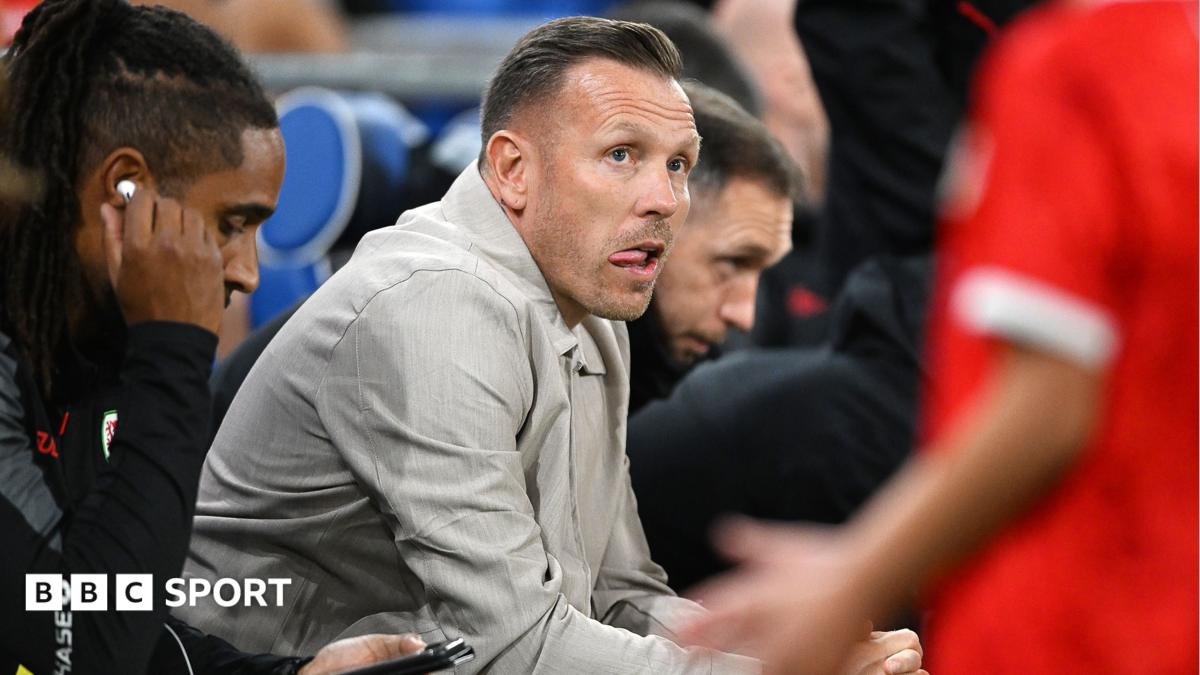
And yet it was the performance perhaps more than the result that appeared to win fans over again and reset the relationship between supporter and head coach.
“If they wanted to turn, that was their chance,” Bellamy said on S4C of the crowd response to Oscar Bobb’s opener after 11 minutes in what was Wales’ first home game since those Burnley links. “But they didn’t, they drove players on.”
Indeed, there had been only a Red Walled-willingness for Wales – and Bellamy – to be better throughout the 90 minutes, the noise lifting as Haaland remained contained and the hosts continued to move forward. They liked what they saw. Action, not words.
Bellamy admitted to having an “identity meeting” with players to try and re-establish what had been the hallmarks of his initial time in charge. It evidently did the trick given the way the tempo and aggression returned.
On the ball there was plenty to please the eye, not to mention the resilience to close a game out – a key criticism of that World Cup campaign.
One win is only one win, but there were red-shirted signs of redemption, from Liam Cullen’s performance – a player Bellamy has been criticised for selecting over others – to Neco Williams’ free-kick following a difficult night in Denmark.
But suddenly the Nations League campaign has new life and the chance of remaining in the top tier, and maybe even a seeding boost for those Euro 2028 qualifiers.
“It felt more like what we saw at the start under Craig,” said former Wales midfielder Joe Ledley.
“I think people have wanted to see it back but they saw it here. Fans don’t always have patience, decision-makers don’t always have patience so I think everyone knew we needed to see a result – but we also saw the performance and things we’ve not seen for a while. That’s a Craig Bellamy side.”
So instead of breaking point, was this a turning point?
“I hope so,” said Robert Earnshaw, another former Wales teammate of Bellamy and now part of the Match of the Day Wales team with Ledley.
“Craig needed it, the team needed it, I think the whole nation needed it,” said Earnshaw.
“Our levels dropped after the disappointment of the World Cup and it was about how could we bounce back – and here we felt that energy and excitement again.
“They had to give the crowd things to be cheerful about, because they were missing that for a while. Against Denmark we were miles away from what we’ve seen.
“This was a statement win.”
And – although the next test fast approaches against Denmark in Cardiff on Sunday – maybe it was also a line drawn.
Magadi, Kenya – For more than a century, soda ash has shaped life in Magadi, a remote town on the shores of Lake Magadi in Kenya’s Kajiado County.
The mineral has brought exports, jobs and business. But for many people living around the lake, that activity has not brought enough opportunities or basic services. The result is a complicated relationship with Tata Chemicals Magadi, the company that has mined soda ash there for generations.
Now that relationship is under strain. The Kenyan government has suspended the company’s mining operations, and President William Ruto has ordered it to leave while a joint technical committee works with the company to resolve outstanding issues.
For Magadi, the dispute is also about what the community and Kenya have gained from a resource extracted there for more than a century.
A century of soda ash
Commercial soda ash production in Magadi dates back to 1911. Tata Chemicals acquired the operation in 2005 and later renamed it Tata Chemicals Magadi Limited.
The company has become one of Kenya’s major soda ash exporters, with much of its production destined for international markets. It has also become part of everyday life in Magadi, providing jobs and supporting services including water, healthcare and education.
But the government says its long history in the area does not exempt Tata from Kenya’s current mining laws.
Mining Cabinet Secretary Hassan Joho told Al Jazeera on September 11 that the regulatory environment changed after the 2010 Constitution and the Mining Act. He said a government-wide compliance audit found that Tata had not applied for a mineral right under the Mining Act and had instead relied on its land concessions.
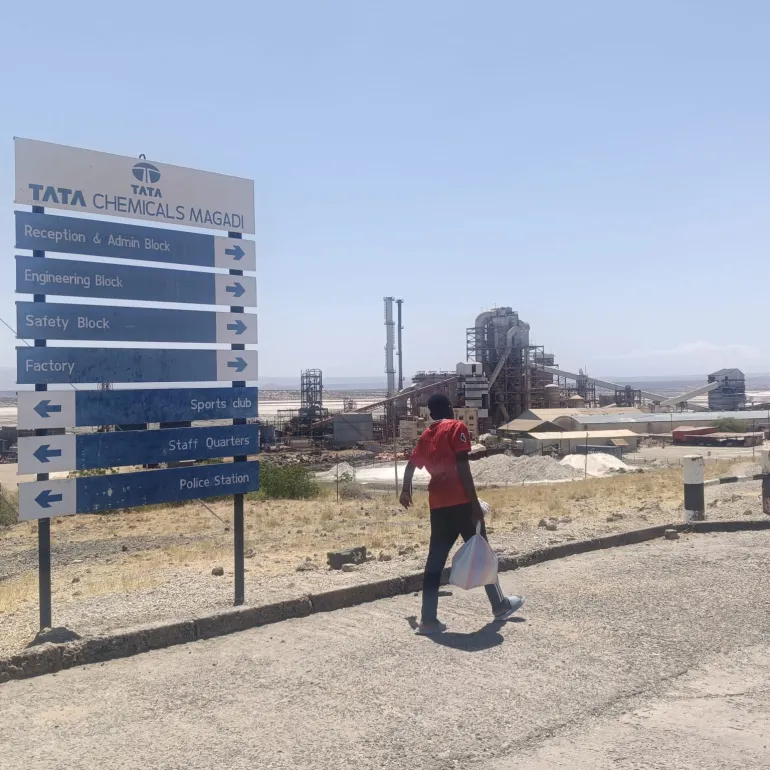
The plant has provided jobs and essential services for generations, but residents and officials are pressing for greater local benefits from the resource [Hafsa Sheikh/Al Jazeera]
According to Joho, Tata made its first application for a mineral right on July 26, 2024, after which the government began engaging with the company over compliance.
“Past oversights do not grant immunity from existing laws,” Joho said.
He said the review also identified issues around mineral royalties, community development agreements, local processing, employment of Kenyan citizens, procurement of local goods and services, and outstanding matters with the Kajiado County government.
The government says Kenya should get more value from the resource instead of mainly exporting it as a raw material.
Ruto has made a similar argument, saying communities have not benefitted enough from the mineral extracted from Magadi. During his visit to Kajiado, he said a new investor should establish major glass and chemical manufacturing facilities in the county, creating jobs and keeping more value in Kenya.
Why now?
The government’s decision has raised a question for a company that has operated in Magadi for more than a century: why now?
Joho told Al Jazeera that the answer lies in the government’s decision to carry out comprehensive compliance audits across the mining sector, including legacy concessions.
The ministry suspended Tata’s operations in July, citing regulatory concerns. Since then, the company and the government have been negotiating over how to resolve the outstanding issues.
Tata disputes the suggestion that it has ignored regulatory requirements.
In a statement to Al Jazeera, the company said its subsidiary submitted a comprehensive response to the ministry on August 11 regarding the issues raised in the July 28 suspension notice. Tata said the submission included information on its compliance with applicable regulations and that it was waiting for further direction from the ministry.
The company said it respected the authority of the Kenyan government and remained committed to constructive engagement with concerned agencies and regulators.
The economic stakes are significant. The Standard has previously reported that Tata’s Magadi operation contributes substantially to Kenya’s economy and that the company has argued that a shutdown would affect exports, foreign exchange and employment.
The operation supports hundreds of workers directly, while thousands more people in Magadi depend on the wider economy around it.
A community caught between dependence and frustration
For residents, the debate is not simply about whether Tata should stay or go. It is about what they have received from a company that has been at the centre of Magadi’s economy for generations, and what they could lose if it leaves.
Nkanoi Matipei, a Magadi resident, said locals want more jobs at different levels, more corporate social responsibility projects and access to land under Tata that they say is currently idle and used for grazing.
Another resident, Esther Nganoni, strongly opposed the idea of removing Tata.
“Tata Chemicals Company has been our lifeline,” Nganoni told Al Jazeera, pointing to bursaries, water and health services provided by the company.
She questioned what a replacement investor would offer the community and said residents must be consulted before any decision is made.
Cosmas Karera Kiratu, who previously served as the subcounty children officer for Kajiado West, told Al Jazeera that Magadi faces serious challenges, including poverty, water shortages, long distances to schools, inadequate infrastructure and teachers, child labour, teenage pregnancy, female genital mutilation and child marriage.
He said some schools are about 15km (9 miles) apart, while water remains particularly difficult to access.
According to Karera, the only clean water available through a piped system is supplied to Tata Chemicals from Ngurumani, about 40km (25 miles) away.
Residents depend heavily on Tata water bowsers, which he said do not reach all communities and often provide insufficient water for both domestic and livestock use.
“The local community was very dependent on Tata company in terms of water, health services, school bursary and schools upgrading,” Karera said.
He warned that an abrupt end to Tata’s operations could have serious consequences if alternative services are not put in place.
The technical committee and what happens next
That uncertainty is now at the centre of the government’s negotiations with Tata.
Joho said the ministry’s suspension was intended to give the company an opportunity to address the identified compliance issues. After Tata committed to remedy the outstanding matters, he said, a joint technical committee was established to guide the process.
Joho said the committee is dealing with the formation and gazettement of Community Development Agreement Committees, local processing facilities, outstanding mineral royalties, employment of Kenyan citizens, procurement of local goods and services and unresolved matters with the Kajiado County government.
He said discussions were progressing.
The plant’s future is now under scrutiny as the government pushes for greater regulatory compliance and wants more value from the resource to remain in Kenya [Hafsa Sheikh/Al Jazeera]
“Deliberations within the joint technical committee remain progressive, with a clear focus on achieving full statutory compliance under the Mining Act and securing socioeconomic returns for the extractive sector, the local community, and the nation at large,” Joho told Al Jazeera.
The Standard reported that the committee is also considering mineral beneficiation and in-country value addition, outstanding community benefits and royalties, unresolved land matters, the possibility of opening the area to multiple mineral extraction companies and outstanding issues involving Kajiado County.
For Kajiado Governor Joseph Ole Lenku, the county government must have a seat at the table.
“We want to thank the president for his firm stand and directives on Tata Chemicals Magadi. I have been vindicated,” Lenku told Al Jazeera.
He said county participation in negotiations was non-negotiable and identified payment of accrued land rates as the county government’s “irreducible minimum”.
He also said the grievances of Magadi residents had been known and repeated for years.
What does the future hold for Magadi?
The government has made clear that if a new investor eventually comes in, it wants more than the export of soda ash. It wants processing, manufacturing, jobs and a larger share of the economic value to remain in Kenya.
But residents are asking what happens to the services and livelihoods that currently depend on Tata.
For Matipei, keeping Tata does not mean accepting the status quo. She wants more jobs, greater community investment and access to land that residents say remains underused.
For Nganoni, removing Tata without a clear alternative could put the community at risk. She argues that residents must be involved in deciding what comes next.
Lenku wants the county government’s interests addressed, while Joho says the government’s objective is to bring the operation fully within Kenya’s mining laws and ensure that the country and local community receive greater socioeconomic benefits.
Tata says it is waiting for the government’s response to its August submission and remains committed to resolving the outstanding issues through engagement.
For Matipei, however, the question is what the community has gained from an industry that has shaped Magadi for generations.
“Over the years, the company’s assistance to the local community has been trickling, sustaining us but denying us economic freedom,” Matipei told Al Jazeera.
Be careful what you wish for when you’re wishing for a new offensive coordinator.
Chargers fans were so over Greg Roman. Anything would be better than his run-heavy scheme stunting quarterback Justin Herbert’s anticipated ascension. Anyone would be preferable to the man holding the reins while the Chargers scored just three points in last season’s wild-card loss to the New England Patriots, after which Roman was fired.
Somehow, after just two games, the Chargers’ offense under McDaniel has Bolts fans wishing anyone else was running the show. Roman included.
Because Roman wouldn’t have overcomplicated a third-and-inches play-call. He wouldn’t have had the 6-foot-6, 240-pound Herbert line up in shotgun and call for motion.
Share via
The Chargers lost to the Las Vegas Raiders 26-14 on Sunday, and the schedule doesn’t get any easier for them moving forward.
And the subsequent snap wouldn’t have hit receiver Tre’ Harris before it got to Herbert. And instead of losing five yards and having Herbert, in a rare show of emotion, slapping the turf in frustration, the Chargers probably would have gotten a fresh set of downs.
So far, McDaniel’s brief Chargers’ tenure hasn’t just been a disappointment. It has, through two games, been a disaster. Because the Chargers really needed these first two wins against opponents who both won only three games last season.
Instead, the Chargers’ offense looked as disjointed and discombobulated in Sunday’s 26-14 loss to the Las Vegas Raiders as it did the previous week in their 26-14 loss to the Arizona Cardinals.
It was an unwanted second helping of “humble pie,” as McDaniel described the Chargers’ Week 1 defeat. And it was nasty.
Now the Chargers’ schedule is about to come at them fast, with their next games against the Buffalo Bills, the Super Bowl champion Seattle Seahawks, Denver Broncos, Kansas City Chiefs and then the Rams, the preseason Super Bowl favorites.
After consecutive 11-win seasons under Jim Harbaugh — who’d never lost to the Raiders and never previously lost two consecutive games to start a season — the Chargers might blink and find themselves 0-7.
What’s worse than frustratingly quick postseason exits? Not making the playoffs at all.
And the Chargers are going to need to engineer a quick turnaround if they’re going to be among the 15% of teams that start a season 0-2 and still reach postseason play.
Chargers offensive coordinator Mike McDaniel walks on the sideline before a preseason game against the San Francisco 49ers at SoFi Stadium on Aug. 20.
(Robert Gauthier / Los Angeles Times)
To do that, they’ll need to score more points. They’ll need to stop shooting themselves in the proverbial feet and take some better shots downfield. Stop dropping the ball — figuratively, literally. They fumbled six times Sunday!
And stop thinking so much. Sundays are for reacting, and any amount of thinking is overthinking.
Maybe it’s personnel? The fact that, outside of Ladd McConkey, the Chargers are short on receivers who can reliably create separation.
Maybe it’s just a matter of time that the Chargers don’t have much of, cramming to learn McDaniel’s methods, to dial in the timing and coordination.
Or maybe, for McDaniel, it’s as simple as simplifying what he’s trying to do with this Chargers offense.
When he was hired in January, the prevailing thought was that the cerebral partnership between McDaniel and Herbert would prove a perfect match.
Even though McDaniel was dismissed after the Dolphins missed the playoffs two consecutive seasons, the coach — who’d developed a reputation as a talented offensive mind under Kyle Shanahan with the San Francisco 49ers — was a hot commodity on the coaching market.
McDaniel reportedly drew interest from the Baltimore Ravens, Cleveland Browns, Tampa Bay Buccaneers, Bills and Raiders. But he opted to come to L.A. to work with Herbert as the All-Pro QB’s fifth offensive coordinator in seven seasons (following three offensive coordinators in his four years at Oregon).
Starting over again, in these two games with McDaniel, Herbert has thrown for a modest 401 yards, just two touchdowns and three interceptions — though one of them bounced off David Njoku’s hands Sunday.
Chargers quarterback Justin Herbert watches a pass attempt fall incomplete after he is hit by Raiders defensive end Malcolm Koonce during the fourth quarter Sunday.
(Allen J. Schaben / Los Angeles Times)
There have also been protection problems, fumbles, a missed field goal, and lots of penalties — including four on star left tackle Joe Alt, who was called for a hold that resulted in a safety on an anything-that-can-go-wrong-will-go-wrong Sunday.
“I’m not looking in any one direction,” Harbaugh said Sunday. “I’m looking at it all.”
On TV, Herbert appeared to be looking off into space on the sideline as McDaniel sat chattering beside him, the game mercifully winding down.
Asked what McDaniel’s message was to the offense, Herbert said: “I haven’t been able to speak with him after.”
There’s a lot to talk about, but be careful what you ask.
Known as MEHKOs, microenterprise home kitchen operations come in many shapes and sizes. They are coffee shops, barbecue joints, supper clubs, backyard tea parties, pickup-only pizzerias and everything in between. For some of these operators, it’s a passion project, and for others, it’s their only source of income.
MEHKOs were first legalized by state lawmakers in 2019, spurred by advocacy from nonprofit organization the COOK Alliance. Riverside County was the first in the state to adopt the program in 2019. MEHKOs were greenlighted in L.A. County in May 2024, and since then over 400 licenses have been approved. While informal backyard restaurants are nothing new in L.A., the program offers a legal, health-department-approved pathway for many existing home kitchens to thrive.
MEHKOs can only sell up to 30 meals per day and no more than 90 meals per week. They’re also not allowed to advertise with signs on their homes or front lawns. And unlike commercial restaurants, where line cooks will often prep ingredients for the rest of the week, MEHKOs can only serve food that was prepared the same day.
“A home kitchen is not designed or required to have the same commercial infrastructure, such as ventilation systems, grease interceptors, specialized wastewater systems,” said James Dragan, who oversees initiatives including the MEHKO program at the L.A. County Department of Public Health. “The limits are important because of the food safety perspective.”
When dining at a MEHKO, be flexible. It might not be as easy as just placing an order. These home businesses are often open just a few days per week with limited hours, and might only accept orders placed in advance. For example, Palestinian home kitchen Mid East Eats — one of L.A.’s first MEHKOs — currently only offers private dinners and monthly supper clubs. It was previously open for walk-ins with a larger menu, but the format was difficult to sustain and would often create food waste.
“I want to continue doing my private dinners because that’s my favorite thing to do,” said Mid East Eats founder Sumer Durkee. “It’s satisfying to me and feels like home, and people leave feeling so happy.”
MEHKOs can serve as a relatively low-cost stepping stone toward opening a brick-and-mortar and offer one-of-a-kind food experiences, even in a city with as rich a culinary vocabulary as L.A. These eight home kitchens, all of which offer dine-in service, are a great starting place to discover the city’s burgeoning MEHKO scene.
Vandals spray red paint on Charlie Kirk statue days after its unveiling to mark one year since his death.
Published On 14 Sep 202614 Sep 2026
A new memorial statue of the slain right-wing activist Charlie Kirk has been vandalised days after it was installed outside Turning Point USA’s headquarters, the youth-focused organisation he co-founded.
Turning Point chief operating officer Tyler Bowyer said on Sunday that the bronze statue, alongside an accompanying sign, was defaced with red spray paint in Phoenix, Arizona.
“This morning we woke up to radical criminals vandalizing our Headquarters. Crossing over Charlie’s face, scratching out Jesus and the Cross & spraying red paint on his neck,” Bowyer wrote on X.
The statue was unveiled on Thursday to mark one year since Kirk’s death. Kirk, a co-founder of Turning Point and staunch ally of US President Donald Trump, was fatally shot while speaking to students at Utah Valley University.
The man accused of killing Kirk, Tyler Robinson, faces a possible death penalty after pleading not guilty to murder charges earlier this month.
Phoenix police said they received calls on Sunday morning about a vandalised memorial outside Turning Point’s headquarters.
Turning Point accused the vandals of intentionally spraying the statue’s neck, the spot where Kirk was shot in the attack, which was captured on video.
“We will restore the statue and replace the signs, but we are also reviewing the footage of the incident and are working with law enforcement to identify who did this and hold them accountable,” Turning Point said in a post on X.
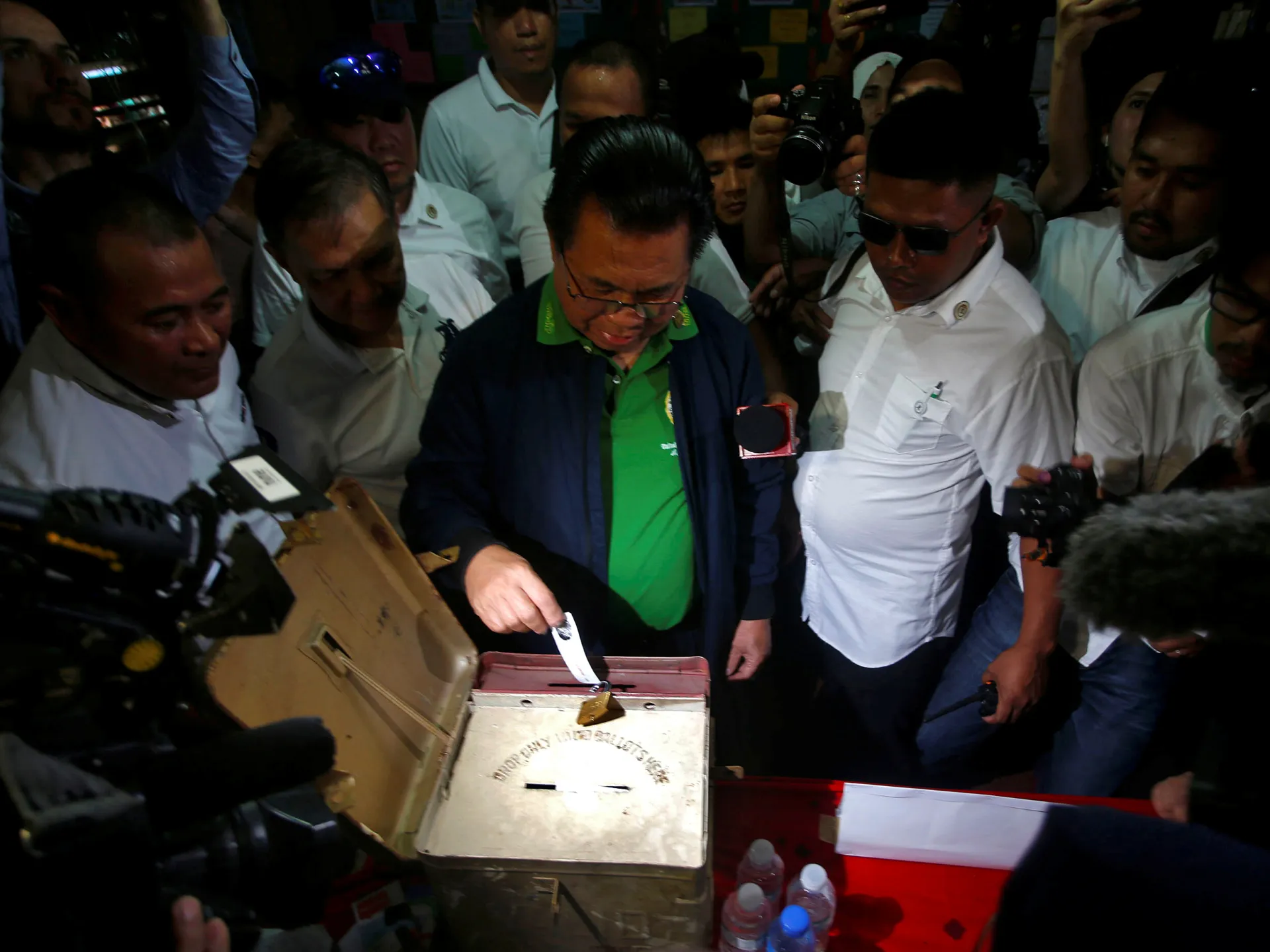
On Monday, the Bangsamoro Autonomous Region in Muslim Mindanao (BARMM) in the Philippines will hold its first parliamentary election since it was established in 2018. The vote will officially mark the end of the transition period under the Bangsamoro Transition Authority (BTA), an interim regional government appointed in 2019.
The election is a significant milestone in the Bangsamoro struggle. It is the outcome of decades of armed conflict and negotiations between the Moro Islamic Liberation Front (MILF) and the government of the Philippines.
The vote will test the Philippine government’s commitment to the peace process and the MILF’s commitment to the democratic process.
The struggle for self-determination
BARMM is located on Mindanao, the second-largest island in the Philippine Archipelago, and it covers roughly the territories inhabited by the Moro people, a native Muslim-majority group. For centuries, the Moro enjoyed self-governance in independent states and resisted Spanish colonialism. Following the Philippines’s independence in 1946, they continued their struggle for self-determination.
In 1989, the Autonomous Region in Muslim Mindanao (ARMM) was created by Manila to give some devolved rights to the Moro. However, ARMM largely failed to address local grievances and demands due to its weak structural power. It was given limited autonomy in political and fiscal decision-making, but it did not manage to improve socioeconomic conditions in the region. The MILF continued the armed struggle.
In 2012, President Benigno Aquino III recognised the ARMM as a “failed experiment”. Under his administration, the Framework Agreement on the Bangsamoro was signed between the government and the MILF, paving the way for a new political entity.
Six years later, under President Rodrigo Roa Duterte, the Organic Law for the Bangsamoro Autonomous Region in Muslim Mindanao was promulgated. This legislation granted the region greater fiscal autonomy, a regional government, a parliament, and a justice system.
Then the Comprehensive Agreement on the Bangsamoro was concluded to outline the mechanism of transition from ARMM to BARMM and set up the MILF-dominated BTA to lead it. All of this is culminating in the parliamentary election, which will determine the makeup of the region’s first legislative body.
A contested election
The vote comes at a time of heightened tensions in BARMM and internal divisions within the MILF. Two camps have emerged within the movement – one loyal to MILF Chair Al Haj Murad Ebrahim and another supporting Chief Minister Abdulraof Macacua.
Last month, Macacua joined the newly formed Bangsamoro Federalist Party (BFP), which will compete in the elections against the MILF’s political wing, the United Bangsamoro Justice Party (UBJP). Shortly after, his convoy was attacked, but he survived unscathed.
In early September, Macacua and 40 commanders were dismissed from the MILF’s military wing for alleged insubordination.
These tensions have prompted increased public anxiety about possible post-election unrest. There are other factors that could overshadow the vote.
In past elections, vote-buying was widespread, election-related violence was rampant, and electoral fraud and manipulation were pervasive. If these practices repeat at a large scale, the electoral outcome may not necessarily provide a straightforward measure of the will of Bangsamoro’s people. It may also not be an accurate reflection of whether they are satisfied with the transitional government or not.
The MILF presents itself as a champion of moral governance. If it is to retain this label, it should not give in to widespread vote-buying and electoral manipulation. It should also not let internal rivalries turn violent.
But there are already some alarming signs. Prominent MILF figures have conveyed that if the UBJP, the front’s political wing, sees manipulation and fraud, its members are ready to fight. They have also suggested that since the MILF led the transition, it should remain in power. On social media, some citizens have condemned the MILF camp’s threats, calling such tactics un-Islamic.
Before the vote, Manila has deployed military forces in key areas. This has heightened people’s fears that fighting with the MILF may erupt. The tense situation might lead to a low voter turnout.
Under these circumstances, the future of the Bangsamoro is riddled with uncertainties.
Whatever happens in the election, we must remember that the future of BARMM is a shared responsibility. The Philippine government and the Bangsamoro parties are duty-bound to honour the peace agreement. In addition, the people must exercise their civic rights and responsibilities to help sustain the peace achieved after a long and painful armed conflict and to move toward a prosperous Bangsamoro land.
The views expressed in this article are the author’s own and do not necessarily reflect Al Jazeera’s editorial stance.
FROM #ad posts to children launching their own fashion lines, the world of influencing is no longer reserved for reality stars and celebs – but their mini-mes too.
Amy Childs’ revealed recently that her nine-year-old daughter was launching her own fashion brand of gym and athleisure wearCredit: amychilds1990 and mypollyuk/ InstagramFerne McCann is often seen promoting products with her daughters Sunday and FintyCredit: instagram
The announcement didn’t go down quite as positively as Amy had hoped, with many fans slamming her for ‘exploiting’ the youngster for the money-spinning venture – leaving her ‘devastated’.
It comes as a whole host of celebs have welcomed their offspring into the world of business.
Molly-Mae Hague’s daughter Bambi joined her in promoting Persil and Comfort laundry productsCredit: PersilRochelle Humes’ children are often seen in social media adverts for her brand, My Little Coco
PR expert Luana Riviera says celeb parents are a ‘goldmine’ when it comes to money-making, as she says: “Being seen with their children makes even the most famous faces seem more down-to-earth and relatable.”
However, fans have been left concerned over the rise in celeb children on their screens.
Amy Childs’ was flooded with comments about ‘exploitation’ after revealing daughter Polly’s clothing brand.
Something feels off about this. Sorry but it’s a money making thing and doesn’t seem right.
“She isn’t old enough to do this sort of thing and have the maturity to understand,” said one.
Another echoed: “God let her be a child a little longer.”
Molly-Mae faced similar backlash after showing daughter Bambi in the bath on her Amazon Prime series and taking part in campaigns together.
“From a PR point of view, the use of families is appealing and will certainly get people talking about the brand and the marketing campaign,” explains Launa, who is the founder of Dauntless PR.
She continued: “But it is important to remember that these decisions are forever and when children get older they may wish they had been given more privacy and normality in their younger years.”
“Whether or not celebrities SHOULD put their children in the public eye in this way is an area which people will have lots of opinions on.
“Some will argue it is a safety risk and that the children themselves aren’t old enough to fully consent or understand the implications of establishing a level of fame in their own right.”
With the move such a controversial one, will the young stars see any of their hard-earned profits?
PR expert Carla Speight believes they will reap the rewards, just not anytime soon.
“These industry savvy parents will be making sure their kids won’t work for free, especially in the case of Molly Mae’s Bambi in the Comfort ads.
“Bambi will have been paid for that and the money will sit in a trust earning interest until she’s at least 16, which gives her a good financial head start.
“Just like most of the celeb children, they’ll either have shares in the brands or they’ll get a wage for each time they showcase the brands and in the case of their parent’s brands, it’s likely they’ll get both.”
DES MOINES — Alongside the familiar sounds of roosters crowing and thrill seekers screaming on rides at the recent Iowa State Fair, there was a chorus of boos from Turning Point Action activists who were heckling Democratic politicians making their way through the crowds.
Videos of the confrontations got hundreds of thousands of views on social media, a burst of attention for a conservative youth organization that is charting its next chapter after last year’s fatal shooting of its leader Charlie Kirk. But the true test of Turning Point Action’s clout was unfolding inside the exhibition center, where staff members were registering voters, handing out buttons and signing people up for social events.
“Building the foundation for 2028,” said one of the fliers.
While Democrats have punted Iowa from the top of its presidential primary calendar, the state’s caucuses will still kick off Republicans’ next nominating process. Turning Point Action is positioning itself to shape that contest, a reminder that preparations for the next White House campaign are already in motion even though no candidates have announced and the midterm elections are still two months away.
Turning Point Action wants at least one staffer in each of Iowa’s 99 counties to mobilize the conservative grassroots.
“It is important to us to see high voter participation in the caucuses,” said Tyler Bowyer, the organization’s chief operating officer. “That’s your measuring stick.”
In addition to Iowa, Turning Point Action grew its footprint in New Hampshire and Nevada for this year’s midterms, which could also help in 2028.
The likely beneficiary of this initiative would be Vice President JD Vance, who is widely expected to launch a presidential campaign. Turning Point leaders including Erika Kirk, Charlie’s widow, have been clear they’re ready to throw their support behind Vance if he jumps in.
More than a dozen Republican officials, activists, lawmakers and strategists in Iowa said Turning Point’s imprint in the state was visible but still something of a mystery, and some privately question whether the organization’s impact will match the buzz it generates online.
But others have eagerly welcomed the organization to the state.
“A year ago, Iowa was virgin — no Turning Point. And many of us complained,” said Kelley Koch, a former Dallas County Republican chair, to a gathering of MAGA Nation Iowa, the grassroots organization she founded. “Finally, Turning Point Action listened to us.”
Early state investments could benefit Vance
When asked about his 2028 ambitions, Vance demurs and says he’s focused on his current job, but he’s expected to be an immediate Republican front-runner if he decides to seek the presidency. Bowyer said Turning Point Action wants to be supportive without “being pushy.”
“We haven’t officially endorsed as an organization yet because no one’s announced, right? But, you know, depending on who announces and when we endorse — yeah, of course we’ll be out campaigning on behalf of who we endorse,” he said.
Bowyer said Vance can bridge the gap between the Make America Great Again movement, which President Trump launched more than a decade ago, and younger voters who were attracted to Charlie Kirk’s brand of conservatism.
“It’s a natural fit,” he said.
Bowyer acknowledged that Turning Point Action’s growing infrastructure in early primary states could cause some agitation on the right if it is seen as throwing its weight behind one candidate. But, he said, “that’s not why we do it,” describing the goal as boosting turnout in the Iowa caucuses to send a strong signal heading into the general election.
Other potential candidates include Marco Rubio, Trump’s secretary of State. Rubio, however, has said he wouldn’t run against Vance.
Sen. Ted Cruz of Texas has not announced a campaign, but he has already made several visits to Iowa this year and said in a recent podcast hosted by Texas Lt. Gov. Dan Patrick that “it’s no secret that I want to be president.”
Looking to grow the grassroots
Although Iowa has shifted rightward over the last decade, it’s considered a political battleground in this year’s midterm elections because of Trump’s sagging approval ratings, declining access to healthcare and tariff-driven turmoil in the agricultural industry.
Sen. Joni Ernst and Gov. Kim Reynolds, both Republicans, are retiring, and there are fiercely contested races to replace them. Democrat Josh Turek and Republican Ashley Hinson are seeking the Senate seat, while Democrat Rob Sand and Republican Zach Lahn want to be governor. Two battleground congressional districts will help determine control of the House as well.
The spotlight on Iowa this year is an opportunity for Turning Point Action to demonstrate its clout.
The organization said it hired four staffers on the ground last year. After Lahn’s surprise win over Trump-endorsed Rep. Randy Feenstra, Turning Point Action said it would double its staffing in the state before the midterms.
Young activists regularly post on social media from county fairs and Republican committee meetings. They upload selfies on sidewalks or stoops to show days spent knocking on doors.
“We’re newer in Iowa,” a Des Moines-based senior field staffer, Kylie Kloewer, told a visitor who stopped by Turning Point Action’s booth at the state fair.
The booth featured signs declaring that there are only two genders and one that said “men can’t get pregnant,” the kind of confrontational culture war messaging that Charlie Kirk practiced on college campuses. Some people nodded and chuckled, while others raised their eyebrows as they wandered by.
Those who walked up to the table could sign up for social clubs that host events, including barbecues and volleyball games.
“Any involvement is success,” said Kelsey Newberry, who is based in the organization’s Phoenix headquarters and was helping at the Iowa State Fair. “You’re bringing people together as a community. The more you talk to your neighbors, the better.
“And even if they’re not ready to get activated now,” Newberry added, “being around like-minded people might encourage them in the future.”
Fingerhut and Price write for the Associated Press. Price reported from Washington.
The Iran conflict and disruption to the Strait of Hormuz are forcing major oil importing countries to rethink how they source crude. Countries that once relied heavily on nearby Middle Eastern suppliers are increasingly turning to producers in the Americas and Africa, accepting longer voyages and higher shipping costs in exchange for greater energy security.
Japan Diversifies Its Oil Supplies
Japan is among the clearest examples of this shift. Before the conflict, more than 90% of its crude came from the Middle East, benefiting from short and relatively inexpensive shipping routes.
Since Gulf exports were disrupted, Japanese imports from the United States have surged. Between March and June, Japan imported more than 4.5 million metric tons of US crude, compared with less than 1 million tons during the same period in 2025.
The alternative comes with a cost. US crude takes roughly nine days longer to reach Japan, increasing freight expenses and requiring refiners to adjust their delivery schedules.
Stay ahead of the geopolitical week.
MD Briefing delivers expert analysis across five global fronts — the Indo-Pacific, energy, geoeconomics, European security, and the Middle East — every Monday morning. Free.
Asia Looks Beyond the Middle East
Japan is not alone. South Korea and India are also increasing purchases from suppliers in the Americas and Africa as Middle Eastern shipments decline.
China, the world’s largest crude importer, has relied heavily on strategic reserves to cushion the impact of the conflict. As those reserves are drawn down, Chinese buyers could return to international markets and intensify competition for crude from alternative producers.
The Americas Emerge as Major Suppliers
The disruption has created a major opportunity for oil exporters outside the Middle East.
US crude exports reached a record 61.6 million metric tons in the second quarter of 2026, up 43% from a year earlier. Brazil, Argentina and Guyana have also recorded strong export growth.
Brazilian shipments to India, for example, were three times higher in the first half of 2026 than during the same period in 2025.
Longer Routes, Higher Costs
The new trade patterns are considerably less efficient.
A tanker travelling from major Gulf terminals to India’s western coast can take only three to five days. A shipment from Brazil to the same destination can take around 25 days.
Longer journeys mean higher tanker demand, greater freight costs and more complicated logistics. Yet importers are increasingly willing to absorb those costs because dependence on a single vulnerable supply corridor carries its own risks.
Avoiding Strategic Chokepoints
The shift is also about reducing exposure to vulnerable maritime routes.
The Strait of Hormuz remains a major risk, while geopolitical tensions have reduced traffic through the Suez Canal. Drought has also constrained the Panama Canal.
As a result, importers are increasingly valuing suppliers whose shipping routes can bypass these chokepoints.
A New Global Energy Map
The emerging pattern is creating a more geographically dispersed oil market.
Middle Eastern producers will remain crucial because of their enormous reserves, low production costs and established infrastructure. But Asian buyers are unlikely to forget the disruption caused by the Hormuz crisis.
Regular purchases from new suppliers can therefore become a form of insurance, even after Gulf exports recover.
Analysis
The most important change is that energy security is beginning to outweigh pure economic efficiency.
For decades, Asian refiners benefited from buying Middle Eastern crude because geography made it cheaper and faster. The Iran conflict has exposed the vulnerability of that model. A short shipping route is of limited value if a single geopolitical crisis can disrupt it.
The result could be a lasting diversification of global oil trade. Importers are unlikely to completely abandon Middle Eastern crude, but they may maintain larger relationships with US, Latin American and African suppliers to create alternative sources of supply.
This means the cost of energy security will increasingly be reflected in the global oil market. Longer voyages, higher freight rates and more complex supply chains may become the price importers are willing to pay for resilience.
The broader shift is therefore from an oil market designed primarily around efficiency to one increasingly designed around redundancy and geopolitical risk.