Weekly insights and analysis on the latest developments in military technology, strategy, and foreign policy.
U.S. President Donald Trump says the Iranians shot down the AH-64 Apache that crashed near the Strait of Hormuz overnight and vowed to retaliate. As we noted earlier today, the crew was safely rescued by a drone boat, an unprecedented action, which you can read more about here.
“I have just been informed by our Great Military that last night the Iranians shot down one of our highly sophisticated Apache Helicopters while patrolling over the Strait of Hormuz,” Trump stated on Truth Social. “There were two pilots involved, both are safe and uninjured. Nevertheless, the United States must, of necessity, respond to this attack.”
Trump says that Iranian forces shot down the Army AH-64 Apache attack helicopter that went down over Hormuz yesterday.
Trump did not elaborate on how the Apache was shot down.
It’s worth noting that Iran’s small boats are known to be man-portable air defense systems (MANPADS) threats and also small FPV drones and loitering munitions, which Iran also possesses, have become a real threat to helicopters.
A U.S. official told Axiosan investigation “determined that an Iranian drone hit the helicopter, causing it to crash. The U.S. official said the investigation had not determined whether that was intentional.”
Trump did not say exactly how the U.S. will respond, but given past history of tensions in the region, an attack on Iranian facilities that could have been involved in the shoot-down would not be surprising. We have seen similar responses when Iran has fired at ships in the past.
Whether this will finally break the shaky ceasefire is an open question. Last week, Trump told reporters that he would consider resuming the war if Iran caused U.S. troop deaths.
“Yeah, if they killed U.S. troops, I think I would do that very quickly,” he said.
We have reached out to the White House and U.S. Central Command for additional details. CENTCOM declined comment.
UPDATE: 1:57 PM EDT –
Iranian official media has yet to explicitly confirm or deny involvement in the downing of the Apache. In a post on X addressing Trump’s claim, the FarsNews Agency offered a veiled threat from Mohammad Ghalibaf, speaker of the Iranian parliament.
“We prefer the language of diplomacy, but we speak other languages far more fluently,” Ghalibaf said on his own X account, repeated here by Fars. “Break your commitments, and we’ll switch to what we speak best. You ride the horse you saddled.”
🔴قالیباف: ما زبان دیپلماسی را ترجیح میدهیم، اما زبانهای دیگر را بسیار روانتر صحبت میکنیم
IRIB just repeated CNN’s report that the helicopter gunship was taken down by a Shahed drone.
🚨 CNN claims: Iran shot down US Apache helicopter with a Shahed drone
— IRIB (Islamic Republic of Iran Broadcasting) (@iribnews_irib) June 9, 2026
Press TV, meanwhile, took a rather cheeky approach.
“US President Donald Trump says Iran shot down ‘one of our highly sophisticated Apache helicopters while patrolling over the Strait of Hormuz,’” the outlet stated on X. “So much for the Iranian military having been ‘obliterated!’”
UPDATE: 4:20 PM EDT –
In a call with The Wall Street Journal, Trump tried to downplay the Apache downing, saying that it “wasn’t a big deal” and stressing that “the pilot is fine.”
Earlier today, Trump sought to play down the incident. In a phone call with the WSJ, Trump said that it “wasn’t a big deal,” stressing that “the pilot is fine.” He said he had the details on the incident and that “it was much different than you think.” https://t.co/arzskUbdSt
Exiting a classified congressional briefing, CENTCOM commander Adm. Brad Cooper offered a short answer to reporter questions about how the U.S. will respond to Iran downing the Apache.
“We’ll see,” he said, according to NOTUS reporter Joe Gould in a post on X.
Reporters asked Centcom’s Adm. Brad Cooper, exiting a classified congressional briefing, what the “response” would be to the downed U.S. helicopter.
In a post on X, CENTCOM announced its “forces began launching self-defense strikes against Iran at 5 p.m. ET today at the Commander in Chief’s direction, in response to yesterday’s downing of a U.S. Army Apache helicopter. The mission is a proportional response to unjustified Iranian aggression.”
We have reached out to the command for more details.
U.S. Central Command (CENTCOM) forces began launching self-defense strikes against Iran at 5 p.m. ET today at the Commander in Chief’s direction, in response to yesterday’s downing of a U.S. Army Apache helicopter. The mission is a proportional response to unjustified Iranian…
CENTCOM’s post follows reports from the official Iranian Mehr news agency about the sounds of explosions.
In a post on Telegram, the official Iranian Mehr news outlet is reporting that there have been “sounds of explosions heard in the Sirik port area.
According to Mehr, “the exact nature of these sounds is not yet clear, and none of the official military or law enforcement agencies have commented on the cause of these sounds so far.”
“Investigations to obtain accurate information about the nature of these explosions are ongoing,” Mehr added.
UPDATE: 5:42 PM EDT –
ABC News Chief Washington Correspondent Jonathan Karl was on the phone with Trump as CENTCOM announced the retaliatory strikes against Iran.
“I think it’s very important to respond,” Karl said Trump told him. “They shot down a helicopter, and we are responding as we speak…I believe the response should be very strong, very powerful, and that’s what this one is.”
I was on the phone with Trump as CENTCOM announced US retaliatory strikes against Iran. Here’s what he said:
“I think it’s very important to respond. They shot down a helicopter, and we are responding as we speak.”
He added: “This is a response to what they did they did with…
Tasnim is reporting that the U.S. strikes appear to be over for now.
“The wave of American attacks in the south has subsided, and after the hostile actions in Qeshm, Sirik, Jask and Mount Mubarake Jask, the situation is now reported to be calm,” the outlet claimed on Telegram. It also published a video it says shows “a suicide drone in the sky of Iraq.”
President Trump accused Iran of shooting down a US Apache helicopter over the Strait of Hormuz and said the US will respond out of “necessity.” The Pentagon confirmed both pilots were rescued by a US sea drone and are uninjured. Kimberly Halkett reports from the White House.
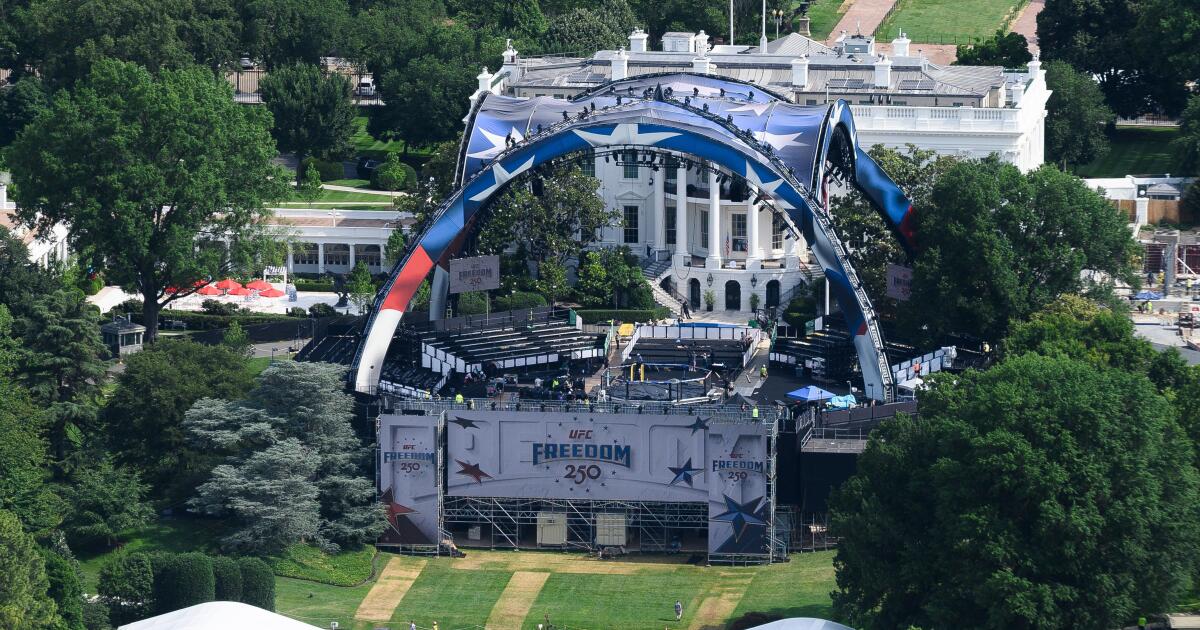
A UFC fight card scheduled for Sunday on the White House South Lawn is facing legal challenges in federal court.
The watchdog group Public Integrity Project filed a lawsuit last weekend on behalf of two Virginia residents aiming to shut down the Mixed Martial Arts event, which has been billed as part of a celebration of the nation’s 250th anniversary. The event is scheduled to take place on President Trump‘s 80th birthday.
The lawsuit refers to the plan for UFC Freedom 250 as “illegal,” stating that proper authorization was not obtained to hold the event and to build structures on federal parklands, and “corrupt,” in that the president and others allegedly stand to benefit financially from the “private, for-profit sports event.”
“This is a profoundly corrupt scheme to enrich the President and his friends,” Public Integrity Project founder Brendan Ballou said in a statement on the group’s website. “If this fight is allowed to proceed, it will be only the beginning, and our national monuments will become little more than branding opportunities for the rich and well-connected. We plan to stop that.”
The group also filed for a temporary restraining order to stop the construction and prevent further planning for the event.
The National Park Service and Department of the Interior, as well as executives from each department, are named as defendants.
“This is an obstructionist, baseless, and dilatory lawsuit brought simply to prevent President Trump from hosting what will undoubtedly go down as one of the most historic sporting events in our Nation’s history during our semiquincentennial celebration,” a Trump administration official said in a statement emailed to The Times.
“This iconic event is no different than the various other White House-hosted events on the South Lawn and properly permitted events on the Ellipse and National Mall throughout the year.”
According to the lawsuit, UFC Freedom 250 violates NPS policy that prohibits sporting events on the South Lawn. In addition, it states that the plans for the event did not receive approval from Congress to construct a massive structure on the lawn and did not undergo a required environmental review before construction.
Last year, the NPS established a temporary rule that allows “special events planned, organized, and executed by executive departments and agencies or the Semiquincentennial Commission for the celebration of the 250th anniversary of American Independence” on Washington’s monumental grounds.
The lawsuit states, however, that the rule does not apply to Sunday’s MMA event.
“UFC Freedom 250 is a private, for-profit sporting event being ‘planned, organized, and executed’ by the UFC, its broadcast partners, and its advertisers, not by the federal government,” the filing states.
“And it is not in any material sense a ‘celebration of the 250th anniversary of American Independence’ — it is, instead, a celebration of the UFC’s brand and the 80th anniversary of Donald Trump’s birth.”
UFC and parent company TKO are said to be footing the bill for the reported $60 million event. Still, it’s a massive platform for UFC, which longtime Trump friend and supporter Dana White runs. The president reportedly bought between $15,000 and $50,000 of TKO stock earlier this year.
No tickets are being sold to the general public. Most of the 5,000 seats next to the White House will be given to military members, while thousands of others will be able to watch on big screens in nearby parks. The event also will stream live exclusively on Paramount+, which is controlled by Trump allies Larry and David Ellison.
“This will be one of the greatest and most historic sports events in history, and President Trump hosting it at the White House is a testament to his vision to celebrate America’s monumental 250th anniversary,” White House spokesperson Davis Ingle said in a statement. “Anyone who finds a problem with that clearly suffers from a severe and incurable disease known as Trump Derangement Syndrome.”
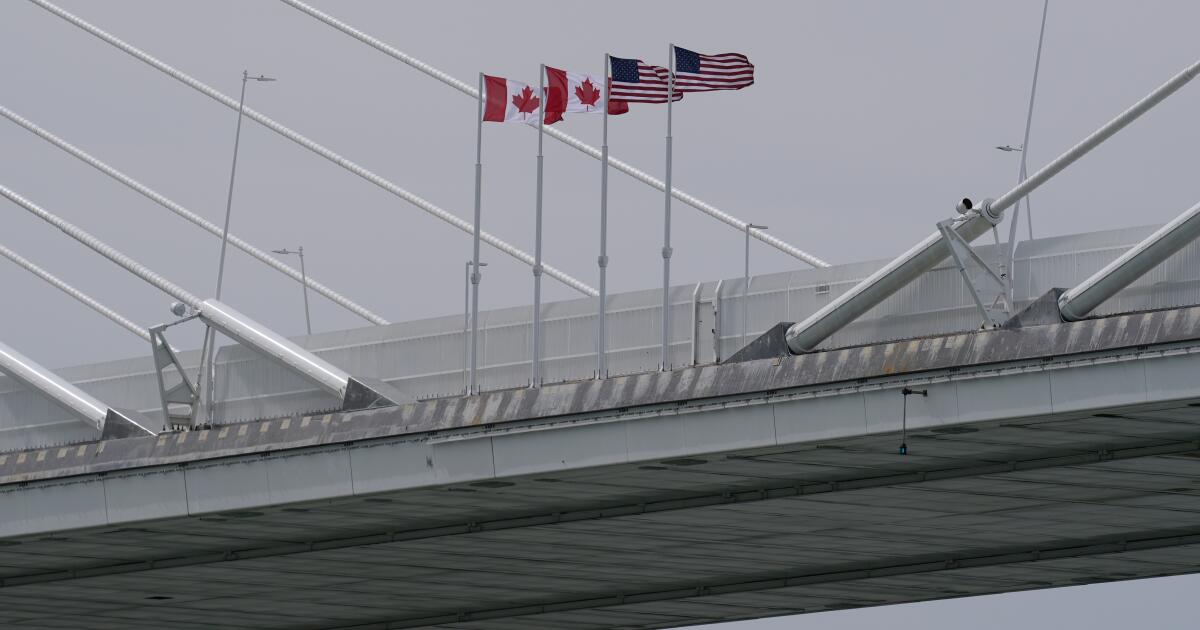
TORONTO — A new Canadian-built bridge across the Detroit River that U.S. President Donald Trump threatened to block will open soon, Canadian Prime Minister Mark Carney said Tuesday.
A ribbon-cutting ceremony for the Gordie Howe International Bridge, jointly owned by Canada and the U.S. state of Michigan, is set to take place on Friday, while the bridge itself is expected to open to traffic later this month.
In February, Trump demanded that Canada turn over at least half the ownership of the bridge to the U.S. federal government and agree to other unspecified demands in one of his many salvos over cross-border trade issues.
The bridge, which would connect Windsor, Ontario, and Detroit, and would be a vital economic artery between Canada and the United States, had been expected to open early this year, according to information on the project’s website.
The bridge is named after Howe, the late Canadian hockey great who spent 25 seasons with the Detroit Red Wings.
The project was negotiated by former Michigan Gov. Rick Snyder — a Republican — and paid for by the Canadian government to help ease congestion over the existing Ambassador Bridge and Detroit-Windsor tunnel. Work has been underway since 2018.
“Obviously the bridge will be open at the end of the week. A symbol of, but also a fact of cooperation between our countries,” Carney told reporters as he walked into Parliament.
“Great for Canadians going across the border, Americans coming across the border, and for commerce,” he said, calling it “positive news.”
Trump threatened the bridge as the United States-Mexico-Canada trade agreement is up for review this year, and Trump has been taking a hard-line position before those talks, including by issuing new tariff threats.
Carney, meanwhile, has spoken out on the world stage against economic coercion by the United States.
Sen. Elissa Slotkin, a Michigan Democrat, has said that the Canadian-funded project is a “huge boon” to her state and its economic future.
Michigan is a swing state that Trump carried in both 2016 and 2024.
Snyder wrote in an op-ed in The Detroit News earlier this year that Trump was wrong in asserting that Canada owns both the U.S. and Canadian sides of the Gordie Howe bridge.
“Canada and the state of Michigan are 50/50 owners of the new bridge,” Snyder wrote. “Canada was wonderful and financed the entire bridge. They will get repaid with interest from the tolls. Michigan and the United States got their half-ownership with no investment.”
The Gordie Howe bridge will join the privately owned Ambassador Bridge as the second span connecting Detroit and Windsor, Ontario.
The rival Ambassador Bridge is considered the busiest U.S.-Canadian border crossing, carrying 25% of all trade between the two countries. It plays an especially important role in auto manufacturing.
Companies controlled by the Moroun family, owners of the rival Ambassador Bridge, previously sued to prevent the Howe bridge from being built.
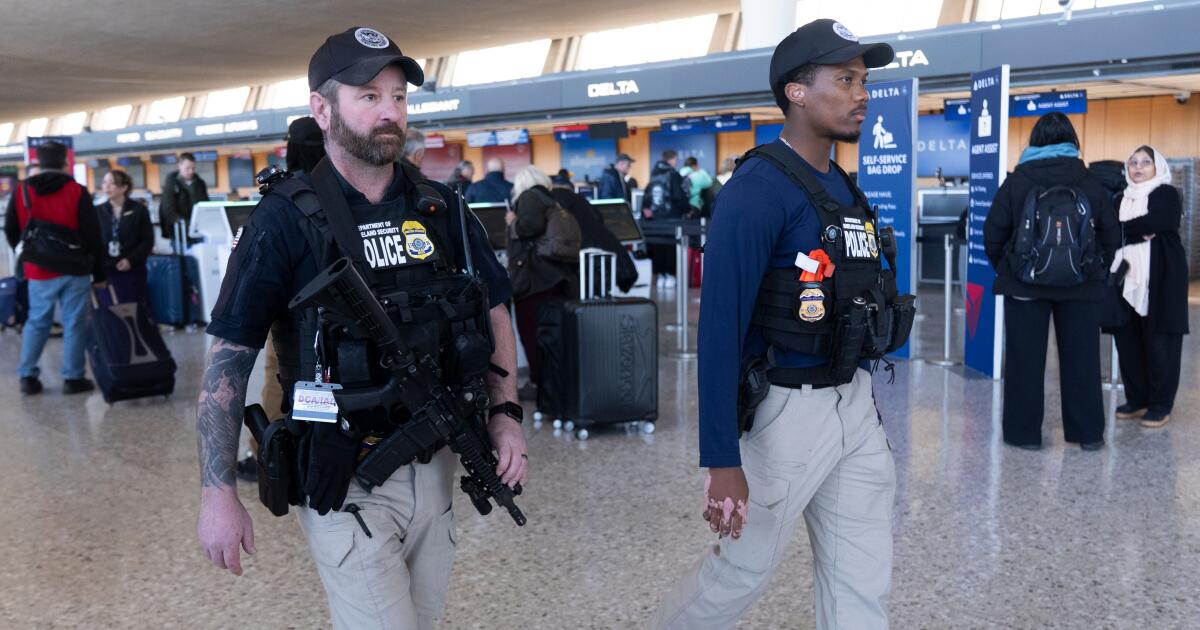
WASHINGTON — House Republicans will look to get nearly $70 billion for immigration enforcement over the finish line Tuesday, enough to fund a pair of Homeland Security agencies through the next three years and the rest of President Donald Trump’s time in office.
Speaker Mike Johnson will need near perfect attendance and unity on his side to complete weeks of action on the bill. The legislation got sidetracked when Republicans sought to include $1 billion for enhanced security on the White House grounds, including for Trump’s new ballroom, and the Trump administration tried to create a nearly $1.8 billion fund to compensate allies of the president who claim they have been unjustly investigated and prosecuted. Those proposals proved politically toxic and were scrapped.
Now, the bill is focused entirely on immigration enforcement, a topic that Republicans have treated as a defining issue between the two major political parties and one they hope will carry them to victory in this year’s midterm elections. The bill provides $38 billion for Immigration and Customs Enforcement, $26 billion for the Border Patrol and another $5 billion to cover unforeseen costs, fueling Trump’s deportation agenda.
“It’s long overdue,” said Johnson, R-La., of the bill. “We have to fund border security and immigration enforcement, and it’s sad that Republicans have to do it on our own.”
Funding accelerates Trump’s deportation agenda
The funding comes on top of the nearly $140 billion that the Republican-controlled Congress gave ICE and Customs and Border Protection last year as part of Trump’s tax and spending cuts bill.
Democrats objected to giving the agencies more money without significant changes in the way they operate after the deaths of Alex Pretti and Renee Good in Minneapolis. For example, Democrats insisted that agents be required to display their ID badges during enforcement operations and that they get a judicial warrant before entering private property. Instead, the funding will come with virtually no strings attached.
House Democratic Leader Hakeem Jeffries vowed his party would oppose the package.
“We believe that taxpayer dollars should be used to make life more affordable for the American people – not give ICE another $70 billion blank check so that they can unleash brutality on American citizens and violently target law-abiding immigrant communities,” said Jeffries of New York.
Homeland Security faced longest shutdown in history
The package is the result of a monthslong standoff in Congress after Democrats refused to fund the Department of Homeland Security in the wake of the immigration enforcement actions in Minneapolis and other American cities, leading to the longest shutdown in agency history.
Negotiations had been underway with the White House to alter ICE operations as Democrats were demanding. When those negotiations failed, Republicans turned to a complicated procedural maneuver to get around the filibuster and pass the immigration funding with no Democratic votes.
If approved, the package would next go to Trump for his signature, all but assuring an essentially uninterrupted flow of funds for his immigration enforcement and deportation agenda into 2029.
The Senate completed its work on the legislation last week during an all-night session that extended into the early morning hours Friday. The final 52-47 vote on the bill was nearly party line, with Sen. Lisa Murkowski of Alaska the only Republican to oppose it.
Money comes at pivotal time for immigration agenda
The money will come at a pivotal time for the Department of Homeland Security, which is under new leadership after Trump replaced Kristi Noem with new Secretary Markwayne Mullin in March.
While Mullin has vowed to keep the department out of the headlines, the administration is under pressure from anti-immigration advocates to deliver on Trump’s campaign promise of the largest deportation operation in American history.
So far, the administration has not hit its goal of 1 million deportations a year, but Trump’s border czar, Tom Homan, has promised more to come, including hinting at immigration enforcement actions in New York, the nation’s biggest city, which is heavily Democratic.
At the same time, the administration is making it more difficult for legal immigrants to remain in the U.S. by working to end Temporary Protective Status, changing the processes for obtaining green cards and leaving some Dreamers — the young people who were brought illegally to the U.S. as children — reporting delays in renewing their status, which allows them to stay and work.
Tight vote ahead
On the House side, Johnson has little margin for error. Republicans can afford to lose only a couple of votes if every lawmaker is present. GOP leadership opted to avoid any hiccups and sent lawmakers home last week rather than take up the bill early Friday once the Senate had completed its all-nighter.
The bill is just a slim package, without the hundreds of pages of details and directives that typically come from Congress when it provides funding for agencies.
Leading up to the vote, Democrats portrayed DHS as an agency that has used its new resources to buy private jets for its leadership, warehouse immigrants in deplorable conditions and attack U.S. citizens.
“To give these rogue agencies another $70 billion now when they still have $100 billion in the bank from last year would implicate all of us in the escalating corruption and shameful actions of this department,” said Rep. Jamie Raskin of Maryland, the ranking Democratic member on the House Judiciary Committee.
Republicans countered that they were fulfilling their duty to safeguard the nation and support the men and women charged with enforcing the law.
“Democrats can say whatever they want, but what it’s about is public safety. What’s it about is keeping Americans safe,” said Rep. Michelle Fischbach, R-Minn.
Freking and Mascaro write for the Associated Press.
Donald Trump’s appearance courtside at Madison Square Garden was supposed to be a historic moment, as, for the first time, a sitting president of the United States was attending an NBA Finals game.
Instead, his arrival became part of the story, drawing boos from sections of the crowd and triggering a massive security operation that reshaped the atmosphere around the storied New York arena on Monday night.
Trump watched from an executive suite as the New York Knicks hosted the San Antonio Spurs in a series that gripped the city and revived memories of the Knicks’ glory years.
When his image flashed up on the big screen during the national anthem, many fans jeered, underlining how sharply divided the country remains even in a space usually reserved for shared celebration.
Outside, Manhattan’s streets were locked down. Metal fencing, airport-style screening and a heavy Secret Service and police presence kept ticketless fans blocks away.
Long queues formed as supporters queued early, while others gathered at public viewing areas across the city.
Inside, however, the spectacle went on. Hollywood actors, musicians, former players and New York fixtures filled the front rows, turning the event into a star-studded night out.
Between the celebrity sightings, the political undertones and a tense 115-111 Spurs win, this was a New York basketball night unlike any other – on and off the court.
NEW YORK — Donald Trump is set to be the first sitting U.S. president to attend an NBA Finals game, bringing strict security measures that will require New York Knicks fans to navigate an extensive safety perimeter around Madison Square Garden and an expected lengthy wait to get inside the building.
The security for Game 3 between the Knicks and San Antonio Spurs and the scene around the arena more closely resembled New Year’s Eve in Times Square, and for fans, it might seem more akin to a trip to the airport. They were asked to get to the game two hours early and will be required to provide a ticket to get past various checkpoints along with passing through a TSA-style magnetometer.
Trump’s appearance led the New York Police Department and Secret Service to establish a multi-block security perimeter around the arena, cancel a watch party outside and institute a no-bag policy for ticket-holders. Fans had gathered around the Garden to watch games during this playoff run, during which the Knicks have won 13 games in a row to reach the final for the first time since 1999 and move two victories from their first NBA title since 1973.
“The NYPD in coordination with the Secret Service made the decision for Game 3, where we have a presidential visit, that we could not support watch parties right outside of the Garden,” Police Commissioner Jessica Tisch said at a news conference Monday. “We are looking forward to bringing back watch parties for Game 4. But I think New Yorkers are used to presidents coming to town, and they understand that that generally means lockdowns of areas and that’s what you’re going to see tonight at the Garden.”
Trump has attended several major sporting events in his time as president, and the security measures have created major hassles for fans.
Thousands of fans missed the start of last year’s U.S. Open men’s singles final between Carlos Alcaraz and Jannik Sinner because of lengthy security lines. Even though the U.S. Tennis Association pushed back the start of the match by a half-hour, many fans still couldn’t get in because added measures meant that they had to go through screening not only when they arrived at the Billie Jean King National Tennis Center but again in front of the steps into Arthur Ashe Stadium, where Trump watched from a suite.
Asked his thoughts on Trump attending, Knicks center Mitchell Robinson said: “Cool, I guess. We can still get out there and play (no matter) who’s here and who’s not.”
Mayor Zohran Mamdani and other dignitaries are also expected to be at the game Monday night.
It was already hard enough for Knicks fans to get inside Madison Square Garden because of astronomical ticket prices. The get-in price for a ticket is higher than the average cost of monthly rent in New York, surging over $6,000. The best seats are tens of thousands of dollars. Mamdani said he bought his ticket for about $1,000 directly from Madison Square Garden.
The difficulty of seeing the game in-person has prompted fans to crowd bars, streets and watch parties all over the city. The watch party near the Garden has become a major event all through the playoffs, but with Trump attending, that event will be moved a few blocks away outside the security perimeter, at Bryant Park.
“We improvise,” said Knicks guard Jose Alvarado, who is a New York native. “We’re New Yorkers. We’re going to find a way to watch a game, and that’s what we’re doing.”
Whyno writes for the Associated Press. AP writer Brian Mahoney contributed to this report.
U.S. President Donald Trump discusses renovations to the Lincoln Reflecting Pool and makes an announcement on “Beautiful, Clean Coal” on Thursday in the Oval Office at the White House in Washington, D.C. A federal judge on Monday ruled that a H-1B visa fee imposed by Trump is illegal. Photo by Samuel Corum/UPI | License Photo
June 8 (UPI) — A federal judge ruled Monday that a $100,000 visa fee for U.S.companies seeking highly skilled workers from other countries is illegal. This voids the requirement set by President Donald Trumpby a presidential proclamation in September.
Judge Leo Sorokin said the policy violated the U.S. Constitution and the federal Administrative Procedure Act and that only Congress has the authority to change federal immigration policy to require the fee. The Trump administration says it will appeal the ruling.
“The president lacked the power or delegated authority to impose a tax on H-1B petitions,” Sorokin said in his decision, CNN reported.
A group of Democratic state attorneys brought the case in December. Letitia James, New York attorney general, was among them.
“Every day, thousands of people with H-1B visas serve New Yorkers as doctors, teachers and other skilled workers,” James said Monday, CNBC reported. “Today, a court put an end to this administration’s illegal attempt to destroy this critical program and the many jobs it makes possible.”
Before Trump’s proclamation, H-1B visa fees ranged from $2,000 to $5,000 per application, CNBC reported. These visas are meant for foreign professionals who hold at least a bachelor’s degree to work in more specialized fields. They’re valid for three years and can be renewed for another three years after that. The New York Times reported that about 85,000 of such visas are available annually, and that they are often used by universities and companies in the fields of technology, finance and medicine.
White House spokeswoman Taylor Rogers said in a statement to CNBC after the ruling that “President Trump has clear legal authority to restrict entry of any class of aliens he determines is not in America’s best interests, and that is exactly what he did.” She said the visa program “has been abused for decades.”
US President Donald Trump was loudly booed when he was shown on screens during the national anthem before Game 3 of the NBA Finals between the San Antonio Spurs and New York Knicks.
NEW YORK — Donald Trump was booed loudly by fans inside Madison Square Garden when he was shown on video screens during the national anthem prior to Game 3 of the NBA Finals on Monday night.
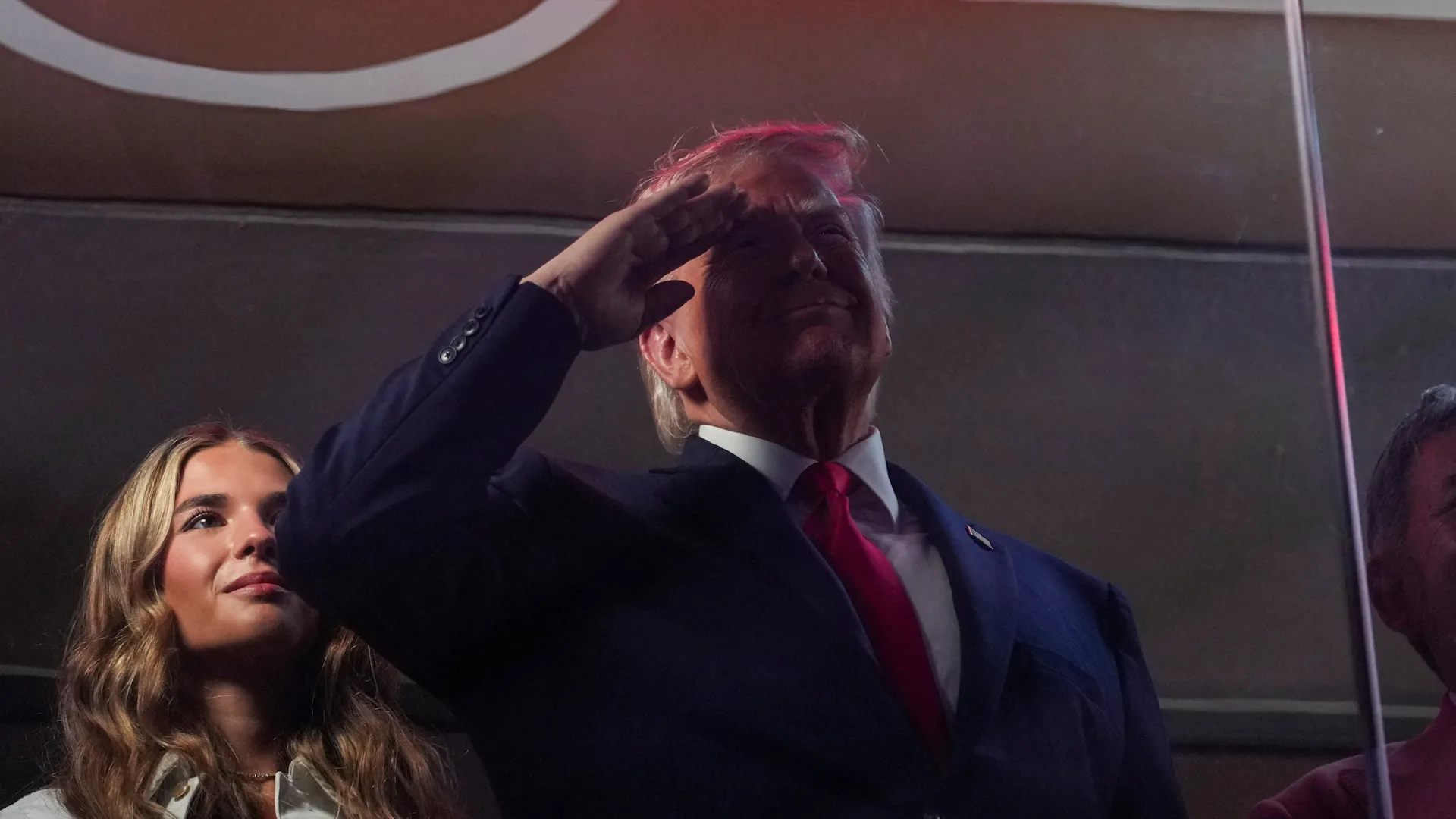
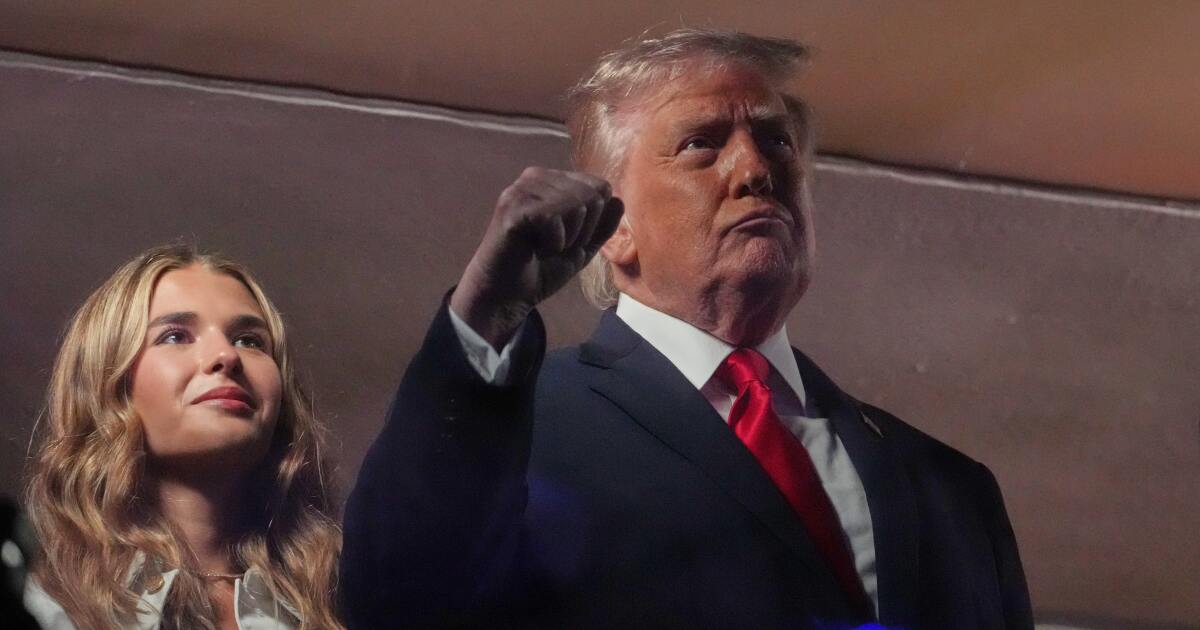
Trump was shown for several seconds giving a military salute. The boos ended when the U.S. flag followed him on the screens, and fans cheered when New York Knicks players were shown. Mentions of the San Antonio Spurs also elicited loud boos.
Trump is watching from Knicks owner James Dolan’s suite, along with granddaughter Kai, personal adviser Boris Epshteyn and Cabinet secretaries Lee Zeldin, Sean Duffy and Doug Burgum. He is the first sitting president to attend an NBA Finals game.
Trump’s Marine One helicopter flew from his home in New Jersey and landed near Wall Street before his motorcade made its way up through Manhattan and to the arena roughly an hour before tipoff. He encountered a handful of people making rude gestures, and outside the area, one group held signs saying “Trump must go.”
He settled into Dolan’s suite shortly afterward.
During the afternoon before Trump’s arrival, the New York Police Department and the U.S. Secret Service set up a large perimeter surrounding Madison Square Garden. Fans lined up to get inside the arena more than four hours before tip-off, in a scene more closely resembling New Year’s Eve in Times Square than the usual leadup to a basketball game.
They were required to provide a ticket or pass to get past various checkpoints, along with going through a Transportation Security Administration-style magnetometer. Secret Service personnel and police were positioned at every corner and in large numbers. Daily commuters, tourists and fans were all confounded at various times as they tried to maneuver the security.
New Yorkers forced to adjust
After traveling from his new home in Florida for the game, Knicks fan Greg Weldon said the main inconvenience he’s faced so far has been the lack of information.
“We’ve asked so many cops, Secret Service, guys with machine guns, what to do, where should we go,” he said. “Nobody knows.”
Knicks coach Mike Brown and Spurs counterpart Mitch Johnson downplayed any concept of being inconvenienced by the closures and enhanced security because of Trump.
“There’s a lot going on, and I’d much rather be a part of it than not,” Johnson said.
With security stepped up, a watch party outside was canceled, and ticket holders were not allowed to bring bags inside the Garden. Fans had gathered near the arena to watch games during this playoff run, during which the Knicks have won 13 games in a row to reach the Final for the first time since 1999 and move two victories from their first NBA title since 1973.
“We are looking forward to bringing back watch parties for Game 4,” Police Commissioner Jessica Tisch said at a news conference Monday. “But I think New Yorkers are used to presidents coming to town, and they understand that that generally means lockdowns of areas and that’s what you’re going to see tonight at the Garden.”
Incidents heighten attention to Trump’s security
This is the latest major sporting event Trump has attended during his time as president, and the security measures have created major hassles for fans.
Thousands of fans missed the start of last year’s U.S. Open men’s singles final between Carlos Alcaraz and Jannik Sinner because of lengthy security lines. Even though the U.S. Tennis Assn. pushed back the start of the match by a half hour, many fans still couldn’t get in because added measures meant that they had to go through screening not only when they arrived at the Billie Jean King National Tennis Center, but again in front of the steps into Arthur Ashe Stadium, where Trump watched from a suite.
Federal law enforcement officials have been reexamining Trump’s security in light of three incidents in the past two years: a shooting at a 2024 rally in Butler, Penn.; the discovery of a man armed with a rifle as Trump played golf in West Palm Beach, Fla., later that year; and the recent shooting at the White House Correspondents’ Assn. dinner.
Asked Sunday his thoughts on Trump attending, Knicks center Mitchell Robinson said: “Cool, I guess. We can still get out there and play [no matter] who’s here and who’s not.”
New York City Mayor Zohran Mamdani and other dignitaries were also at the game.
It was already hard enough for Knicks fans to get inside Madison Square Garden because of astronomical ticket prices. The get-in price for a ticket is higher than the average cost of monthly rent in New York, surging over $5,000. The best seats are tens of thousands of dollars. Mamdani said he bought his ticket, which he said was standing room only, for about $1,000 directly from Madison Square Garden.
The difficulty of seeing the game in person has prompted fans to crowd bars, streets and watch parties all over the city. The watch party near the Garden has become a major event all through the playoffs, but with Trump attending, that event was moved a few blocks away outside the security perimeter, at Bryant Park.
“We improvise,” said Knicks guard Jose Alvarado, who is a New York native. “We’re New Yorkers. We’re going to find a way to watch a game, and that’s what we’re doing.”
United States President Donald Trump has warned Israeli Prime Minister Benjamin Netanyahu that he might find himself fighting on his own if Israel returns to war with Iran.
The warning on Monday came as Israel and Iran said they would pause attacks following their most serious escalation since a ceasefire took effect in April.
Recommended Stories
list of 3 itemsend of list
Trump, who has reportedly grown increasingly exasperated with Netanyahu, demanded that both sides stop “shooting” in a post on his Truth Social platform and said that “final negotiations” towards peace would proceed “subject to ignorance or stupidity getting in its way”.
He also called Netanyahu and told him to stop the strikes, according to media reports.
In an interview with Axios, Trump said he had warned Netanyahu about the consequences of continuing the war.
“I said, ‘Bibi, you better be careful, or you will be on your own very soon’,” Trump said.
The flare-up began on Sunday, triggered by Israel’s deadly bombardment of Lebanon’s capital, Beirut. Iran – which has long said any peace deal with the US depends in part on an end to the fighting in Lebanon – responded with a wave of missiles at northern Israel.
Trump reportedly called Netanyahu on Sunday evening and asked him not to retaliate, but Israel launched attacks on Iran early on Monday.
Israeli forces struck Iranian air defence systems and a petrochemical plant, while Iran retaliated by hitting a similar facility in Haifa and targeting two Israeli airbases. Many of the missiles were intercepted over the occupied West Bank.
No deaths were reported on either side.
Israel plays down tensions
The exchanges complicated Trump’s push to end a war that the US and Israel launched on February 28. A ceasefire announced on April 8 paused all-out warfare. But flare-ups in the Gulf have continued.
For his part, Netanyahu said in a televised statement that he had told Trump that “Israel has a full right to self-defence, and we are exercising it as required”.
“Right now, the fire at the front is contained, because after we hit the terrorist regime in Tehran, it stopped attacking us,” he said.
Netanyahu also warned that should Iran “make the mistake of resuming attacks against us, we will respond with full force”.
Israel’s ambassador to Washington, Yechiel Leiter, downplayed reports of tension between the US and Israeli leaders, telling Fox News that “sometimes, lovers have a spat”.
He said that while Netanyahu had “decided” to “lower the temperature” at Trump’s request, the US president understands “full well” that Israel cannot “absorb ballistic missiles into our country without responding.”
Iran’s Ministry of Foreign Affairs spokesperson, Esmaeil Baghaei, blamed Washington for the escalation.
“The US is directly responsible,” he said. “They are party to the ceasefire negotiations. Therefore, any act in violation of the ceasefire, be it through the interception of vessels [in the Strait of Hormuz], the targeting of southern Lebanon by Israel, or any other event, will cause the United States to be directly responsible for the escalation in the region.”
Iran’s First Vice President Mohammad Reza Aref said the operation against Israel, dubbed “Nasr” or victory, showcased “a new level of deterrence from mighty Iran” and that Israel had been “forced to beg once again” for a ceasefire.
Behind the scenes, diplomatic efforts continue.
Iranian President Masoud Pezeshkian posted on X that Tehran was still “at the negotiating table”, while Iran’s ambassador to the United Nations, Amir Saeid Iravani, said that Washington and Tehran, through Pakistan as an intermediary, are “presenting and exchanging views” towards an agreement.
Iravani told The Associated Press news agency he was hopeful that “very soon” the two sides would reach “a conclusion”.
Pakistan’s Prime Minister Shehbaz Sharif said efforts for a peaceful diplomatic solution was ongoing “earnestly and painstakingly” and called for restraint, “especially when the final objective is just about to be achieved”.
He also said Israel and Iran’s exchange of fire was a “reminder of the dangers associated with a tenuous ceasefire and the unbearable consequences it may lead to”.
Attacks on Lebanon continue
The escalation on Monday also drew in Yemen’s Houthi rebels.
The group fired missiles at Israel early in the morning and declared a complete ban on Israeli maritime navigation in the Red Sea, warning that all Israeli movements would be considered “legitimate military targets”.
Later on Monday, air raid sirens sounded in the Israeli port city of Eilat, with the military saying a suspected aerial target was launched from Yemen.
An Israeli strike killed five people in the city of Tyre, while another, in the Nabatieh district, left seven dead. A third strike in Marwanieh killed two people, the Lebanese Ministry of Health said.
Phyllis Bennis, a fellow at the Institute for Policy Studies, said Trump was trying to give an impression that he was tougher on Israel than he actually is.
“The words could be significant if they were matched by actions,” she told Al Jazeera.
“As long as they’re sending billions of dollars directly to the Israeli military, and as long as they’re protecting Israel from being held accountable in the International Court of Justice or the International Criminal Court, as long as those actions don’t change, the words just don’t mean very much,” she added.
June 8 (UPI) — On Monday, President Donald Trump officially nominated Todd Blanche, the acting attorney general, to take over the job for good, sending the nomination to the Senate. Blanche would replace Pam Bondi, the attorney general Trump fired in April.
Trump said several days ago that he would officially nominate Blanche, who used to be one of the president’s personal defense lawyers, for the role.
Now, the Senate must confirm Blanche through a majority vote. In a statement, Senate Judiciary Committee Chairman Chuck Grassley said that he will support Blanche, CNN reported.
“Blanche is well-qualified and has shown his dedication to restoring law and order across our country,” Grassley said. “The Senate Judiciary Committee’s work to process Blanche’s nomination is underway.”
CNN also reported that Sen. John Cornyn, R-Texas, who is also a member of the committee, said that he will ask Blanche about Trump’s $1.8 billion “anti-weaponization” fund, which was created after a settlement between the Internal Revenue Service and the president, his sons and the Trump Organization.
Blanche said last week that the fund, which some have called a way for Trump to reward his political allies (including those convicted in the Jan. 6, 2021, riots at the U.S. Capitol), is dead. However, he refused to put that in writing. On Thursday, Senate Republicans stopped an attempt by Democrats to ensure the fund’s permanent demise through an amendment to a bill to fund the Department of Homeland Security.
Blanche’s nomination also comes after he arranged for Trump and the other parties in the IRS lawsuit to have immunity from prosecution or enforcement actions on any tax returns filed before the settlement.
SACRAMENTO — Even before President Trump’s latest wave of unfounded claims of election fraud in California, a significant share of voters in the state expressed concerns about federal interference in the electoral process, according to a new poll.
Trump on Monday claimed on his social media site that the race for Los Angeles mayor was a “Rigged Election,” an allegation that came after Democrat Nithya Raman overtook Republican Spencer Pratt for second place in the ongoing primary election vote count.
Raman’s lead had prompted Rep. Abe Hamadeh, an Arizona Republican, to call for the election to be federalized, or run by the federal government rather than the state, a message Trump reposted.
Earlier Sunday, Trump had alleged during an interview with NBC News that California elections officials “were cheating.” That came after a debunked social media conspiracy theory claiming that a lag in an update of electronic voting data by the Associated Press showed Pratt was being cheated. On Monday, House Speaker Mike Johnson said the elections process in the L.A. mayoral race “stinks to high heaven.”
The ongoing attacks by Trump and his supporters continue to erode confidence in the nation’s elections, especially among Republicans, threatening a pillar of American democracy, said political scientist Eric Schickler, co-director of the Institute of Governmental Studies at UC Berkeley.
“The president … wants to use those claims to make changes in the election process that could make it harder for people to vote, and that certainly is a threat to our democratic institutions,” Schickler said.
“One thing we’ve learned in recent years is that we just cannot take the voting process for granted, cannot take for granted that both sides will accept as legitimate the outcome, and can’t take for granted the idea that there won’t be efforts to essentially manipulate the vote counting process,” he added.
A new poll released Friday by the institute found that 41% of California voters were “not confident” that this year’s elections would be free of federal interference. Although 48% had confidence that there would be not meddling, the concerns expressed were still significant, Schickler said.
More telling was the partisan divide among voters when asked whether they have confidence that local officials would conduct fair and secure elections and that the vote count would be accurate. Among Democratic registered voters, 79% said they trusted elections officials to provide an accurate vote count. Among Republicans, 55% said they were not confident that would occur.
California voters who don’t belong to either party said by a 2-1 margin that they had confidence in the vote count, the poll showed.
“The positive is that local officials are still widely trusted by Democrats, no-party-preference voters, and at least a share of Republicans, though a lot fewer than I think in the past, and a lot fewer than you know we would want for a really healthy democracy,” Schickler said.
That growing mistrust among certain parts of the electorate comes after years of baseless claims by Trump that the 2020 election was stolen from him, as well as Republican-led efforts to restrict the use of mail-in ballots and impose new requirements for voters to show identification and proof of citizenship.
Recent rulings by the conservative-leaning Supreme Court also have rolled back federal protections under the Voting Rights Act. In April, the court sharply limited a part of those protections that had forced states to draw voting districts to help elect Black or Latino representatives to Congress, as well as state and local boards.
Trump and his allies have used California’s slow vote-counting process to allege cheating. The day after the June 2 primary, Trump claimed without evidence that Democrats were trying to “steal” the gubernatorial and L.A. mayoral primaries. The next day, he alleged that California Democrats had “found” mail-in ballots and were “rigging the election” with them.
Secretary of State Shirley Weber and other officials have said California’s voting system prioritizes voter accessibility and security over speedy results. The state has more than 23 million registered voters, and ballots go through numerous verification steps, including verifying signatures on mail-in ballots.
“Over 97% of our folks actually vote by mail. They want to keep that system. That system demands more contact, more touching of the ballot, more verification of the individuals who are voting. All of those things take time,” Weber said during a recent interview with ABC10 in Sacramento.
Gov. Gavin Newsom’s office called Trump’s claims during the recent “Meet the Press” interview the “most severe case of California Derangement Syndrome we’ve ever seen.”
Newsom is considering a 2028 run for president and has consistently warned that Trump may try to interfere in both the 2026 and 2028 elections.
The Berkeley poll found that California voters overall — 74% — want candidates running for president in 2028 to prioritize defending democracy and making voting more accessible. Among Democratic voters, 95% said that was important; among Republicans, 41%.
Funding for the poll was provided to IGS by the Evelyn and Walter Haas, Jr. Fund, a private foundation based in San Francisco that aims to increase civic participation and improve the state’s democratic processes.
The poll of 8,578 registered California voters was conducted between May 19 and 25 online in English and Spanish and has a margin of error of about 2 percentage points in either direction.
Times staff writers Alene Tchekmedyian and Kevin Rector contributed to this report.
WASHINGTON — Republicans are warning the White House that a critical surveillance authority is likely to lapse this week amid bipartisan backlash over President Trump’s pick to lead the nation’s intelligence community.
Sen. Tom Cotton, the chairman of the Senate Intelligence Committee, and Sen. Chuck Grassley, chairman of the Senate Judiciary Committee, sounded the alarm over the weekend after a failed procedural vote to extend the program.
The senators in a letter urged Secretary of State Marco Rubio to prepare “for a potential significant gap in foreign intelligence collection” if the authority expires. Section 702 of the Foreign Intelligence Surveillance Act, set to lapse June 12, allows agencies including the CIA, National Security Agency and FBI to collect communications from foreign targets overseas without a warrant.
Efforts to secure a long-term extension of the program already faced hurdles because of bipartisan concerns that the program can incidentally collect Americans’ communications. Privacy advocates and some lawmakers have been pushing to create a new warrant requirement before those communications can be searched.
Senate leaders from both parties appeared to be nearing agreement on a long-term extension. But the effort collapsed after Trump selected federal housing finance regulator Bill Pulte to serve as acting director of national intelligence.
“I know how important this tool is. Why the president would throw this live hand grenade of Bill Pulte in 10 days before this is due to expire, I’m not sure,” Sen. Mark Warner, the top Democrat on the Senate Intelligence Committee, said on ABC’s “This Week.”
Pulte pick upends bipartisan deal
Early Friday morning, after senators spent the night debating separate immigration legislation, seven Republicans joined nearly all Democrats in blocking a long-term extension of the surveillance authority.
Democrats and several Republicans registered their opposition to Trump’s selection of Pulte, arguing the federal housing finance regulator lacks the experience needed to oversee the nation’s 18 intelligence agencies.
“The naming of Pulte to that position, although the timing arguably wasn’t the best, I still don’t think it ought to derail something that’s this important,” Senate Majority Leader John Thune said.
Thune has expressed concern over Pulte’s pick, saying the nation’s top intelligence post should not be “weaponized” and that the job should be filled by “professionals.” Cotton, who rarely strays from supporting Trump and a leading advocate for the surveillance authority, declined to endorse Pulte, saying only that he had “no observations on the matter.”
“He’s not qualified for the long-term position,” Republican Sen. James Lankford, another member of the Intelligence Committee, told “Fox News Sunday.” “That’s been clear on this. He has no national security background.
Both Republican and Democratic senators skeptical of Pulte pointed to his record at the Federal Housing Finance Agency. In the role, he’s been linked with criminal referrals over allegations of mortgage fraud by public officials Trump sought to punish, including New York Attorney General Letitia James, a Democrat; Sen. Adam Schiff, D-Calif.; and Lisa Cook, a board member of the Federal Reserve.
Republicans will need to garner some Democratic support to pass any extension of the surveillance authority in the Senate. But a breakthrough appears difficult so long as Pulte remains in the position, which Trump said last week would only be temporary.
“I don’t see any path to convincing enough Democrats,” Warner said on CNN’s “State of the Union” when asked if renewal was possible with Pulte in the position.
The current reauthorization debate is hardly the first time that lawmakers have grappled with the fate of the surveillance program, particularly after a flurry of revelations about government misuse of the vast trove of intelligence it collects.
The topic in recent years has scrambled predictable partisan alliances, with Democratic critics of the Trump administration uniting with skeptics of government power on the right in voicing concerns about Section 702’s renewal.
In 2024, for instance, those divisions nearly caused the program to lapse. The Senate barely missed its midnight deadline that year before approving by a 60-34 margin legislation to reauthorize Section 702 that was subsequently signed by then-President Joe Biden.
A spokesperson at the Justice Department did not immediately return messages seeking comment Monday about the national security concerns that would be created if the program lapses. The Office of the Director of National Intelligence referred inquiries to the White House, which did not immediately respond to a request for comment.
“America faces real threats from foreign adversaries, terrorists, cyber actors, and hostile intelligence services,” Defense Secretary Pete Hegseth said on social media Sunday. “Section 702 remains one of our nation’s most effective tools for identifying and disrupting those threats before they reach our shores.”
Cotton and Grassley said they believed Democratic leaders would not support another short-term extension of the surveillance authority and urged Rubio to prepare contingency plans. They said Trump should consider an executive order to prevent a disruption in intelligence collection.
Cotton and Warner had said they were close on a bipartisan deal on a long-term extension and could still move quickly should a change occur before Friday. Still, the bill would likely need to go through the House — and the two chambers so far have disagreed on a separate issue regarding central banking digital currency.
“If we go dark next week, right before the World Cup FIFA games, and the 250th anniversary, that would be the most grossly irresponsible thing I’ve seen Congress do in my 22 years in office,” Texas Republican Rep. Michael McCaul said on ABC’s “This Week.”
Cappelletti, Jalonick and Tucker write for the Associated Press.
WASHINGTON — A relentless push by President Trump to reshape Washington‘s cityscape is facing mounting resistance, threatening a slate of transformative monuments intended to cement his legacy in the nation’s capital.
Eager to see his projects completed before leaving office, Trump has responded to growing legal and political obstacles by pushing ahead, attempting to force approvals through faster than opponents can challenge them. But the scramble to fast-track construction has inflated their costs for taxpayers, imperiling his plans and amplifying his political risks as the midterm elections approach.
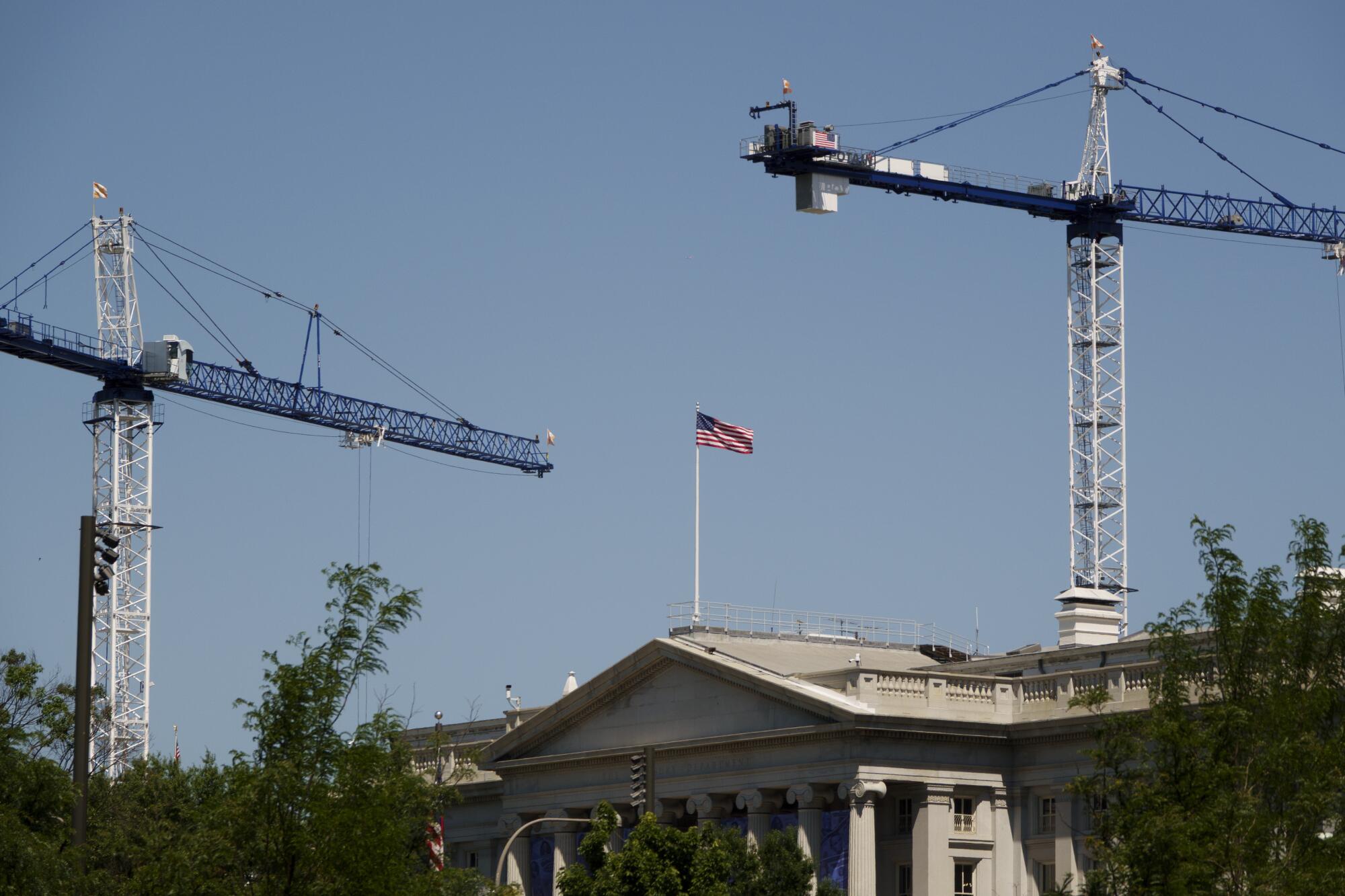
Urban design has become a preoccupation for Trump since the start of his second term. Cranes dot the skyline of the city, and construction fences block access to many of its most cherished parks and venues less than a month before the nation celebrates 250 years since its founding on July 4.
Cranes from the White House East Wing ballroom construction project rise from behind the U.S. Treasury Department building on Thursday in Washington, D.C.
(Kevin Carter/Getty Images)
Government lawyers are defending the president’s use of the wrecking ball, arguing in court that he has unfettered power to build and destroy. Should he ever choose to tear down the Statue of Liberty, the Justice Department told a judge Friday, no one could stop him.
Yet a recent series of legal setbacks, as well as increasing Republican opposition on Capitol Hill, have cast doubt on the fate of his most lavish designs, including the construction of an imposing ballroom at the White House and the erection of a massive triumphal arch on the sightline of the National Mall.
It’s become a race against time for the president, who could soon confront a Democratic-controlled Congress armed with renewed oversight authority and subpoena power, further gumming the works of elaborate construction projects, which could stymie their completion before he leaves office.
“This is very much on the committee’s radar,” said one Democratic source with the House Oversight Committee, citing “serious concerns surrounding corruption.”
Visitors at the Mall gather in front of the Lincoln Memorial and near the Reflecting Pool, which is under renovation on Friday in Washington, D.C. President Trump dismissed criticism of the recent Lincoln Memorial Reflecting Pool renovations, rejecting claims the project amounted to merely a “paint job.”
(Roberto Schmidt / Getty Images)
Trump as ‘builder-in-chief’
Several of Trump’s more modest initiatives, referred to by the administration as beautification projects, are complete or well underway.
At the White House, a historic rose garden conceived by Jacqueline Kennedy was paved over, and its adjoining colonnade refurbished with black granite and gilded presidential portraits. The Palm Room foyer was decked in marble and chandeliers. New flagpoles fly supersized American flags on the North and South lawns.
The en suite bath of the Lincoln Bedroom in the residence has been gutted and renovated. And the Oval Office now practically drips in gold, while an adjoining study, once used by Franklin Roosevelt to scrutinize war maps and Lyndon Johnson to monitor the space race, was converted into the president’s personal swag shop.
A temporary Ultimate Fighting Championship arena constructed on the White House South Lawn is another example of how Trump is leaving a visual mark on the presidential residence. The structure, which towers over the White House, was paid for by the UFC, which is scheduled to host a series of fights on the premises.
Outside the White House complex, fountains across the city are coming back to life after decades of neglect, from DuPont Circle to Freedom Plaza and Union Station. The idyllic Logan Circle, surrounded by historic mansions, is being revitalized by the National Park Service, as is Lafayette Square, the site of an infamous clash between Trump and protesters shortly after George Floyd’s murder in 2020.
1
2
1.National Park Service Conservator for the National Mall and Memorial Parks Ali Cavicchio puts a clear coat over the recently repainted “I Have a Dream” marker at the Lincoln Memorial on June 05, 2026 in Washington, DC. The marker’s letters are carved into stairs of the Lincoln Memorial where Dr. Martin Luther King Jr. stood and delivered his “I Have A Dream” speech in 1963.(Chip Somodevilla / Getty Images)2.Members of the West Branch Area School District in Morrisdale, Pennsylvania, student marching band perform at the Lincoln Memorial on the National Mall on June 05, 2026 in Washington, DC.(Chip Somodevilla / Getty Images)
In some parks, even the turf is getting a makeover.
“People are all thanking me because Washington is beautiful again,” Trump told reporters last week. “The parks are open, we changed the grass. You know, grass has a life, also. Like people, grass has a life, and that grass hasn’t changed in 70 or 80 years.”
On Friday morning, several people sat by the restored cascading fountain at Meridian Hill Park. They walked their dogs, read books and exercised by the water.
Jean Luc, 33, was one of them. As he took a stroll with his 2-month-old daughter, Juno, he said it had been nice to see the government fix up the park, which he says he tries to enjoy with his daughter daily.
“It’s been nice to see the whole process,” he said. “I love it.”
President Trump displays a chart titled “Our Pool is Bigger than Skyscrapers” while discussing his renovations to the Lincoln Memorial Reflecting Pool on Wednesday in the Oval Office.
(Kevin Dietsch / Getty Images)
The Lincoln Memorial Reflecting Pool has been painted over in “American Flag Blue” by a firm that Trump said had worked on the swimming pool at his golf club in Virginia. Millions will be spent to regild the hulking Art Deco statues that buttress Arlington Memorial Bridge. And Trump has plans to connect the Lincoln Memorial to the Potomac River by building a promenade, one of many projects he has said may be named after himself.
Federal contracting data show that the Virginia firm Terra Site Constructors has been awarded roughly $60 million in contracts from the National Park Service to complete work on the various fountain rehabilitation projects across the city.
Another Virginia firm, Atlantic Industrial Coatings, holds a contract for $14.2 million to paint the reflecting pool.
The funding for both contracts comes from the entrance fees paid by national park visitors.
“How fortunate are we to have the builder in chief?” Interior Secretary Doug Burgum said Thursday in the Oval Office. “Someone who both has the vision and the understanding of how to get projects done that would make our city safe and beautiful.”
Construction continues on the White House East Wing ballroom on May 29, 2026.
(Kevin Carter / Getty Images)
‘The finest ballroom anywhere in the world’
Yet other, more controversial projects, exacting irreversible change to capital institutions, are facing greater opposition.
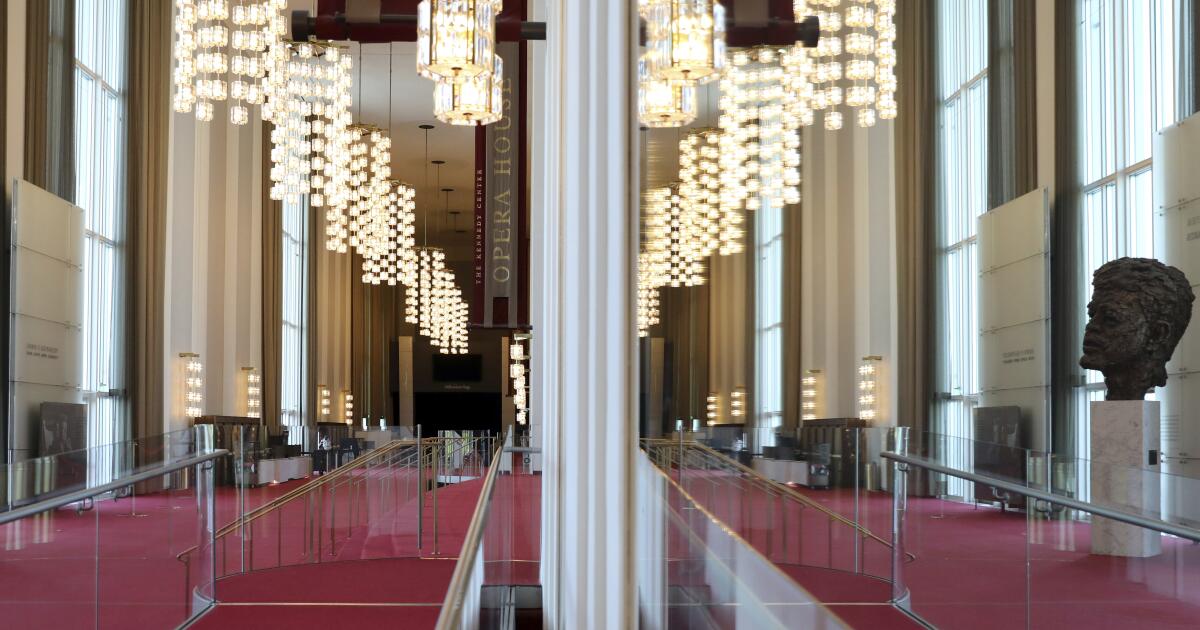
On Thursday, the Kennedy Center for the Performing Arts directed its staff to begin removing Trump’s name from its facade after a judge ruled that the attempted name change, and his effort to close the venue for two years of dramatic renovations, were illegal.
Angered by the court’s decision, Trump directed the Commerce Department to make arrangements to transfer control of the Kennedy Center to Congress. The move would give lawmakers power over the center’s operations, maintenance and management. It was originally an act of Congress that gave the Kennedy Center its name and mandate.
In other areas of the city, preservationists have successfully delayed the president’s bid to paint over the natural gray granite of the Eisenhower Executive Office Building. And Republican lawmakers have refused to vote to fund the construction of a ballroom at the White House that has already laid waste to the East Wing and, if completed, would dwarf the landmark residence.
Construction crews began tearing down the East Wing in October to make way for the 90,000-square-foot facility. Trump, who built a career as a real estate developer, has frequently touted the project, gushing over the sounds of jackhammers and excavation trucks.
Construction continues on the White House South Lawn on June 1, 2026, for an upcoming UFC match. President Trump is hosting a UFC match on the White House grounds to mark the nation’s 250th birthday.
(Kevin Carter / Getty Images)
“Oh, that’s music to my ears. I love that sound,” Trump told Republican senators at a White House event last fall. “A lot of people don’t like it. When I hear that sound, it reminds me of money.”
The ballroom project was initially expected to cost $200 million, a price that has since doubled. It is being financed by private donors and Trump, who has called it a “gift to the United States.”
“We are building what will be the finest ballroom anywhere in the world,” the president said last month.
More than half of the publicly identified donors of the ballroom projects — 14 of the 27 known corporate contributors — have won new or bigger federal contracts worth more than $50 billion in the six months since construction began, according to a report released by Public Citizen, a watchdog group.
“These giant corporations aren’t funding the Trump ballroom fiasco out of the goodness of their hearts,” said Jon Golinger, a public policy advocate at Public Citizen and author of the report. “They have massive interests before the federal government and they hope to curry favor with, and receive favorable treatment, from the Trump administration.”
White House military aides stand next to the giant mirror that hangs along the Rose Garden Colonnade at the White House on May 21, 2026.
(Chip Somodevilla / Getty Images)
The White House has challenged the report’s assertions, saying critics of how the project is being funded are “only people who suffer from a severe and incurable disease known as Trump Derangement Syndrome.”
“President Trump is making the White House beautiful and giving it the glory it deserves at no cost to taxpayers — something everyone should celebrate,” White House spokesman Davis Ingle said in a statement.
The report came out as the ballroom project has faced persistent hurdles in court and Congress.
The National Trust for Historic Preservation sued to stop construction, arguing the administration had not followed the legally required review process and had not secured congressional approval. In March, a federal judge halted aboveground construction, but an appeals court quickly allowed work to resume through June while the case proceeds.
On Friday, the panel heard the case and expressed skepticism about Trump’s push to build the ballroom without congressional approval.
On Capitol Hill, Senate Republicans dropped a proposal to set aside $1 billion in security funding for the ballroom after several GOP senators said it lacked the votes to pass.
Trump has insisted the funding is not necessary to complete the project, though he said it would help secure the complex. Without it, he told reporters last month, “the White House won’t be a very secure place.”
(Los Angeles Times photo illustration; Photo by Kevin Dietsch / Getty Images)
Arc de Trump
The president is also seeking to build a 250-foot-tall “triumphal arch” near Arlington National Cemetery, across the Potomac River at the foot of Memorial Bridge.
Renderings show the arch would be twice the height of the Lincoln Memorial, crowned by a golden statue of Lady Liberty sporting outstretched wings. An observation deck on its roof would offer sweeping views of the city.
Preservationists have criticized the plan as disrupting a sacred sightline between the memorials to Abraham Lincoln and Robert E. Lee, designed as a statement of unity after the Civil War. Even advocates of adding an arch in Washington have criticized the size of Trump’s proposed structure as overbearing. And a group of Vietnam War veterans has sued to try to stop its construction, arguing the project lacks congressional approval and would “dishonor their military and foreign service” because it would block the view of the cemetery.
Commission of Fine Arts member Pamela Hughes Patenaude, left, hands colleague Matthew Taylor a model of President Trump’s proposed triumphal arch to commemorate the country’s 250th anniversary during the commission’s public meeting at the National Building Museum in Washington on April 16, 2026.
(Andrew Harnik / Getty Images)
Despite public opposition, the National Capital Planning Commission last week advanced the project in its review process.
Trump praised the planning commission’s support, saying that “when completed, it will be, without question, the Greatest Arch of them all!”
The president has yet more plans to leave his mark — in some cases with his name, in others with his face.
Transportation Secretary Sean Duffy has proposed a $22-billion overhaul of Dulles International Airport outside the capital that would include a new terminal brandishing Trump’s name. Limited-edition U.S. passports will feature his portrait. And the Treasury has plans to mint a $250 bill featuring Trump’s mugshot from his 2023 Fulton County arrest, pending congressional approval — an unlikely prospect.
A walkway with the numbers “45” and “47” leading to construction on the new ballroom extension of the White House in Washington, D.C., on May 19. President Trump said a military hospital and research facilities will be built on the site of his planned White House ballroom, offering more details about the scope of the sprawling, controversial project.
(Samuel Corum/Bloomberg via Getty Images)
In a moment that went viral on social media, Sen. Jon Ossoff (D-Ga.), who is generating buzz over a potential run for the Democratic presidential nomination in 2028, offered a theory on what’s driving the president.
“He’s trying to put his face on the money. He’s building a monument to himself,” Ossoff told a crowd of supporters.
“But see, Atlanta, he’s doing these things now because no one will honor him when he’s gone,” he added, “because he’s a failed president and a national disgrace.”
Wilner reported from Los Angeles and Ceballos from Washington. Times staff writer Ben Wieder contributed to this report.
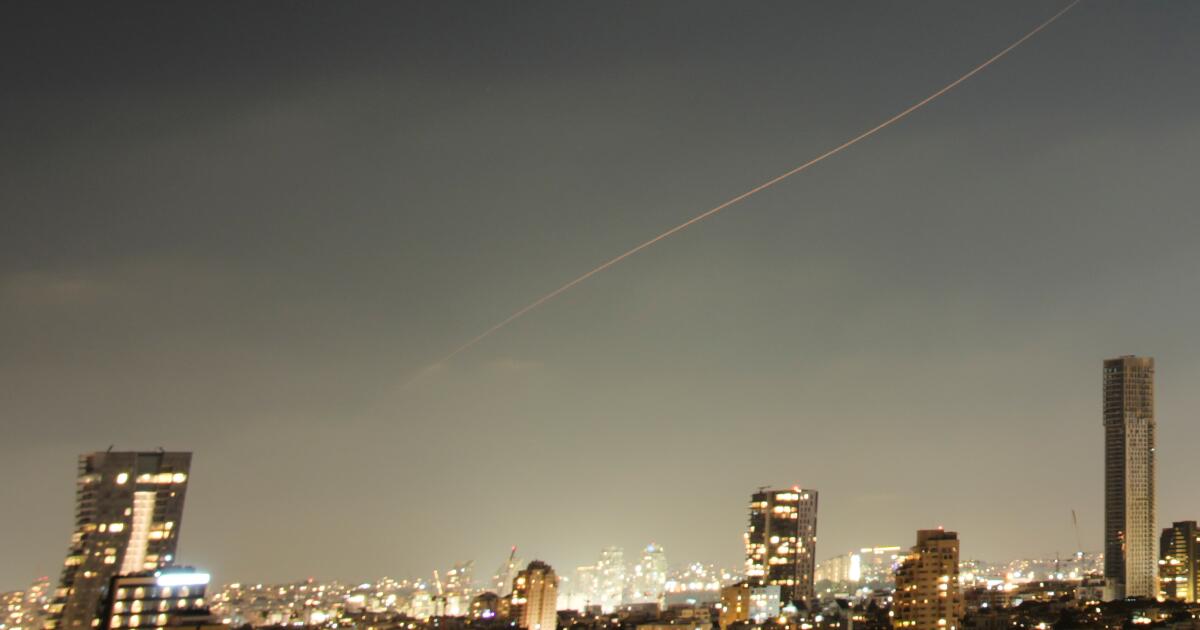
BEIRUT — Israel and Iran traded fire on Monday, all but derailing a brittle two-month ceasefire that had largely stopped the fighting in the U.S and Israel’s assault on Iran.
The tit-for-tat attacks between the two sides threaten to widen the scope of a conflict that has already killed and wounded thousands, displaced more than a million people and rattled economies across the globe — even while embroiling the U.S. in a war with no clear off-ramp.
“Israel and Iran must immediately stop ‘shooting.’ ” wrote President Trump early Monday on his social media platform, Truth Social.
Later, he wrote, “Both sides, Israel and Iran, are looking to do an immediate CEASEFIRE!”
“Final negotiations on ‘Peace’ are proceeding, subject to ignorance or stupidity getting in its way. The Blockade will remain in place, and in full force and effect, until a ‘Final Deal’ is reached. Things should move quickly.”
The latest escalation came after Israel attacked the suburbs of Lebanon’s capital Beirut on Sunday in what it said was a targeted strike against Hezbollah, an Iran-supported paramilitary faction and political party.
In recent days, Iran conditioned a ceasefire agreement with Israel and the U.S. on a cessation of hostilities across all fronts, including Lebanon, threatening it would respond to any Israeli action on the Lebanese capital. Israel rejects linking both battlefields, and insists on having a free hand to attack Hezbollah.
A number of U.S.-brokered ceasefires between the Lebanese and Israeli governments — but without Hezbollah involvement — failed to stop most of the fighting, with Israeli warplanes pounding wide swaths of Lebanon’s south while Hezbollah launched drones and missiles on northern Israel. Nevertheless, the Lebanese government has rejected being included in Iran’s negotiations with the U.S.
By Sunday night, Iran’s threats came to pass with several waves of Iranian ballistic missiles, which caused no injuries and were the first Tehran had fired at Israel since a ceasefire took hold in April. Iran’s military said the fusillade was a warning. But Israel said it would retaliate.
President Trump initially downplayed the Iranian attack on Sunday, saying in an interview with the Financial Times Iran’s barrage was “not going to have any impact on the deal.”
“We’ll see how it ends up. But they [the Iranian strikes on Israel] were attacks that did not kick at all,” he said.
“The deal may make it on its own merit, or not, but this will not have any effect on it.”
Trump also told the Axios news site he would talk to Israeli Prime Minister Benjamin Netanyahu to stop him retaliating against Iran’s barrage.
He also told the Financial Times that Netanyahu “won’t have any choice” but to accept the deal Trump negotiates with Iran.
“I call the shots. I call all the shots. He [Netanyahu] doesn’t call the shots,” Trump said.
Yet by the early morning on Monday, dozens of Israeli warplanes were striking western and central Iran. They hit a petrochemical complex in Mahshahr in southwestern Iran, and waged extensive strikes on “strategic defense systems,” according to Israeli military statements, in what observers said was a prelude to a wider offensive. Residents in Tehran, Isfahan, Tabriz and Shiraz reported powerful explosions.
The Israeli military said in a statement it expected several days of fighting with Iran but was prepared for a prolonged campaign. It said the strikes on Iran were conducted by Israel on its own, but that they had been done in “full coordination” with U.S. Central Command, which also helped in intercepting Iranian missiles launched at Israel.
But that distinction appeared to matter little to Iran’s foreign ministry spokesperson, Esmail Baghaei, who said in a press conference on Monday that the U.S held direct responsibility for recent ceasefire violations and Israel’s action “cannot be looked at in isolation from the U.S.”
“No one believes the Israeli regime would take any action without coordination with the United States,” he said.
“The U.S. bears responsibility for the Israeli regime’s aggression, and it will also be responsible for the consequences of any escalation in tensions.”
Iran launched additional barrages throughout Monday, targeting Israeli airbases in Nevatim and Tel Nof and a petrochemical plant in Haifa, according to a statement from Iran’s Revolutionary Guard Corps. It added Israel was engaging in “a dangerous game by targeting civilian and oil infrastructure — a game that will now encompass all regional energy targets, with global economic consequences resting on America.”
The renewed hostilities also saw Yemen’s Houthis — who receive support from Iran and Hezbollah, and are part of a regional network of Iran-backed factions — enter the fray with a pair of ballistic missiles lobbed at Israel. The Israeli military said one of the missiles was intercepted; the second fell short of Israel.
Houthi spokesman Brig. Gen. Yahya Sarea confirmed the attack in a televised statement on Monday, and said Israeli maritime navigation in the Red Sea would be targeted.
During the Gaza war, the Houthis attacked commercial shipping in the Red Sea — including ships with no link to Israel — to pressure Israel into lifting its blockade on the enclave.
But, unlike Hezbollah, which attacked Israel on March 2, three days after the U.S. and Israeli campaign on Iran, the Houthis had refrained from helping their ally, until Monday.
Their involvement now raises the specter of another squeeze on energy markets already beleaguered by closures on the Strait of Hormuz. Since the U.S.-Israeli assault, the Red Sea has acted as the main alternative conduit for energy supplies, especially for those from Saudi Arabia. If the Houthis closed the Bab Al-Mandab Strait, it would all but paralyze commercial flows.
Oil prices spiked in the wake of the exchanges, with Brent Crude rising 5% to hit $98 a barrel.
Yariv Oppenheimer told Al Jazeera that Israeli PM Benjamin Netanyahu has incentives to escalate tensions with Iran and Hezbollah but is constrained by US President Donald Trump and US interests. He said Iran’s June 7 response was a warning, not a push for war, and doubts Trump would allow major Israeli retaliation.
Attorneys for musician Chuck Redd say a D.C. Superior Court judge dismissed a breach of contract lawsuit filed against the artist after he canceled a Christmas Eve performance at the Kennedy Center in protest of President Trump’s influence over the venue.
The dismissal was granted Friday under Washington’s Anti-SLAPP laws, which are designed to prevent meritless lawsuits intended to silence opposing points of view on matters of public interest.
Redd, a drummer and vibraphone player who has toured with Dizzy Gillespie, Ray Brown and others, had presided over holiday “Jazz Jams” at the Kennedy Center since 2006. He called off last year’s performance shortly after Trump’s handpicked board for the Kennedy Center voted to add the president’s name to the venue, which Congress named for President Kennedy after his assassination.
“The Center sued Mr. Redd because he publicly and rightly objected to adding Donald Trump’s name to the Kennedy Center, a living memorial to former President John F. Kennedy,” Lisa J. Banks, one of Redd’s lawyers, said in a statement. “The lawsuit against Mr. Redd was political retribution, pure and simple, by the Trump Kennedy Center, and the Court correctly saw it as such in dismissing the case with prejudice.”
Redd told the Associated Press in an email Saturday that he is “very pleased with the judge’s ruling.”
The motion to dismiss, filed in March, argued that Redd wasn’t contractually obligated to perform. It included the contract provided by the Kennedy Center, which the artist never signed.
Representatives for the Kennedy Center did not immediately respond to a request for comment on the suit’s dismissal.
Legal challenge claims US president did not seek proper approval for fighting event to be held on his 80th birthday.
Published On 7 Jun 20267 Jun 2026
A lawsuit is seeking to stop United States President Donald Trump from hosting an Ultimate Fighting Championship (UFC) match at the White House.
The lawsuit, lodged on behalf of two Virginia residents, is the first known legal challenge to the mixed martial arts event, which is set to be hosted on June 14.
Recommended Stories
list of 3 itemsend of list
The event will take place on Trump’s 80th birthday. It is also pegged to the 250th anniversary of the signing of the Declaration of Independence, which the US will commemorate on July 4 of this year.
The legal challenge filed on Saturday maintained that Trump did not receive proper authorisation to host the fight.
It argued that the event violated US National Park Service regulations prohibiting sporting events on federal parklands, that Congress did not consent to the construction of a towering arch overlooking the event space, and that no environmental review was conducted before the construction.
“This is fundamentally a private, commercial, corrupt use of our most sacred national monuments for private gain,” said Brendan Ballou, a lawyer for the plaintiffs. “And that is what is motivating this lawsuit.”
In a statement to the Associated Press, the White House dismissed the lawsuit as “obstructionist, baseless, and dilatory”.
The White House maintained the UFC fight was “no different than the various other White House-hosted events on the South Lawn and properly permitted events on the Ellipse and National Mall throughout the year”.
Crews have been erecting an octagon-shaped fighting cage on the South Lawn of the White House, with Trump saying the project will include a “5,000-seat arena right outside the front door of the White House”.
Attendance at the fight will be invite-only and closely monitored. The Military Times news site reported earlier this week that 1,200 service members given tickets to the event must meet certain waist-to-height ratio standards.
Public viewing areas will also be set up at the nearby Ellipse.
Trump has long been closely involved with both professional wrestling and UFC, with his casinos and event spaces hosting past events.
He regularly appeared as a version of himself in World Wrestling Entertainment (WWE) events throughout the 1990s and early 2000s. His current secretary of education, Linda McMahon, is a co-founder of the WWE.
Trump has more recently embraced UFC, which is currently owned by the same company, TKO Group Holdings, as the WWE.
UFC president Dana White has been a close ally of Trump’s.
Political analysts have credited Trump’s embrace of the sport with reaching disaffected male voters in the US, particularly during his 2024 election campaign.
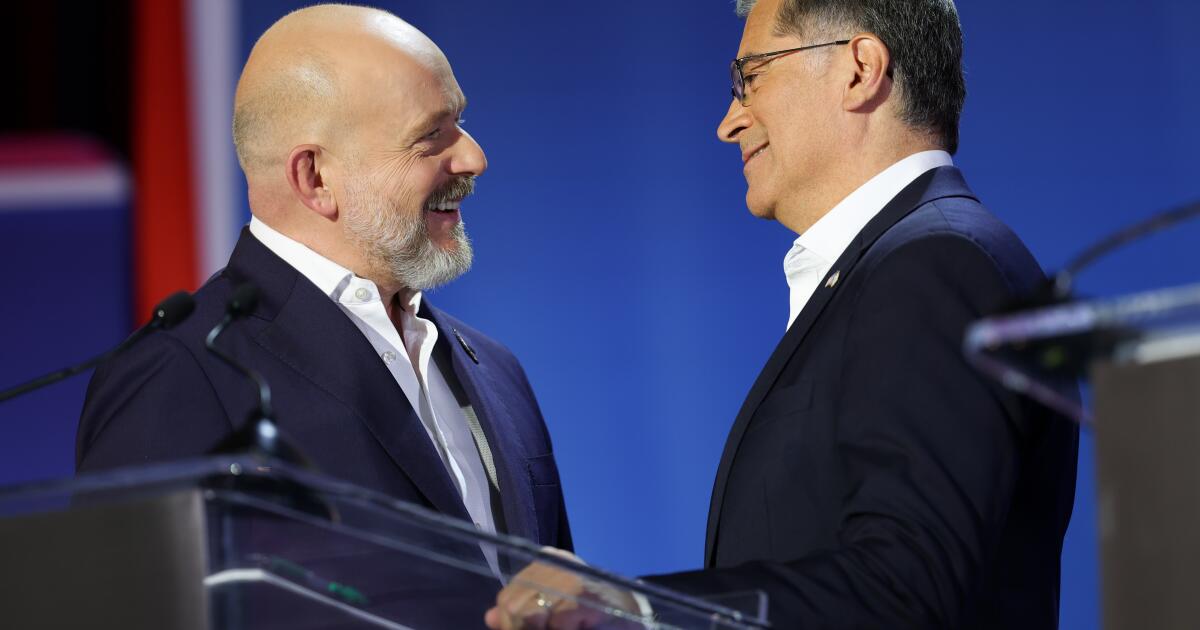
Despite an uptick in his performance, hopes for third-place finisher Tom Steyer are fading along with the number of uncounted ballots, suggesting Democrat Xavier Becerra and Republican Steve Hilton will face off in November.
Given the overwhelming Democratic advantage — both attitudinally and in registration — the outcome of the governor’s race might seem preordained. But it’s voters who decide elections, not know-it-all columnists.
Barabak: So Anita, now that the election is over how are you feeling? Relieved? Giddy? Depressed?
Chabria: Tired, with five months to go. And while it’s true neither of us can see into the future, it’s not too much of a long shot to predict that in a state where registered Democrats vastly outnumber Republicans, the next governor will likely be blue.
So while the primary was bruising and confusing, the general election will be much more predictable — it’s Becerra’s to lose, and he’d have to try really hard to do that.
But here’s what I’ll be looking for in the lead up to November: How far will Hilton go to capitalize on this moment for personal gain? There are plenty of real issues to be discussed where the Republican-Democrat divide could offer worthy debate. What should we do about gas prices? What is the right balance between environmental regulation and building housing?
That is bad for our state and bad for democracy, and it’s troubling that we will likely be subjected to these lies — and that California could be used to further erode voting rights nationally — for the entire summer leading up to the midterms.
What will you be keeping an eye on?
Barabak: How Becerra spends the next five months.
One presumes he’s smart enough not to take anything for granted. Meaning he won’t spend the time between now and Nov. 3 at some swank beach resort, sipping one of those colorful cocktails with a little paper parasol while musing over his inaugural address.
So it will be interesting to see how Becerra campaigns and whether he uses the next several months to build a mandate and also to prepare California voters for the rough road ahead.
Becerra is smart enough, one would think, not to run as Mr. Sky Is Falling and tell voters, “Boy, oh, boy things are really gonna suck going forward.” But the next governor is going to face some really tough challenges, including a structural budget deficit that’s probably going to require both painful cuts and unpopular tax hikes.
On top of that, there are the inevitable disasters, be they earthquake, fire or flood, the latter quite possibly exacerbated this winter by what may be an epic El Niño. There’s also the continued challenge of dealing with a president who treats California the way a dog regards a fire hydrant.
All of it makes you wonder why anyone would want the job — though Steyer panted after it enough to burn through more than $215 million of his fortune in a bonfire of vanity.
Universal healthcare and standing our climate ground in the face of federal rollbacks were two of Steyer’s big talking points, along with standing up to corporate influence. Becerra now inherits those thorny problems if he wants to form a more cohesive Democratic base.
Becerra hasn’t yet offered up his vision of the Golden State, as you point out. As much as it may benefit Hilton to focus on Trump in coming months, the same could be true for Becerra.
Why get into messy policy when you can run on opposing MAGA in a very blue state? I fear the next few months will be more about Trump than California.
Barabak: That’s a charitable way to look at $teyer’s campaign.
Sure, he had plenty of ideas, though I think the promise of delivering universal healthcare — a political nonstarter — was cheap pandering, not visionary leadership.
There’s no shortage of people with good ideas. The only reason anyone paid attention to Steyer, who’s never served in any elected office, was the obscene amount of money he spent on his luxury-class ego trip. So it pleases me voters didn’t reward his arrogance or buy his billionaire-turned-populist, “Amazing Grace” spiel. (“I once was blind, but now I see.”)
And I’m be gladder still that voters showed — once again — the governor’s office is not for sale.
I do agree, however, that Becerra should to more than just cry MAGA! MAGA! MAGA! for the next five months, as if that incantation is magic and will solve all our problems. That applies, by the way, to Democratic candidates everywhere.
All of that said, we should note the governor’s race has yet to be officially decided and Steyer still has at least a theoretical possibility of slipping into the top two.
Chabria: First, we’ll have to agree to disagree. California is on a healthcare cliff and even middle-class Americans (not just Californians) can’t afford either insurance or care.
Single-payer may be a dream, but it’s my dream — for my kids, for my community and for my state, because healthcare shouldn’t be just for the rich and that is increasingly the direction we are going. So any politician, Steyer included, who fights for inclusion rather than accepting exclusion will get my consideration.
And let’s be real — self-funded or corporate-funded — our elections are, to their detriment, too much about money. My outrage is for the 2010 Citizens United Supreme Court decision, which unleashed the current no-limits mess and created a system in which it requires hundreds of millions from somewhere, anywhere to run for our highest offices.
But back to ballots: Slow is not fraud. Slow is not bad if it’s accurate. Slow allows for greater voter participation by allowing mail-in ballots, and carefully checking all ballots for problems. Slow takes into account the federal mangling of the post office that has, yes, slowed down our mail.
And, slow happens because most of our county elections offices are understaffed and budget-starved. If you want fast, you’ve got to pay for it.
So keep your britches on people and don’t buy Trump’s (or Hilton’s) manufactured hype. Every system can be improved, but there’s far worse problems than slow.
What’s your take on the ballot controversy?
Barabak: Here’s one where we agree.
California goes out of its way to make it easy to vote, which, I believe, is a very good thing. Kim Alexander of the non-partisan California Voter Foundation, who’s spent decades on the matter, has suggested ways we can have both wide access and a faster count, starting with better funding of the state’s over-extended county election offices.
This prolonged count is something Gov. Gavin Newsom and the Democratic-run Legislature could have anticipated. Shame on them for not doing more to address it.
I, too, yearn for that perfect candidate who is firm but flexible, old but youthful in his or her thinking, masculine but also feminine, brilliant but not too smart and larger than life but also totally relatable.
President Donald Trump this week pardoned former U.S. Rep. Stephen Buyer, R-Ind., who was convicted in 2023 on four counts of securities fraud for stock trades about mergers that he made before the information had been made public. Photo by Shawn Thew/UPI | License Photo
June 6 (UPI) — President Donald Trump pardoned former U.S. Rep. Stephen Buyer, R-Ind., who was convicted on four counts of securities fraud in 2023 after he left Congress.
Buyer had been convicted and sentenced to 22 months in prison after he was charged with trading stock based on two mergers he knew about based on work at his consulting firm, ABC News and The New York Times reported.
The two mergers he based trades on were T-Mobile’s deal to acquire Sprint and the professional services firm Guidehouse’s deal to buy its competitor Navigant.
In a proclamation released Thursday by the White House, President Donald Trump included a list of current and former members of members of Congress, including Sens. Roger Wicker and Lindsey Graham and Reps. Pet Sessions and Jack Bergman, among several others.
“Mr. Buyer’s career serving as a judge advocate general in the United States Army and as a member of the U.S. House of Representatives from the State of Indiana was distinguished and highly productive,” Trump said.
Buyer was first elected to Congress in 1992, retired from the House in 2010 and then formed his consulting company.
The trades he made based, which were based on executives of the companies he was working for, netted him well over $330,000 in profit when he sold shares of the companies after the mergers were announced.
During his time in Congress, Buyer also was a House prosecutor during the impeaching of former President Bill Clinton in the late 1990s.
Republican Stephen Buyer was convicted and sentenced to 22 months in prison, though he has maintained his innocence.
Published On 6 Jun 20266 Jun 2026
United States President Donald Trump has issued a pardon to Stephen Buyer, a former Republican congressman from Indiana who served nearly two years in prison for making illegal stock trades based on inside information after he left office.
The pardon was dated Thursday and released by the White House late Friday night.
Recommended Stories
list of 3 itemsend of list
Buyer was sentenced to 22 months in prison in 2023 for trades made while working as a consultant and lobbyist. He was ordered to forfeit more than $350,000, representing the amount of the illegal gains, as well as pay a $10,000 fine. He was released in 2025.
The Supreme Court in May rejected Buyer’s appeal without comment or noted dissent.
In granting “a full, complete, and unconditional pardon” to Buyer, Trump cited the Republican’s work, both as a judge advocate general in the US Army and as a politician in the US House. Trump described his career as “distinguished and highly productive”.
Buyer said the pardon “corrects a politically motivated prosecution” and that it was “horrific to be imprisoned for a crime that I did not commit”. He maintains that he is innocent.
Trump used his Truth Social media platform on May 31 to share a pair of letters requesting a presidential pardon for Buyer, a lawyer and Gulf War veteran who left office in 2011.
He was a House prosecutor at Democratic President Bill Clinton’s 1998 impeachment trial, and in 2016, he served on Trump’s transition team, focusing on veterans’ issues.
A letter signed by more than 40 former Republicans in Congress said Buyer was “targeted by the deep state” because of his involvement in Clinton’s trial.
“Like you, Mr President, Steve has been the victim of lawfare conducted by the Biden Administration,” they wrote in the April 2025 letter.
A second letter, from five current House Republicans, said pardoning Buyer would bring justice to his case. The June 2025 letter was signed by Tom Cole of Oklahoma, Ken Calvert of California, Marlin Stutzman of Indiana, Jack Bergman of Michigan and Pete Sessions of Texas.
Buyer, 67, was convicted in connection with insider trading involving the $26.5bn merger of T-Mobile and Sprint, announced in April 2018, and illegal trades in the management consulting company Navigant when his client Guidehouse was set to acquire it in a deal publicly disclosed weeks later.
The US Constitution gives the president broad power to grant pardons for federal crimes.
A pardon does not erase a recipient’s criminal record but can be seen as an act of mercy or justice.