trump administration

National parks brace for summer surge as Trump administration proposes more staff cuts

When families flocked to Yosemite National Park during their recent spring breaks, some met two-hour waits at the entrance gates. At a lakeside spot in the North Cascades in Washington state, there hasn’t been enough staff to open the visitors center. And in Death Valley, water was shut off at two campgrounds.

National parks staff and advocates fear that such issues could only worsen this summer, as the park system faces the busy season with a dramatically reduced staff. At Yosemite, concerns are compounded by the National Park Service’s recent elimination of the park’s timed-entry reservation system, which led to the long spring-break lines.

“We’re definitely really nervous and anxious about the upcoming season, especially with the staff shortage we already have,” said a National Federation of Federal Employees union member at Yosemite who requested anonymity to speak candidly.

The National Park Service has lost nearly a quarter of its staff to buyouts, early retirements and other departures since the Trump administration took office last year, according to an estimate by the National Parks Conservation Assn. This month, the administration proposed cutting nearly 3,000 more positions in its 2027 budget. It also offered a recent new round of buyouts.

The push to cut the park system even further — ahead not only of peak season but of America’s 250th birthday, which the Trump administration has promoted in relation to national parks — has underscored ongoing questions about how smoothly parks can operate as warm weather and summer vacations draw tourists.

Interior Secretary Doug Burgum defended the budget proposal on Capitol Hill last week, telling senators that the visitor experience to parks can be improved even while spending and staff reductions are made.

He said the agency plans to hire 5,500 seasonal workers and asked Congress to approve funding for those employees to work for nine-month stints rather than six months.

“All of that’s going to help us get this thing in shape, even with an overall reduction,” Burgum said Wednesday.

He was met with skepticism by Democrats, who confronted him over the spending proposal.

“That is just a recipe for disaster,” Sen. Patty Murray (D-Wash.) told Burgum.

Congress will have the final say on the proposed cuts, but in the meantime, the reductions that have already occurred presented challenges last season and appear likely to do so again, said Cheryl Schreier, a retired superintendent of Mount Rushmore National Memorial and chair of the Coalition to Protect America’s National Parks.

Whether the parks will get enough qualified candidates to hire the number of seasonal workers needed is also “a really big concern,” she said. “It’s really important to have all of those individuals to be able to operate a park in a good fashion.”

Campers prepare food in Yosemite Valley last December. 9, 2025 in Yosemite, CA.

Campers prepare food in Yosemite Valley last December. 9, 2025 in Yosemite, CA.

(Eric Thayer/Los Angeles Times)

The lower staffing has prompted worry about parks’ capacity for emergency response, protection of the natural landscape and custodial maintenance. Fewer rangers could mean, for instance, fewer people to reach dehydrated, stranded or lost hikers, said Chance Wilcox, California desert director for the National Parks Conservation Assn.

A park service spokesperson said Friday that staffing decisions are made based on local conditions at each park and that the agency is “focused on ensuring parks remain open, accessible, and safe for visitors.”

About 323 million people visit America’s national parks annually, according to the Interior Department. While the parks can expect heavy traffic, a drop in international tourism and the rise in gas prices has injected additional uncertainty into the tourism industry this year.

The number of Canadians visiting the United States has dropped since Trump took office, according to the Canadian government — with the number of Canadians making car trips to the United States this March declining by 35% compared with March 2024.

The Interior Department also instituted a new $100-per-person fee for non-Americans entering 11 of the most popular parks, a move to raise money for the parks but an extra squeeze for Canadians coming across the border and other international visitors.

At the Senate and House hearings on the Interior budget, Burgum presented a vision of the national parks system as one where most employees should be working at a park and interacting with visitors, and said he was more focused on filling those roles than jobs in regional offices.

“Our goal is to have more people actually working in the parks,” he told senators.

An Interior Department spokesperson said the agency was “advancing high-priority improvements” across the system.

“Secretary Burgum has been clear that resources should be prioritized toward visitor-facing services, public safety, maintenance, and projects that improve the experience for the American people,” an Interior Department spokesperson said in a statement Friday.

Critics say that strategy displays a misunderstanding of how the 109-year-old agency functions. Employees who work on contracts, human resources, IT, communications and other organizational and administrative jobs are essential to keeping the parks running, Wilcox said.

“If everything were visitor- or front-facing, the entire agency would collapse from behind,” said Wilcox, of the National Parks Conservation Assn.

The decision to discontinue the reservation system at Yosemite — as well as at Arches and Glacier national parks — is another part of Interior’s mission to bring more people into the parks. The concept was “designed to expand public access” this summer, the park service said in announcing the policy in February. It kept the timed-entry reservation system in Rocky Mountain National Park for the peak season.

Visitors take pictures while walking through Muir Woods

Visitors take pictures while walking through Muir Woods National Monument on July 24, 2025 in Muir Woods National Monument, California.

(Justin Sullivan / Getty Images)

In addition to causing long lines, cramming too many people into the parks at once could lead to environmental damage, particularly if people park cars in natural areas, said Don Neubacher, a retired Yosemite superintendent and member of the Coalition to Protect America’s National Parks.

“It’s going to be mass chaos,” he said.

On a Saturday at the end of March, Jon Christenson of Coarsegold, Calif., drove to the park with his 38-year-old son. They were surprised to encounter a two-hour wait to get into the park, plus at least a half-hour hunt for parking after they made it through the gates, he said.

“It was almost like Disneyland. It was really uncomfortable from the standpoint of just so many people,” said Christenson, 82. “It’s kind of troubling to see that they’ve opened up the floodgates and now it’s kind of ruining the experience for everybody.”

Rangers there are doing multiple jobs, and last summer they helped clean bathrooms in the absence of custodial staff, the Yosemite union member said. Now they, too, are concerned about the potential for gridlock.

The worker asked summer visitors to bring patience: “The folks at the National Park Service … they will be grateful for any compassion and empathy.”

Source link

Will Trump’s reclassifying of medical marijuana have any effect on criminal justice reform?

The Trump administration’s historic move to reclassify state-licensed medical marijuana as a less-dangerous drug was cheered by some advocates but for others, it fell far short for the thousands still incarcerated on federal cannabis-related convictions.

The executive order, which acting Atty. Gen. Todd Blanche signed Thursday, does not address current penalties for possessing and selling marijuana or those jailed with yearslong sentences.

“While this is a victory, the fight is far from over,” said Jason Ortiz, director of strategic initiatives for the Last Prisoner Project, a nonprofit focused on cannabis criminal justice reform.

Proponents of legalizing marijuana as well as overhauling prison sentencing say this order, which does not completely decriminalize the drug, benefits only cannabis researchers, growers and others in Big Weed. Meanwhile, thousands — many of whom are people of color — are stuck serving harsh sentences for marijuana-related offenses. Or they have served their time but having a conviction on their record has made life difficult.

Now, advocates are calling on Congress and state lawmakers to take concrete steps to ensure those with marijuana-related convictions receive fair treatment or be forgiven altogether.

Prisoners and their families look for hope

Blanche’s order reclassifies state-licensed medical marijuana as a less-dangerous drug. The major policy shift, which both Presidents Obama and Joe Biden had considered, means cannabis won’t be grouped with drugs like heroin.

But it does not legalize marijuana for medical or recreational use. It shifts licensed medical marijuana from Schedule I — reserved for drugs without medical use and with high potential for abuse — to the less strictly regulated Schedule III. This will likely give licensed medical marijuana operators and cannabis researchers a major tax break and less stringent barriers to doing normal business.

Virtually no one imprisoned at the federal level is there solely for marijuana possession. But many are there for large-scale possession, trafficking offenses or both.

Hector Ruben McGurk, 66, has been serving life without the possibility of parole since 2007 for transporting thousands of pounds of marijuana and money laundering. He is currently imprisoned in Beaumont, Texas, over 800 miles from his son’s El Paso home. His incarceration has been hard on his son, said McGurk’s daughter-in-law, Ferna Anguiano. And the distance makes visits logistically difficult.

So it’s tempting to see this order as a glimmer of hope, given that the family believes McGurk’s punishment far outweighs his crimes. But Anguiano has no idea how to navigate lobbying for his release.

“His release date is death,” Anguiano said. “I mean, we see all this stuff on the news — bigger cases, fatal cases — and people are going in and out of prison and coming out to their families.”

They try to keep in touch through phone calls and a prison texting service. They’re concerned about McGurk’s health and his diabetes management. It would be a dream come true for him to come home.

“He deserves a second chance,” Anguiano said. “Yes, it was a poor decision he did in his lifetime. He was younger. But he is not a bad person. I think it’s fair to say he has served enough time for it.”

It’s not clear whether punishments would be different had marijuana always been scheduled differently, drug policy experts say.

“In addition to schedule-specific penalties, there are marijuana-specific penalties that have nothing to do with the schedule,” said Cat Packer, director of drug markets and legal regulation at the nonprofit Drug Policy Alliance. “Even if marijuana were to be moved to Schedule V, those criminal penalties would still exist and there are mandatory minimums for simple possession.”

Racial disparities exist in convictions and Big Weed

Destigmatizing marijuana has long been an issue for both political parties. Obama commuted the sentences of about 1,900 federal prisoners, almost all of whom were incarcerated for nonviolent drug crimes. Biden pardoned 6,500 people convicted of use and simple possession of marijuana on federal lands and in the District of Columbia. President Trump’s administration has taken far fewer drug clemency actions and does not have an overarching policy directing such actions.

“What many people on the right and the left would like is to move marijuana from this ‘just as bad as heroin’ category and to just sort of de-schedule it entirely,” said Marta Nelson, director of sentencing reform at the Vera Institute of Justice. “Regulate it like you do alcohol or tobacco.”

Studies show Black Americans are roughly 3.7 to 4 times more likely to be arrested for marijuana possession than white Americans, despite usage rates being roughly the same across racial groups. Federal-level marijuana cases are pretty small today, but those serving sentences for federal drug offenses are overwhelmingly Hispanic and Black, according to Justice Department and Bureau of Justice Statistics data.

The racial disparity with drug convictions is reminiscent of 2010 legislation Obama signed reducing the gap between mandatory sentences for crack cocaine versus powder cocaine. In 2018, Trump made it apply retroactively.

Because business owners with state medical marijuana licenses are predominantly white, the tax relief created by the rescheduling will also likely give a leg up to mostly white businesses, Packer said. A lot of equity programs won’t apply.

“This is going to, in my mind, widen the gap, the financial disparities, the business disparities that currently exist between Black and brown, Latino and white owners in the cannabis industry because licenses were not distributed equitably,” Packer said.

Possible next steps for marijuana convictions

In theory, Trump could issue a blanket pardon like he did for Jan. 6 rioters. But Nelson thinks that is highly doubtful.

“Having marijuana convictions on the record for things like mass immigration enforcement is helpful to the administration,” Nelson said.

An impactful next step would be for Congress to outline very comprehensive legislation addressing existing marijuana-related convictions, expungements and industry regulations, she added.

The Last Prisoner Project and other organizations are planning to renew a dialogue with federal lawmakers, including the Congressional Cannabis Caucus, which includes Democratic Rep. Ilhan Omar of Minnesota and Republican Rep. David Joyce of Ohio. They will also continue to lobby for Trump to conduct a large-scale act of commutation and clemency.

Advocates are also hoping Trump’s order will prompt every state to rethink their marijuana classification and penalties.

“It is imperative that every state review their situation, as a lot of their controlled substances at the state level are tied to the federal government,” Ortiz said. “We’re gonna see other states that are going to need a little help from the public to remind them what the right thing to do is.”

Tang writes for the Associated Press.

Source link

Trump administration flies 10-year-old back from Cuba amid custody fight involving gender identity

President Trump’s administration took the unusual step this week of sending a government plane to Cuba to return a 10-year-old from Utah who is at the center of a complicated and contentious custody fight involving the child’s gender identity.

The child’s parent, Rose Inessa-Ethington, a transgender woman, is accused of taking the child to Cuba without the permission of the biological mother. Federal and state authorities sought the return of the child after a family member expressed concern that Inessa-Ethington went to Havana to get the child gender transition surgery.

Inessa-Ethington, who had run a popular Utah political blog in the 2010s, was arrested along with her partner, Blue Inessa-Ethington, and charged in the U.S. with international parental kidnapping.

The couple traveled with the child to Canada ostensibly for a camping trip in late March with Blue’s 3-year-old child. However, the two adults turned off their phones after telling the older child’s mother they had arrived in Canada. They flew from Vancouver to Mexico and then to Cuba on April 1, according to a criminal complaint filed Monday in federal court in Utah.

The charges don’t say if the couple actually planned on getting the child gender-affirming surgery in Cuba or how they would get it because that surgery isn’t legal for children in Cuba.

The FBI said that Blue Inessa-Ethington withdrew $10,000 from her checking account before leaving. Agents also found at their home a note with instructions from a mental health therapist in Washington, D.C., “to send the therapist the $10,000.00 and instructions on gender affirming medical care for children.” That note didn’t mention Cuba.

The use of the Department of Justice plane in a parental kidnapping investigation comes after the Trump administration sought to block access to gender-affirming care for minors and pressured healthcare providers over the issue.

The Associated Press left telephone and email messages with the court-appointed attorneys who represented Blue and Rose Inessa-Ethington in Virginia. The defendants will be returned to Utah to face one count each of international parental kidnapping, according to court filings.

Search began after child wasn’t returned as scheduled

The search for the child began on April 3 when they were not returned to the mother in Utah as scheduled, court documents show.

The 10-year-old’s mother, who was divorced from Rose Inessa-Ethington and had shared custody of the child, filed a missing-person report with police in Logan, Utah, a college and dairy farming town about 70 miles north of Salt Lake City.

Logan City Police Chief Jeff Simmons said his department’s initial focus was on the custodial interference allegations in the case, and he said investigators did not learn until later about concerns over gender-affirming surgery.

Logan police spokesperson Sgt. Brandon Bevan said those concerns were raised by one family member. He declined to say who.

“They just had the concern about it, no actual physical evidence,” Bevan said.

A Utah state judge ordered the return of the 10-year-old to the child’s mother on April 13. Three days later, a federal magistrate judge issued an arrest warrant for the Inessa-Ethingtons. On the same day, Cuban law enforcement located the group. They were deported to the U.S. aboard the government plane Monday and arraigned in federal court in Richmond, Va.

The 10-year-old was returned to the child’s biological mother, First Assistant U.S. Atty. Melissa Holyoak in Utah indicated in a statement. Representatives of the FBI and U.S. attorneys office in Utah declined to say what happened to the 3-year-old child who had been with the group.

Parents engaged in custody dispute

The custody dispute between the parents does not appear to be a new development. An online fundraiser created five years go by Blue Inessa-Ethington titled “Help a Trans Mother Keep Custody of Her Child” raised $9,766.

“Last week, Rose’s ex relocated several counties away, negatively impacting Rose’s parent-time with the child,” she wrote on the fundraising page. She said the money would be used to seek a court order that would keep the child “safe and stable throughout this process.”

Anyone who has spent time with Rose knows “how much care and thought she puts into parenting her gender open child,” she wrote.

Family members said the child was assigned male at birth but identifies as a girl because of what they believed to be “manipulation” by Rose Inessa-Ethington, according to an April 16 affidavit from FBI Special Agent Jennifer Waterfield.

Gender-affirming care for minors has been limited

The Trump administration moved in December to cut off gender-affirming care for minors, prompting a third of states to sue.

It was the latest in a series of clashes between an administration that says transgender healthcare can be harmful to children and advocates who say it’s medically necessary.

Gender-affirming surgery is rare among U.S. children, research shows. Guidance from several major medical organizations calls for caution around surgery for minors and says decisions about treatments are case-by-case. Fewer than 1 in 1,000 U.S. adolescents receive gender-affirming medications, such as hormones or puberty blockers.

In Cuba, gender-affirming surgeries are banned for minors and performed only for adults through the public health system under strict supervision in designated public hospitals for Cuban citizens. They must be authorized by a medical commission after a comprehensive review of the patient’s file. That process often takes years because it requires a wide range of medical and psychological evaluations.

Brown, Boone and Schoenbaum write for the Associated Press. Brown reported from Billings, Mont., and Boone from Boise, Idaho. AP journalists Eric Tucker in Washington, Cristiana Mesquita in Havana and Devi Shastri in Milwaukee contributed to this report.

Source link

Justice Department to allow firing squads for executions in move to ramp up capital punishment

The Justice Department will adopt firing squads as a permitted method of execution as the Trump administration moves to ramp up and expedite capital punishment cases, officials said Friday.

The Justice Department is also reauthorizing the use of single-drug lethal injections with pentobarbital that were used to carry out 13 executions during the first Trump administration — more than under any president in modern history. The Biden administration had removed pentobarbital from the federal protocol over concerns about the potential for unnecessary pain and suffering.

The moves were announced as part of a broader push to step up federal executions after a moratorium under the Biden administration. Only three defendants remain on federal death row after Democratic President Biden converted 37 sentences to life in prison, though the Trump administration has so far authorized seeking death sentences against 44 defendants.

“The prior administration failed in its duty to protect the American people by refusing to pursue and carry out the ultimate punishment against the most dangerous criminals, including terrorists, child murderers, and cop killers,” Acting Atty. Gen. Todd Blanche said in a statement. “Under President Trump’s leadership, the Department of Justice is once again enforcing the law and standing with victims.”

The federal government has not previously included firing squad as a method of execution in its protocols, according to the Death Penalty Information Center. Five states currently allow executions by firing squad: Idaho, Mississippi, Oklahoma, South Carolina, and Utah.

The pentobarbital protocol was adopted by William Barr, attorney general during Trump’s first term, to replace a three-drug mix used in the 2000s, the last time federal executions were carried out before Trump’s first term in office.

Atty. Gen. Merrick Garland in the final days of the Biden administration withdrew the pentobarbital lethal injection policy after a government review of scientific and medical research found there remains “significant uncertainty” about whether its use causes unnecessary pain and suffering.”

In 2020, under Barr’s leadership, the Justice Department published a rule in the Federal Register to allow the federal government to conduct executions by lethal injection or use “any other manner prescribed by the law of the state in which the sentence was imposed.”

A number of states allow other methods of execution, including electrocution and inhalation of nitrogen gas.

The Trump administration, in a report released Friday, said the Biden administration “got the standard and the science wrong.” The Biden administration’s findings, among other things, “failed to address the overwhelming evidence” that a person injected with pentobarbital “quickly loses consciousness — rendering him unable to experience pain,” the report said.

Currently on death row are are Dylann Roof, who carried out the 2015 slayings of nine Black members of Mother Emanuel AME Church in Charleston, S.C.; 2013 Boston Marathon bomber Dzhokhar Tsarnaev; and Robert Bowers, who fatally shot 11 congregants at Pittsburgh’s Tree of Life synagogue in 2018, the deadliest antisemitic attack in U.S history.

Richer writes for the Associated Press.

Source link

Civil rights groups condemn Southern Poverty Law Center’s indictment and prepare for legal fights

The criminal indictment of the Southern Poverty Law Center this week was met with much outrage but little surprise from civil rights leaders, who have for more than a year prepared for heightened legal scrutiny from the Trump administration, and how to mount a coordinated response.

In rounds of calls immediately following the indictment, civil rights leaders discussed how to support the SPLC, a Montgomery, Ala.-based civil rights group founded in 1971 that has tracked white supremacist groups and been outspoken on voting rights, immigration and policing. Organizers on one call agreed that winning in the court of public opinion would be crucial as judicial proceedings began, leading to dozens of public statements of support and planned rallies.

And legal advisors to civil rights groups urged organizers to prepare themselves for similar criminal indictments, protracted legal action that may exhaust their resources and audits of their staff and internal documents.

The flurry of behind-the-scenes coordination represented a marked escalation and mobilization of plans for activist groups that have been at odds with the Justice Department since President Trump’s return to the White House last year. Organizers say they are prepared to back the SPLC in its legal fight.

“It’s a blatantly obvious attack on civil rights and civil liberties to whitewash the foot soldiers of the great replacement theory and other extremists. This coalition isn’t going silent,” said Maya Wiley, president and chief executive of the Leadership Conference on Civil and Human Rights, an umbrella organization of hundreds of civil rights groups.

Without addressing the indictment, a coalition of more than 100 activist groups on Tuesday published a letter vowing solidarity with groups that are “unjustly targeted” by the federal government. SPLC was a signatory to the pact.

“An attack on one is an attack on all,” the coalition declared. “We will share knowledge, resources, and support with any organization threatened by abuses of power.”

DOJ alleges criminal conduct in SPLC’s longtime informant network

The Justice Department alleges that the SPLC, which rose to prominence for its work prosecuting and tracking hate groups like the Ku Klux Klan, violated federal law through its network of paid informants in extremist groups. The DOJ claims the payments funded hate groups and misled the SPLC’s donors.

The SPLC now faces charges of wire fraud, bank fraud and conspiracy to commit money laundering in the case brought in the federal court in Alabama, where the organization is based.

“The SPLC is manufacturing racism to justify its existence,” said acting Atty. Gen. Todd Blanche at a news conference announcing the charges. Blanche promised the department “will hold the SPLC and every other fraudulent organization operating with the same deceptive playbook accountable.”

Longtime civil rights activists found the claims to be a disingenuous and partisan move that may empower extremist groups.

“The indictment is nakedly political and represents the Justice Department turning on itself,” said Marc Morial, president of the National Urban League. “It places the Justice Department in the posture of, in effect, defending white supremacist groups like the Ku Klux Klan and others.”

Advocates also view the indictment as part of the administration’s broader upending of civil rights law and the Justice Department’s prosecution of Trump’s political opponents.

The SPLC in recent years became a bogeyman among conservatives who resented that the watchdog designated several rightwing organizations that engage in Republican politics as hateful or extremist.

In October, FBI Director Kash Patel canceled the agency’s longtime anti-extremism partnerships with the SPLC and the Anti-Defamation League, which combats antisemitism. Patel at the time called the SPLC a “partisan smear machine.”

The Justice Department and SPLC did not respond to requests for comment.

Indictment represents marked shift for civil rights work

Advocates dispute the DOJ’s characterization of the SPLC’s work, which civil rights activists credit to combating extremist groups across the country.

“The problem is that the indictment essentially claims that it was a fraud on SPLC’s donors to use their funds to fight the Klan, the neo-Nazis and other white supremacist groups, when that is exactly why people gave to the organization,” said Norm Eisen, founder of Democracy Defenders Action, a legal group that works with organizations in legal disputes with the Trump administration.

Eisen added: “The notion that there’s something wrong with using informants and protecting their identities to prevent white supremacist violence is belied by the fact that that is not only what the SPLC did, but it is also the stock and trade of the FBI itself.”

Civil rights organizations are now preparing for further legal action against other organizations that disagree with or actively oppose the Trump administration. Organizations have reviewed their document retention, tax compliance and auditing policies over the last year to safeguard against any probes or lawsuits.

Some civil rights organizations have also floated creating new organizational structures that may better withstand legal scrutiny. On another recent call, activists floated restructuring some groups into for-profit entities, or potentially crafting new financial conduits for donors to give through to ensure that staff could receive pay if an organization’s assets were seized or frozen.

The preparations represent a marked shift for many civil rights leaders, who in recent years counted the Justice Department under both Democratic and Republican administrations as a reliable ally in key civil rights battles.

“What we are seeing in real time is an administration seeking to leverage its position to target individuals and organizations that do not agree with its political thought,” said NAACP President Derrick Johnson, who said the Justice Department has been “weaponized by dangerous forces.”

But for other leaders, the SPLC indictment raised the specter of a return to a previous era, when the Justice Department monitored — and at times prosecuted — civil rights leaders to disrupt their activities.

“We’re not backing down, but we are clear-eyed. Everyone could be in some form of jeopardy if you’re in the crosshairs of this administration,” said Juan Proaño, CEO of the League of United Latin American Citizens, a civil rights group suing the Trump administration over executive orders addressing birthright citizenship and mail-in voting.

“That’s what they’re looking for; they want this to have a chilling effect,” Proaño said.

Brown writes for the Associated Press.

Source link

Bass, Barger meets with Trump to push for L.A. fire recovery funds

Los Angeles Mayor Karen Bass and L.A. County Supervisor Kathryn Barger met privately with President Trump and administration officials Wednesday to press for federal support and yet-unpaid wildfire recovery funding as the region continues to rebuild from the 2025 fires.

“This afternoon we met with President Trump and Administration officials to advocate for families who lost everything,” Bass and Barger said in a statement. “We had a very positive discussion about FEMA and other rebuilding funds as well as the support of the President to continue joining us in pressuring the insurance companies to pay what they owe — and for the big banks to step up to ease the financial pressure on L.A. families.”

Barger said the two leaders had a “high-level discussion” with the president in the Oval Office, sharing stories about what fire survivors are experiencing day to day. She added that “we left details behind with the President,” but did not specify whether Trump made any funding or policy promises during the meeting.

“First and foremost, today’s meeting was to thank the President for his initial support of infusing federal resources to expedite debris removal, as well as his recent tweet about insurance companies, which have already proven fruitful,” she said in a statement provided to The Times.

Bass was similarly reserved about the discussions, telling reporters that “we will follow up with the details,” but signaled progress is being made on federal support.

“I think what’s important is that we certainly got the president’s support in terms of, you know, what is needed, and then the appropriate people were in the room for us to follow up. And that was Russ Vought, who is the head of the Office of Management and budget,” Bass told KNX on Wednesday.

The meeting comes on the heels of a yearlong standoff between California leaders and the Trump administration over wildfire recovery funding, disaster response and whether the federal government should have a say in local rebuilding permitting.

California leaders, led by Gov. Gavin Newsom, have accused the Trump administration of withholding billions in critical wildfire aid, prompting a lawsuit over stalled recovery funds. Officials allege political bias in the delay of billions of dollars from the Federal Emergency Management Agency.

Newsom visited Washington in December. When he made his rounds on Capitol Hill, he met with five lawmakers, including three who serve on the Senate and House appropriations committees, to renew calls for $33.9 billion in federal aid for Los Angeles County fire recovery.

But the governor said he was denied a meeting with FEMA and would not say whether he had attempted to meet with Trump to discuss the issue.

Bass, meanwhile, appears to have found a path to the president on a subject that has been paramount for her community.

The fruitful meeting comes after Trump lobbed insults at the mayor at a news conference earlier this year, where he called her “incompetent” for how she handled last year’s wildfire recovery efforts. He alleged that under Bass’ leadership, the city’s delay in issuing local building permits will take years when it should have taken “two or three days.”

California officials, including Newsom, have urged the Trump administration to send Congress a formal request for the $33.9 billion in recovery aid needed to rebuild homes, schools, utilities and other critical infrastructure destroyed or damaged when the fires tore through neighborhoods more than 15 months ago.

What Bass and Barger’s meeting with the president ultimately produces remains to be seen.

The billions in recovery aid have not yet materialized, but the meeting could potentially give those discussions new momentum.

The White House did not immediately respond to a request seeking comment about the meeting.

Earlier this month, Trump criticized insurance provider State Farm on Truth Social for its handling of the devastating Los Angeles County wildfires. He accused the insurance giant of abandoning its policyholders when tragedy struck.

“It was brought to my attention that the Insurance Companies, in particular, State Farm, have been absolutely horrible to people that have been paying them large Premiums for years, only to find that when tragedy struck, these horrendous Companies were not there to help!” Trump wrote.

But the rebuke didn’t come out of the blue. It stemmed from a controversial February visit to Los Angeles by Trump administration officials.

Trump tapped Environmental Protection Agency Administrator Lee Zeldin in an effort to strip California state and local governments of their authority to permit the rebuilding of homes destroyed in the Eaton and Palisades fires.

Within the week, Zeldin was in Los Angeles, bashing Newsom and Los Angeles officials at a roundtable with fire victims and reporters, saying that residents were suffering from “bureaucratic, red tape delays and incompetency” and that leadership was “denying them … the ability to rebuild their lives”.

During the trip, officials heard direct complaints from local leaders and fire victims about insurers being slow, restrictive and insufficient with their claim payouts.

After these meetings, Trump directed Zeldin to investigate the insurers’ responses. State Farm, facing roughly $7 billion in fire-related claims, is also under formal investigation by California’s insurance commissioner over its handling of the crisis.

Despite tensions with the administration, Bass and Barger appeared confident that progress was being made on the insurance and funding issues.

“Our job is to fight for our communities,” their joint statement concluded. “When it comes to this recovery, our federal partners are essential, and we are grateful for the support of the President.”

Source link

RFK Jr. goes before the Senate. One lawmaker’s competing loyalties will be on display

Bill Cassidy’s roles as a lawmaker, a doctor and a political candidate will collide on Wednesday as he questions Health Secretary Robert F. Kennedy Jr. in two high-stakes Senate hearings.

The Louisiana Republican chairs one of the Senate committees that oversees Kennedy’s department and sits on another, giving him two chances to interrogate the secretary about his plans for an agency responsible for public health programs and research. As a doctor, Cassidy has clashed with Kennedy’s anti-vaccine ideas even though he provided crucial support for the health secretary’s nomination last year.

At the same time, Cassidy is fighting for his political future in next month’s primary in Louisiana, where President Trump has endorsed one of his opponents in an unusual attempt to oust a sitting senator from his own party.

How Cassidy handles the hearings could affect his chances at a pivotal moment of his reelection campaign and set the tone for how Congress oversees the nation’s health agenda at a time of rampant distrust and misinformation.

Cassidy hasn’t faced Kennedy in public since September. In the subsequent months, Kennedy has attempted a dramatic rollback of vaccine recommendations that, if not blocked by an ongoing lawsuit, could undermine protections against diseases like flu, hepatitis B and RSV.

After a backlash, Kennedy has also pivoted to spending more time talking about less controversial topics like healthy eating — albeit with his own spin, including sharing exaggerated claims that various ailments can be cured by diet alone.

Cassidy will have to decide on Wednesday whether to grill Kennedy on vaccines, an issue deeply important to him, or put their differences aside and prioritize loyalty to the Trump administration.

“He’s taken a risk showing any sort of resistance to RFK,” said Claire Leavitt, an assistant professor at Smith College who studies congressional oversight. “He may pay an electoral price for that.”

Cassidy has long advocated for vaccines

Cassidy has spent years walking a political tightrope. He’s one of the few Republican senators who voted to convict Trump during an impeachment trial after the Jan. 6, 2021, attack on the U.S. Capitol.

As a liver doctor, he advocated for babies to receive hepatitis B vaccines shortly after birth, a step that could have prevented the disease in his patients. But when Trump nominated Kennedy, a longtime anti-vaccine activist, Cassidy supported him. He did so after securing various commitments, including that Kennedy would work within the current vaccine approval and safety monitoring system and support the childhood vaccine schedule.

The vote for Kennedy did not appear to mollify Trump. The president endorsed U.S. Rep. Julia Letlow, one of Cassidy’s two primary opponents.

Cassidy also faces opposition from Kennedy’s allies in the “Make America Healthy Again” movement, a group that includes both anti-vaccine activists and a wide variety of other crusaders for health and the environment. The MAHA PAC, aligned with Kennedy, has pledged $1 million to Letlow’s campaign. While the organization hasn’t publicly said so, some have questioned whether the support is partly in retaliation against Cassidy for criticizing Kennedy’s vaccine policy agenda.

“I’m not really sure what MAHA’s beef is,” Cassidy told reporters earlier this month. “Let me point out that I am the reason that Robert F. Kennedy is now the secretary of HHS. He would not have gotten there otherwise.”

Cassidy argues that he has “strongly supported” the MAHA agenda, especially when it comes to the fight against ultraprocessed foods. However, the physician-turned-senator acknowledged that he and MAHA have “disagreed on vaccines.”

“We’ve seen, frankly, that I am right,” Cassidy added, pointing to recent measles-related deaths of children who were not vaccinated.

At a hearing in September, he slammed Kennedy’s decision to slash funding for mRNA vaccine development. He interrogated Kennedy over his attempt to replace members of a vaccine committee, suggesting the new members could have conflicts of interest. He also raised concerns that Kennedy’s vaccine policy decisions could be making it harder for Americans to get COVID-19 shots.

Later that month, Cassidy convened a hearing featuring former U.S. Centers for Disease Control and Prevention Director Susan Monarez, who was ousted by Kennedy less than a month into her tenure after they clashed over vaccine policy, and former CDC Chief Medical Officer Debra Houry, who resigned in August citing an erosion of science at the agency.

“I want to work with the president to fulfill his campaign promise to reform the CDC and Make America Healthy Again. The president says radical transparency is the way to do that,” Cassidy said at the time.

Experts say Cassidy’s vaccine stance might not hurt him

Political consultants said they expect Cassidy’s primary opponents, Letlow and Louisiana Treasurer John Fleming, to seize on any sound bites from Wednesday’s hearings that can make Cassidy seem at odds with the Trump administration.

But Dorit Reiss, a vaccine law expert at UC Law San Francisco, said the political risk of advocating for vaccines may not be as strong among Republicans as some people assume.

“He’s probably not alienating voters by focusing on the issue and calling it out,” she said.

Louisiana political consultant Mary-Patricia Wray said she thinks most diehard MAHA voters already know who they are voting for, and it’s probably not Cassidy.

Instead, she said, he may still be able to appeal to Democrats who switch their party registration to vote in the primary, as well as a wide swath of still-undecided Republican voters who care about the same health care affordability issues he advocates for every day in Congress.

“If I was advising Bill Cassidy, I would tell him your goal here is not to get out unscathed,” Wray said. “Your goal is to prove that your consistency on issues regarding public health is an asset in your campaign, not a detriment.”

Election outcome will shape future oversight of HHS

Also at stake if Cassidy doesn’t make it to November’s general election is what will happen to his responsibility to oversee the massive U.S. Department of Health and Human Services as the chair of the Senate Health, Education, Labor and Pensions committee.

Leavitt, the Smith College professor, said seniority typically plays the most important role in who chairs Senate committees. She said another Republican in today’s increasingly hyperpartisan Congress may not be as willing as Cassidy to check Kennedy’s power.

Reiss, the vaccine law expert, said she wishes Cassidy had done more hearings or introduced legislation to rein in Kennedy. And she said the senator bears the blame for allowing Kennedy to bring unfounded vaccine fears into the government in the first place.

“His original sin, of course, was voting for Kennedy at all,” Reiss said.

Swenson writes for the Associated Press. AP writer Sara Cline contributed to this report.

Source link

A renewed threat to JPL as the Trump administration tries again to cut NASA

NASA recaptured the world’s attention with Artemis II, which took astronauts to the moon and back for the first time in half a century. But the agency’s scientific projects could again be under threat as the Trump administration makes a renewed push to drastically cut their funding — including at the Jet Propulsion Laboratory.

The cuts, proposed in the Trump administration’s 2027 budget request to Congress, would pose further challenges to the already weakened Caltech-managed lab and could be broadly damaging to American efforts to bring back new discoveries from space. They echo last year’s attempt by the administration to slash NASA funding, which Congress rejected.

Though the Artemis project is billed as laying a foundation for a crewed NASA mission to Mars, exploration of the Red Planet is among the endeavors that could be slashed. The rover currently exploring Mars’ ancient river delta and a mission to orbit Venus are among projects with JPL involvement targeted for spending cuts, according to an analysis of the NASA budget proposal by the nonprofit Planetary Society.

“This isn’t [because] they’re not producing good science anymore. There’s no rhyme or reason to it,” said Casey Dreier, chief of space policy at the Planetary Society, which led opposition to the administration’s similar effort to cut NASA funding last year.

Storm clouds hang over the Jet Propulsion Laboratory on Feb. 7, 2024.

Storm clouds hang over the Jet Propulsion Laboratory on Feb. 7, 2024.

(David McNew / Getty Images)

This time, the administration is asking Congress to cut NASA funding by 23% — including a 46% cut to its science programs, which are responsible for developing spacecraft, sending them into outer space to observe and analyzing the data they send back.

The proposal would cancel 53 science missions and reduce funding for others, according to the Planetary Society analysis. The effort to pare down NASA Science comes amid the Trump administration’s broader effort to cut scientific research across federal agencies.

The plan swiftly drew bipartisan criticism from members of Congress, who rejected the administration’s similar 2026 proposal in January. Republican Sen. Jerry Moran of Kansas, who chairs the Senate appropriations subcommittee that oversees NASA, indicated last week that he would work to fund NASA similarly for 2027, saying it would be “a mistake” not to fund science missions.

Moran plans to hold a hearing with NASA Administrator Jared Isaacman before the end of April to review the budget request, a spokesperson for his office said. The president’s budget request is an ask to Congress, which ultimately holds the power to allocate funding.

But until Congress creates its own budget, NASA will use the plan as its road map, which could slow grants and contracts. The proposal “still creates enormous chaos and uncertainty in the meantime for critical missions, the scientific workforce, and long-term research planning,” said Rep. Judy Chu (D-Monterey Park), whose district includes JPL.

A NASA spokesperson declined to comment Friday. In the budget request, Isaacman wrote that NASA was “pursuing a focused and right-sized portfolio” for its space science missions in order to align with Trump’s federal cost-cutting goals.

The budget “reinforces U.S. leadership in space science through groundbreaking missions, completed research, and next-generation observatories,” Isaacman wrote.

Jared Isaacman testifies during his confirmation hearing to be the NASA administrator

Jared Isaacman testifies during his confirmation hearing to be the NASA administrator in the Russell Senate Office Building on Capitol Hill on Dec. 3, 2025.

(Anna Moneymaker / Getty Images)

At JPL — which has for decades led innovation in space science and technology from its La Cañada Flintridge campus — questions had already swirled about the lab’s role in the future of NASA work.

Multiple rounds of layoffs over the last two years, the defunding of its embattled Mars Sample Return mission and a shift by the Trump administration toward lunar exploration and away from the type of scientific work that JPL executes had pushed the lab into a challenging stretch.

It has had a steady stream of employee departures in recent months, and those left have been scrambling to court outside funding from private investors, sell JPL technology to companies and increase productivity in hopes of keeping the lab afloat, according to two former staffers, who requested anonymity to describe the mood inside the lab.

“If we’re not doing science, then what are we doing?” asked one former employee, who recently left JPL after more than a decade there.

A spokesperson for the lab declined to comment, referring The Times to the budget proposal.

The NASA programs marked for cancellation or cutbacks support thousands of jobs at JPL and other centers, said Chu, who has led a push for increased funding for NASA Science. After last year’s layoffs, JPL “cannot afford to lose more of this expertise,” she said in a statement.

Among the JPL projects that appear to be slated for cancellation are two involving Venus, Dreier said. One, Veritas, is early in development and would give work to the lab for the next several years, he said.

The project would be the first U.S. mission to Venus in more than 30 years, Dreier said, and aims to make a high-resolution mapping of the planet’s surface and observe its atmosphere.

The Perseverance rover, which is on Mars collecting rock and soil samples, could face spending reductions. The budget request proposes pulling some funding from Perseverance to fund other planetary science missions and reducing “the pace of operations” for the rover.

Though how the Mars samples might get back to Earth is uncertain, the rover is still being used to explore the planet and search for evidence of whether it could have ever been habitable to life.

Researchers hope the tubes of Martian rock, soil and sediment can eventually be brought back to Earth for study. The team has about a half a dozen more sample tubes to fill and the rover is in good shape, said Jim Bell, a planetary scientist and Arizona State University professor who leads the camera team on Perseverance, which works daily with JPL.

He said NASA’s spending proposal put forth “no plan” for the future of the agency’s work.

“Are people just supposed to walk away from their consoles,” Bell asked, “and let these orbiters around other planets or rovers on other worlds — just let them die?”

The NASA document did not clearly show which programs were targeted for cuts and did not list which projects were targeted for cancellation. The Planetary Society and the American Astronomical Society each analyzed the proposal and found that dozens of projects appeared to be canceled without being named in the document.

Across NASA, other projects slated for cancellation according to the Planetary Society’s analysis include New Horizons, a spacecraft exploring the outer edge of the solar system; the Atmosphere Observing System, a planned project to collect weather, air quality and climate data; and Juno, a spacecraft studying Jupiter.

The administration’s plan also doesn’t prioritize new scientific projects, Bell said, which further jeopardizes long-term job stability and space discovery at centers like JPL.

“We’re going through this long stretch now with very few opportunities to build these spacecrafts,” Bell said. “All of the NASA centers are suffering from the lack of opportunities.”

Last year, the Trump administration proposed to slash NASA’s 2026 funding by nearly half. Instead, Congress approved funding in January that provided $24.4 billion for the agency — a cut of about 29% rather than the proposed 46%. The 2027 budget request asks for $18.8 billion.

Congress kept funding for science missions nearly steady, allocating $7.25 billion for science missions, about a 1% decrease from 2025. The administration had proposed cutting the science investment down to $3.91 billion. This time, the budget requests $3.89 billion.

Under the Trump administration, NASA has put an emphasis on moon exploration, including this month’s successful Artemis II mission. Isaacman, who defended the proposed cuts on CNN last week, touted the agency’s lunar plans, including a project to build a base on the moon.

The agency has indicated commitment to some existing science missions, including the James Webb Space Telescope, the to-be-launched Nancy Grace Roman Space Telescope, the Dragonfly spacecraft set to launch for Saturn’s moon in 2028, and other projects.

“NASA doesn’t have a topline problem, we just need to focus on executing and delivering world-changing outcomes,” Isaacman said on CNN.

Scientists have urged the government not to choose between funding science and exploration but to keep up investment in both.

“It’s ultimately kind of confusing, especially on the heels of the Artemis II mission,” said Roohi Dalal, deputy director for public policy at the American Astronomical Society. “The scientific community … is providing critical services to ensure that the astronauts are able to carry out their mission safely, and yet at the same time, they’re facing this significant cut.”

Source link

Ordered free, still locked up: Judges fume over ICE detentions

Judge Troy Nunley was fed up.

Federal immigration officials had once again flouted his authority by keeping a man locked up in a California City detention center after Nunley ordered him released. When he was finally set free, the man was booted onto the street with no passport, driver’s license or other personal effects. The judge’s demand that the items be returned were met with silence.

And so on Tuesday, Nunley, the chief judge of the Eastern District of California, slapped Department of Justice attorney Jonathan Yu with an official sanction and a $250 fine.

In a scathing order, Nunley laid out why he was compelled to take such a rare step. The fine may have been less than some traffic tickets, but it’s nearly unheard for a judge to formally admonish a government lawyer.

By Yu’s own admission, he was drowning in work. In his order, Nunley recounted the attorney’s claim he’d been assigned more than 300 nearly identical cases in the last three months, all of immigrants in detention who argued they were being held without cause.

Court filings show many California cases involve longtime U.S. residents unexpectedly hauled off to jail after routine check-ins with immigration officials. One was an Afghan who’d helped the American war effort. Another a Cambodian grandmother of eight who fled Pol Pot’s killing fields as a girl nearly 50 years ago.

Until last year, most would have fought deportation on bond after a brief hearing with an immigration judge. Now, their only hope of release is to file a petition for writ of habeas corpus — a legal maneuver once typically reserved for death row inmates and suspected terrorists — inundating the country’s busiest federal courts with thousands of emergency suits.

The Trump administration attorney said he was trying to “triage” the situation, but Nunley found he repeatedly failed to comply, leaving people with the right to walk free stuck behind bars.

“The Court is not persuaded,” he wrote, issuing the sanctions.

The order came days after Nunley took the unusual step of announcing a “judicial emergency” in the district, which covers nearly half of California, stretching from the Oregon border to the Mojave Desert in the inland part of the state, including Fresno, Bakersfield and Sacramento.

In the last year, the Eastern District has received more petitions from immigration detainees than almost any other jurisdiction in the United States: More than 2,700 since January, compared to fewer than 500 last year and just 18 in 2024. Similar crises are playing out elsewhere, with federal courts in Minnesota briefly paralyzed amid the Trump administration’s enforcement blitz there last winter.

People detained are seen behind fences

People detained are seen behind fences at an ICE detention facility in Adelanto, California on July 10, 2025.

(Patrick T. Fallon/AFP via Getty Images)

In an interview with The Times, Nunley said dealing with the surge of activity since last summer has been “like being hit over the head with a bat.”

“We’re up all night doing these cases,” he said.

So far this year, the Eastern District’s six active judges have ordered almost people 2,000 freed.

“The majority of the cases that we see are cases where people should not be detained,” Nunley said. “They should be receiving hearings to determine whether or not they are to remain in this country, and until they receive those hearings, they should be free.”

Since last July, the Department of Homeland Security has ordered that all immigrants it arrests are subject to “mandatory detention” — a policy that had previously only applied to those caught at the border.

The change came four days after President Trump signed a spending bill that earmarked $45 billion to expand the federal network of immigrant lockups.

“This has been a sea change in the way the government has read the law,” said My Khanh Ngo, a senior staff attorney at the ACLU Immigrants’ Rights Project. “Almost every judge who has looked at this has agreed these people should get bond, and yet thousands of people are still sitting in detention.”

high school students protest immigration raids

Elizabeth Vega, 15, right, and Darlene Rumualdo, 15, from Torres High School join labor organizers, clergy leaders and immigrant rights groups to protest immigration raids nationwide at La Placita Olvera in downtown Los Angeles on January 23, 2026.

(Genaro Molina/Los Angeles Times)

Longtime U.S. residents who might once have fought removal from home — where they can more easily gather evidence to support their case and confer with lawyers — are instead being held indefinitely.

Many have no criminal record. Some have been in the U.S. so long that the countries they came from no longer exist.

“People are locked up in the same facilities as people accused of crimes, people who’ve been convicted of crimes … and then you’re telling people, you have no shot of getting out,” Ngo said. “Detaining people and not giving them the chance to get out of detention is a way of coercing people to give up their claims.”

The habeas process can take weeks or months depending on the judge and the district.

“When the immigration cases dropped on our district, we got hit harder than any other outside West Texas,” Nunley said. “Initially we had more cases than anyone else.”

Today, data compiled by ProPublica and legal activist groups including the Immigration Justice Transparency Initiative show almost a quarter of the roughly 30,000 active habeas petitions in the United States are in California courts. Nunley’s own tabulations show half the California cases are in his district, where a perfect storm of stepped-up enforcement, a large population of immigrant workers and a concentration of detention centers produced a flash flood of habeas petitions.

The cases rely on the Constitution’s guarantee of due process before being deprived of life, liberty or property. But according to court filings, in some instances the government has argued “the Fifth Amendment does not apply” to detained immigrants.

DOJ lawyers responding to the bids for freedom now regularly complain they’re being crushed under paperwork.

Judges accustomed to having government lawyers comply with their orders have been left fuming.

In California’s Central District, which includes L.A. and surrounding areas, Judge Sunshine Sykes wrote a fiery decision earlier this year that said the Trump administration is inflicting “terror against noncitizens.”

Sykes is one of several federal judges across the country that have tried to compel the government to resume bond hearings. The 9th U.S. Circuit Court of Appeals blocked that decision in March, leaving the habeas system in place for now. But with challenges or recent decisions across multiple circuits, experts say the fight is fated for the Supreme Court.

“ICE has the law and the facts on its side, and it adheres to all court decisions until it ultimately gets them shot down by the highest court in the land,” a Homeland Security spokesperson said in an email to The Times.

A woman holds a "ICE not welcome here!" sign at a vigil in San Pedro in January.

A woman holds a “ICE not welcome here!” sign at a vigil in San Pedro in January.

(Gina Ferazzi/Los Angeles Times)

The lawyers fighting to free those jailed under the Trump administration’s mandatory detention policy say they were not initially equipped for these legal battles because they used to be exceedingly rare.

Most federal judges had only seen a handful of habeas petitions before last summer — then suddenly they had hundreds of requests for urgent relief, according to Jean Reisz, co-director of the USC Immigration Clinic.

Reisz said there are efforts to get pro bono law groups trained on how to effectively argue habeas cases, “but it takes a while to get up to speed.”

A Federal agent asks residents to move back at the scene of a shooting

A federal agent asks residents to move back after a shooting during an immigration enforcement operation in Willowbrook on January 21, 2026.

(Genaro Molina/Los Angeles Times)

At the same time, Reisz said, lawyers are pushing judges who oversee the cases to act swiftly, since interminable procedural delays ensure people remain incarcerated.

“Most of the habeas petitions include a motion for temporary restraining orders, and that requires emergency decisions from the courts, which requires the courts to act very fast,” Reisz said.

In California’s federal district courts, the backlog remains thousands deep. Nunley said the system is struggling to keep up with the crush of cases.

“There’s nothing that says that noncitizens should not be entitled to due process,” Nunley said. “These are our people, they reside in our district. They’re entitled to the same due process that you and I are entitled to.”

Source link

About 15 Latin American deportees from the U.S. arrive in Congo

Around 15 people deported from the United States landed in Congo’s capital Kinshasa early Friday, one of their lawyers told the Associated Press.

It was the latest example of the Trump administration using agreements with African countries to accelerate migrant removals that have raised questions about respect for the migrants’ rights.

An official at the Congolese migration agency confirmed the arrivals but didn’t provide details.

The deportees are all from Latin America and the Congolese government plans to keep them in the country for a short period, said U.S. attorney Alma David, who represents one of the deportees. She has been speaking with her client since arriving in Kinshasa.

All the deportees are believed to have legal protection from U.S. judges shielding them against being returned to their home countries, David said. The deportees are believed to be staying at a hotel in Kinshasa.

The International Organization for Migration, a United Nations-affiliated agency, will be involved to offer “assisted voluntary return,” David told AP.

“The fact that the focus is on offering them ‘voluntary’ return to their home country when they spent months in immigration detention in the U.S. fighting hard to not have to go home is very alarming,” she said.

An International Organization for Migration spokesperson said the organization was providing humanitarian assistance to the deportees at the request of the Congolese government. It said it may also offer assisted voluntary return, which is “strictly voluntary and based on free, prior and informed consent.”

Congo’s Ministry of Communications said in a statement earlier this month that it will receive some migrants as part of a new deal under the Trump administration’s third-country program.

It described the arrangement as a “temporary” one that reflects Congo’s “commitment to human dignity and international solidarity.” It would come with zero costs to the government with the U.S. covering the needed logistics, it said.

The statement said no automatic transfer of the deportees is planned, adding: “Each situation will be subject to individual review in accordance with the laws of the Republic and national security requirements.”

The U.S. has struck such third-country deportation deals with at least seven other African nations, many of them among countries hit hardest by the Trump administration’s policies restricting trade, aid and migration.

The Trump administration has spent at least $40 million to deport about 300 migrants to countries other than their own, according to a report released recently by the Democratic staff of the Senate Foreign Relations Committee.

Lawyers and activists have raised questions over the nature of the deals with countries in Africa and elsewhere. Several of the African nations that have signed such deals have notoriously repressive governments and poor human rights records — including Eswatini, South Sudan and Equatorial Guinea.

Kamale and Banchereau write for the Associated Press. Banchereau reported from Dakar, Senegal. AP writer Saleh Mwanamilongo in Bonn, Germany contributed to this report.

Source link

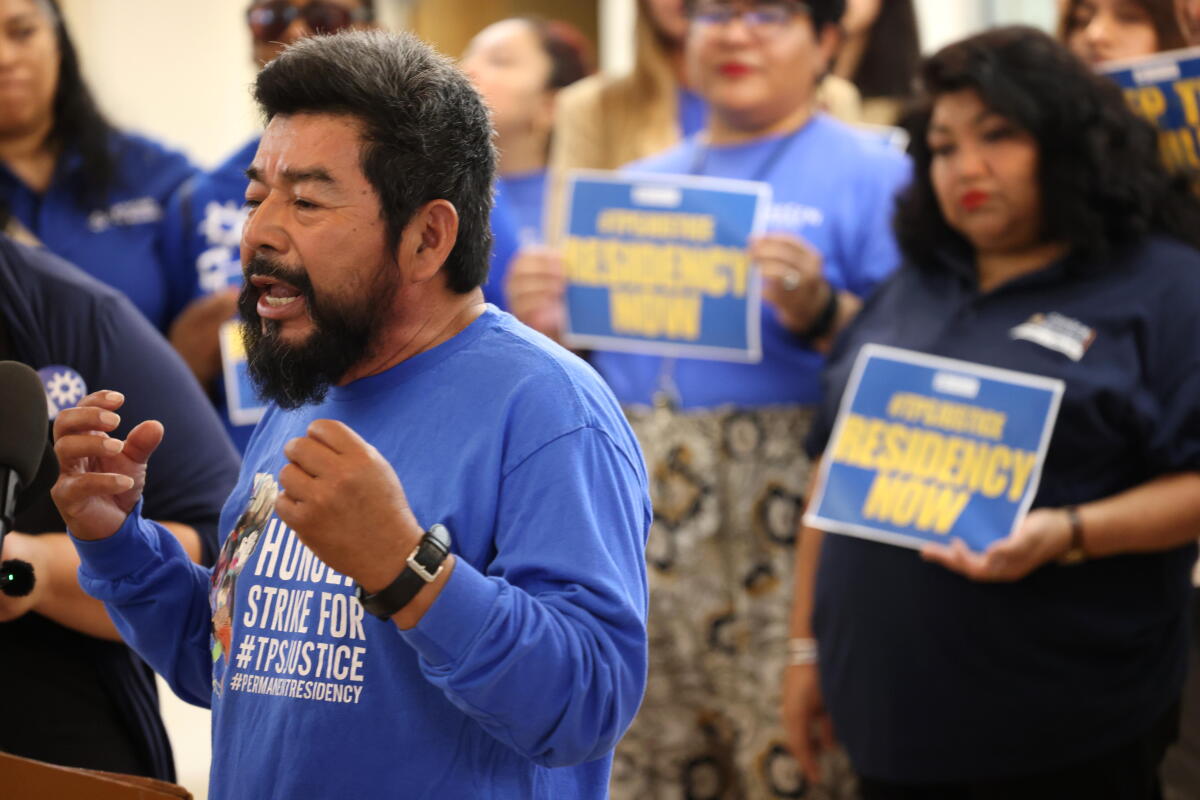
House passes a bill to protect Haitian immigrants, in slap back to the Trump administration

In a rare bipartisan moment, the House passed legislation Thursday that would extend temporary protections for Haitian immigrants, a long-shot effort fighting back against President Trump’s attempts to end the program.

The bill, pushed forward by House Democrats with a group of Republicans over the objections of the GOP leadership, would require a three-year extension of temporary protected status for Haitians by the Trump administration. That would allow hundreds of thousands of qualifying immigrants to remain in the United States without fear of deportation.

The vote was 224-204, drawing applause in the chamber. But it faces uncertainty in the Senate, and the Republican president would almost certainly seek to veto it.

“I know firsthand how important our Haitian neighbors are to our communities, to our civic life, to our culture, to our workforce, to our economy,” said Democratic Rep. Ayanna Pressley of Massachusetts, who is co-chair of the House Haiti Caucus and represents one of the largest Haitian communities in the country.

During the debate, she recounted the number of Haitian immigrants working in healthcare, housing construction and other industries. Haitians with temporary legal status “are not the problem, quite the contrary, they are part of the solution,” she said.

Pressley has said deporting Haitians back to the troubled Caribbean country would be a “death sentence,” given the effects of natural disasters and gang violence. “Congress can do the right thing,” she said.

Ten Republicans, many from districts with large numbers of Haitian residents, joined all Democrats and one independent in voting for passage.

Congress tries to act before the Supreme Court does

The effort to help 350,000 Haitians living lawfully in the United States comes as the administration is working to end the temporary legal status for several groups, exposing them to deportation.

In less than two weeks, the Supreme Court is prepared to consider a fast-track case that would end the protected status for Haitian and Syrian immigrants in a challenge widely seen as threatening the broader program. The administration filed emergency appeals after lower courts stopped the immediate end of the program.

It is part of the administration’s efforts to strip certain immigrant groups of legal status as the White House works to fulfill Trump’s campaign promise of conducting the largest mass deportation operation in history. Some 1.3 million people fleeing countries around the world have been granted temporary protected status in the U.S.

The protections for Haiti, first approved after a devastating 2010 earthquake, have been extended multiple times. The State Department warns Americans not to travel to Haiti “due to kidnapping, crime, terrorist activity, civil unrest.”

Guerline Jozef, executive director of the Haitian Bridge Alliance, an advocacy organization, fought back tears as she described the fear of deportations coursing through the community.

“We are asking, where will you be? On the right side of history?” she said at a news conference outside the Capitol. “Or continuing to cause trauma to people who are asking for nothing other than safety and protection?”

Trump has described migrants from poorer countries in vulgar terms, and he has falsely accused Haitian migrants in Ohio of eating their neighbors’ cats and dogs.

The conservative majority court has allowed the end of temporary legal status for a total of 600,000 people from Venezuela while lawsuits play out, leaving them to face potential deportation.

Lawmakers debate whether to help Haitians or stick with Trump

Rep. Laura Gillen (D-N.Y.) whose district includes Long Island’s Haitian community, said she promised constituents she would work to protect their status. She introduced the legislation with Republican Rep. Mike Lawler of New York as soon as she took office last year.

“It’s cruel to expect Haitians to be forced to return to these deadly, dangerous conditions,” she said at a news conference. “Human lives are at risk.”

Lawler said there are differences of opinion on immigration policy, but that Haitian immigrants have become vital to his community and forcing them out would be unjust and unwise.

“They are small business owners, they are nurses, they are caregivers, they participate in our economy and take care of American citizens,” he said. “Congress has a responsibility to act.”

But Rep. Jim Jordan (R-Ohio) decried the number of immigrants, including Haitians, who have entered the U.S., and cited Democratic efforts to halt funding for enforcement and deportation efforts.

“Make temporary permanent,” he said, “that’s their plan.”

Rep. Brandon Gill (R-Texas) said the program was “backdoor amnesty” for foreigners.

To Rep. Tom McClintock (R-Calif.), the temporary status first granted under the Obama administration has become “an open-ended invitation” for immigrants to enter the country, including some illegally, and remain.

“The Trump administration has heeded the cries of the American people,” he said.

Using a discharge petition to force votes

The vote was the latest effort by House Democrats to maneuver past the Republican majority using a discharge petition — once a rare tool, but now used increasingly to form bipartisan coalitions.

The discharge petition process forces the bill to the House floor for consideration, powering past House Speaker Mike Johnson (R-La.) and GOP leaders. It was used to help pass legislation that required the Justice Department to release the files of the sex trafficking investigation of Jeffrey Epstein.

Republicans hold a slim majority in the House and are typically able to swat back such efforts from Democrats. But Democrats and Republicans have formed bipartisan alliances to reach the majority needed on the discharge petitions.

Pressley’s effort to discharge the bill won support from four Republicans on the initial petition, and several more once it came to the floor vote.

Mascaro writes for the Associated Press.

Source link

County prosecutor charges ICE agent with assault for pointing gun at people on Minneapolis highway

An ICE agent is charged with assault for allegedly pointing his gun at people in a car while driving on a Minneapolis highway, prosecutors in Minnesota said Thursday.

An arrest warrant in Hennepin County, which includes Minneapolis, says Gregory Donnell Morgan Jr. is charged with two counts of second-degree aggravated assault. The warrant says Morgan was working as an Immigration and Customs Enforcement officer in the Minneapolis area on Feb. 5 when he pointed a gun at the occupants of a vehicle on Minnesota State Highway 62.

Hennepin County Atty. Mary Moriarty said she believes it is the first criminal case brought against a federal immigration officer involved in the Trump administration’s crackdown on immigration enforcement that surged federal authorities into cities including Los Angeles, Chicago, Portland and New Orleans.

Department of Homeland Security and Justice Department officials didn’t immediately respond to emails seeking comment. The Associated Press called a number associated with Morgan and sent a message to his possible email address but did not receive any immediate response.

Moriarty said during a news conference that Morgan was driving a rented, unmarked SUV on the shoulder of the highway when a car on the road moved into the shoulder to try to slow Morgan down, not knowing he was a federal officer. After the car returned into the legal lane, Morgan pulled up alongside and pointed his service weapon at the people in the car.

Morgan, 35, and his partner, who was not charged, were on their way to the federal building to end their shift when they were caught in traffic. Charging documents note Morgan did not say the incident occurred during an enforcement action.

According to the charging documents, Morgan told a Minnesota State Patrol officer that he pulled up alongside the victim’s vehicle, drew his firearm and yelled “Police Stop.” The warrant says the victims couldn’t hear him because their windows were up.

Morgan is charged with two counts of assault because he threatened both people in the vehicle, and there is a warrant out for his arrest, Moriarty said.

The charges could intensify a clash between the Trump administration and Minnesota officials over the crackdown. Todd Blanche, the acting attorney general, has warned that the Justice Department could investigate and prosecute state or local officials who arrest federal agents for performing their official duties.

Moriarty said she is not concerned about blowback from the Trump administration and that her office’s goal is to “hold people accountable if they violate the laws of the state,” she said.

She said Morgan’s actions were beyond the scope of a federal officers’ authority.

“There is no such thing as absolute immunity for federal agents who violate the law in the state of Minnesota,” she said.

In Minnesota, felony second-degree assault is punishable by up to seven years in prison, or up to 10 years imprisonment if the assault inflicted “substantial bodily harm.”

The Department of Homeland Security deployed about 3,000 federal officers to the Minneapolis-St. Paul area from December through February in what the agency called its “largest immigration enforcement operation ever.” The Minnesota operation led to thousands of arrests, angry mass protests and the fatal shootings of two U.S. citizens.

Backlash over the aggressive tactics mounted, and two of the crackdown’s most high-profile leaders were soon gone. Trump fired Homeland Security Secretary Kristi Noem in March shortly after the Minnesota surge ended. That same month, Gregory Bovino, the Border Patrol sector chief who led immigration operations in several large cities, announced his retirement.

In a letter to California officials last year, then-Deputy Atty. Gen. Blanche wrote that “the Justice Department views any arrests of federal agents and officers in the performance of their official duties as both illegal and futile.”

“Numerous federal laws prohibit interfering with and impeding immigration or other law-enforcement operations,” Blanche wrote. “The Department of Justice will investigate and prosecute any state or local official who violates these federal statutes (or directs or conspires with others to violate them).”

Sullivan and Bynum write for the Associated Press. Bynum reported from Savannah, Ga. AP reporter Alanna Durkin Richer in Washington, contributed to this report.

Source link

Ceasefire or escalation? Trump weighs Iran talks amid troop surge

With a fragile ceasefire set to expire with Iran in a matter of days, President Trump is still deciding between diplomacy and a resumption of fighting that may ultimately hinge on his definition of victory.

Negotiations have continued over the last week between the warring sides over a potential agreement that would end the conflict and curtail Iran’s nuclear ambitions, with interlocutors from Pakistan passing messages that have kept talks alive. Tehran has floated an extension of the two-week ceasefire, set to expire Tuesday, that is under active consideration by the American side.

But the Islamic Republic has simultaneously vowed retaliation over a new U.S. blockade of Iranian ports that in effect cut off Tehran’s oil sales, which make up nearly 85% of the country’s export revenue. And the Trump administration is deploying up to 10,000 additional troops to the region, on top of the 50,000 already there, both reinforcing the blockade and threatening ground operations if diplomacy fails.

Conflicting messages from the Trump administration are designed to escalate pressure on Tehran ahead of the ceasefire deadline, potentially extracting concessions at the negotiating table.

But speaking with reporters, Trump has made it clear he is seeking a way to end the war for good.

I think it’s close to over,” Trump told Fox Business Network’s “Mornings with Maria” on Wednesday. “I view it as very close to over. If I pulled up stakes right now, it would take them 20 years to rebuild that country. And we’re not finished. We’ll see what happens. I think they want to make a deal very badly.”

Negotiations toward that end have proved more challenging than the administration initially anticipated.

Trump has said he started the war in order to eliminate Iran’s nuclear infrastructure, degrade its ballistic missile and drone programs, and destroy its navy. But in talks, the Iranians have not relented on their right to enrich uranium, to maintain conventional defensive capabilities and to police traffic through the Strait of Hormuz, one of the world’s most vital waterways.

Tehran rejected a proposal by U.S. negotiators last week for a 20-year pause on Iran’s domestic enrichment of fissile material, with the Iranians countering with a five-year moratorium, one official said.

In his interview with Fox, Trump said the talks were going so well that an extension of the ceasefire might not be necessary. Yet, speaking with the New York Post, Trump suggested he wouldn’t settle for less than an indefinite cap on Iran’s nuclear work.

“I’ve been saying they can’t have nuclear weapons,” Trump said, “so I don’t like the 20 years.”

“I don’t want them to feel like they have a win,” he added.

The U.S. ceasefire with Iran was predicated on the resumption of free navigation through the Strait of Hormuz. But Iranian threats of a new toll system and warnings of drifting mines have limited traffic, prompting the Trump administration to announce a full blockade of the strait. Despite the U.S. threat, ships have continued transiting the passage this week, suggesting the U.S. blockade has focused more specifically on Iranian ports.

Amid the impasse, global oil prices remain stubbornly high — a concern for Republicans entering this year’s midterm election season. Trump told Fox that he expected prices to drop to prewar levels by the time of the vote in November.

“There’s gonna be a hit, but it’s going to recover, I think, fully,” Trump said. “I think that we will be somewhere around where we were — maybe even lower. And when this is over, I think the stock market is going to boom.”

A second round of high-level negotiations could take place in Islamabad, Pakistan, over the next several days, Karoline Leavitt, the White House press secretary, told reporters at a news briefing Wednesday.

Pakistani officials traveled to Tehran on Wednesday to deliver a message from the U.S. delegation, potentially laying the groundwork for new, in-person talks.

“He’s made his red lines in these negotiations very clear to the other side,” Leavitt said. “We feel good about the prospects of a deal.”

Source link