California’s effort to restrict sales of handguns that can be converted into fully-automatic machine guns drew an immediate federal challenge Wednesday, with the Trump administration suing the state over its new “Glock ban” law just hours after it took effect.
The U.S. Department of Justice is seeking a court order to block the controversial state law that limits where most Glock and Glock-style pistols can be sold. The lawsuit, filed in U.S. District Court for the Central District of California, also aims to invalidate key parts of the state’s handgun roster — a list that dictates the types of firearms that Californians may legally purchase. In a statement Wednesday, acting Atty. Gen. Todd Blanche said that both policies “trample” the rights of law-abiding Californians.
“The Second Amendment is a sacred right belonging to all Americans, even those in California,” Blanche said. “California cannot ban the most popular type of handgun in America.”
California’s Assembly Bill 1127 does not explicitly name the Glock brand, but instead targets any handgun with a specific mechanism that can easily be converted by a black market device. These simple “Glock switches” convert semiautomatic handguns into a weapon capable of firing 20 rounds per second with a single squeeze of the trigger.
Advances in 3D printing have made the conversion devices widely available and cheap to produce. Federal authorities reported recovering 11,088 of them from crime scenes between 2019 and 2023. Switches have been used in several mass shootings, including one in Sacramento that resulted in six deaths and 12 injuries in 2022.
The new law does not prohibit the possession of affected handguns already owned by Californians, and includes exemptions for gun dealers, as well as law enforcement and military agencies.
Gov. Gavin Newsom signed the bill in October, and has maintained that firearm laws are responsible for California’s declining crime rates and gun deaths.
“The Trump administration is once again trying to dismantle California’s commonsense gun safety laws,” Diana Crofts-Pelayo, a spokesperson for the governor, said in a statement. “Our response is simple — these laws save lives.”
The federal government argues in its complaint that California can’t ban legal semiautomatic handguns simply because they could be illegally altered, adding that state and federal law already prohibit such pistol converters. The U.S. compared California’s approach to banning ordinary shotguns because they can be illegally shortened.
The lawsuit also challenges California’s decades-old handgun roster, which requires new handgun models to pass certain safety tests before they can be approved for retail sale. A federal judge tentatively blocked portions of the roster requirements in a separate 2023 case, which is being appealed before the 9th Circuit. That lawsuit was filed by the California Rifle & Pistol Assn. and other gun rights supporters following a landmark 2022 decision by the U.S. Supreme Court that set new standards for evaluating firearm restrictions.
Under those new guidelines, the Trump administration wants a judge to find that California’s gun restrictions violate the 2nd Amendment, and is seeking an order to bar the state from enforcing them.
The Trump administration is relying on a federal civil rights law typically used against police departments accused of repeated constitutional violations, arguing that California Atty. Gen. Rob Bonta and state Justice Department agents qualify as peace officers and therefore violate gun owners’ rights whenever they enforce handgun restrictions.
Bonta, who is named in the suit, has a winning court record over the Trump administration, and has secured at least 12 final court rulings and more than 35 preliminary injunctions or emergency orders.
“We won’t be intimidated by another politically motivated lawsuit,” said Crofts-Pelayo, Newsom’s spokesperson. “We’ll continue defending the laws that protect Californians and keep dangerous weapons off our streets.”
NEW YORK — The Trump administration on Tuesday said it would freeze federal funding for New York’s Medicaid Fraud Control Unit, a state agency responsible for investigating and prosecuting fraud in the safety-net government healthcare program.
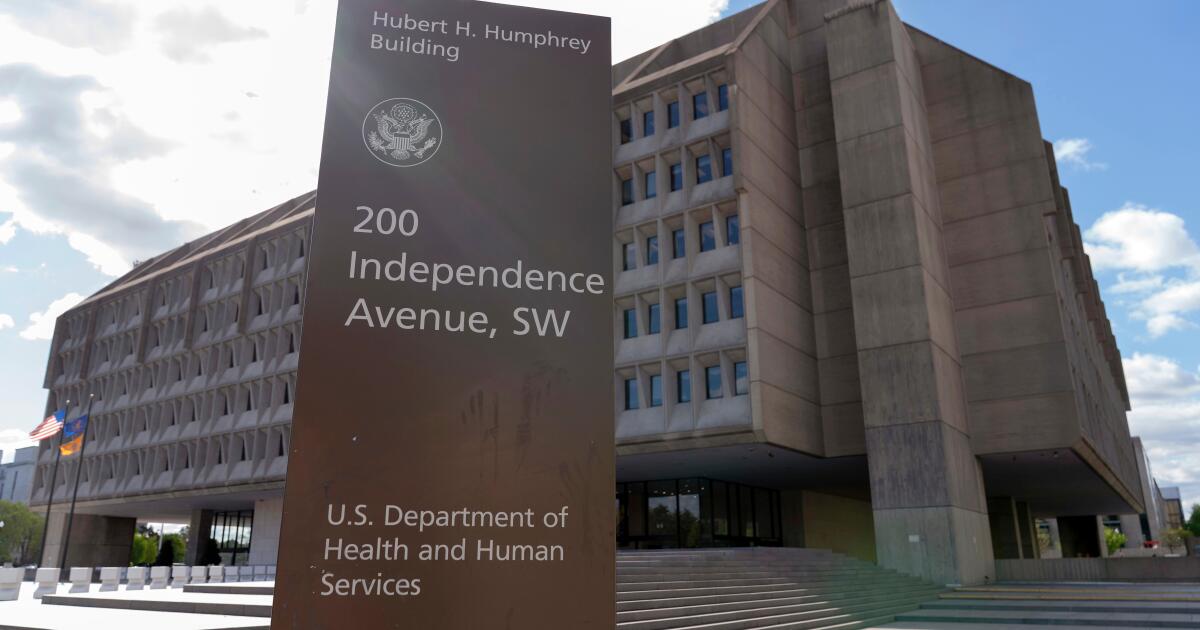
In a letter sent to New York officials, U.S. Department of Health and Human Services Inspector General Thomas March Bell accused the state of not securing enough criminal indictments and said millions of dollars in funding would be suspended through at least Sept. 30.
The move is the second suspension of a state Medicaid fraud unit this year by the Republican Trump administration, and part of a barrage of anti-fraud actions it has aggressively promoted in the healthcare sector. They have included the creation of a new task force, targeted investigations, funding deferrals and demands for revalidation of healthcare providers that have touched all states but are focused largely on Democratic ones.
The pulled funding also comes after the administration admitted a glaring error in figures meant to help justify a fraud inquiry into New York’s Medicaid program this year, a mistake critics said revealed a Trumpian tendency to attack first and verify the facts later.
New York Atty. Gen. Letitia James, a Democrat, immediately vowed to fight Tuesday’s funding freeze.
“During my time as Attorney General, my office has recovered over $627 million for Medicaid and was recognized by this very administration for leading the nation in anti-fraud efforts,” she wrote. “We are considering all legal options to stop this outrageous action.”
Letter accuses New York of low performance compared to other states
Bell’s letter to James and New York Medicare Fraud Control Unit Director Amy Held argues that the unit is moving too slowly on cases and amassing too few indictments and convictions for wrongdoing in the Medicaid system. It notes that compared with four similarly sized units in other states, it secured the lowest number of criminal fraud convictions between 2023 and 2025.
The letter acknowledges that one reason the state has fewer criminal convictions than others is that it made a deliberate choice to focus on “high impact, complex fraud cases” rather than smaller-scale individual cases, but says that trade-off didn’t produce sufficient results.
“Enough is enough,” Bell wrote. “The New York MFCU has failed to comply with the terms and conditions of its MFCU grant award.”
Bell said in the letter that the funding suspension could be lifted before Sept. 30 if New York takes corrective action, “showing it has remediated concerns that formed the basis for this suspension.” He said if the state doesn’t fix the problems, the freeze will continue.
New York officials dispute the Trump administration’s claims
New York’s attorney general’s office said in a statement that it has “long been recognized as a national leader in effectively investigating and prosecuting Medicaid fraud schemes,” including by the Health and Human Services inspector general’s office. A 2025 report from the office notes that New York is one of four states that made up half the total civil recoveries in that year.
A spokesperson for the attorney general’s office said most of the unit’s criminal convictions focus on company owners, executives and corporations that would return large amounts to Medicaid.
“This administration’s unprecedented attack on New York is another political distraction,” James said in a statement.
The funding cutoff follows a similar move in Hawaii. In early June, Bell told Hawaii officials that Medicaid fraud funding would be cut off there, saying that it had a three-year stretch without a Medicaid fraud indictment or conviction.
Joan Alker, executive director and co-founder of Georgetown University’s Center for Children and Families, said there’s an irony in the federal government cutting off money intended for prosecuting fraud when its stated goal is to do just that.
“If you want to fight fraud, don’t take away money from states’ fraud control units,” she said. “I chalk this up to more political theater to distract voters from historic Medicaid cuts before the midterms.”
Move follows months of federal warnings and deferrals
For months, the Trump administration has contended that states — especially some Democratic-led ones — have been lax about fraud in social safety-net programs, including Medicaid.
It has demanded that at least five states, four of them governed by Democrats, share information about how they identify, prevent and address Medicaid fraud.
The federal government has also withheld some Medicaid funding from Minnesota and California over fraud concerns. Minnesota Gov. Tim Walz, a Democrat who was Kamala Harris’ 2024 running mate, accused President Trump of making cuts because of retribution.
The fraud-busting efforts have also targeted Medicare programs. Dr. Mehmet Oz, who leads the federal Centers for Medicare and Medicaid Services, announced a six-month moratorium on new enrollments for providers of hospice and home care nationally.
Swenson and Mulvihill write for the Associated Press. Mulvihill reported from Haddonfield, N.J. AP writer Anthony Izaguirre contributed to this report.
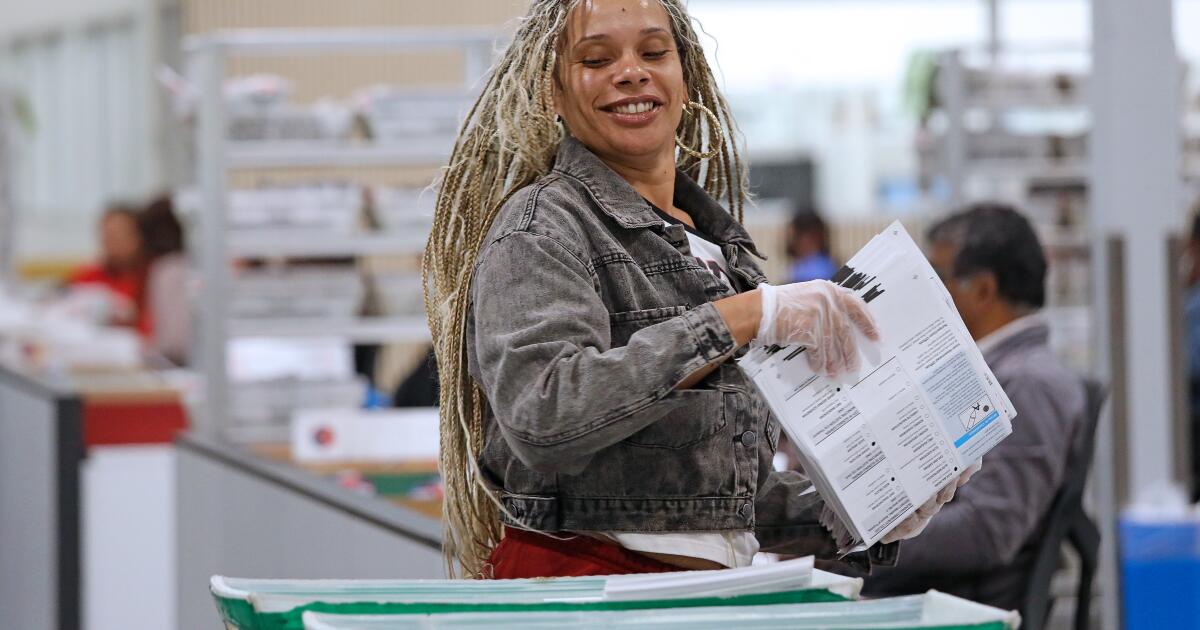
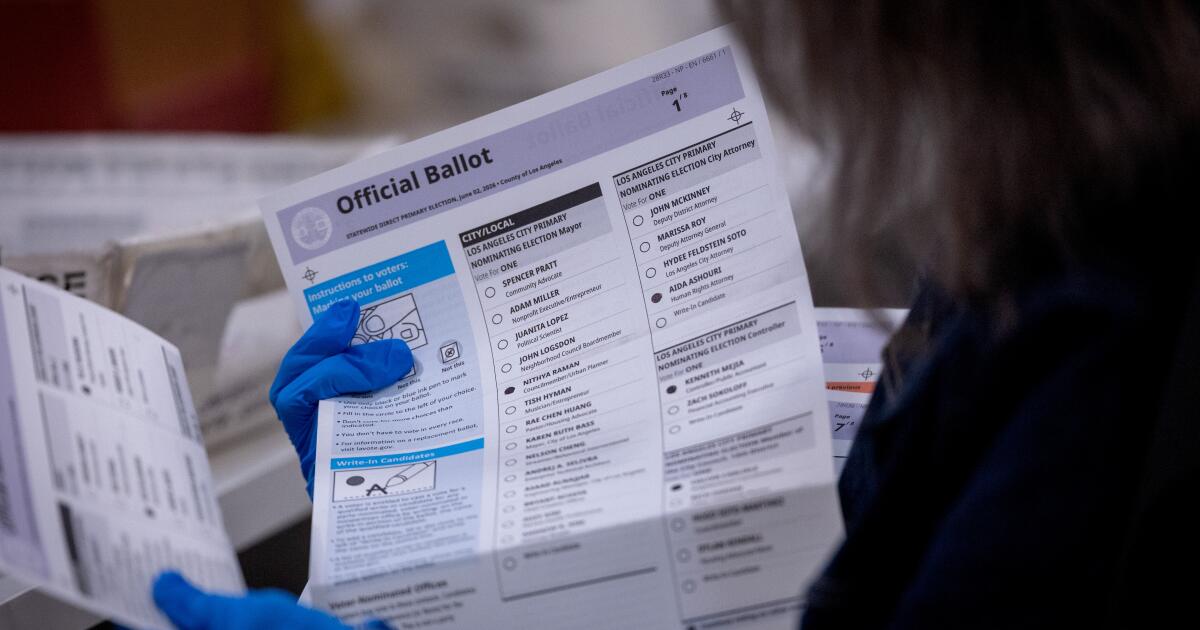
California officials cheered a U.S. Supreme Court ruling Monday that allows states to continue counting mail ballots postmarked by election day but received in the days after — calling it a win for voter participation and access, including in the upcoming November midterm.
They also acknowledged delays in recent vote counting have spurred frustration, and promised to speed the process through other solutions — including by investing millions into new election infrastructure and vote processing capabilities.
Gov. Gavin Newsom — who called the court ruling a “win for voters, plain and simple” — has previously said the state should be able to count ballots faster, and his latest budget includes $29 million for “increased staffing, technology and equipment upgrades and purchases for counties,” $10 million for voter education and outreach at the state and county levels and $750,000 for combating election misinformation.
The court decision, a loss for President Trump and other critics who contend such policies contribute to unacceptable delays in vote counting, specifically upheld a Mississippi policy to accept mail ballots received within five business days of an election.
But it also lets stand similar policies in other states — including California, which counts ballots postmarked by and received within seven days of an election.
California Secretary of State Shirley Weber, who has long prioritized voter participation over a speedy count, called the high court’s ruling a “win for voters, for the rule of law, and for the future of our democracy.”
She said that she will “keep working to ensure every eligible Californian has the opportunity to be heard, because our democracy is strongest when every voice and vote count.”
Dean Logan, head of the Los Angeles County registrar-recorder/county clerk’s office, said in a statement to The Times that the ruling “affirms what Los Angeles County voters deserve: the assurance that a ballot cast by Election Day will be counted if received within the legal timeframe established in State Law.”
“Our office will continue to provide voter education, multilingual outreach, and leverage available resources to ensure voting access for our 5.8 million registered voters,” Logan said.
Many voting rights experts agree California’s vote counting should and could be faster, but disagree with the Trump administration’s efforts to step in with policies such as election day deadlines.
In 2024, California counted more than 406,000 late-arriving mail ballots, but they represented only about 2.5% of the statewide total. Experts say California’s delayed results have far more to do with the massive influx of mail ballots that are placed in ballot drop boxes or arrive at processing facilities on or just before election day.
Rick Hasen, an election law expert and director of the Safeguarding Democracy Project at UCLA Law, said the court’s decision was a “symbolic loss” for Trump, in that the court rejected his preferred policy on mail ballots, but “doesn’t appreciably change how long it takes to count ballots” because late-arriving ballots were never the problem.
In a report published Thursday, the California Voter Foundation recommended statewide adoption of “sign, scan, and go” programs that allow elections officials to immediately process mail ballots that voters submit in person at polling centers or drop boxes.
The foundation recommended ballot curing programs that speed up the process by utilizing a secure text platform when double checking whether a ballot is legitimate when a voter’s signature doesn’t match state records.
It also urged the state to invest $35 million in a voter education campaign to encourage early ballot returns, and more than $55 million in improving counting capacity and efficiency in county elections facilities.
Trump and other conservatives had called for an end to state policies allowing late-arriving mail ballots to be counted as an overdue fix to a voting system that often can’t produce election results in close races for days after polls close, as was the case in California’s recent primary races for governor and L.A. mayor.
Trump has pointed to California’s time-consuming count as proof of widespread fraud to undermine Republican candidates, though he has never produced evidence to support that claim and Democrats have fiercely denied it.
On Monday, Trump called the high court’s decision to uphold such state policies a “tremendous loss,” and more reason to pass the Save America Act — a bill he has backed that would enforce new voter ID and proof of citizenship requirements and ban mail ballots except for military personnel, individuals suffering from illness, disability, and in other rare circumstances.
He said politicians have “no excuse” other than “CHEATING!” to oppose such measures, especially at “a time when there is a powerful Communist Movement taking place in our Country, one more dangerous than World War I, World War II, Pearl Harbor, or September 11th.”
But California leaders rejected that — saying the criticisms of mail ballots are baseless and an attempt by Trump and his allies to undermine elections in which they are poised to lose, particularly in big blue states such as California, by attempting to wrest control over voting processes that have always been the purview of states, not the federal government.
California Atty. Gen. Rob Bonta said Monday that states have been “primarily responsible for regulating elections” since the nation’s founding, and his office was “pleased that the U.S. Supreme Court has respected that authority.”
“Today’s decision recognizes a basic reality: Mail delays happen. When people vote by election day, their ballots should not be discarded because of those delays,” he said.
Sen. Alex Padilla (D-Calif.), the ranking Democrat on the Senate Rules and Administration Committee, which has oversight over federal elections, praised the high court Monday for acknowledging that nothing in federal law precludes states from counting mail ballots in the days after an election.
“Today’s decision is a victory for voting rights and a rejection of Trump’s attacks on mail and absentee voters,” Padilla said.
Liberal groups and many voting rights experts also hailed the ruling as a win for voters.
Moving up deadlines for mail ballots is just one effort in a much broader political war over voting and the rules that govern it. The U.S. Constitution generally gives states the authority to run their own elections, but the Trump administration has been trying to assert greater federal control — especially around mail ballots.
Earlier this year, Trump signed an executive order directing the U.S. Postal Service to assert control over mail balloting by designing new envelopes with special bar codes that would allow the federal government to ensure ballots only go to and get returned by eligible voters. The order prompted the Postal Service to propose new rules requiring states to hand over their voter mailing lists so it could implement Trump’s directive.
In a letter to U.S. Postmaster General David Steiner on Wednesday, Democratic senators denounced the proposed rule as an “unconstitutional and illegal attempt to transform [USPS] into an election administration agency controlled by the White House and President Trump.”
In a Senate hearing the same day, Steiner said that under the new rule, the USPS would not mail the ballots of a state that refused to turn over its voter lists, but also that his agency would adhere to any court orders curtailing its implementation.
On Thursday, just such an order came down in a federal case in which California and other Democrat-led states challenged Trump’s executive order. U.S. District Judge Indira Talwani ruled that the Constitution does not grant the president “any specific powers over elections,” and blocked his order as unlawful.
Nevada Secretary of State Cisco Aguilar, who is chair of the Democratic Assn. of Secretaries of State, said states such as California were right to focus on increasing investment in their own election infrastructure rather than accepting the Trump administration’s “bad policy ideas” for speeding things up.
Newsom’s office on Monday said that is exactly what California has been doing. It pointed to laws passed by the state Legislature last year that allow election officials to begin processing mail ballots earlier and require them to finish counting ballots sooner.
WASHINGTON — The Supreme Court on Monday upheld state laws that allow for counting mail ballots that are postmarked by election day but arrive later.
The 5-4 decision rejects a Republican challenge to laws in California and 13 other mostly Democratic states which permit the counting of these late-arriving ballots.
Justice Amy Coney Barrett and Chief Justice John G. Roberts Jr. joined with the three liberals to form the majority.
The decision is a mild surprise and should bolster Democrats in the fall election.
While California’s seven-day grace period for mail ballots has contributed to slow tabulations, it has not been shown to trigger fraud or unreliable vote counts.
Election law experts blame slow tallies on the surge in voting by mail combined with the need to carefully match signatures on these ballots.
The court said federal law since 1845 has set election day nationwide as the Tuesday after the first Monday in November and voters were required to cast their ballots that day.
Citing that fact, the Republican National Committee and the Trump administration joined a challenge to a Mississippi law adopted during the COVID-19 pandemic that allowed counting ballots that were up to five days late.
Trump’s lawyers said federal law preempted or overrode the state law.
“From the dawn of America, election day has meant the day the ballot box closes — and when election officials must be in receipt of all ballots,” wrote Solicitor Gen. D. John Sauer.
Democrats said the Constitution says the “time, place and manner of holding elections” for Congress “shall be prescribed in each state” by its legislature. However, Congress was given the power to override those state rules and set its own regulations for federal elections.
Barrett said the federal election day requires only that the voter must decide by then.
“The election-day statutes require the electorate’s choice to be made on election day. That occurs so long as election day is the deadline for individuals to vote — as it is in Mississippi,” she wrote. “But the election-day statutes do not set a deadline for ballot receipt, so they do not prevent Mississippi from counting ballots postmarked before election day yet received afterward.”
While Congress could have prohibited the counting of late-arriving ballots, it had not done so. That may be because states wanted to count ballots from members of the military stationed overseas even if they arrived late.
Last year, however, the 5th Circuit Court of Appeals in New Orleans struck down Mississippi’s law that allowed for counting ballots that were cast by election day but arrived up to five days later.
The opinion by three judges, all Trump appointees, concluded that the election day set by Congress “is the day by which ballots must be both cast by voters and received by state officials.”
In its appeal, Mississippi stuck with a states’ rights view and argued that the federal election-day statutes mean that ballots must be cast — not received — by election day.
“This is a victory for voters and for an election system that meets the needs of the people it serves,” said Common Cause President Virginia Kase Solomón. “Eligible Americans shouldn’t lose their voice because of mail delays outside their control.”
WASHINGTON — California’s two Democratic senators on Thursday criticized the Trump administration after it requested $87.6 billion from Congress to address some of the nation’s most “urgent needs” but omitted funding for victims of last year’s Los Angeles wildfires.
“Donald Trump’s desire to punish Los Angeles and the state of California for not voting for him, means once again that thousands of Angelinos are left watching this administration fight for anything but them, their businesses, and their communities,” Sens. Alex Padilla and Adam Schiff said in a joint statement.
“These fires did not discriminate based on party or political preference. Neither should this administration,” they added.
The omission is the latest strain in a yearlong standoff between California leaders and the Trump administration over federal disaster aid, and it comes after Los Angeles Mayor Karen Bass and Los Angeles County Supervisor Kathryn Barger met with President Trump at the Oval Office in April to request the funding.
At the meeting, Trump signaled his commitment to working with local officials to help with disaster recovery efforts. The officials asked for $16 billion that would be split between the city and county. The money would consist primarily of disbursements from the Federal Emergency Management Agency flagged for communities hit by the fires, part of a $33.9-billion wildfire relief funding request made by Gov. Gavin Newsom.
Two months later, those talks have yet to yield results sought by local leaders.
The budget request, submitted by the Office of Management and Budget on Wednesday, mostly seeks funding for the Pentagon to address costs related to the Iran war. It also includes $11.1 billion in economic assistance for American farmers, $1.4 billion to address the Ebola virus outbreak in Central Africa, $500 million to support “ongoing efforts to complete restorations and construction projects” across the nation’s capital and $1 billion to boost the pensions of workers at General Motors that were cut as a result of the automaker’s bankruptcy.
“I urge the Congress to take action on these important and urgent requests as soon as possible,” White House budget director Russell Vought wrote in a letter addressed to House Speaker Mike Johnson (R-La.).
Vought said the administration was open to discussing “additional relief for other urgent matters.” The White House did not immediately respond when asked why the budget request did not mention the Eaton and Palisades disaster relief funds.
State leaders, including Newsom, have repeatedly accused the Trump administration of stonewalling billions in wildfire aid. The governor visited Washington in December to meet with lawmakers, including three who serve on the Senate and House appropriations committees, to push for the funding.
The governor also attempted to meet with FEMA about the matter, but said his request was denied. Newsom, a political foe of Trump’s, would not say whether he had attempted to meet with Trump to talk about the recovery efforts.
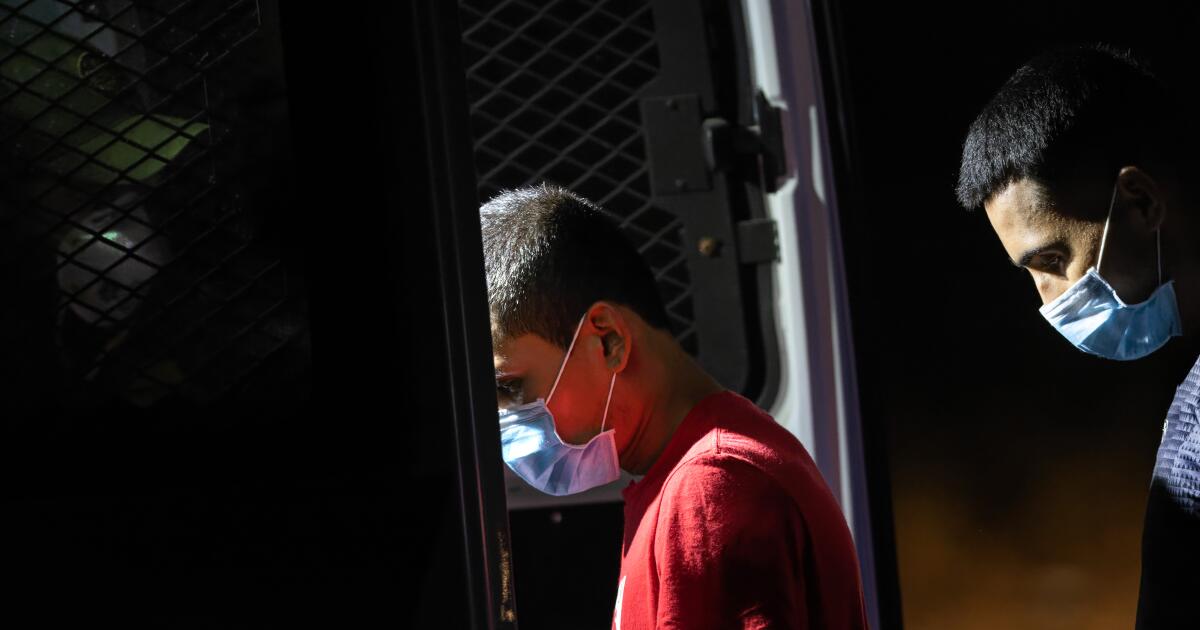
WASHINGTON — A Democratic U.S. senator warns the Trump administration is getting ready to round up 500 immigrant children in a hasty effort to remove them from the country, bypassing legal protections. It would be their second attempt after a federal court intervened last year in an overnight plan to fly out hundreds of children on Labor Day weekend.
Sen. Ron Wyden of Oregon wrote in a letter Wednesday to U.S. Health Secretary Robert F. Kennedy Jr., which oversees the Office of Refugee Resettlement caring for unaccompanied migrant children, that he had “credible information” that the Trump administration had a list of more than 500 migrant children it was targeting for a fast-track removal process and that the department was racing to act in days. He warned that the administration was abdicating “core humanitarian and child welfare mandates” and demanded an immediate halt to any plans to remove the children.
Wyden, who is the ranking member and senior Democrat of the Senate Finance Committee, which has jurisdiction over ORR, did not detail how he came by his information. His office declined to provide further details. ORR falls under the Department of Health and Human Services.
An HHS spokesperson denied any such plans.
“The new information I obtained leads me to believe that the Department is laying the groundwork for another lawless deportation effort, this time on a greater scale, across more countries of origin,” Wyden wrote.
“You have been entrusted with the care and safety of the children placed within the ORR network. Proceeding with this plan knowingly endangers their lives and violates your duty to these vulnerable children.”
Wyden also issued an early warning last August ahead of what eventually became a chaotic weekend of efforts by the Trump administration to remove Guatemalan children in its care and send them home.
HHS spokesperson Emily Hilliard said in “there are no plans to target these children,” calling Wyden’s claims ”irresponsible fearmongering.”
“The Trump Administration is working to identify the parents or legal guardians of unaccompanied alien children in our care because ensuring every child is placed with a properly vetted sponsor is our top priority,” she said.
Over the Labor Day weekend, dozens of migrant children either staying in government-supervised shelters or with foster families were taken from their homes and bused to airfields in Texas bound for Guatemala. A federal judge woken up in the middle of the night eventually stopped the planes. Lawyers for the children — many who had fled violence at home to come to the U.S. — later described how traumatic the middle-of-the-night removal effort was for them.
The administration insisted it was reuniting the Guatemalan children — at the Central American nation’s request — with parents or guardians who sought their return. Lawyers for at least some of the children said that wasn’t true and argued that in any event, authorities still would have to follow a legal process that they did not.
Migrant children traveling alone are usually entrusted to U.S. government care, and there are various legal protections designed to protect them once they’re in the U.S. and navigating the immigration system.
The Trafficking Victims Protection Reauthorization Act of 2008 is one of the key pieces of legislation designed to protect them. With some limited exceptions, it requires that children be placed in the “least restrictive setting possible,” which generally means that they can be released to a sponsor such as a relative in the U.S. while their immigration proceedings play out.
The children can apply for a specially protected status if they can’t return to their home country because of abuse or neglect and they can also apply for asylum.
The Trump administration has made it increasingly difficult for those children to be released to sponsors though. The administration says that they are doing due diligence to make sure that sponsors are thoroughly vetted and that in the past, children were released into dangerous situations.
But advocates say that the result has been children lingering for months in government shelters.
This time, Wyden said the children at risk of being removed come from various countries, potentially including Guatemala, Honduras, El Salvador, and Afghanistan, and have been in U.S. custody — mainly in foster care — for at least 180 days. He said they were described as not having any “viable sponsor” who could come forward and take care of them in the U.S.
Not having an identified sponsor could mean the child’s parents are in their home countries, are deceased or are too afraid to claim their children after ICE started arresting some parents who are not in the country legally during their reunification efforts.
Gonzalez and Santana write for the Associated Press.
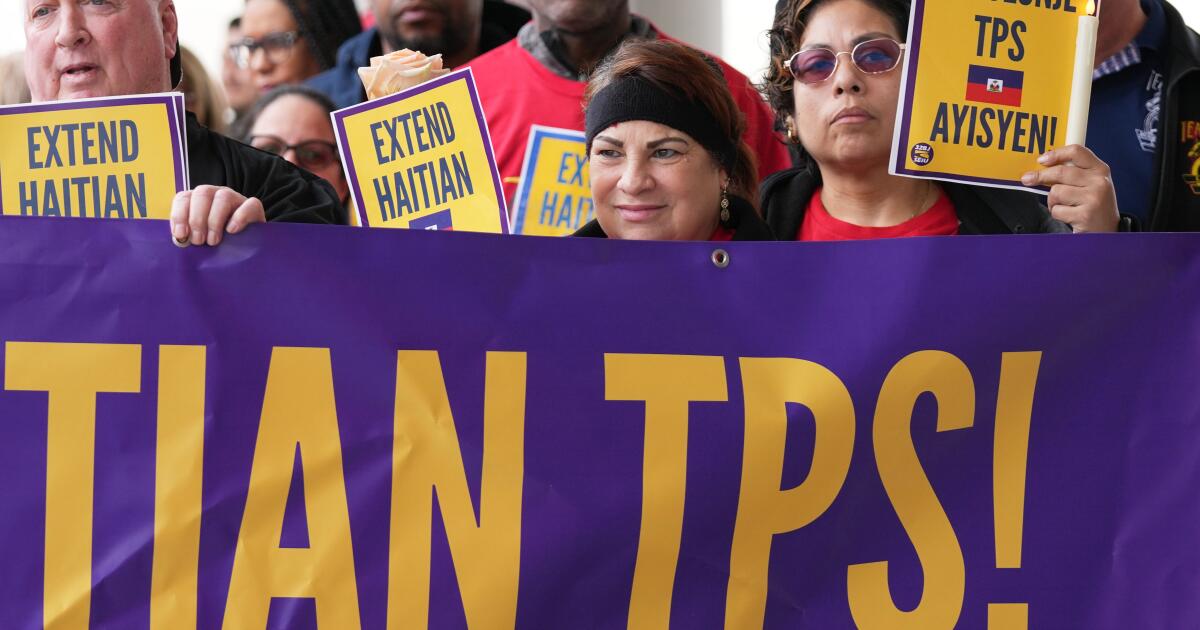
WASHINGTON — The Supreme Court ruled Thursday that the Trump administration may end the Temporary Protected Status granted to more than 350,000 Haitians and Syrians whose home countries remain unsafe.
In a 6-3 decision, the court’s conservative majority said Congress gave the administration, not judges, the power to cancel or renew this temporary protection for non-citizens who are living and working here.
In a second win Thursday for the Trump administration, the court also upheld the administration’s policy of blocking asylum seekers at the southern border.
By the same 6-3 vote, the court said migrants do not have a right to apply for asylum if they are not already in the United States.
The decision on Temporary Protected Status could affect up to 1.3 million non-citizens who are in the country.
In 1990, Congress authorized this emergency humanitarian relief for non-citizens whose home countries were wracked by armed conflict, natural disasters or other extraordinary disruptions.
Under the law, the Department of Homeland Security may grant this protection for 6, 12 or 18 months and either renew or extend it for a similar period.
But this legal authority has been under dispute since Trump returned to the White House last year and targeted the 1.3 million people with TPS from 17 countries who were living in the United States.
Trump’s lawyers said the law made clear there was “no judicial review” of the government’s decision to cancel the grant of temporary protection.
However, immigrant rights lawyers argued the government failed in its duty to consult the State Department and assess whether it was safe for migrants to return home.
Repeatedly, U.S. district judges agreed with the challengers and ruled the administration’s decisions were “arbitrary” and unreasonable. But in nearly every case, the Supreme Court granted emergency appeals from the administration and set aside those orders.
Since TPS was created, the government has ended the protected designation for citizens of 18 countries.
DHS under then-Secretary Kristi Noem ended TPS for Honduras, Nicaragua, Afghanistan and Venezuela. A spokesperson for the agency previously said the Haiti designation became “a de facto amnesty program” and that allowing Syrians to remain is contrary to national interest.
Advocates for the immigrants argue that the administration failed to conduct the required process to properly evaluate each country’s conditions and instead acted on political grounds driven by racial animus.
State Department travel advisories for both countries warn people against traveling to either because of the risk of terrorism, kidnapping and widespread violence. But Federal Register notices announcing the terminations said country conditions had improved enough.
Recently released internal documents show that DHS decided to terminate protections for Haitians without any input from the State Department.
Citing the documents, which were obtained by the National TPS Alliance in a separate lawsuit, lawyers for the Haitians asked the Supreme Court to dismiss the case and send it back to lower courts. They argued that the justices should first consider the communications before issuing a decision.
Internal emails show that homeland security officials sought a recommendation from the State Department in May 2025, ahead of Noem’s early June deadline on whether to extend protections for Haiti. But by the time Noem signed what appears to be a final decision memo, U.S. Citizenship and Immigration Services had not received input from the State Department, the emails show.
“State recommendation for Haiti TPS has not come in despite of many outreach,” a homeland security deputy assistant secretary wrote in a June 2, 2025, email. A recommendation “would be helpful to have,” the person added.
Eleven days later, a USCIS project manager wrote in an email that Noem “recently elected to terminate Haiti without country conditions from DOS.”
USCIS initially recommended automatically extending protections before Homeland Security decided to terminate them, earlier versions of the memo indicate.
The June decision was blocked by a federal judge. In November, DHS issued another notice terminating TPS protections for Haitians.
That time, according a previously publicized email, a homeland security senior counselor asked a State Department official for the agency’s views on the country conditions in Haiti. The official, Spencer Chretien, didn’t address the country conditions but responded that “there would be no foreign policy concerns.”
Lawyers for the Haitians argued that response didn’t meet the legal standard for a sufficient consultation, though the Trump administration disagreed.
A federal appeals court on Tuesday allowed the Trump administration to resume carrying out speedy deportations of undocumented migrants throughout the United States, not just near the border.
A divided three-judge panel of the U.S. Court of Appeals for the District of Columbia Circuit threw out a lower court ruling that temporarily blocked President Trump’s expanded use of expedited removal. The ruling was a big victory for the Republican administration, which views the expansion of so-called expedited removal as a key tool for carrying out its mass deportation policy.
An attorney for the plaintiffs said the ruling “undermines the fundamental principle that people receive due process when the government seeks to deport them.”
“The Trump administration’s push for fast-track deportations will subject people to an unfair and error-prone system,” Anand Balakrishnan, senior staff attorney with the ACLU’s Immigrants’ Rights Project, said in a statement.
Trump appointed the two judges in the majority in Tuesday’s decision. The third was appointed by President Obama, a Democrat.
The plaintiffs had not “shown that the expedited-removal process denies its members notice and an opportunity to be heard,” Judge Justin R. Walker, one of the Trump appointees, wrote.
Expedited removal — quick deportation without a chance to appear before a judge — has previously been applied to migrants arriving by sea or caught at or near the border shortly after crossing.
In January, Trump expanded its use to undocumented migrants all over the U.S. Immigration agents began whisking migrants away from courthouses where they had gone for immigration proceedings and then removing them from the country within days.
U.S. District Judge Jia Cobb ruled in August that plaintiffs challenging the expansion had made a “strong showing” that it was trampling on people’s due-process rights, and she issued a stay order putting the policy on hold. Cobb was appointed to the federal bench by President Biden, a Democrat.
Many migrants living deep in the U.S. have been in the country for more than two years, making them ineligible for expedited removal under federal law. Cobb said the administration had not developed procedures to ensure they and other groups of migrants were not wrongly deported under the expedited process.
The plaintiffs had put forward “substantial evidence” that the expedited removal process, on the contrary, carried a high risk of error when applied more broadly, Cobb said. The ruling cited examples of people who had lived in the U.S. for far longer than two years but were still ordered to be removed in expedited proceedings.
The Trump administration appealed, arguing in a court filing that its expansion was legal, and protections were in place to prevent arbitrary removal.
Cobb’s ruling was an “egregious error” that was depriving the administration of an “essential tool to combat the unprecedented surge of illegal immigration over the past few years” and efficiently deport potentially millions of people, Justice Department attorneys argued in the October filing.
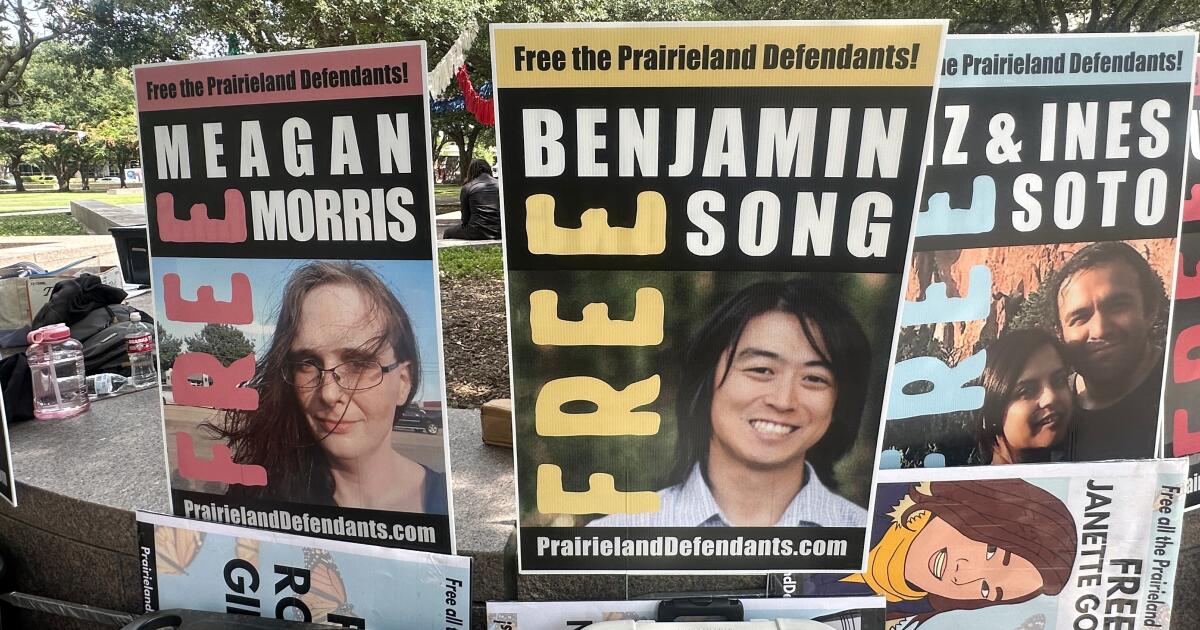
FORT WORTH, Texas — A demonstrator who shot and wounded a police officer outside a Texas immigration center last July 4 was sentenced to 100 years in federal prison Tuesday, while other protesters accused of having links to antifa were given multiple decades in federal prison.
Benjamin Song was convicted of attempted murder last March after prosecutors say he opened fire and wounded a police officer at the Prairieland Detention Center in Alvarado.
The seven other protesters sentenced Tuesday received prison terms ranging from 30 to 70 years.
“Our issue with this case has always been this isn’t a bunch of terrorists. This is a bunch of kids and young adults who really have a really big heart and really wanted their voice to be heard,” Philip Hayes, Song’s attorney, said outside the federal courthouse in Fort Worth. “It was never intended that anybody get hurt. It was never intended that any shots would be fired.”
He said his client would appeal the sentencing.
“Song, aside from this day, has had an impeccable life. A former Marine. A good student,” Hayes said. “He had a lot of good qualities that were just ignored. The judge went ahead and gave as much as he could.”
One of the defendants, Daniel Sanchez Estrada, was convicted of corruptly concealing a document and conspiracy to conceal documents. Others pleaded guilty to providing material support to terrorists rather than take their case to trial.
Prosecutors say the eight are members of antifa, a decentralized anti-fascist organization that has become a target of the Trump administration. They have denied any affiliation and maintain they attended the demonstration to show support for immigrants inside the detention center.
President Donald Trump last fall signed an executive order designating antifa a domestic terrorist organization, even though there is no domestic equivalent to the State Department’s list of foreign terror organizations.
Critics warn the case could have wide-reaching impact on protests given that organizations operating within the U.S. are supposed to be protected by First Amendment free-speech rights.
Short for “anti-fascists,” antifa is not a single organization but rather an umbrella term for far-left militant groups that confront or resist neo-Nazis and white supremacists at demonstrations.
Last week, federal prosecutors charged 15 people with impeding the Trump administration’s immigration crackdown in Minnesota. They claimed the demonstrators were members of antifa who conspired against the federal government to block arrests and deportations by setting up blockades around government buildings and throwing chunks of ice at federal vehicles, among other actions.
Stengle and Marcelo write for the Associated Press. Marcelo reported from New York.
WASHINGTON — A federal judge on Monday ruled that a recently revamped version of a federal tool central to the Trump administration’s election integrity strategy is unlawful and can no longer be used.
U.S. District Court Judge Sparkle L. Sooknanan sided with advocacy groups that argued the recent upgrades to the program, called Systematic Alien Verification for Entitlements, or SAVE, aggregated Americans’ sensitive personal data in a way that could result in voters being wrongly purged from voter rolls.
“All in all, the federal government has knowingly trampled on the privacy rights of American citizens in a manner that threatens the sacred right to vote,” Sooknanan said in an order explaining the decision. “This Court cannot stand idly by while that happens.”
She said Congress had expressly prohibited the government from centralizing Americans’ personal identifying information and that the federal agencies that created the SAVE program “knew that the database violates those statutory protections.”
The decision is a major legal setback for President Trump in his efforts to use federal agencies to encourage a nationwide crackdown on noncitizens illegally on state voter rolls. The modified SAVE system, which critics had referred to as an unlawful centralized federal database of voter information, had been a key pillar of the second election executive order the Republican president signed earlier this year. The ruling leaves its future uncertain.
“It’s amazing how hard the Left will fight to stop us from solving problems they insist do not exist,” James Percival, general counsel at the Department of Homeland Security, said of the ruling in a social media post.
The department referred to his post as its comment on the ruling. The Department of Justice did not immediately return a request for comment.
The SAVE program was created under an immigration law mandating that Homeland Security help federal, state and local agencies prevent government benefits from going to noncitizens. At least 25 states used it to check their voter rolls since April 2025, after the Trump administration significantly expanded its search abilities. Since then, at least 67 million registrations have been scanned through the program, but critics worry it could end up purging valid voters from the rolls.
The plaintiffs, including the League of Women Voters, the Electronic Privacy Information Center and five unnamed U.S. citizens, had alleged the revamped SAVE program violated Americans’ privacy and voting rights. The groups also alleged the Trump administration violated federal privacy laws by ignoring transparency requirements about the changes to the system.
“The agencies were scrambling to comply with an Executive Order aimed at reshaping federal elections, which directed them to create a system for mass voter verification,” the judge wrote. “So they haphazardly combined and repurposed the private information of millions of Americans, including citizenship data that they knew to be unreliable.”
Plaintiffs attorney Nikhel Sus told the court during the October hearing that naturalized citizens face a greater risk of unlawfully being purged from voter rolls.
“They are uniquely vulnerable to errors in the database,” said Sus, an attorney for Citizens for Responsibility and Ethics in Washington.
Sus said Monday he sees Sooknanan’s ruling as an “across the board victory” and noted the plaintiffs were pleased the judge’s ruling reinforced their argument that the federal government doesn’t have implied authority to freely share sensitive data across agencies.
Swenson and Hussein write for the Associated Press. Swenson reported from New York.
After Gov. Gavin Newsom announced this week that the U.S. Department of Justice may be investigating his wife, Jennifer Siebel Newsom, media and pundits pounced on millions in charity payments he has solicited for nonprofits, including ones she is involved in.
Those donations, known as “behested payments,” aren’t illegal in California, but, long before Newsom started asking for them, many have found them unsavory — with good cause. A behest, after all, is by definition a command or at least a strong suggestion.
Anytime a politician is commanding money, regardless of the purpose, there is at least the appearance that the giver — Meta, Google, Blue Shield for example — may expect something in return.
It may seem absurd that the Trump administration could be investigating Newsom for questionable ethics, when Trump has hawked everything from crypto-coins to sneakers from the Oval Office. But the problem Newsom now faces is that behested payments are actually skeevy, and legal or not, they make an excellent target for pummeling the presidential contender. Especially because some of the charities are tied to his wife.
“The Newsom case has blown it wide open, but this has been an issue for years,” Sean McMorris told me. He’s the transparency, ethics and accountability program manager at Common Cause, a nonpartisan organization that has been raising alarms over behested payments for more than a decade.
McMorris said that while these payments don’t violate any laws, they are “ripe for abuse” because companies and people likely aren’t ponying up cash just to be good citizens. If you or I called up PG&E and asked them to give a few million to our favorite cause, I doubt we’d have much luck, even if it involved kittens, puppies or small children in need.
The entire system, McMorris points out, “doesn’t really work unless you’re shaking down people who you know need things from you as a politician.”
Jerry Brown used behested payments to get millions for charter schools he supported. Lesser luminaries such as mayors (including Antonio Villaraigosa, Eric Garcetti and Karen Bass, just to name the last three in L.A.) have used them for all kinds of stuff from jobs programs to fixing up official residences.
And it’s far from a Democratic thing. Arnold Schwarzenegger, a Republican, used them to pay for travel and after-school programs. Republican James Gallagher, who recently won a congressional seat, used them to fund computers for schools while he was in the state Legislature. Senate Minority Leader Brian Jones has raised millions, including helping to get $800,000 in donations to fund a replica of a historic ship for the maritime museum in his San Diego district.
Trump himself could be considered king of behested payments, with his corporate-paid ballroom and birthday bash.
Literally, folks, find me a politician with an itty-bitty bit of clout, and I’ll show you a trail of behested payments stretching through their pet projects. For that reason alone, it’s unlikely that California legislators will take any action to curb them, especially now when doing so would appear as a criticism to Newsom and Democrats in general.
And, to be fair, behested payments can do a lot of good. Newsom supercharged behested payments during the pandemic, raising hundreds of millions for programs to get Californians through that social disaster.
For that reason and others, not all experts find them terribly troubling. Jessica Levinson, a Loyola Law School professor with an expertise in election and governance issues, points out that money in politics is nothing new and at least behested payments are (mostly) required to be acknowledged. Anything over $5,000 and the politician has to report it to the California Fair Political Practices Commission, which keeps a public database.
That makes behested payments far more transparent than, say, dark money donations to a mysterious political action committee. And at least the money is going to a good cause, be it historical ships or computers for kids.
“I actually don’t think that they’re the evil mechanism that other people do,” Levinson said. “I mean, my feeling is like, let’s live in reality, right? People are going to want to give as much money to or close to powerful people as possible, and I think that we have a choice between money going to independent expenditure groups or political committees or going to nonprofits.”
So behested payments in and of themselves might not be much of a headache for Newsom. But some of the payments Newsom solicited went to nonprofits Siebel Newsom is involved with, and which have paid her a salary. That proximity is uncomfortable for many of us. There is no distinction for a behest given to a charity with direct ties to the politician, but maybe there should be.
None of that is to say the Newsoms are off the hook in a federal investigation. Newsom’s office said that along with the FBI, agents from the IRS have been knocking on doors and asking questions. All of us — probably the Newsoms included — will just have to wait to see if the fine-tooth combs of the feds pick up any dirt.
If there is any lesson to be learned at this point, it’s about ambition and hubris. Behested payments are easy money for California politicians and business as usual — everyone does it. But maybe they shouldn’t. It’s not black or white.
Newsom is learning quickly what it means to have a powerful enemy like Trump, one who has shown he will use the full power of the American government for his own purposes. One who can tip the scales and slide white to gray and gray to felony.
Federal investigators do not like to come up empty-handed, and the wink-wink nature of behested payments creates just that kind of ambiguity that provides reasonable cause for investigation — a self-inflicted vulnerability that surely has every California politician nervous.
PHILADELPHIA — The Trump administration can replace a slavery exhibit at George Washington’s home in Philadelphia, a federal appeals court panel said Thursday, striking down a lower court’s injunction that required the National Park Service to reinstall the interpretive panels.
The unanimous ruling by the three-judge panel of the 3rd U.S. Circuit Court of Appeals said a lower court judge wrongly interpreted Philadelphia’s contract claims involving Independence National Historical Park, saying the city merely having standing to sue did not mean its arguments had merit. The panel also praised the plans for the replacement installation, writing that they were “full of historical context,” despite objections from historians and city officials that the content appears whitewashed.
The ruling comes a week after a Massachusetts federal judge ordered the Trump administration to restore sites changed under an executive order calling for the nation’s museums, parks and landmarks to not display elements that “inappropriately disparage Americans past or living.” The federal government has asked for a stay on that ruling while it appeals.
It was unclear how the Massachusetts ruling would affect the restoration or replacement of the panels at the President’s House Site. About half the large panels at the outdoor exhibit had been restored before a February pause in the work.
Messages to spokespeople for the Department of Interior and the National Park Service were not returned.
In a statement on Instagram late Thursday, Philadelphia Mayor Cherelle Parker vowed to pursue legal avenues to reverse the decision.
“We cannot and WILL not rest until the full story of American history – including the existence of Slavery at the President’s House here in Philadelphia – is told, for our Nation and the World to see,” she wrote.
Dawn Chavous, a volunteer for Avenging the Ancestors Coalition, one of the advocacy groups that helped develop the site in the 2000s, said they are disappointed with the decision but are speaking to their attorneys and considering options.
“For decades, ATAC has worked to ensure that the stories of the enslaved African descendants who lived and labored at the President’s House are not erased, overlooked, or misrepresented,” the group said in an emailed statement. “That commitment remains unwavering. We believe that historical truth matters, and we will continue to advocate for the protection, preservation, and accurate interpretation of this important chapter of American history.”
The city of Philadelphia sued in January after the National Park Service, in response to President Trump’s executive order, removed the explanatory panels from the President’s House Site, where George and Martha Washington lived with nine of their slaves in the 1790s, when Philadelphia was briefly the nation’s capital.
The city had worked in tandem with the federal government, historians and private partners to create the exhibit in the early 2000s — as part of a longstanding cooperation agreement over the downtown historical park — and contributed $1.5 million toward its creation.
The city argued that the federal government must consult with the city before making changes to the President’s House Site. Justice Department lawyers argued the administration alone can decide what stories are told at National Park Service properties.
In its ruling Thursday, the appeals panel said the maintenance portion of the contract between the city and the federal government could not be interpreted to mean the site would remain as it was when it was completed.
“The duty to ‘maintain’ is better understood as a general management obligation that accompanies ownership, not a promise that the exhibits will forever remain in place regardless of the owner’s wishes,” the opinion said.
Casey and Lauer write for the Associated Press. Casey contributed to this report from Boston.
WASHINGTON — A unanimous Supreme Court ruled Thursday for gun rights and against drug laws.
In a 9-0 ruling, the justices struck down part of the longstanding federal gun control law that makes it a crime for an “unlawful user” of illegal drugs to possess a gun.
The Trump administration had urged the court to uphold the conviction of a Texas man who was investigated for alleged terrorist ties and admitted to being a regular user of marijuana.
Rejecting that claim, Justice Neil M. Gorsuch, speaking for the court, said the law was far too broad and overly harsh.
“The law automatically bans an individual from possessing a gun from the moment he becomes an unlawful user of any controlled substance until he ceases being one,” he wrote. “It doesn’t matter what controlled substance an individual uses, in what amounts he does so, or whether his drug use has ever made him a danger to himself or others.”
And it can lead to a 15-year prison term, he added.
He noted, however, the court was not ruling on “addicts” or people who were under the influence of drugs when they were arrested.
The American Civil Liberties Union welcomed the ruling.
“Today’s unanimous 9-0 decision makes it clear that the government cannot make it crime for people to own a gun, which the Supreme Court has held is a fundamental constitutional right, simply because they use marijuana,” said Cecillia Wang, legal director at the American Civil Liberties Union. “With nearly half of Americans reporting marijuana use at some point in their lives, this ruling protects the rights of millions and curbs the government’s ability to impose arbitrary and discriminatory penalties.”
Since 1968, federal law has prohibited gun possession by felons, fugitives and other persons deemed to be dangerous. Included was anyone who is “an unlawful user of or addicted to any controlled substance.”
But the 5th Circuit Court of Appeals ruled in a Texas case this restriction on guns violated the 2nd Amendment. It said “there is no historical justification for disarming a sober citizen not presently under an impairing influence.”
Appealing to the Supreme Court, the Trump administration urged the justices to uphold the law.
“Habitual illegal drug users with firearms present unique dangers to society—especially because they pose a grave risk of armed, hostile encounters with police officers while impaired,” said Solicitor Gen. D. John Sauer.
He asked the court to rule in the case of a Pakistani native who was investigated by the FBI for his suspected ties to the Islamic Revolutionary Guard Corps.
In 2020, Ali Danial Hemani and his parents “traveled to Iran to participate in a celebration of the life of Qasem Soleimani, an Iranian general and terrorist who had been killed by an American drone strike the month before,” the administration told the court last year.
The FBI obtained a warrant to search Hemani’s family home.
Agents found a Glock 9mm pistol, 60 grams of marijuana and 4.7 grams of cocaine.
Hemani said he used marijuana about every other day.
A federal grand jury in Texas charged him with possessing a firearm as an unlawful habitual user of marijuana.
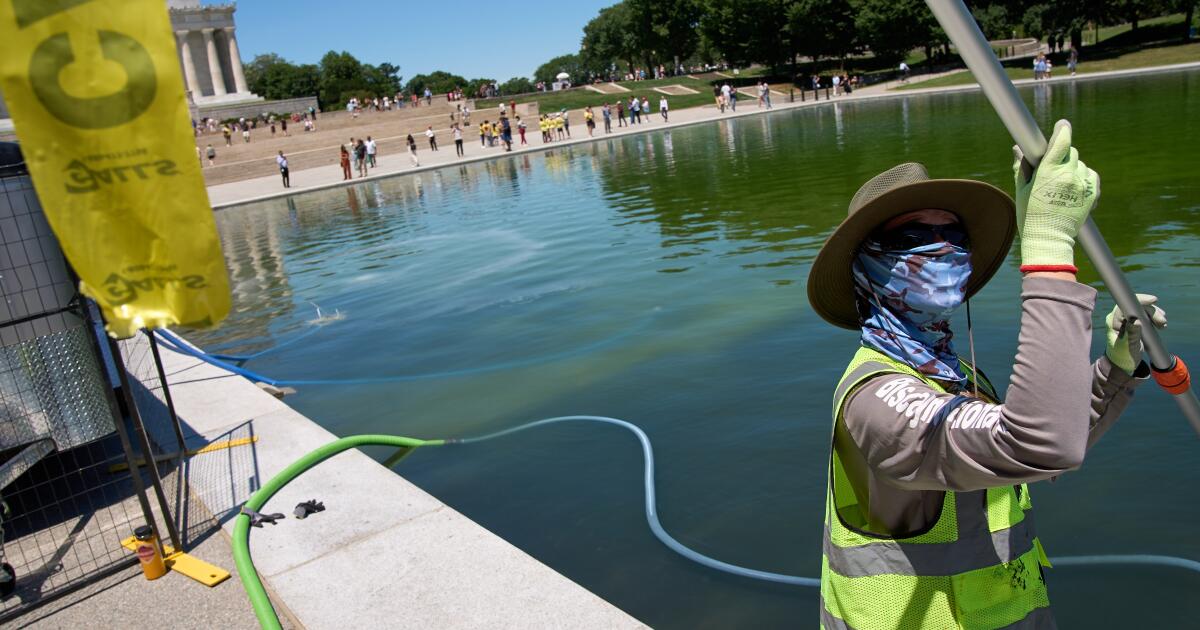
WASHINGTON — President Trump’s remodeled Lincoln Memorial Reflecting Pool with its “American flag blue” bottom has turned chartreuse from an algal bloom that park service workers struggled to address Tuesday just days after its more than $14 million renovation.
The Washington Monument is once again visible in the refilled pool, but Trump’s vision of an azure expanse between the D.C. landmarks has been complicated by the harsh realities of chemistry and biology known to any backyard pool owner. The work has been confounded by the unique challenges posed by the scale of the structure, bigger than 10 Olympic-sized pools — which Trump has called a lake — and the source of its water: the often-fetid Tidal Basin.
Algae has plagued the site since it opened more than 100 years ago, but Trump set his sights on addressing it as part of his aggressive push to beautify Washington as the country approaches its 250th anniversary. Contracts worth at least $14.8 million have been awarded for the project, announced in April by Trump, who said he was inspired by complaints from a friend visiting from Germany who called the pool dark and disgusting.
Teams of National Park Service employees and contractors deployed chemicals and ozone nanobubbles Tuesday in a bid to keep the algae in check, not dissimilar from efforts to clean the pool before Trump’s renovation kicked off.
“What do you expect?” asked Cochise Wanzer II, president of the Pool Service Company in Arlington, Virginia. “You’re basically taking natural, untreated river water, pumping it in and expecting it to do something different from what it would do out in the open.”
And the new coat of paint on the bottom of the pool has added an additional twist to ensuring the cleanliness of one of Washington’s most memorable destinations: “Now that the bottom is nice and dark, it elevates the temperature and the algae grows better,” said Wanzer.
The chemicals and ozone nanobubbles — a water purification treatment used to avoid some harsh chemicals — were one part of the effort underway to clean the Reflecting Pool. Workers used a swimming pool-type vacuum cleaner to suck up algae from the bottom, leaving behind clean patches of American Flag Blue paint adjacent to enormous swaths of green algae in a pattern familiar to anyone who has ever vacuumed a carpet before.
The park service said in a statement it is also using hydrogen peroxide, a milder treatment than chlorine and one used in spas and natural swimming pools. “There are no harmful side effects to marine life or to the environment,” it said.
As the mitigation work continued, a contractor took off his socks and shoes and rolled up his pants to his knees and proceeded to wade into the pool to place an ozone nanobubble tube as tourists and locals milled about on a sunny morning.
Rick and Ariana Pettit, a couple from Las Vegas who are road tripping in their RV across the United States, posed for photos at the iconic site of protests and marches as cleaning continued. Dressed in American flag-themed leggings and a Make America Great Again leotard, Pettit remarked to her husband, attired in an “Veteran for Trump” American flag button-up: “Look, it’s already looking more blue.”
Wanzer was blunt in his assessment of what it would take to maintain the pool as an algae-free space: “They may want to drain it, hose it all down, and start from the beginning with fresh water and treat it as the water comes in.”
Federal prosecutors announced charges Tuesday against 15 people who are accused of impeding federal agents during the Trump administration’s massive immigration surge in Minnesota earlier this year.
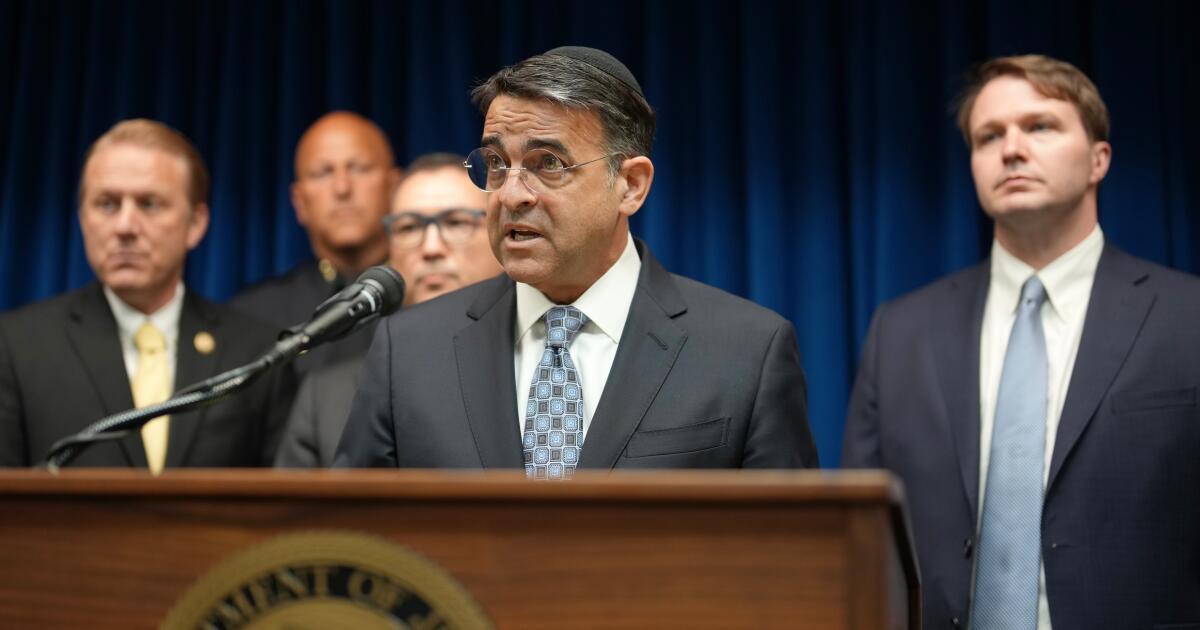
The investigation targeted two “Minneapolis-based antifa groups” whose members were trained in “surveillance, operational planning and rapid mobilization against law enforcement,” Minnesota U.S. Atty. Daniel N. Rosen said at a press conference.
The charges come as the Trump administration has escalated its attacks on “antifa,” an umbrella term for a diffuse movement of militant left-wing activists, which President Trump has described as a domestic terror group.
Rosen said some of those arrested identified as “antifa” while deploying a range of tactics to disrupt the immigration crackdown, such as “stalking” federal agents and using blocks of ice to slow their convoys. He declined to say whether any federal agents were injured as a result of their actions.
“Whether or not they actually, at the end of the day, cause bodily harm is not the measure of whether or not they committed a serious federal crime,” Rosen told reporters.
Twelve people were arrested Tuesday, two remain at large and one is already in custody, Rosen added. The names and specific charges of those arrested were not immediately available.
The charges come months after the administration’s “Operation Metro Surge” brought thousands of federal agents to the Twin Cities, setting off mass protests and leading to the fatal shooting of two U.S. citizens.
During the surge, convoys of agents in unmarked SUVs traveled through neighborhoods, at times banging down doors, waiting outside schools and demanding residents produce proof of citizenship.
Primarily organized through anonymous neighborhood messaging threads, a sprawling network of outraged Minnesotans quickly formed, with ordinary citizens and activists using whistles and car horns to call attention to the masked, heavily armed agents.
At the time, border czar Tom Homan indicated that federal authorities were probing “the organization and funding of the attacks on ICE.”
“They’ll be held accountable,” Homan said. “Justice is coming.”
Last September, Trump signed an order classifying antifa as a domestic terror organization and directing federal agencies to “investigate, disrupt, and dismantle” its affiliates and funders.
Democrats and several First Amendment groups have raised issue with the designation. While the federal government may designate foreign terror groups, there is no formal mechanism to apply the same label to domestic groups.
Trump has long invoked the term against a range of political opponents, including peaceful protesters without anarchist leanings.
NEW YORK — A nationwide network of charitable foundations is encouraging its members to emphasize their positive contributions to American life, a 250th anniversary campaign aimed at quelling what it calls the “greater intensity” of scrutiny felt from the federal government and populist movements.
Popular notions of philanthropy as merely a game for the ultrawealthy to fund partisan projects and commit fraud have left the sector vulnerable to political attacks, as the Council on Foundations sees it, influencing policies that hamper essential community services. The advocacy group, which represents about 1,000 nonprofits, hopes to overcome what CEO Kathleen Enright calls the sector’s “perception gap” with its “Generosity Builds” campaign, launched Monday.
Enright believes most Americans don’t recognize their reliance on the charitable sector. Just about 1 in 20 adults said they or anyone in their immediate family received nonprofit services in the past year, according to a 2023 Indiana University Lilly Family School of Philanthropy report.
“This week, I got an MRI at Georgetown University Hospital, I participated in my church at St. Columba’s, my daughter was inducted into National Junior Honor Society. Four or five nonprofits have been instrumental in my life this week,” she said. “Folks just aren’t putting that tag on it.”
And that tag is growing increasingly important, Enright said. Last year, negotiations over President Trump’s tax and spending bill included proposals to levy new taxes on private foundations that Enright said would have taken resources from communities if they made it into the final law.
The battle over defining what nonprofits actually do has recently been amplified from the highest rungs of the Trump administration, which has upended decades of partnerships built with nonprofits. Trump froze, cut or threatened a sweeping range of social service grants characterized by the White House as “government largesse that’s often riddled with corruption, waste, fraud, and abuse.” More recently, the Department of Justice charged the Southern Poverty Law Center — a civil rights nonprofit accused by Republicans of targeting conservatives in its work tracking extremists — with defrauding donors through payments to informants.
Vice President JD Vance described the Ford Foundation, the Gates Foundation and the Harvard University endowment as “cancers on American society” back as a 2021 U.S. Senate candidate, telling Tucker Carlson that “we are actively subsidizing the people who are destroying this country and they call it a charity.”
“All across our country, we have nonprofits — big foundations — that are effectively social-justice hedge funds,” he said in a talk that year on “woke capital.”
Narratives about nonprofits being “overly politicized” or wasteful are “extreme minority stories” that don’t reflect how philanthropy operates, according to Enright.
Across many surveys, trust in the nonprofit sector has remained higher than most others. But its impact is sometimes difficult to measure and explain. The sector hasn’t faced an environment this challenging in almost six decades, according to Kathryn Thomas, the vice president of communications for the Charles Stewart Mott Foundation in Flint, Michigan.
She cited the congressional effort to increases taxes on foundations’ investment incomes and acknowledged the Trump administration’s federal funding cuts.
“In an era when everything is under partisan attack and there’s so much polarization, we really have to do a better job of emphasizing why we exist,” Thomas said.
Enright said the story of philanthropy is not one where a rich person “saves the day.” She sees growing concerns about billionaires’ influence fueling suspicion about philanthropists’ motivations. Some argue the charitable sector allows moneyed interests to decide how tax dollars are spent rather than elected officials.
The campaign will emphasize that most donors “have just a little bit more than they need and therefore want to give back,” she said, especially at the local level.
“Money does not solve problems. It’s a tool that creative people and institutions inside communities use to solve problems,” she said. “The real heroes of most of these stories are nonprofit leaders, religious leaders, civic leaders who just roll up their sleeves and get something done — but do it with some financial underpinning by charitable foundations.”
That’s the story told by the Gulf Coast Community Foundation in Sarasota, Florida. A 10-apartment affordable housing complex for military veterans opened last year with the foundation’s support.
The area has an “embarrassingly high” number of veterans without housing, according to Jon Thaxton, the foundation’s director of policy and advocacy. Many are priced out in Sarasota, increasingly a luxury destination with high real estate prices.
Local donors had been trying to build a similar project when they approached the foundation in 2020 for help. Thaxton secured land already vested for affordable housing, corralled $2.2 million in donations, got $800,000 from the city and won the backing of their U.S. representatives.
The foundation’s leaders believe their track record made that possible. Phillip Lanham, the president and CEO, noted the project was completed across multiple election cycles and a pandemic, suggesting that community foundations are well situated to “play the long game.”
“Most people think that foundations like us deal with money and donors. We really don’t. We deal with relationships and trust,” Thaxton said. “That’s our commodity. That’s what we earn. That’s what we save. And that’s what we contribute back to the community.”
The Council on Foundations will also elevate examples of early, ordinary philanthropists as part of its case for philanthropy as an integral “part of the American story.” Enright credited a formerly enslaved man with donating land in North Carolina that became an African Methodist Episcopal church that endures as a pillar of the local community.
Lillian Kuri, the president and CEO of the Cleveland Foundation, welcomed the focus on everyday philanthropists. The Cleveland Foundation is considered the first community foundation, established in 1914 by lawyer Frederick Harris Goff as a way to fund durable change in the city.
The foundation aims to find new ways to expand today’s tent of philanthropists dedicated to improving their surrounding areas. It announced new investments this week in a fund dedicated to turn vacant industrial land into job-ready work sites. They’ve also launched a fund that allows donors to invest in major Northeast Ohio companies, supporting local business growth while that money increases into a sizable amount that can be donated to nonprofits.
“Generosity cuts across everybody,” she said, adding that community foundations offer “a way for everyday people — not just the largest, wealthiest people — to participate in the change they want to see in their communities.”
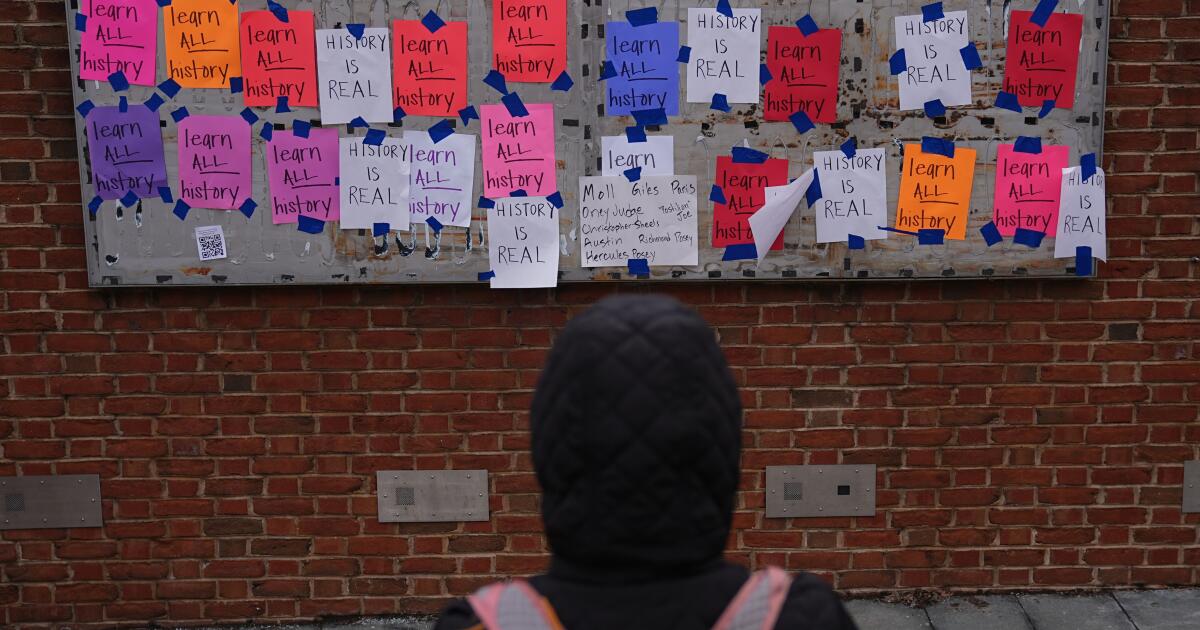
A federal judge has ordered the Trump administration to restore signs related to topics such as climate change, slavery and Indigenous and LGBTQ+ history that were removed under an executive order to purge language at national parks that allegedly cast America in a negative light.
The order has prompted the removal of mentions of President Washington’s slaves at Independence National Historical Park in Philadelphia, signs regarding climate threats at Fort Sumter in South Carolina and a pride flag at the Stonewall National Monument in New York City, according to the lawsuit challenging the action.
A preliminary injunction was issued Friday by U.S. District Judge Angel Kelley in Boston, who sided with a coalition of conservation and historical groups and ordered all language removed under the order to be reinstated before the Fourth of July. Earlier this year, another federal judge ordered the signage related to Washington’s slaves restored.
In Friday’s injunction, Kelley accused the Trump administration of seeking “to rewrite the Nation’s history with a white-out pen,” and said that national parks play an important role in telling the multifaceted history of America, including “the good, the bad, and the ugly.”
“Because Defendants deemed it important to strip the parks of these undeniable truths in anticipation of the 250th Anniversary of our great Nation,” she wrote, “it is equally important that our shared history be honestly told and fully restored by the 250th Anniversary to properly honor the remarkable achievements of the United States.”
A spokesperson for the U.S. Department of the Interior dismissed the ruling as the work of a “liberal activist judge.”
“The Department will look at our appeal options while we celebrate UFC Freedom 250 on the South Lawn of the White House this weekend in honor of our nation’s 250th with the greatest president in the history of our country — President Donald J. Trump,” the spokesperson said in a statement.
Trump initially signed the executive order in March 2025, arguing that a revisionist movement is seeking to undermine American history by replacing objective fact with a distorted, ideologically driven narrative.
“Under this historical revision, our Nation’s unparalleled legacy of advancing liberty, individual rights, and human happiness is reconstructed as inherently racist, sexist, oppressive, or otherwise irredeemably flawed,” the order stated.
Under the order, more than 430 sites under the purview of the National Park Service were told to review language on monuments, memorials, statues and markers to ensure they didn’t disparage Americans past or present, with a close eye on language added during former President Biden’s administration. QR codes were also added at sites encouraging visitors to report any signs they believed violated the order.
In February, a coalition including the National Parks Conservation Assn., American Assn. for State and Local History, Assn. of National Park Rangers and Union of Concerned Scientists filed a lawsuit in federal court in Boston alleging that the order was erasing American history and science.
“National parks serve as living classrooms for our country, where science and history come to life for visitors,” Alan Spears, senior director of cultural resources at the parks conservation association, said in a February statement. “As Americans, we deserve national parks that tell stories of our country’s triumphs and heartbreaks alike. We can handle the truth.”
ALEXANDRIA, Va. — A federal judge agreed on Friday to extend a court-ordered block on the Trump administration’s creation and operation of a $1.8 billion settlement fund for compensating people who claim to be victims of a weaponized government.
Earlier this month, acting Atty. Gen. Todd Blanche told Congress that the government is scrapping its plans for the fund in the face of a fierce bipartisan backlash. Government attorneys have argued that lawsuits challenging the fund are now moot, but plaintiffs’ attorneys aren’t satisfied by Blanche’s assurances that the fund won’t move forward.
Neither was U.S. District Judge Leonie Brinkema, who ruled that the “Anti-Weaponization Fund” will remain blocked until further notice from the court.
“The (government’s) mootness argument, in my view, doesn’t go anywhere,” the judge said.
President Trump, meanwhile, has not publicly and unequivocally endorsed its cancellation. He has continued to express support for the fund in remarks to reporters.
Brinkema gave the parties a week to negotiate an agreement for Blanche to submit a sworn declaration that the administration won’t revive the fund.
Brinkema previously agreed to temporarily block the administration from proceeding with the fund for at least two weeks. Her May 29 order was due to expire on Friday.
Trump’s Republican administration created the fund to resolve his lawsuit against the Internal Revenue Service over the leak of his tax returns.
Plaintiffs who sued to block fund payouts argue that the government can’t legally divert taxpayer money into what they argue is a slush fund for compensating Trump’s allies.
In a separate case on Wednesday, a different judge in Washington, D.C., rejected a government watchdog’s parallel request for a court order temporarily blocking the Trump administration from forging ahead with the fund. U.S. District Judge Richard Leon said he accepts Blanche’s representation that the fund is now moot.
Leon had asked Justice Department attorney Andrew Block why Blanche doesn’t formally rescind his May 18 order establishing the fund. Block said he didn’t know. He still didn’t have an answer to that question when Brinkema posed it two days later.
“It’s a huge gap in the record that we don’t have an answer to that question,” the judge said.
In the Virginia case, attorneys from the legal advocacy group Democracy Forward asked for an order to temporarily suspend the fund’s implementation and stop the Trump administration from disbursing any payouts from it.
The plaintiffs include a fired prosecutor and a college professor acquitted of assaulting federal agents at a protest.
Even before the administration said it was dropping the fund, the Justice Department did not form the five-member commission that would decide on payout criteria, so no money was paid out nor claims accepted.
Many of the Republican president’s allies are opposed to compensating rioters who stormed the U.S. Capitol on Jan. 6, 2021. In May, however, Blanche wouldn’t rule out the possibility that Capitol rioters who engaged could be eligible to apply for payments from the fund.
Trump issued mass pardons to Capitol rioters on his first day back in the White House last year. More than 1,500 people were charged in the Jan. 6 attack before Trump erased every case with his sweeping act of clemency.
Brinkema was nominated to the bench by President Clinton, a Democrat.
WASHINGTON — A year after the Trump administration kicked off its aggressive immigration enforcement tour with military-style raids across greater Los Angeles, federal officials have veered toward a less flashy but broader strategy: making immigrants’ lives harder so they will leave.
The changes range in scale and scope, from disqualifying immigrants from certain jobs to indefinitely pausing the processing of visa applications. They target those lawfully present as well as the undocumented.
Since President Trump’s second term began, the administration has used executive orders and federal regulations to chip away at services or benefits, such as work permits and small business loans, that immigrants could obtain in the past.
Now, immigrants are finding that freedoms — the ones that once made the U.S. a desirable place to start over — are disappearing. Many are retreating back into the shadows as they fear previously routine tasks, such as traveling across states, filing taxes and seeking medical care.
“The priority is to force people to leave the country or not come, regardless of legal status or really any other criteria,” said David Bier, immigration studies director at the Libertarian think tank the Cato Institute. “They’re taking a sledgehammer to the system.”
Trump won the White House in part on his promise to clamp down on illegal immigration, but recent polling shows support for his agenda has waned, especially after immigration agents shot and killed two U.S. citizens in Minneapolis.
In a statement, White House spokesperson Abigail Jackson said Trump’s highest priority has always been the deportation of immigrants with criminal records. The Department of Homeland Security said Trump also prioritizes immigration that strengthens the country financially, socially and culturally.
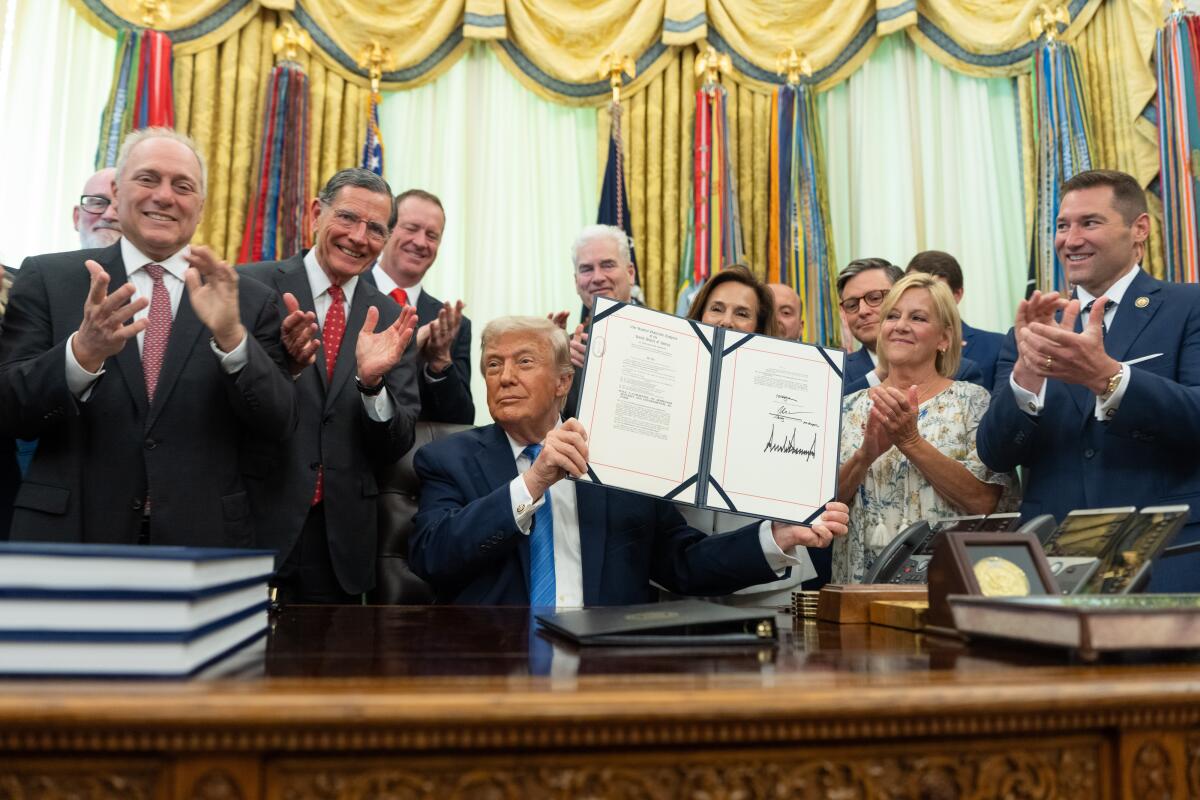
President Trump displays the signed “Secure America Act” during a ceremony in the Oval Office on Wednesday. The act provides $70 billion for immigration enforcement and border-security agencies.
(Aaron Schwartz / CNP, Bloomberg)
The number of arrests by ICE agents has declined. On average, ICE arrested about 1,000 immigrants per day in early March, down from a peak average of just under 1,400 in mid-January, agency data show. And there are fewer detained immigrants — facilities across the country held about 60,000 detainees in April, compared to more than 70,000 in late January.
The downturns prompted some Trump loyalists to say the administration is failing to fulfill his signature promise, which is an assertion the administration rejects.
“ICE is NOT slowing down,” said Homeland Security spokesperson Lauren Bis. “Since Day One, DHS law enforcement has been delivering on President Trump’s promise to the American people to arrest and deport criminal illegal aliens.”
At a border security conference last month, Tom Homan, who leads border policy for the White House, suggested immigration agents would return to more muscular enforcement tactics.
“You ain’t seen s— yet,” he told the audience.
But along with focusing on deportations, the administration is deploying other tactics to deter illegal — and legal —immigration.
ICE agents confront protesters on June 8 as they gather outside the federal immigration center at Delaney Hall in Newark, New Jersey, where ICE is housing detained immigrants.
(Spencer Platt / Getty Images)
Curtailing visas
Last month, the Department of Homeland Security announced that “except in extraordinary circumstances,” immigrants seeking lawful permanent residency must leave the U.S. to complete the process. After a backlash, the administration defended the policy, saying it won’t prevent anyone who qualifies for a green card from getting one.
U.S. Citizenship and Immigration Services, the agency in charge of processing immigration benefits, has upped security screening since Trump took office. The agency says that’s to root out fraud, but critics say all it does is unnecessarily slow down a system that already vets applicants vigorously.
The administration indefinitely banned people from 75 countries from receiving immigrant visas, which allow people to move permanently to the U.S.
In a similar move, the government halted the processing of immigration applications for people from 39 countries and who are already in the U.S. On June 5, a federal judge struck down the policy in a scathing ruling that said the administration “justifies its actions with pretextual concerns of ‘national security’ that mask anti-immigrant sentiments.”
Children of Guatemalan origin, from left, Areimy, Mariela and Enrique, arrive at Miami International Airport on Dec. 4, 2025, as they prepare to leave the United States to reunite with their recently deported parents in Guatemala.
(Chandan Khanna / AFP via Getty Images)
The judge’s ruling may offer relief, but for many immigrants, the effects of the policy are devastating. Armin, a 42-year-old from Iran, said he has racked up more than $15,000 in debt since the pause took effect in December. Armin asked The Times not to fully identify for fear of jeopardizing his immigration case.
The nutritional scientist came to the U.S. in 2019 on a student visa and has a pending green card application under a provision that allows certain highly skilled immigrants to apply for permanent residency without needing an employer to sponsor them.
After receiving his PhD and completing a postdoctoral program, Armin was in between jobs when he received a research grant in November. But with the processing of his work authorization halted, the university that issued the grant said it couldn’t hire him as a research associate. In February, he was turned down for another job.
Armin said he is confused about why the administration won’t differentiate between legal immigrants and those who should be deported.
“I can’t believe it,” he said. “I’m doing research and my research has national interest benefits. You expect support from the government. Unfortunately they don’t differentiate. They don’t care about your resume.”
Bier said the visa policies affect half of all legal immigrants coming from abroad. He published a report in April about how Trump has cut legal immigration far more than illegal immigration, noting that the administration’s policies have led to big drops in visas for international students, high-skilled workers and refugees.
“The legal immigration system is being used as a means to carry out the mass deportation agenda,” he said.
Alessandro Negrete, who lived most of his life in the U.S. undocumented, crosses into Mexico after deciding to leave.
(Robert Gauthier / Los Angeles Times)
Encouraging self-deportation
More than 90,000 immigrants have been granted voluntary departure since the start of the Trump administration, according to federal immigration court data through April that was analyzed by TRAC, a data research organization. Voluntary departure avoids official deportation and can leave open the possibility of an immigrant returning to the U.S. legally.
Homan, who declined to be interviewed for this story, has said self-deportations were part of the administration’s immigration plan all along.
“We knew if we surged unlimited ICE resources in the interior, and we do these operations, that that will force those that are here illegally to leave on their own,” he recently told the Washington Examiner.
Halting work permits
In the past, asylum seekers and others with deportation protections have had the ability to seek permits to work legally in the U.S. But work is now an administration target.
One proposed regulation would prevent asylum seekers from working legally in the U.S. Another proposal, published Friday, would further restrict access to work permits for other immigrants.
Under a rule that took effect last month, asylum seekers pay an annual $102 fee within 30 days of receiving a notice from U.S. Citizenship and Immigration Services. If the deadline is missed, their applications will be rejected — with no opportunity to appeal — and they could be placed in deportation proceedings. Those who apply for asylum with the agency have entered the U.S. legally, such as on a visa, and are not undocumented.
Asylum seekers rest at a Tijuana migrant shelter a day after President Trump began his second term in the White House.
(Robert Gauthier/Los Angeles Times)
Conchita Cruz, co-executive director of the Asylum Seeker Advocacy Project, said many asylum applicants have not received notice that the fee is due.
Cruz said she believes the Trump administration is using these changes as an excuse to dismiss people’s asylum claims. While the president has the power to decide whether to offer or rescind humanitarian programs, such as Temporary Protected Status, the right to seek asylum is enshrined in law.
“We’re worried this is a pretext for people to fall out of the asylum system and fall out of the workforce,” she said.
The processing of work permits has already been slowed, leaving many immigrants who still qualify for employment authorization unable to work.
During a House Homeland Security Committee hearing last week, Rep. Lou Correa (D-Santa Ana) asked Homeland Security Secretary Markwayne Mullin to help him speed up the work permit renewals for two police officers who were recently fired by agencies in his district because their DACA status expired.
Mullin said he would help but that Congress ultimately must pass a permanent solution for DACA recipients.
“These are police officers on Main Street, sir,” Correa responded.
“Not all of them are,” Mullin said. “I’m not just going to wave a magic wand and fix them all.”
“You have that magic wand — that’s your job,” Correa said.
It wasn’t just Democrats complaining about slow processing. Rep. Gabe Evans (R-Colo.) similarly asked Mullin for help because many of his constituents — “farm workers, youth ministers, nurses, grocery store business managers” — who have lived and worked in the U.S. legally for decades are now having trouble renewing their visas.
Secretary of Homeland Security Markwayne Mullin, left, and President Trump, center, walk to the motorcade after exiting Air Force One at Joint Base Andrews, Maryland, on May 20.
(Kent Nishimura / AFP via Getty Images)
Calls for mass deportations
Mullin, who took the reins in March after Trump fired his predecessor, Kristi Noem, rolled back some of Noem’s policies, including telling agents to stop entering homes without judicial warrants and canceling some contracts she had initiated.
But the changes and the downturn in arrests have drawn criticism from some fervent Trump supporters.
“Trump’s legacy is tied up in this,” said Mike Howell, a former DHS attorney who founded a group called the Mass Deportation Coalition. “It’s going to be hard to tell a younger voter to get excited to show up when one of their top issues is mass deportation and, a year and a half in, it doesn’t appear it’s going full-steam ahead.”
Howell said enforcement at work sites is critical to scaling up arrests and deportations. That more such operations haven’t happened, he said, is a political decision to appease wealthy donors and special interest groups who don’t want to see their workers deported.
The architect of Trump’s immigration agenda is Stephen Miller, a top White House aid who has called for a “moratorium on immigration from third-world countries,” demanded 3,000 arrests per day and said that immigrants and their descendants “recreate the conditions, and the terrors, of their broken homelands.”
Royce Bernstein Murray, a former Homeland Security official who worked on immigration policy under the Biden administration, said the winding down of flashy enforcement surges has given the administration more time to “focus on tearing down the legal immigration system.”
“This is Stephen Miller’s sweet spot,” she said. “He was never in enforcement — he’s a policy guy. This is really an opportunity for him to make good on all he has planned for years.”
While ICE has, in recent months, returned to its more conventional targeted enforcement tactics, Homan has sought to make clear that mass deportations are still a goal.
“For the people out there saying ‘President Trump’s getting weak on mass deportation,’ you don’t know what the hell you’re talking about,” Homan said at the border expo.
On Monday, Homan told Fox News that he had just reviewed plans for an ICE operation that would surge agents to New York City.
In many ways, the most ambitious World Cup in history — which kicked off Thursday in Mexico City — has inspired more angst than anticipation, more fear than fervor.
The competition, returning to North America for the first time in more than three decades, has expanded to 48 teams and 104 matches, to be played over 39 days in 16 cities in the U.S., Mexico and Canada. The complex planning was eight years in the making.
Yet even before the competition opened with Mexico facing South Africa at the iconic Estadio Azteca, it has been marred by a number of controversies that threaten to overshadow the soccer and cloud the tournament’s legacy.
“I view this World Cup as the most politically combustible World Cup in recent history. And that’s saying something,” said Jules Boykoff, a political science professor at the University of Portland and author of eight books on the politics of international sport.
“We’re in uncharted territory in many ways.”
Relations between the host countries, once strong, have been strained by the Trump administration’s tariff policies and disagreements over border security. Travel bans have barred potential World Cup visitors — and even support staff and match officials — from entering the U.S. and others are fearful of making the trip, worried about ICE raids and immigration roundups.
The U.S. is at war with a tournament qualifier, Iran. And Iran has fired missiles and drones on Jordan, Qatar and Saudi Arabia, nations that also are World Cup participants.
The International Sports Press Assn. said Iranian and African journalists have been denied visas to cover games in the U.S., and Iran protested after more than a dozen members of its support staff had their requests to enter the U.S. rejected. The Iranians, who were forced to move their training base from Tucson to Tijuana, will spend limited time in the U.S. during group-play games that will take place in Inglewood and Seattle.
Players and journalists from Senegal, Uzbekistan and Iraq have been detained at U.S. airports for up to seven hours by immigration officials. Then on Monday, Omar Artan, a decorated referee and the first Somali official selected to work a World Cup, was turned away at Miami International Airport.
In addition, ticket prices have been so high and the lottery process for obtaining them so opaque, the attorneys general of New York and New Jersey have begun formal investigations into FIFA practices. Other states, including California, hosting tournament matches have begun asking questions as well.
All that has conspired to produce a World Cup that is struggling to catch on with the public. According to a recent poll by Yougov.com, a majority of Americans — 54% — say they are not at all interested in the tournament and nearly six in 10 say they will not watch any matches.
“People are just in a bad mood,” Boykoff said. “It’s a tough time.”
FIFA president Gianni Infantino remains optimistic, promising this will be “the biggest, the most inclusive, the greatest FIFA World Cup ever.” He made the same claim about the 2022 World Cup in Qatar and the 2018 tournament in Russia.
FIFA president Gianni Infantino speaks during a news conference on Wednesday before the start of the World Cup.
(Carl Recine / Getty Images)
“The World Cup should be understood as both a global sporting celebration and a major commercial enterprise, with these two dimensions being mutually enforcing rather than contradictory,” said Steve Georgakis, a lecturer on sports studies at the University of Sydney and a frequent author on soccer.
This year’s tournament is projected to swell FIFA’s coffers by nearly $9 billion and the TV ratings, it says, will be massive.
“Its universal appeal combined with the participation of 48 nations ensures that it remains a genuinely global sporting event,” Georgakis said.
Boykoff has his doubts.
“In this particular political moment, with the Trump administration being erratic and impulsive and needing a win from this tournament and the fact there’s so many moving parts geopolitically, I don’t have confidence that it’s just going to end up being a soccer-focused next five weeks,” he said.
This is not the first World Cup to kick off under some kind of black cloud.
The 1974 tournament in West Germany was tarred by the geopolitical fallout of the 1973 Yom Kippur War. Four years later Argentina’s military dictatorship used the World Cup to sportswash a “Dirty War” in which as many as 30,000 people were tortured, murdered and disappeared.
The 2010 and 2014 World Cups were troubled by cost overruns and delays in the construction of stadiums and other infrastructure and the threat of labor unrest while global outrage over human rights violations and discrimination against women and LGBTQ people hung over the last two tournaments.
Those issues never fully disappeared but were overshadowed by the brilliance of the soccer. Jonathan Wilson, a columnist with the Guardian and author of “The Power and the Glory: The History of the World Cup,” expects the same this summer.
“The other stuff will still be there in the background,” he said, “but fundamentally the football will, for the vast majority of people, take over. It’s just sort of a natural cycle.”
Argentina star Lionel Messi controls the ball during an international friendly against Iceland on Tuesday.
(Butch Dill / Associated Press)
And as with every World Cup, there undoubtedly will be unforgettable moments.
Argentina’s Lionel Messi and Portugal’s Cristiano Ronaldo, the top scorers in soccer history, will be playing in their sixth and final World Cups — Messi chasing a second straight title and Ronaldo pursuing the only prize that has eluded him.
Kylian Mbabbe will be trying to take France to a third consecutive final while young superstars like Erling Haaland of Norway and Lamine Yamal of Spain will be looking to put their mark on their first World Cups.
Four teams — Jordan, Curacao, Cape Verde and Uzbekistan — have qualified for the tournament for the first time.
And there will be other storylines no one saw coming, all of which will contribute to the narrative of this World Cup.
“Major sporting events have a way of capturing public attention and shifting the conversation toward what is happening on the field rather than off it,” Georgakis said.
How much the actions of the Trump administration affect that calculation remains to be seen.
There are travel restrictions in place that fully or partially bar citizens from 39 countries — including a number of World Cup participants — from entering the U.S. And the administration has said ICE and Homeland Security personnel will have a visible presence at World Cup venues, including SoFi Stadium in Inglewood, where the American team will begin play Friday.
“There will be federal agents,” confirmed L.A. County Sheriff Robert Luna, who added that he could not guarantee immigration sweeps would not take place. “ They told us that specifically would not be occurring,” he said. “Any of that’s subject to change.”
Mexico fans celebrate during a watch party at Plaza Mexico in Lynwood on Thursday.
(Kayla Bartkowski / Los Angeles Times)
The difficulty in obtaining visas and the fear of being rounded up by immigration agents are being blamed, in part, for less-than-expected tourist traffic. Hotel operators in all 11 World Cup host cities say bookings for the tournament are well below projections. Several countries have issued warnings about travel to the U.S.
Then there are the own goals from FIFA over tickets and parking prices as high as $900 at some stadiums, weather issues and a short-lived ban on water bottles.
FIFA has defended its policies on ticket prices by arguing that premiums are necessary to maximize revenue, which it will invest in global soccer development. Variable, market-based pricing, it said, simply reflects standard entertainment practices in North America. The organization did, however, reverse its ban on fans bringing bottles into games. Spectators are now allowed to enter stadiums with one soft, plastic 20-ounce water bottle.
And despite a warning from climate scientists that one in four World Cup games could be played in dangerously hot conditions, FIFA will start 40 of them at 3 p.m. or earlier local time, the warmest time of day, to accommodate European TV viewers.
Georgakis said the play on the field will have to overcome all those issues if this World Cup is to earn a favorable place in history.
“Ultimately the success of the World Cup will be judged by what happens on the field,” he said. “If the football is compelling, dramatic and memorable, the tournament will likely be remembered as a great World Cup. If the play falls short, then the off-field issues such as ticket prices, extreme heat, ICE enforcement activities, the Trump administration will receive great attention and could shape perceptions of the event.”
WASHINGTON — The Trump administration has identified more than 15,000 cases of adults gaining custody of multiple immigrant children who enter the U.S. without a parent, officials said Thursday, signaling a potential push to prosecute prolific child sponsors.
The Justice Department highlighted cases against three Guatemalan nationals that they say underscore the dangers of improper vetting of sponsors in a program that seeks to unite kids with relatives or family friends after they enter the U.S. Officials said they are investigating numerous other so-called super-sponsors — those who gained custody of more than three unrelated children — to determine whether the sponsors took the kids in fraudulently.
“We will not accept half measures when it comes to securing the border, protecting American lives and saving children from exploitation,” Acting Atty. Gen. Todd Blanche told reporters.
Taking custody of multiple unrelated migrant children is not a crime. The sponsors may be caring and well-intentioned, but senior administration officials calling them out suggests that authorities harbor suspicion about them and may subject them to deeper scrutiny.
Under former President Biden, officials tried to release children to eligible adult sponsors within 30 days, reuniting many families quickly. But the approach also yielded errors, with some children being released to adults who forced them to work illegally or to people who provided clearly false identification and addresses.
Under Trump, the administration tightened rules aimed at preventing traffickers from illegally bringing children into the country, and that has also led to a dramatic increase in federal custody times for kids. As of May, children are held in federal custody for an average of 206 days before they’re released, compared with an average of 37 days when Trump took office. At the same time, the number of total children in custody has steadily dropped.
Striking a balance between releasing children to vetted sponsors and shielding them from danger has proved a contentious partisan disagreement.
Democrats “want to claim that Republicans, because we’re enforcing the laws, it’s inhumane, somehow,” Blanche said after criticizing the vetting procedures under the Biden administration. “What’s inhumane about taking care of our kids?”
The cases announced Thursday include charges against a woman who, authorities say, was living in the U.S. illegally, schemed with others to smuggle kids across the border, then used fake identities to gain custody of them in exchange for money. In another case, a woman is accused of falsely claiming that she was siblings with a teen who had entered the U.S. illegally in her application to become the teen’s sponsor.
The Associated Press has sought comment from attorneys representing the accused in those cases.
Critics of the Trump administration have raised concerns over wellness checks carried out by immigration officers at elementary schools, immigration officers showing up and detaining sponsors at reunification meetings with children, and newly required documentation that’s created a “paperwork barrier” and led to a recent lawsuit.
Even sponsors willing to undergo the new vetting procedures have been forced to wait through unnecessary delays.
A Chicago father who is a U.S. citizen and had a valid birth certificate for his child was kept waiting for five months before the government could schedule a fingerprinting appointment. During the wait, his toddler daughter was sexually abused in federal custody, a lawsuit claimed.
Richer and Gonzalez write for the Associated Press. Gonzalez reported from McAllen, Texas.
WASHINGTON — House Republicans will look to get nearly $70 billion for immigration enforcement over the finish line Tuesday, enough to fund a pair of Homeland Security agencies through the next three years and the rest of President Donald Trump’s time in office.
Speaker Mike Johnson will need near perfect attendance and unity on his side to complete weeks of action on the bill. The legislation got sidetracked when Republicans sought to include $1 billion for enhanced security on the White House grounds, including for Trump’s new ballroom, and the Trump administration tried to create a nearly $1.8 billion fund to compensate allies of the president who claim they have been unjustly investigated and prosecuted. Those proposals proved politically toxic and were scrapped.
Now, the bill is focused entirely on immigration enforcement, a topic that Republicans have treated as a defining issue between the two major political parties and one they hope will carry them to victory in this year’s midterm elections. The bill provides $38 billion for Immigration and Customs Enforcement, $26 billion for the Border Patrol and another $5 billion to cover unforeseen costs, fueling Trump’s deportation agenda.
“It’s long overdue,” said Johnson, R-La., of the bill. “We have to fund border security and immigration enforcement, and it’s sad that Republicans have to do it on our own.”
Funding accelerates Trump’s deportation agenda
The funding comes on top of the nearly $140 billion that the Republican-controlled Congress gave ICE and Customs and Border Protection last year as part of Trump’s tax and spending cuts bill.
Democrats objected to giving the agencies more money without significant changes in the way they operate after the deaths of Alex Pretti and Renee Good in Minneapolis. For example, Democrats insisted that agents be required to display their ID badges during enforcement operations and that they get a judicial warrant before entering private property. Instead, the funding will come with virtually no strings attached.
House Democratic Leader Hakeem Jeffries vowed his party would oppose the package.
“We believe that taxpayer dollars should be used to make life more affordable for the American people – not give ICE another $70 billion blank check so that they can unleash brutality on American citizens and violently target law-abiding immigrant communities,” said Jeffries of New York.
Homeland Security faced longest shutdown in history
The package is the result of a monthslong standoff in Congress after Democrats refused to fund the Department of Homeland Security in the wake of the immigration enforcement actions in Minneapolis and other American cities, leading to the longest shutdown in agency history.
Negotiations had been underway with the White House to alter ICE operations as Democrats were demanding. When those negotiations failed, Republicans turned to a complicated procedural maneuver to get around the filibuster and pass the immigration funding with no Democratic votes.
If approved, the package would next go to Trump for his signature, all but assuring an essentially uninterrupted flow of funds for his immigration enforcement and deportation agenda into 2029.
The Senate completed its work on the legislation last week during an all-night session that extended into the early morning hours Friday. The final 52-47 vote on the bill was nearly party line, with Sen. Lisa Murkowski of Alaska the only Republican to oppose it.
Money comes at pivotal time for immigration agenda
The money will come at a pivotal time for the Department of Homeland Security, which is under new leadership after Trump replaced Kristi Noem with new Secretary Markwayne Mullin in March.
While Mullin has vowed to keep the department out of the headlines, the administration is under pressure from anti-immigration advocates to deliver on Trump’s campaign promise of the largest deportation operation in American history.
So far, the administration has not hit its goal of 1 million deportations a year, but Trump’s border czar, Tom Homan, has promised more to come, including hinting at immigration enforcement actions in New York, the nation’s biggest city, which is heavily Democratic.
At the same time, the administration is making it more difficult for legal immigrants to remain in the U.S. by working to end Temporary Protective Status, changing the processes for obtaining green cards and leaving some Dreamers — the young people who were brought illegally to the U.S. as children — reporting delays in renewing their status, which allows them to stay and work.
Tight vote ahead
On the House side, Johnson has little margin for error. Republicans can afford to lose only a couple of votes if every lawmaker is present. GOP leadership opted to avoid any hiccups and sent lawmakers home last week rather than take up the bill early Friday once the Senate had completed its all-nighter.
The bill is just a slim package, without the hundreds of pages of details and directives that typically come from Congress when it provides funding for agencies.
Leading up to the vote, Democrats portrayed DHS as an agency that has used its new resources to buy private jets for its leadership, warehouse immigrants in deplorable conditions and attack U.S. citizens.
“To give these rogue agencies another $70 billion now when they still have $100 billion in the bank from last year would implicate all of us in the escalating corruption and shameful actions of this department,” said Rep. Jamie Raskin of Maryland, the ranking Democratic member on the House Judiciary Committee.
Republicans countered that they were fulfilling their duty to safeguard the nation and support the men and women charged with enforcing the law.
“Democrats can say whatever they want, but what it’s about is public safety. What’s it about is keeping Americans safe,” said Rep. Michelle Fischbach, R-Minn.
Freking and Mascaro write for the Associated Press.