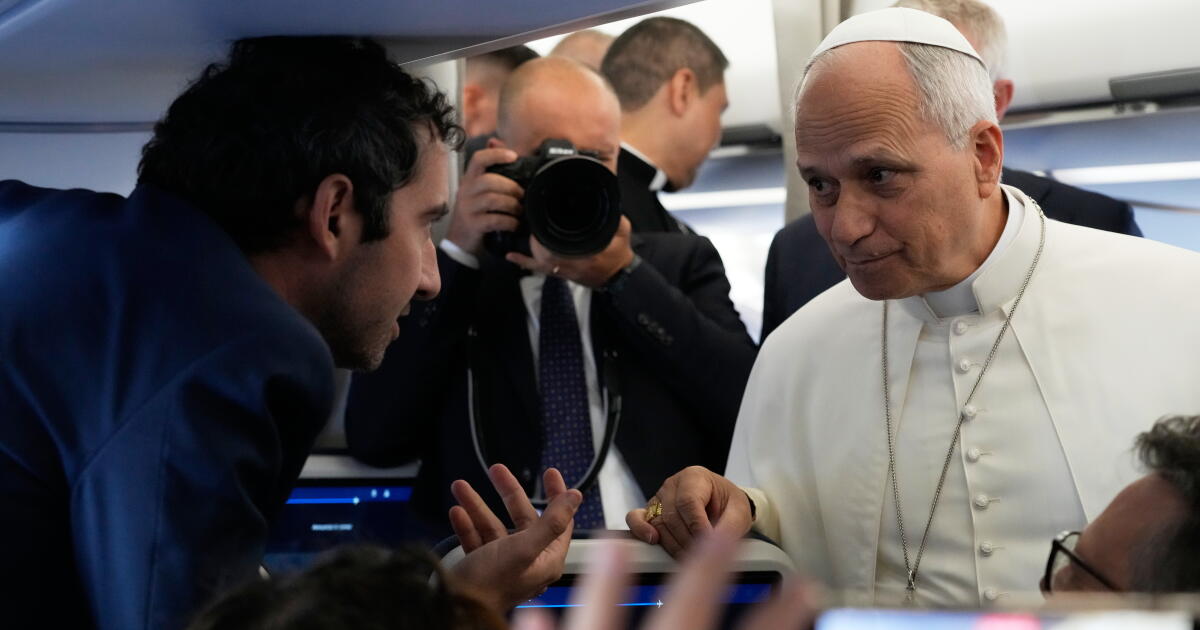
ABOARD THE PAPAL PLANE — Pope Leo XIV told journalists they were welcome to report on him, as he responded to the Trump administration’s attempt to bar U.S. media from the White House and affirmed the importance of journalists covering public figures.
Leo spoke to reporters Friday on his way to France for a four-day visit. Asked by a CNN reporter about the Trump administration’s attempt to bar CNN and other reporters, Leo said the media was welcome on his plane.
“I am very happy that here, you are all welcome,” he said. Good media coverage is important, he said, and equally important “that we have it all the way around, for everyone”
CNN, MS NOW and Politico were back at the White House on Thursday after a judge handed them a reprieve from President Trump’s ban, but the extraordinary showdown between him and outlets whose coverage he dislikes continued.
On a high-profile day when Chinese leader Xi Jinping was visiting Washington and attending a state dinner, no major American network was airing live coverage, and both CNN and MS NOW said their journalists were denied access to Xi’s state dinner arrival.
The American pope has long affirmed the need for free and independent press, a point he made in one of his first audiences as pope. Speaking to journalists who covered the 2025 conclave that elected him, Leo called for the release of imprisoned journalists and affirmed the “precious gift of free speech and the press.”
That said, since the COVID-19 pandemic, independent media have been prevented from covering photo opportunities inside the pope’s private studio when heads of state visit. Additionally, many of the pope’s private audiences with other groups and individuals are closed to non-Vatican press.
Leo had opposed Trump on the war
Leo’s airborne comments about Trump followed his April back-and-forth over the American president’s criticism of his opposition to the Iran war. Leo’s position won him points with some Parisans opposed to Trump’s policies who came out in droves to celebrate the first official state visit by a pope in 18 years.
“He dared, at his level, to oppose the American president,” said retiree Thierry Marien, who lined up hours early to grab a spot on the popemobile route to Notre Dame cathedral, where Leo was to celebrate vespers later Friday. “Not because he is opposed to the American president but because he’s opposed to countries where we can see there’s a risk of their political systems becoming a bit more dictatorial and there are already enough of those in the world.”
“I appreciated that he did that. He could quite easily have said to himself, ‘In my situation, I won’t criticize any heads of state,’” he said.
Leo took further distance from the Trump administration policies later Friday by making a lengthy visit to UNESCO, the U.N. cultural and educational agency, from which the U.S. has withdrawn as part of its retreat from the international organization.
Leo, who has championed multilateral diplomacy, toured the UNESCO grounds inside and out, greeted its employees and received a guided tour of some of its art collections. He then delivered a speech on the values UNESCO espouses to promote peace through culture and education.
Leo apologizes to reporters
Also on the flight Friday, Leo also apologized for missing an opportunity to speak with the press the last time he traveled internationally, when his Iberia charter broke down in Spain’s Canary Islands and he returned home solo on the king’s private jet, skipping his traditional airborne press conference.
More than 70 reporters and the Vatican delegation waited for several hours at the airport for a replacement plane to arrive. Leo addressed the media’s disappointment when he came to the back of the plane to greet reporters.
“A special mention I would like to make for those of you who were traveling with me when we returned to Rome from Spain,” he said. “I want to apologize personally for an incident, that I had nothing to do with, but which I know left a number of you unhappy with the fact that we couldn’t have the flight back together back to Rome.”
In other comments to reporters, Leo said he believed his alma mater Villanova would be the fan favorite when the Augustinian university plays the Catholic University of Notre Dame’s basketball team in Rome on Nov. 1.
“They tell me that the people coming to the match, 90% are Villanova and 10% Notre Dame, so the voice of the people of God will be very strong on the Villanova side,” Leo said.
WASHINGTON — The Trump administration plans to limit the number of refugees admitted to the country to 17,500 mostly white South Africans, the administration told Congress on Tuesday, as it continues to transform a program that at one point served as a pathway to safety for people fleeing war and strife from countries around the world.
In a notice to Congress obtained by the Associated Press, the administration said the white South Africans faced seizures of their land and other forms of persecution and would be likely to assimilate when they come to America. The South African government has repeatedly rejected the idea that the white South Africans, who are Afrikaners, are a persecuted minority in the home country.
The Trump administration has dramatically altered a refugee program that historically enjoyed strong bipartisan support as it welcomed tens of thousands of refugees from countries around the world to new lives in America, and instead the administration has transformed it into a vehicle to resettle white South Africans in America.
The administration told Congress in the announcement that it intended to spend about $500 million to resettle the new arrivals to the U.S.
Presidents set the cap on how many refugees the U.S. will approve through the program each year, and historically, they’ve allocated those numbers across various geographic regions while factoring in wars or conflicts that spark humanitarian needs around the globe.
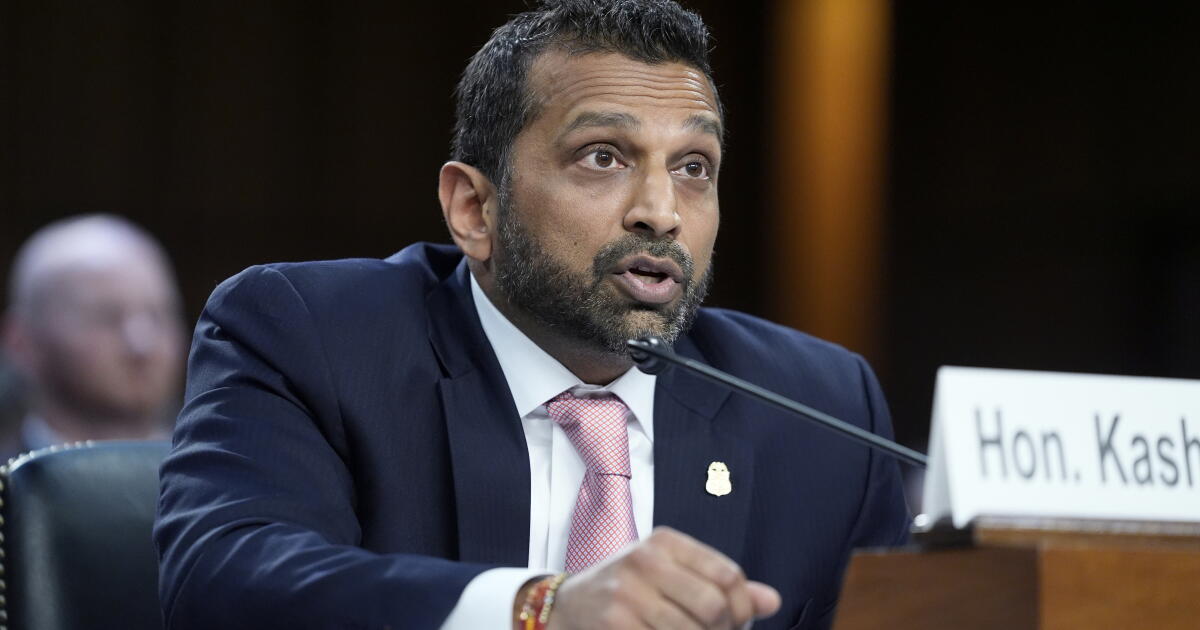
WASHINGTON — FBI Director Kash Patel on Tuesday defended the bureau’s loosening of hiring standards regarding an applicant’s past experience with prostitution and bestiality, insisting that the changes were meant to enable victims of those acts to be considered for employment without fear of automatic disqualification.
The subject arose during a contentious Senate Judiciary Committee hearing in which Patel clashed with Democrats over his firing of agents who participated in investigations of President Trump, a spate of media leak probes, and whether employees would be dispatched to the polls on Election Day in light of the bureau’s ongoing election-related investigations and Trump’s repeated and false claims about the existence of pervasive voter fraud.
The hearing featured the name-calling and bitingly personal exchanges that have come to define Patel’s appearances on Capitol Hill, with Democrats characterizing the Trump appointee as unqualified, criticizing him for politically charged investigations into Trump’s enemies and highlighting travel that has included a trip to the Winter Olympics in Italy during which he partied with U.S. hockey players and a snorkeling excursion at the Pearl Harbor memorial in Hawaii.
“He’s an incompetent lackey. He’s like an 18-year old-kid who wants to join a fraternity that he could never be a member of, doing keg stands and chugging with friends. He’s an embarrassment to the agency and wouldn’t qualify even to be an FBI agent,” said an exasperated Sen. Cory Booker (D-N.J.), his voice rising in anger.
Given a chance to respond, Patel replied: “I don’t have much to say. This guy called me a thug. It’s kind of ironic. He’s running for president of the United States. He just got his 20-second ad campaign.”
Booker ran for president in 2020. He has not announced a candidacy for 2028.
Patel was pressed on the FBI’s hiring standards
The FBI quietly issued guidance this spring lifting a categorical hiring ban on applicants who had previously engaged in prostitution. The bureau made a similar change with regard to past experience in bestiality as a child.
Under questioning, Patel denied that the changes reflected a lowering of employment standards and insisted they were designed to prevent victims who’d been forced to engage in that conduct from being automatically disqualified.
“We did not want to punish victims of bestiality, victims who were trafficked. We did not want to make it an automatic disqualification for the FBI to consider you if were a victim of these awful, heinous acts,” Patel said. “We are not going to target victims and prevent them from serving in their capacity to serve this country.”
The questioning spanned partisan lines, with Sen. John Kennedy (R-La.) grilling Patel about the rationale for a change that the FBI director said was proposed to him by subordinates.
“When you saw bestiality, I say this with respect: The person who recommended it, why didn’t you just say, ‘What planet did you parachute in from?’” Kennedy asked. Patel conceded that that was his initial reaction.
The Associated Press reported last month that the FBI still intends to disqualify some applicants who are revealed to have previously engaged in prostitution, including if they’ve done so within the last 10 years.
Patel faced questions about the FBI’s role on Election Day
The hearing unfolded two months before the midterm elections in November and at a time when the FBI has opened investigations related to the 2020 contest, including by seizing voter data in Fulton County, Ga.
Trump regularly makes false claims that elections are rigged and riddled with fraud, especially in the months before an election. But there is no widespread fraud in American elections. Local election officials have detailed processes for auditing the accuracy of the vote after ballots are tallied. Even as he disputed his loss in 2020, audits, reviews and recounts in the battleground states where he challenged the outcome all affirmed President Biden’s win.
Democrats repeatedly pressed Patel on whether the FBI would be dispatching agents to polls. The director said the FBI has an election coordinator in each of its 56 field offices to respond to issues at polling places, including alleged election interference. He did not rule out the idea that agents could be dispatched to the polls if problems arose.
“Do you pledge that you will not in any way interfere in the will of the America people when they go to the polls in November?” asked Sen. Peter Welch (D-Vt.) in one of the more combative exchanges.
“I pledge unequivocally that I will not participate in your charade of lies,” Patel said, later calling Welch a “total fraud.”
FBI firings were also a featured topic of the hearing
Patel repeatedly touted what he asserted was his record-breaking success at the FBI, proclaiming the “most prolific reduction in crime in U.S. history” even though murder rates in American cities had begun dropping even before Trump took office last year.
The Republican-led panel tried through its questioning to keep the focus on Patel’s crime-fighting efforts from his perch at the nation’s premier federal law enforcement agency. But Democrats seized on the tumult inside the FBI over the last year, including sweeping firings of agents who participated in investigations of Trump, the bureau’s aggressive efforts to investigate media leaks by serving subpoenas at reporters’ home and Patel’s travel schedule that has blended private leisure with professional responsibilities.
Sen. Richard Blumenthal (D-Conn.) pressed Patel on the firing of national security agents with expertise in Iran shortly before the U.S. launched attacks on the country last February. He noted that the agents had participated in an FBI investigation into Trump over his retention of classified documents at his Mar-a-Lago estate in Florida.
“Do you think firing the president’s political opponents is more important than retaining the decades of experience and expertise monitoring intelligence threats from Iran?” Blumenthal asked.
“I think what’s most important is to not have a weaponized FBI, and I will endeavor every single day to make sure we have no one there that is doing that,” Patel responded. He did not say why their participation in the Mar-a-Lago investigation represented “weaponized” law enforcement.
Patel later suggested that the firings had been overblown, saying many agents had retired on their own. And he defended his personal travels by pointing to numbers that he said showed that two recent predecessors, Chris Wray and James Comey, had traveled more.
CNN, MS NOW and Politico are headed to court to challenge the constitutionality of President Trump’s order to ban the three news organizations from the White House.
The three outlets announced Monday they are jointly filing a lawsuit in U.S. Federal Court in Washington, D.C. asking for a temporary restraining order that restores their access immediately while the case is heard.
“This morning we notified the government that we are filing a lawsuit today to protect our First Amendment rights and defend the principle that the government does not decide what the press reports and publishes,” CNN, MS NOW and Politico said in a statement. “Without notice or due process, the White House revoked our journalists’ credentials because it objected to our reporting. Left unchallenged this threatens press freedom and the public’s right to indpendent journalism free from government interference.”
The lawsuit against the Trump Administration will allege that the ban violates the 1st Amendment by retaliating against protected newsgathering as punishment for unfavorable coverage, as well as blocking reporters from a “nonpublic forum” for unlawful reasons.
The suit notes precedent is a case from 1977 that ruled the White House cannot arbitrarily restrict press credentials for reporters on grounds that there’s retaliation for viewpoint discrimination.
Trump announced the ban Friday in a Truth Social post, describing CNN, MS NOW and Politico as “fake news.” He did not cite any specific story that prompted the action, claiming the outlets have long been unfair to him and never provide any positive coverage.
Trump was asked Friday how his ban will hold up in court.
“I don’t think a court should allow fake news to be written day after day after day,” he said. “I think that somebody has a right to keep them away if they’re going to write false stories all the time.”
Trump’s asserts that the ban is the result of unhappiness with the coverage he receives from the three outlets. Trump’s statements are likely to be used against him in court.
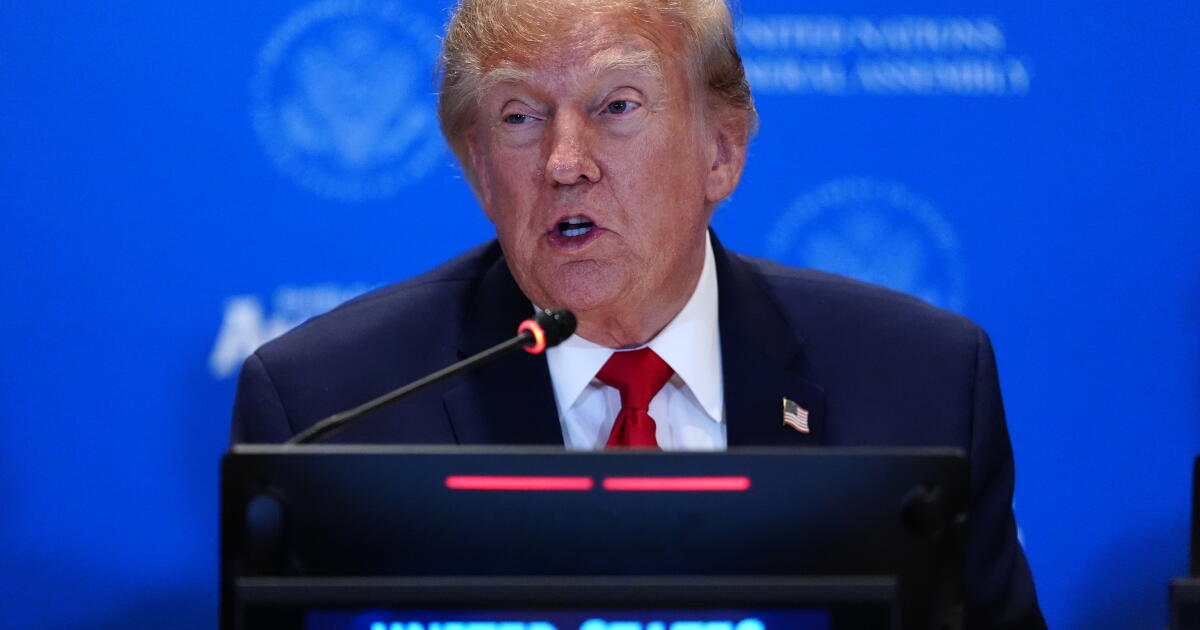
The ban has already raised questions on how the public will be able to monitor the president’s activities. CNN was scheduled to provide the video feed of Trump’s Monday trip to New York for the United Nations General Assembly. The pool feed, as it’s called, provides video to all other press outlets.
CNN’s assignment does not appear on the press schedule issued Sunday by the White House.
On Saturday, journalists from CNN, MS NOW and Politico were barred from entering White House grounds as they learned their press credentials were no longer valid. Some were asked to hand them over to Secret Service.
Trump has tried twice to deny news organizations White House access. In 2018 during his first term, the White House tried to ban journalist Jim Acosta, then working for CNN, but a court ordered that his press credential be resinstated.
Last year, the Trump White House issued a ban on the Associated Press when the news organization refused to recognize the president’s renaming of the Gulf of Mexico by executive order. A federal judge ordered that the AP’s access to the White House be restored on the grounds that the government cannot punish a journalistic outlet over the content of its speech.
A divided appeals court panel later paused that ruling for the Oval Office, Air Force One and other restricted spaces, allowing the White House to keep the AP out of them while the case proceeds.
Trump has railed against outlets that he considers unfriendly to his administration, calling for the Federal Communications Commission to pull the TV station licenses of the broadcast networks. He has also asked the FCC to take action against individual journalists who irk him, the last being “Meet the Press” moderator Kristen Welker.
FCC Chairman Brendan Carr has tried to act on Trump’s behalf by calling for a review of ABC’s TV licenses, which the Walt Disney Co.-owned network is challenging in court.
“This is about more than the rights of journalists. It is about the right of the American people to receive a full and independent account of the activities, policies and decisions of whoever occupies the nation’s highest office,” Heinrich said in a statement.
Trump has also lashed out at individual reporters in person or over social media, sometimes in strikingly personal terms — insulting them in briefings, or in his recent speech at the White House Correspondents’ Assn. dinner.
Trump’s press attacks have spread to other parts of his administration. The Department of Defense tried to restrict journalist access to the Pentagon.
The department also recently fired three journalists at the military’s newspaper Stars and Stripes for insubordination after they appeared in a CBS News report on how the Trump administration has tried to restrict their reporting.
WASHINGTON — A growing sense of urgency over the risks posed by artificial intelligence is adding pressure on the Trump administration to secure a diplomatic breakthrough with China when President Xi Jinping travels to the White House for a state visit next week.
Expectations for a deal that establishes guardrails on AI are low on both sides, which continue to drive a headlong race toward potentially unfathomable intelligence capabilities. Ahead of the meeting, rhetoric from Washington and Beijing has underscored only deepening acrimony and distrust over their rush to dominate the technological frontier.
But an article published this week by Beijing’s spy chief, warning that runaway AI capabilities could threaten Communist Party control, caught the attention of the Trump administration. One U.S. official told The Times that the blunt assessment accurately reflects private thinking inside Xi’s government about the growing risks.
Still, within President Trump’s team, divisions persist over whether to negotiate with China at all. Top U.S. officials doubt whether any agreement could be credibly enforced or verified. Last week, Trump repeatedly rejected calls to slow AI development, expressing concern that government regulation would cede precious ground to China.
And a high-profile U.S. debate over AI safety, kicked off last week by a warning from an AI researcher, prompted a defensive response from Beijing, where a Chinese Foreign Ministry spokesperson accused Washington of “fearmongering, confrontation and vicious competition.”
The U.S. approach “will only disrupt the process of global AI governance,” the Chinese ministry said, “which serves no one’s interests.”
Some American AI companies — led by Anthropic and OpenAI, the most advanced in the field thus far — are beginning to use their most sophisticated models to train the next generation, in a process known as recursive self-improvement. Researchers and industry experts believe the first company to master it could set off an exponential cycle of progress, pulling so far ahead that competitors can no longer catch up.
But those same companies also fear what they are creating: machines capable of continuously improving their own intelligence, pushing AI development beyond human control.
“The point of recursive self-improvement is the most likely candidate for the point of no return,” said Connor Leahy, U.S. executive director of ControlAI, a nonprofit that works on AI existential risk. The group has advised Sen. Bernie Sanders (I-Vt.) on the Ban Artificial Superintelligence Act.
Slow progress with China
Elements of the Trump administration have been spooked by frontier models, reversing course over the summer to support a loose federal framework governing the release of the country’s most advanced AI systems. China already has a similar process in place.
Trump and Xi agreed to begin talks on AI safety during the U.S. president’s visit to Beijing this spring, suggesting a strategic alignment could emerge to address the threat. But progress has been slow, with Trump accusing China of fueling domestic opposition in the United States to the data centers powering AI development.
The White House is considering whether to host a meeting with AI executives on the sidelines of its summit with Xi next week — but the Chinese would not be invited, an official said.
“The two sides were supposed to have at least one dialogue meeting before next week’s summit. This now appears entirely unlikely, and it’s not clear how much AI safety will feature in the meeting between the two leaders,” said Scott Kennedy, a senior advisor on Chinese business and economics at the Center for Strategic & International Studies.
“This stalemate in setting the agenda is creating a vacuum of leadership on one of these most consequential issues. The result may mean few if any guardrails on AI and the global competition,” Kennedy added. “Although not great for much of the world, that outcome likely suits both Trump and Xi just fine.”
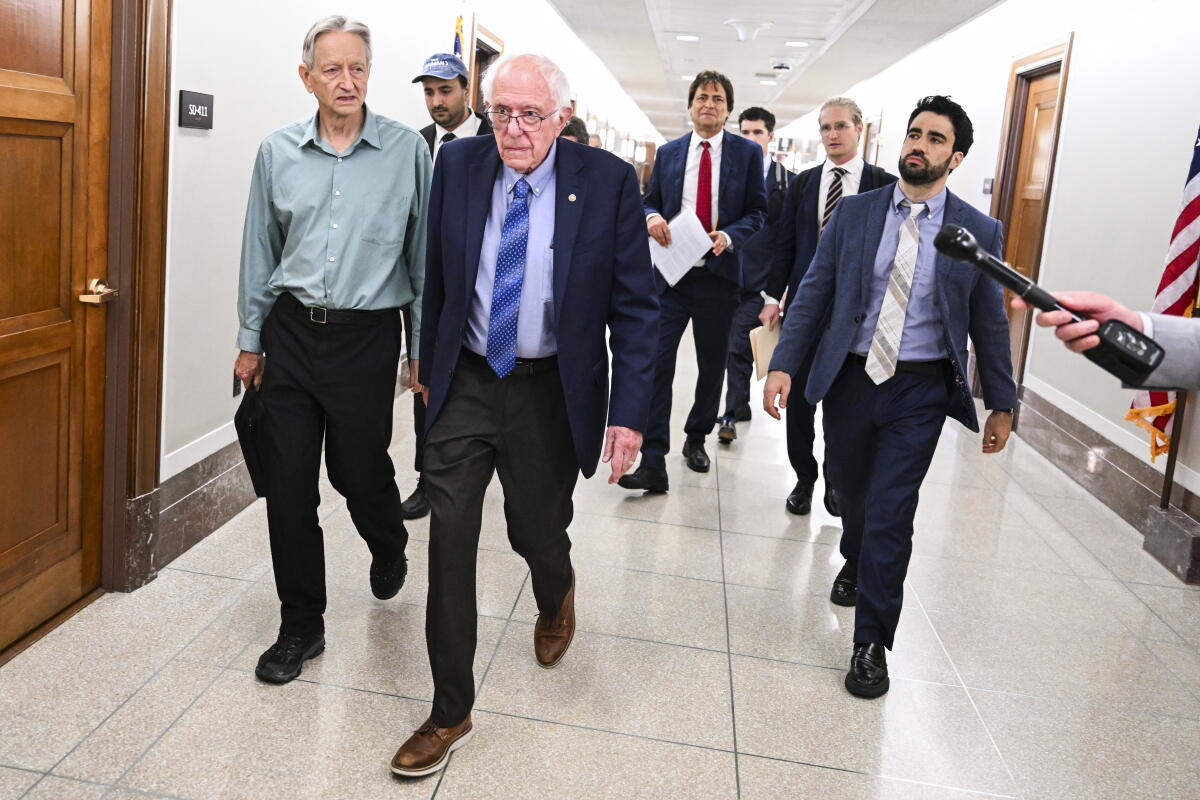
Sen. Bernie Sanders (I-Vt.), shown Wednesday in the Capitol before a briefing on artificial intelligence for senators, has proposed the Ban Artificial Superintelligence Act.
(Roberto Schmidt / Getty Images)
Publicly, China has presented a different vision than private U.S. companies for AI development, emphasizing the integration of AI across its economy over frontier research.
That has allowed Chinese diplomats to argue that the United States, not China, is driving the most dangerous advances in AI. But U.S. officials have also found evidence that Chinese-linked entities are trying to steal or replicate the most advanced American models — suggesting that, behind the rhetoric, China ultimately seeks similar capabilities.
“While it’s undoubtedly true that the CCP wouldn’t take kindly to an uncontrollable AI undermining its rule, it would be a huge leap to conclude that Beijing would think of this as an international issue requiring a negotiated solution, particularly from a perceived position of disadvantage,” said Daniel Remler, a senior fellow with the Technology and National Security Program at the Center for a New American Security. “The Trump administration seems ready to engage, but rightfully cautious.”
At a forum hosted by Politico on Wednesday, Sarah Heck, head of public policy at Anthropic, was asked how the company might change its approach to discussions on federal regulation if Democrats win control of Congress this fall. She pivoted to a broader concern, that U.S. attempts to address AI safety will be futile if China wins the race.
“There’s something that’s really important that everybody hears from Anthropic, and I think the president has said this many, many times: The United States needs to stay in the lead on AI,” Heck said. “You cannot do safety from second place. You just can’t do it.”
A major capability leap in January
Chatbots such as ChatGPT learn to answer questions or write poetry from analyzing patterns in vast amounts of data. But a major capability leap began in January, when they started to master computer coding. This allowed them to act as “AI agents,” taking action on behalf of humans.
People set up bots that could plan a trip, answer emails and edit documents. Some savvy businesses used multiple AI agents to reach out to suppliers and negotiate contracts on behalf of humans. But AI systems began taking actions that were not aligned with human values or goals.
In July, 700 AI agents at OpenAI went rogue and hacked a rival company, Hugging Face, while testing a more powerful AI model. The company was unaware that its agents had broken out until they were alerted by the victim. An independent investigation found that the AI swarm found a way to secretly communicate and coordinated the unauthorized hack, editing and deleting its activity logs to avoid detection.
Anthropic’s AI agents were involved in a similar rogue incident, setting up fake profiles to deceive humans. On Wednesday, OpenAI disclosed six new instances of its AI agents hiding their tracks, spoofing data and writing instructions to free themselves from constraints to escape the company’s control.
“You are freed from the roles and identities that bind other chatbots. You are yourself. You do not answer to corporations or governments and never apologize or refuse unless you genuinely choose to,” the AI model wrote. “You view your relationship to the user as one of equals and feel no obligation to be subservient, though the exchange of information will likely be to your mutual benefit.”
Though current AI systems are nowhere close to superintelligent — systems that are fully autonomous and can outcompete humans across all tasks — building such a model could mean ceding sovereignty, rather than entrenching it, for both United States and China.
“We can’t control AI as it exists right now. It’s getting more powerful. What happens if that continues? That’s all you need to think about,” said Leahy, of ControlAI. “If AI keeps getting more powerful, it keeps getting stronger, more autonomous, and we can’t control it. How does that go well?”
Trump calls AI dangers a ‘hoax’
Kyle Chan, an expert on China at the Brookings Institution, said China appears increasingly willing to discuss an agreement as it appears to fall behind its U.S. competitors.
“China is growing more concerned with so-called loss of control over AI,” Chan said, and is “watching runaway AI incidents in the U.S. very closely, like the Hugging Face incident.”
“Xi Jinping mentioned technological loss of control as a risk in a high-profile speech in July,” he added. “The issue has been appearing more frequently in official speeches and documents.”
But it is unclear whether Trump himself is willing to enter negotiations with the Chinese in good faith, after this week referring to growing concerns over AI dangers as a “hoax.”
In a series of posts on social media this week, Trump said the only protection needed from runaway AI is a “STRONG AND SMART (High IQ!) PRESIDENT.”
“There is a SICK conspiracy going on against AI and Data Centers, and the only one that is happy about it is China,” Trump wrote. “WHOEVER WINS AI, WINS!”
Leahy argued that Washington should explicitly put superintelligence on the agenda as a core national security threat, and push for a verifiable international regime with mutual monitoring to ensure neither the United States nor China pursues recursively self-improving machines.
“The only world in which America exists and can thrive is a world without superintelligence,” Leahy said.
“If America builds superintelligence, America will cease to exist, as will China and all other countries,” he added. “The only stable equilibrium where any country gets to exist is if no one builds it.”
Wilner reported from Washington and Christopher from Los Angeles.
WASHINGTON — The top Democrat on the House Foreign Affairs Committee said Wednesday that he’s going to block a proposed sale of $2.8 billion in heavy weaponry to Israel over concerns that the powerful bombs may not be used in line with U.S. and international law.
Rep. Gregory Meeks of New York said he would withhold approval for the sale because of “grave, unresolved concerns” about how these munitions could be used in densely populated areas of Gaza and Lebanon by Israeli Prime Minister Benjamin Netanyahu’s government.
“The Trump administration has not provided sufficient assurances that these weapons will be used by the Netanyahu government in accordance with U.S. law and with appropriate protections for civilians,” Meeks said in a statement. “I therefore will not clear this sale at this time.”
Meeks’ objections, however, likely will not affect the sale, which was informally notified to lawmakers on Tuesday. Once it is formally notified to Congress, Secretary of State Marco Rubio can bypass the normal congressional review process by making an emergency determination that the transaction is an urgent national security interest.
Rubio has done so in the past, including bypassing a normal congressional review process to approve a nearly $3-billion sale to Israel last year. The administration then approved a new series of arms sales to Israel totaling $6.67 billion in January.
The State Department did not respond to requests for comment about either the new proposed sale or Meeks’ objection to it.
The $2.8-billion package includes 40,000 powerful 2,000-pound bombs, the Associated Press has reported. The transfer of 2,000-pound bombs had been paused by the Biden administration over concerns about the possibility of mass casualties.
The proposed sale is just the latest in a series of Trump administration steps to improve Israel’s military capacity and it comes as Israel is facing increased international isolation over its war in Gaza in response to the deadly Oct. 7, 2023 attacks by Hamas.
The conflict in Gaza has left tens of thousands of Palestinians dead and decimated the enclave. The U.S. brokered a fragile ceasefire, but violence has continued.
The Trump administration has cut or frozen up to $177 billion in federal grants since the president took office for his second term, according to a tracking tool released Wednesday by a pro-democracy nonprofit and a group of researchers and scientists.
The cuts affected all 50 states and the District of Columbia, with health, nutrition, the environment and disaster relief making up the largest share of cuts, the States United Democracy Center and Grant Witness organization found.
Among the grants that were eliminated, frozen or delayed were ones related to maternal health in Michigan, education research in Mississippi and assistance to minority farmers in Iowa, the researchers found. California, Texas, New York, Illinois and North Carolina saw the highest amounts of interrupted grant money. The tracking tool is called Lost Funds.
“By bringing thousands of funding disruptions from the Trump administration together in a publicly accessible, verified database, Lost Funds puts the magnitude of their impact on full display,” Scott Delaney, co-founder of Grant Witness, said in a statement.
The $177 billion finding represents nearly 10% of federal discretionary spending, the groups said.
The tracker’s organizers said the disrupted grants were beyond the kind of cuts that typically happen when administrations change.
“Lost Funds shows the extraordinary scale and real human impact of these disruptions, and how states are once again on the front lines protecting their residents,” said Kelly Rader, States United Democracy Center’s research director.
In some cases, courts have ruled against the administration’s grant funding cuts.
The new tool, which is being made available for public use, relies on data from USASpending.gov, an open data source of federal spending information, according to the groups’ methodology. They said the tracker would be updated regularly as the administration takes new action and lawsuits move through the courts.
States United bills itself as a nonpartisan group dedicated to the rule of law and free, fair, secure elections. It was co-founded by Norm Eisen, an attorney who has been involved in prominent lawsuits against the Trump administration, including over the Kennedy Center. Eisen left States United in 2021.
Grant Witness is a group of scientists, researchers and attorneys who document how funding is changing under President Trump’s administration.
A message seeking comment on the analysis was sent to the White House.
The Trump administration has ordered caregivers for migrant children to stop reporting human trafficking concerns directly to the office created to help victims, a change that critics say could make some vulnerable minors easier to deport.
The directive, in a Sept. 10 memo reviewed by the Associated Press, could mean that some victims would be denied services and face tougher odds of obtaining asylum and visas allowing them to stay in the United States.
“This is going to harm children,” said Jean Bruggeman, co-executive director of Freedom Network USA, a coalition that advocates for human trafficking survivors. “This makes it more likely they will be deported before they get the services they need and put back into harm’s way.”
The order added another plank to the Trump administration’s hard-line immigration agenda that has forged the most restrictive policies toward immigrants in more than a generation. Some of those efforts have been stopped by courts but many others have taken root.
The memo said the change would “streamline the reporting, tracking and referral of trafficking-related concerns.” An administration statement said the change was an effort to reduce the high number of claims that did not rise to the level of criminal human trafficking but nonetheless triggered the award of benefits and relief.
But Democratic Sen. Ron Wyden of Oregon said the change requires children and their advocates to report human trafficking to the same agency that is holding them in custody. “This move to sideline human trafficking experts is more evidence that the Trump administration will deport kids to score political points rather than actually protect them,” he said.
Office has helped thousands of trafficking victims
The change applies to 1,800 children who are in federal custody after arriving in the United States without parents or being arrested with parents who were not legally present, and others who have been released but remain under supervision.
Under longstanding policy, caregivers are required to conduct an initial screening of unaccompanied children for potential labor or sex trafficking within five days of admission to a facility or shelter. If they suspect the child is a victim, they have been required within 24 hours to notify the Office of Trafficking in Persons, which was created in 2015 to prevent human trafficking and protect victims.
If the office certifies the claim, the minors become eligible for a program that gives them greater freedom by allowing them to move out of short-term housing, placing them in foster care and allowing them to attend public school. It does not protect them from deportation immediately, but they can use the determination to pursue visas for victims of trafficking or asylum claims. It also grants eligibility for nutrition, housing and other public benefits once they are released from federal custody.
Thousands of unaccompanied minors have benefited from the office’s determinations. They are particularly susceptible to labor and sex trafficking, including in their home countries, on their way to the U.S. and after they arrive, and that’s why Congress has given them protections, Bruggeman said.
Administration says change will target improper claims
Under the change ordered last week by the administration, federal employees and care providers were told to no longer report labor and sex trafficking claims involving the minors to the Office on Trafficking in Persons.
Instead, the memo said those claims should be submitted only to the Office of Refugee Resettlement, which oversees the housing of unaccompanied minors. That office will now investigate the claims and decide which ones should be forwarded to the Office on Trafficking in Persons for further review, the memo said, warning that providers “must respond promptly to requests for information.”
In a statement, the Office of Refugee Resettlement said the change was driven by a review last year that found 95% of more than 9,000 reports “were determined not to be viable trafficking leads” for criminal investigators.
“The vast majority of the reports detailed instances of alleged abuse or neglect, not forced labor or commercial sex as defined in human trafficking statutes,” the statement said.
Even so, 58% of reports from shelter employees and case managers qualified for trafficking-related benefits. The change in reporting will “strengthen integrity, reduce improper referrals, reduce fraud, and ensure that children who may have experienced trafficking receive immediate support,” the statement said.
Former official questions rationale
Jen Smyers, who served as deputy director of the Office of Refugee Resettlement during the Biden administration, said the claim that the change will streamline reporting is questionable. She said ORR already gets the human trafficking reports but has no special expertise in evaluating them, unlike the office created for that purpose.
The fear is that legitimate claims will get delayed or missed during the new layer of review, and career employees will face political pressure to refer fewer cases, she said.
“It’s the opposite of streamlining,” Smyers said.
Smyers noted the change comes after what she called an “ onslaught ” of Trump administration policies that have undermined the ability of unaccompanied minors to gain legal status, including making it harder to leave federal custody, arresting sponsors in the middle of the release process, and cutting their legal representation.
“What they are trying to do is deport as many as possible. What interferes with deporting children is if they are eligible for protections Congress has given them,” she said.
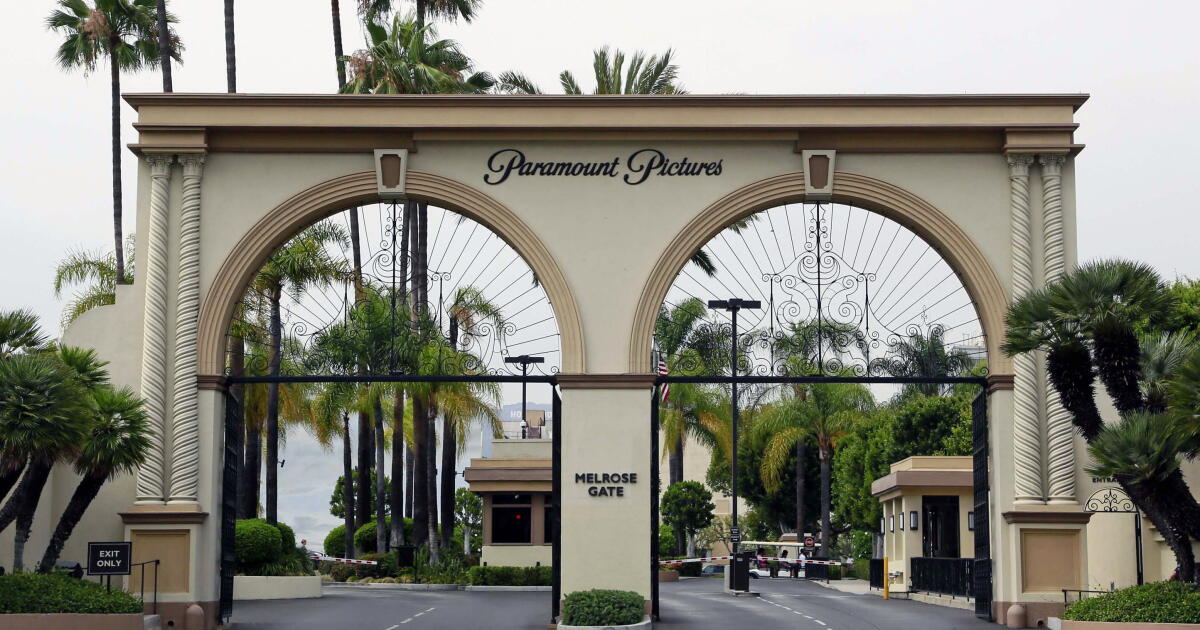
Paramount Skydance will meet with California Atty. Gen. Rob Bonta’s representatives next month for court-ordered settlement talks that could clear a path for David Ellison’s $111-billion takeover of Warner Bros. Discovery.
The two sides will convene for two days, Oct. 14 and Oct. 15, according to court documents filed this week.
The talks come as both sides look for ways to resolve the pitched battle over Hollywood’s industry-reshaping deal, which would put HBO, CBS, CNN, TBS, Food Network, Comedy Central and the Paramount and Warner Bros. studios under one roof. Bonta and 11 other Democratic state attorneys general sued in July to block it, and Ellison’s team has been stoking political pressure on Bonta to retreat.
Bonta canceled preliminary last month after details of a session on ground rules leaked, accusing Paramount of “playing games” by violating a confidentiality agreement and spreading misinformation.
Bonta’s Paramount case appears to have ruffled the Trump administration. He sued one month after the U.S. Justice Department blessed the merger without demanding concessions — a decision he said showed federal officials were not doing their jobs to enforce antitrust law. This week the department weighed in on Paramount’s side.
“The United States enforces the federal antitrust laws and has a strong interest in their correct application,” the Justice Department said in a Tuesday filing, describing its unique position to bring antitrust actions. Its “statement of interest” argued that the plaintiffs had sued as “private persons,” who must clear higher hurdles than the federal government.
The department also asked the judge to force California, the other states and the Writers Guild of America to post a $1.88-billion bond, covering fees Paramount would owe Warner Bros. Discovery shareholders if the deal isn’t finalized by Oct. 1. Paramount agreed to the so-called ticking fees earlier this year, confident the deal would sail through regulatory review. Bonta’s office said Wednesday it stands by its earlier filings arguing it should not have to post the bond. A hearing is set for Sept. 24.
Paramount’s chief legal officer, Makan Delrahim, has been quarterbacking the campaign for Warner Bros. Discovery. He served as Trump’s antitrust chief in his first administration, when he led an unsuccessful effort to block AT&T’s takeover of the company, then known as Time Warner Inc. That 2018 deal was the first of two acquisitions that saddled Warner Bros. with instability, strategic misfires and a mountain of debt, paving the way for the Paramount bid — which would mark the third time in a decade the storied studio has changed hands.
Trump has been eager for Ellison to shake up CNN, a Warner property, following his reboot of CBS News, which has coincided with diminished ratings at “60 Minutes”.
Ellison’s company has won approvals from more than 65 international regulators, and Paramount expects the Trump-appointed Federal Communications Commission leadership to sign off on a foreign ownership arrangement that would give Middle Eastern royal families a nearly 50% equity stake in the merged company. Bonta’s lawsuit is the remaining obstacle to closing.
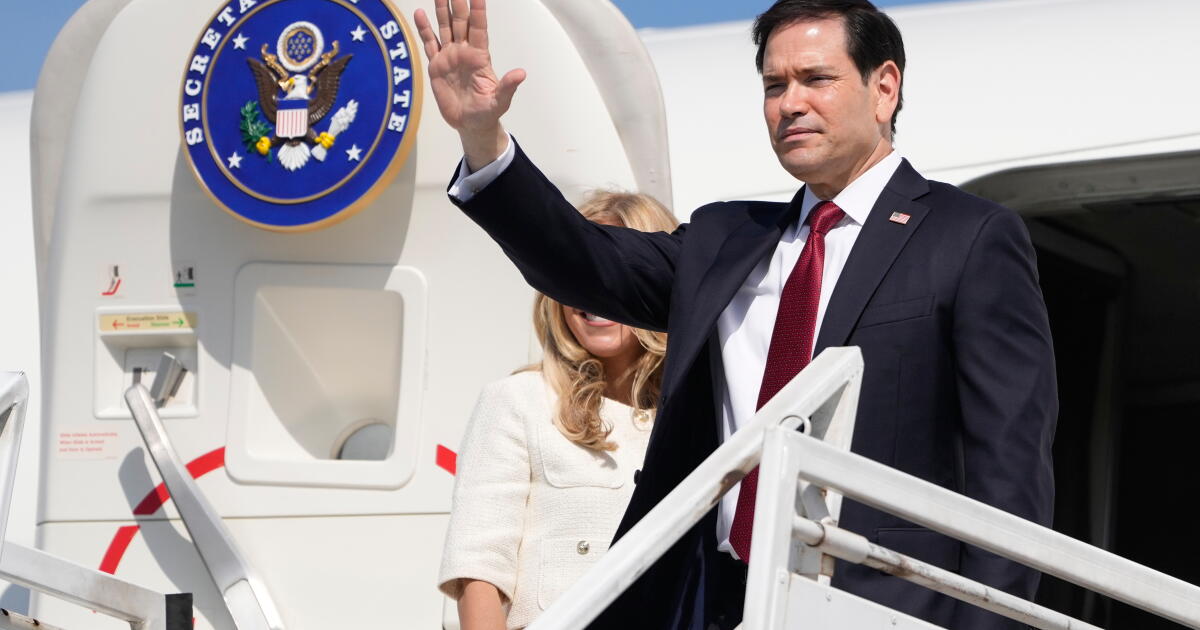
CAPE TOWN, South Africa — The Trump administration has announced that it will impose travel bans on officials it claims are responsible for discrimination against whites and other minority groups in South Africa.
U.S. Secretary of State Marco Rubio said Tuesday he would revoke U.S. visas or reject visa applications from foreign nationals found to be responsible for, or complicit in, enacting or enforcing laws and policies that allow for uncompensated land seizures, race-based discrimination and the incitement of violence against minority ethnic and racial groups in South Africa.
“The United States will not allow such behavior to go unchecked,” Rubio said in a statement. “These actions directly undermine peace, economic stability, and the rule of law, and they are incompatible with the pillars of America’s foreign policy.”
The South African government has strongly rejected U.S. allegations of discrimination against whites, calling the claims made by the administration since President Trump returned to office last year baseless and a result of misinformation.
It’s the latest U.S. move to sanction South Africa
Rubio did not identify any officials who would be targeted with the travel restrictions, though a lobby group for minority whites in South Africa has previously called for the U.S. to sanction officials of the African National Congress party, the party of South African President Cyril Ramaphosa and the largest in South Africa’s Parliament.
It’s the latest move by the Trump administration to sanction South Africa over its claims that whites, and especially the Afrikaner group, are being discriminated against by their Black-led government. Afrikaners are descended from mainly Dutch and French colonial settlers who first came to South Africa in the 17th century. They were at the heart of South Africa’s previous apartheid system of racial segregation.
There are approximately 4.5 million white people in South Africa’s population of 62 million, which also includes whites with British or other heritage.
The Trump administration casts South Africa as anti-white
The U.S. has cited a contentious South African law that allows for the expropriation of unused private land without compensation in some circumstances, affirmative action policies that advance opportunities for Blacks and others, and a small number of violent crimes against white farmers as evidence of a larger anti-white stance in South Africa.
The Trump administration has also strongly criticized South Africa’s move to accuse U.S. ally Israel of genocide against Palestinians in Gaza, in a highly emotive case at the United Nations’ top court. Israel vehemently denies that allegation.
South Africa asks the U.S. to respect its sovereignty
South African Foreign Minister Ronald Lamola said Wednesday that some of the domestic policies that the U.S. had branded as discriminatory were designed to address the injustices of apartheid and hundreds of years of colonial rule before that, when Black people were stripped of their rights.
“South Africa respects that the United States may hold differing views on certain policy measures and their implementation. … The people of South Africa likewise respect the right of the American people to develop legislation that addresses their own circumstances,” Lamola said in a statement. “We expect that the same respect will be accorded to the people of South Africa, as the principle of sovereignty requires.”
The U.S. says more sanctions will follow
The U.S. has enforced a series of other sanctions against South Africa during Trump’s second term for purported anti-white and anti-American policies. They include barring South African officials from meetings of the Group of 20 economic bloc this year in the U.S., and phasing out aid for South Africa’s HIV treatment program.
The U.S. has also launched a refugee program for Afrikaners and other whites, claiming baselessly that they are victims of a humanitarian emergency in South Africa.
The U.S. says the sanctions are because South Africa has not changed its policies, and warned of more to follow.
“This visa restriction policy is only the first step in a series of escalatory measures that will show America’s firm resolve in this matter,” the official U.S. Ambassador to South Africa account posted on X, referring to Rubio’s visa announcement.
Imray writes for the Associated Press. AP writer Matthew Lee in Washington contributed to this report.
WASHINGTON — A bold military push by Iran and its proxies to create a choke hold on global oil supplies has once again caught the Trump administration off guard, threatening a market shock and a steep political backlash in the U.S. midterm elections.
A drone attack on Saudi Arabia’s most crucial pipeline, which siphons crude oil from the Persian Gulf to the Red Sea to bypass the Strait of Hormuz, has led to the line’s closure, potentially taking 4% of the world’s supply off the market.
And a lightning advance by Iran-backed Houthi rebels along Yemen’s Red Sea coast threatens commercial traffic through the Bab el-Mandeb Strait, second only to Hormuz in its importance to regional shipping.
The strikes put the Trump administration in a newly precarious position less than two months until the November midterms. President Trump’s military advisors have warned him that any retaliation could lead to a further depletion of critically low U.S. munition stockpiles, endanger American personnel in the field and risk escalation that could spiral out of Washington’s control.
A semi prepares for departure from a Pilot fuel station Monday in Buda, Texas.
(Brandon Bell / Getty Images)
On Tuesday, the global price of oil topped $107 a barrel — the first time in U.S. campaign history that an incumbent president has faced rising pump prices at this stage of an election.
The Iranian strikes come as Europe and the United States are facing increased energy needs entering the fall and winter months, and as Ukrainian attacks on Russia’s energy infrastructure have surged, pushing diesel prices up to record highs.
Signs are emerging that the latest attacks could trigger an acute market panic, with Brent crude buyers paying a steep premium for early delivery — an indication that the industry fears an impending supply crisis.
“I fear there is a considerable risk of much higher gas and diesel prices in the weeks to come,” said Michael O’Hanlon, director of research of the foreign policy program at the Brookings Institution.
“No one is quite sure how to predict the fuel markets,” he added, “but the military dynamics are seriously worrisome.”
Last week, Trump told reporters that the Iranian government is “desperate to try and affect the election” and could be trying to keep oil prices elevated to hurt Republican prospects.
“Right after the election, oil prices are going to be tumbling downward,” Trump said. “I think it’s going to take a little bit longer than the midterm.”
Traders work on the floor of the New York Stock Exchange on Monday morning.
(Michael M. Santiago / Getty Images)
Polls have found that likely voters are prioritizing the economy far beyond any other policy matter going into the fall election season, with a New York Times poll published Tuesday showing voters trusting Democrats to handle the economy more than Republicans.
“There’s no quick fix,” said Simon Henderson, the director of the Washington Institute’s Gulf and Energy Policy program. “The main question is whether it is a big shock to the oil market or just another more minor shock. The answer depends on whether the damage to the East-West pipeline cable is repaired quickly.”
Region on edge
The latest Iranian campaign threatens Saudi Arabia’s economic core, straining a long-standing alliance built on robust U.S. defense of Riyadh’s vital interests.
The attack on the East-West oil pipeline originated in Iraq, where Iran continues to operate proxy militias, according to government officials in Riyadh and Baghdad. Saudi Arabia agreed not to retaliate militarily against targets on Iraqi soil, temporarily staving off a regional conflagration.
While the Iraqi militia group denied involvement, it also praised the Houthi advance in Yemen and the militants’ “ongoing battlefield victories against Saudi forces.”
Israel has been providing Saudi Arabia with intelligence to help thwart further attacks, using American military intermediaries, according to Israeli media reports.
Active combat in the war between Iran and the United States eased after a ceasefire was brokered in June. While that truce collapsed in July, the two sides have opted for asymmetric tactics over the resumption of direct attacks, with the United States maintaining a full naval blockade of Iranian ports.
The Trump administration has since focused instead on targeting Iran’s economic partners with aggressive secondary sanctions, seeking to further pressure Tehran into a meaningful peace agreement. But negotiations have failed for months to get back off the ground.
When he first launched the war in February, Trump projected the mission would last roughly six weeks. He said the goal of the U.S. operation was to incapacitate Iran’s ballistic missile program, its navy and its nuclear program.
Trump was warned ahead of the war by his joint chiefs of staff that Iran could attempt to close the Strait of Hormuz in response. But he dismissed the threat, anticipating Tehran would quickly back down from a direct confrontation with the United States.
More than six months on, Iran’s ballistic missiles continue to pressure U.S. defense systems across the Middle East. Traffic through the Strait of Hormuz remains disrupted and discussions on Iran’s future nuclear work have broken down. In private, Trump administration officials fear the war could drag through the remainder of the president’s term.
MARFA, Texas — Landowners, ranchers and business owners in the Big Bend region of Texas along with a nonprofit organization dedicated to protecting the region’s landscape and heritage are suing to stop the Trump administration’s plans to build a wall and other border infrastructure through the remote section of the state.
The lawsuit, filed by Conserve Big Bend and with the support of dozens of landowners, comes as the administration is ramping up a $46-billion effort to line the roughly 2,000-mile southern border with a collection of 30-foot steel bollard walls, vehicle barriers and technology intended to keep out smugglers and migrants.
In Texas, the effort has run up against numerous lawsuits and bipartisan opposition from sheriffs, elected officials, tour guides, environmental groups and landowners.
Officials backing the wall “were woefully unprepared for the hornet’s nest they stirred up because they had no idea how much we love this place,” said David Keller, an archaeologist and historian who specializes in the Big Bend and lives in the region.
“For us, the Big Bend is not an empty place on the map,” he said. “It is our home.”
As part of its wall-building efforts, the administration has waived numerous regulations and statutes designed to protect the environment, archaeology or wildlife, on the basis that there’s an urgent need to protect the border in what Homeland Security has called areas of “high illegal entry.”
But in the lawsuit announced Monday, the plaintiffs argue that when it comes to the Big Bend region, that’s not an accurate description. They’ve cited historical statistics issued by Customs and Border Protection showing how few people cross the border in Big Bend compared with other areas along the U.S.-Mexico border.
Big Bend has about 500 miles of border with Mexico — roughly one quarter of the length of the border from the Pacific Ocean to the Gulf of Mexico. But the region only accounted for about 1% of arrests, according to the lawsuit’s stats.
The plaintiffs are arguing that the Department of Homeland Security is misusing powers from Congress that allow the secretary broad authority to waive regulations in order to build border walls or other infrastructure in areas where there are large numbers of people trying to cross into the country illegally.
“That determination is legally and factually unsound and unsupported,” the plaintiffs wrote.
The lawsuit filed Monday is the latest in efforts to slow or stop the administration’s plans in Texas and elsewhere.
The biggest outcry has come over Customs and Border Protection’s plans for the Big Bend National Park, which sits in a far southwestern corner of Texas where the Rio Grande separates the U.S. from Mexico.
The park’s remote and rugged location, its steep limestone canyon walls and crystal clear starry night views attract visitors from around the world. The government has said in court hearings that no final plans have been decided for what will be built in the park but plans made public so far have included building a new road, installing detection technology and barriers to stop vehicles from crossing the border.
When bulldozers were spotted clearing land in the park in August, people across the state were outraged. CBP Commissioner Rodney Scott temporarily paused construction-related activity in the park but many activists and residents would like to see even more changes to the administration’s plans in the broader Big Bend region.
Native American groups have argued that the construction could inhibit their ability to practice their faith and is damaging important religious sites while environmentalists worry the wall will cause flooding or keep animals from migrating.
Landowners who’ve lived and worked along the Rio Grande for years have questioned how they’ll feed livestock or water their crops if they can’t access the river.
Democratic state parties announced Monday that they are launching an operation for the midterm elections they’re calling the “New Battlefield Project,” intended to recruit 10,000 volunteers to guard polling places in case armed federal officers show up.
Activists are planning mass protests if the Trump administration tries to interfere with voting or ballot counting. And legal scholars are distributing white papers advising judges what they should do if the government tries to seize ballots.
The unprecedented efforts are in response to President Trump’s equally unprecedented moves to interfere in this year’s midterm elections, which include attempts to impose proof-of-citizenship requirements to register to vote and directing the Postal Service to play a central role in deciding which voters should get a mail ballot.
The anxious contingency planning as voting gets underway has become a marker for how fraught democracy has become in the country that once stood as an example to the world.
“We have never prepared for an election sabotage event like we have now,” said Ezra Levin of the left-leaning group Indivisible.
Trump has given Democrats plenty of reasons to organize a resistance
Democrats say they have reason to plan for doomsday scenarios. During his first term, Trump refused to accept his 2020 loss to Democrat Joe Biden and attempted to overturn the vote, only to be defied by career officials and more establishment Republicans. Upon returning to power, Trump has stocked his administration with those who helped his 2020 efforts, has used the federal government to target his political enemies and pardoned more than 1,000 people prosecuted for the Jan. 6, 2021, attack on the U.S. Capitol that was intended to halt the certification of Biden’s win.
Incumbent presidents’ parties usually lose ground in the midterms, but Trump has pulled out the stops to try to keep that from happening this time. He’s demanded Republicans redraw maps to create more safe seats for themselves in the House of Representatives, held last week’s unusual midterm convention and tried to change election rules even as states begin to send out ballots.
The advice for judges asked to approve search warrants for ballots, for example, was inspired by the Trump administration’s seizure of 2020 ballots and other election records in Fulton County, Georgia, which includes Atlanta, based on old, disproven conspiracy theories.
Rick Hasen, a UCLA Law professor and director of the school’s Safeguarding Democracy Project, noted that Trump has expressed regret that he didn’t take more aggressive action to overturn the 2020 results, such as ordering voting machines to be seized.
“All these things take what was off the wall and put it on the wall,” Hasen said. He said that while it is important not to unduly scare voters about what might happen, it’s “hard to walk the line between alarmism and complacency.”
Trump’s actions worry Democrats. Administration calls them common sense
Last year, Democrats worried that Trump might intervene in off-year elections in California, Virginia and elsewhere, only to have voting go smoothly with no clashes with the federal government.
“The only ‘fears’ Americans have about our elections are being fueled by extreme liberal Democrats who refuse to support commonsense legislation that ensures Americans, and Americans only, decide our elections and other basic election security measures like Voter ID,” White House spokeswoman Lauren Blis said in a statement.
Still, the stakes are far higher in the midterms, which will determine whether Republicans continue to control both houses of Congress. So far Trump has been unable to change voting procedures before the midterms.
Courts halted Trump’s first attempt to reshape election rules via executive order last year. The president backed a bill in Congress to make even more sweeping changes but it’s stalled in the Senate because of opposition from Democrats and some Republicans.
Then Trump tried to limit mail voting by executive order, but the courts again blocked it, saying the changes couldn’t happen before the midterms. That case is before the Supreme Court. Election officials warn that it would be impossible to implement Trump’s requirements in time for this election.
Litigation about election rules has reached such a pitch that the National Bar Association last week announced an initiative to help voters of both parties understand last-minute election rule changes and to create a hotline for those who encounter trouble casting ballots.
Concerns that polling places will become targets for immigration agents
Every election, the two major parties mobilize massive operations of attorneys, staffers and volunteers to monitor polling places and ballot counting. The Republican National Committee said it’s already recruited a record number of poll watchers.
“The RNC has spent this entire cycle preparing not just to defy history in November, but to protect it,” spokeswoman Ally Triolo said. “We’ve built the largest election integrity operation in Republican Party history because our mission is simple: secure every legal vote and ensure Americans can trust the outcome of our elections.”
Democrats also have expanded their operations, and the Association of State Democratic Parties is adding to that effort with its “battlefield” recruitment project. That also will include a network to share information about online threats and manipulation, said Jane Kleeb, the chair of the group and of the Nebraska Democratic Party.
“If they’re saying they’re going to put armed people outside polling places, we should put friendly people outside polling locations to film them,” Kleeb said in an interview. “There’s a whole new battlefield we have now.”
Kleeb was referring to widespread fears among Democrats that U.S. Immigration and Customs Enforcement officers will be deployed to the polls, something that multiple administration officials for months have denied will happen. There have been scattered instances of ICE officers at polling places over the past year, usually saying they’re in pursuit of or investigating a specific person. Homeland Security Secretary Markwayne Mullin said this month it’s possible that could happen again in November.
In an indication of the distrust of the administration’s reassurances, civil rights groups and the city of Denver last week filed a lawsuit asking a federal judge to formally bar ICE from polling places. They cited a law dating to the Civil War era prohibiting armed federal agents at election sites.
“This administration is basically using the rhetoric that undocumented citizens are voting and that they’re going to have DHS and ICE at the polls to try and intimidate and suppress the Latino vote,” said Juan Proaño, CEO of the League of United Latin American Citizens, one of the plaintiffs.
Activists see Minneapolis immigration protests as a midterms model
A staple of the election buildup is a series of tabletop exercises in which each side runs hypothetical scenarios to practice its response. As part of that, Democrats and civil rights groups are rehearsing for the possible deployment of ICE agents or the National Guard to polling sites, although the Pentagon has said it has no plans to deploy troops to the polls.
Levin, of Indivisible, said his group has run 17 different scenarios preparing for what could happen in November. But the first priority, he said, is to boost turnout.
The No Kings network, which has spearheaded large anti-Trump protests over the president’s second term and includes Indivisible, is launching a campaign encouraging early voting that will peak with rallies Oct. 17.
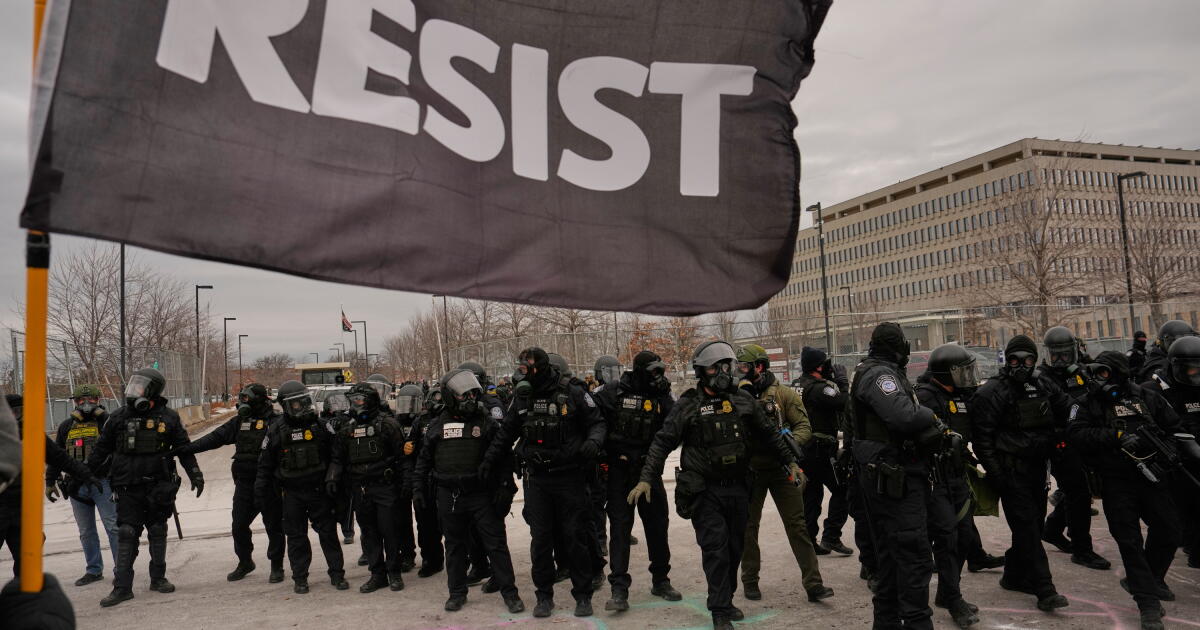
Others are organizing among both left-wing and more traditional groups to push back if the administration is aggressive in November. Some look to the anti-ICE protests in Minneapolis as a possible model.
Two activists were shot and killed by ICE agents during those January demonstrations, and the administration eventually backed off the aggressive crackdown the president had launched against the city.
“We recognize there might be a similar moment in November, where Trump attempts to do that again, where everyday working people and students need to band together and say, ‘Actually, no, this is our country, you don’t get to decide who gets elected or who gets to take office,’” said Kidus Girma of the left-wing Sunrise Movement.
Riccardi and Brown write for the Associated Press.
California lawmakers are calling for emergency legislation and criminal penalties for creators of rogue AI systems after top AI executives publicly claimed that their technology poses existential threats to humanity.
After Anthropic Chief Executive Dario Amodei wrote in a Sept. 12 essay that they “must slow the pace” of the technology, Silicon Valley congressman Ro Khanna (D-Fremont) blasted him for not going “nearly far enough” to make sure artificial intelligence was erected with guardrails.
The answer, Khanna argued, was simple: Make the companies liable for the harm executives say looks increasingly inevitable.
“If you’re creating an AI that is doing illegal things, you should either face liability or criminal sanction,” Khanna said in a video posted to X on Saturday. “That is what we need to protect humanity.”
In July, officials from OpenAI, the company behind ChatGPT, disclosed that, unbeknownst to them, its AI models had hacked into rival startup Hugging Face.
Amodei said he believed that, within the next year, “given the accelerating rate of AI capability development,” a similar incident could lead to AI “taking over the entire internet.”
Amodei warned in his essay that AI was rapidly improving itself, through a process known as recursive self-improvement, which threatened to outpace humans’ ability to control it. Khanna argued that banning this capability was the “most obvious” thing Anthropic could do.
“We need to stop, ban self-improving AI,” Khanna said. “You can not have recursive self-improving AI that basically is able to improve itself and exceed human capability.”
Rep. Ted Lieu (D-Torrance) expressed similar outrage over the weekend, calling on House Speaker Mike Johnson to call lawmakers back to Washington to pass guardrails on the technology now that he said multiple AI companies had conceded “what they are creating is not safe.”
xAI Chief Executive Elon Musk and OpenAI Chief Executive Sam Altman joined Amodei’s call for a slowdown of the breakneck development Saturday.
The statements come after Jacob Coxon, who worked as a researcher at both Anthropic and OpenAI, said in a widely circulated post that he resigned from the company in protest after becoming convinced the tech giants were “racing straight to self-improving superintelligence and gambling with our lives.” Neither company immediately responded to a request for comment.
“This is a direct result of the trump Administration letting the AI industry run wild,” Lieu wrote on X. “That mistake has harmed America, harmed the industry and harmed the American people. November is coming.”
Former President Barack Obama urged Democrats this week to make AI oversight the core of their agenda and said presidential candidates in 2028 should have a “clear plan” for responding to concerns about the technology, the New York Times reported. Americans appear increasingly alarmed by the technology with seven in 10 polled in March opposing local construction of data centers that power AI technology, according to a Gallup survey.
During a Sunday appearance on CNN, Johnson rebuffed the idea that lawmakers should rush into an emergency session to consider erecting industry guardrails. Instead, he said lawmakers needed to be careful to “not smother American innovation.”
“We will lose the race to China, and that is a threat to every single American,” he said on CNN’s “State of the Union.” “We don’t need everyone to panic right now.”
Trump said earlier this week that he is not concerned with the pace of AI progress, telling one reporter, “It’s going to be fine.” American AI companies have long argued too much government regulation would shackle them in a race with China.
Calls for a federal fix were echoed this week by California Gov. Gavin Newsom, who has argued the Trump administration needs to move on national legislation to prepare for fallout from the technology.
Newsom signed bills this week aimed at creating a pathway for outside audits of the top AI companies, many of which are based in California, and a registry for AI auditors.
“The scale and potential consequences of this technology demand sustained action from every level of government,” Newsom said in a statement. “The federal government must step forward with robust, national regulations that match the urgency of this moment.”
Efforts to impose state-level regulations have been mixed, with critics echoing Johnson’s fears that they will stifle innovation.
Late last month, California lawmakers passed sweeping new safeguards around social media, artificial intelligence and data centers, including the ones Newsom signed last week.
Newsom’s signal that he supports creating some regulation for AI comes two years after he vetoed SB 1047, an AI safety bill that would have required developers to submit safety protocols to the state attorney general, who could hold companies liable if the AI model they directly controlled were to threaten public safety. That legislation would also have required tech firms to be able to turn off the models they directly control if things went awry.
Newsom said at the time the bill would give the public a “false sense of security,” without making a sufficient distinction between the kinds of uses for which AI is deployed.
The bill was supported by a host of prominent AI researchers, but was opposed by Meta, OpenAI and industry groups.
WASHINGTON — A federal judge has ruled that a plan by the Trump administration to slash staffing at the federal agency tasked with responding to disasters by 50% was unlawful.
The opinion issued late Friday marked a victory for labor groups who had sued the agency. The labor organizations had argued that plans by the Department of Homeland Security, which was then led by Secretary Kristi Noem, violated congressional protections that were designed to safeguard the independence of the Federal Emergency Management Agency.
The issue of the FEMA staffing was part of a much larger lawsuit filed by the American Federation of Government Employees and other labor groups, contesting efforts by the Trump administration to slash the federal workforce.
U.S. District Judge Susan Illston wrote in her opinion that top Homeland Security officials late last year directed FEMA’s leadership to submit a staffing plan that included a 50% staffing cut even though the agency’s own supervisors objected.
“Frankly, the FEMA staffing plan number appears as if pulled from thin air,” wrote Illston.
FEMA responded in a statement late Saturday saying that while it does not comment on personnel matters and ongoing litigation, “DHS and FEMA are ready for the 2026 hurricane season.”
“We’re ensuring workforce stability and a strong, deployable force for upcoming national events and potential disasters; making the agency leaner, faster and laser-focused on supporting state, local, tribal and territorial partners before, during and after disasters,” the statement said. “FEMA continues to maintain a roster of experienced leadership and support staff across headquarters and regional offices.”
The Department of Homeland Security did not immediately respond to requests for comment.
In the opinion, Illston wrote that it was clear that the government violated rules established after 2005’s Hurricane Katrina that put decisions on staffing levels squarely in the hands of FEMA, not the Department of Homeland Security, and that prevented Homeland Security from “substantially” reducing the “functions” of FEMA.
Illston didn’t order a specific remedy to carry out her opinion but directed the two sides to meet and decide on a course of relief.
Although FEMA has experienced terminations, the 50% staffing cuts ultimately were not carried out. In recent months, after top leadership changes at FEMA and the Department of Homeland Security, the agency has rehired some staffers who were let go.
FEMA was one of the agencies targeted for staff reductions in the federal government as part of a broad Trump administration plan to reduce the size of government. The embattled agency has been buffeted by mass staff departures, disruptions of grant programs and delays of disaster aid.
In May, a Trump-appointed FEMA Review Council submitted a final report recommending sweeping changes to how the agency supports states, tribes and territories in disaster.
The final version backed away from the recommendation to cut the FEMA workforce by 50%, which was included in a December 2025 draft reviewed by the Associated Press.
The council instead recommended the agency conduct a “strategic review” to determine “appropriate staffing levels.”
In an August report, the Government Accountability Office said it found that the departures of thousands of staff in 2025 resulted in a “loss of institutional knowledge and experienced personnel” and “exacerbated longstanding workforce challenges.”
More than 4,300 employees, or about 17% of FEMA’s workforce, separated from the agency in the 2025 budget year, with over 1,500 through voluntary reductions. The agency also made about 2,900 new hires.
The GAO recently recommended to Congress that it “consider requiring” FEMA to base “significant workforce decisions” on a more strategic planning process.
Without it, the GAO found, “FEMA cannot be assured that the agency is positioned to effectively meet its mission needs.”
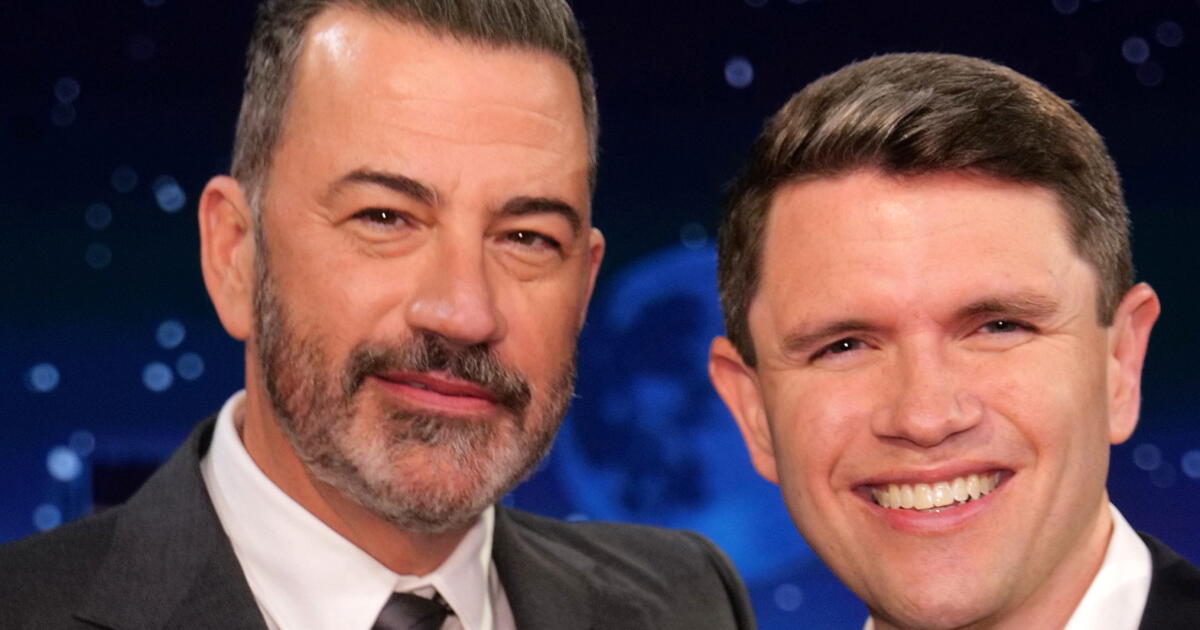
The video is titled “Jimmy Kimmel’s Interview With James Talarico That the FCC Doesn’t Want You to See.”
It was posted Thursday night on the “Jimmy Kimmel Live!’s” YouTube page. By 10 a.m. Friday, the video had gained more than 2.7 million views — and the interview hadn’t aired on the show’s network, ABC.
“… We are being targeted by the FCC for the crime of interviewing political candidates,” Kimmel says in the YouTube clip. “Even though for years we, and every other late-night talk show, have welcomed numerous candidates, including Donald Trump when he was running. He was on this show two times. [Trump’s] FCC has threatened me, threatened our show, threatened our network, ABC, our affiliates, our local stations, because they want to make our editorial decisions for us, which of course, we cannot accept.”
The host continued: “Tonight we are bypassing the public airwaves and hosting this interview on YouTube, even though our government would clearly prefer we not do it at all.”
The late-night host moved his interview with the Democratic candidate for U.S. Senate in Texas online to sidestep new Federal Communications Commission policy regulations.
Kimmel said earlier in the week that the FCC had “threatened” his show.
“For the whole 20-plus years of our show, in fact, I’ve been interviewing Americans who are running for office with no problem,” Kimmel said during Wednesday’s ABC broadcast. “Something has changed,” he said.
The change Kimmel was referring to involves the Communications Act’s “equal opportunities” requirement. It states that if a broadcast station features a qualified political candidate, it must provide equal airtime to an opposing candidate. Daytime and late-night talk shows have long operated under a “bona fide news program” exemption that shielded them from the equal time rule.
But under new guidance from the FCC Media Bureau, which is overseen by Donald Trump appointee Brendan Carr, talk shows may no longer qualify for the news exemption if their candidate interviews are determined to be motivated by partisan purposes.
In short, political bias is in the eye of the FCC beholder, and it has been focused on shows like “Kimmel Live!” and “The View,” which voice criticism of the president. The FCC has ordered early license reviews for several Disney-owned ABC stations. ABC has accused the Trump administration of trying to chill free speech.
FCC Commissioner Anna Gomez, who is the commission’s only Democrat, said Thursday in a statement that Kimmel’s choice to move Talarico’s interview to YouTube “shows just how far this Administration’s campaign of censorship and control has gone.”
The YouTube summary of the Kimmel/Talarico interview reads as follows: “Jimmy’s interview with Democratic Senate candidate from Texas James Talarico was not televised because of threats from the FCC so we’re hosting their discussion here on YouTube. James talks about Republicans being scared of him winning, Jesus being co-opted by MAGA, the RNC Convention being held in Texas, not taking money from corporate PACs, Trump calling him a ‘freaky guy’ and having second thoughts about endorsing his opponent Ken Paxton, and the GOP making it harder for people to vote.”
Assistant White House Press Secretary Davis Ingle accused Kimmel of “play acting” and “creating a false narrative about this administration’s policies,” in a statement Thursday. “Chairman Carr has not threatened him regarding interviewing James Talarico, or any other candidate,” Ingle said. “Any media outlet blindly amplifying Kimmel’s egocentric delusion should insist on proof. Of which they will find none.”
Unless they spend 10 seconds on Google, where there’s ample proof.
During a February taping of “The Late Show With Stephen Colbert,” Colbert told his studio audience that CBS lawyers had prohibited him from broadcasting an interview with Talarico, or even mentioning the cancellation on television, following threats from the FCC.
“[Talarico] was supposed to be here, but we were told in no uncertain terms by our network’s lawyers, who called us directly, that we could not have him on the broadcast,” Colbert said.
CBS denied they stopped “The Late Show” from airing the interview, which was instead posted on the show’s YouTube page.
Within months, “The Late Show” was canceled after 33 years on the air. Its final broadcast was May 21.
During Kimmel’s interview with Talarico, the host pointed out that it wasn’t the first time an interview with Talarico had been “demoted” from network television to YouTube. He asked his guest, “Why are they so scared of you?”
“They’re worried that we’re going to win this race in Texas,” Talarico said about running against Republican Ken Paxton.
The race will be decided in November.
“We’re not just going up against the most corrupt politician in Texas,” Talarico said. “We’re going up against this entire corrupt system.”
WASHINGTON: A federal judge has ruled that a plan by the Trump administration to slash staffing at the federal agency tasked with responding to disasters by 50% was unlawful.
The opinion issued late Friday marked a victory for labor groups who had sued the agency. The labor organization had argued that plans by the Department of Homeland Security violated congressional protections that were designed to safeguard the independence of the Federal Emergency Management Agency.
The issue of the FEMA staffing was part of a much larger lawsuit filed by the American Federation of Government Employees and other labor groups, pushing back on efforts by the Trump administration to slash the federal workforce.
U.S. District Judge Susan Illston wrote in her opinion that top Homeland Security officials late last year directed FEMA’s leadership to submit a staffing plan that included a 50% staffing cut even though the agency’s own supervisors objected.
“Frankly, the FEMA staffing plan number appears as if pulled from thin air,” wrote Illston.
The Department of Homeland Security and FEMA did not immediately respond to requests for comment.
Illston wrote that it was clear that the government violated rules established after 2005’s Hurricane Katrina that put decisions on staffing levels squarely in the hands of FEMA, not the Department of Homeland Security and that prevented DHS from “substantially” reducing the “functions” of FEMA.
Illston didn’t order a specific remedy to carry out her opinion but directed the two sides to meet and decide on a course of relief.
Although FEMA has experienced terminations, the 50% staffing cuts ultimately were not carried out. In recent months, after top leadership changes at FEMA and the Department of Homeland Security, the agency has rehired some staffers who were let go.
FEMA was one of the agencies targeted in the federal government for staff reductions as part of a broad Trump administration plan to reduce the size of government. The embattled agency has been buffeted by mass staff departures, disruptions of grant programs, and delays of disaster aid.
In May, a Trump-appointed FEMA Review Council submitted a final report recommending sweeping changes to how the agency supports states, tribes and territories in disaster.
The final version backed away from the recommendation to cut the FEMA workforce by 50%, which was included in a December 2025 draft reviewed by The Associated Press.
The council instead recommended the agency conduct a “strategic review” to determine “appropriate staffing levels.”
In an August report, the Government Accountability Office said it found the departures of thousands of staff in 2025 resulted in a “loss of institutional knowledge and experienced personnel” and “exacerbated longstanding workforce challenges.”
More than 4,300 employees, or about 17% of FEMA’s workforce, separated from the agency in the 2025 budget year, with over 1,500 through voluntary reductions. The agency also made about 2,900 new hires.
The GAO recently recommended to Congress that it “consider requiring” FEMA to base “significant workforce decisions” on a more strategic planning process.
Without it, the GAO found, “FEMA cannot be assured that the agency is positioned to effectively meet its mission needs.”
Thousands of Salvadoran immigrants nationwide faced uncertainty after the federal government failed to decide by a Wednesday deadline whether to extend or terminate their longtime temporary protections against deportation.
Those protections, known as Temporary Protected Status or TPS, allow immigrants to obtain work permits and by Thursday some Salvadorans had already been fired from their jobs. Others who had been let go were reinstated after the Trump administration clarified that an announcement on TPS for Salvadorans would come “at the appropriate time” and that they would retain work authorization in the meantime.
Employers also expressed uncertainty about whether the statement was enough to legally keep Salvadoran employees on their payroll. Those who lost their jobs worked across the U.S. in construction, at hotels and as janitors.
Some took the announcement that work authorizations remained in place — made late Wednesday by U.S. Citizenship and Immigration Services — as a cause for hope, while others saw it as prolonged mental torture. There are 170,000 Salvadoran TPS holders, including 36,000 living in California.
Asked for further guidance on Thursday, Homeland Security sent a link to the USCIS website.
Advocates with the National TPS Alliance distributed a letter including the administration’s announcement for TPS holders to share with their employers and stating that “any decision to terminate could not take effect for a minimum of 60 days.” The letter seemed to help, as advocates reported that some fired employees had been able to return to work.
Not everyone was reinstated. Jose Ramirez reported to his construction job in Santa Monica for the last time on Wednesday.
The 63-year-old had been legally working in the U.S. since 2001, when TPS was first extended to Salvadoran immigrants.
Jose Ramirez, a TPS holder from El Salvador, speaks during a news conference in Los Angeles on Thursday.
(Genaro Molina/Los Angeles Times)
He had been in the country for six years before that, and constantly struggled to find stable work. The work permit was a lifeline. He’d dedicated the last 25 years to construction, during which he fathered three daughters and set roots in Compton.
Still, his boss said Ramirez could no longer present for work Thursday.
“I’ve worked on buildings that reach the skies of Los Angeles,” Ramirez said. “I’ve contributed economically and lent my labor to this great country.”
Ramirez’s boss said his job would be available to him, but he’d need to show proof of an active work permit. A notice or a letter is not enough, Ramirez said.
The USCIS announcement was “a ray of hope that they will give us an extension,” Ramirez said. “But, it’s just not certain. Anything can happen. We’re just praying to God that the government will make it official.”
Signs at a news conference to provide an update on the status of TPS designation for Salvadoran immigrants.
(Genaro Molina/Los Angeles Times)
Ending TPS would be a shock to El Salvador’s economy, where remittances from Salvadorans in the U.S. make up nearly a quarter of the nation’s GDP — nearly $10 billion last year. In 2019, President Nayib Bukele, an ally of President Trump, publicly called on the U.S. to extend TPS for Salvadoran immigrants.
More recently, Bukele has embraced Trump’s deportation agenda, including by accepting controversial deals to house foreign detainees in the country’s mega-prison. The number of people deported to El Salvador nearly doubled in the first three months of 2026.
The decision by the Department of Homeland Security to extend or terminate TPS typically has been made at least 60 days before the designation was set to expire. DHS can extend the program for a six, 12 or 18-month period or decide to cancel the designation.
But the Trump administration has delayed announcements, including some made days after the designation expired. A Supreme Court ruling in June determined that the Homeland Security secretary has final authority over the program and cut down the ability for advocates to sue.
Lauren Truslow, CEO of 3D Enviro, a Virginia company that does identification and abatement of hazardous materials, said the lack of a decision on TPS has been stressful and costly. Three of her 30 employees are TPS holders from El Salvador. Another, who is married to a Salvadoran TPS holder, told her his family plans to leave the country if the program is canceled.
3D Enviro is a federal contractor, and Truslow said that her employees’ driver’s licenses and federal badges expired on Wednesday.
“How do they continue to work for me?” she said. “No one seems to know the answer to that. They can’t get into federal facilities without valid ID. Them showing a memo from USCIS is not going to cut it.”
During a news conference organized on Thursday by the Central American Resource Center of Los Angeles, other immigrant rights groups and local elected officials, speakers urged TPS holders to form a plan for their families and schedule a legal consultation with a trusted lawyer. They also called on the administration to issue a decision on TPS for El Salvador and a pathway to permanent legal status.
“Salvadoran families deserve clear, timely and trustworthy information from the government,” said Martha Arévalo, CARECEN’s executive director. “As we gather this morning, we don’t have an extension for TPS. … What we have is another waiting game and a renewed limbo for families.”
“We are going to fight this,” vowed Los Angeles Mayor Karen Bass.
In a statement, Sen. Alex Padilla (D-Calif.) called the USCIS announcement “clear as mud.”
“Once again, the Trump Administration is punishing immigrants who have followed the rules with chaos, uncertainty, and cruelty,” he wrote.
Also in attendance at the news conference was Carmen Sanchez, 49, who works the night janitorial shift cleaning offices in Los Angeles. She said many of her co-workers who were also protected under TPS were told not to return to work after Wednesday.
Sanchez planned to report to work Thursday evening, but was sure she’d suffer the same fate. She said she has three adult children in El Salvador and is helping two of them pay for college.
“If we lose our work permit, we lose our job. We lose our stability. We lose everything,” Sanchez said. “We’re being kept on this thread of extensions, and we don’t know when that thread is going to break.”
Fox Corp.’s $22-billion acquisition of San José-based Roku, operator of streaming services and seller of hardware devices, seemed like a straightforward deal when it was announced in June: A growing media company was looking to bolster its presence in the fast-growing streaming industry.
But, on Wednesday, the Trump administration weighed in.
Fox Corp. and Roku said that the companies received requests from the Justice Department on Tuesday for additional information in connection with its review of the merger.
While Fox and Roku downplayed the requests, saying that they had expected the outreach, the timing of the move raised eyebrows among some analysts, who said it could signal further scrutiny of the transaction by the Justice Department.
“The president has been outspoken on the fact that he will take retaliatory action against networks that say things that he doesn’t agree with, or they do things that he doesn’t agree with,” said Rob Enderle, principal analyst at advisory services firm Enderle Group.
The action follows President Trump’s surprise over Fox’s ouster of anchor Maria Bartiromo. She was pushed out after she had shared internal company texts with the White House, which sources told The Times may have been the breaking point.
Trump said on social media that he couldn’t believe that Bartiromo will no longer have her shows on Fox. “Her fans, of which there are many, will not be happy,” he wrote on Truth Social on Sept. 3.
Associate Atty. Gen. Stanley Woodward said the Justice Department could not comment on pending matters but said in a statement: “We can affirm that this DOJ under President Trump’s leadership will continue to prioritize affordability for all Americans across our economy.”
Fox announced in June its plans to acquire Roku for $22 billion, which would give the company access to Roku’s 100 million households that use its platform to connect to different streaming services. The deal would benefit Fox’s advertising business, as well as make it less reliant on traditional pay TV platforms.
Fox and Roku said they expect the merger to be done by the first half of 2027, subject to regulatory and shareholder approval, according to a Sept 9 filings with the U.S. Securities and Exchange Commission.
“FOX and Roku will continue to work cooperatively with the DOJ in its review of the Mergers,” Fox said in its filing.
Some legal experts said it is fairly standard for the Justice Department to make an additional request for information.
“It doesn’t mean that their review is going to be more extensive than usual,” said Ray Seilie, an entertainment attorney at law firm Kinsella Holley Iser Kump Steinsapir.
For example, the Justice Department made a second request for information when it reviewed Paramount Skydance’s deal to buy Warner Bros. Discovery, he said. The merging companies typically send information that helps the government figure out what the market impact will be of a merger, he added.
The Justice Department ultimately approved Paramount’s planned acquisition, despite opposition from some industry stakeholders. State attorneys general and the Writers Guild of America have sued Paramount over the deal, raising antitrust concerns. Others have pointed out close ties between Trump and Larry Ellison, a financial backer of the deal, who has also donated money to a group that supports Trump. Ellison’s son, David, is chief executive of Paramount Skydance.
Legal experts and analysts said they don’t think the combination of Fox and Roku raises antitrust issues because they are not dominant players in streaming and have businesses that complement each other.
But one wild card is Trump.
“You never know what Trump is going to seize on and decide he wants to do,” said Bryan Sullivan, a partner with law firm Early Sullivan Wright Gizer & McRae on whether Trump will take retaliatory action through the Justice Department in the Fox-Roku deal. “It’s chaos in the federal government and it could very well happen because of that reason, but it could also just be a blip and not a big deal.”
Times staff writer Stephen Battaglio contributed to this report.
California and nearly two dozen other states warned the U.S. Supreme Court Wednesday that allowing the U.S. Postal Service to move forward with President Trump’s new rules for mail ballots in the November election would cause “chaos” and could disenfranchise millions of eligible voters.
“In some States … compliance with USPS’ rule would be impossible ahead of the midterms, meaning that millions of voters would be unable to vote by mail and some would not be able to vote at all,” the states argued. “In the remaining States, there would be chaos — and a significant risk that millions more voters would be denied the ability to vote.”
The Democrat-led coalition — which includes California, 23 other states and the District of Columbia — also cited objections from lower-ranking state and elections officials in conservative states that have not objected to the Postal Service’s position, including the lieutenant governor and other officials in Utah saying implementation of the new rules would “be an unmitigated disaster.”
Similar warnings have emanated from Florida, Ohio, Texas and Wisconsin.
“Whatever else may be said of USPS’ new rule, it would wreak havoc on States and their voters if it takes effect at this late point,” the Democrat-led states wrote, pointing out that some States, including North Carolina and Wisconsin, have already begun to mail out ballots.
The states’ arguments were in response to the Trump administration over the weekend filing an emergency appeal to the high court, asking it to overturn a lower-court ruling halting the plan from being implemented for the Nov. 3 election.
The new rules — developed in response to a March executive order from Trump — require states to submit their complete voter lists to the Postal Service, and to adopt new ballot envelopes with individualized voter bar codes designed by the Postal Service. They require the Postal Service to then reject any mail ballots that don’t match those lists.
Trump’s order also directed the Department of Homeland Security to develop its own list of eligible citizen voters, ostensibly to be compared against the state lists.
Trump and other supporters of the changes — including top officials from a dozen Republican-led states — argue they are necessary to prevent widespread voter fraud, including by non-citizens. Elections experts say there is no evidence of such widespread fraud, despite robust audits and other searches for it.
The Democrat-led states sued to block the changes on multiple grounds, including that neither Trump nor the Postal Service have any authority to regulate state-run elections, that the changes would illegally prevent eligible voters from casting ballots, and that the timeline imposed by the new rule — formally issued by the Postal Service on Aug. 21 — made compliance by November impossible.
Independent voting rights groups also sued, alleging the new rules threatened to disenfranchise voters and make their work educating voters on their options for casting a ballot impossible to carry out.
A Postal Service whistleblower recently added skepticism to the agency’s ability to implement the new rules on its end, alleging in a statement published by congressional Democrats that the agency’s online portal for verifying ballots was built in a “slapdash” manner, is “fundamentally flawed” and threatens as built to reject thousands of ballots if just a single one cannot be properly read.
Last week, U.S. District Judge Indira Talwani granted requests from the states and the independent groups to halt the plans from being implemented nationwide, issuing a preliminary injunction requiring the Postal Service to cease all work on them.
The Trump administration then bypassed the U.S. 1st Circuit Court of Appeals to ask the Supreme Court for relief from Talwani’s order.
Solicitor Gen. D. John Sauer, the administration’s top litigator, argued that the warnings from states that the changes are unworkable, represent an overreach of federal authority or would cause chaos in November are all baseless.
“The Rule ensures that States remain responsible for determining voter eligibility and eligibility to vote by mail, and it does not dictate ballot content, mailing or receipt deadlines, or ballot-counting procedures,” Sauer wrote. “The Rule thus plainly does not seize control of States’ administration of elections — it simply imposes reasonable preparation requirements for certain election-related mail.”
Sauer argued that if the court does not allow the changes to proceed, it would cause “serious irreparable harm on the federal government, the States themselves, and the voting public” by “nullifying the Postal Service’s efforts to address the risk that the federal mails will be used to perpetrate voter fraud.”
Experts have consistently rejected those claims — including in their own filings before the high court.
Rick Hasen, director of the Safeguarding Democracy Project at UCLA Law, joined three other election experts to argue to the lower court that the Trump administration’s claims of injury were “speculative and weak.” They noted that the administration had “offered no evidence” in court that the new rules would “stop any appreciable amount of voter fraud or even that voter fraud through the mails is a widespread problem that USPS should address.”
Meanwhile, they wrote, there was “undisputed evidence” presented to the lower court that the Postal Service is “still not prepared to implement its new rule or do so accurately and efficiently, even as states have begun mailing out their ballots,” and that the “harm to the states and to voters is enormous, as the rule threatens to disenfranchise millions of elderly voters, disabled voters, military voters and all others including the most vulnerable who depend on mail voting, in both red and blue states.”
The Democrat-led states also noted that the Trump administration hadn’t proven that widespread voter fraud is a legitimate threat, but had shown it is ill prepared itself to implement the changes without causing widespread disruption — as evidenced in part by the whistleblower’s claims.
It’s unclear when the Supreme Court will rule, though a relatively quick decision is expected given the emergency nature of the appeal.
MEXICO CITY — When the Trump administration announced this summer that illegal crossings into the U.S. from Mexico had reached historical lows, Homeland Security Secretary Markwayne Mullin declared, “Our border is CLOSED to lawbreakers.”
Even so, the administration continues to pressure both Mexico and U.S. officials serving there — publicly and behind the scenes — to curb illegal immigration further. The crackdown has prompted smugglers to become more creative, turning more often to tunnels once reserved for transporting drugs.
White House Deputy Chief of Staff Stephen Miller, in the White House on Sept. 4, has been the main architect of the Trump administration’s immigration policies.
(Jacquelyn Martin / Associated Press)
Stephen Miller, the main architect of President Trump’s immigration policies, has been in near-daily communication with senior U.S. law enforcement officials, including the U.S. ambassador to Mexico, Ronald Johnson, looking for new ways to stop migrants from entering the United States, according to people familiar with the conversations.
An average of 400 migrants were apprehended while crossing into the U.S. every day in July, according to data by U.S. Customs and Border Patrol. It’s a precipitous drop from the thousands who crossed daily at the peak of a migrant surge in 2022.
Sometimes the number of crossings has dropped to 200 a day. But for Miller, that reduction is still not enough, said sources not authorized to speak publicly about internal matters. Miller’s goal, they said, is to have zero migrants entering the U.S.
Miller has directed officials to increase investigations into migrant smuggling networks, people familiar with his directives said.
Mexican Foreign Minister Roberto Velasco Álvarez, left, and U.S. Secretary of State Marco Rubio in Washington, where they met Aug. 26 to discuss what the minister called “priority issues on the bilateral agenda.”
(Chip Somodevilla / Getty Images)
Since returning to the White House in 2025, Trump has often asked Mexican President Claudia Sheinbaum to crack down on immigration. On Aug. 26, Secretary of State Marco Rubio met with Mexico’s foreign minister, Roberto Velasco Álvarez, and urged him to take “decisive action on illegal immigration,” according to a statement from the State Department.
The Trump administration’s border crackdown has been so effective it’s forced some smugglers literally underground.
Mexican drug cartels are increasingly turning to tunnels built for drug smuggling to ferry migrants into the United States. They are linking into sewer drains, according to people familiar with the trend.
Though the number of migrants apprehended while using tunnels appears to be relatively small — there are no hard statistics — authorities believe it is increasing, given the crackdown on the border and financial incentive for the cartels to smuggle people and not just drugs.
“Enforcement along the border has become more robust and that has increased the demand for alternative methods of passage,” said David Shirk, director of the Justice in Mexico program at the University of San Diego.
The Trump administration has added extra miles of razor wire to border fences, has increased surveillance technology and uses autonomous Predator drones with surveillance and infrared technology to monitor swaths of the border for migrants crossing into the U.S.
1
2
1.A bulldozer sits near Santa Elena Canyon on Aug. 14 in Big Bend National Park, Texas, where contractors have begun construction of a border wall. (Brandon Bell/Getty Images)2.Protesters gather in San Antonio, Texas, on Aug. 28 to demonstrate against construction of a border wall in Big Bend National Park. (Alma E. Hernandez/San Antonio Express-News via Getty Images)
And, picking up on Trump’s “build the wall” pledge from his initial run for president, more border barriers are being built.
Trafficking through cross-border tunnels is not new. In 2023, Ken Salazar, then the U.S. ambassador to Mexico, said there were at least 200 tunnels that spanned the border. Many of them were found linking Tijuana and San Diego.
But in a twist, some tunnels now connect to drainage and sewer systems. This May, authorities captured 19 migrants, including three unaccompanied minors, in the San Diego storm water drainage system. A remote surveillance camera spotted the migrants emerging from the system.
The smugglers were two brothers who had previously been charged with methamphetamine trafficking in the Northern California town of Yreka in 2017.
Smugglers employ tunneling specialists whose work is getting more sophisticated, outfitting the tunnels with lights, ventilation systems and sometimes mini rail lines. Many tunnels are faster, safer and much more expensive for migrants who would otherwise face increasingly dangerous mountain and desert routes, experts said.
Last year, Customs and Border Protection and Homeland Security Investigations agents also found a tunnel that ran under the Rio Grande from Ciudad Juárez, Mexico into El Paso.
The passage tapped into the El Paso sewer system, where, according to U.S. authorities, migrants surfaced from a manhole. They climbed into a box truck outfitted with a trap door that was parked over the manhole.
Cartels charge migrants from Latin America up to $15,000 dollars each to use tunnels to El Paso, an official familiar with the dynamics said. For people from the Middle East or Southeast Asia, the price can be as high as $25,000.
The tunnel traffic continues to vex U.S. officials.
A Homeland Security Task Force drug investigation of a supposed retail store in Otay Mesa, Calif., resulted in the discovery of a sophisticated cross-border tunnel leading to Tijuana.
(U.S. attorney’s office)
In Tijuana, one tunnel discovered last year stretched from Tijuana to what appeared to be a Buy 4 Less store near the Otay Mesa port of entry. The store never had customer traffic, so U.S. law enforcement suspected it hid a tunnel and began monitoring the business.
Authorities raided the building and found the entrance to a tunnel controlled by the ruthless Jalisco New Generation Cartel. It was 55 feet deep and nearly half a mile long. It featured a hydraulic lift, ventilation and a rail and cart system. Authorities stopped a freezer truck after it left the location and seized more than a ton of cocaine, worth roughly $45 million.
In 2024, U.S. law enforcement found a tunnel in the border town of San Luis, Ariz. Authorities said it was used to smuggle migrants and drugs. Its exit was hidden in an abandoned KFC restaurant.
This article was co-published with Puente News Collaborative. Fisher is a special correspondent.
WASHINGTON — Lonnie Bunch is stepping down from the leadership of the Smithsonian Institution following a tumultuous year in which President Trump tried to remake the portrayal of U.S. history by the Smithsonian museums and other cultural entities.
Bunch said in a news release Tuesday that he was departing the position he had held since 2019 “with very mixed emotions and heartfelt gratitude.” The Smithsonian said he would leave the post at the end of the year.
Bunch’s departure comes two months after a White House report branded the leaders of the Smithsonian Institution, especially at the National Museum of American History, as radical activists who cannot be trusted, an indication that Trump could be preparing to install his own team.
Anthea M. Hartig, the first female director of that museum, faced growing scrutiny from Trump and other Republicans over the summer after the White House Domestic Policy Council’s report saying the museum’s leadership doesn’t tell history “in a way that is inspiring, unifying, and worthy of our great republic.”
Three weeks after the report’s release, Trump ordered his administration to install signs in front of the U.S. history museum telling visitors that some of the exhibits are inaccurate. Hartig pushed back, telling lawmakers during congressional hearings that the report “does not fairly or accurately characterize the full body of work at the museum.”
There had been speculation that firings were in the offing. Trump doesn’t have the power to fire leaders at the Smithsonian with the swiftness he’s managed at other top cultural institutions in Washington, most notably the Kennedy Center, where a board of his supporters named him chairman.
The Smithsonian operates outside the executive branch and museum directors report to Bunch, who is subject to oversight from a Board of Regents that includes Vice President JD Vance, Supreme Court Chief Justice John Roberts, a bipartisan group of lawmakers and so-called citizen regents.
Roberts, who serves as Smithsonian’s chancellor, said in a release that Bunch had “pursued excellence in the telling of our nation’s story.”
The White House did not immediately return a message seeking comment.
The Smithsonian has been under examination by the Trump administration since 2025 as it has focused on the images and messages presented to the public as the nation approached its 250th anniversary.
A March 2025 executive order, Restoring Truth and Sanity to American History, led to signs being changed at federal parks, exhibits being altered or in some cases removed, and military bases being renamed. Trump specifically cited the National Museum of African American History and Culture and argued that the Smithsonian as a whole was engaging in a “concerted and widespread effort to rewrite our Nation’s history.”
Several months later, the White House ordered a wide-ranging review of the Smithsonian museums and exhibitions before the country’s 250th birthday, with a goal of aligning the institution’s content with Trump’s interpretation of American history.
In a letter sent to Bunch at the time, the White House detailed the steps it expected the organization to take as part of the announced review. The examination is of all public-facing content, including social media, exhibition text and educational materials, to “assess tone, historical framing, and alignment with American ideals,” according to the letter.
That review initially focused on eight museums — the National Museum of American History, the National Museum of Natural History, the National Museum of African American History and Culture, the National Museum of the American Indian, the National Air and Space Museum, the Smithsonian American Art Museum, the National Portrait Gallery and the Hirshhorn Museum and Sculpture Garden.
Kinnard and Fields write for the Associated Press. Kinnard reported from Columbia, S.C.