truce

Yemen’s landmine crisis endures despite truce and de-mining efforts | Conflict News

Sanaa, Yemen – It was August 2023, and Enaya Dastor was reading a school textbook while also keeping an eye on her goats as they grazed near her village, Jabal Habashy, in central Yemen’s Taiz governorate.

Whenever the livestock moved away, the then-13-year-old would walk or run to bring them back to the pasture near her house.

Recommended Stories

list of 3 itemsend of list

That afternoon, she was following them as usual when an explosion rang out.

A landmine had detonated beneath her.

“People gathered around me after the blast, and I was taken to the hospital immediately. It was a horrible moment, ” Dastor told Al Jazeera. Surgeons were forced to amputate her left leg, leaving her with a lifelong disability.

The incident took place more than a year after fighting between Yemen’s government and Houthi forces largely stopped, following a ceasefire in April 2022.

But landmines left behind on former battlefields and front lines continue to kill and injure Yemenis.

The hidden risks have turned fields, roads, and villages into areas of ongoing danger. Landmines and other explosives have killed at least 339 children and injured 843 since the 2022 truce, according to Save the Children. The organisation found that nearly half of child casualties related to the conflict were due to landmines and explosive remnants of war.

‘Sleeping killers’

The parties to Yemen’s conflict planted thousands of mines during the civil war, which began in 2014.

Two months before Dastor’s incident, a boy in a nearby village had stepped on a landmine. One of the boy’s legs was amputated in the explosion, she told Al Jazeera.

“Landmines are sleeping killers, waiting for the innocents to step on them or move them without caution. That is how they wake up to shed blood and take human souls,” said Dastor.

“I used to go with other girls to the pasture. We grazed the cattle and play for hours. We were not aware of the danger, and we did not know when these deadly objects were planted,” she added.

After the landmine explosion took her leg, her family and others fled the village, which had previously been on a front line.

To date, Dastor’s family has not returned. They now live in the city of Taiz.

“I do not want to see another child harmed or hear another landmine explosion. I loathe walking on the soil under which mines were planted,” she said.

In the first half of 2025 alone, 107 civilians were killed or injured, most of them children, according to Save the Children. Included in that number are five children who were killed while playing football on a dirt field in Taiz.

Lost hope

From 2015 through 2021, ground fighting was brutal, and warplanes continuously bombed across Yemen, killing and injuring thousands of civilians.

The landmines have added a lasting layer of danger. A study carried out in 2022 by Yemeni human rights groups found that 534 children and 177 women were killed by mines between April 2014 and March 2022.

In addition, 854 children, 255 women, and 147 elderly people were injured during the same period in 17 Yemeni provinces, with the heavily fought-over Taiz recording the highest number.

In 2018, Mohammed Mustafa lost his left leg in a landmine explosion in Taiz’s Maqbna district. He was only 20 years old. Eight years on, he can still recall the details of that moment.

“I stepped on a landmine when I was walking in a mountainous area at sunset time. After the blast, I looked towards my feet, and I found my left leg was gone,” he told Al Jazeera.

Mustafa was in a rural area with no hospitals nearby. He had to travel five hours by ambulance to the city of Taiz, and the distance he covered to reach a healthcare centre added to his pain.

“I fainted repeatedly on the way to Taiz city. The next day, I woke up in the hospital, and saw my leg amputated up to the knee,” he said.

With support from family, relatives and friends, he recovered. Mustafa is now a member of the Yemeni Amputee Football Federation, a father, and a small business owner.

“My family and friends stood by me, lifted my morale, and accompanied me on outings in the city to help me forget my pain and worry. I realised I was not alone,” he said.

De-mining challenges

Efforts to remove landmines from many areas in Yemen continue. But totally ridding the country of the problem remains complex, particularly as no final deal has been agreed upon to end the war.

Project Masam, a de-mining team funded and initiated by Saudi Arabia, said in a statement in March that, since the project’s launch in July 2018, a total of 549,452 mines, unexploded ordnance, and improvised explosive devices (IEDs) had been removed by March 20, 2026.

During the same period, the project’s teams cleared explosives from 7,799 hectares (19,272 acres) in Yemen. Similarly, the Danish Refugee Council (DRC) said early this month it has cleared more than 23,302 square metres (250,820sq ft) of Yemeni land from mines and explosive remnants of war.

Adel Dashela, a Yemeni researcher and non-resident fellow at the MESA Global Academy, focusing on conflict and peace building studies, said that many factors make the de-mining process challenging.

“The mines have been planted indiscriminately in different areas, and some of the territories are under the control of different armed groups, which makes them inaccessible to de-miners,” Dashela told Al Jazeera.

“Other challenges facing the de-mining process in Yemen include the lack of clear maps and the lack of qualified local personnel to handle these mines effectively. There is also a shortage of government’s modern equipment for detecting these devices and explosives,” he added.

Dashela noted that flash floods, such as those Yemen experienced in August 2025, sweep away explosives from one area to another, complicating the clearance process and exposing more people to further risks.

This means many more Yemenis will likely suffer.

The loss of a limb might bring lasting sorrow to landmine survivors, but some, like Dastor, are determined not to dwell on the past. She is focusing on the future.

“Today, I am in tenth grade, and I will finish high school in two years,” she said. “After that, I will enrol in law college and will graduate as a lawyer. I want to defend those who face injustice.”

“The injury has changed how I move or walk, and separated my family from our home,” she said. “But it cannot disable my mind or stop my dreams.”

Source link

Outlines of a deal emerge with major concessions to Iran

Upbeat claims from President Trump over an imminent peace deal to end the war with Iran were met with deep skepticism Friday across the Middle East, where Iranian and Israeli officials questioned the prospects for a lasting agreement that would satisfy all parties.

The outlines of an agreement began to emerge that would provide Iran with a major strategic victory — and a potential financial windfall — allowing the Islamic Republic to leverage its control over the Strait of Hormuz to exact significant concessions from the United States and its ally Israel as Trump presses for a swift end to the conflict.

In a series of social media posts and interviews with reporters, Trump announced that the strait was “fully open,” vowing Tehran would never again attempt to control it. But Iranian officials and state media said that conditions remained on passage through the waterway, including the imposition of tolls and coordination with the Islamic Revolutionary Guard Corps.

Iranian diplomats posted threats that its closure could resume at any time of their choosing, and warned that restrictions would return unless the United States agreed to lift a blockade of its ports. Trump had said Friday that the blockade would remain in place.

“The conditional and limited reopening of a portion of the Strait of Hormuz is solely an Iranian initiative, one that creates responsibility and serves to test the firm commitments of the opposing side,” said a top aide to Iran’s president, dismissing Trump’s statements on the contours of a deal as “baseless.”

“If they renege on their promises,” he added, “they will face dire consequences.”

In an overture to Iran, Trump said Israel would be “prohibited” from conducting additional military strikes in Lebanon, where the Israeli government of Prime Minister Benjamin Netanyahu seeks to prevent Hezbollah, an Iranian proxy militia, from rearming, a potential threat to communities in the Israeli north.

But in a speech delivered in Hebrew, Netanyahu would say only that Israel had agreed to a temporary ceasefire, while members of his Cabinet warned that Israel Defense Forces operations in southern Lebanon were not yet finished. A top ally of the prime minister at a right-wing Israeli news outlet warned that Trump was “surrendering” to Iran in the talks.

It was a day of public messaging from a president eager to end a war that has proved historically unpopular with the American public, and has driven a rise in gas prices that could weigh on his party entering this year’s midterm elections.

Yet, Republican allies of the president have begun warning him that an agreement skewed heavily in Tehran’s favor could carry political costs of its own.

Trump was forced to deny an Axios report Friday that his negotiating team had offered to release $20 billion in frozen Iranian assets in exchange for Tehran agreeing to hand over its fissile material, buried under rubble from a U.S. bombing raid last year.

That sum would amount to more than 10 times what President Obama released to Iran under a 2015 nuclear deal, called the Joint Comprehensive Plan of Action, that was the subject of fierce Republican criticism in the decade since.

“I have every confidence that President Trump will not allow Iran to be enriched by tens of billions of dollars for holding the world hostage and creating mayhem in the region,” said Sen. Lindsey Graham (R-S.C.), a strong supporter of the war. “No JCPOAs on President Trump’s watch.”

Still, Trump said in a round of interviews that a deal could be reached in a matter of days, ending less than two weeks of negotiations.

He claimed that Tehran had agreed to permanently end its enrichment of uranium — a development that, if true, would mark a dramatic reversal for the Islamic Republic from decades developing its nuclear program, and from just 10 days ago, when Iranian diplomats rejected a U.S. proposal of a 20-year pause on domestic enrichment in favor of a five-year moratorium.

He said Iran had agreed never to build nuclear weapons — a pledge Tehran has made repeatedly, including under the Nuclear Nonproliferation Treaty, in a religious decree from then-Supreme Leader Ayatollah Ali Khamenei, and in the 2015 agreement — while continuing nuclear activities viewed by the international community as exceeding civilian needs.

And he repeatedly stated that Iran had agreed to the removal of its enriched uranium from the country, either to the United States or to a third party. Iranian state media stated Friday afternoon that a proposal to remove the country’s highly enriched uranium had been “rejected.”

Iran’s agreement to allow safe passage for commercial vessels through the Strait of Hormuz is linked to a ceasefire in Lebanon that the Israeli Cabinet approved for only a 10-day period. Regardless of whether it holds or is extended, Israeli officials said their military would not retreat from its current positions in southern Lebanon — opening up Israeli forces to potential attack by Hezbollah militants unbound by a truce brokered by the Lebanese government.

The Lebanese people, Hezbollah officials said, have “the right to resist” Israeli occupation of their land. Whether the fighting resumes, the group added, “will be determined based on how developments unfold.”

An Iranian official threw cold water on the prospects of reaching a comprehensive peace deal in the coming days, telling Reuters that a temporary extension of the current ceasefire, set to expire Tuesday, would “create space for more talks on lifting sanctions on Iran and securing compensation for war damages.”

“In exchange, Iran will provide assurances to the international community about the peaceful nature of its nuclear program,” the official said, adding that “any other narrative about the ongoing talks is a misrepresentation of the situation.”

Trump told reporters Friday that the talks will continue through the weekend.

While Trump claimed there aren’t “too many significant differences” remaining, he said the United States would continue the blockade until negotiations are finalized and formalized.

“When the agreement is signed, the blockade ends,” the president told reporters in Phoenix.

Times staff writer Ana Ceballos contributed to this report.

Source link

Lebanese return to devastated south as fragile 10-day truce takes hold | Israel attacks Lebanon News

Hezbollah warns it has its ‘finger on the trigger’ in case of Israeli violations of the temporary ceasefire.

Displaced Lebanese have begun cautiously returning to their homes in the south after Lebanon and Israel agreed to a 10-day truce, even as the Lebanese army calls on residents to delay their return and Hezbollah warns it has its “finger on the trigger” in case of Israeli violations.

Tens of thousands of people poured into areas of southern Lebanon on Friday morning hours after the truce went into effect, many heading back to homes and villages battered by more than a month of Israeli attacks.

Recommended Stories

list of 3 itemsend of list

“People just couldn’t wait,” reported Al Jazeera’s Zeina Khodr from Nabatieh, one of the hardest hit areas.

“Even if it’s 10 days, they want to return to their homes. Some of them are just coming to see what remains of their homes, what remains of their lives.

“They want to show that they don’t want to give up their lands,” added Khodr.

While the ceasefire largely appeared to hold, Lebanon’s army accused Israel of several early violations on Friday, including intermittent shelling of ‌southern Lebanese villages.

Lebanon’s National News Agency also reported that unexploded ordnance killed a boy in the town of Majdal Selem, while rescuers uncovered the bodies of at least a dozen people killed in earlier attacks in Tyre.

French President Emmanuel Macron warned that the ceasefire “may already be undermined by ongoing military operations” and called for “the safety of civilians on both sides of the border”.

Hezbollah said its fighters “will keep their finger on the trigger because they are wary of the enemy’s treachery”.

Israeli air strikes and a ground invasion of parts of southern Lebanon have killed more than 2,100 people and displaced some 1.2 million in the latest round of fighting, according to Lebanese authorities.

Hezbollah attacks, meanwhile, killed two Israeli civilians, while 13 Israeli soldiers were killed in Lebanon, according to Israel.

Israeli officials have said they intend to maintain control over Lebanese territory extending to the Litani River as a “buffer zone” against Hezbollah.

‘Unliveable’

As residents assessed the damage to their hometowns, some pledged to stay, while others – finding nothing to return to or fearing the fragile truce could collapse – said they would leave again.

“There’s destruction and it’s unliveable. Unliveable. We’re taking our things and leaving again,” said Fadel Badreddine, who returned to Nabatieh with his young son and wife. “May God grant us relief and end this whole thing permanently – not temporarily – so we can return to our homes and lands.”

Al Jazeera’s Khodr said “wherever you look you see damage, destruction” in Nabatieh. “So much has been lost in this conflict in the past 46 days.”

If the ceasefire holds, it could ease one of the main points of tension in US-Iran negotiations. Iran and mediator Pakistan had maintained that Lebanon should be covered in a separate US-Iran ceasefire framework, while Israel claimed it was not part of that deal and continued its attacks.

Ali Akbar Dareini, a researcher at Iran’s Center for Strategic Studies, said the Israel-Lebanon ceasefire had removed one obstacle to wider negotiations between the US and Iran because Tehran views the regional conflict as interconnected, describing this as a “unity of fronts”.

Pakistani Prime Minister Shehbaz Sharif, whose country hosted last week’s ceasefire talks between the US and Iran, welcomed the Israel-Lebanon truce on Friday and expressed “hope that it will pave the way for sustainable peace”.

He also praised the mediation role of US President Donald Trump, who has invited Israeli Prime Minister Benjamin Netanyahu and Lebanese President Joseph Aoun to the White House for “meaningful talks”.

“Pakistan reaffirms its unwavering support for the sovereignty and territorial integrity of Lebanon, and will continue to support all efforts aimed at lasting peace in the region,” Sharif said on X.

Source link

Pakistan offers ‘two-phased’ truce deal to end US-Israel war on Iran | US-Israel war on Iran News

Pakistan has proposed a two-stage plan to end the US-Israel war on Iran and reopen the Strait of Hormuz, with both sides now mulling the framework, a source has told the Reuters news agency.

Esmaeil Baghaei, spokesman for Iran’s Ministry of Foreign Affairs, on Monday acknowledged diplomatic efforts by Pakistan, which has shared a plan with Iran and the United States to end hostilities, according to Reuters.

Recommended Stories

list of 3 itemsend of list

Baghaei added that Iran is focused on its security amid the latest attacks from the US and Israel.

A top university in Tehran and the South Pars Petrochemical Plant in Asaluyeh were bombed on Monday, killing at least 34 people in Iran.

Axios first reported on Sunday that the US, Iran and regional mediators were discussing a potential 45-day ceasefire as part of a “two-phased deal” that could lead to a permanent end to the war, citing US, Israeli and regional sources.

The source told Reuters that Pakistan’s army chief, Field Marshal Asim Munir, has been in contact “all night long” with US Vice President JD Vance, Special Envoy Steve Witkoff, and Iranian Foreign Minister Abbas Araghchi.

“All elements need to be agreed today,” the source said, adding the initial understanding would be structured as a memorandum of understanding finalised electronically through Pakistan, the sole communication channel in the talks.

Under the proposal, a ceasefire would take effect immediately, reopening the Strait of Hormuz, with 15 to 20 days given to finalise a broader settlement.

The deal, tentatively dubbed the “Islamabad Accord”, would include a regional framework for the strait, with final in-person talks in the capital of Pakistan.

The final agreement is expected to include Iranian commitments not to pursue nuclear weapons in exchange for sanctions relief and the release of frozen assets, the source said.

‘No reopening of Hormuz’

Tehran has responded by stating that it will not reopen the strait as part of a temporary ceasefire, a senior Iranian official told Reuters on Monday, adding that it will not accept deadlines as it reviews the proposal. Washington also lacks the readiness for a permanent ceasefire, the official said.

The US has not yet responded to Pakistan’s plan.

“Pakistan officials tell me that Islamabad is involved in ‘frantic diplomacy’, as they put it,” said Al Jazeera’s Osama Bin Javaid.

“The problem they’re facing, as one official put it, is essentially that it’s a schoolboy brawl that they are dealing with. It is egos that they have to manage, and it is also a sea of distrust over which they have to build bridges.”

One source told Javaid that Pakistan is speaking to Iran’s clergy, diplomats, and military commanders, but the level of distrust is still high.

“You heard the Iranian Foreign Ministry spokesman mention that they have come under attack multiple times by the US and Israel. And then, if there is some sort of rapprochement, if there is some sort of agreement, what are the guarantees that their leaders are not going to be targeted?” said Javaid.

US’s 15-point plan ‘illogical’, says Tehran

Baghaei, the Foreign Ministry spokesman, said on Monday that Tehran would never accept a 15-point plan put forward by the US last month. He stated that Tehran had finalised its demands amid recent proposals to end the war, but would reveal them only when appropriate.

He stressed that Iran would not bow to pressure, the IRNA news agency reported.

“A few days ago, they put forward proposals through intermediaries, and the 15-point US plan was reflected through Pakistan and some other friendly countries,” Baghaei said. “Such proposals are both extremely ambitious, unusual, and illogical.”

Baghaei underlined that Iran has its own framework.

“Based on our own interests, based on our own considerations, we codified the set of demands that we had and have,” he said.

The Foreign Ministry spokesman also rejected the idea that engaging with mediators signals weakness.

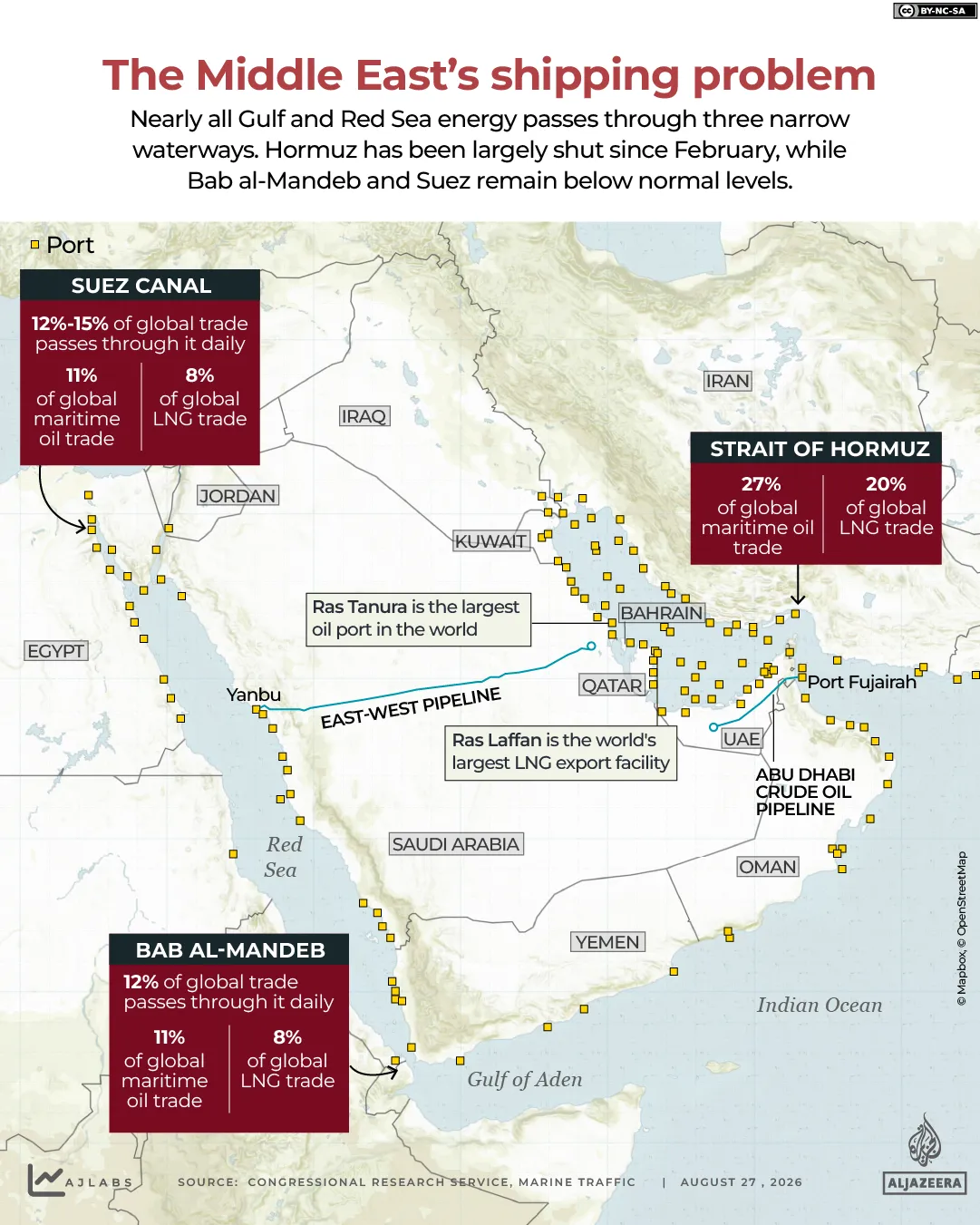
The latest diplomatic push by Pakistan comes amid escalating hostilities that have raised concerns over disruption to shipping through the Strait of Hormuz, a critical artery for global fuel supplies. More than 20 percent of the world’s oil and gas passes through the waterway, which remains under a de facto Iranian blockade.

Trump, in an expletive-laden post on Sunday, threatened to rain “hell” on Tehran if it did not make a deal by the end of Tuesday that would reopen the strait.

More than 2,000 people have been killed in Iran since the war began on February 28, according to Iranian authorities.

Israel has also invaded southern Lebanon and struck Beirut, where Lebanese authorities say 1,461 people, including at least 124 children, have been killed. More than 1.2 million Lebanese have been displaced.

Source link

US envoys meet Hamas in Cairo to salvage fragile Gaza truce | Donald Trump

In a devastated enclave where more than two million Palestinians remain crammed into a shrinking strip of land under the overwhelming shadow of Israeli military occupation and bombardment, daily survival is tethered to a fragile October “ceasefire”.

But as Israeli and US bombs rain down on Iran, and Tehran retaliates across the region, that battered truce faces a breaking point, prompting an unprecedented diplomatic manoeuvre: direct talks between United States President Donald Trump’s “Board of Peace” and Hamas.

Recommended Stories

list of 4 itemsend of list

Envoys from the new body, personally headed by Trump to oversee post-war Gaza, but with more far-reaching designs, met with Hamas representatives in the Egyptian capital over the weekend, according to the Reuters news agency.

The meetings aimed to safeguard the “ceasefire”, which has been under even more severe strain since the regional war began on February 28.

Following the talks, Israel announced it would partially reopen the Rafah border crossing between Gaza and Egypt on Wednesday. The crossing, Gaza’s sole pedestrian lifeline outside direct Israeli control, was shut when the Iran offensive began.

Despite the diplomatic push, violence in the enclave persists. Israeli strikes on Sunday killed at least 13 Palestinians including two boys, a pregnant woman, and nine police officers, serving as a stark reminder of Israel’s all-encompassing military grip on the territory.

A pragmatic shift or tactical ploy?

While the talks mark a notable engagement by Washington, analysts view the move not as a legitimisation of the Palestinian group, but as a calculated tactic underpinned by the threat of renewed violence.

Abdullah Aqrabawi, a Palestinian political analyst, noted that Washington’s willingness to meet Hamas reflects a stark reality on the ground. “There is a comprehensive, realistic acknowledgement that the main military, political, and social actor in the Gaza Strip is Hamas,” Aqrabawi told Al Jazeera.

However, he warned against viewing the meetings as a fundamental shift in US policy. In the era of the Trump administration, diplomatic meetings do not equate with political recognition. Instead, Aqrabawi argued, the approach is framed by the constant threat of a return to a “war of extermination”.

The ultimate goal of these talks, he explained, is to empower a newly formed technocratic committee in Gaza to build a social base capable of challenging the armed group.

The illusion of ‘reverse blackmail’

Initial reports suggested that Hamas had threatened to abandon the “ceasefire” if Gaza border restrictions continued, purportedly using the regional chaos of the Iran war to force Israel’s hand.

Aqrabawi dismissed this assessment, noting that Hamas has consistently expressed a desire to avoid a return to full-scale war. Rather than a successful Palestinian pressure campaign, he said the reopening of the Rafah crossing serves a different strategic purpose for Washington and Tel Aviv.

“Any facilities, whether the Rafah crossing or allowing aid entry, come through the “Board of Peace” and the new technocratic committee formed in the Gaza Strip,” Aqrabawi said. “It is not a response to negotiations or Palestinian pressure, but rather in the context of allowing this committee to penetrate Palestinian society.”

He added that this aims to establish a security foundation that allows for the disarmament of the resistance, even if it leads to internal Palestinian civil conflict.

Disarmament and the 20-point plan

Prior to the regional escalation, Trump’s flagship Middle East initiative – a 20-point plan for Gaza – had partially halted the mass killings and secured the release of Israeli military captives and some Palestinian prisoners. In exchange, Hamas accepted a ceasefire that left the Israeli military occupying more than half of the enclave.

But the second phase of Trump’s plan, which hinges on Hamas laying down its weapons in exchange for amnesty and reconstruction, remains deadlocked. While some might assume the regional conflict gives Hamas leverage to scrap the disarmament clause entirely, Aqrabawi suggested the opposite is unfolding.

The US and Israel, heavily engaged in Iran, are likely intensifying pressure on the Palestinian group to secure a swift, enforceable victory in Gaza. “The pressure happening today on the occupation government and the American perspective of the war with Iran may push them to pressure Hamas to accomplish this task as quickly as possible,” Aqrabawi said.

Yet, Hamas remains resolute. The group views its weapons as essential for resisting the occupation and forming the foundation of future Palestinian security institutions.

As Washington and Tel Aviv attempt to use the spectre of renewed genocide to engineer Gaza’s political future, the reality for the Palestinians trapped inside the enclave remains unchanged. For them, the partial reopening of a single border crossing is not a diplomatic breakthrough, but a fleeting gasp of air in a besieged Gaza Strip where daily survival is held hostage to the demands of the military occupation.

Source link