‘Uno, Uno, Uno No Mercy!” the six-year-old son of our hosts for the day bellows while leading my boys, 10 and 12, into his dimly lit corrugated iron home. I let out a little sigh of relief. The popular card game is a much-needed icebreaker as ominous clouds close in on the remote stan (the Albanian word for a shepherd dwelling). Despite the language barrier, much laughter and consternation soon spill out of the darkness, just as hail hammers down on the tin roof. Dogs bark, chickens cluck and sheep bleat as the thunder grows louder, and we all – our eight hosts, seven guests and one guide – shelter in the tiny kitchen, the living room-cum-bedroom (now Uno parlour), or on the veranda.
It’s day two of a seven-day trip with Undiscovered Balkans, crisscrossing between Albania and Montenegro on foot and by car. Having always wanted to hike the Peaks of the Balkans trail, a 119-mile (192km) hike linking Montenegro, Kosovo and Albania, I jumped at the chance to sample this new guided itinerary. Combining some of the region’s most famous hikes with gentler excursions for kids, such as a day experiencing life as a shepherd, or visits to remote swimming spots, it seemed a novel alternative to our usual “get a map and hope for the best” approach to hiking holidays.
The trip starts in Podgorica, Montenegro’s unassuming capital, where we meet our guide, Aurora (one of just a handful of female Albanian mountain guides), Emma, a cofounder of Undiscovered Balkans, and her daughter and friend, who join us for the first few days. Before any of us can complain about the heat (it’s edging up towards the high 30s), we jump in a minibus to cool off at a popular local swimming spot on the Cemi River, then cross into Albania and weave up cooler mountain roads to the remote village of Lëpushë.
A swimming spot on the Cemi River. Photograph: Holly Tuppen
Here, surrounded by orchards, beehives and terraced fields, and mesmerised by the dense forest and serrated limestone peaks beyond, we make Bujtina Lëpushë guesthouse our home for two nights. “You’ll realise how quiet this is when you get on the main Peaks of the Balkans trail,” Emma says. The trail receives more than 40,000 visitors a year, so spreading the love outside the well-trodden route helps reduce overcrowding and provides an economic lifeline for villages like Lëpushë.
Our day playing Uno under a tin roof is our first taste of Albania’s easy-going hospitality and millennia-old rural routines. The day trip from Lëpushë to the stan is organised by Nina, who runs the Shepherd’s Way, a community tourism project that helps Malësorë (highlander) shepherds earn extra income while sharing their way of life. “The ancient transhumance [moving sheep to high ground in summer] still carried out by 12 families here was recently awarded Unesco world heritage status,” she says as we walk to the stan from our guesthouse, swifts darting overhead. “While working on that project as a photographer, I felt compelled to do something to support this precious culture, and so now work with the families to offer experiences on their terms.”
Theth valley, in Albania, on the Peaks of the Balkans trail. Photograph: Aliaksandr Mazurkevich/Alamy
The weather soon scuppers the plan to spend the day herding and milking sheep. Instead, hours drift by baking bread, playing Uno, losing arm-wrestling contests and sipping mountain tea. “Boredom is a big part of shepherd life,” Aurora explains, noticing our slight discomfort at doing nothing. By the end of the day, however, as the sun breaks and the boys rush out to play football in fields of butterflies, we realise communal boredom is probably the best cultural immersion you can find.
The next day is our first hike of the trip, following a deserted footpath from Lëpushë through beech forest and open plains to the 1,859-metre summit of Maja e Vajushës (Volušnica in Montenegrin). “And that’s Montenegro – we’ll be sleeping down there tonight,” Aurora announces, as we look out towards a sea of mist pierced only by an eerie flock of choughs. It’s supposedly spectacular on a clear day. At the second of our five border crossings, the kids take a while to wrap their heads around the geography, but Aurora explains that the border follows the Accursed Mountains, as we are doing. Having raced up, we take our time meandering back down, picking wild blueberries, stopping for freshly made yoghurt in a stan and buying honey from the village hive cooperative along the way.
After our hike, a 40-minute drive from Lëpushë – via a brilliant blue, refreshing swim spot at Kanioni i Bashkimit canyon – whisks us back into Montenegro to spend the night at Eko Katun Rosi, a cabin camp in Vusanje. The presence of hiking groups from all over Europe gives away that we’re now on the main Peaks of the Balkans trail, as do the surrounding soaring peaks and the portion sizes (there’s no shortage of meat and cheese in these parts). On the way, we notice that the call to prayer has replaced church bells. “It’ll be churches tomorrow and mosques the day after,” Aurora says. Even religion is dictated by geography here – Christianity survived in the valleys that the Ottomans couldn’t reach.
The next morning, we drive around small farms to the Prokletije national park and start a 10-mile hike over the border at Qafa e Pejës pass and into Theth valley – the heart of the Peaks of the Balkans trail. It’s the longest and steepest hike of the trip, and we’re grateful for Aurora’s careful pacing as butterfly- and cricket-filled meadows give way to a steep hairpin path. At the top, we shelter behind an abandoned gun post to eat a picnic lunch straddling the border. With about six gun posts for every square kilometre of land in Albania, we’re not short of opportunities to ask Aurora about life under communism. Tales of hiding goats underground to make sure there’s enough milk for all the family keep any moans about sore legs at bay.
A church in Theth village. Photograph: Jan Wlodarczyk/Alamy
The descent into the sprawling village of Theth feels a world away. Hot pine forests tumble down steep yellow cliff faces, lizards dart between fallen rocks, and caves offer shady water stops. In the valley below, dry riverbeds carve ashen-grey scars across dense forest as far as the eye can see. Exhausted, we hitch a lift to our bed for the night from the first cafe we find.
As we drive past Theth’s sprawling bars, camps and lodges, some of which have been destroyed recently as part of a government clampdown on unofficial development, we’re grateful to spend the night in a quieter hamlet just above the town. Marash Rrgalla guesthouse is a 200-year-old working kulla(farmhouse) with five comfortable rooms, a bucolic garden and a cat called Sweetie. The boys run off to meet the pigs and the cow, and in true Albanian style it’s not long before we’re enjoying a homegrown, homemade feast as the sun dips, turning the Albanian Alps pink.
After a day off the trails, dipping in and out of Theth’s swimming spots at Nderlyse pools and the Blue Eye of Kaprre – “Finally, we get a day to swim!”, the 10-year-old exclaims – we embark on the iconic hike from Theth to Valbona. Unlike on our previous hikes, the path is packed with people from all over the world, so the day is peppered with passing chats. “Wow, so young! Well done, boys!” an American hollers as we reach the narrow top of the 1,800m Qafa e Valbonës pass. With no other kids in sight, the boys are rightfully chuffed and celebrate with a plate of chips – the first of the holiday – once we’ve completed the dusty and hot descent to Valbona.
From Valbona, we spend the next two days travelling by car and ferry towards our final stop, Shkodër. Despite pockets of nature and peace, including a ferry trip down the steep-sided Komani Lake, and standup paddleboarding with egrets and kingfishers on Lake Shkodër with Drini Times, we soon find ourselves longing for the mountains.
Although grateful for holiday staples like ice-creams, chips and Fanta in Shkodër, building sites, roadworks and litter bring home the fast pace of change in a country on the move. The contrast makes our time in the mountains, surrounded by centuries-old traditions and landscapes as wild as they get in Europe, feel like an enormous privilege, particularly with the kids in tow.
Undiscovered Balkans’ seven-day Albania and Montenegro family hiking trip costs from £1,195pp, with departures on any Sunday in June, July or August
Writer Catherine Usher travelled by train to the pretty town of Troyes in the Champagne region, discovering art, history and – of course – the best bubbly
This article contains affiliate links, we will receive a commission on any sales we generate from it. Learn more
Discover a relaxed and inviting city break, with no need to step on a plane(Image: Getty)
Troyes is only a 90-minute train ride from Paris but, compared to the capital, it’s a more compact and intimate location for a French mini-break. You’ll find atmospheric churches, attractive independent shops and chic museums, making it the ideal place to explore for a few days. Although it’s a very popular stop-off point for holidaymakers driving further south in France or onwards to Germany or Switzerland, a car isn’t a necessity. We travelled to Paris first via Eurostar –a much more environmentally-friendly option than flying – then took the train to Troyes. (It’s a 10-minute walk between Gare du Nord and Gare de l’Est in Paris.) Once in Troyes, we were able to explore much of the town on foot.
Troyes is a pretty city with lots of half-timbered buildings in the old town that were largely built in the 16th century. There are countless cobbled streets to wander down and the atmosphere is relaxed and friendly.
Two museums well worth taking a stroll around are the Musée d’Art Moderne and the Cite du Vitrail.
The Modern Art Museum , located next to the cathedral, is home to paintings by artists such as Henri Matisse and André Derain. The sloping ceilings on the upper floor make it feel cosy and visitors can enjoy a sense of proximity to the artwork.
The Cite du Vitrail is the stained glass museum and it is a wonderful, tranquil venue where you can immerse yourself in the elegance and beauty of stained glass. Located in an 18th century building, it explores stained glass from the Middle Ages to the present day and houses striking and memorable exhibits.
Making time for Champagne
Being in the heart of the Champagne region, discovering its most famous export is a must. Chassenay d’Arce champagne house in Ville-sur-Arce is about an hour’s drive from Troyes. It was founded in 1956 by five pioneers and the organisation is now made up of 130 families, with a focus on co-operation and knowledge-sharing.
Visiting its vast cellars and seeing how the bottles are produced is a real eye-opener, and the tasting workshop at the end of the tour is an obvious highlight for champagne connoisseurs and novices alike (see chassenay.com).
Troyes is a straightforward place to explore, but if you really want to find out about its history then a guided tour is a must. Hosted by Troyes La Champagne Tourisme, tours can be arranged for smaller or larger groups, of up to 30 people. Our host, Laura Dudek, was a well-informed, enthusiastic guide who tailored the experience to our interests, taking us to see many of the city’s ornate and impressive churches and cathedrals. For those who prefer to go it alone, you can explore with a City Pass, which includes an audioguide and admission to the museums.
Where to eat and drink
A flute of champagne is no doubt on the agenda for many visitors, and most of the bars and cafés have a variety of local brands to sample.
Octave is a sophisticated, rather understated restaurant located in the centre of Troyes with a beautiful courtyard, where you can enjoy dinner under the stars – usually joined by the friendly cat who lives nearby. The tapas style menu may look daunting at first glance, but the knowledgeable staff are happy to advise and we were very pleased with their recommendations.
For a speedy, fuss-free lunch while sightseeing, Tonton Farine is a welcoming bakery/canteen where everything is homemade. As it’s France, everything tastes more wholesome and delicious than a British equivalent. Most of the other customers looked like they were locals on their lunch break.
If you’re away from Troyes enjoying a champagne tour, Le Moussec in Les Riceys is a fabulous place to stop for lunch. The dishes are tasty and hearty, the restaurant is buzzing, which is always a good sign, and the staff are warm and attentive without being suffocating.
Where to stay
Two elegant boutique hotels, La Maison de Rhodes and Le Champ des Oiseaux, are located in adjoining medieval buildings and offer a combined 23 rooms. Owned and run by the same family, the welcoming hotels are a great base from which to explore the city.
Room categories and decor vary between the two properties, but guests share access to a range of amenities, such as a tranquil walled garden (we were getting Romeo and Juliet vibes), an outdoor heated pool and a small spa. The restaurant has an elegant yet homely ambiance and after your evening meal you can enjoy a nightcap in the moonlit garden. Once settled with a glass of wine, some nibbles and a book, it’s incredibly hard to drag yourself away.
How much does it cost?
Rooms at La Maison de Rhodes start from £245 and Le Champ des Oiseaux start from £174 per night on a B&B basis – see maisonderhodes.com. To book a tour of the town, see troyeslachampagne.com. Eurostar journeys between London and Paris start from £39 each way – see eurostar.com. Fares are all-inclusive with no hidden extras, children under four go free, and a Paris-London journey by Eurostar means 96% fewer CO2 emissions than travelling by plane.
Enchanting little town with friendly locals, colourful buildings and thriving independent shops is like stepping back in time
The River Ashburn runs through the town (Image: Katie Oborn)
A charming and picturesque town nestled on the fringes of untamed moorland lies just a stone’s throw from where I’m based, yet I’d only recently ventured there for the first time. There’s nothing quite like discovering somewhere new – and I’m fortunate to have an abundance of options, given the wealth of distinctive towns dotted around Plymouth in Devon.
Ashburton isn’t far from my Plymouth home, so a friend and I recently made our way towards Dartmoor to discover what this town had to offer. The appealing destination is celebrated for its independent retailers and quintessentially Devonian charm – both of which thoroughly impressed me during our visit.
We caught the bus from Plymouth (the number 38) and the trip was smooth and enjoyable, weaving through stunning countryside, towns and delightful villages en route.
In an era when we’re constantly bombarded with news of shop closures and struggling town centres, stumbling upon Ashburton, with its collection of independent businesses to browse, felt genuinely uplifting.
The streets here remain untouched by modernity – you could easily picture bygone eras as you stroll through the town – and every local we encountered was incredibly welcoming, reports the Express.
There are numerous pubs, tearooms and cafes alongside distinctive establishments, including antique dealers, plus a bakery with customers spilling out onto the pavement – and what really caught my eye was how, despite the drizzle, Ashburton radiated colour thanks to its vibrantly painted properties. The atmosphere feels wonderfully crisp in this town, encircled by rolling countryside and the stunning vastness of Dartmoor National Park, lending the area a peaceful, almost timeless quality.
Browsing through one vibrant independent gift shop called PAD proved delightful – and I ended up purchasing a few quirky bits and bobs that you simply won’t find elsewhere.
There’s also the attractively laid-out Ashburton Fish Deli along one of the principal streets, offering delicious locally-sourced seafood, Mediterranean-inspired products and various other intriguing finds.
All told, I reckon you could probably track down everything you’d require in this town, from top-notch clothing available in various independent boutiques to bargain-hunting opportunities in the small selection of charity shops.
We paused for a late breakfast at Diablo’s Diner, which had a welcoming neighbourhood feel and delicious grub. I’m particularly picky when it comes to bacon, but this little cafe delivered the finest – superb quality, crispy (as I’d requested) – and the prices were extremely fair.
As a Devonian myself, I’m astonished that I’d not discovered this gorgeous town until now, but I’ll definitely be returning soon – in fact, there’s a fascinating festival happening in Ashburton from late April through early May.
The Dartmoor Tors Festival is “bringing together walkers, thinkers, creatives who are interested in natural landscapes and how we relate to them”, the festival website explains. This festival is set to be “a celebration of the power and beauty of places seen as wild and ancient around Britain, and an exploration of why and how they provoke a response”.
The tiny island is home to just six permanent residents, and has more sheep than people, while its only entry and exit point takes you soaring 250m above the Atlantic Ocean
The Island is only accessible via one unusual route – in the air (Image: Chris Hill via Getty Images)
Far removed from the rest of civilisation, this tiny island has been frozen in time, with nothing but fragments of a life that once thrived and a handful of people who still call it home.
Off the coast of West Cork in Ireland sits Dursey, a charming island steeped in history but offering little else. Ever since the stunning landscape acquired a new form of transport, visitors have been able to travel across from the mainland in a distinctive way and discover a place that appears to have ceased to exist.
This tranquil island is home to approximately six permanent residents, with around 15 houses that are deemed habitable and up to seven farmers.
Their livestock stays on the island, and the owners who traditionally inherited the land continue to spend a few nights on the island but never remain. This means there are likely more sheep inhabiting Dursey than there are people.
Best UK holiday cottage deals
This article contains affiliate links, we will receive a commission on any sales we generate from it. Learn more
Sykes Cottages offers a wide range of handpicked holiday homes across the UK and Ireland, from cosy countryside retreats to stunning coastal escapes. Prices start from £27 per night
It’s understood that when people who live in Dursey have children, they have no option but to have a primary home on the mainland, to enable schooling and access to other facilities.
Unique attraction
Dursey is home to a rare form of transport in Ireland, and the country’s one and only cable car. It carries travellers 250m above the Atlantic Ocean, across to the island, surrounded by nothing but verdant green hills.
Starting from Ballaghboy, Cork, on Ireland’s mainland, the aerial voyage transports you to Dursey in a mere seven and a half minutes.
Throughout the journey travellers can absorb the breathtaking coastal views as the minuscule speck of land gradually grows larger before them.
Built in 1969 as a reliable and secure link between the island and Cork’s mainland, as the surrounding waters are considered far too hazardous for regular boat crossings.
The stretch of water is known as the Dursey Sound and has proved erratic over the decades, with rapid tidal surges. Beyond this, submerged rocks encircling the landmass also render it a perilous voyage and generally unsafe for travellers.
After experiencing the cable car journey, one visitor posted on TripAdvisor: “For us this was the most beautiful part of Ireland.
“We took our mountain bikes over in the cable car, and luckily for us, the weather was glorious. We saw almost all of the island and spent ages staring at the views. We just haven’t seen anything to top it despite travelling the whole way round Ireland.”
Another expressed their admiration for the island, posting: “I absolutely loved Dursey Island. It’s a stunning place, delightfully remote and serene. It is the last place in Europe that the sun sets, a cool fact for you!”.
Historic ruins
Its rugged terrain is also home to numerous equally weathered historical ruins, dating back as far as the 17th century. The most notable of these historic structures is O’Sullivan Beare Castle, which was almost completely razed during the Nine Years’ War in 1602.
Very little of it survives today, and the devastation inflicted by English forces also resulted in a massacre of local residents. One visitor claimed: “Dunboy Castle was very cool, though some information on the site would have been helpful – similar to the plaques found elsewhere. The ruins are overgrown, and you almost stumble into them. “.
Another attraction is the 19th-century Napoleonic-era signal tower. It stands quietly on the island’s highest point, originally built with the purpose of warning against French invasion.
Yet it has remained in ruins since the mid-19th century, abandoned and forgotten by history.
Commonly known as the Church of Kilmichael, it comprises the monastic church and graveyard lying in ruins on the quiet island. It’s believed that the church was established by monks from Skellig Michael but was likewise destroyed in the infamous siege of 1602 by Sir George Carew’s army.
The village is home to one of the country’s finest beaches, boasts a cosy pub with unrivalled views, and has a historically important site nearby – a must-visit destination in England.
Breathtaking views and pristine beaches – what’s not to love?(Image: Chris Griffiths via Getty Images)
Encircled by crystal-clear waters and striking views stretching endlessly into the distance, Cornwall overflows with magnificent sights. Among them is a small coastal village in West Cornwall, positioned approximately nine miles from the vibrant seaside resort of Penzance by road.
With the South West Coast Path winding through this charming seaside settlement, it’s easy to appreciate just how beautiful this spot truly is. This little Cornish village sits just two miles by car and one mile on foot from Cornwall’s iconic Land’s End.
Whilst not technically a cove in the strictest geological definition, the village of Sennen Cove has a handful of year-round inhabitants, though a significant proportion of the properties there serve as holiday rentals and seasonal residences.
Save on the best holiday cottages in Cornwall
This article contains affiliate links, we will receive a commission on any sales we generate from it. Learn more
Famous for its rugged coastline, golden beaches, picture-perfect villages and rich maritime heritage, Cornwall is one of the most-visited corner of the UK. Sykes Cottages has a large number of holiday homes to choose from, with prices from £36 per night.
Sennen Cove serves an essential function for the Royal National Lifeboat Institution (RNLI) as it houses a critical lifeboat station. A modest fleet of working fishing vessels can be spotted moored in the cove, alongside recreational fishing boats, reports Cornwall Live.
Things to do in Sennen Cove
The panoramas from the headland slash observation point, Pedn-men-du, are unmatched and absolutely merit the brief walk from the heart of the coastal village.
Delightful boutiques, art galleries including the distinctive circular Roundhouse and Capstan Gallery, and an impressive array of dining and drinking establishments make Sennen Cove an essential destination to visit in Britain.
Sennen Cove features one principal village pub, Old Success Inn, which has become an absolute favourite amongst both residents and tourists.
The charming 17th-century fisherman’s inn radiates character and appeal, situated in a prime location that commands views across the golden sands of Sennen Cove Beach – another significant, perhaps the most crucial, attraction in the village.
Providing guests with expansive outdoor seating offering breathtaking vistas and a welcoming indoor area complete with a roaring fire, Old Success Inn is the essential spot when visiting Sennen Cove, with lodging also on offer for travellers.
Acclaim for the iconic pub at the centre of Sennen Cove is endless, with one Tripadvisor review stating: “A recent visit on the back of a trip nearby was excellent.
“The location, of course, cannot be beaten – even stormy weather is great to view from here – unmatched to be honest. What’s great is the service and personnel which is brilliant no matter who sees to you.
“You are charmed and looked after as soon as you walk in and that’s what we loved the most. Of course the excellent food to match also helps. You can come here any time you want (it’s ALWAYS open) and it doesn’t matter.”
The Blue Lagoon and Shantys Fish Bar (in the main village of Sennen) are obvious choices for an excellent portion of fish and chips. Sennen Cove Cafe, adjacent to the lifeboat station, is ideal for a quick snack whilst enjoying some watersports, swimming, or simply relaxing by the beach.
The historic First and Last Inn (also in mainland Sennen) is another excellent place to grab some food and a refreshing pint.
One of Cornwall’s finest beaches
Sennen Cove Beach, also popularly known as Whitesands Bay, has frequently been praised as one of Cornwall’s most stunning and attractive beaches, thanks to its mile-long white sands and spectacular views.
A premier surfing location for locals and visitors alike, Sennen Cove Beach is widely recognised as a surfing paradise celebrated for its near-perfect surf conditions.
The surfing schools and centres are ideal for lessons and surf equipment can be rented independently at the beach, near the café and the car park.
Sennen Cove Beach is also renowned for once being the professional territory of Britain’s first qualified lifeguard dog, Bilbo.
The 14-stone Newfoundland would regularly be spotted patrolling the beach’s immaculate sands in his red and yellow jacket, often at the back of a lifeguard’s quad bike.
Bilbo was trained by his owner, head RNLI lifeguard Steve Jamieson, and went on to become an active lifesaver as well as the face of beach safety on Sennen Cove Beach. He passed away in 2015, at the age of 12.
Tourists are consistently impressed by how pristine and well-kept this beach remains, even during peak times, with one reviewer commenting on Tripadvisor: “This is a truly lovely beach, spotlessly clean with excellent safety standards.
“Even though it was extremely busy as it was a lovely hot Cornwall day there was enough room for everyone. A lovely wide, family friendly beach where after swimming all day you could get a fantastic hand made pizza from a pizza truck. A wonderful experience to remember from a family holiday.”
The spectacular ‘castle on the cliff’
Located just half a mile from Sennen Cove on foot, Maen Cliff Castle is an ancient Iron Age hill fort perched on Mayon Cliff, positioned between Land’s End and Sennen Cove.
It’s an essential stop for anyone exploring the region, offering breathtaking panoramic views and a fascinating heritage that will whisk you centuries into the past.
Only earthworks and walls remain of the historic structure, alongside two standing gate stones which indicate the entrance to the site. Tracing its origins to approximately 500 BC, it stands as one of Cornwall’s earliest datable Cliff Castles, enriching its already compelling story.
Being one of just two fortified locations in Cornwall where early Iron Age pottery has been unearthed, Maen Cliff Castle represents a genuine treasure of the region.
Fragments of pottery spanning the era from 400 BC to 400 AD have been uncovered at the location, enhancing its intrigue and layered history.
In fact, local legend suggests the castle was once the dwelling of the giant Myen Du, though the promontory fort more probably served as a defensive retreat or observation point, a commercial trading station or a location for significant ceremonial gatherings.
SHOPPERS are flocking to Amazon to snag a sleek underseat cabin bag that’s been slashed in cost just in time for the holiday season.
Originally £29.99, the budget-friendly Taygeer Underseat Cabin Bag has now been dropped in price.
Sign up for the Travel newsletter
Thank you!
Amazon has slashed the cost of this 24-litre travel bag and it’s perfect for budget airline travellers
Taygeer Underseat Cabin Bag, from £18.99 (was £29.99)
Discounts on these handy backpack vary across depending on colour – you can pick up the black model for £22.79, but that drops to £18.99 if you have Amazon Prime membership.
It looks like a solid choice for anybody flying with budget airlines, where luggage rules are strict and some unlucky travellers get stung with extra fees at the terminal gate.
Now, free personal bag allowance has been upped from 40x20x25cm to 40x30x20cm – that’s a 20% increase and an extra 4 litres of space.
Small wonder so many Amazon shoppers are dashing to pick up this rucksack after that price drop.
It is specifically designed to meet those new dimensions while offering a suitcase-style, 180-degree opening that makes packing all your bits an absolute breeze.
Despite its compact size, the bag is packed with features like a built-in wet pocket for toiletries, plus a separate shoe pouch.
You can also pick it up at sizes designed for Easyjet and Lufthansa flights.
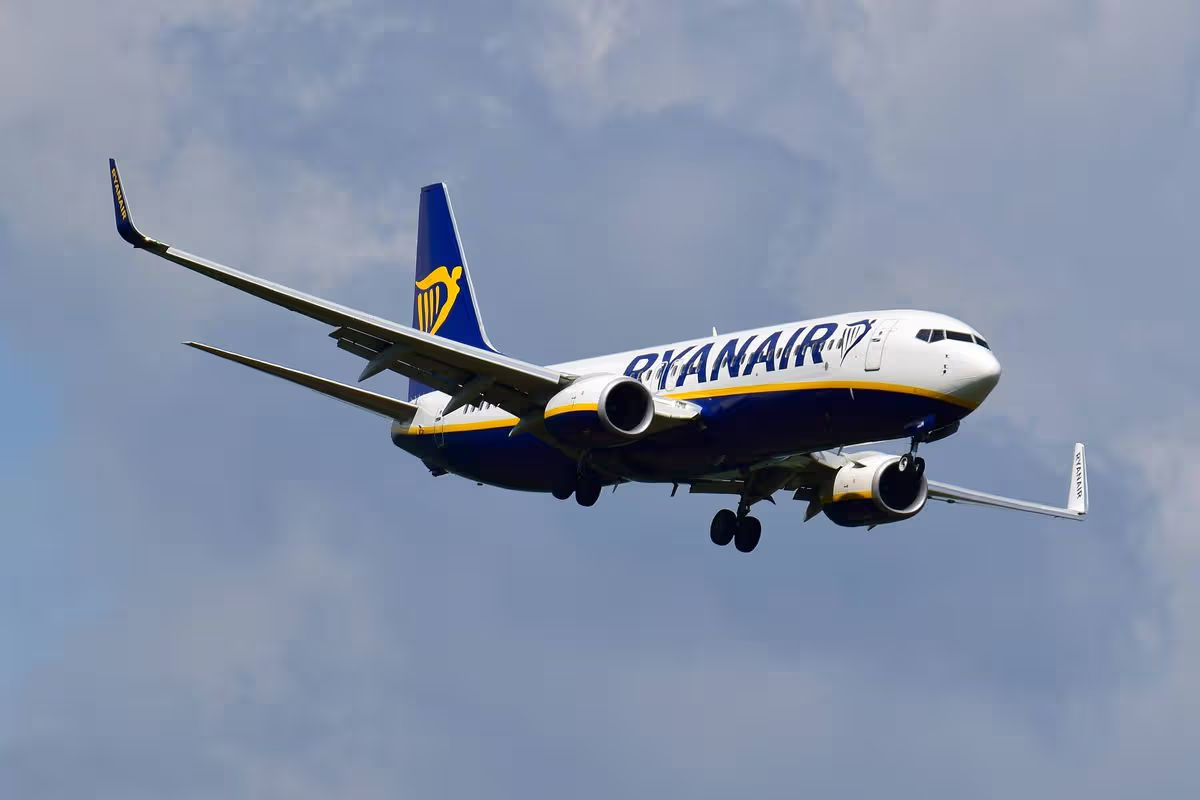
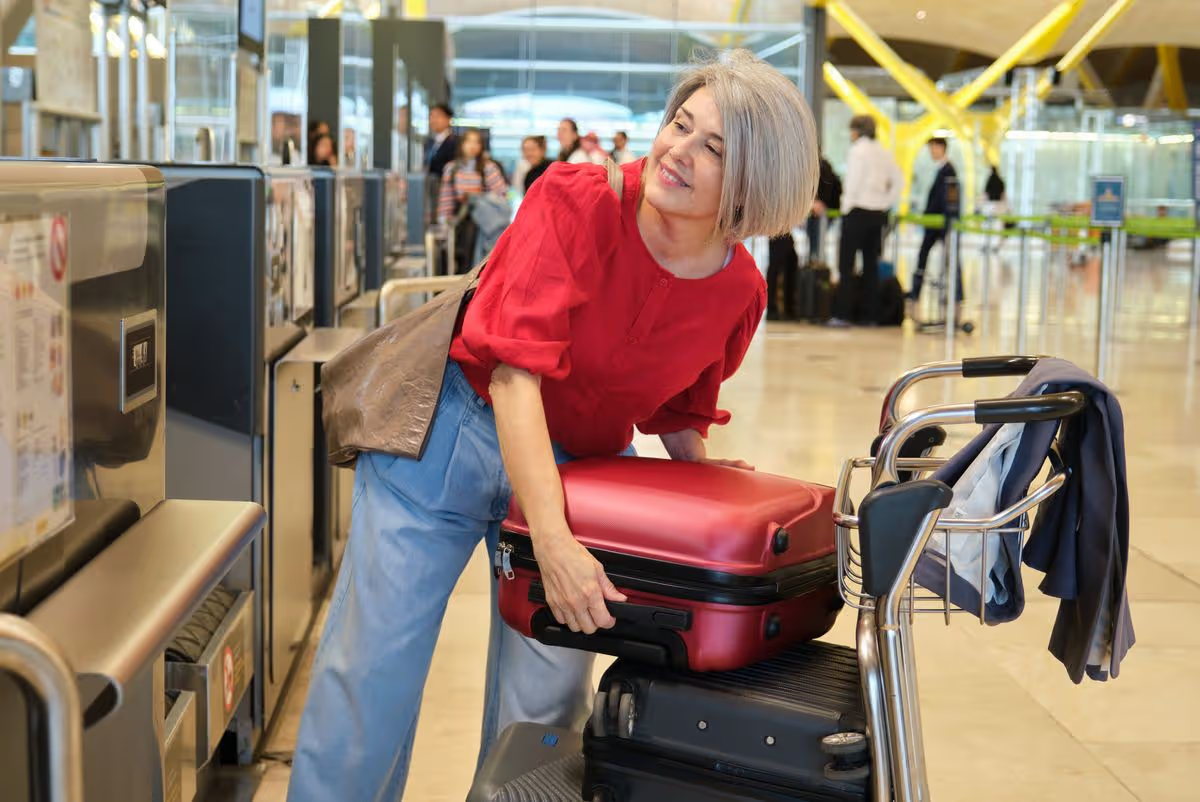
Ryanair passengers have been told to pack a cardboard box in their hand luggage
Ryanair increased its cabin bag allowance in 2025(Image: Nuria Gonzalez Sanchez via Getty Images)
Ryanair passengers have been advised to slip a piece of cardboard into their hand luggage following an announcement the airline made last summer. The budget airline increased its ‘personal bag’ size by 20% in response to new EU regulations.
As of September 2025, passengers travelling on a basic fare can bring a larger bag on board, measuring up to 40cm x 30cm x 20cm, without incurring additional charges. The bag must weigh less than 10kg and fit under the seat in front of you.
With the new bag dimensions now in effect, packing expert Tom Schott from Schott Packaging is cautioning travellers against a potentially costly mistake, as he believes the increased allowance might tempt people to overpack their bags. Tom said: “The new dimension is a game-changer, but only if you use it wisely.
“The mistake is to simply cram more in. The real victory for passengers is using that volume to pack with structure. A well-packed bag is a compliant bag.”
One of Tom’s many tips to avoid this is to pack some cardboard. He explained: “Soft bags lose volume. A lightweight, snug-fitting cardboard box inside your bag provides a rigid frame, allowing you to use every corner and prevent the bulge that attracts gate staff.”
He also suggests using sealable bags to maximise space, organising items into smaller compartments, and protecting valuables. Tom added: “Place a small, sturdy box in the centre of your bag, cushioned by clothes.
“This creates a crush-proof zone for chargers, adapters, and toiletries, preventing damage and leaks.”
Holidaymakers are also advised to “pre-plan your bag”, with Tom recommending you arrange all your belongings on the floor within a 40cm x 30cm outline beforehand, as this “provides a real-world view of what fits and helps you assemble your packed modules logically and quickly.”
Tom went on to say: “These aren’t just clever tricks, but core principles of efficient packing. By applying them, you can confidently pack that extra outfit and still breeze through the boarding gate”.
Brits who may be put off travelling over the next few weeks due to the events in the Middle East can still enjoy plenty of beautiful locations that will leave you feeling like you’re abroad
The mammoth journey is now flown twice a week and spans three continents
The longest route in the world takes 29 hours(Image: VCG via Getty Images)
The world’s longest flight record was set last year with the launch of a new 29-hour route. It is now the longest in the world, spanning almost 20,000km, which is 12,427 miles.
The route is so long that the plane even needs to stop off to refuel. Passengers are in their seats for over a day as the plane travels from Shanghai, China, to Buenos Aires, Argentina.
It is flown twice a week by China Eastern Airlines. Due to the distance, the plane stops at Auckland Airport, New Zealand, to refuel.
Staff also get swapped around whilst at the stop, yet the passengers carry on. At almost 20,000km, the route is used to ship supplies between China, New Zealand and South America, as well as passengers.
It was launched on December 4 last year. The route from China to Argentina takes more than 25 hours, while the return leg takes an additional four.
Ensure our latest lifestyle and travel stories always appear at the top of your Google Search by making us a Preferred Source. Click here to activate or add us as your Preferred Source in your Google search settings.
“This new route fills the gap in direct flights between Shanghai and major South American cities,” China Eastern Airlines said at the time of the first flight.
“It opens a ‘southbound corridor’ connecting opposite ends of the Pacific and reshapes air travel between three continents.” The staggering journey sees passengers board a jumbo 316-seat Boeing 777-300ER.
Before the launch of the route last year, the quickest available journey from Shanghai to Buenos Aires took 31 hours. It involved non-direct flights with a layover.
It is a popular route, as more than 55,000 people born in China live in the South American country, according to data from Simply Flying.
Data also showed that 96,000 passengers flew between China and Buenos Aires in the 12 months to September 2025, before the new route existed.
The flight has set the record for the longest commercial flight route in the world, yet it can’t secure the world’s longest direct flight route title because it makes a stop.
The title of the longest non-stop flight is currently held by Singapore Airlines. It takes 19 hours to travel from Singapore to New York.
However, it isn’t set to hold the record for long as Qantas is set to launch a new non-stop route next year. It is planning a 22-hour nonstop flight from Sydney, Australia, to London in 2027.
Thanks to a 20,000-litre fuel tank, the plane wouldn’t need to stop to refuel. It will travel 10,573 miles and has been labelled “the final frontier of long-haul travel” by Qantas.
Ramadan is in full swing in Los Angeles, where a community of hundreds of thousands of Muslims is observing a month dedicated to fasting, prayer, reflection and service. With the unfolding war in the Middle East, the holiday holds even more significance for locals with ties to the region.
The Islamic holiday began Feb. 17 and ends March 19, during which observers fast from dawn to sunset to foster discipline, self-control and gratitude. Observers break their daily fast with an iftar, a festive meal shared with loved ones after sunset. Many also rise before dawn for a suhoor meal.
Halal, which translates to “permissible” in Arabic, pertains to the type of meat and the way it’s prepared. Pork and its byproducts are not allowed, and a Muslim must slaughter the animal while invoking the name of Allah. The animal must also be healthy and blood should be completely drained after slaughter.
This Ramadan season, several L.A. restaurants are offering late-night hours, special iftar menus and discounts for the holiday.
“The demand for iftar and halal food is skyrocketing,” said Assad Shalhoub, a member of MENA Creator Club, a community group for Middle Eastern and North African content creators that organized an iftar gathering at West Adams’ Maydan Market. “I think a lot of people are becoming more proud of their culture and their heritage, and with that comes a lot of people seeking things like this.”
Here are eight halal restaurants to break fast and share a meal with loved ones during Ramadan.
A FLIGHT attendant has opened up on secrets of the trade and revealed how you can earn brownie points in the air to score freebies.
The flight attendant, who has been serving major airlines for two decades, said it is easier than you think to win the favor of those working on planes.
Sign up for the Travel newsletter
Thank you!
A 20-year veteran flight attendant revealed the secret to getting freebies on the plane – and it’s not as hard as you might think (stock image)Credit: GettySandra White said that being really nice can go a long way while you’re up in the air (stock image)Credit: Getty
Sandra White has lifted the lid on her veteran experience serving the skies.
“You draw more bees with honey,” she said, meaning rude or impatient flyers will likely not get anything for free – especially not any “off-menu” items.
She shared several tips with Shermans Travel, ranging from how to get a free drink, how to score a better seat, and how not to be the most annoying person on the plane.
“Scoring a free beer on a flight is not all that hard,” she admitted.
According to White, there are a few reasons why she’ll give a customer a free drink, but it all comes down to one thing: being nice – really nice.
If a plane is having mechanical problems and passengers have been sitting on the tarmac for hours – without being rude – she’ll likely comp them a drink.
“I’m sure they need it,” she said.
She noted that if a flyer happens to only have cash on them, while most airlines only accept cards, she’ll just hand you the drink.
“Basically, kindness goes a long way,” she said.
And as far as a better seat goes, politely asking if there is any availability could help you to win big.
White shared that she’s more than happy to make sure a guest is as comfortable as possible.
When it comes to seats on the plane, that typically comes down to the gate agent’s discretion – but occasionally, flight attendants will send you up to first class if there’s space, and if they ask nicely.
It is not a guarantee, but it never hurts to be friendly to the person serving you peanuts.
The worst passengers, however, are those that come onto the plane having had too much fun while in the airport.
That is, flyers who are already drunk on the flight.
“Annoying drunks” are the bane of a flight attendant’s existence, according to White, thinking their funnier than they are and ordering more drinks before beverage service has even started.
White said these flyers should not even bother getting on the plane.
“I’ve only had to cut off two people – you really don’t want to make a drunk angry at 36,000 feet,” she said.
“They might defecate on the beverage cart. Yes, this really happened to a co-worker.”
The Carlsbad theme park will on Friday open Lego Galaxy, a new 2.4-acre themed land that will feature its most adult-focused attraction yet in the Galacticoaster. An indoor, space-themed thrill ride, Galacticoaster is brief but impressionable, a spinning race through a darkened landscape to save a Lego-infused galaxy from an “asteroid of probable destruction.”
At 40 mph, it’s the park’s fastest ride, but coming in at about 60 seconds and focusing on banking and turning means it still has full family appeal. Expect it to serve as an introductory, big kid coaster for many. It’s infused with lighthearted humor — floating farmers and barnyard animals cruise among the stars — lending it a rather relaxed atmosphere for a save-the-world, fast-paced attraction. In other words, it’s sleek, it’s hurried and it’s cutesy.
Share via
“My favorite is the surfing alien,” says Tom Storer, North American project director for Merlin Magic Making, the creative team behind Lego experiences. “She’s my favorite thing to see in there. It’s right after the blast. It will sneak up on you.”
The Galacticoaster is the centerpiece of Lego Galaxy, which also includes two smaller outdoor attractions, a vintage-style shoot-’em-up video game and a play area for little ones. Its part of a $90-million investment in Legoland’s California and Florida parks on behalf of parent Merlin Entertainment (an identical Galacticoaster can be found in Lego’s Florida park). Lego Galaxy hopes to draw visitors — and perhaps new audiences — by focusing on slicker, more modern technology and injecting in the park the sort of excitable ride more commonly found at Legoland’s Southern California competitors.
Storer, for instance, isn’t shy about the Galacticoaster’s inspiration.
A view of the stars and scenery that surrounds the Galacticoaster track.
(Legoland / Merlin Entertainment)
“What is the space roller coaster of 2026? Space Mountain is a classic from back in the day,” he says, referring to the Disneyland Resort staple launched in 1977. “But this is kind of the new way.”
It is faster and brighter than Space Mountain, as the Galacticoaster is heavily populated with twinkling stars, planetary projections and many a Lego brick creation. But while Space Mountain tops off at about 32 mph, it likely still has Galacticoaster beat in the intensity factor due to its lift hill, sudden dips, jolting turns and near pitch-black darkness. No matter, says Storer, as here the objective was to place guests in a welcoming adventure with plenty to look at.
“When you think of outer space, you instantly think of stars and planets,” Storer says. “We have a really cool digital planet and we have stars everywhere.”
The Galacticoaster sits four per car, loading attendees parallel in a row via a moving platform. Once seated and locked in, it nearly immediately takes off, jetting riders into a darkened hallway with white lights before injecting them into a Lego galaxy. Lego aficionados or those who grew up with the sets will likely spy many an allusion to past toys. In the ride’s queue, for instance, guests in line will walk past a wall that features a timeline of many a Lego space set. Action comes fast, but surrounds guests, as the coaster cars rotate around a hurtling asteroid.
Legoland’s new Galacticoaster is an indoor space-themed roller coaster with twinkling stars and many Lego brick projections.
(Legoland / Merlin Entertainment)
While it twists from side to side, which has drawn light comparisons to Guardians of the Galaxy: Cosmic Rewind at Walt Disney World’s Epcot, with some referring to this as sort of a starter version of that more powerful coaster, it’s a smooth and relatively unobtrusive twisting. Those prone to motion sickness — and I am one of them — likely need not be too concerned here.
While Legoland has other coasters, many are known as what Storer refers to as “pink knuckle” coasters, slang for safe for kids and families. Galacticoaster, with a minimum height requirement of 36 inches, certainly is as well, but the creative executive hopes it falls somewhere between the pink and white knuckle level of force, the latter term reserved for the most thrilling of coasters.
“We’re known for having ‘pink knuckle’ coaster, where it’s not too scary,” he says. “It’s kind of, ‘My first coaster.’ This is family-friendly. We’d never do anything that’s not family-friendly. We want to make sure our guests from 5 to 12 have lots to do, but it’s a little more punchy and has that cool launch with a space blast-off feel.”
Theme park aficionados will be keen to know that this is the first attraction in the park to feature an animatronic figure. The character of Biff Dipper, an engineer, will be found in the ride’s preshow, familiarizing guests with the story of the asteroid that spells impending doom. Stout and slightly gruff, Dipper has a digital face that can approximate more than 40 expressions. The animatronic, says Storer, was an important investment for the park, as Legoland in Lego Galaxy was cognizant of guests becoming bored in what will surely be one of the park’s longest lines this upcoming spring and summer season.
There are interactive elements throughout Lego Galaxy. In the Galacticoaster, for instance, riders will build a virtual approximation of a spaceship from a touchscreen, selecting options for wings, cannons and more. Some are militant. Others look like burgers or rainbows. There are 625 variations, and the creation will then appear at the start and finish of the attraction, injected into the ride’s projectors via a guest wristband. Legoland officials like to refer to Galacticoaster as a 10-minute experience, a time that takes in the preshow with the Dippper figure as well as the construction of the spacecraft.
The character of Biff Dipper is Legoland’s first animatronic figure. Dipper is in the preshow of the Galacticoaster.
(Legoland / Merlin Entertainment )
Elsewhere in Lego Galaxy, there’s a full video game-like experience called the Rocket Assembly Bay. Here, guests will first build their own spaceship, and then have it scanned into the game for a cooperative shoot-’em-up. Rocket Assembly Bay is good fun, and rewarding even, to see a virtual scan of a hand-built ship injected into the game, this despite that fact that the play experience is largely a modern update of old coin-op “Asteroids.”
“There’s something about the simplicity of some of the things that have been done,” Storer says.
Two other core attractions dot the land. The G-Force Test Facility is a spinner that’s pitched as an astronaut training experience. Guests with a minimum height of 40” will be elevated off the ground via vehicles situated on rotating arms. There’s plenty of swinging and rotating action in this more standard amusement park-like creation, although Storer notes that riders won’t experience any actual G-forces. Still, here’s one that those with a propensity to motion sickness may want to take a pass on.
Lego Galaxy is rounded out with a play area and the preschool-focused ride Launch & Land. For those with a minimum height of 34 inches, this is a casual, patient experience, one in which seated guests will gently lift off into the air for a slightly elevated view of the land. Nominally designed as a spaceport, Lego aliens and spaceships populate the area. Press a button near one of the ships, and initiate, for instance, an engine test.
But don’t expect anything too serious. The Galacticoaster, after all, has a farting space cow.
There will also be the option for Comfort Standard and Comfort Plus sleepers which will have fewer beds per cabin as well as more bedding and in the most luxurious category, amenities such as welcome drinks and a breakfast service.
In Comfort cabins, there can be up to five people with the carriage featuring seats during the day and beds at night.
There will also be a table available during the day.
These cabins tend to be mixed gender, but there are women-only cabins available to book.
Each passenger will get a blanket, a sheet and a pillow and the bathrooms can be found in the corridor.
Bottled water can also be found in each cabin, but breakfast has to be added to your booking for an additional fee.
In comparison, a Comfort Standard cabin has three beds, each with a duvet.
There is also a small window table and a big fold up table.
And finally, in Comfort Plus cabins passengers will find a maximum of three beds and seats in addition.
Towels, toiletries, breakfast, mineral water and a welcome drink are all included as well.
There are different types of cabins you book with either seats or bedsCredit: Europeansleeper.net
A small lounge is also planned for the train, where passengers will be able to buy snacks and drinks.
The train will feature plug sockets and basic Wi-Fi as well.
However, the anticipated launch date of the train has been pushed back from June 18 to September 9, with tickets available to book from March 17.
The train will operate from Brussels on Mondays, Thursdays and Saturdays and from Milan on Wednesdays, Fridays and Sundays.
From Brussels, the train will leave at 5:56pm each time, stopping in Cologne at 10:07pm, Zurich the following day at 6:42am and finally arriving in Milan at 11:30am.
From Milan, the train will leave at 5:30pm each time, stopping in Zurich at 10:35pm, Cologne the following day at 7:59am and finally Brussels at 11:10am.
Other stops on the route include Liège in Belgium; Aachen in Germany; Arth-Goldau, Göschenen, Bellinzona, Lugano and Chiasso in Switzerland and Lake Como in Italy.
Tickets for a shared classic compartment start from €49.99 (£43.31) one-way.
Alternatively, you can book a private space from €179.99 (£155.96) either in a classic compartment for up to five people or a comfort compartment for up to three people.
European Sleeper is also launching a route between Paris and Berlin on March 26, with a stop in Hamburg being added to the route from July 13.
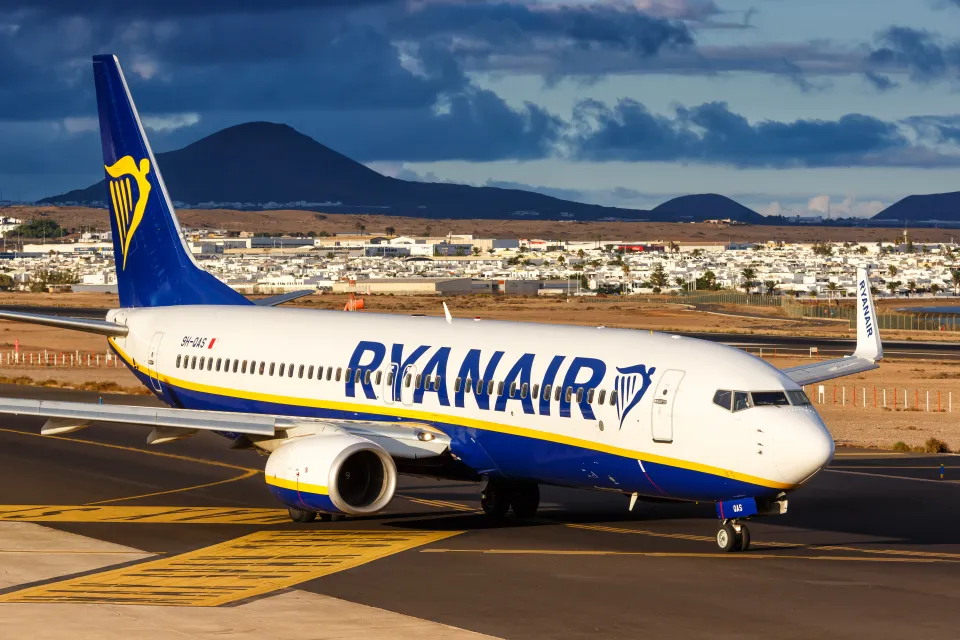
Ryanair passengers should make sure they are up to date on the budget airline’s policies, amid claims that a family of four were hit with a fine of £400 due to misunderstanding the rules
16:31, 06 Mar 2026Updated 16:33, 06 Mar 2026
Despite Ryanair being clear about its rules, passengers still get caught out(Image: Jakub Porzycki/NurPhoto/REX/Shutterstock)
As a budget airline, Ryanair is famous for its low fares, but another thing it has become notorious for are its strict rules on luggage. While the airline clearly sets out its rules when you book, as well as on its website, people continue to be caught out by them.
A recent change to Ryanair’s baggage policy saw it increase the size allowed for the free underseat bag that comes with even the most basic fares. In the past, bags had to be 40 x 25 x 20 cm, but as of last year, passengers can bring a bag of up to 40 x 30 x 20 cm. This small item can be a laptop bag, handbag, rucksack, or any item that fits within the dimensions to fit under the seat in front of you.
For an additional fee, which varies depending on route and availability, passengers can bring a second cabin bag of up to 10KG in weight. This bag can be up to 55 x 40 x 20cm in size and passengers will need to be able to load this into the overhead locker themselves without assistance from the flight crew. Checked luggage is also available to add for those who prefer to put items into the hold. There are 10kg, 20kg and 23kg bag options available.
However, despite the warnings, one family got caught out at the airport after not checking their bags’ dimensions and allegedly were hit with a £400 fee. A poster on Which? Travel’s Facebook page claimed they ended up being given the charge after not checking the rules before their return flight to the UK.
In a statement responding to the claims made at the time, Ryanair said: “People should avoid Ryanair’s high fees for oversized bags. They can do so by simply travelling with bags that meet our agreed dimensions. Our sizers are bigger than our permitted dimensions, so if that the bag fits in the sizer, it gets on, if it doesn’t, it gets charged.”
In a Which? report, its travel team set out a series of guidelines to avoid paying extra costs when travelling with Ryanair. The number one rule is to make sure the bag you bring really does fit into the holder, as gate crew will often check bag sizes. If your bags don’t fit into the sizer, you could end up being charged for extra luggage and potentially made to check your bag into the hold.
Don’t rely on measurements given by your bag’s manufacturer. Get the tape measure out when the bag is packed, as luggage can be bulkier when full, and make sure you include the wheels and folded handle in your measurements.
Ryanair’s website warns: “Passengers who bring an oversize bag (over 55x40x20cm) to the boarding gate will either have their bag refused or, where available, placed in the hold of the aircraft for a fee of £/€ 70.00 – £/€ 75.00. You will be required to leave your bags at the aircraft steps, in the gate bag trolley, or as directed by Ryanair agents, for stowage in the hold.”
It also warned that passengers need to ensure they’ve booked the second cabin bag if they want to bring one, as there’s no guarantee it’ll be accepted at the gate. “Non-priority customers who bring their 10kg check-in bag to the boarding gate will either have their bag refused or, where available, placed in the hold of the aircraft for a fee of €/£ 46.00 – €/£ 60.00.”
Have a story you want to share? Email us at webtravel@reachplc.com
Visits to the Balearic Islands dropped in January of this year, and restaurant bookings are also down causing concern in the industry. However, plans to cap visitor numbers on one island are going ahead
16:27, 06 Mar 2026Updated 16:34, 06 Mar 2026
Restaurants in the Balearics have seen a drop in trade(Image: Getty Images)
Tourism bosses in Spain have been left concerned over dropping numbers in the hospitality industry amid a ‘disastrous’ start to the year for the Balearic Islands.
The islands, which include the popular destinations of Majorca, Ibiza, and Menorca, saw a drop in international visitor numbers of 8.83% in January. While restaurants also saw a drop in footfall, attributed to rising prices, across 2025.
Overall, across the Balearic Islands there was a 3% drop in restaurant footfall across 2025. While the amount might sound small, the tight profit margins in hospitality and the islands’ heavy reliance on tourism mean that modest drops can have a substantial impact.
The decline in restaurant customer numbers is being partly attributed to rising prices across the islands, the Majorca Daily News previously reported. Data analysts pointed out that in areas where dining is the most affordable, such as the mainland regions of Castile-La Mancha and Extremadura, customer numbers grew.
The analysis concluded: “This behaviour suggests that consumers have reached a price ceiling, which limits price increases in the most expensive areas and reinforces the idea of a restraint in real spending, even in areas traditionally less price-sensitive.”
The restaurant industry is also concerned about the numbers for 2026. Juanmi Ferrer, president of the CAEB Restaurants Association, representing island outlets, remarked that the year kicked off with a “disastrous January” and predicted it would be “like last year, or at most a little worse”.
He explained: “The last thing a restaurant owner wants is to raise prices, because that means fewer customers. This year we’ll try to absorb those extra three to four percentage points of inflation as much as we can.”
One option being considered is a restaurant voucher scheme, similar to a recent initiative across the island that supported shops. The retail scheme gave all residents aged over 16 four vouchers worth €15 each, which could be used on purchases of €30 or more, to encourage people to shop locally.
During summer 2025, concerns emerged that certain Majorcan resorts had become “completely dead”, with Miguel PérezMarsá, chairman of the nightlife association, saying: “The tourists we’re interested in are being driven away; they don’t feel welcome and are going to other destinations.” His comments came as thousands took to the streets in overtourism protests.
At last year’s World Travel Market (WTM) in London, Ibiza’s Tourism Minister, Jaume Bauza, acknowledged declining visitor numbers, revealing that 20,000 fewer British tourists visited the renowned party destination during the 2025 peak season compared to the previous year. Industry experts have suggested this decline may reflect holidaymakers deliberately shifting their travel dates to October and November to capitalise on more affordable rates.
However, it should be noted that such a dip comes at the end of several record years for tourism on the island chain, with Brits and other Europeans flocking in huge numbers to the Balearics post-Covid.
Despite the drop in numbers causing alarm, the islands are continuing with measures to tackle overtourism. Plans have been announced to slash the number of daily cruise ship berths from 8,500 to 7,500 between June and September in Palma, Majorca, meaning fewer cruise ship passengers arriving once the change is implemented between 2027 to 2039.
Only three cruise ships would dock in Palma each day, with only one of these vessels allowed to transport more than 5,000 passengers. Opposition party PSOE – a socialist party for the Balearic Islands – also put forward a proposal recently for visitor numbers to be capped across the islands at 17.8 million a year. However, its proposal was rejected.
Have a story you want to share? Email us at webtravel@reachplc.com
Wizz Air has announced that it’s received approval to operate flights between the UK and USA with its first flights set to take off in the summer in time for the World Cup
The budget airline is better known for its Eastern European services but will soon be flying stateside(Image: Getty Images)
Budget airline Wizz Air has confirmed it now has “regulatory approval” to operate flights to the United States. The airline, who currently offer routes from the UK to destinations such as Poland, Turkey, Italy, and Romania, will offer the flights for football fans visiting the USA for the 2026 World Cup.
The airline confirmed it will now offer tailored charter flights to groups from teams to supporters and tour operators who are organising group travel to the USA. It confirmed that charter enquiries for summer travel are now open.
However, the airline also clarified that it has “no intention or plans to launch regular commercial flights to the US” but that “the new authorization represents a significant achievement and reflects months of preparation, regulatory coordination, and operational planning.”
So, while individuals won’t be able to book onto scheduled services, those who are travelling with large groups, organising a tour, or travellers looking for a private travel experience will be able to charter a transatlantic flight with Wizz Air.
Yvonne Moynihan, Managing Director of Wizz Air UK, said in a statement: “This is a proud and exciting day for everyone at our airline,” said . “Receiving approval to operate between the UK and the United States is a huge milestone for our company. It opens the door to incredible opportunities, particularly for European football teams and supporters travelling across the Atlantic this summer.
“We are ready to deliver exceptional charter experiences and bring fans closer to the action in the United States.”
England’s first fixture is set for June 17 at Dallas Stadium in Arlington, meaning many football fans are likely to descend on the Texas city to watch the big game. Its other group games are England vs Ghana, set for June 23 in Boston, and Panama vs England on June 27 in New York.
Scotland’s World Cup fixtures are set for June 14 when they take on Haiti in Boston, followed by another match in the city against Morocco on June 19. The team will then head to Miami for Scotland vs Brazil on June 24.
Wales and Northern Ireland are yet to secure their places in the World Cup as both teams are still in the qualifying stages. In addition to fixtures across the USA, some matches will also be held in Canada and Mexico who are joint hosts.
However, seeing the matches in person is likely to be an expensive undertaking. Tickets for group stage games range from $100 to $575 (about £75 to £431), although FIFA has announced a very limited number of £45 tickets to each game. A seat at the July 19 final, which will take place in New Jersey, will be especially costly. Tickets bought at face value range from $2,030 to $6,370, about £1,500 to £4,800, with resellers no doubt charging even more.
Have a story you want to share? Email us at webtravel@reachplc.com
One UK village is known for its strict preservation rules managed by the Fitzwilliam Wentworth Amenity Trust, which dictate everything from the colour of front doors to banning takeaways
For those who enjoy putting their personal stamp on their home decor, England’s ‘strictest’ village might not be the ideal place to settle down. In this locale, creativity takes a backseat as virtually everything is painted in a uniform shade of green. Fast food lovers and supermarket shoppers might also want to give the Yorkshire village of Wentworth a wide berth, as both takeaways and supermarkets are strictly off-limits.
The historic estate village is renowned for its stringent conservation rules, overseen by the Fitzwilliam Wentworth Amenity Trust. Takeaways, supermarkets, and ‘flashing neon signs’ are all prohibited in an effort to maintain the village’s traditional charm.
Instead, dining options are confined to a handful of classic establishments such as the Rockingham Arms, the George and Dragon pub, and the Village Tearooms.
Every front door in the village must adhere to a specific hue known as “Wentworth Green” (alternatively referred to as Hollybush Green or BS 14C39). Drainpipes and gates typically need to match this colour, whilst window frames should be painted off-white.
The majority of the village’s buildings boast external walls constructed from local sandstone, and any alterations must receive the trust’s approval.
Content cannot be displayed without consent
Influencer Robbie Thompson, who boasts a following of 87,500 on Instagram, recently posted a reel about the village, dubbing it the “strictest village in England”.
In his video, he revealed that the village’s pubs, shops, and restaurants exclusively serve British cuisine and that a traffic and tourism steering group keeps a close eye on parking and traffic levels.
Robbie, who bills himself as a ‘champion of British food’, also revealed the village shop – fittingly called The Village Shop – stocks English jams, chutneys, teacakes, black pudding pork pies and what he describes as an “incredibly good” steak and ale pie served with mushy peas, mint sauce and gravy.
Over at the tea room (simplu named The Village Tea Room), Robbie insists proprietor Jane whips up the “lightest lemon sponge you’ll ever eat”.
As for the local pubs, you’ll discover more British staples including Scotch Eggs and Sticky Toffee puddings, the influencer reports.
He further notes you’ll come across honesty boxes scattered throughout the village flogging locally-sourced honey and eggs.
The post proved a massive hit, clocking up over 53,000 likes, with one person gushing: “Love this.”
Someone else commented: “That steak pie with mushy peas looked real legit though.”
A third person weighed in: “I’m Filipino and I love visiting villages like this. I always say British people should be proud their culture.”
Though one viewer couldn’t resist joking: “Looks like they could do with a kebab shop.”
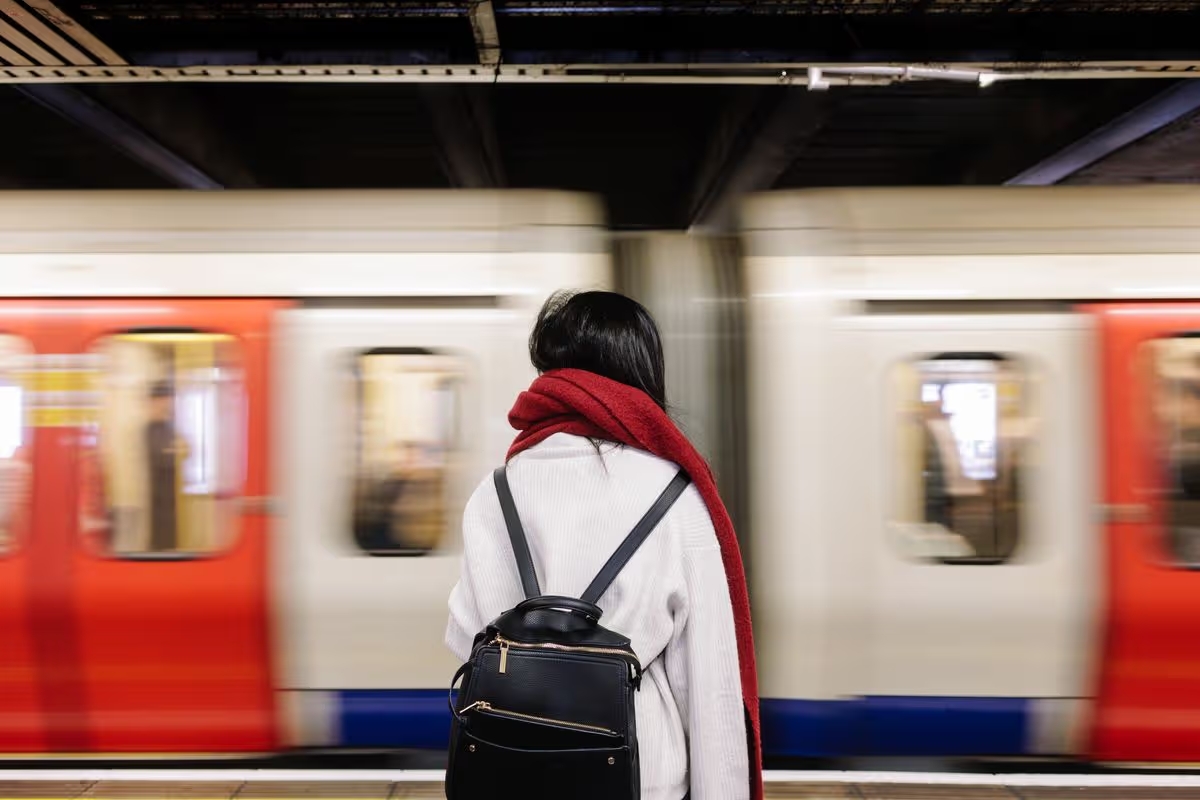
HUNDREDS of thousands of commuters are bracing for travel chaos this weekend.
An entire tube line will be brought to a halt due to track work.
Sign up for the Travel newsletter
Thank you!
An entire tube line will be shut down this weekendCredit: AP
Transport for London has warned that the Hammersmith&City line will be shut across Saturday, March 7 and Sunday, March 8.
This is reportedly due to track work being carried out along the line.
Sections of the Circle, District and Metropolitan lines will also be affected by the shutdown.
Passengers traveling between Hammersmith and Tower hill, and between Edgware Road and High Street Kensington on Circle and District lines will need to find a different route.
Those who commute between Baker Street and Aldgate on Metropolitan line will also have to pick an alternative journey.
A huge chunk of Piccadilly line will also be closed over the weekend with no service between Cockfosters and Uxbridge, even on Friday and Saturday Night Tube.
The disruption comes as part of a major upgrade plans on the line, which will see new trains introduced, tracks improved and better CCTV installed on platforms.
Acton Town and Heathrow will continue to provide services.
The closure means commuters will have to seek alternative routes or replacement transport, with other Tube and rail services expected to be busier than usual.
Meanwhile, parts of the DLR will be closed to test out a batch of upgraded trains.
THE UK isn’t short of amazing swimming pools, with some dating back to the Victorian era.
But one in the city centre of London remains relatively unknown – despite a multi-million campaign to reopen it.
Sign up for the Travel newsletter
Thank you!
A swimming pool in London has been raved about as a “hidden treasure”Credit: Everyone ActiveThe pool is part of the Marshall Street Leisure Centre in SohoCredit: AlamyThe pool dates back to the 1930sCredit: Alamy
Marshall Street Baths is built on the grounds of one of London’s oldest bathhouses in 1852.
Also previously called Westminster Public Baths, it was rebuilt to what it looks like now back in 1931.
Even used as a training ground during World War II, it fell into disrepair over the years.
It was forced to close in 1997, before reopening as Nuffield Healthleisure centre in 2010 after a £25million refit.
BRITISH Airways is launching the world’s largest business class cabin this year.
This week, new information about British Airways‘ new business class seats was leaked.
Sign up for the Travel newsletter
Thank you!
The new seat layout was leaked earlier this weekCredit: British AirwaysBritish Airways’ A380 will soon feature Club Suites – a new business class seatCredit: British Airways
The leak included the proposed seat plan, revealing the expected layout of the airline’s new A380 cabin.
The new Airbus A380 configuration will feature 110 Club World seats, making it the largest business class cabin on any aircraft.
BA is set to start refurbishing its A380s in the second quarter of this year and inside the refitted planes, passengers will find Club Suites – the newest business class offering.
The suites will feature a privacy screen door, a special lining that reduces noise, a 53.3cm-wide seat and a 200cm bed.
Passengers will also be able to make use of a 47cm touchscreen as well as side bins and cabinets for their belongings.
Every seat will also have direct aisle access.
The number of premium seats will increase, meaning that the total capacity of the aircraft will be lower.
According to the leaked seat plan, the main deck will feature 12 new first class suites, 84 premium economy seats and 215 economy seats.
The upper deck will be just for Club World business class, with 110 seats in total.
In comparison, this will be a 48-seat reduction compared to the current layout which features 14 first class seats, 97 business class seats, 55 premium economy seats and 303 economy seats.
Club Suites are already available on all A350s, 787-10s, and most 777s from London Heathrow Airport.
In mid-2026, British Airways is also set to introduce its new First seat.
The seats are designed to have a “modern luxury hotel feel” with “home comforts” and “thoughtful British touches”.
The new First seat will be wider and longer and will feature an 81.2cm 4K touchscreen.
The seats will feature direct aisle accessCredit: British Airways
The seats will have a ‘buddy dining’ feature as well, which will allow two passengers to dine together in one suite.
There will be a multi-purpose ottoman too, and a floor-level wardrobe.
These seats also form part of the airline’s A380 retrofit plans.
British Airways mainly uses its A380s from London Heathrow to major long-haul destinations such as Los Angeles, Miami, Boston and Johannesburg.
Leeds Castle in Kent is said to be haunted by two black dogs and the ghost of a woman in a flowing dress – but this luxury overnight stay in Catherine of Aragon’s former home was worth every penny
I enjoyed a royal weekend at Leeds Castle(Image: Matthew King)
There’s something that feels slightly forbidden about strolling through the grounds of a castle after dark when all the day-trippers have departed. The ambience is somewhat spine-tingling, but it genuinely gives you a flavour of what existence must have been like within the walls of these enormous estates in centuries past.
That’s certainly how I felt during my overnight stay at Leeds Castle in Kent, frequently dubbed the Castle of Queens owing to the numerous female rulers who made it their residence. Its somewhat puzzling name derives from Saxon leader Led or Leed, who established the foundations for what would evolve into Leeds Castle, constructing a timber structure on two islands in the centre of the River Len.
This modest wooden dwelling was eventually superseded by a stone stronghold, and through the centuries it expanded into the magnificent castle that subsequently became the residence of Henry VIII’s first spouse, Catherine of Aragon. Yet with that illustrious heritage comes stories of hauntings, the most well-known local myth being spectral encounters with two black dogs, believed to be linked to a previous occupant supposedly involved in witchcraft.
There are also accounts of a phantom in a long flowing dress roaming through the chambers. However, I’m pleased to report that no such spirits disturbed my slumber, and I managed to achieve a solid eight hours of rest in a comfortable four-poster bed.

Our accommodation was situated in the Stable Courtyard, and alongside a beautiful canopied bed, it featured a soaking tub, lake views, and a minibar filled with local delicacies. Certainly worth risking a ghostly encounter for.
Leeds Castle also provides accommodation in its Maiden’s Tower, formerly home to Catherine of Aragon’s ladies-in-waiting, as well as cottages and riverside lodges positioned at the water’s edge. Throughout the day, guests can explore the castle and grounds, and you’ll notice plenty of families braving the elements and enjoying strolls through the magnificently landscaped gardens, but once the gates shut, the ambience becomes tranquil and peaceful.
That evening, we dined at the Castle View restaurant. Located just across the river from the castle, it boasts a vast floor-to-ceiling window that enables you to admire it illuminated at night.
There’s an outdoor terrace which I imagine is stunning during the summer months as you’d be able to watch the sunset whilst dining. The restaurant’s menu features simple, comforting classics with an emphasis on seasonal ingredients and locally-sourced produce.
We were drawn to everything from fish and chips to homemade pies, with my husband ultimately selecting a ribeye steak – which was ‘perfectly’ medium rare in his opinion – whilst I went for the special of cod with chorizo and a butterbean stew. The fish was beautifully flaky and delicate, complementing the robust beans perfectly.
We also sampled a bottle of Pinot Noir from Wildshark Vineyard, located just a few minutes from the castle. My previous encounters with English wine haven’t always been positive, and I’m still resentful about an extortionately-priced bottle that resembled fizzy vinegar, but this red wine may have won me over.
It was velvety, packed with fruity notes, and crucially, I didn’t suffer my typical red wine headache despite consuming half the bottle.
Following a comfortable, spectre-free evening, we tucked into breakfast in the restaurant, which offers a respectable continental buffet alongside hot dishes including a full English and eggs royale. Upon checking out, guests are still welcome to explore the castle for the remainder of the day, so we packed up the car and wrapped up warm to venture out for a wander.
Whilst the castle dates back centuries, its final private owner was Lady Olive Baillie, who is credited with restoring much of the historic property in the 1920s. She also transformed it into somewhat of a party destination, with the elite of transatlantic society, politics, and culture amongst its notable guests.
From Winston Churchill to Charlie Chaplin, numerous famous faces have resided here. Enthusiasts of vintage fashion and style will relish exploring Lady Baillie’s rooms where items from her beaded gowns to chic 1920s shoes and record player are displayed. If you’re a fan of Downton Abbey, you’ll certainly recognise those vibes.
Returning to the grounds, we attempted, and became lost in, the hedge maze. In my defence, it was drizzling with rain, and I likely would have had more patience on a sunny day.
Admitting defeat, we instead visited the birds of prey centre, which featured stunning owls and eagles, and discovered some entertaining family-friendly activities such as adventure playgrounds. There’s even an artificial beach where children can construct sandcastles.
Once again, definitely one for the summer to-do list. And with a 9-hole golf course overlooking the castle, it’s remarkable how much there is to do just moments from your room.
Spending the night at Leeds Castle is truly a memorable experience. It’s rare to find yourself waking up within the grounds of a historic castle, and an overnight stay makes you feel connected to its rich past.
The castle’s team are exceptional, from the warm reception at arrival to the prompt, friendly restaurant staff and knowledgeable guides who patiently shared the building’s fascinating story – it’s evident the castle is being brilliantly cared for in its current chapter.
Rooms at the Stable Courtyard start from £134 per night. For more information and to make a reservation, visit leeds-castle.com.
IF YOU are thinking about where to visit on your next UK staycation, 17 UK cities have just been named among the best in Europe.
A report revealing Europe‘s best cities for 2026 has been released and 17 UK cities feature including the ‘Athens of the North’, one of the best cities in Europe for weather and the UK’s ‘newest second city’.
Sign up for the Travel newsletter
Thank you!
London has been named the best city in EuropeCredit: Alamy
Cities across Europe were ranked across several categories using data from numerous sites such as social media and core statistics.
The categories include Livability, which looks at things such as biking options, public transport, air quality and green spaces; Lovability which looks at Instagram posts, theatres, museums and reviews and Prosperity, which looks at airports, business systems and universities – here are all of the UK entries.
London – 1st
Coming out on top of all 100 cities, is the UK’s capital – London.
Dubbed the ‘Capital of Capitals’, London secured the top position in three of the 34 subcategories, which was the most out of any city, including Prosperity and Lovability.
The index states: “London’s magnetic appeal continues to draw a global audience, from students and entrepreneurs to tourists and corporate titans.”
The report notes how London & Partners’ Tourism Vision has set ambitious goals of making London the most visited, sustainable and diverse global city destination by 2030.
Laura Citron, CEO of London & Partners said: “2026 is another year to watch for London, as the capital city undergoes major growth and transformation including the opening of two major museums (London Museum and V&A East), new theatres and world-first events like Pro Climbing League.
“London is truly Europe’s global city: with a trillion-dollar economy, more green space than any city on the continent and unrivalled connections to the rest of the world.”
Edinburgh – 23rd
The capital of Scotland is the second location in the UK to feature on the list, with the index noting how it is “rich with history” and “ambitiously planning for the future“.
Dubbing it the “Athens of the North”, the index commended Edinburgh for its work to become net-zero by 2030.
In in particular, it highlighted how it is the second-most visited city in the UK after London thanks to its “cinematic views, among the freshest air in Europe (fourth for Air Quality), an array of sights (including its famed castle), and a happening citizenry that puts on the world’s premier Fringe Festival each year”.
The city is also planning 17 more hotels by 2028 as it prepares to host the start of the Tour de France in 2027.
Edinburgh came in 23rd place on the tableCredit: Alamy
Manchester – 27th
Naming Manchester “England‘s worker bee city”, the report highlights how the city boasts both industrial history and literary history as a UNESCO City of Literature.
The city’s opening of the 23,500-seat Co-op Live arena in 2024 – the largest indoor arena in the UK – has helped Manchester attract one million fans in less than a year.
In addition, the city was noted for its regeneration projects such as Old Trafford and its expansion of its airport, ranking it in the top five for connectivity in Europe.
Other top things to do in the city include heading to The Lowry which houses L.S. Lowry’s paintings and exploring Gothic architecture such as the John Rylands Library.
Glasgow – 51st
Described as “Scotland’s artful, urban heart”, Glasgow placed 51st.
The vibrant city that is the home of Scottish Opera, Ballet and the National Theatre of Scotland is a former European Capital of Culture.
It is also a top city for music and its tourism is on the rise, with around five million overnight visitors staying in the city in 2024, a 20 per cent increase from 2023.
If visiting the city, make sure to head to its free museums like the Burrell Collection and do a bit of shopping on Buchanan Street.
Glasgow placed 51st being noted at “Scotland’s urban, artful heart”Credit: Alamy
Bristol – 56th
Highlighting its creative industry, the report named Bristol in 56th place.
Stand out features of the city include the opening of the YTL Arena at Brabazon Hangars in 2028, which will be on the city’s former Filton Airfield which was once home to Concorde.
The venue will include a festival hall, community hub, food hall, work spaces and leisure facilities.
If heading to the city, make sure to explore the street art and try and look out for pieces by Banksy…
Bristol – which has a great street art scene – placed 56thCredit: Alamy
According to the report, few cities entertain like Birmingham does, “where classic pubs and underground clubs power a happening nightlife scene, ranked 23rd in Europe”.
And the city has a number of new projects in the works include the Powerhouse Stadium, which will be a 62,000-seat arena and the future home of Birmingham CityFootball Club.
If you love chocolate, make sure to visit Cadbury World.
Liverpool – 66th
The city of Liverpool placed 66th on the table with its cultural quarters and regeneration works noted.
Projects in the city include the regeneration of the North Docks and the revitalisation of the city’s International Slavery Museum.
The city’s nightlife is also great, with a range of pubs and bars scoring it 16th best for nightlife in Europe.
If you are a fan of The Beatles, you can head to The Beatles Story, which is the world’s largest permanent exhibition dedicated to the band.
Oxford – 68th
The historic university city of Oxford came in at 68th.
Under an hour from London on the train, Oxford is home to Europe’s best university.
In addition the report noted how the city is “an understated green space gem” with several connections to famous literary figures such as CS Lewis and JRR Tolkien.
Many of the historic buildings in the city and on the university campus offer tours such as the Bodleian Library and Radcliffe Camera.
The historic city of Oxford is just under an hour from LondonCredit: Alamy
Leeds – 71st
In 71st place is Leeds – described as being “ripe for fun and investment”.
Currently, the city is undergoing a massive terminal expansion at its airport to accommodate visitor demand.
And the city has a number of other visitor-focused projects, with Premier Inn opened a 143-room hotel atop Leeds City Market.
When in the city, visit the Victorian Corn Exchange to discover independent boutiques.
Leeds is “ripe for fun and investment”Credit: Alamy
Sheffield – 82nd
The city that George Orwell once called “the ugliest town in the Old World” is now “Yorkshire’s brainy, prosperous hub” according to the report.
Placing 82nd, the report celebrates Sheffield for its “glassy university centres, myriad green spaces, and some of the cleanest air in Europe (32nd)”.
Close to the city, you can also head to the Peak District National Park for walks and amazing views of the countryside.
Nottingham – 83rd
One place behind Sheffield is Nottingham in 83rd place.
The city is currently undergoing a number of ambitious projects including the development of the €1.61billion Island Quarter, which will feature restaurants, an events hall and homes.
As the “Home of English Sport”, the city also has a plethora of great pubs to explore.
Make sure to check out the City of Caves when in Nottingham – it boasts over 800 caves hand-carved into the sandstone.
Nottingham is home to 800 hand-carved cavesCredit: Alamy
This year, the seaside city will see the reopening of Hilsea Lido as well as a number of other coastal projects that will create more green spaces and public areas.
Also this year, Portsmouth 100 will kick off to celebrate the century of the destination being a city.
It will be a year-long celebration with a number of exhibitions and events.
Coventry – 98th
Securing 98th place is Coventry, with “the third-best weather in Europe”, according to the report.
The city is currently working on a City Centre project as well, which should create a new district in the heart of the city.
One top spot to explore in the city are the ruins of the Cathedral.
Coventry has “the third-best weather in Europe”Credit: Alamy
Cardiff – 99th
Coming in at 99th is Cardiff, which according to the report could be the UK’s new second city.
Being the closest European capital to London via train (under two hours), the city has a lot to offer including mountains, beaches and castles.
And the city’s station will start a massive rebuild this year set to cost €162million.
The city is also home to a number of recent projects including the regeneration of Cardiff Bay and The Bay Wetlands.
Another new project is Atlantic Wharf which will feature new homes, hotels and an indoor arena set to open in 2028m along with a 120-room floating hotel.
Newcastle – 100th
Last but not least and securing the final spot on the table, is Newcastle.
Just two-and-a-half hours from London by train, Newcastle features a number of new attractions.
For example, you can head to Freight Island, with street-food and events.
EasyJet has also launched a new base at Newcastle Airport, adding 11 flight routes.
Top 10 cities in Europe
ACCORDING to the report on the Best Cities in Europe for 2026, here are the top 10 spots: