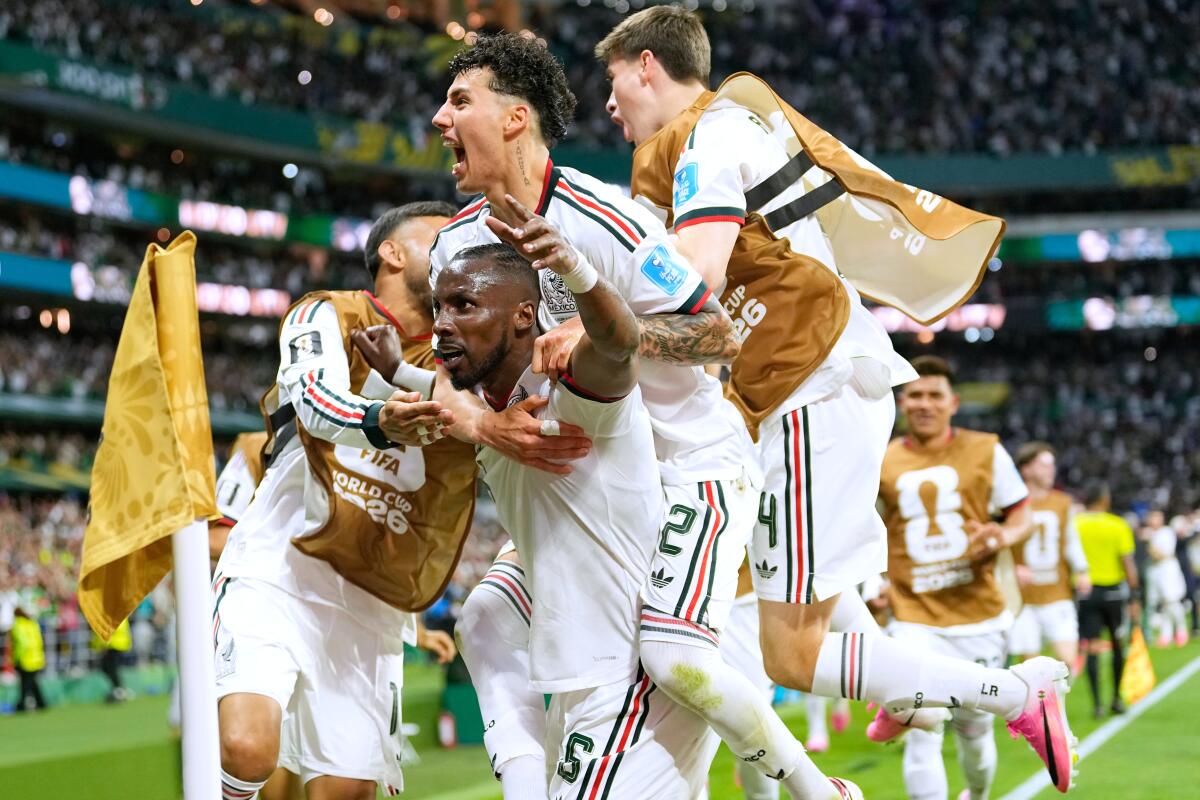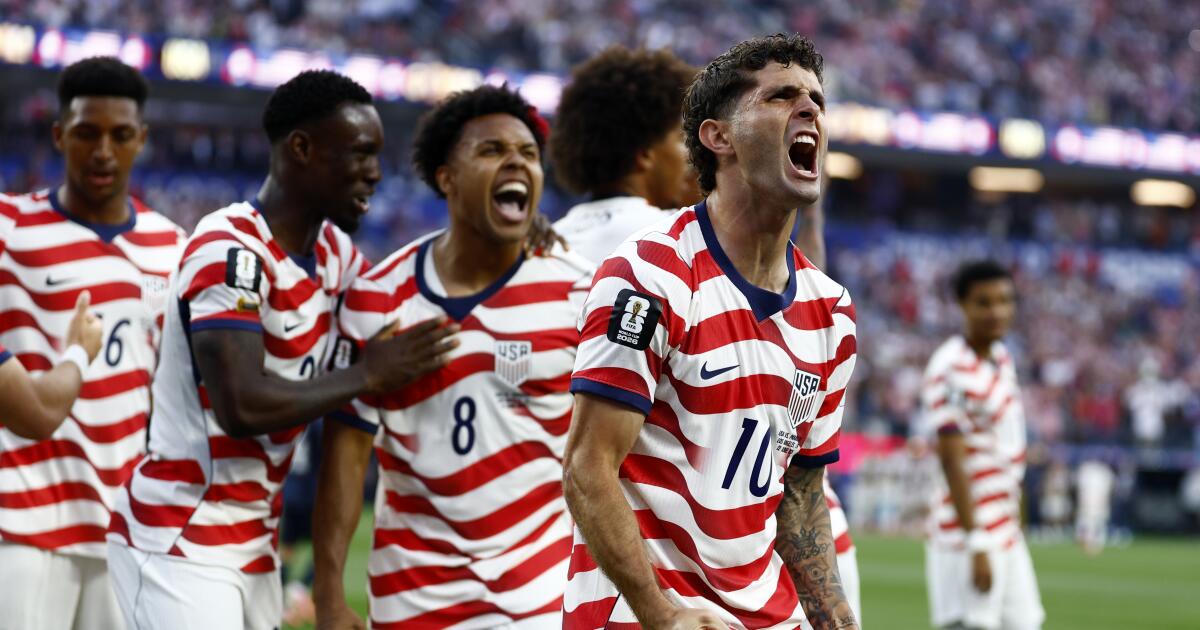
As Mexico moves to the Round of 16 in the 2026 World Cup following its Tuesday night 2-0 win over Ecuador — advancing in the knockout stage of the tournament for the first time in 40 years — El Tri fans have rallied behind a unifying phrase: “¿Y si sí?”
The simple three-word expression — which roughly translates to “What if… yes?” — has given Mexico supporters all over the world renewed hope: What if Mexico wins the World Cup?
The now ubiquitous phrase has been featured in memes and compilation videos. Even Mexican goalkeeper Memo Ochoa has gotten in on the action, posting a selfie on Instagram wearing a straw cowboy hat with “¿Y si sí?” etched on it.
Origins of the phrase can be traced back to a May interview with Efraín Juárez, who led Pumas UNAM to the Liga MX Clausura final. During the media appearance, journalist Rodrigo Celorio asked the head coach, “Y si sí?” (“What if yes?”), to which Juárez responded, “Y si sí? Y si los Pumas sí son campeones?” (“What if yes? What if Pumas are be champions?”).
Although Pumas would lose to Cruz Azul 2-1, the optimistic sentiment resonated with TikTok users, especially with the World Cup just weeks away. Some hopeful fans took to social media to post their own interpretation of the phrase, often coupled with clips of past Mexican men’s national teams. Others included a mariachi soundbite of Juan Gabriel’s “Hasta Que Te Conocí” from his 1990 performance at the Palacio de Bellas Artes — an appearance that was seen as a milestone for Mexico’s working-class communities given that the iconic Mexico City venue was best known to cater to the elite class. Because if someone who grew up in extreme poverty like Juan Gabriel could bring a mariachi band to the illustrious Palacio de Bellas Artes, why couldn’t the Mexican national team win its first ever World Cup?
The phrase “¿Y si sí?” is also a callback to a 2018 interview Javier “Chicharito” Hernández gave to journalist David Faitelson, who asked the former striker if he was serious about Mexico’s chances of winning that year’s tournament.
“Why can’t we be Greece in the [2004] EuroCup? Why can’t we be Leicester in the Premier League? Why not?” said Hernández, referring to underdog teams that defeated the odds against more favorable clubs.
As the two discussed Mexico’s probability of advancing in the knockout stages of World Cup, Hernández balked back with his now famous phrase: “Imaginémonos cosas chingonas!” (“Let’s imagine badass things!”), followed by “Porque no?” (“Why not?”)
Now both “¿Y si sí?” and “Porque no?” have taken on new meaning in 2026. After Fox Deportes reporter Rodolfo Landeros asked attacking midfielder Gilberto Mora why Mexico could win the World Cup ahead of the June 11 kickoff, the 17-year-old responded with “Es qué, porque no?” (“Because, why not?”).
After Mexico won all three of its group stage matches, TUDN reporter Julio Ibáñez asked the wunderkind Mora, “¿Y si sí?” to which the young soccer player replied “Y Porque no?” When Ibáñez asked if people should get their hopes up, Mora said yes. “Si, que se ilusione” (“Yes, they should dream big”), playing up the running gag.
With Mexico set to face England, one of the teams favored at the start of the tournament, on July 5, would it be so wrong if fans allow themselves to dream? ¿Y si sí? ¿Porque no?
SANTA CLARA, Calif. — Mauricio Pochettino’s team continues to do things in this summer’s World Cup that no U.S. team has ever done before.
Its three wins are the most in a single tournament. So are the 10 goals in four games. It has the best goal differential ever and its two shutouts ties a record.
Yet all that means absolutely nothing to the players.
“They’re great milestones,” captain Tim Ream said. “But I don’t think anybody’s even once mentioned the different things that we’re doing. We’re focused on what we’re doing daily on the training ground, because that puts us in the best possible position to to put these performances.
“So yeah, not aware or even worried about records that we’re breaking.”
Well, except for maybe one.
With Wednesday’s gritty 2-0 over Bosnia and Herzegovina, a game the U.S. finished with just 10 men, the Americans won a game in the World Cup knockout stage for just the second time. That sends them on to a round-of-16 meeting with Belgium on Monday in Seattle where a win would be — you guessed it — historic.
“It’s cool and it’s great and it’s an accomplishment,” midfielder Weston McKennie said of the records. “But at the same time, we have high expectations for ourselves. That’s what we expect of ourselves, what we expect of our team.
“We just want to focus on Belgium now and continue to try to make history.”
That chore got a good deal more difficult because of an unwanted team record that was also set Wednesday. When Folarin Balogun scored a goal late in the first half then drew a red card early in the second, he became the first American — and third player ever — to get one of each in the same World Cup knockout game.
“Cool record,” defender Chris Richards said.
But while the goal, Balogun’s third of the tournament, proved to be all the U.S. needed to beat Bosnia, the red card — which cannot be appealed according to U.S. Soccer — means he’s suspended for the game with Belgium.
“It’s just so unfortunate, honestly,” Christian Pulisic said. “Looking back at it, it seems so harsh. I just told him he’s done so much for us, and now we’ve got his back.”
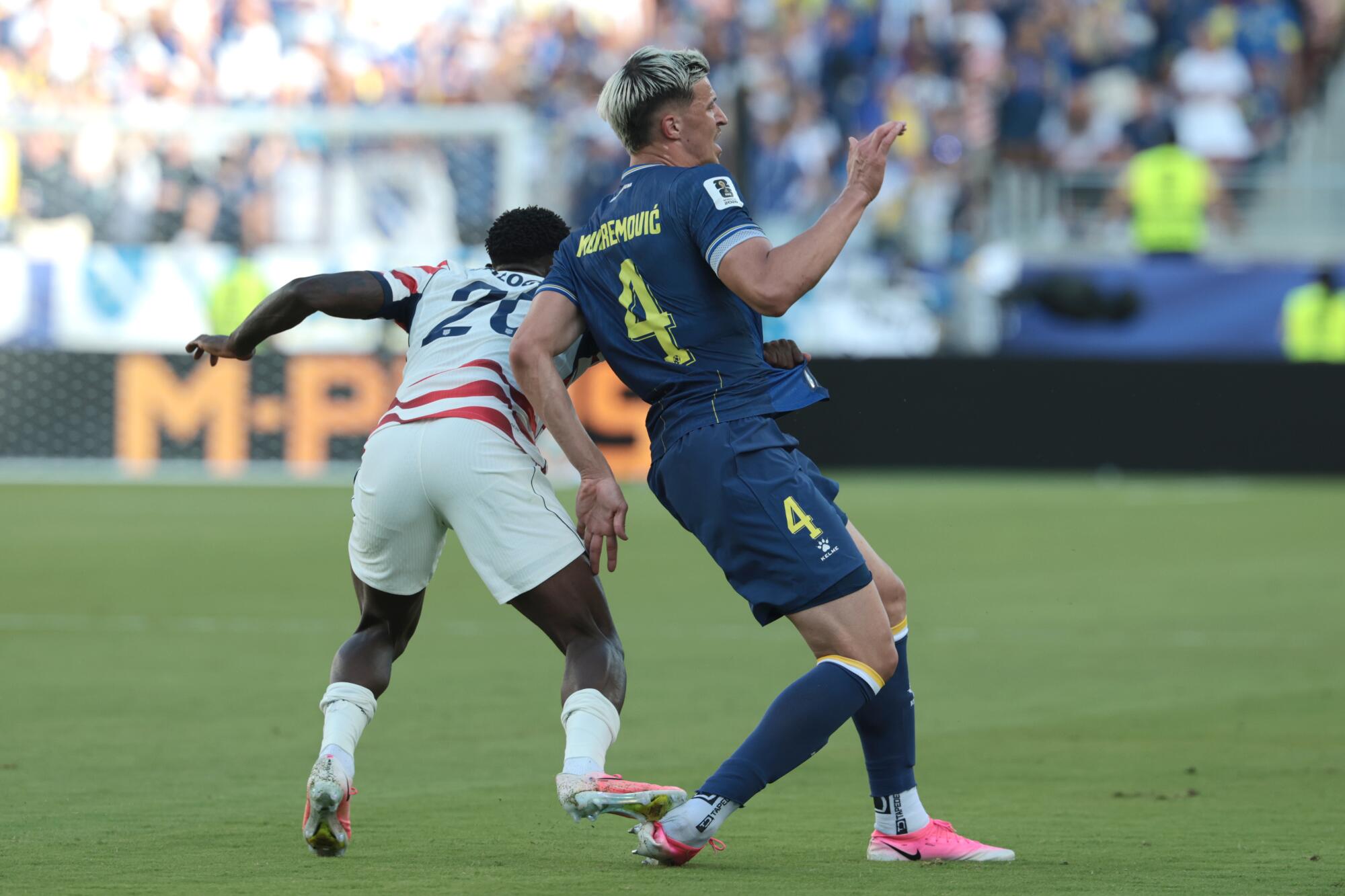
The red card came in the 64th minute with the U.S. protecting a 1-0 lead built on Balogun’s goal just before the intermission. The American striker was battling hulking Bosnia defender Tarik Muharemovic for a loose ball when he inadvertently raked Muharemovic’s right calf with his studs up, then landed on his ankle, twisting it awkwardly.
Brazilian referee Raphael Claus did not flash either card before stopping play at the behest of the video assistant referee. But after consulting a slow-motion reply, Claus gave Balogun a red card for a dangerous challenge.
“For me, never is this a red card,” said Pochettino, now the winningest U.S. coach in World Cup history. “Watching after on TV, never was [it his] intention to step up on the player. That was a normal action in football.”
Maybe. But Claus sent Balogun off just the same, leaving the U.S. to protect a one-goal advantage for the final 30 minutes while playing a man down. It was probably the sternest test the Americans have faced in the tournament.
“It would be easy to have an excuse if they did score,” McKennie said. “But that’s not the type of team we are.”
For Ream, the challenge was actually no challenge at all.
“Would it be weird if I downplayed this and said [I] wasn’t even fazed by it?” he said. “It didn’t feel like we were down a man. We were still able to carve out chances and we were still able to keep hold of the ball. Everybody knew their roles.
“It felt really calm and felt really, really easy and simple for us in that moment.”
And that allowed another hero to shrug off the pain of his own wounds and step up big.
Early in the second half a Bosnian player stomped on Malik Tillman, shredding his boot and cutting his right foot (but not drawing a red card). During the hydration break, Tillman was able to change shoes and in the 82nd minute, his white sock turning red with blood, he found himself standing over a free kick just outside the Bosnian penalty area.
“I’ve been dreaming about this game. I’ve been dreaming about, yeah, maybe taking a free kick and scoring,” said Tillman, who bent the ball off the gloved right hand of Bosnian keeper Nikola Vasilj and into the net for his first World Cup goal. “I trained for this in our practices and then it actually came true.”
So did the team’s dreams of reaching the round of 16, only now they’re arriving without their leading scorer, who will have to watch the Belgium game from the stands. Balogun’s absence, however, creates opportunity for others, with Haji Wright and Ricardo Pepi the most likely candidates to take his place.
And if this U.S. team has proven anything, it’s proven that it loves nothing more than embracing opportunities to prove people wrong.
“We’re going to miss him for the next game but we know that if it’s Pepi or Haji, whoever, is going to step up next and they’re going to do the job just as well as he did,” Richards said of Balogun. “One thing about this team is we’re really a big family and we’re shown it this whole tournament.
“Coming in, there was a lot of question marks about our whole team in general. Game by game we started to put ourselves right. Because we knew we had it the whole time.”
SANTA CLARA, Calif. — Folarin Balogun was still learning to walk the last time the U.S. won a knockout round game in a World Cup. On Wednesday, he helped lead the Americans to another with his goal in the waning seconds of the first half, sparking a 2-0 win over Bosnia and Herzegovina that sends the team on to the round of 16 of this summer’s tournament.
The other goal came from Malik Tillman in the 82nd minute. The Americans have scored multiple goals in every game of the tournament for the first time ever, also setting a national record with 10 goals overall in the tournament.
The U.S. will face Belgium in the next round Monday in Seattle. Belgium advanced with a 3-2 win over Senegal in extra time.
Balogun wasn’t around to see the finish though, drawing a straight red card for stomping on the right ankle of Bosnian center back Tarik Muharemovic in the 61st minute, a foul Brazilian referee Raphael Claus confirmed via a video review. That forced the Americans to see Wednesday’s game out with just 10 players.
“For me, never is this red card,” U.S. coach Mauricio Pochettino said. “Watching after on TV, never was [it] intention[al] to step up on the player. That was a normal action in football that happened by accident.
“That is why for me it’s never a red card.”
Claus disagreed, which could prove costly against Belgium because the card comes with a one-game suspension the U.S. cannot appeal.
“It’s just so unfortunate, honestly,” teammate Christian Pulisic said. “Looking back at it, it just seems, it seems so harsh. I just told him he’s done so much for us, and now we got his back. So that’s it.”
Balogun put the U.S. in front to stay just before the intermission. The sequence started with Bosnian defender Stjepan Radeljic sliding in front of a Tillman pass, deflecting it forward toward Muharemovic. But Muharemovic got his feet crossed, allowing the ball to carom to Balogun who did the rest, sweeping the ball into the net with his left boot from about 15 feet.
The goal was Balogun’s third of the tournament, tying him with Landon Donovan (2010) for most by an American in a single World Cup since 1930. The lead was the Americans’ first at halftime in a World Cup knockout game since 2002, when they beat Mexico in the round of 16.
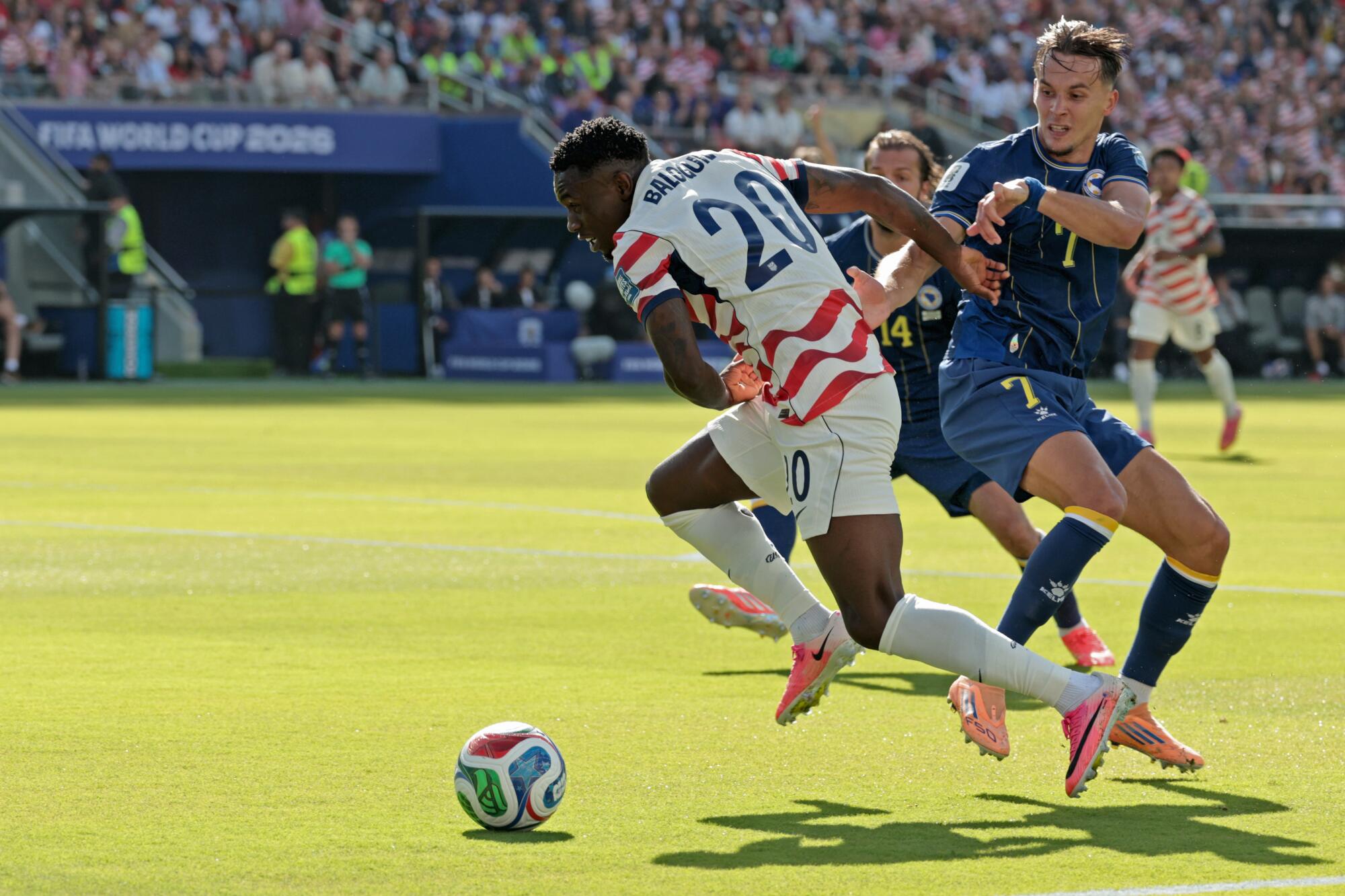
Folarin Balogun and Bosnia-Herzegovina defender Amar Dedic in action during the first half.
(Robert Gauthier / Los Angeles Times)
It looked to be a precarious lead when Muharemovic crumpled to the ground with about 30 minutes in regulation time. Claus did not show a card but after the VAR official suggested he take a look at a slow-motion replay, he came away from the monitor and reached for the red, making Balogun the first American to get a red card and score a goal in the same World Cup game.
“I think it’s a yellow card,” midfielder Tyler Adams said. “I think when you slow everything down, it’s only going to look worse.”
A few minutes after Balogun left, the game paused for the second-half hydration break, which proved to be a lucky break for the U.S. Tillman had his right foot stomped on early in the half, ripping his boot and leaving his foot bloodied. The break came him a chance to change shoes.
In the 82nd minute, he swung that new right shoe at a free kick from the top of the box, bending it off the gloved right hand of Bosnian keeper Nikola Vasilj and in the net. That brought another first, according to OptaJack, which said Tillman was the first U.S. player to score on a direct free kick in a competitive match since Jozy Altidore in 2017 Gold Cup final.
“I’ve been dreaming about this game. I’ve been dreaming about maybe taking a free kick and scoring a free kick,” said Tillman, who practices set pieces endlessly after training sessions. “And then it actually came true.”
Until Wednesday, the U.S. hadn’t beaten a European team in 13 tries, a slump that included draws with Wales and England in the 2022 World Cup and six losses in as many games under Pochettino.
The last UEFA country it did beat? Bosnia and Herzegovina, in December 2021.
“Details decided the game,” Vasilj said.
After the red card “we started controlling the game,” he continued “and they canceled that with the second goal. We had our moments and you could feel something was coming. The only thing missing was the goal.”
Staff writer Mirjam Swanson contributed to this report.
Some kids grow up with video games and summer camp. Sebastian Berhalter grew up with the World Cup.
He was 13 months old when his father, Gregg, played in the tournament for the first time and 5 when his dad was called back. And four years ago, when Sebastian was already a professional in his own right, he went to Qatar to watch his father coach the U.S. to the round of 16.
Yet none of that prepared the younger Berhalter for his own World Cup debut earlier this month.
“It’s ridiculous,” Sebastian said. “Before the game, I just kept chuckling to myself, like, ‘What the hell is going on?’ Literally I couldn’t believe it. Playing for my country, it’s the best feeling in the world.
“I just can’t believe that happened.”
Nor could he believe what happened next. Because after making appearances off the bench in the team’s first two group-play games — both of which ended in U.S. victories — Berhalter started the third game. And with a goal and an assist in a loss to Turkey, he already has more World Cup goals and assists than his dad.
In fact, he’s the only American with a goal and assist in the same World Cup game in the last 96 years. Not bad for your first start in the tournament.
His father still has bragging rights in one category, however, since the 2002 team he played for is still the only American team to win a knockout game in a World Cup. Sebastian can match that Wednesday in Santa Clara when the U.S. plays Bosnia and Herzegovina in the round of 32 of this summer’s expanded tournament.
“They’re a good team,” Sebastian said of the Bosnians. “It’s a round of 32, so do or die. I think you play every game like it’s a knockout game. For us it’s, it’s keep doing what we’ve been doing.”
If Gregg provided the inspiration and the road map that guided his son to the World Cup team, the younger Berhalter had to wait for Mauricio Pochettino before he could take his first steps on that road. That came in the spring of 2025, about 11 months after his dad had been sacked as coach, when Pochettino, the new manager, gave the younger Berhalter his first national team call-up.
He’s gone on to make 16 appearances for the U.S., including three in the World Cup. And that’s something Gregg is convinced couldn’t have happened as long as he was coach.
“I think about it all the time,” he recently told ESPN. “I never could have picked him.”
The scrutiny would have been too fierce, he feared, the whispers of nepotism too loud. Sure, Michael Bradley played more than 50 internationals games for his father Bob, including four in the 2010 World Cup. But he was already on the team when his father took over from Bruce Arena, who gave Michael his first call-up.
So, Sebastian had to wait. He had to play for three MLS teams, win an MLS Cup and three Canadian Championships and become too good to ignore in order to get his first shot with the national team — one which came from Pochettino, not his father.
Neither Berhalter has regrets.
“What I know,” Gregg, now coach and sporting director of the Chicago Fire, told ESPN, “is that everything is in the place it’s supposed to be. This is how life is. It’s his turn. It’s his time now.”
And he’s playing as if there’s no time to waste.
After making his international debut in a friendly with Switzerland last May, Sebastian played five full games in the Gold Cup last summer, then scored his first international goal in a friendly with Uruguay less than three weeks before leading the Vancouver Whitecaps into the MLS Cup against Inter Miami.
So, when the time came for Pochettino to name his World Cup roster last month, it was clear Sebastian, 25, had earned a spot.
“He’s a monster. He’s a monster, in the way of how professional he is,” the coach said. “He’s the type of player who’s going to train, going to train, going to train. I mean, sometimes I have to say [to him], ‘Go inside, no?’“
After stumbling in the group-play final, which Turkey won with a goal deep in stoppage time, the U.S. will have no room for error in its first elimination game. It’s a game in which history may — or may not — be on the Americans’ side.
On one side, the U.S. is winless in its last 13 games against European opponents. On the other, its last win over a UEFA team came in December 2021, in California, over Bosnia and Herzegovina, a team to which it has never lost.
There’s an omen in there somewhere.
“Our goal is to win the World Cup,” Sebastian said. “That’s what we want to do. It’s always been our mission and we’re still taking it one game at a time.”
There’s also the family record book to think about. One more victory and Sebastian will have more World Cup wins than his dad. Two more and he’ll be in the tournament quarterfinals, which is as far as his father went in his first World Cup.
In Qatar, Sebastian was the one in stands, cheering on his dad. In this tournament, the roles have been reversed. And Gregg told his son he couldn’t be happier about or prouder of how things have worked out.
“Four years ago, I was waiting for him to come up in the stands. Now, he was waiting for me to come up in the stands,” Sebastian said. “That was special.
“When you hear words that your dad is proud of you, that’s a cool moment.”
A double strike from Arsenal’s Leandro Trossard against New Zealand carried Belgium to top of Group G, ahead of Egypt on goal difference.
Published On 27 Jun 202627 Jun 2026
Belgium defeated New Zealand 5-1 to book their place in the knockout rounds of the 2026 World Cup on Friday, eliminating the All Whites from the tournament. The result secured the European nation’s first win of the World Cup, as they finished on top of Group G in Vancouver.
A double strike from Arsenal’s Leandro Trossard and goals from Kevin De Bruyne, Romelu Lukaku and Alexis Saelemaekers carried Belgium into the last 32 in first place ahead of Egypt on goal difference.
Recommended Stories
list of 4 itemsend of list
Egypt claimed the runners-up spot after a 1-1 draw with Iran in Seattle. The Iranians finished third in the group and face an anxious wait to know about their knockout fate.
Belgium dominated a lopsided first half and had alarm bells ringing in the New Zealand defence early on when Trossard’s angled shot cannoned off the inside of the upright only to be cleared off the line by Tyler Bindon.
Belgium looked poised to take the lead moments later when Jordanian referee Adham Makhadmeh pointed to the penalty spot after Trossard’s shot hit the arm of covering defender Finn Surman.
But VAR sent Makhadmeh to the monitor to take another look at the decision, which was subsequently overturned and New Zealand breathed again.
Yet Belgium did not have long to wait before the breakthrough and again it was Trossard who proved to be in the right place at the right time, bundling home from close range after De Bruyne’s corner sowed panic in the six-yard box.
Trossard effectively made the game safe five minutes into the second half, controlling a rebound in a crowded area to volley home past New Zealand goalkeeper Max Crocombe at the near post.
Kevin De Bruyne #7 of Belgium celebrates after scoring his team’s third goal [Emilee Chinn/Getty Images via AFP]
De Bruyne then stroked home an elegant low finish in the 66th minute to make it 3-0, a crucial goal which saw the Belgians leapfrog over Egypt into first place on goal difference.
Yet there was to be a dramatic end when New Zealand’s Elijah Just volleyed home a consolation strike from the edge of the area to make it 3-1.
That could have been potentially costly, with the goal suddenly bumping Belgium down into second place.
But Lukaku nodded home his team’s fourth in the 86th minute with his first touch just a minute after coming on as a substitute to return Belgium to the top of the table.
Saelemaekers completed the scoring with a shot from the edge of the area.
Expanding the World Cup to 48 teams always presented one obvious problem – it was an imperfect number for a tournament.
With 32 teams, the maths was simple – eight groups of four teams, with the top two going through to a last 16, then quarter-finals, semi-finals and a final.
By adding another 16 nations, Fifa had to find a way to get to a symmetrical knockout stage. There was no ideal solution – one which preserved the intensity of the previous format.
The original plan was to create 16 groups of three teams. The two top in each would go through to the last 16.
But there was an issue. Three-team groups meant individual fixtures – and those in the final match would know exactly what they needed to do to qualify. Nations could play for specific results to secure their passage to the knockout rounds.
Fifa, after all, knew all about alleged collusion from the scandal at the 1982 World Cup. Back then, with groups of four, teams did not play their final group matches at the same time.
West Germany faced Austria in the standalone last game. A slender win for the Germans would send both teams through at the expense of Algeria. The match finished 1-0 to West Germany. Algeria went out.
Fifa changed the format so all final fixtures would be played simultaneously, but that would not have been possible with three-team groups.
The climax to the group stage in Qatar was so exciting that Fifa had a rethink. It accepted there must be 12 four-team groups and two matches would be played at the same time to determine who would qualify.
Except for one crucial difference – something that removed much of the jeopardy that made the last World Cup so gripping.
Eight of the third-placed teams must go through for there to be 32 teams in the knockout rounds. It became harder to be knocked out than to progress.
And one issue becomes clear with two matches this week.
First up, Australia played Paraguay on Thursday. The teams were second and third in Group D and both on three points.
Four points is almost certain to be enough to take one of the eight third-placed qualifying slots, so it created a situation in which the teams knew that a draw was helpful to both.
Australia are definitely through in second place and celebrated with their supporters at the final whistle. Paraguay played it low key but, barring a very unlikely set of results in the remaining groups, they will go through too.
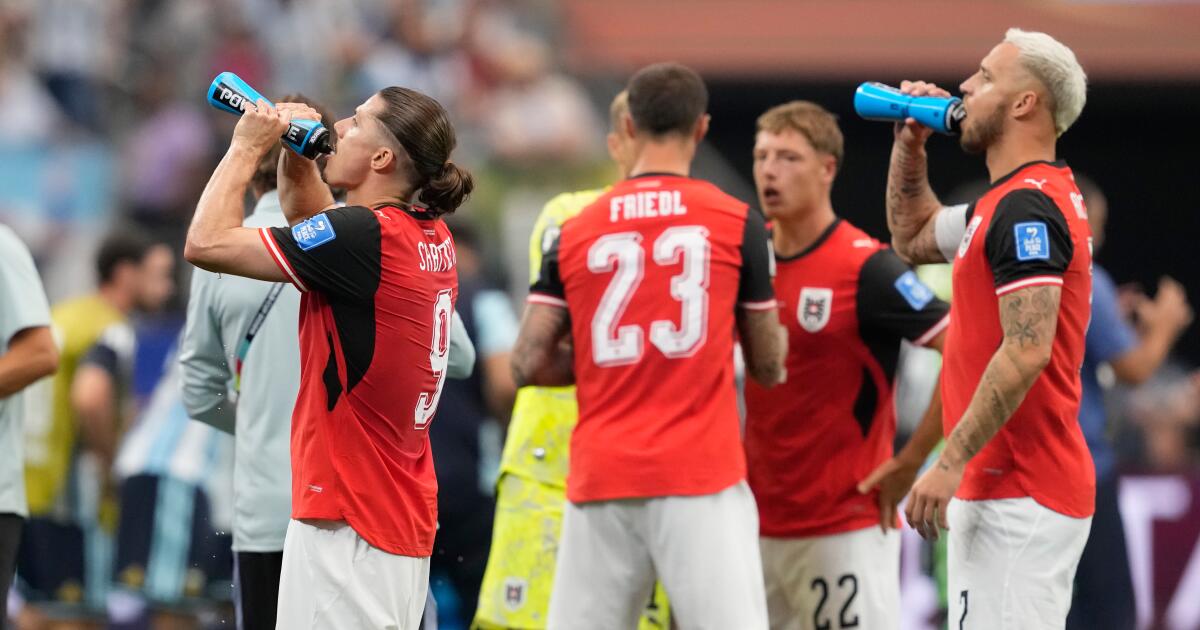
The next game of interest in this respect is Austria v Algeria in Group J (03:00 BST Sunday).
Again, the two teams are second and third on three points. A point is very likely to send both teams through, while defeat is much more likely to send one home.
Will we see another draw?
After being impacted negatively in 1982, Algeria could be the beneficiaries in 2026.
You could argue a game in Group F on Thursday fell into the same category, with Japan starting the match on four points and Sweden on three.
That match also finished 1-1 to guarantee the Scandinavians would progress, but there was no real risk involved for Japan if they have lost.
It is the same in Group L, too, with Ghana on four points and Croatia on three.
MEXICO CITY — The Mexican national team overcame a lackluster first half to rout the Czechia thanks to a dream second half that allowed it to finish the group stage undefeated on a night that will be remembered as one of the greatest in Mexican World Cup history.
The celebration of Mexico’s 3-0 win Wednesday at Azteca Stadium turned into a tribute to legendary goalkeeper Guillermo Ochoa, who entered the game in the final minutes to receive a standing ovation unlike any other Mexican player has ever received in the history of the tournament.
With the loss, the Czechia was eliminated after failing to earn more than one point in the tournament. In the other group match, South Africa defeated South Korea 1-0 in Monterrey and advanced in second place. South Korea will have to wait to find out if it advances as one of the eight best third-place teams or it was eliminated.
Czechia put up a strong performance during the first 45 minutes, during which Mexico showed little offensive clarity, mainly due to a lack of control in midfield.
Everything changed in a matter of six minutes during the second half, when El Tri figured out Czechia and secured its best victory in the group stage.
Mateo Chávez, 22, opened the scoring in the 55th minute with the help of Mexico’s lethal counterattack. Luis Romo set up the goal by shaking off three Czechia players at midfield and pushing forward, passing to Chávez, who beat Czechia’s Michal Sadilek and buried a shot to the left side of goal.
Forward Julián Quiñones extended the lead in the 61st minute, exploiting Czechia’s defensive confusion in the penalty area.
Álvaro Fidalgo, who was a second-half substitute, capped the win with a stoppage time goal. The run on the final goal was set up by a booming Ochoa kick and triggered a raucous celebration by the goalkeeper and his teammates.
The match encapsulated both the present and the future of the Mexican national team.
Gilberto Mora, a 17-year-old midfielder from Tijuana and the team’s youngest player at the World Cup, was instrumental in the second half, setting up several of the plays that decided the outcome. With a 2-0 lead, one of the greatest moments for a goalkeeper in World Cup history unfolded. Ochoa replaced starting goalkeeper Raúl Rangel and was greeted with a standing ovation from a large portion of the 80,824 fans at Azteca Stadium.
Mexico’s Julian Quinones celebrates scoring his side’s second goal against Czechia during a World Cup match in Mexico City on Wednesday.
(Silvia Izquierdo / Associated Press)
The fans chanted Ochoa’s name every time the goalkeeper touched the ball, honoring a player who has competed in six World Cups for Mexico.
Coach Javier Aguirre said that finishing first in the group was a “primary objective” for Mexico, which had already qualified for the next round. The team achieved a first for a Mexican national team by securing three consecutive wins without conceding a goal in the group stage of a World Cup. Mexico defeated South Africa 2-0 in the opening match and South Korea 1-0 in the second game.
The national team, which is co-hosting the tournament alongside Canada and the United States, will face its next opponent — one of the best third-place finishers — on Tuesday at Azteca Stadium.
The only sour note for Mexico came in the scoreless first half when the restless crowd unleashed a popular homophobic chant at least twice. FIFA has previously sanctioned the Mexican soccer federation in an effort to stop fans from saying the chant.
Fox has adopted a new split-screen approach to ads during the World Cup’s mandatory hydration breaks, after a stir among viewers over how it had been handling the pauses.
By the Mexico-South Korea match last week, Fox had changed course, running split-screen advertisements for the first time: two side-by-side panels, one keeping the camera on the stadium while the other played a commercial. The approach hasn’t been consistent, though. For Friday’s U.S.-Australia match, the network reverted to full-screen ads.
Fox declined to comment on the changes.
Viewers were quick to notice the split-screen format and weigh in on social media. “At least FOX stopped doing the stupid full screen breaks,” one user wrote on X. “I can live with split screen.”
The World Cup has posted substantial ratings gains for Fox.
Throughout the first 16 telecasts of the tournament, the network is averaging more than 6 million viewers from Fox and Fox Sports 1, up 128% from 2022’s World Cup in Qatar. The broadcast of the U.S. team’s first game this month was the most-watched FIFA Men’s World Cup telecast in English in U.S. history, with more than 18 million views, according to the network.
The hydration break itself is new to the World Cup. FIFA announced it in December as a way to protect players’ health in the summer heat. In every match, the referee is to call for a break around the 22-minute mark of both halves, regardless of the weather.
In addition to helping the players, these extra minutes created a new advertising window. Networks are allowed to leave the on-field action 20 seconds after the referee signals the hydration break and return 30 seconds before play resumes, allowing for ads of up to two minutes and 10 seconds in total. They can air any full-screen ad they’d like, or run a split-screen ad — though a split-screen has to feature a FIFA partner, such as Coca-Cola or Adidas.
Ads during the tournament’s earlier games reportedly cost around $200,000 for a 30-second slot. The price jumps to $750,000 when the U.S. is playing, according to the Wall Street Journal.
When any rules change in televised sports, the most dedicated fans are going to get upset, said Patrick Rishe, the director of the sports business program at Washington University in St. Louis. Despite all the online uproar, he said that the hydration breaks are overall beneficial, as they allow networks an extra opportunity to recoup revenue and brands to get additional exposure.
“This is commercially fantastic for FIFA and the networks. It’s tactically helpful for the teams, and I do think it’s helpful for growing interest in the sport,” Rishe said. “It makes it easier for the casual fans to stay engaged.”
How it started: A dream. A French machine-gun officer in the trenches during the First World War. A man named Jules Rimet, who believed an international soccer tournament would bring the nations together with the goal of peace.
How it’s going: The world’s biggest party. A 48-nation celebration of the world’s most beloved sport. Expected to generate about $8.9 billion, it’s become such a big deal that it’s being hosted by three countries — one of which, yes, launched a war on a competing nation in the months before the tournament.
The United States’ war with Iran, costly in all the profound ways that war is, also laid the groundwork for an uneven — and possibly precedent-setting — playing field.
At this World Cup, Team Melli has been subjected to shifting travel restrictions and uncertainty unlike the other 47 teams, spending the tournament commuting between Southern California and its base in Tijuana.
And still, after Sunday’s 0-0 draw against Belgium, the world’s No. 10-ranked team, Team Melli is in position to not only get out of its group at the World Cup for the first time, but to win Group G.
Iran’s treatment only makes its performance more impressive — while bringing into question the future of a tournament that purports to be apolitical. And conjuring up concerns about how the Olympics will operate when L.A. is supposed to open its arms to the world two years from now.
Will we be laying down blanket bans again? Will it be easier to ditch diplomacy than to deal hospitably with a global audience for a global event?
Russia and Qatar were capable of implementing systems that relaxed visa requirements to accommodate every team and its fans in the previous two World Cups. Why couldn’t the United States?
Instead, the U.S. State Department suspended visa issuance for nationals from not only Iran, but also from participating countries Haiti, Senegal and Ivory Coast. Iraq’s striker, Aymen Hussein, was held and questioned for nearly seven hours at Chicago’s O’Hare airport.
And the U.S. has allowed members of Iran’s team — discounting the 15 administration officials who reportedly were denied entry — to enter the country only within 24 hours of a match and leave the same day.
And those arbitrary restrictions — they’re OK 24 hours before a match, but not 48? — have put Team Melli at a competitive disadvantage.
“I think that united us even more,” said winger Alireza Jahanbakhsh, who spoke eloquently in English postmatch, a gracious statesman in Adidas sneakers. “That’s one of the things that I think we showed today — we showed a great team character. And part of it comes from the situation we are in.”
Through an interpreter, coach Amir Ghalenoei broadened the scope of what Iran has been facing in its runup to the World Cup.
“We were in a state of war for six months, we didn’t have a league and I remember once during a FIFA qualifying day, we traveled 40 hours by land to another country to play,” Ghalenoei said. “Everybody knows about the visa issues. Everyone knows about our coming to America. A part of the team was in competition conditions and part of them had their domestic league suspended because of the war … and many of the teams that were supposed to play us, canceled.
“I think we entered the World Cup in the worst possible conditions. This is the part I wanted the whole world to know … but the players who entered the World Cup under these conditions are truly commendable.”
It’s been a spirited rebuttal to what’s felt like a counterattack on the inherent values of the World Cup. A reminder that governments and governing bodies can get it wrong, but the beautiful game stays undefeated.
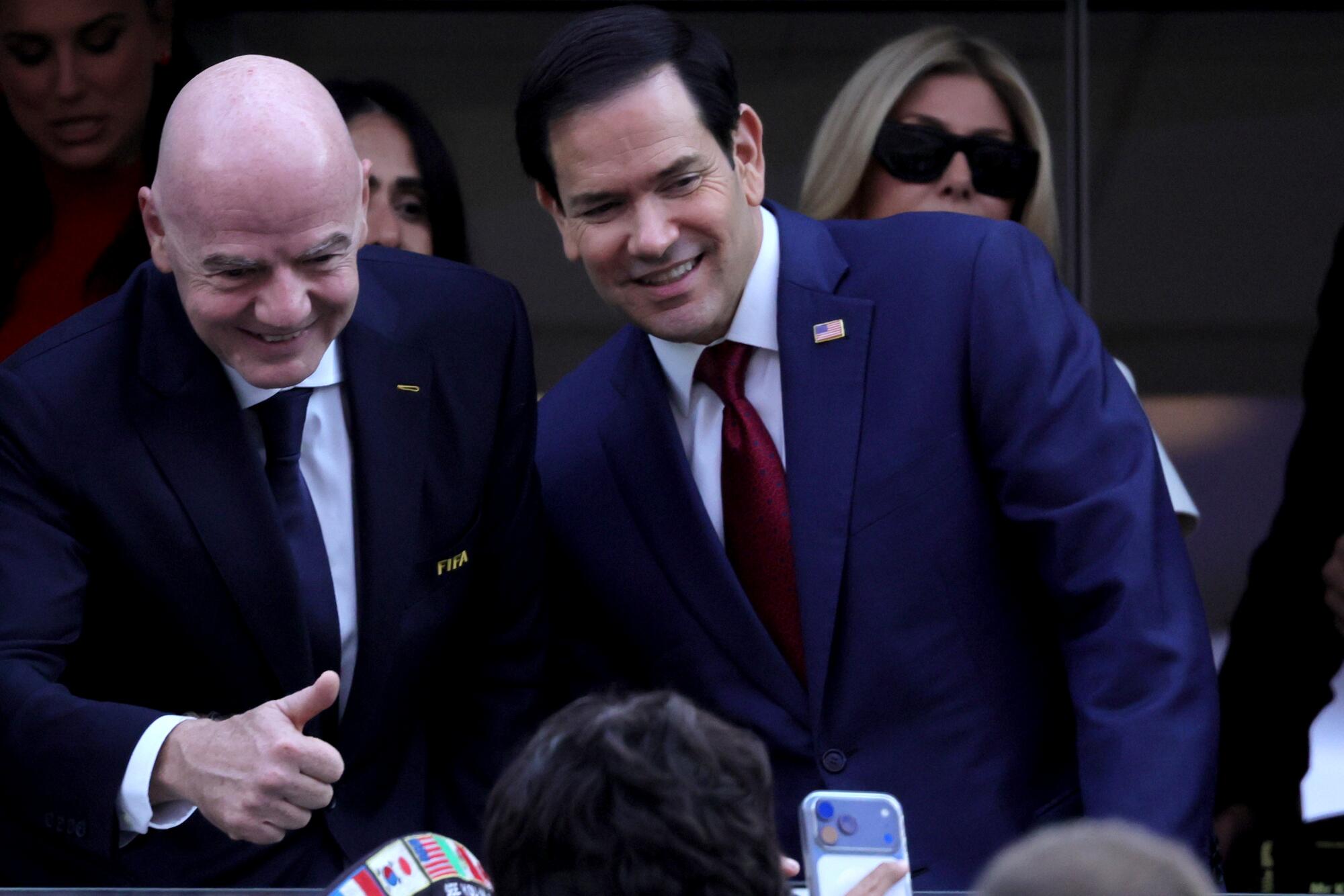
FIFA president Gianni Infantino, left, and U.S. Secretary of State Marco Rubio pose for a photo before a World Cup game between the U.S. and Paraguay at SoFi Stadium on June 12.
(Robert Gauthier / Los Angeles Times)
But what about FIFA?
What about the all-powerful governing body that runs the sport, whose motto is “Football Unites the World”?
The world’s foremost party planning committee, with the cachet to override branded venue names with generic, location-based names — Los Angeles Stadium instead of SoFi Stadium — on Google and Apple maps?
What has FIFA done to flex its muscle to maintain the integrity of the world’s beautiful game?
Not much.
There have been niceties and brownnosing, but no sanctions or threats thereof. Not even a hint of repercussions for diminishing the integrity of the event.
No fines, like what FIFA imposed on six national football associations in response to racist incidents involving supporters during the qualifiers for the World Cup.
No bans, like what FIFA leveled in 1988, when it ousted Mexico from all FIFA competitions for using four overage players in the Under-20 World Cup, or in 2006, when Myanmar was banned from qualifying after refusing to play Iran in an Asian qualifying match for the 2002 World Cup.
Peace talks are ongoing between the United States and Iran, but Iran’s footballing ambassadors haven’t been free to move or to prepare as they wish ahead of its matches against Belgium, and before that, their 2-2 draw against New Zealand.
Apparently, though, Iran will get greater control over travel arrangements before its now hugely consequential final group-stage match is in Seattle against Egypt on June 26, or so Ghalenoei believed when he addressed reporters Saturday.
“What my problem is, why didn’t they let us come earlier for the first two games as well?” Ghalenoei asked. “If they’ve managed to do this now, why didn’t they do that for our first game and for this game?”
Good questions.
Questions no one should be asking at the World Cup.
Iran’s terrible, horrible, no good, very bad World Cup got a lot better Sunday.
By playing Belgium to a scoreless draw before another packed house at SoFi Stadium, Iran is in position to win its group with a victory over Egypt on Friday and advance to the knockout stage for the first time.
That would be a just reward for a team that is unbeaten two games into what has been a trying tournament off the field.
Before it even left Iran, the team was forced to move its training camp from Tucson to Tijuana, and more than a dozen members of its delegation were told they would be barred from entering the U.S. The players had their movements in the U.S. severely limited, heard their national anthem jeered twice and generally have been unwelcome as the first qualifiers to play a World Cup game in a country with which they are at war.
And if all that wasn’t bad enough, on Sunday, Iran had a brilliant first-half goal, one that seemingly had given it its first lead of the tournament, erased on a video replay that confirmed the narrowest of offside violations.
The disallowed goal, one of the best any team has scored in this World Cup, came on a set piece in the 25th minute. Iranian captain Ehsan Hajsafi took the free kick from about 35 yards, but instead of going to the goal, he pushed the ball through the Belgium wall to Mehdi Taremi, who took a clean first touch, then put a left-footed ball between Belgian keeper Thibaut Courtois and the left post.
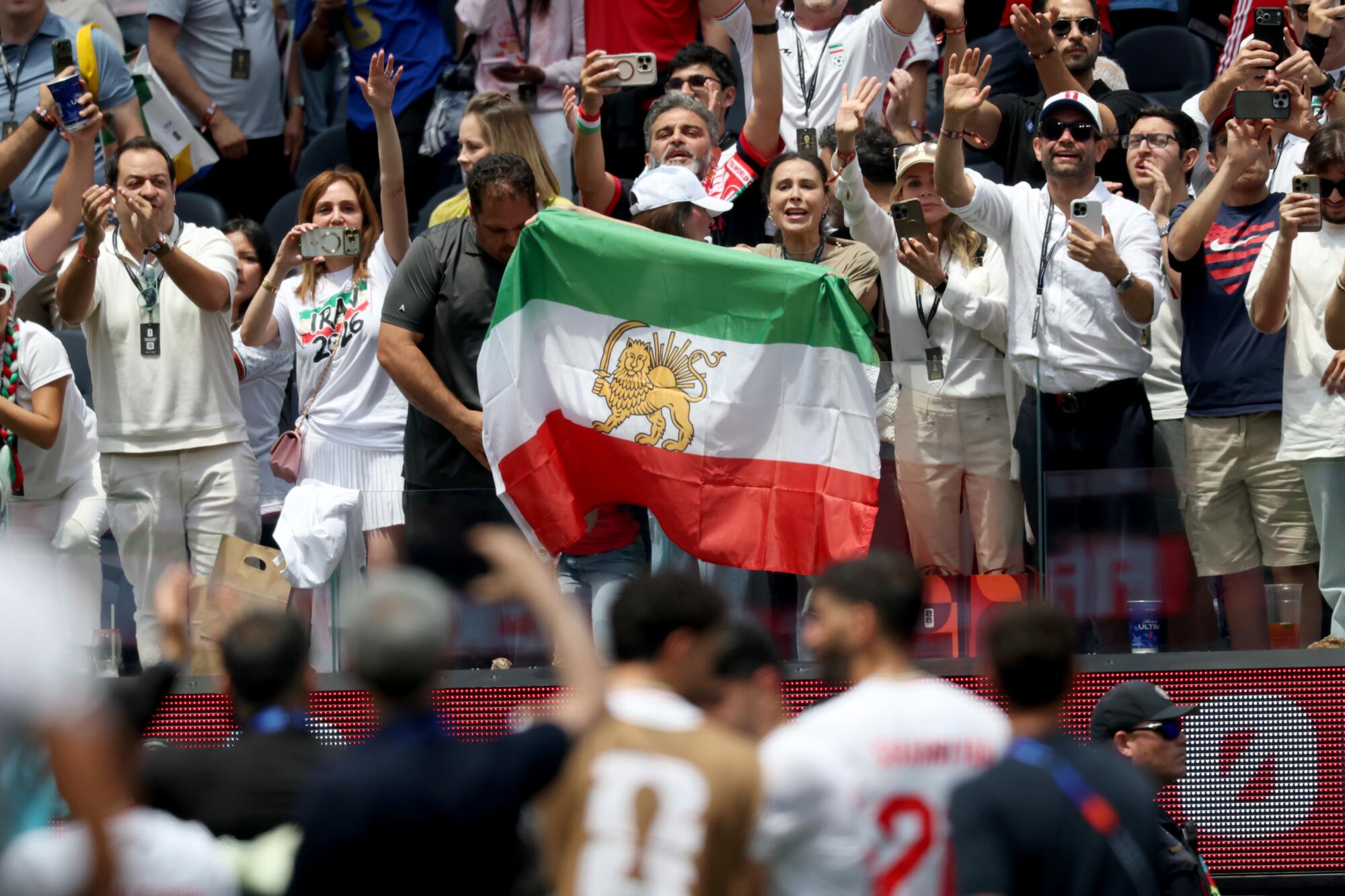
Iranian soccer fans hold a pre-revolutionary Iranian flag following the team’s scoreless draw with Belgium in the World Cup at SoFi Stadium on Sunday.
(Robert Gauthier / Los Angeles Times)
The play caught Belgium completely by surprise, and for one of the few times in this tournament, Iran had reason to cheer. But the celebration was short-lived when referee Dario Herrera took the goal away after a lengthy video review determined Taremi to be offside.
That was the best thing that went right for Belgium in a first half it dominated, only to come up empty. It had an 11-2 edge in shots, completed six times as many passes and controlled the ball for more than 36 of the first 45 minutes. But it couldn’t get the ball past Iranian keeper Alireza Beiranvand.
If the World Cup has been trying for Iran, it’s been frustrating for Belgium, which needed an own goal from Egypt’s Mohamed Hany to escape with a draw in its opener. And a smothering Iranian defense that frequently packed seven players in the box added to that frustration Sunday.
Belgium forward Romelu Lukaku, left, and Iran defender Shojae Khalilzadeh battle for the ball in the second half of a World Cup match at SoFi Stadium on Sunday.
(Robert Gauthier / Los Angeles Times)
That allowed Iran to get the first dangerous chance of the second half — and it also came off a set piece — with Taremi banging a clean volley on target from the center of the box. But Courtois stood his ground and made the save.
The game took a turn in the 62nd minute when Belgium’s Nathan Ngoy mishit a weak backpass, sending Taremi on a breakaway with only Courtois to beat. When Ngoy reached out and grabbed the Iranian by the shirt, pulling him to the ground, he drew a red card, leaving Belgium to play the final half-hour down a man.
Iran clearly deserved a better fate after absorbing wave after wave of a withering Belgium attack without breaking. It also was quicker and far more creative on offense, though it had nothing to show for that.
For Belgium, still looking for its first goal of the tournament, the result was another strain on an aging golden generation of players. If they don’t beat New Zealand in their final group-stage game Friday, they’ll leave the World Cup after the first round for a second straight time.
VANCOUVER, Canada — When the first men’s World Cup game played in Canada kicked off last week, Anthony Totera sat in the stands and wept.
“It was a dream come true,” said Totera, who has spent most of his 57 years on earth promoting Canadian soccer. “I can’t describe the emotions. It was something surreal.”
If the 1994 World Cup, the first held in the U.S., forever altered the direction of American soccer, this summer’s tournament, which Canada is sharing with the U.S. and Mexico, has the potential to do the same for that country.
“This is going to be something monumental,” Totera said. “We’re going to get to another level, another point, where we’re going to say this was when it all turned.”
With an opening draw against Bosnia and Herzegovina last week in Toronto and Thursday’s 6-0 blowout victory over Qatar in Vancouver, this tournament is already the most successful on the field for Canada, which had lost all six previous World Cup games it had played. Now it’s poised to advance to the knockout rounds for the first time ever.
Jonathan David’s three goals were more than Canada had scored in its previous World Cup seven games combined. And former LAFC goalkeeper Maxime Crepeau, who lost his chance to play in the last World Cup when he broke his leg in the MLS Cup final, had no trouble making them stand up, recording Canada’s first-ever World Cup clean sheet.
The hosts outshoot Qatar 32-2 and had 97 touches in the box in one of the most dominant performances in recent World Cup history.
“I really think that we’re a soccer country,” LAFC midfielder Stephen Eustaquio said. “It’s a very special group.”
But the win was a costly one since Canada, which entered the tournament missing three starters to injury, lost another early in the second half when midfielder Ismael Kone was carted off on a stretcher with an apparent broken leg after Qatar’s Assim Madibo clipped him from behind.
And while that success on the field — costly or not — is significant, Steve Reed, the former Canadian Soccer Assn. president who was instrumental in bringing the World Cup to Canada, said the real goal wasn’t to win games as much as it was to win over the public.
“Each time we have hosted major tournaments, we have seen a significant increase in participation and general public interest,” said Reed, who was part of the group that organized the 2015 women’s World Cup in Canada. That tournament produced nearly a half-billion dollars in economic activity, double the original projections. It also boosted investment of soccer infrastructure, including the construction or upgrading of 21 “FIFA-quality” pitches, and surged youth participation numbers. The quarterfinal game between the host country and England drew a record TV audience of 20.8 million Canadians.
“I would say that we have proved that we excel at hosting major events. This will just be reinforced in 2026,” Reed said.
“In terms of expectations,” he continued, “one would be the continued growth of the game, particularly on the men’s side. We have always been great at the grassroots level. But we need to be better at the top end of the game, creating more professional opportunities for players in our domestic leagues and creating a pipeline to bigger clubs in major leagues.”
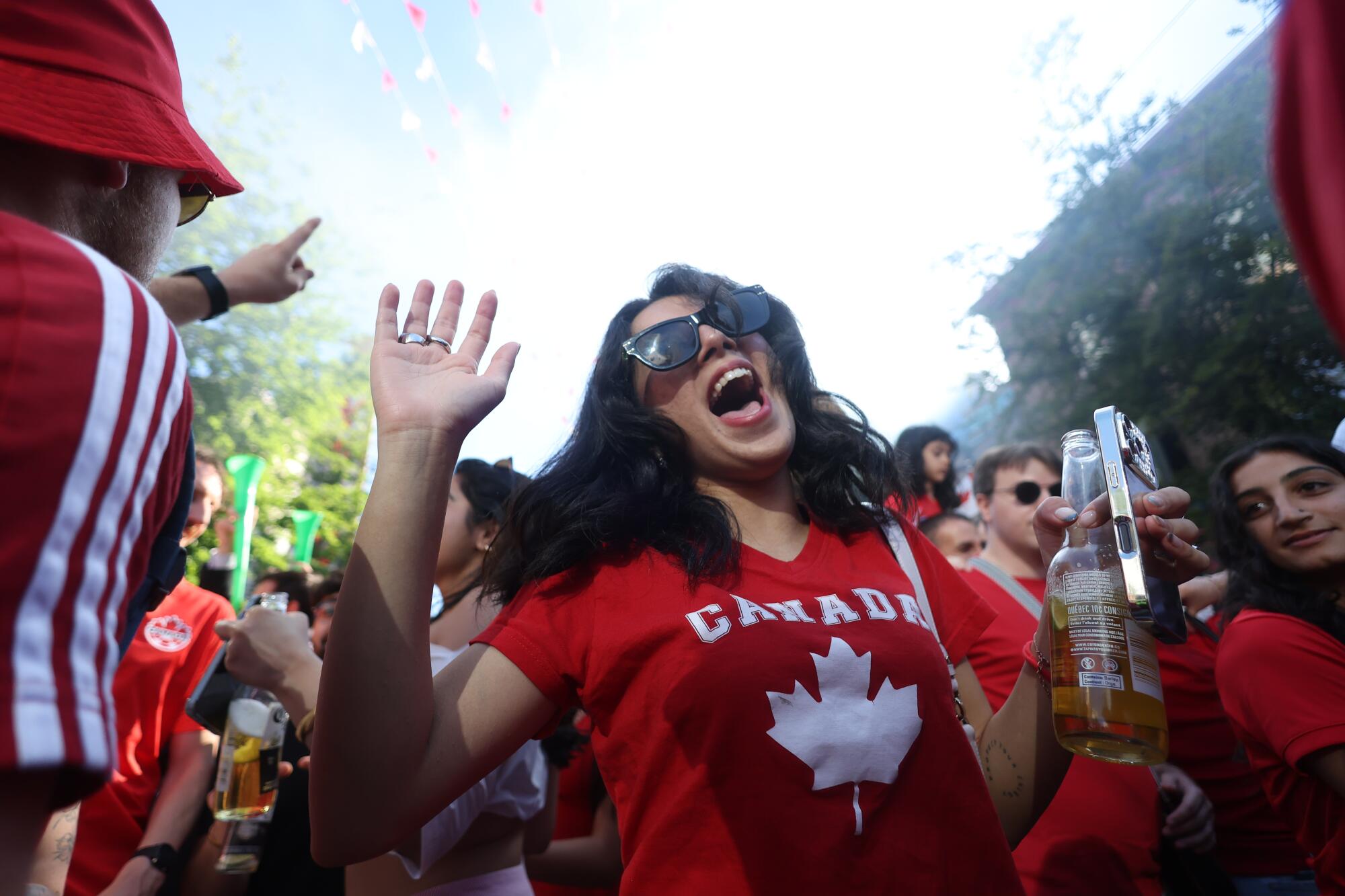
Canada fans celebrate after a 6-0 win over Qatar at the World Cup on Thursday.
(Kaleb Tatum / Associated Press)
That’s exactly the kind of legacy the 1994 World Cup created in the U.S., where it gave birth to Major League Soccer, a deep lower-tier professional infrastructure and an academy system that has sent players to major teams all over the world. Canada has also benefited from that, with MLS placing teams in Vancouver, Montreal and Toronto. Nine players from the league — including three from LAFC — are on Canada’s World Cup team.
In the last decade, Canada has begun building its own youth development system. It also launched the Canadian Premier League, an eight-team professional league that has already sent 15 players to the national team. Those initiatives had a good foundation to build on since soccer is Canada’s most popular sport in terms of registration and participation and ranks behind only hockey as a spectator sport.
Still, when Victor Montagliani, a former Canadian Soccer Assn. president, first publicly floated the idea of bidding to host the men’s World Cup in 2013, he was lampooned.
“People absolutely laughed at him, all across this country,” said Totera, who is now the grassroots ambassador for the Premier League. “But his closest friends and people that knew him knew he didn’t lie when he said, ‘I want to bring the World Cup to Canada.’ And he brought it.”
Canada had to pair with the U.S. and Mexico to make that happen, with the so-called United Bid beating back a proposal from Morocco thanks in part to some steady diplomacy from Reed, who took over as president when Montagliani was chosen to lead CONCACAF, the governing body that oversees soccer in North America, Central America and the Caribbean.
Canada’s reward was 13 World Cup games — seven in Vancouver and six in Toronto. Mexico gets the same number, while 78 of the record 104 matches will be played in the U.S.
That same year, 2018, Reed and Canada Soccer put the final piece of its World Cup preparations in place when it hired John Herdman to rebuild its men’s team.
In seven years with the country’s women, Herdman had taken a team that finished last in the 2011 World Cup to the quarterfinals of the next tournament, sandwiched between two bronze-medal performances in the Olympic Games. His impact on the men’s team was equally as stunning.
When Herdman took over, it had been 32 years since Canada played in its only World Cup. The country not only returned in its first cycle under the new coach, but it won the CONCACAF qualifying tournament to earn its place in the 2022 tournament.
“Being a Canadian football supporter, the roller-coaster ride has been downward for most of the years,” said Totera, who pulled on his first Canada soccer shirt the year he entered first grade. “But for the last few years, it’s been on on the upswing.”
Herdman found success in part by making the recruitment of dual nationals a priority, starting four of them — including Alphonso Davies, who immigrated to Canada from a refugee camp in Ghana — in Qatar.
Nearly a quarter of Canada’s population was born somewhere else and Herdman leaned into that diversity.
Jesse Marsch, the U.S.-born coach who took over the national team in 2024, followed Herdman’s lead, recruiting six dual nationals to his World Cup team. As a result the 26 players on Canada’s roster, or their parents, come from more than 17 countries — from Iran, Croatia, Jamaica and Barbados to Haiti, Lebanon, Nigeria and the Philippines.
“We’re a melting pot. We embrace it,” said Totera, whose family moved to Canada from Italy. “I look at that team, our team, and they’re from all parts of the world. Not one from one section of the world or the other section. No, all over.
“Amazing.”
Now, with a win and draw in two games, that diverse Canadian team is almost certain to advance out of a World Cup group stage for the first time — just as the U.S. did when it first hosted a men’s World Cup in 1994.
“After ‘94, after the World Cup was there, they took off to bigger and better things,” Totera said. “I believe once we get into the knockout route, we won’t look back.
“We’re on the cusp of something really special in this country right now. And we need to grab it and run with it.”
Argentina’s Lionel Messi isn’t the only one scoring in the 2026 FIFA World Cup.
Fox and Telemundo are off to a blazing start in the TV ratings for the quadrennial soccer tournament, delivering big increases over the 2022 World Cup held in Qatar.
Through the first 16 group stage matches, an average of 6 million viewers have watched on Fox and cable network FS1 cable network, a 128% increase over the 2022 FIFA World Cup according to Nielsen data.
The first 12 group stage matches of the tournament drew an average of 7.5 million viewers on the Comcast-owned Spanish language network Telemundo, a 234% increase from four years ago. The Telemundo telecasts are also streamed on Peacock.
The U.S. Men’s National Soccer Team’s opening match against Paraguay held Friday at SoFi Stadium set a record for the most-watched World Cup game on both and English and Spanish language television. The match scored 18 million viewers on Fox and its streaming platforms, while Telemundo’s telecast averaged 9.5 million.
The early ratings show the enduring power of live sporting events and their ability to draw mass audiences at a time when streaming video has splintered viewership . Scripted hit prime time TV shows need seven days or more of viewing on demand to reach the audience levels the World Cup is attracting in real time.
“Having this World Cup in North America clearly has a huge impact on ratings,” said Patrick Rishe, director of the sports business program at Washington University in St. Louis.
World Cup matches held in the U.S. for the first time since 1994 helps — and a competitive USNMT playing in front of home crowds could turbocharge the ratings to even bigger heights. Fox is expecting another record when the team plays its third group stage match in prime time on June 25.
Some sports media pundits have been citing the addition of out-of-home viewing and internet-connected televisions to Nielsen data as the reason sports ratings have been on the rise. But Mike Mulvihill, president of insights and analytics for Fox Sports, asserts that the viewers have been there all along.
“For many years, the numbers were under-counted and what we’re seeing now is a truer representation of the sports audience,” Mulvihill said in a recent interview. “You just cannot overstate what it means to us to be able to capture all that viewing that’s happening at fan fests, in bars and at smaller watch parties.”
Out-of-home viewing boosted the audience levels for Mexico’s inaugural World Cup match on June 11 by 50%, and contributed several million viewers to the total for the USMNT opener.
Mulvihill projects that by the end of the tournament, 150 million people will have watched some portion of Fox’s 2026 FIFA World Cup coverage. The figure approaches the 170 million people Fox reaches with a slate of regular season NFL games.
“For us, it’s like having two NFL seasons in a single year,” Mulvihill said.
Fox will be able to capitalize on the strong numbers for the early matches. Networks typically hold back some commercial inventory for big events in case audience levels fall short of what advertisers are guaranteed. Fox has surpassed those expectations and can now go back into the marketplace to sell available commercials for the later rounds, most likely for more than what was paid before the tournament.
The 2026 World Cup may also be benefiting from a viewing public that wants a distraction from the ongoing political discord in the U.S. and war in the Middle East.
“Sports still remains the one thing we can all kind of talk about and disagree about without it being divisive,” said Lisa Delpy Neirotti, director of the sports management program at the George Washington University School of Business.
Delphy Neirotti believes the World Cup has some momentum from the NBA Finals, which averaged 20.6 million viewers on ABC for the New York Knicks’ triumph over the San Antonio Spurs, The feel-good story of the Knicks winning their first championship in 53 years delivered the most-watched Finals since 1998 and put fans in the mood for more action.
“Fans were already primed up, meeting with friends, watching sports and now they can continue that camaraderie and that collective experience,” Delphy Neirotti said. “They want to be with community.”
The combined numbers for Fox and Telemundo are highest in Los Angeles, which in addition to a large Latino population has 500,000 Iranians. An average audience of 4.7 million viewers watched the Iranian national team play to a 2-2 tie against New Zealand on Monday, the second most-watched match ever on Fox Sports 1.
But there are plenty of World Cup fans in the heartland. Kansas City had the highest local rating for Fox’s coverage of the USMNT’s match, with more than 9% of the market’s homes tuning in.
Kansas City hosted its first World Cup match Tuesday at Arrowhead Stadium, where Argentina’s Messi set a tournament record with three goals in his team’s 3-0 victory over Algeria. The city has cultivated soccer fans with well-attended watch parties held in its Power and Light District.
“The watch parties that they’ve planned out throughout their cities to give people an opportunity to be part of the event, even though they’re not going to the event,” Rishe said. “Whether you’re watching or just walking by, it’s exciting.”
South Africa earned their first victory at the Women’s T20 World Cup as they beat Pakistan by two wickets at Edgbaston.
The Proteas were hammered by favourites Australia in their opener, setting them back in a difficult group which also includes 50-over world champions India.
Their win came from a combination of brilliant bowling from veteran all-rounder Marizanne Kapp and shambolic batting from Pakistan’s top order, who collapsed to 29-5 and then 50-8.
Kapp, 36, made an immediate impact with two wickets in the opening over, before some diabolical running between the wickets gifted South Africa three more.
But an inspired half-century from captain Fatima Sana dragged Pakistan up to 126-9 after a stand of 71 for the ninth wicket with Tuba Hassan.
Fatima finished unbeaten on 55 from 38 balls including two sixes in the final over bowled by Nadine de Klerk which conceded 19.
The skipper then kept her side in the game with the ball – finishing with figures of 3-23 – as South Africa made hard work of the chase by throwing away regular wickets.
Their batting needs to improve considerably if they are to challenge India and Australia in the group’s top two, but all-rounder Annerie Dercksen’s 52 and De Klerk’s 37 were enough to get them over the line with just over three overs to spare.
The Proteas have reached the past two T20 World Cup finals but lost both, to Australia in 2023 and New Zealand in 2024. Pakistan have suffered two defeats, having lost to India on Sunday.
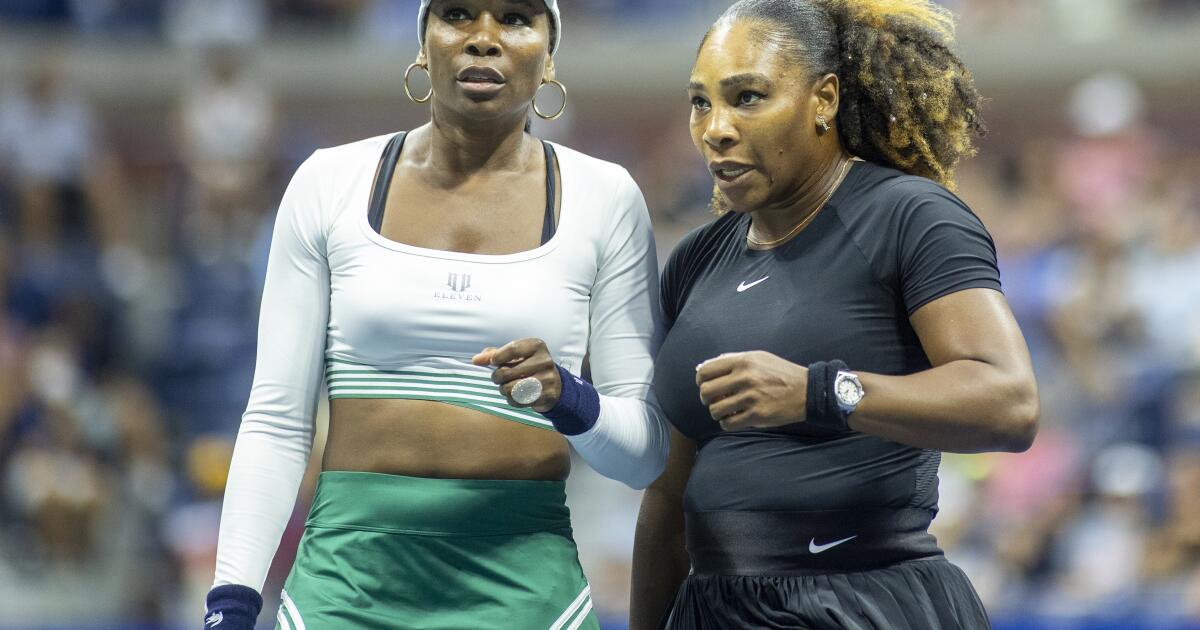
The Williams sisters — Venus, 45, and Serena, 44 — will bring back their doubles partnership at Wimbledon in under two weeks. The All England Club announced the doubles wild card invitation on Tuesday.
Should they win for a record seventh time, the Williams sisters would make history as the oldest Grand Slam-winning doubles combo by nearly 16 years.
The record of 74 years and 303 days is held by Hsieh Su-wei and Barbora Strýcová, who won at Wimbledon in 2023. Venus will turn 46 on Wednesday and Serena will be 45 on Sept. 26, putting their combined age by the tournament’s end at 90 years and roughly 290 days.
The Williams sisters have won six doubles titles together at Wimbledon, most recently in 2016 with the first coming in 2000. They have won 14 Grand Slam doubles titles together, the second most by any women’s team in the Open Era behind the 20 won by Martina Navratilova and Pam Shriver.
Serena recently returned to competition after almost four years away from professional tennis. She will compete in the Berlin Open doubles alongside world No. 10 singles player Karolína Muchová on Tuesday against Erin Routliffe and Giuliana Olmos.
The initial tournament in Serena’s comeback was abbreviated. Her playing partner, Canadian teenager Victoria Mboko, suffered a knee injury that ended their effort at the Queen’s Club Championship after one match, a 7-6(2), 6-2 victory over No. 3 seeds Erin Routliffe and Nicole Melichar-Martinez.
Venus, who will turn 46 on Wednesday, is in the midst of her record 33rd consecutive WTA season. She has been eliminated in the first round of singles at several tournaments while faring better in doubles.
The pairing at Wimbledon will be the first since 2022 for the Williams sisters. Serena took a long hiatus beginning that year and gave birth in 2023 to her second child, Adira River Ohanian.
Many of the sisters’ career highlights have come at Wimbledon. Serena has 14 titles on the hallowed grass court — six in doubles, one mixed doubles and seven in singles. Venus Williams has won 11 Wimbledon titles — five in singles and six in doubles.
Neither Williams sister is slated to play singles in this year’s tournament, although one women’s singles wild card has not been allocated.
Consider it a save for the tournament, three points for soccer in America and maybe even a win for uniting the States.
The Americans on the pitch did all that, including making sure a sellout crowd of 70,492 fans got their money’s worth for their exorbitantly high-priced seats to watch football under Friday Night Lights at SoFi Stadium.
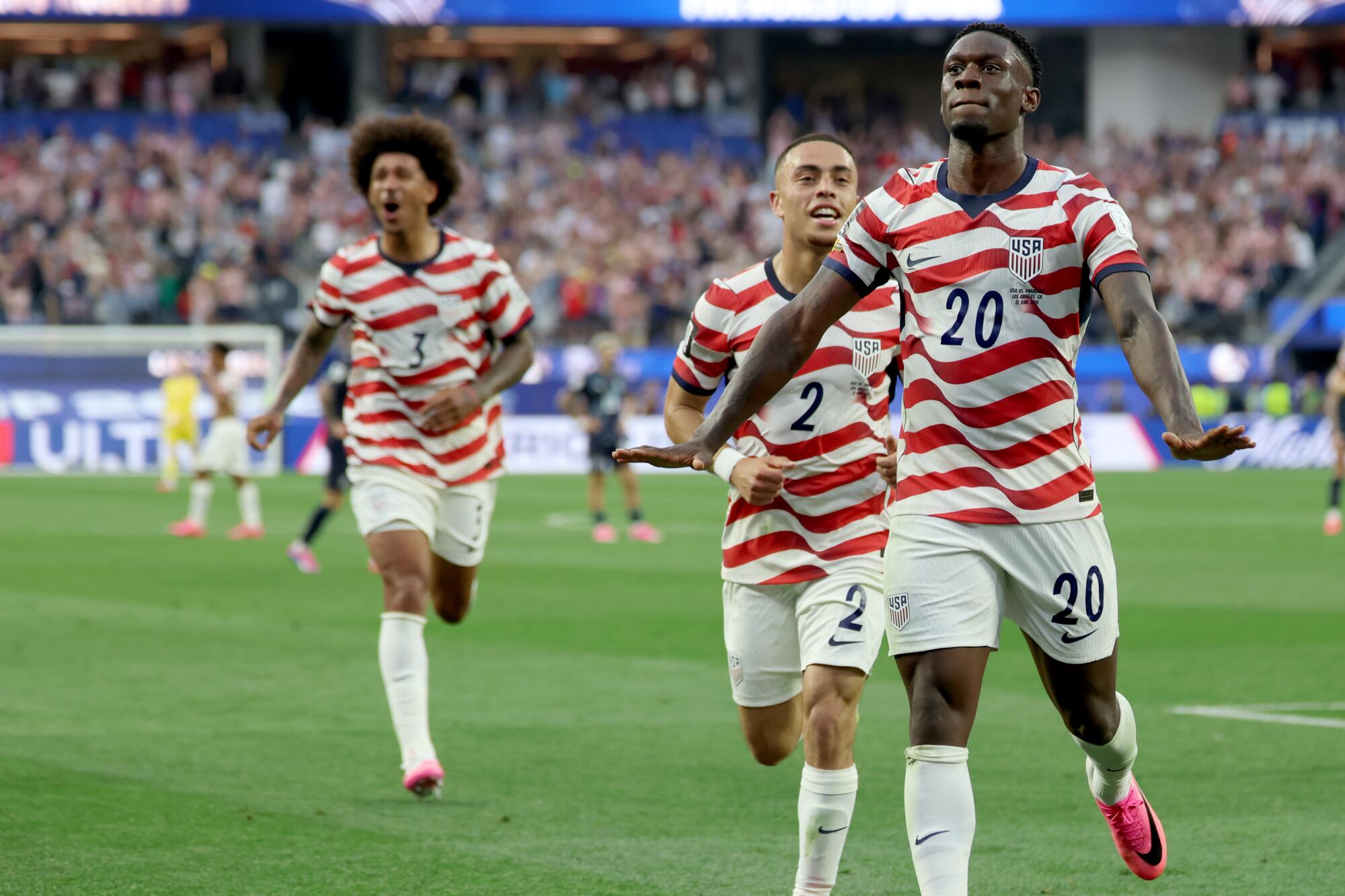
U.S. forward Folarin Balogun, right, celebrates with Sergino Dest and Chris Richards after scoring during a World Cup win over Paraguay on Friday at SoFi Stadium.
(Robert Gauthier/Los Angeles Times)
It was not a clean sheet. And it wasn’t an elixir for all the issues — visas, tickets, transportation — that ailed the tournament in its buildup.
But the opening statement by the United States confirmed what we thought might be true. Only one thing could save this soccer tournament: soccer.
The U.S. delivered a performance to change the conversation — for the next few weeks and maybe longer.
Making history to alter history.
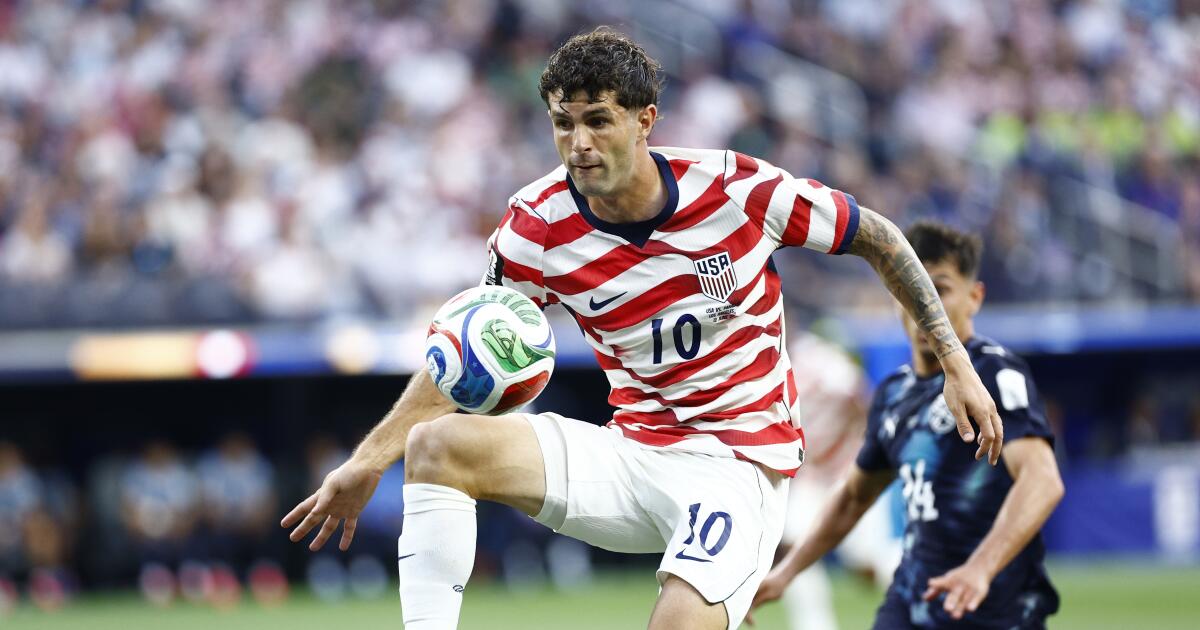
The United States scored multiple goals in a World Cup first half for the first time since 2002.
It got two of them from Folarin Balogun, the Brooklyn-born, England-raised forward of Nigerian descent who became just the second USMNT player to score two goals in a World Cup game and the first since 1930.
Got a perfect match from Chris Richards, the afro-rocking defender with the long, loping strides, who was 83 for 83 on his passes. That’s better than any player at a World Cup since 1966.
And if possession is nine-tenths of the law of attraction, know that the Americans possessed the ball 71% of the first half, most in the first half of a World Cup game in the modern era.
Landon Donovan, star of the 2002 team that reached the World Cup quarterfinals — a record that still stands — posted on X: “From start to finish, that was the most enjoyable day of soccer I’ve ever experienced.”
That’s the stuff that will get the American people going. Get us invested, get us behind them. That could convert even devout casuals.
Americans love a good underdog story. We also want the best, the finest, the biggest — and this, with its expanded field of 48, is the biggest version of the biggest and best tournament in the world.
And the only thing we love more than winning is dominating. The United States did that Friday against a Paraguayan team that had allowed only 10 goals in 18 World Cup qualifying matches, and whom the United States beat 2-1 in a tense match in November.
Fans cheer during the U.S. win over Paraguay in their World Cup opener Saturday at SoFi Stadium.
“The fans, amazing,” said Pochettino, the team’s accomplished Argentine coach. “On behalf of the whole team, a massive thank you to the fans. Because the energy that they [gave] to the team was amazing. We can do amazing things if the fans are in this as well.”
Friday was so good for soccer in America.
And so good for America. The kind of butt-kicking that’s chicken soup for a nation’s soul.
Maybe it’s idealistic and naive, or apple-pie-in-the-sky wishful thinking, but I believe that they can win. (And by win, I mean make the quarterfinals again.)
There’s no removing politics from this World Cup, but wouldn’t it be fun to all rally behind a team together? Can’t you see the country coalescing behind the right wingers and left wingers on the pitch? Picture people celebrating the freedom inherent in Pochettino’s system? Cheering the all-for-one and one-for-all of this team of dual nationals and Americans raised abroad — or in Alabama?
Postmatch, Pochettino refused to single out any one player, instead giving reporters a recitation of his roster: “[Christian Pulisic] was amazing [setting up two goals]. Balogun was amazing, of course. Tim Ream was amazing, of course. Chris Richards was amazing, yes. Weston McKennie, he was amazing, amazing. Antonee Robinson, Alex Freeman, amazing. Sergiño Dest, amazing …”
It was a game eight years in the making. The first World Cup match on American soil in more than a generation and the start of a tournament that has the potential to alter the direction of soccer in this country for the next generation.
And the U.S. seized on every bit of that opportunity Friday, with Christian Pulisic setting up two goals and Folarin Balogun scoring twice in his World Cup debut, sparking an impressive 4-1 victory over Paraguay in a game that was far more one-sided than the score indicated.
The U.S., which needed a big effort to start the tournament, was on the front foot from the start, going in front to stay in the seventh minute — although it was Paraguayan midfielder Damián Bobadilla who got credit for the goal after stepping in front of Balogun and deflecting in a cross from Weston McKennie.
Pulisic, the American star who is under intense pressure to perform in this tournament, set up the goal, pushing the ball between a pair of defenders before poking it on for McKennie in the center of the box. Bobadilla then did the rest, inadvertently sticking his right foot in front of the ball and bouncing it by Paraguayan keeper Orlando Gil.
Balogun appeared to double the lead coming out of the hydration break midway through the opening half, but the goal was negated by an offside call. That only delayed the second goal, however, with Balogun making it 2-0 by one-timing in a perfect feed from Pulisic from the penalty spot in the 31st minute.
Balogun added to the U.S. advantage just before the intermission, running on to a perfectly weighted through ball from Malik Tillman, stepping through a challenge from Omar Alderete entering the penalty area and turning around Paraguayan captain Gustavo Gómez before left-footing a shot into the top left corner to complete his first brace for the national team.
Gil was just a spectator on the play, with no chance to best the save. The goal marked the first time Paraguay had given up three scores in a World Cup game — much less one half — since 2002 and it came at the end of what was arguably the best opening 45 minutes a U.S. team has played in the tournament in decades.
Gio Reyna scored the fourth U.S. goal on the final play of the game.
Pulisic left in favor of Sebastian Berhalter to start the second but the U.S. continued to dominate in every way it was possible to dominate, controlling the ball for nearly 60 of the 90 minutes and completing more than twice as many passes. Paraguay’s first shot on goal didn’t come until the 73rd minute when Mauricio, a halftime substitute, took advantage of a slow-reacting U.S. defense to pull a goal back.
U.S. coach Mauricio Pochettino also got a solid game out of center back Chris Richards, playing for the first time since tearing two ligaments in his left ankle a month ago.
The Americans will face Australia in the second of three group-stage games next Friday in Seattle, where a draw will all but guarantee them a spot in the round-of-32, something Pulisic said should be just the first objective for this team.
This World Cup is the largest and most ambitious sporting event in history, with three host countries — Canada and Mexico, in addition to the U.S. — and a record 48 teams playing 104 games in 16 cities spread across four time zones. A long run by the American team, playing on home soil, could excite a nation and give soccer the kind of boost it hasn’t seen since 1994, the last time a World Cup was played here.
It could also change the narrative of a tournament whose run-up was clouded by outrageously high ticket prices, travel bans, the threat of ICE raids at tournament venues and the war in the Middle East, the first to pit a World Cup host against a World Cup qualifier.
And the U.S. portion of that tournament opened with pomp despite those circumstances, with Thai pop star Lisa, Nigerian recording artist Rema and Brazilian singer Anitta headlining a 10-minute mini concert staged before a massive replica of the World Cup trophy set over a blue map of the U.S. Katy Perry mounted a stage of her own an hour later to debut her song “Wonder” as the flags of the 48 participating countries circled around her.
President Trump did not attend the game, just as Mexican president Claudia Sheinbaum skipped her country’s opener Thursday in Mexico City and prime minister Mark Carney missed Canada’s first game Friday in Toronto. Secretary of State Marco Rubio took Trump’s place in the Hollywood-heavy crowd of 70,492 that packed SoFi Stadium, one which included Tom Cruise, David and Victoria Beckham, Halle Berry, Rob Lowe, Becky G, Jaime Foxx, Paris Hilton, Bill Gates, Justin Trudeau and Kareem Abdul-Jabbar.
That crowd was a sea of blue and red — the U.S. and Paraguay share the same colors — but the cheering was primarily for the Americans since Paraguay rarely mounted a threat.
In many ways, the most ambitious World Cup in history — which kicked off Thursday in Mexico City — has inspired more angst than anticipation, more fear than fervor.
The competition, returning to North America for the first time in more than three decades, has expanded to 48 teams and 104 matches, to be played over 39 days in 16 cities in the U.S., Mexico and Canada. The complex planning was eight years in the making.
Yet even before the competition opened with Mexico facing South Africa at the iconic Estadio Azteca, it has been marred by a number of controversies that threaten to overshadow the soccer and cloud the tournament’s legacy.
“I view this World Cup as the most politically combustible World Cup in recent history. And that’s saying something,” said Jules Boykoff, a political science professor at the University of Portland and author of eight books on the politics of international sport.
“We’re in uncharted territory in many ways.”
Relations between the host countries, once strong, have been strained by the Trump administration’s tariff policies and disagreements over border security. Travel bans have barred potential World Cup visitors — and even support staff and match officials — from entering the U.S. and others are fearful of making the trip, worried about ICE raids and immigration roundups.
The U.S. is at war with a tournament qualifier, Iran. And Iran has fired missiles and drones on Jordan, Qatar and Saudi Arabia, nations that also are World Cup participants.
The International Sports Press Assn. said Iranian and African journalists have been denied visas to cover games in the U.S., and Iran protested after more than a dozen members of its support staff had their requests to enter the U.S. rejected. The Iranians, who were forced to move their training base from Tucson to Tijuana, will spend limited time in the U.S. during group-play games that will take place in Inglewood and Seattle.
Players and journalists from Senegal, Uzbekistan and Iraq have been detained at U.S. airports for up to seven hours by immigration officials. Then on Monday, Omar Artan, a decorated referee and the first Somali official selected to work a World Cup, was turned away at Miami International Airport.
In addition, ticket prices have been so high and the lottery process for obtaining them so opaque, the attorneys general of New York and New Jersey have begun formal investigations into FIFA practices. Other states, including California, hosting tournament matches have begun asking questions as well.
All that has conspired to produce a World Cup that is struggling to catch on with the public. According to a recent poll by Yougov.com, a majority of Americans — 54% — say they are not at all interested in the tournament and nearly six in 10 say they will not watch any matches.
“People are just in a bad mood,” Boykoff said. “It’s a tough time.”
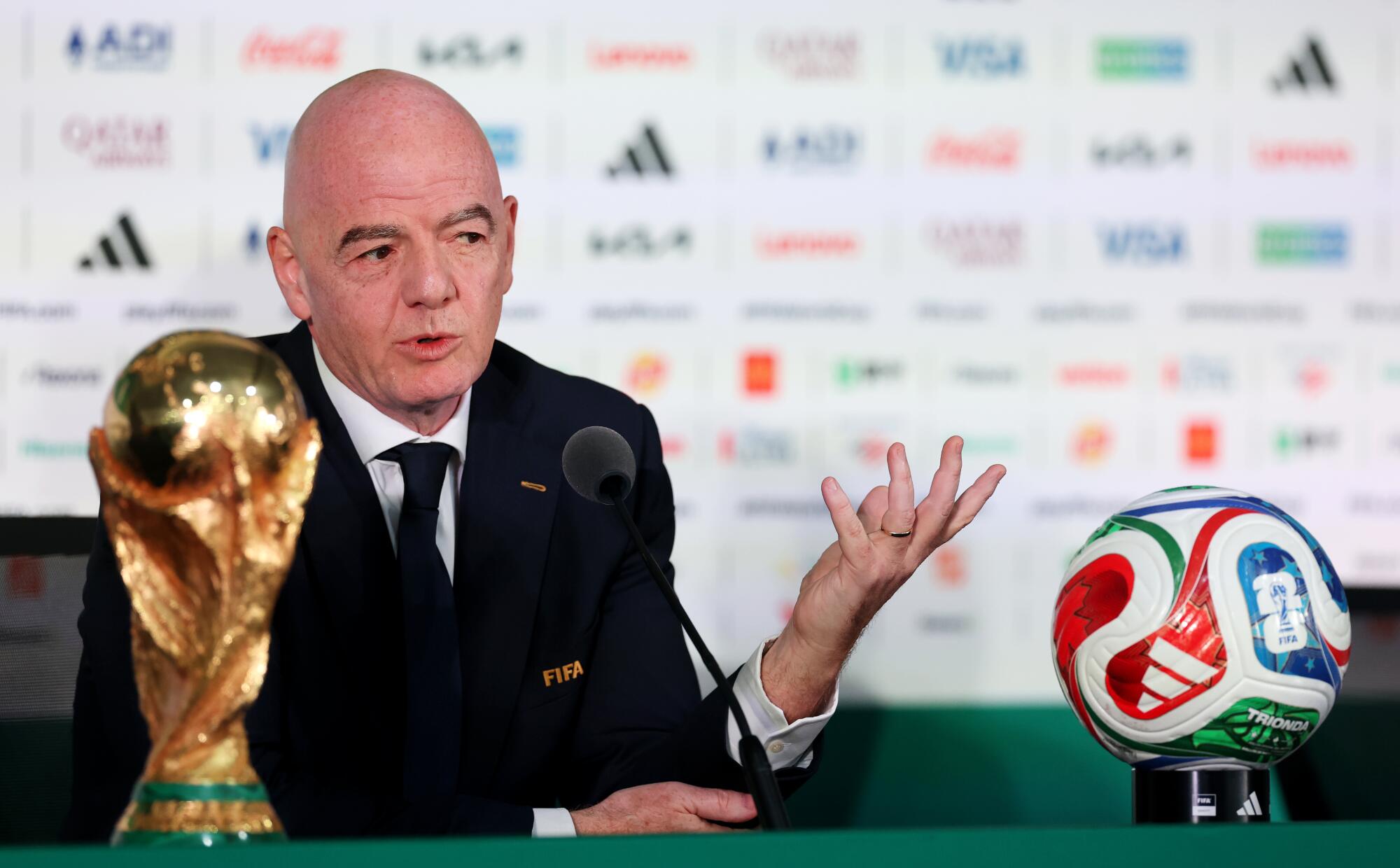
FIFA president Gianni Infantino remains optimistic, promising this will be “the biggest, the most inclusive, the greatest FIFA World Cup ever.” He made the same claim about the 2022 World Cup in Qatar and the 2018 tournament in Russia.
FIFA president Gianni Infantino speaks during a news conference on Wednesday before the start of the World Cup.
(Carl Recine / Getty Images)
“The World Cup should be understood as both a global sporting celebration and a major commercial enterprise, with these two dimensions being mutually enforcing rather than contradictory,” said Steve Georgakis, a lecturer on sports studies at the University of Sydney and a frequent author on soccer.
This year’s tournament is projected to swell FIFA’s coffers by nearly $9 billion and the TV ratings, it says, will be massive.
“Its universal appeal combined with the participation of 48 nations ensures that it remains a genuinely global sporting event,” Georgakis said.
Boykoff has his doubts.
“In this particular political moment, with the Trump administration being erratic and impulsive and needing a win from this tournament and the fact there’s so many moving parts geopolitically, I don’t have confidence that it’s just going to end up being a soccer-focused next five weeks,” he said.
This is not the first World Cup to kick off under some kind of black cloud.
The 1974 tournament in West Germany was tarred by the geopolitical fallout of the 1973 Yom Kippur War. Four years later Argentina’s military dictatorship used the World Cup to sportswash a “Dirty War” in which as many as 30,000 people were tortured, murdered and disappeared.
The 2010 and 2014 World Cups were troubled by cost overruns and delays in the construction of stadiums and other infrastructure and the threat of labor unrest while global outrage over human rights violations and discrimination against women and LGBTQ people hung over the last two tournaments.
Those issues never fully disappeared but were overshadowed by the brilliance of the soccer. Jonathan Wilson, a columnist with the Guardian and author of “The Power and the Glory: The History of the World Cup,” expects the same this summer.
“The other stuff will still be there in the background,” he said, “but fundamentally the football will, for the vast majority of people, take over. It’s just sort of a natural cycle.”
Argentina star Lionel Messi controls the ball during an international friendly against Iceland on Tuesday.
(Butch Dill / Associated Press)
And as with every World Cup, there undoubtedly will be unforgettable moments.
Argentina’s Lionel Messi and Portugal’s Cristiano Ronaldo, the top scorers in soccer history, will be playing in their sixth and final World Cups — Messi chasing a second straight title and Ronaldo pursuing the only prize that has eluded him.
Kylian Mbabbe will be trying to take France to a third consecutive final while young superstars like Erling Haaland of Norway and Lamine Yamal of Spain will be looking to put their mark on their first World Cups.
Four teams — Jordan, Curacao, Cape Verde and Uzbekistan — have qualified for the tournament for the first time.
And there will be other storylines no one saw coming, all of which will contribute to the narrative of this World Cup.
“Major sporting events have a way of capturing public attention and shifting the conversation toward what is happening on the field rather than off it,” Georgakis said.
How much the actions of the Trump administration affect that calculation remains to be seen.
There are travel restrictions in place that fully or partially bar citizens from 39 countries — including a number of World Cup participants — from entering the U.S. And the administration has said ICE and Homeland Security personnel will have a visible presence at World Cup venues, including SoFi Stadium in Inglewood, where the American team will begin play Friday.
“There will be federal agents,” confirmed L.A. County Sheriff Robert Luna, who added that he could not guarantee immigration sweeps would not take place. “ They told us that specifically would not be occurring,” he said. “Any of that’s subject to change.”
Mexico fans celebrate during a watch party at Plaza Mexico in Lynwood on Thursday.
(Kayla Bartkowski / Los Angeles Times)
The difficulty in obtaining visas and the fear of being rounded up by immigration agents are being blamed, in part, for less-than-expected tourist traffic. Hotel operators in all 11 World Cup host cities say bookings for the tournament are well below projections. Several countries have issued warnings about travel to the U.S.
Then there are the own goals from FIFA over tickets and parking prices as high as $900 at some stadiums, weather issues and a short-lived ban on water bottles.
FIFA has defended its policies on ticket prices by arguing that premiums are necessary to maximize revenue, which it will invest in global soccer development. Variable, market-based pricing, it said, simply reflects standard entertainment practices in North America. The organization did, however, reverse its ban on fans bringing bottles into games. Spectators are now allowed to enter stadiums with one soft, plastic 20-ounce water bottle.
And despite a warning from climate scientists that one in four World Cup games could be played in dangerously hot conditions, FIFA will start 40 of them at 3 p.m. or earlier local time, the warmest time of day, to accommodate European TV viewers.
Georgakis said the play on the field will have to overcome all those issues if this World Cup is to earn a favorable place in history.
“Ultimately the success of the World Cup will be judged by what happens on the field,” he said. “If the football is compelling, dramatic and memorable, the tournament will likely be remembered as a great World Cup. If the play falls short, then the off-field issues such as ticket prices, extreme heat, ICE enforcement activities, the Trump administration will receive great attention and could shape perceptions of the event.”
Serena Williams opted to let Nike break the news about her pro tennis comeback at age 44 in two slick commercials. The abrupt end to her doubles foray at the HSBC Queen’s Club Championships was more muted.
Williams’ playing partner Victoria Mboko injured her left knee in a fall during a singles match Wednesday. The turn of events restricted Williams’ return to tennis to one match, a 7-6(2), 6-2 victory with the Canadian teenager over No. 3 seeds Erin Routliffe and Nicole Melichar-Martinez.
Shed no tears for Williams. She pivoted quickly and will partner with Czech tennis star Karolína Muchová in doubles at the grass-court WTA 500 Berlin Open next week.
“Every tournament I add to my schedule right now feels special, and Berlin is no exception,” Williams said in a statement. “I’m excited to compete in front of the German fans and continue building momentum throughout the grass-court season.”
Another commercial by Nike, her collaborator and business partner of more than two decades, probably isn’t necessary. Williams’ announcement that she would play for the first time since the 2022 U.S. Open came via a pair of clips from the athletic footwear and apparel conglomerate.
One was captioned “good news travels fast.” Talk about buzzy. Her phone makes all sorts of sounds while she’s working out on the court, ending with the text: “Guess everybody heard the news,” and her saying, “I gotta change my number.”
The second is even zanier, a bit with LeBron James and Nike executives pitching a film called “The GOAT’s Goodbye” to Williams, who wants none of it because she still wants to play. James says to the suits, “You’re gonna have to find someone else,” and Williams walks onto the court with racket in hand.
Tagline: “The GOAT’s back.”
For now, her comeback is open-ended. Wimbledon begins June 29 and Williams has not indicated whether she will play. She has 14 titles in the prestigious tournament, six in doubles, one mixed doubles and seven in singles.
Asked shortly after her lone doubles victory at the Queen’s Club why she returned to the tour after a hiatus punctuated by the birth in 2023 of her second child, Adira River Ohanian, Williams shrugged.
“I don’t know, I had nothing better to do,” she said with a smile. “I got tired of sitting at home. My kids are out of school for the summer, so why not?”
The 2026 FIFA World Cup is set to start Thursday with Mexico facing South Africa in Mexico City and South Korea taking on Czechia in Guadalajara, Mexico.
The tournament then heads north on Friday, with Canada facing Bosnia-Herzegovina in Toronto before the United States opens Group D play against Paraguay at SoFi Stadium.
Here’s everything you need to know about the matches through the opening days of the 39-day, 48-team tournament across the U.S., Mexico and Canada.
Here’s a look at Thursday’s matchups (all times Pacific):
Mexico vs. South Africa
Mexico’s Raúl Jiménez, left, celebrates after scoring during an international friendly against Serbia on June 4.
The buzz: Although the World Cup will be shared by three countries for the first time, Mexico gets the honor of playing the opening game. No country has played host to more World Cups than Mexico, which also staged the tournament in 1970 and 1986. Both times the first game was played in the iconic Azteca Stadium, where the World Cup kicks off again. The first two times the World Cup was played in Mexico, the home team made the quarterfinals and El Tri, playing under coach Javier Aguirre, a midfielder on the 1986 team, seems poised for another long run. Mexico is unbeaten in eight games this year, including wins over World Cup qualifiers Panama, Ghana and Australia and draws with Belgium and Portugal. Mexico has given up just one goal in the past eight months. South Africa, which played Mexico to a draw in the opening game of the 2010 World Cup, is winless in 2026.
South Korea vs. Czechia
South Korea’s Son Heung-min controls the ball in front of El Salvador’s Brayan Landaverde during an international friendly match on June 3.
The buzz: South Korea is one of five countries to have played in the past 11 World Cups — and it’s the only one of the five never to have won the tournament. And the only two times South Korea played in a North American World Cup, in 1986 and 1994, it failed to win a game. Still, with an offense led by LAFC’s Son Heung-min, the MLS leader in assists, and a defense anchored by Bayern Munich center back Kim Min-jae (aka The Monster), the Taegeuk Warriors are a formidable foe. Czechia, playing in the World Cup for just the second time as an independent nation, has been unimpressive in its tournament warm-ups; its last win over a World Cup qualifier was a 2-1 win over Norway 27 months ago.
Here’s a look at Friday’s matchups:
Canada vs. Bosnia-Herzegovina
Bosnia’s Edin Dzeko heads the ball during a World Cup qualifying match against Italy on March 31.
The buzz: Alphonso Davies has been ruled out of Canada’s World Cup opener in the hope that he will be available for the rest of the tournament. And his absence will be felt since Davies, sidelined since May 6 with a hamstring injury, is not only the team’s best player but also its captain. The injuries are piling up for Canada, which lost center back Moïse Bombito and forward Marcelo Flores to injuries after the World Cup roster had been determined. Under American coach Jesse Marsch, the team entered the top 30 in the FIFA world rankings for the first time, losing just five times in 29 matches, but still looking for its first victory in a World Cup match.
Bosnia, playing in the World Cup for the second time since gaining independence, is led by 40-year-old Edin Dzeko, the country’s all-time leader in caps and goals. It qualified for the World Cup by drawing Wales, then Italy, and beating both on penalty kicks in a pair of UEFA playoffs in March.
United States vs. Paraguay
U.S. forward Christian Pulisic controls the ball in front of Senegal’s Krepin Diatta during an international friendly on May 31.
(Jamie Squire / Getty Images)
Where: SoFi Stadium | Inglewood Time: 6 p.m. TV | Streaming: Fox, Telemundo | Fox One, Peacock
The buzz: With a goal and an assist in the Americans’ penultimate warm-up with Senegal, Christian Pulisic broke out of a career-long scoring drought and proved himself ready for the World Cup. But he’ll need help from his supporting cast if the U.S. is to get out of group play and this game could be key to that goal. Paraguay’s schedule over the past year featured several games with World Cup qualifiers, including wins over Mexico and Uruguay, draws with Japan and Ecuador and one-score losses to Brazil, Morocco and the U.S. Its leading scorer is midfielder Miguel Almirón, who plays in MLS with Atlanta United.
Here’s a look at Saturday’s matchups:
Qatar vs. Switzerland
Qatar’s Akram Afif plays during an international friendly against El Salvador on June 6.
(Luiza Moraes / Getty Images)
Where: Levi’s Stadium, Santa Clara Time: noon TV | Streaming: Fox, Telemundo | Fox One, Peacock
The buzz: Qatar made its World Cup debut four years ago and became the first host to exit the tournament without a point, losing all three group-play games by two goals each. The team has improved dramatically since then, beating Mexico to reach the quarterfinals of the 2023 CONCACAF Gold Cup. But its World Cup preparations were disrupted by war in the Middle East, which forced the cancellation of scheduled friendlies with Serbia and Argentina. As a result, the team has played just twice in the last seven months and hasn’t scored a goal since last December.
Switzerland, meanwhile, is ranked in the top 20 in the world by FIFA, has lost just twice — to No. 2 Spain and No. 10 Germany — in its past 17 tries and made the quarterfinals of the past two Euros.
Brazil vs. Morocco
Brazil’s Casemiro, right, celebrates with teammate Vinicius Junior after scoring against Panama during an international friendly match on May 31.
(Bruna Prado / Associated Press)
Where: MetLife Stadium, East Rutherford, N.J. Time: 3 p.m. TV | Streaming: FS1, Telemundo | Fox One, Peacock
The buzz: Group C gets off to a compelling start with sixth-ranked Brazil, the tournament’s only five-time champion, facing No. 7 Morocco, the surprise team of 2022. And both come in hot: Morocco has lost just one of its past 45 games, dating to January 2024, while Brazil has beaten World Cup qualifiers Egypt, Panama, Croatia, Senegal, South Korea, Paraguay, Colombia, Ecuador and Mexico over the past 24 months.
Barring a major stumble, both will make it out of group play but this game will likely determine which will go through as a group champion, giving it a much easier path through the knockout rounds.
Haiti vs. Scotland
Haiti’s Frantzdy Pierrot controls the ball in front of Tunisia’s Mohamed Amine Ben Hamida during an international friendly on March 28.
(Vaughn Ridley / Getty Images)
Where: Gillette Stadium, Foxborough, Mass. Time: 6 p.m. TV | Streaming: FS1, Telemundo | Fox One, Peacock
The buzz: Though lacking the sizzle of Brazil-Morocco, Group C’s other first-day matchup is no less important. With eight third-place teams advancing out of group play, a win here would give either Scotland or Haiti a solid shot at going through while a draw could doom both.
Haiti, participating in the World Cup for just the second time — and the first time since 1974 — hasn’t played at home in five years because of violence and instability in Haiti. But it thumped New Zealand 4-0 in one of its final World Cup tuneups and lost to three other World Cup qualifiers — the U.S., Saudi Arabia and Tunisia — by just a goal in the past year. All but three of the players on Haiti’s roster play for first- or second-division teams in Europe or the U.S.
Scotland had an easier time in qualifying and won its past two World Cup tuneups, beating Curacao and Bolivia by a combined score of 8-1. Its top player is Liverpool defender Andy Robertson but its oldest is goalkeeper Craig Gordon, at 43 the most senior player in the tournament.
Australia vs. Turkey
Australia goalkeeper Mathew Ryan warms up before an international friendly match against Mexico at the Rose Bowl on May 30.
(Luiza Moraes / Getty Images)
Where: BC Place, Vancouver, Canada Time: 9 p.m. TV | Streaming: FS1, Telemundo | Fox One, Peacock
The buzz: Turkey could be one of the surprise teams in the tournament after qualifying for the World Cup for the first time since 2002 with a pair of 1-0 wins over Romania and Kosovo. Turkey has risen five spots, to No. 22, in the FIFA world rankings in the past ninth months, its best showing in a decade. And in the last year it has beaten the U.S. and tied No. 2 Spain. Its best player is Inter Milan midfielder Hakan Calhanoglu, Turkey’s active leader in caps and goals.
Australia had its best-ever World Cup four years ago in Qatar, winning twice and advancing to the round of 16 for the first time since 2006. But it has struggled of late, losing four of its past six games to fellow World Cup qualifiers.
Tim Ream is the only player on the American World Cup team who was alive the last time the tournament was played in the U.S. But he was only 5, so the memories are kind of sketchy.
“I remember bits and pieces of 1994,” he said.
Still, it’s fallen on Ream, as both the captain and the oldest man on the roster, to prepare the team for what they’re about to experience when the U.S. opens play Friday at SoFi Stadium.
“I’ve tried to tell guys and tried to convey the message that this is a once-in-a-career [opportunity] and with that comes more expectation, more pressure,” he said. “But at the same time we have to enjoy it.
“It’s about just opening your eyes and taking everything in because this is unique, this is completely different from anything that any of us as players has experienced.”
Only 22 men in history have suited up for a home World Cup game on U.S. soil. Players including Alexi Lalas, Eric Wynalda, Cobi Jones and Marcelo Balboa parlayed that fame into broadcasting careers. Others have become coaches. Fifteen of them were inducted into the National Soccer Hall of Fame.
Ream, who played in the last World Cup in Qatar, said it’s difficult to compare the experience of that tournament with this one — especially since this one hasn’t started yet.
“It’s not our first rodeo, but it’s our first one on U.S. soil,” he said. “So it’s kind of our first rodeo in a way. It’s exciting.
“So take it in, enjoy it, embrace everything that it is. Because it’s so unique, it’s so special. And it’s not something that we will ever get to do again.”
Midfielder Cristian Roldan was also at the last World Cup, although he didn’t appear in a game. He says the energy is different this time around.
“You feel it when you’re there. You’re kind of isolated, you’re alone,” said Roldan, one of 13 players on this team who were also on the team in Qatar, half a world away. “But it’s different here. You see how many media members are here. You see how many people we’ve seen in training over the last few weeks. You feel that energy, you feel that support.
“Now it’s about translating that energy, that support, that pressure into something good.”
Goalkeeper Matt Turner agreed.
“This one, obviously, it’s a lot more tangible,” he told reporters Tuesday. “You guys are all here, right, real close to us. We have 5,000 fans for training yesterday. It’s very different. In Qatar, you’re in a lot more of a bubble.
“But us players, the ones that had the [World Cup] experiences, I think we’ve done a really good job of keeping that boundary.”
What’s lacking this time, Turner said, was the pressure of a qualifying campaign to bring the team together. Because the U.S. is one of the three host countries — alongside Mexico and Canada — it was assured a spot in 48-team field when it won the right to stage the tournament eight years ago. As a result it hasn’t played a competitive game in more than 11 months.
“The intensity of those games, the environments that you have to dip into and get results, you find out a lot about the players and find out a lot about the team,” he said. “This time around, it’s been different. We’ve had a lot of different looks, a lot of different players getting a chance to prove themselves and show themselves.
“It’s not anything bad or good. I just think it was a little bit different.”
Striker Folarin Balogun, one of 13 World Cup newbies on the U.S. team, said he doesn’t expect the gravity of the experience to hit him until he lines up for Friday’s opening game with Paraguay.
“It’s probably going to start to go more real to me when I’m preparing to go on to the pitch,” he said, sitting behind a table next to Ream. “I’m hearing the fans shouting and screaming, so I definitely think it’ll be real to me the closer I get.
“But you know, this is the first opportunity for me to play in the World Cup so I don’t really have any expectations.”
Balogun then looked over at a frowning Ream, who had just finished urging his teammates to be sure to stop and smell the flowers along this World Cup journey.
“Just trying to stay present, stay in the moment,” Balogun hastened to add. “You know, enjoying the experience. I think it can be a really memorable World Cup.”
History tends to repeat itself at the World Cup. Such is the case with Mexico and South Africa, two teams that will face off in the World Cup opening match for the second time in history, just as they did in Johannesburg on June 11, 2010. The score that night was 1-1.
Many still remember Siphiwe Tshabalala and his powerful shot into the top corner that beat Mexican goalkeeper Óscar Pérez, and a celebration that remains etched in the collective memory of the soccer world. Unfortunately for the South African team that night, Rafa Márquez equalized for El Tri with 11 minutes remaining during what turned out to be a disappointing World Cup for the host nation.
Sixteen years later, the 2026 World Cup kicks off, curiously enough, with the same matchup, but with the roles reversed. Mexico is now the host at Azteca Stadium, known during this competition as Mexico City Stadium, at 7,216 feet above sea level. It will be the third World Cup the venue has hosted.
“It won’t be easy at all,” South Africa coach Hugo Broos said last December upon learning his team would debut against one of the hosts. “It’s a great thing to play in front of 80,000 people. We have nothing to lose.”
Mexico’s Giovani Dos Santos jumps on the back of Rafael Marquez after Mexico scored against South Africa during a World Cup group match on June 11, 2010, in Johannesburg, South Africa.
(Michael Steele / Getty Images)
On the Mexican side, the similarities to 2010 are striking — and not necessarily for the right reasons. Coach Javier Aguirre is back on El Tri’s bench — the same coach who led that campaign in South Africa — which, at first glance, might seem curious, though in practice it reflects the stagnation of a soccer team that has gone eight consecutive World Cups without advancing past the round of 16.
Former Barcelona player Márquez, who scored the equalizer, also remains connected to the national team, now as an assistant coach, with the mandate to take the reins of the team once the Aguirre era concludes after the World Cup. The squad has seen more than a dozen coaches come and go since 2010, including a qualification for Brazil 2014 that nearly ended in tragedy before a goal by the United States rescued the Mexican team and sealed its admission into the tournament.
“Javier [Aguirre] was a firefighter in 2002, he was a firefighter in 2010 and he stepped in as a firefighter again then — it’s the same old story,” said John Sutcliff, a journalist who has covered Mexico for more than 36 years. “[The federation officials] aren’t working in the best interest of the national team. There’s a lot of interest in bringing in foreigners [to the Mexican league] for business purposes and we don’t have players in Europe’s top leagues.”
Mexico’s recent record speaks for itself. It was eliminated in the World Cup round of 16 in 2010 by Argentina, by the Netherlands in 2014, by Brazil in 2018 and failed to even advance past the group stage in Qatar in 2022. Considered the “Giant of CONCACAF,” Mexico has remained dominant in its region since 2010, with five Gold Cups, although it has lost ground to the United States in the Nations League.
Outside the region, its participation in 2010 has been limited mainly to two editions of the Copa América held on U.S. soil, in which it has failed in both, reaching the quarterfinals in 2016 and being eliminated in the group stage in 2024.
“I think it’s been a roller coaster ride over these 16 years; for a moment it seemed like it was making progress, but then there were spectacular crashes,” said Gibrán Araige, a journalist who has followed El Tri through several World Cup cycles.
Mexico’s Raúl Jiménez celebrates with teammates after scoring against Serbia during a friendly at Nemesio Diez Stadium on June 4 in Toluca, Mexico.
(Agustin Cuevas / Getty Images)
For Araige, the level of the 2010 squad is similar to the current one, with players who are not yet established but have solid European experience.
Of the 26 players called up by Aguirre, 10 play in Europe, but few play for elite clubs or get significant playing time on their teams, mostly hampered by injuries, as is the case with Santi Giménez (AC Milan, Italy), César Huerta (Anderlecht, Belgium), Luis Chávez (Dinamo, Russia) and Edson Álvarez (Fenerbahçe, Turkey).
For its part, South Africa has not made significant progress since 2010.
After being eliminated in the group stage, finishing behind Uruguay and Mexico in a tournament held in its own country, it became the first host nation in a World Cup to fail to advance past that stage — a record that Qatar matched in 2022.
Bafana Bafana failed to qualify for the next three World Cups. In fact, this is the first time they have qualified since 2002, as they did not have to qualify in 2010, having hosted the tournament.
They were eliminated as group runners-up behind Ethiopia on the road to Brazil in 2014, they finished last in their group on the road to Russia in 2018 and finished second behind Ghana in the qualifiers for Qatar in 2022.
South African players run during a World Cup training session at Estadio Hidalgo on June 3 in Pachuca, Mexico.
(Manuel Velasquez / Getty Images)
They have also lacked consistency in the Africa Cup of Nations, missing the 2012 and 2017 editions.
Broos, who took over as South Africa’s head coach in 2021, sought to instill discipline and relied on local talent, which was vital in securing a spot in this year’s World Cup. During the qualifying round, South Africa won its group by finishing ahead of Nigeria and advanced despite starting the campaign with a loss due to an ineligible player used in a match against Lesotho.
Broos faced criticism for strategic errors early on, but ultimately built a competitive team that achieved historic qualification, aided by nine direct World Cup spots in the expanded tournament field.
“It’s a truly excellent group of players. We got through a very tough qualifying phase, which I think helped polish the team,” said Mark Gleeson, a journalist specializing in African soccer.
For Gleeson, South Africa missed a major opportunity to strengthen its league by failing to retain investors and wealthy clients after the 2010 World Cup and continued to operate in the same way — a trend reflected in the league’s stagnation and the scarcity of talent playing abroad.
Lwethu Makhanya (Philadelphia Union, USA), Ime Okon (Hannover 96, Germany), Mbekezeli Mbokazi (Chicago Fire, USA), Sphephelo Sithole (CD Tondela, Portugal) and Lyle Foster (Burnley, England) are among the few South African players competing abroad for a national team reliant on domestic soccer.
South Africa huddle during a training session at Estadio Hidalgo on June 3 in Pachuca, Mexico.
(Manuel Velasquez / Getty Images)
However, with the World Cup’s new 48-team format, the task of advancing proved less daunting for teams in the qualifying phase and at the World Cup, there will also be more opportunities to advance beyond the group stage because the best third-place finishers move on. That math could benefit South Africa even if it loses its opening match.
Should Bafana Bafana lose to Mexico, they would have to beat the Czech Republic in their second match on June 18 in Atlanta and would likely play for qualification on June 24 against South Korea in Monterrey.
“The Czechs are among the weakest in Europe, and there’s a good chance of beating them. Furthermore, South Korea is well below its own historical standards, as was evident in March with very poor results in high-pressure matches,” Gleeson said.
To prepare for the altitude in Mexico City, Broos, a former Belgian player who competed in the 1986 World Cup in Mexico, brought his team in early and, starting May 30, held training camp in Pachuca, a city at higher in elevation than the capital. Several of his players are already accustomed to some altitude from playing for clubs in Johannesburg, at 5,751 feet.
“South Africa has a chance; we can compete,” Tshabalala said in an interview after the draw. “I think the pressure will be on Mexico because they’re the hosts. That gives us a real opportunity to pull off an upset.”
A scoreless draw against Nicaragua in Johannesburg days before the World Cup isn’t exactly encouraging, but it also fits with the team’s expectations and the mindset of “having everything to gain and little to lose.”
“We have to enjoy it, and when you enjoy something, you can achieve great things,” said Broos.
A few hours after Lionel Messi and the Argentine World Cup team checked into their training base in Kansas City, a series of thunderstorms pounded the area, knocking out power, felling trees and bringing flood and tornado warnings.
Hardly ideal conditions for the world’s biggest soccer tournament. Yet that’s likely just the opening salvo of a disruptive weather system that could affect the 38-day competition, which kicks off next week with games in Mexico, Canada and the U.S.
“It’s pretty safe to say climate change is going to have a mark on this World Cup,” said Kaitlyn Trudeau, a senior research associate of climate science for Sacramento-based Climate Central. “With climate change we know it’s not just going to be hotter, but it’s also going to increase the humidity as well.”
And that could make this summer’s World Cup one of the last of its kind. Tournament soccer in June and July has been a tradition dating to the first World Cup in 1930, but since then global temperatures in June have warmed by 1.89 degrees, according to the U.S. National Oceanic and Atmospheric Administration. That may not sound like a lot, but it takes many days and nights of extreme heat to move the needle that much.
“It can be a very dangerous situation,” Trudeau said.
As a result, FIFA President Gianni Infantino has already begun discussions on moving the start of the tournament from June to March or October after 2030. In the meantime, early kickoffs, cooling breaks, air-conditioned stadiums and regular weather-related delays will necessarily become common features of the tournament, according to “Pitches in Peril,” a detailed report on the impact of climate change on global soccer, released in the run-up to the World Cup.
“Football’s all of a sudden starting to reckon with the new climate realities,” said Elliot Arthur-Worsop, founding director of Football For Future, a pioneering U.K. nonprofit and co-publisher of “Pitches in Peril.”
“Extreme weather events are becoming more unpredictable,” he said. “The players, the spectators and the officials, they’re all at risk here, especially when it comes to extreme heat. How can we future-proof the game?
“Adaptation looks like moving the entire tournament to another time of year to deal with the extreme weather. Short term it could be moving the kickoff times, it could be introducing more drink breaks, having more heat protocols and safety regulations.”
Some climatologists fear summer events like the World Cup and Olympic Games are just one heatwave away from a major weather-related tragedy. In fact, Arthur-Worsop said his group’s study found that this men’s World Cup, the first held in North America in 32 years, will likely be the last played here.
“By the time the cycle of awarding the hosting rights would possibly come back, our climate projections show that the tournament in its current form would be unplayable due to extreme weather events,” he said. “Not only heat, but other compounding threats such as extreme wind and flooding and wildfires.”
Trudeau worries that whatever adaptations are eventually adopted won’t keep pace with a rapidly warming planet.
“We are basically pushing ourselves to a limit,” she said. “I’m not saying we’re going to absolutely lose the World Cup. But we are making it so much harder to find time to safely enjoy these kinds of events.
“This is not a safe environment and we should not be putting people’s lives at risk just to watch a game.”
FIFA did move the 2022 World Cup, pushing the start of the tournament in Qatar from June to November. Even then the games had to be played in air-conditioned stadiums, though. Three of the 16 venues to be used this summer — in Atlanta, Houston and Arlington, Texas — are domed and climate-controlled.
But the next World Cup, to be held in 2030, will be played mostly in Spain, Portugal and Morocco, where June and July temperatures frequently top 95 degrees. And just one of the likely venues is climate-controlled.
As for this summer’s tournament, a 2025 study published in the International Journal of Biometeorology found that conditions in 14 of the 16 World Cup host cities are likely to exceed the extreme Wet Bulb Globe Temperature (WBGT) threshold, an advanced index used to measure how the human body experiences heat stress.
A weather delay interrupts a Club World Cup match between Auckland City FC and Boca Juniors in Nashville in June 2025.
(Alex Grimm / Getty Images)
But you don’t have to do complicated math to know it’s hot because there’s also the “feels like” index, which registers how your body feels the heat. That can be vastly different from the reading on a thermometer. In Miami, for example, where seven World Cup games will be played, humidity will make an air temperature of 90 degrees “feel like” 109 degrees.
Under those conditions, it becomes more difficult for the body to cool itself.
“We talk about temperatures all the time, but that is only one part of the equation. It’s not including the amount of heat that you might feel from humidity,” Trudeau said. “It’s so important because once it gets too humid, then our body’s main cooling mechanism, sweating, is no longer possible.
“These are the kinds of situations where you have to be really careful. Not just players, but also people who maybe work at the stadiums, people who are watching the matches. It can be a very dangerous situation.”
Playing games in the cooler evening hours could alleviate that but FIFA, in a nod to TV viewers in Europe, scheduled 40 of the tournament’s 104 games, including the majority of games in the knockout rounds, to kick off at 3 p.m. or earlier local time. And though mandatory three-minute hydration breaks midway through each half have been added, Trudeau questions their impact.
“That’s kind of silly to be like, ‘Oh, we’re going to give an extra water break. But we’re going to be doing it at the hottest time of the day,’” she said. “It kind of sends mixed messages, right? What is the main priority of FIFA here? Is it to get the most views and the most revenue and the most whatever? Or is it to actually protect these players?
“We should not be having these in the hottest parts of the world at the hottest times of day,” she continued. “It’s just common sense.”
Chelsea’s Benoit Badiashile puts water on his face before a Club World Cup match against Esperance de Tunis in Philadelphia in June 2025.
(Francois Nel / Getty Images)
FIFA defended the schedule, saying in a statement that climate-related risks are assessed as part of overall tournament planning and managed in close coordination with the host cities, stadium authorities and national agencies.
“Building on experience from recent tournaments, a tiered heat-mitigation model will apply,” the statement continued. “When forecasts indicate elevated temperatures, venues will activate additional cooling capacity, including shaded areas, misting systems, cooling buses and expanded water distribution. Work-rest cycles for staff and volunteers are adapted accordingly, and first-aid readiness is reinforced with clear triage and escalation pathways for suspected heat illness. These measures scale dynamically based on real-time conditions before and during each event.”
Last summer’s FIFA Club World Cup, a 63-game tournament played in the U.S. as a kind of dress rehearsal for this year’s event, gives an indication of the problems ahead. That tournament was plagued not just by high heat and humidity, but also by thunderstorms and lightning that paused or delayed a half-dozen matches in Orlando, Fla.; Nashville; Cincinnati; Charlotte, N.C.; and East Rutherford, N.J.
“The heat is incredible,” said Argentine midfielder Enzo Fernandez, who played in last summer’s tournament with Chelsea. “I got a bit dizzy during a play. I had to lie down on the ground because I was really dizzy.
“Playing in this temperature is very dangerous.”
But if health risks are the primary concern of summer sporting events on a warming planet, they aren’t the only ones. The weather also affects the quality of play, said Norwegian defender Julian Ryerson, who played for Borussia Dortmund in last summer’s club tournament.
“Football is different when you play in this humidity and heat,” he said. “It is really tough. You take some precautions. That’s the only way to go about it.”
As the planet continues to bake, there are also increasingly fewer ways of going about staging a World Cup. You can play it nontraditional times and in nontraditional places. You can play it indoors in air-conditioned stadiums.
Or you can not play it at all.
“We’re running out of options,” Trudeau said. “We have to understand that unless we are going to address human-caused climate change, you’re going to start losing these things that are culturally important to us or economically important.
“We cannot keep doing these things at the rate we’re doing them and the times that we’re doing them in the ways that we’re doing them while we also continue to warm the planet.”