













Reporting from Sacramento — Susan Kennedy, the former top aide to Gov. Arnold Schwarzenegger, has agreed to pay $32,500 in fines for shadow lobbying, or advocating for clients before a state agency without registering as a lobbyist, according to documents released Monday.
The state Fair Political Practices Commission’s enforcement staff says Kennedy failed to register though she attempted to influence the California Public Utilities Commission from 2012 through 2014 on behalf of her clients, Lyft Inc. and San Gabriel Valley Water Co. Kennedy was paid $201,000 for the lobbying work.
Kennedy served on the California Public Utilities Commission from 2003 to 2006. She was chief of staff to Schwarzenegger from 2007 to 2011 before she became a consultant.
She signed an agreement with the FPPC enforcement staff admitting to the violations of the state Political Reform Act.
“In this case, the violations were serious since the public and other interested parties were not informed of Kennedy’s lobbying activity,” the agreement says. “While Kennedy maintains she did not intend to qualify as a lobbyist, given her experience and sophistication, she should have been aware at the time that her activity qualified as lobbying.”
The agreement and fines are expected to be approved by the Fair Political Practices Commission on Feb. 15.
The panel has been investigating shadow lobbying for years at the state Capitol and has fined others who have tried to secretly influence state government.
The state defines a lobbyist as someone who receives $2,000 or more in a calendar month to communicate directly, or through an agent, with state officials for the purpose of influencing legislative or administrative action. Such people must register as lobbyists with the state and periodically report who is paying them, how much and for what purpose.
Kennedy failed to register and disclose her payments, resulting in eight violations of the Political Reform Act. In 2012, Lyft Inc. gave Kennedy a $15,000-a-month contract to help “strategic management” of Lyft’s public policy interests, the report said.
Lyft and other ride-hailing firms including Uber were under the scrutiny of the PUC for operating without its approval at the time, and Lyft agreed to pay a fine of $20,000 for operating without the agency’s authority.
After being retained by Lyft, Kennedy contacted CPUC President Michael Peevey, Executive Director Paul Clanon and other staff to convince them that the state should work with the ride-hailing firms, not shut them down.
At Kennedy’s prodding, the California Public Utilities Commission decided to adopt rules on the new industry regarding liability insurance, driver licensing and background checks, driver training programs and vehicle inspections.
James C. Harrison, an attorney for Kennedy, said she “moved immediately once the discrepancy was identified to provide the necessary information requested by the FPPC. Integrity and character are hallmark principles in how Kennedy conducts herself in business, which is why she is acting swiftly and looks forward to its resolution.”
WASHINGTON — A man charged with attacking the White House Correspondents’ Assn. dinner is seeking to disqualify top Justice Department officials from direct involvement in prosecuting him because they could be considered victims or witnesses in the case, creating a potential conflict of interest.
Acting Atty. Gen. Todd Blanche and U.S. Atty. Jeanine Pirro were attending the April 25 event at the Washington Hilton when Cole Tomas Allen allegedly ran through a security checkpoint and fired a shotgun at a Secret Service officer.
In a court filing late Thursday, Allen’s attorneys argued that it creates at least the appearance of a conflict of interest for Blanche and Pirro to be making any prosecutorial decisions in the case.
“As this case proceeds closer to trial, the country and the world will continue to wonder — how can the American justice system permit a victim to prosecute a criminal defendant in a case involving them?” defense attorneys Eugene Ohm and Tezira Abe wrote.
Ohm and Abe, who are assistant federal public defenders, suggested that the appointment of a special prosecutor might be warranted. They urged U.S. District Judge Trevor McFadden, a Trump nominee assigned to Allen’s case, to disqualify Pirro, Blanche and possibly other Justice Department officials from direct involvement in the investigation and prosecution.
“Both heard gunshots, which presumably forced them to duck below the tables with the rest of the occupants. They were quickly evacuated. Shortly thereafter, they learned that law enforcement believed the target was certain administration officials,” Ohm and Abe wrote.
Pirro said her office will respond to the defense lawyers’ arguments in its own court filing.
“We will not tolerate people who come to the District of Columbia to engage in antidemocratic acts of political violence; and we will prosecute all such acts to the fullest extent of the law,” Pirro said in a statement.
Allen is scheduled to be arraigned Monday on charges in an indictment handed up Tuesday by a grand jury in Washington.
The charges include attempting to assassinate President Trump, who is a longtime friend of Pirro’s. Blanche served as a personal attorney for Trump before joining the Justice Department last year.
Blanche, through a spokesperson, referred a request for comment to Pirro’s office.
Allen also is charged with assaulting a federal officer with a deadly weapon and two additional firearms counts. He faces a maximum sentence of life in prison if convicted of the attempted assassination charge alone.
The Secret Service officer who was shot once in a bullet-resistant vest fired his own weapon five times without hitting anybody. Allen, 31, of Torrance, was injured but was not shot.
KIM Kardashian’s Met Gala megaboobs were spray-painted at an auto repair shop in Kent — and its owner said tonight it was an “honour”.
Martyn Smith, 55, spent 13 hours on the orange fibreglass creation at his garage in Lydd on Romney Marsh.
Sign up for the Showbiz newsletter
Thank you!
Kim Kardashian’s Met Gala megaboobs were spray-painted in KentCredit: SplashAuto repair shop owner Martyn Smith said it was an ‘honour’ to work on the outfitCredit: SWNSMartyn spent 13 hours on the orange fibreglass creationCredit: SWNSThe breastplate before it was paintedCredit: SWNS
He felt “very proud” at seeing reality star Kim, 45, wear it in New York this week.
The Brit garage owner was asked to do the “top-secret” breastplate paint job — and was only told it was for Kim when he finished.
He said he agreed to drop work after being approached at his auto repair shop on a Kent industrial estate by two local artists.
Martyn, who runs MPS Body & Paint, would not say what he charged — but it was “in the hundreds not the thousands”.
He added: “When I saw it, I felt very proud and honoured. I only had 24 hours to do it.”
The breastplate was co-created by Kent artists Patrick Whitaker and Keir Malem, who then went to Martyn after he had repaired their car a few years earlier.
The dad of two, who works at the auto business with sister Nicki Hill, 50, said: “It looked great, but it had imperfections and tiny air holes which I had to fill with stopper.
Kim Kardashian wearing the breastplate at the Met Gala on Monday nightCredit: GettyMartyn was asked to do the ‘top-secret’ breastplate paint jobCredit: SWNS
“It had mould lines which I had to smooth out, before re-priming it and rubbing it down. It then needed a base coat and a lacquer top coat.
“With drying times, it was a lengthy process, but I knew it had to be perfect. I worked all day on it until 8.30pm.
“It was kept hush-hush as they told me it was top secret.
“I thought it might be for Madonna or Gal Gadot given the design.
The 55-year-old was only told it was for Kim Kardashian when he had finishedCredit: SWNSMartyn runs MPS Body & Paint in KentCredit: SWNS
“When they collected it they finally told me it was for Kim Kardashian.”
Martyn said he knew the name but was more of a fan of her boyfriend, F1 great Sir Lewis Hamilton.
Meanwhile, Nicki discovered Kim would be at the Met Gala on Monday night — her daughter Elli-Jane’s 20th birthday.
“She stayed up to watch it and said: “I was falling asleep as it was late and Elli-Jane shouted, ‘Mum, mum she’s wearing it’.
“She was bouncing up and down with excitement and then I was quite emotional.”
Martyn, who had gone to bed, said his paint job looked “fantastic” when he saw photos the next day, and the reaction since has been “crazy”.
He would welcome similar work but added: “I don’t know many people who have got a breastplate really.”
Democrat Xavier Becerra’s rapid rise in California’s race for governor made him a ripe and constant target during a combative nationally televised debate Tuesday evening, his first real test in a high-stakes election that remains highly volatile.
Becerra was ripped throughout the two-hour CNN debate, primarily by his Democratic rivals, who accused him of dodging questions about his stance on single-payer healthcare, falling short as a Biden Cabinet secretary and pocketing a campaign donation from Chevron.
“I think everyone’s invoking my name. It’s nice to hear my name quite a bit,” said Becerra, who served as the U.S. secretary of Health and Human Services during the Biden administration. “I will tell you this: Distorting the facts in your quest to be governor is never good, but using Trump lies to try to damage your opponents is worse, and that’s what we see happening.”
As ballots land in California voters’ mailboxes, the state’s seven top gubernatorial candidates clashed over immigration, President Trump, tax policy, political temperament and a hodgepodge of scandals, mudslinging and other unsavory actions that have risen to the forefront of the hotly contested race.
The snarky, sometimes petulant exchanges reflect how unsettled the race to replace termed-out Gov. Gavin Newsom is, as well as California’s outsize economic and political gravitas on the national and international stage.
Shortly after the debate began, former Orange County Rep. Katie Porter chastised her fellow candidates for their unceasing attacks.
“I can’t believe [the] interrupting and bickering and name calling and shouting and disrespect for everyone up here who’s stepping into public service that anyone wants to talk about my temperament,” said the former Democratic Congress member from Irvine.
Here are the top takeaways from a two-hour debate that somehow seemed even longer:
Becerra takes his lumps
Beccera, who has surged in the weeks before the June 2 primary, faced a barrage of attacks from his Republican and Democratic rivals about his oversight of unaccompanied immigrant minors during his tenure at the Health and Human Services Department and his relationship with a longtime adviser who, along with other consultants, skimmed about $225,000 from one of Becerra’s dormant campaign accounts.
Becerra is not accused of wrongdoing and has been painted as a victim in the prosecutor’s court filings. Still, conservative commentator Steve Hilton, a Republican, suggested Becerra knew about the scheme, and former Los Angeles Mayor Antonio Villaraigosa, a Democrat, questioned why Becerra paid an unusually high fee to one of the consultants named in the indictment.
“It doesn’t pass the smell test,” Villaraigosa said.
Becerra also was accused of changing his position on single-payer healthcare, a top priority of liberal voters that aims to create a healthcare system run and funded by the federal government.
Though Becerra has long supported single-payer healthcare, he recently assured members of the California Medical Assn. — one of the most influential medical lobbyinggroups in California, which has endorsed him — that he would not support it as governor, according to a KQED report.
When asked directly about this, Becerra said “those reports were inaccurate. I continue to be for Medicare for all.”
Becerra sidestepped repeated questions from Porter about whether he supported a state-sponsored single-payer healthcare system in California, saying that he wants to cover “everyone with something like Medicare for all.”
“Covering everyone with something is not single-payer. It’s not even federal Medicare for all. But you won’t say whether you support California having its own state-run single-payer system,” Porter said.
Single-payer healthcare is a telling issue
Democratic billionaire Tom Steyer also has taken heat for changing his position on the issue. The hedge fund founder turned environmental warrior opposed single-payer healthcare during his 2020 presidential bid and now supports a statewide single-payer system called CalCare. He is endorsed by the California Nurses Assn., one of CalCare’s biggest supporters.
A recent analysis by UC researchers estimates CalCare would cost $731 billion to implement in 2027 — a price tag that’s $14 billion larger than all anticipated healthcare spending in California next year.
Villaraigosa said creating a state-sponsored single-payer healthcare system — with a price tag larger than the entire state budget — is a “pie in the sky” proposal. He said he considers healthcare a human right but said a system such as CalCare would require approval from the Trump administration — and that’s not going to happen.
“As a patient, it nearly killed me,” he said. “That’s another story we don’t have time for. As a policymaker, you end up with the worst patient satisfaction, costs that you can’t afford, taxes, sky-high to pay for it. It is a total disaster.”
Race remains a toss-up
The 2026 gubernatorial contest has been an undulating, unpredictable whirlwind. Unlike every governor’s race for more than a quarter of a century, there is no clear frontrunner, leading to a sprawling field of candidates with notable resumes but little recognition among California’s 23.1 million registered voters.
On Monday, the state Democratic Party released its latest voter survey, which found Hilton and Becerra tied at 18%, and Bianco with 14%. Steyer received the backing of 12%, while support for the other top Democrats in the race — Porter, San José Mayor Matt Mahan, Villaraigosa and State Supt. of Public Instruction Tony Thurmond — was in the single digits. Thurmond did not meet the polling threshold to qualify for Tuesday’s debate or an NBC/Telemundo face-off taking place on Wednesday.
Tuesday’s debate with the leading candidates took place at East Los Angeles College and was hosted by CNN, the first time national media has paid such attention to a California statewide contest since 2010.
Partisan divide on immigration
On the debate stage in Los Angeles, a city that was targeted by Trump administration immigration raids, Bianco criticized California’s sanctuary state laws, which prevent local law enforcement from assisting with federal immigration enforcement.
Villaraigosa defended the undocumented immigrants residing in California, saying they are vital to the economic success of the state. He also accused Bianco of not understanding how California’s sanctuary state policy works — with the former Los Angeles mayor telling him that California has turned over thousands of undocumented immigrants convicted of crimes to federal immigration officials.
“I want Mr. Villaraigosa to tell the mother of the 14-year-old in my county that is dead because of an illegal immigrant that had been deported three times because of DUIs that sanctuary state policy keeps us safe. I don’t think she’s going to agree with you,” Bianco said.
Democrats Porter, Steyer, Mahan and Becerra accused the Trump administration of “terrorizing” Latino communities and targeting people for deportation based on the color of their skin.
Steyer said he would prosecute ICE agents “and the people who send them,” including former Homeland Security Secretary Kristi Noem and Trump advisor Stephen Miller, for illegal racial profiling.
Agreement on need for housing
On the issue of housing, the candidates agreed that California has fallen short of providing enough homes to make the state affordable. Mahan, the mayor of San José, said he has reduced the city’s homeless population by making it easier to build ADUs in people’s backyards, and by reducing red tape for additional types of housing.
Villaraigosa said he built more market-rate, affordable and workforce housing when he was mayor of Los Angeles than anyone else on the stage.
Hilton pressed for building single-family homes in areas of the state with space, rather than forcing more housing into places where residents don’t want them.
Steyer said, “Californians can’t afford to live here,” and there has to be a greater conversation about building more housing, and faster. He also said that cities and counties “do not want new housing” because they can’t afford to pay the health and education costs associated with more residents, and he will solve that issue by closing tax loopholes for big businesses.
Still, housing, homelessness and affordability — top-of-mind issues for California voters — overall received scant attention during the debate, even though CNN debate moderators Kaitlan Collins and Los Angeles-native Elex Michaelson pressed the candidates on the state’s incessant problems with affordability.
Steyer did use the affordability issue to criticize Becerra, currently his greatest political threat, for taking a campaign contribution from Chevron.
“Being in bed with oil companies is a mistake,” Steyer said. “Xavier Becerra has taken the max amount of money from Chevron, and he has said they’re good guys that we need. The truth of the matter is the oil companies are ripping us off at the pump. They’re polluting our air and they’re burning up the climate.”
Becerra responded that it was “a rich response from a guy who made his billions investing in fossil fuels and oil companies, in coal companies.”
“Now he makes the billions, and he has spent more than every other candidate combined in this campaign, using those profits to now try to buy his seat in the governor’s office,” Becerra said.
Where they stand on the proposed billionaire tax
A notable area of policy disagreement among Democrats is a proposal to levy a one-time 5% tax on the wealth and assets of billionaires. Supporters of the measure say they have gathered enough signatures to qualify it for the November ballot.
If approved, the funds would mostly pay for healthcare cuts approved by the Trump administration last year.
Porter said that, although she wants to increase taxes on the state’s wealthiest residents, she doesn’t support the proposal because it is a “one-time tax” that won’t solve the state’s underlying budget issues.
“Yes to a progressive tax code, yes to the wealthy paying more, but this tax is about cheap political points,” Porter said.
Steyer said he would vote for the tax, but he agreed that state leaders ought to go further, including by taxing corporate interests more.
Bianco agreed with Porter that the billionaire tax is a bad idea.
Villaraigosa said California relies too much on the its wealthiest residents to fill state coffers, which leads to “feast and famine” in its budgets. He said businesses and high-earners are leaving the state, and that a plan to tax the wealthiest Americans needs to be enacted at the federal level.
Republican vs. Republican
The two Republicans on stage appeared content to spend their time blasting the Democrats rather than each other.
Bianco was asked if he thought that Republican voters could trust Hilton.
“You’ve called Hilton unethical and dishonest and said that he swindled his way into the Republican side,” Collins said, citing an article from the Atlantic.
“I would never use the word swindled, but the context — yes, I have said that,” Bianco said after some back-and-forth about the particulars of his criticisms. “Have Steve and I disagreed? Absolutely we have.”
He avoided directly criticizing Hilton but said he was the only person on the stage “that their entire existence in their job revolves around honesty, integrity.”
Hilton swerved, saying voters cannot keep voting for the same thing — Democratic leadership — if they want to see change in the state.”
Times staff writers Dakota Smith and Doug Smith contributed to this report.
Poland’s Swiatek said she would prefer continued discussions and negotiations with the majors instead of a boycott.
“I think the most important thing is to have proper communication and discussions with the governing bodies so we have some space to talk and maybe negotiate,” the Wimbledon champion said.
“Hopefully before Roland Garros there’s going to be opportunity to have these type of meetings and we’ll see how they go.
“But boycotting the tournament, it’s a bit extreme kind of situation.
“I guess we as players are here to play as individuals, and we’re competing against each other.
“So it’s really hard for me to say how it would work, if it’s even there on the picture. For now, I haven’t heard anything.”
But French Open champion Gauff thinks strike action would be a genuine possibility if the players come together as one.
“If we all collectively agree, then yes,” the American said.
“I wouldn’t want to be the only one, but we definitely can move more as a collective.
“From the things I’ve seen with other sports, usually to make massive progress and things like this, it takes a union. We have to become unionised in some way.”
World number two Elena Rybakina says she has not been involved in the campaign, but would go with the majority.
“If the majority say we are boycotting, then of course I’m up for it. It’s not an issue,” the Australian Open champion said.
World number five Jessica Pegula has been an articulate advocate of the players’ campaign, but virtually ruled out strike action during a BBC Sport interview in Indian Wells in March.
“We love playing the Slams – I don’t think anyone’s going to strike against the Slams,” the American said.
“I just think it’s us asking for what we think we deserve, but I do think that if the men and the women can come together – which we have on that front – and keep pushing, there’s nothing wrong with us just asking for what we think is right.”
People view the Kia EV3 on display during the New York International Auto Show in New York, New York, USA, 02 April 2026. Photo by SARAH YENESEL / EPA
May 4 (Asia Today) — Hyundai Motor and Kia accelerated their shift toward electrified vehicles in the United States in April, even as overall sales fell slightly.
Hyundai Motor Group said Monday it sold 159,216 vehicles in the U.S. market in April, down 2.1% from a year earlier. Hyundai Motor sold 86,513 vehicles, down 1.5%, while Kia sold 72,703, down 2.8%. Genesis sales rose 0.8% to 6,356 vehicles.
The decline was attributed to a high base effect from advance purchases last year linked to tariff concerns. Major global automakers also reported weaker sales, while Hyundai Motor Group maintained its No. 2 position in the market.
Eco-friendly vehicle sales showed clear growth despite the overall decline. Hyundai and Kia sold 48,425 eco-friendly vehicles in April, up 47.6% from a year earlier. Their share of total sales exceeded 30% for the first time, reaching 30.4%.
Hybrid sales surged 57.8% to a record 41,239 vehicles. Hyundai sold 21,713 hybrids, up 47.7%, while Kia sold 19,526, up 70%.
Electric vehicle sales also rose 7.7% to 7,186. Hyundai EV sales edged lower to 4,779, but Kia’s EV sales jumped 65% to 2,407, driving growth in the segment.
By model, the Hyundai Tucson led sales with 22,024 vehicles, followed by the Elantra with 14,778 and the Palisade with 11,324. Sonata sales rose 18.2% to 7,105, while Elantra sales climbed 12.6%, showing signs of recovery in sedan demand.
Among hybrid models, Sonata hybrid sales surged 170% to 4,520 and Elantra hybrid sales rose 55.3% to 2,399, reflecting stronger demand for electrified models.
For Kia, the Sportage remained the top seller with 15,803 vehicles, followed by the K4 with 13,214 and the Telluride with 12,577. Seltos sales rose 31.7% to 5,335, absorbing demand in the compact SUV segment.
Among Kia’s eco-friendly vehicles, the Sportage hybrid rose 65.2% to 7,446 and EV9 sales jumped 481.5% to 1,349.
Genesis maintained its position in the premium market, led by GV70 sales of 2,837, up 7.7%, and G70 sales of 991, up 23.4%.
Hyundai and Kia said their balanced portfolio of hybrids, electric vehicles and internal combustion engine models is helping them respond flexibly to changing market conditions.
A TOP travel company has launched a new guarantee for customers that allows them to get a refund the same day their flight is cancelled.
On The Beach has launched a new initiative for travellers this summer, where, if their flight is cancelled, they will get a refund on the same day.
Sign up for the Travel newsletter
Thank you!
Follow The Sun’s award-winning travel team on Instagram and Tiktok for top holiday tips and inspiration @thesuntravel.
The holiday package provider is the first to offer ‘Cancelled Flight Cover’, and it is included on all On The Beach packages.
The perk will come into play if your flight is either cancelled or rescheduled by 12 hours or more, with On The Beach first trying to find you the “next best flight”.
If this is not possible or you don’t want the alternative flight, a refund will be processed on the very same day for your flight, hotel and any extras you booked.
It comes as airlines and travellers face uncertainty this summer, with possible cancellations across Europe due to fuel supply concerns.
Some airlines are already cutting flights but other providers usually take up to 14 days to refund customers.
Caspar Nelson, holiday expert at On the Beach, said: “Holidaymakers deserve certainty, especially when disruption strikes.
“We’re proud to be the first package holiday provider to commit to same-day refund processing for cancelled flights, giving customers the confidence to book knowing we’ve got their back when it matters most.
“If the worst happens and a flight is cancelled, we’ll move quickly to either find a new route or return every penny of their holiday money that same day.
“This means they can get a new break booked, make alternative plans fast, and get back to looking forward to their summer instead of worrying about it.”
Weekly insights and analysis on the latest developments in military technology, strategy, and foreign policy.
Driven by a race to get ahead of quickly evolving enemy capabilities, the U.S. Navy is now aiming to enter the next step of contracting for its 6th-generation crewed fighter – known as F/A-XX – by August. Despite intervention from Congress, the next-generation carrier-based fighter has remained in limbo since the Pentagon moved to effectively shelve the program last year.
That’s according to Chief of Naval Operations (CNO) Adm. Daryl Caudle, who spoke with reporters Monday at the Sea-Air-Space 2026 exposition near Washington, D.C. In response to a question from TWZ, Caudle acknowledged the uncertainty that has kept F/A-XX in a holding pattern, even as the Air Force’s future fighter, dubbed the F-47, has forged ahead. The current competitors for the F/A-XX are Boeing, which is also the F-47’s prime contractor, and Northrop Grumman.
A rendering of Boeing’s proposed F/A-XX design. Boeing
“One of the challenges we’re seeing is, not only [are] our peer competitors improving their capability for anti-air, either air-to-air or surface-to-air, but the lower cost of entry of very capable weapons is also making more players on the field in which that level of stealth and technology is required,” Caudle, the Navy’s top officer, said. “So this is not about the need for a peer adversary. This is just having an aircraft that can operate with a level of uncertainty and with the acceptable level of risk.”
This is in line with arguments Caudle made in favor of moving ahead of F/A-XX in January, where he cited growing threats posed by smaller nation-state adversaries, including Iran, as well as non-state actors.
Today, Caudle again emphasized that he nevertheless had been “very vocal” on the need for a carrier-based next-generation fighter, and had expressed “many times” to Deputy Secretary of War Steve Feinberg that the service had to secure the aircraft. It’s important, Caudle said, for both the future carrier air wing and collaboration and planning with the MQ-25 Stingray, the Boeing-made carrier refueling drone set to reach initial operational capability later this year.
“It ties to our MQ-25 for stealth refueling. It ties to our reach. It ties to the work we’re doing for making the carrier air wing something that remains very effective into the future based on the range in which you can operate safely,” Caudle said. “So the need’s clearly there.”
MQ-25A Stingray first taxi test
While it was recently reported that the Navy, bolstered by funding from Congress for the new F/A-XX, planned to award a contract for the program by year end, Caudle said August was now the likely timeframe.
As noted, the Pentagon had moved to essentially shelve F/A-XX in its Fiscal Year 2026 budget request, with the Navy only requesting a relatively meager $74 million for the program. U.S. officials said at the time this decision had been driven largely by concerns about the ability of the U.S. industrial base to support work on two sixth-generation fighters, the other being the F-47, simultaneously.
“We’ve got a lot of airframes out there. We’ve got an F-35 program. We’ve got a F-47 program. You know, we’re still building the [F/A-18 Super Hornet] … there’s a lot of airplanes being built,” Adm. Caudle said today. “The Air Force has got a lot of demand on the system. The Navy’s got a lot of demand … One of the contractors who would make this plane for us is in a place where they really can’t deliver in the timeframe we need it. So there was, you know, a check twice, cut once, kind of mentality here on this decision. And now there, I think we’re all on the same page on the reason why the hard look needed to be done. I’m good with it.”
A rendering of the US Air Force’s F-47 sixth-generation fighter. USAF
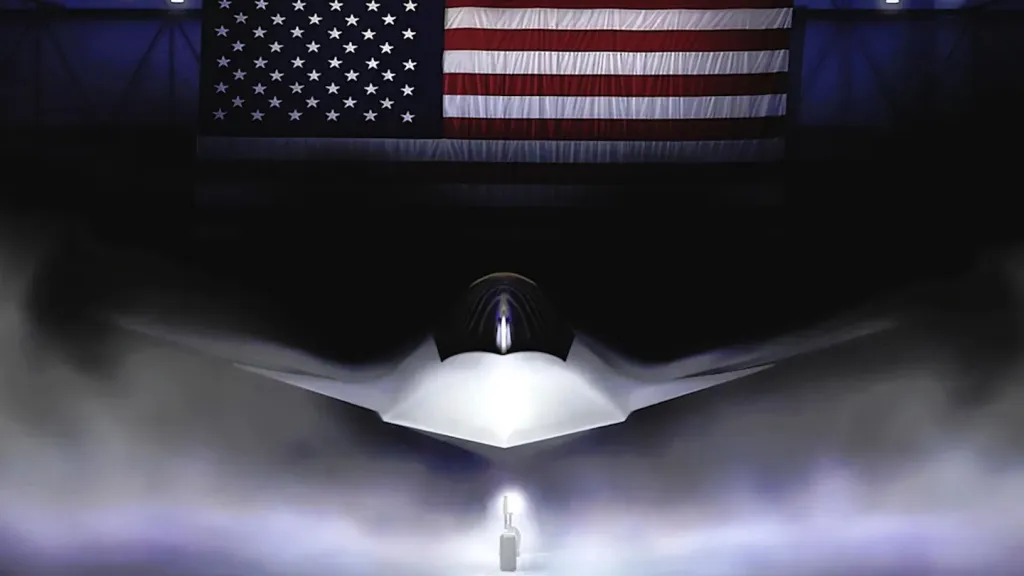
As noted, Boeing and Northrop Grumman are in competition to produce the F/A-XX, a program that first took shape as a Navy request for information in 2012. An earlier down-select reportedly eliminated Lockheed Martin in March 2025. Last August, Northrop Grumman released a rendering of its concept for the aircraft, showing a streamlined nose and landing gear on the front of a carrier with the tagline, “Project Power Anywhere.” Boeing’s concept, released the same month, drew visual comparisons to its F-47 Next-Generation Air Dominance fighter for the Air Force.
Citing classification, Adm. Caudle said today he couldn’t provide any information on design or payload details that give the Navy confidence in pursuing F/A-XX despite the adversary threats he mentioned. However, he suggested speed was increasingly essential to having a chance at maintaining overmatch.
“We monitor very closely, red-team that very hard, and assess that threat with a predicted trajectory of whether or not the existing designs we’ve seen will still overmatch that,” he said. “So I think we’re okay there, but we do know that our existing airframes could become vulnerable to some of those threats by the time [it’s fielded] … because it takes time to deliver that, that our existing airframes could be vulnerable to some of those threats, and we want to make sure the air wing of the future can still participate.”
Despite Caudle’s comments today, it should be remembered that this is not the first time that major progress on the Navy’s next-gen fighter has supposedly been imminent. Last October, Reuters reported the program had been greenlighted by Secretary of War Pete Hegseth, with a contract expected to follow in short order.
Aside from funding moves from Congress to ensure the survival of the F/A-XX program, no public steps have been taken to advance the program since.
WASHINGTON — If agony in high places is any measure, the war in Bosnia is already President Clinton’s Vietnam.
The President says that it is the issue he cannot stop worrying about at the end of the day; he takes the problem home at night and hashes it over with his wife, Hillary Rodham Clinton. The tragedy in the Balkans is “not only heartbreaking,” he said this week, “it’s infuriating.”
And Secretary of State Warren Christopher, a notably unemotional man, throws up his hands at the subject. “This is a problem from hell,” he declared. On Wednesday, Christopher met privately with author and Holocaust survivor Elie Wiesel to discuss the issue’s moral implications.
Clinton’s advisers have huddled for hours over the last three weeks to thresh out options for diplomatic and military action–and still have not reached a decision.
Like Lyndon B. Johnson, whose presidency was wrecked by the American military intervention in Vietnam, Bill Clinton faces an agonizing conflict between his international ideals and the potential cost of achieving them.
Beginning in last year’s presidential campaign, Clinton declared that the United States had a responsibility to stop the onslaught of Bosnia’s Serbs against the republic’s other ethnic groups, the Croats and Muslims. “We have an interest in standing up against the principle of ‘ethnic cleansing’ . . ,” he said earlier this month. “If you look at the other places where this could play itself out in other parts of the world, this is not just about Bosnia.”
Yet the President’s attempt to stop the Serbs through diplomatic pressure has failed. So Clinton, only three months into his presidency, faces an unpalatable choice between escalation and retreat–that, and a swelling national debate over the limits of American responsibility.
Since the fall of Saigon in 1975, Americans have argued over every potential military intervention in terms of Vietnam, whether the battlefield was Lebanon, Central America, the Balkans and even Desert Storm in its early days. Is Bosnia another quagmire, a war America should not enter because its price in blood will inevitably run too high? Or is it, as Christopher has asked, another Holocaust–a tragedy America must stop because the cost in innocent lives–and to America’s moral conscience–is too great to ignore?
All historical analogies are inexact, of course. But Vietnam and the Holocaust are the twin phantoms that haunt the Clinton Administration’s debate over what to do in the Bosnian highlands.
Last week, at the opening of Washington’s new Holocaust Memorial Museum, Clinton found himself confronted directly with one of history’s unwelcome ghosts, when Wiesel appealed to him to stop the war in Bosnia: “Something, anything must be done,” Wiesel pleaded.
At the same time, members of Congress and senior military officers are increasingly warning of the other pitfall. “All of us want to stop the tragedy in Bosnia,” said Sen. John McCain (R-Ariz.), a former pilot who spent five years as a prisoner of war in North Vietnam. “But . . . I’m not willing to risk another Vietnam.”
Clinton has tried to defuse such fears by promising that he is only considering the use of air power in Bosnia, not the introduction of ground troops. Responds McCain, “The fact is, militarily, if you want to affect the situation, you have to inject massive (numbers of) ground troops.”
The President and his advisers do not like the Vietnam analogy but they cannot escape it. Their own careers, their ways of thinking, were forged in the crucible of the nation’s longest war.
White House National Security Adviser Anthony Lake resigned his first White House job–under Richard M. Nixon, in 1970–to protest the relentless escalation of the war. Defense Secretary Les Aspin served as a young Army lieutenant on the Pentagon staff that planned the conflict. Secretary of State Warren Christopher, then a Justice Department official, was assigned to quell the sometimes-violent protests that followed.
And Clinton spent his college years struggling with the issue of the war–whether to volunteer, to resist the draft or, as he finally chose, to maneuver his way out of military service.
On the ground, diplomats and military experts say, Bosnia is not much like Vietnam at all–except, perhaps, for its mountains. In Vietnam, the United States faced a well-armed guerrilla army hardened by years of war against the colonial French. In Bosnia, the Serb militias are said to be ill-trained and ill-disciplined, and their weapons, while effective against their lightly armed Muslim foes, would have little effect against U.S. air power.
In Vietnam, the Communists had an important strategic ally in the Soviet Union. “That had a restraining influence on Johnson, who didn’t want to risk a nuclear confrontation with Moscow,” noted Patrick Glynn of the American Enterprise Institute. “The Serbs don’t have a big brother with nuclear weapons.”
Where the Vietnam analogy is most telling, officials said, is not in the hills of Bosnia but in the corridors of official Washington. Once again, an Administration is thinking about intervention in a tangled civil war–and hoping to find a low-cost way to do it.
“Are we looking at a pattern of decision-making that looks like Vietnam?” asked Glynn, who has advocated military intervention in Bosnia. “I worry that the Administration is falling into an old pattern–a gradualist approach that commits us to action but takes only small steps that don’t solve the problem.”
“The idea of taking only intermediate steps is very dangerous,” agreed John Steinbruner of the Brookings Institution.
“I really do sympathize with Clinton’s dilemma,” he added. “This could blow him out of the water. But I don’t think he can stay out and get away with it. And I don’t think he can do it the easy way. I’m afraid he’s going to have to organize an international coalition and intervene in a big way.”
So far, no one in the Administration has publicly called for that kind of massive intervention, which would presumably include the use of U.S. and allied ground troops. Instead, Clinton and his Cabinet appear closely divided over more limited options–principally, lifting a U.N. embargo to allow the Bosnian Muslims to import weapons and launching air strikes against the Serbs to stop their offensive and force them back to peace talks.
Clinton himself initially tried to stay away from the issue, aides said, hoping he could avoid being diverted from his ambitious domestic agenda. But in recent weeks, he has reluctantly concluded that he cannot escape. “I think it is a challenge to all of us . . . to take further initiatives in Bosnia,” he declared at the Holocaust museum last week. “I accept it.”
And Clinton has accepted the argument that a small, symbolic military action would be worse than none at all. “That shouldn’t be done just to say that people . . . will feel better that we did something,” he said in an interview with the Boston Globe earlier this week.
But he has not worked out how to enforce those high principles in practice. “The essence of the matter isn’t just punishing the Serbs. It’s establishing a principle that this is a breakdown in the world’s civil order and the world has to respond,” said Steinbruner.
Clinton, Christopher and others like to note that the dilemma in Bosnia is one that they inherited from the previous Administration of President George Bush.
But that is becoming cold comfort, as the problem rapidly becomes theirs as well.
“If Bush were in power, he’d be facing the same problems,” Steinbruner noted. “But Bush ignored the problem. The Democrats are reacting the way they do because they have a harder time writing these things off. They’re less ruthless about it. They worry more about the moral questions in foreign policy . . . and so they fall into the natural trap of trying to do something, but not too much.”
WASHINGTON — The Senate Banking Committee voted on party lines Wednesday to approve Kevin Warsh as the next chair of the Federal Reserve to replace Jerome Powell, a longtime target of President Trump’s insults for not cutting borrowing costs as far as the president wanted.
The vote was 13-11, with all Republican senators voting in favor and Democrats opposed.
Warsh is a former top Fed official but has also been a sharp critic of the institution and Powell’s leadership. He has called the inflation spike to 9.1% in 2022 the central bank’s biggest policy mistake in four decades. A vote on his nomination probably won’t take place until next month, but he could be confirmed by the time Powell’s term as chair ends May 15.
The Senate Banking vote is the first of two key events surrounding the future of the Fed’s leadership. Also Wednesday, Powell is presiding over what will probably be his last meeting of the Fed’s interest rate-setting committee. At a news conference Wednesday afternoon, Powell may indicate whether he will remain as a member of the central bank’s board of governors after his term as chair ends.
It would be unusual for Powell to stay, but doing so would deprive the Trump administration of an opportunity to appoint a new member to the board. Powell may choose to stay if he sees it as necessary to protect the Fed’s independence, which has become part of his legacy as its leader.
Sen. Tim Scott, a South Carolina Republican and chair of the committee, said Warsh is “battle tested” and added that, “It is incredibly important that we break the bind of Bidenomics on households across this nation.”
Sen. Elizabeth Warren, a Democrat from Massachusetts, criticized the banking panel for voting on Warsh’s nomination. Doing so “will bring the president one step closer to completing his illegal attempt to seize control of the Fed and artificially juice the economy,” she said, citing Trump’s effort to fire Fed governor Lisa Cook and investigate Powell.
The Fed on Wednesday is widely expected to leave its key rate unchanged at about 3.6% for its third straight meeting, defying Trump’s calls for lower rates.
Warsh has called for “regime change” at the Fed and could alter many of its practices, including the economics models it focuses on, how it communicates with the public, and how large its bondholdings will be in the long run.
Those changes could affect financial markets, but otherwise won’t necessarily be visible to the general public. But Warsh has also advocated for additional interest rate cuts, which could potentially lower borrowing costs for mortgages, auto loans, and business loans. He will face barriers to implementing those cuts anytime soon, however, largely because the Iran war has caused a spike in gas prices, pushing inflation to a two-year high of 3.3%.
The Fed typically keeps rates elevated, or even raises them, to combat worsening inflation.
Most of the other 11 members of the Fed’s rate-setting committee have indicated they would prefer to wait and evaluate where inflation and the economy are headed before making any changes to rates. It could take time for Warsh to build up enough influence to push for rapid rate cuts. He will also replace Stephen Miran, a member of the Fed’s rate-setting committee who was appointed by Trump last September and is the most consistent advocate for rate reductions at the central bank.
Warsh also faces questions about his independence from the White House, a key issue that dogged him during a Senate Banking hearing last week. On Wednesday, Warren said, “Mr. Warsh is a Trump sock puppet who is so cowed by the president that he could not even say that Trump lost the 2020 election.”
Last December, Trump called for much lower interest rates in a social media post, and added that “anyone who does not agree with me will never be Fed chair!” And just last week he told Fox Business that he expects rates to head lower, “when Kevin gets in.”
Warsh denied at his hearing, however, that Trump had ever pressured him directly to cut rates.
Four UK airports have found themselves in the top 10 of the ‘worst for delays’ across Europe, with one securing the top spot following average delays of almost two hours
Four UK airports have been named among the ‘worst for delays’ across Europe(Image: Getty Images/Stock Image)
A UK airport has been named the ‘worst in Europe’ for delays, while three other UK airports also found themselves in the top 10.
New research from AirAdvisor ranked Manchester Airport as the worst airport in Europe for hour-long flight delays. The airline comparison experts analyzed data from 9,594,711 flights across 46 European airports in 2025 to reveal results based on the percentage of flights delayed by 60 minutes or more (weighted at 70 percent) and the average length of those delays (weighted at 30 percent).
This saw Manchester take the top spot, with 6.16 percent of its flights delayed by 60 minutes or more in 2025 and an average delay of 116.7 minutes, which amounts to almost 2 hours. AirAdvisor AirData found that the routes from Manchester most prone to delays were to Amsterdam Schiphol, Paris Charles de Gaulle, and Dublin.
A Manchester Airport spokesperson told The Mirror: “This analysis of the Civil Aviation Authority’s data is misleading as it ignores important context – context which is directly referenced by the CAA in the notes accompanying the research and in the research itself. Punctuality is affected by factors that are outside of an airport’s control. The two most significant factors contributing to delays in the last year have been industrial action affecting air traffic control in Europe, and the weather. These were exacerbated by airspace restrictions above conflict zones meaning airports with significant long-haul networks, like Manchester, were more significantly affected than others.
“As an industry we are working collectively to achieve the best possible on-time departure rates, while protecting flight schedules and avoiding the need for cancellations.”
But it wasn’t just Manchester that found itself named among the worst. Birmingham, London Gatwick, and London Stansted joined the airport, making the UK the most represented country in the top 10.
London Gatwick was ranked the sixth worst in Europe, with a 5.24 percent rate of hour-long delays and an average delay of 111.88 minutes. According to the data, AirAdvisor found that the most impacted routes from Gatwick were to three major holiday hotspots: Barcelona, Malaga, and Lisbon.
In tenth place was Birmingham Airport, after the experts found that it scored a 5.26 percent rate of hour-long delays and an average duration of 108.01 minutes. The most disrupted routes from Birmingham were said to be flying to the popular destinations of Amsterdam, Dublin, and Paris Charles de Gaulle.
A Birmingham Airport spokesperson said: “Flight delays can happen for several reasons including industrial action and bad weather, some of which are out of an airport’s control. This month over half of all aircraft left on time and we continue to work hard to improve punctuality. Our colleagues work tirelessly to provide brilliant passenger service, with the vast majority of people rating their experience as excellent.”
Meanwhile, London Stansted came in joint tenth with Birmingham, after data found that it had a 5.5 percent rate of hour-long delays and an average delay of 106.24 minutes. AirAdvisor said the most delayed routes from Stansted were to Dublin, Edinburgh, and Istanbul Sabiha Gokcen.
A London Stansted Airport spokesperson told the Mirror: “It’s very important to put this analysis into perspective. The data looks at 46 airports but there are more than 340 major airports across Europe, so this represents a small and self-selective sample. This type of analysis of the Civil Aviation Authority’s data is misleading as it ignores important context – context which is directly referenced by the CAA in the notes accompanying the research and in the research itself.
“It should also be noted this research has been produced by a flight compensation company and looks specifically at delays of more than 60 minutes, which are often driven by wider factors such as air traffic restrictions, industrial action, adverse weather impacts and airline operations, airline crew shortages or delays to inbound flights rather than airport performance.
“Like all major airports operating in busy European airspace, punctuality on certain routes can be affected by congestion elsewhere in the network. We continue to work closely with airlines, air traffic control and partners across the aviation system to reduce disruption and keep journeys running as smoothly as possible for passengers.”
London Gatwick has been contacted by The Mirror for a comment.
Top 10 worst airports in Europe for long delays
Manchester, UK
Palma de Mallorca, Spain
Kraków Balice, Poland
Nice Côte d’Azur, France
Bucharest Henri Coandă, Romania
London Gatwick, UK
Porto, Portugal
Marseille Provence, France
Birmingham, UK
London Stansted, UK
Birmingham, London Gatwick, and London Stansted were contacted for comment.
Do you have a travel story to share? Email webtravel@reachplc.com
Atletico Madrid’s trip to Arsenal in the league phase feels a long time ago, but it will stick in their mind not just for the four goals they shipped, but for their struggles in attack.
Atletico produced only 0.32 xG from open play in that defeat and managed only one shot on target, so, if they are to take anything against Arsenal this time around, getting Julian Alvarez in the game will be key.
The Argentina forward has scored nine goals in the competition this season, more than any Atletico player had managed in a Champions League campaign.
He’s also a menace defending from the front, with a mammoth 853 high-intensity pressures – more than anyone else this season. That’s 70 per game on average.
That work ethic, ruthlessness in front of goal and the wizardry to bend a free-kick into the top corner, as Barcelona found out, make the 26-year-old vital to Atletico’s chances of progressing.
PLANNING a holiday, staycation or day out should be exciting but eye-watering prices can turn it into a wallet-draining nightmare.
But you don’t have to pay full whack. From dirt-cheap flights to cut-price hotels and bargain days out, there are loads of easy ways to cut the costs.
There are loads of ways you can save on your holidays, flights, accommodation and days outCredit: GettyTravel reporter Cyann Fielding has found all the best websites to save you cash on your holiday.Credit: Cyann Fielding
Whether you’re chasing a last-minute break, a cheap stay or discounted tickets, here’s how to do it for less and keep more cash in your pocket.
Websites
Secret Flying
The Secret Flying website hunts out super-cheap deals and “error fares” – bargain flights caused by pricing glitches – and links you straight to booking sites like Skyscanner.
It’s free to use and lists offers by region, but you’ll need to be flexible on dates and destinations to bag the best ones.
The biggest bargains sell out fast, so it’s worth signing up for alerts to stay one step ahead.
Holiday Hypermarket
Holiday Hypermarket is owned by the TUI group and is the discount website for TUI holidays where they guarantee that you won’t find a TUI, Marella or Crystal holiday cheaper anywhere else.
With up to 70 per cent off brochure prices, they sell a lot of last minute breaks – but with the same TUI flights, hotels and transfers.
Luxury Escapes
A website that offers high end holidays at affordable prices is Luxury Escapes.
They negotiate directly with hotels to get good deals on holiday bundles, including flights, accommodation and extras like free cocktails, massages and childcare.
Hostelworld
If you’re looking for something cheap and cheerful and don’t mind bunking up with other people then Hostelworld is a useful tool.
It will help you to search for hostels in the destination you’re heading to and compare prices.
It can also find hostels with private rooms too if you don’t want to share.
Cashback sites
While it might not save youmoneyon you’re current holiday – it could save you some cash on the next one.
At Quidco you can get at as much as 3.75 per cent on an EasyJet holiday (which works out at as £11 back on a £300 trip)
Or there is hotels.com, which gives you seven per cent cashback (£14 if you book a hotel for two nights at £200).
Other brands include TUI, British Airways, Trainline and Skyscanner. so it is worth checking if you can claim anything before you book.
Apps
02 Priority
If your phone contract is with O2, then you really should download Priority.
In addition to entering competitions to win holidays, you can often get discounts on holiday packages, concerts, and events.
For example, you can get four tickets to Vue cinemas for £18 or two for £9.
Or save £220 when you spend £2,000 with lastminute.com.
MiXR.
The MiXR. app shows local pubs, clubs and bars where you can reserve a table and pre-book food or drink packages.
But it can also get you savings.
Each time you spend money on your linked card at a partnered bar or pub, you’ll get points.
Get to 5,000 points and you’ll have a £5 voucher (each £1 you spend you get 50 points).
There are also offers on the app including 25 per cent off Camden Hells beer.
Apps such as MiXR. and Dusk can save you on drinks outCredit: Getty
Dusk
Dusk dubs itself ‘the free drink app’ and it isn’t lying.
The app shows you which bars and pubs in your area have deals on and the exact route to get there.
If you scroll, you’ll find specific venues have a sticker on them offering a free drink.
For example, it could say ‘free espresso martinis on Monday at 3pm’, which means you can get that drink for free if you visit that specific venue at the given time.
Some of the venues are marked with yellow stars which means you can earn points too.
Once you’ve collected a number of points you can exchange for drinks.
For example, 200 points gets you a free bottle of prosecco at Be At One, 500 points can get you 50 per cent off at Karaoke Room and so on.
You can use Dusk in a number of cities across the UK including London, Manchester, Birmingham, Liverpool, Brighton, Leeds, Newcastle, Nottingham, Cambridge, Oxford, Cardiff, Sheffield, Bath, Exeter, Norwich, Bournemouth, Hull and York.
Eat Club
Having only launched in the UK last year, Eat Club is now available in London and Manchester.
The app shows you nearby restaurants that have spare tables, great for last-minute plans.
You can also get great discounts, such as up to 50 per cent off of your bill.
There are also some apps that will save you money on food, such as Too Good To Go and Eat ClubCredit: Getty
Too Good To Go
Too Good To Go is an app that prevents food waste by selling off items leftover at the end of the day.
The app is partnered with a number of brands including Greggs and Pizza Express.
If you jump onto the app and use the map function, you will find stores near you that have bags of food to sell for a few quid before the end of the day.
Having used the app numerous times, I usually pay around £3.50 for a bag that contains over £20 worth of food.
I have even used it in New York, when finding a budget lunch option seemed impossible.
Unidays
If you are a student or recent graduate, you should sign up to an account with Unidays.
It is free to joing, you’ll just need your student email and then you can make savings such as getting two Cineworld tickets for £13 and 30 per cent off Hilton hotel stays.
If you are a student, there are a couple of student apps where you can get discountsCredit: Getty
Student Beans
Similar to the above, Student Beans is a discount app for anyone studying. With a student email you can benefit from discounts such as 25 per cent off of National Express travel and 10 per cent off of Ryanair flights.
Cheapskate London
Cheapskate London is a free newsletter released each Monday that shares the best free and cheap things to do across the capital.
Previous free events include educational talks, family activity sessions at museums, and even building your own wormery.
Accor
If you subscribe to the Accornewsletter, you will typically get 10 per cent off hotel stays.
You’ll also get exclusive offers and personalised deals.
Nectar
If you shop at Sainsbury’s and don’t have a Nectar account then you’re really missing out.
When you do your weekly food shop, you’ll rack up points which you can then use on your holiday.
For example, you can spend your points on Eurostar journeys, British Airways flights and more.
Loyalty programmes such as Nectar allow you to build points to use against things such as flightsCredit: Getty
Avios
Avios are loyalty points that you can collect and use mainly with British Airways for flights, hotels and upgrades.
You can earn them by flying with British Airways or its partners, as long as you have an account.
If you build up enough points, you can purchase flights and pay only a small cash fee for admin such as tax and fees.
Marriott Bonvoy
Marriott Bonvoy’s hotel loyalty programme is free to join and covers around 10,000 destinations across the globe.
Members earn points with each stay and then the points can be redeemed on free nights at Marriott Bonvoy hotels.
Hilton Honors
Hilton Honors is free to join, and much like Marriott Bonvoy, is the hotel’s loyalty programme.
Members earn points on stays and everyday activities which can then be redeemed on free stays and experiences as well.
Members tend to get 10 points per £1 spent.
Hotel chains often have their own loyalty programmes that offer 10 per cent discountsCredit: Getty
Paid-for memberships
The Nudge
Costing just £5 per month The Nudge is an insider’s guide to London and often reports on the latest openings in the capital.
The discounts are easy to find on the app and include deals like 40 per cent off at Greek seafood restaurant Kimu in Marylebone or 50 per cent off food at The Culpeper in Spitalfields.
There are also discounts on events such as 50 per cent off of tickets to Burger Fest in Richmond and even pampering treatments like £50 off facials at Skinwork in Soho or 40 per cent off access to Lowlu open-air sauna in Kentish Town.
The Nudge will also run member events such as exclusive supper clubs.
Blue Light
If you work in the NHS or the emergency services, you probably already know about Blue Light.
Blue Light, which costs £4.99 for a two-year membership, gets you discounts at major brands, restaurants and entertainment venues as well as £100 off your TUI holiday or 15 per cent off Away Resorts.
You can even get a discount on airport parking, such as five per cent at London Gatwick.
Railcard
Railcards aren’t just for youngsters, there are all sorts of railcards you can get.
In general, they will get you a third off most rail fares and cost between £30 and £35 each year.
Different railcards include 16-25-year-olds, 26-30-year-olds, Senior (over 60 years old) and Disabled Persons.
There’s also a Family and Friends Railcard which gets adults a third off their rail fare and then 60 per cent off kids’ rail fares if they are aged between five and 15 years old.
And if you are heading off on a number of staycations, make sure you have a railcardCredit: Alamy
Trusted Housesitters
Accommodation costs can bump up the total cost of your holiday, but there is a way around this.
With Trusted Housesitters, you can head to someone’s home and stay there while they are away and all you need to do is look after their pet.
It operates in 180 countries and essentially is a win-win system as the person going away needs a pet sitter and you want somewhere to stay.
Members pay an annual fee to use the platform, which range from £99 to £199.
Dis-loyalty
Dis-loyalty is a travel and food membership that costs £12 a month to join.
In return, you’ll earn points and get discounts on hotel stays, such as 50 per cent off newly opened hotels.
You can also grab a free hot drink each day at one of the membership’s participating locations.
Days Out with the Kids
Days Out with the Kids is the perfect site if you are looking for inspiration during the weekends or school holidays.
The website is partnered with over 8,500 attractions across the UK, and offers members access to exclusive discounts.
The membership costs £4.99 per month, but according to the website, it saves families an average of £12.99 per trip.
Hols from £9.50
If you want to head to a holiday park in the UK or Europe, The Sun’s Hols from £9.50 has over 20 holiday parks to choose from.
To benefit from the £9.50 deal, you have to collect five codewords printed in the paper over a set period of time and enter them on the Sun Holidays website.
Alternatively, to avoid needing a passcode you can join Sun Club for £1.99.
For more offers on holidays travel companies have revealed the cheapest places to book – with week-long holidays from £189.
With the upcoming May bank holidays and extra long weekends, this might be the best time to book a break by the seaside, and there are some beautiful UK destinations to choose from
This article contains affiliate links, we will receive a commission on any sales we generate from it. Learn more
The best UK coastal destinations have been revealed for a staycation (Image: Getty Images)
The UK’s best seaside destinations for a mini staycation have been named, from ‘coral’ beaches to turquoise waters and traditional beach huts lining the shores.
The UK is home to some of the most awe-inspiring landscapes, and the stretches of picturesque coastline more than account for that. From the whitewashed cliffs of Devon to Victorian piers stretching out to sea along the Somerset coast, and the azure waters of Cornwall that compare to those in the Caribbean.
With a whopping 1,500 beaches across the UK, we’re spoilt for choice on where to spend a weekend escape or mini-break by the seaside. Yet, some have been named the best of them all, and it’s in perfect time ahead of the May bank holiday weekends.
Following research by the staycation specialist, Sykes Holiday Cottages, the top 10 UK destinations that are best for a short coastal break have been revealed. Whether you’re looking for a seaside escape with the backdrop of mountain peaks, the pristine shores with sugar-white sand, or the traditional seaside fun with a pleasure pier, there’s somewhere to suit everyone.
Topping the list was the breathtakingly beautiful terrains of the Isle of Skye in Scotland, thanks to stretches of sprawling coastlines against the backdrop of rugged mountains and emerald-green valleys. The beaches are striking, with crystal-clear waters, dark volcanic shores and crushed maerl on the famed Claigan Coral Beach.
St Ives in Cornwall, known for its turquoise waters and golden sand beaches, modestly followed behind. Dubbed the ‘Cornish California’, it’s long been a favourite among Brits seeking a break in the coastal town, with surfing beaches, a charming harbour and sheltered bays.
One that might come as a surprise, beating the likes of Devon, is the diverse coastline of Whitby in North Yorkshire. Its main beach, West Cliff, is known for its wide stretches of golden sand, traditional beach huts, and rock pools, framed by a dramatic backdrop of rocky cliffs and the ruins of historic Whitby Abbey.
In fourth place was the lively coast of Brighton in East Sussex, with its iconic four-mile promenade, historic Palace Pier over its shingle beach and Victorian arches. Known as the ‘London by the Sea’, there’s an energetic atmopshere, a catalogue of eateries, shops and attractions, alongside its traditional seaside charm.
Another seaside spot that made the top five was the Causeway Coast in Northern Ireland, known for its 30-mile stretch of Atlantic coastline, sand beaches and white chalk cliffs. There are villages, towns, and harbours dotted near the coast, offering an idyllic weekend break against its picture-postcard vistas.
While Devon didn’t make the top five, its coast in Torquay put the holiday hotspot amongst the top 10, alongside Anglesey in North Wales and Bournemouth in Dorset. But it was Cornwall that was featured heavily on the list, with Newquay and Padstow also making the top 10 of the best seaside getaways.
Top 10 coastal destinations for a short break:
Isle of Skye, Scotland
St Ives, Cornwall
Whitby, North Yorkshire
Brighton, East Sussex
Causeway Coast, Northern Ireland
Torquay, Devon
Anglesey, North Wales
Bournemouth, Dorset
Newquay, Cornwall
Padstow, Cornwall
To book a staycation by the sea, visit the Sykes Holidays Cottages website. You can also call 01244 617 683, or download the Sykes Holiday Cottages app.
Kobe Bryant rookie trading cards aren’t particularly rare. And because rarity equates to value, standard issue 1997 cards featuring the late Lakers great retail for a pedestrian $100 to $300.
Then there are 1997 Kobe Bryant Metal Universe Precious Metal Gems Green cards, which just by typing that highfalutin name can give even the most savvy collector goose bumps.
The key word is green. Most Bryant rookie Metal Universe Precious Metal Gems cards have a red background and fetch around $300,000. Only 10 were made with a metallic green background and only three have been graded by respected grading firm Professional Sports Authenticator (PSA).
So green translates to greenbacks. Alt, a company that enables users to sell, buy and securely store collectible cards, announced Thursday it purchased one of those — take a breath first — 1997 Kobe Bryant Metal Universe Precious Metal Gems Green cards in a private transaction for $3.15 million.
The company said on Instagram that the purchase makes it the most expensive Bryant card ever sold, eclipsing the previous record of $2.4 million set in September. Another copy of the same card sold for $2 million in 2022.
“It was on every collector’s wall, in every price guide, at the top of every wish list,” Alt CEO Leore Avidar Avidar said on Alt’s Instagram page. “Acquiring it for our fund is personal, but it’s also a reflection of where this market has gone.”
The image of Bryant in midair passing — not shooting! — highlights the card, which earned a PSA 5 grade.
The card adds to Alt’s impressive collection. The fund set price records at time of purchase for LeBron James, Stephen Curry and Giannis Antetokounmpo cards in addition to the one of Bryant.
The most paid for a sports trading card was $12.932 million for a 2007-08 Upper Deck Exquisite Collection Dual Logoman Autographs signed card featuring Bryant and Michael Jordan last fall. The purchase was made by investor and “Shark Tank” personality Kevin O’Leary along with veteran collectors Matt Allen and Paul Warshaw and surpassed the previous record of $12.6 million held by a 1952 Topps Mickey Mantle card.
The Bryant/Jordan card is the second-most expensive sports collectible of all time behind Babe Ruth’s 1932 World Series “called shot” jersey, which sold for $24.12 million in 2024.
High-end Bryant cards remain coveted by collectors. Allen, well known in the industry as Shyne150, privately spent $4 million on two Bryant 1-of-1 signed Panini Flawless Logoman cards.
UCLA women’s basketball team has added some star power as its revamped roster begins to take shape.
Former Iowa State forward Addy Brown announced Thursday she is committing to UCLA, giving the Bruins one of the top players in the portal.
Brown averaged 11.9 points, 8.8 rebounds and 5.3 assists per game while shooting 43.1% from the floor and 33.8% from three-point distance with the Cyclones last season. She played just 21 games due to injury, but she is one of the better two-way players in the nation on the transfer market.
The 6-foot-2 forward co-starred with Audi Crooks for Iowa State the past few seasons and was a part of the mass exodus from the Cyclones’ program.
UCLA also signed Arkansas sophomore guard Bonnie Deas earlier this month. She is likely to start at point guard for the Bruins and is one of the best rebounding guards in the nation.
Along with returner Timea Gardiner, the Bruins are starting to form somewhat of a core to defend their national championship. Gardiner was a starter during UCLA’s 2024-25 Final Four run, but missed all of this past season with injury and has one season of eligibility left.
A lineup with Deas and Aarnisalo in the backcourt, Hunter at the three and Gardiner or Brown at the four and adding another big or Sienna Betts at the five would be a competitive lineup in the Big Ten.
Before going to TCU, Hunter played two seasons at Oregon State where she earned All-Pac-12 Defensive Team honorable mention and All-Pac-12 Freshman team honors. This past season with a Horned Frogs team that went to the Sweet 16, she was third in scoring with 10.2 points per game and averaged 3.2 rebounds per contest. She also shot 45.7% from the field and was 33.7% from beyond the arc.
Aarnisalo played her freshman year in Westwood after she originally committed to UCLA in 2025. Due to injuries from point guard Kiki Rice at the start of the 2024-25 season, she was forced into action early her freshman season and finished the year averaging 5.1 points per game.
The Helsinki, Finland, native averaged 10.2 points per game for the Tar Heels as a sophomore last season while shooting 47.3% from the field and 40.3% from the arc. The Bruins will desperately need to replace the three-point production lost with the departure of Rice, Gianna Kneepkens and Charlisse Leger-Walker.
UCLA coach Cori Close said she wanted to sign five players from the portal. She probably needs one more guard and a little more forward depth coming off the bench following the departures of Gabriela Jaquez and Angela Dugalic.
Lena Bilic and Amanda Muse are returners coming off the bench who got a little bit of playing time in the tournament and should have much larger roles, but they are still relatively unproven in late-game situations. They will get a chance to develop as backups with some more Power Four experienced starters now in the fold.