Top News

Top news of today about travel

U.S. imposes visa restrictions over gang violence in Haiti

A person rides a motorcycle through street fires, in Port-au-Prince, Haiti, on March 1, 2024, a day after gang violence left at least five dead and twenty injured. Gang violence in Haiti has surged since 2021. File Photo by Johnson Sabin/EPA-EFE

Nov. 24 (UPI) — The United States on Monday announced it was imposing visa restrictions on Haitian government officials the Trump administration accuses of supporting gangs and other criminal organizations in the Caribbean nation.

Individuals affected were not identified in the State Department press release, which said the move comes under a Biden-era policy targeting those who provide financial or material support to gangs and criminal organizations operating in Haiti.

“The United States remains committed to supporting Haiti’s stability and expects measurable progress toward free and fair elections,” the State Department spokesperson said.

“The Haitian people have had enough with gang violence, destruction and political infighting. The Trump administration will promote accountability for those who continue to destabilize Haiti and our region.”

Haiti has suffered from a political crisis and a surge in gang violence since President Jovenel Moise was assassinated in July 2021.

Criminal violence has since exploded, with gangs controlling much of Port-au-Prince. In a Nov. 12 press release, United Nations Integrated Office in Haiti said at least 1,247 people were killed and 710 injured between July 1 and Sept. 30 in the capital area. There were also 145 kidnappings and 400 victims of sexual violence, it said.

More than 1.4 million have been displaced across the country.

Between April 1 and June 30, there were at least 1,520 people killed and 609 injured, 185 kidnappings and 628 victims of sexual violence, the BINUM said in a previous update.

The Biden administration announced the visa restriction policy, under the Immigration and Nationality Act, in October 2022.

The move comes as the Trump administration is conducting an immigration crackdown.

The Trump administration has sought to end temporary protection status for Haiti, which shields some Haitian nationals in the United States from deportation. However, the move is being challenged in the courts.

Source link

‘Elite capture’: How Pakistan is losing 6 percent of its GDP to corruption | Business and Economy

Islamabad, Pakistan – A new assessment by the International Monetary Fund (IMF) has concluded that corruption in Pakistan is behind an economic crisis driven by “state capture” – where public policy is manipulated to benefit a narrow circle of political and business elites.

The Governance and Corruption Diagnostic Assessment (GCDA), finalised in November 2025, presents a grim picture of a system marked by dysfunctional institutions that are unable to enforce the rule of law or safeguard public resources.

Recommended Stories

list of 4 itemsend of list

According to the 186-page report, corruption in Pakistan is “persistent and corrosive”, distorting markets, eroding public trust and undermining fiscal stability.

The report, requested by the Pakistani government, warns that without dismantling the structures of “elite privilege”, the country’s economic stagnation will persist.

While corruption vulnerabilities are present at all levels of government, according to the report, “the most economically damaging manifestations involve privileged entities that exert influence over key economic sectors, including those owned by or affiliated with the state.”

The report argues that Pakistan stands to gain substantial economic benefits if governance improves and accountability is strengthened. Such reforms, it notes, could significantly lift the country’s gross domestic product (GDP), which stood at $340bn in 2024.

“Based on cross-country analysis of the reform experience of emerging markets, IMF analysis projects that Pakistan could generate between a 5 to 6.5 percent increase in GDP by implementing a package of governance reforms over the course of five years,” the report said.

Stefan Dercon, a professor of economic policy at the University of Oxford who has advised the Pakistani government on economic reforms, said that he agreed that the absence of accountability in corruption cases was eating away at the country’s economic potential.

“Failure of implementation [of laws and principles of accountability] gives vested interests too often free rein and addressing this must be at the core of efforts for economic reform,” he told Al Jazeera.

Here is what we know about the IMF report, the areas of weakness it highlights, the policy recommendations it makes, and what the experts say.

What does the IMF report say?

Pakistan has turned to the IMF 25 times since 1958, making it one of the fund’s most frequent borrowers. Nearly every administration, whether military or civilian, has sought IMF assistance, reflecting chronic balance of payments crises.

The current programme was started under Prime Minister Shehbaz Sharif.

Pakistan Prime Minister Shehbaz Sharif meets with managing director of the International Monetary Fund (IMF), Kristalina Georgieva, in Paris, France June 22, 2023. Press Information Department (PID)/Handout via REUTERS ATTENTION EDITORS - THIS PICTURE WAS PROVIDED BY A THIRD PARTY.
Pakistan Prime Minister Shehbaz Sharif, right, meets with the managing director of the IMF, Kristalina Georgieva, in Paris, France, June 22, 2023 [Handout/Prime Minister’s Office via Reuters]

The GCDA’s release comes ahead of the IMF executive board’s expected approval of a $1.2bn disbursement next month, part of the ongoing 37-month-long, $7bn programme.

Pakistan narrowly avoided default in 2023, surviving only after the IMF extended an earlier nine-month deal, which was followed by the ongoing 37-month programme.

According to the GCDA, Pakistan consistently ranks near the bottom of global governance indicators among nations. Between 2015 and 2024, the country’s score on control of corruption remained stagnant, placing it among the worst performers worldwide and within its neighbourhood.

At the heart of the IMF’s findings is the concept of “state capture”, where, according to the fund, corruption becomes the norm and, in fact, the primary means of governance. The report argues that the Pakistani state apparatus is frequently used to enrich specific groups at the expense of the broader public.

The report estimates that “elite privilege” – defined as access to subsidies, tax relief and lucrative state contracts for a select few – drains billions of dollars from the economy annually, while tax evasion and regulatory capture crowd out genuine private sector investment.

These findings echo a 2021 United Nations Development Programme (UNDP) report, which said economic privileges granted to Pakistan’s elite groups, including politicians and the powerful military, amount to roughly 6 percent of the country’s economy.

Ali Hasanain, an associate professor of economics at the Lahore University of Management Sciences, said the IMF’s description of elite capture is accurate but added that it was “hardly a revelation”.

He pointed to the 2021 UNDP report and other domestic studies that describe how Pakistan’s economic system has long served politically connected actors who secure “preferential access to land, credit, tariffs and regulatory exemptions.”

“The IMF diagnostic repeats what many domestic studies, including those by the World Bank and Pakistan’s own institutions, have already emphasised: Powerful interests shape rules to maintain their advantage,” he told Al Jazeera.

The new report notes that tax expenditures, including exemptions and concessions granted to influential sectors such as real estate, manufacturing and energy, cost the state 4.61 percent of GDP in the 2023 fiscal year alone.

It also calls for an end to special treatment for influential public sector entities in government contracts and urges greater transparency in the functioning of the Special Investment Facilitation Council (SIFC).

The SIFC, created in June 2023 during Sharif’s first term, is a high-powered body comprising civilian and military leaders and tasked with promoting investment by easing bureaucratic obstacles. Although positioned as a flagship initiative jointly owned by the government and the military, it has faced sustained criticism for a lack of transparency.

The report describes broad legal immunity granted to SIFC officials, many from the armed forces, as a major governance concern. It warns that this immunity, combined with the council’s authority to exempt projects from regulatory requirements, creates significant risks.

Highlighting the absence of transparency, the GCDA says the SIFC should publish annual reports with details of all investments it has facilitated, including concessions granted and the rationale behind them.

“The recently established Special Investment Facilitation Council, which has been vested with substantial authority to facilitate foreign investments, operates with untested transparency and accountability provisions,” the report said.

Judiciary and rule of law

The report identifies the judiciary as another critical bottleneck. Pakistan’s legal system is overwhelmed by more than two million pending cases. In 2023 alone, the number of unresolved cases before the Supreme Court increased by 7 percent.

Over the last 12 months, Pakistan has passed two constitutional amendments, both of which faced severe backlash from many in the legal community who said that they represent a “constitutional surrender”. In essence, the amendments create a parallel Federal Constitutional Court that critics say will reduce the powers of the Supreme Court, while also changing rules that guide how judges are appointed and transferred, in ways that opponents say could give the executive great control over whom to promote and whom to punish.

The government, however, has insisted that the changes were made to improve the efficiency and efficacy of the judicial system.

Similar credibility challenges affect the National Accountability Bureau (NAB) and the Federal Investigation Agency (FIA), the two principal bodies responsible for investigating corruption.

The GCDA cites a 2024 government task force, which found that NAB has, at times, exceeded its mandate and launched politically motivated cases. This selective accountability, the report says, has damaged public trust and created a climate of fear within the bureaucracy, slowing decision-making.

While NAB says it recovered 5.3 trillion rupees ($17bn) between January 2023 and December 2024, the report notes that conviction rates remain low.

The diagnostic calls for fundamental reforms to NAB’s appointment processes to ensure independence and a shift from “political victimisation” to “rule-based enforcement”.

Was the report necessary?

The IMF outlines reforms which experts acknowledged would be comprehensive if pursued by authorities.

Yet analysts also note that international institutions and domestic researchers have repeatedly made similar observations in the past, with little follow-through by the government.

Sajid Amin Javed, a senior economist at the Sustainable Development Policy Institute (SDPI) in Islamabad, says the fact that Pakistan is already under an IMF programme may compel the government to take the findings more seriously.

He said that the IMF report could have gone further than it has by acknowledging that many of its recommendations have been made by others in the past, “without bringing any change”.

“Perhaps the assessment could have been made to see why these failures happened,” he said.

Javed welcomed the report’s attempt to quantify economic losses from corruption, hoping it might push policymakers to act.

“Corruption and governance are intrinsically tied to each other. Corruption leads to weak governance, and weak governance promotes corruption, making them conjoined,” he said.

Hasanain, however, was more sceptical, questioning why the IMF waited for a formal request from the Pakistani government despite having its own internal assessment mechanisms.

Pakistani rickshaw drivers chant slogans during a protest against the recent increasing in petrol prices, Friday, June 3, 2022. Pakistani government massively increased in petrol to revive IMF program draws. (AP Photo/K.M. Chaudary)
Pakistan’s economy was close to a default in June 2023, before the resumption of the IMF’s support programme  [File: KM Chaudhry/AP Photo]

What can the government do?

Analysts said Pakistan’s economic landscape has long been shaped by politically connected actors who enjoy preferential access to land, credit, tariffs and regulatory exemptions. The IMF’s observations, they noted, are not new.

Hasanain argues that corruption, including elite capture of markets, regulatory bodies and public policy, is political in nature and cannot be addressed without deeper reforms.

“Without a broader political awakening, governance reforms will remain technical fixes built on unstable foundations. Ultimately, elite capture is undone only when political incentives change,” he said.

Javed, meanwhile, pointed to what he called policy design capture, arguing that those responsible for drafting governance and anticorruption reforms are often part of the same elite ecosystem.

“Elite policy capture on policy design is perhaps the most important component which allows the elite capture. The report’s recommendations show that we must go for participatory and inclusive methods to get out of our current conundrum,” he said.

For Hasanain, the most urgent reform is a unified economic turnaround plan that is fully owned by the prime minister and communicated clearly.

He said that Pakistan’s economic landscape was cluttered with “committees, councils, task forces and overlapping ministries”, each producing its own documents without accountability.

“The government should consolidate these scattered structures into one clear reform platform with defined priorities, timelines and measurable outcomes. Progress should be published monthly, debated publicly, and subjected to independent scrutiny,” he said.

Hasanain argued that such consolidation would improve coordination, build public trust and signal seriousness to investors.

For Javed, the most immediate priority is reforming the public procurement system, which governs how government bodies buy goods and services using public funds.

“Our procurement system is not working on value of money, but instead it focuses on quantity of money, where lowest bidder wins the bid,” he said, arguing that this approach meant that contracts often did not go to those best suited to deliver what was needed. “This system needs urgent modernisation.”

“An urgent realisation is the order of the day that if we need to have a flourishing, transparent economy, we have no choice but to overhaul our entire economic framework,” Javed said.

Source link

Russia-Ukraine war: List of key events, day 1,370 | Russia-Ukraine war News

Here are the key events from day 1,370 of Russia’s war on Ukraine.

Here’s where things stand on Tuesday, November 25.

Trump’s plan

  • Ukrainian President Volodymyr Zelenskyy said that a proposed peace plan now under discussion with the United States and Europe has incorporated “correct” points, but sensitive issues still need to be discussed with US President Donald Trump.
  • Zelenskyy added that if negotiations proceeded on resolving the war, “there must be no missiles, no massive strikes on Ukraine and our people”.
  • Trump also hinted at new progress in the talks, which took place in Geneva. “Is it really possible that big progress is being made in Peace Talks between Russia and Ukraine??? Don’t believe it until you see it, but something good just may be happening,” he wrote on Truth Social.
  • A senior official told the AFP news agency that the US pressed Ukraine to accept the deal in Geneva, despite Kyiv’s protests that the plan conceded too much to Moscow. The official said Washington did not directly threaten to cut off aid if Kyiv rejected its deal, but that Ukraine understood this was a distinct possibility.
  • White House Press Secretary Karoline Leavitt clarified that there is no meeting scheduled between Trump and Zelenskyy this week amid reports of a possible trip by the Ukrainian leader to the US capital.
  • Leavitt told US broadcaster Fox News that “a couple of points of disagreement” remain between the US and Ukraine on a potential deal to end Russia’s invasion.
  • Leavitt also pushed back against criticism, including from within Trump’s Republican Party, that the president is favouring Russia in efforts to end the war in Ukraine, describing those statements as “complete and total fallacy”. She said the US president was “hopeful and optimistic” that a plan could be worked out.
  • Kremlin spokesman Dmitry Peskov said Russia would wait to see how talks between the US and Ukraine on a potential peace plan pan out, and would not be commenting on media reports about such a serious and complex issue.
  • But Kremlin foreign policy aide Yuri Ushakov said that a European counter-proposal to a US 28-point peace plan for Ukraine was “not constructive” and that it simply did not work for Moscow.
  • British Prime Minister Keir Starmer said there was more work to do to establish a “just and lasting peace” in Ukraine, but added that progress was being made.
  • Finland’s President Alexander Stubb, too, welcomed progress made at the meetings in Geneva, but added that major issues remain to be resolved.
  • Polish Prime Minister Donald Tusk said no deal regarding Ukraine can be allowed to undermine the security of Poland and Europe; on the contrary, it should strengthen it.
  • German Foreign Minister Johann Wadephul said that the talks in Geneva on amending Trump’s 28-point plan to end the war with Russia had produced a “decisive success” for Europeans. Swedish Foreign Minister Maria Malmer Stenergard said that to achieve a lasting peace in Ukraine, its borders can’t be changed by force and there can’t be limitations on Ukraine’s military that would invite further Russian aggression.
  • Turkish President Recep Tayyip Erdogan told Russia’s Vladimir Putin in a phone call that Ankara will contribute to any diplomatic effort to facilitate direct contact between Russia and Ukraine and to reach a “just and lasting” peace, his office said.

Fighting

  • Powerful explosions rocked Ukraine’s capital, Kyiv, on Tuesday as the Ukrainian air force issued a warning about missile attacks across the country.
  • Russia’s Ministry of Defence said the country’s air defences shot down 10 drones en route to Moscow, a day after a Ukrainian strike on a power plant cut off heating in a town near the capital. Moscow Mayor Sergei Sobyanin said emergency services were clearing up sites where debris from drones had fallen.
  • The Defence Ministry added that a total of 50 Ukrainian drones were downed across the Moscow, Bryansk, Kaluga and Kursk regions, as well as Crimea and over the waters of the Black Sea.

Politics

  • Polish prosecutors have arrested and charged a third Ukrainian man suspected of collaborating with Russia to sabotage a rail track, authorities said. Two other Ukrainians, who fled to Belarus, had already been charged in absentia over the blast on the Warsaw-Lublin line connecting Warsaw to the Ukrainian border.

  • Two young street musicians who were jailed for more than a month in Russia for singing anti-Kremlin songs have left the country after being released from detention, according to Russian media reports. Vocalist Diana Loginova, 18, and guitarist Alexander Orlov, 22, were detained on October 15 in central St Petersburg after an impromptu street performance deemed critical of Putin and the government.

Energy

  • Oil prices climbed about 1 percent on mounting doubts about whether Russia will get a peace deal with Ukraine that will boost Moscow’s oil exports. Brent futures rose 81 cents, or 1.3 percent, to settle at $63.37 a barrel. West Texas Intermediate (WTI) crude gained 78 cents, or 1.3 percent, to settle at $58.84.

  • Four opposition Democratic US senators, including Elizabeth Warren, said that the lax enforcement by the Trump administration of sanctions on Russia’s Arctic LNG 2 export terminal has allowed China to buy discounted liquefied natural gas and has helped Moscow fund the war in Ukraine.

  • A heating and power plant in Russia’s Moscow region has resumed operations after shutting down due to a fire caused by a Ukrainian drone strike on Sunday, regional governor Andrei Vorobyov said.

  • Russia’s Black Sea port of Tuapse resumed oil product exports last week after a two-week suspension following Ukrainian drone attacks, while the local oil refinery has restarted processing crude, the Reuters news agency reported, citing industry sources and data.
  • Russian state oil and gas revenue may fall in November by about 35 percent from the corresponding month in 2024 to 520 billion roubles ($6.59bn) due to cheaper oil and a stronger local currency, according to calculations and analysis by Reuters.

Source link

Illinois police capture ‘Slender Man’ attacker after leaving group home

Nov. 24 (UPI) — Police in Illinois said they captured Morgan Geyser, one of the two people who pleaded guilty to stabbing a friend to appease an imaginary creature called Slender Man, 165 miles from the Wisconsin group home where she was staying.

Geyser, 23, allegedly cut off her monitoring bracelet Saturday night before leaving the residence in Madison and meeting up with an acquaintance.

In an incident report, Madison police said the Department of Corrections received an alert around 9:30 p.m. Saturday that Geyser’s GPS monitoring bracelet was malfunctioning. Around 11:35 p.m., group home staff informed DOC that Geyser was not at the home and she had removed her GPS bracelet.

On Sunday night, police in Posen, Ill., a suburb south of Chicago, told ABC News that law enforcement officials took her into custody. Madison police confirmed her capture to CNN.

Madison police said they received confirmation at 10:34 p.m. Sunday that Geyser had been taken into custody in Illinois.

The Posen police said officers found Geyser at a truck stop with another person, identified as a 42-year-old man, who was arrested on charges of criminal trespassing and obstructing identification, WBBM-TV in Chicago reported.

Geyser is scheduled for an extradition hearing on Tuesday in Chicago. She is not facing any charges in Illinois.

Geyser and the friend were found at a truck after police received reports of two people loitering behind the building. They were sleeping on the sidewalk.

Initially, Geyser gave police a false name. She then told police she didn’t want to give her name because she had “done something really bad,” and officers could “just Google” her.

The friend told WBBM-TV she didn’t want Geyser to be alone after Geyser left the group.

They took a bus and then walked to the truck stop.

Geyser and Anissa Weier pleaded guilty to the 2014 stabbing of their friend, Payton Leutner, when all three girls were 12. Geyser and Weier lured Leutner into the woods where they stabbed her 19 times. They told police a creature known as Slender Man threatened their lives and the lives of their families if they didn’t kill Leutner, who survived the attack.

Geyser and Weier were charged with attempted second-degree murder in 2017 but were found not guilty by reason of mental defect.

Waukesha County Circuit Judge Michael Bohren committed them to a psychiatric hospital for 40 years.

Psychiatrists diagnosed Geyser with schizophrenia and she was released to a group home this year.

A spokesperson for the Leutner family released a statement saying they were aware of Geyser’s disappearance.

“Payton and her family are safe and are working closely with local law enforcement to ensure their continued safety,” a statement said.

“The family would like to thank all of the law enforcement entities involved in the efforts to apprehend Morgan.”

The demolition of the East Wing of the White House is seen during construction in Washington, on Monday. President Donald Trump began demolishing the East Wing last month to build a $200 million ballroom at the property. Photo by Bonnie Cash/UPI | License Photo

Source link

G20 fails to deliver on sovereign debt distress | Debt News

Heads of state from the world’s most powerful countries gathered in Johannesburg, South Africa, over the weekend for a summit that had been billed, under South Africa’s G20 presidency, as a turning point for addressing debt distress across the Global South.

South African President Cyril Ramaphosa had consistently framed the issue as central to his agenda, arguing that spiralling repayment costs have left governments, particularly in Africa, with little room to fund essential services like healthcare and education.

Recommended Stories

list of 4 itemsend of list

But despite repeated pledges – including in the leaders’ summit declaration to “strengthen the implementation of the G20 Common Framework” – South Africa did not deliver any new proposals for easing fiscal constraints in indebted nations.

Hopes that world leaders would use the G20 summit to tackle sovereign debt distress were further dashed when United States President Donald Trump, at odds with South Africa over domestic policies, skipped the meeting altogether amid Washington’s retreat from multilateralism.

The summit also marked the close of a brief period of Global South leadership in the G20, following presidencies held by Indonesia in 2022, India in 2023, and Brazil in 2024. The US is set to assume the G20 presidency on December 1.

Debt ‘vulnerabilities’

The G20 – which consists of 19 advanced and emerging economies, the European Union and the African Union – represents 85 percent of global gross domestic product (GDP) and roughly two-thirds of the world’s population.

In October, G20 finance ministers and central bank chiefs met in Washington and agreed to a consensus statement on debt.

“We recognise that a high level of debt is one of the obstacles to inclusive growth in many developing economies, which limits their ability to invest in infrastructure, disaster resilience, healthcare, education and other development needs,” the statement said.

It also pledged to “reaffirm our commitment to support efforts by low- and middle-income countries to address debt vulnerabilities in an effective, comprehensive and systematic manner”.

The communique committed to improving the much-criticised Common Framework, a mechanism launched by the G20 five years ago to accelerate and simplify debt restructuring – when countries have to reprofile debts they can no longer afford to repay.

Elsewhere, the statement advocated for greater transparency around debt reporting and more lending from regional development banks.

Record-high debt levels

According to the Institute of International Finance, a banking industry association, total debt in developing countries rose to a record high of $109 trillion by mid-2025.

In recent years, COVID-19, climate shocks and rising food prices have forced many poor countries to rely on debt to stabilise their economies, crowding out other investments. For instance, the United Nations recently calculated that more than 40 percent of African governments spend more on servicing debt than they do on healthcare.

Africa also faces high borrowing costs. In 2023, bond yields – the interest on government debt – averaged 6.8 percent in Latin America and the Caribbean, and 9.8 percent in Africa.

Meanwhile, Africa collectively needs $143bn every year in climate finance to meet its Paris Agreement goals. In 2022, it received approximately $44bn.

At the same time, countries on the continent spent almost $90bn servicing external debt in 2024.

No progress

Shortly before the release of the G20’s final communique, 165 charities condemned the group’s slow progress on debt sustainability and urged President Ramaphosa to implement reforms before transferring the G20 presidency over to the US in December.

“While this year’s G20 has been put forward as an ‘African G20’, there is no evidence that any progress has been made on the debt crisis facing Africa and many other countries worldwide during the South African presidency,” the group said in a letter.

The missive called on the International Monetary Fund (IMF) to sell its gold reserves and set up a debt relief fund for distressed governments. It also backed the creation of a ‘borrowers club’ to facilitate cooperation among low-income countries.

The call for a unified debtor body reflects growing frustration with existing frameworks, notably the Paris Club, in which mostly Western governments, but not China, have exerted undue influence over the repayment policies of debtor nations.

In May 2020, the G20 launched a multibillion-dollar repayment pause to help poor countries cope with the COVID‑19 crisis. Known as the Debt Service Suspension Initiative, the programme is continuing to provide relief to some participating countries.

The launch of the Common Framework, soon afterwards, was designed to coordinate debt relief among all creditors. At the time, the initiative was hailed as a breakthrough, bringing together the Paris Club, China and private creditors to help prevent a full-blown debt crisis in developing countries.

But coordinating equal treatment, including government lenders, commercial banks, and bondholders, has made the process slow and prone to setbacks.

To date, none of the countries that joined the Common Framework – Ethiopia, Zambia, Ghana, and Chad – have completed their debt restructuring deals.

And even then, the programme has relieved just 7 percent of the debt costs for the four participating nations, according to ONE Campaign, an advocacy group.

‘Outmanoeuvred’

In March, South Africa convened an expert panel – headed by a former finance minister and a former Kenyan central banker – to explore how to assist heavily indebted low-income countries, particularly in Africa.

In a report released earlier this month, the panel echoed many of the ideas put forward by the 165 charities that wrote to Ramaphosa in October, calling for measures like an IMF-backed special debt fund and the formation of a debtors’ club.

But the experts’ proposals “weren’t even acknowledged at the leaders’ summit”, Kevin Gallagher, director of Boston University’s Global Development Policy Center, told Al Jazeera. He said that the G20 presidency “failed to address the scale of the global debt problem”.

“Ultimately,” Gallagher added, “South Africa was outmanoeuvred by larger, more economically important members of the G20 who saw little benefit to themselves in reforming the international financial architecture on debt.”

‘Double whammy’ of debt

In the early 2000s, the IMF, World Bank and some Paris Club creditors cancelled more than $75bn of debt – roughly 40 percent of external obligations – under the Heavily Indebted Poor Countries Initiative.

Since then, however, many developing countries have slipped back into the red. After the 2008 financial crisis, private creditors poured money into low-income economies, steadily replacing the cheaper loans once offered by institutions like the World Bank.

Between 2020 and 2025, almost 40 percent of external public debt repayments from lower-income countries went to commercial lenders. Just one-third went to multilateral institutions, according to Debt Justice, a United Kingdom-based charity.

China has also emerged as the world’s largest single creditor, especially in the Global South, committing more than $472bn through its policy banks – such as the China Development Bank and the Export-Import Bank – between 2008 and 2024.

“On top of debt becoming more expensive over the past 10 or 15 years, there is now a wider universe of lenders that developing countries have turned to,” says Iolanda Fresnillo, a policy and advocacy manager at Eurodad, a civil society organisation.

“It’s been a double whammy. Debt is now costlier and harder to resolve,” she said, noting the difficulty of coordinating creditors in a restructuring. Protracted debt crises slow growth by squeezing public investment.

Overcoming these hurdles is made harder when creditors pursue competing commercial interests. Fresnillo says an independent debt-restructuring body, designed to shorten negotiation times and limit economic costs, could help.

In September, the head of the UN Conference on Trade and Development (UNCTAD), Rebeca Grynspan, said, “There is no permanent institution or system that is there all the time dealing with debt restructuring … maybe we can create new momentum.”

However, talk of an international sovereign debt restructuring mechanism isn’t new. The IMF spearheaded a push for a neutral body – which would be akin to a US bankruptcy court – in the late 1990s.

The Fund’s proposed restructuring mechanism faced swift pushback. Major creditor countries, particularly the US, opposed ceding power to an international body that could override its legal system and weaken protections for US investors.

Still, “the need for this type of international solution is obvious”, says Fresnillo. “Having a basic set of rules, as opposed to an ad hoc negotiation for every new debt crisis, should be a bare minimum.”

She added that “adopting a global standard on taxing transnational corporations could also guarantee a baseline of revenues for low-income countries. But with multilateral cooperation so weak right now, I wouldn’t hold my breath.”

Source link

Pentagon agency wants to exhume, ID remains from Pearl Harbor attack

Nov. 24 (UPI) — A federal agency wants to exhume unknown servicemembers who died in the Pearl Harbor attack in Honolulu, Hawai, including on the battleship Arizona, 84 years ago.

The Defense Department’s Prisoner of War/Missing in Action Accounting Agency announced it “will seek exhumation of dozens of unknowns from the Pearl Harbor attack once an advocacy group is confirmed to have reached the required mark in its genealogy work,” Stars & Stripes reported last week. The agency has a searchable list of missing military personnel dating to World War II.

They want to remove 86 sets of commingled remains buried as unknowns from the Arizona in the National Memorial Cemetery of the Pacific and 55 sets of remains with no known ship affiliation, DPAA director Kelly McKeague told Stars & Stripes.

Since the surprise attack on Dec. 7, 1941, the Arizona has been underwater as a gravesite for more than 900 entombed.

The Pearl Harbor National Memorial straddles the sunken battleship with an oil sheen. The names of all 1,177 casualties are engraved on a marble wall in the Shrine Room of the memorial.

The U.S. Navy considers the site a final resting place.

In all, 2,403 were killed at Pearl Harbor, including on the USS Oklahoma with 429 fatalities.

Of the ship’s dead, 277 of the sailors and marines are buried in Honolulu’s National Memorial of the Pacific with the 86 unknown remains.

The Pentagon requires a general threshold of family reference samples from 60% of the “potentially associated service members” before removal.

With the Arizona, that means 643 families. Once the threshold had been reached, final approval from the Defense Department can be sought.

The Armed Forces DNA Identification Laboratory had DNA from 613 families and is awaiting additional test kits, DPAA director Kelly McKeague said.

Rear Adm. Darius Banaji, the agency’s deputy director, said in 2021 the Navy had no plans to exhume the remains and try to identify them because there is insufficient documentation, the Military Times reported.

It would cost approximately $2.7 million and take 10 years to track down enough families.

In 2023, Virginia-based real estate agent Kevin Kline formed Operation 85 with a “mission to identify 85 or more crew members removed from the ship in 1942, or found near the U.S.S. Arizona after the attack, never identified, and left buried in commingled graves ten miles away from Pearl Harbor, marked only as “UNKNOWN USS ARIZONA.”

His great-uncle, Robert Edwin Kline, a gunner’s mate second class petty officer, was among those killed on the Arizona, and his remains were never recovered or identified.

Kline brought in research analysts and a forensic genealogist to track down the appropriate family member DNA donors and worked with the Navy and Marine Corps casualty offices to send DNA kits to the families.

They have tracked down 1,415 family members from 672 families

“What DPAA is preparing to do now is exactly the mission we built the foundation for,” Kline said. “When the system said ‘no,’ families stepped forward and made ‘yes’ possible.”

James Silverstein is a California attorney and maternal grandnephew of Pearl Harbor casualty Petty Officer 2nd Class Harry Smith.

“So much hard work and dedication has gone into something that should have been so uncontroversial, yet has been so difficult to receive approval for,” he told Stars & Stripes. “It will be such a glorious homecoming and well-deserved sendoff when they are identified.”

Source link

Ethiopian volcano erupts after lying dormant for 12,000 years | Volcanoes News

No casualties reported, but local resident of Afar region says impact of eruption ‘felt like a sudden bomb had been thrown’.

A long-dormant volcano in northern Ethiopia has erupted, sending plumes of ash across the Red Sea towards Yemen and Oman.

The Hayli Gubbi volcano in the Afar region of Ethiopia, located about 800 kilometres (500 miles) northeast of Addis Ababa, erupted for several hours on Sunday morning, leaving the nearby village of Afdera covered in ash.

Recommended Stories

list of 3 itemsend of list

There were no casualties from the eruption, which sent thick plumes of smoke up to 14km (nine miles) into the sky, sending ash clouds to Yemen, Oman, India, and northern Pakistan, according to the Toulouse Volcanic Ash Advisory Centre (VAAC) in France.

Ahmed Abdela, a resident of the Afar region, said it “felt like a sudden bomb had been thrown”. Many people who had been heading to the Danakil desert, a local tourist attraction, were left stranded in ash-covered Afdera on Monday, he said.

Mohammed Seid, a local administrator, said there were no casualties, but the eruption could have economic implications for the local community of livestock herders.

Hayli Gubbi volcano
The Hayli Gubbi volcano erupted for the first time in 12,000 years, spewing ash clouds in the Afar region in Ethiopia [Afar Government Communication Bureau via Anadolu]

“While no human lives and livestock have been lost so far, many villages have been covered in ash, and as a result, their animals have little to eat,” he said.

The volcano, which rises about 500 metres in altitude, sits within the Rift Valley, a zone of intense geological activity where two tectonic plates meet.

The Smithsonian Institution’s Global Volcanism Program said Hayli Gubbi has had no known eruptions during the current geological epoch, which experts know as the Holocene.

The Holocene began approximately 12,000 years ago at the end of the last Ice Age.

Afar authorities have not yet reported casualties.

Source link

Trump shields U.S. steelmaking coal from Clean Air Act rules

The logo of U.S. Steel pictured in May on a plant near Braddock, Pa. On Friday, the Trump administration issued a proclamation exempting coal-using steel manufacturing facilities called “coke ovens” from Biden-era regulatory updates to the Clean Air Act. File Photo by Archie Carpenter/UPI | License Photo

Nov. 24 (UPI) — U.S. President Donald Trump issued a proclamation granting two years of regulatory relief from a stringent, existing Environmental Protection Agency on coke over facilities.

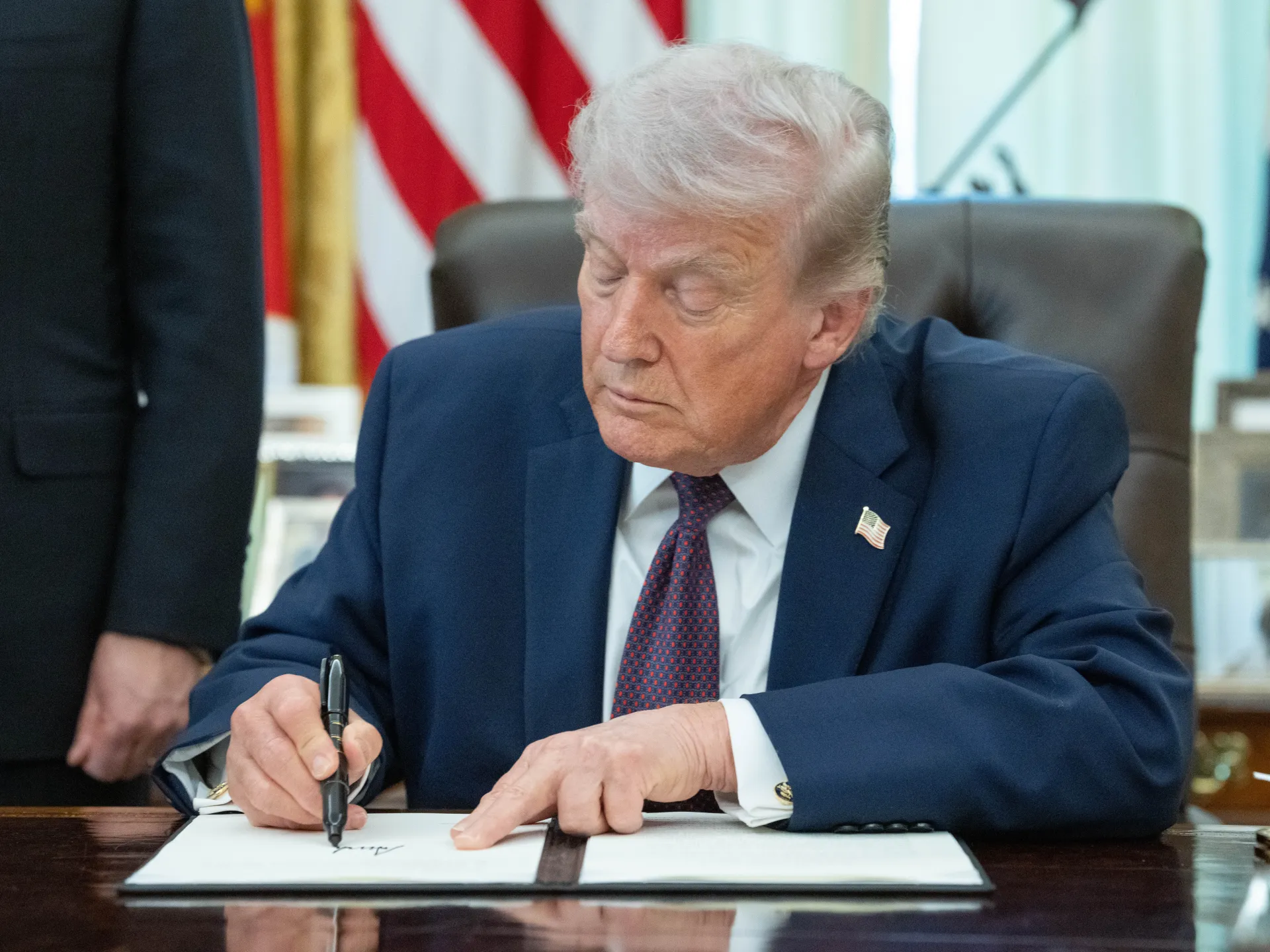
rump inked a proclamation Friday that exempts manufacturing facilities from Biden-era regulatory updates to the Clean Air Act that affect coal in steelmaking plants known as coke ovens.

The Coke Oven Rule, according to the White House, “places severe burdens on the coke production industry and, through its indirect effects, on the viability of our nation’s critical infrastructure, defense, and national security.”

A coke oven is a chamber in which coal is flamed to produce coke, which then fuels steelmaking. The Biden EPA estimated compliance cost would cost companies about$500,000 in additional fees.

The Trump administration’s new policy switch will absolve at least 11 U.S. coke oven plants from a need to cut back on release of toxic pollutants, including mercury, formaldehyde, soot and dioxins for two years.

“Specifically, the Coke Oven Rule requires compliance with standards premised on the application of emissions-control technologies that do not yet exist in a commercially demonstrated or cost-effective form,” Trump’s proclamation said.

A number of companies eligible for the exemptions include ABC Coke, EES Coke, SunCoke Energy, Cleveland Cliffs and U.S. Steel.

The previous administration under then-President Joe Biden argued the rule was critical to cut back on pollution and could curtail an increase in dirty air.

In March, the EPA set the stage for the coke oven proclamation by announcing it would allow Clean Air Act exemptions to be processed online.

Prominent environmental groups, meanwhile, say the exemptions will likely harm local communities.

It followed a slew of other Trump administration rollbacks on environmental regulations, most recently on wetland protection and other greenhouse gas emission standards for motor vehicles and engines.

Source link

France seeks progress on nuclear talks as Iran top diplomat to visit Paris | Government News

France prepares to host Iran’s foreign minister in Paris for high-stakes talks on nuclear and regional tensions.

France will host Iran’s foreign minister in Paris this week for talks that are set to include stalled nuclear negotiations.

French Foreign Minister Jean-Noel Barrot confirmed on Monday that his Iranian counterpart Abbas Araghchi will arrive on Wednesday for discussions that Paris hopes will nudge Iran back into full cooperation with the International Atomic Energy Agency (IAEA) as part of a defunct nuclear deal.

Recommended Stories

list of 3 itemsend of list

“This will be an opportunity for us to call on Iran to comply with its obligations towards the IAEA and for a swift resumption of cooperation with the agency,” Barrot said ahead of the meeting.

French officials also plan to raise the status of two French nationals who were released from detention in Iran but remain unable to leave the country. Both are currently staying inside the French embassy in Tehran, and Paris has repeatedly pressed for their return.

The Paris meeting comes as Tehran has signalled it sees little urgency in resuming indirect talks with the United States over the future of its nuclear programme.

Earlier this month, Iran declared it was “not in a hurry” to restart negotiations, despite mounting pressure following the return of United Nations sanctions and growing economic strain.

Araghchi reiterated that position in an interview with Al Jazeera, saying Tehran remained open to dialogue if Washington approaches talks “from an equal position based on mutual interest”.

He dismissed reported US conditions – including demands for direct talks, zero enrichment, restrictions on missile capabilities, and curbs on support for regional allies – as “illogical and unfair”.

“It appears they are not in a hurry,” he said. “We are not in a hurry, either.”

Tehran’s top diplomat also argued that regional politics are shifting in Iran’s favour.

Referring to the Israeli prime minister, he said: “I sometimes tell my friends that Mr [Benjamin] Netanyahu is a war criminal who has committed every atrocity, but did something positive in proving to the entire region that Israel is the main enemy, not Iran, and not any other country.”

A planned sixth round of indirect US–Iran nuclear talks collapsed in June after Israel attacked Iranian nuclear sites, triggering a 12-day war that killed more than 1,000 people in Iran and caused billions of dollars in damage.

The two sides reached a ceasefire after the US bombed three Iranian nuclear sites: Fordo, Natanz and Isfahan.

US President Donald Trump in 2018 unilaterally withdrew from the Joint Comprehensive Plan of Action (JCPOA), a deal between the US, Iran, France, Germany, Russia, the United Kingdom, China and the European Union that saw Tehran curtail its nuclear programme in exchange for sanctions relief.

Iran has since continued to violate provisions of the agreement, arguing that the US withdrawal has nullified the deal. Iranian officials maintain that the country is only developing its nuclear programme for civilian purposes.

UN sanctions against Iran were reimposed in September as part of the 2015 agreement’s “snapback” mechanism.

Source link

Argentina has record rise in syphilis cases, driven largely by young

Nov. 24 (UPI) — Argentina has reported a record increase in syphilis infections this year, with cases up 20.5% compared to the same period last year, according to the Ministry of Health’s National Epidemiological Bulletin.

Officials say the country is experiencing the highest levels since systematic reporting began.

During the first 44 weeks of the year, health authorities recorded 36,702 infections, a figure that nearly matches the 36,917 cases reported in all of 2024 and well above the 30,445 cases registered in 2023.

National rates have also climbed steadily, rising from 56 cases per 100,000 people in 2019 to 93 in 2024.

The increase is visible across all regions and affects mostly young people. Seventy-six percent of confirmed cases involve individuals between the ages of 15 and 39, with the highest rates among those 20 to 29.

The surge is unfolding alongside a broader cultural environment among young Argentines. Trends on TikTok and Instagram often portray or normalize sex without condoms, and references to this practice appear frequently in music and social media videos.

The Ministry of Health says the rise reflects two main factors: sustained circulation of the infection and improved detection through the national surveillance system.

Argentina’s situation mirrors a wider regional trend. The Pan American Health Organization estimates that the Americas register more than 3.3 million new syphilis infections each year, with regional cases increasing by nearly 30% since 2020. The region also continues to report some of the highest levels of congenital syphilis in the world.

In response, representatives from 23 countries met in São Paulo in July to coordinate a regional strategy. The meeting produced a document calling for expanded access to testing and treatment, stronger surveillance and greater political commitment to contain the disease.

International health agencies warn that syphilis continues to rise globally and that its growth in the Americas is placing increasing pressure on public health systems, particularly among young adults and pregnant women.

Source link

Chilean city has fastest fixed broadband Internet in world, study says

Supporters of Chilean presidential candidate Jose Antonio Kast look at their phones while awaiting election results in Santiago on November 16, aided by a fast Internet. Photo by Ailen Diaz/EPA

Nov. 24 (UPI) — The Chilean city of Valparaíso has the fastest fixed broadband Internet in the world, according to the Speedtest Global Index, which ranks average connection speeds based on user tests.

The port city leads the latest ranking with an average download speed of 398.21 megabits per second, surpassing major cities such as Abu Dhabi in the United Arab Emirates, which placed second with 376 Mbps and Lyon, France, which ranked third.

In the United States, Los Angeles is the first city to appear in the ranking, in 11th place, followed by New York in 12th.

Valparaíso ranked ahead of Chile’s capital, Santiago, because it sits in a strategic location for technology companies that use the city as a hub for developing fiber-optic infrastructure for Chile, South America and connections to Oceania.

“Valparaíso is the landing point for submarine cables such as Google’s Curie, América Móvil’s Mistral and SAC, which add capacity and redundancy to the connectivity ecosystem, while Google’s Humboldt transpacific cable with the Chilean government is set to land in Valparaíso in 2027,” Danilo Bórquez, who holds a doctorate in complex systems engineering and is a professor at the Adolfo Ibáñez University’s engineering school, told UPI.

He added that residents of Valparaíso have faster and more stable Wi-Fi.

“With more than 300 Mbps you can have several users online at the same time. Video calls run smoothly and game or photo downloads and backups are much faster. You can also hold classes or use educational platforms without interruptions, with materials downloading in seconds or minutes,” Bórquez said.

At the national level, fiber-optic adoption is high. “In Chile, it accounts for about 70% of fixed connections, which drives the typical speeds measured by Speedtest. There are companies that can migrate or extend fiber to another 4.3 million households in Chile, which increases the base of users with high-speed plans.”

Marco Aravena, director of Modernization and Digital Transformation and a computer engineering professor at the University of Valparaíso, told UPI that service providers come to the city to expand fiber-optic Internet access.

“In Valparaíso you have Las Torpederas beach, where one of the submarine cables that brings fiber-optic connections from other parts of the world comes ashore. We are one of the technology hubs through which internet arrives in Chile. It’s not that users connect directly to that fiber, but they have more direct access to it,” he said.

Experts say these factors make Valparaíso attractive for people who want to work in hybrid or remote roles.

“Valparaíso is becoming a hub that allows people to come live and work here because of its strong connectivity. It also attracts students because there are many universities in the city,” Aravena said.

However, the city has significant investment in technology and networks but little investment in infrastructure or economic development.

According to the latest 2024 Urban Quality of Life Index from the Catholic University, Valparaíso scored medium-high in connectivity and mobility, but low in housing and surroundings and medium-low in health and the environment.

Source link

What are the implications of Israel’s latest attack on Hezbollah? | Hezbollah News

Haytham Ali Tabatabai is Hezbollah’s most senior figure to be killed since a ceasefire began in November 2024.

An Israeli air strike on Beirut has killed Haytham Ali Tabatabai, Hezbollah’s chief of staff.

Tabatabai was the highest-level Hezbollah official targeted by Israel since a ceasefire came into force a year ago between the armed group and Israel’s military.

Recommended Stories

list of 3 itemsend of list

There have been frequent Israeli breaches of the agreement, but observers say the latest attack is a major escalation.

So why is this strike coming now – and what are the implications?

Presenter:

Imran Khan

Guests:

Joe Macaron – Geopolitical analyst specialising in US strategy in the Middle East

Nadim Houry – Executive director of the Arab Reform Initiative

Alon Pinkas – Former Israeli ambassador and consul general of Israel in New York

Source link

‘The worst one presented’: Sudan rejects US-led ceasefire proposal | Military

NewsFeed

Sudan’s army chief Abdel-Fattah al-Burhan blasted a new US-led ceasefire plan as “the worst one presented,” accusing mediators — including the United Arab Emirates — of bias. The RSF says it accepted the truce. Sudan’s 30-month war has killed tens of thousands and is the world’s largest humanitarian crisis.

Source link

Kohl’s promotes interim CEO Michael Bender to permanent role

A Kohl’s department store pictured April 2020 in Alameda, Calif. On Wednesday, the Wisconsin-headquartered company’s named interim CEO Michael Bender its third chief executive in a three year period in a unanimous move effective Sunday. File Photo by John G. Mabanglo/EPA

Nov. 24 (UPI) — Khol’s on Monday announced interim CEO Michael Bender will be officially named the company’s cheif executive.

Bender will be the Wisconsin-headquartered company’s third CEO in a three-year period in a unanimous move effective Sunday.

“As previously shared, the board engaged an external firm and conducted a comprehensive search,” according to Kohl’s board Chairman John Schlifske.

Schlifske said at the conclusion of its search effort, the board had “enthusiastically” appointed Bender in its unanimous vote to retain Bender.

Declining sales, meanwhile, have been met with leadership issues.

Bender stepped into the CEO role on a temporary basis in May and was appointed after the then-CEO Ashley Buchanan was fired over conflict of interest issues.

“While we’re pleased by our recent progress, we’re deeply motivated to accelerate our transformation — together with our partners, vendors and incredible Kohl’s associates all across the country,” he said in a statement.

It arrived as Kohl’s seeks to spur growth in sales at its more than 1,160 store locations.

Bender, who joined Kohl’s after years in management at other retailers such as Walmart and Victoria’s Secret, has been on the Kohl’s company board since June 2019.

He became board chair last year in May.

Monday’s announcement arrived the day before the company was expected to report its third-quarter fiscal earnings Tuesday.

Source link

Chelsea vs Barcelona: UEFA Champions League – team news, start and lineups | Football News

Who: Chelsea vs Barcelona
What: League Phase, UEFA Champions League
Where: Stamford Bridge, London, UK
When: Tuesday at 8pm (20:00 GMT)
How to follow: We’ll have all the build-up on Al Jazeera Sport from 17:00 GMT in advance of our live text commentary stream.

Chelsea will host Barcelona at Stamford Bridge on Tuesday in a hugely consequential Matchday 5 League Phase clash in the UEFA Champions League (UCL).

Recommended Stories

list of 4 itemsend of list

Chelsea and Barcelona, both former Champions League winners, head into this highly anticipated showdown with an identical seven points from their opening four fixtures, making this match pivotal as both sides aim to climb the standings in search of automatic top-eight qualification into the last-16 of the competition.

The star-studded clubs are riding recent hot streaks with Chelsea, bolstered by a trio of recent wins against Tottenham, Wolves and Burnley, closing in on the Premier League’s top spot behind table-topping Arsenal, while reigning La Liga champions Barcelona are again competing with archrival Real Madrid for the domestic title.

Here is all to know before their epic clash at Stamford Bridge:

What happened in Chelsea’s last Premier League match?

Goals from Pedro Neto and Enzo Fernandez earned Chelsea a 2-0 victory at lowly Burnley on Saturday.

The result moved the Blues past Manchester City and into outright second on the English Premier League (EPL) table behind leaders Arsenal.

Enzo Maresca’s side will clash with the Gunners next Sunday in a top-of-the-table premiership showdown at Stamford Bridge.

What happened in Barcelona’s last La Liga match?

Barcelona secured a dominant 4-0 victory over 10-man Athletic Bilbao on Saturday in their first match back at their home venue Nou Camp since May 2023.

Ferran Torres had two goals for Barca with Robert Lewandowski and Fermin Lopez also adding to the scoresheet.

Athletic lost midfielder Oihan Sancet to a red card in the 54th minute after he was sent off for a crude challenge on Lopez.

Lewandowski, who scored the opener, said he will remember kicking the first goal at the team’s rebuilt Nou Camp stadium “forever”.

“Today was a special day, not only for me but for everyone. Because of this I’m very happy that I could score the first goal, coming back to the Nou Camp,” Lewandowski told Barca One.

“I have so much experience playing in different stadiums, but here is something special. I’m very proud of myself and also of the team because we did a great job today and we won.”

Robert Lewandowski in action.
Lewandowski (#9) opened the scoring against Athletic Bilbao after four minutes to get Barca’s inauguration party started at the Nou Camp after two and a half years playing away from their home stadium [Josep Lago/AFP]

What happened in the last UCL League Phase match for both clubs?

Chelsea were held to a shock 2-2 draw by Azerbaijan side Qarabag in their last outing on November 5, while Barcelona had to rally from a goal down and split the points in a 3-3 result against Club Brugge in Belgium.

Where do Chelsea and Barcelona sit on the UCL League Phase standings?

Barcelona are currently 11th on the UEFA League Phase standings with Chelsea right behind in 12th position. Both sides have two wins, one draw and one loss from their four fixtures.

Teams need to finish the League Phase standings in a top-eight position to secure direct qualification into the round of 16. Those clubs that finish in ladder positions 9-to-24 will enter into a home and away playoffs to reach the last-16.

Where did Barcelona finish in last season’s Champions League?

The Catalan club were widely expected to reach the Champions League final but were eliminated by Inter, who staged a late comeback in the second leg of their record-equalling semifinal.

Palmer out of Barca clash

Chelsea star Cole Palmer is close to returning but will miss the UCL clash with Barcelona before the top-of-the-table Premier League showdown against Arsenal, Maresca said on Monday.

Palmer, who suffered a groin injury in August before returning with back-to-back goals against Brentford and Bayern Munich, was nearing his comeback, but an accident at home delayed his return.

The 23-year-old England international stubbed his toe on a door during the night, resulting in a fracture.

“Cole is wearing a (protective) boot,” Maresca told reporters.

“We don’t know when he will be back but for sure it will be soon. He’s already on the pitch, he’s already touching the ball and the feeling (for him) is good.

“I don’t think he will be available for these two games (Barca and Arsenal), but he is doing well.”

Cole Palmer reacts.
Injured Chelsea star Cole Palmer is close to returning to the training pitch but will miss this week’s important Barcelona and Arsenal fixtures [File: Jan Kruger/Getty Images]

Barca’s Lopez showing summer suitors Chelsea what they missed

Fermin Lopez, 22, is establishing himself as a regular starter for manager Hansi Flick’s side, even though outside of Spain he is not yet a household name.

Chelsea know plenty about Lopez, though, having had a 40-million-euro ($46m) bid rebuffed by Barcelona in the summer. In Tuesday’s Champions League fixture, the attacking midfielder will be one of their main goal threats.

Flick was eager to keep Lopez, while Barca were open to selling him at the right price, which Chelsea did not reach.

“I’m convinced that he will stay, but in the end I don’t know what happens. We have to wait. I am really happy when the market is closed,” said Flick in August, eventually getting his wish.

Despite his improvement and obvious utility for Barca – or maybe even because of it – he is an asset the Catalan giants could cash in.

If he shines at Stamford Bridge, it would be no surprise to see Chelsea’s interest in the midfielder reawaken and his price tag rise further.

Barcelona's Spanish midfielder #16 Fermin Lopez scores his team's third goal during the Spanish league football match between FC Barcelona and Athletic Club Bilbao at Camp Nou Stadium in Barcelona on November 22, 2025. (Photo by Lluis GENE / AFP)
Barcelona’s Spanish midfielder #16 Fermin Lopez is a rising star in La Liga [File: Lluis Gene/AFP]

Form guide: last five matches

Chelsea: W-L-W-W-W (Premier League, most recent result last)

Barcelona: W-L-W-W-W (La Liga, most recent result last)

Head-to-head: Chelsea-Barcelona

The two clubs have faced each other 14 times, with both teams winning four times while six ended as draws.

The sides last met at the round of 16 in the 2017-2018 Champions League with Barcelona progressing to the quarterfinals 4-1 on aggregate. Argentinian superstar Lionel Messi was the standout in the second leg with two goals – including his 100th UEFA Champions League goal – on the night.

Lionel Messi reacts.
Barcelona’s Lionel Messi celebrates scoring his 100th UEFA Champions League goal against Chelsea in their UEFA Champions League last-16 second leg match at the Nou Camp, Barcelona, Spain on March 14, 2018 [Albert Gea/Reuters]

Chelsea’s team news

Oft-injured Reece James was taken off at halftime of Saturday’s EPL fixture at Burnley, but the Chelsea captain’s early finish was preplanned and not the result of a new injury, according to Maresca, so he is expected to be available for team selection.

“The idea was to manage Reece,” said Maresca. “This is the reason why he played 45 minutes [only]. It was planned.

“It’s not easy, because me personally, I would like Reece to continue, but we need to protect Reece.”

French centre-back Wesley Fofana, who was omitted from the matchday squad against Burnley, is believed to be match fit ahead of the Barca clash.

Levi Colwill (knee), Dario Essugo (thigh) and Romeo Lavia (thigh) all remain sidelined for the Blues.

Chelsea’s possible starting XI

Sanchez (Goalkeeper); James, Adarabioyo, Chalobah, Cucurella; Caicedo, Fernandez; Neto, Pedro, Garnacho; Delap

Barcelona’s team news

On-loan Manchester United forward Marcus Rashford missed Barca’s 4-0 victory over Bilbao on Saturday with illness but was back on the training pitch the following day, prompting rumours that he might suit up against Chelsea on Tuesday.

First-choice goalkeeper Marc-Andre ter Stegen will miss the fixture as he continues to recover from a back issue. Joan Garcia will stand in for the German.

Pedri (hamstring) and Gavi (knee) are unavailable for the La Liga champions.

Dynamic winger Raphinha, who returned on the weekend from a hamstring injury, is a strong possibility to regain his starting role against the Blues.

Barcelona’s possible starting XI

J. Garcia (goalkeeper); Kounde, Araujo, Cubarsi, Balde; Casado, De Jong; Yamal, Lopez, Torres; Lewandowski

Barcelona's Marcus Rashford in action during the pre-La Liga season friendly soccer match between FC Barcelona and Como
Barcelona’s Marcus Rashford, who is battling illness, might still play in Tuesday’s important Champions League match against Chelsea at Stamford Bridge [File: Quique Garcia/EPA]

Source link

3 Pakistani national police killed, 12 others hurt, in suicide bombing

Federal Constabulary troops stand guard Monday outside the regional headquarters of the force in Peshawar, Khyber Pakhtunkhwa province, following a deadly attack by militants. Photo by Bilawal Arbab/EPA

Nov. 24 (UPI) — At least three officers of Pakistan’s Federal Constabulary were killed Monday and 12 people, including civilians, were injured in a suicide bombing at the force’s regional headquarters in Peshawar in the northwest of the country.

Two loud explosions were heard coming from the compound at about 8:10 a.m. local time, with an official saying five security officials and seven civilians had been injured.

Calling it a “foiled terrorist plot,” authorities said two armed attackers were shot dead before they were able to enter the building.

“Initially, three militants tried to attack the headquarters. One terrorist blew himself up at the gate, while two others tried to enter the premises but were gunned down by FC personnel,” Peshawar Capital City Police Officer Mian Saeed Ahmad told reporters.

Ahmad said authorities were already on high alert due to the security situation in Khyber Pakhtunkhwa, the province where Peshawar is located, which borders Afghanistan, and where the Pakistan Taliban, also known as Tehrik-i Taliban Pakistan, has carried out a series of deadly attacks.

A TTP splinter group called Jamatul Ahrar said it carried out the attack.

“The perpetrators of this incident should be identified as soon as possible and brought to justice,” said Pakistani Prime Minister Shehbaz Sharif.

The Federal Constabulary is a national paramilitary police force responsible for internal security as well as tackling organized crime and drug production and trafficking.

Monday’s attack came two weeks after a suicide bomber killed 12 people and injured 36 after detonating a car bomb outside a court building in Islamabad, which Pakistan Defense Minister Khawaja Asim blamed on the TTP and its backers in Afghanistan.

The government said the Taliban regime in Kabul backs the TTP, which has been waging a campaign of violence against Shiite Muslims in Pakistan and launching attacks against Pakistan’s military and government in a bid to replace the secular state with an Islamic one.

Tensions escalated in early October when Pakistan mounted airstrikes on TTP targets in Kabul and three other cities. The Taliban responded by launching deadly attacks along its border with Pakistan in which 23 soldiers were killed and at least 29 were injured.

Pakistan carried out retaliatory strikes that officials said killed 200 Taliban-backed Afghan militants and claimed Pakistani forces had destroyed Afghan terrorist training camps.

In September, six soldiers were killed in an attack on an FC compound in Khyber Pakhtunkhwa’s Bannu district, 100 miles southwest of Peshawar. Five militants that authorities said belonged to the TTP were killed in the ensuing firefight.

The TTP is proscribed by the United States and Britain, among others, as a foreign terror organization.

Source link

Kimchi exports expected to hit all-time high in 2025: customs data

Kimchi exports are expected to hit an all-time high this year, South Korean customs data showed Monday. The Korean staple is seen here at a Seoul supermarket on Monday. Photo by Yonhap

South Korea’s kimchi exports are expected to hit an all-time high this year amid rising global demand for Korean food, customs data showed Monday.

Overseas sales of kimchi, a traditional Korean side dish typically made from cabbage, reached US$137.39 million in the first 10 months of 2025, up 2 percent from $134.67 million recorded over the same period last year, according to data by the Korea Customs Service.

Imports of kimchi rose 3.1 percent on-year to $159.46 million from $154.59 million over the 10-month period.

At the current pace, full-year exports are expected to surpass the previous record of $163.57 million set in 2024, backed by continued global interest in Korean cuisine.

Japan remained the largest buyer of Korean kimchi, importing $47.55 million worth from January to October, up 4.4 percent from a year earlier.

Exports to the United States fell 5.8 percent on-year to $36.01 million, while shipments to the Netherlands declined 3.3 percent to $7.97 million.

Copyright (c) Yonhap News Agency prohibits its content from being redistributed or reprinted without consent, and forbids the content from being learned and used by artificial intelligence systems.

Source link

Lee warns of risks of accidental clash with N. Korea, vows efforts to resume dialogue

South Korean President Lee Jae Myung (L) warned of the risk of accidental clashes with North Korea during a press briefing aboard the presidential flight from Johannesburg, South Africa, to Ankara, Turkey, on Sunday. Photo by Yonhap

President Lee Jae Myung has warned risks of accidental clashes with North Korea, saying Seoul must continue to make efforts with patience to resume dialogue with Pyongyang to reduce such risks.

Lee gave the assessment on inter-Korean relations at a press conference aboard his flight from Johannesburg to Ankara on Sunday (local time), as part of his four-nation trip to Africa and the Middle East.

Inter-Korean relations have turned extremely hostile and confrontational, and North Korea is engaging in very extreme actions without even the most basic level of trust,” Lee told reporters. “We are in a very dangerous situation where accidental clashes could break out at any time.”

He renewed his call for dialogue after Seoul proposed military talks to clarify the Military Demarcation Line (MDL), aimed at preventing unintended clashes near the border. The proposal came amid repeated incidents of North Korean soldiers briefly crossing the MDL while clearing land or laying mines in the buffer zone.

Lee noted that the North has been installing triple layers of barbed wire along the MDL, raising the risk of warning-fire incidents amid differing views on the precise border line.

“With all communication channels severed, even if an accidental clash occurs, there is no way to resolve it,” he said.

To ease tensions on the Korean Peninsula, Lee underscored the need to push for dialogue with Pyongyang even if it remains unresponsive.

While reaffirming unification with North Korea is South Korea’s ultimate goal, Lee said it must be approached from a long-term perspective.

“We have no intention of pursuing unification by absorption,” he said, emphasizing that discussions on unification should come only after dialogue resumes and peaceful coexistence is established.

Asked whether South Korea could consider curtailing its joint military drills with the United States to bring Pyongyang to the negotiating table, Lee said it is premature to draw conclusions, calling the matter “the most sensitive” issue for North Korea.

He said that while a stable peace regime in which large-scale exercises are unnecessary would be desirable in the long term, decisions on drills should depend on evolving circumstances.

“If a stable peace regime is firmly established between the two Koreas, it would be desirable not to conduct the drills,” he said. “Depending on the situation, reducing or postponing the exercises could become either the result of building a peace regime or leverage to help create one. It is difficult to say at this moment which it will be.”

Pyongyang has long denounced the Seoul-Washington exercises as “war rehearsals,” while the allies claim they are defensive in nature.

On relations with China, Lee reiterated that South Korea should stably manage ties with its largest trading partner while advancing the alliance with the U.S. to a strategic comprehensive one encompassing the economy and technology.

“The basic principle of our diplomacy is the Korea-U.S. alliance, while stably managing relations with China,” he said. “The foundation of this approach is pragmatic diplomacy centered on national interests. I have clearly communicated this principle to both the U.S. and China.”

Regarding the diplomatic row between Beijing and Tokyo over Japanese Prime Minister Sanae Takaichi’s recent remarks on Taiwan, Lee called for a “cool-headed approach” guided by national interest.

He said he held separate talks with Takaichi and Chinese Premier Li Qiang on the sidelines of the Group of 20 (G20) summit in South Africa to prevent misunderstandings or conflict.

“I have explained our position in the two meetings,” he said, adding that “there are no additional risk factors” in South Korea’s relations with the neighboring nations.

South Korea, China and Japan reportedly had consultations to arrange their first trilateral summit since May 2024. But the outlook for trilateral engagement remains cloudy amid a diplomatic row between Tokyo and Beijing.

Lee said leaders he met on the sidelines of the G20 summit in South Africa and visits to the United Arab Emirates (UAE) and Egypt showed strong interest in South Korea’s defense industry.

“In particular, they were interested in joint development, production, sales and exploring new markets,” he said.

He expressed optimism in clinching a major defense deal from the UAE following his summit with President Mohamed bin Zayed Al Nahyan last week.

Lee also said Egyptian President Abdel Fattah El-Sisi outlined plans to expand Cairo International Airport under an estimated cost of around 3-4 trillion won (US$2-2.7 billion), while expressing hope that Korean companies would join the project to overhaul and operate it.

In Johannesburg, Indian Prime Minister Narendra Modi proposed establishing a cooperative framework in the shipbuilding industry involving South Korea, Japan and India, Lee added.

Ahead of his summit with Turkish President Recep Tayyip Erdogan on Monday, Lee said he wants to highlight Korea’s advanced nuclear energy capability to promote the state-run Korea Electric Power Corp. (KEPCO)’s bid to win a new nuclear plant project in Turkey.

In 2023, KEPCO submitted a preliminary bid to Turkey’s project to build its second nuclear power plant in Sinop on the Black Sea coast.

Copyright (c) Yonhap News Agency prohibits its content from being redistributed or reprinted without consent, and forbids the content from being learned and used by artificial intelligence systems.

Source link

B.C. continues search for grizzly bear, 2 cubs involved in school group attack

Nov. 24 (UPI) — Canadian conservation officials continue their search for three grizzly bears that attacked a group of elementary students injuring four people, including a teacher, last week in rural British Columbia.

Since the Thursday attack in Bella Coola Valley, located about 620 miles north of Vancouver, B.C. conservation officers have been searching the region for the mother grizzly bear and two cubs.

On Sunday, the B.C. Conservation Officer Service has been rotating teams to search for the bears, including during the night.

Royal Canadian Mounted Police air assets with thermal imaging cameras have been deployed to assist, the BCCOS said in a statement, while urging members of the public to not aid in their search efforts.

Additional officers arrived a day prior, and trapping efforts were ongoing.

Residents are being urged to avoid the 4 Miles subdivision of Bella Coola Valley where the attack occurred and to remain indoors.

Any bears captured amid the search will be assessed by wildlife biologists as well as federal veterinarians “to determine next steps,” the BCCOS said.

On Thursday, local authorities were notified of a bear attack involving a school group. Three students and an adult were injured, BCCOS Insp. Kevin Van Damme said in a recorded statement posted on Facebook.

The group had stopped along a trail when the bear, emerging from the woods, attacked. A teacher, armed with pepper spray and a bear banger, successfully repelled the animal, he said.

The four injured were transported to a hospital in Vancouver for further treatment.

The bear may have been previously injured, Van Damme said.

B.C. Premier David Eby thanked the teachers for their “heroism.”

“The conservation officers, I’m assured, are working hard to identify and find the bear, and I know for all of us in the province [this is] just a terrible story and terrible outcome and we wish a quick recovery and the best for everyone who was injured,” he said during a press conference following the attack.

According to the British Columbia Conservation Foundation, grizzly bear attacks in the province are uncommon but occasionally turn fatal.

Source link