Weekly insights and analysis on the latest developments in military technology, strategy, and foreign policy.
Fielding more hardened shelters to better protect U.S. forces at bases in the Middle East is now a top priority in the face of Iranian attacks, according to Secretary of War Pete Hegseth. At the same time, this underscores questions about why more investments in physical hardening were not made in the region well before the current conflict. This is especially true given months of planning leading up to this and the clear threats that Iranian drones and missiles posed.
Hegseth talked about U.S. defensive posture in the Middle East at a press conference today at the Pentagon. The Secretary also announced that he had made a previously undisclosed visit to the region to meet with American service members.
Hegseth shakes hands with a US service member somewhere in the Middle East during his recent trip. US Military
“I’ll say, what I witnessed, where I went, was a completely locked-in discipline of bunker use and bunker improvement. So, from the beginning, as we stated very clearly, the first thing we did was set up a defense and make sure our defensive capabilities were maxed out before any of this even started,” Hegseth said. “That included fortifications, as much as possible, but it also included dispersement [sic]. If all of our people are in one place, you can imagine why that’s a big problem.”
“Alongside that dispersement [sic] is more and more bunkers. And I can tell you, talking to base commanders, talking to our allies in Israel, talking to others, rapidly fielding that and then improving those positions is a theater priority, no doubt, as are the air defenses and the layered air defenses,” he continued. “It’s not just Patriots and THAADs [Terminal High Altitude Area Defense systems]. It’s fighters and defensive CAPs [combat air patrols]. It’s other kinetic defeat systems. It’s electronic warfare. So the defense of our troops and our assets is max [sic].”
“I will say, on some of those other assets you talked about, air wings, airframes, there’s some things adversaries are doing to provide info and intel that they shouldn’t. We’re aware of it, and ultimately, we move things around,” he added. “One of the biggest principles you learn in the military is to not set patterns, predictable patterns, and so we’re – commanders are working hard to adjust in real time with those systems and make sure they’re in the right places and not easily targetable.”
Hegseth was responding to a two-part question about the status of efforts to establish additional bunkers at bases in the region and what other measures were being taken to better protect high-value assets, including aircraft like the E-3 Sentry Airborne Warning and Control System (AWACS). On March 27, an Iranian attack on Prince Sultan Air Base in Saudi Arabia succeeded in destroying one of these prized AWACS jets, as well as damaging other aircraft and injuring several American service members, as you can read more about here.
Separately, on March 23, the U.S. Space Force had put out a contracting notice to identify “potential sources” of “prefabricated, transportable, hardened shelter systems” that could be delivered to Jordan within weeks or even days of a contract award. The U.S. military has a major presence in Jordan, particularly at Muwaffaq Salti Air Base, which has been a key hub in the current campaign against Iran. Muwaffaq Salti has, in turn, also come under Iranian attack, with an AN/TPY-2 missile defense radar there having been notably targeted.
The U.S. Army Corps of Engineers also put out another contracting notice regarding planned new hardened underground facilities at Al Udeid Air Base in Qatar on March 25, which TWZ was first to report. This is a longer-term project, with work not expected to start until 2028.
KC-135 tankers seen parked out in the open at Al Udeid Air Base in Qatar in 2021. USAF
In recent years, U.S. military officials have often pushed back on calls for more physical hardening, having questioned the cost-effectiveness and general utility of doing so. More emphasis has generally been put on expanding active defenses, such as surface-to-air missiles, as well as employing concepts of operations centered on dispersion of forces and camouflage, concealment, and deception. In addition to talking about the importance of bunkers, Hegseth hit these same general talking points himself just this morning.
The destruction of the E-3 at Prince Sultan Air Base raises additional questions about the limits of dispersal and other operating concepts, which the U.S. Air Force has codified under the banner of Agile Combat Employment (ACE). Satellite imagery makes clear that E-3s and other aircraft have continued to be parked out in the open at well-established points on the taxiways at the base in Saudi Arabia. More broadly speaking, American forces in the region continue to operate primarily from a small number of large bases, the locations of which are well known.
At the same time, while additional information from those sources would help refine Iranian targeting processes, it would not be necessary to launch attacks on key assets and facilities, especially larger ones, at locations like Prince Sultan or Muwaffaq Salti in Jordan. Iran has its own intelligence streams in the region that it could leverage, as well. We have seen numerous examples of very deliberate targeting on the part of Iranian forces, especially when it comes to prized air and missile defense radars and communications arrays, many of which are fixed in place, from the start of the current conflict.
And they VERY likely had recent intel from satellite imagery (China and Russia)
There are ways to provide targeting data beyond near real time satellite imagery. And even then, who knows how often they are moving them. It would be worth a BM and definitely worth a hopeful shot of a one-way attack drone.
An entire section on physical hardening from new counter-drone guidance the US military released in January. US Military
At the same time, the U.S. military is clearly still playing catch-up in this regard. These are issues that extend well beyond the Middle East and the current conflict with Iran, too. Though Iran’s drones and missiles clearly present real dangers, the scale and scope of those attacks pale in comparison to the volume and diversity of incoming threats U.S. forces would expect to face in a large-scale conflict in the Pacific against China.
It is true that you cannot protect everything from every threat, but physical hardening can help lessen the impacts. It also limits the overall options an enemy has for attacking a particular target and imposes additional costs to achieving the desired level of destruction. Paired with other tactics, it can drastically improve the survivability of a combat air force on the ground.
Hopefully there will FINALLY be a real wake up call here on hardened infrastructure for air bases. They (DoW leadership) have and are living in a fantasy land with this. It’s maddening. It’s easier to kill your most potent combat aircraft on the ground, where they sped the vast…
And this is at home and overseas. You can’t protect everything, not even close, but you can protect a portion of your fleet and plan around that capacity.
The current conflict with Iran has clearly put new emphasis on expanding the hardened infrastructure at air bases and other facilities in the Middle East, but it remains to be seen whether this latest wakeup call will be heard more broadly.
Actor James Tolkan, known for his role as the Hill Valley High principal in “Back to the Future” and the no-nonsense commanding officer in “Top Gun” has died. He was 94.
Tolkan died Thursday in Lake Placid, N.Y., where he lived, his booking agent, John Alcantar, told the Associated Press on Saturday.
In “Back to the Future,” Tolkan portrayed Vice Principal Gerald Strickland, who surveyed the school’s halls with a whistle around his neck and a tardy slip burning a hole in his pocket.
“You got a real attitude problem, McFly,” Tolkan’s character snaps at Michael J. Fox’s character, Marty McFly, in the cult classic 1985 film. “You’re a slacker. You remind me of your father when he went here. He was a slacker, too.”
The line became one of Tolkan’s most famous, and mega-fans would flock to Comic-Cons around the country to ask the star to call them a slacker, requests he typically obliged.
The actor had a number of film and television gigs through the 1960s and ’70s, but he was doing David Mement’s Broadway play “Glengarry Glen Ross” when he got the offer to play Strickland in “Back to the Future.”
“I always said, ‘I’m never going to Hollywood until they send for me,’ ” he told T.C. Restani during a 2015 interview. “And I said, OK, this is my chance. And of course, nobody realized that it was going to be such an important picture. But it was. It was one of those marvelous events where all the planets were aligned and ‘Back to the Future’ became this shooting star of a movie.”
Tolkan was also well known for drilling Maverick and Goose with swift reprimands and tough love between puffs of his cigar as their commanding officer, Tom “Stinger” Jardian, in the 1986 blockbuster “Top Gun.”
“That was very special, because when you make a movie you never know, but in ‘Top Gun,’ everybody felt like it was going to be a success,” Tolkan told Bob McCarthy during a 2016 Comic-Con interview. “ They just felt it, knew it right from the first day.”
Born June 20, 1931, in Calumet, Mich., Tolkan was the son of a cattle dealer — Ralph M. Tolkan. He moved around in his adolescence, spending time in Chicago and landing in Arizona after his parents’ divorce. It was there that his athletic skills got him noticed by the Eastern Arizona College football coach. Tolkan landed a scholarship to the college, but his academic career was short-lived, and he left to enlist in the U.S. Navy.
After a year of service during the Korean War, he was discharged due to a heart ailment, and with $75 to his name he set out for the Big Apple to try his hand at acting. In New York, Tolkan studied under Stella Adler and Lee Strasberg at the famed Actors Studio and started landing stage roles before working his way to the big screen.
Although his experience in the military informed the types of roles Tolkan would play — Army office, Air Force commander, police lieutenant, attorney — his work as an actor was his passion. “If you choose to be an actor, you have to choose to be an actor, and you have to stick with it through thick and thin,” he told a FanX audience member during a 2023 panel at the Salt Lake City pop-culture convention. “When things get tough, you can’t think about doing something else. You’ve got to say to yourself, ‘I’m gonna do this.’ ”
Other notable acting projects of Tolkan’s include the 1973 film “Serpico,” starring Al Pacino; the 1981 movie “Prince of the City”; the role of Napolean in Woody Allen’s 1975 film, “Love and Death”; and the 1983 film “WarGames,” in which he acted alongside Matthew Broderick.
Tolkan is survived by his wife of 54 years, Parmelee Welles.
We’re headed to the 25th edition of the festival, which returns to the Empire Polo Club in Indio on April 10-12 and April 17-19 with Sabrina Carpenter, Justin Bieber,Karol G at the top of the bill.
Our crew heading to the desert has literally decades of experience covering the festival, giving us unique insight into one of the world’s most famous music festivals.
So tell us — what do you want to know about Coachella? And what do you want to see from our live coverage in the field?
Are you heading to Indio or celebrating Couch-ella (and its more affordable beverage options) at home? Do you have tried-and-true tips you tell anyone when Coachella comes up in conversation? We want to know about them.
Talks are under way in Islamabad, as the Pakistani government acts as mediator between the US and Iran.
Published On 29 Mar 202629 Mar 2026
Top diplomats from Saudi Arabia, Egypt and Turkiye have gathered in Islamabad for two-day talks with their Pakistani counterpart on the US-Israel war on Iran, seeking to de-escalate the conflict.
The talks on Sunday and Monday are being led by Pakistani Foreign Minister Ishaq Dar, who announced late on Saturday that Iran had allowed “20 more ships” under the Pakistani flag, or two ships daily, to pass through the Strait of Hormuz.
Recommended Stories
list of 4 itemsend of list
Pakistan’s Prime Minister Shehbaz Sharif also said on Saturday that he had a “detailed telephone conversation with my brother President Masoud Pezeshkian of Iran earlier today, lasting over one hour”, as part of preparations for the Islamabad talks.
Al Jazeera’s Kamal Kyder, reporting from Islamabad, said Pakistan has been acting as “a key interlocutor” between the United States and Iran, passing messages between the two sides as part of the mediation efforts.
“The gathering in Islamabad, what many people say, is the beginning of a critical process that includes the only viable option: diplomacy and dialogue,” he said.
“A difficult process, given the escalation, so all eyes will be on Islamabad – what consensus can be reached here, and whether that will be acceptable to the US, whether it is looking for a way out of this war or whether it is trying to buy time,” he added.
Pezeshkian hailed Islamabad’s efforts and “thanked Pakistan for its mediation efforts to stop the aggression against the Islamic republic”, according to his office.
The pair have spoken previously in recent weeks about the conflict and Pakistan’s commitment to bringing it to an end.
Islamabad has longstanding links with Tehran and close contacts in the Gulf, while Sharif and the army chief, Field Marshal Asim Munir, have struck up a personal rapport with US President Donald Trump.
Germany’s Foreign Minister Johann Wadephul said earlier on Friday he expected a direct US-Iran meeting in Pakistan “very soon”, without revealing his source.
The risk of an expanded Iran war grew on Saturday as Yemen’s Iran-aligned Houthi rebels launched their first attacks on Israel since the start of the conflict, after the first of the two contingents of the thousands of additional US forces dispatched to the Middle East arrived on Friday on an amphibious assault ship.
BACK to the Future and Top Gun actor James Tolkan has sadly died aged 94.
The Hollywood star passed away peacefully at his New York state home on Thursday after a celebrated TV and stage career spanning 55 years.
Sign up for the Showbiz newsletter
Thank you!
Hollywood actor James Tolkan has passed away aged 94Credit: GettyTolkan as tough teacher Mr. Strickland in Back to the FutureCredit: AlamyThe actor was also known for his role as Commander “Stinger” Jardian in Top GunCredit: Getty
His death was announced on the Back to the Future website as well as by writer-producer Bob Gale, but a cause was not provided.
Tolkan played the slacker-hating teacher Mr. Strickland in the first two films of the iconic 80s franchise, returning as the grandfather of his character in the third.
He was also known for his performance as air group commanding officer “Stinger” Jardian in the 1986 blockbuster Top Gun, alongside stars Tom Cruise, Val Kilmer and Meg Ryan.
Tolkan’s five-decade-long career started in the 1960s series Naked City and called it a day after the 2015 film Bone Tomahawk.
He was born on June 20, 1931 in Calumet, Michigan and served in the brutal Korean War as part of the United States Navy.
The young sailor was discharged due to a heart condition and set his sights on becoming an actor, earning a BA in drama from the University of Iowa.
An obituary on the Back to the Future website says that he then “got on a bus for New York City with $75 in his pocket, went to work on the docks and enrolled with both Stella Adler and Lee Strasburg to learn the art of acting.
“He spent 25 years in New York theater, from off off Broadway to the great White Way.
Most read in Entertainment
“Notably, he was a member of the original ensemble cast of the ‘Glengarry Glen Ross’.”
Tolkan moved his career from New York to California and Canada in 1983 when he was cast in War Games.
After his roles in Back to the Future and Top Gun, Tolkan had a dual role in Woody Allen’s Love and Death.
Tolkan is survived by his wife of 54 years, Parmelee – whom he met in the off-Broadway play Pinkville in 1971 – and his three nieces in Des Moines, Iowa.
The late actor adored animals and the obituary asked for donations in his memory to your local animal shelter, animal rescue organisation or Humane Society chapter.
This beautiful seaside town has been named among the best places to relocate to in America
Best city in the US to relocate to that Americans say is frozen in time(Image: Getty)
A recent study conducted by The Law Offices of James Scott Farrin examined working and living standards throughout the United States to identify the most desirable location to move to in America. The investigation took into account elements including annual earnings, insurance provision, living expenses, safety rankings, housing affordability, and general standard of living.
New Jersey was identified as one of the finest states to relocate to in 2026, for both living and employment purposes. Expatriates in New Jersey can anticipate generous wages, a secure setting, and pleasant weather conditions.
Among the premier retirement destinations in New Jersey is Cape May, a stunning coastal resort that “feels frozen in time”.
Cape May is a pedestrian-friendly historic town, and ranks amongst the most established seaside resorts, boasting 19th-century Victorian properties, delightful shops and excellent restaurants.
The area experiences a humid subtropical climate characterised by sweltering, muggy summers. According to Great Family Vacations, Cape May ranks as one of the top places to retire in the United States.
The picturesque town provides pensioners with a tranquil seaside way of life, picturesque shores, and a lively and hospitable community. The travel specialists stated: “Cape May, on the southernmost tip of New Jersey, is much more than another seaside retreat.”
American pensioner Michael Potts remarked: “Cape May is a nice Victorian town. It has terrific restaurants, great beaches and is laid-back. It has exactly what we were looking for.” Another pensioner remarked: “There’s endless walking in town and a path along the beach. The beaches are clean; the architecture is beautiful.”
British expats flocked to Tripadvisor to voice their opinions, with one noting that the American town feels like travelling back in time as it boasts “the largest concentration of Victorian houses in the US”.
Another resident said it brought back memories of Brighton. “The shops are especially similar. The beach in Brighton was all stones, which made it quite hard to walk. The pier in Brighton reminded me of some of the boardwalks in Wildwood or Ocean City, NJ.”
Weekly insights and analysis on the latest developments in military technology, strategy, and foreign policy.
The Army’s Rhode Island-sized test range in Utah’s high desert has long carefully policed access and entry privileges. But as the service takes notes from industry on how to innovate faster and move more efficiently, access to Dugway Proving Ground, and other Army test ranges, are becoming an easier ticket.
“We want you on our ranges,” Maj. Gen. Patrick Gaydon, commanding general of Army Test and Evaluation Command (ATEC), told a military and industry audience Wednesday at the Association of the United States Army’s Global Force Symposium in Huntsville, Ala.
“Ranges are national treasures, and we need industry to iterate in our program offices, to be able to iterate and learn how, on these ranges, to do things you can’t do elsewhere.”
Soldiers fire round from M901 Paladin during a live-fire exercise at Dugway Proving Ground, Utah, Sep. 17, 2020. Utah National Guard men and women with 2nd Battalion, 222nd Field Artillery traveled to Dugway Proving Ground to participate in their annual training exercise. (Utah Army National Guard photo by Sgt. Jordan Hack) Staff Sgt. Jordan Hack
For years, Gaydon said, the Army evaluated range access requests with a priority structure of one to five, in which industry was five – the lowest priority. This effectively “blocked industry off the ranges,” he said, as did a permissions process that required him to personally approve visits.
“I looked at that for my first couple months in command, but about a year ago, we completely changed that,” he said. “Approval authority is at the tester or commander level – as long as you have a nexus to defense. If you have a car company wanting to use a track out there that has nothing to do with defense, I’ll still [have to] approve that.”
In December, ATEC announced another change it billed as an effort to “combine speed with rigor” to get new tools into the hands of soldiers faster. An overhauled safety release process waived an array of paperwork red tape for troops testing out “non-type-classified systems,” or commercial and prototype gear, on Army ranges. Particularly as the service accelerates drone and anti-drone weapons testing, emphasizing low-cost and commercial solutions, this has become a headache.
During three large Army experimentation events in Germany, Hawaii and Texas, ATEC officials had to issue nearly three dozen safety release forms for unmanned aerial systems, UAS payloads, and counter-UAS weapons, officials said in a release.
Project team members prepare to launch a small unmanned aircraft system (sUAS) to observe golden eagle nests on Dugway Proving Ground. The nests were observed for two years using three platforms to determine the strengths and weaknesses of each method. Dugway Proving Ground photo. Becki Bryant
The new process allows for group safety releases for systems already on the military’s cleared UAS “blue list,” as well as higher-echelon release authority to extend permissions beyond individual requesting units. It also extends some safety release expiration dates and waives evaluation for systems previously deemed low-risk.
Col. Joseph Alexander, commander of the Army’s Redstone Test Center in Huntsville, highlighted recent efforts to build a UAS test range as an extension of the “UAS test operations campus,” or UTOC, that opened there years before.
Test personnel, he said, “came to use and said, ‘Hey, we’ve got more space. We need to go faster, because that’s the accelerated testing, to be able to deliver capability.”
The range, he said, aims to bring UAS testing needs “within 48 hours” for “some of those smaller, maybe time-sensitive missions.”
Aurora Flight Sciences launches an Anduril Altius-700 during the tests at Dugway Proving Grounds, Utah. (Aurora Flight Sciences Photo) David Hylton
As the service announced in February, Redstone will also be home to a Future Long Range Assault Aircraft (FLRAA) test facility ahead of the fielding of the Army’s MV-75 tiltrotor aircraft, set to begin as soon as next year. This will include a $59 million radio frequency test space and a nearly 13,000-square-foot anechoic, or echoless, chamber for precision instrumentation assessment.
“You should be able to put weapons systems purpose-built for FLRAA [in there],” Alexander said.
“Yesterday, I was in a FLRAA virtual prototype,” he said of the two Alabama-based MV-75 simulators manufacturer Bell-Textron delivered to the Army last year. “We can’t quite use that to test. We can use it to prepare test pilots to fly FLRAA. But that’s another example … that will certainly drive down the amount of live testing if we get it right with digital engineering.”
A BEAUTIFUL resort on a lesser-visited Spanish island has been named the best in the country.
The luxury hotel, Paradisus Melia, which sits on the southern coast of Fuerteventura, has just named the ‘Best Resort in Spain for 2026′.
Sign up for the Travel newsletter
Thank you!
The newly renovated Paradisus Melia has been named the ‘Best Resort in Spain’Credit: Jet2It has four swimming pools and adult-only areas that look over the beachCredit: Jet2
The luxury resort was awarded the title last week by Forbes just a few months after rebranding and reopening in October 2025.
While it’s on the luxe side of a holiday you can book it with the likes of Jet2, TUI and On the Beach from £136 per person per night.
In the summer months, Fuerteventura has average highs of 26C and at the Paradisus Melia, you can cool off in one of its four swimming pools.
Three are freshwater, one saltwater and there’s a children’s section with a slide too.
There’s also a chance to upgrade to the ‘Reserve Pool‘ which is adult-only.
It comes with other perks too like use of the pretty cabanas, access to the exclusive lounge and concierge service along with premium drinks.
All the pools are surrounded by sunloungers, straw woven umbrellas and palm trees.
When it comes to eating and drinking, which you can take advantage of with an all-inclusive package, the hotel has multiple bars and restaurants.
Grab a drink at the cocktail bar, lounge bar or snack bar.
And for food, you can take your pick from one of the eight restaurants.
These include one which is buffet-style, two that are adults-only, and all have dishes that are traditionally Spanish, local, Italian and international.
When it comes to activities, guests can take advantage of the air-conditioned gym.
Or have a go at aqua aerobics, Pilates, table tennis and yoga.
There’s entertainment too and during the evening there’s live music and professional shows.
It’s a luxury stay on an all-inclusive basisCredit: Jet2
Here’s another hotel in Fuerteventura – and it’s set out like a small village…
*If you click on a link in this box, we will earn affiliate revenue
Hotel Club Jandia Princess, Fuerteventura This resort is set up like a small village, with low-rise buildings set among palm trees and six different swimming pools. Entertainment spans from DJ nights to bingo and live sports screenings, plus sports on offer include water polo, rifle shooting and shuffleboard.
When it comes to rooms, each has been newly made over and kept in a minimalist style with relaxing neutral colours and balconies for enjoying the evening sun.
The only board package guests can book is ‘All Inclusive Plus’ which includes buffet-style breakfast and dinner as well as lunch, snacks and drinks.
One holidaymaker said: “We had such a fabulous holiday at this resort. It has definitely raised our bar for all-inclusive holidays.”
With Jet2, two adults can head to Paradisus Melia on May 13, 2026 for a seven-night all inclusive break with transfers and return flights to London Gatwick from £953 per person.
The hotel is fairly isolated, but is minutes from incredible island beaches.
It has beautiful views across Plaża Sotavento and it takes just a minute to get onto the golden sands.
Also nearby is Playa de Sotavento de Jandía which one visitor said is “undoubtedly one of the most beautiful beaches on the island.”
For those who want to head further afield, the nearest town is Costa Calma – you’ll need to take a transfer or taxi here which will take around six-minutes.
While it’s not as vibrant as other Spanish towns, it does have shopping centres, restaurants and beach bars.
Iranian Ambassador to South Korea Saeed Koozechi speaks during a press conference at the Iranian Embassy in Seoul on Thursday. Photo by Yonhap
Iran’s top envoy to Seoul said Thursday South Korean ships can pass through the Strait of Hormuz, but only with prior coordination with Tehran, saying that his country has asked Seoul to provide details of the vessels stranded in the key waterway amid the ongoing conflict.
Iranian Ambassador to South Korea Saeed Koozechi made the remarks in a press conference, as 26 South Korean ships with about 180 crew members aboard remain stranded in the shipping lane effectively blocked by Iran following attacks by the United States and Israel.
Koozechi also said that Iran considers South Korea a non-adversarial country.
“There are no problems with the vessels,” he said through an interpreter. “But in order for them to pass through, you need coordination, prior consultations with the Iranian military and government.”
Koozechi went on to say that Tehran had asked Seoul to provide the details of the stranded ships during the phone talks between their foreign ministers on Monday, without specifying whether the request was meant to start negotiations on the ships’ passage.
“Iran is acting in good faith and is willing to allow South Korean ships to transit the Strait of Hormuz, but the process will depend on receiving the relevant information and the vessels list. Once they are provided, we will consider it,” he said.
When asked to confirm Iran’s request, Seoul’s foreign ministry said it was a request for cooperation on safety measures in the event of a humanitarian situation on the anchored vessels, and not related to their transit.
“We have not negotiated (with Iran) on (the passage) of vessels,” a ministry official said, adding that it has received no such request from Tehran, nor has it provided any details of the ships.
In the phone talks with his Iranian counterpart, Foreign Minister Cho Hyun called on Tehran to ease tensions and ensure safe navigation through the vital waterway for global energy supplies.
Cho also requested Iran’s cooperation regarding the safety of stranded South Korean vessels and their crew, but the issue of permitting their transit was reportedly not addressed.
While Iran sees South Korea as a non-hostile country, restricting activities of ships engaged in business with U.S. companies has been unavoidable as part of its self-defense measures, the ambassador said.
“Imposing restrictions on them is only natural,” Koozechi said. “Blocking their activities and enforcing economic restrictions is Iran’s right to self-defense.”
Thursday’s press event featured a photo exhibition and documentary screening at the Iranian Embassy in Seoul. The materials highlighted the impact of U.S.-Israeli attacks on Iran, including images of destroyed buildings and footage of children killed in an airstrike at an elementary school and their grieving families.
Copyright (c) Yonhap News Agency prohibits its content from being redistributed or reprinted without consent, and forbids the content from being learned and used by artificial intelligence systems.
Hours after Kevin Durant knocked him out of the top five on the NBA’s all-time scoring list , Jordan was all smiles as he walked to Victory Lane to greet Tyler Reddick after the driver’s win Sunday at Darlington Raceway.
Reddick — who drives for 23XI Racing, which is co-owned by Jordan and veteran driver Denny Hamlin — joined NASCAR Hall of Famers Dale Earnhardt and Bill Elliott as the only Cup Series drivers to win four of the first six races in a season.
To do so, Reddick had to overcome a malfunctioning battery and a large deficit in the final 50 laps. Afterward, Jordan jumped the track’s safety barrier to greet Reddick and his team with some hard high fives and enthusiastic cheers.
“I think the key to him winning was just keeping his head,” Jordan said after the race. “We just had to get the car right, and I think he did an unbelievable job. I just wanted everything to be good, because once he gets back out there, then I feel like his competitive juices are going to carry him all the way to the end. He earned it all week, and I’m real proud of the team.”
Earlier this year, Reddick became the first NASCAR driver to start the season with three consecutive wins. He stands atop Cup Series standings, leading second-place Ryan Blaney of Team Penske by 95 points. Reddick’s 23XI teammate Bubba Wallace is currently in third place.
One night earlier, Durant scored 27 points in the Houston Rockets’ 123-122 victory over the Miami Heat to overtake Jordan for fifth place on the NBA’s all-time leading scorer list. In his 18th season, Durant has 32,294 points — two more than Jordan, who played 13 seasons for the Chicago Bulls and two for the Washington Wizards. Durant and the Rockets play the Bulls in Chicago on Monday.
Jordan has yet to comment publicly on the matter, but Durant had plenty of praise for the man considered by many to be basketball’s GOAT on Saturday during his postgame news conference.
“I’ve been inspired by all of these players that I’m either coming close to or passing up, and MJ is in a world of his own,” Durant added. “He’s in a galaxy of his own as somebody that I look up to, respect and who basically shaped the game for me.”
Durant also pointed out that Jordan would have scored many more points had he not taken multiple seasons off during the span of his playing career.
“He left a few, I want to say, thousand or so points on the table, too, with the amount of games he missed,” Durant said. “… He scored points quickly, man. So he set the bar high, and it’s pretty cool to reach that bar.”
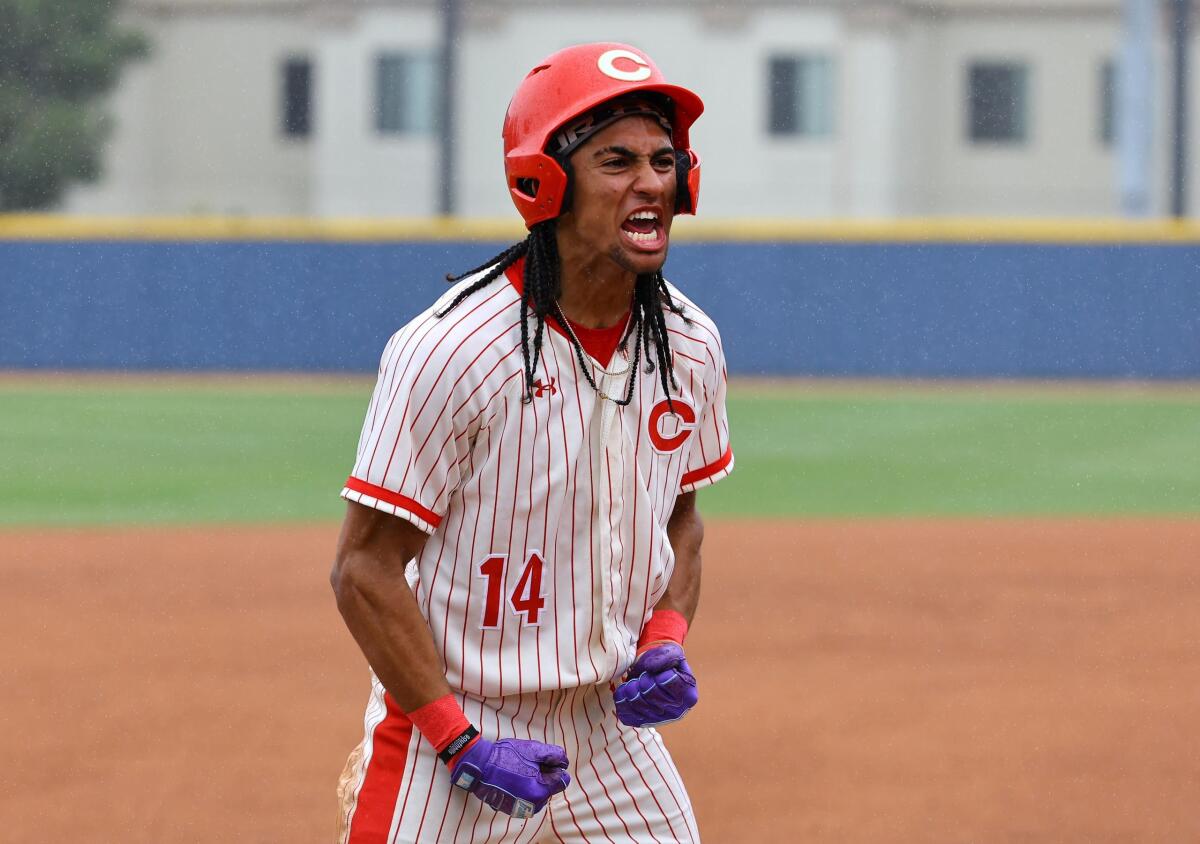
Hi, and welcome to another edition of Prep Rally. I’m Eric Sondheimer. One month into the high school baseball season, the top teams in the City Section are becoming clear.
Get our high school sports newsletter
Prep Rally is devoted to the SoCal high school sports experience, bringing you scores, stories and a behind-the-scenes look at what makes prep sports so popular.
By continuing, you agree to our Terms of Service, which include arbitration and a class action waiver. You agree that we and our third-party vendors may collect and use your information, including through cookies, pixels and similar technologies, for the purposes set forth in our Privacy Policy such as personalizing your experience and ads.
Top City teams emerge
With league play having begun, top teams are stepping forward in City Section baseball one month into the season.
To no one’s surprise, West Valley League rivals Birmingham (10-1, 3-0) and El Camino Real (9-3, 3-0) deserve to be ranked No. 1 and No. 2 in the City Section going into their first matchup of the season Tuesday at Birmingham. They are slated to play three league games. Both teams’ pitching has been outstanding.
Birmingham junior Nathan Soto is 3-0 with an 0.34 ERA. Sophomore Carlos Acuna is 4-0 with a 1.44 ERA. El Camino Real’s Jackson Sellz is 3-0 with an 0.54 ERA. Hudson December and Andrew Katz have also contributed on the mound. Look for a low-scoring game with some bunts Tuesday.
Bell (12-1, 2-0) is back to playing the way the Eagles performed in 2024 when they won the City title. Jayden Rojas, the City player of the year as a sophomore, is batting .421 and 4-0 on the mound with an 0.32 ERA. The Eagles are the heavy favorite to win the Eastern League.
Carson (9-1-1, 3-0) has taken early charge of the Marine League race, getting some clutch hits from Skylar Vinson.
Sun Valley Poly (6-3, 3-0) already has wins over Sylmar, North Hollywood and Kennedy in the Valley Mission League. Fabian Bravo is the pitcher/hitter to watch.
Perhaps the biggest surprise is Monroe at 11-0 and now the favorite to win the East Valley League. Four-year varsity pitcher Miguel Gonzalez is 4-0 with an 0.85 ERA and 32 strikeouts and only three walks in 24 2/3 innings. The leading hitter with 21 hits is junior Luis Martinez. The Vikings have yet to face a top opponent, so it remains to be seen which playoff division they will end up in.
Garfield, Sylmar, San Fernando, Cleveland and Narbonne are all capable of working their way into an Open Division playoff berths after slow starts.
Basketball awards time
Maxi Adams of Sierra Canyon was The Times’ boys’ basketball player of the year.
(Craig Weston)
During a season in which the individual talent for boys and girls basketball was extraordinary, earning all-star recognition became quite an achievement.
The Times’ boys’ basketball player is Maxi Adams of Sierra Canyon. Here’s the report.
The versatile Anthony Murphy of Corona showed off his speed and power in 8-3 win over King, getting a home run, triple, double and single. That’s called hitting for a cycle. And he almost did it again in the next game with a home run, a double and two singles. He also struck out all three batters he faced in a relief role.
Corona (7-0) is set to face Corona Santiago (9-2) in a three-game series this week. To say scouts will be out en masse when Santiago’s Striker Pence pitches Wednesday might be an understatement. He’s only a sophomore with a fastball that can reach 100 mph. The games are Monday at Santiago, Wednesday at Corona and Friday at Santiago.
Santa Margarita has lost standout shortstop Brody Schumaker for the rest of the season because of a shoulder injury. Freshman Cooper Holland provided a lift in Las Vegas with 11 RBIs. The new shortstop is sophomore Warren Wulfemeyer, whose grandfather, Mark, is one of the most recognizable names in Orange County basketball history.
Former Sherman Oaks Notre Dame pitcher Justin Lee, the 2023 player of the year by The Times, was clocked throwing his fastball between 97 and 99 mph pitching for UCLA.
Two unbeaten teams, St. John Bosco and Sherman Oaks Notre Dame, are ranked No. 1 and No. 2 in this week’s this week’s top 25 rankings by The Times. St. John Bosco has shut out five of its seven opponents. Jack Champlin is creating options for the St. John Bosco coaching staff. He continues to be a great closer but is also effective as a starter.
The National High School Invitational begins Wednesday in Cary, N.C. Southern California is well represented with Orange Lutheran, St. John Bosco, Aquinas and Harvard-Westlakek participating.
Friday marks the end of the sit-out transfer period in the Southern Section. Players who did not move become eligible. Bishop Alemany could be the team to watch. Mikey Martinez, who helped Crespi win the Mission League title last season as a pitcher and outfielder, will join the Warriors.
Softball
Murrieta Mesa continues to dominate with 14 consecutive wins to start the season. Sophomore Tatum Wolff is hitting .533 with 24 hits, including eight doubles.
Chaminade is 9-0 and came through with a break-through win over defending Mission League champion Sherman Oaks Notre Dame 7-6, scoring five runs in the seventh. The Eagles have an outstanding sophomore pitcher in Finley Suppan, the daughter of former major leaguer Jeff Suppan. Here’s the report.
JSerra (13-2), Fullerton (11-1), Norco (9-2), Oaks Christian (10-1) and Etiwanda (14-1) continue to be teams on the rise.
City Section softball is wide open as teams test themselves against Southern Section opponents. Defending champion Granada Hills is 5-5.
Banning is 7-6. Carson is 7-5. They will join San Pedro in another tough Marine League battle.
Track and field
The impressive early marks in the 100 meters for boys signals some real fast times will be coming later in the spring.
Benjamin Harris of Servite leads the way at 10.23 seconds. Next are Quran Clayton Jr. of Oak Hills and Jorden Wells of Servite at 10.28. Others include Nicolas Obimgba of Torrance (10.34), Zion Phelps of Loyola (10.39), Jaden Griffin of Newbury Park (10.43), Wesley Ace of Gardena Serra (10.51), Quincy Hearn of Sherman Oaks Notre Dame (10.52) and AJ McBean of Mira Costa (10.55).
Many are football players using track to get faster, and college recruiters are noticing.
Ejam Yohannes of Loyola has stamped himself the favorite in the 400 with a time of 46.11. Imagine if he improves a little what he might be running coming June.
Dean Guzman of Moorpark cleared 6-9 in the high jump at the Maurice Greene Invitational.
For girls, Olivia Kirk of Calabasas ran a state-leading 11.51 in the 100 meters at Oaks Christian. Teammate Malia Rainey ran 11.76. Kirk also has the leading 200 time at 23.46.
Sophomore Grace Smith from Claremont ran the 800 in 2:08.80 at the Hi-Racer Meet of Champions.
Volleyball
Loyola’s JP Wardy, left, tries to tip the ball past Mira Costa’s Colby Graham, center, and Miles Crotty during a match at Mira Costa in Manhattan Beach on March 20, 2026.
(Steve Galluzzo / For The Times)
Always expect drama and excitement when volleyball rivals Loyola and Mira Costa meet. It happened again Friday, with Mira Costa rallying from a 2-0 deficit to beat the Cubs in five sets. It was a remarkable performance turned in by junior Mateo Fuerbringer, who recorded 37 kills. He’s committed to UCLA.
Boys Volleyball: Full Playoff Results From The 9th Annual Chatsworth Invitational Tournament Are In. Saugus Defeats Host Chatsworth To Capture Gold, Village Christian Takes Silver, East Valley Earns Bronze, And Van Nuys Finishes With Copper. @CIFLACS#RepTheCitypic.twitter.com/yQdRlZf6tc
Saugus defeated the host Chancellors to win the Chatsworth tournament championship.
So long Angelo Gasca
Venice coach Angelo Gasca showing off City Division I title trophy in 2021.
(Cliff Kensinger)
The high school sports community was in mourning after the death of Venice football coach Angelo Gasca. He was 65.
Few have made a bigger impact for their community on and off the field than Gasca, who was involved as a coach at Venice for 36 years and also played for the Gondoliers.
Todd Quinsey is the new football coach at Ayala. . . .
Christian Collins of St. John Bosco, a McDonald’s All-American, has committed to USC. . . .
Inglewood guard Jason Crowe Jr. was selected the Gatorade state player of the year. . . .
Jon Palarz has resigned after 17 years as basketball coach at Calabasas. . . .
Former Granada Hills Kennedy football coach Dion Lambert is the new defensive coordinator at Simi Valley. . . .
Brandon Clifford has been named the basketball coach at Campbell Hall. He last coached in Greensboro, N.C. . ..
Derek Allen is the new boys water polo coach at Agoura. . . .
United Teachers Los Angeles has announced members would strike on April 14 if no deal is reached with the Los Angeles Unified School District. That would disrupt spring sports in the City Section, likely forcing games to be postponed or canceled based on previous strikes. Charter schools such as Birmingham and Granada Hills would not be affected since their teachers have separate contracts. . . .
Dylan O’Leary is the new football coach at San Dimas after being an assistant at South Hills. . . .
In 2021, JSerra pitcher Gage Jump delivers a pitch against Harvard-Westlake.
(Robert Gauthier/Los Angeles Times)
Former JSerra pitcher Gage Jump has become one of the top pitching prospects in the Oakland Athletics organization. The left-hander originally signed with UCLA before transferring to LSU. He was drafted No. 74 overall in 2024. He’s listed at 6-feet tall but throws with power.
From On3, a story on the controversy in Nevada, where public schools in Clark County are moving to independent status as protest against Bishop Gorman’s powerful football program.
Granada Hills Kennedy QB Diego Montes has been accepted to UCLA Henry Samueli School of Engineering and Applied Science with Civil Engineering. What an achievement. Ringer for intramural football team.
Incredibly, former Sherman Oaks Notre Dame pitcher Jack McDowell is not in the College Baseball Hall of Fame. He was an All-American at Stanford, a Cy Young Award winner with the White Sox. That needs to change. One of the greatest high school and college pitchers of the 1980s.
The new shortstop for Santa Margarita is sophomore Warren Wulfemeyer. His grandfather, Mark, is one of the best basketball players produced in Orange County. A look back at what grandpa did at Troy. https://t.co/CRXwYqZUPt
Have a question, comment or something you’d like to see in a future Prep Rally newsletter? Email me at eric.sondheimer@latimes.com, and follow me on Twitter at @latsondheimer.
Did you get this newsletter forwarded to you? To sign up and get it in your inbox, click here.
The Ryan Gosling-led “Project Hail Mary” rocketed to the top of the box office this weekend, marking a big win for Amazon MGM Studios.
The film — which stars Gosling as a science teacher who embarks on a space mission to save humanity — hauled in $80.5 million in the U.S. and Canada, making it the biggest domestic debut of the year so far. Globally, “Project Hail Mary” brought in $140.9 million.
The movie is an adaptation of a novel by Andy Weir, author of “The Martian” — another successful book-to-screen adventure. The big opening weekend for “Project Hail Mary” is a boost for Amazon MGM Studios, which had heavily promoted the film as an example of the big blockbusters it could produce.
“We believe deeply in the Hail Mary, and it’s clear audiences do as well,” Kevin Wilson, head of domestic theatrical distribution for Amazon MGM Studios, said in a statement. “What we’re seeing in theaters —the energy, the exit scores, the word of mouth — is everything we believed this film would deliver.”
Walt Disney Co. and Pixar’s “Hoppers” came in second at the box office this weekend with a domestic total of $18 million. The original animated film has now garnered $120.4 million in the U.S. and Canada since it debuted in theaters earlier this month.
Indian action film “Dhurandhar The Revenge” came in third with $10 million, followed by Disney-owned Searchlight Pictures’ horror film “Ready or Not 2: Here I Come” and Universal Pictures’ romance “Reminders of Him” rounding out the top five.
Riverside County Sheriff Chad Bianco, who is a leading Republican candidate for governor, has seized more than 650,000 ballots from last November’s election and is investigating whether they were fraudulently counted.
“This investigation is simple: Physically count the ballots and compare that result with the total votes recorded,” Bianco said at a news conference Friday.
The unusual probe drew a sharp rebuke from California Atty. Gen. Rob Bonta, who said in a statement Friday that it is “unprecedented in both scope and scale” and appears “not to be based on facts or evidence.”
“There is no indication, anywhere in the United States, of widespread voter fraud,” Bonta said. “Counts, recounts, hand counts, audits, and court cases all support this.”
According to Bonta’s office, Bianco’s department on Feb. 26 seized about 1,000 boxes of ballot materials in Riverside County related to the November election for Proposition 50, which temporarily redrew the state’s congressional districts to favor Democrats in response to partisan redistricting in Republican states, including Texas.
The sheriff said his investigators are looking into allegations by a local citizens group that “did their own audit” and found that the county’s tally was falsely inflated by more than 45,000 votes — a claim that local election officials have rejected.
President Trump, who remains fixated on his 2020 election loss, continues to amplify election conspiracy theories and has repeatedly called for the federal government to “nationalize” state-run elections to counter what he says is widespread fraud.
Bonta and California Secretary of State Shirley Weber, both Democrats, have vowed to fight federal interference that could affect voting in California, including efforts to seize election records, as the FBI recently did in Georgia.
Bianco is an outspoken Trump supporter who said in an endorsement video in 2024 that, after 30 years of putting criminals in jail, he figured it was “time to put a felon in the White House — Trump 2024, baby” — referencing Trump’s conviction by a New York jury for falsifying business records while paying hush money to a porn actor.
Bianco’s investigation, which includes all the ballots cast in Riverside County in November, raises questions about how he would handle the election denialism movement if elected governor.
A poll released last week by UC Berkeley’s Institute of Governmental Studies and co-sponsored by The Times showed Bianco and conservative commentator Steve Hilton leading the crowded field of gubernatorial candidates by slim margins, in a left-leaning state.
Last fall, Proposition 50 passed in Riverside County with 56% of the vote — a margin of more than 82,000 ballots.
A citizens group called the Riverside Election Integrity Team has said it performed an audit finding that 45,896 more ballots were counted than were cast.
In a lengthy February presentation to the Riverside County Board of Supervisors, Registrar of Voters Art Tinoco disputed that figure, saying it was based on a misunderstanding of raw data that had not been fully processed.
The actual discrepancy, Tinoco said, was 103 votes, a variance of 0.016% that was far below what he said was the state’s preferred 2% margin of error for certifying results.
Bianco on Friday said that there “is no acceptable error, small or large, in our elections.”
The sheriff did not name the Riverside Election Integrity Team, but his description of the allegations brought to him by “a group of citizen volunteers” matched theirs.
Bianco said the investigation was “not a recount” for the Proposition 50 contest and was “just as much to prove the election is accurate as it is to show otherwise — we will not know until the count is complete.”
Bonta said his office has “attempted to work cooperatively” with the Sheriff’s Department to understand the basis for the probe. The sheriff, Bonta said, “has delayed, stonewalled, and otherwise refused to work with us in good faith” and failed to provide most of the requested documents.
“We’re concerned that there is not sufficient justification for seizing every ballot that was cast in this very largely populated county,” an official in Bonta’s office said in an interview Friday night.
In a March 4 letter to Bianco, the attorney general cited Bianco’s plan to use Sheriff’s Department staffers, “who are not trained and have no experience,” to count the ballots.
“Let me be clear: this is unacceptable,” Bonta wrote. “Your decision to seize ballots and begin counting them based on vague, unsubstantiated allegations about irregularities in the November special election results sets a dangerous precedent and will only sow distrust in our elections. You are also flagrantly violating my directives.”
At his news conference Friday, Bianco fired back by calling Bonta “an embarrassment to law enforcement.”
A Riverside County Superior Court judge, Bianco said, has ordered the appointment of a special master to oversee the ballot count.
In a statement Friday, Secretary of State Weber said “the Sheriff’s assertion that his deputies know how to count is admirable. The fact remains that he and his deputies are not elections officials and they do not have expertise in election administration.”
South Korea’s Defense Minister Lee Jong-sup (2-L) attends a ceremony to unveil the signboard of the Defense Acquisition Program Administration (DAPA) at the agency’s new home in Daejeon, some 164km south of Seoul, South Korea. File Photo by YONHAP / EPA
March 20 (Asia Today) — South Korea’s arms procurement agency has pledged a sweeping overhaul of its systems and export strategy as it pushes toward the government’s goal of becoming one of the world’s top four defense exporters. The Defense Acquisition Program Administration, or DAPA, is South Korea’s defense procurement agency, and it is now led by Administrator Lee Yong-cheol.
Speaking at a briefing with defense reporters in Seoul on Wednesday, Lee said the agency would press ahead with faster decision-making, stronger export execution and greater technological self-reliance. He said the current moment amounted to a last chance to reform an organization long criticized for inefficiency and delay.
Lee said DAPA’s export drive must go beyond ceremonial overseas trips and focus instead on securing contracts and building practical business outcomes. But he also acknowledged that export growth alone is not enough if the underlying system remains slow and structurally weak.
One of the clearest examples, he said, was the long-delayed KDDX next-generation destroyer program. The project drifted for more than two years as authorities failed to make a policy choice between direct contracting and open bidding, exposing what Lee described as a deeper decision-making problem rather than a regulatory one.
Lee said South Korea also remains behind in drone warfare capabilities. While drones have become central to modern combat, the country’s military systems are still focused largely on reconnaissance, with limited strike and interception capacity and continued dependence on imported core components. He said DAPA plans to rely more heavily on rapid acquisition and early deployment of prototypes to speed fielding.
Defense semiconductors remain another major vulnerability. South Korea depends heavily on foreign technology for key components used in radars, guided weapons and communications systems, a weakness Lee described as an urgent national task. He said the answer lies in building stronger links between the civilian semiconductor sector and military demand while sustaining long-term investment.
Lee also pointed to Canada’s submarine procurement program as a major test of South Korea’s export competitiveness. He said the outlook was not unfavorable but remained uncertain, describing the bid as a national effort involving diplomacy, industry and military capabilities. Yonhap reported Friday that Lee sees the contest as essentially even, with South Korea competing against Germany for a contract covering 12 submarines.
DAPA said it will also seek structural reforms to prevent repeated delays, including penalties for intentional slowdowns and changes to procurement procedures that can trap projects in repeated failed bidding cycles. Lee has instructed staff to move from planning-based administration to execution-based management, with clear deadlines and accountability.
The agency’s challenge now is whether it can turn reform rhetoric into durable institutional change. For South Korea to become a top-tier defense exporter, industry officials say, speed, structure, technology and political resolve will all need to advance together.
The WNBA will likely get an injection of UCLA talent. One of the players most equipped to make an impact right away, it turns out, might be Kiki Rice.
Some mock drafts have the senior guard as high as being picked No. 5 overall after concerns she might fall out of the first round entirely before this season.
After a career-best season, though, Rice is one of the top prospects in a loaded class. That wasn’t a given after taking a step back in all statistics other than shooting last season.
The No. 1 seed Bruins are hoping to ride that to a national title, with the next step coming Saturday against No. 16 seed California Baptist in the first round of the NCAA tournament. Tipoff is at 7 p.m. at Pauley Pavilion.
UCLA guard Kiki Rice shoots over Ohio State guard Jaloni Cambridge during the semifinals of the Big Ten tournament on March 7 in Indianapolis.
(Michael Conroy / Associated Press)
WNBA scouts are hoping Rice proves she can be one of the best early first-round investments in the league.
“The work she did on her mentality, film study, with leadership, using her voice, working on her handles, I just think it’s her commitment to the details,” UCLA coach Cori Close said. “I’m not surprised that she’s playing this way because of the intentional work that she puts in.”
A Big Ten All-Defensive Team and unanimous All-Big Ten First Team selection this season, Rice is averaging career highs in points (15.3), rebounds (6.0) and shooting percentage (50.4%). Her assist numbers have dropped since the addition of Charlisse Leger-Walker, but that’s allowed Rice to create her own offense.
“I think one of the things that Kiki’s been able to do is have different kinds of scoring catches this year because of Charlisse’s presence on our team,” Close said. “But I do think the biggest thing has probably been her passing, her facilitation, as well as her ability to shoot.”
WNBA scouts have taken notice, too. One evaluator said her ability to play with a “group of weapons” has set herself up to be taken seriously for a larger role even as a rookie. For a long time, among those scouting in the league, she was viewed as a potential backup point guard, but her shooting ability and defensive consistency has made her a more complete prospect.
Her 2.2 defensive win shares are third in the Big Ten and her 83.0 defensive rating is seventh.
“I worked a ton of [defense] in the offseason and really stepped up to the challenge of guarding the other team’s best perimeter player,” Rice said. “I think me being challenged in that way, it’s been a really great area of growth, and that’s probably the area that I’m most proud of.”
Rice’s improvement from the three-point line is a big one for WNBA scouts. She improved her deep shot from 21.7% to 38.1% across four seasons.
UCLA guard Kiki Rice steals the ball from Washington guard Chloe Briggs at Pauley Pavilion on Feb. 19.
(Gina Ferazzi/Los Angeles Times)
That, plus her defensive prowess and ability to play point guard and more of a loose guard role, have helped her WNBA stock rise tremendously.
“Defensively has been probably the most impactful growth thing that she’s had,” Close said. “But Kiki — people don’t realize she was out for six months. She had surgery on April 15th last year and was out for six months.”
Rice was injured at the start of last season and then underwent right shoulder surgery right after the Final Four. Despite the injury, she played in 34 games last season, averaging 12.8 points and 5.0 assists per game.
Rice won the Big Ten tournament’s most outstanding player award after UCLA thrashed Iowa by 51 points in the championship. She averaged 16.6 points and 5.3 assists during three Big Ten tournament games.
Her numbers might be even better if she were the team’s top offensive option, like Hannah Hidalgo with Notre Dame. Instead, she is sharing time with other top WNBA prospects such as Lauren Betts, Gianna Kneepkens and Leger-Walker.
“What I love most is she’s one of the most selfless people I’ve ever played with,” Betts said of Rice. “She really could [not] care less about all of the attention. She just wants to win games. She’s always there for her teammates. I’m so grateful I get to be her teammate and her friend. She’s amazing.”
In addition to her three-point shot improvement, around 60% of her points still come in the paint from driving to the basket, making her a threat all over the floor.
“There were lots of times in previous years where Kiki could get downhill, but we didn’t have the court spacing because we didn’t have the quality of shooting that allowed those driving lanes to take place,” Close said.
UCLA guard Kiki Rice shoots over USC guard Malia Samuels at Pauley Pavilion on Jan. 3.
(Eric Thayer/Los Angeles Times)
The biggest question with Rice is whether her three-point shooting can scale to a higher volume in the WNBA, where guards are more likely to shoot from deep than be relied on in the post. She has never taken more than 2.7 attempts per game.
Part of that is because there are so many options from three-point range that Rice doesn’t have to be the primary shooter. Kneepkens is making 44.2% of her three-pointers and Gabriela Jaquez has hit 41.1% while Leger-Walker is shooting 36.4% from range.
That hasn’t affected Rice’s efficiency, though.
“I think this year the way that we moved the ball and everyone gets touches is so important for everyone and allows me to be successful,” Rice said.
UCLA guard Kiki Rice celebrates with teammates as she’s handed the Big Ten tournament most outstanding player trophy on March 8 in Indianapolis.
(Michael Conroy / Associated Press)
With the way the draft order falls, Rice is likely to end up with either an expansion team or a team that struggled last season, such as Washington or Chicago. That might mean she’ll need to step in and produce in her first season as a pro.
That is why her stock has risen so much this season — she’s shown she has the versatility to do what is needed.
“Kiki has been playing the best basketball of her career,” Close said. “I think she has put in the work. She knows what she’s earned, and she’s sort of ‘that girl’ for us.”
LOOKING for a day out in the capital for less? Thanks to Sun Superdays, we are offering Sun readers up to £10 off tickets to London’s most iconic attractions.
Take your pick from four top attractions, including the London Eye, Madame Tussauds London, SEA LIFE London and The London Dungeon.
Sign up for the Travel newsletter
Thank you!
Enjoy unparalleled 360-degree views of the city on the London Eye
Join Sun Club for just £1.99 a month — don’t miss out.
If you fancy a spot of sightseeing, step inside the greatest view aboard the iconic London Eye.
Enjoy unparalleled 360-degree views of the city as you rotate through the breathtaking skyline above South Bank.
See all your favourite landmarks from every elevated angle during a relaxing 30-minute rotation, spotting the Houses of Parliament, Buckingham Palace, and even Windsor Castle on a clear day.
Come face to face with your favourite stars at Madame Tussauds LondonCredit: Jonathan Short
For those who would rather rub shoulders with stars, step through the world-famous doors of Madame Tussauds London and immerse yourself into the world of superstars as you attend the ultimate fame experience.
Get closer than ever to A-listers like John Boyega and Dwayne ‘The Rock’ Johnson, perform with Drake and Dua Lipa, or attend a private audience with Their Majesties King Charles III and Queen Camilla.
See sharks, rays and penguins all in the heart of London
Alternatively, you can dive into an underwater adventure at SEA LIFE London. Come face to fin with your favourite creatures including sting rays, jelly fish, sharks, turtles and more.
Journey through incredible themed zones such as Coral Kingdom and Open Oceans. Soak up fun facts about marine life and learn about conservation and SEA LIFE’S mission to protect the ocean and its creatures.
Or if you are feeling brave, the London Dungeon offers a uniquely thrilling journey into the city’s darkest history.
Bringing together an amazing cast of theatrical actors, special effects, stages, scenes and thrilling rides.
Each showcasing hysterically horrible history across a series of immersive shows, including the Torturer, sinister witch trials and many other spine-chilling shows.
HOW TO BOOK YOUR TICKETS
There are two ways to unlock the savings and book your tickets:
Sun Club:
Join Sun Club for £1.99 per month or £12 for the year to claim this offer and many more.
Go to the Offers Hub and find the Sun Superdays page.
Follow the steps on this page to book your tickets from 11am on Monday, March 23.
Sun Savers:
Download the Sun Savers app or sign up at sunsavers.co.uk. Go to the Offers and click “Click Collecting” on the Sun Superdays page.
Pick up The Sun and collect TWO Sun Savers codes. We will print one code daily in the paper between Saturday, March 21 – Friday, March 27.
Go to the Offers section and find the Sun Superdays page and follow the steps on this page to book your tickets from 11am on Monday, March 23.
Join Sun Club for just £1.99 a month — don’t miss out.
18+ UK only (exc. IoM & CI). Sun Savers multiple code collect 21/03/26-27/03/26 or subscription to Sun Club or Digital Newspaper required. Book by 22/04/26. Offer valid for ‘up to £10 off’ tickets at selected London Merlin UK attractions. Pricing varies, £10 off adult tickets and £7-£4 off child tickets. Exclusions may apply. Subject to availability. Non-transferable & non-refundable. Online access required. New customer offer: £1.99 per month or £12 per year unless you cancel at least seven days before your next billing date. Full T&Cs apply, see sunsavers.co.uk or club.thesun.co.uk/sun-club.
If you’re looking for destinations for a May half-term break that are perfect for families and not too far away, then this island often compared to the Caribbean could be one for your shortlist
This article contains affiliate links, we will receive a commission on any sales we generate from it. Learn more
The island has been nicknamed the ‘Caribbean of Europe’(Image: Getty Images)
Finding the perfect family holiday destination can be tricky. You want somewhere with amazing beaches and natural beauty, but at the same time, you need to be practical and ensure you pick somewhere easy to travel to and in your budget.
Recently, easyJet released a new Family Holiday Index, its way of ranking the top holiday destinations for people travelling with children based on a number of factors. These include the logistics of travelling to the destination, beach and water access, cost, and the number of family activities on offer.
Using this information, it was able to compile a top ten ranking of family holiday destinations, and unsurprisingly, Spanish destinations took six out of the ten spots. However, ranking at number six was an Italian island that has been dubbed the ‘Caribbean of Europe’ thanks to its spectacular beaches and unspoilt scenery.
Sardinia scored highly as a family destination thanks to its huge selection of beaches, family activities, and easy accessibility from the UK. The island has two main air hubs: Cagliari Elmas Airport in the south which is the largest and Olbia Costa Smeralda Airport in the north which is popular in the summer. EasyJet offers seasonal services to Olbia from Bristol, Edinburgh, London-Gatwick, and London-Luton. If you’re planning to fly to Cagliari from the UK, there are routes available on Ryanair and British Airways.
Sardinia flights on easyJet start from just £35.60 one way in May, and flights to the island take from two-and-a-half to three hours, making them bearable for most kids. You can also book Sardinia holidays with easyJet Holidays, with a package for four staying in a quadruple room in Borgo di Campagna, departing May 8, coming in at £340 per person. You can also save another £100 off the total package cost by using code SPRINGSALE at checkout.
Spiaggia La Pelosa is considered one of the island’s best beaches and it’s perfect for families. Its shores are covered in soft white sand, although some of the scenery is a little rocky, and the sea is a vibrant shade of turquoise and usually has only gentle waves. You can walk far from shore and still only be up to your knees in the clear blue waters, so it’s perfect for kids who like to paddle and splash around.
Unlike many overcrowded beaches, access to La Pelosa is tightly controlled during the summer from June 1 and October 1. Visitors need to book a spot in advance, and there’s an entry fee of €3.50 per person for over 12s (just over £3). However, this ensures you aren’t fighting the crowds to find a spot.
The Costa Smeralda offers a choice of beaches along a 35-mile stretch of coast in the north-east of the island. It’s a glamorous spot where you’ll often see superyachts coming into dock, and here you’ll find lots of upscale resorts with fine dining and designer shops.
Kids who love to swim will enjoy a boat trip to La Maddalena Archipelago, a National Park made up of seven tiny islands that can only be reached via boat. Many tour operators offer full-day boat tours where you can visit multiple islands, as well as stopping in the middle of the turquoise Med so you can dive straight into the ocean for a swim or snorkel.
If you have a kid who’s a budding history buff then Sardinia is full of interesting ancient sites to explore. Su Nuraxi di Barumini is the remains of a Bronze Age defensive complex, and has structures dating back thousands of years. Cagliari’s Castello sits on top of a hill and is full of ancient buildings, museums, and historic sites.
Kids who are studying the Roman Empire in school will particularly love a tour of the Roman Amphitheatre of Cagliari, where they can hear gory tales of fights to the death between gladiators or men vs wild beasts. It was also where many public executions were carried out and became the most important buildings in ancient Cagliari.
Sardinian food is also generally kid-friendly and even picky eaters are likely to find something they like. During the day, look out for street food vendors selling Spianadina, traditional flatbreads often filled with cheese and ham for a simple lunch. In the evening, there are plenty of cosy, authentic restaurants to choose from where kids can enjoy wood-fired pizza and fresh pasta.
EasyJet and easyJet Holidays Family Holiday Index – Full rankings
Palma de Mallorca, Spain
Algarve (Faro), Portugal
Costa del Sol (Málaga), Spain
Costa Blanca (Alicante), Spain
Lanzarote, Spain
Sardinia, Italy
Crete, Greece
Ibiza, Spain
Barcelona Coast, Spain
Dubrovnik Coast, Croatia
Have a story you want to share? Email us at webtravel@reachplc.com
A stunning over-water spa at the Conrad by Hilton hotel, with room for text, in the MaldivesCredit: Alamy
THE average Brit has enjoyed three ‘holidays of a lifetime’ – with Maldives, Tokyo and the Great Barrier Reef among top destinations.
Previously considered something taken once in everyone’s life, Brits are finding new ways to make travel a priority with 46 per cent believing dream trips are more achievable than 10 years ago.
Sign up for the Travel newsletter
Thank you!
Akihabara in Tokyo, JapanCredit: AlamyAerial view of Lady Elliot Island, the southern most island in the Great Barrier Reef of the coast of AustraliaCredit: Alamy
The poll of 2,000 adults found stunning natural scenery (50 per cent) and luxury accommodation (45 per cent) are the top criteria for making somewhere a holiday of a lifetime.
And 71 per cent have used loyalty points to help them book a trip that would previously have been out of reach.
The research comes as Virgin Red releases its fourth annual report, The Points Index, ‘Living the Dream Holiday’, revealing the shift in how the nation values loyalty points in a bid to unlock ‘once-in-a-lifetime’ holidays.
Data from the firm showed that in 2025, adults were using reward points to attain these trips, with 31.2 billion points redeemed across its travel experiences, marking a 13 per cent year-on-year increase.
In the UK, point-spending peaks are in May and July and highest in September, potentially coinciding with back-to-school fatigue.
The survey also found 21 per cent who might book a big trip, would do so to celebrate a milestone birthday.
A third (34 per cent) are currently in the midst of planning a big holiday, with 39 per cent prioritising beach and relaxation holidays abroad – and only 19 per cent opting for shorter getaways.
Other key elements of a once in a lifetime trip include exceptional food and drink (40 per cent) and experiences unique to the region’s culture (38 per cent).
Of those who took part in the study by OnePoll.com, nearly three quarters (74 per cent) have paid for either part, or the full price of a flight with loyalty points, while 29 per cent have used points to upgrade flights.
Andrea Burchett, chief loyalty officer at Virgin Red, said: “Loyalty is fundamentally reshaping how consumers think about travel.
“Trips once seen as ‘once in a lifetime’ are becoming achievable, as consumers increasingly treat points as a strategic currency.
“Even amid economic uncertainty, points are helping consumers prioritise meaningful travel, loyalty is helping make it possible.”
TOP 10 ‘HOLIDAY OF A LIFETIME’ DESTINATIONS – ACCORDING TO BRITS:
The Great Barrier Reef, Australia
Maldives
Tokyo, Japan
Hawaii, USA
Sydney, Australia
The Amazon Rainforest, Brazil
The Galápagos Islands, Ecuador
Machu Picchu, Peru
New York City, USA
Seychelles
The average Brit has enjoyed three ‘holidays of a lifetime’Credit: Alamy
BEIRUT — Iran’s top security official, Ali Larijani, has been killed in an Israeli airstrike, a move that represents a palpable hit to an Iranian leadership that has shown little interest in compromise after almost three weeks of war with the U.S. and Israel.
Killing Larijani, who led Iran as de facto wartime leader after Supreme Leader Ayatollah Ali Khamenei died on the first day of the war, eliminates a veteran official seen as the consummate insider despite not having the religious credentials for the Islamic Republic’s highest offices. Israel, in an announcement Tuesday, said the attack occurred the night before.
For all his bellicose comments since the war began, Larijani was also seen as a pragmatist, and observers say his death might strengthen the resolve of what’s left of Iran’s leadership, rather than induce a willingness to compromise.
His post as secretary of Iran’s Supreme National Security Council gave Larijani control of the country’s top security body, where he tasked government forces with subduing anti-regime protests in January. Thousands of Iranians were killed.
Also killed in the Israeli strikes was Gen. Gholamreza Soleimani, the head of the Basij, the volunteer auxiliary wing of the Islamic Revolutionary Guard Corps and an integral part of the state’s ability to keep order.
“Larijani and the Basij commander were eliminated overnight and joined the head of the annihilation program, Khamenei, and all the eliminated members of the axis of evil, in the depths of hell,” Israeli Defense Minister Israel Katz said in a statement Tuesday.
Israeli officials have employed “axis of evil” to refer to Iran and its allies, including the militant groups Hamas and Hezbollah.
Larijani had served as parliamentary speaker for 12 years and became the point man on nuclear negotiations as well as relations with allies such as China and Russia. He often acted as the government’s representative in the media.
Iranian officials confirmed that Larijani and Soleimani had been killed. They said Larijani’s son, the head of his office and several guards were also killed in the strikes.
Soon after Katz’s announcement, Iranian authorities released an undated note said to have been written by Larijani in which he honored Iranian sailors killed in a U.S. attack. The image of the note was also posted to Larijani’s account on X.
There was no explanation why the note was released and whether it is signified Larijani was still alive.
“We are undermining this regime in the hope of giving the Iranian people an opportunity to remove it,” said Israeli Prime Minister Benjamin Netanyahu.
Netanyahu and President Trump have repeatedly called on ordinary Iranians to topple the government.
Though assassinating Larijani counts as yet another intelligence coup for Israel and the U.S., both may come to regret the loss of a figure who, despite his defiant rhetoric since the war began Feb. 28, was considered by some analysts as a realist.
His killing adds to the evisceration of Iran’s upper echelons, raising the question of who is left to negotiate an end to the war, or have enough influence to make Iran’s deep state accept compromise.
Some observers say that’s the point.
“Why did the Israelis take out Larijani in this moment? Because Netanyahu is focused on blocking Trump’s pathways for a ceasefire and follow-up negotiations with Iran,” said Ellie Geranmayeh, a senior policy fellow at the European Council for Foreign Relations, adding that “Larijani would have been the man to get that job done.”
Khamenei’s assassination, Geranmayeh said, had already empowered more hard-line figures in government, and Larijani’s death “could act as an accelerator to that path.”
“Israel seems to be turning its attention to targeting those that could push for a political solution to the current crisis,” she said.
Larijani’s death would add to the murkiness surrounding Iran’s leadership. After Khamenei was killed and it remained unclear who would replace him, Trump added to the uncertainty by saying that the country’s new leader would need his approval, but also that the U.S. had killed many of the leaders whom he would have deemed acceptable.
After Khamenei’s son, Mojtaba Khamenei, was named the new supreme leader, Trump expressed his displeasure but repeatedly dodged questions about what the transition under the younger Khamenei would mean for the U.S. war effort.
After the elder Khamenei’s death, Larijani emerged as a high-profile voice for Iran, saying that Trump must “pay the price” for the U.S. strikes on the country.
In response, Trump acted as if he didn’t know who Larijani was.
“I have no idea what he’s talking about, who he is. I couldn’t care less,” Trump told CBS News.
Benjamin Radd, a political scientist and senior fellow at the UCLA Burkle Center for International Relations, said Larijani was perceived to be “the last of the competent bunch” within the Iranian leadership — an intellectual who had a complex understanding of the geopolitical reality on the ground, who had negotiated with the U.S. in the past, and who was “adept at maneuvering” all the various parts of the Iranian power structure.
Radd said Larijani “lost that mantle of being the pragmatist” when he strongly backed the deadly January crackdown on protesters, for which he was “more responsible than anyone else.”
He “absolutely was responsible for a tremendous amount of carnage and death and destruction,” Radd said.
And yet, with his death, “all of that diplomatic, institutional experience” that he did have “is gone” from the Iranian leadership, Radd said.
Those left in power, he said, are “generally not the sharpest people, they’re not the people who understand the subtleties of diplomacy, of what negotiating with the U.S. is like.”
Bulos reported from Beirut and Rector from Colorado.