toddlers

Rachel Nickell: How tiny clue in toddler’s hair solved 15-year mystery of mum’s brutal murder

Rachel Nickell’s horrific death sent shockwaves across the UK, but it took the police more than 15 years to solve her murder. As the case is explored in a new Netflix documentary, we speak to the expert who found a breakthrough clue after years of investigation failures

The Murder of Rachel Nickell teased in Netflix trailer

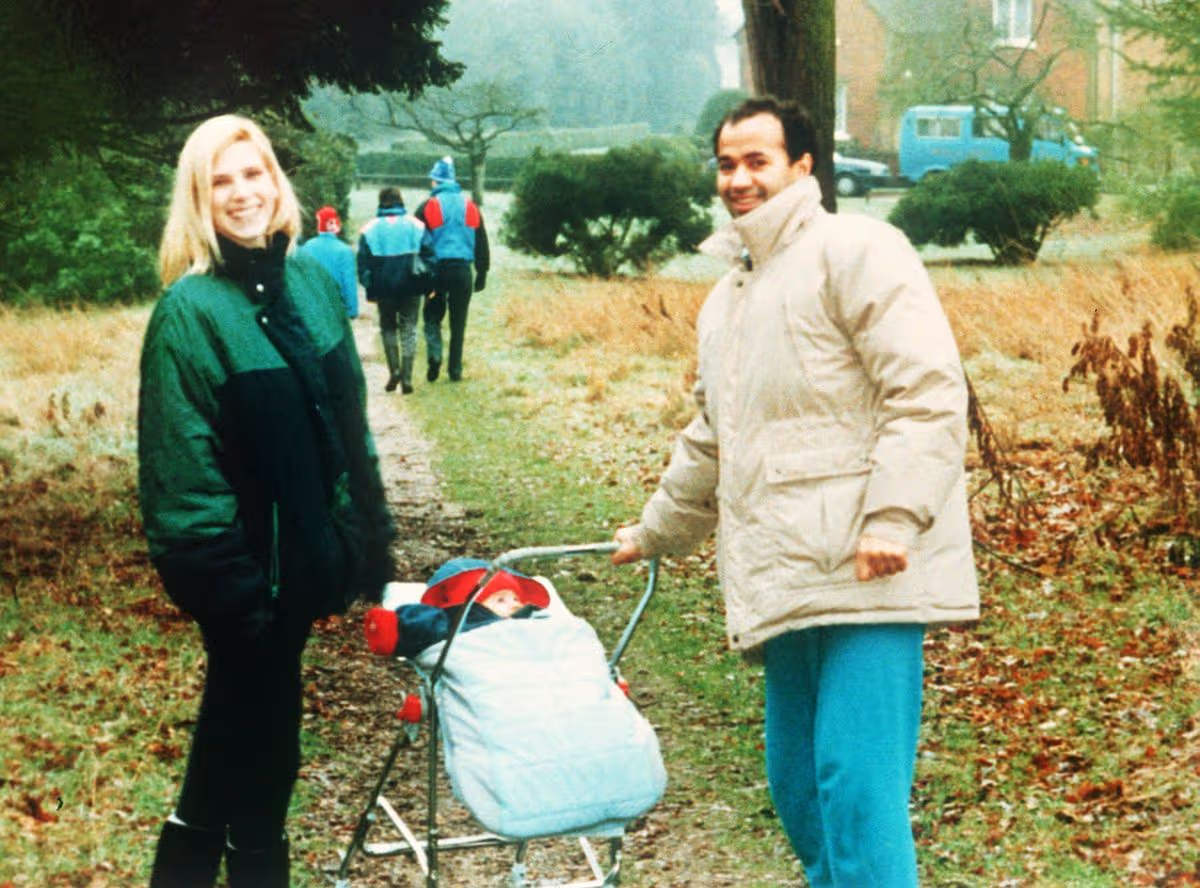
Rachel Nickell had her whole life ahead of her when it was cruelly stolen in a sickening attack – leaving her toddler son as the sole witness.

In July 1992, the 23-year-old mum was strolling through Wimbledon Common with her two-year-old son Alex Hanscombe, and their dog Molly. In a quiet, wooded area, she was ambushed, sexually assaulted and stabbed dozens of times.

Alex was later found by a passerby, desperately clinging to his mother’s body. In a heartbreaking attempt to help, the toddler had placed a piece of paper on her forehead as a makeshift bandage after pleading with her to wake up. Even at that tender age, Alex later revealed, he knew instantly that his mother was never coming back.

The brutal murder shattered the life of Alex and his father André Hanscombe. Yet, it would be 16 years for anyone to face justice. The haunting case is now the subject of a new three-part series for Netflix dramatisation, The Witness, alongside an accompanying documentary featuring never before seen archive footage, and deeply personal accounts from those who lived through the tragedy.

Among those interviewed is legendary forensic scientist Angela Gallop, whose work has helped solve many of the UK’s most high-profile murders, including the killings of Stephen Lawrence and Damilola Taylor.

Her team was handed the case in 2002, a decade after the murder, when the investigation had gone completely cold. They had agonisingly little to work with: a microscopic trace of male DNA recovered from the crime scene. To make matters even more difficult, forensic technology at the time was ill-equipped to handle such a minute sample. In order to find the killer, they had to pioneer an entirely new methodology to examine the sample.

Reinvestigating the decade-old DNA required immense precision. Describing the pressure and the patience required to manipulate the tiny shred of evidence, Angela said: “The technique that had been used at the time was a very new, sensitive method, but we had never particularly liked it in my laboratory.

“For Rachel’s case, we got hints of male DNA using our standard test, but we wanted to see if we could squeeze out some more information. By concentrating and purifying the DNA, we managed to achieve it, but it took two years to develop the technique properly.”

After a painstaking process, the team eventually got a strong enough DNA profile to add to their database – and it matched with a man named Robert Napper, a paranoid schizophrenic and serial rapist.

To ensure the case was ironclad, they raced back to the crime scene and analysed all the sample items that had been collected. Angela and her colleagues then went on to uncover footwear marks and forensic paint evidence linking Napper directly to Wimbledon Common.

His footwear was matched directly to the mud profiles taken from the area, and microscopic paint flakes matching Napper’s toolbox were discovered trapped in the hair of two-year-old Alex. The box, found in Napper’s flat, contained knives and other weapons.

The new DNA breakthrough was enough to convict Napper and exonerate Colin Stagg, the innocent man wrongfully targeted by a flawed police honey-trap operation. A new Netflix documentary will examine the botched investigation, which led to Stagg – a local resident who walked his dog on the common – spending 13 months behind bars in custody, and facing rampant speculation that he killed Rachel.

He was freed by an Old Bailey judge in 1994, who criticised officers for using a ‘honeytrap’ undercover policewoman to try to make him confess to the murder, branding the entrapment evidence as “reprehensible”

Mr Justice Ognall, who halted the trial, described officers actions as “deceptive conduct of the grossest kind” after undercover officer “Lizzie James” tried to seduce Stagg, promising a relationship in the hope of getting a confession. Stagg later received £700,000 compensation from the Home Office.

In 2008, Napper admitted manslaughter on the grounds of diminished responsibility and was detained indefinitely at Broadmoor. He was already incarcerated at the psychiatric unit, having been convicted in 1995 for the equally depraved double killing of single mother Samantha Bisset, 27, and her four-year-old daughter Jazmine.

Discovering the match provided a profound sense of justice for Angela’s team, particularly regarding the human toll of the investigation. “We had a DNA result that hit a match on the National DNA database, so the police have got something to investigate,” she said.

“There was an added level of satisfaction because Colin Stagg had been professing his innocence for all those years. We were able to show that he was telling the truth,” she said.

The new documentary about the 1992 murder features Alex describing the moment that he knew his mother had died after being stabbed 49 times.

A home video video captures him describing the moment his mother was killed on Wimbledon Common to his dad André, who gently discusses what his son saw on the day.

Now 36, Alex describes seeing Napper, telling his dad: “I saw him first,” he says, telling Andre that the man was carrying a bag which he opened. Asked what he took out, he replies simply: “A knife.”

He then tells his dad that the man “knocked me over” and that he witnessed his mum being stabbed. “There’s his knife,” the little boy tells his dad, indicating the picture he is drawing of his mother. “I saw the knife. I saw it, Yeah, I saw it all.”

Speaking in the trailer for the film, André explains: “My son saw his mother’s murder but nobody could have possibly known how long it was gonna take to find the person who did this.”

Ahead of the Netflix show, Angela is keen to emphasise that DNA evidence is rarely a simple “magic bullet.” Television would make people think that experts can simply swab a crime scene and receive a clear-cut result just 30 minutes later, Angela said, adding: “If it was going to be really straightforward, the original scientists would have discovered the truth a long time ago.

“You have to be much more clever. Sometimes you have to look for one type of evidence to find another. In the Stephen Lawrence and the Pembrokeshire Coastal Path murders, it was analysing textile fibres that led us to finding blood traces and therefore DNA.”

As well as the archive footage, the documentary will explore how Angela’s work led to justice for Stagg after her breakthrough solved the case.

The three part drama, The Witness, will follow Alex and André as they deal with the devastating impact of losing Rachel. Jordan Bolger plays André, while Max Fincham is the teenage Alex. Both men acted as consultants on the series.

The story aims to show how a father and son “moved through the aftermath of unimaginable tragedy, from darkness into light.”

The other cast include Kevin Eldon as DCI Mick Wickerson, Neil Maskell as DI Keith Pedder, Mark Stanley as DS Ivan Agnew, Jon Pointing as DC Nick Sparshatt, James Dryden as DC Paul Miller, Kerry Godliman as André’s mother June, James Bradshaw as DCI Tony Nash and Claire Rushbrook as Dr. Jean Harris-Hendriks.

In a joint statement released last month, André and Alex Hanscombe said: “Our life has been a battle. We can never express how indebted we are to everyone that’s been a part of this, for the kindness and generosity they’ve extended to us, for the chance they took with us in bringing our story to the screen, and for the care they have taken.

“Our journey has all been by the grace of God and a promise to go on together, and we feel incredibly blessed to be able to share our story in this way.

“We hope that audiences will be left with a testament to the tough battle of life we all face and to the power of faith, hope, love – and never giving up.”

  • Documentary The Murder of Rachel Nickell has been made to accompany the new drama about what happened that day, called The Witness. Both will be released on Netflix on June 4.

Source link

3 L.A. hikes that are great for toddlers to teens (and kids at heart)

I excitedly followed my uncle down the narrow dirt path along Wildhorse Creek, a canopy of oaks, maples and other deciduous trees above us.

“What’s this?” I asked, picking up a stick that looked like it’d gotten into a fight with a wood chipper.

“That’s a beaver stick,” my Uncle Dale told me, explaining that one of the cute rodents had chewed on it, probably in the midst of making a dam along the river.

“Can I keep it?” I asked, a little in awe that I could hold such a magical thing.

We were trekking along a trail that my uncle had created on my family’s land in Oklahoma. For years, the stick was in my childhood bedroom, a memento from my earliest hiking memory.

You are reading The Wild newsletter

Sign up to get expert tips on the best of Southern California’s beaches, trails, parks, deserts, forests and mountains in your inbox every Thursday

Spending time hiking with my uncle helped me fall in love with the outdoors, and I hope this week’s edition of The Wild, The Times’ weekly outdoors newsletter, helps you make memorable moments with the kids in your life too.

I chose three hikes for children of all ages, including for us kids at heart. The trails are all either easy or some level of moderate. They don’t require technical skills, but curiosity, sunscreen and a reusable water bottle are all encouraged. They each feature a mix of native plants and trees and offer opportunities to see a range of wildlife.

I chose trailheads where parking isn’t too challenging (at least, I hope it isn’t). There are restrooms at two out of the three trails. You’ll want to pack snacks and water, as two of the three hikes don’t have water refill stations available.

Logistics done, let’s dive into the hikes!

A dirt path along a hillside covered in brown and green grass with puffy moody clouds in the sky and a city in the distance.

The Park to Playa Trail offers panoramic views of L.A. County, including views of the Pacific Ocean and San Gabriel Mountains.

(Jaclyn Cosgrove / Los Angeles Times)

1. Park to Playa Trail to Baldwin Hills Scenic Overlook

Distance: 2.6 miles
Elevation gain: 304 feet
Difficulty: Easy
Dogs allowed? Limited (see below)
Accessible alternative: Gwen Moore Lake path at Kenneth Hahn State Recreation Area

The Park to Playa Trail is a 13-mile regional trek that starts near Leimert Park and takes hikers all the way to the Pacific Ocean. It’s also fun to break into small adventures, like the one I outline below.

You can take Park to Playa from Culver City up to the Baldwin Hills Scenic Overlook, a fun day for adults and kids (and teenagers who enjoy taking selfies with great views). If visiting Friday through Sunday, you and your kids can pop into the Baldwin Hills Scenic Overlook Visitor Center, which offers educational exhibits, maps and more.

Although Culver City Park allows dogs, canines aren’t allowed on trails in Baldwin Hills Scenic Overlook, so you and Fluffy would need to use roads or sidewalks once you enter state parkland.

To begin your hike, park in or near this Culver City Park lot. The lot offers two-hour parking. If you’d like to stay longer, you can pay to park in the 10-hour parking along the street. Either way, you’ll follow the Park to Playa Trail signs northeast out of the lot.

A multi-layered wood bridge trail.

A wood bridge trail leads hikers to great views of L.A.

(Jaclyn Cosgrove / Los Angeles Times)

You’ll take a well-built wood bridge trail that’s shaded by several large oak and other trees. At the top of the bridge, you’ll arrive at a small picnic area with a public art piece that’s also an equatorial sundial. You’ll get your first glimpse here at the views you can expect the higher you climb.

Head north, either taking the short stairs or ramp, to then hike east past green sports fields. You’ll follow the Park to Playa Trail around a field before entering Baldwin Hills Scenic Overlook via a charming metal archway.

From here, the dirt path widens, and you’ll start to notice more native plants such as California brittlebush and a variety of sages (which offer a fun sensory experience when you pause to give them a sniff).

Runners and joggers take a paved road down amid tall native grasses and a cloudy sky.

The Park to Playa Trail passes through the Baldwin Hills Scenic Overlook area.

(Jaclyn Cosgrove / Los Angeles Times)

Just under a mile in, you’ll reach your first large overlook. Look east toward the Hollywood Hills, and you can likely spot the Hollywood sign and Griffith Observatory. I paused here to watch a red-tailed hawk dip and fly above the city below.

Follow Park to Playa as it winds around, turning left (east) onto a separate trail that will take you up to the main overlook. You’ll soon pass the famous Culver City Stairs, which you could take the rest of the way up to the overlook, or follow the gentler dirt path before you. The path will head southeast before leading you to the overlook where it’s mandatory to pause and take it all in: the ocean, the mountains, the views of why we live here.

From the overlook, you can take the path south to the visitor center, where you’ll also find flush toilets and water fountains. You have the option to turn back around and head down with your crew to where you parked — or continue onward on Park to Playa, which if you feel adventurous, you could take to Kenneth Hahn State Recreation Area.

A creek with several rocks for crossing the trail.

The Antonovich Trail runs alongside Walnut Creek in San Dimas.

(Jaclyn Cosgrove / Los Angeles Times)

2. Antonovich Trail

Distance: 7.8 miles out and back
Elevation gained: 385 feet
Difficulty: On the easier end of moderate
Dogs allowed? Yes
Accessible alternative: The Antonovich Trail, but instead of entering the trail off San Dimas Avenue, where you must navigate a steep hill, start the trail from this parking area; the trail is not paved, but it is mostly flat if you head in the westerly direction from the parking lot.

The Antonovich Trail is a 7.8-mile out-and-back trail that follows gently flowing Walnut Creek, shaded by canopies of coast live oak, fig and Southern California black walnut. Besides a steep descent from the parking lot into the canyon, the route is mostly flat.

Unfortunately, there’s no easy restroom access along the trail. If that’s a deal-breaker, then I’d recommend the Placerita Canyon and Waterfall Trail, which I wrote about here, if you’d like to hike in a similarly shaded canyon vibes. You’ll park near the Placerita Canyon Nature Center, which I’d highly recommend visiting for its educational exhibits and animal ambassadors. It has flush toilets and water fountains.

As shown on this map, there are multiple places to start the Antonovich Trail. If starting it from the lot off San Dimas Avenue, you will navigate an exposed, steep dirt path down into the canyon. As you descend, take in the views of the San Gabriel Mountains.

The trail is popular with horse riders and locals who enjoy bringing their dogs to frolic in the cool creek waters. Keep a keen eye out for birds commonly spotted here, including black phoebe, acorn woodpeckers and hawks. Also watch out for poison oak.

The path splits off into multiple unofficial trails, so keep an eye on your hiking app or map as you scurry along. The first time I hiked this trail, I was diverted from the main route a few times, including once when, to my delight, my detour brought me to a tire swing (which I tested out, flying over a nearby sparkling pool of water).

The trail appears to just abruptly end, but it actually connects to a larger local trail network.

A narrow metal fence leading to a large boulder where visitors can take in sweeping desert views.

The Devil’s Chair Trail in Devil’s Punchbowl Natural Area leads to an incredible overlook point on a small boulder.

(Jaclyn Cosgrove / Los Angeles Times)

3. The Devil’s Chair Trail

Distance: 7.4 miles
Elevation gain: About 1,500 feet
Difficulty: Moderate
Dogs allowed? Yes
Accessible alternative: Prime Desert Woodland Preserve walking trail in Lancaster

The Devil’s Chair Trail is a 7.4-mile out-and-back hike that takes visitors through ancient sandstone formations of every imaginable shape and size. It’s a great all-day adventure for adults, teenagers and older kids.

About an hour-and-a-half drive from L.A. near Pearblossom, the hike starts in the Devil’s Punchbowl Natural Area, a 1,310-acre L.A. County park with massive sandstone rock formations and a healthy desert landscape of juniper and Joshua trees, along with native wildlife, including bighorn sheep.

Upon arriving in the large parking lot, you’ll find vault toilets and a visitor check-in area. The nature center is a great stop with live snakes, bugs and other crawly creepers inside. The rosy boa and tarantula are among my favorites to view.

The Devil’s Chair Trail was previously closed because of storm damage, but reopened about two weeks ago, thanks to the diligent work of county staff.

Its trailhead is in the southeast corner of the parking lot. The first mile of this hike is arguably the hardest part because you gain 500 feet in just under a mile.

After catching your breath, you’ll turn left (or east), cross a seasonal creek and hike for just over 2½ miles on a gentle path.

As you hike along the trail, you’ll likely spot chipmunks and gray squirrels. I frequently hear a variety of birds when I hike in the park, including hawks, ravens, white-crowned sparrows and dark-eyed juncos (which are very cute).

You also get incredible views of the desert below and mountains in the distance, including nearby Table Mountain in Angeles National Forest and the Tehachapi Mountains in Kern County.

To reach the trail’s namesake, you will walk down a narrow fenced path to a small boulder, surrounded by a short fence, that overlooks the valley below. This is the aforementioned devil’s chair. It’s a great spot to take a family selfie, share snacks and reminisce. And if you’re lucky, you might spot bighorn sheep in the valley below.

***

Regardless of how you spend time in the outdoors, with your immediate or chosen family, I hope you make great memories on our public lands.

A wiggly line break

3 things to do

A person standing on a green hill guides a massive pink octopus kite.

A guest at Clockshop’s Kite Festival flies a large octopus kite at L.A. State Historic Park.

(Gina Clyne / Gina Clyne Photography)

1. Fly a kite with friends in Chinatown
Clockshop’s Kite Festival, an annual free celebration, is scheduled from 2 to 6 p.m. Saturday at L.A. State Historic Park. Visitors can attend free art and kite-making workshops, compete in a kite competition and dance to local music. This year, The Times collaborated with Clockshop to publish a newspaper kite design. We will have a booth where you can get a copy of our newspaper kite design while supplies last. RSVP and donate at clockshop.org.

2. Yank weeds in Northeast L.A.
The Ascot Hills Green Team and local hiking group We Explore Earth will host a volunteer day from 8 to 10:30 a.m. Saturday at Ascot Hills Park. Participants will yank out castor bean and black mustard, two invasive species that turn into serious fire hazards when they dry out. Closed-toe shoes, long pants and a reusable water bottle are recommended. Register at eventbrite.com.

3. Restore the land in Santa Clarita
TreePeople, an L.A. climate resilience nonprofit, will co-host a volunteer restoration day with CalFire from 8 a.m. to noon Saturday in San Francisquito Canyon in Santa Clarita. Volunteers will remove invasive weeds and water native plants over uneven ground. Register at treepeople.org.

A wiggly line break

The must-read

Photo illustration of two glowing wireframe eagles playing poker in a real-life nest.

(Photo illustration by Jim Cooke / Los Angeles Times; source photo / Getty Images)

Cute animal videos are a huge part of what makes the online world go round, including a recent viral video where Big Bear’s bald eagle Shadow appears to give his famous mate Jackie a nice massage. Too bad it was fake. Times staff writer Lila Seidman wrote that deepfake wildlife videos are taking over social media, prompting much concern from animal experts. “Far from benign, some experts say the videos can skew how people view and even interact with wildlife — potentially leading to perilous encounters,” Seidman wrote. “They may also undermine viewers’ growing desire to tune into nature to escape the frenetic rhythms of daily life.”

Happy adventuring,

Jaclyn Cosgrove's signature

P.S.

Any hiker who has driven into Angeles National Forest has undoubtedly forgotten to buy a $5 day pass or mistakenly left their annual pass at home. Good news, forgetful ones! Angeles National Forest installed an automated day pass dispenser at the pull-off at the intersection of Angeles Crest Highway and Angeles Forest Highway. The lot previously housed the Clear Creek information center and sits just west of the entrance to Switzer Picnic Area. The machine only takes cards. Better to stop and grab a pass than risk a ticket!

For more insider tips on Southern California’s beaches, trails and parks, check out past editions of The Wild. And to view this newsletter in your browser, click here.

Correction: A previous version of the April 30 edition of The Wild instructed readers to take Griffith Avenue outside the Audubon Center at Debs Park. The street’s name is Griffin Avenue.


Source link