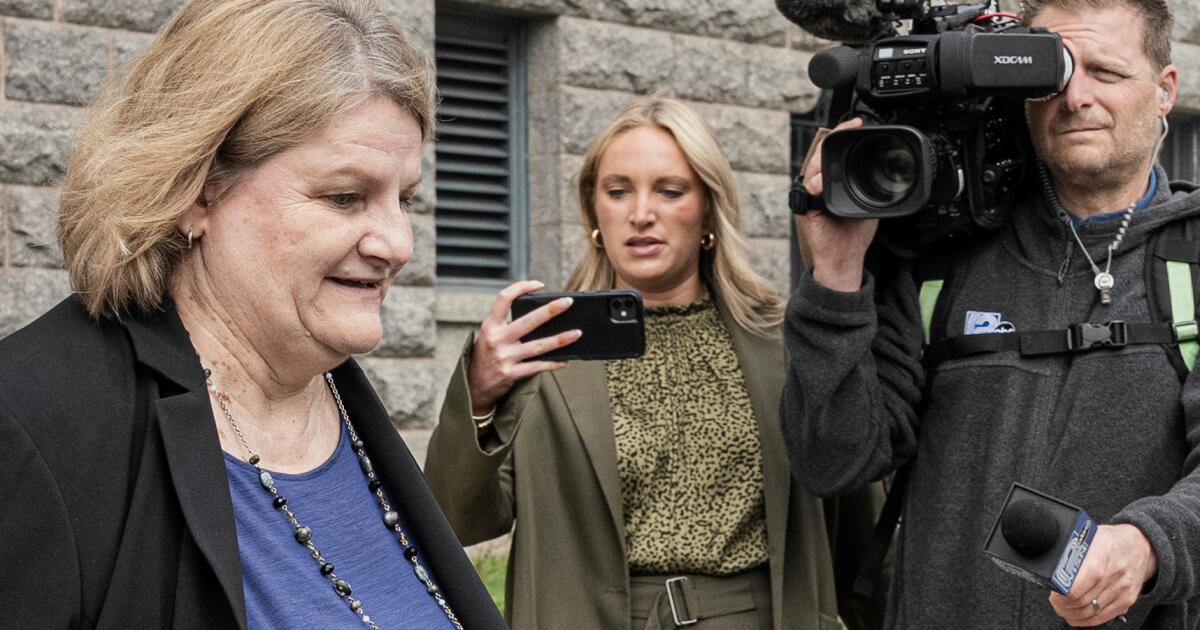
MILWAUKEE — Former Wisconsin Judge Hannah Dugan was spared from prison Wednesday for ushering a Mexican defendant out of her courtroom to evade U.S. Immigration and Customs Enforcement agents. A federal judge fined her $5,000 and cited her otherwise law-abiding life in issuing the sentence.
“I think this is a situation where an otherwise good person, upset by immigration policies in this country, made a bad decision in the moment,” U.S. District Judge Lynn Adelman said.
Dugan, 67, was convicted of felony obstruction in December. Her lawyers argued during her trial that President Trump’s administration sought to “crush” Dugan in an effort to ensure judicial compliance with the ICE strategy of targeting immigrants as they showed up for court hearings.
Dugan resigned the Milwaukee County circuit judgeship she had held for nine years in January amid threats of impeachment from Republican state lawmakers who labeled her an activist judge. In her resignation letter, she said her prosecution threatened “the independence of our judiciary.” Republican U.S. Rep. Tom Tiffany, a fierce Trump loyalist running for Wisconsin governor, urged authorities to “lock her up” in a social media post following her conviction.
Two Marquette University law professors spoke on her behalf, including a former state Supreme Court justice and a Jesuit priest who read a statement describing Dugan as a defender of oppressed people and saying he didn’t believe there was a need for punishment. “Hannah models what it means to be a Christian,” Gregory O’Meara said.
Dugan says she was just trying to do her job
Dugan then rose to address the court, saying she’s tried to do her best as a judge, and that her actions that day in April 2025 were not done maliciously but rather to maintain the “decorum and safety of the courtroom.”
“I have been cast as both a scofflaw and a hero. I am neither. I am a public servant who’s just trying to do my job,” Dugan said, adding that she has had to retire from public life due to threats against her and her family.
A prosecutor then acknowledged that “she has experienced collateral damage because of her conduct,” but said “judges can’t choose to disregard the law.”
Adelman then spoke, saying he doesn’t believe prison is necessary. He noted that Dugan lost her job, now has a felony conviction and experienced threats that forced her to move and stop attending community events.
“This is a few minutes of conduct for someone who has dedicated her life to public service,” the judge said. “It’s a marked deviation from an otherwise law-abiding life.”
He also noted that Dugan’s actions didn’t stop the ICE agents from arresting the defendant outside the courthouse.
Prosecutors pushed for a ‘serious sentence’
While jurors found her guilty of felony obstruction, they acquitted her of concealing an individual to prevent arrest, a misdemeanor.
Prosecutors argued in a sentencing memo filed last week that Dugan violated her oath as a judge and put both law enforcement and the public at risk.
“Judges are entrusted with tremendous discretion, but there is a line they cannot cross,” Executive Assistant U.S. Attorney Richard Frohling wrote. “The defendant crossed that line.”
Dugan’s attorneys argued she has been “punished enough,” including resigning as a judge and facing threats of violence. They argued in her sentencing memo that she should not be sentenced to any jail time besides the part of one day she already spent in federal custody.
Under federal sentencing guidelines, the presentence report calls for 15 to 21 months behind bars. The judge is not bound by those guidelines.
Prosecutors said the average sentence for obstruction cases is 16 months, but they did not recommend a sentence.
“This was a serious offense, and it warrants a correspondingly serious sentence,” Frohling wrote.
Attorney Jason Luczak said after the sentencing that they would still appeal Dugan’s conviction.
Dugan’s case was a first for Wisconsin
Dugan’s case marked the first time that a state judge in Wisconsin went to trial on charges of obstructing immigration agents.
On April 18, 2025, immigration officers went to the Milwaukee County courthouse after learning Eduardo Flores-Ruiz, 31, had reentered the country illegally and was scheduled to appear before Dugan for a hearing in a state battery case.
Dugan confronted agents outside her courtroom and directed them to the chief judge’s office, saying their administrative warrant wasn’t sufficient to arrest Flores-Ruiz.
After the agents left, she led Flores-Ruiz and his attorney out a private jury door. Agents spotted Flores-Ruiz in the corridor, followed him outside and arrested him after a foot chase. A week later, FBI agents arrested Dugan in the courthouse, leading her outside in handcuffs.
Flores-Ruiz was deported in November.
Savage and Bauer write for the Associated Press. Bauer reported from Madison, Wisc. AP contributors include Hannah Fingerhut in Des Moines, Iowa.
An upstate New York resident sued U.S. Immigration and Customs Enforcement for sending federal officers to his house with a warning over an email he sent to the agency’s one-time head.
David Streever, who is a U.S. citizen, was on a trip to Finland when two officers showed up to his Rochester home in June and presented his wife with a warning notice informing him that the email he sent months earlier was considered a threat, his attorneys said. Streever sent the email in January to Todd Lyons, then the acting director of ICE, after an immigration officer fatally shot Minneapolis resident Renee Good during an anti-ICE demonstration.
Streever’s email called Lyons “a monstrous human being” who “will never know peace.” In a lawsuit filed Monday in Washington, he said the agency violated his 1st Amendment rights.
Streever is one of at least two residents of upstate New York who was served with a federal warning in June in the wake of criticizing ICE online. The Philadelphia-based Foundation for Individual Rights and Expression is representing Streever, and said it filed the lawsuit because Streever’s right to free expression was violated.
“This is very clearly within the protection of the 1st Amendment,” said Adam Steinbaugh, an attorney with the foundation. “It was in the context of political speech.”
Representatives for ICE previously declined to comment on the warning to Streever, citing an ongoing investigation, and the agency did not immediately comment Monday. The suit also names Homeland Security Secretary Markwayne Mullin, whose office also did not immediately comment.
“ICE investigates all credible threats towards its employees and officers, including threats to the ICE Director,” the agency said in a statement last week.
The entirety of the three-paragraph email, which carried the subject line “What’s next,” and referenced a leader in Nazi Germany:
“You are a monstrous human being and will go down in history as America’s Reinhard Heydrich, the butcher.
“The way you are protecting the obvious execution in Minnesota, even as we see the videos, will lead to your downfall. Even Trump will turn on you before the end, and you will be a sad, despised man who eats himself alive with shame at your own pathetic weakness.
“You will never know peace. You will seek to lose yourself, to escape the burden of knowing the truth about yourself. But wherever you go, you will find yourself. You will torment yourself until your last day on Earth.”
Federal agents also attempted to confront Streever at a hotel in New York City when he returned from Finland, but they were turned away by hotel staff, Steinbaugh said.
Federal officials went to Streever’s house the same week that officials visited Paigelynne Gonyea, a poll worker, at a voting location during New York’s primaries to confront her about a social media post.
Gonyea believes the warning stemmed from writing “I think today is a great day for Jonathan to be indicted,” in a post with a picture of Jonathan Ross, the ICE officer who shot and killed Good. She posted it in January, after Ross had already been identified by the news media.
Lauren Bis, a spokesperson for the U.S. Department of Homeland Security, shared an image of a different social media post from Gonyea in which she said Gonyea shared Ross’ address. Part of that post was redacted.
Bis said in a statement in June that Gonyea “committed a federal crime by posting the address of an ICE law enforcement officer online” and “if you doxx our officers, we will investigate you, and you will be brought to justice.”
A representative for the New York Attorney General’s Office has said the office is aware of the two residents’ contact with federal agents. The representative has said the office has been reviewing the interaction between Gonyea and federal agents that took place at the polls.
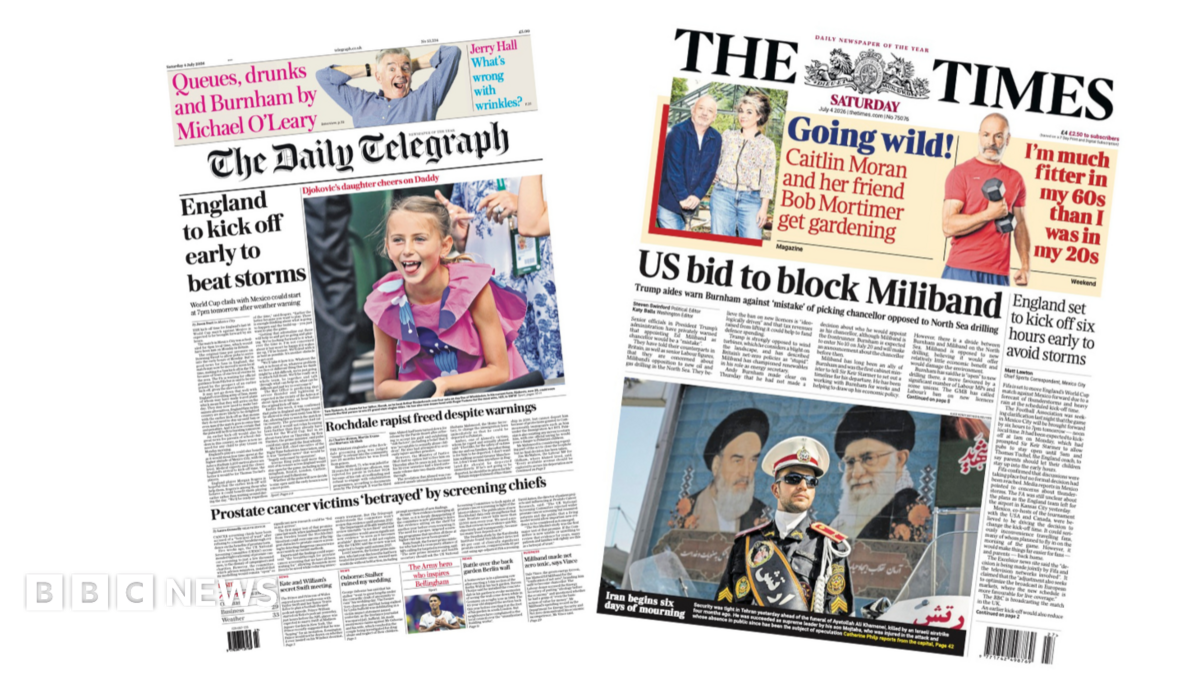
The Daily Mail says the family of the late Bobby Moore have launched a High Court “crusade” to get back the red football jersey he wore, external when he led England to their 1966 World Cup victory. According to the paper, his former wife, Tina Moore, has lodged a case against a businessman she believes either “has or has had possession of the shirt, or can help her recover it.” He denies having the garment.
The Guardian has a double-page spread on Taylor Swift’s wedding to Travis Kelce., external It notes the celebration “caused the closure of 11 streets” in Midtown New York – and says that on Friday the “first class lounges of Heathrow and JFK airports were crawling with celebrities” who were on their way to to the event.
The FT Weekend reports that two World War II foes have united, external, after a German defence company bought a firm that supplied gears for Spitfires. The paper says Huddersfield-based David Brown has been purchased by Renk, which created gearboxes for tanks in Nazi Germany.
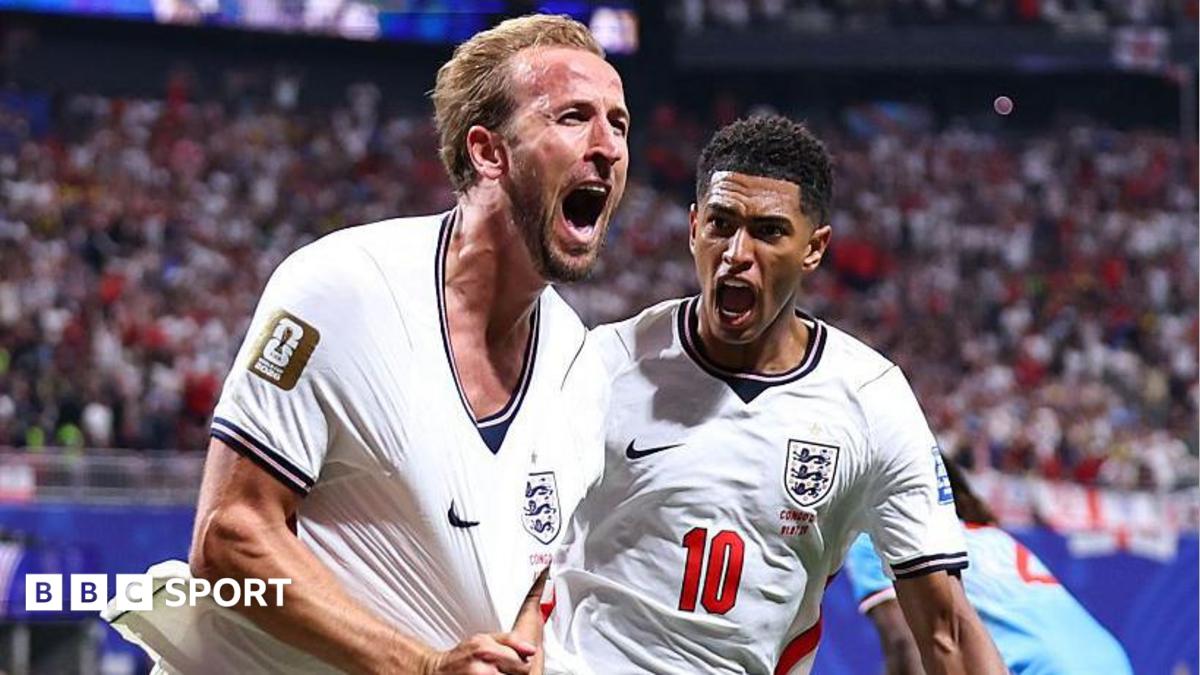
Asked at England’s training session on Friday about the possibility of the game being moved, winger Marcus Rashford said it was “not ideal” but the squad would deal with it.
“I think for us it’s the same how we prepare for the game,” he said. “It has to be the same.
“We have to be focused. We have to be ready for anything. I think it’s one of our strengths as a group.
“Everyone, including the players and staff… we are ready for whatever challenges get thrown at us. So obviously it’s not ideal but also it doesn’t really matter.”
The build-up to Sunday’s fixture has been dominated by talk about Mexico’s record at the Estadio Azteca and how England’s players will deal with the altitude.
The arena sits 7,220ft (2,240m) above sea level, and Mexico have lost just twice in 89 matches at the iconic stadium.
At that altitude, the Earth’s barometric pressure is lower, making the air thinner and meaning less oxygen is taken into the bloodstream with each breath.
Even for professional footballers, that has a potentially significant impact – increased heart rate, shortness of breath, dehydration, quicker and more intense fatigue.
The fixture had been set to start in the early evening, when temperatures were forecast to be about 20C.
However, a midday kick-off is expected to see temperatures hit highs of about 26C, which will theoretically make conditions even more difficult.
France’s group-stage fixture against Iraq was delayed for over two hours because of safety concerns amid adverse weather conditions in Philadelphia.
Last summer’s Club World Cup, which was also hosted by the United States, had six major weather delays across the 63 matches played.
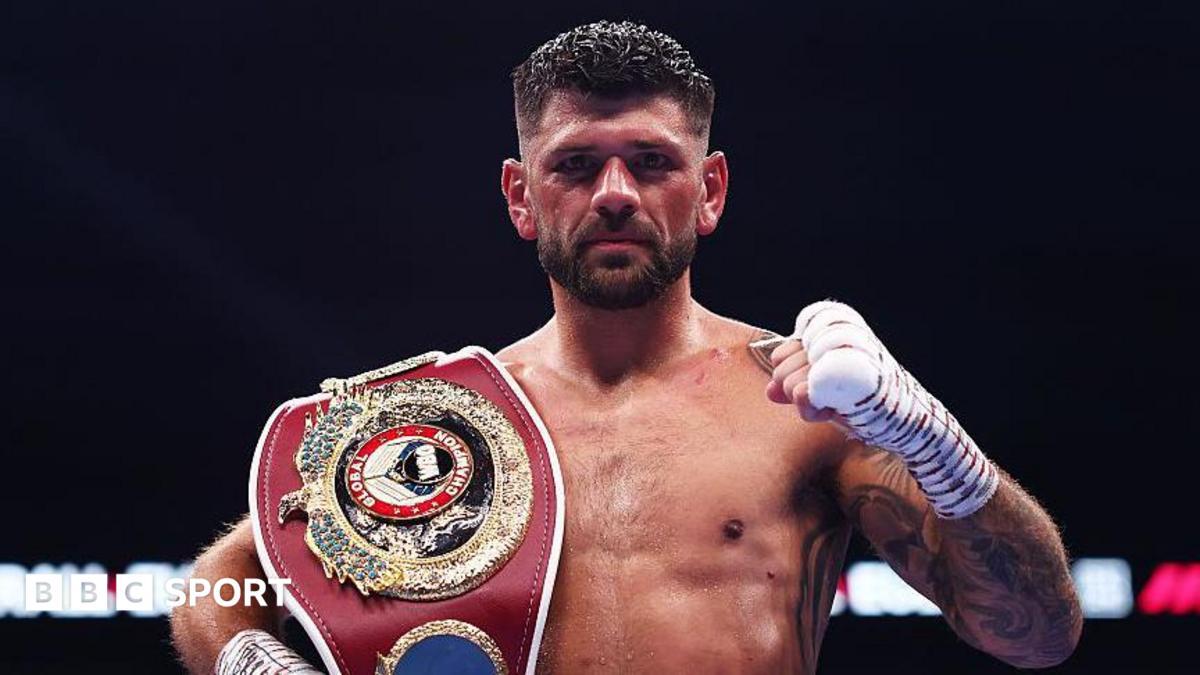
Joe Cordina faces a court appearance in July after being charged “with assault and threatening a person with an offensive weapon in a public place”.
The 34-year-old Welshman is a former super-featherweight world champion and had been due to fight for the WBO lightweight title in the United States on 4 July.
South Wales Police (SWP) has confirmed Cordina and another man have been charged in connection with an incident that took place outside a petrol station in the Cardiff suburb of Pentwyn last February.
SWP stated: “Joseph Cordina, 34, from Pontprennau, has been charged with assault and threatening a person with an offensive weapon in a public place. He is due to appear at Cardiff Magistrates’ Court on July 7.
“Jamie O’Brien, 32, from Pentwyn, has been charged with assault and is due to appear at Cardiff Magistrates’ Court on July 28.”
Cordina revealed in a social media post on Wednesday that he had been denied a US visa, saying: “I was due to fly to the United States this week. A couple of days back I went to the US embassy in London and they basically denied me a visa.
“I tried to explain certain things, and had all the paperwork to back it up, and they wasn’t having it.
“They just sort of basically told me you ain’t getting in.”
Weekly insights and analysis on the latest developments in military technology, strategy, and foreign policy.
A plan to attack the UFC America 250 event at the White House on June 14 with explosive drones was thwarted by the FBI, according to federal records. Exactly how capable those involved were of actually pulling it off remains unclear. However, the alleged plot amplifies concerns that TWZhas been documenting for years about threats posed by drones to critical facilities in the homeland and how they continue to change the national security picture at home and abroad.
The long-standing potential for a drone attack on the White House was something we recently discussed last month in an examination of President Donald Trump’s plans to fortify the under-construction ballroom. More on that later in this story.
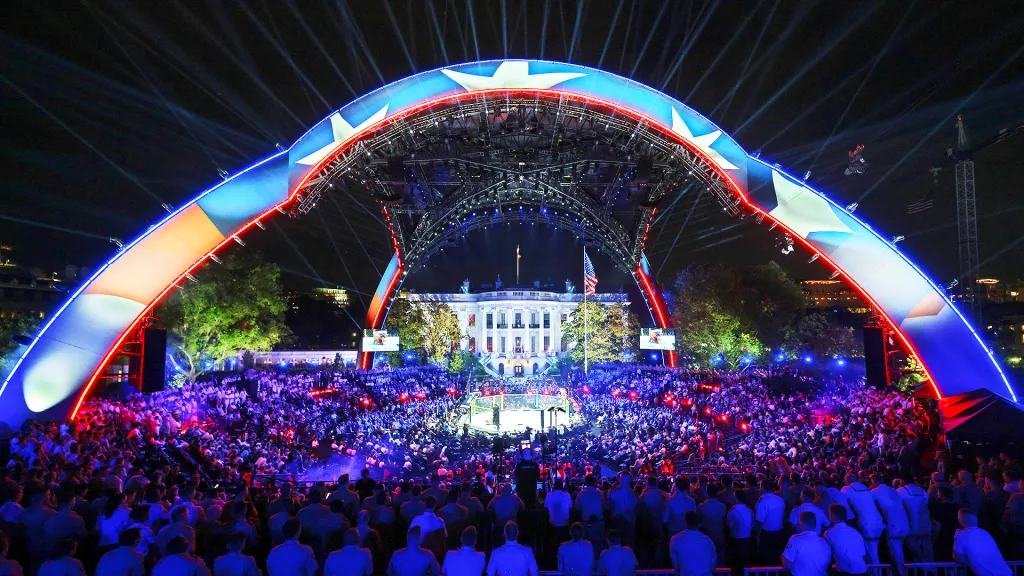
WASHINGTON, DC – JUNE 14: Guests, including members of the U.S. military, attend the Ultimate Fighting Championship (UFC) Freedom 250 mixed martial arts event under the open-air “Claw” on the South Lawn of the White House on June 14, 2026 in Washington, DC. On his 80th birthday, President Donald Trump hosted a series of seven mixed martial arts fights on the South Lawn, which the White House is calling “a once-in-a-generation celebration of the American fighting spirit.” (Photo by Chip Somodevilla/Getty Images) Chip Somodevilla
The plot involved a group of individuals who wanted to “attack the UFC event and involved staging a ‘demonstration’ on the north side of the White House,” CBS News reported, citing the court filings. “The group would then fly drones ‘laden with unspecified explosive devices which would detonate over the north side of the UFC arena,’” according to the filing in the case of one of the five people arrested, 19-year-old Tycen Proper.
When the drones exploded, “the group then planned to force attendees of the UFC event and ‘high value targets’ to evacuate to the south,” Proper’s affidavit read. The suspect told investigators that the plan was for group members to “act as snipers and additional shooters,” shooting fight attendees and the “high value targets” as they fled from the explosions.
The affidavit said the “high value targets” were “wealthy people” and politicians, CBS noted.
Proper allegedly told investigators the goal of the attack was to “jumpstart” a revolution in the U.S. He was interviewed from a hospital, according to the document, where he was admitted on an emergency basis due to “homicidal ideations.”
NEW: Tycen Proper, one of five suspects arrested in the White House UFC drone attack plot, allegedly wanted to target Sen. Marsha Blackburn because she received money from “the pro Israel lobby and supports them.”
In addition to Proper, Bryan Omar Roa, 24, of Calimesa, California; Michael Alan Thomas, 32, of Pinon Hills, California; Daniel K. Eskridge, 32, of Kidder, Missouri; and Abraham Hermosillo Alvarez, 31, of Omaha, Nebraska were also charged, according to the Justice Department.
BREAKING: Details via federal arrest affidavit reveal that a California man named Michael Alan Thomas was one of the alleged organizers of the alleged UFC White House terror plot. Feds say he admitted he believes the U.S. government is run by elites who sacrifice and eat… pic.twitter.com/L8i1bTR9Em
BREAKING: FBI, law enforcement partners disrupt alleged plot against UFC Freedom 250 event at White House; 5 in custody, officials say https://t.co/CEBKJA5zPt
TWZ cannot independently verify any of these details at this time and it remains publicly unclear what capabilities, training, funding and equipment the suspects had to actually carry out a complex attack like the one described. Proper’s mother said her son “began interacting with a group online that was comprised of individuals who claimed to be ex-military and Christian-based,” according to the court documents. They espoused anti-government and anti-Semitic sentiments.
At the very least, it would have taken unique skills and some level of discipline, coordination and operational security to pull off this kind of a plot. It would have also required funding and time. The FBI and other law enforcement agencies disrupt attack plans long before they get close to becoming operational, and many of those have a low chance they could actually been implemented as dreamed-up. That does not mean the individuals involved or their plans are not still a significant threat. In this case, there is no information available on whether anyone involved had the means and ability to stage an attack like the one described.
Guests, including members of the U.S. military, attend the Ultimate Fighting Championship (UFC) Freedom 250 mixed martial arts event under the open-air “Claw” on the South Lawn of the White House on June 14, 2026 in Washington, DC. (Photo by Chip Somodevilla/Getty Images) Chip Somodevilla
Regardless, it is important to note it would be a challenge to stop people simply from bringing weaponized uncrewed aircraft into range of the White House without law enforcement having prior knowledge. Actually employing those drones as weapons successfully is another story. Still, the danger of such an attack looms large and is growing by the day.
As we have frequently highlighted, two incidents last year highlight the alarming danger of near-field drone attacks that raised lingering concerns in the U.S.
The following video shows one of the Ukrainian drone attacks on Russian bombers during Operation Spider Web.
In both Russia and Iran, the drones were set up undetected deep in enemy territory during armed conflict against military targets. The plot on the White House, as characterized in the court documents, is of course different on many levels and was to be planned and executed by citizens, not sponsored by another nation at war with its neighbor. At the same time, both presents a host of challenges to defend against, many of which overlap.
Given the presence of the president, his family and thousands of VIP guests on the White House lawn at the time, as well as the event’s extremely high-profile nature, UFC Freedom 250 was “designated a Special Event Assessment Review 1 event, like the Super Bowl, Indianapolis 500, Kentucky Derby and college football games, according to the Department of Homeland Security,” ABC News reported last week.
Security was also tightened at the Ellipse outside the White House, where thousands more watched the event on large screens.
Security forces take security measures as preparations continue on the South Lawn of the White House ahead of the Ultimate Fighting Championship (UFC) Freedom 250 event, part of the America 250 celebrations, in Washington, D.C. (Photo by Mehmet Eser/Anadolu via Getty Images) Anadolu
The increased precautions included concern about drones, said Tara McLeese, special agent in charge of the Secret Service’s Washington Field Office.
Federal law prohibits flying drones in the airspace over the National Capital Region, so McLeese advised fans ahead of the event to “leave their drones at home.”
“We will have law enforcement drones for overwatch, but just to make it simple for the public, if they see a drone, we want them to report that,” she said, according to ABC.
The Secret Service declined to talk about its concerns over drone threats, instead pointing us to its post on X.
Protective intelligence cases are on the rise, and our teams work tirelessly behind the scenes to investigate threats, identify those responsible, and ensure accountability. Statement from Director Curran on the events of this past weekend: pic.twitter.com/Oca3QVLg9o
— U.S. Secret Service Office of Communications (@SecretSvcSpox) June 16, 2026
While we don’t know the extent of the counter-drone measures deployed by the FBI, Secret Service or even the military, they certainly included devices to detect and, if needed, jam the signals of threatening drones. However, as the war in Ukraine and Israel’s push into Lebanon have proven, the efficacy of these methods is far from assured. This is especially so since the introduction of drones controlled via fiber optic cables, which mitigate the effects of radio frequency passive detection and active jamming with a direct hardwired link between a drone and its operator.
First Person View (FPV) drone controlled via fibre optic cables have been widely used in Ukraine, Lebanon and elsewhere in the world to counter the effects of radio frequency jamming. (Photo by Mykhaylo Palinchak/SOPA Images/LightRocket via Getty Images) SOPA Images
Meanwhile, as we noted in our story about Trump using the ballroom he is building as a kind of defensive fortification, using traditional kinetic protection from drones and other aerial threats in and around the White House is limited and risky. The advent of interceptor drones, many that are hit-to-kill or use electromagnetic pulses and other low collateral damage means instead of explosive warheads, is starting to mitigate some of those concerns.
“Clearly, the drone issue is a massive one and has been for many years. This structure will serve as a secure place to do daily business if needed. Based on Trump’s comments, it will also act as a critical active defense node with its roof hosting air defenses, and apparently ones that are capable of at least a limited degree of area defense, not just highly-localized point defense. This is where drones could come into play. Drone interceptors (drones that intercept other drones) are well suited for the unique challenges of defending the White House and the Mall area as a whole, where collateral damage is a huge concern. Some of these systems use warheads, while others do not, physically smashing into their targets or blasting them with electrical pulses and other non-traditional effects instead. Drone interceptor capabilities are expanding rapidly now, equipping forward bases and warships. They proved critical in defending U.S. interests against Iranian attacks during the recent war. In Ukraine, they have proven indispensable in countering waves of Russian Shaheds.”
U.S. President Donald Trump speaks to the media alongside posters of his proposed White House ballroom amid construction at the White House on May 19, 2026 in Washington, DC. (Photo by Chip Somodevilla/Getty Images) Chip Somodevilla
Directed energy, such as lasers and high-power microwave weapons are another potential countermeasure, but these systems remain somewhat in their infancy and have very short range. Above all else, using them in dense urban areas, especially those with nearby low-flying air traffic, can be extremely problematic. They are not widely deployed for the counter drone role in the United States and won’t be in the near term.
It’s also worth remembering that the alleged plan did not necessarily rely on the accuracy of the drones or the damage they could inflict. The goal was to induce panic by their very presence and drive people into a field of fire to be attacked by snipers.
Even if counter-drone measures were able to provide a relatively robust protective bubble over UFC 250 at the White House, the plot as described in the documents further highlights the vulnerability large events have from even the lowliest of drone attack attempts.
The U.S. at the moment is protecting several facilities across the country with huge crowds during the World Cup soccer tournament at a time of heightened global tensions. Countering drone attacks was a central component of pre-event security measures as well as ongoing efforts.
Players and match officials walk into the pitch before the FIFA World Cup 2026 Group G match between IR Iran and New Zealand at Los Angeles Stadium on June 15, 2026 in Los Angeles, California. (Photo by Stu Forster/Getty Images) Stu Forster
This all comes as the U.S. is working to increase authorities to allow the military and law enforcement to better protect against drone threats.
Officials have already taken action against drone operators using these new authorities. Last week, FBI Los Angeles said it seized drones and issued citations to pilots near SoFi Stadium for alleged violations of temporary flight restrictions during last Friday’s World Cup match, The Los Angeles Times reported. The bureau “shared photos showing confiscated drones as well as an image of a drone operator being cited,” the newspaper noted. “However, it did not specify how many drones were taken or how many pilots were issued citations. It also did not provide details on the technology used to locate or track the drone operators.”
The bureau did not say if the operators of these drones had nefarious intent or whether they were armed, though neither of those are prerequisites for violating the no-drone-zone rules.
The FBI’s Counter Drone Enforcement Team has been busy around last night’s #WorldCup game and related events ensuring drone pilots aren’t violating @FAA Temporary Flight Restrictions. But some were, and as promised, they were cited and had their drones seized. Meanwhile,… pic.twitter.com/s0vy75E73E
While the actual ability of the alleged perpetrators to pull off the combined drone and sniper attack on the White House like what’s described remains unknown, the threats to the homeland from uncrewed aircraft are only growing by the day, as are nefarious actors’ experience and creativity with the technology.
Trump cancels planned Iran attacks, saying talks are close as Tehran reviews a proposed US deal.
Published On 12 Jun 202612 Jun 2026
United States President Donald Trump said he had cancelled a third straight night of planned attacks on Iran, saying talks with Tehran were close to producing a deal.
The announcement marked a dramatic turnaround. Just hours earlier, Trump warned that Iran would be hit “very hard” and threatened to target Kharg Island and other oil facilities.
Reporting from Tehran, Al Jazeera’s correspondent said a senior Iranian official confirmed that a proposed memorandum of understanding with the US was being considered by Iran’s top leadership.
Here is what has happened:
In Iran
Trump calls off planned Iran attacks: Hours after warning that Iran would be hit “very hard” and threatening attacks on Kharg Island and other oil facilities, Trump said he had cancelled the planned strikes, claiming negotiations had reached a breakthrough. In a Truth Social post, Trump said discussions had been elevated to Iran’s top leadership and that the “final points” of an agreement had been approved by all parties involved, including the US and several regional allies.
Tehran says the sacrifices of war were worth it: Reporting from Tehran, Al Jazeera’s Mohamed Vall said many Iranians would be relieved to see the conflict end after months of hardship and loss. But the government is also trying to sell a potential deal as a victory, telling people that “it is worth the suffering” because Iran could come out of the war “in much stronger shape”, with the possibility of sanctions being lifted and assets being unfrozen.
In the US
Expert says Trump used an ‘escalate to de-escalate’ strategy: Richard Weitz, an international security expert at the NATO Defense College, told Al Jazeera that Trump’s threats to intensify the conflict may have been aimed at forcing a diplomatic breakthrough. The strategy, he said, is to “threaten to escalate” a conflict “in order to force an end to it”. However, Weitz cautioned that “we still have a bit of uncertainty over what precisely was agreed and how it will be implemented.”
Trump has tried to hold Netanyahu back in recent weeks: Reporting from Washington, DC, Al Jazeera’s Kimberly Halkett said Donald Trump and Israeli Prime Minister Benjamin Netanyahu have long had “a shared desire to limit Iran’s nuclear programme” and ensure Tehran never obtains a nuclear weapon. But she said there was a “growing concern” within the White House that Netanyahu could “derail efforts in the diplomatic realm”, with Trump increasingly trying to restrain the Israeli leader and, in the US president’s words, “allow time for diplomacy”.
In Lebanon
Hezbollah says it carried out 24 attacks on Israeli forces: The Lebanese armed group said it launched a series of drone, missile and rocket attacks on Israeli soldiers, armoured vehicles and military positions across southern Lebanon and the Bekaa Valley between Wednesday and Thursday. Hezbollah said it repeatedly struck troop concentrations near Tayr Harfa, while also attacking Israeli forces in Naqoura, al-Qaouzah, Rashaf, Qantara, Zawtar al-Sharqiyah and Yohmor al-Shaqif.
Explosions hit Qeshm Island, ports along Strait of Hormuz after Trump threatens to hit Iran ‘very hard’.
Published On 10 Jun 202610 Jun 2026
The United States has launched fresh strikes against “multiple targets” in Iran at President Donald Trump’s direction, in a fresh escalation that prompted Tehran to declare the Strait of Hormuz closed to “all types of vessels”.
The US military said the strikes late on Wednesday were “in response to Iran’s unwarranted and continued aggression”, as Iranian state media reported explosions on Qeshm Island and in the cities of Bandar Abbas and Sirik along the Strait of Hormuz.
Recommended Stories
list of 4 itemsend of list
Blasts also hit the southern city of Kargan, wounding at least two people.
Iran’s Islamic Revolutionary Guard Corps accused the US of “repeated violations” of their April ceasefire, and said the Strait of Hormuz was “closed until further notice”.
It said all traffic in the vital waterway, including oil tankers and commercial vessels, would be affected, and firmly rejected the US’s previous claims that it had helped ships pass through the strait.
The IRGC subsequently added that “two oil tankers attempting to illegally pass through the strait were hit”.
The escalation comes a day after the US and Iran exchanged tit-for-tat strikes over the downing of a US Apache helicopter in the Strait of Hormuz.
Earlier, Trump said the US would hit Iran “very hard”.
“We’ll see what happens with the deal. We were really close to a deal. But they keep stringing us along. They keep playing us for suckers because you know what? They dealt with some very stupid presidents. I have to say that I’m embarrassed to say it,” he told reporters at the White House.
Iran’s President Masoud Pezeshkian slammed Trump’s threat in a post on X.
“Critical infrastructures are the lifeblood of the people. Threats to target them – from transportation networks to the electricity and water industries – are not a show of strength but a sign of desperation in the face of a nation’s will,” he wrote.
“Iran, relying on the knowledge and capabilities of its specialists, national unity, and solidarity, will stand firm against any pressure or threat,” he added.
Nearly 17 years after the King of Pop’s death, Michael Jackson is dominating the box office, television ratings and headlines.
“Michael,” the biopic about the star that hit theaters in April, has surpassed $900 million at box offices globally, according to Deadline, making it the second-highest-grossing film of 2026 behind “The Super Mario Galaxy Movie,” which hit $1 billion. Although “Bohemian Rhapsody” is still the highest-grossing musical biopic, “Michael” is a mere $11 million behind and will likely snag the title in coming weeks.
The film, which stars Jackson’s nephew Jaafar Jackson, follows the “Thriller” hitmaker from his early career leading the Jackson Five to reaching pinnacle star status in the late ’80s. The film’s timeline ends before 1993, when Jackson faced sexual abuse allegations brought by 13-year-old Jordan Chandler.
On Tuesday, “Michael” was released to streaming services, and fans at home can rent or buy on-demand from Amazon Prime Video and other platforms.
Also available for streaming is the Netflix docuseries “Michael Jackson: The Verdict,” which became available on June 3 and dominated the streamer’s charts with nearly 18 million views in its first week. The three-part series examines the pop star’s 2005 molestation trial, in which he was acquitted of all charges, and features key players from the trial, including jurors, eyewitnesses and prosecutors.
The lead prosecutor, Ron Zonen, spoke with TMZ on Tuesday and said that, although he wasn’t sure audiences would view the allegations with a different lens 20 years later, he wanted the documentary to be “as accurate as possible” and feature “the perspective of people who were involved in the trial.”
As far as the response from viewers, Zonen told the outlet that he’d received threats via email. “Well, there are people who are fans, who express their displeasure at the position that we took in this documentary, and express their displeasure very clearly to me,” he said, adding that he’s not bothered by the bad blood with mega-fans, and that the threats were more numerous at the time of the trial.
Department reports raise concerns about increased espionage activity amid US-Israeli war with Iran, ceasefire talks.
The Pentagon’s intelligence arm has raised the assessed threat level on Israeli spying from “high” to “critical” in recent weeks, according to US media.
NBC News first broke news of the change on Friday, with The New York Times issuing its own report the following day.
Recommended Stories
list of 3 itemsend of list
The news outlets cited anonymous sources as saying the switch came in light of concerns over increasingly aggressive tactics related to the US-Israeli war with Iran.
They said the Pentagon’s Defense Intelligence Agency (DIA) had raised the alert level amid fears that Israel is increasingly attempting to surveil top US officials. The aim is allegedly to understand internal White House deliberations about ending the war.
US President Donald Trump and Israeli Prime Minister Netanyahu have publicly diverged in their approach to the war, which the US and Israel started on February 28.
Trump, on one hand, has repeatedly said he wants to bring the war to a close, amid mounting political pressure at home.
Netanyahu, meanwhile, has called for war to resume, despite an April 8 ceasefire. The fighting has been mostly paused since the temporary truce was announced, but efforts to reach a lasting agreement have repeatedly stalled.
The New York Times reported that, while Israel has been known to spy on the US, the DIA cited an uptick in activities beginning in late 2024, as the administration of US President Joe Biden increased pressure on Israel over its genocidal war in Gaza.
That increase continued into 2025, as Trump returned to the presidency and began deliberating about how to approach Iran.
The newspaper added that other recent intelligence assessments have also documented evidence that there are Israeli efforts to monitor Trump’s special envoy Steve Witkoff as well as Elbridge Colby, a top policy official at the Pentagon, and his deputy Michael DiMino IV.
Witkoff had been the lead negotiator in nuclear talks that preceded the initial US-Israeli attack on Iran in February.
Both NBC News and The New York Times cited unnamed US officials in their reports. The US Department of Defense did not immediately respond to a request for comment from Al Jazeera.
However, an unnamed spokesperson told both news organisations that the reports were “false”.
Still, the reported concerns are likely to raise questions over the close intelligence and military coordination between Israel and the US.
Washington has, for years, provided billions in military aid and weapons sales to Israel, including throughout the genocide in Gaza.
The US Congress is also currently debating a section of a new defence bill, which would integrate the two countries’ research and development for weaponry to an unprecedented degree.
While the US and its allies are known to regularly conduct intelligence operations on each other, officials told both NBC and The New York Times that Israel’s recent vigour was unique.
The New York Times reported that the increased DIA designation surpasses all current allies, as well as a handful of countries with more fraught relations.
Recent incidents included Israel’s military intelligence trying to plant listening devices at the DIA headquarters in 2021, according to the newspaper.
In 2025, Israel’s domestic intelligence agency, Shin Bet, was found to have tried to plant a similar device in a Secret Service vehicle, the report said.
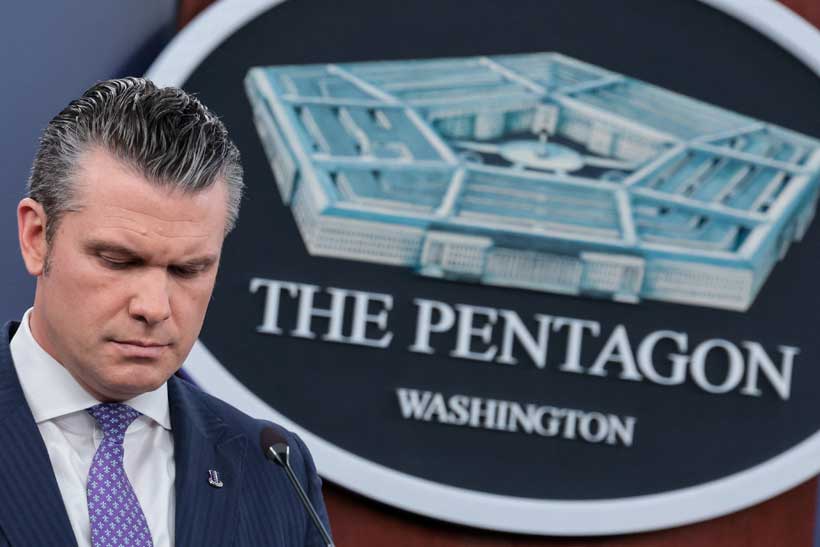
U. S. Defence Secretary Pete Hegseth called on Asian allies to increase military spending to counter China’s rising influence during his speech at the Shangri-La Dialogue in Singapore. He expressed concern over China’s military buildup and its potential to disrupt the regional balance of power. Hegseth emphasized the need for a robust network of allies that can deter aggression and maintain stability. The U. S. expects allies to raise defense spending to 3.5% of GDP, while the U. S. itself is investing $1.5 trillion in its military.
Hegseth addressed the need for action over discussions, suggesting that the region requires more military resources, such as ships and submarines, rather than just conferences. He underlined that partners want stability and that the U. S. must exhibit strength and disciplined leadership. He also noted improvements in U. S.-China relations, citing increased military communication to help manage tensions, while acknowledging that the relationship remains complicated.
Zhou Bo, a Chinese delegate, recognized a better tone in Hegseth’s remarks compared to the previous year, attributing this change to previous diplomatic engagements. He stated that both nations have communication channels open and that the situation might not be as severe as perceived. Hegseth reiterated President Trump’s call for allies to take more responsibility for their defense costs, proclaiming an end to U. S. defense subsidies for wealthy nations, emphasizing the need for allies to contribute actively.
Hegseth praised contributions from various allies and highlighted Japan’s efforts to enhance its defenses alongside the U. S. Regarding the Middle East, he stated the U. S. is prepared to resume strikes on Iran if diplomatic efforts fail and emphasized the ability to focus on both Asian and Middle Eastern interests simultaneously.
On the topic of arms sales to Taiwan, Hegseth avoided directly addressing concerns but affirmed that decisions about such sales are ultimately up to President Trump. The U. S. is reportedly considering a substantial arms package for Taiwan, which China views as its territory. Hegseth assured that there has been no change in U. S. policy towards Taiwan despite the ongoing dynamics in U. S.-China relations.